
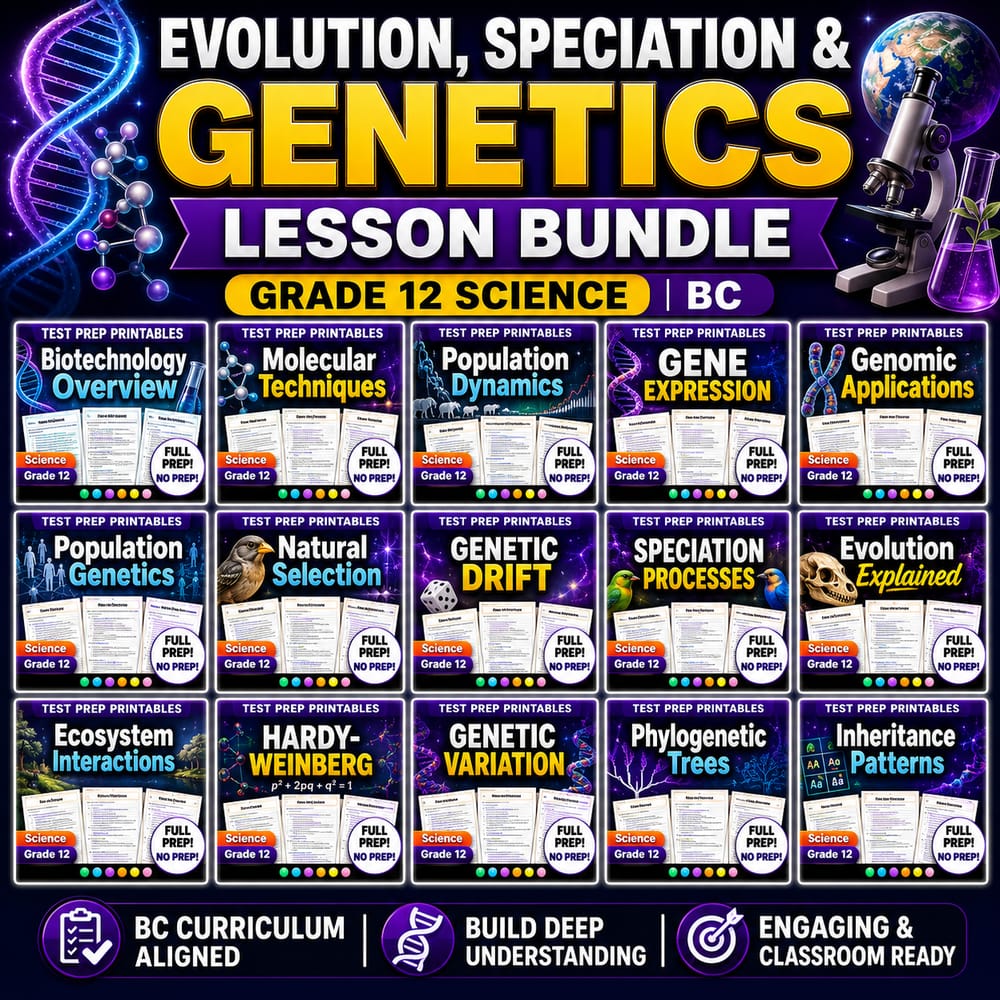


Evolution, Speciation & Genetics Lesson Bundle | Grade 12 Science | BC
$60.00$75.00Save $15.00
Prism Point Learning
·2 followers·13 sales
SubjectScienceGradeGrade 12
What’s included
15 worksheets · Save $15.00 (20%) · prices shown inside the bundle
 Biotechnology Overview Worksheet | Grade 12 Science Practice
- Explain how biotechnology techniques such as recombinant DNA, PCR, DNA sequencing, and genome editing work at a high level.
- Describe real-world applications of biotechnology in medicine, agriculture, and industry.
- Evaluate benefits and risks of biotechnological advances using ethical and environmental considerations.
$4.00$5.00 Molecular Techniques Worksheet | Grade 12 Science Practice
- Explain how PCR amplifies specific DNA fragments and why cycle temperatures matter.
- Describe how gel electrophoresis separates nucleic acids by size and how that supports interpretation.
- Compare roles of sequencing, plasmids/viral vectors, and CRISPR-Cas systems in biotechnology applications.
$4.00$5.00 Population Dynamics Worksheet | Grade 12 Science Activities
- Explain how birth rates, death rates, immigration, and emigration affect population size over time
- Differentiate exponential growth from logistic growth using carrying capacity and limiting resources
- Describe how biotic interactions (predation, competition, mutualism, parasitism) and abiotic factors shape community structure
$4.00$5.00 Gene Expression Worksheet | Grade 12 Science Activities
- Explain how transcription and translation convert genetic information into functional proteins.
- Describe how regulation at transcriptional and post-transcriptional levels affects protein production.
- Evaluate how epigenetic modifications and RNA processing can change gene expression and phenotype.
$4.00$5.00 Genomic Applications Worksheet | Grade 12 Science Activities
- Explain how population-scale sequencing and high-resolution genomic data support disease risk prediction and conservation genetics.
- Describe how personalized medicine uses genotype information and why consent and privacy matter.
- Evaluate potential benefits and risks of interventions such as gene drives, including biosafety and long-term ecological impacts.
$4.00$5.00 Population Genetics Worksheet | Grade 12 Science Activities
- Explain how allele frequencies change due to selection, mutation, migration (gene flow), and genetic drift.
- Use concepts of effective population size and inbreeding to predict genetic consequences in fragmented or small populations.
- Describe how metapopulation dynamics and extinction–recolonization affect evolutionary potential and conservation outcomes.
$4.00$5.00 Natural Selection Worksheet | Grade 12 Science Activities
- Explain how environmental pressures change allele frequencies through differential survival and reproduction
- Differentiate patterns of selection (directional, stabilizing, disruptive) and predict their outcomes
- Use examples such as antibiotic resistance to connect natural selection to observable evolutionary change
$4.00$5.00 Genetic Drift Worksheet | Grade 12 Science Practice and Assessment
- Explain how genetic drift causes random changes in allele frequencies, especially in small populations.
- Describe how bottleneck and founder events reduce genetic diversity and can increase inbreeding risk.
- Compare the effects of genetic drift and natural selection using effective population size.
$4.00$5.00 Speciation Processes Worksheet | Grade 12 Science Activities
- Explain how geographic isolation and ecological divergence can reduce or stop gene flow between populations.
- Describe how chromosomal changes and reproductive barriers can lead to speciation.
- Evaluate how hybridization and adaptive radiation can produce new lineages.
$4.00$5.00 Evolution Basics Worksheet | Grade 12 Science Activities
- Explain how variation, differential survival, and reproduction can change allele frequencies over generations
- Compare key evolutionary mechanisms (natural selection, genetic drift, gene flow, and mutation) and describe their effects
- Use multiple lines of evidence (fossil record, biogeography, comparative anatomy, and molecular similarity) to support the idea of evolution
$4.00$5.00
Reviews & Feedback
Loading reviews...
Questions & Answers
Loading questions…
About this bundle
Related categories
Frequently asked questions
Who is Evolution, Speciation & Genetics Lesson Bundle | Grade 12 Science | BC designed for?
Evolution, Speciation & Genetics Lesson Bundle | Grade 12 Science | BC is designed for Grade 12 students and Science learners and can be used in classrooms, homeschool, or independent practice.
How do I download Evolution, Speciation & Genetics Lesson Bundle | Grade 12 Science | BC?
Add it to your cart and complete checkout. After payment, you can download immediately from your account, and you'll also receive a download link by email.
Similar Products

Population Genetics & Evolution Lesson Bundle: Grade 12 Science TEKS
$40.00$50.00

Grade 12 Molecular Genetics & Evolution Lesson Bundle Daily Reading | Alberta
$48.00$60.00

Grade 10 Life Science Evolution, Genetics & Cells Lesson Bundle – Florida NGSSS
$64.00$80.00

Grade 12 Science Genetics & Evolution Worksheets Lesson Bundle
$19.20$24.00

Grade 11 Science Biology Cells, Genetics & Evolution Lesson Bundle | BC
$60.00$75.00