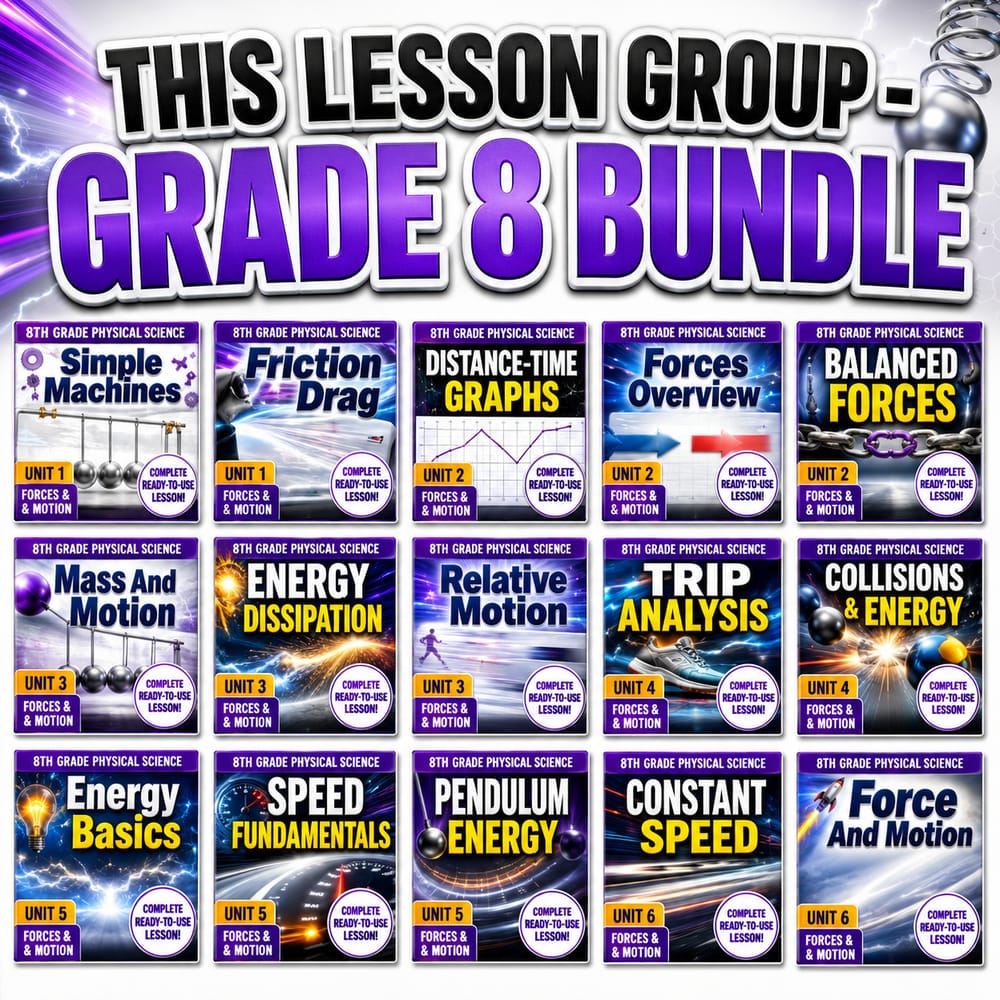
Forces, Motion & Energy Lesson Bundle | Grade 8 Science | BC — bundle cover
Forces, Motion & Energy Lesson Bundle | Grade 8 Science | BC — included worksheet 1
Forces, Motion & Energy Lesson Bundle | Grade 8 Science | BC — included worksheet 2
Forces, Motion & Energy Lesson Bundle | Grade 8 Science | BC — included worksheet 3
Forces, Motion & Energy Lesson Bundle | Grade 8 Science | BC — included worksheet 4
Forces, Motion & Energy Lesson Bundle | Grade 8 Science | BC — included worksheet 5
Forces, Motion & Energy Lesson Bundle | Grade 8 Science | BC — included worksheet 6
Forces, Motion & Energy Lesson Bundle | Grade 8 Science | BC — included worksheet 7
Forces, Motion & Energy Lesson Bundle | Grade 8 Science | BC — included worksheet 8
Forces, Motion & Energy Lesson Bundle | Grade 8 Science | BC — included worksheet 9
Forces, Motion & Energy Lesson Bundle | Grade 8 Science | BC — included worksheet 10
Forces, Motion & Energy Lesson Bundle | Grade 8 Science | BC — included worksheet 11
Forces, Motion & Energy Lesson Bundle | Grade 8 Science | BC — included worksheet 12
Forces, Motion & Energy Lesson Bundle | Grade 8 Science | BC — included worksheet 13
Forces, Motion & Energy Lesson Bundle | Grade 8 Science | BC — included worksheet 14
Forces, Motion & Energy Lesson Bundle | Grade 8 Science | BC — included worksheet 15
Grade 8 Science worksheet — Forces, Motion & Energy Lesson Bundle | Grade 8 Science | BC

Description

Overview


Forces, Motion & Energy brings Grade 8 Science in the BC framework to life with 15 ready-to-teach worksheet activities. This focused lesson bundle guides students from describing forces and motion to explaining energy changes, including how friction and collisions affect real systems.

Designed for a single unit cycle, these worksheets support clear modeling, evidence-based reasoning, and classroom discussion as students connect patterns in graphs, measurements of speed and distance, and energy transfers in everyday contexts.

What’s Included


  • ✅ Pendulum Energy Worksheet Pack | Grade 8 Science Activities – Students track how energy shifts between potential and kinetic forms as a pendulum swings.
  • ✅ Trip Analysis Worksheet | Grade 8 Science Activities – Students use measurements and representations to interpret a trip’s motion over time.
  • ✅ Speed Fundamentals Worksheet | Grade 8 Science Practice – Students practice calculating speed and connecting it to how far and how long.
  • ✅ Simple Machines Worksheet | Grade 8 Science Practice – Students analyze how simple machines can change force and motion in practical situations.
  • ✅ Relative Motion Worksheet | Grade 8 Science Activities – Students compare motion from different reference points and justify their reasoning.
  • ✅ Mass And Motion Worksheet | Grade 8 Science Practice – Students explore how mass influences acceleration and momentum-related outcomes.
  • ✅ Friction And Drag Worksheet | Grade 8 Science Activities – Students investigate how friction and drag change motion and energy dissipation.
  • ✅ Forces Overview Worksheet | Grade 8 Science Practice – Students identify forces, classify them, and connect force diagrams to motion changes.
  • ✅ Force And Motion Worksheet | Grade 8 Science Activities – Students connect net force to acceleration and use evidence to support claims.
  • ✅ Energy Dissipation Worksheet | Grade 8 Science Practice – Students explain how energy spreads out and becomes less useful for motion.
  • ✅ Energy Basics Worksheet | Grade 8 Science Practice Assessments – Students demonstrate understanding of energy forms, transfers, and conservation in context.
  • ✅ Distance-Time Graphs Worksheet | Grade 8 Science Practice – Students interpret distance-time graphs and infer speed from graph features.
  • ✅ Constant Speed Worksheet | Grade 8 Science Activities – Students analyze scenarios where speed stays the same and connect to graph patterns.
  • ✅ Collisions And Energy Worksheet | Grade 8 Science Activities – Students model collisions and examine how energy changes during impact.
  • ✅ Balanced Forces Worksheet | Grade 8 Science Practice – Students represent balanced forces and predict motion when acceleration is zero.

Skills & Standards


Within the BC framework, this unit supports disciplinary core ideas about forces, motion, and energy by emphasizing modeling, interpretation of data, and explanation based on evidence. Students build abilities to (1) analyze relationships among force, acceleration, and motion; (2) interpret and create graph-based representations such as distance-time graphs; and (3) reason about energy transfers and dissipation when systems interact.

Crosscutting concepts are reinforced through consistency of models (e.g., using force diagrams to justify claims), cause-and-effect relationships (e.g., how friction and drag alter motion), and energy behavior (e.g., identifying where energy goes during pendulum motion, collisions, and balanced/unbalanced force situations). Throughout the bundle, learners practice using scientific language to describe processes, support conclusions with given measurements or representations, and refine explanations using comparisons across scenarios.

Because each worksheet targets a specific part of the Forces, Motion & Energy storyline, students can connect everyday experiences—trips, moving objects, machines, and impacts—to the scientific representations used in class.

Perfect For


  • Teachers seeking structured instruction
  • Sub plans
  • Homework or review
  • Intervention or centers
  • Assessment preparation

How to Use


Plan for a typical 1–3 week unit pacing, selecting worksheets in an order that matches your instruction (start with forces and motion foundations, then graphs and motion relationships, and finish with energy dissipation and collisions). Use a consistent routine: assign one concept worksheet per day or rotate through stations.

  • Try a short warm-up using a quick scenario (balanced forces, constant speed, or a friction/drag example) and have students sketch a force or motion representation before working the questions.
  • For guided practice, model one worked example with the class (for instance, interpreting a distance-time graph) and then let students complete the next problems independently.
  • Use exit tickets after energy or collision worksheets to check whether students can explain the change using evidence from the worksheet scenario.

Closing


With Forces, Motion & Energy, students develop clear, evidence-based explanations that connect motion and energy to the systems they encounter in everyday life.

Forces, Motion & Energy Lesson Bundle | Grade 8 Science | BC

$60.00$75.00Save $15.00
Prism Point Learning
·2 followers·13 sales
SubjectScienceGradeGrade 8

What’s included

15 worksheets · Save $15.00 (20%) · prices shown inside the bundle

  1. Simple Machines Worksheet | Grade 8 Science Practice
    Simple Machines Worksheet | Grade 8 Science Practice

    Grade 8 · Science · 31 Pages

    • Explain how simple machines trade force magnitude for distance to accomplish work.
    • Describe how levers, pulleys, and gears change input and output forces and motion.
    • Connect efficiency and friction to energy transformation in real mechanical systems.
    $4.00$5.00
  2. Friction And Drag Worksheet | Grade 8 Science Activities
    Friction And Drag Worksheet | Grade 8 Science Activities

    Grade 8 · Science · 31 Pages

    • Explain how friction and fluid drag are resistive forces that oppose motion and affect acceleration.
    • Describe how normal force and surface type influence friction, and how speed, shape, and fluid properties influence drag.
    • Connect resistive forces to energy changes and to terminal speed when driving force balances drag.
    $4.00$5.00
  3. Distance-Time Graphs Worksheet | Grade 8 Science Practice
    Distance-Time Graphs Worksheet | Grade 8 Science Practice

    Grade 8 · Science · 32 Pages

    • Interpret a distance-time graph by using the slope to determine speed.
    • Use two points on a distance-time graph to calculate average speed over a time interval.
    • Analyze piecewise motion by comparing different segments to identify constant, increasing, or decreasing speed.
    $4.00$5.00
  4. Forces Overview Worksheet | Grade 8 Science Practice
    Forces Overview Worksheet | Grade 8 Science Practice

    Grade 8 · Science · 31 Pages

    • Explain what a force is and how forces can change an object's speed or direction
    • Describe how forces combine to produce a net force and how opposing forces can cancel
    • Use qualitative and proportional reasoning to predict changes in motion from different net forces
    $4.00$5.00
  5. Balanced Forces Worksheet | Grade 8 Science Practice
    Balanced Forces Worksheet | Grade 8 Science Practice

    Grade 8 · Science · 30 Pages

    • Explain how balanced forces lead to zero net force and no change in motion
    • Differentiate static equilibrium from dynamic equilibrium using real-life examples
    • Determine whether a situation shows balanced or unbalanced forces by considering opposing forces
    $4.00$5.00
  6. Mass And Motion Worksheet | Grade 8 Science Practice
    Mass And Motion Worksheet | Grade 8 Science Practice

    Grade 8 · Science

    • Explain how mass affects acceleration when the same net force is applied
    • Use qualitative proportional reasoning to describe the inverse relationship between mass and acceleration for a fixed net force
    • Interpret real-world comparisons (light skateboard vs. heavy cart) to predict motion changes
    $4.00$5.00
  7. Energy Dissipation Worksheet | Grade 8 Science Practice
    Energy Dissipation Worksheet | Grade 8 Science Practice

    Grade 8 · Science · 31 Pages

    • Explain how friction, inelastic deformation, and air resistance cause mechanical energy to dissipate into thermal energy.
    • Describe how efficiency measures the fraction of input energy that becomes useful output energy in mechanical systems.
    • Use everyday examples to identify where energy dissipation and efficiency losses occur.
    $4.00$5.00
  8. Relative Motion Worksheet | Grade 8 Science Activities
    Relative Motion Worksheet | Grade 8 Science Activities

    Grade 8 · Science · 32 Pages

    • Explain how a reference frame changes an observer’s measured speed for moving objects.
    • Use relative velocity ideas to predict when two objects meet or when one overtakes another.
    • Apply proportional relationships among distance, speed, and time within a chosen frame.
    $4.00$5.00
  9. Trip Analysis Worksheet | Grade 8 Science Activities
    Trip Analysis Worksheet | Grade 8 Science Activities

    Grade 8 · Science · 31 Pages

    • Calculate average speed for trips with multiple legs using total distance and total time.
    • Explain how slower segments affect overall average speed in nonuniform motion.
    • Use segmental thinking (distance-time pairs) to justify an average-speed result.
    $4.00$5.00
  10. Collisions And Energy Worksheet | Grade 8 Science Activities
    Collisions And Energy Worksheet | Grade 8 Science Activities

    Grade 8 · Science · 32 Pages

    • Explain how collisions transfer and transform energy between objects
    • Differentiate between elastic and inelastic collisions using energy outcomes
    • Use momentum and energy ideas together to predict what happens during collisions
    $4.00$5.00

Reviews & Feedback

Loading reviews...

Questions & Answers

Loading questions…

About this bundle

Related categories

Frequently asked questions

Who is Forces, Motion & Energy Lesson Bundle | Grade 8 Science | BC designed for?
Forces, Motion & Energy Lesson Bundle | Grade 8 Science | BC is designed for Grade 8 students and Science learners and can be used in classrooms, homeschool, or independent practice.
How do I download Forces, Motion & Energy Lesson Bundle | Grade 8 Science | BC?
Add it to your cart and complete checkout. After payment, you can download immediately from your account, and you'll also receive a download link by email.