
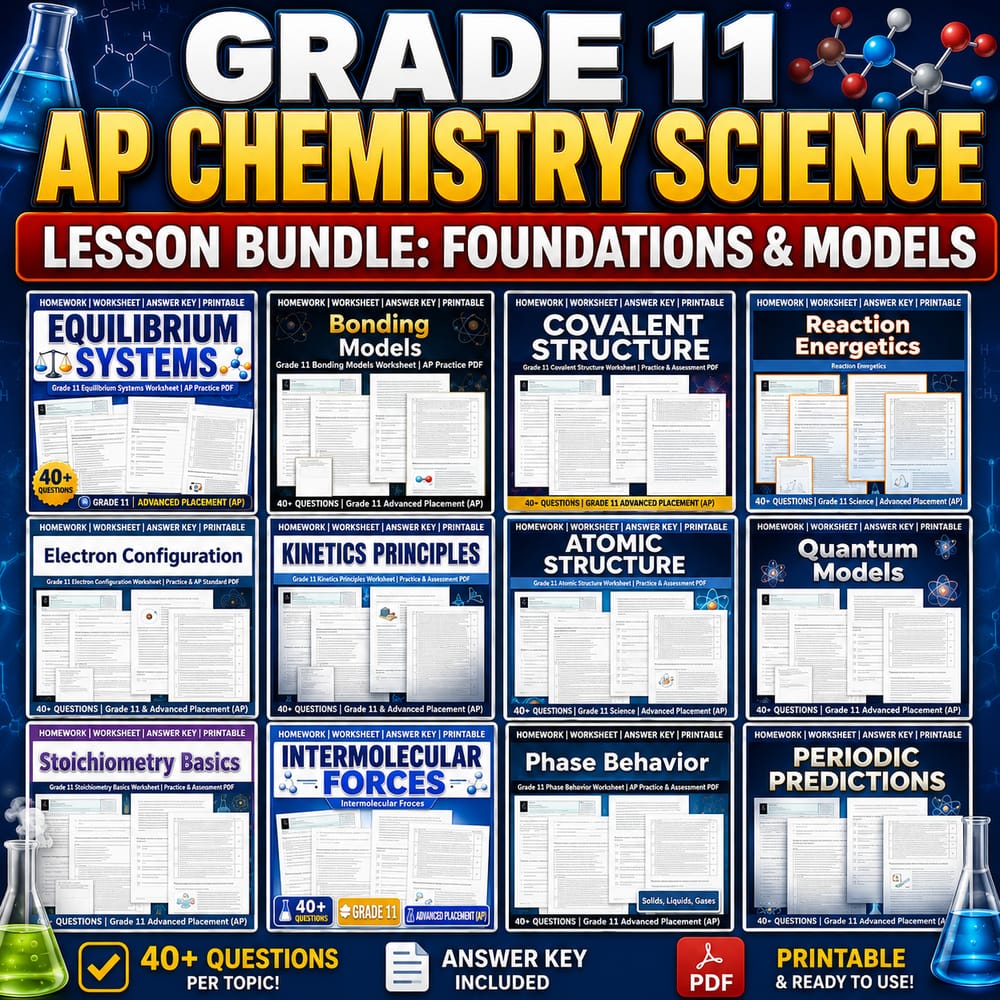


Grade 11 AP Chemistry Science Lesson Bundle: Foundations & Models
$48.00$60.00Save $12.00
Clear Sky Classroom
·1 followers·19 sales
SubjectScienceGradeGrade 11
What’s included
12 worksheets · Save $12.00 (20%) · prices shown inside the bundle
 Grade 11 Equilibrium Systems Worksheet | AP Practice PDF
- Explain and apply equilibrium constants (Kc and Kp) to homogeneous and heterogeneous systems
- Use reaction quotient Q to predict the direction of shift using Le Châtelier’s principle
- Calculate equilibrium compositions using stoichiometry and ICE tables while checking that Q equals K
$4.00$5.00 Grade 11 Bonding Models Worksheet | AP Practice & Assessment PDF
- Differentiate ionic, covalent, and metallic bonding using potential-energy concepts and electron behavior
- Use electronegativity differences and formal charge ideas to justify bonding model predictions
- Predict how bonding models relate to macroscopic properties such as conductivity and melting point
$4.00$5.00 Grade 11 Covalent Structure Worksheet | Practice & Assessment PDF
- Explain how molecular geometry and bond angles can be predicted using VSEPR and hybridization
- Relate orbital overlap and hybridization to bond types (sigma vs pi) and bond strength
- Use resonance to interpret bond order, bond lengths, and spectroscopic observations
$4.00$5.00 Grade 11 Reaction Energetics Worksheet | Practice & Assessment PDF
- Explain how enthalpy changes relate to reaction heat and how calorimetry measurements connect to q = m c ΔT
- Use Hess’s law, bond enthalpies, and formation energies to calculate overall reaction enthalpy
- Interpret energy diagrams to distinguish endothermic and exothermic processes and predict qualitative spontaneity using entropy ideas
$4.00$5.00 Grade 11 Electron Configuration Worksheet | Practice & AP Standard PDF
- Apply Aufbau, Pauli exclusion, and Hund’s rules to determine electron configurations and orbital filling order.
- Connect electron configurations and valence electrons to expected bonding patterns and common oxidation states.
- Interpret how orbital shapes and nodal structure relate to subshell energy and probability distribution.
$4.00$5.00 Grade 11 Kinetics Principles Worksheet | Practice & Assessment PDF
- Explain how rate laws and reaction order relate to experimentally observed changes in concentration over time.
- Use concentration–time and initial-rate information to interpret or derive integrated rate expressions.
- Connect collision theory and transition-state ideas to temperature dependence, activation energy, and Arrhenius behavior.
$4.00$5.00 Grade 11 Atomic Structure Worksheet | Practice & Assessment PDF
- Explain the roles of protons, neutrons, and electrons in determining atomic identity and charge
- Use emission spectra and mass spectrometry evidence to support quantized electron energy levels and isotopic variation
- Calculate atomic mass from isotopic abundances and interpret ions formed by electron changes
$4.00$5.00 Grade 11 Quantum Models Worksheet | Practice & Assessment PDF
- Explain how quantum theory accounts for wave–particle duality and energy quantization in atoms.
- Describe how orbitals (including nodal patterns and hybridization ideas) relate to chemical bonding tendencies.
- Interpret atomic spectral evidence (photoelectron and absorption spectra) to support claims about ionization energies and electron affinities.
$4.00$5.00 Grade 11 Stoichiometry Basics Worksheet | Practice & Assessment PDF
- Explain how moles, molar mass, and balanced chemical equations connect to quantitative composition and conservation of mass.
- Convert between mass, moles, and molecules using dimensional analysis and mole relationships.
- Use limiting reagent reasoning to determine the amount of product formed and interpret percent yield.
$4.00$5.00 Grade 11 Intermolecular Forces Worksheet | Practice & Assessment PDF
- Characterize dispersion, dipole–dipole, and hydrogen bonding interactions and explain how they affect boiling point, vapor pressure, and solubility.
- Use molecular polarity and intermolecular (surface) interactions to predict phase behavior and macroscopic trends.
- Interpret potential-energy curves and comparative property tables to justify how intermolecular forces influence cohesive versus adhesive tendencies.
$4.00$5.00
Reviews & Feedback
Loading reviews...
Questions & Answers
Loading questions…
About this bundle
Related categories
Frequently asked questions
Who is Grade 11 AP Chemistry Science Lesson Bundle: Foundations & Models designed for?
Grade 11 AP Chemistry Science Lesson Bundle: Foundations & Models is designed for Grade 11 students and Science learners and can be used in classrooms, homeschool, or independent practice.
How do I download Grade 11 AP Chemistry Science Lesson Bundle: Foundations & Models?
Add it to your cart and complete checkout. After payment, you can download immediately from your account, and you'll also receive a download link by email.
Similar Products

AP Chemistry Foundations Lesson Bundle | Grade 11 Science | AP Framework
$68.00$85.00

Chemistry Foundations Lesson Bundle | Grade 12 Science AP
$48.00$60.00

Grade 10 Science Chemistry Foundations Lesson Bundle for AP Curriculum
$31.20$39.00

Grade 12 Chemistry Foundations Science Lesson Bundle for Advanced Placement (AP)
$41.60$52.00

Grade 12 Chemistry Foundations Lesson Bundle – AP Science Activities
$28.80$36.00