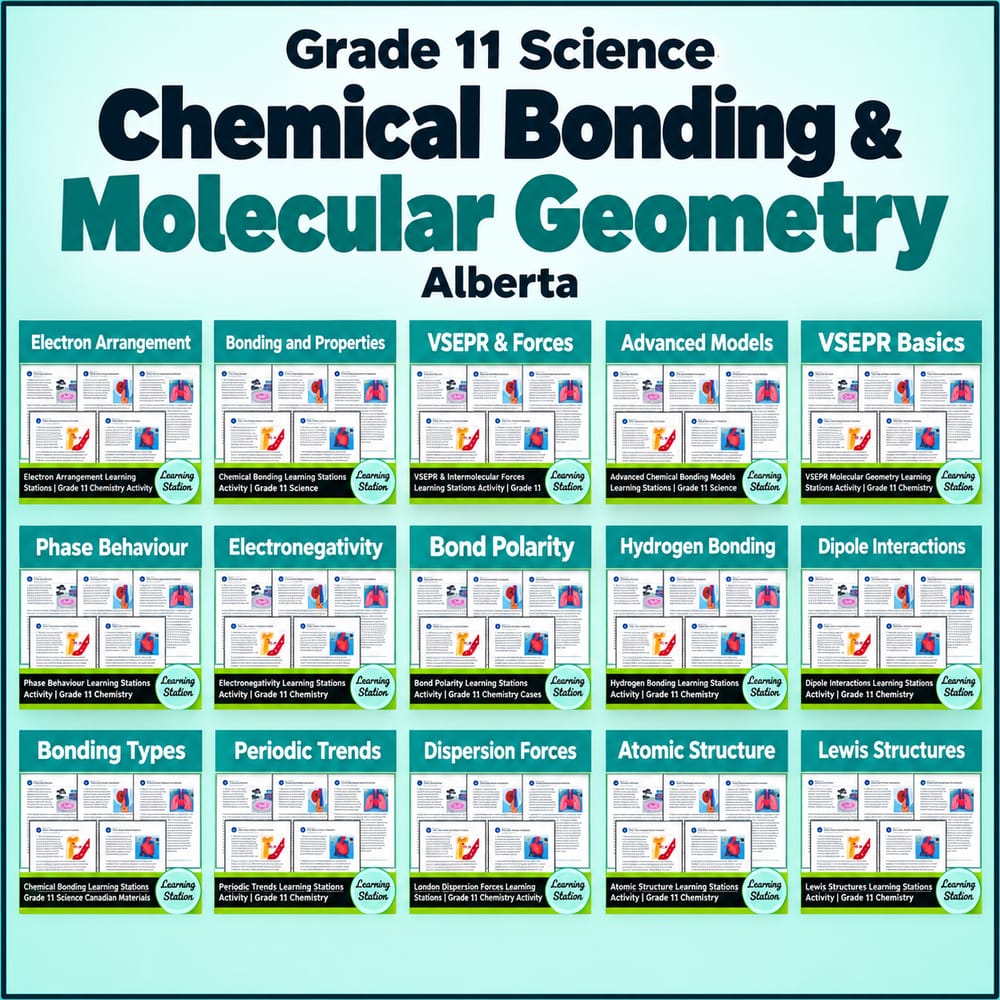
Grade 11 Science Chemical Bonding & Molecular Geometry Stations Bundle — bundle cover
Grade 11 Science Chemical Bonding & Molecular Geometry Stations Bundle — included worksheet 1
Grade 11 Science Chemical Bonding & Molecular Geometry Stations Bundle — included worksheet 2
Grade 11 Science Chemical Bonding & Molecular Geometry Stations Bundle — included worksheet 3
Grade 11 Science Chemical Bonding & Molecular Geometry Stations Bundle — included worksheet 4
Grade 11 Science Chemical Bonding & Molecular Geometry Stations Bundle — included worksheet 5
Grade 11 Science Chemical Bonding & Molecular Geometry Stations Bundle — included worksheet 6
Grade 11 Science Chemical Bonding & Molecular Geometry Stations Bundle — included worksheet 7
Grade 11 Science Chemical Bonding & Molecular Geometry Stations Bundle — included worksheet 8
Grade 11 Science Chemical Bonding & Molecular Geometry Stations Bundle — included worksheet 9
Grade 11 Science Chemical Bonding & Molecular Geometry Stations Bundle — included worksheet 10
Grade 11 Science Chemical Bonding & Molecular Geometry Stations Bundle — included worksheet 11
Grade 11 Science Chemical Bonding & Molecular Geometry Stations Bundle — included worksheet 12
Grade 11 Science Chemical Bonding & Molecular Geometry Stations Bundle — included worksheet 13
Grade 11 Science Chemical Bonding & Molecular Geometry Stations Bundle — included worksheet 14
Grade 11 Science Chemical Bonding & Molecular Geometry Stations Bundle — included worksheet 15
Grade 11 Science worksheet — Grade 11 Science Chemical Bonding & Molecular Geometry Stations Bundle

Description

Bring together 75 learning stations across 15 Grade 11 Science resources covering chemical bonding, molecular geometry, atomic structure, and intermolecular forces. Designed around the Matter and Chemical Bonding unit in Alberta, this chemical bonding learning stations bundle gives teachers five stations per resource, making it easier to select practice for the topic being taught rather than searching for separate activities.

🧪 What's Included

The 15 resources are grouped around connected chemistry ideas, from the arrangement of electrons to the forces that influence the behaviour of substances.

Atomic Structure and Periodic Properties
• Atomic structure: Explore the structure of atoms as a starting point for chemical bonding.
• Electron arrangement: Focus on how electrons are arranged in atoms.
• Periodic trends: Examine patterns in elemental properties across the periodic table.
• Electronegativity: Explore differences in how atoms attract bonding electrons.

Chemical Bonding and Molecular Structure
• Chemical bonding fundamentals: Two separate five-station resources, including one focused on Canadian materials and another covering chemical bonding more generally.
• Lewis structures: Practise representing bonding and electron arrangements in molecules.
• Bond polarity: Examine how electronegativity differences relate to polar bonds through chemistry cases.
• VSEPR molecular geometry: Explore how electron arrangements influence molecular shapes.
• Advanced bonding models: Extend the study of chemical bonding beyond introductory representations.

Intermolecular Forces and Physical Behaviour
• London dispersion forces: Focus on attractions associated with temporary electron distributions.
• Dipole interactions: Examine attractions between polar molecules.
• Hydrogen bonding: Study this particular type of intermolecular attraction.
• VSEPR and intermolecular forces: Connect molecular geometry with the forces between molecules.
• Phase behaviour: Explore how substances behave in different physical phases.

📚 Topics Covered

• Atomic structure and electron arrangement
• Periodic trends and electronegativity
• Chemical bonding and Lewis structures
• Bond polarity and molecular shape
• VSEPR theory and advanced bonding models
• London dispersion forces, dipole interactions, and hydrogen bonding
• Intermolecular forces and phase behaviour

🏫 How Teachers Can Use It

Use the chemical bonding learning stations during a Grade 11 chemistry unit as students move from atomic structure into molecular geometry. The five-station format also works well for small-group rotations, particularly when a class needs to revisit one concept before moving on.

For revision, pull out the Lewis structures, bond polarity, or intermolecular forces activities to target areas that need more attention. The separate VSEPR resources are useful when moving from identifying molecular shapes to considering how those shapes relate to intermolecular attractions.

💰 Bundle Savings

The complete set costs $48, compared with $60 when purchased separately. That saves $12 (20%) and gives you 15 resources containing 75 stations altogether.

Keeping these chemical bonding learning stations together means you can find practice for a particular part of the Matter and Chemical Bonding unit without tracking down individual resources each time.

Grade 11 Science Chemical Bonding & Molecular Geometry Stations Bundle

$48.00$60.00Save $12.00
MTS Academic Studio
New·0 followers·0 sales
SubjectScienceGradeGrade 11Pages169 Pages
Learning Objectives
Identify atomic structures and describe electron arrangements in atoms.
Explain periodic trends and compare electronegativity between elements.
Represent chemical bonding using Lewis structures and bonding models.

What’s included

15 worksheets · 169 pages · Save $12.00 (20%) · prices shown inside the bundle

  1. Electron Arrangement Learning Stations | Grade 11 Chemistry Activity
    Electron Arrangement Learning Stations | Grade 11 Chemistry Activity

    Grade 11 · Science · 11 Pages

    • Explain molecular polarity using valence-electron arrangement and shape
    • Compare polar and nonpolar molecules using structural evidence
    • Relate molecular polarity to intermolecular attractions
    $3.20$4.00
  2. Chemical Bonding Learning Stations Activity | Grade 11 Science
    Chemical Bonding Learning Stations Activity | Grade 11 Science

    Grade 11 · Science · 12 Pages

    • Relate ionic, metallic, and covalent bonding to physical properties
    • Infer bonding structures from observable material-property evidence
    • Compare conductivity, hardness, melting behaviour, and solubility
    $3.20$4.00
  3. VSEPR & Intermolecular Forces Learning Stations Activity | Grade 11
    VSEPR & Intermolecular Forces Learning Stations Activity | Grade 11

    Grade 11 · Science · 11 Pages

    • Use VSEPR reasoning to interpret molecular geometry
    • Connect molecular geometry with molecular polarity
    • Explain intermolecular forces from molecular structure
    $3.20$4.00
  4. Advanced Chemical Bonding Models Learning Stations | Grade 11 Science
    Advanced Chemical Bonding Models Learning Stations | Grade 11 Science

    Grade 11 · Science · 11 Pages

    • Explain bonding properties using molecular orbital models
    • Interpret conductivity using electronic band structure
    • Compare effects of orbital overlap and electron delocalization
    $3.20$4.00
  5. VSEPR Molecular Geometry Learning Stations Activity | Grade 11 Chemistry
    VSEPR Molecular Geometry Learning Stations Activity | Grade 11 Chemistry

    Grade 11 · Science · 12 Pages

    • Identify bonding regions and lone pairs around central atoms.
    • Predict molecular geometry using VSEPR electron-domain principles.
    • Compare five molecular arrangements using bond angles and symmetry.
    $3.20$4.00
  6. Phase Behaviour Learning Stations Activity | Grade 11 Chemistry
    Phase Behaviour Learning Stations Activity | Grade 11 Chemistry

    Grade 11 · Science · 11 Pages

    • Explain how intermolecular forces influence phase behaviour
    • Compare volatility and vapor pressure across real substances
    • Explain how temperature and pressure affect phase changes
    $3.20$4.00
  7. Electronegativity Learning Stations Activity | Grade 11 Chemistry
    Electronegativity Learning Stations Activity | Grade 11 Chemistry

    Grade 11 · Science · 12 Pages

    • Explain electron sharing using electronegativity differences
    • Compare unequal and nearly equal sharing of bonding electrons
    • Connect bond polarity and partial charges to chemical behavior
    $3.20$4.00
  8. Bond Polarity Learning Stations Activity | Grade 11 Chemistry Cases
    Bond Polarity Learning Stations Activity | Grade 11 Chemistry Cases

    Grade 11 · Science · 12 Pages

    • Explain how electronegativity differences create bond dipoles and partial charges
    • Interpret bond-dipole vectors using molecular shape
    • Distinguish polar bonds from polar molecules
    $3.20$4.00
  9. Hydrogen Bonding Learning Stations Activity | Grade 11 Chemistry
    Hydrogen Bonding Learning Stations Activity | Grade 11 Chemistry

    Grade 11 · Science · 11 Pages

    • Identify molecular features that allow hydrogen bonding to occur
    • Explain how hydrogen bonding influences boiling and density
    • Relate hydrogen bonding to molecular structure and material strength
    $3.20$4.00
  10. Dipole Interactions Learning Stations Activity | Grade 11 Chemistry
    Dipole Interactions Learning Stations Activity | Grade 11 Chemistry

    Grade 11 · Science · 11 Pages

    • Explain orientation-dependent attractions between permanent molecular dipoles
    • Relate molecular structure to dipole interaction strength
    • Explain temperature effects on boiling and condensation behaviour
    $3.20$4.00

Reviews & Feedback

Loading reviews...

Questions & Answers

Loading questions…

About this bundle

Related categories

Frequently asked questions

Who is Grade 11 Science Chemical Bonding & Molecular Geometry Stations Bundle designed for?
Grade 11 Science Chemical Bonding & Molecular Geometry Stations Bundle is designed for Grade 11 students and Science learners and can be used in classrooms, homeschool, or independent practice.
How do I download Grade 11 Science Chemical Bonding & Molecular Geometry Stations Bundle?
Add it to your cart and complete checkout. After payment, you can download immediately from your account, and you'll also receive a download link by email.