
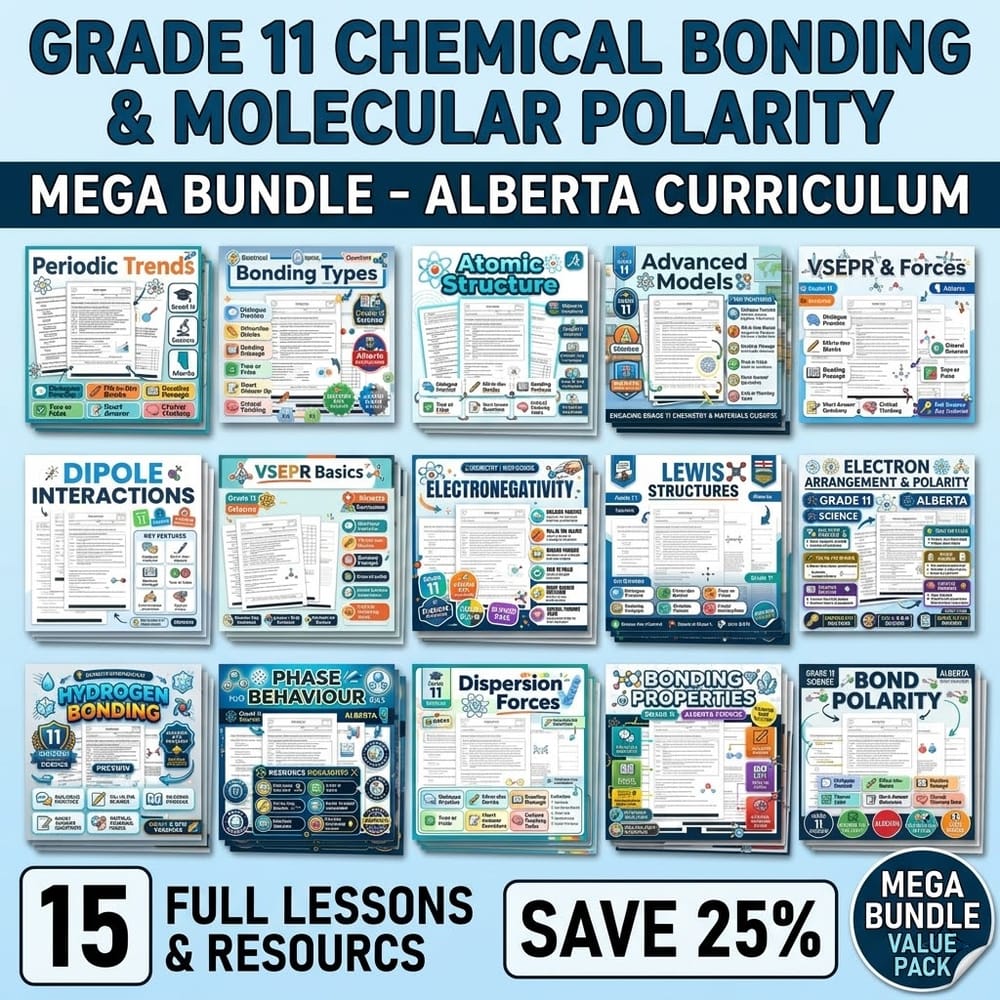


Grade 11 Chemical Bonding and Molecular Polarity Science Lesson Bundle – Alberta
$60.00$75.00Save $15.00
J.S Sheets
New·3 followers·24 sales
SubjectScienceGradeGrade 11
What’s included
15 worksheets · Save $15.00 (20%) · prices shown inside the bundle
 Periodic Trends Worksheet for Grade 11 Science | Standards-Aligned Practice
- Explain how atomic radius, ionization energy, and electronegativity vary across the periodic table.
- Describe how periodic trends influence element bonding and material properties.
- Connect periodic patterns to real-world examples such as corrosion and alloying in Alberta metallurgy.
$4.00$5.00 Bonding Types Worksheet for Grade 11 Science | Alberta Standards Practice
- Compare ionic, covalent, and metallic bonding based on electron transfer, sharing, and delocalization.
- Link each bonding type to characteristic structural motifs such as lattices, molecules, and electron seas.
- Relate bond types to Alberta phenomena like road salt, hydrocarbons in bitumen, and pipeline steels.
$4.00$5.00 Atomic Structure Worksheet | Standards-Aligned Science Practice Grade 11
- Describe the organization of protons, neutrons, and electrons within an atom.
- Explain how electron arrangements influence reactivity and bonding tendencies.
- Identify regional examples such as sodium and carbon to illustrate atomic behavior in industry and environment.
$4.00$5.00 Advanced Models Worksheet | Science Assessment for Grade 11 | Alberta
- Explain how molecular orbital theory and band theory extend bonding explanations beyond localized models.
- Identify how orbital overlap, band structure, and molecular symmetry influence spectroscopic features, reactivity, and electrical properties.
- Apply advanced bonding concepts to transition metal complexes and materials used in energy technologies.
$4.00$5.00 VSEPR & Forces Worksheet | Science Practice for Grade 11 Alberta Standards
- Understand how molecular shapes are predicted using VSEPR theory and how these shapes influence intermolecular forces.
- Explain the relationship between molecular geometry and dipole moments, hydrogen bonding, and physical properties such as boiling and melting points.
- Apply concepts to real-world examples, including water, ammonia, hydrocarbons, and regional phenomena like freeze-thaw patterns and petroleum volatility.
$4.00$5.00 Dipole Interactions Worksheet | Science Assessment for Grade 11 | Alberta
- Explain the concept of dipole–dipole interactions and how molecular polarity influences intermolecular forces.
- Describe how dipole interactions affect properties such as boiling point, solubility, and phase behavior.
- Analyze real-world examples of dipole interactions in industrial and atmospheric contexts.
$4.00$5.00 VSEPR Basics Worksheet for Grade 11 Science | Alberta Standards Practice
- Understand how electron pair repulsion influences molecular geometry in VSEPR theory.
- Identify common molecular shapes such as linear, trigonal planar, tetrahedral, trigonal bipyramidal, and octahedral.
- Explain the role of bonding and nonbonding electron pairs in determining bond angles and molecular symmetry.
$4.00$5.00 Electronegativity Worksheet | Science Assessment for Grade 11 Alberta
- Understand the concept of electronegativity and how it influences bond polarity.
- Identify trends in electronegativity across periods and groups in the periodic table.
- Explain how differences in electronegativity lead to polar and nonpolar covalent bonds.
$4.00$5.00 Lewis Structures Worksheet | Science Assessment for Grade 11 Alberta Standards
- Understand how to represent valence electrons, lone pairs, and bonding pairs in Lewis structures.
- Apply principles of formal charge minimization and resonance to draw accurate Lewis structures.
- Recognize exceptions to the octet rule in molecules relevant to Alberta chemistry such as CO2, SO2, and hydrocarbons.
$4.00$5.00 Electron Arrangement and Polarity Worksheet for Grade 11 Science
- Explain how valence electron distribution influences molecular polarity.
- Identify polar and nonpolar molecules based on electron arrangement.
- Connect electron density maps to observable polarity in molecules.
$4.00$5.00
Reviews & Feedback
Loading reviews...
Questions & Answers
Loading questions…
About this bundle
Related categories
Frequently asked questions
Who is Grade 11 Chemical Bonding and Molecular Polarity Science Lesson Bundle – Alberta designed for?
Grade 11 Chemical Bonding and Molecular Polarity Science Lesson Bundle – Alberta is designed for Grade 11 students and Science learners and can be used in classrooms, homeschool, or independent practice.
How do I download Grade 11 Chemical Bonding and Molecular Polarity Science Lesson Bundle – Alberta?
Add it to your cart and complete checkout. After payment, you can download immediately from your account, and you'll also receive a download link by email.
Similar Products

Grade 11 Chemistry Lesson Bundle — Bonding, Polarity & Orbitals (Alberta)
$36.00$45.00

VSEPR & Chemical Bonding Lesson Bundle | Grade 11 Science | Alberta
$60.00$75.00

Matter and Chemical Bonding Lesson Bundle – Grade 11 Science Alberta
$60.00$75.00

Grade 11 Science Chemical Bonding & Molecular Geometry Stations Bundle
$48.00$60.00

Grade 11 Science Matter and Chemical Bonding Lesson Bundle | Alberta
$36.00$45.00