
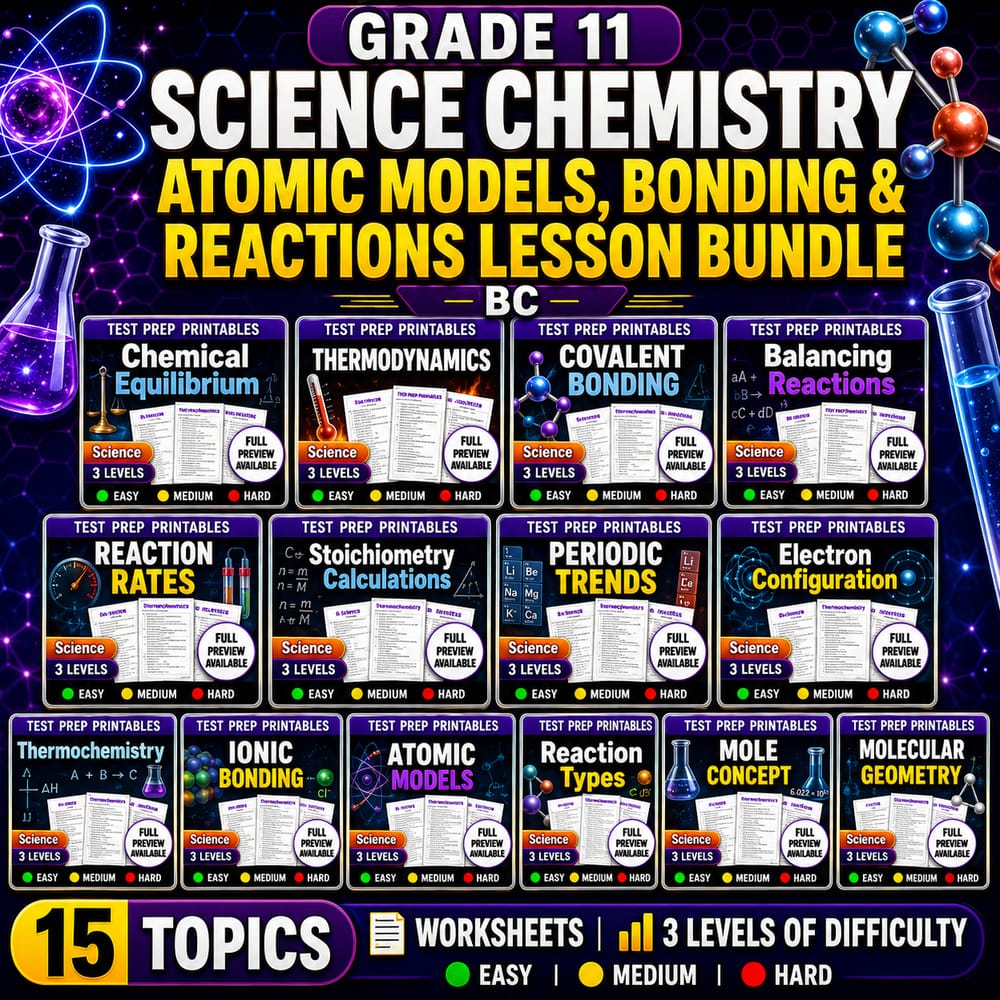


Grade 11 Science Chemistry Atomic Models, Bonding & Reactions Lesson Bundle | BC
$56.00$70.00Save $14.00
Prism Point Learning
·2 followers·13 sales
SubjectScienceGradeGrade 11
What’s included
15 worksheets · Save $14.00 (20%) · prices shown inside the bundle
 Chemical Equilibrium Worksheet | Grade 11 Science Practice
- Explain chemical equilibrium using the idea of equal forward and reverse reaction rates and constant macroscopic concentrations.
- Write and interpret equilibrium constant expressions and relate them to reactant/product amounts.
- Use Le Chatelier’s principle to predict qualitative shifts in equilibrium after concentration, temperature, or pressure changes.
$4.00$5.00 Hybridization Worksheet | Grade 11 Science Activities
- Explain how atomic orbitals mix to form hybrid orbitals and predict molecular shapes from hybridization.
- Match sp, sp2, and sp3 hybridization to common bond angles and electron/molecular geometries.
- Describe how hybrid orbitals form sigma (σ) bonds and how unhybridized p orbitals can form pi (π) bonds.
$4.00$5.00 Covalent Bonding Worksheet | Grade 11 Science Practice
- Explain covalent bonding in terms of shared electron pairs and filled valence shells.
- Describe how electronegativity differences create bond polarity and affect molecular dipoles.
- Use bond order, bond length, and bond energy to compare and predict molecular stability.
$4.00$5.00 Balancing Reactions Worksheet | Grade 11 Science Activities
- Explain how balancing a chemical equation enforces conservation of mass and conservation of atoms.
- Use stoichiometric coefficients to determine mole ratios for reactants and products.
- Balance ionic equations while conserving both atoms and overall charge.
$4.00$5.00 Reaction Rates Worksheet | Grade 11 Science Assessment
- Explain how collision frequency, molecular orientation, and activation energy affect reaction rates
- Use rate laws to describe how reactant concentrations influence reaction rate
- Apply the Arrhenius equation idea to interpret how temperature changes rate constants
$4.00$5.00 Stoichiometric Calculations Worksheet | Grade 11 Science Practice
- Use balanced chemical equations and mole ratios to convert between mass and moles and between moles of reactants and products.
- Determine the limiting reagent and predict which product forms in the smallest theoretical amount.
- Calculate percent yield by comparing actual yield to theoretical yield.
$4.00$5.00 Periodic Trends Worksheet Grade 11 Science Practice
- Explain periodic trends in atomic radius, ionization energy, electron affinity, and electronegativity using effective nuclear charge and electron shielding.
- Predict how atomic properties change across a period and down a group and relate these changes to chemical reactivity.
- Use periodic trends to justify bonding polarity and likely ion formation.
$4.00$5.00 Electron Configuration Worksheet Grade 11 Science Activities
- Explain how quantum numbers describe electron orbitals and electron spin
- Use Aufbau principle, Pauli exclusion principle, and Hund’s rule to determine electron filling order
- Relate electron configurations to valence electrons, ion formation, and periodic trends
$4.00$5.00 Thermochemistry Worksheet | Grade 11 Science Activities
- Differentiate endothermic and exothermic reactions using enthalpy changes
- Explain how breaking and forming bonds relate to reaction enthalpy
- Use standard enthalpies of formation and Hess’s law concepts to predict heat changes
$4.00$5.00 Ionic Bonding Worksheet | Grade 11 Science Practice and Assessment
- Explain how electron transfer leads to the formation of cations and anions in ionic bonding
- Describe how electrostatic attraction and lattice structure affect properties such as melting point, brittleness, and conductivity
- Use lattice energy and ion charges/radii to predict trends in solubility and compound formulas
$4.00$5.00
Reviews & Feedback
Loading reviews...
Questions & Answers
Loading questions…
About this bundle
Related categories
Frequently asked questions
Who is Grade 11 Science Chemistry Atomic Models, Bonding & Reactions Lesson Bundle | BC designed for?
Grade 11 Science Chemistry Atomic Models, Bonding & Reactions Lesson Bundle | BC is designed for Grade 11 students and Science learners and can be used in classrooms, homeschool, or independent practice.
How do I download Grade 11 Science Chemistry Atomic Models, Bonding & Reactions Lesson Bundle | BC?
Add it to your cart and complete checkout. After payment, you can download immediately from your account, and you'll also receive a download link by email.
Similar Products

Grade 9 Chemistry Lesson Bundle | NGSS: Stoichiometry, Reactions & Bonding
$22.40$28.00

Grade 12 Chemistry Stoichiometry & Atomic Models Science Lesson Bundle AP
$48.00$60.00

Grade 9 Science | Reaction, Bonding, and Atomic Structure Unit Worksheet Bundle
$11.20$14.00

Grade 10 Science Unit Bundle | Chemistry, Atomic Structure & Reactions
$28.80$36.00

Grade 11 Chemistry Lesson Bundle — Bonding, Polarity & Orbitals (Alberta)
$36.00$45.00