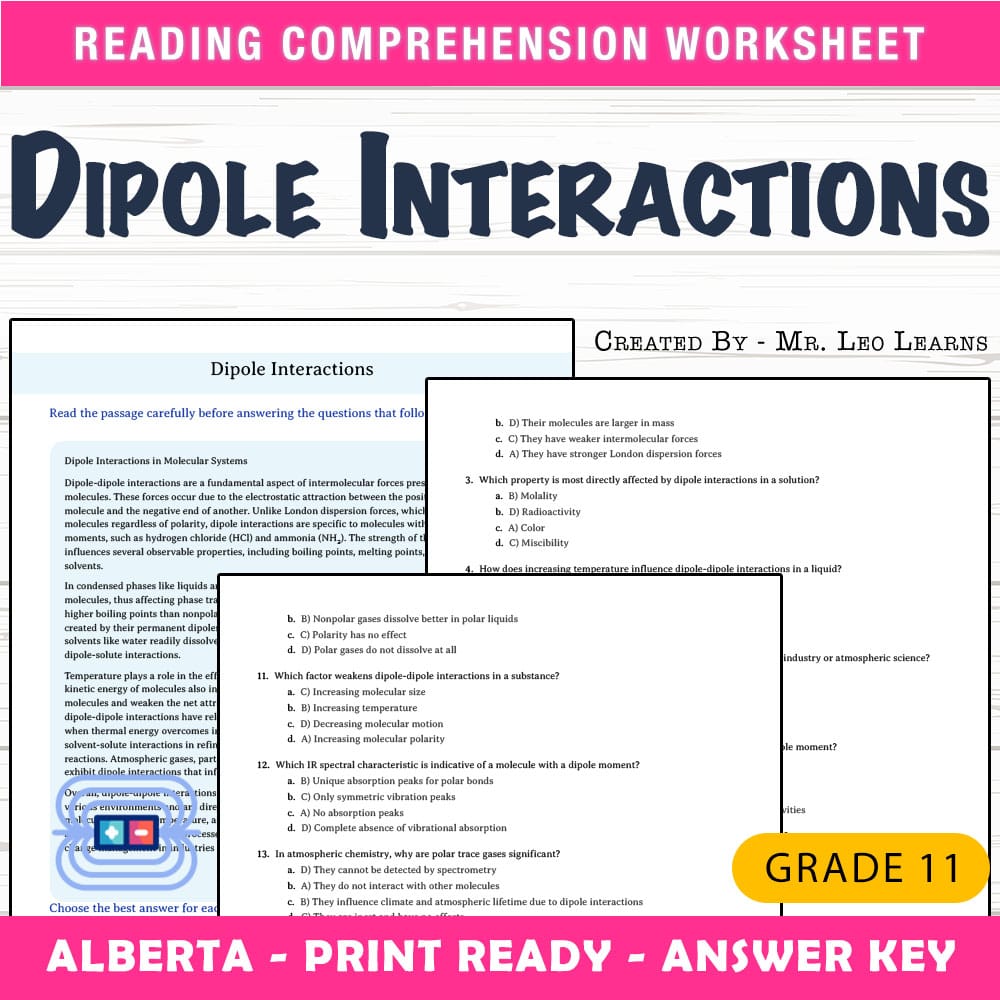
Imagine standing in front of your class as students read a passage on intermolecular forces, trying to grasp the concept of dipole–dipole interactions. Some students may struggle to understand how polarity influences molecular behavior, leading to confusion during discussions or assessments. This worksheet provides a structured, straightforward way for students to reinforce their comprehension of dipole interactions through a dedicated multiple-choice question paper. It offers a clear, print-ready resource that supports independent review and comprehension of this crucial chemistry topic.
What This Resource Helps Students Do
This worksheet is designed to guide students through the core ideas behind dipole–dipole interactions, facilitating a deeper understanding of intermolecular forces. The combination of a reading passage and targeted multiple-choice questions helps students process information actively, encouraging critical thinking and application skills. It supports learners as they distinguish between different types of intermolecular forces, understand the factors affecting boiling points, and identify molecular polarity, all at their own pace. With this resource, students strengthen their ability to analyze concepts and solidify their grasp of polar molecules in a systematic way.
Inside the PDF
• A passage explaining dipole–dipole interactions and their significance in chemistry
• 25 multiple-choice questions focused on comprehension and application
• Printed in a clear, easy-to-read layout designed for immediate use
• Answer key included with a detailed rubric to support grading and feedback
• Designed to optimize classroom photocopying and student engagement
How It Improves Learning
This worksheet encourages active engagement with the topic, moving students from basic recognition to deeper reasoning about dipole–dipole forces. The reading passage breaks down complex ideas into accessible language, making the scientific concepts less intimidating. The multiple-choice questions challenge students to apply what they've learned, helping improve critical thinking skills. The clear layout and focused questions allow students to self-assess their understanding, boosting confidence as they grasp the relationship between molecular polarity and intermolecular forces. Teachers will find that this resource promotes independent learning and helps identify areas that may need further review, fostering a more interactive classroom environment.
Core Skills Students Will Develop
- → Understanding molecular polarity and intermolecular forces
- → Applying knowledge to explain physical properties like boiling points
- → Analyzing scientific passages to identify key ideas
- → Formulating scientific reasoning based on provided data
Ways Teachers Use This Worksheet
This resource can serve multiple instructional purposes, such as providing a structured classwork activity, assigning it as homework for reinforcement, or using it as an assessment tool to gauge student understanding. It is especially useful for small-group discussions, review sessions, and early finisher tasks. Teachers may also incorporate it during revision to reinforce key concepts before assessments, ensuring students are well-prepared and confident in their knowledge of dipole interactions.
Why This PDF Saves Time
The ready-to-print format of this worksheet minimizes preparation, allowing teachers to quickly distribute and start student work without additional setup. Its clear and consistent layout ensures easy photocopying and reduces the time spent on formatting or creating supplementary materials. The inclusion of an answer key streamlines grading activities, enabling prompt feedback and saving valuable instructional time.
In short, this worksheet offers a comprehensive, classroom-ready resource that supports student understanding of dipole–dipole interactions while saving busy teachers time. It is designed to be directly printed and used immediately in your lesson plan, providing a reliable tool to help students master this vital chemistry concept confidently and independently. 😊