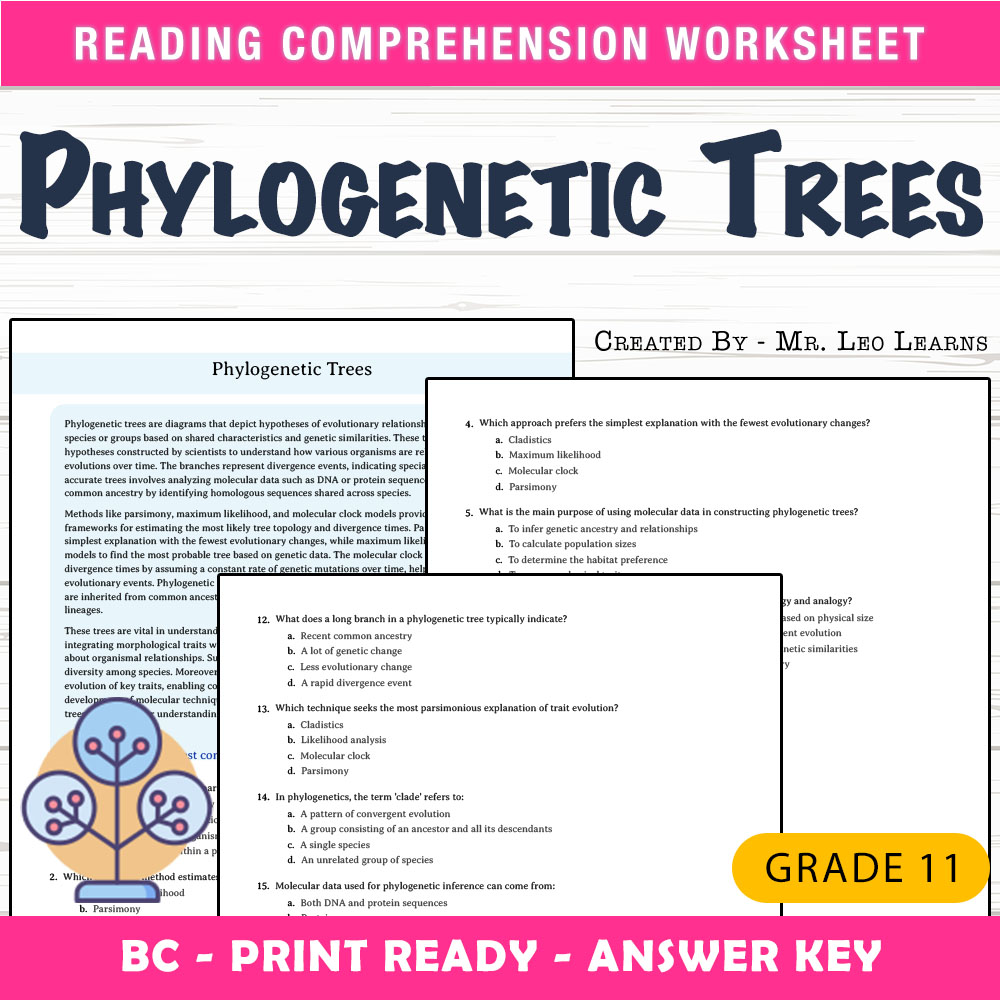
Imagine a classroom where students are focused, eager to understand complex concepts like evolutionary relationships. As they work through the lesson on phylogenetic trees, they often find it challenging to grasp how these diagrams depict hypotheses about how different species are related over time. This worksheet provides a straightforward, print-and-go solution that helps clarify these intricate ideas. It offers structured questions that guide students step-by-step through the key features and uses of phylogenetic trees, making the concept accessible and manageable.
What This Resource Helps Students Do
This worksheet supports students in building a clearer understanding of phylogenetic trees by encouraging active thinking about the diagrams. Through carefully designed multiple-choice questions and a reading passage, students develop the ability to interpret evolutionary relationships, understand common ancestry, and evaluate the methods used to estimate divergence times. The task progression fosters independent reasoning, allowing learners to connect theoretical concepts with visual representations, which is essential for mastering evolutionary biology in Grade 11 science.
Inside the PDF
• 25 structured questions designed for step-by-step learning
• A print-ready format that requires no preparation
• Complete answer key with rubric to facilitate quick grading
• Layout optimized for easy photocopying and classroom distribution
How It Improves Learning
This worksheet improves student understanding by breaking down complex concepts into manageable parts. The reading passage introduces the essential terminology and functions of phylogenetic trees, establishing a foundation for comprehension. The multiple-choice questions then reinforce this knowledge, encouraging students to analyze diagrams and interpret data accurately. The questions are crafted to promote reasoning skills, helping students move from initial confusion to confident understanding. As learners repeatedly practice these skills, they develop a stronger grasp of how evolutionary relationships are represented and assessed in scientific research, leading to improved performance on assessments and a deeper appreciation of biological history.
Core Skills Students Will Develop
- ➡️ interpreting phylogenetic diagrams
- ➡️ understanding evolutionary relationships
- ➡️ evaluating molecular methods in evolution
- ➡️ analyzing scientific hypotheses
Ways Teachers Use This Worksheet
This worksheet is versatile for many classroom activities. It can be used as a classwork handout during instruction to reinforce key concepts, assigned as homework to support independent learning, or employed as an assessment tool to gauge understanding. Teachers may also use it in small-group settings for targeted review or as early finisher work, providing students with meaningful practice without extra preparation. Its clear layout and print-ready format make it easy for educators to incorporate into daily lessons with confidence.
Why This PDF Saves Time
Designed in a print-and-go format, this worksheet and answer key eliminate the need for additional prep work. Teachers can quickly distribute the worksheet during lessons, knowing it aligns directly with core biology topics. The consistent, easy-to-photocopy layout ensures uniformity and saves valuable class time. Additionally, the answer key with rubric offers quick, reliable grading without spending time creating or interpreting complex answer frameworks, making it a dependable resource for busy science educators.
Every teacher appreciates ready-to-use materials that support student success and confidence. This worksheet is advance prepared with clarity and practicality in mind, ready to be printed and implemented immediately. It provides a structured, classroom-friendly resource designed to meet the learning needs of Grade 11 science students while saving precious planning time. Your students will benefit from consistent practice, helping them master the interpretation of phylogenetic trees and deepen their understanding of evolutionary biology. 😊