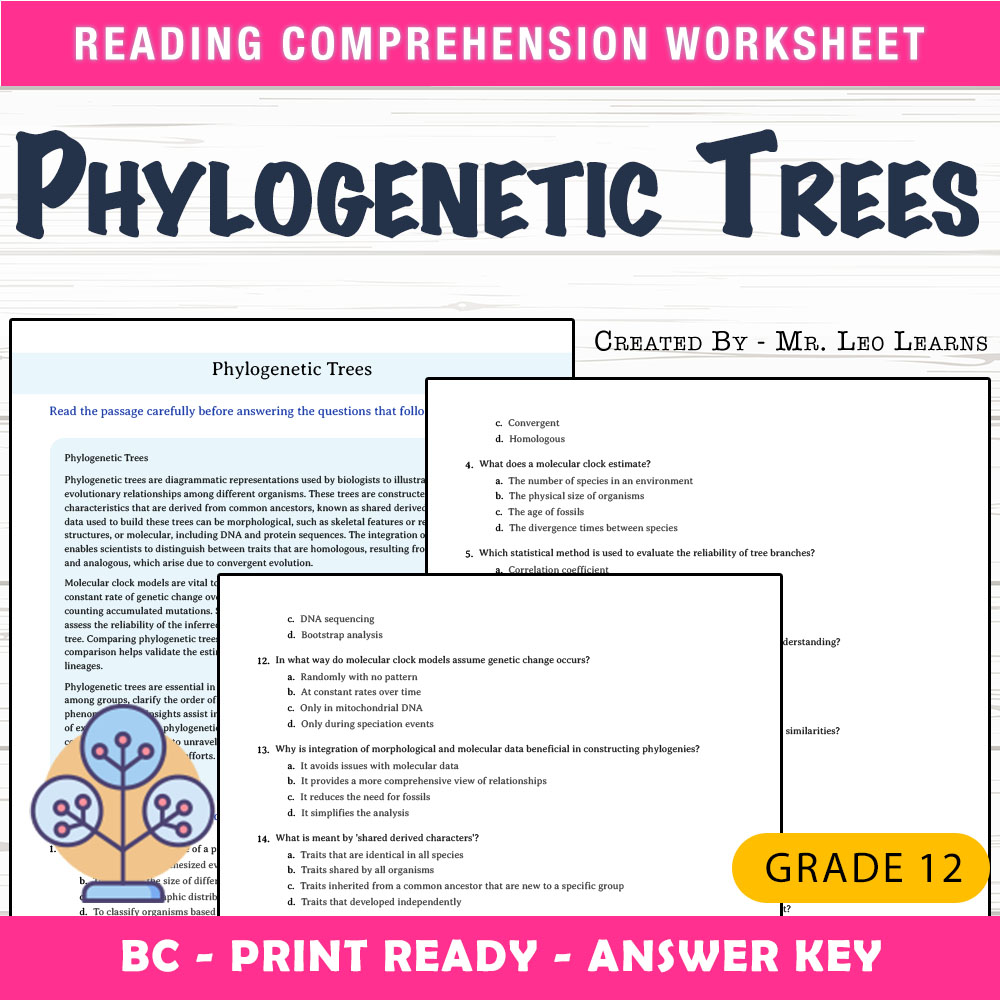
Imagine a typical classroom where students are learning about evolutionary biology. They often find it challenging to understand how scientists interpret evolutionary relationships through diagrams. As they dive into phylogenetic trees, confusion can arise around concepts such as common ancestors, data interpretation, and tree features. This worksheet provides a clear, structured way to explore these ideas, helping students develop confidence in reading and analyzing phylogenetic trees while reinforcing core biological concepts.
What This Resource Helps Students Do
This worksheet guides students through understanding the purpose and features of phylogenetic trees. It encourages independent thinking by asking them to interpret diagrams, analyze data, and apply their knowledge to different scenarios. The multiple-choice questions develop critical reasoning skills, allowing learners to connect biological concepts with visual representations. By working through the reading passage and questions, students build their ability to explain the significance of phylogenetic trees and utilize them to understand evolutionary history.
Inside the PDF
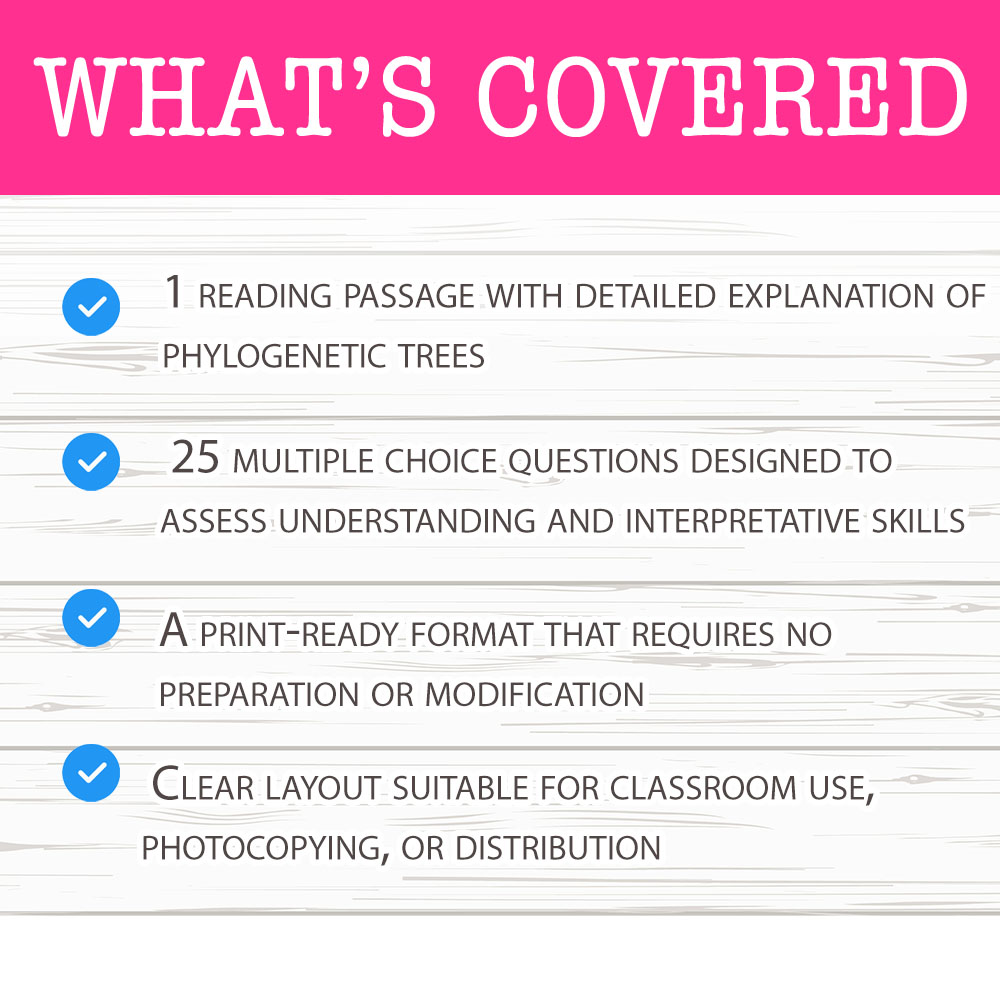
• 1 reading passage with detailed explanation of phylogenetic trees
• 25 multiple choice questions designed to assess understanding and interpretative skills
• A print-ready format that requires no preparation or modification
• Clear layout suitable for classroom use, photocopying, or distribution
How It Improves Learning
This worksheet enhances learning by gradually moving students from basic comprehension to deeper analysis of phylogenetic trees. The reading passage introduces key concepts in an accessible way, serving as a foundation for the questions. The multiple-choice format helps students practice identifying features, functions, and data sources in a variety of contexts. As students respond to these questions, they reinforce their understanding and develop reasoning skills that are essential in evolutionary biology. The worksheet’s structure encourages independent learning and confidence in interpreting complex diagrams, making it an effective tool for review or assessment.
Core Skills Students Will Develop
- ➡️ Understanding biological classifications and evolutionary relationships
- ➡️ Analyzing scientific diagrams and data
- ➡️ Applying concepts of common ancestry and divergence
- ➡️ Developing reasoning and critical thinking skills in biology
Ways Teachers Use This Worksheet
Educators can incorporate this worksheet into classroom activities as part of a lesson on evolution, classification, or biological data analysis. It serves well for independent practice, formative assessment, or review sessions. Teachers might assign it as a homework task, use it for small-group discussions, or include it in assessments to gauge student understanding. Its print-and-go format makes implementation straightforward, ensuring consistency and saving prep time while providing targeted practice for students at the Grade 12 level.
Why This PDF Saves Time
With its ready-made, print-ready layout, this worksheet eliminates the need for lesson prep or extensive formatting. The clear questions and organized format enable quick distribution, giving teachers a reliable resource for immediate use. The inclusion of a comprehensive answer key further simplifies grading and review, reducing the time spent on assessment while maintaining clarity and consistency in student evaluation.
Remember, this worksheet is designed to be student-friendly, classroom-ready, and an effective support tool for mastering phylogenetic trees. It provides a straightforward, reliable way to reinforce key concepts and sharpen interpretive skills, helping students gain confidence in understanding evolutionary biology. 😊