
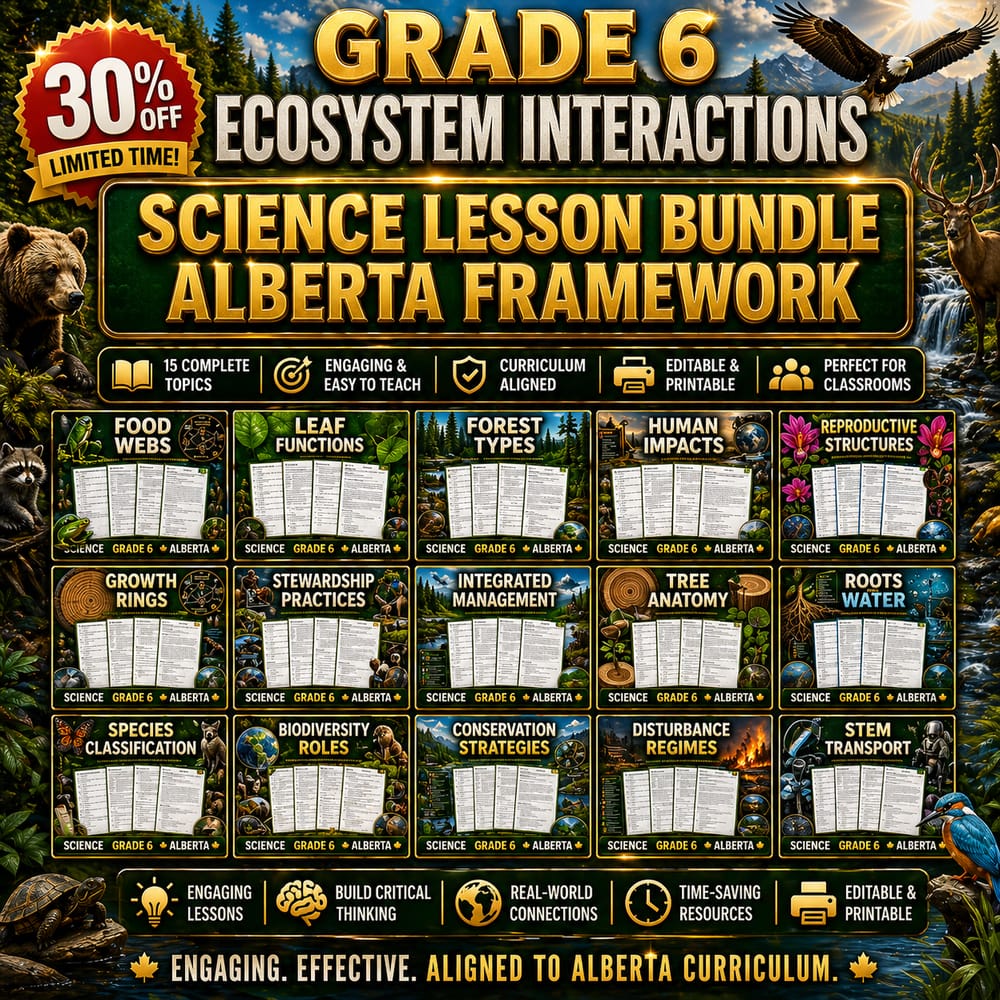


Grade 6 Ecosystem Interactions Science Lesson Bundle: Alberta Framework
$60.00$75.00Save $15.00
Silver Birch Teaching
New·0 followers·0 sales
SubjectScienceGradeGrade 6Pages120 Pages
What’s included
15 worksheets · 120 pages · Save $15.00 (20%) · prices shown inside the bundle
 Grade 6 Science | Food Webs Worksheet – Alberta Standards (PDF)
- Explain how energy moves through forest food webs using producers, consumers, and decomposers.
- Identify trophic relationships and describe how predators, herbivores, and decomposers are connected.
- Describe how seasonal changes and disruptions (like invasive species) can affect food web structure and function.
$4.00$5.00 6th Grade Science | Leaf Functions Worksheet (Alberta Standards) (PDF)
- Describe how leaf structures support photosynthesis, gas exchange, and transpiration.
- Explain how stomata and leaf traits (leaf area and chlorophyll) affect water use efficiency and growth.
- Compare how conifers and deciduous trees manage leaf functions across seasons in Alberta.
$4.00$5.00 6th Grade Science | Forest Types Worksheet (PDF) Alberta Standards
- Identify major forest types (boreal/mixedwood, montane, subalpine, aspen parkland) using characteristic species and conditions
- Explain how abiotic gradients such as elevation, soil moisture, and fire history influence where forest types occur
- Use forest type knowledge to describe habitat diversity and potential impacts of climatic shifts
$4.00$5.00 Grade 6 Science Worksheet on Human Impacts | Alberta Standards (PDF)
- Describe how human activities affect forest ecosystems, including habitat connectivity, soil, and water quality
- Identify ways that fragmentation and pollution can change species composition
- Explain why invasive species can increase ecological harm over time
$4.00$5.00 6th Grade Science – Reproductive Structures Worksheet (Alberta Standards) (PDF)
- Explain how flowers and cones support reproduction in plants.
- Describe how seeds and different dispersal mechanisms affect where plants grow.
- Compare vegetative propagation and seed-based reproduction in terms of regeneration and genetic diversity.
$4.00$5.00 Grade 6 Science | Growth Rings Worksheet (Alberta Standards) (PDF)
- Explain how growth rings form and how they can be used to estimate a tree’s age and growth patterns.
- Describe how ring width and density can reflect environmental conditions such as moisture, temperature, and disturbances.
- Connect dendrochronology methods to reconstructing past climate and disturbance events (such as drought or fire).
$4.00$5.00 6th Grade Science | Stewardship Practices Worksheet (Alberta) PDF
- Explain how stewardship practices help landscapes by improving habitat, reducing erosion, and supporting water regulation.
- Identify key stewardship actions such as community planting, shelterbelts, and urban canopy programs.
- Describe how Indigenous knowledge can be incorporated respectfully into land care and restoration.
$4.00$5.00 Grade 6 Science | Integrated Management Worksheet (Alberta Standards) (PDF)
- Explain how integrated management balances ecological, economic, and social objectives in forest and park landscapes
- Identify how Alberta forest planning uses ecosystem-based management, adaptive harvest planning, and monitoring to manage risks
- Describe how stakeholder collaboration and long-term monitoring support multiple forest values and resilience
$4.00$5.00 6th Grade Science | Tree Anatomy Worksheet (Alberta Standards) (PDF)
- Identify major parts of a tree (roots, trunk, branches, leaves, buds, and bark) and describe their functions.
- Explain how form–function relationships help trees survive in different habitats.
- Use scientific vocabulary to describe transport, storage, support, and protection in trees.
$4.00$5.00 Grade 6 Science | Roots and Water Worksheet (Alberta Standards) (PDF)
- Explain how root systems provide anchorage, water and nutrient uptake, and storage
- Describe how different root adaptations (lateral roots and taproots) help trees survive in different environments
- Summarize how mycorrhizal fungi improve absorption and drought resilience
$4.00$5.00
Reviews & Feedback
Loading reviews...
Questions & Answers
Loading questions…
About this bundle
Related categories
Frequently asked questions
Who is Grade 6 Ecosystem Interactions Science Lesson Bundle: Alberta Framework designed for?
Grade 6 Ecosystem Interactions Science Lesson Bundle: Alberta Framework is designed for Grade 6 students and Science learners and can be used in classrooms, homeschool, or independent practice.
How do I download Grade 6 Ecosystem Interactions Science Lesson Bundle: Alberta Framework?
Add it to your cart and complete checkout. After payment, you can download immediately from your account, and you'll also receive a download link by email.
Similar Products

Interactions and Ecosystems Lesson Bundle Grade 7 Science – Alberta
$60.00$75.00

Grade 6 Life Processes & Ecosystem Interactions Science Lesson Bundle: General
$28.80$36.00

Grade 7 Science Ecosystems Lesson Bundle | NGSS Interactions & Energy
$20.00$25.00

Grade 12 Science Biology and Ecosystems Lesson Bundle | AP Framework
$33.60$42.00

Grade 9 Science Ecosystems Lesson Bundle | NGSS Interactions & Energy
$12.00$15.00