
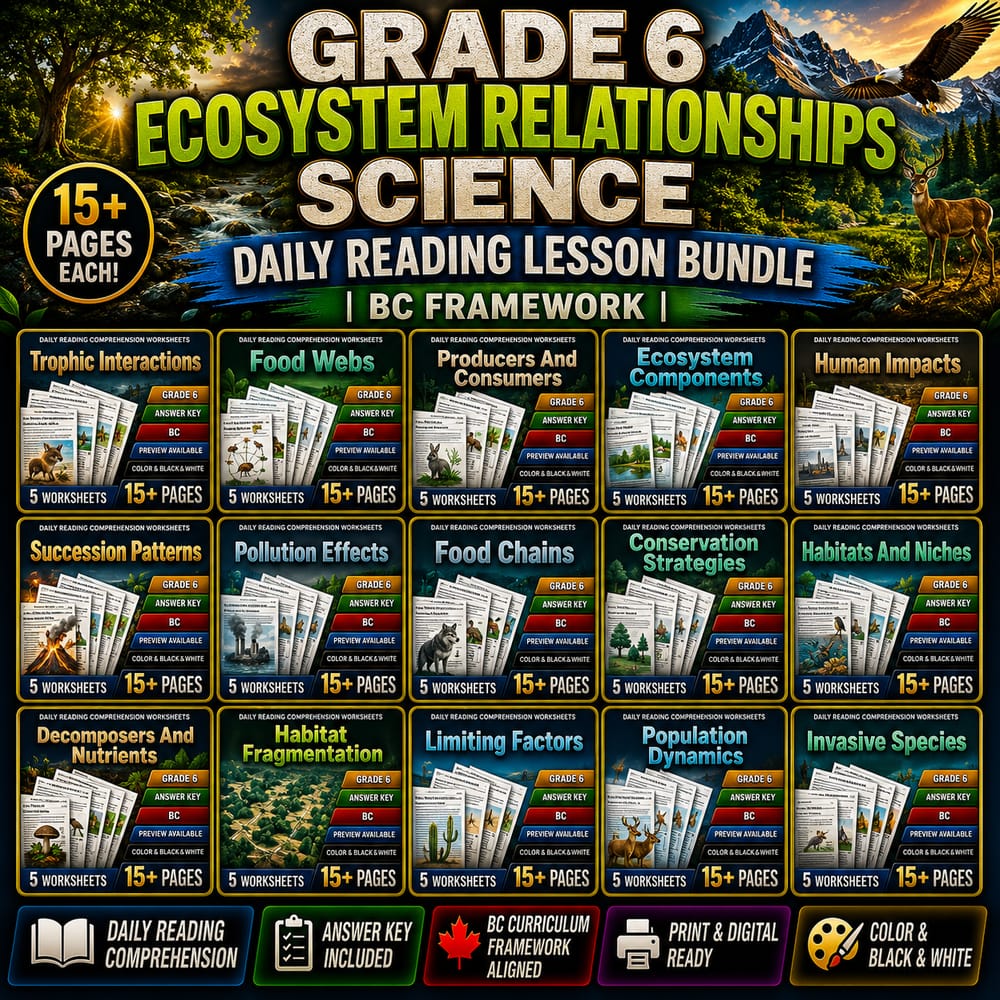


Grade 6 Ecosystem Relationships Science Daily Reading Lesson Bundle | BC
$48.00$60.00Save $12.00
Bright Mind Resources
New·1 followers·12 sales
SubjectScienceGradeGrade 6
What’s included
15 worksheets · Save $12.00 (20%) · prices shown inside the bundle
 Grade 6 Science – Trophic Interactions & Ecosystem Relationships | Worksheet
- Understand the basic concepts of trophic interactions including predation, herbivory, parasitism, competition, and mutualism.
- Recognize examples of each trophic interaction in ecosystems.
- Explain how trophic interactions influence community structure and energy flow.
$3.20$4.00 Grade 6 Science – Food Webs & Energy Flow | Daily Reading Worksheet
- Identify different species involved in food webs
- Describe the roles of producers, consumers, and decomposers
- Understand how species interactions create interconnected feeding relationships
$3.20$4.00 Grade 6 Science – Producers & Consumers in Ecosystems | Daily Reading Worksheet
- Understand the role of producers in ecosystems.
- Identify different types of producers, such as plants and chemosynthetic bacteria.
- Explain how producers convert energy into biomass through photosynthesis and chemosynthesis.
$3.20$4.00 Grade 6 Science – Ecosystem Components & Interactions | Daily Reading Worksheet
- Identify biotic components in an ecosystem
- Understand the interactions between living and nonliving factors
- Explore how plants and animals influence their habitats
$3.20$4.00 Grade 6 Science – Human Impacts on Ecosystems & Deforestation Reading Worksheet
- Understand how deforestation affects ecosystems
- Identify the consequences of human land clearing
- Develop reading comprehension skills
$3.20$4.00 Grade 6 Science – Succession Patterns & Ecosystem Development | Worksheet
- Understand the concept of ecological succession
- Identify different types of succession
- Recognize pioneer species and their role
$3.20$4.00 Grade 6 Science – Pollution Effects & Heavy Metals | Daily Reading Worksheet
- Understand how heavy metals contribute to pollution
- Identify different pollutants that affect ecosystems
- Analyze the impact of pollutants on organisms and habitats
$3.20$4.00 Grade 6 Science – Food Chains & Energy Flow | Daily Reading Worksheet
- Understand what a food chain is and how it illustrates energy transfer
- Identify different organisms at various levels in a food chain
- Recognize the importance of each organism within an ecosystem
$3.20$4.00 Grade 6 Science – Conservation Strategies & Ecosystem Health | Reading Worksheet
- Understand the purpose and importance of protected areas
- Identify different conservation strategies
- Analyze how conservation efforts benefit ecosystems and communities
$3.20$4.00 Grade 6 Science – Habitats & Niches | Daily Reading Worksheet
- Understand what habitats and niches are
- Identify different types of habitats
- Explain how niches influence species interactions
$3.20$4.00
Reviews & Feedback
Loading reviews...
Questions & Answers
Loading questions…
About this bundle
Related categories
Frequently asked questions
Who is Grade 6 Ecosystem Relationships Science Daily Reading Lesson Bundle | BC designed for?
Grade 6 Ecosystem Relationships Science Daily Reading Lesson Bundle | BC is designed for Grade 6 students and Science learners and can be used in classrooms, homeschool, or independent practice.
How do I download Grade 6 Ecosystem Relationships Science Daily Reading Lesson Bundle | BC?
Add it to your cart and complete checkout. After payment, you can download immediately from your account, and you'll also receive a download link by email.
Similar Products

TEKS Ecosystems Grade 6 Science Daily Reading Worksheets Lesson Bundle | TEKS
$32.00$40.00

Biology and Ecosystems Lesson Bundle – Grade 9 Science AP Daily Reading
$56.00$70.00

Ecosystems Grade 9 Science Daily Reading Worksheets Lesson Bundle | NGSS
$20.00$25.00

Grade 8 Ecosystems Daily Reading Worksheets Lesson Bundle | BC
$48.00$60.00

Grade 7 Ecosystems Science Lesson Bundle for Daily Reading Worksheets | Alberta
$48.00$60.00