
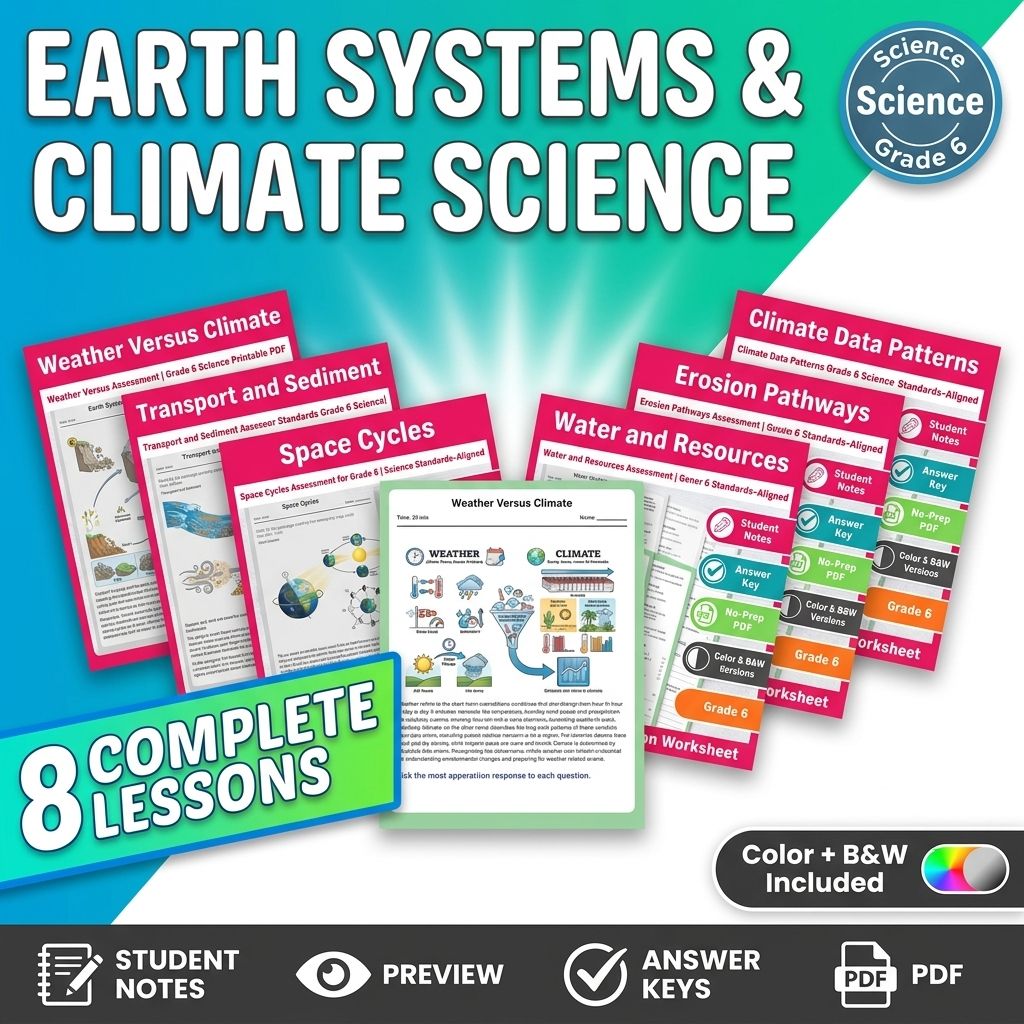
Grade 6 Life Science Science Lesson Bundle – General Framework Unit
$32.00$40.00Save $8.00
Prism Point Learning
·2 followers·13 sales
SubjectScienceGradeGrade 6
What’s included
8 worksheets · Save $8.00 (20%) · prices shown inside the bundle
 Climate Data Patterns Assessment for Grade 6 Science – Standards-Aligned
- Understand how graphs of temperature and precipitation reveal climate patterns.
- Identify and interpret trends and variability in climate data over multiple years.
- Differentiate between typical climate patterns and anomalies using historical data.
$4.00$5.00 Weather Versus Climate Assessment Grade 6 Science Printable PDF
- Distinguish between weather and climate based on their characteristics and timeframes.
- Identify examples of weather and climate phenomena from observations.
- Explain how weather and climate patterns are studied and interpreted.
$4.00$5.00 Mass Wasting Assessment for Grade 6 Science | Standards-Aligned
- Understand the processes involved in mass wasting such as rockfalls, landslides, and slumps.
- Identify factors that trigger surface movements like rainfall, freeze-thaw cycles, and earthquakes.
- Explain how debris deposition affects drainage and erosion patterns.
$4.00$5.00 Earth System Links Assessment | General Grade 6 Science Standards
- Understand how Earth's systems are interconnected and how changes in one system can affect others.
- Identify the different Earth systems: lithosphere, hydrosphere, atmosphere, and biosphere.
- Describe how energy from the Sun drives cycles and interactions among Earth's systems.
$4.00$5.00 Erosion Pathways Assessment for Grade 6 Science | Standards-Aligned
- Understand the processes of erosion and deposition and how they shape Earth's surface.
- Identify agents responsible for erosion such as water, wind, ice, and gravity.
- Explain how deposition occurs and the features it creates like deltas and dunes.
$4.00$5.00 Space Cycles Assessment for Grade 6 | Science Standards-Aligned
- Understand the cycles in the sky caused by Earth's rotation, orbit, and tilt.
- Identify how the Moon's orbit creates phases and affects the night sky.
- Predict the effects of Earth's movement on day length, seasons, and night and day.
$4.00$5.00 Water and Resources Assessment | General Standards Grade 6 Science
- Describe the stages of the water cycle and how it connects Earth's systems.
- Identify the processes involved in water movement and storage on Earth.
- Explain how land cover and temperature influence water infiltration, runoff, and ecosystem conditions.
$4.00$5.00 Transport and Sediment Assessment | General Standards Grade 6 Science
- Understand how streams and wind transfer particles of different sizes based on energy and strength.
- Explain the process of sorting of sediments during transportation and deposition.
- Identify natural structures formed by sediment sorting, such as sandbars and deltas.
$4.00$5.00
Reviews & Feedback
Loading reviews...
Questions & Answers
Loading questions…
About this bundle
Related categories
Frequently asked questions
Who is Grade 6 Life Science Science Lesson Bundle – General Framework Unit designed for?
Grade 6 Life Science Science Lesson Bundle – General Framework Unit is designed for Grade 6 students and Science learners and can be used in classrooms, homeschool, or independent practice.
How do I download Grade 6 Life Science Science Lesson Bundle – General Framework Unit?
Add it to your cart and complete checkout. After payment, you can download immediately from your account, and you'll also receive a download link by email.
Similar Products

Grade 6 Life Processes & Ecosystems Science lesson bundle: General Framework
$36.00$45.00

Grade 6 Life Processes Science Lesson Bundle Assessment: General Framework
$36.00$45.00

Grade 11 Biology Foundations Science Lesson Bundle: General Worksheets
$21.60$27.00

Life Processes Grade 6 Science Daily Reading Worksheets Lesson Bundle | General
$28.80$36.00

Grade 3 Life Cycles & Classification Science Lesson Bundle: General
$32.00$40.00