
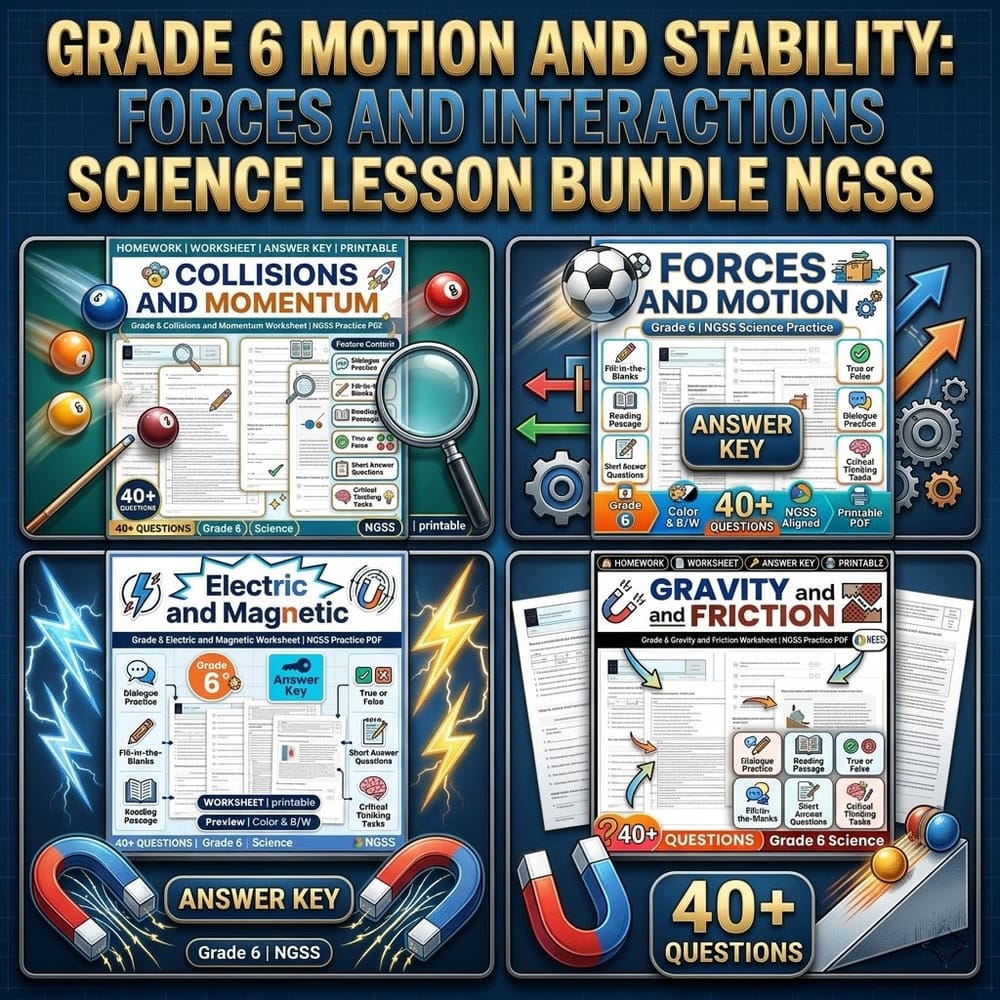
Grade 6 Motion and Stability: Forces and Interactions Science Lesson Bundle NGSS
$16.00$20.00Save $4.00
Clear Sky Classroom
·1 followers·19 sales
SubjectScienceGradeGrade 6
What’s included
4 worksheets · Save $4.00 (20%) · prices shown inside the bundle
 Grade 6 Collisions and Momentum Worksheet | NGSS Practice PDF
- Understand the principles of conservation of momentum in two-body collisions.
- Differentiate between elastic and inelastic collisions through examples.
- Identify the forces involved during contact in collisions and how they produce action-reaction pairs.
$4.00$5.00 Grade 6 Forces and Motion Worksheet | NGSS Practice PDF
- Understand the relationship between net force, mass, and acceleration.
- Identify scenarios where forces act on objects and analyze their effects.
- Apply the formula net force equals mass times acceleration to solve problems.
$4.00$5.00 Grade 6 Electric and Magnetic Worksheet | NGSS Practice PDF
- Understand how electric and magnetic forces depend on source strength and distance.
- Identify examples of electrostatic and magnetic interactions.
- Explain how force magnitude varies with charge, current, and separation.
$4.00$5.00 Grade 6 Gravity and Friction Worksheet | NGSS Practice PDF
- Understand how gravitational attraction depends on mass and distance.
- Differentiate between gravitational forces and contact forces like friction.
- Identify examples illustrating gravitational interactions and frictional resistance.
$4.00$5.00
Reviews & Feedback
Loading reviews...
Questions & Answers
Loading questions…
About this bundle
Related categories
Frequently asked questions
Who is Grade 6 Motion and Stability: Forces and Interactions Science Lesson Bundle NGSS designed for?
Grade 6 Motion and Stability: Forces and Interactions Science Lesson Bundle NGSS is designed for Grade 6 students and Science learners and can be used in classrooms, homeschool, or independent practice.
How do I download Grade 6 Motion and Stability: Forces and Interactions Science Lesson Bundle NGSS?
Add it to your cart and complete checkout. After payment, you can download immediately from your account, and you'll also receive a download link by email.
Similar Products

Motion and Stability Forces Grade 8 Science NGSS Worksheets Bundle
$12.80$16.00

Grade 10 Science Motion and Stability Forces & Interactions Bundle
$14.40$18.00

Motion Stability Forces G11 Science Daily Reading Worksheets Lesson Bundle |NGSS
$16.00$20.00

Motion and Stability Forces and Interactions Lesson Bundle | Grade 10 Science | NGSS
$24.00$30.00

Grade 8 Motion and Stability Forces Interactions Science Lesson Bundle (NGSS)
$12.80$16.00