
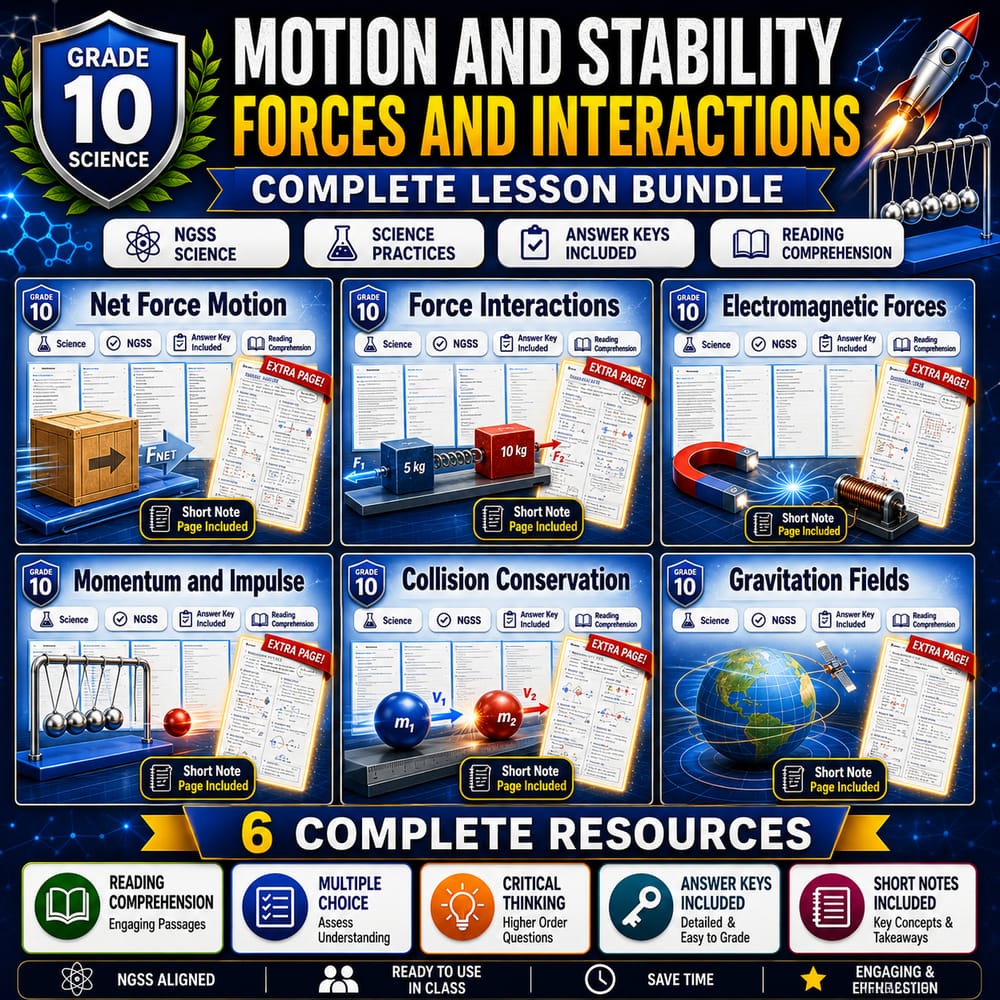
Motion and Stability Forces and Interactions Lesson Bundle | Grade 10 Science | NGSS
$24.00$30.00Save $6.00
MTS Resources
New·0 followers·0 sales
SubjectScienceGradeGrade 10
What’s included
6 worksheets · Save $6.00 (20%) · prices shown inside the bundle
 Gravitation Fields Worksheet | NGSS Physics Activity with Answer Key
- Explain how Newton’s law of gravitation leads to an inverse-square gravitational field for a point mass.
- Calculate gravitational field strength and gravitational potential energy changes near Earth and for other mass distributions (using the point-mass approximation).
- Use gravitational field and force ideas to reason about orbital motion and tidal effects qualitatively and quantitatively.
$4.00$5.00 Net Force Motion Worksheet | NGSS Physics Activity with Answer Key
- Explain how net force determines acceleration using Newton’s second law (F = ma).
- Use vector addition to calculate net force when multiple forces act on an object.
- Interpret constant-acceleration motion using kinematics and motion graphs.
$4.00$5.00 Momentum and Impulse Worksheet | NGSS Physics Activity + Answer Key
- Use vector momentum p = m v to analyze motion in one and two dimensions
- Apply the impulse-momentum theorem J = ∫F dt = Δp to predict velocity change
- Use force–time data (area under the curve) to calculate impulse and related momentum changes
$4.00$5.00 Electromagnetic Forces Worksheet | NGSS Physics Activity + Answer Key
- Use the Lorentz force law to determine the direction and relative magnitude of forces on moving charges in electric and magnetic fields.
- Connect electric fields to linear acceleration and magnetic fields to curved motion for particles and currents.
- Apply vector orientation (right-hand rule and cross product direction) to predict deflection and trajectories.
$4.00$5.00 Collision Conservation Worksheet | NGSS Physics Activity + Answer Key
- Apply conservation of linear momentum using 2D vector components in multi-body collisions.
- Use center-of-mass motion to analyze how internal forces redistribute momentum and kinetic energy.
- Distinguish elastic from inelastic collisions using post-collision speed and energy partition.
$4.00$5.00 Force Interactions Worksheet | NGSS Physics Activity + Answer Key
- Classify forces as contact or noncontact and identify examples from real situations
- Use Newton’s third law to describe action–reaction force pairs in pairwise interactions
- Represent forces as vectors on free-body diagrams and relate net force to acceleration conceptually
$4.00$5.00
Reviews & Feedback
Loading reviews...
Questions & Answers
Loading questions…
About this bundle
Related categories
Frequently asked questions
Who is Motion and Stability Forces and Interactions Lesson Bundle | Grade 10 Science | NGSS designed for?
Motion and Stability Forces and Interactions Lesson Bundle | Grade 10 Science | NGSS is designed for Grade 10 students and Science learners and can be used in classrooms, homeschool, or independent practice.
How do I download Motion and Stability Forces and Interactions Lesson Bundle | Grade 10 Science | NGSS?
Add it to your cart and complete checkout. After payment, you can download immediately from your account, and you'll also receive a download link by email.
Similar Products

Motion and Stability Forces Grade 8 Science NGSS Worksheets Bundle
$12.80$16.00

Grade 10 Science Motion and Stability Forces & Interactions Bundle
$14.40$18.00

Motion Stability Forces G11 Science Daily Reading Worksheets Lesson Bundle |NGSS
$16.00$20.00

Grade 8 Motion and Stability Forces Interactions Science Lesson Bundle (NGSS)
$12.80$16.00

Grade 6 Motion and Stability: Forces and Interactions Science Lesson Bundle NGSS
$16.00$20.00