
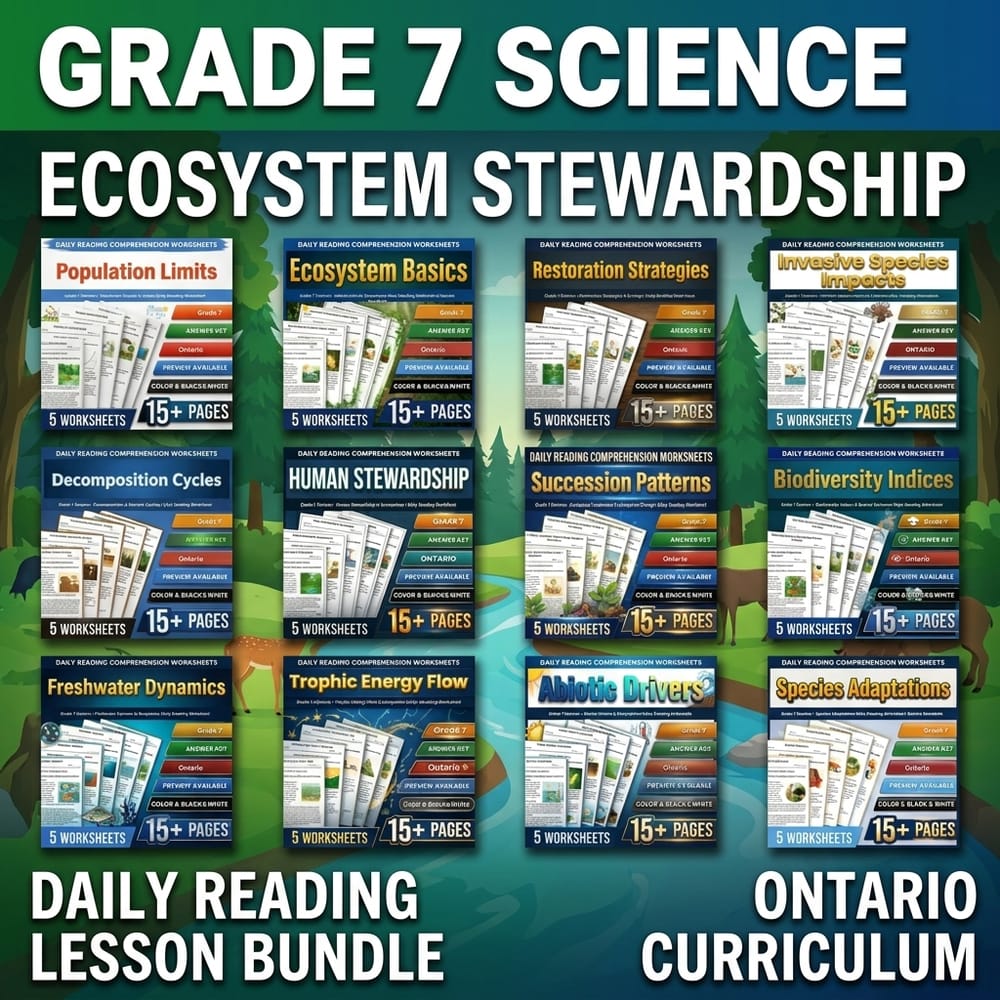


Grade 7 Ecosystem Stewardship Science Daily Reading lesson bundle | Ontario
$38.40$48.00Save $9.60
Bright Mind Resources
New·1 followers·12 sales
SubjectScienceGradeGrade 7Pages287 Pages
What’s included
12 worksheets · 287 pages · Save $9.60 (20%) · prices shown inside the bundle
 Grade 7 Science – Population Growth & Limits | Daily Reading Worksheet
- Understand basic concepts of population growth and decline.
- Distinguish between exponential and logistic growth models.
- Identify limiting factors affecting populations.
$3.20$4.00 Grade 7 Science – Ecosystems Daily Reading Worksheet | Ontario Standards
- Identify the components of an ecosystem including biotic and abiotic elements.
- Distinguish between biotic and abiotic factors and understand their roles.
- Understand the different trophic categories: producers, consumers, decomposers.
$3.20$4.00 Grade 7 Science – Restoration Strategies & Ecology | Daily Reading Worksheet
- Understand basic principles of ecological restoration
- Identify reference conditions and recovery goals
- Differentiate between active and passive restoration approaches
$3.20$4.00 Grade 7 Science – Invasive Species Impacts & Spread | Daily Reading Worksheet
- Understand what invasive species are and how they are introduced into new ecosystems
- Identify early signs of invasive species impact
- Learn pathways through which non-native species enter environments
$3.20$4.00 Grade 7 Science – Decomposition & Nutrient Cycling | Daily Reading Worksheet
- Understand the process of decomposition and its role in ecosystems
- Identify key organisms involved in decomposition such as detritivores, fungi, and bacteria
- Explain how nutrients like carbon and nitrogen are transformed during decomposition
$3.20$4.00 Grade 7 Science – Human Stewardship in Ecosystems | Daily Reading Worksheet
- Understand human impacts on ecosystems, including habitat alteration, pollution, resource extraction, and species introduction.
- Analyze the consequences of human activities on biodiversity and ecosystem functions.
- Identify principles of stewardship such as mitigation, habitat protection, restoration, and monitoring.
$3.20$4.00 Grade 7 Science – Ecological Succession & Ecosystem Change | Reading Worksheet
- Define ecological succession and distinguish between primary and secondary succession.
- Identify the stages of succession in different ecosystems.
- Explain the environmental factors that drive succession, such as soil development and seed dispersal.
$3.20$4.00 Grade 7 Science – Biodiversity Indices & Species Richness | Reading Worksheet
- Define species richness and understand its role in biodiversity
- Identify factors that influence species richness in different habitats
- Analyze the importance of species richness for ecological stability
$3.20$4.00 Grade 7 Science – Freshwater Systems & Ecosystems Daily Reading Worksheet
- Understand the structure and features of ponds and lakes
- Explain how abiotic gradients like oxygen and light influence aquatic communities
- Describe seasonal changes such as thermal turnover and their effects
$3.20$4.00 Grade 7 Science – Trophic Energy Flow & Ecosystem | Daily Reading Worksheet
- Identify the different trophic levels in an ecosystem.
- Explain how energy flows from one trophic level to the next.
- Understand the concept of energy loss and efficiency in ecological pyramids.
$3.20$4.00
Reviews & Feedback
Loading reviews...
Questions & Answers
Loading questions…
About this bundle
Related categories
Frequently asked questions
Who is Grade 7 Ecosystem Stewardship Science Daily Reading lesson bundle | Ontario designed for?
Grade 7 Ecosystem Stewardship Science Daily Reading lesson bundle | Ontario is designed for Grade 7 students and Science learners and can be used in classrooms, homeschool, or independent practice.
How do I download Grade 7 Ecosystem Stewardship Science Daily Reading lesson bundle | Ontario?
Add it to your cart and complete checkout. After payment, you can download immediately from your account, and you'll also receive a download link by email.
Similar Products

TEKS Ecosystems Grade 6 Science Daily Reading Worksheets Lesson Bundle | TEKS
$32.00$40.00

Biology and Ecosystems Lesson Bundle – Grade 9 Science AP Daily Reading
$56.00$70.00

Ecosystems Grade 9 Science Daily Reading Worksheets Lesson Bundle | NGSS
$20.00$25.00

Grade 8 Ecosystems Daily Reading Worksheets Lesson Bundle | BC
$48.00$60.00

Grade 7 Ecosystems Science Lesson Bundle for Daily Reading Worksheets | Alberta
$48.00$60.00