
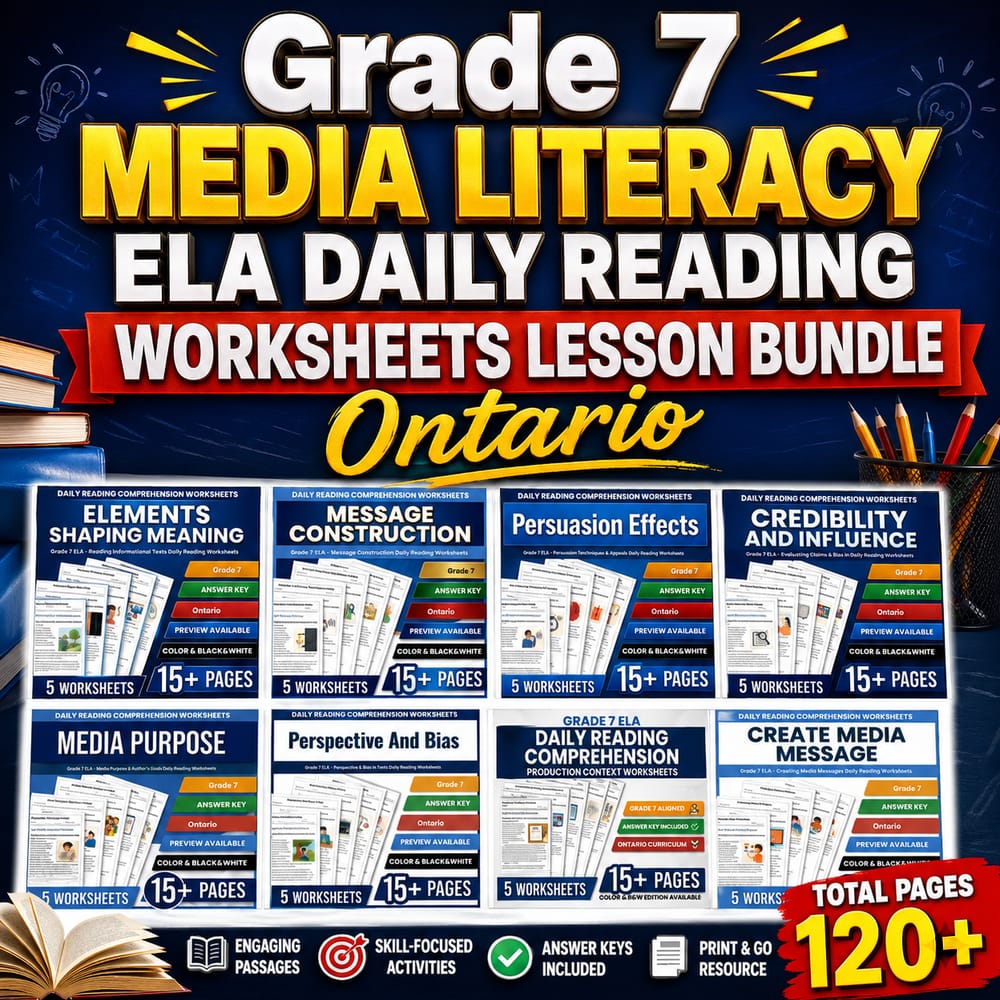
Grade 7 Media Literacy ELA Daily Reading Worksheets Lesson Bundle | Ontario
$25.60$32.00Save $6.40
Quiet Forest Education
·3 followers·20 sales
SubjectELAGradeGrade 7Pages246 Pages
What’s included
8 worksheets · 246 pages · Save $6.40 (20%) · prices shown inside the bundle
 Grade 7 ELA – Elements Shaping Meaning Daily Worksheet | Ontario Standards
- Understand how visual and audio elements influence interpretation in media
- Analyze the impact of camera angles and editing choices on viewer perception
- Identify how typography and layout guide viewer attention and comprehension
$3.20$4.00 Grade 7 ELA – Message Construction Techniques in Media | Daily Reading Worksheet
- Understand how contrast can highlight differences and emphasize messages.
- Identify various techniques used in constructing persuasive messages.
- Analyze the impact of visual and sound elements in message framing.
$3.20$4.00 Grade 7 ELA – Persuasion Techniques & Response | Daily Reading Worksheet
- Identify tone and emotional cues in persuasive texts
- Analyze how construction choices affect message perception
- Evaluate the impact of imagery and language on audience response
$3.20$4.00 Grade 7 ELA – Analyzing Evidence & Bias in News Stories Daily Reading Worksheet
- Understand how credibility is assessed in news stories.
- Identify different types of evidence used to support claims.
- Evaluate influence of headlines, statistics, and imagery on trustworthiness.
$3.20$4.00 Grade 7 ELA – Media Purpose & Informing | Daily Reading Worksheet
- Identify the purpose of media texts as informing, persuading, entertaining, or positioning.
- Analyze media content to determine how it emphasizes or omits information.
- Understand how tone supports the message in media communications.
$3.20$4.00 Grade 7 ELA – Perspective & Bias in Texts | Daily Reading Worksheet
- Identify different perspectives in written texts.
- Recognize bias through word choice, visuals, and evidence.
- Understand framing choices and distinguish opinions from facts.
$3.20$4.00 Grade 7 ELA – Daily Reading & Production Context | Worksheets & Practice
- Identify how production choices influence meaning in media texts
- Analyze differences between various media formats such as press releases, news segments, and social media posts
- Understand the role of source selection, format, and audience expectations in shaping messages
$3.20$4.00 Grade 7 ELA – Creating Media Messages Daily Worksheet | Ontario Standards
- Understand key concepts related to ELA
- Apply knowledge through practice questions
- Demonstrate comprehension of the material
$3.20$4.00
Reviews & Feedback
Loading reviews...
Questions & Answers
Loading questions…
About this bundle
Related categories
Frequently asked questions
Who is Grade 7 Media Literacy ELA Daily Reading Worksheets Lesson Bundle | Ontario designed for?
Grade 7 Media Literacy ELA Daily Reading Worksheets Lesson Bundle | Ontario is designed for Grade 7 students and ELA learners and can be used in classrooms, homeschool, or independent practice.
How do I download Grade 7 Media Literacy ELA Daily Reading Worksheets Lesson Bundle | Ontario?
Add it to your cart and complete checkout. After payment, you can download immediately from your account, and you'll also receive a download link by email.
Similar Products

Grade 12 ELA Media Literacy Worksheets | Ontario Media Literacy
$14.40$18.00

Media Studies Grade 11 ELA Daily Reading Worksheets Lesson Bundle | Ontario
$16.00$20.00

Grade 4 Media Literacy Lesson Bundle | Ontario ELA Worksheets
$12.00$15.00

Grade 12 ELA Daily Reading & Literary Media Literacy Lesson Bundle | Ontario
$112.00$160.00

Media & Bias Grade 12 ELA Daily Reading Worksheets Lesson Bundle | Ontario
$19.20$24.00