
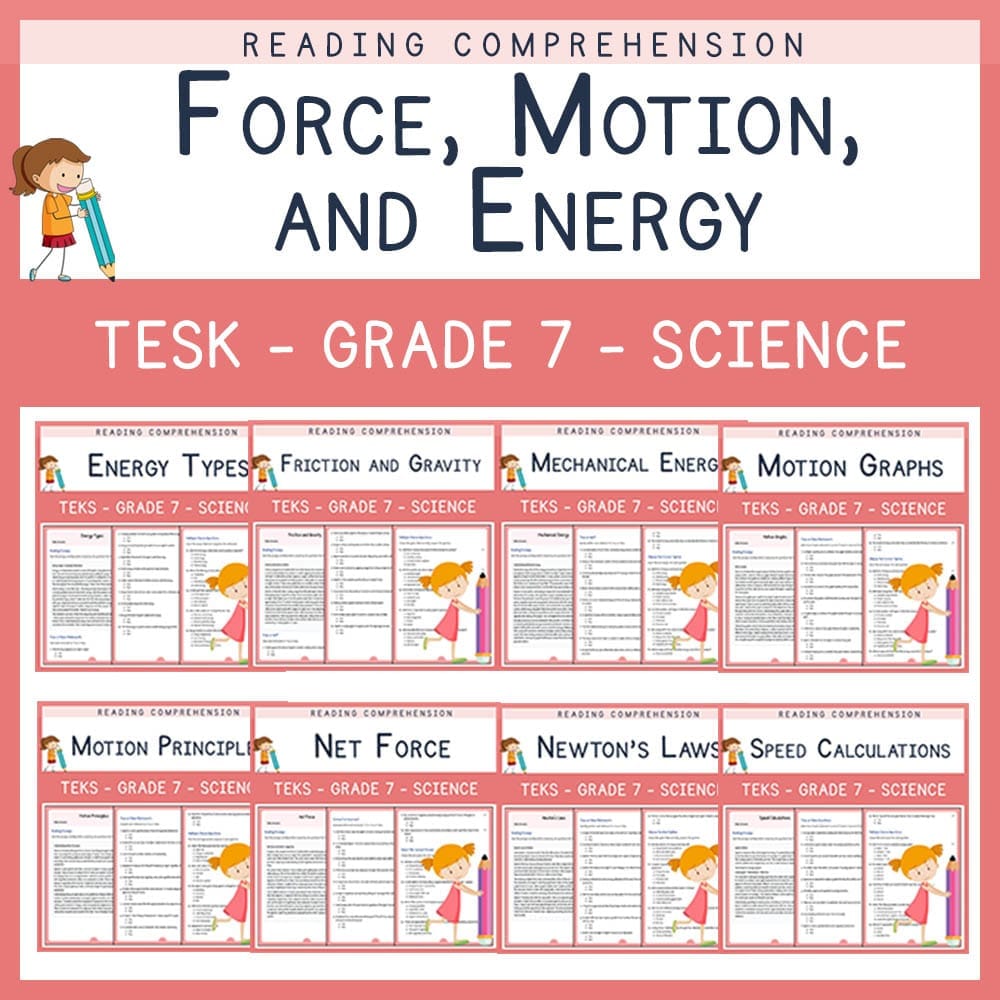
Grade 7 Science | Force, Motion, and Energy Lesson Bundle | TEKS Aligned
$19.20$24.00Save $4.80
Lumora Learning
·3 followers·12 sales
GradeGrade 7
What’s included
8 worksheets · Save $4.80 (20%) · prices shown inside the bundle
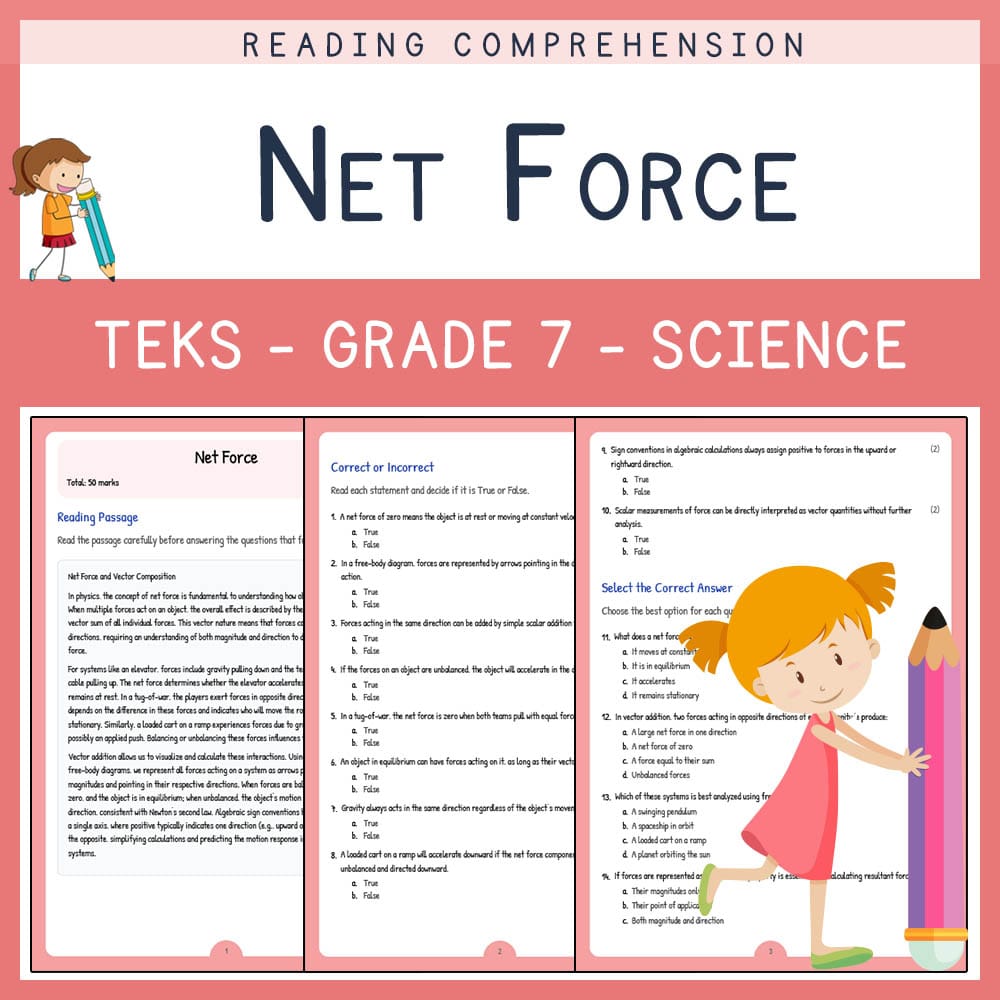 Grade 7 Science | Net Force Worksheet | TEKS-Aligned
- Understand how forces combine using vector addition to determine net force.
- Interpret free-body diagrams to analyze systems like elevators, tug-of-war, and loaded carts.
- Apply algebraic sign conventions to solve for net force in one-dimensional systems.
$2.40$3.00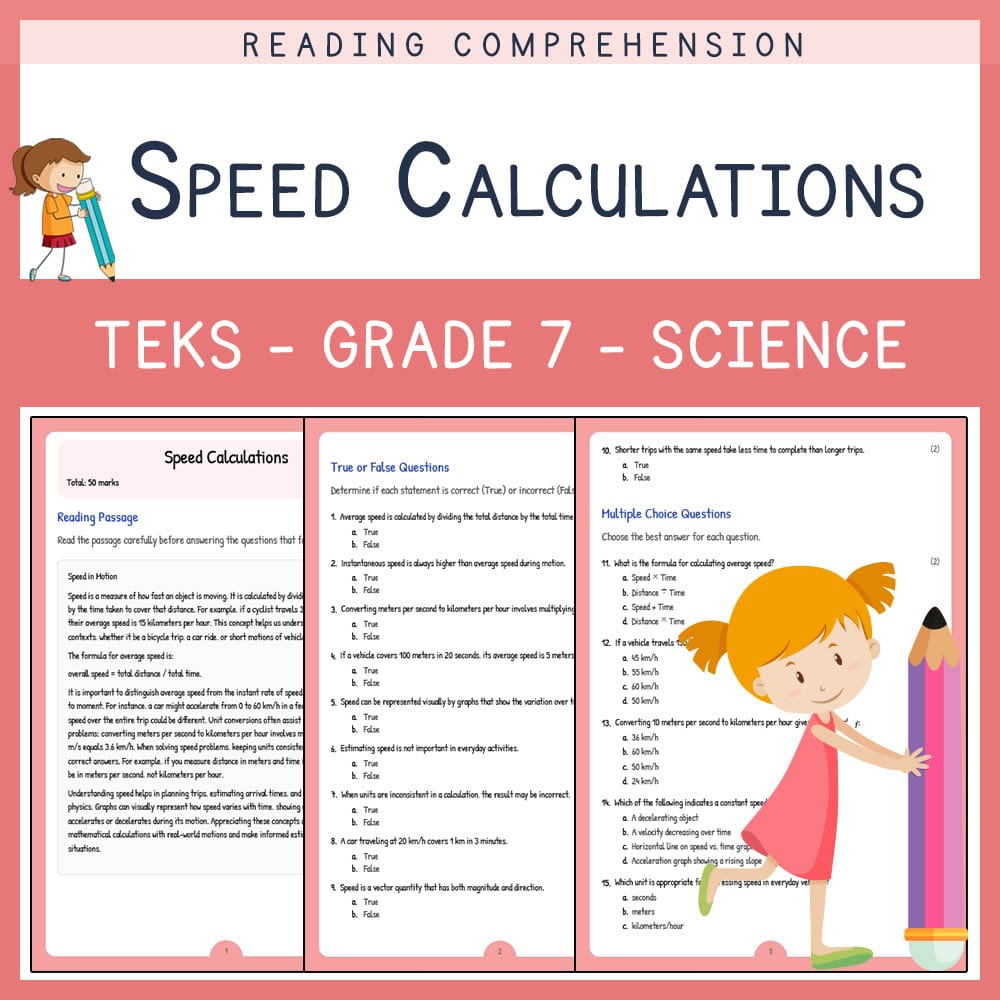 Grade 7 Science | Speed Calculations Worksheet | TEKS-Aligned
- Understand how to compute average speed using distance and time data.
- Differentiate between average speed and instantaneous rate.
- Apply unit conversions between meters per second and kilometers per hour.
$2.40$3.00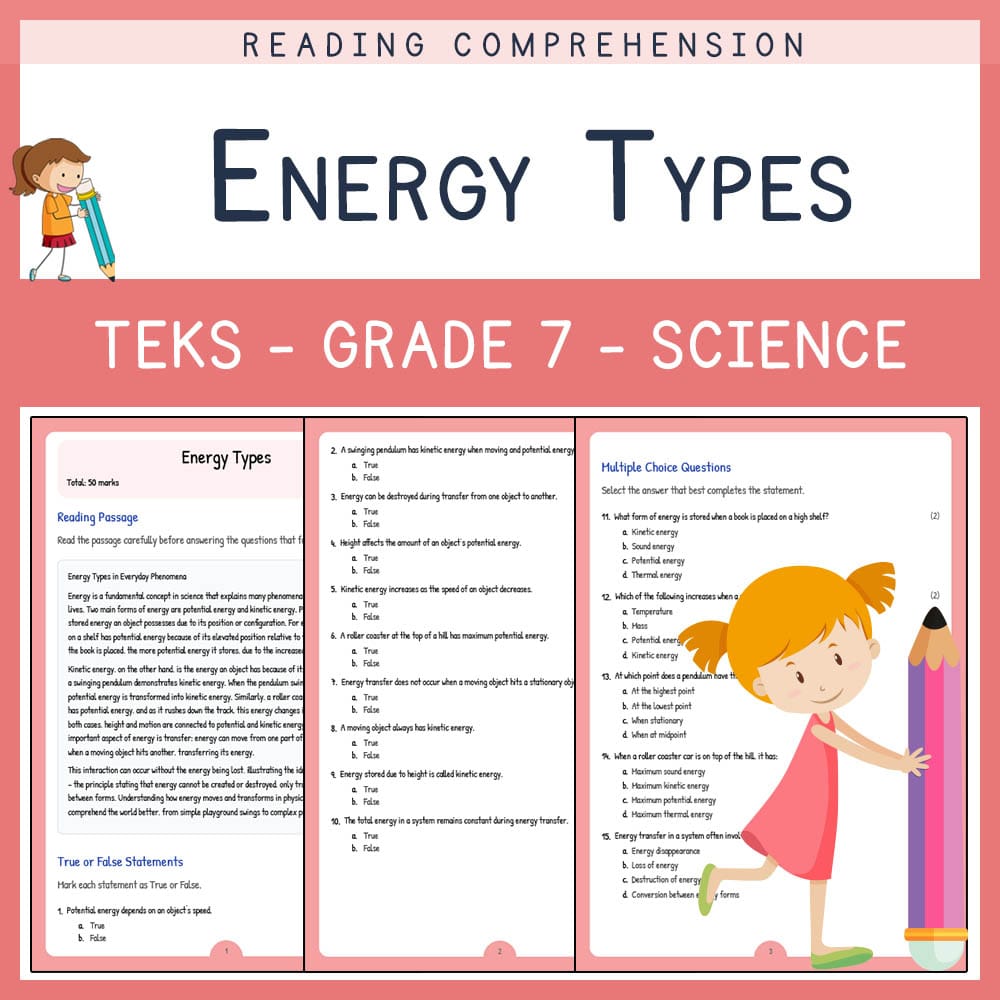 Grade 7 Science | Energy Types Worksheet | TEKS Aligned
- Define kinetic and potential energy using everyday phenomena.
- Explain how height and motion influence energy forms.
- Illustrate energy transfer among system components.
$2.40$3.00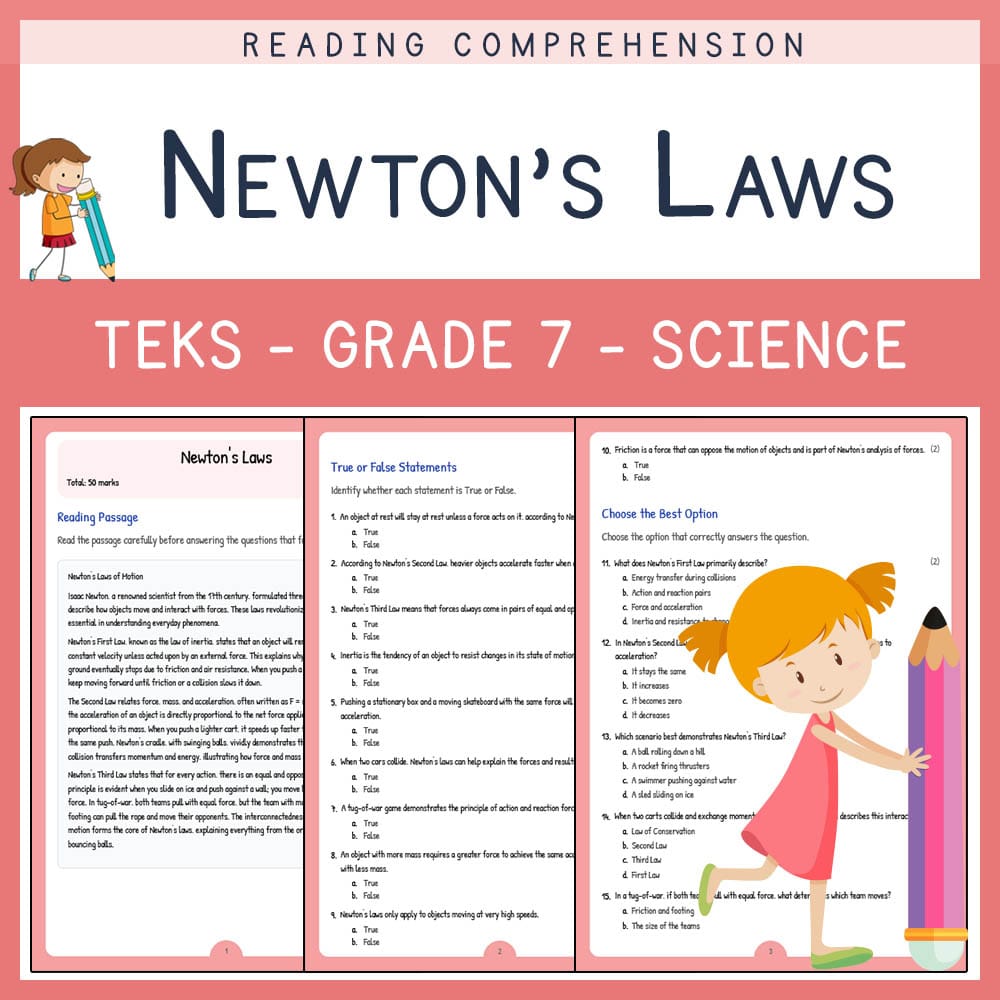 Grade 7 Science | Newton's Laws Worksheet | TEKS-Aligned
- Understand and explain Newton's three laws of motion through real-world examples.
- Identify situations where inertia, acceleration, and action–reaction pairs occur in everyday life.
- Relate algebraic proportion ideas to force and mass to interpret cause-and-effect relationships.
$2.40$3.00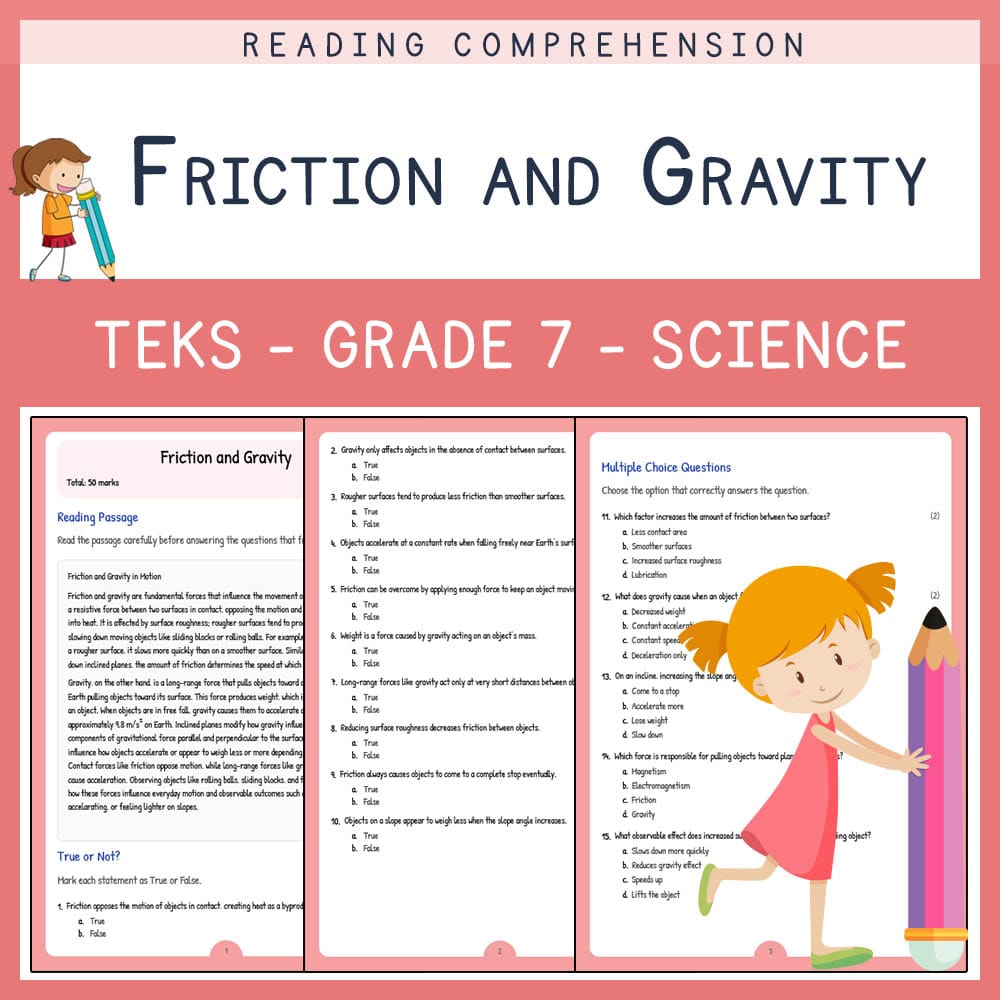 Grade 7 Science | Friction and Gravity Worksheet | TEKS Aligned
- Understand how friction opposes motion and how surface roughness influences resistance.
- Describe how gravity affects objects in free fall and on inclined planes.
- Differentiate between contact forces like friction and long-range forces like gravity.
$2.40$3.00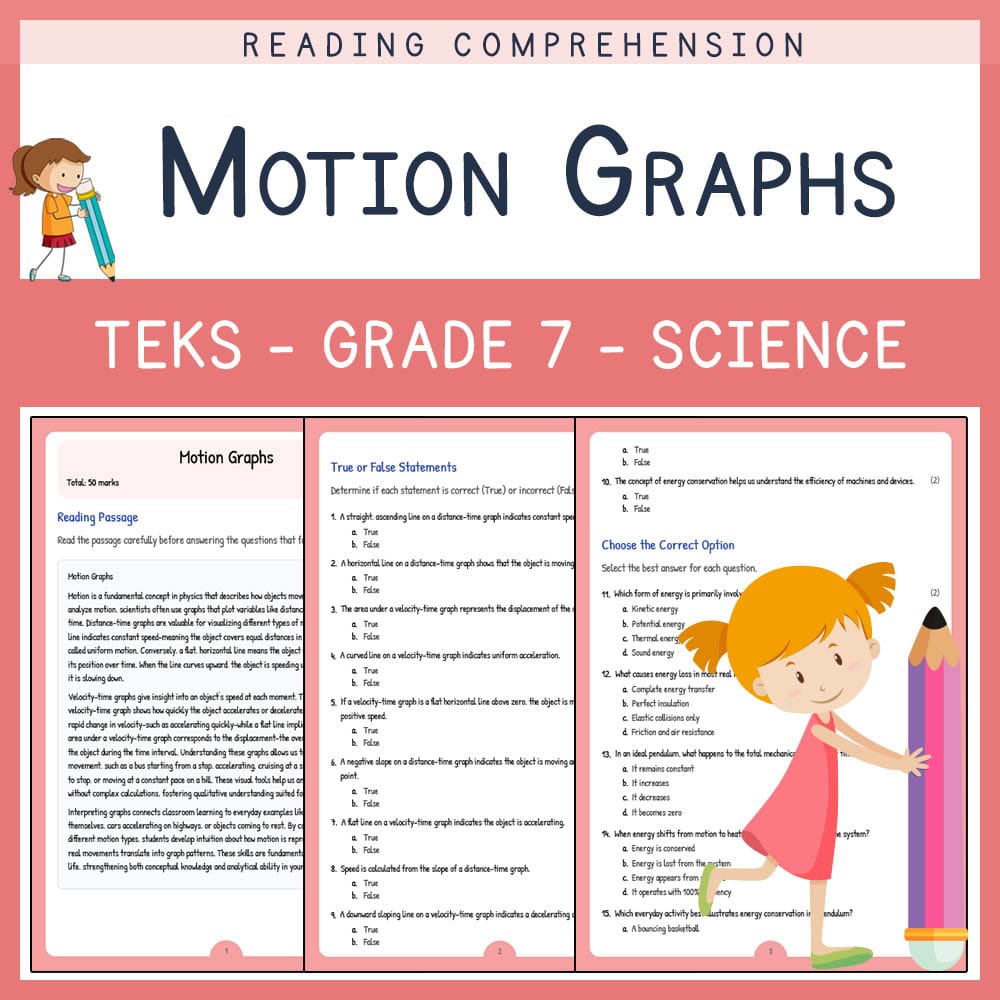 Grade 7 Science | Motion Graphs Worksheet | TEKS Aligned
- Interpret distance–time graphs to describe types of motion, including uniform motion, acceleration, and rest.
- Understand velocity–time graphs and relate slopes to speed and area under curves to displacement.
- Compare different graphs qualitatively and connect graphical patterns to real-world motion scenarios.
$2.40$3.00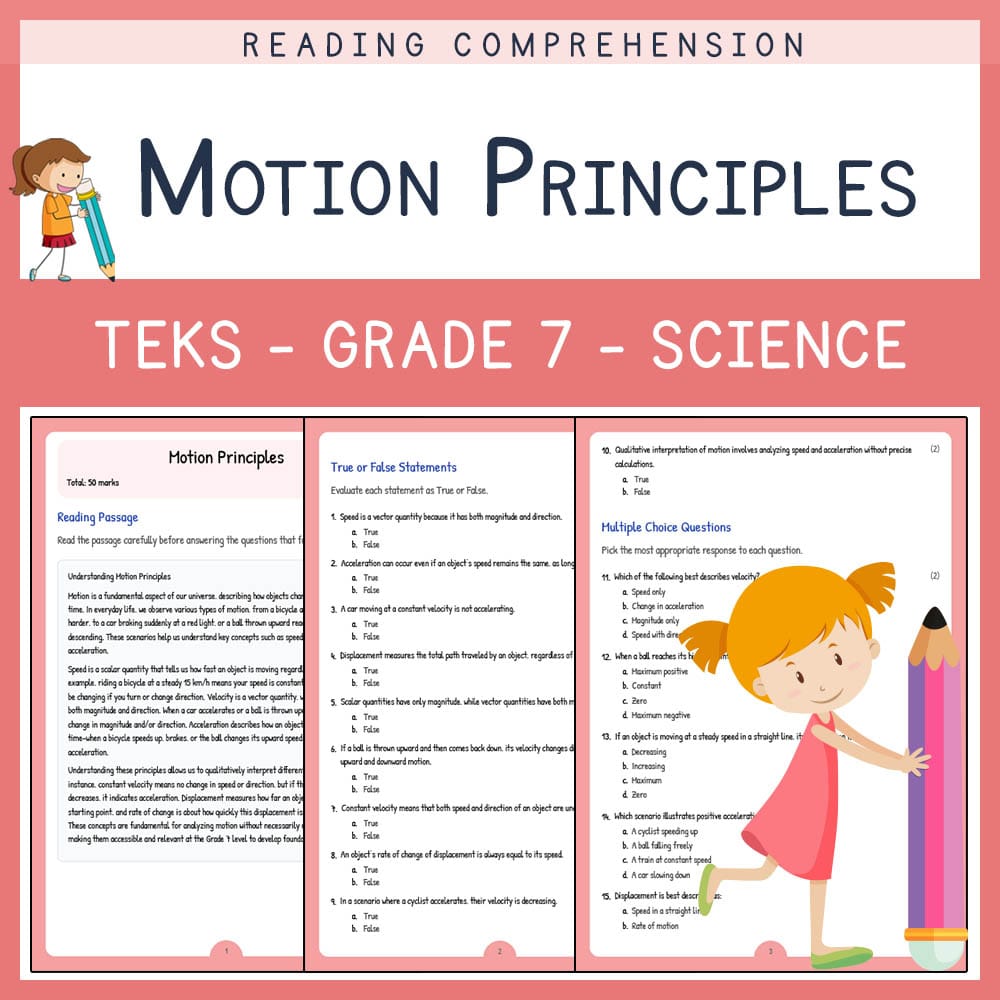 Grade 7 Science | Motion Principles Worksheet | TEKS Aligned
- Understand and distinguish between speed, velocity, and acceleration through real-world examples.
- Identify scalar versus vector quantities in motion scenarios.
- Analyze how displacement, time, and rate of change relate in various motion contexts.
$2.40$3.00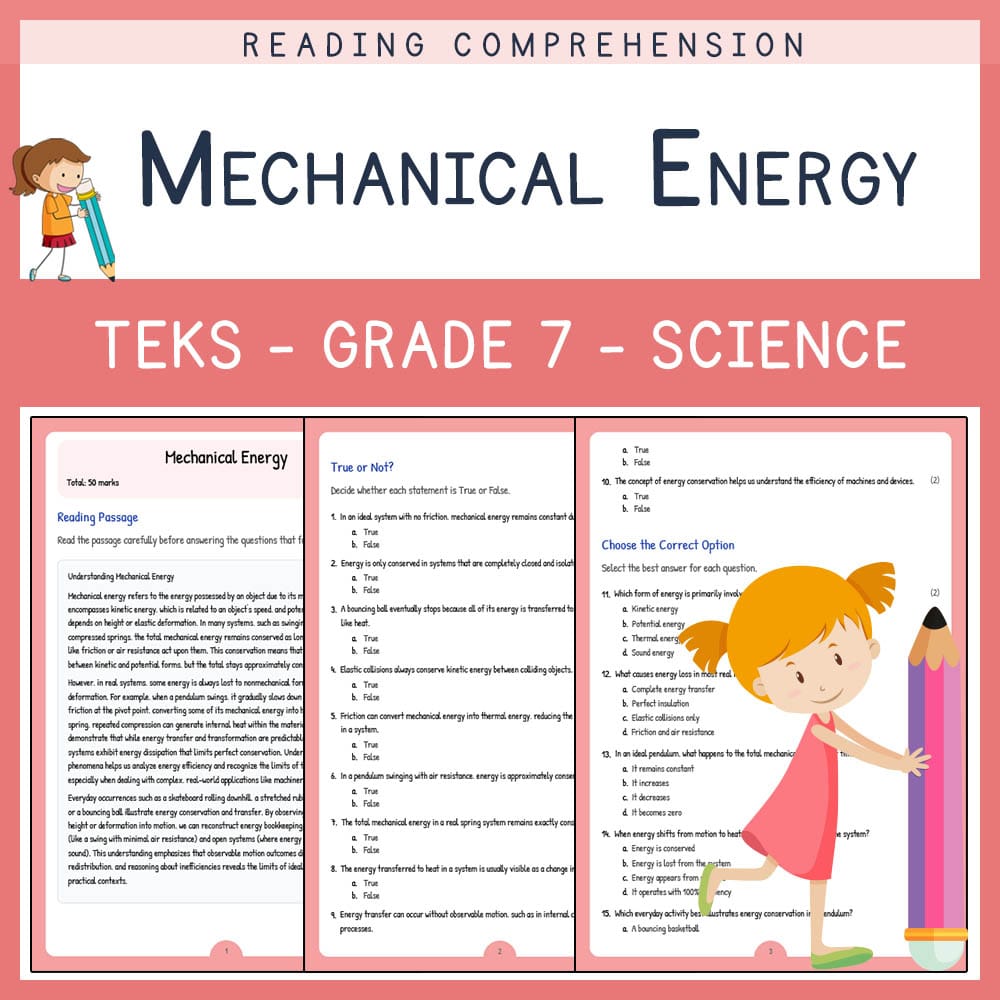 Grade 7 Science | Mechanical Energy Worksheet Elena | TEKS Alligned
- Understand the principles of mechanical energy conservation.
- Describe energy transfer processes in pendulums and springs.
- Identify observable signs of energy loss to nonmechanical forms.
$2.40$3.00
Reviews & Feedback
Loading reviews...
Questions & Answers
Loading questions…
About this bundle
Related categories
Frequently asked questions
Who is Grade 7 Science | Force, Motion, and Energy Lesson Bundle | TEKS Aligned designed for?
Grade 7 Science | Force, Motion, and Energy Lesson Bundle | TEKS Aligned is designed for Grade 7 students and can be used in classrooms, homeschool, or independent practice.
How do I download Grade 7 Science | Force, Motion, and Energy Lesson Bundle | TEKS Aligned?
Add it to your cart and complete checkout. After payment, you can download immediately from your account, and you'll also receive a download link by email.
Similar Products

Grade 6 Science Forces and Motion Worksheets Bundle | NGSS
$12.80$16.00

Grade 8 Force Motion and Energy Science Reading Worksheets Bundle | TEKS
$40.00$50.00

Grade 11 Science Cross-Discipline Models of Energy, Matter & Force Lesson
$48.00$60.00

Forces, Motion & Energy Lesson Bundle | Grade 9 Science (Alberta)
$56.00$70.00

Grade 11 Science | Metabolism & Energy Processes Lesson Bundle | TEKS-aligned
$24.00$30.00