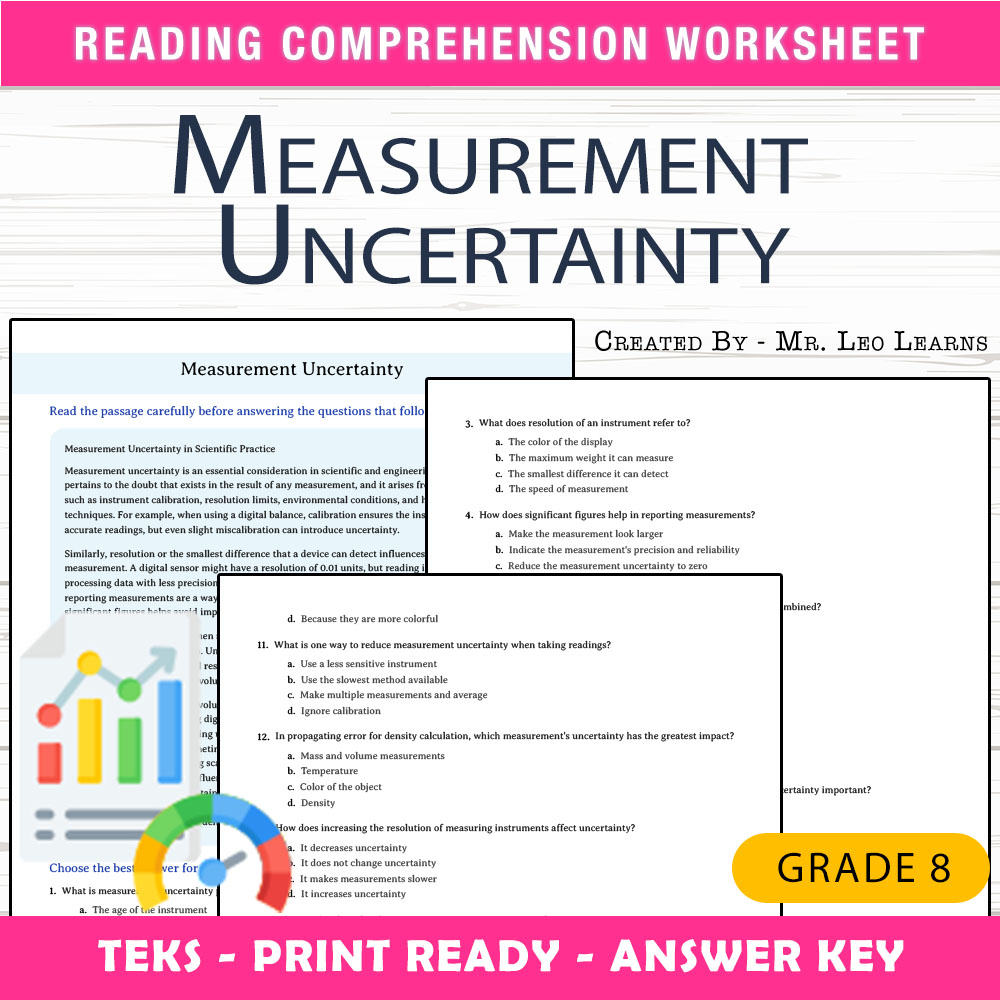
Imagine a busy classroom where students are carefully conducting experiments, but some are uncertain about how precise their measurements really are. This is a common challenge in science education, especially when teaching concepts like measurement uncertainty and the importance of accuracy. This worksheet provides a clear, structured way for students to explore the topic in depth, reinforcing their understanding through engaging questions and realistic scenarios. Perfect for supporting hands-on learning, it helps students move beyond guesswork to appreciate the significance of measurement precision in scientific and engineering contexts.
What This Resource Helps Students Do
This worksheet supports students in developing a strong understanding of measurement uncertainty, encouraging them to analyze how and why measurements can vary. Through guided reading and multiple-choice questions, students learn to identify sources of uncertainty, such as instrument limitations and human error. The worksheet builds confidence by providing multiple opportunities for independent practice and critical thinking, enabling students to interpret data accurately and recognize the importance of calibration and precision in scientific experiments. By engaging with these questions, students enhance their reasoning skills and ability to evaluate measurement results with greater confidence and clarity.
Inside the PDF
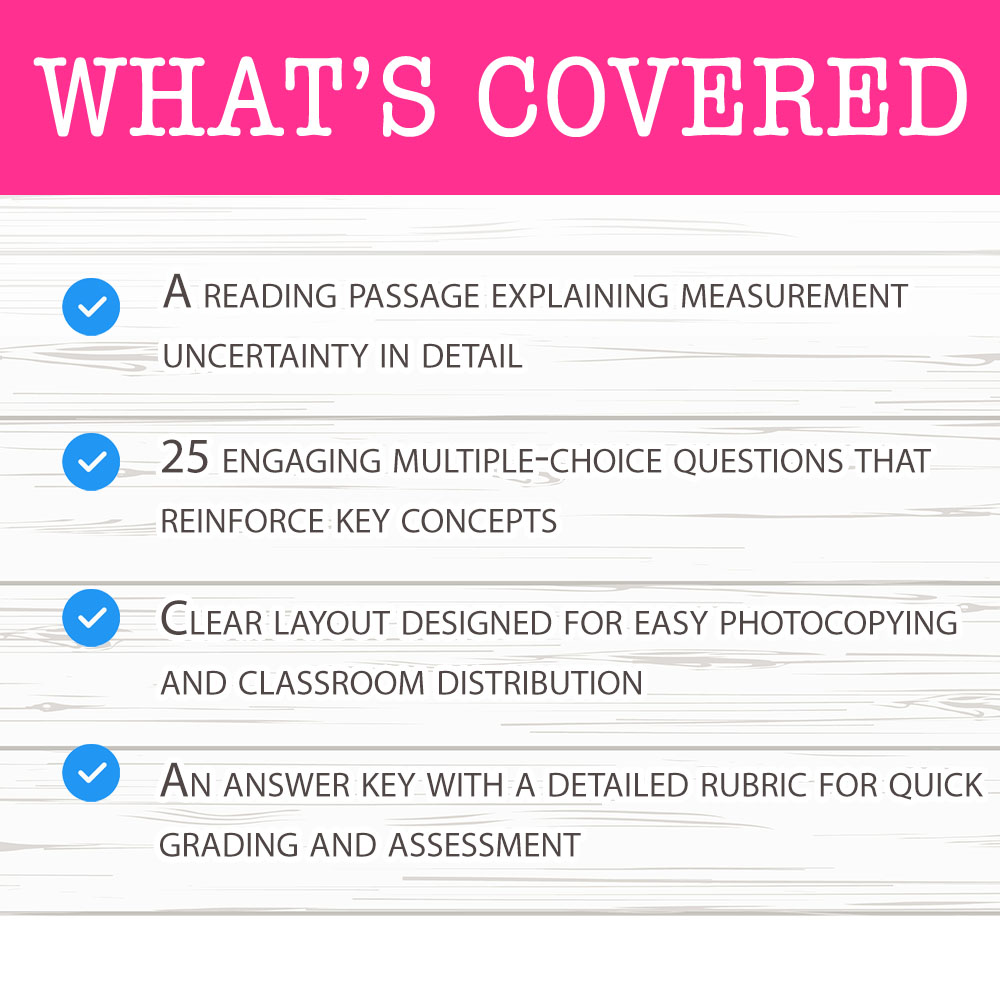
• A reading passage explaining measurement uncertainty in detail
• 25 engaging multiple-choice questions that reinforce key concepts
• A print-ready format that requires no additional preparation
• Clear layout designed for easy photocopying and classroom distribution
• An answer key with a detailed rubric for quick grading and assessment
How It Improves Learning
This worksheet enhances student understanding by presenting information in a straightforward way, making complex ideas more accessible. It guides students step-by-step through the concept of measurement uncertainty, helping them recognize common sources and implications. The multiple-choice questions encourage active thinking and application, moving students from simple recall to deeper analysis. Completing this worksheet fosters a sense of accuracy and precision, reinforcing important scientific practices. As students work through the questions, they develop confidence in interpreting measurement data and appreciate the role of calibration and error minimization in real-world science settings. The varied question formats and clear layout make it easier for students to grasp and retain critical concepts, leading to improved understanding and performance in science investigations.
Core Skills Students Will Develop
- ➡️ Understanding measurement uncertainty and its sources
- ➡️ Analyzing the importance of calibration in measurements
- ➡️ Interpreting data accuracy and precision
- ➡️ Critical thinking about scientific measurement practices
Ways Teachers Use This Worksheet
This resource serves multiple instructional purposes, ideal for classwork, homework assignments, or assessment reviews. Teachers can use it to reinforce lessons on measurement accuracy after hands-on activities or as a formative assessment to gauge student understanding of key concepts. It works well for small-group discussions or individual practice, especially for students who need additional support in scientific measurement techniques. Educators may also assign this worksheet as early finisher work or use it during review sessions to solidify understanding before assessments, ensuring students are confident in applying their knowledge of measurement uncertainty in various contexts.
Why This PDF Saves Time
This worksheet offers a ready-to-print, print-and-go format that reduces preparation time. Its clear layout and straightforward design make it easy for teachers to distribute and implement immediately. The included answer key with rubric streamlines grading and provides immediate feedback, saving valuable classroom time. With no need for additional formatting or digital tools, teachers have a reliable, consistent resource available for any science lesson involving measurement and data accuracy. Its simplicity ensures that teachers can focus on instruction and student engagement rather than content creation or setup.
Supported by this worksheet, teachers can confidently guide students through the important concepts of measurement uncertainty, helping learners develop skills that are vital for success in science. Whether used for direct instruction, review, or independent practice, this worksheet is designed to support student achievement and foster essential scientific reasoning. Ready to use in your classroom, it’s an effective tool to promote understanding and confidence in scientific measurements. 📚