
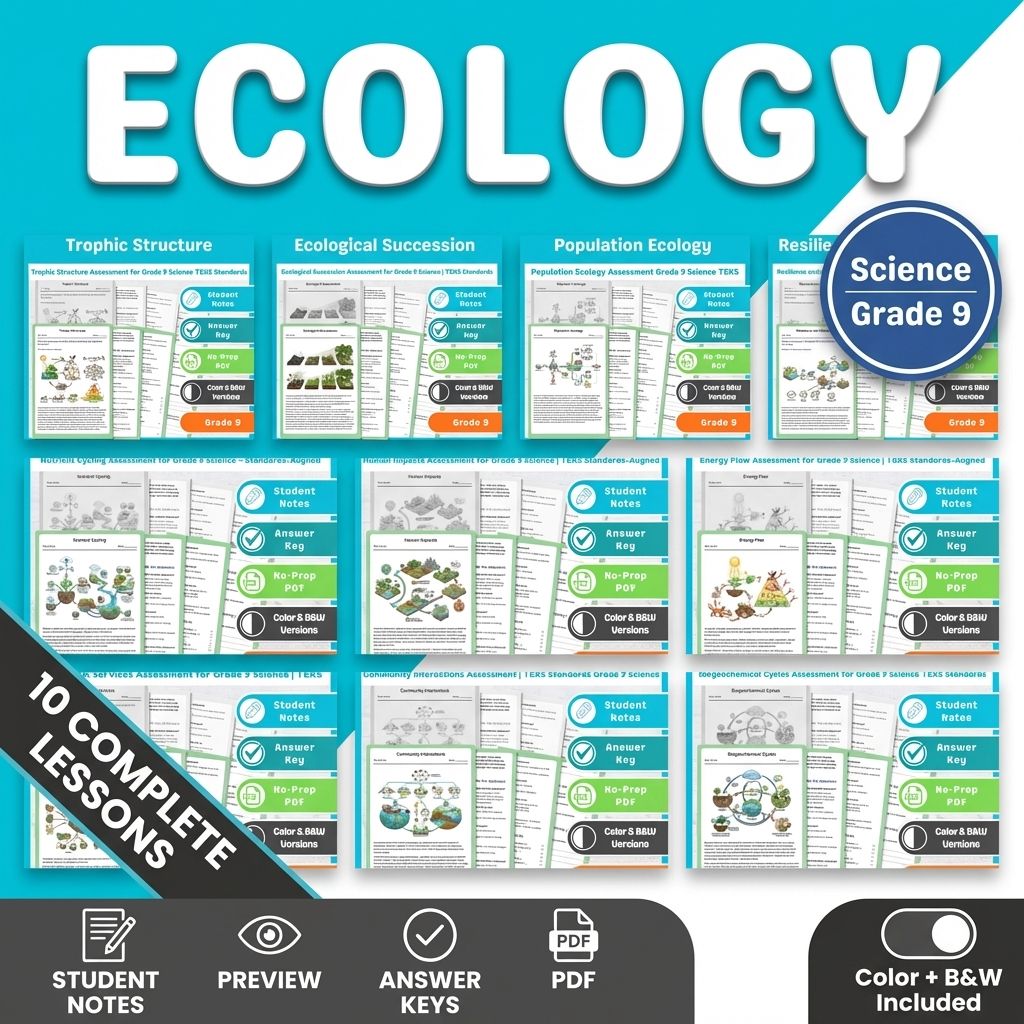
Grade 9 Ecology & Environmental Interactions Science lesson bundle: TEKS
$40.00$50.00Save $10.00
Prism Point Learning
·2 followers·13 sales
SubjectScienceGradeGrade 9
What’s included
10 worksheets · Save $10.00 (20%) · prices shown inside the bundle
 Energy Flow Assessment for Grade 9 Science | TEKS Standards-Aligned
- Explain how energy moves through ecosystems from primary producers to consumers and decomposers.
- Describe the process of photosynthesis and its role in transferring energy within an ecosystem.
- Understand the concept of energy transfer efficiency and how energy pyramids illustrate trophic levels.
$4.00$5.00 Ecosystem Services Assessment for Grade 9 Science | TEKS
- Define and describe different types of ecosystem services including provisioning, regulating, cultural, and supporting functions.
- Explain the role of biodiversity in maintaining ecosystem services such as pollination and water purification.
- Analyze how land-use change, pollution, and climate shifts affect ecosystem service capacity and distribution.
$4.00$5.00 Nutrient Cycling Assessment for Grade 9 Science – Standards-Aligned
- Understand the processes involved in nutrient cycling and their role in ecosystems.
- Identify key biological and physical mechanisms affecting nitrogen and phosphorus movement.
- Explain the impact of human activities on nutrient cycling and aquatic health.
$4.00$5.00 Community Interactions Assessment | TEKS Standards Grade 9 Science
- Understand the different types of species interactions that shape community structure.
- Identify examples of ecosystem engineers and keystone species.
- Explain how indirect effects influence ecosystem stability.
$4.00$5.00 Population Ecology Assessment Grade 9 Science TEKS
- Understand the key factors that influence population growth and decline.
- Identify the differences between density-dependent and density-independent factors.
- Analyze how population patterns affect community structure and ecosystem dynamics.
$4.00$5.00 Biogeochemical Cycles Assessment for Grade 9 Science TEKS Standards
- Understand the components and processes involved in biogeochemical cycles.
- Identify how elements like carbon, nitrogen, and phosphorus move through Earth's spheres.
- Explain the role of biological processes such as photosynthesis, decomposition, and nitrogen fixation.
$4.00$5.00 Trophic Structure Assessment for Grade 9 Science TEKS Standards
- Explain the roles of producers, consumers, and decomposers in ecosystems.
- Describe how food chains and webs illustrate energy flow among species.
- Identify factors affecting trophic efficiency and ecosystem productivity.
$4.00$5.00 Resilience and Resistance Assessment | TEKS Standards Grade 9 Science
- Define and differentiate between resilience and resistance in ecosystems.
- Explain how ecological thresholds influence regime shifts and community functions.
- Identify factors such as feedback loops, variability, and connectivity that affect ecosystem resilience.
$4.00$5.00 Ecological Succession Assessment for Grade 9 Science | TEKS Standards
- Understand the concepts of primary and secondary succession in ecosystems.
- Identify factors influencing succession dynamics and trajectories.
- Describe how species traits, dispersal, and disturbance regimes affect ecosystem recovery.
$4.00$5.00 Human Impacts Assessment for Grade 9 Science | TEKS Standards-Aligned
- Identify human activities that affect biodiversity and ecosystem services.
- Describe the effects of habitat fragmentation, pollution, and resource extraction.
- Analyze how changes in species diversity influence ecosystem functions and services.
$4.00$5.00
Reviews & Feedback
Loading reviews...
Questions & Answers
Loading questions…
About this bundle
Related categories
Frequently asked questions
Who is Grade 9 Ecology & Environmental Interactions Science lesson bundle: TEKS designed for?
Grade 9 Ecology & Environmental Interactions Science lesson bundle: TEKS is designed for Grade 9 students and Science learners and can be used in classrooms, homeschool, or independent practice.
How do I download Grade 9 Ecology & Environmental Interactions Science lesson bundle: TEKS?
Add it to your cart and complete checkout. After payment, you can download immediately from your account, and you'll also receive a download link by email.
Similar Products

Grade 10 Ecology & Environmental Interactions Science Worksheets | TEKS
$48.00$60.00

Ecology & Environmental Interactions Lesson Bundle | Grade 10 Science | TEKS
$48.00$60.00

Grade 11 Ecosystem & Ecology Science Lesson Bundle | TEKS Daily Reading
$32.00$40.00

Grade 9 Science Ecosystems Lesson Bundle | NGSS Interactions & Energy
$12.00$15.00

Ecology & Environmental Interactions Lesson Bundle | Grade 11 Science | TEKS
$40.00$50.00