
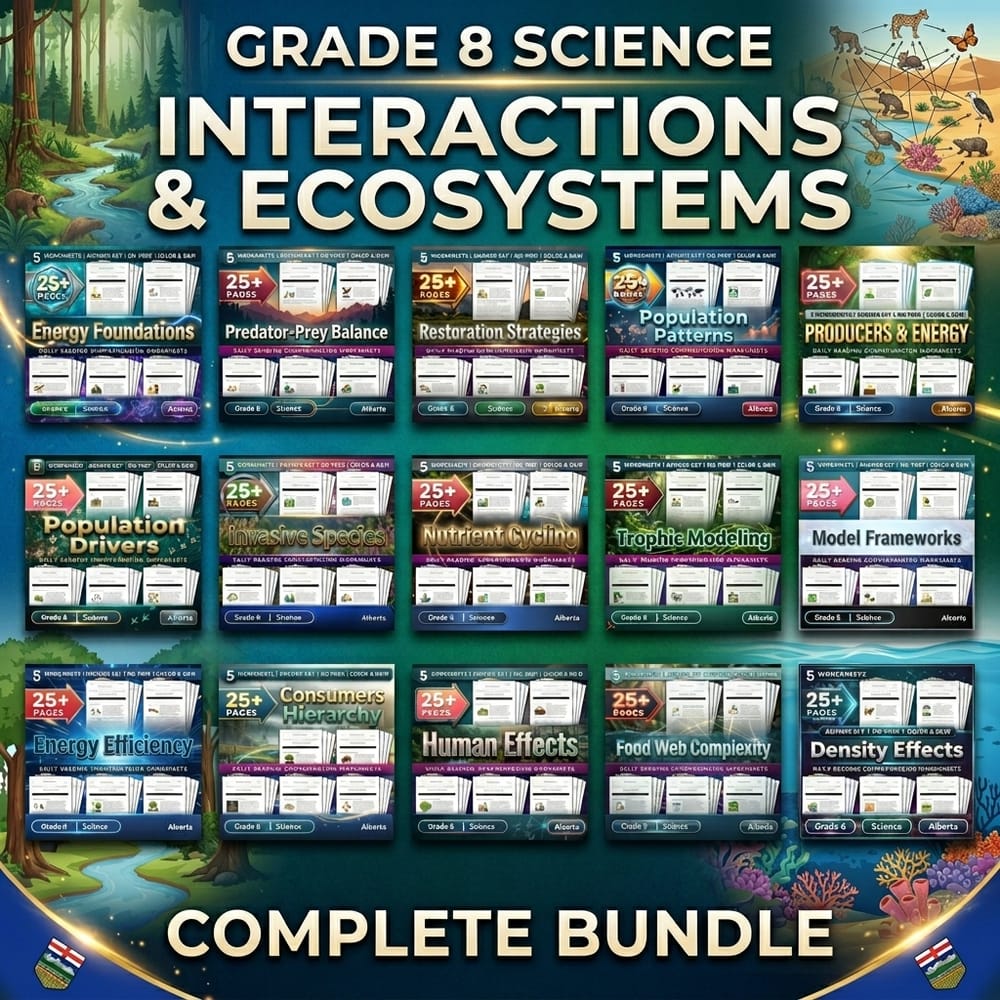


Interactions and Ecosystems Lesson Bundle Grade 8 Science – Alberta
$60.00$75.00Save $15.00
Coral Reef Learning
·2 followers·23 sales
SubjectScienceGradeGrade 8
What’s included
15 worksheets · Save $15.00 (20%) · prices shown inside the bundle
 Grade 8 Science | Energy Foundations in Ecosystems - Daily Reading Comprehension
- Understand primary sources of energy in ecosystems, such as sunlight and chemical energy.
- Describe how energy moves through different trophic levels in a food web.
- Explain the roles of producers, consumers, decomposers, and detritivores in energy transfer.
$4.00$5.00 Grade 8 Science | Predator–Prey Balance - Daily Reading Comprehension
- Explain the concept of predator-prey relationships in ecosystems.
- Identify examples of predator-prey interactions such as wolf–elk and raptor–rodent.
- Describe how predator presence or absence affects community structure and population dynamics.
$4.00$5.00 Grade 8 Science | Ecological Restoration Strategies for Ecosystem Recovery
- Understand the principles of habitat reclamation and restoration.
- Identify different strategies used to restore ecological functions.
- Analyze the importance of monitoring recovery metrics.
$4.00$5.00 Grade 8 Science | Population Patterns in Science - Daily Reading Comprehension
- Understand the basic concepts of population change.
- Identify the characteristics of exponential growth.
- Recognize factors that influence population dynamics.
$4.00$5.00 Grade 8 Science | Producers & Energy - Daily Reading Comprehension
- Identify different types of primary producers in ecosystems.
- Understand the role of producers in converting solar and chemical energy.
- Distinguish between various ecosystems based on producer types and productivity.
$4.00$5.00 Grade 8 Science | Understanding Population Drivers - Daily Reading Comprehension
- Identify key factors influencing population size and distribution
- Explain how abiotic and biotic components interact to shape populations
- Relate real-world examples such as migration, habitat, and climate effects
$4.00$5.00 Grade 8 Science | Invasive Species & Ecosystems - Daily Reading Comprehension
- Understand the concept of invasive species and their pathways into new ecosystems.
- Identify specific examples of invasive plants and aquatic organisms in Alberta.
- Describe the ecological impacts of invasive species on native biodiversity and ecosystems.
$4.00$5.00 Grade 8 Science | Nutrient Cycling - Daily Reading Comprehension
- Understand the key processes involved in nutrient cycling within ecosystems.
- Identify the roles of decomposers, nitrogen fixation, and mineralization.
- Learn how environmental factors such as temperature and moisture influence nutrient cycling rates.
$4.00$5.00 Grade 8 Science | Trophic Modeling in Ecosystems - Daily Reading Comprehension
- Identify the basic components of trophic models
- Explain how energy flows among different trophic levels
- Describe the purpose of flow diagrams and mathematical models in ecology
$4.00$5.00 Grade 8 Science | Understanding Ecosystem Models - Daily Reading Comprehension
- Identify key components of ecological models such as trophic levels and nutrient pools.
- Explain how models represent the movement of matter and energy within ecosystems.
- Interpret model outputs and recognize their assumptions and limitations.
$4.00$5.00
Reviews & Feedback
Loading reviews...
Questions & Answers
Loading questions…
About this bundle
Related categories
Frequently asked questions
Who is Interactions and Ecosystems Lesson Bundle Grade 8 Science – Alberta designed for?
Interactions and Ecosystems Lesson Bundle Grade 8 Science – Alberta is designed for Grade 8 students and Science learners and can be used in classrooms, homeschool, or independent practice.
How do I download Interactions and Ecosystems Lesson Bundle Grade 8 Science – Alberta?
Add it to your cart and complete checkout. After payment, you can download immediately from your account, and you'll also receive a download link by email.
Similar Products

Interactions and Ecosystems Lesson Bundle Grade 7 Science – Alberta
$60.00$75.00

Grade 6 Ecosystem Interactions Science Lesson Bundle: Alberta Framework
$60.00$75.00

Grade 6 Life Processes & Ecosystem Interactions Science Lesson Bundle: General
$28.80$36.00

Grade 7 Science Ecosystems Lesson Bundle | NGSS Interactions & Energy
$20.00$25.00

Grade 9 Science Ecosystems Lesson Bundle | NGSS Interactions & Energy
$12.00$15.00