
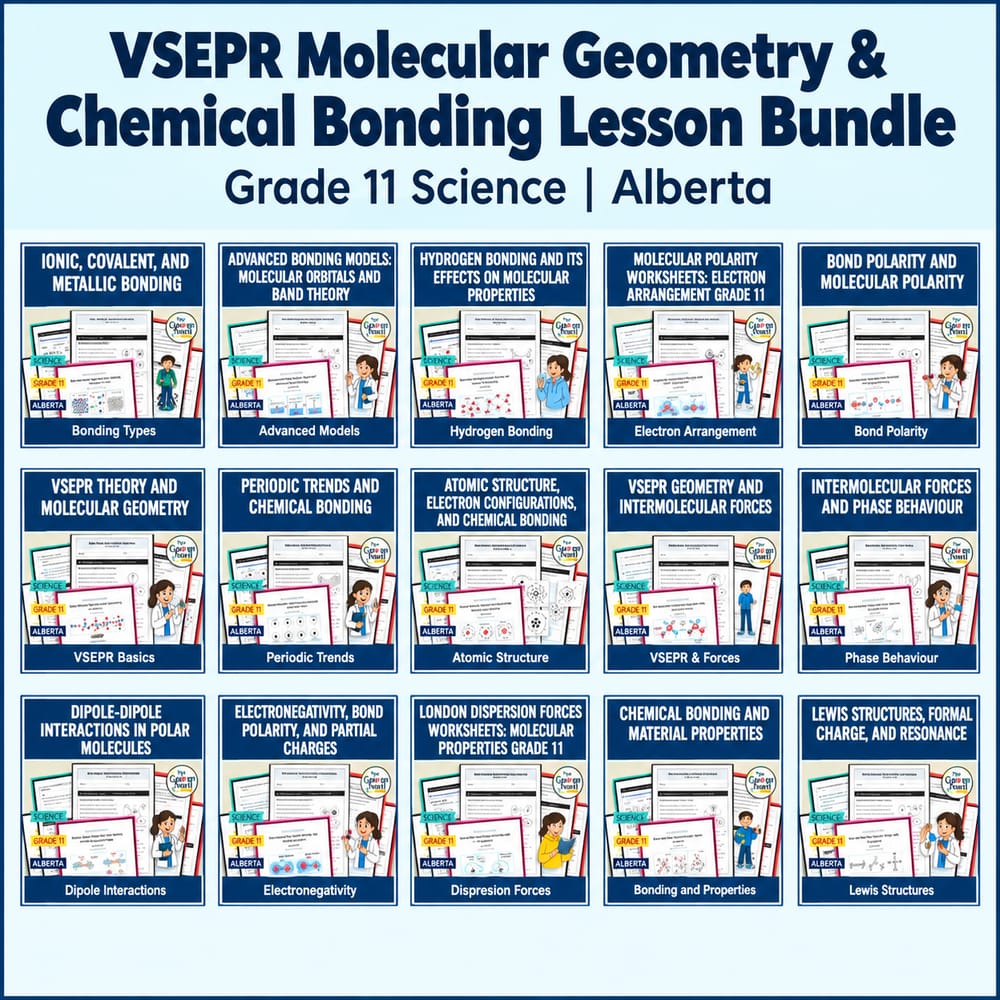


VSEPR Molecular Geometry & Chemical Bonding Lesson Bundle | Grade 11 Science | Alberta
$48.00$60.00Save $12.00
the curious pencil
·1 followers·3 sales
SubjectScienceGradeGrade 11Pages280 PagesSubject areaChemistry, Physical Science, Basic Principles, Environment, General Science, PhysicsStandardsAligned to Alberta curriculumAnswer keyIncluded
What’s included
15 worksheets · 280 pages · Save $12.00 (20%) · prices shown inside the bundle
 Ionic, Covalent and Metallic Bonding Worksheet | Grade 11 Science
- Compare electron transfer, sharing, and delocalisation in chemical bonds
- Describe ionic lattices, covalent molecules, and metallic structures
- Explain electrical conductivity using mobile ions and electrons
$3.20$4.00 Molecular Orbital Theory and Band Theory Worksheet Grade 11 Science
- Explain how atomic orbitals combine to form molecular orbitals
- Compare bonding and antibonding orbitals by formation and relative energy
- Distinguish conductors, semiconductors, and insulators using band gaps
$3.20$4.00 Hydrogen Bonding and Molecular Properties Worksheet | Grade 11 Science
- Identify suitable donor and acceptor groups involved in hydrogen bonding.
- Explain how hydrogen bonding influences water's boiling point and ice density.
- Relate hydrogen bonding to protein structure and polymer properties.
$3.20$4.00 Molecular Polarity Worksheets: Electron Arrangement Grade 11 Chemistry
- Explain how electronegativity differences affect electron distribution
- Compare the polarity of water and carbon dioxide
- Interpret molecular geometry and bond dipoles to predict polarity
$3.20$4.00 Bond Polarity and Molecular Polarity Worksheet for Grade 11 Chemistry
- Explain how electronegativity differences produce partial charges in covalent bonds.
- Represent bond dipoles as vectors pointing toward more electronegative atoms.
- Compare molecular polarity using molecular geometry and bond dipole cancellation.
$3.20$4.00 VSEPR Theory and Molecular Geometry Worksheets Grade 11 Science
- Explain how electron-group repulsion determines molecular geometry
- Identify five common electron-group geometries and their ideal angles
- Distinguish bonding pairs from nonbonding electron pairs
$3.20$4.00 Periodic Trends and Chemical Bonding Worksheets | Grade 11 Chemistry
- Explain atomic radius trends across periods and down groups
- Compare ionization energy with electronegativity
- Predict cation and anion formation from periodic trends
$3.20$4.00 Atomic Structure and Chemical Bonding Worksheet | Grade 11 Science
- Identify the locations, charges, and roles of subatomic particles.
- Determine electron configurations from atomic numbers.
- Explain how valence electrons influence ion formation and reactivity.
$3.20$4.00 VSEPR Geometry and Intermolecular Forces Worksheet | Grade 11 Chemistry
- Use VSEPR theory to predict molecular shapes.
- Explain how molecular geometry affects permanent molecular polarity.
- Distinguish London dispersion, dipole-dipole, and hydrogen bonding.
$3.20$4.00 Intermolecular Forces and Phase Behaviour Worksheet Grade 11 Science
- Explain how intermolecular attractions influence vapour pressure and boiling point.
- Compare how molecular size and polarity affect boiling behaviour.
- Interpret phase diagrams to describe physical states under changing conditions.
$3.20$4.00
Reviews & Feedback
Loading reviews...
Questions & Answers
Loading questions…
About this bundle
Related categories
Frequently asked questions
Who is VSEPR Molecular Geometry & Chemical Bonding Lesson Bundle | Grade 11 Science | Alberta designed for?
VSEPR Molecular Geometry & Chemical Bonding Lesson Bundle | Grade 11 Science | Alberta is designed for Grade 11 students and Science learners and can be used in classrooms, homeschool, or independent practice.
How do I download VSEPR Molecular Geometry & Chemical Bonding Lesson Bundle | Grade 11 Science | Alberta?
Add it to your cart and complete checkout. After payment, you can download immediately from your account, and you'll also receive a download link by email.

