
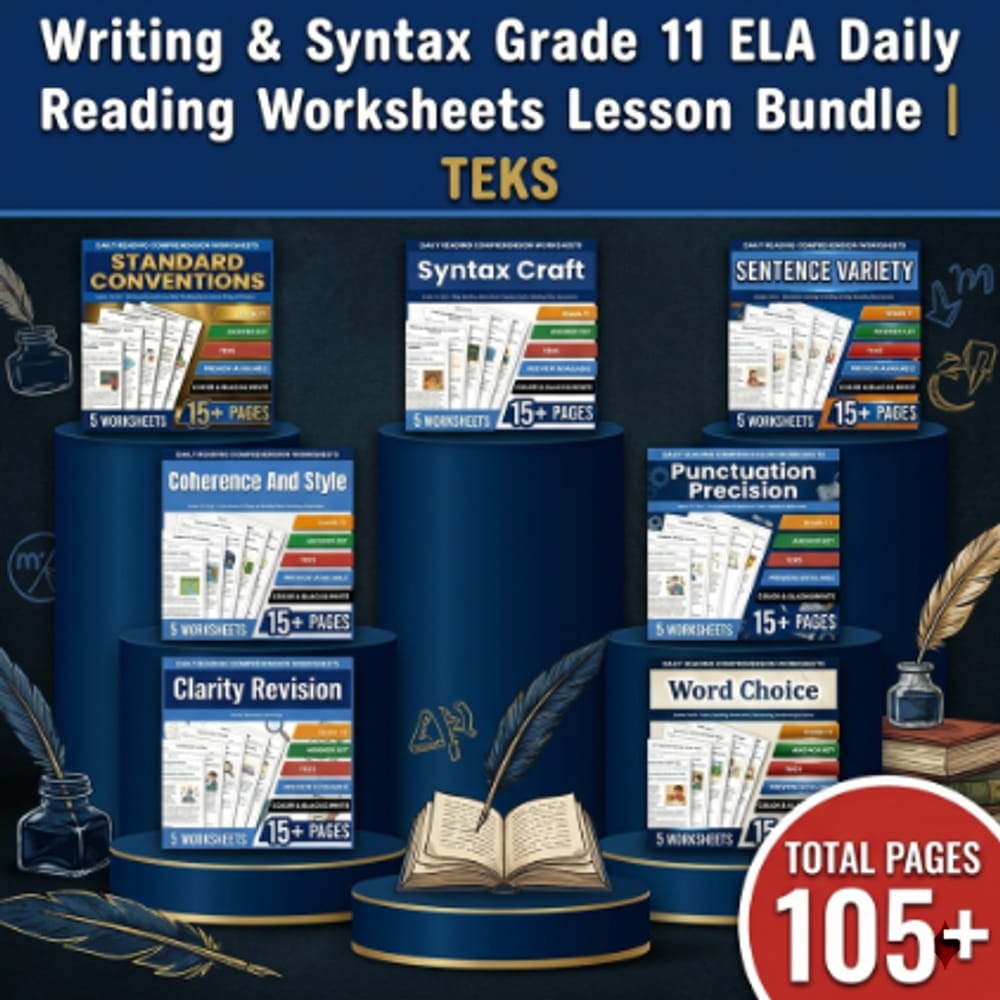
Writing & Syntax Grade 11 ELA Daily Reading Worksheets Lesson Bundle | TEKS
$22.40$28.00Save $5.60
Quiet Forest Education
·3 followers·20 sales
SubjectELAGradeGrade 11Pages214 Pages
What’s included
7 worksheets · 214 pages · Save $5.60 (20%) · prices shown inside the bundle
 Grade 11 ELA – Standard Conventions Daily Reading Worksheet | 5 Days of Practice
- Understand key concepts related to ELA
- Apply knowledge through practice questions
- Demonstrate comprehension of the material
$3.20$4.00 Grade 11 ELA – Daily Reading Worksheet | Syntax Craft: Building Clear Sentences
- Understand the basic components of sentence structure
- Identify main ideas and supporting details within sentences
- Improve sentence clarity by avoiding misplaced modifiers
$3.20$4.00 Grade 11 ELA – Sentence Variety & Writing | Daily Reading Worksheet
- Understand key concepts related to ELA
- Apply knowledge through practice questions
- Demonstrate comprehension of the material
$3.20$4.00 Grade 11 ELA – Coherence & Style in Writing Daily Reading Worksheet
- Identify elements that contribute to logical flow in a paragraph.
- Recognize purposeful transitions that enhance coherence.
- Understand how paragraph grouping supports an overall line of reasoning.
$3.20$4.00 Grade 11 ELA – Punctuation & Commas | Daily Reading Worksheet
- Understand key concepts related to ELA
- Apply knowledge through practice questions
- Demonstrate comprehension of the material
$3.20$4.00 Grade 11 ELA – Clarity Revision in Writing & Reading | Daily Reading Worksheet
- Identify vague and unclear language in sentences
- Understand the importance of clarity for effective communication
- Practice revising sentences to improve clarity and conciseness
$3.20$4.00 Grade 11 ELA – Daily Reading Worksheet | Enhancing Vocabulary & Verbs
- Identify and select precise verbs to improve clarity and tone in writing.
- Understand how stronger verb choices can influence the mood and impact of a paragraph.
- Practice revising sentences by substituting general verbs with more specific alternatives.
$3.20$4.00
Reviews & Feedback
Loading reviews...
Questions & Answers
Loading questions…
About this bundle
Related categories
Frequently asked questions
Who is Writing & Syntax Grade 11 ELA Daily Reading Worksheets Lesson Bundle | TEKS designed for?
Writing & Syntax Grade 11 ELA Daily Reading Worksheets Lesson Bundle | TEKS is designed for Grade 11 students and ELA learners and can be used in classrooms, homeschool, or independent practice.
How do I download Writing & Syntax Grade 11 ELA Daily Reading Worksheets Lesson Bundle | TEKS?
Add it to your cart and complete checkout. After payment, you can download immediately from your account, and you'll also receive a download link by email.
Similar Products

Grade 8 ELA Full-Year Bundle | TEKS Daily Reading
$112.00$160.00

Evidence & Research Grade 11 ELA Daily Reading Worksheets Lesson Bundle | TEKS
$16.00$20.00

Writing & Argument Grade 11 ELA Daily Reading Worksheets Lesson Bundle | TEKS
$38.40$48.00

Grade 10 ELA Language Lesson Bundle | TEKS Daily Reading & Writing Skills
$44.80$56.00

Writing Grade 10 ELA Daily Reading Worksheets Lesson Bundle | teks
$32.00$40.00