
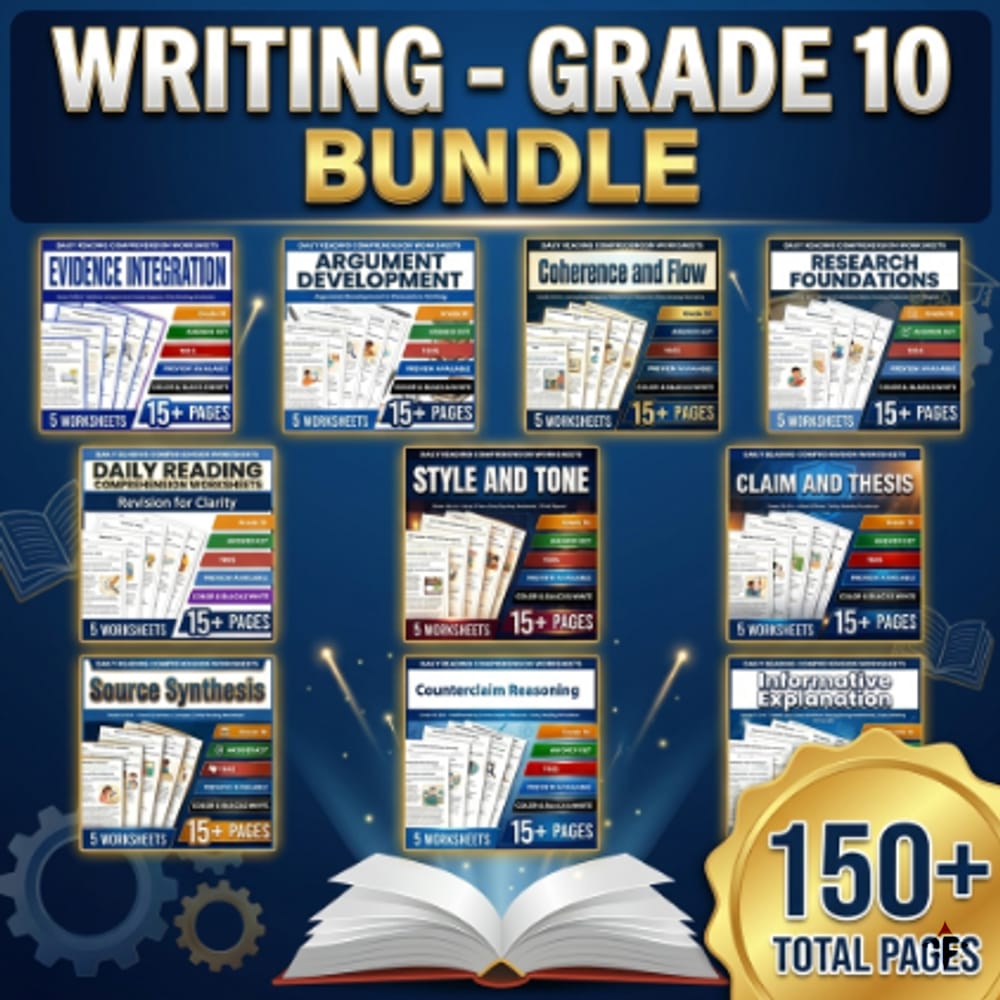
Writing Grade 10 ELA Daily Reading Worksheets Lesson Bundle | teks
$32.00$40.00Save $8.00
Quiet Forest Education
·3 followers·20 sales
SubjectELAGradeGrade 10Pages307 Pages
What’s included
10 worksheets · 307 pages · Save $8.00 (20%) · prices shown inside the bundle
 Grade 10 ELA – Evidence Integration & Textual Support | Daily Reading Worksheet
- Identify quotations and paraphrases within a text
- Understand the role of context and commentary in evidence-based writing
- Analyze how evidence supports an argument or explanation
$3.20$4.00 Grade 10 ELA – Argument Development & Persuasive Writing | Daily Worksheet
- Identify the main argument or thesis statement in a text.
- Understand how evidence supports claims in argumentative writing.
- Distinguish between different types of supporting details.
$3.20$4.00 Grade 10 ELA – Analyzing Paragraph Structure & Coherence | Daily Worksheet
- Identify the components of well-organized paragraphs
- Analyze how transition words improve coherence
- Understand the importance of logical sequence in paragraph development
$3.20$4.00 Grade 10 ELA – Research Foundations Daily Reading Worksheet | TEKS Aligned
- Evaluate the credibility of sources used in research-based writing.
- Understand how to select reliable sources to strengthen written arguments.
- Identify characteristics of credible information in various sources.
$3.20$4.00 Grade 10 ELA – Revision for Clarity & Response Practice | Daily Worksheet
- Refine sentence clarity and word choice
- Identify and correct vague or imprecise language
- Enhance sentence structure for better clarity
$3.20$4.00 Grade 10 ELA – Style & Tone Daily Reading Worksheet | TEKS Aligned
- Understand key concepts related to ELA
- Apply knowledge through practice questions
- Demonstrate comprehension of the material
$3.20$4.00 Grade 10 ELA – Claim & Thesis | Daily Reading Worksheet
- Understand key concepts related to ELA
- Apply knowledge through practice questions
- Demonstrate comprehension of the material
$3.20$4.00 Grade 10 ELA – Source Synthesis & Analysis | Daily Reading Worksheet
- Understand key concepts related to ELA
- Apply knowledge through practice questions
- Demonstrate comprehension of the material
$3.20$4.00 Grade 10 ELA – Understanding Counterclaim & Rebuttal | Daily Reading Worksheet
- Identify counterclaims in argumentative texts.
- Understand how to acknowledge opposing viewpoints.
- Practice writing rebuttals that strengthen an argument.
$3.20$4.00 Grade 10 ELA – Explaining Cause & Organizing Information | Daily Worksheet
- Identify causes and effects in an explanatory text
- Understand how environmental factors influence observable outcomes
- Develop skills to analyze cause-and-effect relationships in informational writing
$3.20$4.00
Reviews & Feedback
Loading reviews...
Questions & Answers
Loading questions…
About this bundle
Related categories
Frequently asked questions
Who is Writing Grade 10 ELA Daily Reading Worksheets Lesson Bundle | teks designed for?
Writing Grade 10 ELA Daily Reading Worksheets Lesson Bundle | teks is designed for Grade 10 students and ELA learners and can be used in classrooms, homeschool, or independent practice.
How do I download Writing Grade 10 ELA Daily Reading Worksheets Lesson Bundle | teks?
Add it to your cart and complete checkout. After payment, you can download immediately from your account, and you'll also receive a download link by email.
Similar Products

Grade 8 ELA Full-Year Bundle | TEKS Daily Reading
$112.00$160.00

Evidence & Research Grade 11 ELA Daily Reading Worksheets Lesson Bundle | TEKS
$16.00$20.00

Writing & Argument Grade 11 ELA Daily Reading Worksheets Lesson Bundle | TEKS
$38.40$48.00

Writing & Syntax Grade 11 ELA Daily Reading Worksheets Lesson Bundle | TEKS
$22.40$28.00

Grade 10 ELA Language Lesson Bundle | TEKS Daily Reading & Writing Skills
$44.80$56.00