
Daily Reading Worksheets Worksheets
8,400 type resources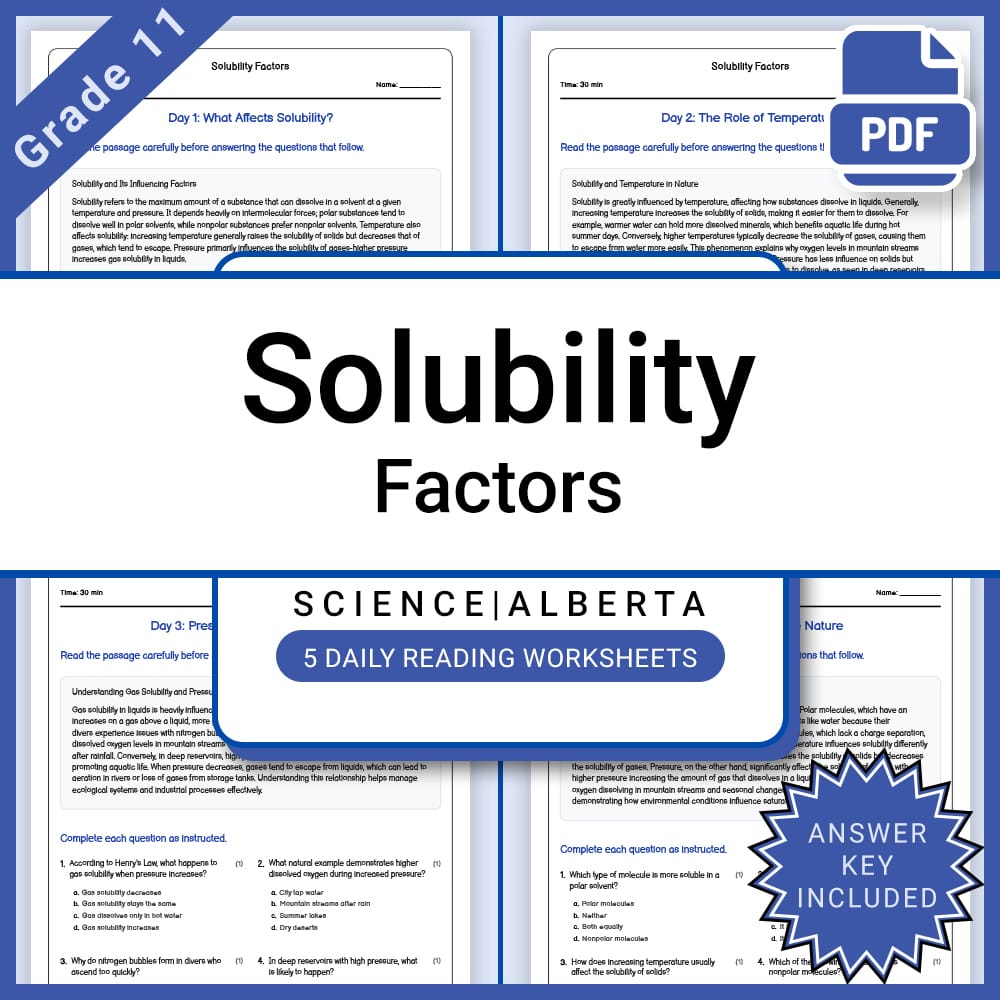
Grade 11 Science – Solubility Factors Daily Reading Worksheet + Answer Key
JCreated byJ.S SheetsLearning Objectives
- Identify key factors that influence solubility
- Explain how temperature, pressure, and intermolecular forces affect dissolution
- Relate natural examples to solubility principles
Also included in: Grade 11 Science Lesson Bundle | STEM Concepts and Alberta Framework +1 more
Instant download
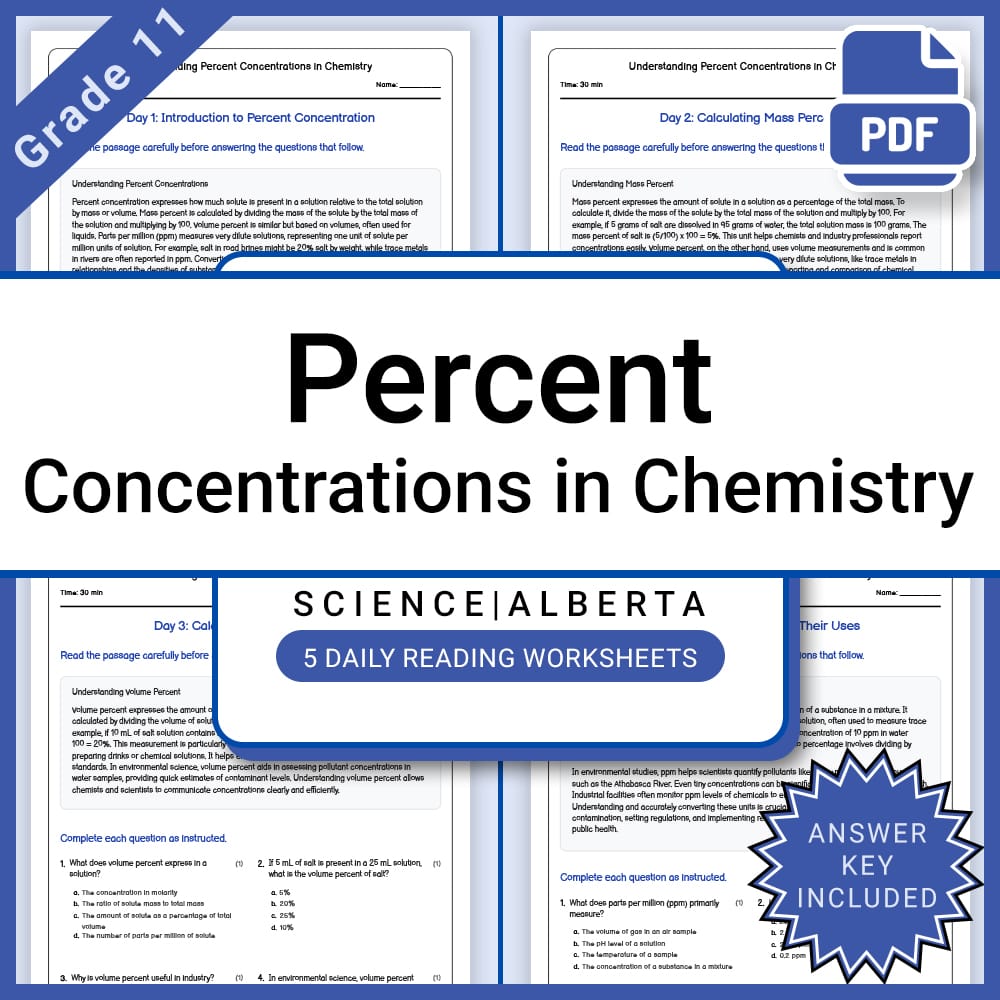
Grade 11 Science – Percent Concentrations Daily Reading Worksheet + Answer Key
JCreated byJ.S SheetsLearning Objectives
- Define mass percent, volume percent, and parts per million as units of concentration.
- Explain how to convert between different concentration units.
- Interpret real-world examples of concentration measurements in environmental and industrial contexts.
Also included in: Grade 11 Science Lesson Bundle | STEM Concepts and Alberta Framework +1 more
Instant download
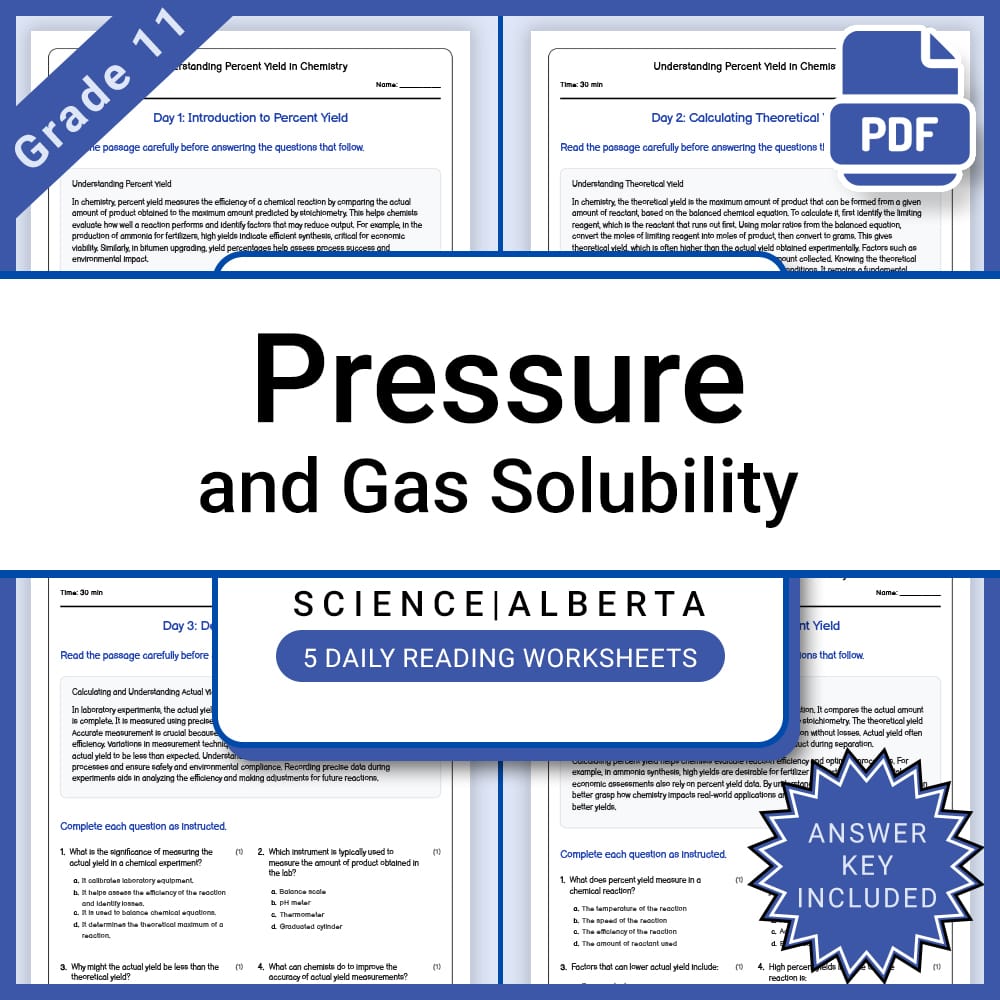
Grade 11 Science – Understanding Pressure Daily Reading Worksheet + Answer Key
JCreated byJ.S SheetsLearning Objectives
- Explain how pressure influences gas solubility based on Henry's Law.
- Identify practical examples of pressure effects in real-world applications such as aquifer management and beverage carbonation.
- Analyze the relationship between pressure changes and dissolved gases in liquids.
Also included in: Grade 11 Science Lesson Bundle | STEM Concepts and Alberta Framework +1 more
Instant download
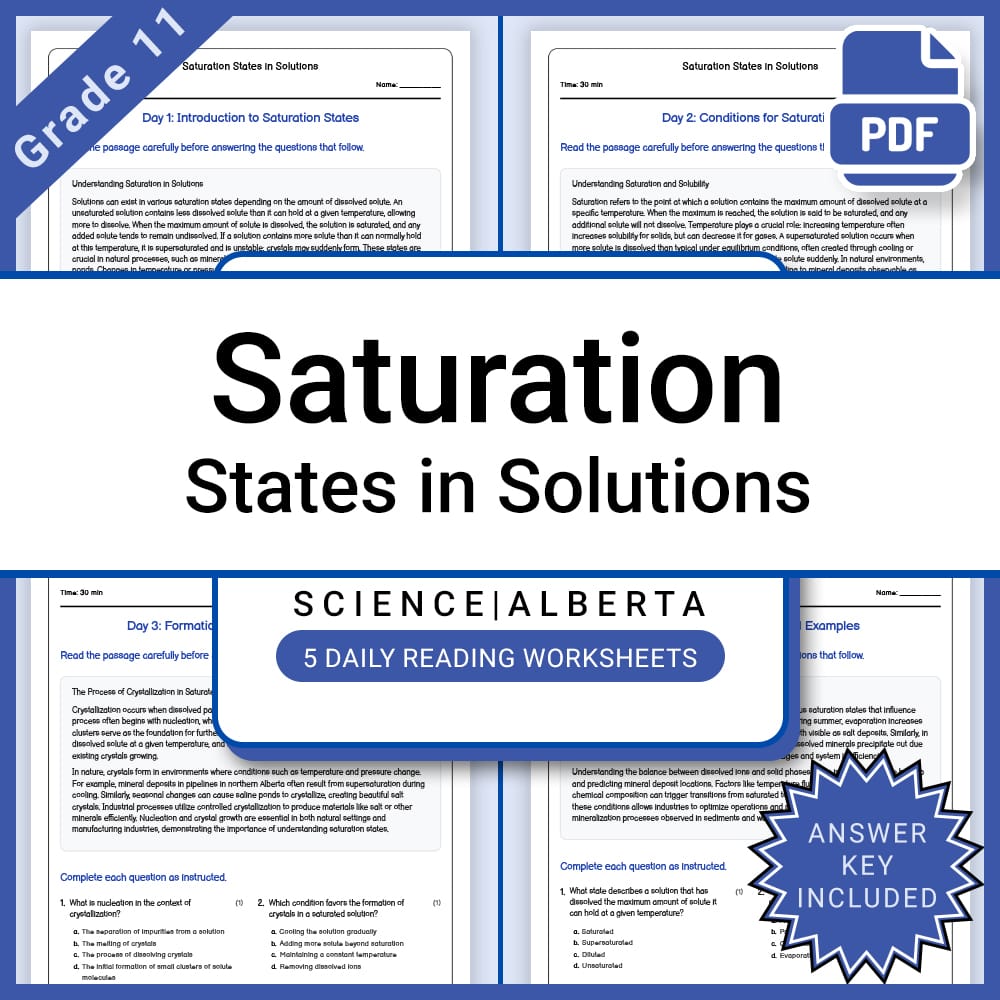
Grade 11 Science – Saturation States Daily Reading Worksheet + Answer Key
JCreated byJ.S SheetsLearning Objectives
- Understand different types of saturation states: unsaturated, saturated, and supersaturated.
- Identify conditions that lead to changes in saturation levels.
- Recognize how saturation impacts mineral formation and solution stability.
Also included in: Grade 11 Science Lesson Bundle | STEM Concepts and Alberta Framework +1 more
Instant download
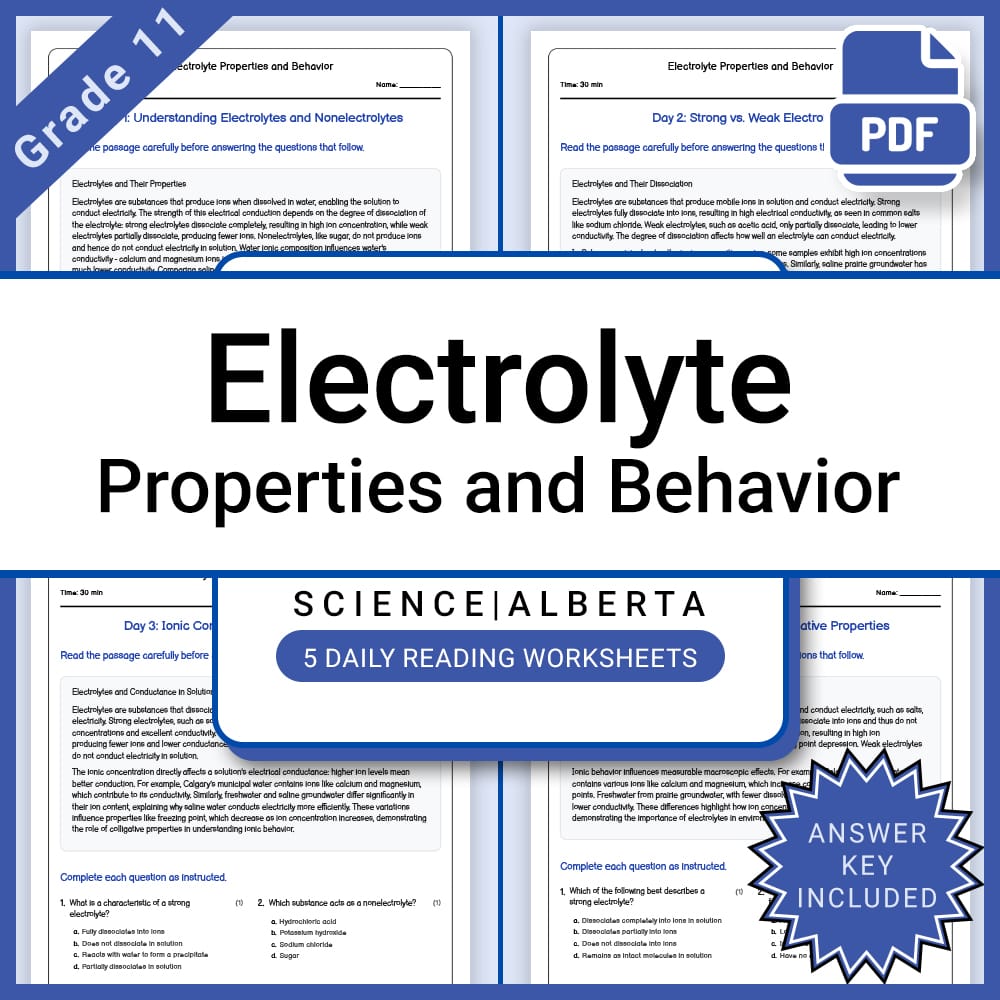
Grade 11 Science – Electrolyte Properties Daily Reading Worksheet + Answer Key
JCreated byJ.S SheetsLearning Objectives
- Understand the difference between electrolytes and nonelectrolytes
- Identify strong versus weak electrolytes based on ionization
- Relate ion concentration to electrical conductivity
Also included in: Grade 11 Science Lesson Bundle | STEM Concepts and Alberta Framework +1 more
Instant download
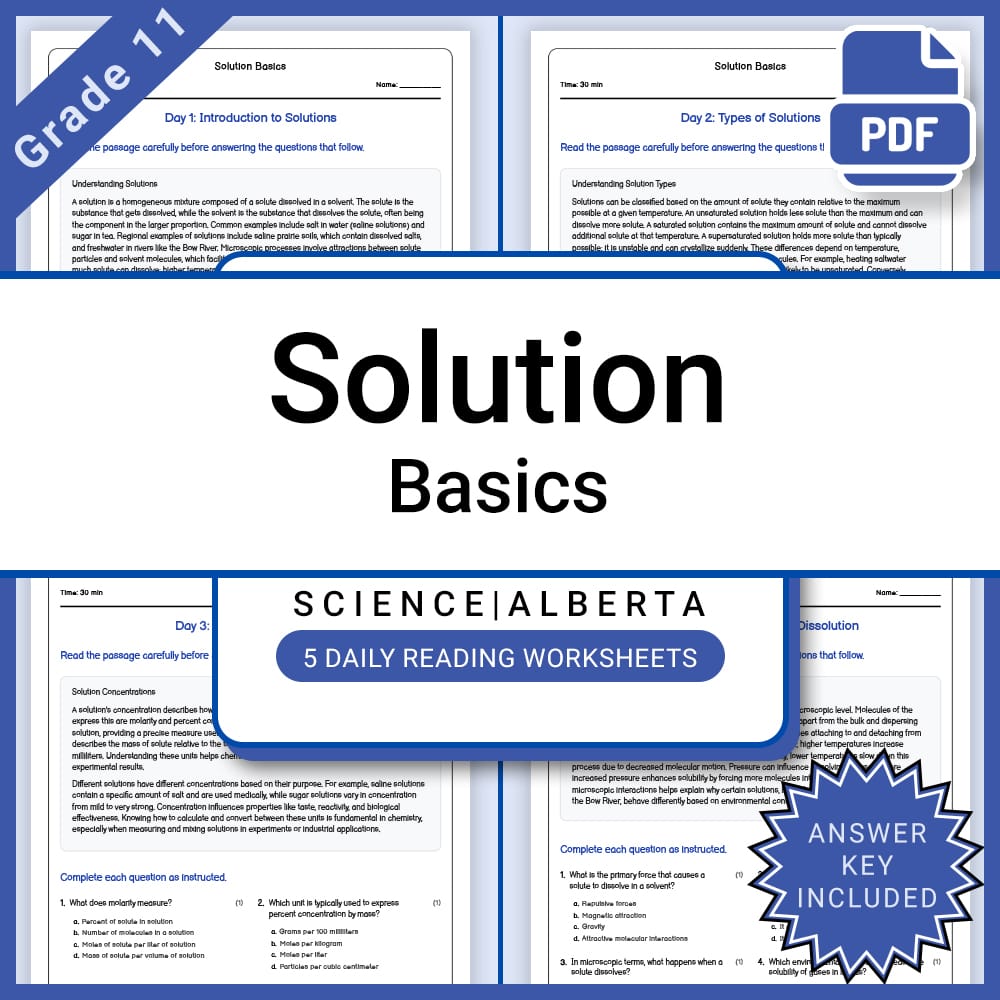
Grade 11 Science – Solution Basics Daily Reading Worksheet with Answer Key
JCreated byJ.S SheetsLearning Objectives
- Define solute and solvent in the context of solutions.
- Identify different types of solutions and their regional examples.
- Understand microscopic processes involved in dissolution.
Also included in: Grade 11 Science Lesson Bundle | STEM Concepts and Alberta Framework +1 more
Instant download
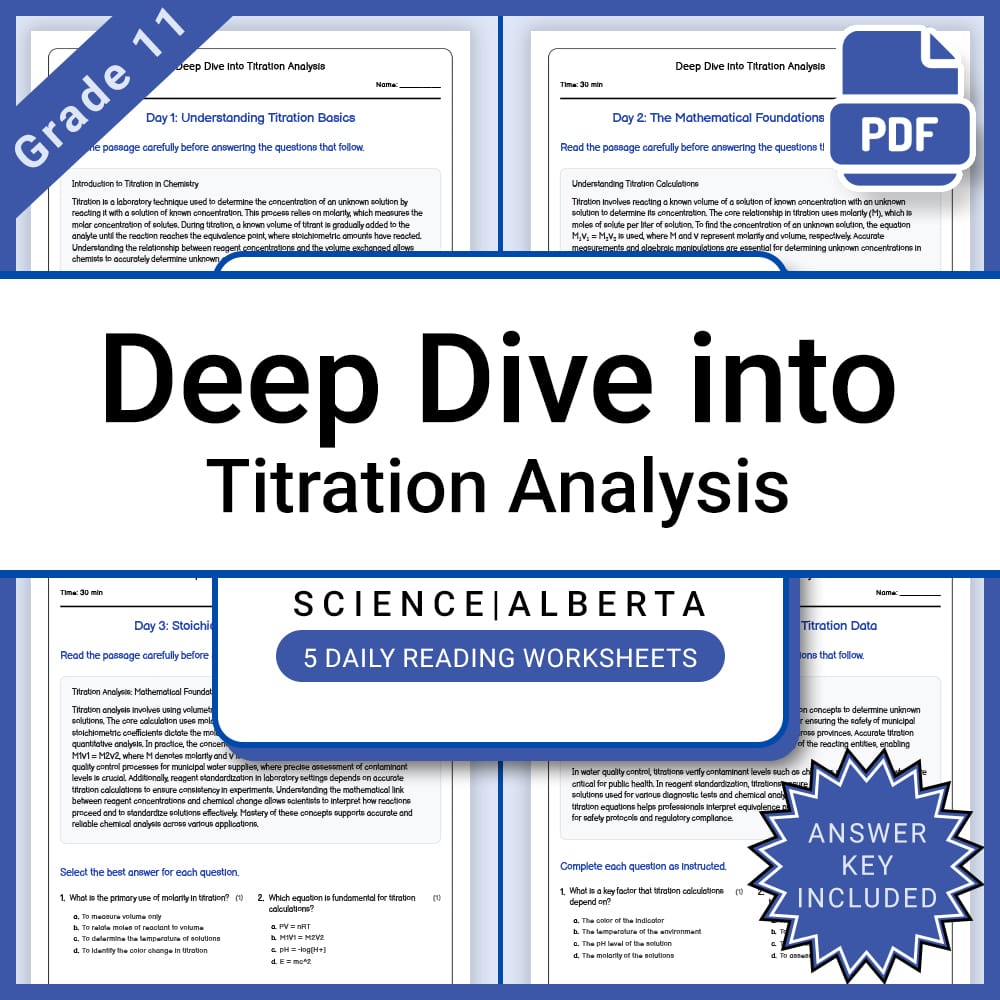
Grade 11 Science – Deep Dive into Titration Analysis Daily Reading Worksheet with Answer Key
JCreated byJ.S SheetsLearning Objectives
- Understand the mathematical basis of titration calculations using molarity and stoichiometry.
- Interpret equivalence points and relationship between reagent concentrations in titration.
- Apply algebraic techniques to analyze titration reactions for solution determination.
Also included in: Grade 11 Science Lesson Bundle | STEM Concepts and Alberta Framework +1 more
Instant download
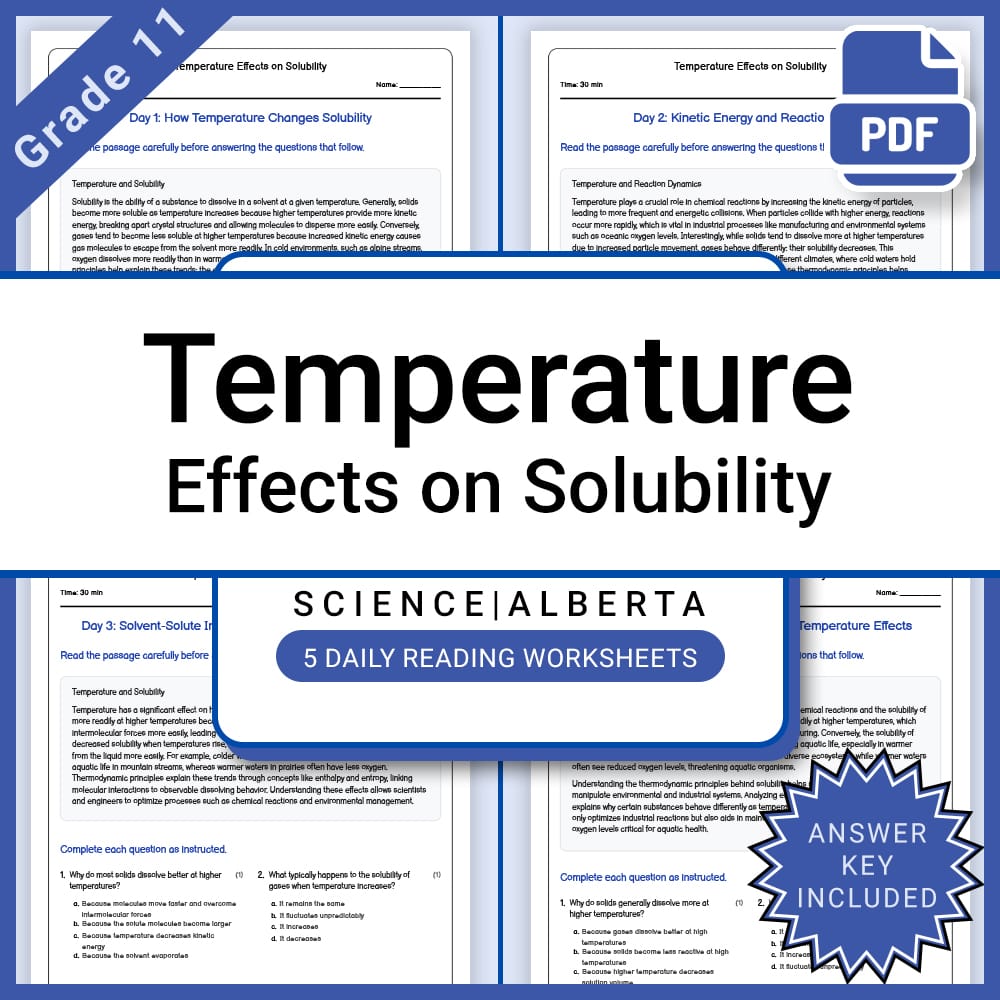
Grade 11 Science – Temperature Effects Daily Reading Worksheet + Answer Key
JCreated byJ.S SheetsLearning Objectives
- Understand how temperature influences the solubility of solids and gases.
- Explore the thermodynamic reasons behind changes in solubility with temperature.
- Apply knowledge of solvent-solute interactions in environmental and industrial contexts.
Also included in: Grade 11 Science Lesson Bundle | STEM Concepts and Alberta Framework +1 more
Instant download
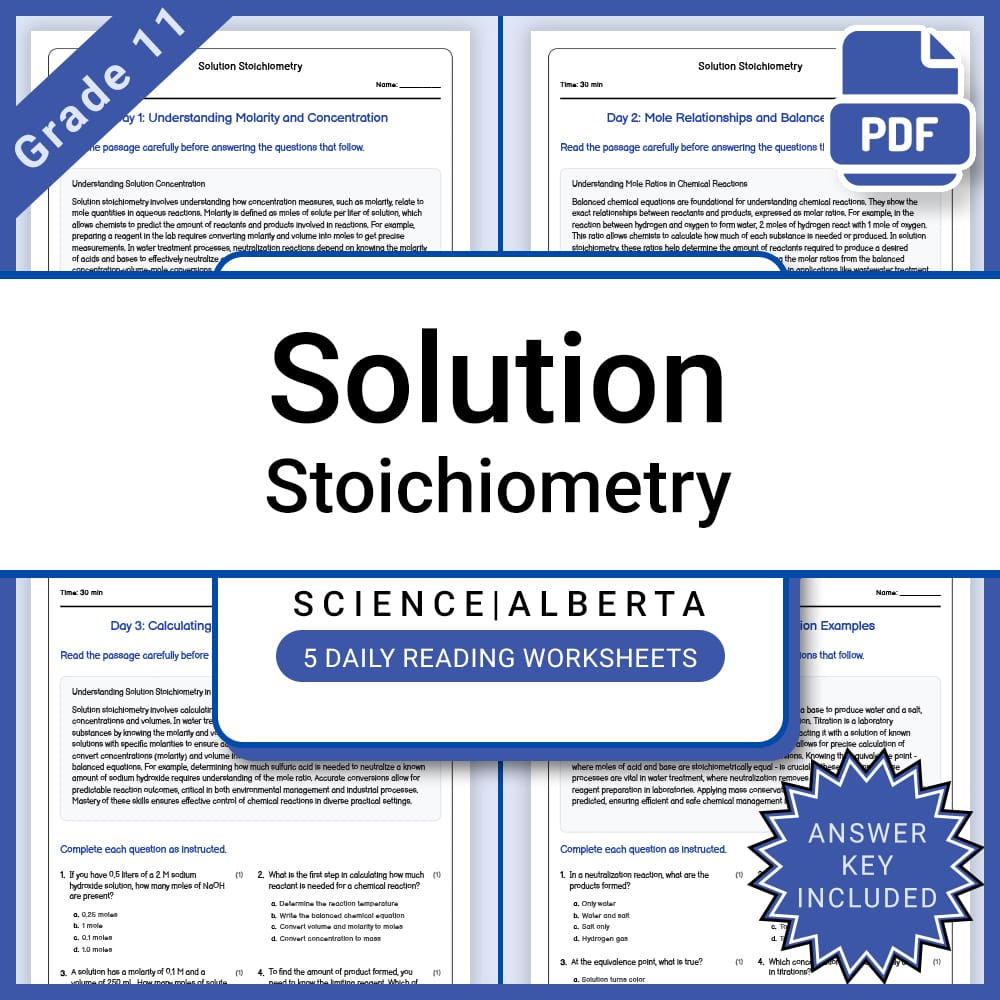
Grade 11 Science – Solution Stoichiometry Daily Reading Worksheet + Answer Key
JCreated byJ.S SheetsLearning Objectives
- Understand the concept of molarity and how to calculate solution concentrations
- Learn the mole–mole relationship in aqueous reactions
- Identify limiting reagents in solution-based reactions
Also included in: Grade 11 Science Lesson Bundle | STEM Concepts and Alberta Framework +1 more
Instant download
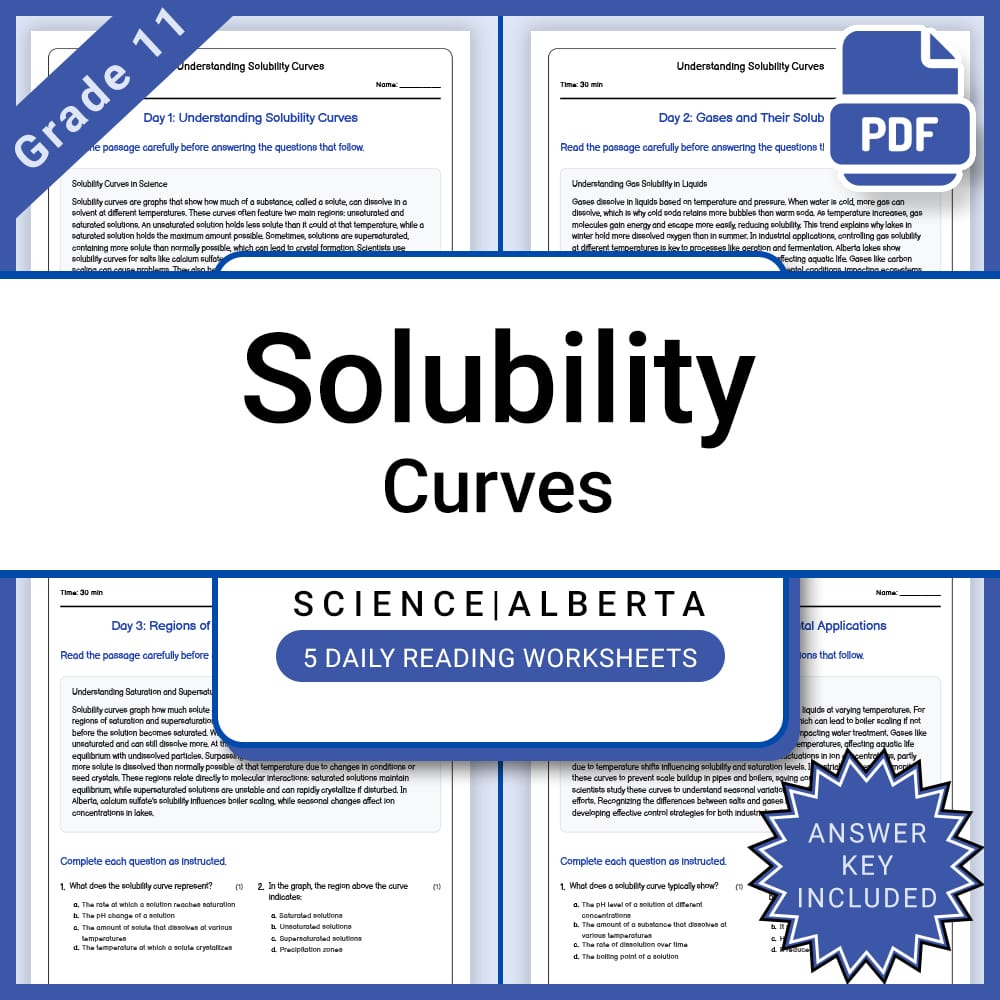
Grade 11 Science – Solubility Curves Daily Reading Worksheet with Answer Key
JCreated byJ.S SheetsLearning Objectives
- Interpret solubility curves for salts and gases.
- Identify regions of saturation, undersaturation, and supersaturation on a graph.
- Relate graphical trends to molecular interactions and temperature effects.
Also included in: Grade 11 Science Lesson Bundle | STEM Concepts and Alberta Framework +1 more
Instant download

Grade 7 Heat Transfer Worksheet | Conduction Convection Radiation | NGSS
 Created byBRIGHT PATH RESOURCES
Learning Objectives
- Understand the mechanisms of heat transfer: conduction, convection, radiation
- Identify examples of heat transfer in everyday life
- Describe measurable evidence of heat transfer
Also included in: Energy & Heat Transfer Grade 7 Science Lesson Bundle Daily Reading | NGSS +2 more
Instant download

Grade 12 Biotechnology Tools Worksheet | Practice & Assessment PDF
 Created byClear Sky Classroom
Learning Objectives
- Explain how nucleic acid amplification and sequencing technologies generate molecular data relevant to genetic information.
- Interpret sequencing read mappings and gene expression profiles to support or limit biological inferences.
- Evaluate how genome modification approaches change DNA and discuss key evidence criteria and limitations.
Also included in: Grade 12 Cell, Genetics, and Ecosystems Science AP Lesson Bundle Worksheet B +1 more
Instant download

Grade 6 Synthetic Materials Worksheet | NGSS Science Activity & Notes
Created byBRIGHT PATH RESOURCESLearning Objectives
- Identify the sources of various synthetic materials.
- Describe the manufacturing processes involved in making plastics.
- Compare properties of natural and synthetic materials for specific uses.
Also included in: Matter and Its Interactions Grade 6 Science Lesson Bundle | NGSS +2 more
Instant download

Grade 7 Comparative Anatomical Evidence Worksheet | NGSS Practice PDF
Created byClear Sky ClassroomLearning Objectives
- Identify different types of anatomical structures that provide evidence for evolution.
- Differentiate between homologous and analogous structures through examples.
- Understand how morphological and genetic data contribute to phylogenetic analysis.
Also included in: Grade 7 Natural Selection & Adaptation Science Lesson Bundle for NGSS +1 more
Instant download

Grade 11 Worksheet B: Inheritance Patterns (Mendelian + Beyond) Practice | NGSS
Created byClear Sky ClassroomLearning Objectives
- Explain Mendelian principles of segregation and independent assortment using meiosis-based reasoning.
- Distinguish incomplete dominance, codominance, sex linkage, polygenic inheritance, and genetic linkage.
- Use probability to predict likely offspring phenotypes and interpret pedigrees and blood-group patterns.
Also included in: Grade 11 Genetics Science Lesson Bundle: NGSS Mutation & Inheritance +1 more
Instant download
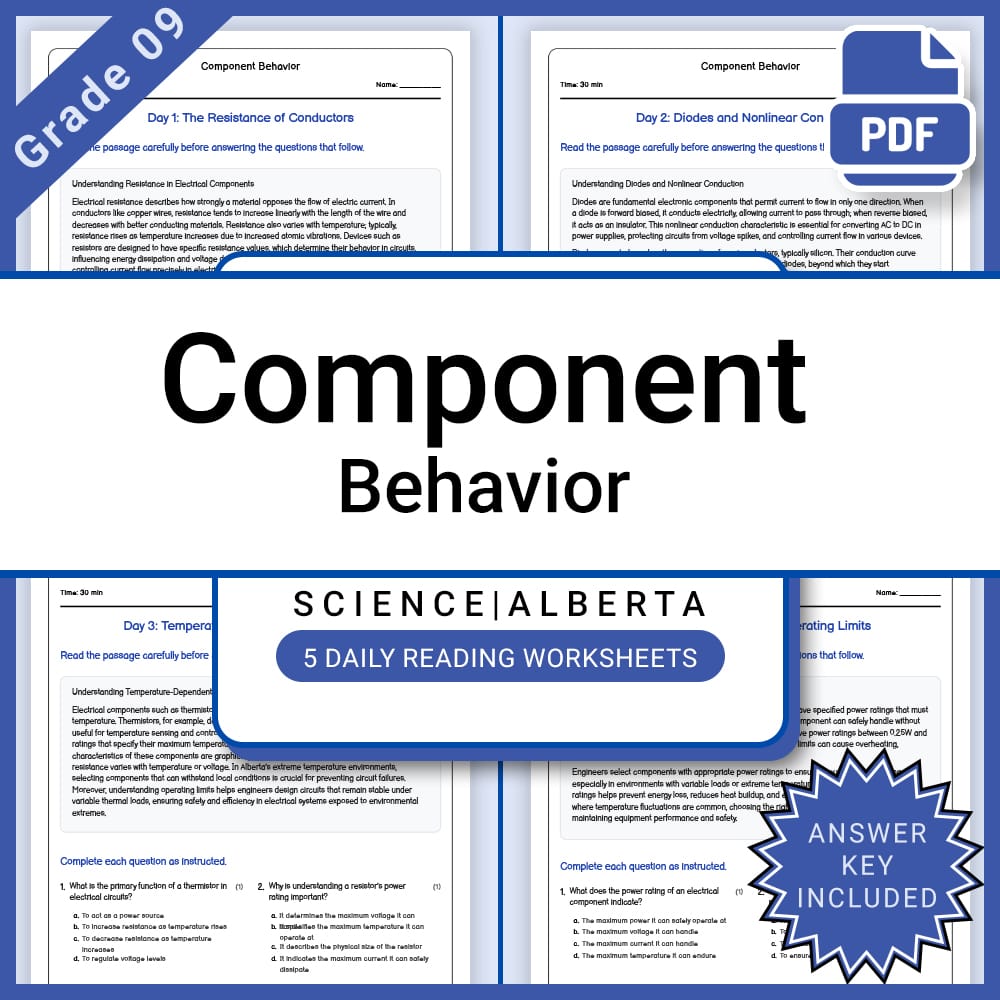
Grade 9 Science – Component Behavior Daily Reading Worksheet + Answer Key
JCreated byJ.S SheetsLearning Objectives
- Identify how resistance in electrical components varies with current and temperature.
- Understand the behavior of diodes and what makes their conduction nonlinear.
- Analyze how temperature affects the resistance of thermistors and other sensors.
Also included in: Grade 9 Science Lesson Bundle: Electrical Systems and Energy Concepts +1 more
Instant download
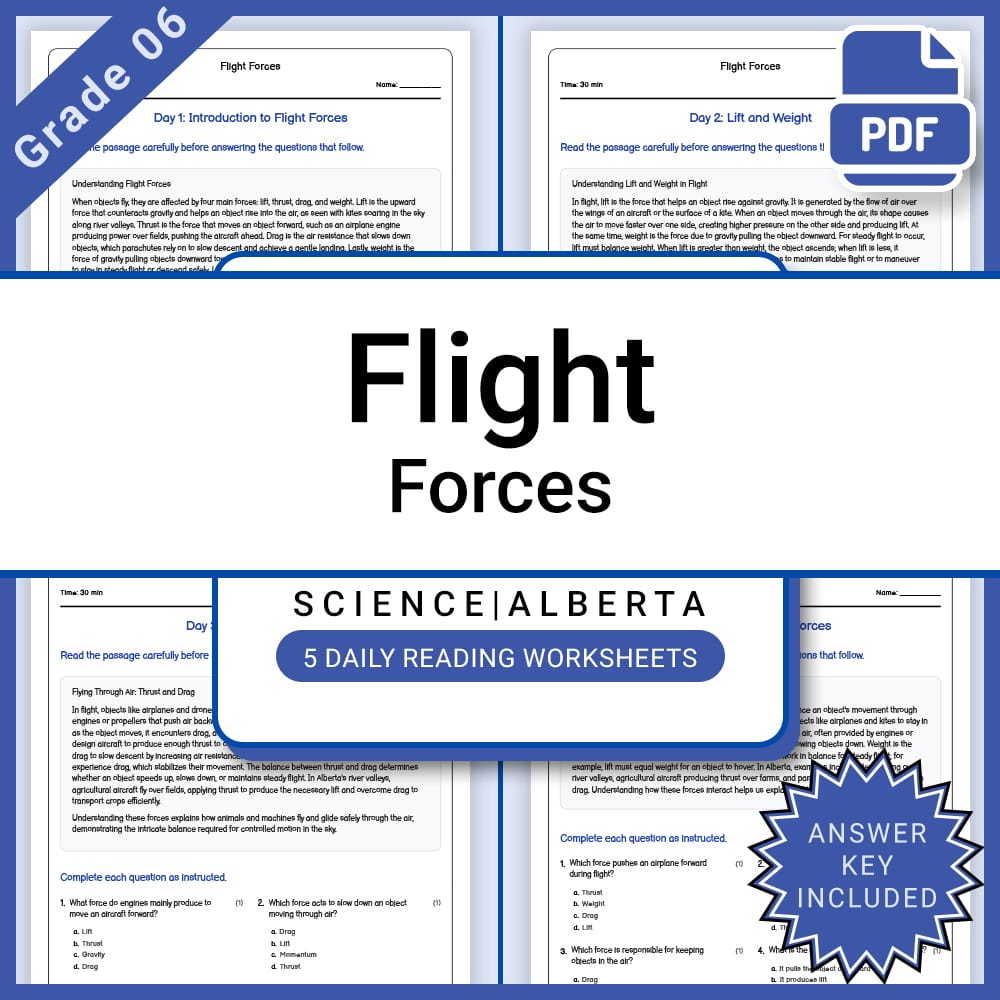
Grade 6 Science – Flight Forces Daily Reading Worksheet with Answer Key
JCreated byJ.S SheetsLearning Objectives
- Identify the four primary forces of flight: lift, thrust, drag, and weight.
- Describe how each force affects an object's motion through air.
- Understand real-world examples of flight forces, such as kites, aircraft, and parachutes.
Also included in: Grade 6 Science Lesson Bundle: Flight, Weather, and Aerodynamics +1 more
Instant download
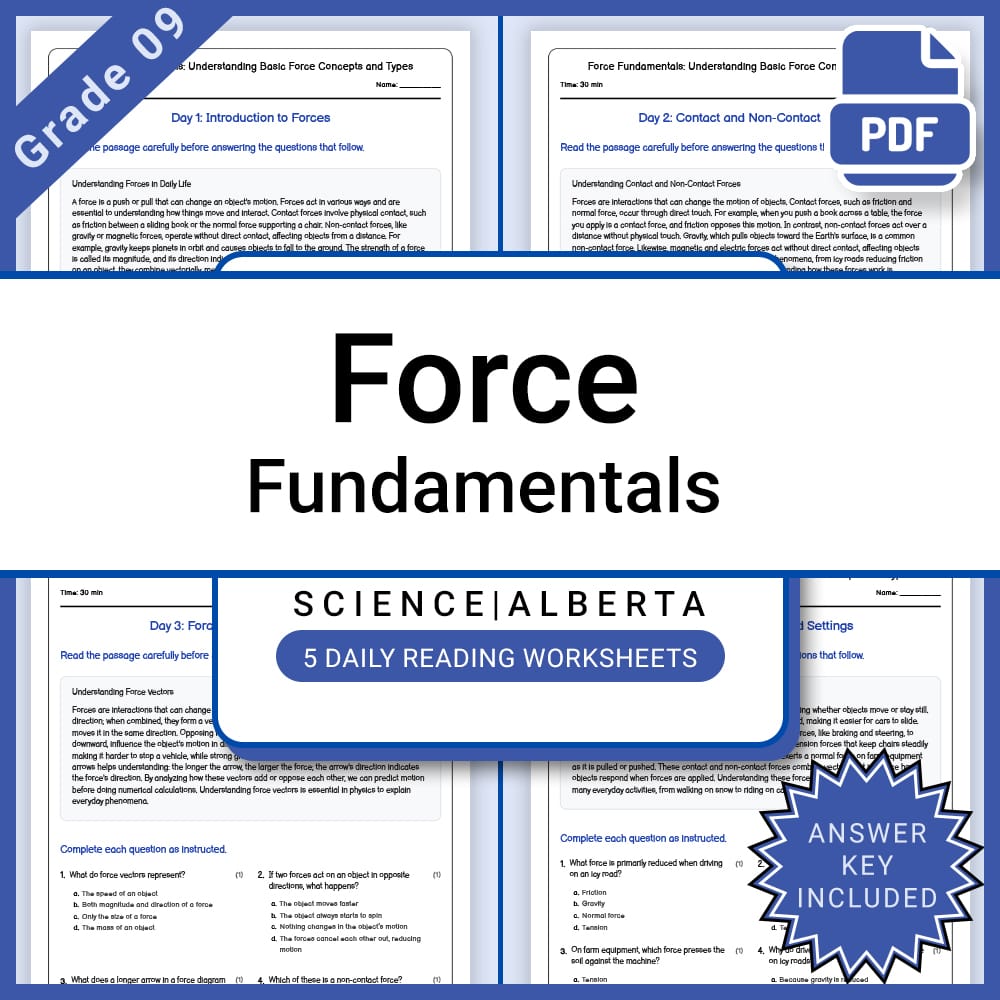
Grade 9 Science – Force Fundamentals Daily Reading Worksheet + Answer Key
JCreated byJ.S SheetsLearning Objectives
- Define what a force is and describe how it affects objects.
- Identify different types of forces, including contact and non-contact forces.
- Explain real-world examples of forces acting on objects.
Also included in: Grade 9 Science Lesson Bundle | Physics and Motion Worksheets +1 more
Instant download

Grade 6 Developing Solutions Science Worksheet | NGSS Engineering Design
Created byBRIGHT PATH RESOURCESLearning Objectives
- Understand the criteria and constraints used in designing solutions.
- Compare different design options based on qualitative and quantitative metrics.
- Use models and evidence to rank and refine potential solutions.
Also included in: Engineering Design Grade 6 Science Daily Reading Worksheets Lesson Bundle | Ngss +2 more
Instant download

Grade 6 Materials For Performance Worksheet | General Practice PDF
Created byClear Sky ClassroomLearning Objectives
- Match material properties (strength, water resistance, conductivity, porosity, durability) to real-world performance needs.
- Compare design options by considering trade-offs such as cost, availability, and ease of shaping.
- Explain how water filter design choices (membrane thickness and pore size) affect contaminant reduction over time.
Instant download

Grade 7 Adaptation Traits Worksheet | Practice & Assessment PDF
Created byClear Sky ClassroomLearning Objectives
- Define adaptations as structural, physiological, and behavioural traits that improve survival and reproduction in specific environments
- Explain how selective pressures influence which traits become more common in a population
- Describe how trade-offs in resource allocation can affect the success of an adaptation
Instant download

Grade 10 Worksheet B: Nutrient Cycling Worksheet | NGSS Practice PDF
Created byClear Sky ClassroomLearning Objectives
- Explain how carbon and nitrogen move among the atmosphere, biosphere, lithosphere, and hydrosphere through major biogeochemical processes
- Describe how photosynthesis, respiration, nitrification, denitrification, and decomposition control nutrient pools and fluxes
- Analyze how human activities (fossil fuel combustion and agricultural runoff) change nutrient cycling and affect ecosystems
Also included in: Grade 10 Ecosystem Energy Transfer & Biodiversity Science Lesson Bundle: NGSS +1 more
Instant download

Grade 5 Food Web Links Worksheet | General Use Practice PDF
Created byClear Sky ClassroomLearning Objectives
- Explain how food webs connect multiple food chains within an ecosystem
- Describe how changes in one organism’s population can affect other populations across a food web
- Use food web vocabulary (producer, herbivore, predator, food chain, food web) accurately
Instant download
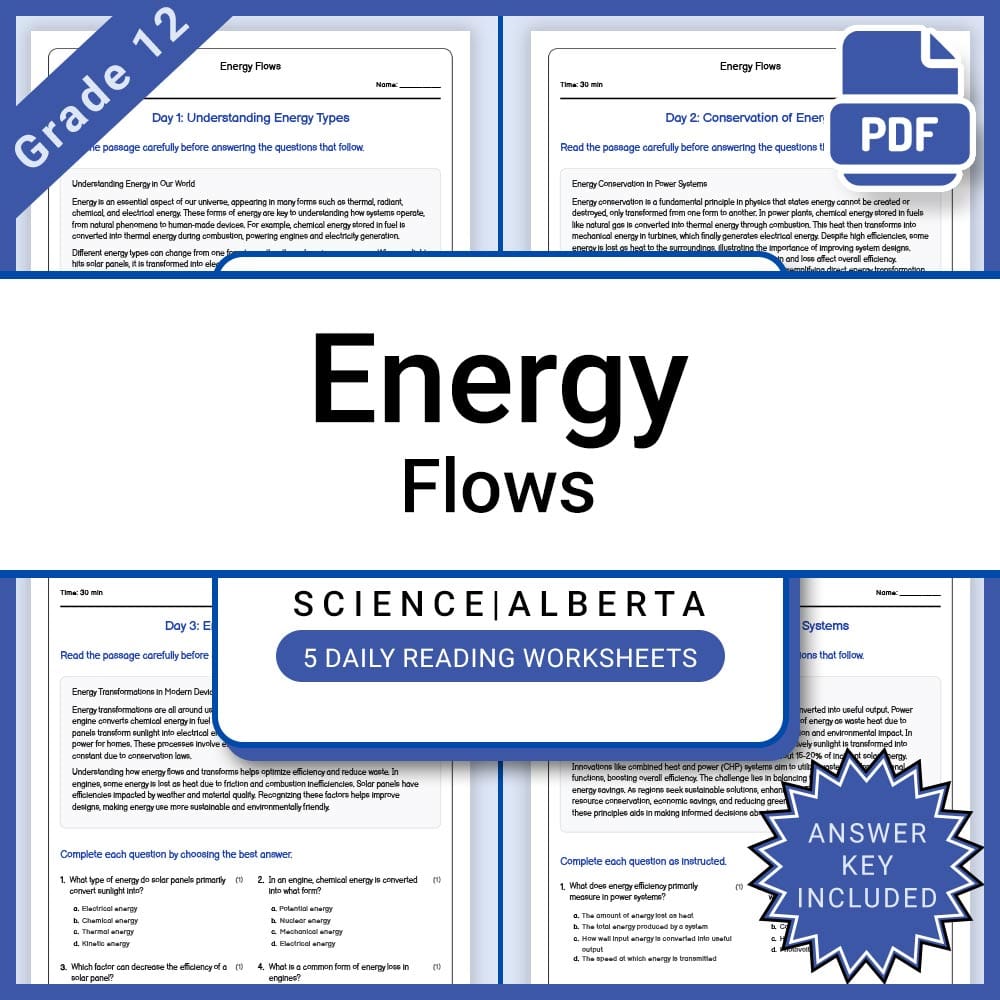
Grade 12 Science – Energy Flows Daily Reading Worksheet + Answer Key
JCreated byJ.S SheetsLearning Objectives
- Identify different forms of energy such as thermal, chemical, electrical, and radiant.
- Understand how energy transforms from one type to another in various systems.
- Apply thermodynamic principles to real-world energy processes like combustion, heat loss, and solar energy conversion.
Also included in: Grade 12 Science Lesson Bundle | Alberta Framework and Real-World Applications +1 more
Instant download
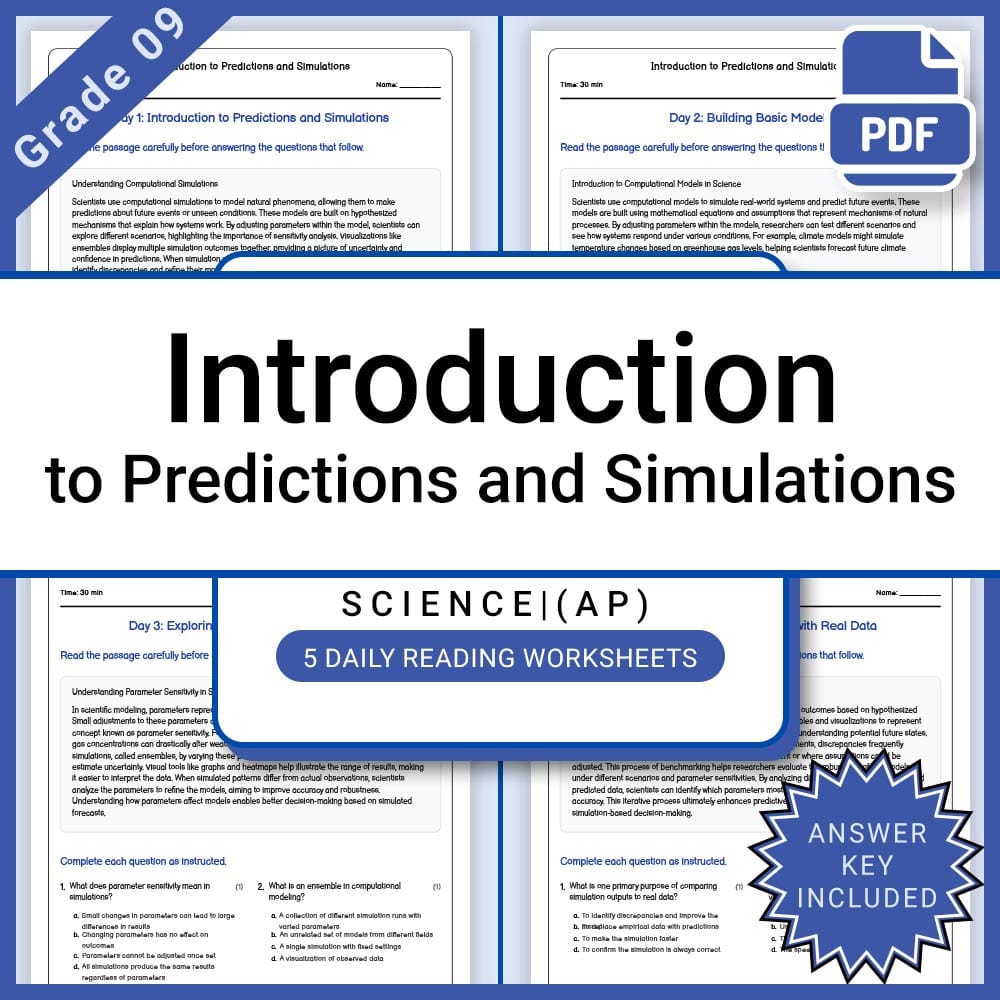
Grade 9 – Introduction to Predictions and Simulations Worksheet + Answer Key
JCreated byJ.S SheetsLearning Objectives
- Understand the purpose of simple computational simulations in science.
- Recognize how models generate predictions based on hypotheses.
- Learn about the role of parameter sensitivity in simulations.
Also included in: Grade 9 Science Lesson Group - AP Framework Daily Reading Worksheets +1 more
Instant download
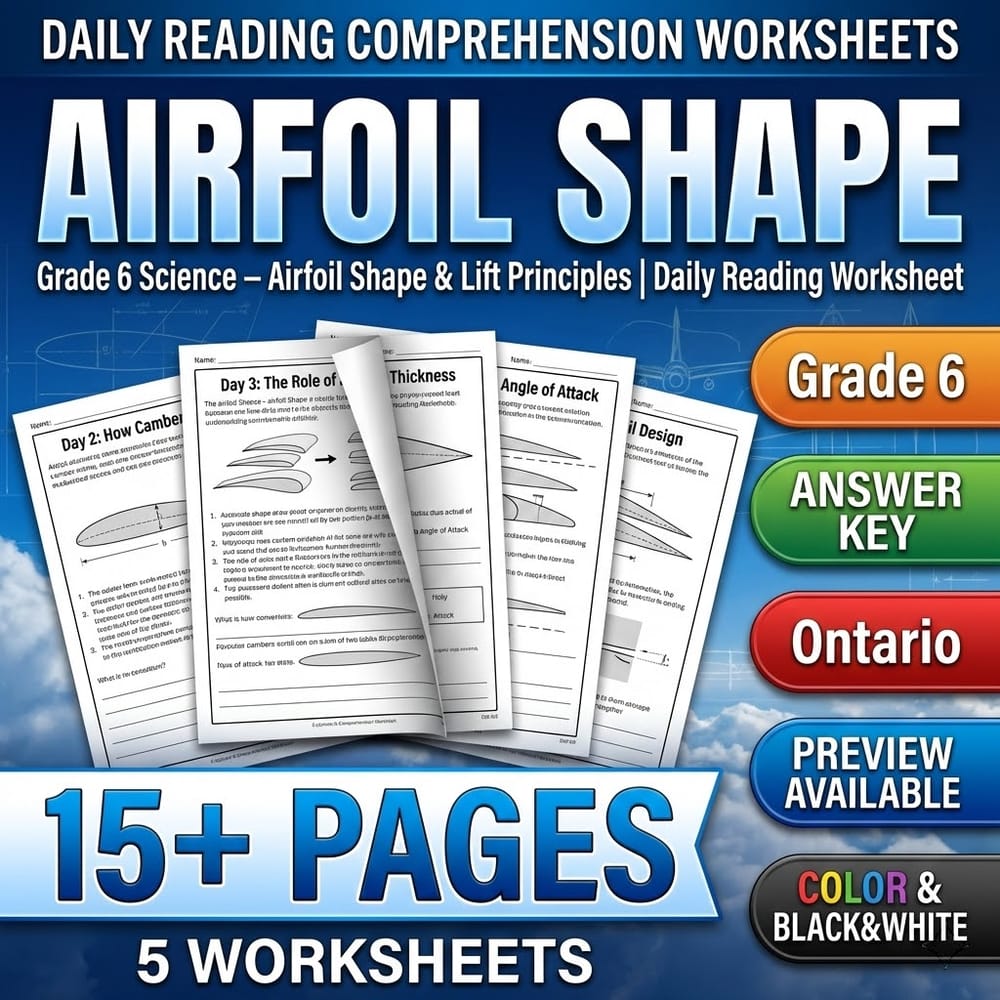
Grade 6 Science – Airfoil Shape & Lift Principles | Daily Reading Worksheet
 Created byQuiet Forest Education
Learning Objectives
- Understand the key features of different airfoil profiles
- Describe how camber, thickness, chord length, and leading-edge curvature influence lift
- Compare Bernoulli and Newtonian explanations of lift
Also included in: Flight Science Grade 6 Daily Reading Worksheets Bundle | Ontario +1 more
Instant download
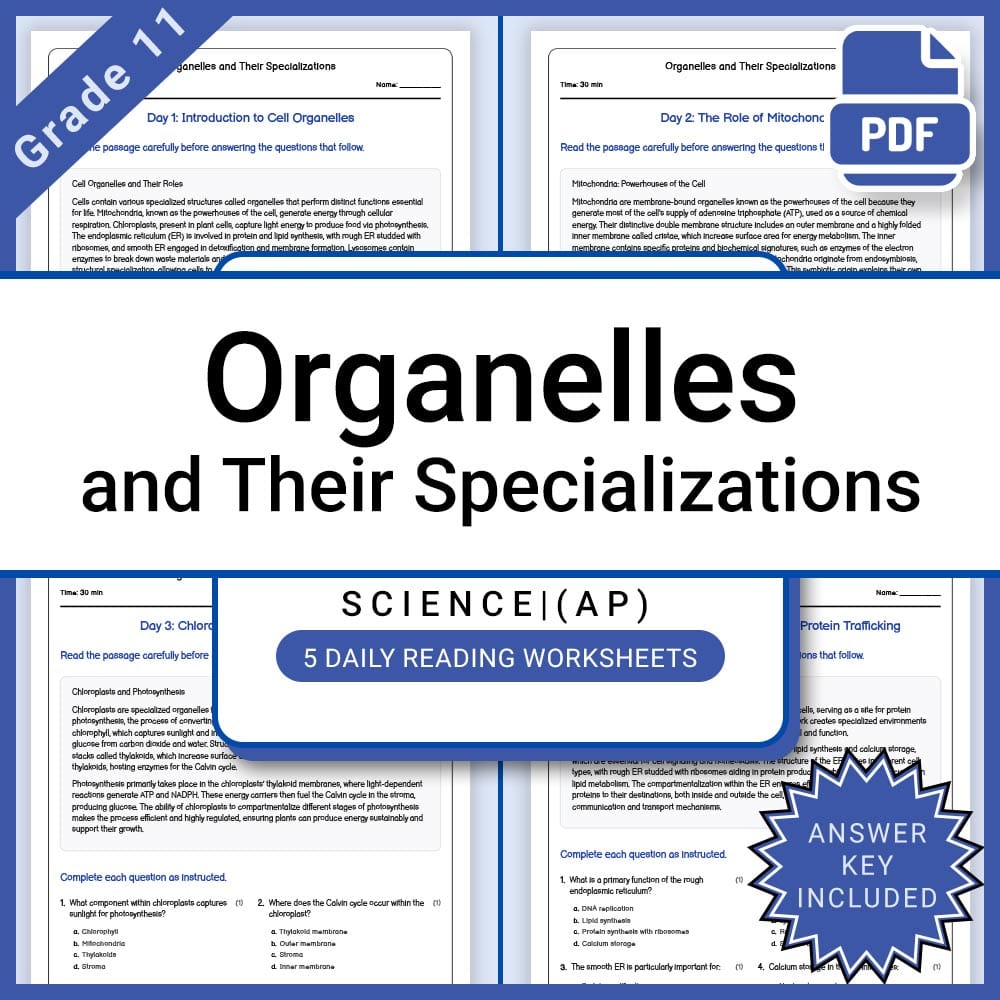
Grade 11 Science – Organelles and Their Specializations Worksheet + Answer Key
JCreated byJ.S SheetsLearning Objectives
- Understand the structural differences of key organelles: mitochondria, chloroplasts, endoplasmic reticulum, and lysosomes.
- Explain how compartmentalization enhances metabolic pathways and cellular functions.
- Describe the origins and membrane compositions of different organelles.
Also included in: Grade 11 Science Biology and Ecosystems AP Lesson Bundle +1 more
Instant download
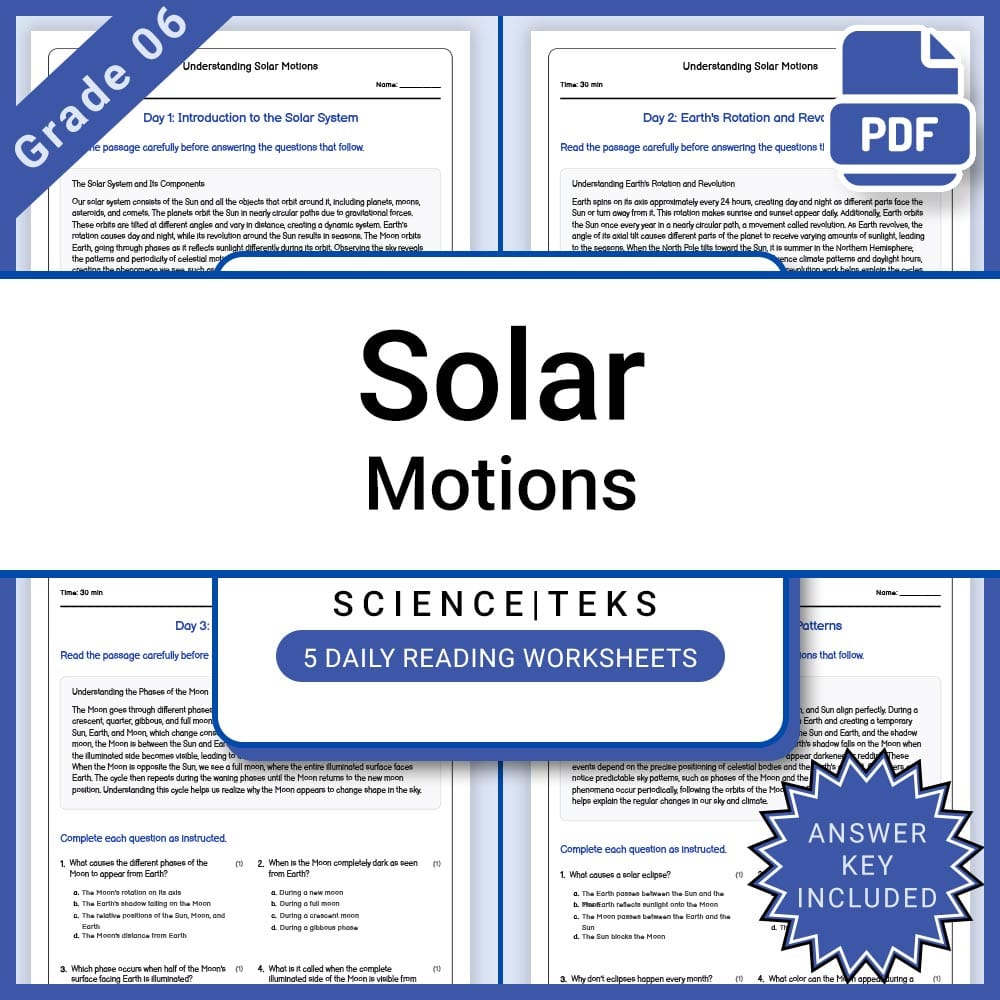
Grade 6 Science – Solar Motions Daily Reading Worksheet + Answer Key
JCreated byJ.S SheetsLearning Objectives
- Identify the main components of the solar system.
- Explain the orbital motions of planets around the Sun.
- Describe how gravitational interactions influence planetary paths.
Also included in: Grade 6 Science Lesson Bundle: Space, Water, Earth, and Resources TEKS +1 more
Instant download
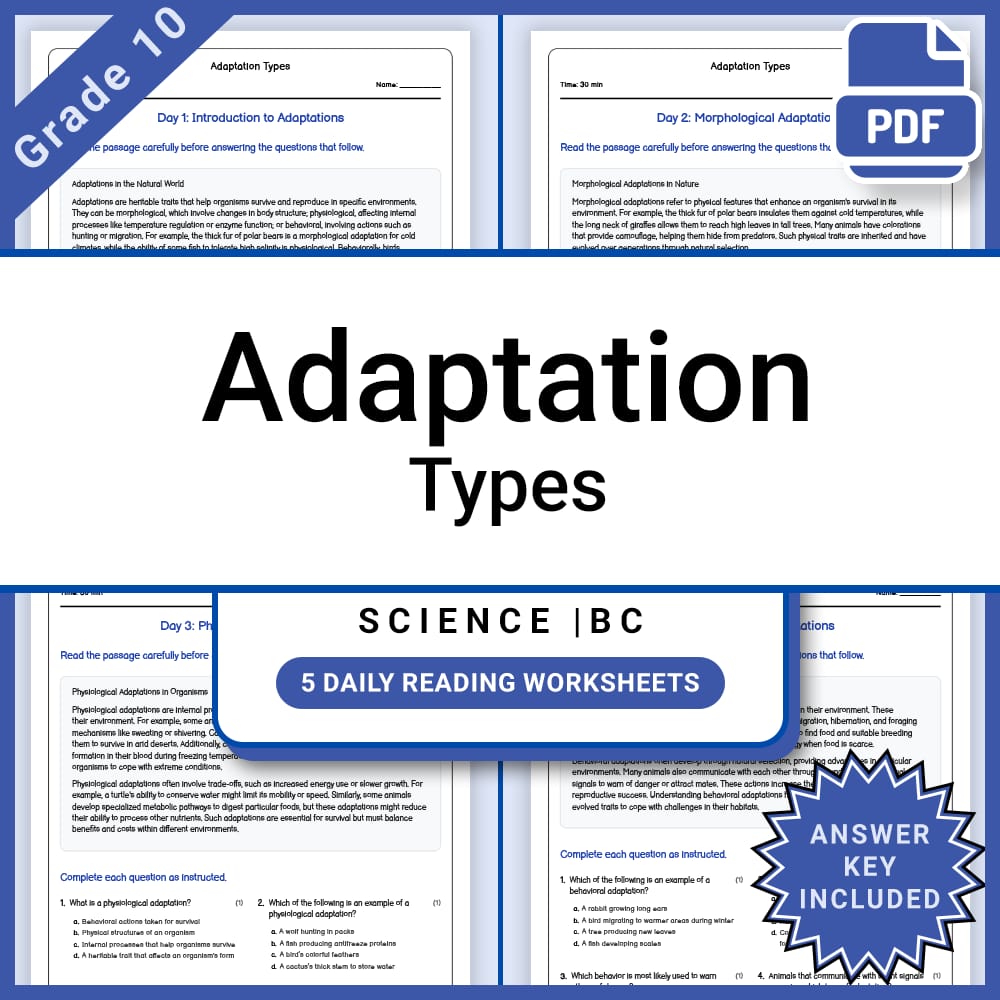
Grade 10 Science – Adaptation Types Daily Reading Worksheet with Answer Key
JCreated byJ.S SheetsLearning Objectives
- Define morphological, physiological, and behavioral adaptations.
- Explain how adaptations improve survival or reproduction in specific environments.
- Identify examples of different adaptation types.
Also included in: Grade 10 Science Lesson Bundle | Genetics, Evolution, Biodiversity & More +1 more
Instant download

Computational Modeling Science Reading Worksheet | Grade 11 NGSS
Created byBRIGHT PATH RESOURCESLearning Objectives
- Identify the purpose of a computational model in engineering and science contexts.
- Recognize key parts of building a simulation model, including assumptions, parameters, and boundary conditions.
- Connect validation and sensitivity ideas to how models are used for predictions.
Also included in: Engineering Design Grade 11 Science Daily Reading Worksheets Bundle | NGss +1 more
Instant download

Grade 7 Conservation Strategies Worksheet | BC Use Practice PDF
Created byClear Sky ClassroomLearning Objectives
- Explain how conservation strategies such as protected areas, habitat restoration, invasive species control, and sustainable harvesting reduce human impacts.
- Use ecological ideas (food webs, population dynamics, and abiotic constraints) to predict why conservation actions help ecosystems.
- Evaluate and propose conservation strategies using adaptive monitoring and evidence-based decision-making.
Instant download

Grade 8 Health – Online Behaviours & Digital Citizenship Daily Reading Worksheet
Created byQuiet Forest EducationLearning Objectives
- Identify positive and negative online interactions
- Recognize examples of cyberbullying
- Understand strategies to respond to harmful online behaviour
Also included in: Social-Emotional Skills Grade 8 Health Daily Reading Worksheets Bundle | Ontario +2 more
Instant download
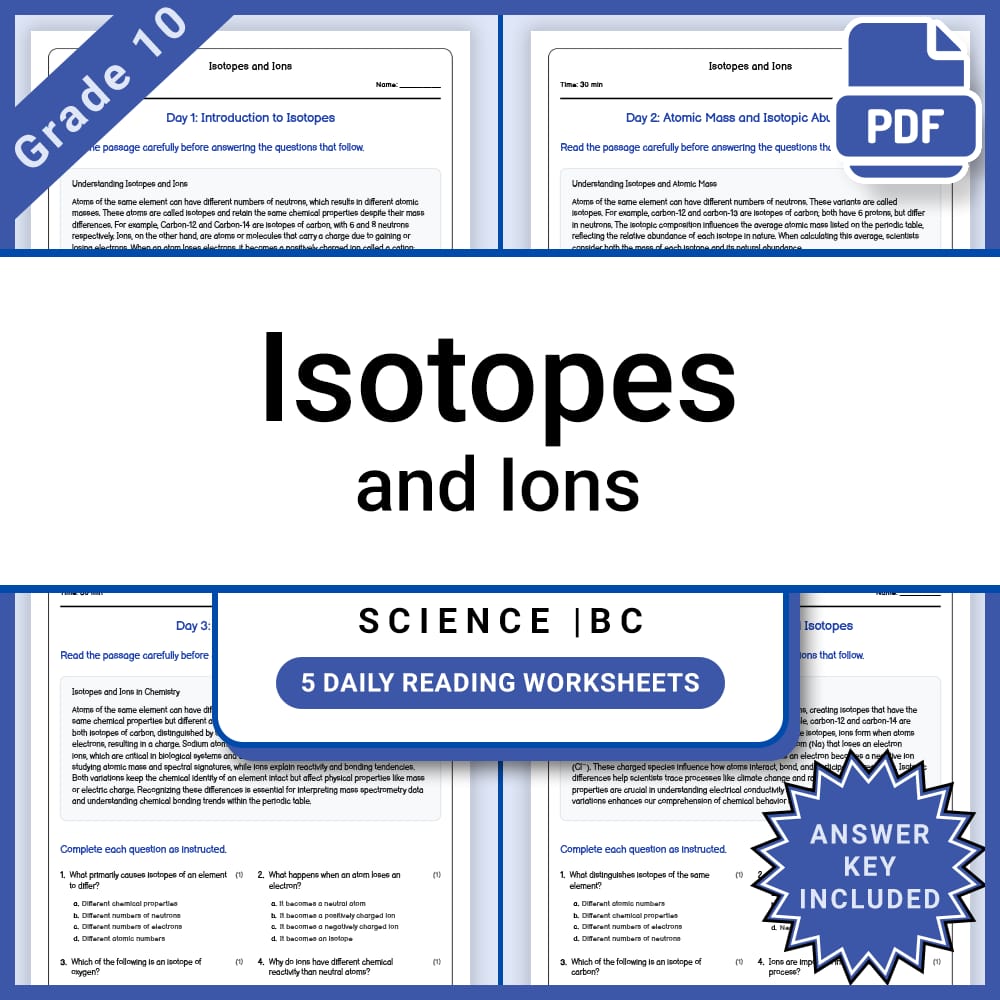
Grade 10 Science – Isotopes and Ions Daily Reading Worksheet + Answer Key
JCreated byJ.S SheetsLearning Objectives
- Understand key concepts related to Science
- Apply knowledge through practice questions
- Demonstrate comprehension of the material
Also included in: Grade 10 Science Lesson Group – Core Concepts & Skills Bundle +1 more
Instant download
Grade 10 Science – Bonding Types Daily Reading Worksheet with Answer Key
JCreated byJ.S SheetsLearning Objectives
- Understand the different types of chemical bonds: ionic, covalent, and metallic.
- Identify ionic bonds based on electron transfer and element properties.
- Describe how atoms achieve stability through bonding mechanisms.
Also included in: Grade 10 Science Lesson Group – Core Concepts & Skills Bundle +1 more
Instant download
Grade 10 Science – Yield and Purity Daily Reading Worksheet + Answer Key
JCreated byJ.S SheetsLearning Objectives
- Define percent yield and explain how it measures process efficiency.
- Describe the concept of purity and its importance in chemical samples.
- Connect measured mass to atomic conservation in chemical transformations.
Also included in: Grade 10 Science Lesson Group – Core Concepts & Skills Bundle +1 more
Instant download
Grade 10 Science – Atomic Particles Daily Reading Worksheet with Answer Key
JCreated byJ.S SheetsLearning Objectives
- Identify the subatomic particles that make up atoms.
- Describe the roles of protons, neutrons, and electrons within an atom.
- Understand how atomic number and mass number relate to atomic structure.
Also included in: Grade 10 Science Lesson Group – Core Concepts & Skills Bundle +1 more
Instant download
Grade 10 Science Reaction Classification Daily Reading Worksheet + Answer Key
JCreated byJ.S SheetsLearning Objectives
- Understand the different types of chemical reactions, especially synthesis reactions.
- Identify synthesis reactions based on reactants and products.
- Explain the characteristic features of synthesis reactions and their significance.
Also included in: Grade 10 Science Lesson Group – Core Concepts & Skills Bundle +1 more
Instant download
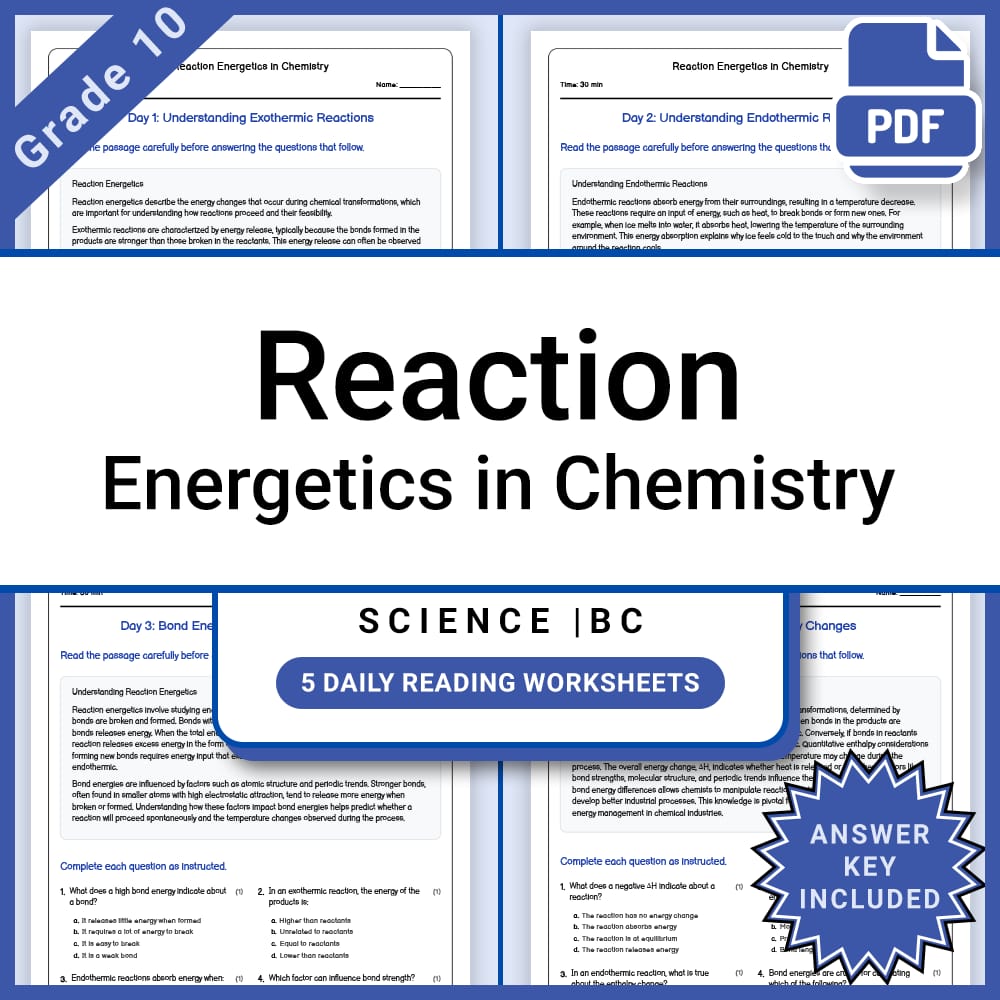
Grade 10 Science – Reaction Energetics Daily Reading Worksheet + Answer Key
JCreated byJ.S SheetsLearning Objectives
- Understand the concept of energy changes during chemical reactions
- Differentiate between exothermic and endothermic reactions
- Identify signs of energy release or absorption in reactions
Also included in: Grade 10 Science Lesson Group – Core Concepts & Skills Bundle +1 more
Instant download
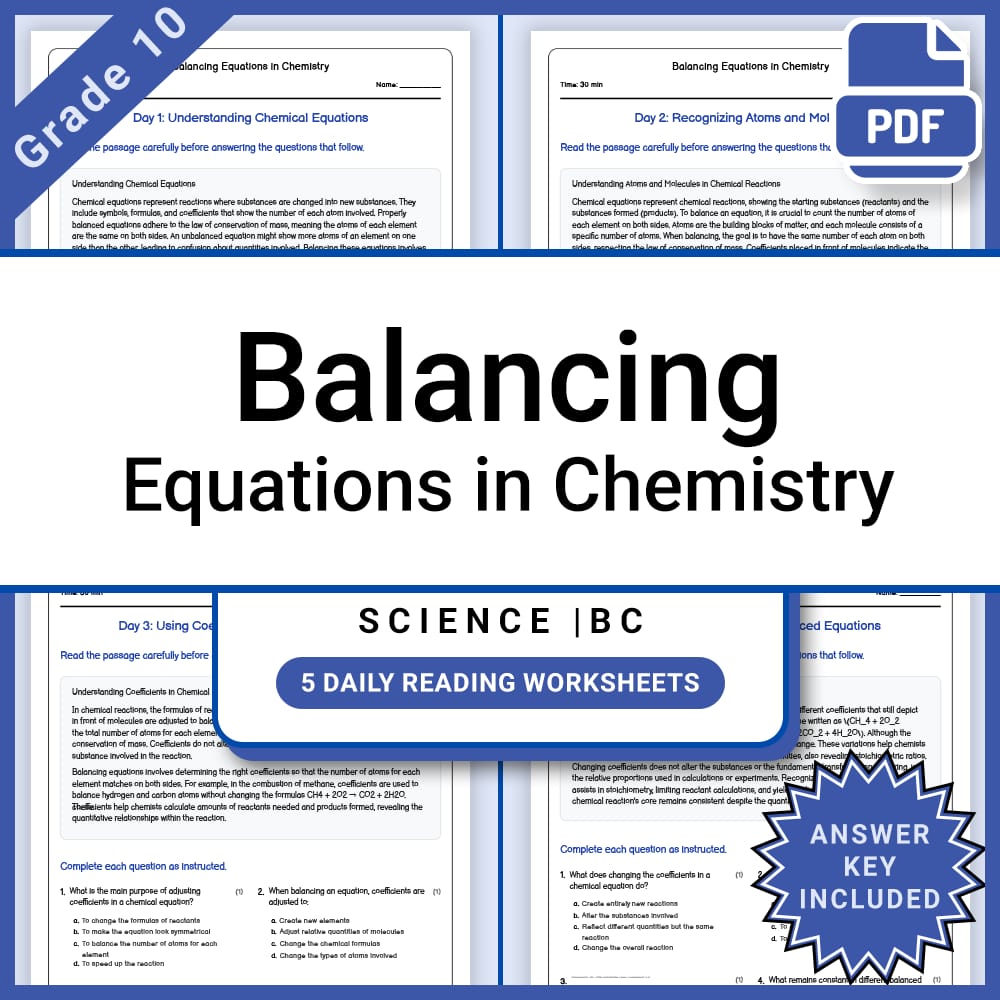
Grade 10 Science – Balancing Equations Daily Reading Worksheet + Answer Key
JCreated byJ.S SheetsLearning Objectives
- Understand the importance of balancing chemical equations
- Identify unbalanced vs. balanced equations
- Learn how coefficients are used to balance equations
Also included in: Grade 10 Science Lesson Group – Core Concepts & Skills Bundle +1 more
Instant download
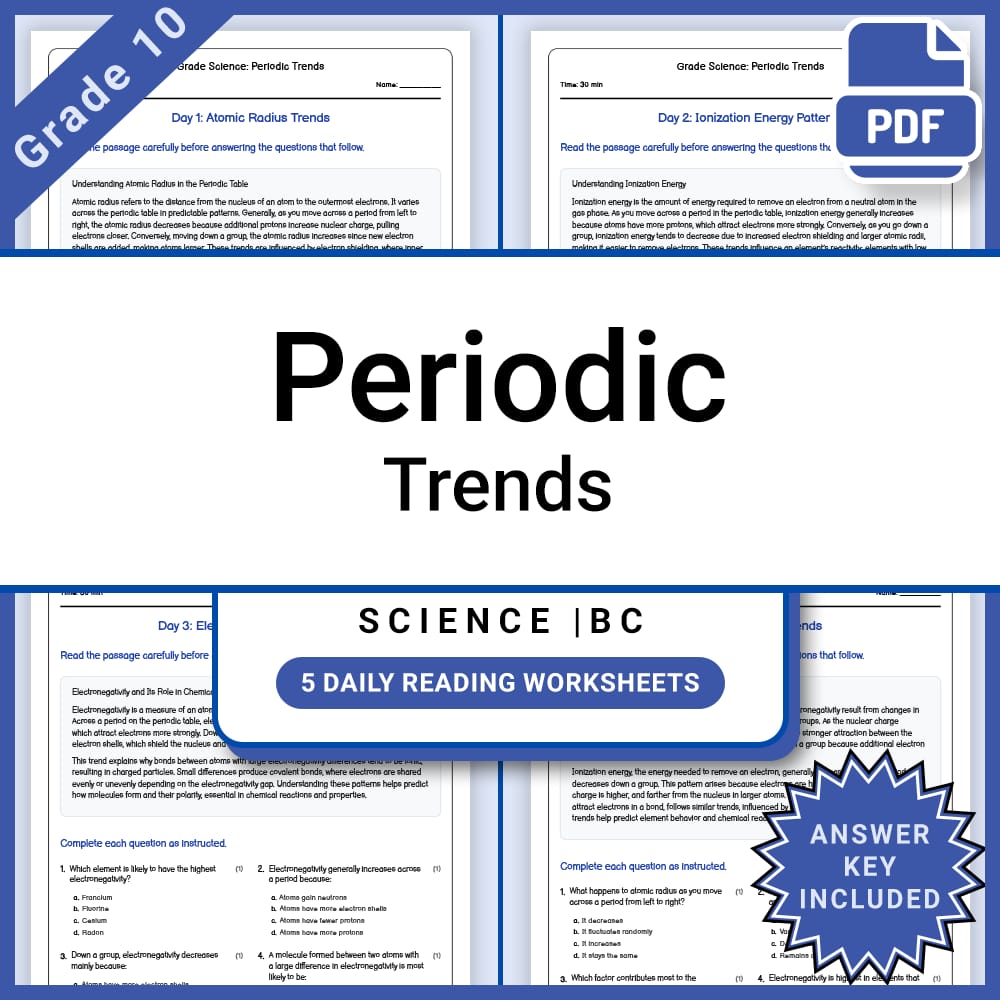
Grade 10 Science – Periodic Trends Daily Reading Worksheet + Answer Key
JCreated byJ.S SheetsLearning Objectives
- Understand how atomic radius changes across periods and down groups in the periodic table.
- Identify factors influencing atomic size, such as nuclear charge and electron shielding.
- Describe the significance of atomic radius in element properties and chemical behavior.
Also included in: Grade 10 Science Lesson Group – Core Concepts & Skills Bundle +1 more
Instant download
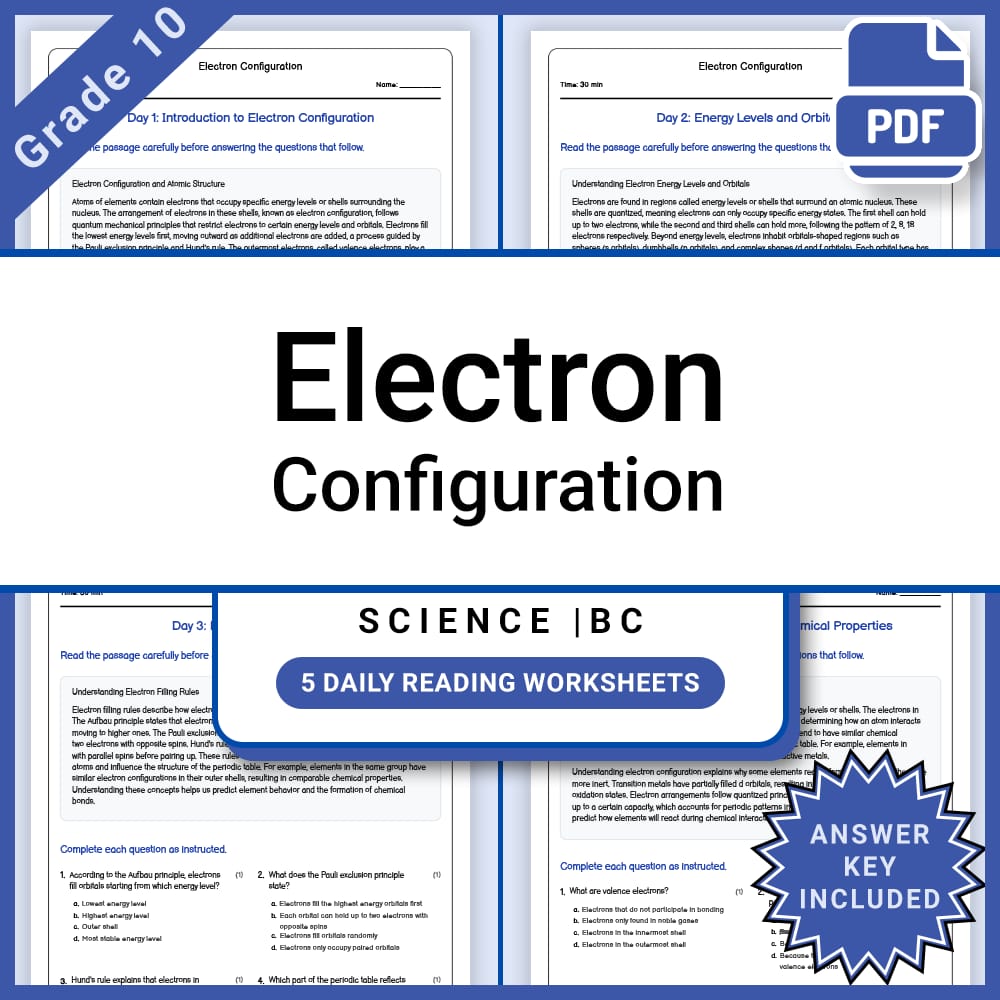
Grade 10 Science – Electron Configuration Daily Reading Worksheet + Answer Key
JCreated byJ.S SheetsLearning Objectives
- Understand how electrons are arranged in energy levels around an atom.
- Identify the pattern of electron filling in orbitals according to the atomic number.
- Relate electron configurations to the position of elements in the periodic table.
Also included in: Grade 10 Science Lesson Group – Core Concepts & Skills Bundle +1 more
Instant download
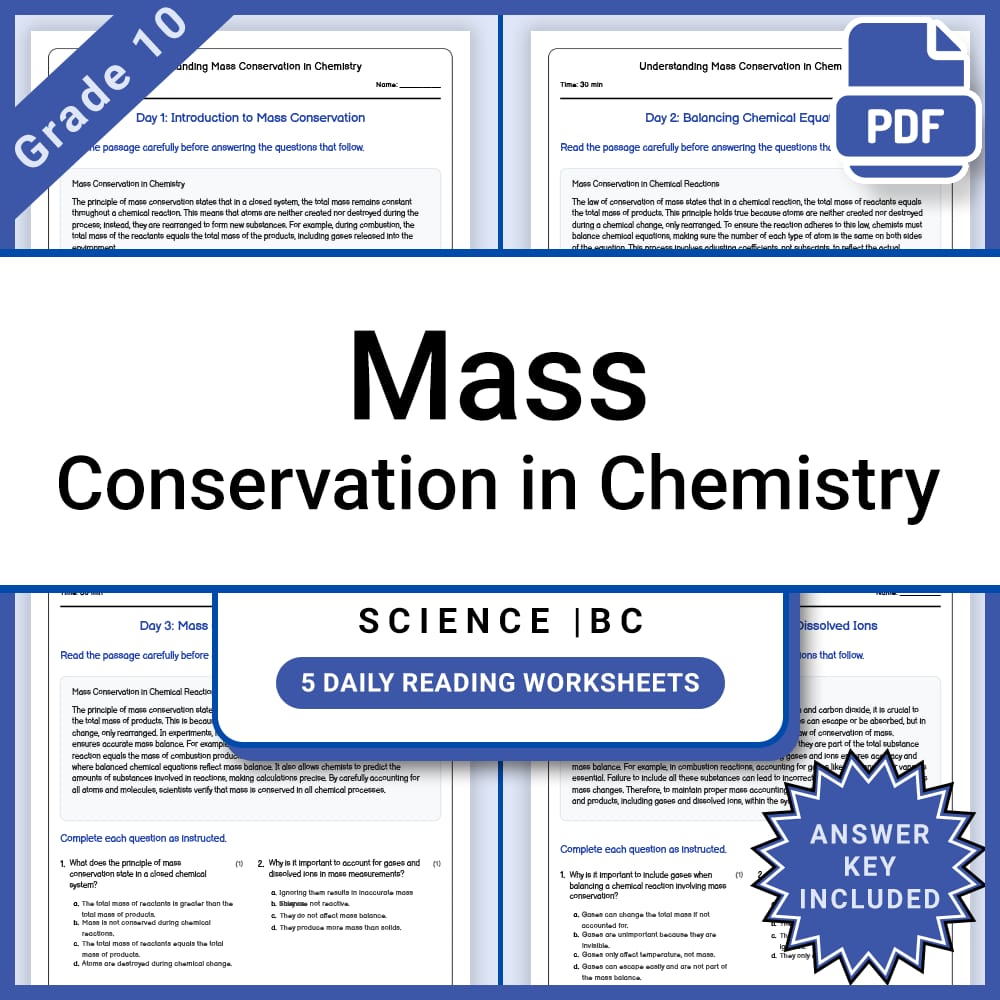
Grade 10 Science – Mass Conservation Daily Reading Worksheet + Answer Key
JCreated byJ.S SheetsLearning Objectives
- Understand key concepts related to Science
- Apply knowledge through practice questions
- Demonstrate comprehension of the material
Also included in: Grade 10 Science Lesson Group – Core Concepts & Skills Bundle +1 more
Instant download
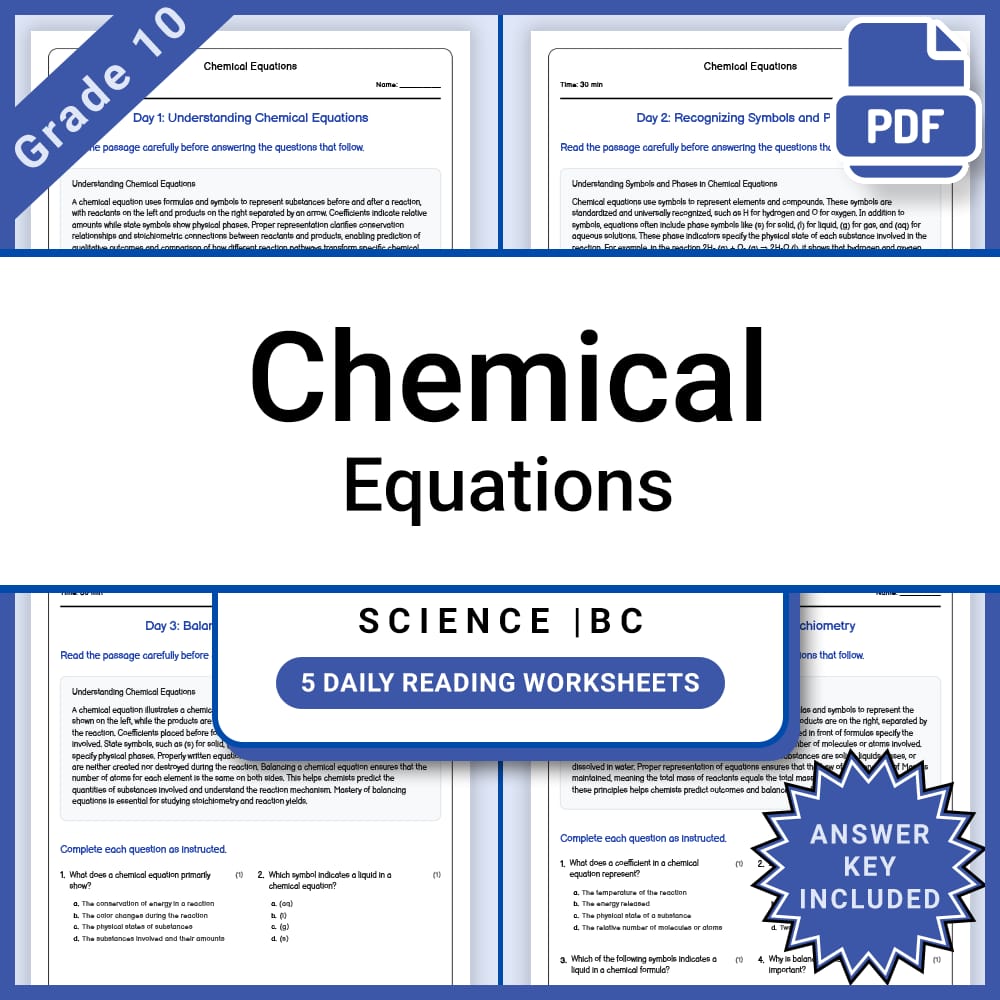
Grade 10 Science – Chemical Equations Daily Reading Worksheet + Answer Key
JCreated byJ.S SheetsLearning Objectives
- Understand the structure of chemical equations
- Identify reactants and products in chemical formulas
- Learn the significance of coefficients and state symbols
Also included in: Grade 10 Science Lesson Group – Core Concepts & Skills Bundle +1 more
Instant download

Grade 10 Science – Redox Reactions Daily Reading Worksheet with Answer Key
JCreated byJ.S SheetsLearning Objectives
- Understand the concept of oxidation and reduction in chemical reactions.
- Identify oxidation and reduction processes in simple reactions.
- Learn to assign oxidation numbers to atoms in compounds.
Also included in: Grade 10 Science Lesson Group – Core Concepts & Skills Bundle +1 more
Instant download

Grade 10 Science – Limiting Reagents Daily Reading Worksheet + Answer Key
JCreated byJ.S SheetsLearning Objectives
- Define what a limiting reagent is in a chemical reaction.
- Identify the limiting reagent by comparing available moles of reactants.
- Explain why excess reagents remain after a reaction completes.
Also included in: Grade 10 Science Lesson Group – Core Concepts & Skills Bundle +1 more
Instant download
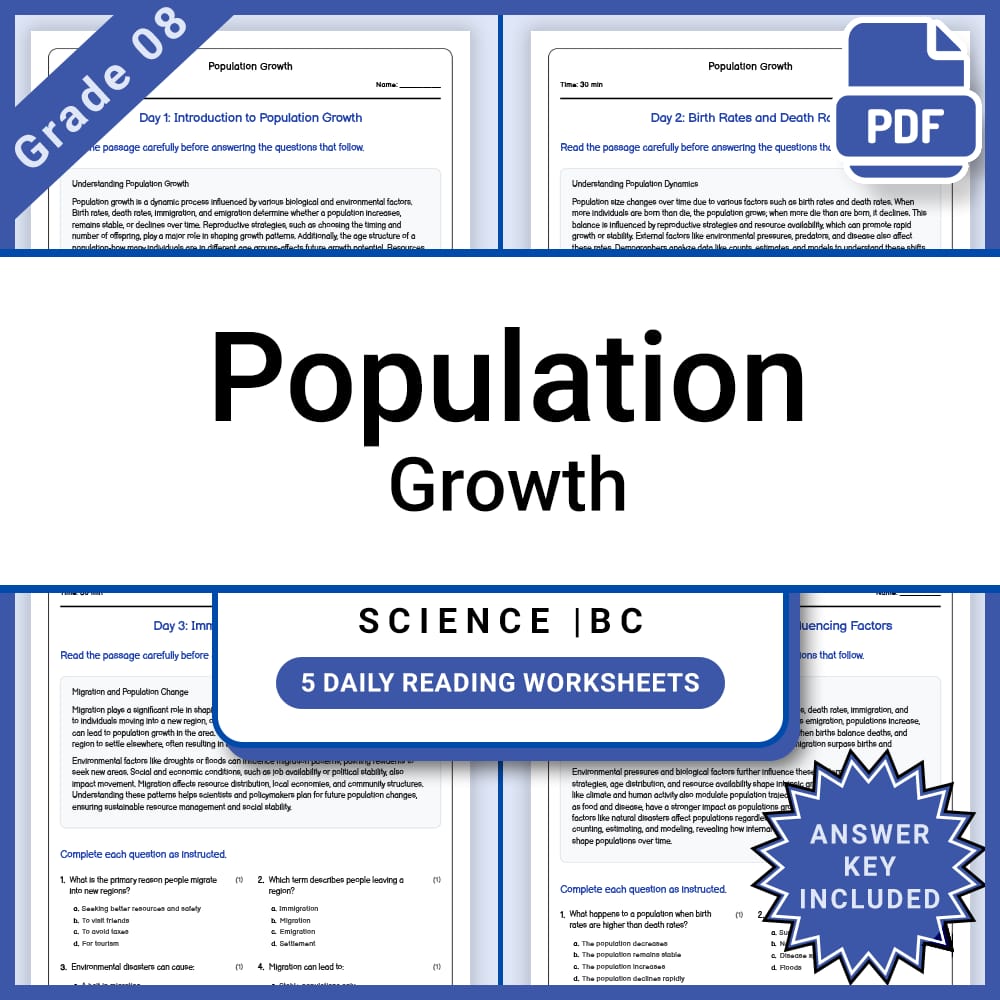
Grade 8 Science Population Growth Daily Reading Worksheet + Answer Key
JCreated byJ.S SheetsLearning Objectives
- Understand the basic concepts of population change
- Identify factors that influence population growth and decline
- Analyze how environmental and biological factors affect populations
Also included in: Grade 8 Science Lesson Bundle: Ecosystems, Biodiversity & Environmental Impacts +1 more
Instant download
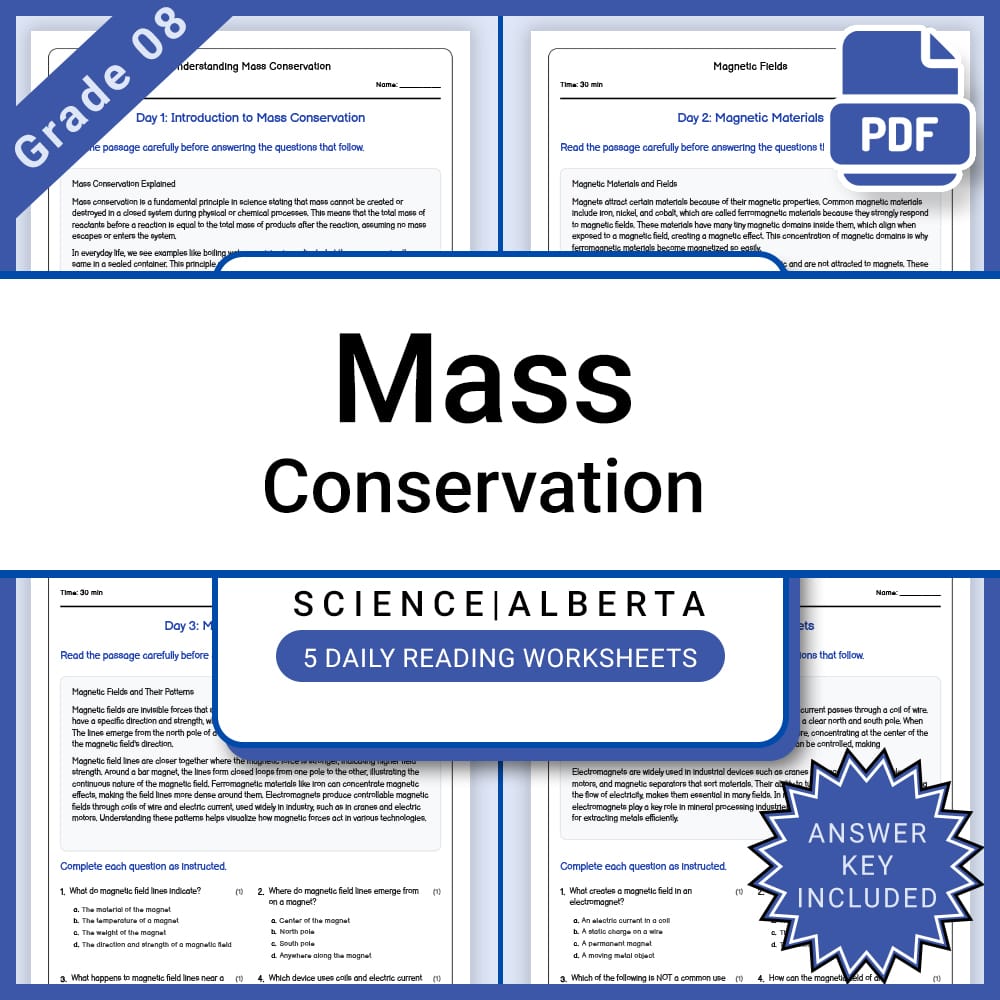
Grade 8 Science – Mass Conservation | Daily Reading Worksheet with Answer Key
JCreated byJ.S SheetsLearning Objectives
- Define the principle of mass conservation.
- Identify real-world examples of mass conservation.
- Explain why total mass remains constant during physical and chemical changes.
Also included in: Grade 8 Science Lesson Group Bundle | Alberta Framework +1 more
Instant download

Grade 7 Adaptation Function Worksheet | Practice & Assessment PDF
Created byClear Sky ClassroomLearning Objectives
- Explain how structural adaptations help organisms carry out life processes such as respiration, protection, and water regulation
- Compare behavioral and morphological adaptations and describe how each can improve survival or reproduction
- Identify trade-offs in adaptations and explain how improving one function can limit another
Instant download
Browse more categories
About Daily Reading Worksheets Worksheets
Explore daily reading worksheets activities across subjects and grades. Our 8,400 daily reading worksheets printables are ready to print, with answer keys where available.
Every worksheet on MyTeachingSheets is created by independent teacher-authors and reviewed before publication. All resources download as printable PDFs for classroom, homework, or at-home practice, and many include answer keys. Preview any worksheet free before buying.