
Reading comprehension Worksheets
40,284 type resources
Volcanic Processes Worksheet | Grade 9 AP Science Practice
 Created byBright Quill Resources
Learning Objectives
- Explain how magma composition, temperature, viscosity, and volatile content control eruptive styles.
- Compare effusive shield volcanism and explosive stratovolcano behavior using evidence such as gas emissions and eruption deposits.
- Interpret tectonic settings and petrologic indicators to connect volcanic activity with landscape and atmospheric change.
Instant download

Atmospheric Patterns Worksheet for AP Science Grade 10 with Answer Key
Created byBright Quill ResourcesLearning Objectives
- Explain how atmospheric structure and pressure differences drive weather and regional climate
- Use wind-field and pressure-surface ideas to interpret fronts, storm tracks, and circulation cells
- Connect synoptic-scale patterns to monsoons and mid-latitude cyclones
Instant download

Circuit Fundamentals Worksheet with Answer Key & AP Science Guide
Created byBright Quill ResourcesLearning Objectives
- Apply Ohm’s law to relate voltage, current, and resistance in DC circuits
- Analyze series and parallel circuits using equivalent resistance and conservation reasoning
- Connect electrical power and energy transfer rates to circuit behavior using algebraic expressions
Instant download

Wave Behavior Worksheet & AP Science Activity with Answer Key
Created byBright Quill ResourcesLearning Objectives
- Compare transverse and longitudinal waves using amplitude, wavelength, frequency, and wave speed
- Explain how wave interactions (reflection, refraction, interference, and superposition) affect energy and information transfer
- Analyze standing-wave formation and relate it to boundary conditions and harmonics
Instant download
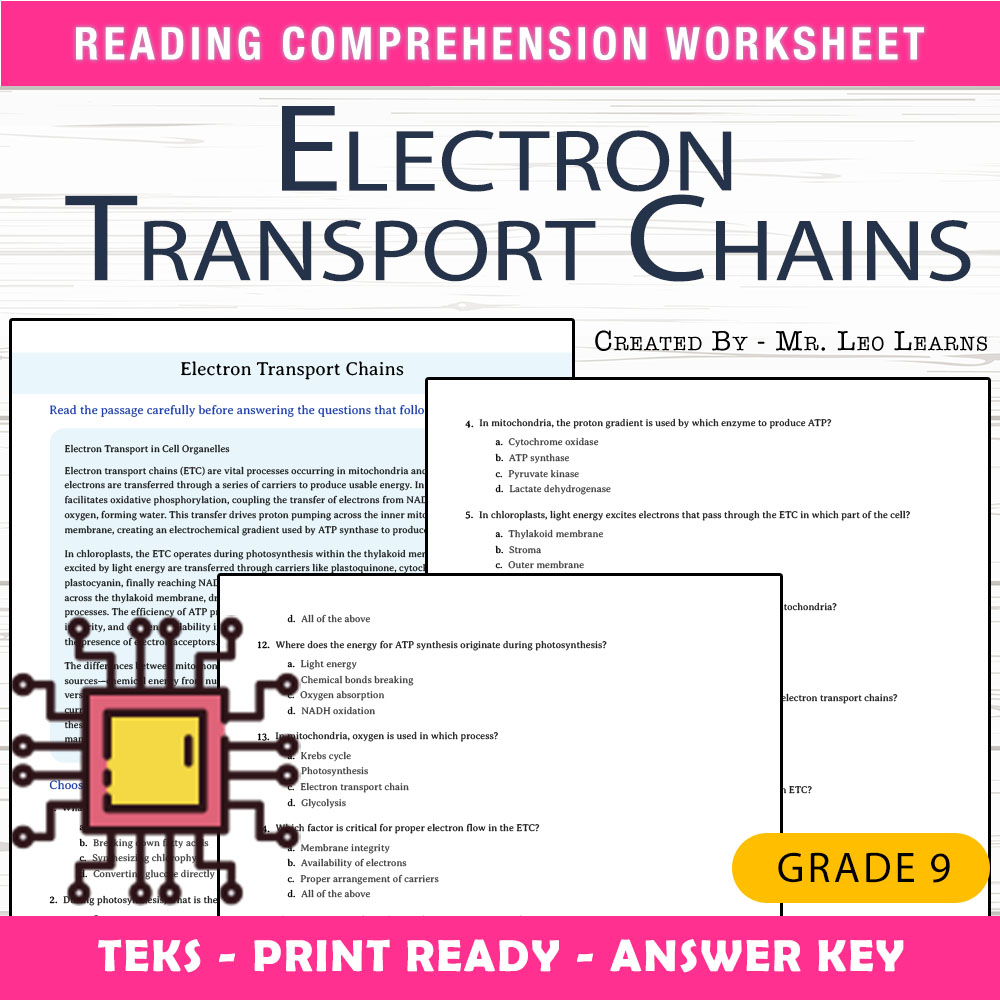
Grade 9 Science — Electron Transport Chains Worksheet for Mastery
 Created byThe Resource Hub
Learning Objectives
- Describe the process of electron transport in mitochondria and chloroplasts.
- Identify the role of proton gradients and ATP synthase in energy production.
- Compare mitochondrial and thylakoid electron transport mechanisms.
Also included in: Grade 9 Science | Enzymes, Photosynthesis & Metabolic Pathways Unit Bundle +1 more
Instant download
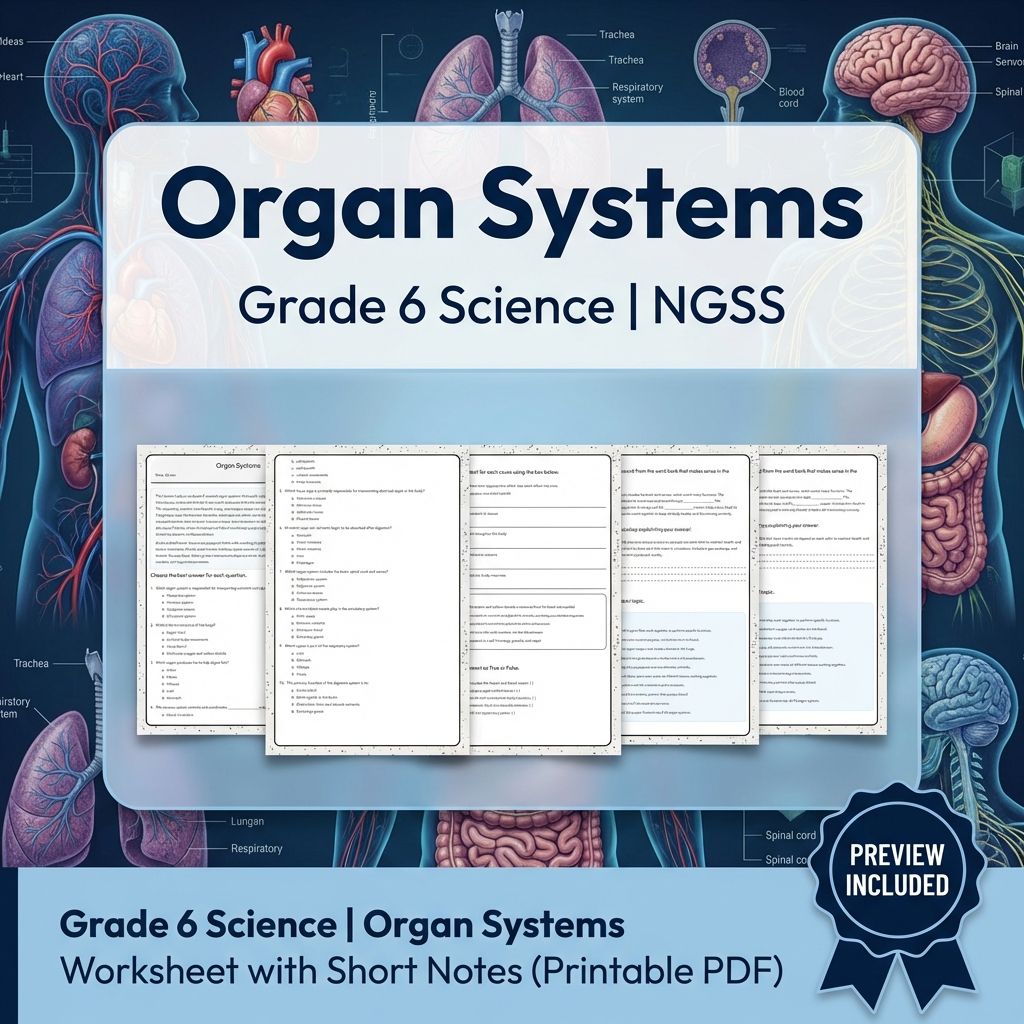
Grade 6 Science | Organ Systems Worksheet with Short Notes (Printable PDF)
 Created byMeadowlark Worksheets
Learning Objectives
- Describe the basic organization of circulatory, respiratory, digestive, and nervous systems.
- Explain the roles of tissues and organs within each organ system.
- Connect cellular functions to overall system-level processes and outcomes.
Also included in: Grade 6 Science NGSS From Molecules to Organisms: Structures & Processes +1 more
Instant download
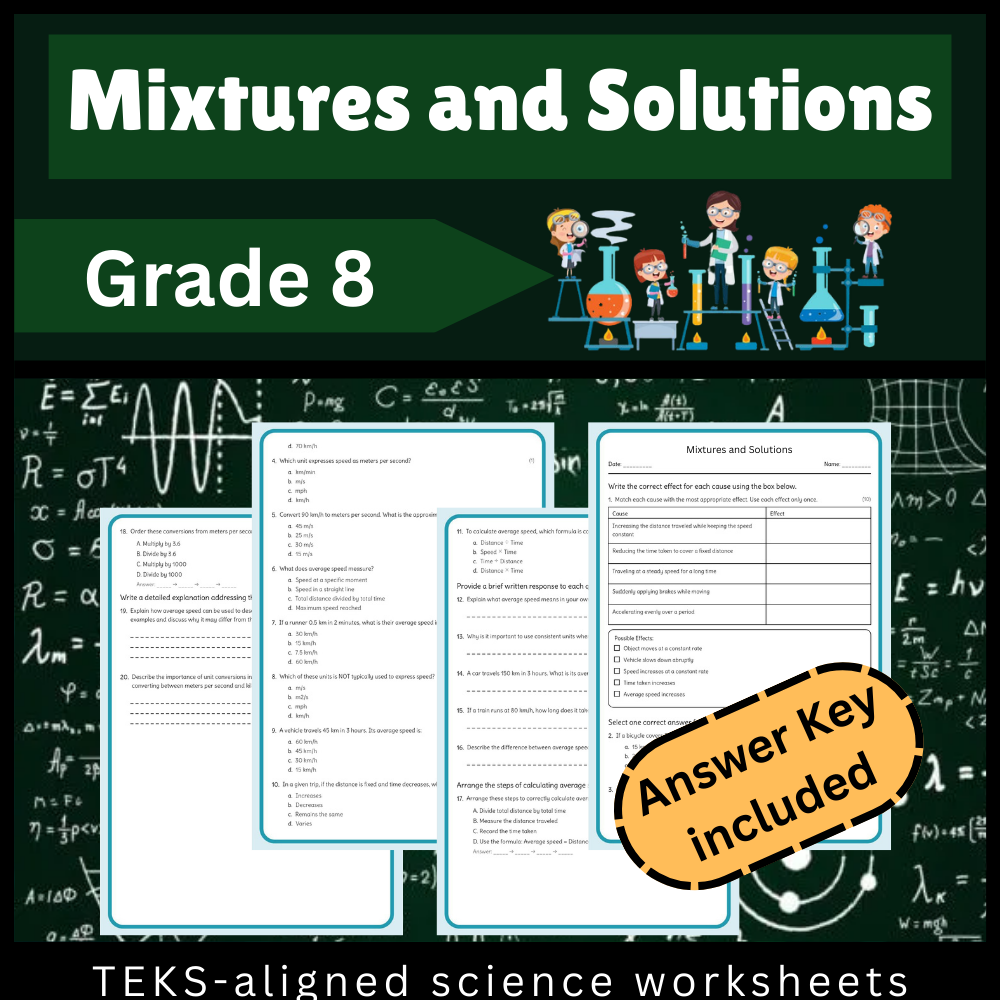
Grade 8 Science | Mixtures and Solutions Worksheet (Answer Key) PDF
 Created byBright Mind Resources
Learning Objectives
- Identify different types of mixtures as heterogeneous or homogeneous.
- Explain how solutions are formed and the concept of saturation and solubility.
- Describe common methods for separating mixtures such as filtration, evaporation, and distillation.
Also included in: Grade 8 Science Unit Bundle | States of Matter & Reaction Rates Worksheets- TEKS +1 more
Instant download

Grade 10 Science – Molecular Geometry & Shapes | Daily Reading Worksheet
Created byBright Mind ResourcesLearning Objectives
- Define molecular geometry using electron-domain models.
- Explain how electron pairs influence 3D molecular arrangements.
- Identify common molecular shapes and their electron-domain configurations.
Also included in: Grade 10 Stoichiometry & Atomic Structure Science Reading Lesson Bundle | AP +2 more
Instant download

Grade 10 Science – Population Patterns & Ecology | Daily Reading Worksheet
Created byBright Mind ResourcesLearning Objectives
- Understand the factors that influence population size and growth
- Identify concepts like birth rate, death rate, and carrying capacity
- Analyze basic population models and age-structure diagrams
Also included in: Grade 10 AP Science Daily Reading Lesson Bundle: Ecology, Genetics & Cells +2 more
Instant download

Grade 11 Science – Organelle Specialization & Function | Daily Reading Worksheet
Created byBright Mind ResourcesLearning Objectives
- Understand the structural differences between key organelles like mitochondria, chloroplasts, endoplasmic reticulum, and lysosomes.
- Explain how organelle specialization impacts metabolic pathways and cellular efficiency.
- Describe the endosymbiotic origin of mitochondria and chloroplasts.
Also included in: Grade 11 Cell Organelle Science Daily Reading Worksheets Lesson Bundle | AP +2 more
Instant download

Grade 10 Science – Model-Data Fit & Residuals | Daily Reading Worksheet
Created byBright Mind ResourcesLearning Objectives
- Understand the concept of comparing model predictions with observed data
- Learn how to interpret residuals and identify systematic deviations
- Apply goodness-of-fit concepts to evaluate model adequacy
Also included in: Grade 10 Scientific Reasoning Science Lesson Bundle | AP Daily Reading +2 more
Instant download

Grade 10 Science – Oscillations & Key Concepts | Daily Reading Worksheet
Created byBright Mind ResourcesLearning Objectives
- Understand the basic concept of oscillation
- Learn key terminology such as period, frequency, amplitude, and phase
- Explore how energy shifts between kinetic and potential forms during oscillations
Also included in: Motion, Energy & Electricity Grade 10 Science Reading Worksheets Bundle | AP +2 more
Instant download

Grade 10 Science – DNA Structure & Molecular Messaging | Daily Reading Worksheet
Created byBright Mind ResourcesLearning Objectives
- Identify the components of DNA and describe its structure.
- Understand how DNA stores genetic information.
- Recognize the importance of DNA's specificity in genetic transmission.
Also included in: Grade 10 AP Science Daily Reading Lesson Bundle: Ecology, Genetics & Cells +2 more
Instant download

Grade 10 Science – Impulse & Momentum | Daily Reading Worksheet
Created byBright Mind ResourcesLearning Objectives
- Understand the concept of impulse as a force applied over time that changes momentum.
- Relate impulse to the change in an object's momentum using the impulse-momentum theorem.
- Describe different types of collisions: elastic, inelastic, and perfectly inelastic.
Also included in: Motion, Energy & Electricity Grade 10 Science Reading Worksheets Bundle | AP +2 more
Instant download

Grade 9 Science – Membrane Transport & Cell Homeostasis | Reading Worksheet
Created byBright Mind ResourcesLearning Objectives
- Describe the basic mechanisms of passive diffusion, facilitated transport, and active transport across cell membranes.
- Explain how membrane composition and transport proteins influence cellular homeostasis.
- Predict the effects of structural modifications in membrane transport proteins on their function.
Also included in: Grade 9 Daily Reading Science Worksheets Lesson Bundle | AP +2 more
Instant download

Grade 10 Science – Projectile Motion Daily Reading Worksheet | AP Standards
Created byBright Mind ResourcesLearning Objectives
- Understand the basic principles of projectile motion and independent components
- Learn how horizontal and vertical motions are treated separately under gravity
- Explore vector decomposition and trajectory equations in projectile motion
Also included in: Motion, Energy & Electricity Grade 10 Science Reading Worksheets Bundle | AP +2 more
Instant download

Grade 10 Science – Human Footprints & Land Use Change | Daily Reading Worksheet
Created byBright Mind ResourcesLearning Objectives
- Understand how human land use changes affect ecosystems.
- Identify the impacts of land-use change on Earth’s systems.
- Analyze data and diagrams related to land use and environmental impact.
Also included in: Grade 10 Earth Science Daily Reading Worksheets Lesson Bundle | AP +2 more
Instant download

Grade 10 Science – Reaction Stoichiometry & Mole Concept | Reading Worksheet
Created byBright Mind ResourcesLearning Objectives
- Understand the mole concept and its importance in chemical calculations
- Calculate moles from given mass and molar mass
- Interpret and balance chemical equations for matter conservation
Also included in: Grade 10 Stoichiometry & Atomic Structure Science Reading Lesson Bundle | AP +2 more
Instant download

Grade 10 Science – Model Foundations & Scientific Models | Reading Worksheet
Created byBright Mind ResourcesLearning Objectives
- Identify different types of scientific models and their purposes
- Understand how to interpret and analyze conceptual diagrams, mathematical relations, and physical analogues
- Compare strengths and limitations of various model representations
Also included in: Grade 10 Scientific Reasoning Science Lesson Bundle | AP Daily Reading +2 more
Instant download

Grade 9 Science – Integrated Modeling & Environmental Science | Worksheet
Created byBright Mind ResourcesLearning Objectives
- Understand the principles of integrated environmental models
- Interpret the structure and variables of coupled models
- Recognize the role of parameter sensitivity and uncertainty in modeling
Also included in: Grade 9 Earth Systems Science Daily Reading Worksheets Lesson Bundle | AP +2 more
Instant download

Grade 9 Science – Dynamic Systems & Data Representation | Reading Worksheet
Created byBright Mind ResourcesLearning Objectives
- Understand the concept of dynamic systems and how they change over time.
- Identify different types of changes and patterns in system behavior.
- Analyze simple phase diagrams and interpret rate changes in systems.
Also included in: Grade 9 Science Data Analysis Daily Reading Worksheets Lesson Bundle | AP +2 more
Instant download

Grade 9 Science – Measurement & Uncertainty | Daily Reading Worksheet
Created byBright Mind ResourcesLearning Objectives
- Define and distinguish between random and systematic uncertainties in measurements.
- Explain the significance of statistical descriptors such as standard deviation and standard error.
- Describe methods used to propagate uncertainty through calculations.
Also included in: Grade 9 Science Data Analysis Daily Reading Worksheets Lesson Bundle | AP +2 more
Instant download

Grade 11 Science – Graphical Literacy & Data Interpretation | Reading Worksheet
Created byBright Mind ResourcesLearning Objectives
- Understand different types of graphs used in scientific data presentation
- Interpret trends and patterns from line graphs, histograms, box plots, and scatterplots
- Analyze how axis choices and scale affect data interpretation
Also included in: Science Data Models Grade 11 Science Daily Reading Worksheets lesson bundle | AP +2 more
Instant download

Grade 11 Science – Scientific Experiments & Design Logic | Reading Worksheet
Created byBright Mind ResourcesLearning Objectives
- Understand the principles of controlling variables in experiments
- Identify operational definitions of variables
- Recognize the importance of replication and randomization
Also included in: Science Data Models Grade 11 Science Daily Reading Worksheets lesson bundle | AP +2 more
Instant download

Grade 9 Science – Plate Boundaries & Tectonic Movements | Reading Worksheet
Created byBright Mind ResourcesLearning Objectives
- Identify the three main types of plate boundaries: divergent, convergent, and transform.
- Describe the surface features associated with each type of boundary.
- Recognize real-world examples of each boundary type from maps and cross-sections.
Also included in: Grade 9 Earth Systems Science Daily Reading Worksheets Lesson Bundle | AP +2 more
Instant download

Grade 11 Science – Quantitative Modeling & Biological Systems |Reading Worksheet
Created byBright Mind ResourcesLearning Objectives
- Understand different types of models used in biological research
- Recognize how models are parameterized and validated with empirical data
- Analyze the limitations and advantages of various modeling approaches
Also included in: Grade 11 Cell Organelle Science Daily Reading Worksheets Lesson Bundle | AP +2 more
Instant download

Grade 11 Science – Population Genetics & Evolution | Daily Reading Worksheet
Created byBright Mind ResourcesLearning Objectives
- Define and explain allele and genotype frequencies.
- Understand the principles of Hardy-Weinberg equilibrium.
- Identify the effects of forces such as selection, genetic drift, migration, and mutation on populations.
Also included in: Grade 11 Cell Organelle Science Daily Reading Worksheets Lesson Bundle | AP +2 more
Instant download

Grade 11 Science – Understanding Circular Motion & AP Daily Reading Worksheet
Created byBright Mind ResourcesLearning Objectives
- Define uniform and nonuniform circular motion
- Identify key concepts such as centripetal and tangential acceleration
- Describe how net forces act in circular motion scenarios
Also included in: Grade 11 Physics Daily Reading Lesson Bundle | AP Science Framework +2 more
Instant download

Grade 11 Science – Energy Balance & Climate Variability | Reading Worksheet
Created byBright Mind ResourcesLearning Objectives
- Understand the components of Earth's energy budget.
- Interpret radiative flux diagrams and albedo maps.
- Analyze how differential heating drives climate phenomena.
Also included in: Earth Systems Grade 11 Science Daily Reading Worksheets Lesson Bundle | AP +2 more
Instant download

Grade 11 Science – Statistical Reasoning & Data Analysis Daily Reading Worksheet
Created byBright Mind ResourcesLearning Objectives
- Understand the concept of variability in scientific data.
- Learn basic sampling concepts and their importance in scientific studies.
- Recognize the role of sampling distributions and how they relate to inference.
Also included in: Science Data Models Grade 11 Science Daily Reading Worksheets lesson bundle | AP +2 more
Instant download

Grade 11 Science – Energy Currency in Cells & ATP | Daily Reading Worksheet
Created byBright Mind ResourcesLearning Objectives
- Understand key concepts related to Science
- Apply knowledge through practice questions
- Demonstrate comprehension of the material
Also included in: Grade 11 Cell Organelle Science Daily Reading Worksheets Lesson Bundle | AP +2 more
Instant download

Grade 12 Science – Integrated Modeling & Biological Systems | Reading Worksheet
Created byBright Mind ResourcesLearning Objectives
- Understand molecular interactions and energy transfer mechanisms
- Construct basic molecular models illustrating energy flow
- Analyze how molecular processes influence cellular and larger system behaviors
Also included in: Grade 12 Evolution & Population Change Science Daily Reading Lesson Bundle | AP +2 more
Instant download

Grade 12 Science – Modeling Earth & Approaches | Daily Reading Worksheet
Created byBright Mind ResourcesLearning Objectives
- Understand basic Earth processes through simplified models
- Identify different types of models used in Earth sciences
- Analyze the purpose and limitations of Earth system models
Also included in: Earth Systems Grade 12 Science Daily Reading Worksheets Lesson Bundle | AP +2 more
Instant download

Grade 8 Science– Electromagnetic Induction & Magnetic Fields | Reading Worksheet
Created byBright Mind ResourcesLearning Objectives
- Understand the concept of magnetic fields and their sources.
- Learn how changing magnetic flux induces electric currents.
- Identify real-world applications of electromagnetic induction.
Also included in: Grade 8 Electricity Science Daily Reading Worksheets Lesson Bundle | Alberta +2 more
Instant download

Grade 8 Science – Energy Foundations in Ecosystems | Daily Reading Worksheet
Created byBright Mind ResourcesLearning Objectives
- Understand primary sources of energy in ecosystems such as sunlight and chemical energy
- Describe how energy moves through different levels of the food web
- Explain the role of decomposers and detritivores in energy transfer
Also included in: Grade 8 Ecosystems Science Daily Reading Worksheets Lesson Bundle | Alberta +2 more
Instant download

Grade 8 Science – Population Patterns & Ecosystem Dynamics | Reading Worksheet
Created byBright Mind ResourcesLearning Objectives
- Identify different types of population growth curves
- Understand the factors influencing population dynamics
- Recognize real-world examples of population fluctuations
Also included in: Grade 8 Ecosystems Science Daily Reading Worksheets Lesson Bundle | Alberta +2 more
Instant download

Grade 8 Science – Electric Charge & Electricity | Daily Reading Worksheet
Created byBright Mind ResourcesLearning Objectives
- Understand what electric charge is and its basic properties.
- Differentiate between static electricity and current electricity.
- Identify examples of static electricity in everyday life.
Also included in: Grade 8 Electricity Science Daily Reading Worksheets Lesson Bundle | Alberta +2 more
Instant download

Grade 8 Science – Free-Body Diagrams & Forces | Daily Reading Worksheet
Created byBright Mind ResourcesLearning Objectives
- Identify different forces acting on an object in various scenarios
- Understand how to represent forces using vectors in free-body diagrams
- Analyze how forces influence the motion of objects
Also included in: Grade 8 Science Systems Forces Daily Reading Worksheets Lesson Bundle | Alberta +2 more
Instant download

Grade 8 Science – Aerodynamic Drag & Air Resistance | Daily Reading Worksheet
Created byBright Mind ResourcesLearning Objectives
- Define aerodynamic drag and explain its effects on moving objects.
- Identify factors that influence air resistance such as shape, area, and flow conditions.
- Describe real-world applications where reducing or increasing drag is important.
Also included in: Grade 8 Science Systems Forces Daily Reading Worksheets Lesson Bundle | Alberta +2 more
Instant download

Grade 8 Science – Friction & Surface Texture Daily Reading Worksheet
Created byBright Mind ResourcesLearning Objectives
- Define static and kinetic friction
- Identify real-world examples of friction
- Explain how surface texture and materials affect friction
Also included in: Grade 8 Science Systems Forces Daily Reading Worksheets Lesson Bundle | Alberta +2 more
Instant download

Grade 8 Science – Particle Theory & Environmental Systems - Reading Worksheet
Created byBright Mind ResourcesLearning Objectives
- Understand the basic principles of particle theory and how particles behave in different environmental systems.
- Learn how particles interact and move within lakes, basins, and contaminated sites.
- Recognize the role of particle classification and chemical signatures in tracing environmental processes.
Also included in: Matter Change Grade 8 Science Daily Reading Worksheets Lesson Bundle | Alberta +2 more
Instant download

Grade 8 Science – Series & Parallel Circuits | Daily Reading Worksheet
Created byBright Mind ResourcesLearning Objectives
- Understand the differences between series and parallel circuit arrangements.
- Identify components connected in series versus parallel.
- Predict the behavior of circuits based on their configuration.
Also included in: Grade 8 Electricity Science Daily Reading Worksheets Lesson Bundle | Alberta +2 more
Instant download

Grade 8 Science – Power & Efficiency in Electrical Devices | Reading Worksheet
Created byBright Mind ResourcesLearning Objectives
- Understand the concept of power as energy transfer per unit time
- Identify factors affecting the efficiency of electrical devices
- Analyze how energy loss mechanisms impact device performance
Also included in: Grade 8 Electricity Science Daily Reading Worksheets Lesson Bundle | Alberta +2 more
Instant download

Grade 8 Science – Population Effects on Earth Systems | Daily Reading Worksheet
Created byBright Mind ResourcesLearning Objectives
- Understand how population growth influences resource consumption
- Analyze links between demographic changes and environment
- Evaluate evidence of human impact on climate, land, and water
Also included in: Geoscience Grade 8 Science Daily Reading Worksheets Lesson Bundle | NGSS +1 more
Instant download

Grade 8 Science – Understanding Momentum & Collisions | Daily Reading Worksheet
Created byBright Mind ResourcesLearning Objectives
- Define momentum and explain its significance in physics.
- Differentiate between elastic and inelastic collisions.
- Describe how momentum changes before and after a collision.
Also included in: Physical Science Grade 8 Science Daily Reading Worksheets Lesson Bundle | NGSS +1 more
Instant download

Grade 8 Science – Material Origins & Synthetic Materials | Reading Worksheet
Created byBright Mind ResourcesLearning Objectives
- Understand how petroleum is processed into plastics
- Recognize the steps involved in transforming raw materials into finished products
- Identify the importance of molecular structure in determining material properties
Also included in: Particle Motion Grade 8 Science Daily Reading Worksheets Lesson Bundle | NGSS +1 more
Instant download

Grade 8 Science – Problem Definition in Engineering | Daily Reading Worksheet
Created byBright Mind ResourcesLearning Objectives
- Define criteria and constraints for engineering problems.
- Identify measurable performance goals, safety requirements, and environmental conditions.
- Analyze trade-offs in problem scenarios such as cost, durability, and time.
Also included in: Grade 8 Tradeoff Analysis Science Daily Reading Worksheets Lesson Bundle | NGSS +1 more
Instant download

Grade 7 Science – Understanding Simple Machines & Daily Reading Worksheet
Created byBright Mind ResourcesLearning Objectives
- Define what simple machines are and describe their basic functions.
- Identify different types of simple machines including lever, pulley, wedge, screw, inclined plane, and wheel-and-axle.
- Explain the concept of mechanical advantage and how it is achieved using simple machines.
Also included in: Grade 7 Structures & Forces Science Lesson Bundle Daily Reading | Alberta +2 more
Instant download
Browse more categories
About Reading comprehension Worksheets
Find reading comprehension worksheets for class practice, homework, or self-study. All 40,284 are instant PDF downloads.
Each resource here is built by an independent educator and reviewed for quality. Worksheets print straight from PDF and suit classroom use, homework, or extra practice; most come with answer keys, and you can preview before purchasing.