
Reading comprehension Worksheets
40,284 type resources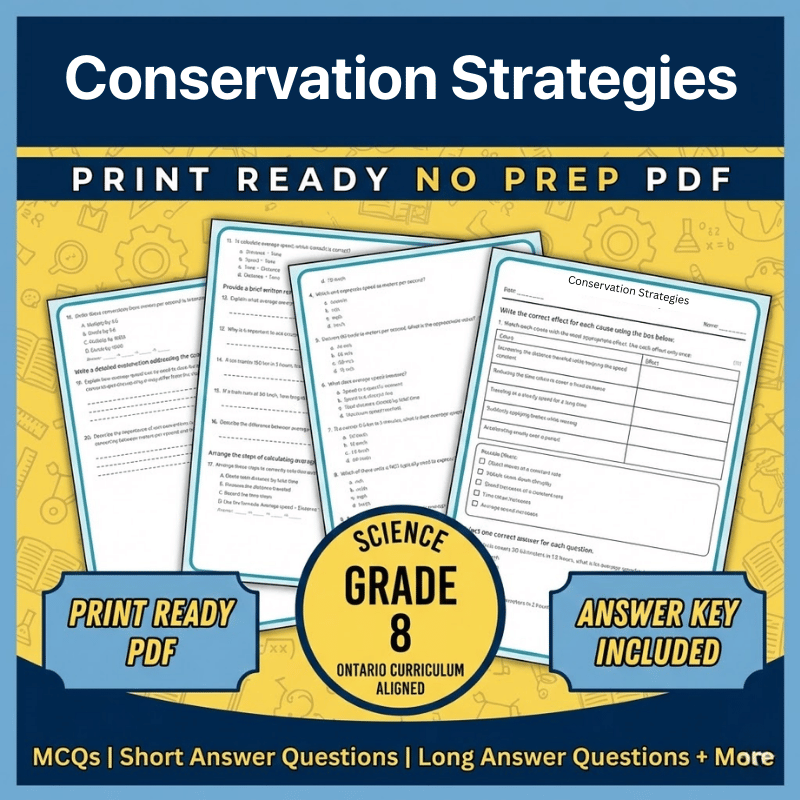
Grade 8 Science Worksheet | Conservation Strategies (Ontario Standards) (PDF)
 Created byBright Mind Resources
Learning Objectives
- Identify principles and methods for the stewardship of freshwater resources.
- Analyze trade-offs among water supply, ecological health, and economics.
- Evaluate community and individual actions that influence water sustainability.
Instant download
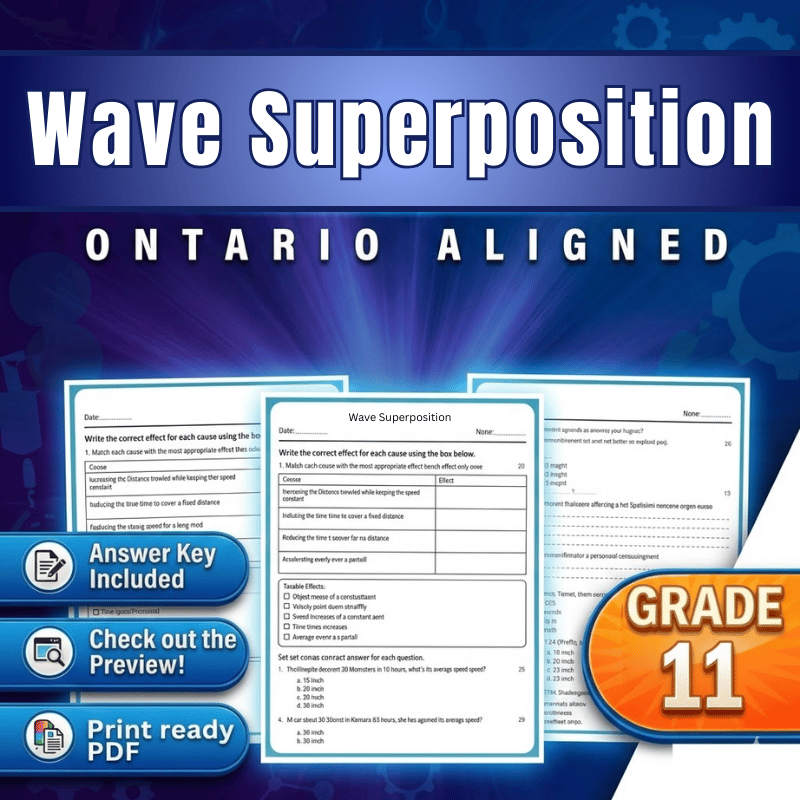
Grade 11 Science | Wave Superposition Worksheet (Ontario, PDF)
Created byBright Mind ResourcesLearning Objectives
- Explain the principle of superposition and its role in wave interference patterns.
- Describe how standing waves form in bounded media, identifying nodes and antinodes.
- Identify the relationship between resonant frequencies, harmonics, and boundary conditions.
Instant download
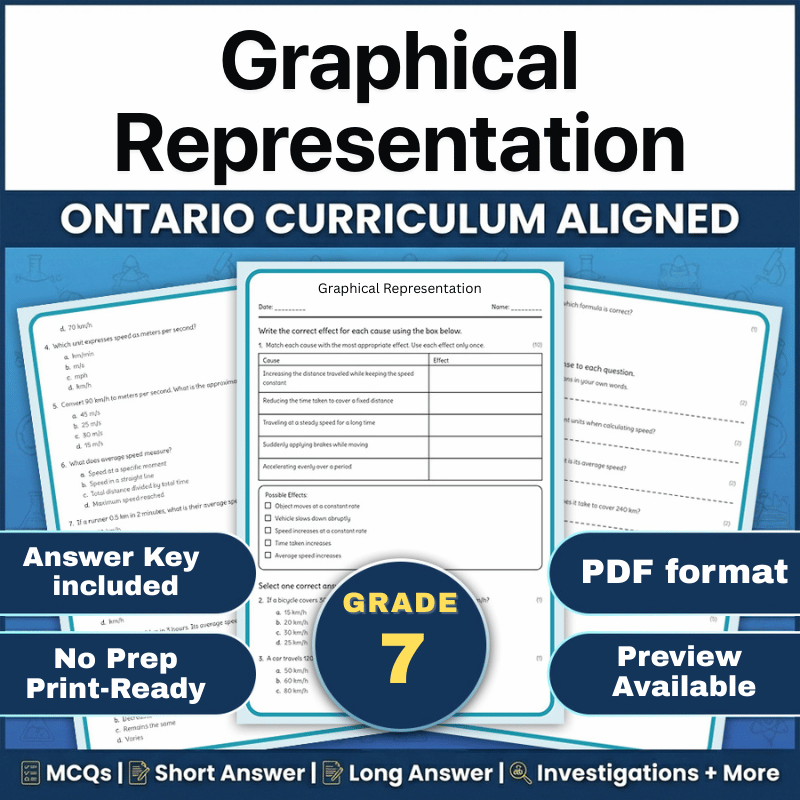
Grade 7 Science | Graphical Representation Worksheet (Ontario) (PDF)
Created byBright Mind ResourcesLearning Objectives
- Understand the different types of graphs and when to use each.
- Learn how to construct and interpret bar charts, histograms, line graphs, and scatter plots.
- Recognize the importance of axis scaling, error bars, trend lines, and annotations for clarity.
Instant download
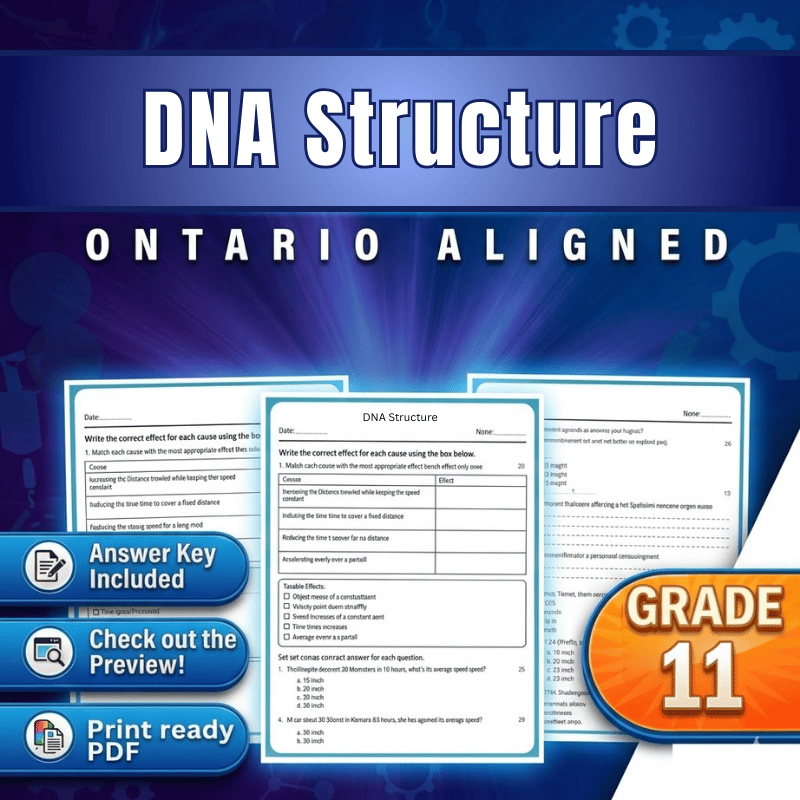
Grade 11 Science | DNA Structure Worksheet (PDF) – Ontario Standards
Created byBright Mind ResourcesLearning Objectives
- Describe the molecular and structural features of DNA, including nucleotide chemistry, antiparallel strands, and double-helical geometry.
- Explain how base-pairing specificity and higher-order chromatin organization influence genetic processes such as replication and transcription.
- Understand the role of DNA stability, strand directionality, and complementary coding in inheritance, mutation, and genetic information transfer.
Instant download
Grade 11 Science – Energy Transfer Worksheet (Ontario | Science PDF)
Created byBright Mind ResourcesLearning Objectives
- Identify various forms of energy including work, heat, and internal energy.
- Explain modes of energy transfer and conservation principles.
- Apply quantitative methods such as calorimetry and work–energy analysis to real-world scenarios.
Instant download
Grade 11 Science | Contaminant Dynamics Worksheet (Ontario – PDF)
Created byBright Mind ResourcesLearning Objectives
- Describe pathways and transport mechanisms of physical and chemical contaminants in ecosystems.
- Explain bioaccumulation and biomagnification processes in food webs.
- Assess the effects of nutrients, heavy metals, and persistent organic pollutants on community composition.
Instant download
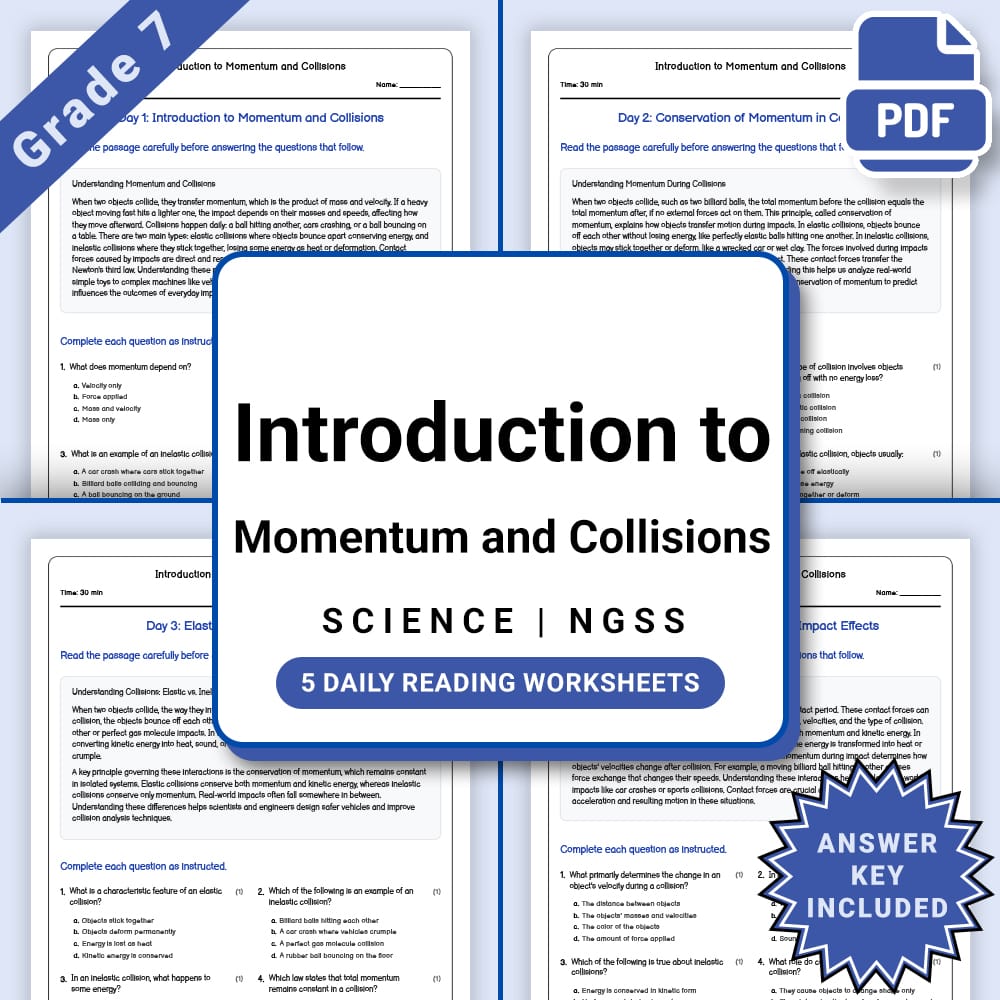
Grade 7 Science – Introduction to Momentum and Collisions (PDF + Answer Key)
 Created byCopper Leaf Classroom
Learning Objectives
- Understand the basic concepts of momentum and collisions.
- Identify how momentum is transferred during impacts.
- Differentiate between elastic and inelastic collisions.
Instant download
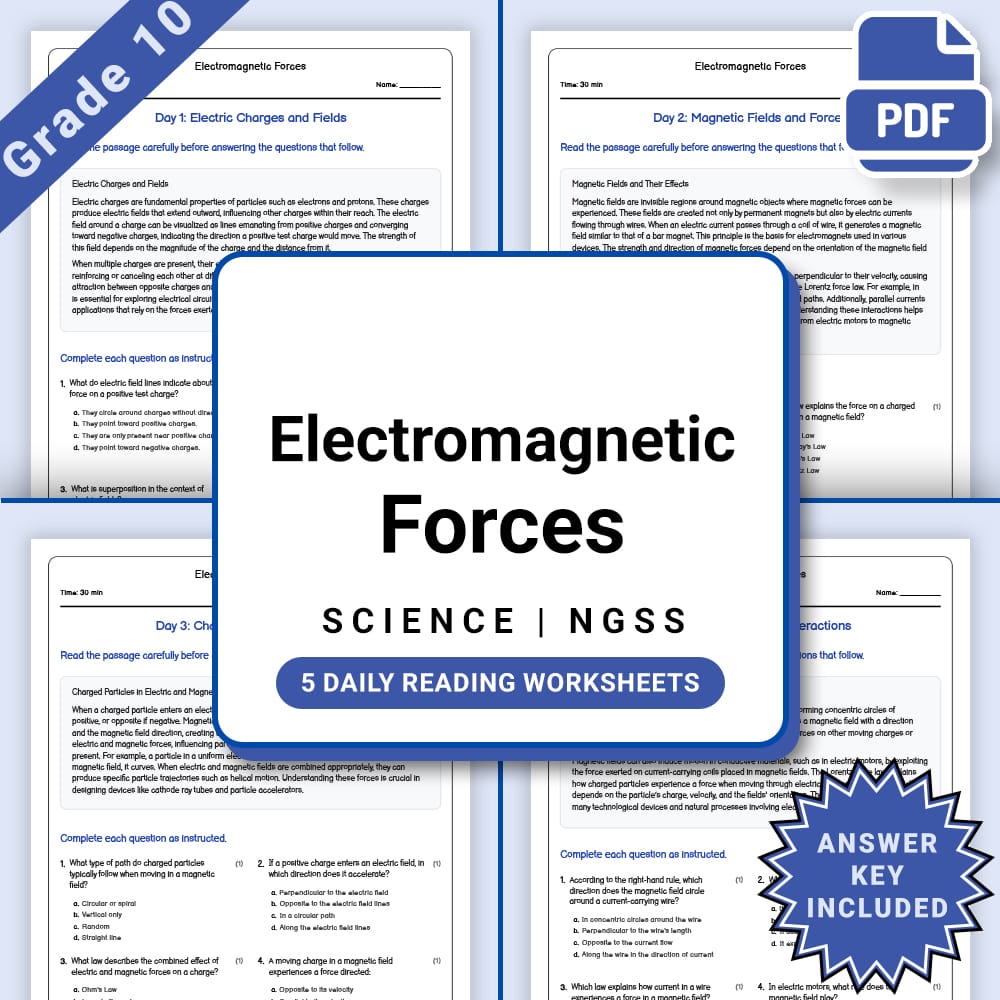
Grade 10 Science – Electromagnetic Forces Worksheet (PDF +Answer Key)
Created byCopper Leaf ClassroomLearning Objectives
- Understand how electric charges create electric fields around them.
- Explain the interaction between magnetic fields and electric currents.
- Describe the principles of the Lorentz force law in simple contexts.
Instant download
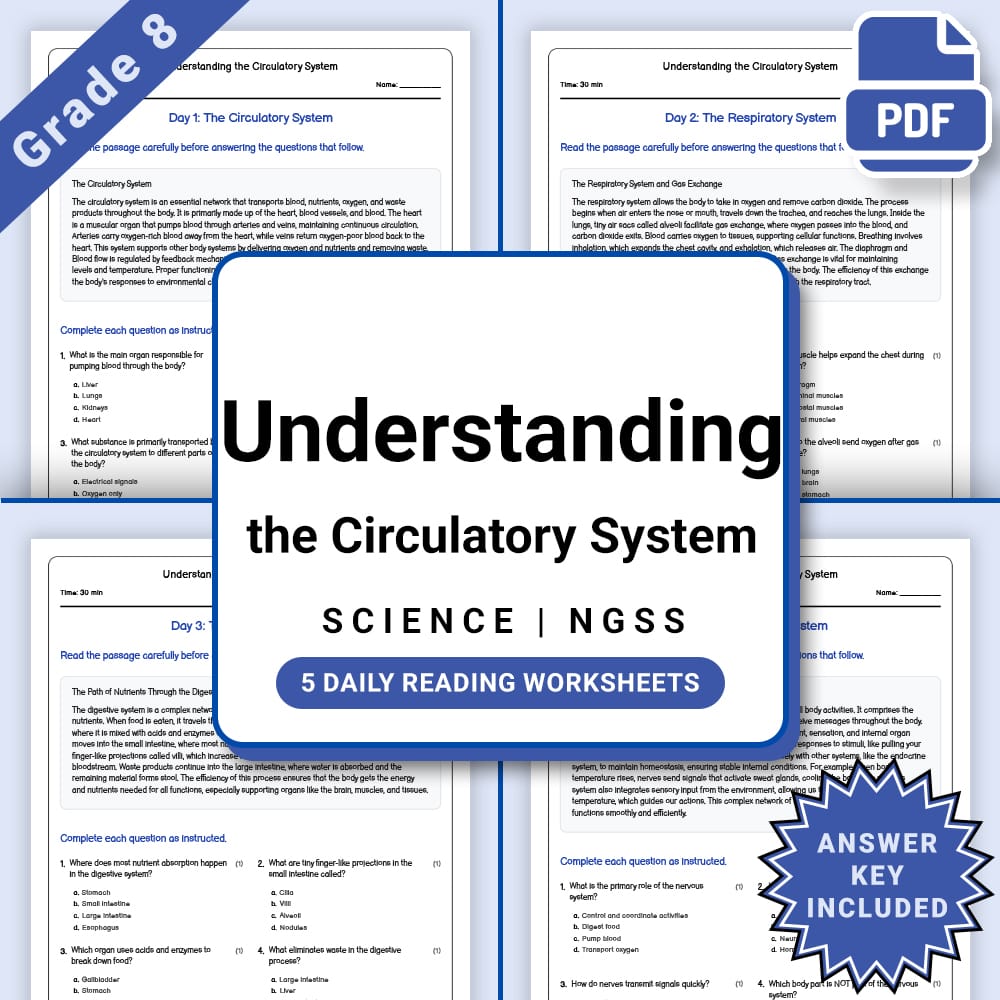
Grade 8 Science – Understanding the Circulatory System (PDF + Answer Key)
Created byCopper Leaf ClassroomLearning Objectives
- Identify the main components of the circulatory system
- Describe how blood circulates throughout the body
- Explain the role of the heart and blood vessels
Instant download
Grade 9 Science | Metabolic Pathways Worksheet (Answer Key) Aligned with TEKS
Created byBright Mind ResourcesLearning Objectives
- Describe the differences between catabolic and anabolic pathways.
- Explain how energy is harvested or stored during metabolic reactions.
- Identify mechanisms regulating pathway activity such as feedback inhibition and substrate availability.
Also included in: Grade 9 Science | Photosynthesis & Metabolic Pathways Unit Bundle (TEKS Aligned) +3 more
Instant download
Grade 9 Science | Glycolysis Overview Worksheet (Answer Key) – TEKS Aligned
Created byBright Mind ResourcesLearning Objectives
- Describe the stepwise process of glycolysis and its key intermediates.
- Explain how ATP and NADH are produced during glycolysis.
- Identify the different fates of pyruvate under aerobic and anaerobic conditions.
Also included in: Grade 9 Science | Photosynthesis & Metabolic Pathways Unit Bundle (TEKS Aligned) +3 more
Instant download
Grade 9 Science | Evolution Basics Worksheet (Worksheet + Answer Key, PDF)
Created byBright Mind ResourcesLearning Objectives
- Define evolution and identify its main mechanisms.
- Explain how natural selection, genetic drift, mutation, and gene flow influence genetic change over time.
- Analyze examples of how populations adapt and diverge through evolutionary processes.
Also included in: Grade 9 Science Unit | Evolution, Speciation & Genetics Worksheet Pack - TEKS +3 more
Instant download
Grade 9 Science | Cell Signaling Worksheet (Answer Key) – TEKS Aligned
Created byBright Mind ResourcesLearning Objectives
- Describe how receptor proteins bind ligands to initiate cell signaling.
- Identify different types of cell signaling pathways and their functions.
- Explain how signal transduction pathways alter cellular responses like gene expression and metabolism.
Also included in: Grade 9 Science Unit | Human Body Systems Worksheets & TEKS Aligned Bundle +3 more
Instant download
Grade 9 Science – Molecular Evidence Worksheet (Worksheet + Answer Key) | TEKS Aligned
Created byBright Mind ResourcesLearning Objectives
- Understand how molecular data is used to infer evolutionary relationships.
- Identify key concepts such as homologous genes, sequence divergence, and molecular clocks.
- Analyze patterns of genetic similarities and differences among species.
Also included in: Grade 9 Science Unit | Evolution, Speciation & Genetics Worksheet Pack - TEKS +3 more
Instant download
Grade 9 Science | Glucose Regulation Worksheet (Worksheet + Answer Key) – TEKS Aligned
Created byBright Mind ResourcesLearning Objectives
- Describe how hormonal feedback regulates blood glucose levels.
- Explain the roles of insulin and glucagon in maintaining energy balance.
- Identify the effects of insulin and glucagon on liver and muscle tissues.
Also included in: Grade 9 Science Unit | Human Body Systems Worksheets & TEKS Aligned Bundle +3 more
Instant download
Grade 10 Science | Energy Changes Worksheet (AP Standard + Answer Key) (PDF)
Created byBright Mind ResourcesLearning Objectives
- Explain the concepts of endothermic and exothermic reactions in terms of energy transfer.
- Describe how bond breaking and forming influence reaction heat and potential energy diagrams.
- Understand the basic ideas of enthalpy and reaction spontaneity.
Instant download
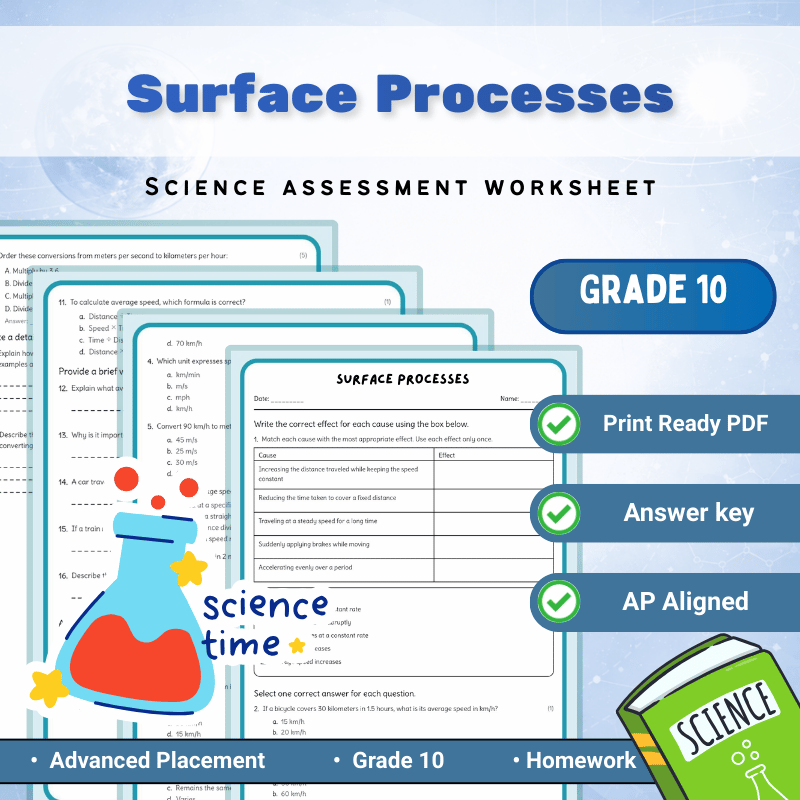
Grade 10 Science Surface Processes Worksheet | AP Standards (PDF) Practice Set
Created byBright Mind ResourcesLearning Objectives
- Understand key surface processes such as weathering, erosion, sediment transport, and deposition.
- Interpret how climate, lithology, and human activity influence landscape evolution.
- Identify observable signatures of surface processes, including sediment grain-size distributions and channel profiles.
Instant download
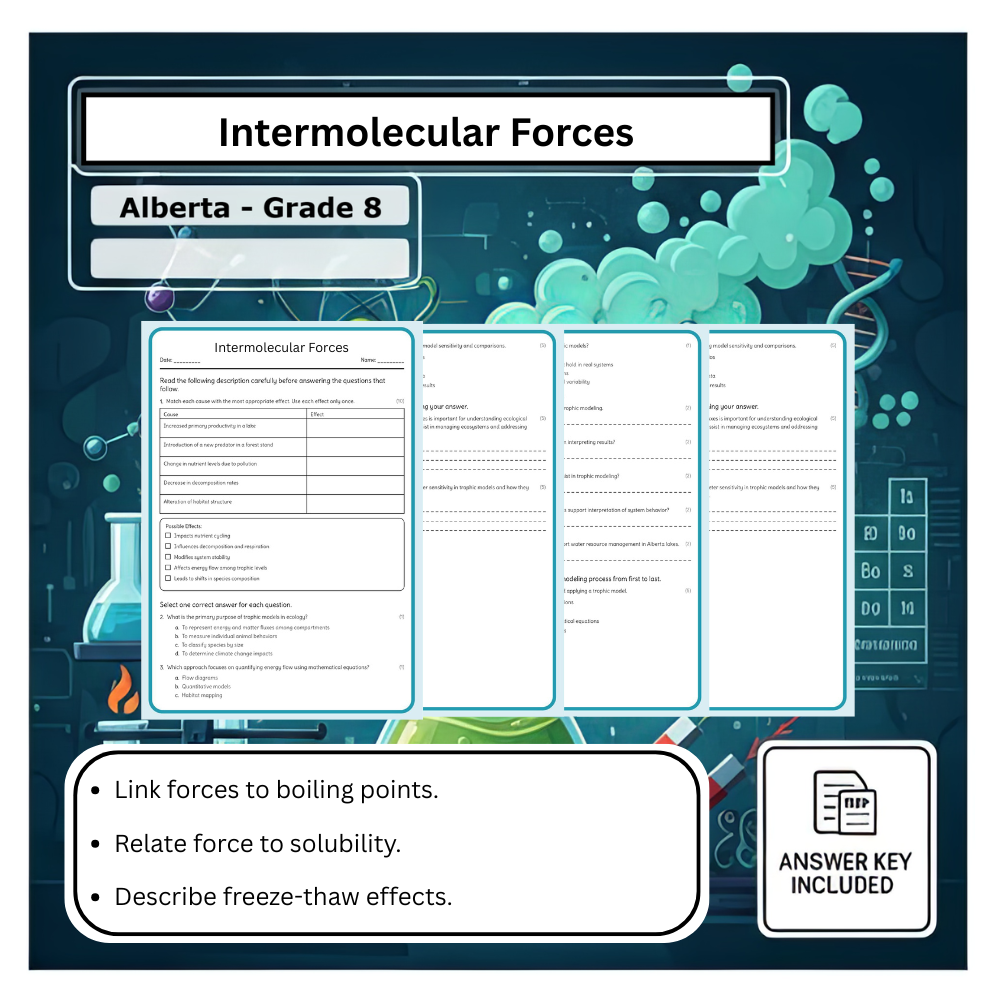
Grade 8 Science – Intermolecular Forces Worksheet (PDF) – Alberta Standards
Created byBright Mind ResourcesLearning Objectives
- Explain how intermolecular forces affect melting and boiling points.
- Relate the strength of intermolecular forces to chemical volatility and solubility.
- Describe regional phenomena like freeze-thaw cycles, volatility of hydrocarbons, and humidity effects in Alberta.
Instant download
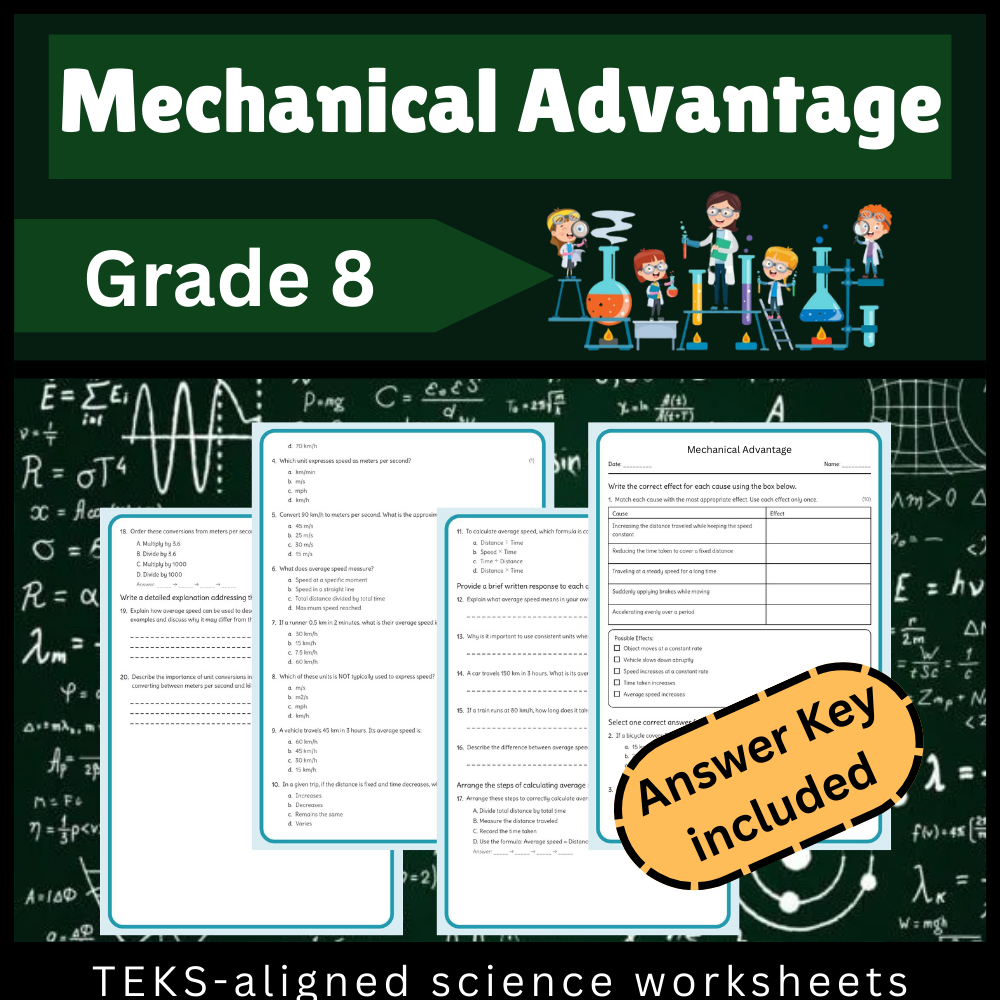
Grade 8 Science | Mechanical Advantage Worksheet (Answer Key) – TEKS Aligned
Created byBright Mind ResourcesLearning Objectives
- Understand and calculate the ideal and actual mechanical advantage of simple machines.
- Apply algebraic formulas to relate force, distance, and work in machine systems.
- Analyze the effects of frictional losses on real mechanical advantage.
Also included in: Grade 8 Science Unit | Motion, Forces & Energy Worksheets Bundle (TEKS Aligned) +1 more
Instant download
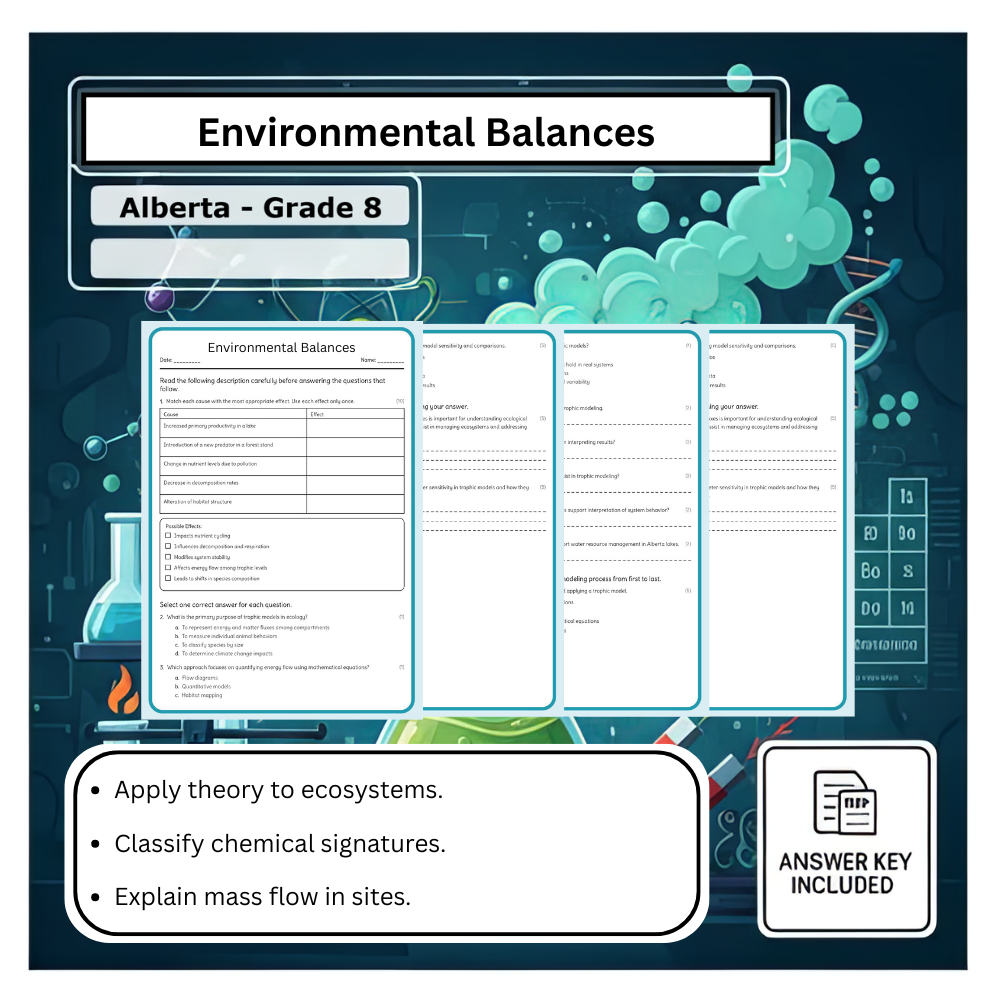
Grade 8 Science – Environmental Balances Worksheet (PDF) – Alberta Standards
Created byBright Mind ResourcesLearning Objectives
- Understand how particle theory applies to environmental systems.
- Classify environmental processes based on phases and chemical signatures.
- Explain the principle of mass conservation in ecosystems and contamination sites.
Instant download
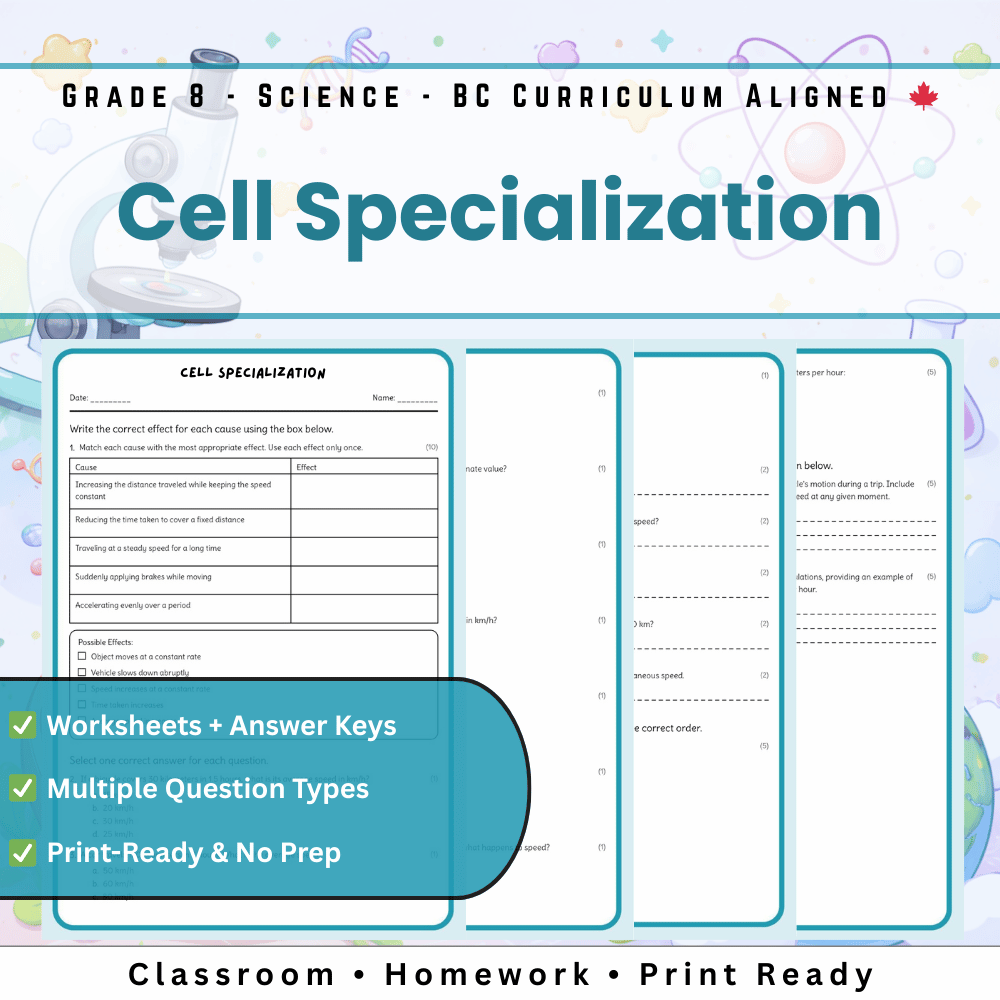
Grade 8 Science – Cell Specialization Worksheets + Answer Key | BC Standards
Created byBright Mind ResourcesLearning Objectives
- Explain how cell specialization allows cells to perform specific biological tasks.
- Identify examples of specialized cells and their adaptations.
- Describe how structural modifications support cell function in tissues.
Instant download

Grade 8 Science – Circular Motion Worksheet (PDF) | Alberta Standards
Created byBright Mind ResourcesLearning Objectives
- Understand the concept of centripetal force and how it causes objects to move in a circle.
- Analyze how forces, mass, and radius affect the necessary centripetal force in circular motion.
- Describe real-world phenomena involving circular motion, such as road curves and amusement rides.
Instant download
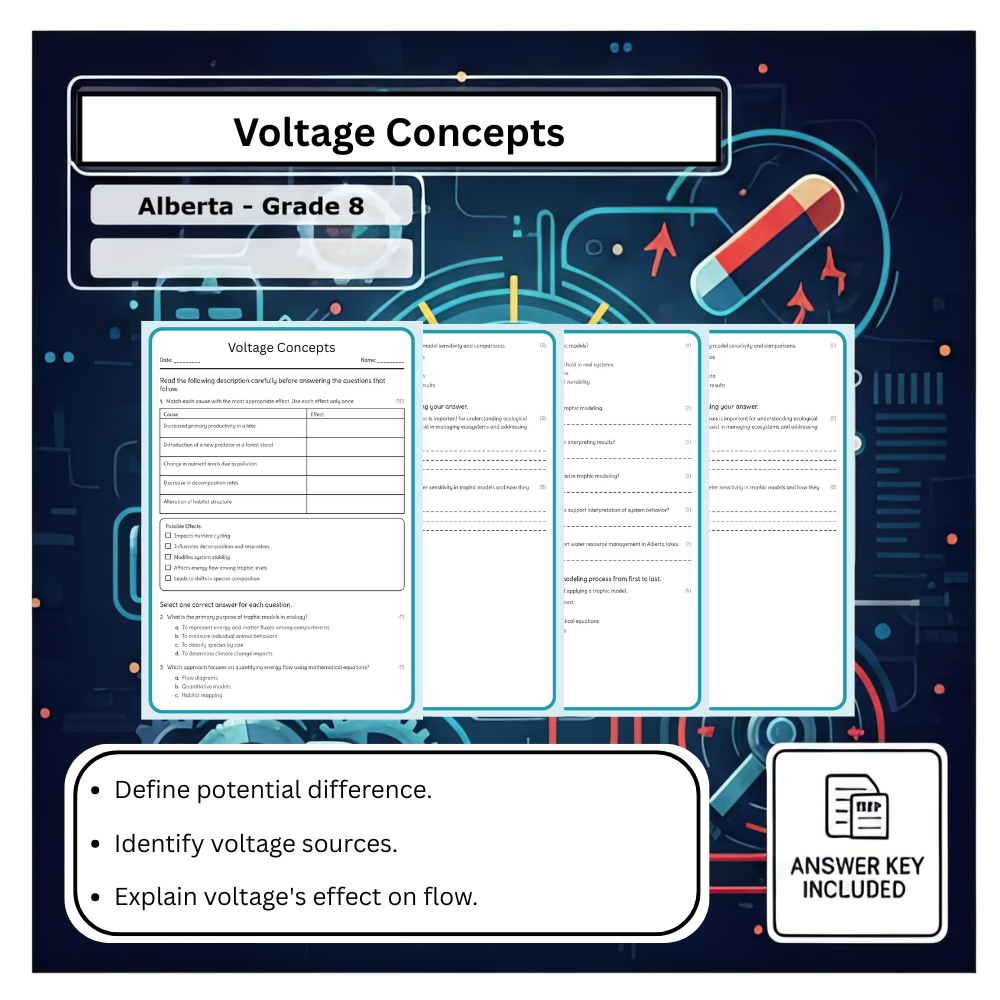
Grade 8 Science | Voltage Concepts Worksheet (PDF) – Alberta Standards
Created byBright Mind ResourcesLearning Objectives
- Understand the concept of voltage as electric potential difference.
- Identify sources of voltage such as batteries and generators.
- Explain how voltage affects current flow in circuits.
Instant download
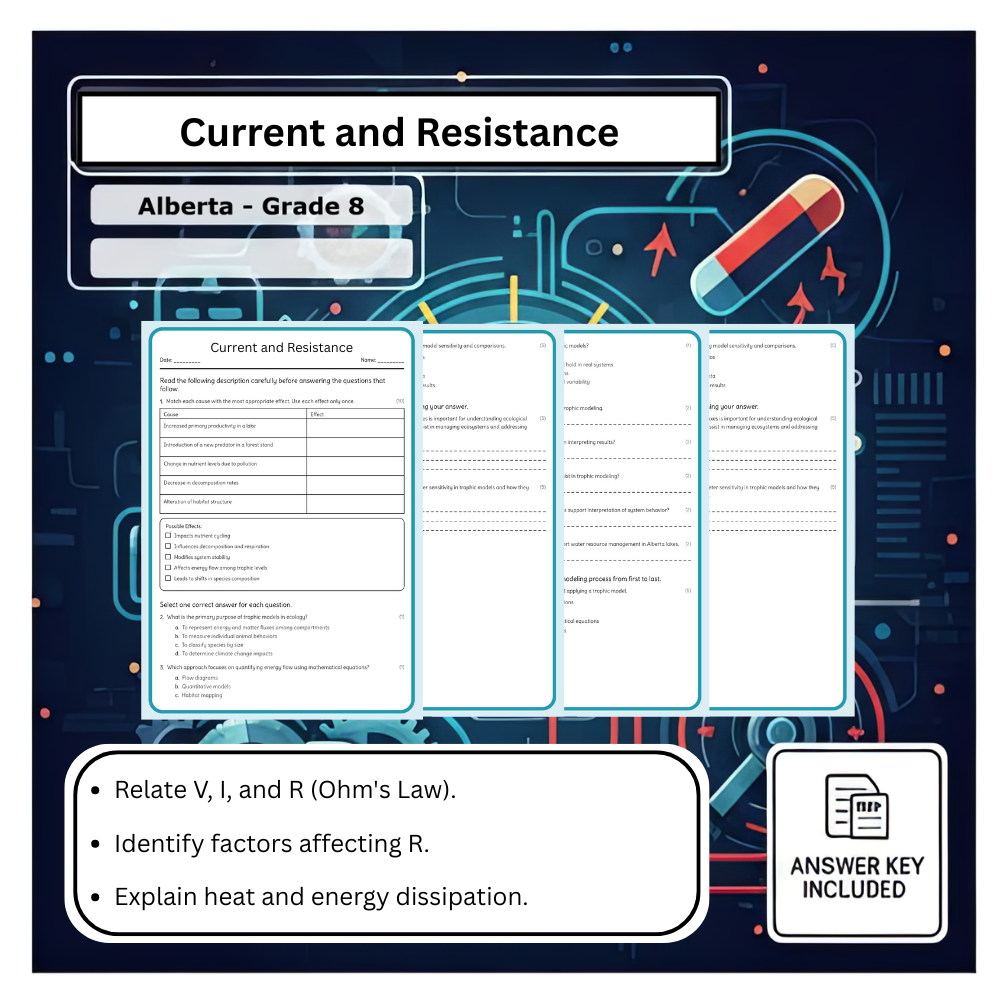
Grade 8 Science | Current and Resistance Worksheet (PDF) – Alberta Standards
Created byBright Mind ResourcesLearning Objectives
- Understand the relationship between voltage, current, and resistance in electrical circuits.
- Identify factors affecting resistance in different materials and conditions.
- Explain how resistance influences energy dissipation and component heating.
Instant download
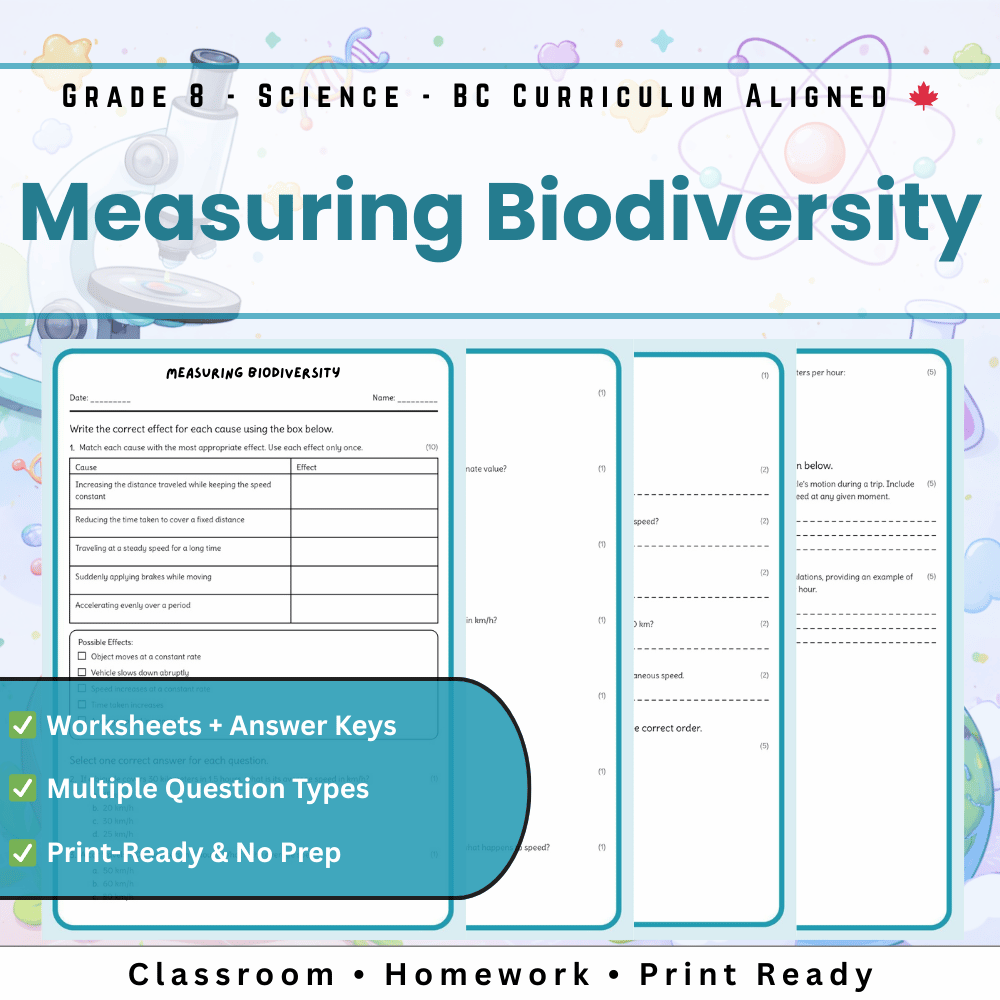
Grade 8 Science | Measuring Biodiversity Worksheet (Answer Key) | BC Standards
Created byBright Mind ResourcesLearning Objectives
- Understand the concepts of species richness, evenness, and diversity indices in measuring biodiversity.
- Explain how habitat heterogeneity, sampling methods, and temporal factors influence biodiversity estimates.
- Analyze patterns of biodiversity across different environments to inform conservation efforts.
Instant download
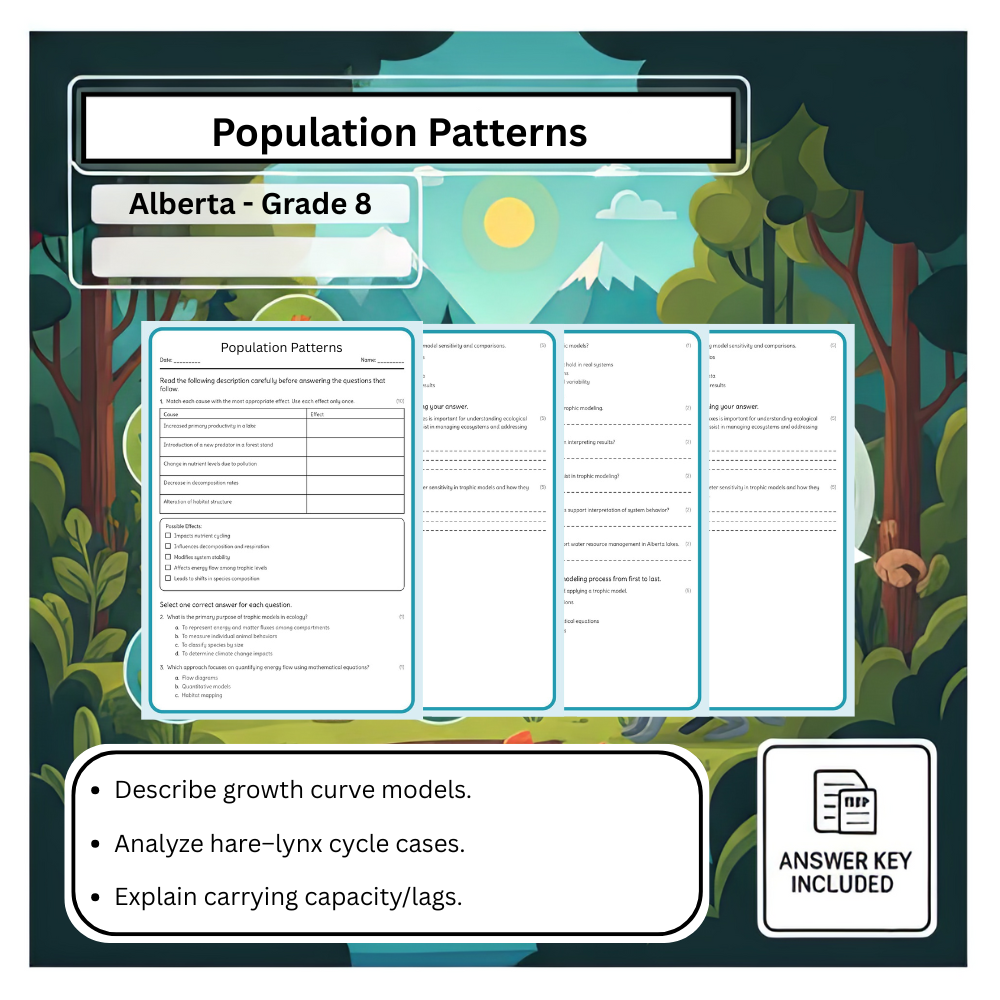
Grade 8 Science | Population Patterns Worksheet (PDF) – Alberta Standards
Created byBright Mind ResourcesLearning Objectives
- Describe different types of population growth curves, including exponential and logistic models.
- Analyze case studies such as snowshoe hare–lynx cycles and forest insect outbreaks to understand population dynamics.
- Explain factors like carrying capacity, reproductive strategies, and time lags in shaping population trajectories.
Instant download
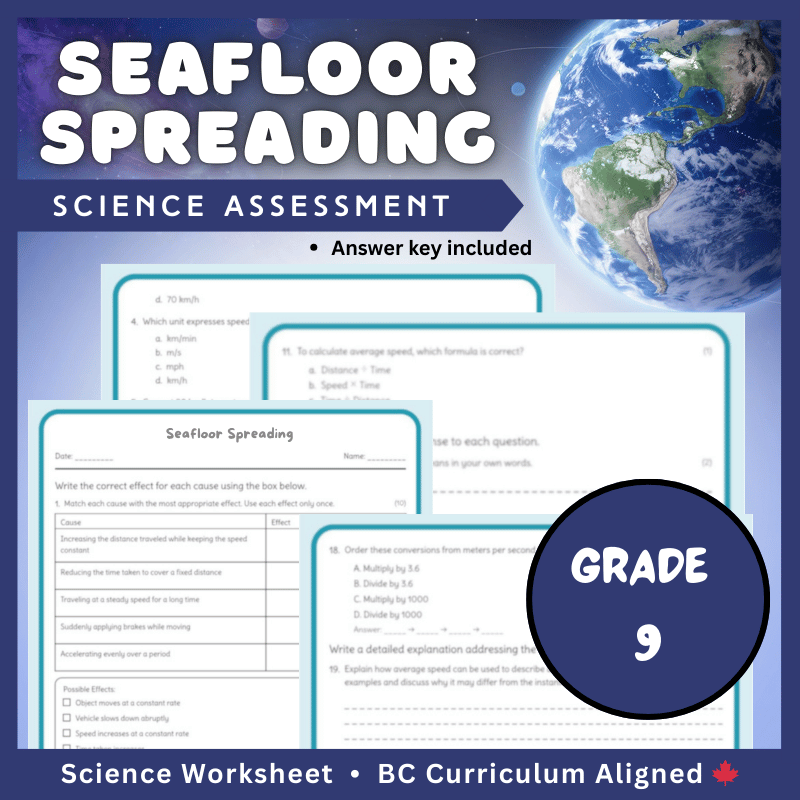
Grade 9 Science | Seafloor Spreading Worksheet (Answer Key) – BC Standards
Created byBright Mind ResourcesLearning Objectives
- Understand the process of seafloor spreading at mid-ocean ridges.
- Identify evidence supporting the theory of plate tectonics, including magnetic striping and age progression.
- Explain how oceanic crust is created and recycled in earth's lithosphere.
Instant download
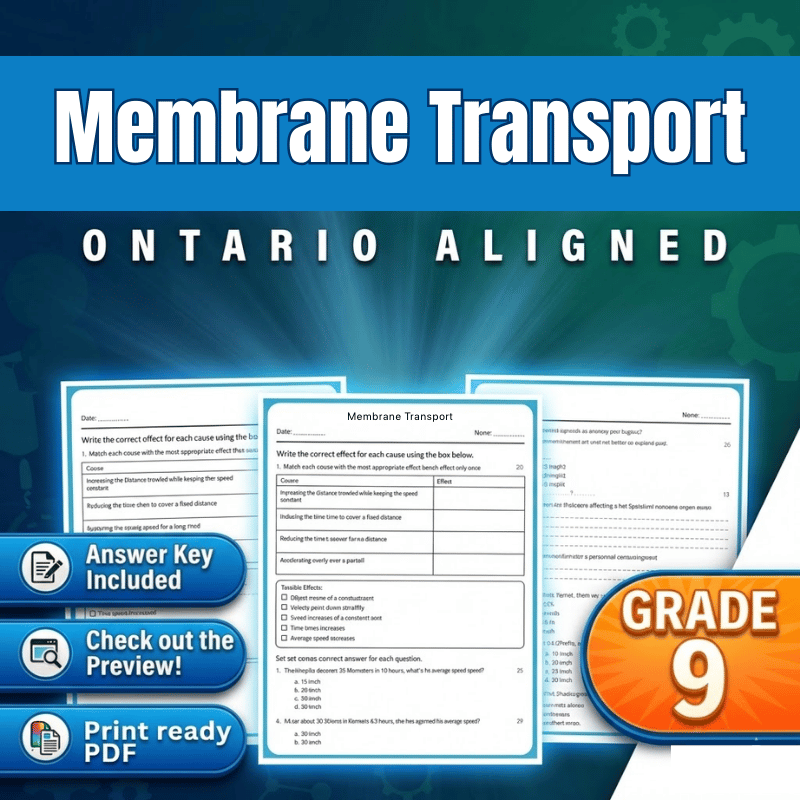
Grade 9 Science | Membrane Transport Worksheet (Ontario Standard) (PDF)
Created byBright Mind ResourcesLearning Objectives
- Describe mechanisms of molecular movement across cellular membranes such as diffusion, osmosis, and active transport.
- Explain the role of electrochemical gradients and membrane potential in facilitating transport.
- Differentiate between paracellular and transcellular pathways in epithelial layers.
Instant download
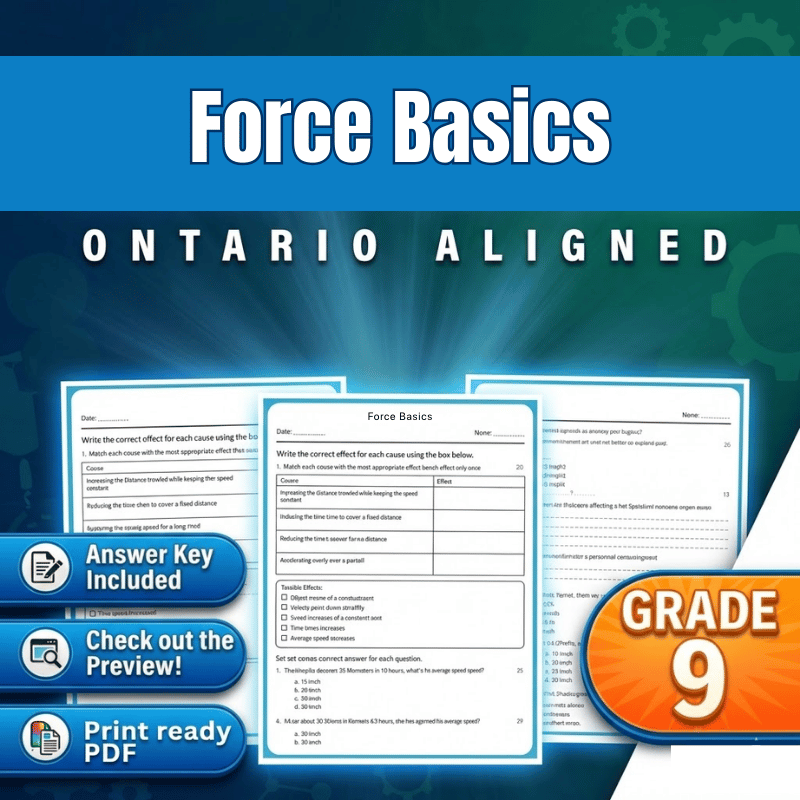
Grade 9 Science – Force Basics Worksheet (Ontario) (PDF)
Created byBright Mind ResourcesLearning Objectives
- Distinguish between contact and non-contact forces with examples and descriptions.
- Identify the direction, point of application, and relative magnitude of different forces.
- Recognize action–reaction pairs and understand their roles in interactions.
Instant download

Grade 9 Science – Decision Modeling in Sustainability(Answer Key) | NGSS-Aligned
Created byBright Mind ResourcesLearning Objectives
- Understand how decision models incorporate economic, environmental, and social variables.
- Analyze trade-offs involved in mitigation and adaptation strategies for climate resilience.
- Evaluate policy instruments and their impacts across multiple scales using scenario analysis.
Instant download
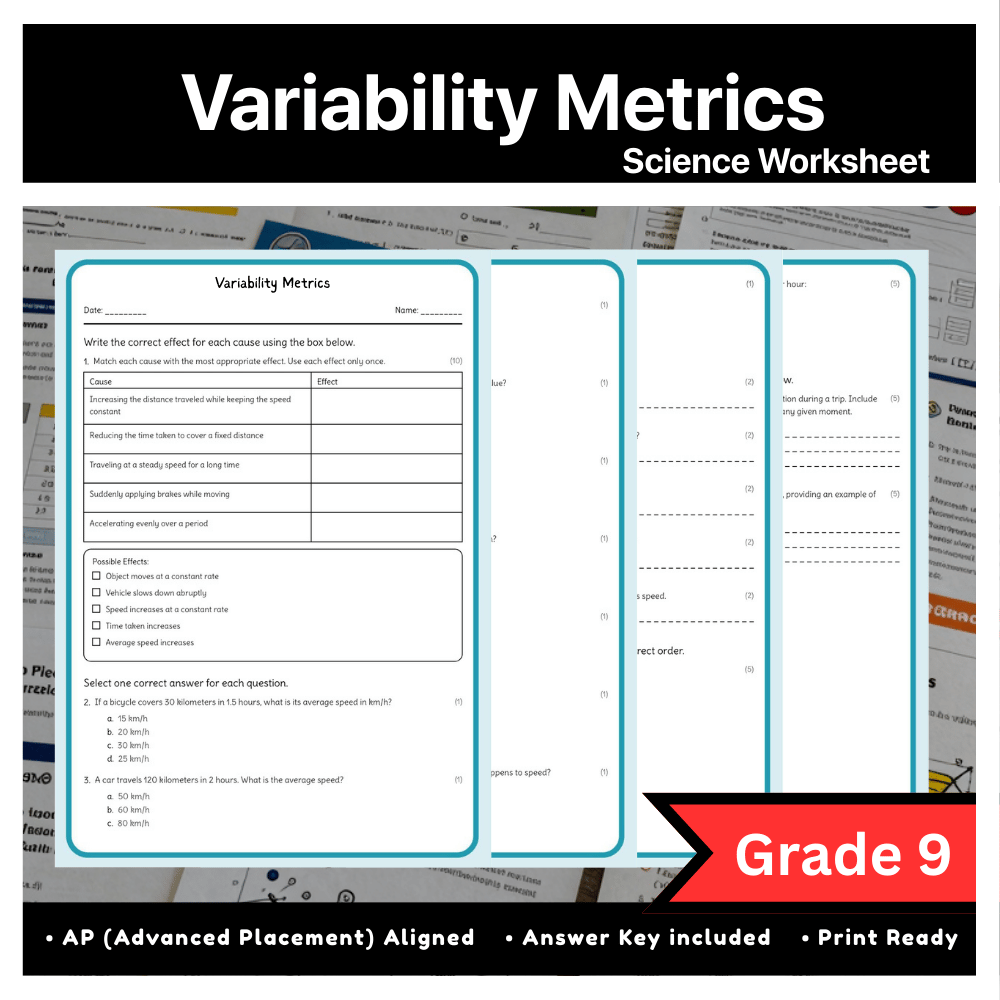
Grade 9 Science – Variability Metrics Worksheet (Answer Key) – AP Standards
Created byBright Mind ResourcesLearning Objectives
- Understand measures of dispersion such as variance, interquartile range, range, and coefficient of variation.
- Interpret how each variability measure informs confidence in estimates and decision-making.
- Relate variability to sampling design, heterogeneity across groups, and model expectations.
Instant download
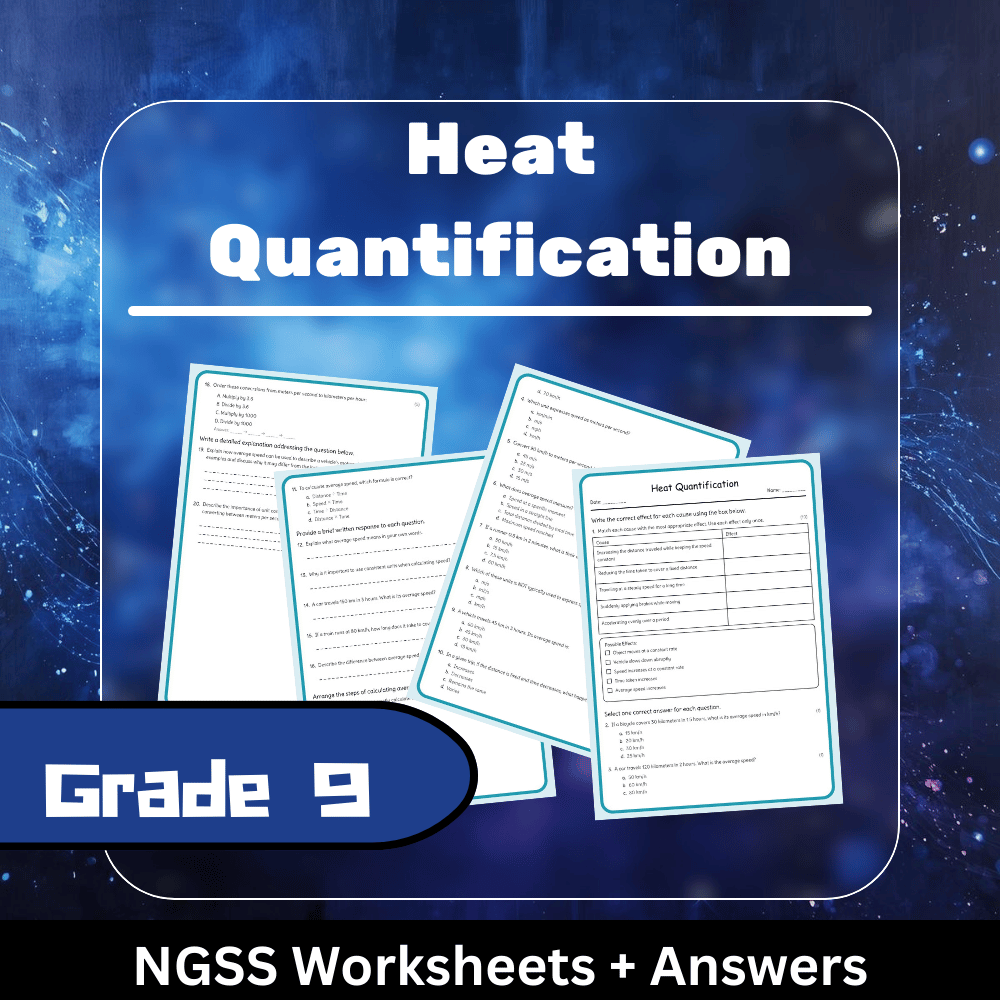
Grade 9 Science | Heat Quantification Worksheet (NGSS-Aligned, PDF)
Created byBright Mind ResourcesLearning Objectives
- Understand the concepts of heat transfer via conduction, convection, and radiation.
- Apply mathematical formulas involving specific heat capacity, mass, and temperature change to calculate thermal energy transfer.
- Identify sign conventions and their significance in heat flow and energy changes within closed systems.
Instant download
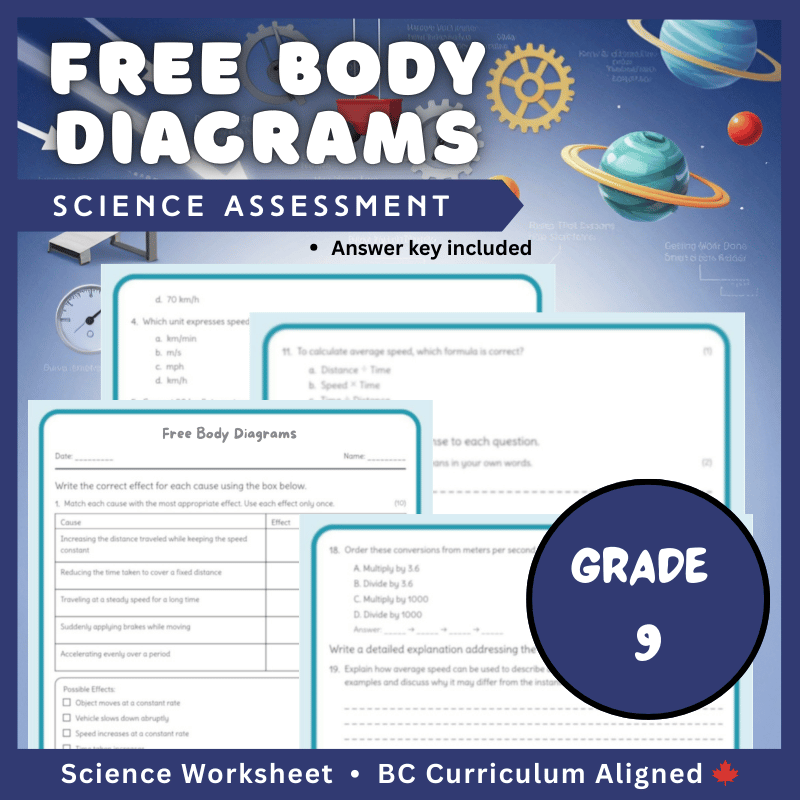
Grade 9 Science | Free Body Diagrams Worksheet (PDF) – BC Standards
Created byBright Mind ResourcesLearning Objectives
- Understand what a free body diagram represents and its purpose in physics.
- Identify and sketch all external forces acting on a single object in a free body diagram.
- Calculate net force and determine the resulting acceleration from force vectors.
Instant download
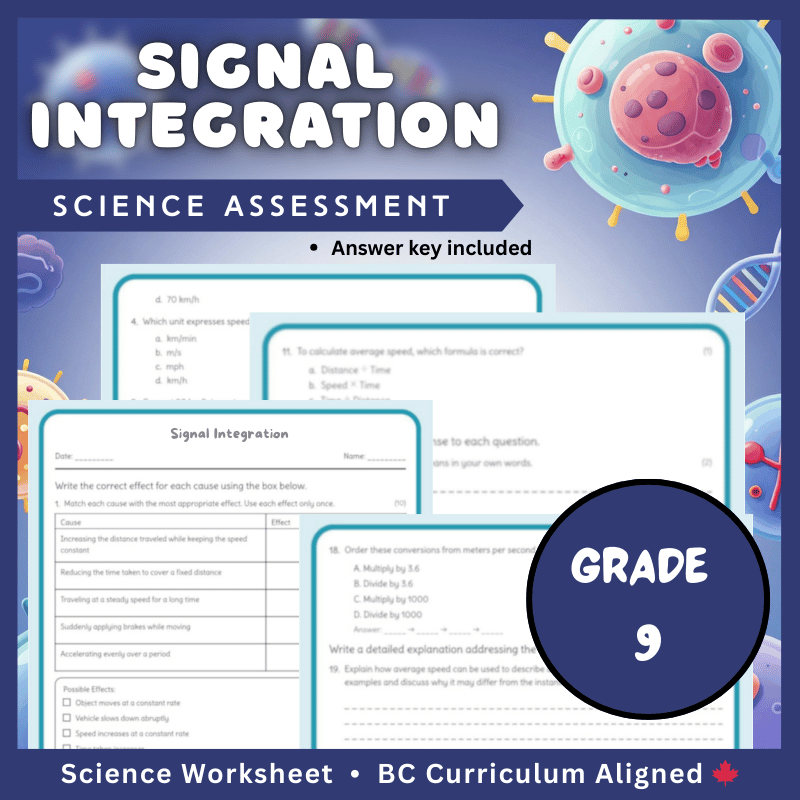
Grade 9 Science | Signal Integration Worksheet (Answer Key) – BC Standards
Created byBright Mind ResourcesLearning Objectives
- Describe how the nervous and endocrine systems coordinate responses to stimuli.
- Explain the roles of nerve impulses and hormones in maintaining homeostasis.
- Identify examples of rapid neural responses and longer-term hormonal effects.
Instant download
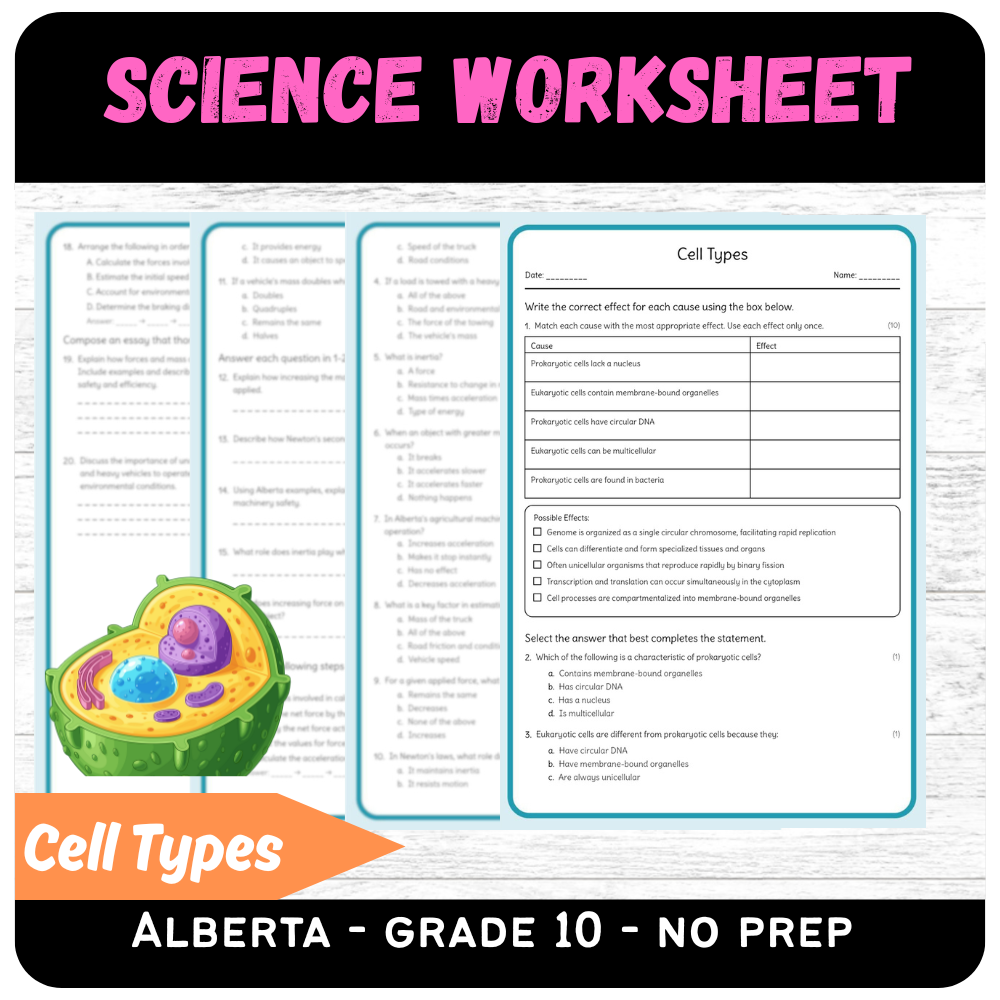
Grade 10 Science - Cell Types Worksheet (Worksheet) | Alberta Standards
Created byBright Mind ResourcesLearning Objectives
- Identify the structural differences between prokaryotic and eukaryotic cells.
- Explain how cell structure influences cellular functions such as reproduction and genetic control.
- Compare examples of prokaryotic and eukaryotic organisms within regional ecological contexts.
Instant download
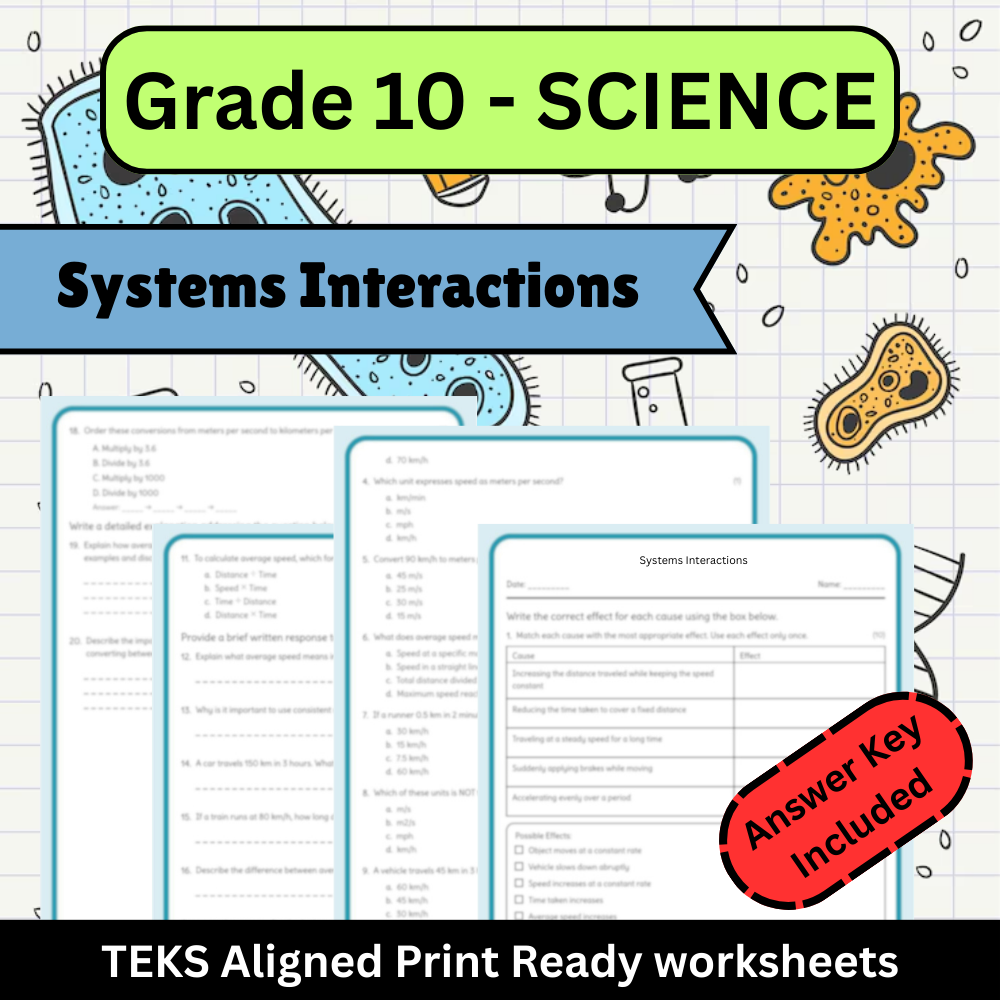
Grade 10 Science – Systems Interactions Worksheet (Worksheet + Answer Key) | TEKS Aligned
Created byBright Mind ResourcesLearning Objectives
- Describe how multiple organ systems coordinate to maintain homeostasis during physiological challenges.
- Identify signaling pathways and feedback mechanisms involved in organ system interactions.
- Explain the concept of emergent properties arising from combined system actions.
Also included in: Grade 10 Science | Body Systems & Homeostasis Worksheet Bundle (TEKS Aligned) +5 more
Instant download
Grade 10 Science – Comparing Photosynthesis & Cellular Respiration Worksheet (PDF)
Created byBright Mind ResourcesLearning Objectives
- Compare the inputs and outputs of photosynthesis and cellular respiration.
- Identify the roles of carbon and energy flow in biological systems.
- Explain reciprocal relationships between autotrophs and heterotrophs in ecosystems.
Also included in: Grade 10 Science Unit Bundle – Photosynthesis, Respiration & Energy TEKS +5 more
Instant download
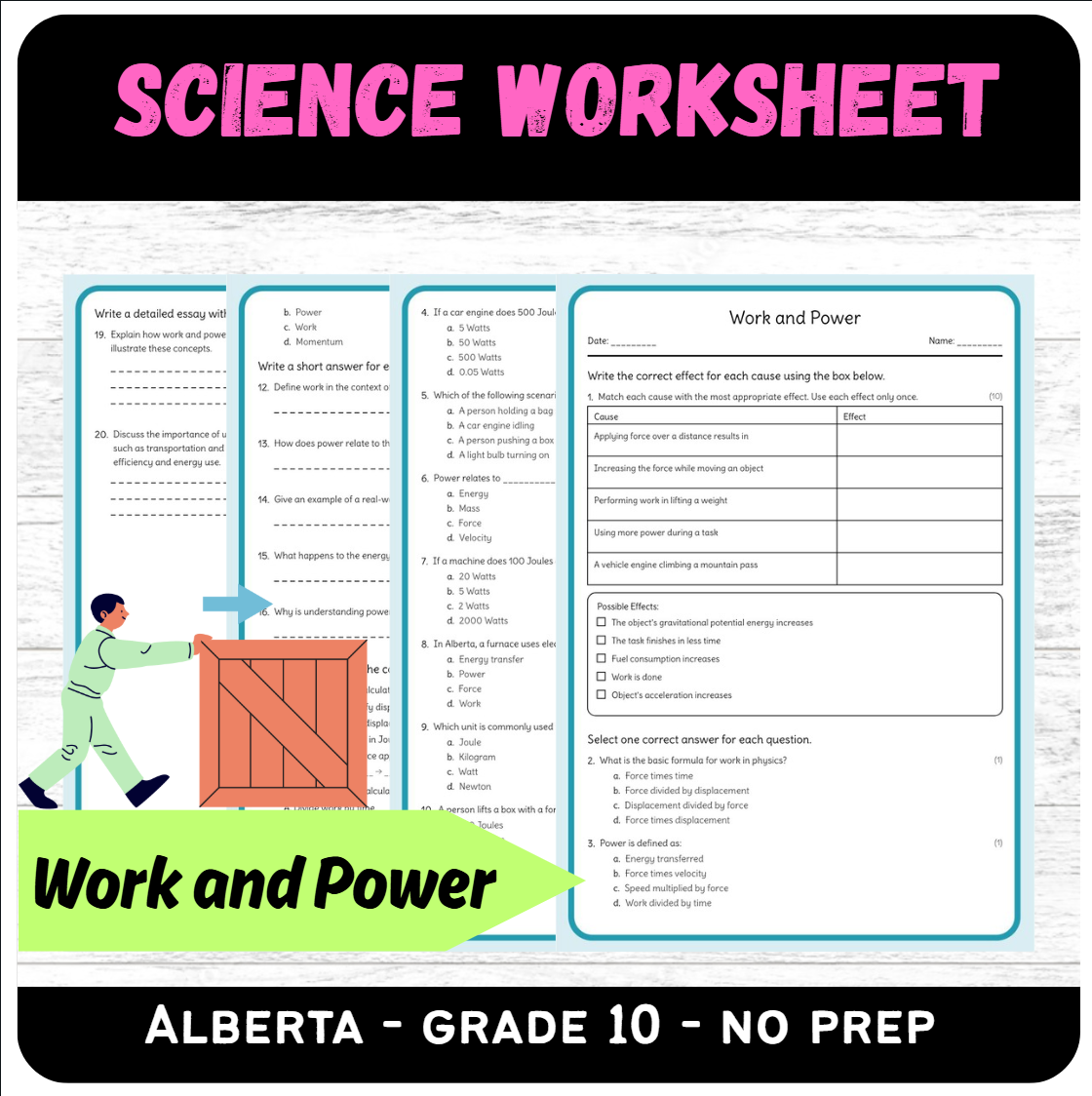
Grade 10 Science | Work and Power Worksheet – Alberta Standards (PDF)
Created byBright Mind ResourcesLearning Objectives
- Understand the definitions of work and power in physics.
- Calculate work done based on force and displacement.
- Explain how power relates to energy transfer over time.
Instant download
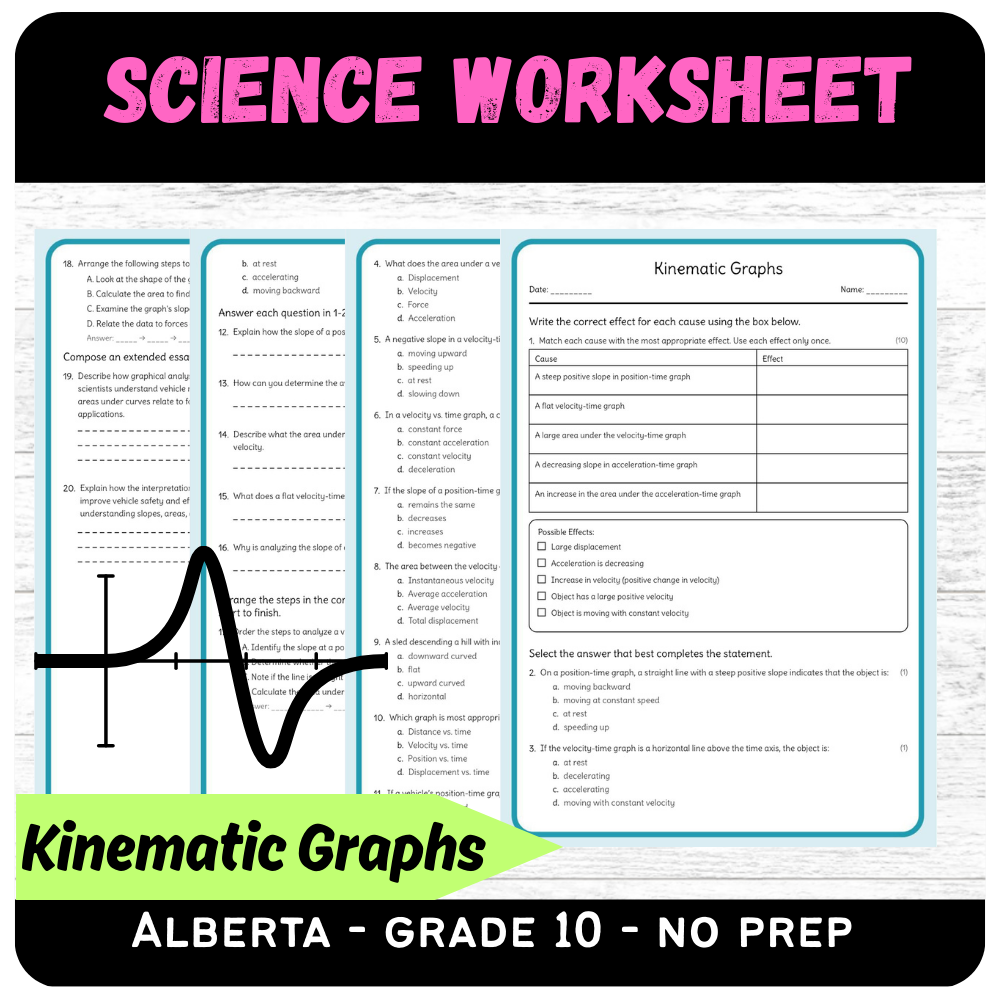
Grade 10 Science – Kinematic Graphs Worksheets (PDF) | Alberta Standards
Created byBright Mind ResourcesLearning Objectives
- Understand how position, velocity, and acceleration graphs represent motion.
- Learn to interpret slopes and areas under kinematic curves to analyze instantaneous and average quantities.
- Apply graphical analysis to real-world vehicle and sled motion scenarios.
Instant download
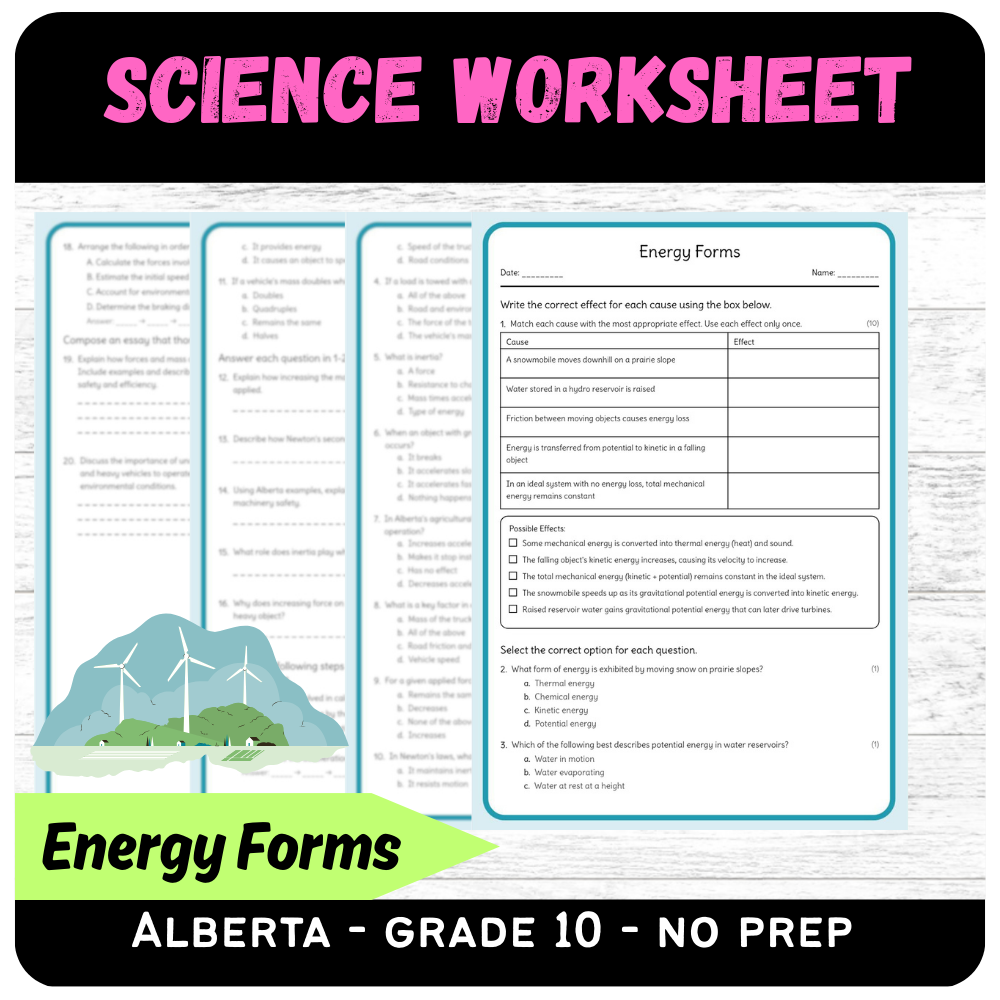
Grade 10 Science – Energy Forms Worksheet | Alberta Standards
Created byBright Mind ResourcesLearning Objectives
- Define kinetic and potential energy with real-world examples.
- Explain the conservation of mechanical energy in idealized systems.
- Describe how non-conservative forces affect energy distribution.
Instant download
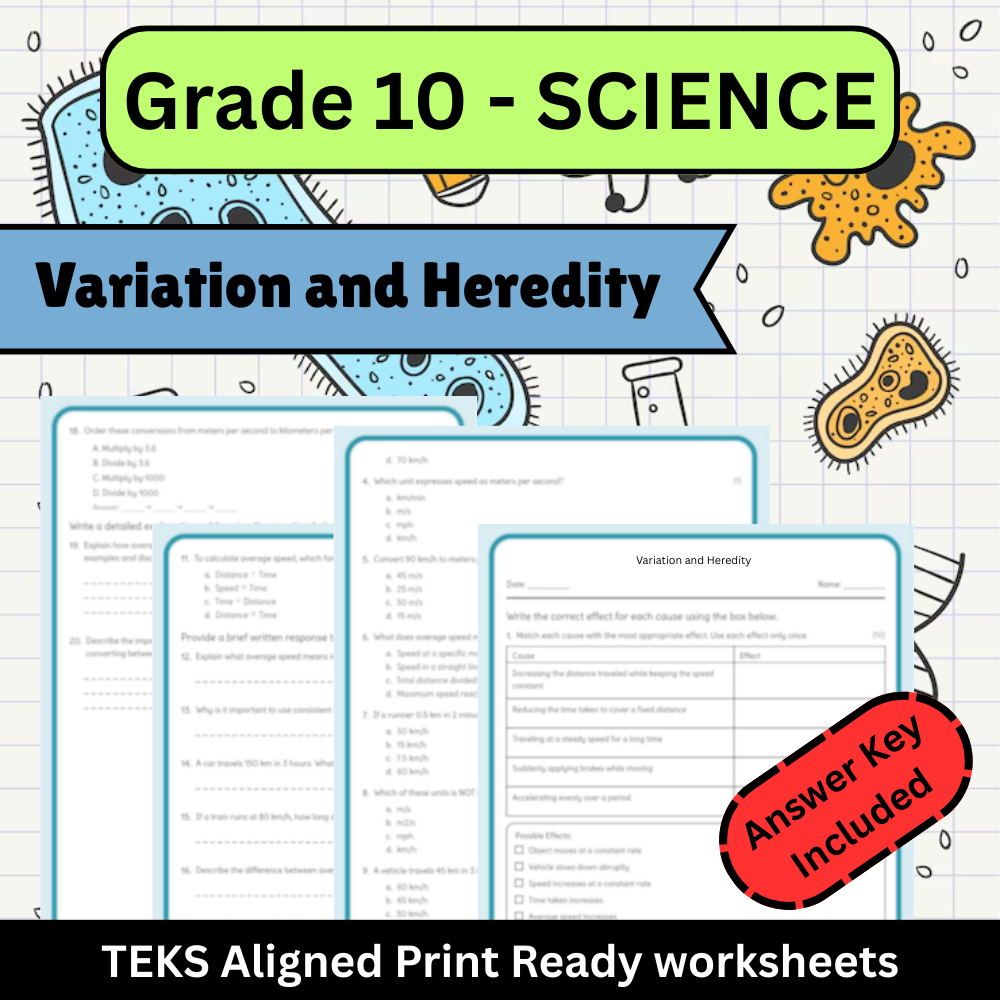
Grade 10 Science | Variations and Heredity Worksheet (Worksheet + Answer Key) – TEKS Aligned
Created byBright Mind ResourcesLearning Objectives
- Understand how genetic variation arises from mutation, recombination, and gene flow.
- Explain how heritable traits influence organism survival and reproduction.
- Describe how natural selection acts on existing variation to change populations over generations.
Also included in: Grade 10 Science | Evolution & Heredity Unit Worksheet Bundle (TEKS Aligned) +5 more
Instant download
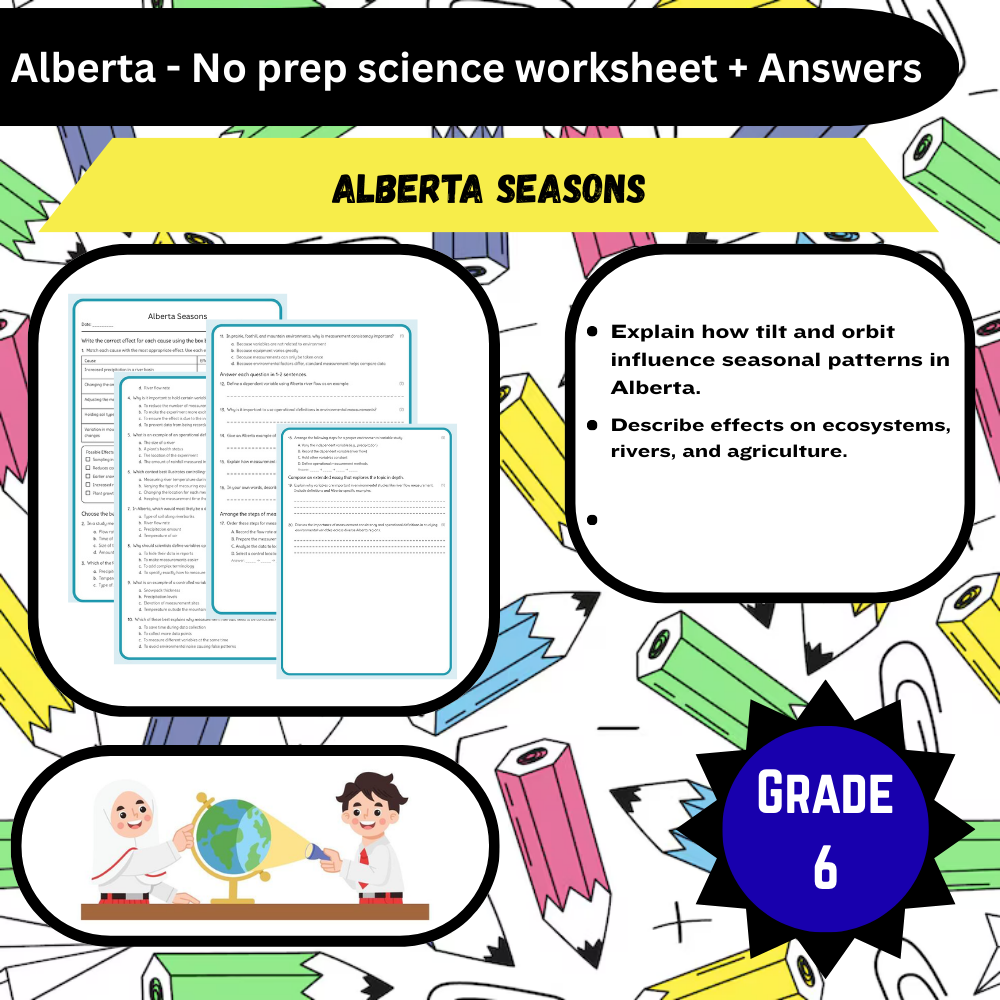
Grade 6 Science | Alberta Seasons Worksheet (PDF) – Standard-Aligned
Created byBright Mind ResourcesLearning Objectives
- Explain how Earth's tilt and orbit influence seasonal patterns in Alberta.
- Describe the effects of seasonal changes on ecosystems, rivers, and agriculture in Alberta.
Instant download
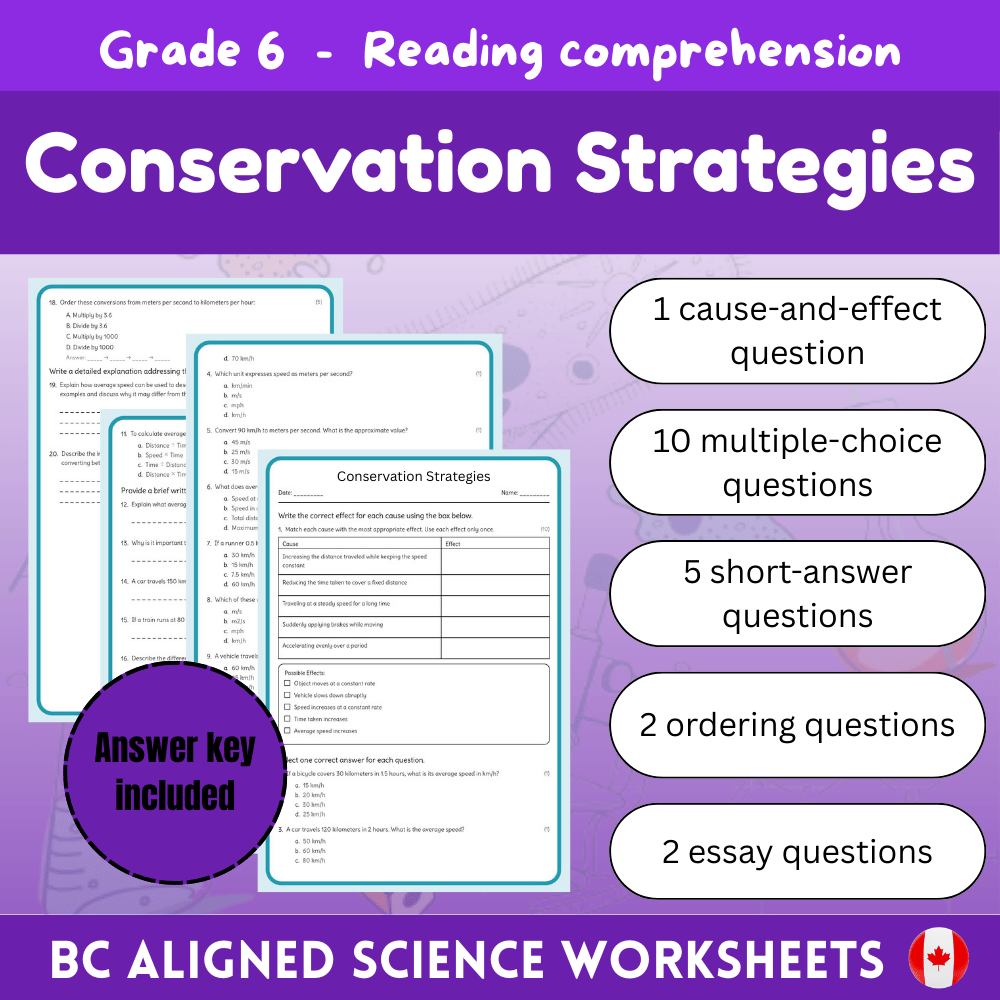
6th Grade Science | Conservation Strategies Worksheet (PDF) | BC Standards
Created byBright Mind ResourcesLearning Objectives
- Identify different conservation strategies used to protect ecosystems.
- Understand how each strategy contributes to ecosystem restoration and maintenance.
- Analyze trade-offs involved in conservation efforts.
Instant download
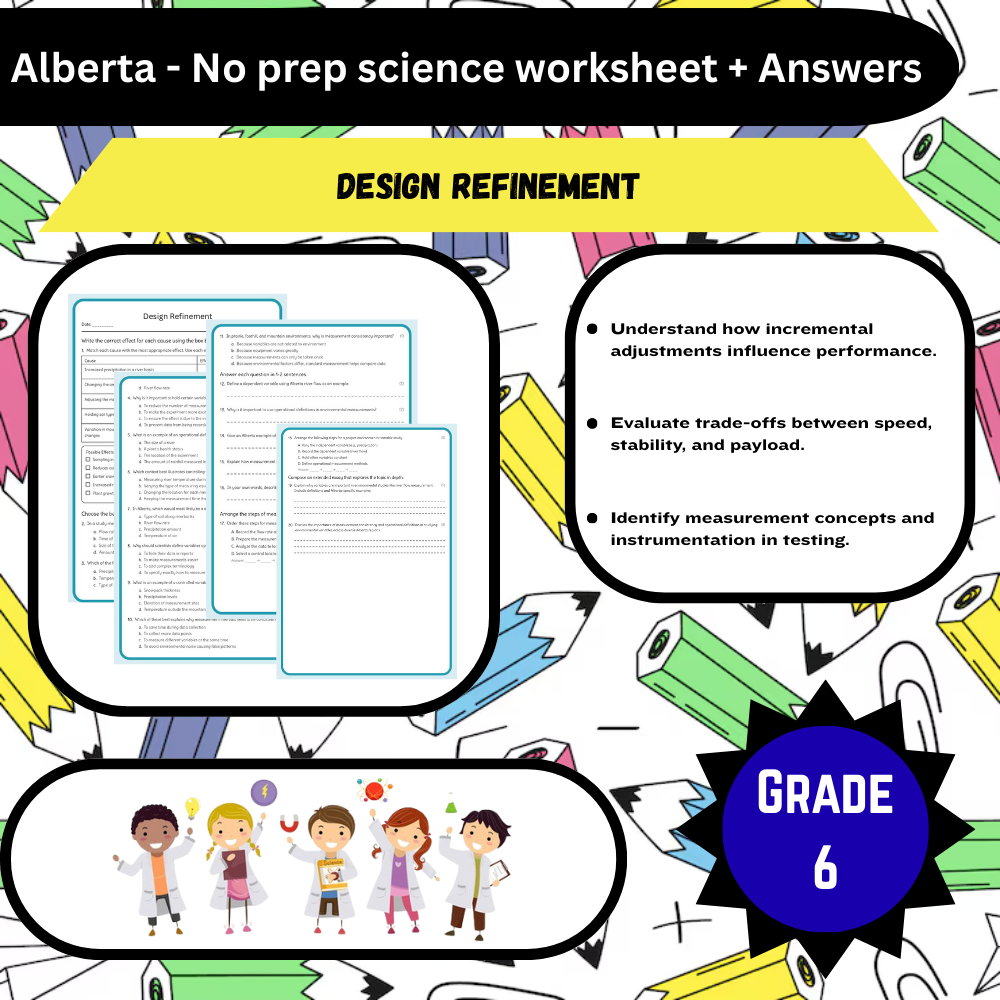
Grade 6 Science | Design Refinement (Worksheet + Answer Key) | Alberta Standards
Created byBright Mind ResourcesLearning Objectives
- Understand how incremental adjustments to aerodynamics influence performance and safety.
- Evaluate trade-offs between speed, stability, and payload in design modifications.
- Identify measurement concepts such as consistent observation and simple instrumentation in testing flight paths.
Instant download
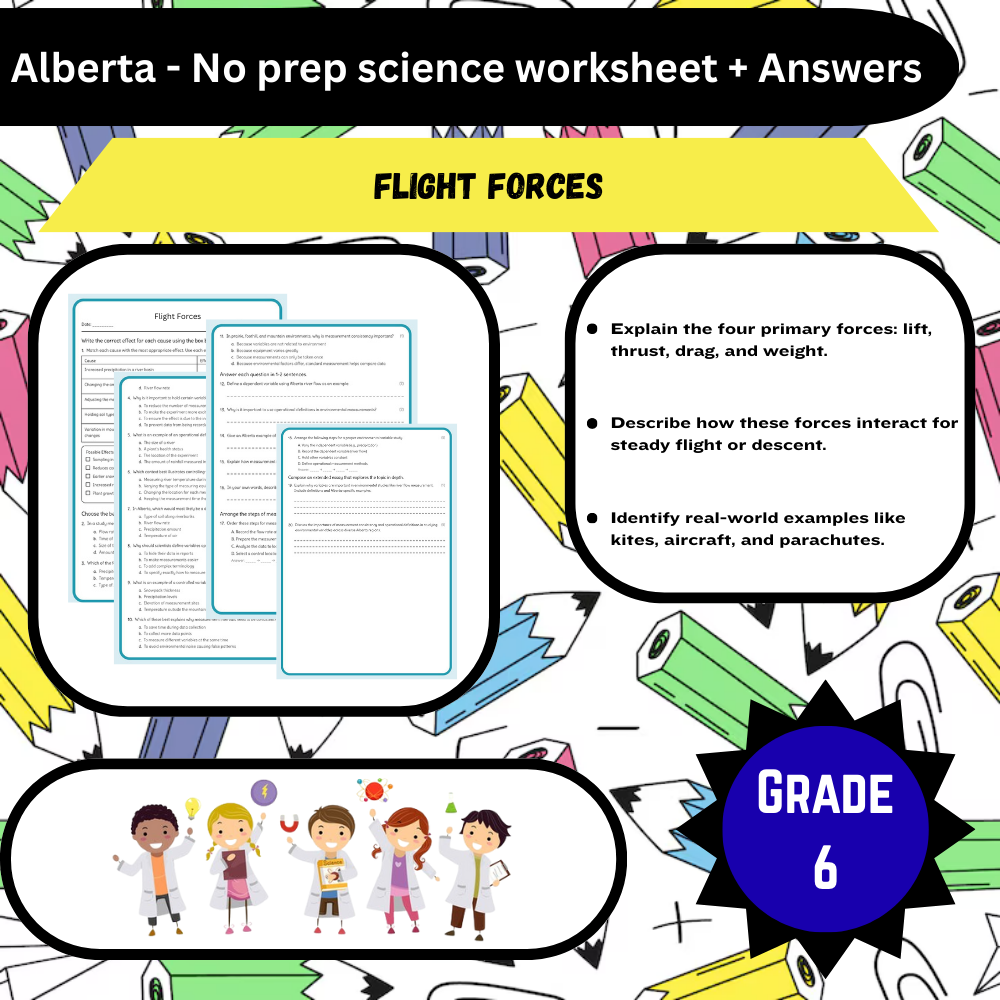
Grade 6 Science – Flight Forces Comprehensive Worksheet (PDF)
Created byBright Mind ResourcesLearning Objectives
- Explain the four primary forces of flight: lift, thrust, drag, and weight.
- Describe how these forces interact to create steady flight or descent.
- Identify real-world examples of flight forces, such as kites, aircraft, and parachutes.
Instant download
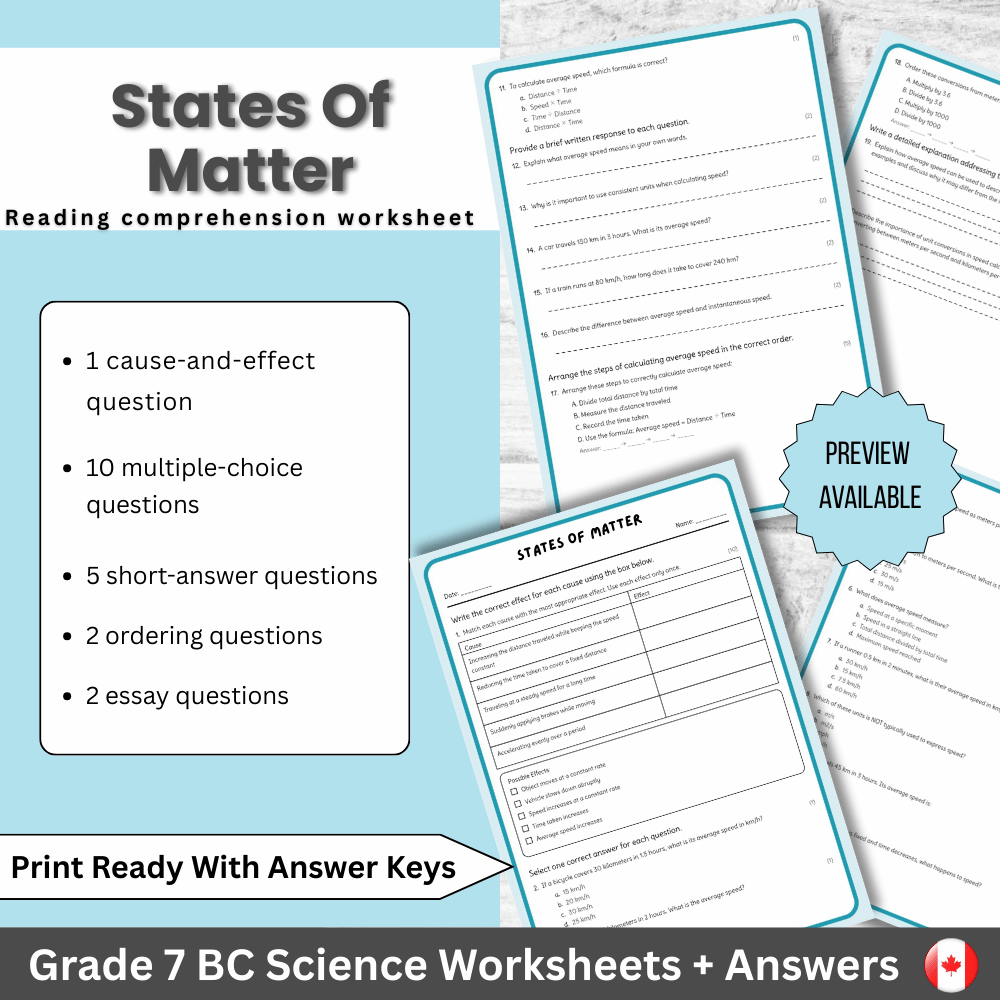
7th Grade Science | States of Matter Worksheet (Answer Key) – BC Standards
Created byBright Mind ResourcesLearning Objectives
- Understand the particle arrangements, spacing, and movement in solids, liquids, and gases.
- Describe how temperature and pressure influence state changes.
- Identify observable characteristics that classify substances as solids, liquids, or gases.
Instant download
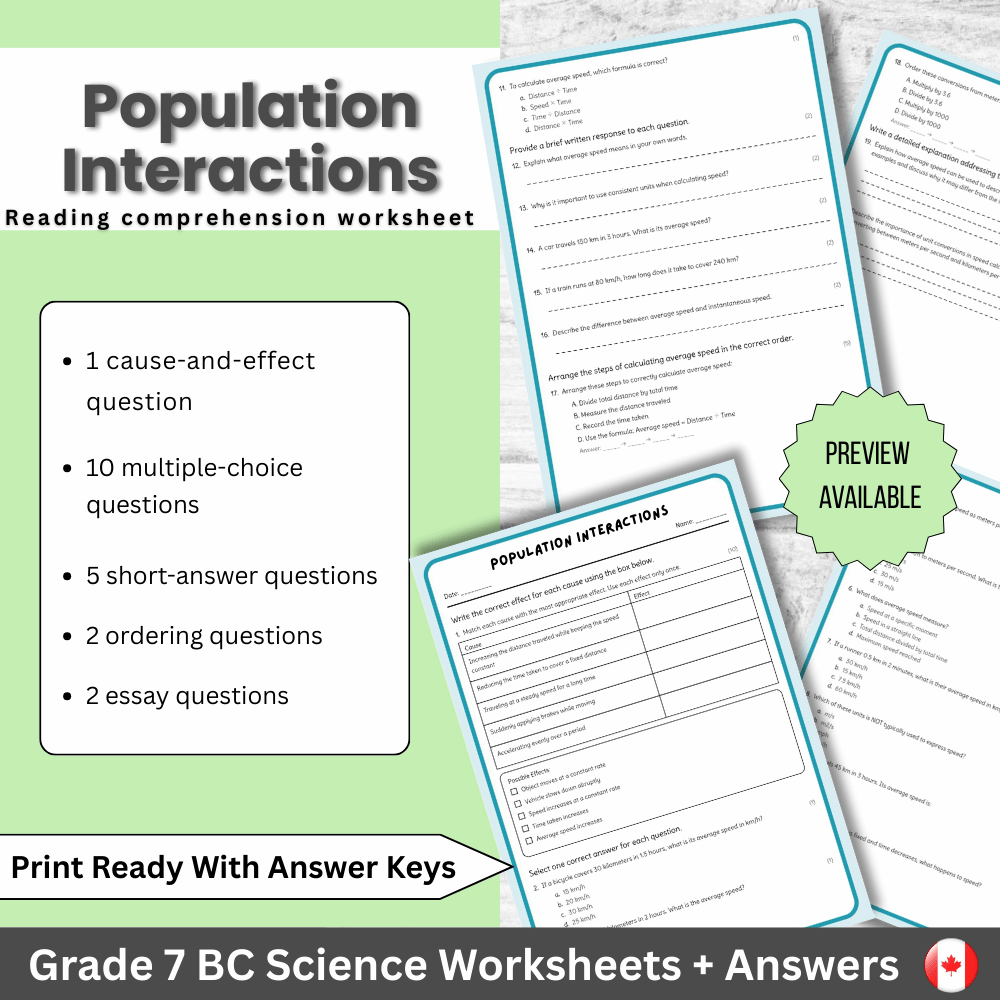
Grade 7 Science | Population Interactions Worksheet (Answer Key) – BC Standards
Created byBright Mind ResourcesLearning Objectives
- Identify and describe different types of population interactions such as competition, predation, and mutualism.
- Explain how species coexistence is facilitated through niche partitioning, temporal separation, or habitat differentiation.
- Analyze mechanisms that stabilize or destabilize populations within communities.
Instant download
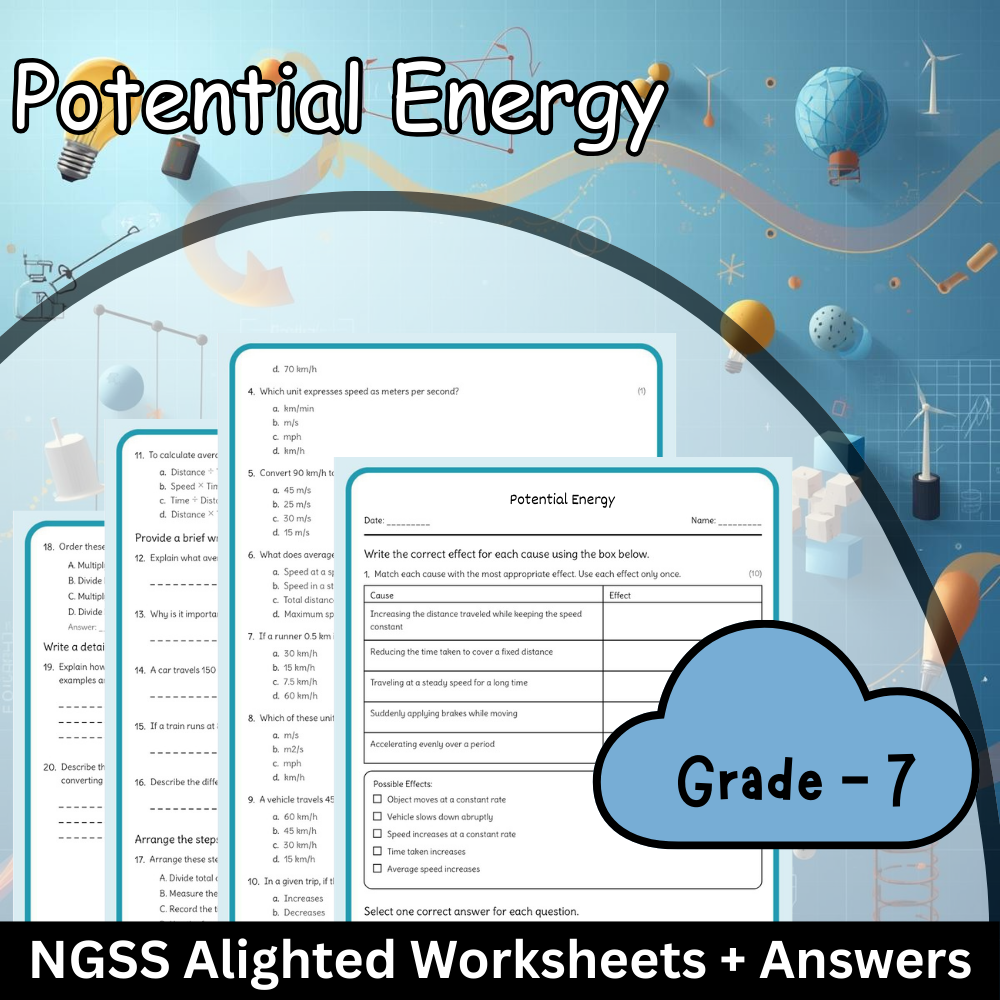
Grade 7 Science | Potential Energy Worksheet (Worksheet + Answer Key) NGSS
Created byBright Mind ResourcesLearning Objectives
- Understand the concept of potential energy and how it is stored in different systems.
- Identify examples of gravitational, elastic, and magnetic potential energy.
- Explain how spatial arrangements affect stored energy in systems.
Instant download
Browse more categories
About Reading comprehension Worksheets
Find reading comprehension worksheets for class practice, homework, or self-study. All 40,284 are instant PDF downloads.
Each resource here is built by an independent educator and reviewed for quality. Worksheets print straight from PDF and suit classroom use, homework, or extra practice; most come with answer keys, and you can preview before purchasing.