
Reading comprehension Worksheets
40,284 type resources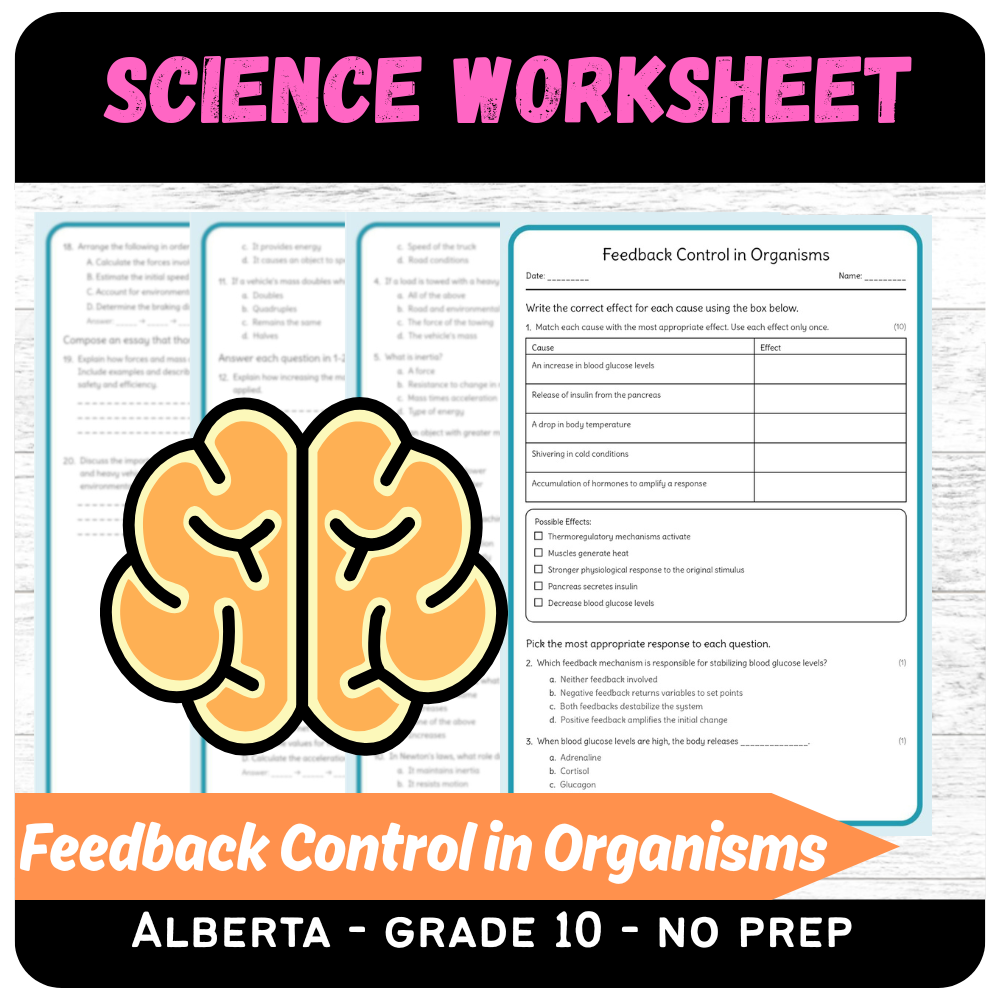
Grade 10 Science | Feedback Control in Organisms Worksheet (PDF)
 Created byBright Mind Resources
Learning Objectives
- Explain the mechanisms of negative and positive feedback in physiological processes.
- Compare different feedback loops and their roles in homeostasis and physiological regulation.
- Illustrate the consequences of failure in feedback regulation for organism health and ecosystems.
Instant download
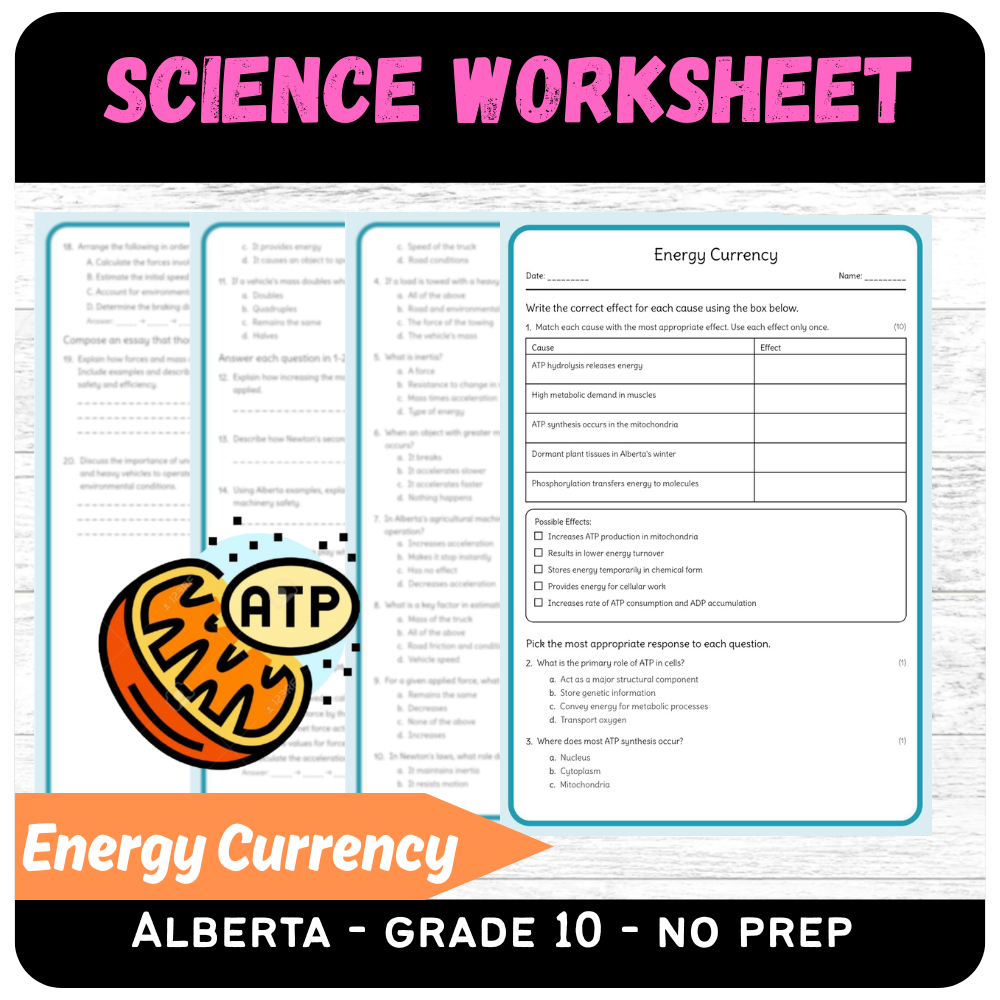
Grade 10 Science | Energy Currency Worksheet (PDF) – Alberta Standards
Created byBright Mind ResourcesLearning Objectives
- Explain the role of ATP as the primary energy currency in cellular processes.
- Describe how ATP synthesis and hydrolysis support metabolic reactions.
- Analyze differences in ATP turnover rates in various tissues and environments.
Instant download
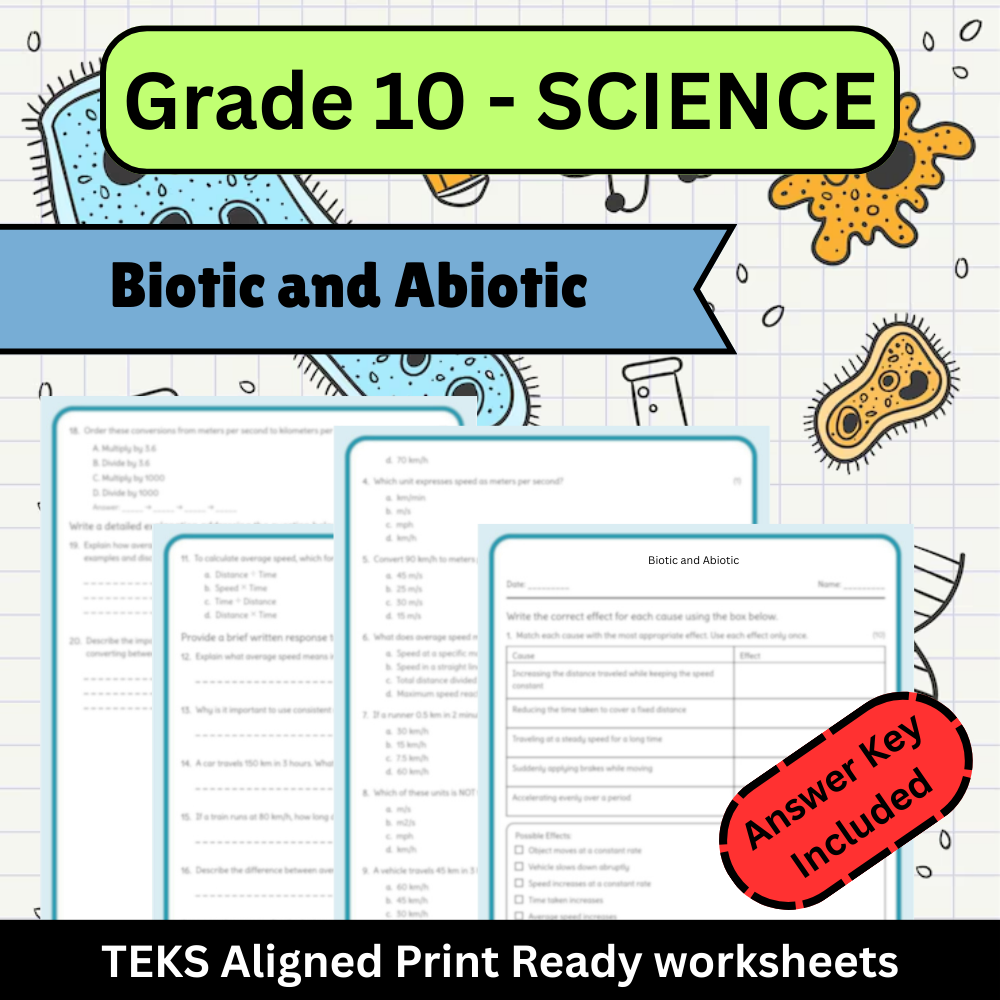
Grade 10 Science – Biotic and Abiotic Factors Worksheet (Answer Key) | TEKS
Created byBright Mind ResourcesLearning Objectives
- Identify the differences between biotic and abiotic factors in ecosystems.
- Explain how biotic and abiotic factors interact to influence habitats and communities.
- Describe how abiotic gradients affect species ranges and populations.
Also included in: Grade 10 Science | Ecosystems & Biodiversity Unit Worksheet Bundle(TEKS-Aligned) +5 more
Instant download
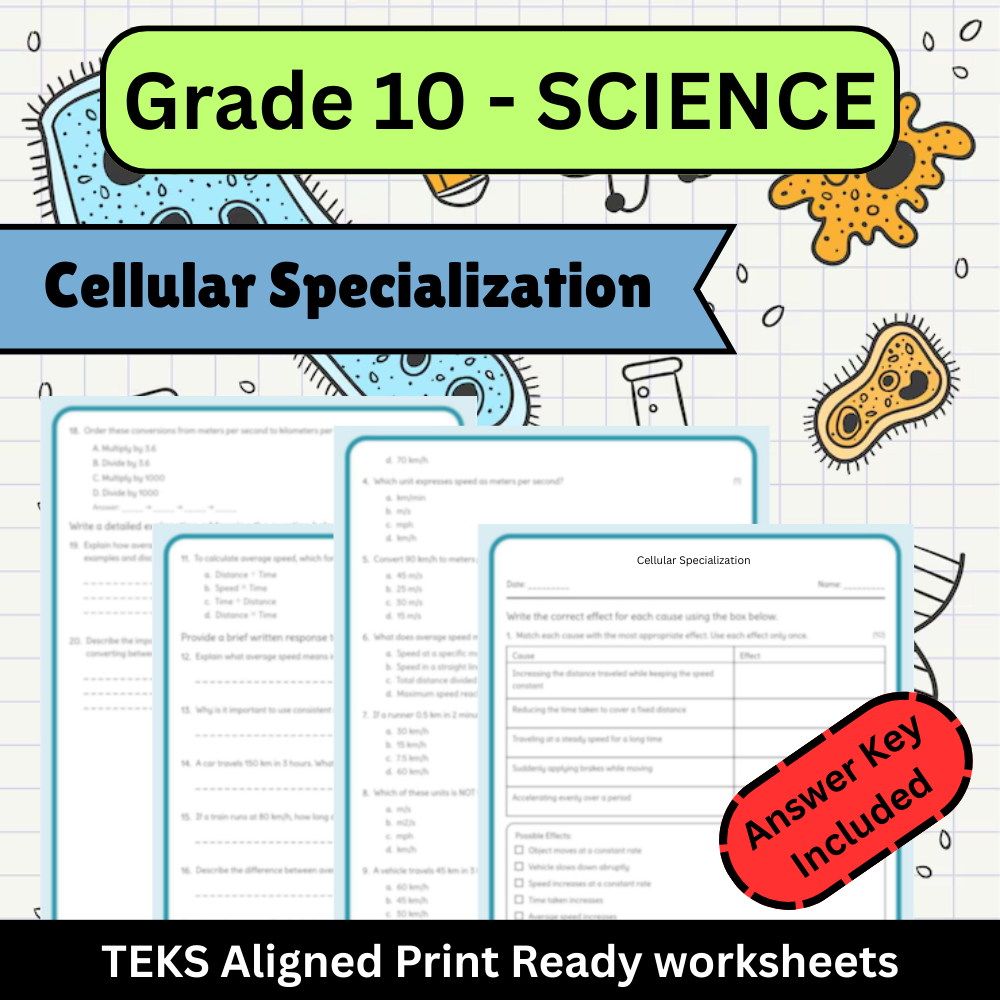
Grade 10 Science – Cellular Specialization Worksheet (Worksheet + Answer Key) | TEKS Alignment
Created byBright Mind ResourcesLearning Objectives
- Understand how organelles are specialized for specific cellular functions.
- Identify relationships between organelle abundance and cell function.
- Explain how cells form tissues and organ systems in multicellular organisms.
Also included in: Grade 10 Science | Cell Structure & Function Unit Worksheet Bundle(TEKS-Aligned) +5 more
Instant download
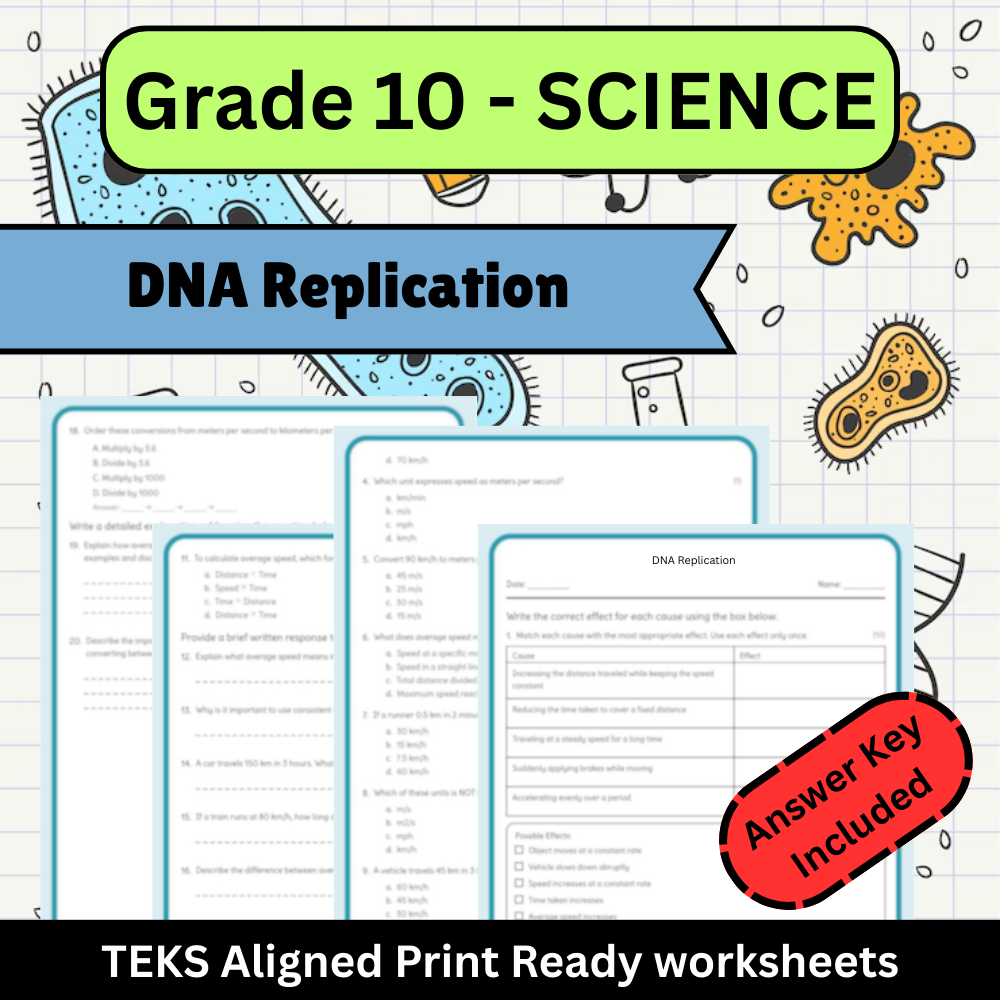
Grade 10 Science – DNA Replication Instructional Worksheet (Worksheet + Answer Key)
Created byBright Mind ResourcesLearning Objectives
- Describe the process of DNA replication, including the roles of key enzymes.
- Explain the semiconservative nature of DNA replication.
- Identify the differences between leading and lagging strands during replication.
Also included in: Grade 10 Science | Genetics & DNA Unit Worksheet Pack (TEKS Aligned) +5 more
Instant download
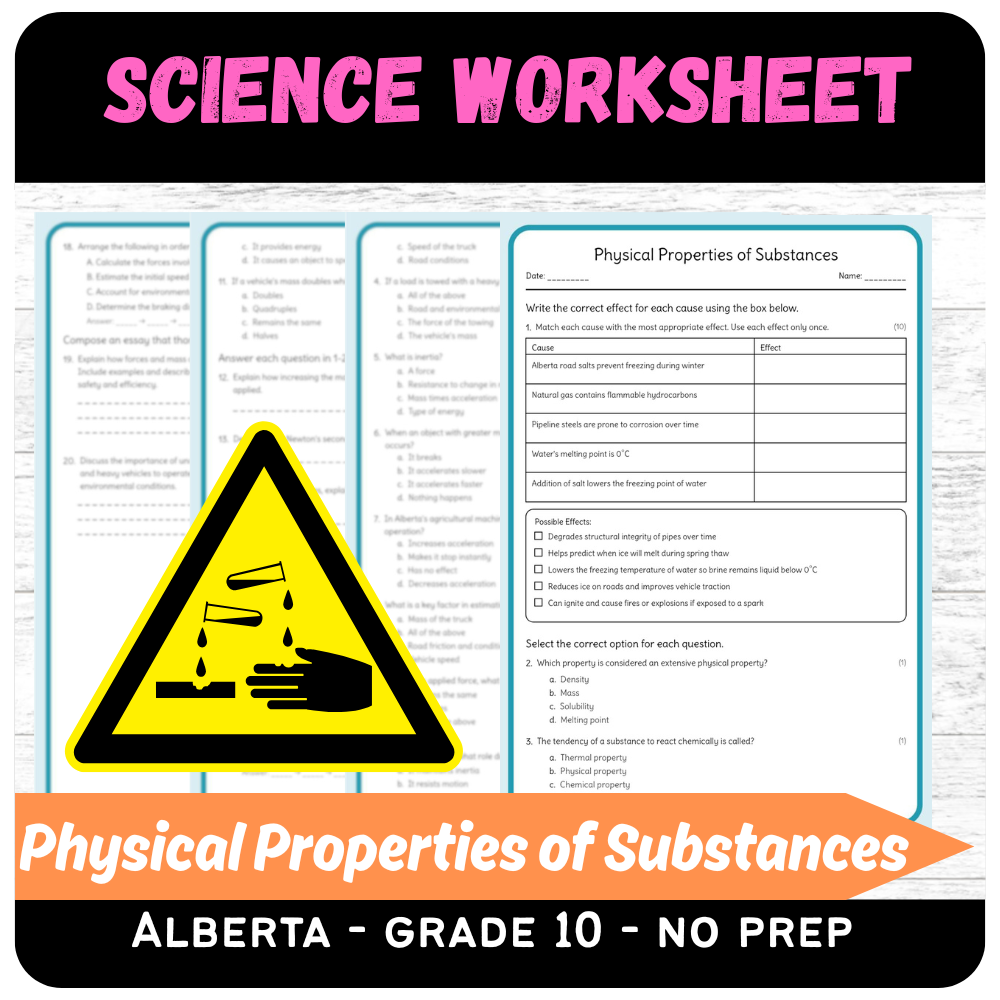
Grade 10 Science – Physical Properties of Substances Worksheet (PDF)
Created byBright Mind ResourcesLearning Objectives
- Identify and differentiate between intensive and extensive physical properties.
- Explain the significance of physical and chemical properties in material selection and environmental behavior.
- Apply knowledge of physical and chemical properties to real-world examples.
Instant download
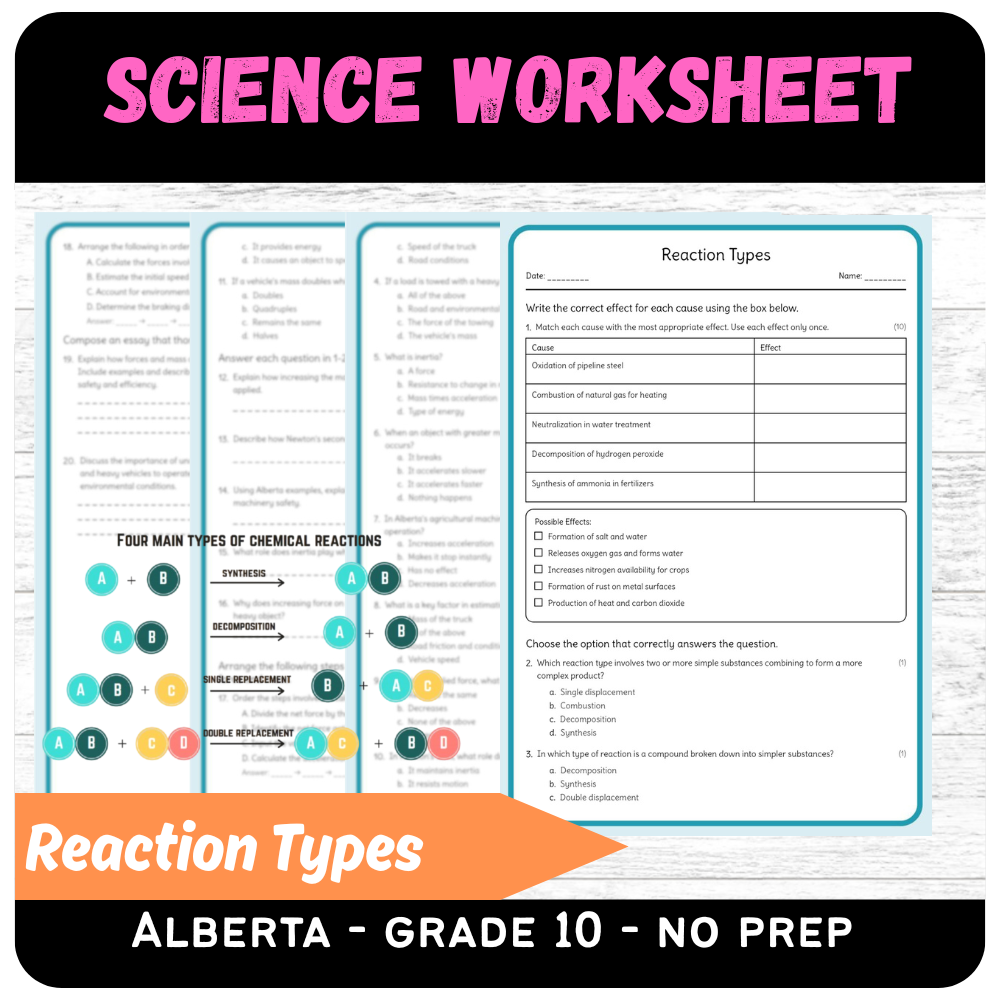
Grade 10 Science – Reaction Types Worksheet (PDF) – Alberta Standards
Created byBright Mind ResourcesLearning Objectives
- Understand the different types of chemical reactions including synthesis, decomposition, single and double displacement, and combustion.
- Identify reaction patterns and predict products based on reaction type using Alberta-relevant examples.
- Interpret chemical equations and classify reactions under typical provincial environmental conditions.
Instant download
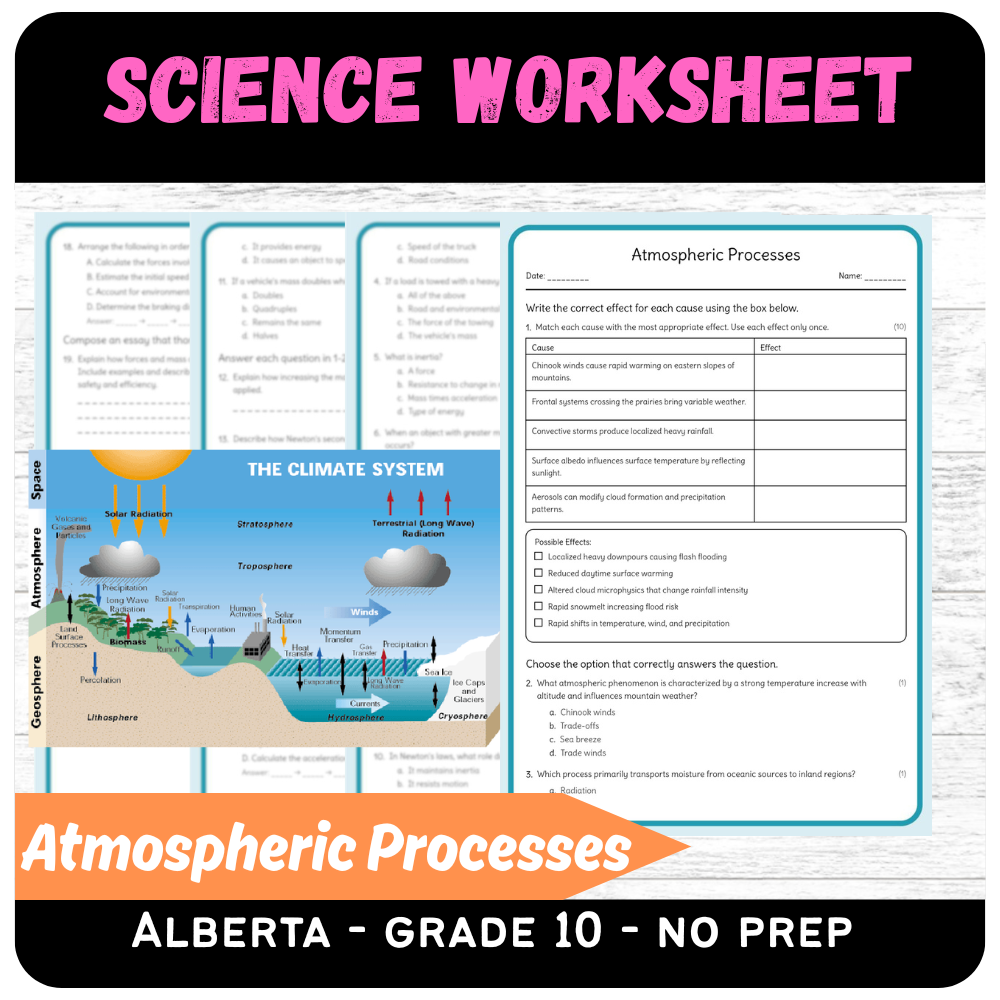
Grade 10 Science | Atmospheric Processes Worksheet (PDF) — Alberta Standards
Created byBright Mind ResourcesLearning Objectives
- Explain how pressure patterns, moisture transport, and thermal gradients influence weather systems and climate.
- Identify regional atmospheric phenomena and their effects on precipitation and weather variability.
- Describe how atmospheric composition, aerosols, and surface albedo modulate Earth's energy balance.
Instant download
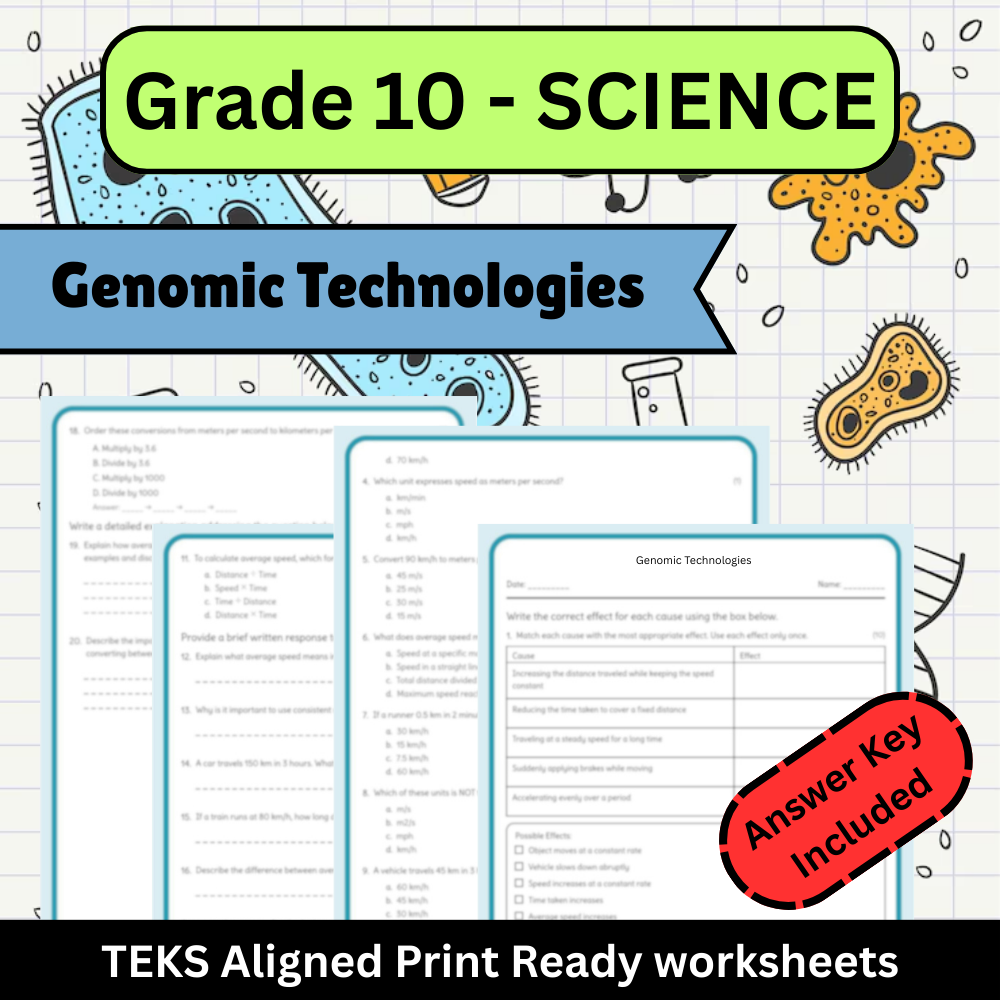
Grade 10 Science | Genomic Technologies Worksheet (Worksheet + Answer Key) – TEKS Aligned
Created byBright Mind ResourcesLearning Objectives
- Understand key genomic technologies such as PCR, DNA sequencing, and CRISPR.
- Explain how recombinant DNA techniques are used in biotechnology.
- Evaluate the societal and ecological impacts of genomic editing tools.
Also included in: Grade 10 Science | Genetics & DNA Unit Worksheet Pack (TEKS Aligned) +5 more
Instant download
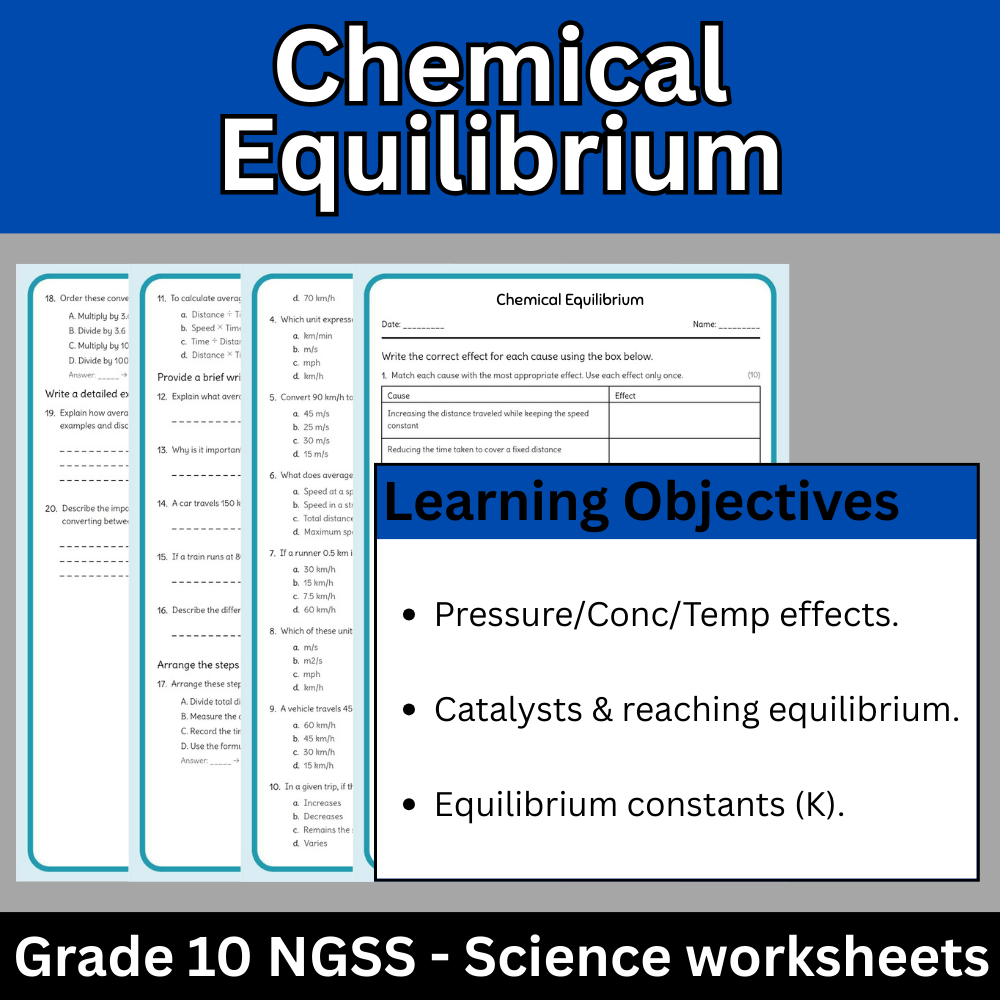
Grade 10 Science | Chemical Equilibrium Worksheet (Answer Key) – NGSS Standards
Created byBright Mind ResourcesLearning Objectives
- Understand how changes in pressure, concentration, and temperature affect chemical equilibria.
- Explain the role of catalysts in reaching equilibrium faster.
- Describe the significance of equilibrium constants as quantitative measures of reactions.
Instant download
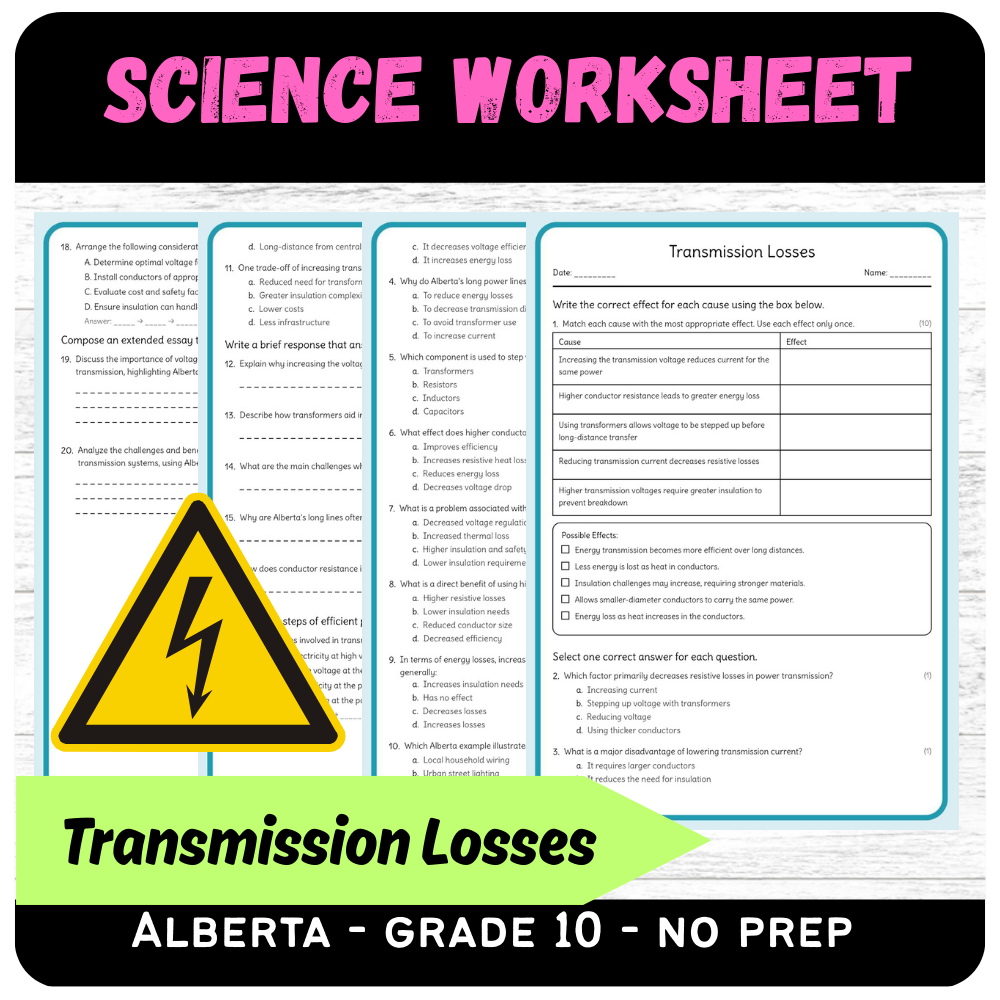
Grade 10 Science – Transmission Losses Worksheet (PDF) – Alberta Standards
Created byBright Mind ResourcesLearning Objectives
- Explain how current and conductor resistance affect energy losses in power transmission.
- Describe strategies such as voltage regulation and transformer use to improve transmission efficiency.
- Analyze Alberta examples of long-distance power lines and interprovincial energy transfers.
Instant download
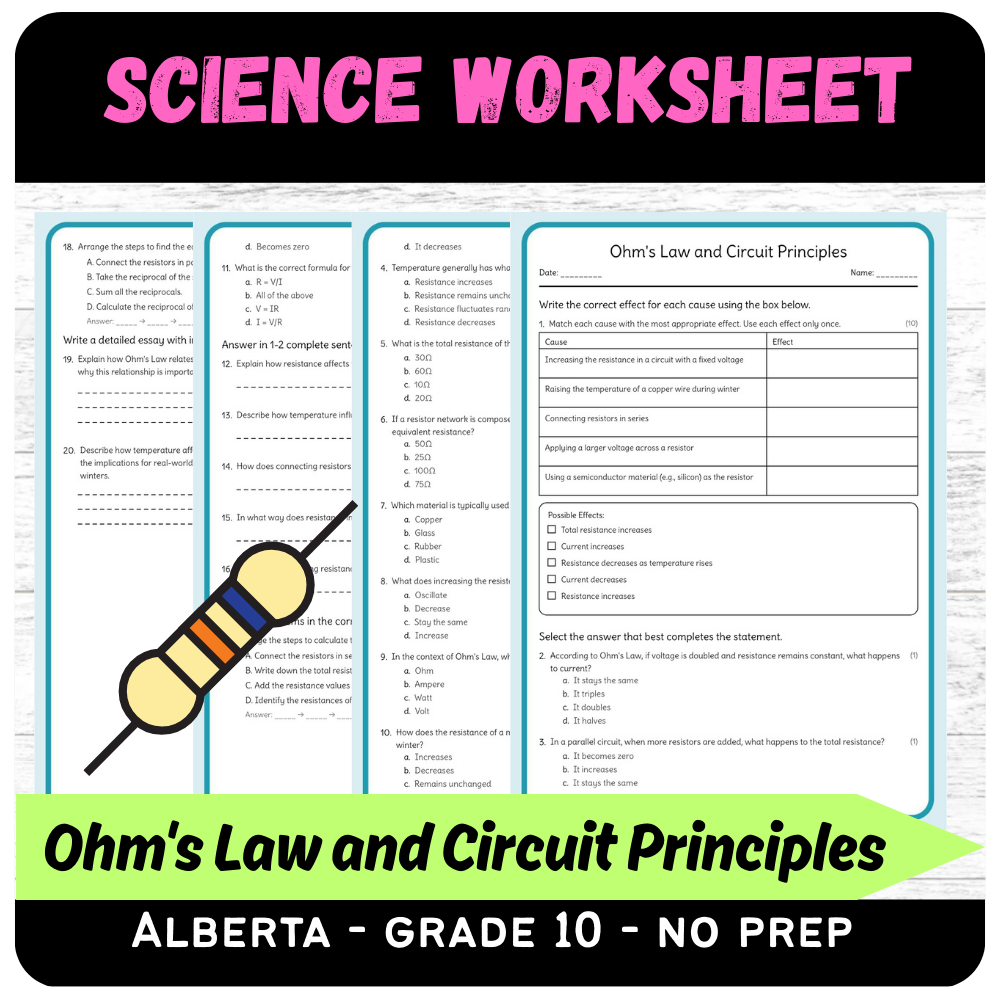
Grade 10 Science | Ohm's Law & Circuit Principles Worksheet (PDF)
Created byBright Mind ResourcesLearning Objectives
- Understand the relationship between voltage, current, and resistance as described by Ohm's Law.
- Calculate equivalent resistance in series and parallel resistor networks.
- Analyze how temperature affects the resistance of different materials.
Instant download
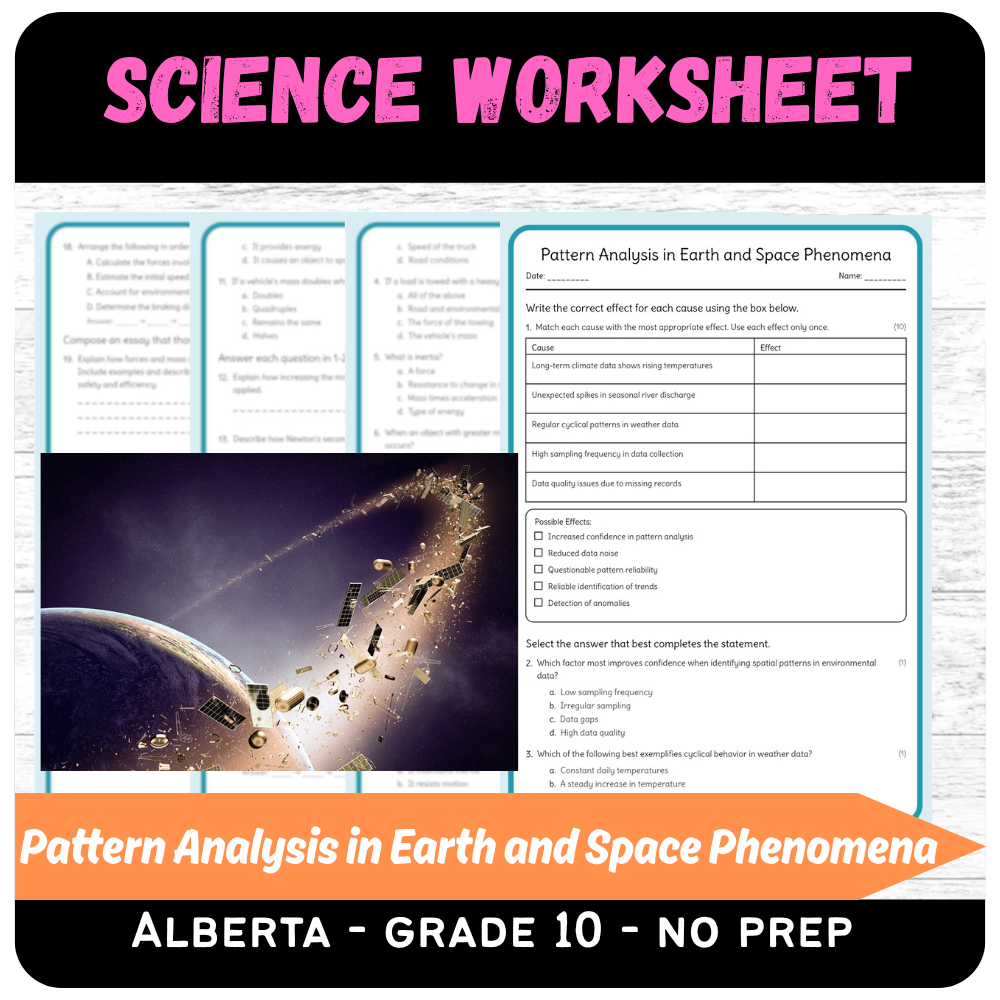
Grade 10 Science – Pattern Analysis in Earth and Space Phenomena (Worksheet + Answer Key)
Created byBright Mind ResourcesLearning Objectives
- Understand how to recognize and interpret temporal and spatial patterns in environmental data.
- Learn methods for analyzing regional climate, river discharge, and meteorological data to identify regularities and anomalies.
- Explore how data quality, sampling frequency, and statistical summaries influence confidence in pattern detection.
Instant download
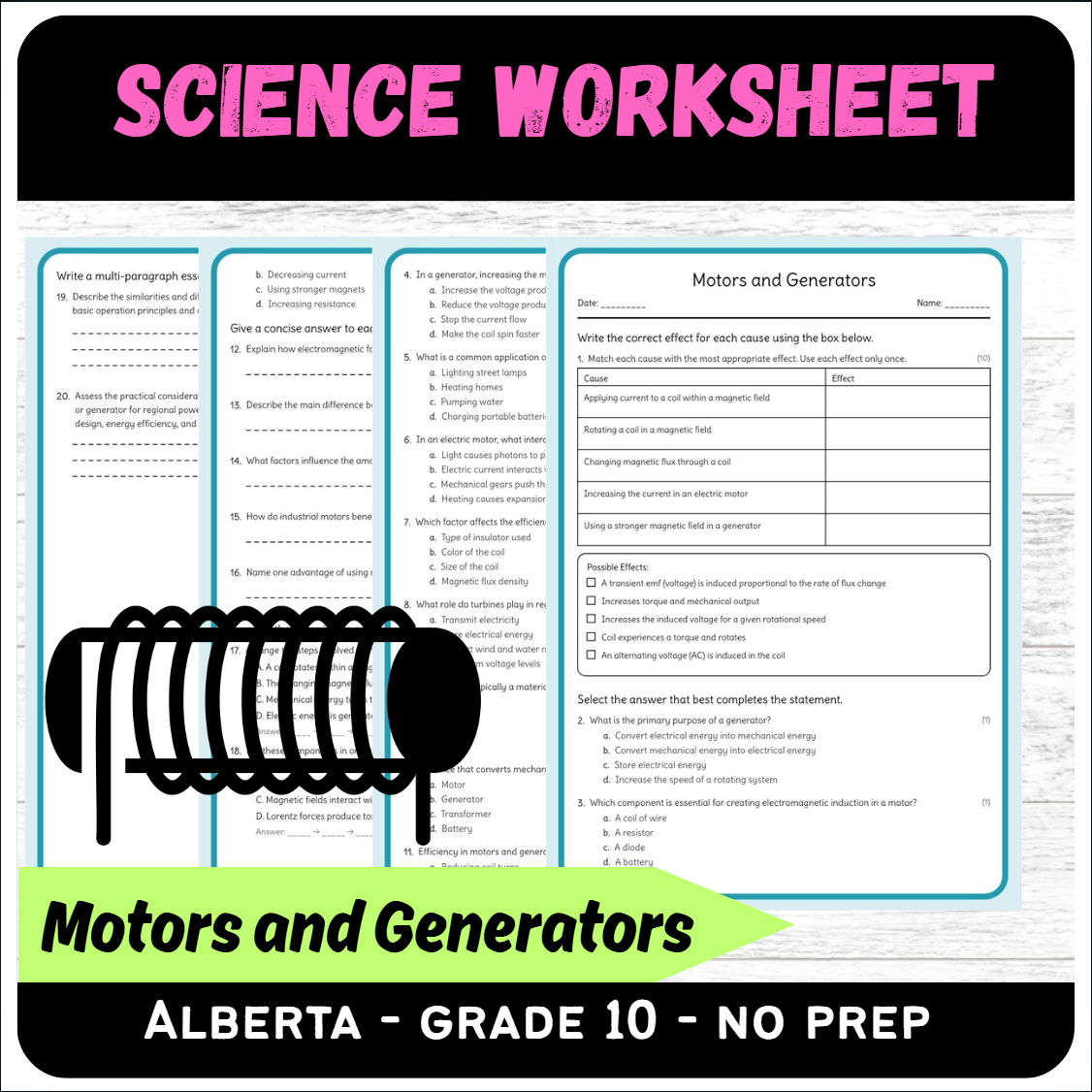
Grade 10 Science | Motors and Generators Worksheet (PDF) – Alberta Standards
Created byBright Mind ResourcesLearning Objectives
- Understand how motors and generators convert electrical energy into mechanical energy and vice versa.
- Explain the principles of electromagnetic induction involved in motor and generator operation.
- Analyze the relationship between electrical current, magnetic fields, and mechanical output in electromechanical devices.
Instant download
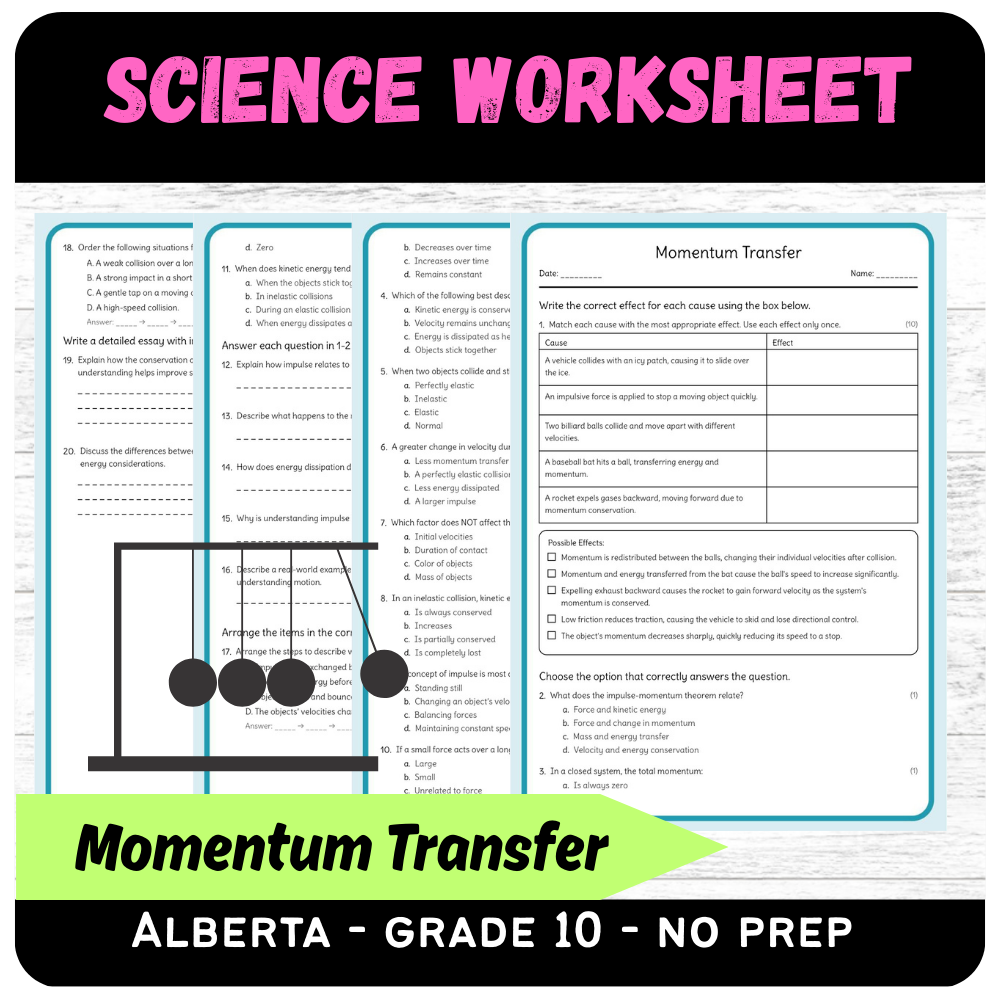
Grade 10 Science – Momentum Transfer Worksheet (Answer Key) | Alberta Standards
Created byBright Mind ResourcesLearning Objectives
- Understand the principle of conservation of momentum in closed systems.
- Analyze collisions and interactions where forces act over time.
- Explain the relationship between impulse and momentum during collisions.
Instant download
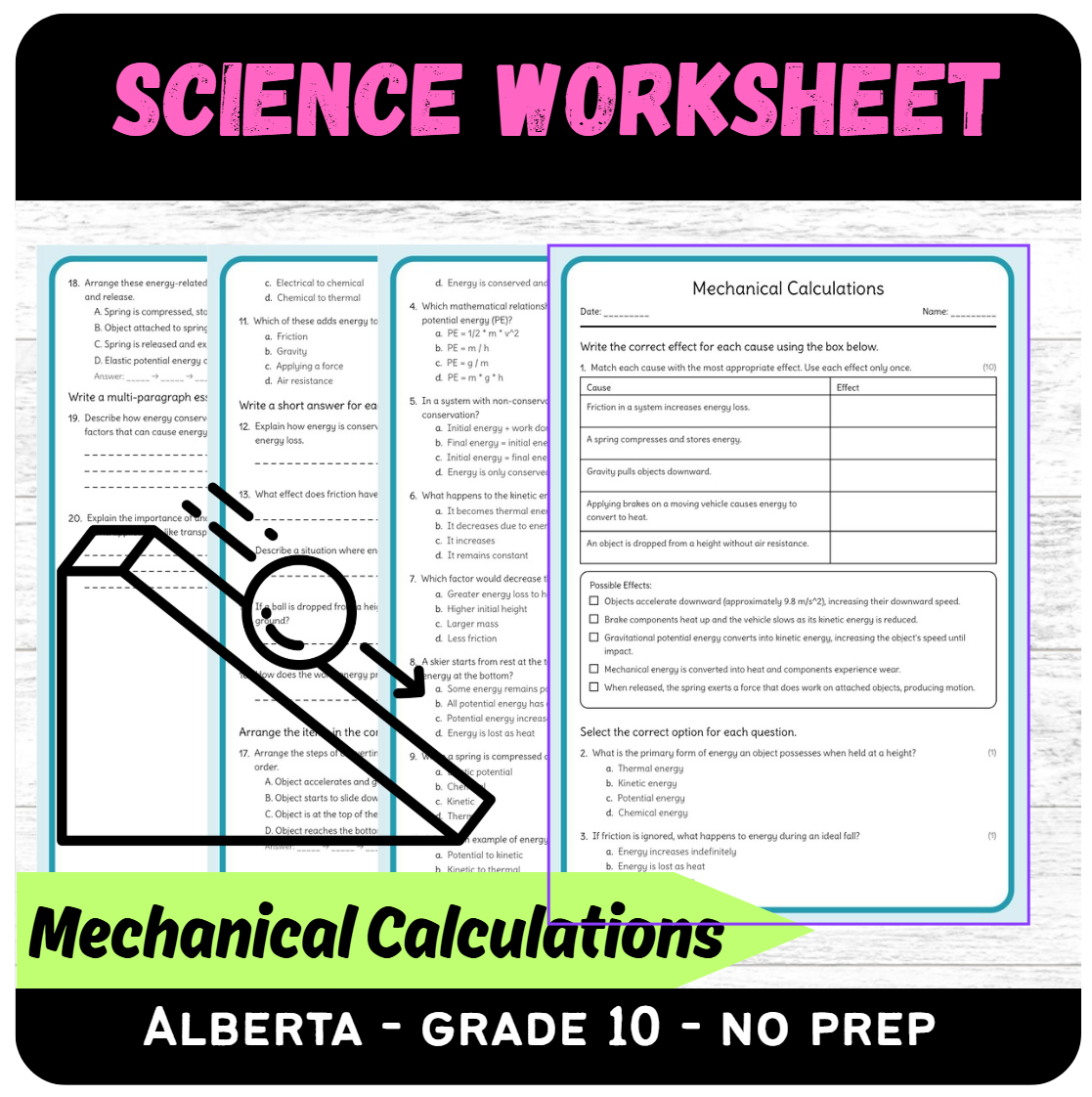
Grade 10 Science – Mechanical Calculations Worksheet (PDF) – Alberta Standards
Created byBright Mind ResourcesLearning Objectives
- Understand how energy is conserved and transformed in mechanical systems involving friction, springs, and gravity.
- Apply mathematical formulas to calculate potential and kinetic energy in real-world scenarios.
- Analyze the effects of non-conservative forces like friction on energy transfer.
Instant download
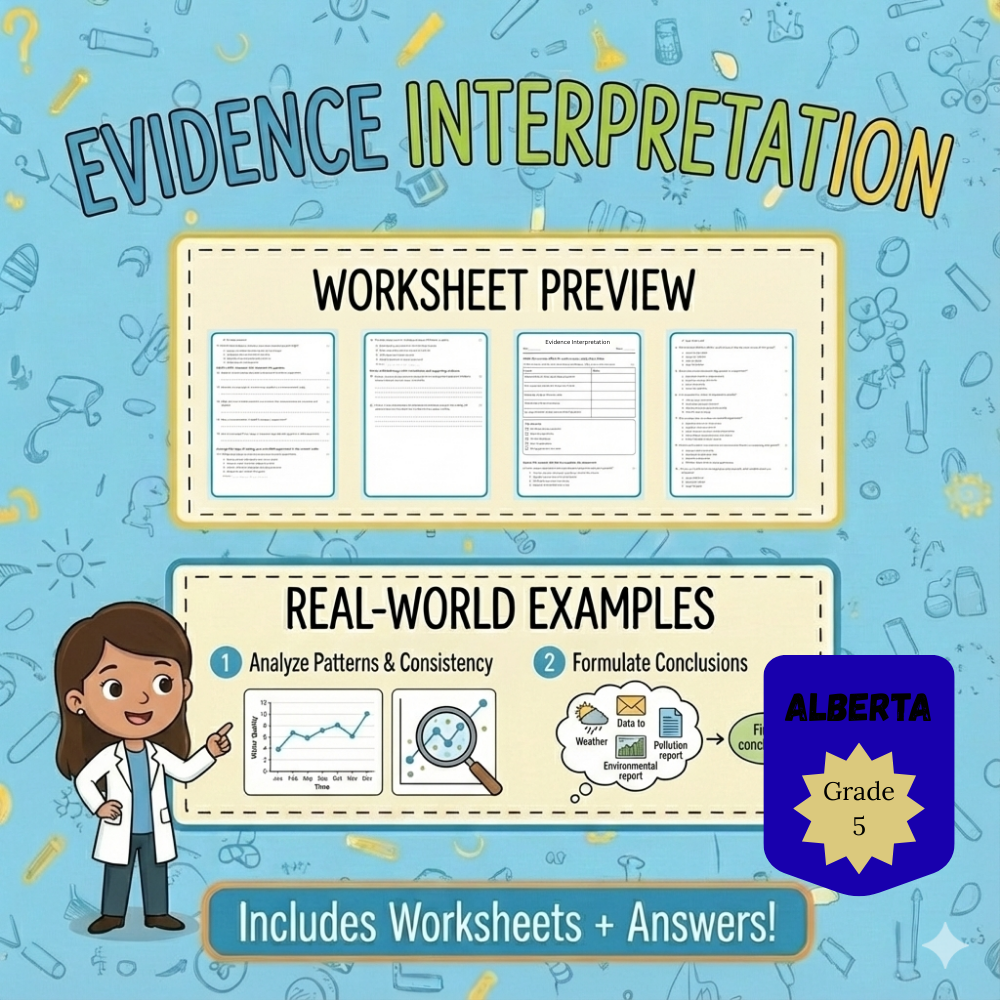
Grade 5 Science – Evidence Interpretation Worksheet (PDF) – Alberta Standards
Created byBright Mind ResourcesLearning Objectives
- Analyze patterns in environmental data from provincial monitoring networks.
- Evaluate the consistency of qualitative and quantitative evidence.
- Formulate reasoned conclusions supported by multiple data sources.
Instant download
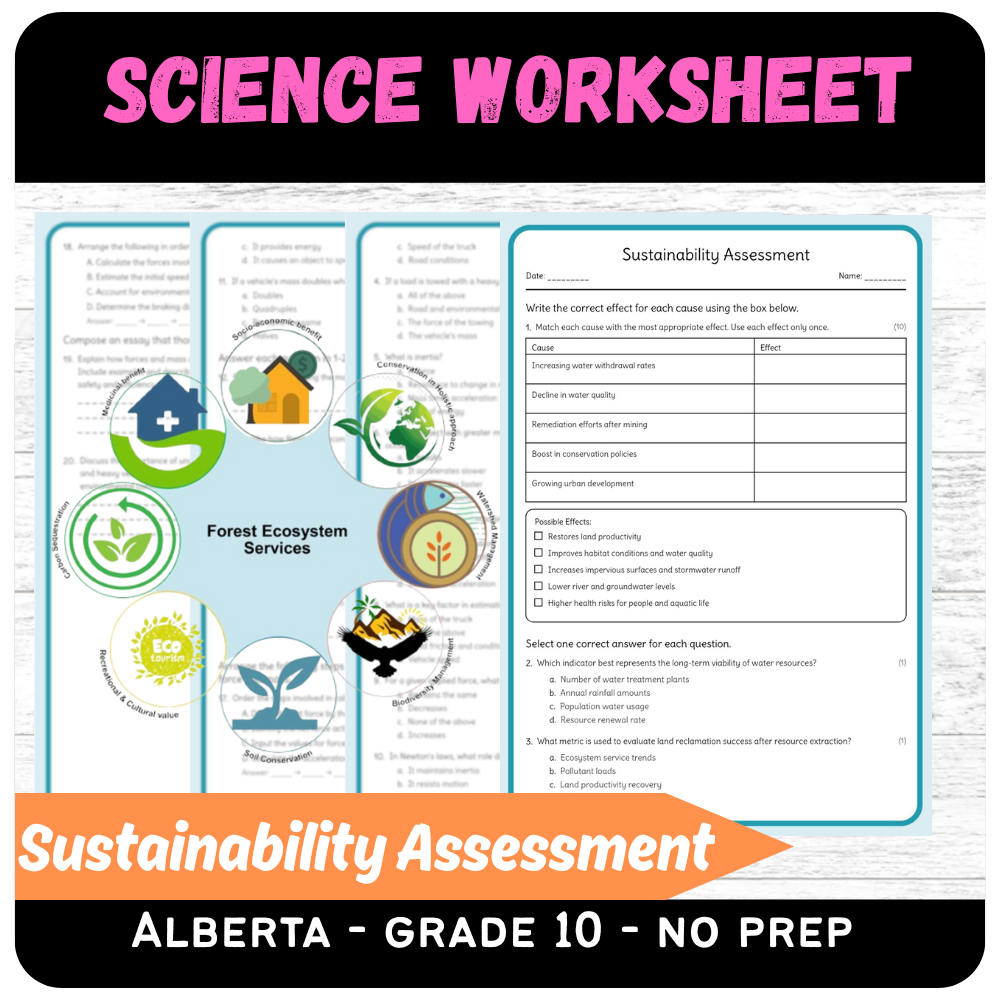
Grade 10 Science – Sustainability Assessment Worksheet (PDF) – Alberta Standards
Created byBright Mind ResourcesLearning Objectives
- Understand how environmental, economic, and social indicators are used to evaluate resource sustainability.
- Analyze frameworks for water allocation, land reclamation, and the effects of development to make informed decisions about resource management.
- Interpret metrics such as resource renewal rates, pollutant loads, and ecosystem service trends to assess sustainability.
Instant download
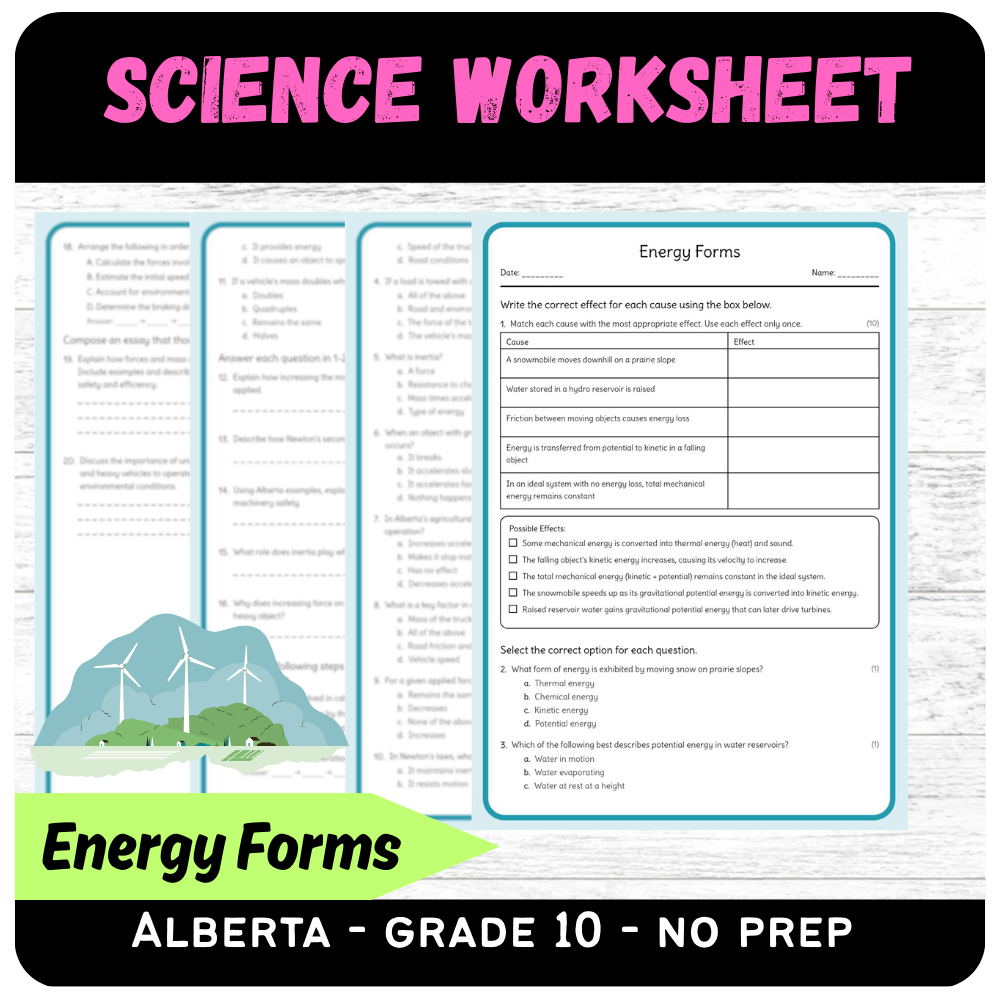
Grade 10 Science – Energy Diagrams Worksheet (PDF) – Alberta Standard
Created byBright Mind ResourcesLearning Objectives
- Interpret energy diagrams and bar charts to analyze energy transfer between different forms in various processes.
- Identify sources and sinks of energy in mechanical and thermal phenomena using visual representations.
- Link graph and diagram data to conservation principles in regional and engineered systems.
Instant download
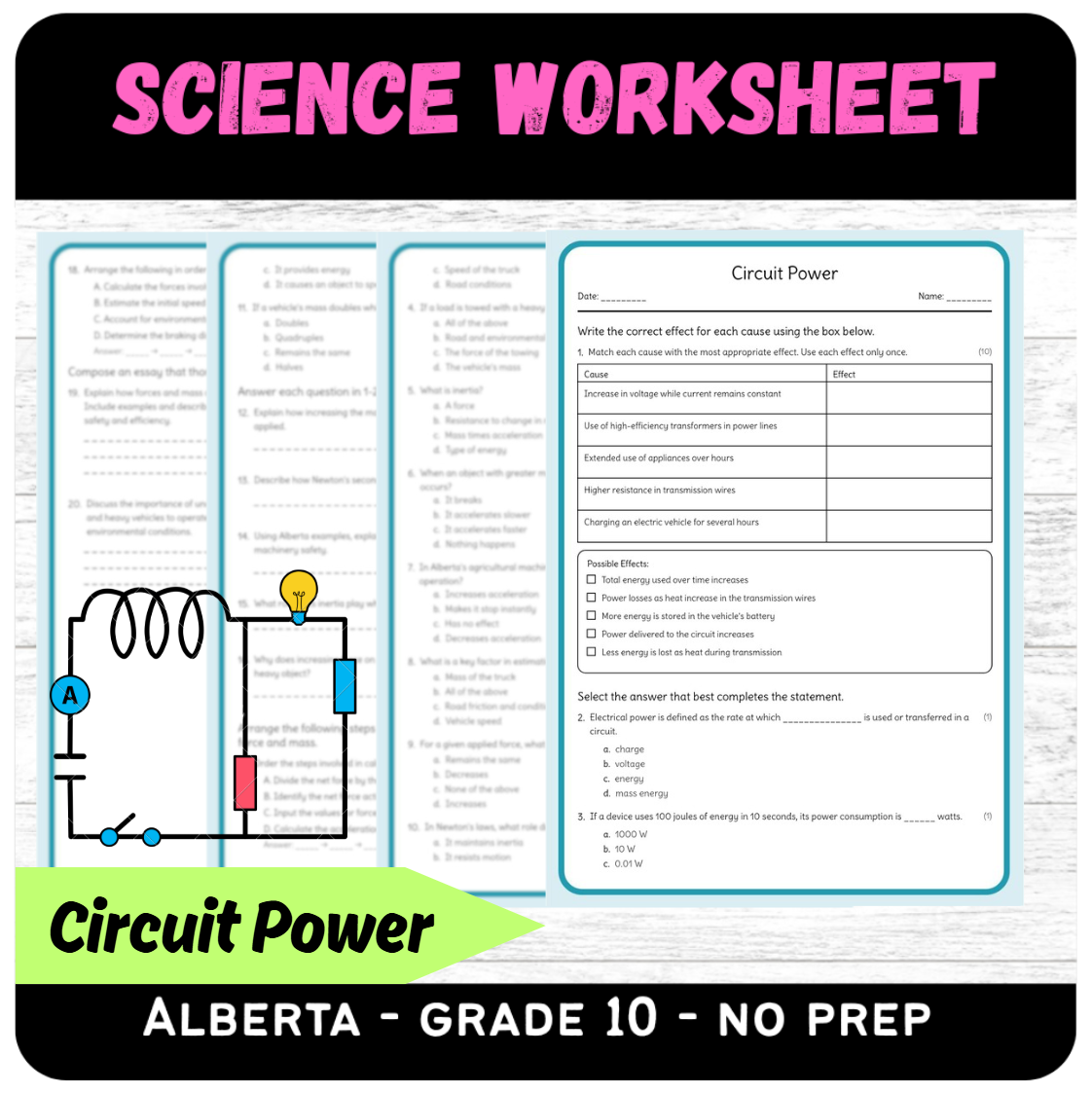
Grade 10 Science | Circuit Power Worksheet (PDF) – Alberta Standards
Created byBright Mind ResourcesLearning Objectives
- Understand the concept of electrical power in circuits and how voltage and current relate to energy consumption.
- Calculate electrical energy used over time in household and regional contexts.
- Apply the principles of power and energy to practical examples such as heating loads and electric vehicle charging.
Instant download
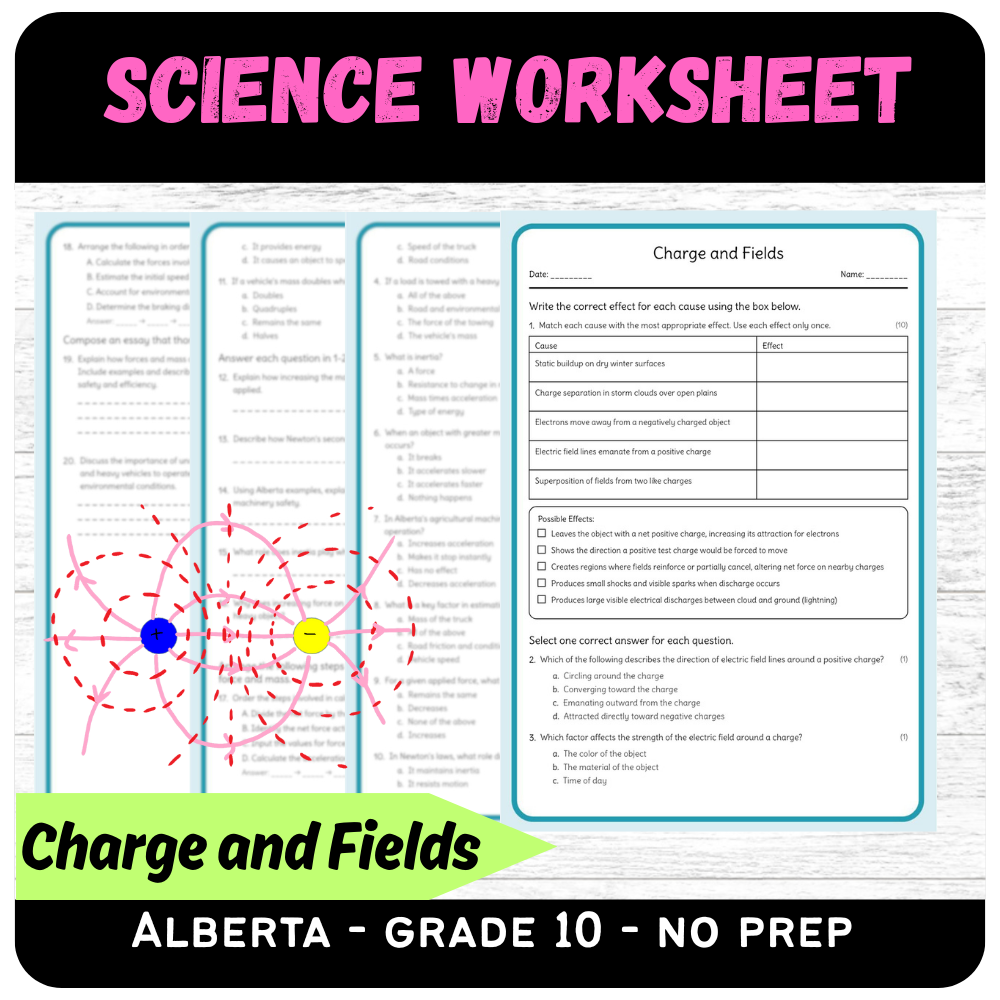
Grade 10 Science | Charge and Electric Fields Worksheet (PDF)
Created byBright Mind ResourcesLearning Objectives
- Understand the concept of electric charge, its sign and magnitude.
- Explain how electric field lines represent the strength and direction of forces between charges.
- Apply superposition principles to analyze electric fields from multiple charges.
Instant download
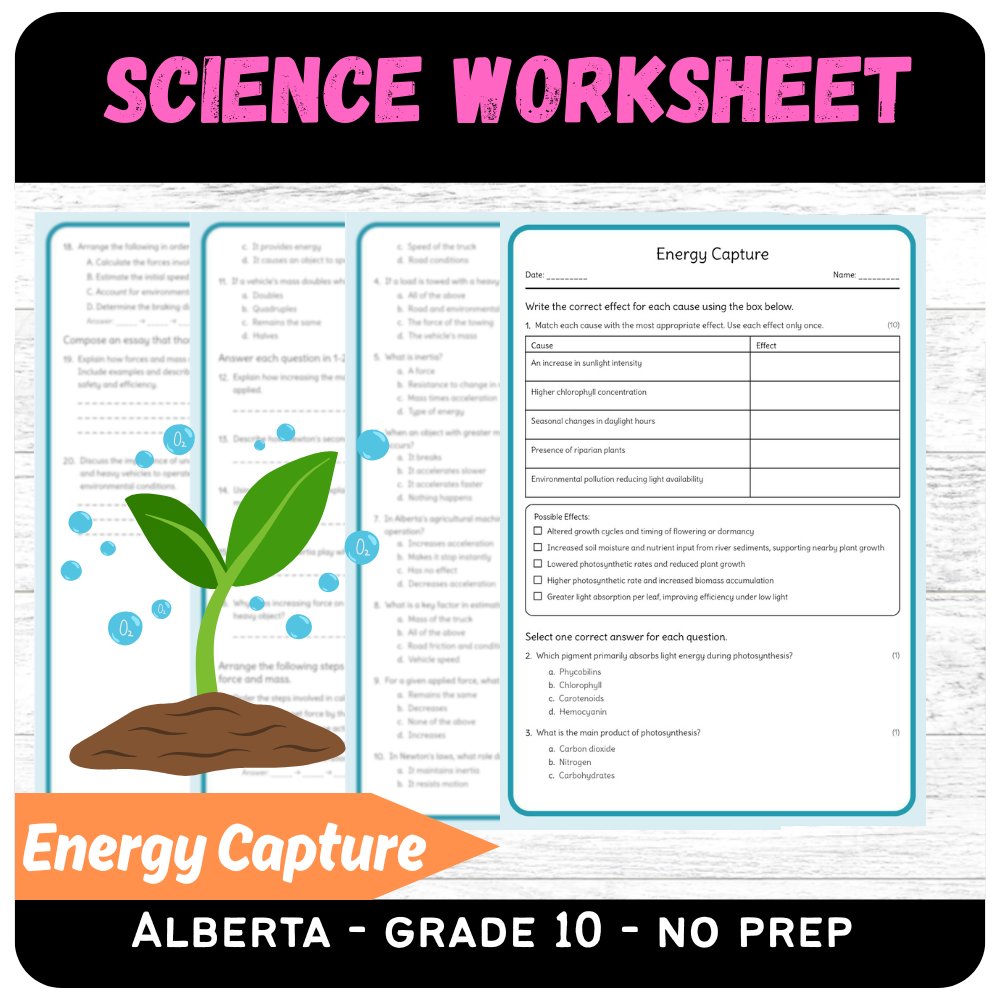
Grade 10 Science – Energy Capture Worksheet (PDF) | Alberta Standards
Created byBright Mind ResourcesLearning Objectives
- Explain the process of photosynthesis and how light energy is converted into chemical energy.
- Identify the roles of chlorophyll and other pigments in capturing light energy.
- Describe environmental influences on energy capture efficiency in plants.
Instant download
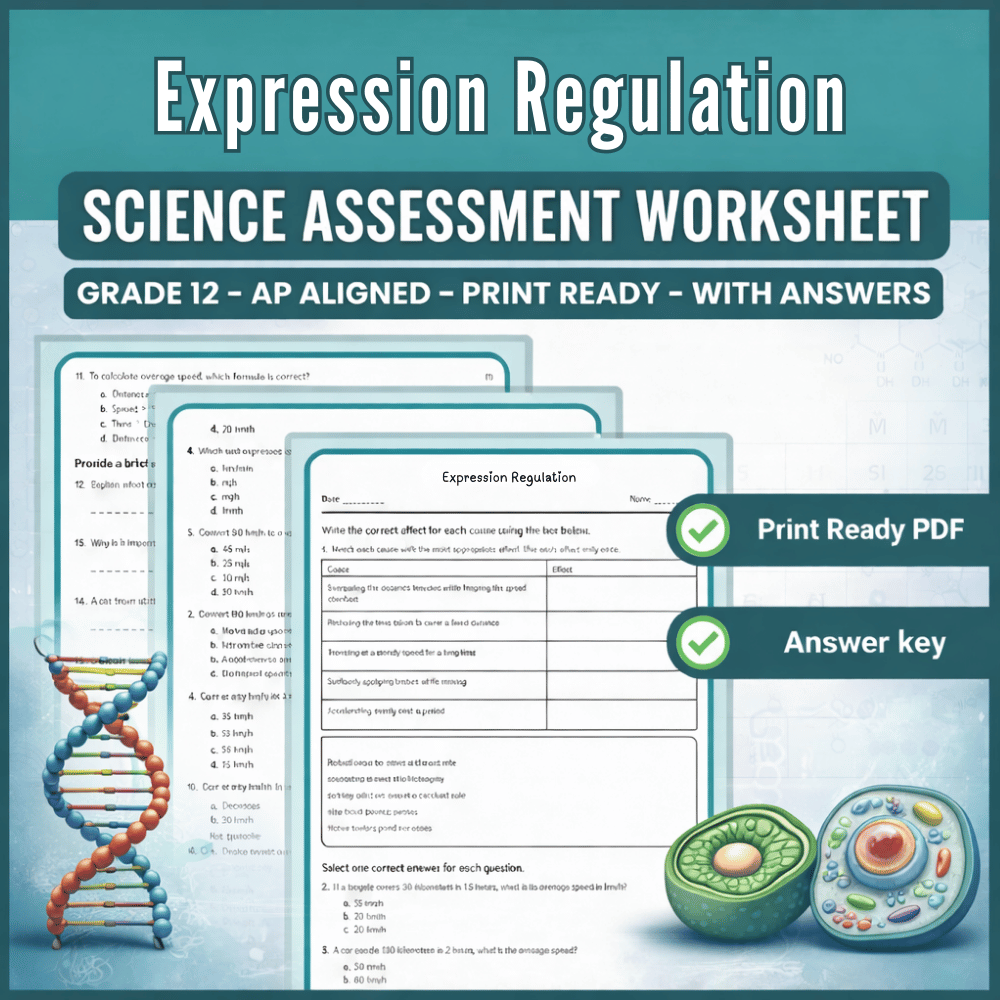
Grade 12 Science – Expression Regulation Worksheet (AP Standards) (PDF)
Created byBright Mind ResourcesLearning Objectives
- Describe the molecular mechanisms controlling gene expression, including promoter architecture and transcription factors.
- Explain how epigenetic modifications influence gene activity.
- Understand alternative splicing and post-translational regulation as means of controlling protein expression.
Instant download
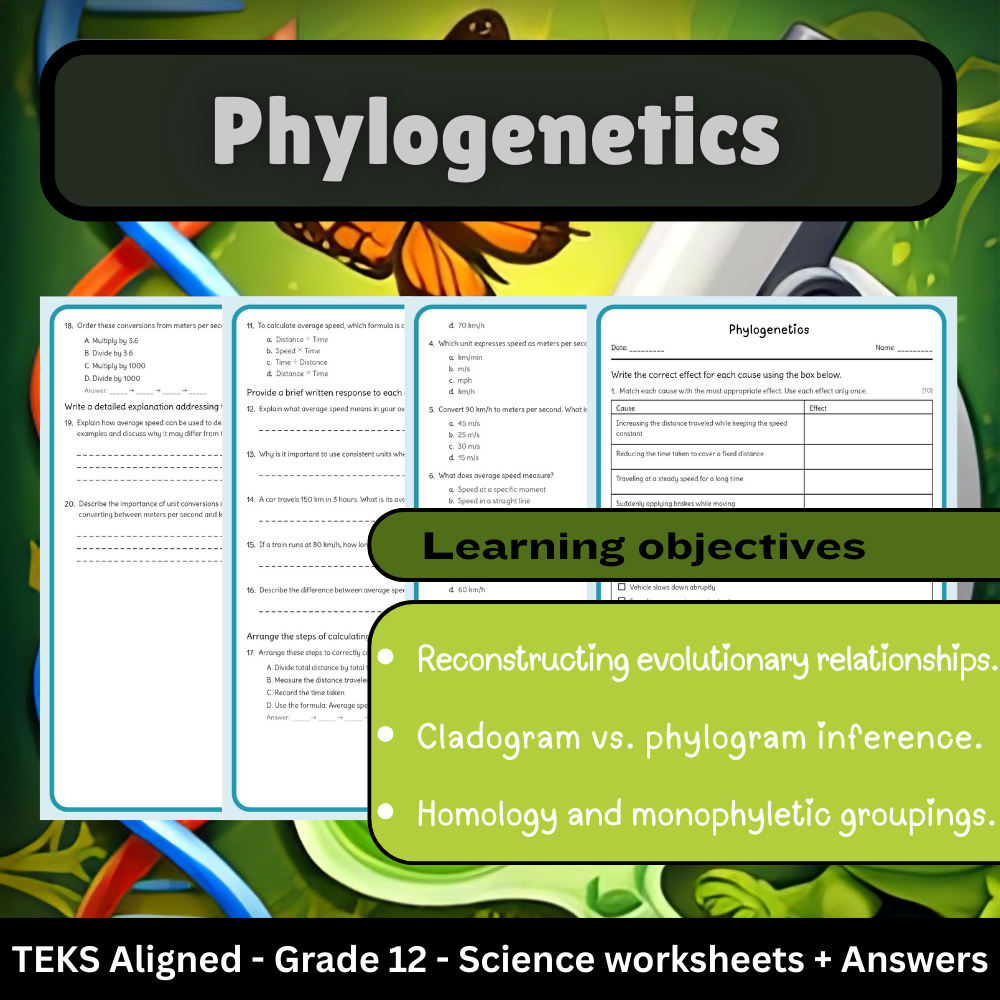
Grade 12 Science – Phylogenetics Worksheet (Worksheet + Answer Key) TEKS-Aligned
Created byBright Mind ResourcesLearning Objectives
- Understand the methods used for reconstructing evolutionary relationships, including character matrix analysis and molecular sequence alignment.
- Describe how cladogram and phylogram inference contribute to phylogenetic studies.
- Explain the concepts of homology, monophyly, paraphyly, and polyphyly in taxonomy.
Instant download
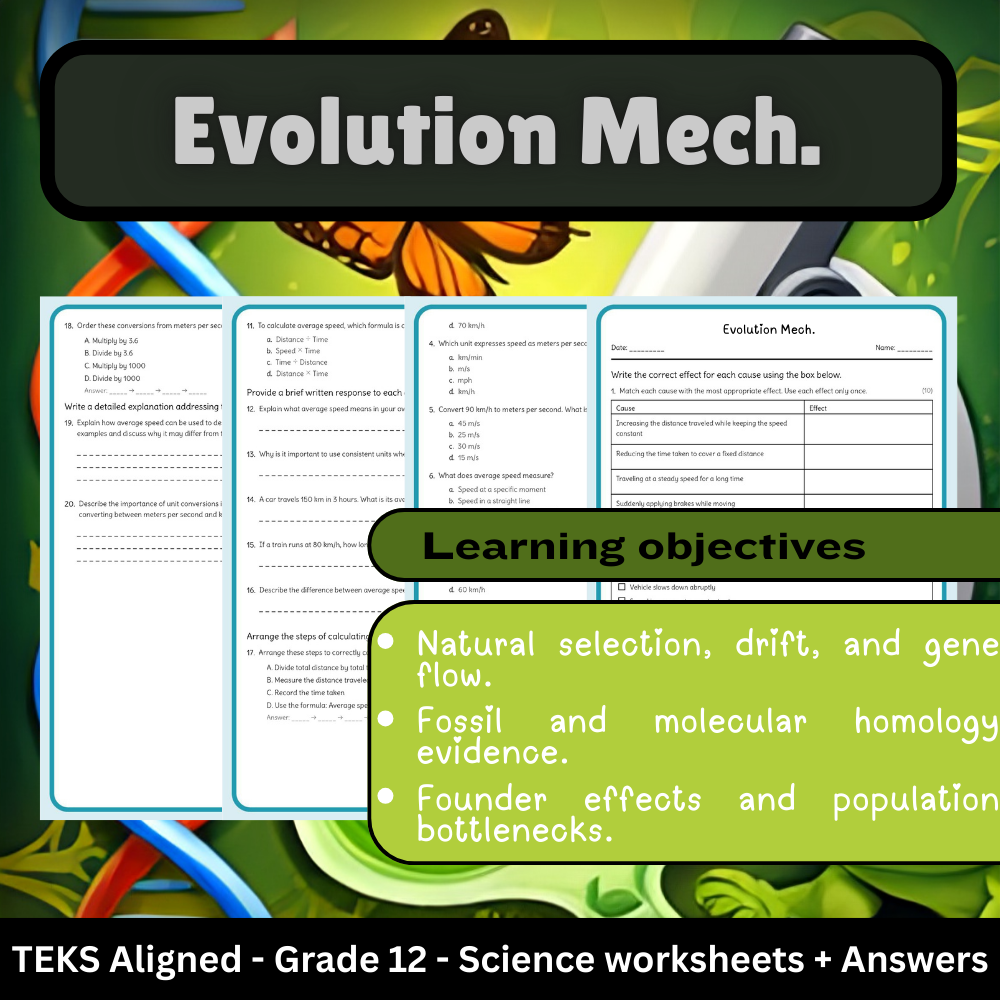
Grade 12 Science | Evolution Mechanisms Worksheet (TEKS-Aligned) – PDF
Created byBright Mind ResourcesLearning Objectives
- Understand the primary mechanisms that generate biological diversity, including natural selection, genetic drift, gene flow, and mutation.
- Identify evidence supporting evolutionary processes from fossils, comparative anatomy, and molecular homology.
- Explain population-level processes such as founder effects and bottlenecks and their influence on genetic variation.
Instant download
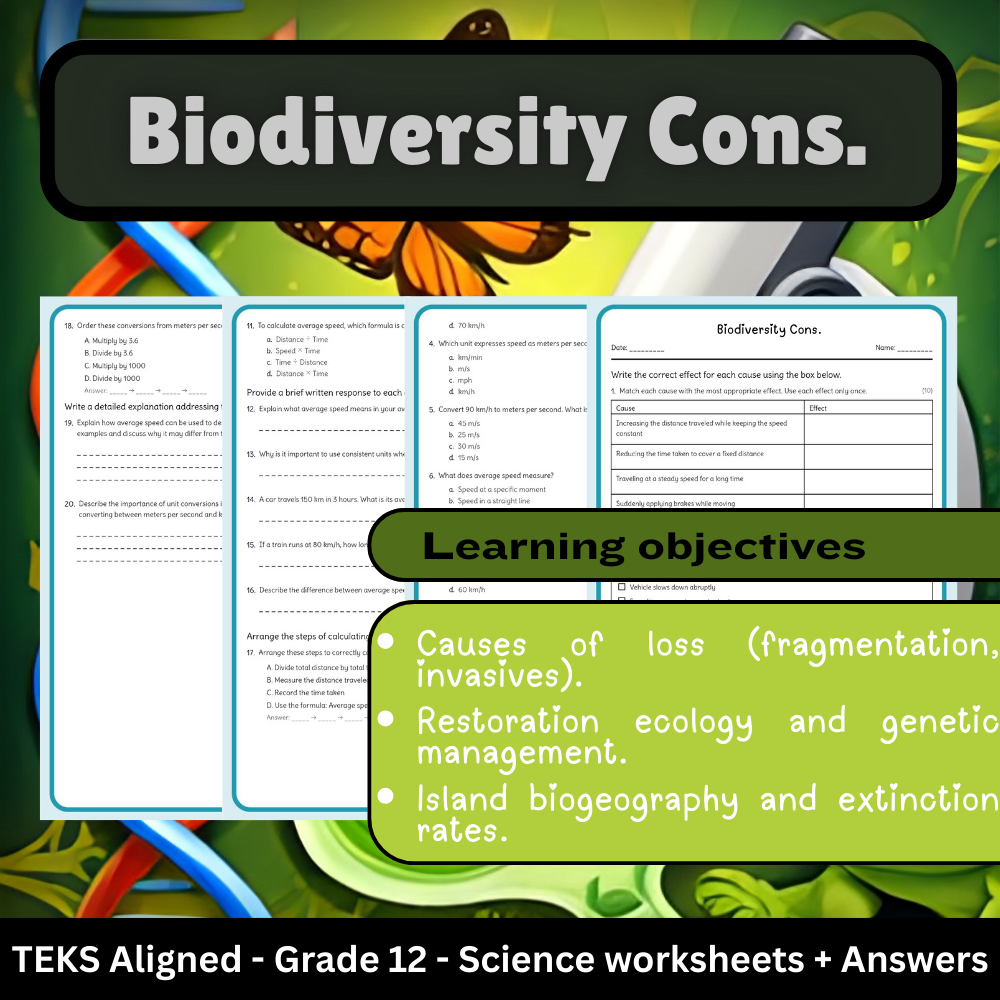
Grade 12 Science- Biodiversity Conservation Worksheet +Answer Key-TEKS Alignment
Created byBright Mind ResourcesLearning Objectives
- Identify key causes leading to biodiversity loss such as habitat fragmentation, invasive species, overexploitation, and climate change.
- Describe various measures and strategies used for conserving biodiversity, including protected areas, restoration ecology, and genetic management.
- Understand the implications of island biogeography for endemic species and the methods for estimating extinction rates from fossil and contemporary records.
Instant download
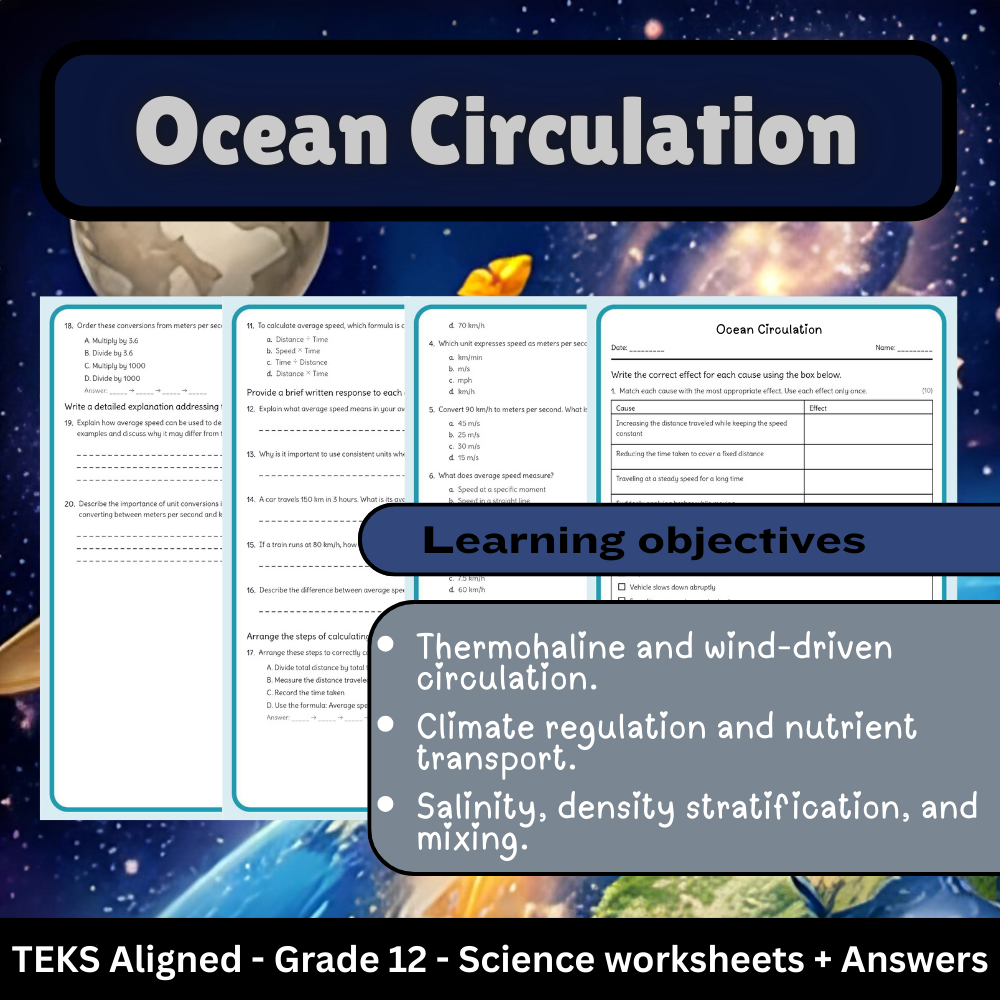
Grade 12 Science | Ocean Circulation Concepts & TEKS Worksheet (PDF)
Created byBright Mind ResourcesLearning Objectives
- Understand the mechanisms driving ocean circulation, including thermohaline and wind-driven processes.
- Identify the role of ocean currents in regional and global climate regulation and nutrient transport.
- Explain the processes of salinity, density stratification, and mixing in the context of biogeochemical cycles.
Instant download
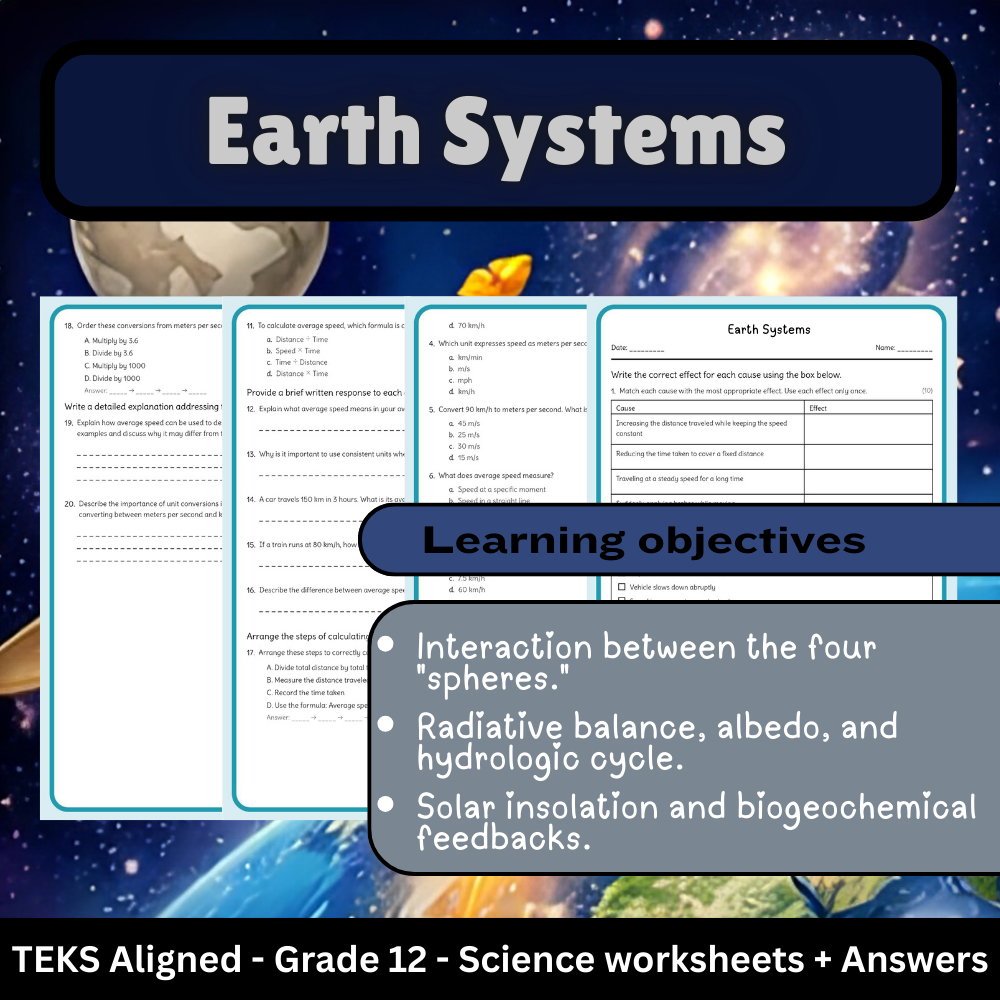
Grade 12 Science | Earth Systems TEKS Worksheet(Answer Key) for Climate & Cycles
Created byBright Mind ResourcesLearning Objectives
- Describe the interactions between atmosphere, hydrosphere, lithosphere, and cryosphere in energy transfer and matter cycling.
- Explain key mechanisms like radiative balance, albedo effects, and the hydrologic cycle and their influence on climate variability.
- Analyze seasonal solar insolation, ocean–atmosphere coupling, and biogeochemical feedbacks as system phenomena.
Instant download
Grade 12 Science | Integrated Modeling Worksheet (AP Standards) (PDF)
Created byBright Mind ResourcesLearning Objectives
- Understand the role of integrated modeling in complex science scenarios.
- Analyze how models incorporate uncertainty quantification.
- Evaluate the criteria for assessing model adequacy and validity.
Instant download
Grade 12 Science | Bonding Basics Worksheet (AP Standard) - PDF
Created byBright Mind ResourcesLearning Objectives
- Identify the principal types of chemical bonding: ionic, covalent, and metallic.
- Understand how charge distribution, lattice structures, and shared-electron models characterize bond types.
- Explain how different bond types influence properties such as electrical conductivity, melting point, and solubility.
Instant download
Grade 12 Science | Reaction Quantification Worksheet (AP Standards) (PDF)
Created byBright Mind ResourcesLearning Objectives
- Understand complex stoichiometric calculations involving concentration units, molarity, and dilution.
- Apply limiting reagent analysis and volumetric techniques to quantify reaction progress and yield.
- Utilize symbolic manipulation and dimensional analysis to connect laboratory measurements with mole-based predictions.
Instant download
Grade 12 Science | Stoichiometric Concepts Worksheet (AP Standards) (PDF)
Created byBright Mind ResourcesLearning Objectives
- Understand and apply the mole concept and molar mass to relate quantities of reactants and products.
- Interpret balanced chemical equations to determine molar relationships.
- Calculate limiting reactant, theoretical yield, and percent yield from mass and mole data.
Instant download
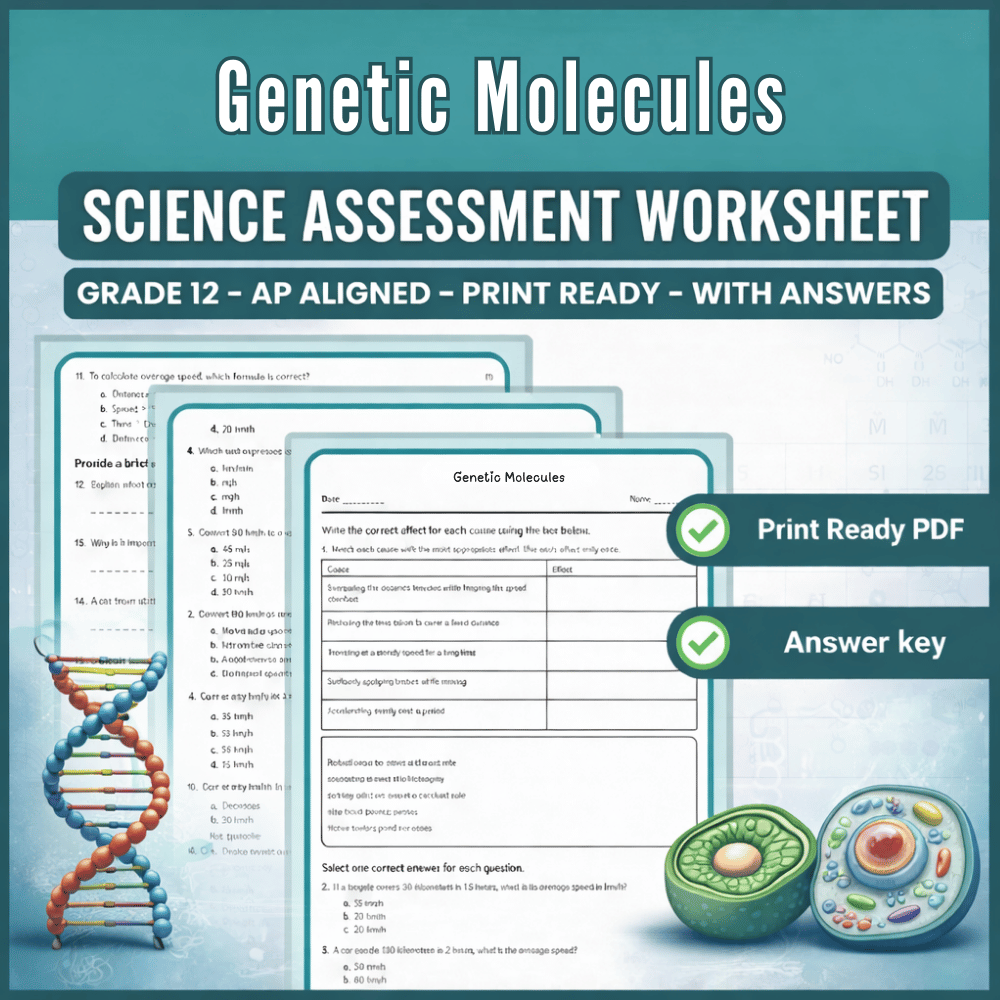
Grade 12 Science – Genetic Molecules Worksheet (AP Standards) (PDF)
Created byBright Mind ResourcesLearning Objectives
- Describe the structure and function of nucleic acids.
- Explain the mechanisms of DNA replication and mutation.
- Analyze how molecular changes affect genome organization and inheritance.
Instant download
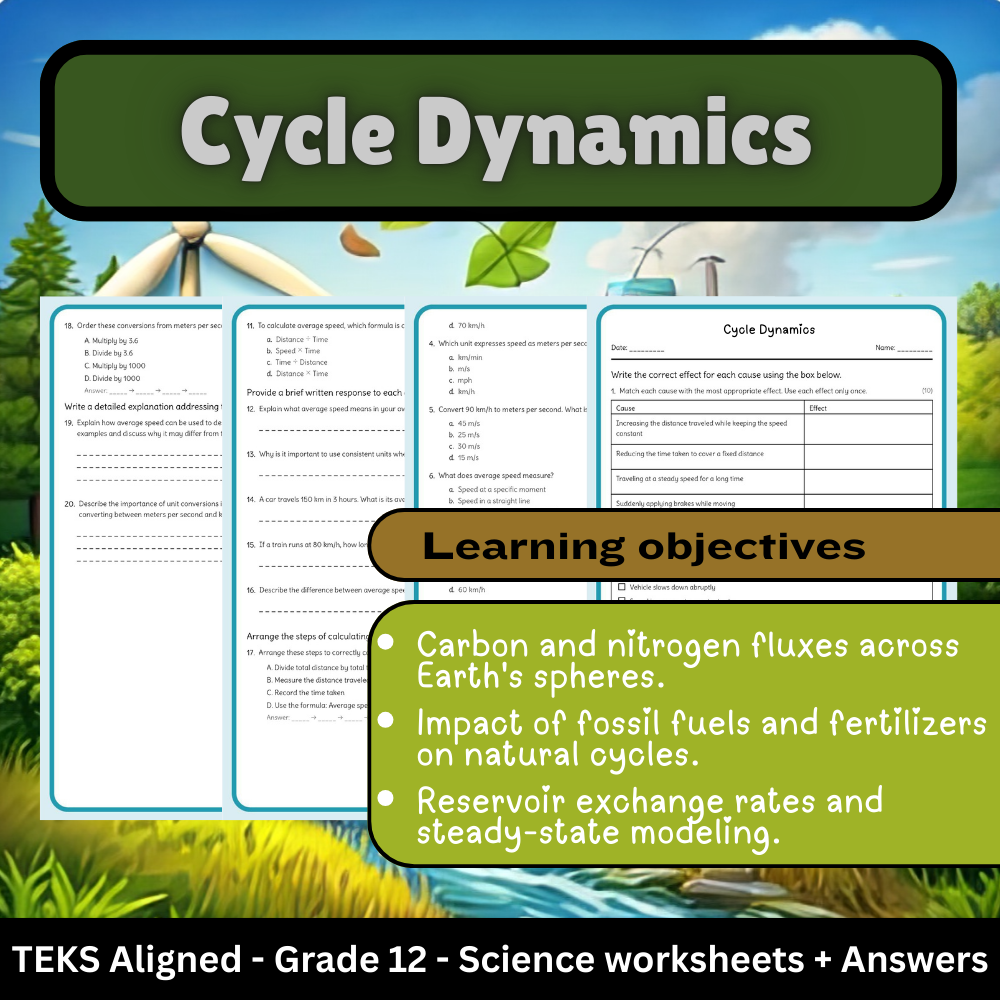
Grade 12 Science | Cycle Dynamics Worksheet (Answer Key) – TEKS Science
Created byBright Mind ResourcesLearning Objectives
- Analyze the flow of carbon and nitrogen within environmental cycles and understanding the fluxes among atmosphere, biosphere, hydrosphere, and lithosphere.
- Evaluate the impact of human activities such as fossil fuel burning and fertilizer runoff on natural biogeochemical fluxes.
- Apply concepts of reservoir exchange rates and steady-state conditions to environmental systems modeling.
Instant download
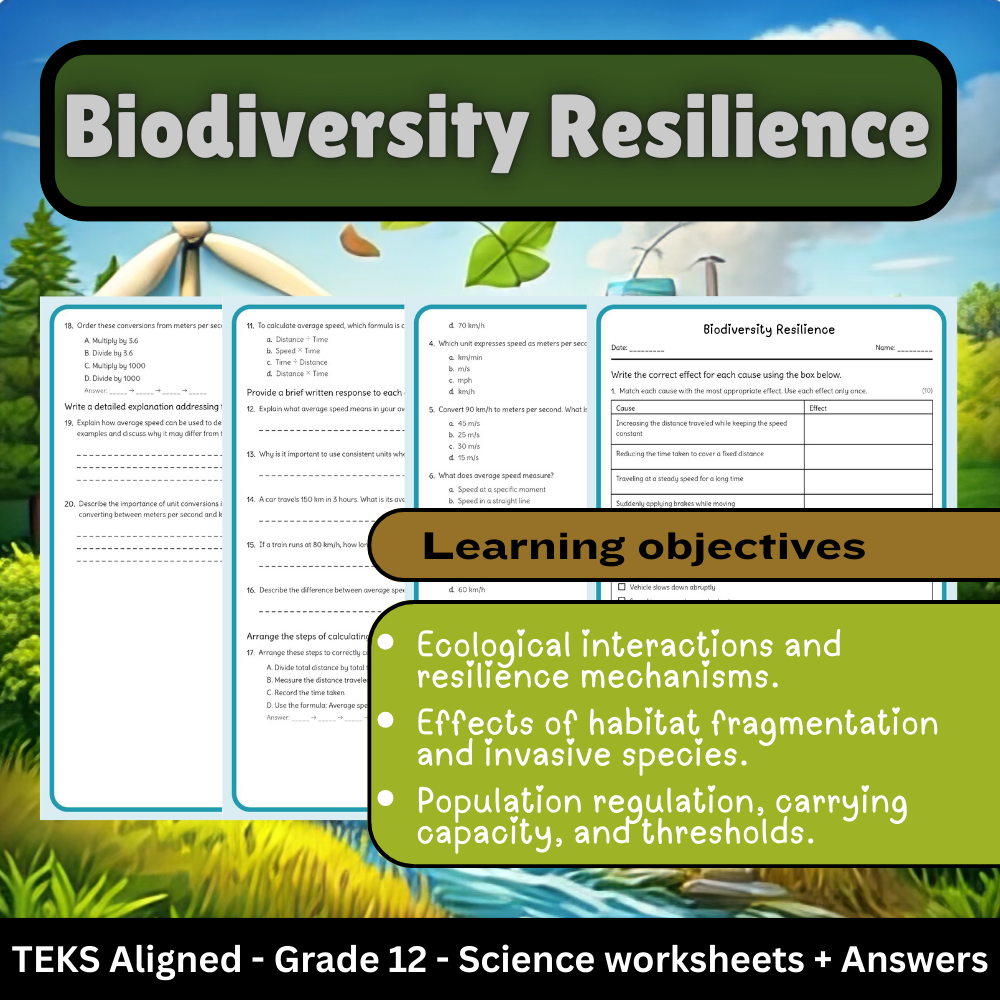
Grade 12 Science | Biodiversity Resilience Worksheet (PDF) – TEKS Standards
Created byBright Mind ResourcesLearning Objectives
- Understand key concepts of biodiversity patterns, ecological interactions, and resilience mechanisms.
- Analyze the impact of disturbances such as habitat fragmentation and invasive species on ecosystems.
- Interpret models of population regulation, carrying capacity, and thresholds in ecological systems.
Instant download
Grade 12 Science – Regulatory Networks Worksheet (PDF) – Alberta Standards
Created byBright Mind ResourcesLearning Objectives
- Understand the components and function of gene regulatory networks in biological systems.
- Analyze how epigenetic modifications influence gene expression in different environmental contexts.
- Explore real-world example applications in biotechnology related to regulation mechanisms.
Instant download
Grade 12 Science | Integration & Synthesis in Biology Worksheet (PDF)
Created byBright Mind ResourcesLearning Objectives
- Understand how genetic variation influences evolutionary processes such as mutation, selection, and gene flow.
- Analyze ecological interactions and their impact on population dynamics and adaptation.
- Link molecular genetics to ecosystem effects and evolutionary outcomes through real-world examples.
Instant download
Grade 12 Science | Modeling and Prediction Worksheet (PDF)
Created byBright Mind ResourcesLearning Objectives
- Understand the role of mathematical and computational models in environmental forecasting and climate projections.
- Analyze the assumptions, limitations, and sources of uncertainty in different model types.
- Apply concepts of sensitivity analysis, boundary conditions, and calibration to model evaluation.
Instant download
Grade 12 Science – Measurement Concepts Worksheet (PDF) – Alberta Standards
Created byBright Mind ResourcesLearning Objectives
- Explain fundamental measurement concepts including SI units, calibration, and traceability.
- Differentiate between precision and accuracy in measurement data.
- Interpret measurement errors and their impact on data quality.
Instant download

Grade 12 Science Oscillator Energy Worksheet (AP) – Science 1 PDF
Created byBright Mind ResourcesLearning Objectives
- Describe the energy exchange between potential and kinetic energy in oscillatory systems.
- Explain how amplitude affects the energy in simple harmonic motion.
- Analyze the effects of damping on energy dissipation in oscillators.
Instant download
Grade 12 Science | Data Uncertainty Worksheet (PDF) – Alberta Standards
Created byBright Mind ResourcesLearning Objectives
- Understand the concepts of measurement error, sampling variability, and model uncertainty in data analysis.
- Apply propagation of uncertainty and interpret confidence intervals in environmental monitoring contexts.
- Evaluate hypotheses and understand the significance of non-significant results in scientific studies.
Instant download
Grade 12 Science Worksheet – Electricity and Power (AP Standards) (PDF)
Created byBright Mind ResourcesLearning Objectives
- Understand how power and energy transfer relate in electrical circuits.
- Analyze transient charging and discharging behaviors in RC networks.
- Calculate power dissipation and power delivered by sources considering internal resistance.
Instant download
Grade 12 Science | Dynamics of Systems Worksheet (AP Standards) (PDF)
Created byBright Mind ResourcesLearning Objectives
- Analyze multi-body systems with constraints using equations and force relations
- Interpret pulley and connected-mass configurations in system analysis
- Understand the application of free-body diagrams and internal force propagation
Instant download
Grade 12 Science | Chemical Fate Worksheet (PDF) – Alberta Standards
Created byBright Mind ResourcesLearning Objectives
- Understand the processes of chemical dissolution, sorption, volatilization, and biodegradation in soil and water systems.
- Analyze case studies of contaminant pathways such as agricultural runoff and petrochemical spills.
- Evaluate how kinetic and equilibrium considerations influence contaminant distribution and remediation strategies.
Instant download
Grade 12 Science – Geometric Optics Worksheet (PDF) – Alberta Standards
Created byBright Mind ResourcesLearning Objectives
- Understand the principles of reflection and refraction of light using ray models.
- Apply Snell's law to calculate angles and light behavior at interfaces.
- Determine the properties of lenses, including focal length and image formation.
Instant download
Grade 12 Science – Biotech Applications Worksheet (PDF) – Alberta Standards
Created byBright Mind ResourcesLearning Objectives
- Understand the key applications of biotechnology in agriculture, diagnostics, and environmental remediation.
- Analyze the ethical, regulatory, and socioeconomic considerations associated with biotechnological advancements.
- Evaluate genetic improvement strategies and detection techniques used in regional biotech contexts.
Instant download
Grade 12 Science | Nuclear Energy (Worksheet + Answer Key) – Alberta Standard
Created byBright Mind ResourcesLearning Objectives
- Understand the principles of nuclear fission and fusion and their energy outputs.
- Apply concepts of binding energy per nucleon and critical mass in reactor physics.
- Analyze real-world applications of nuclear technology in medicine and energy systems.
Instant download
Grade 12 Science – Solids and Lattices Worksheet (PDF) – Alberta Standards
Created byBright Mind ResourcesLearning Objectives
- Understand atomic packing and unit cell geometries in different types of solids.
- Identify the types of bonding that produce ionic crystals, metallic lattices, and covalent networks.
- Explain how structural features influence mechanical strength, conductivity, and melting behavior of materials.
Instant download
Browse more categories
About Reading comprehension Worksheets
Find reading comprehension worksheets for class practice, homework, or self-study. All 40,284 are instant PDF downloads.
Each resource here is built by an independent educator and reviewed for quality. Worksheets print straight from PDF and suit classroom use, homework, or extra practice; most come with answer keys, and you can preview before purchasing.