
Reading comprehension Worksheets
40,284 type resources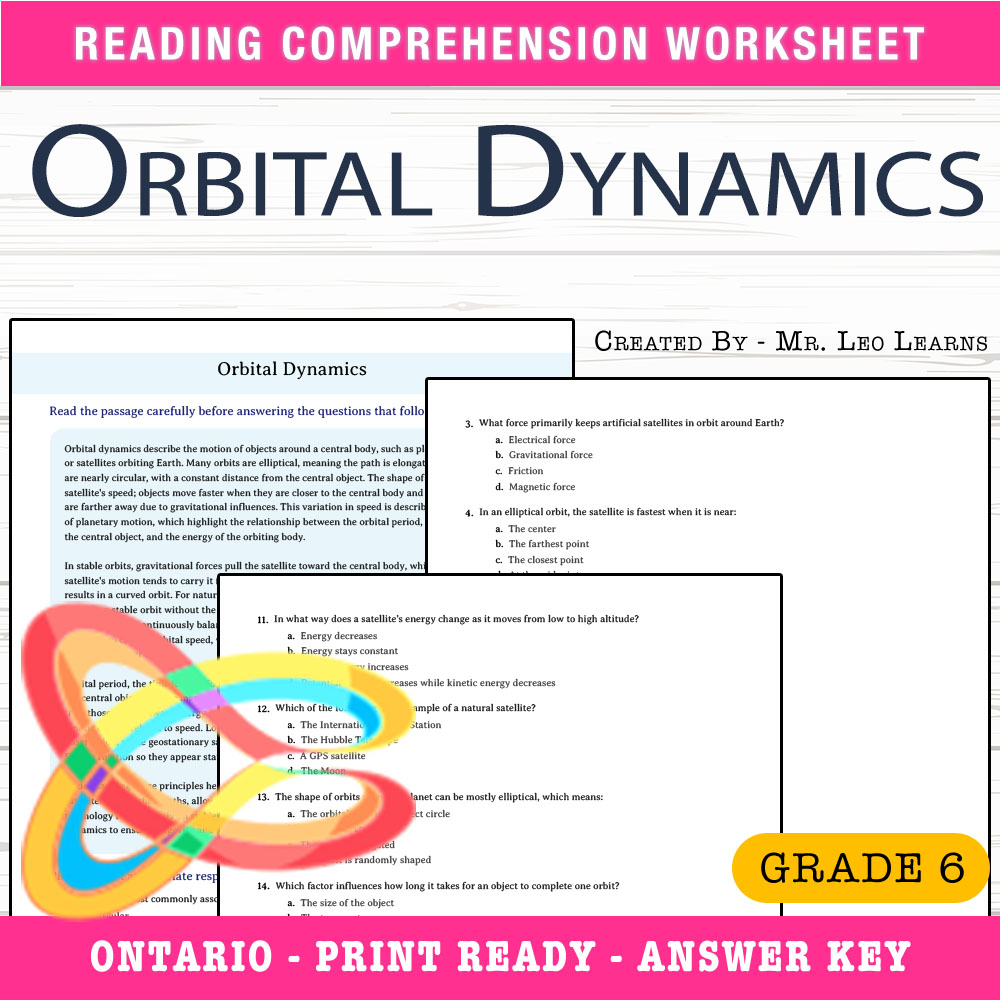
Grade 6 Science — Orbital Dynamics Worksheet for Mastery
 Created byThe Resource Hub
Learning Objectives
- Understand the basic concepts of elliptical and near-circular orbits.
- Explain how orbital speed varies with distance from the central body.
- Describe the balance of gravitational force and inertial motion in producing orbits.
Also included in: Grade 6 Science Unit | Space Systems & Orbital Mechanics Worksheet Pack +1 more
Instant download
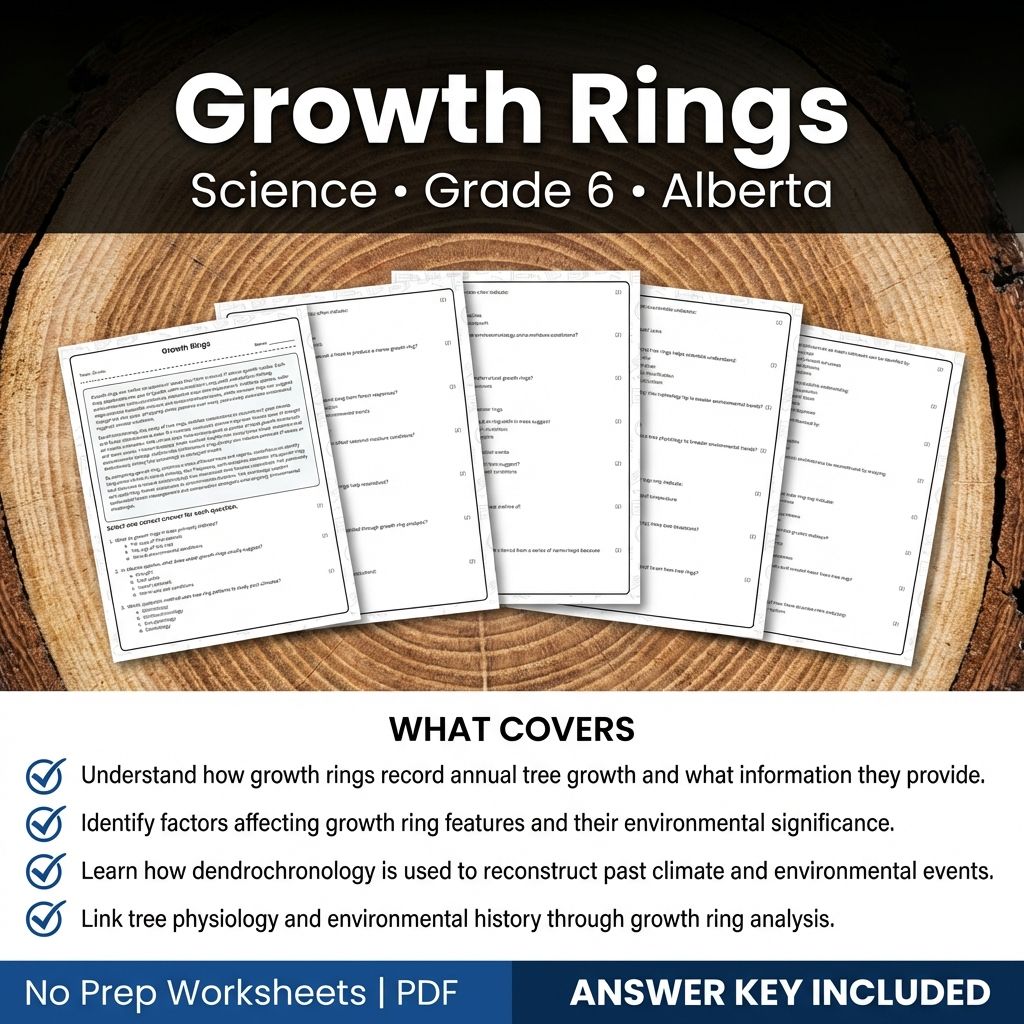
Grade 6 Science Worksheet on Growth Rings | Alberta Standards
 Created byCoral Reef Learning
Learning Objectives
- Understand how growth rings record annual tree growth and what information they provide.
- Identify factors affecting growth ring features and their environmental significance.
- Learn how dendrochronology is used to reconstruct past climate and environmental events.
Instant download
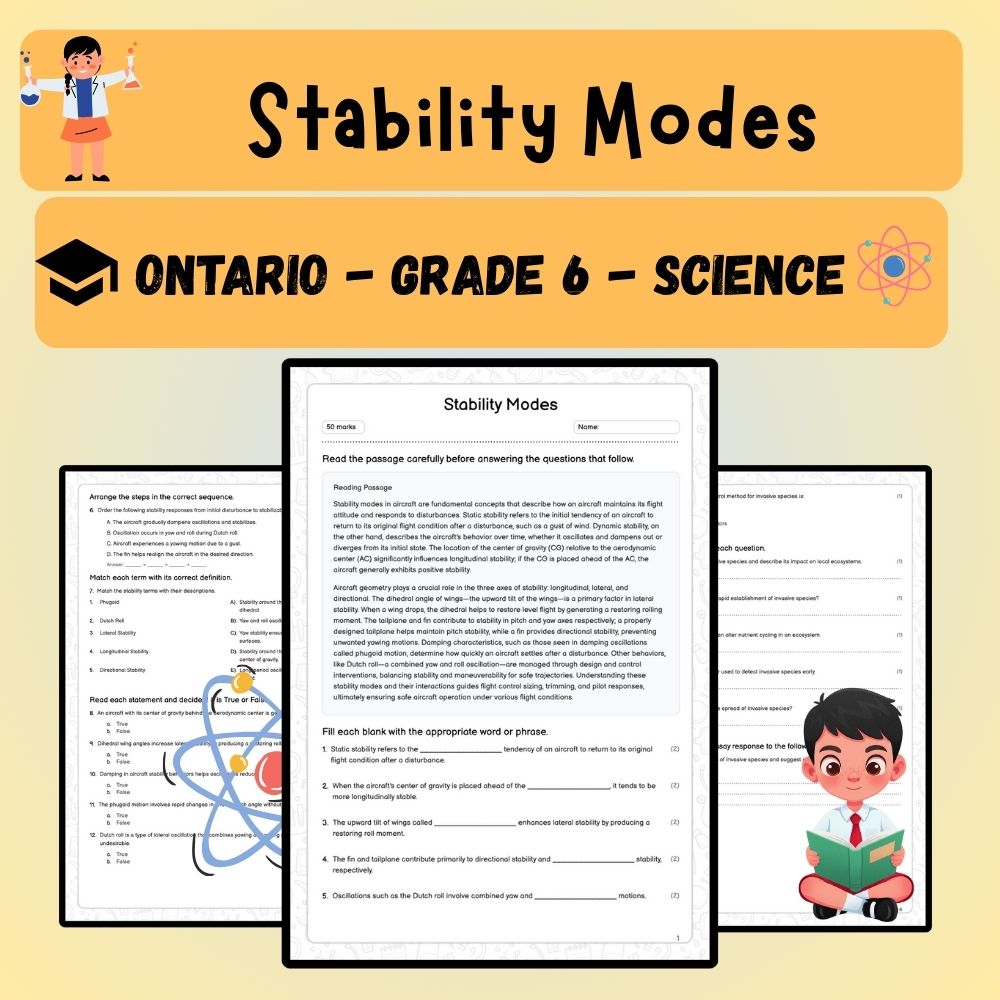
Grade 6 Science | Stability Modes Worksheet (Worksheet + Answer Key) – Ontario Standards
 Created byPrism Point Learning
Learning Objectives
- Explain the difference between static and dynamic stability in aircraft.
- Identify how aircraft geometry influences longitudinal, lateral, and directional stability.
- Describe the effects of center of gravity, dihedral angles, and tail designs on stability behaviors.
Instant download
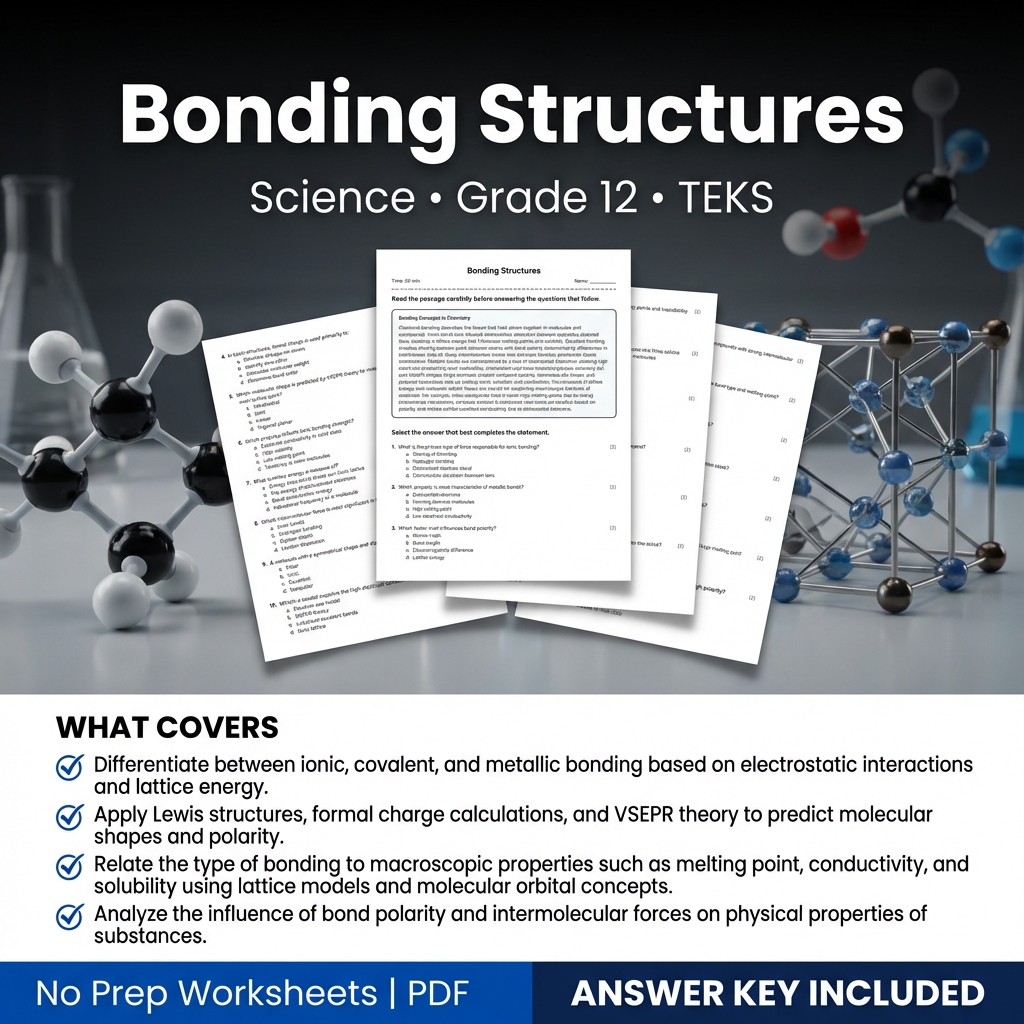
Grade 12 Science Worksheet on Bonding Structures | TEKS-Aligned Practice
Created byCoral Reef LearningLearning Objectives
- Differentiate between ionic, covalent, and metallic bonding based on electrostatic interactions and lattice energy.
- Apply Lewis structures, formal charge calculations, and VSEPR theory to predict molecular shapes and polarity.
- Relate the type of bonding to macroscopic properties such as melting point, conductivity, and solubility using lattice models and molecular orbital concepts.
Instant download
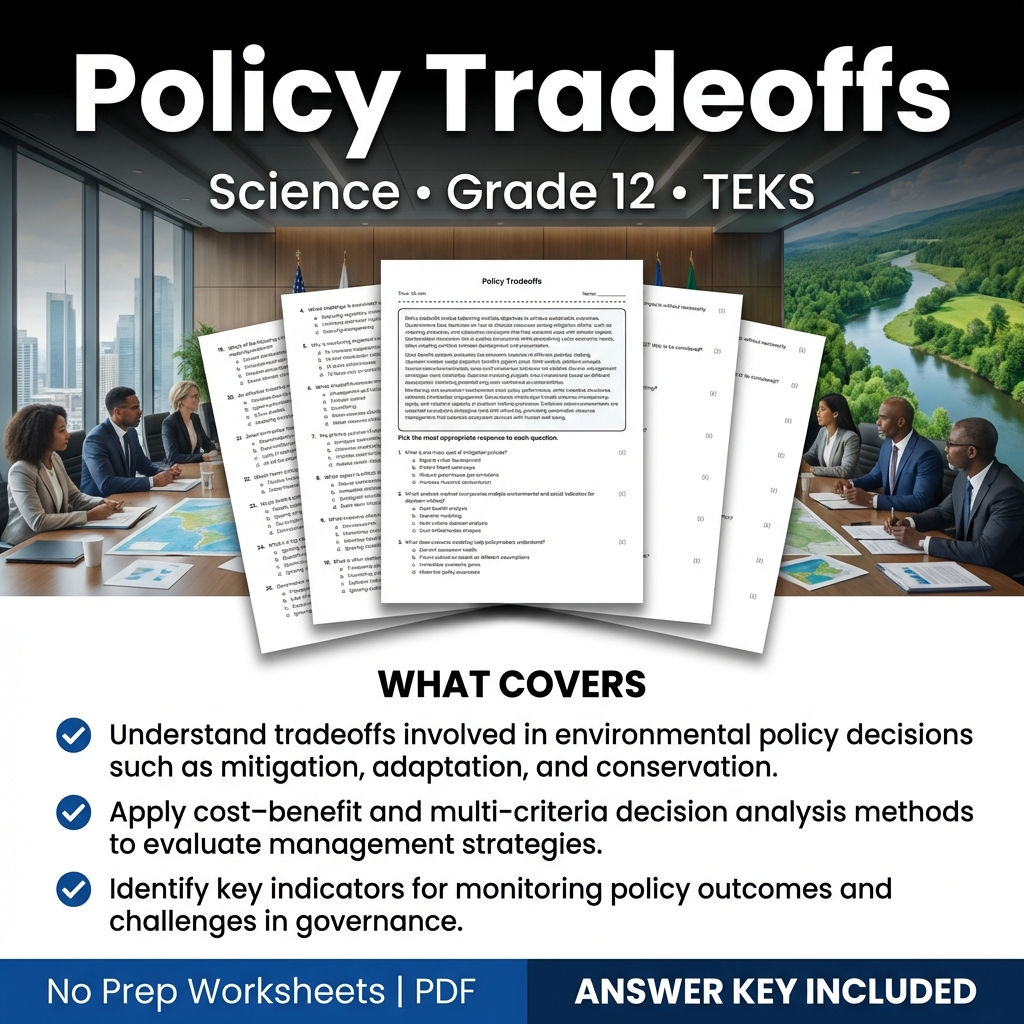
Policy Tradeoffs Worksheet for Grade 12 Science TEKS Standards
Created byCoral Reef LearningLearning Objectives
- Understand tradeoffs involved in environmental policy decisions such as mitigation, adaptation, and conservation.
- Apply cost–benefit and multi-criteria decision analysis methods to evaluate management strategies.
- Identify key indicators for monitoring policy outcomes and challenges in governance.
Instant download
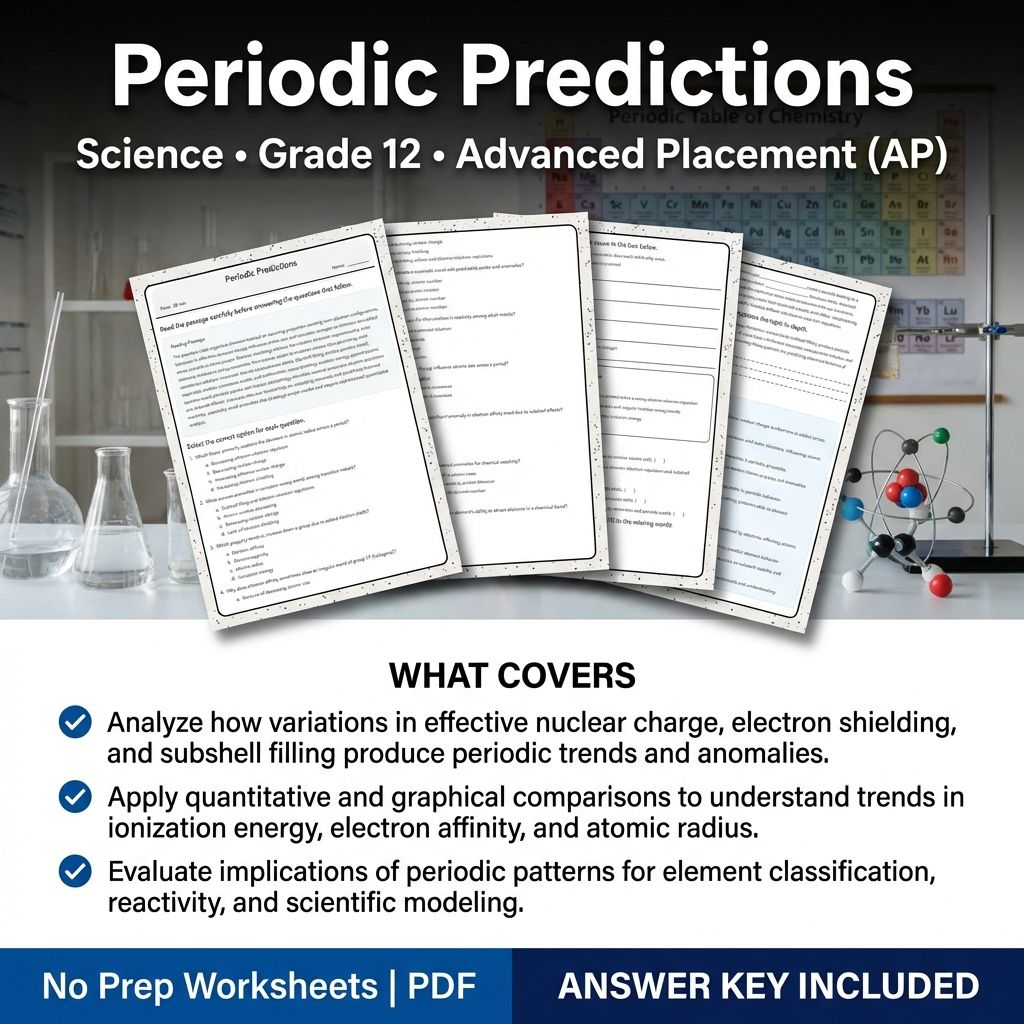
Grade 12 Science | Periodic Predictions Worksheet & Answer Key (Printable PDF)
Created byCoral Reef LearningLearning Objectives
- Analyze how variations in effective nuclear charge, electron shielding, and subshell filling produce periodic trends and anomalies.
- Apply quantitative and graphical comparisons to understand trends in ionization energy, electron affinity, and atomic radius.
- Evaluate implications of periodic patterns for element classification, reactivity, and scientific modeling.
Also included in: Grade 12 Science Unit Worksheet Bundle – Advanced Chemistry Concepts & Topics +1 more
Instant download
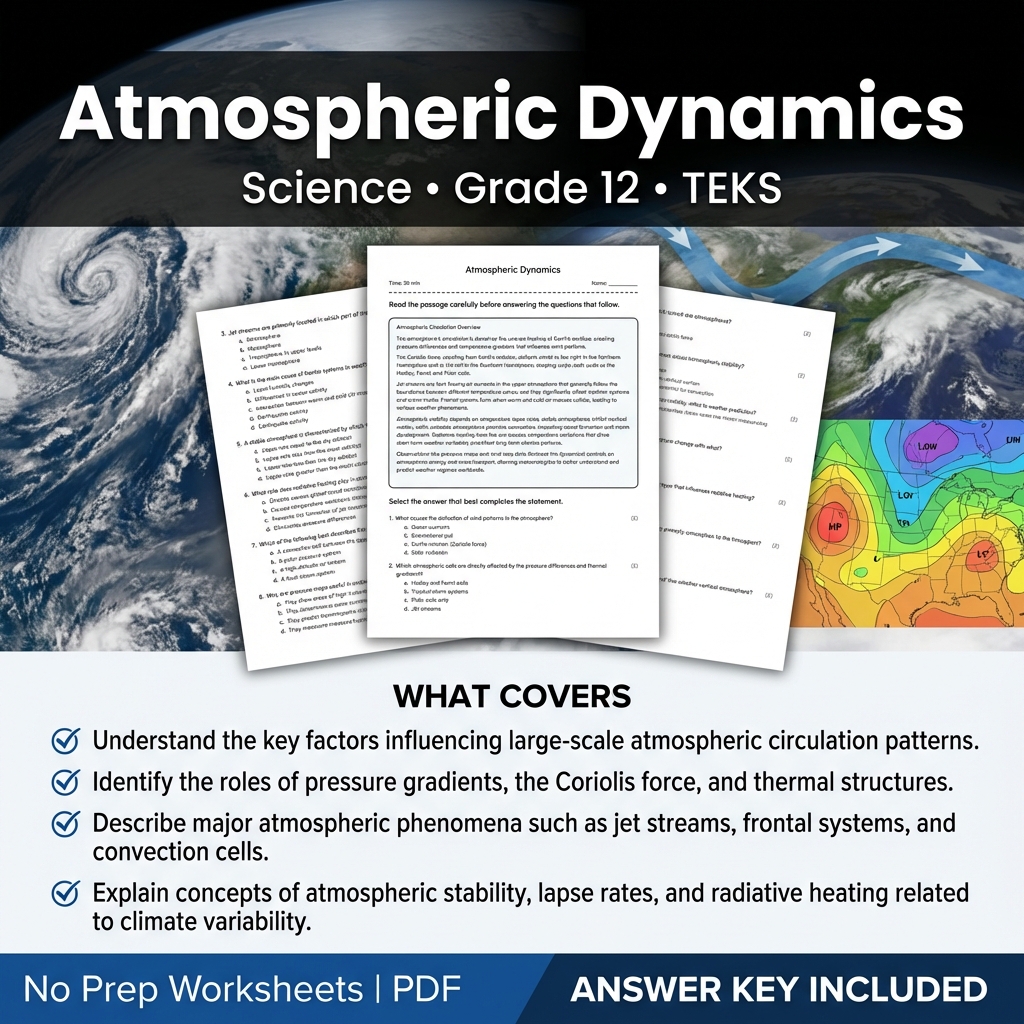
Atmospheric Dynamics Worksheet for Grade 12 Science | Standard Practice
Created byCoral Reef LearningLearning Objectives
- Understand the key factors influencing large-scale atmospheric circulation patterns.
- Identify the roles of pressure gradients, the Coriolis force, and thermal structures.
- Describe major atmospheric phenomena such as jet streams, frontal systems, and convection cells.
Instant download
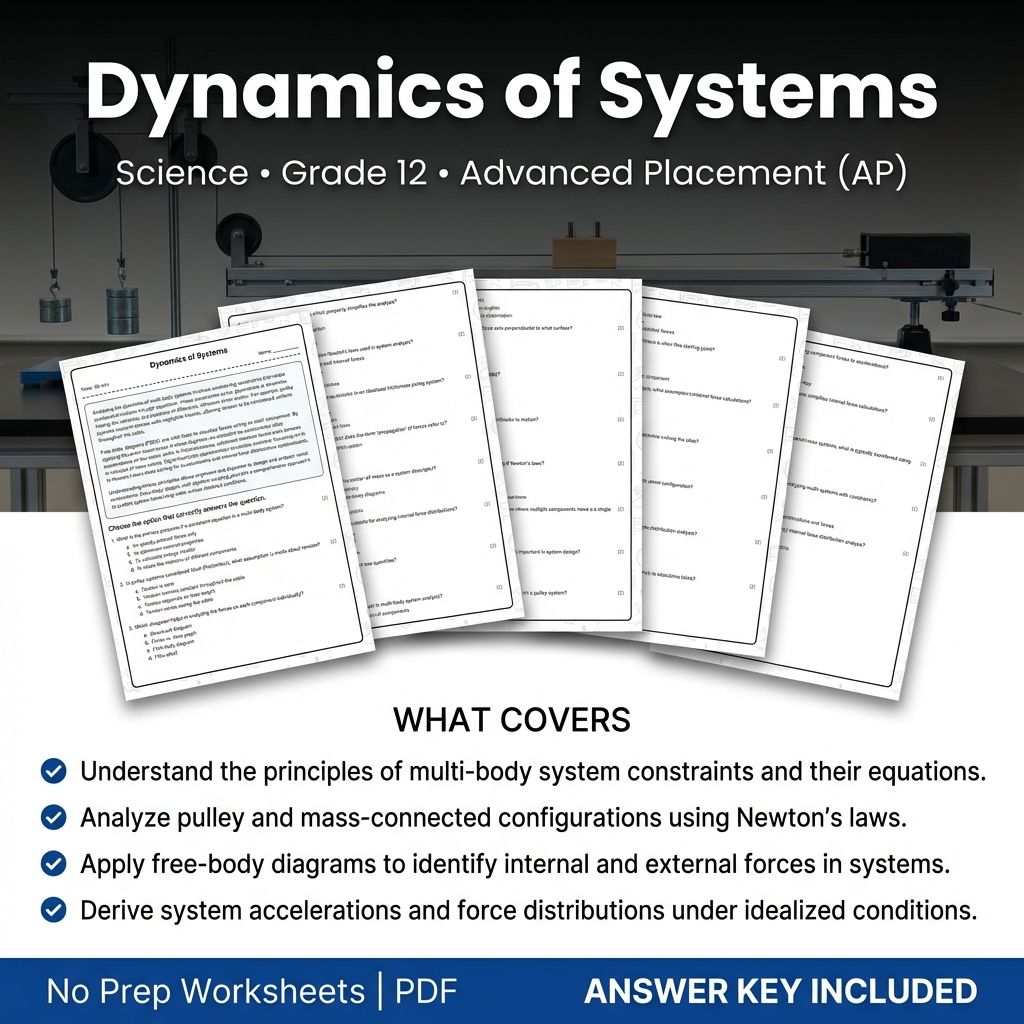
12th Grade Science | Dynamics of Systems Worksheet & Answer Key (Printable PDF)
Created byCoral Reef LearningLearning Objectives
- Understand the principles of multi-body system constraints and their equations.
- Analyze pulley and mass-connected configurations using Newton’s laws.
- Apply free-body diagrams to identify internal and external forces in systems.
Also included in: Grade 12 Science Unit Bundle – Physics Topics with Worksheets & Answer Keys +1 more
Instant download
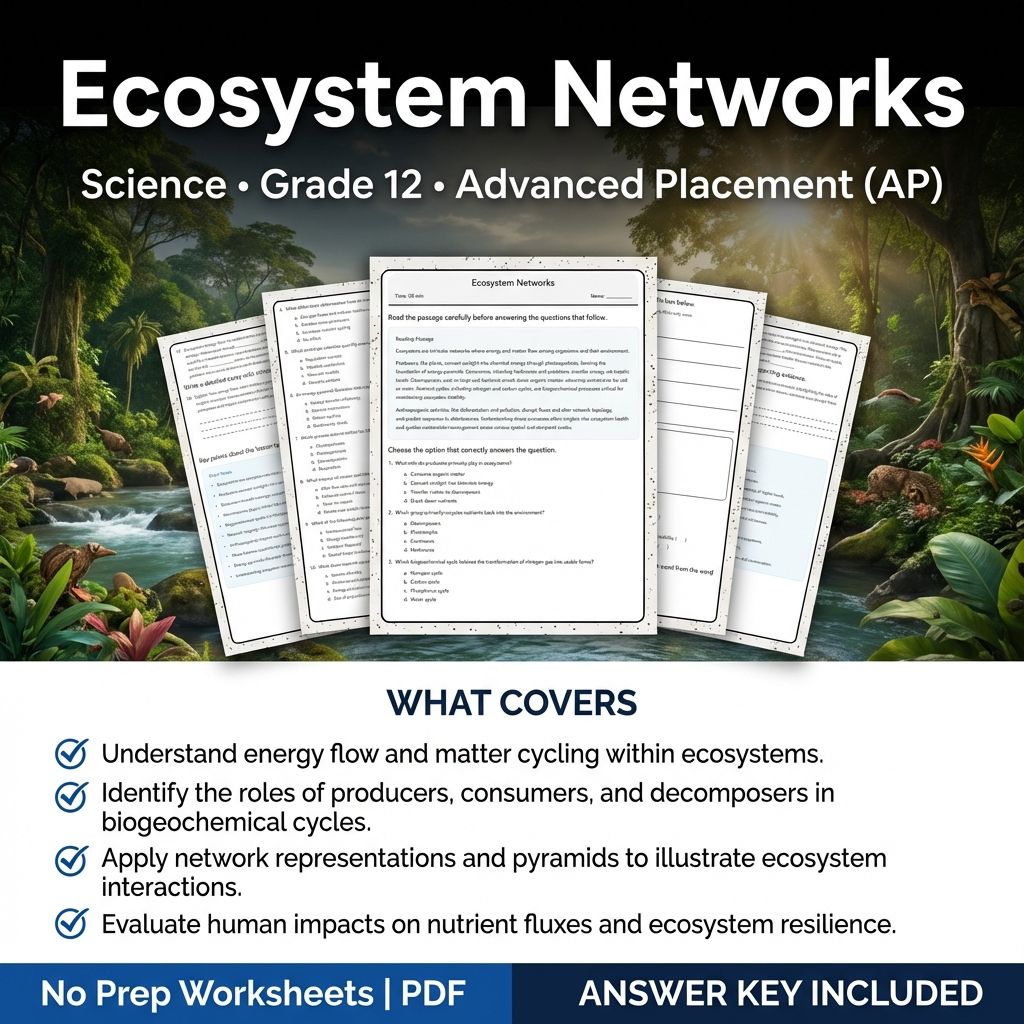
12th Grade Science | Ecosystem Networks Worksheet + Answer Key (Printable PDF)
Created byCoral Reef LearningLearning Objectives
- Understand energy flow and matter cycling within ecosystems.
- Identify the roles of producers, consumers, and decomposers in biogeochemical cycles.
- Apply network representations and pyramids to illustrate ecosystem interactions.
Also included in: Grade 12 Science Unit Worksheet Bundle – Cell Biology, Genetics & Ecology +1 more
Instant download
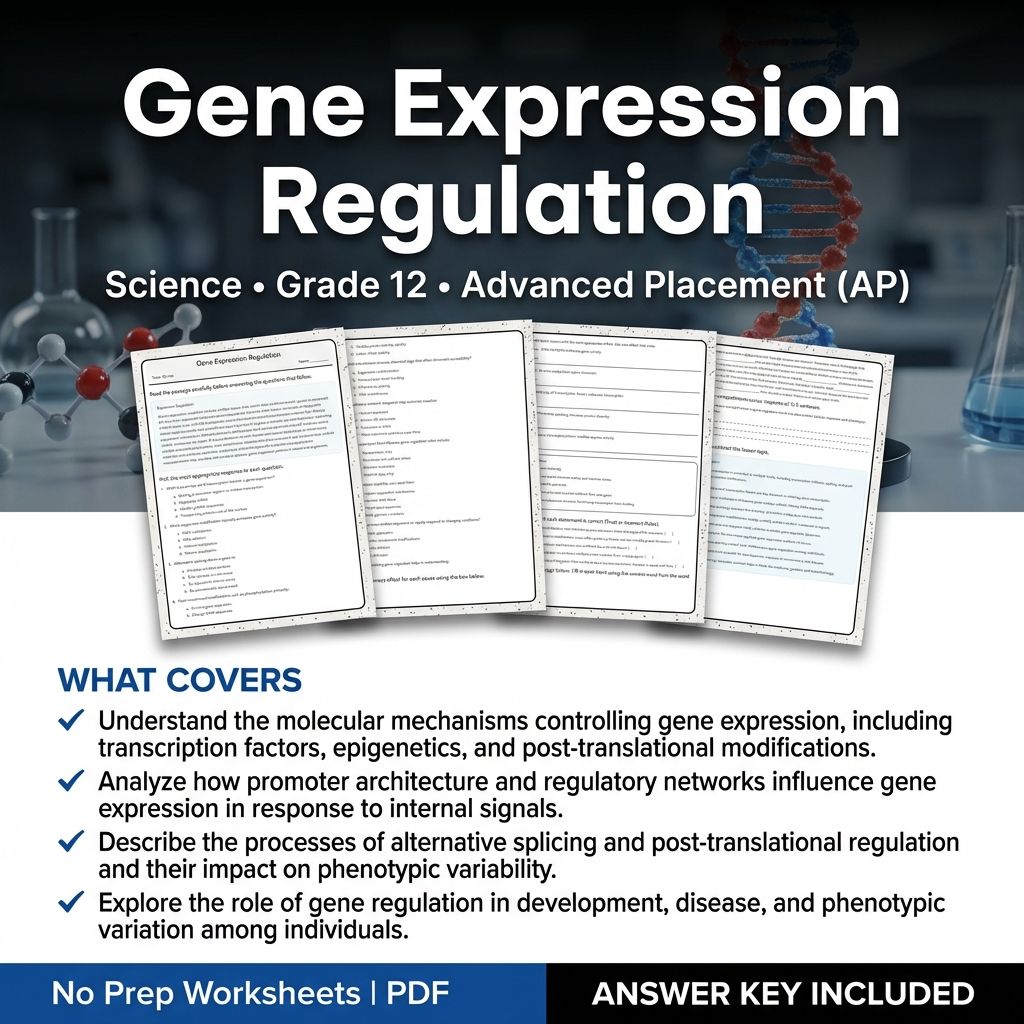
Grade 12 Science Worksheet | Gene Expression Regulation Practice & Assessment (PDF + Answer Key)
Created byCoral Reef LearningLearning Objectives
- Understand the molecular mechanisms controlling gene expression, including transcription factors, epigenetics, and post-translational modifications.
- Analyze how promoter architecture and regulatory networks influence gene expression in response to internal signals.
- Describe the processes of alternative splicing and post-translational regulation and their impact on phenotypic variability.
Also included in: Grade 12 Science Unit Worksheet Bundle – Cell Biology, Genetics & Ecology +1 more
Instant download
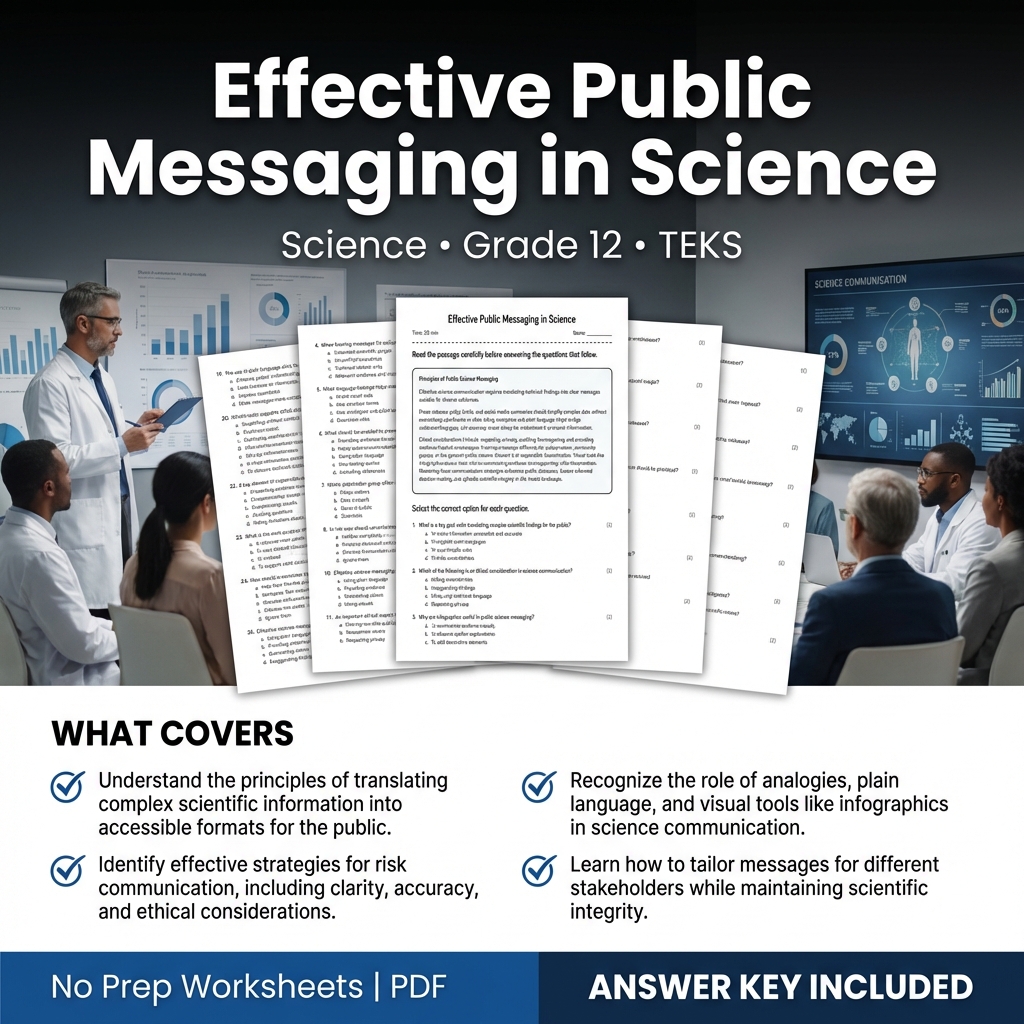
Grade 12 Science Worksheet | Effective Public Messaging in Science
Created byCoral Reef LearningLearning Objectives
- Understand the principles of translating complex scientific information into accessible formats for the public.
- Identify effective strategies for risk communication, including clarity, accuracy, and ethical considerations.
- Recognize the role of analogies, plain language, and visual tools like infographics in science communication.
Instant download
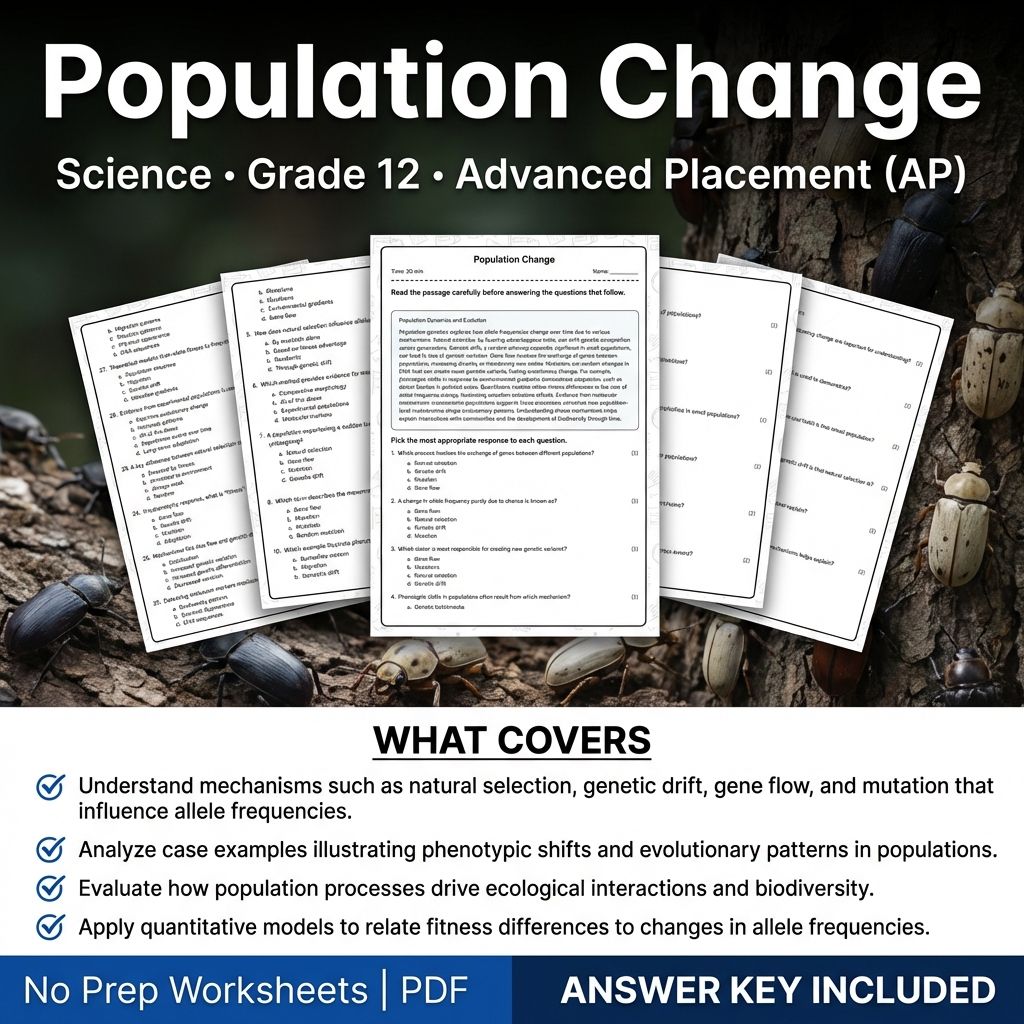
12th Grade Science | Population Change Worksheet & Answer Key (Printable PDF)
Created byCoral Reef LearningLearning Objectives
- Understand mechanisms such as natural selection, genetic drift, gene flow, and mutation that influence allele frequencies.
- Analyze case examples illustrating phenotypic shifts and evolutionary patterns in populations.
- Evaluate how population processes drive ecological interactions and biodiversity.
Also included in: Grade 12 Science Unit Worksheet Bundle – Cell Biology, Genetics & Ecology +1 more
Instant download
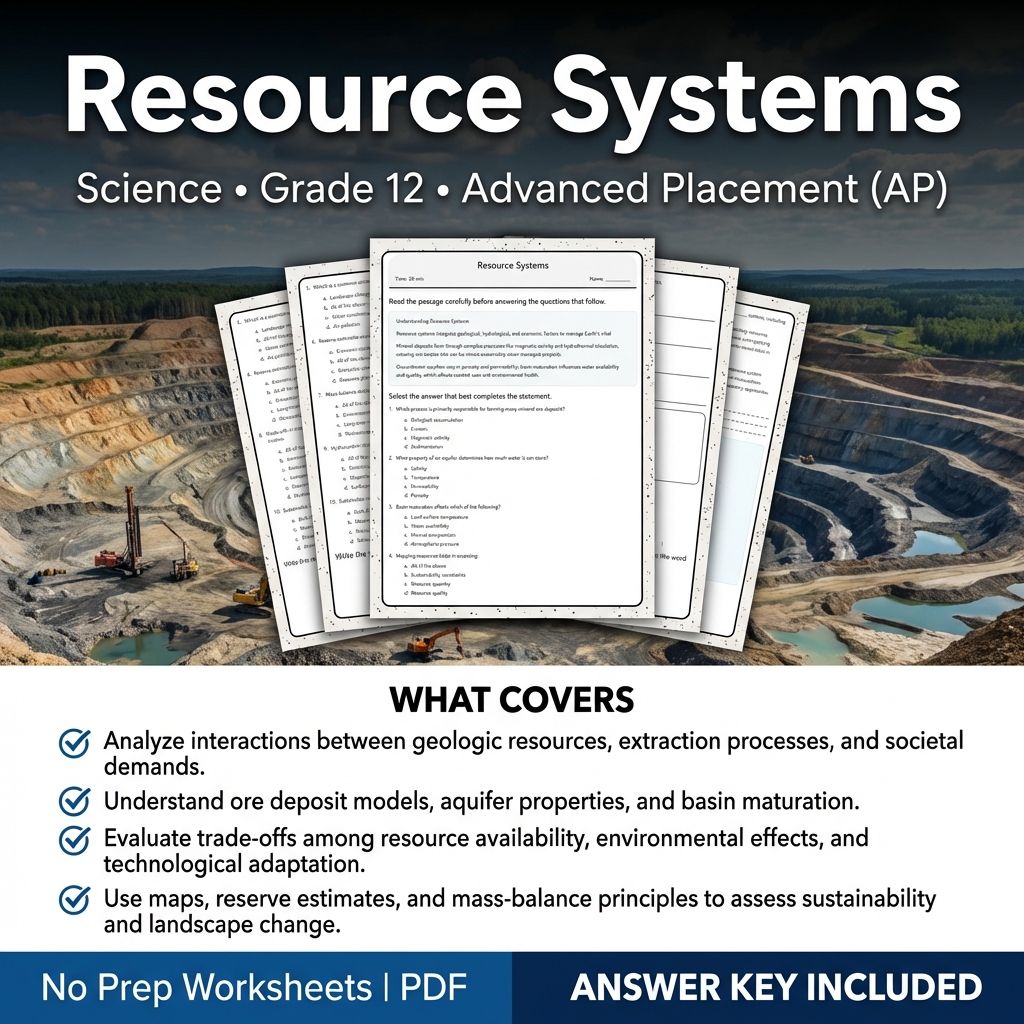
Grade 12 Science | Resource Systems Worksheet with Answer Key (Printable PDF)
Created byCoral Reef LearningLearning Objectives
- Analyze interactions between geologic resources, extraction processes, and societal demands.
- Understand ore deposit models, aquifer properties, and basin maturation.
- Evaluate trade-offs among resource availability, environmental effects, and technological adaptation.
Also included in: Grade 12 Science Unit Worksheets Pack | Earth's Systems & Surface Processes +1 more
Instant download
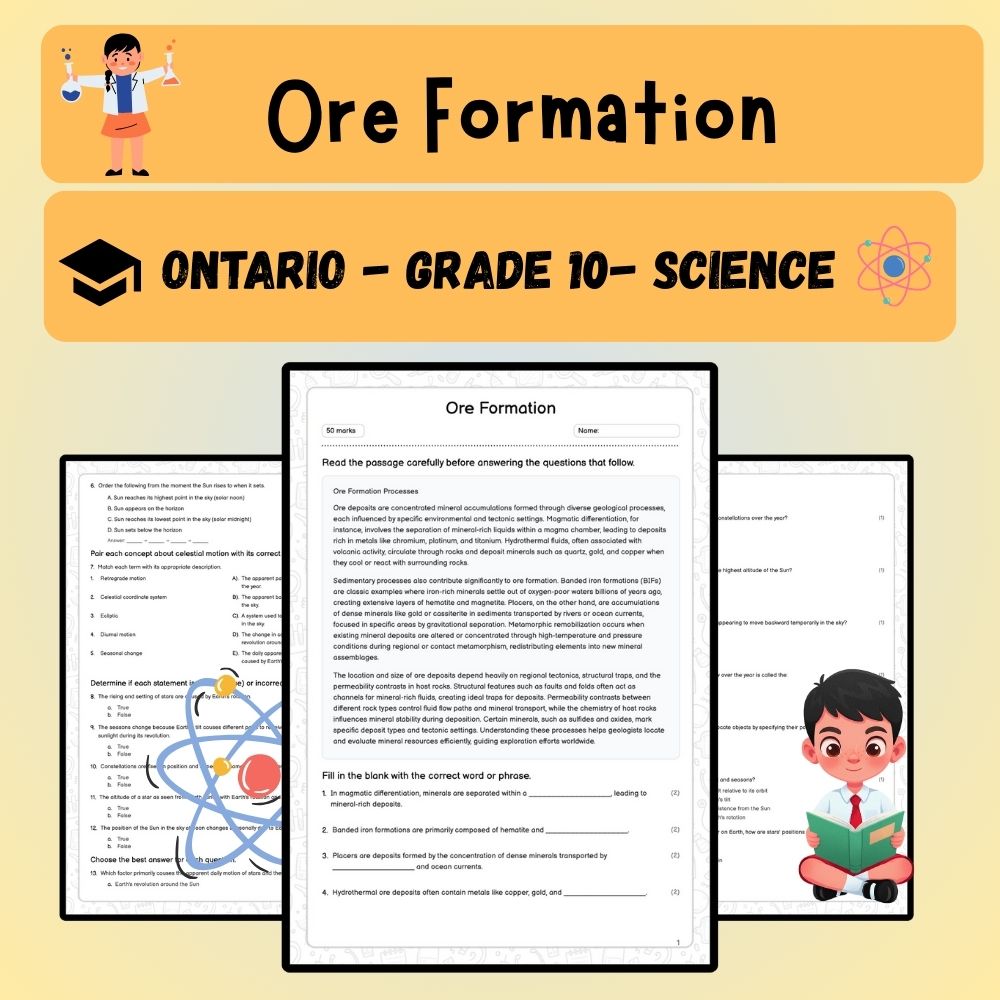
Grade 10 Science | Ore Formation Worksheet (Worksheet + Answer Key) – Ontario Standard
Created byPrism Point LearningLearning Objectives
- Describe principal ore-forming processes including magmatic differentiation, hydrothermal fluid circulation, sedimentary concentration, and metamorphic remobilization.
- Explain spatial controls such as structural traps, permeability contrasts, and host-rock chemistry in ore deposit localization.
- Identify typical mineral assemblages associated with different deposit types and tectonic settings.
Also included in: Grade 10 Science UNIT Bundle | Earth Processes & Resources Ontario Standards +1 more
Instant download
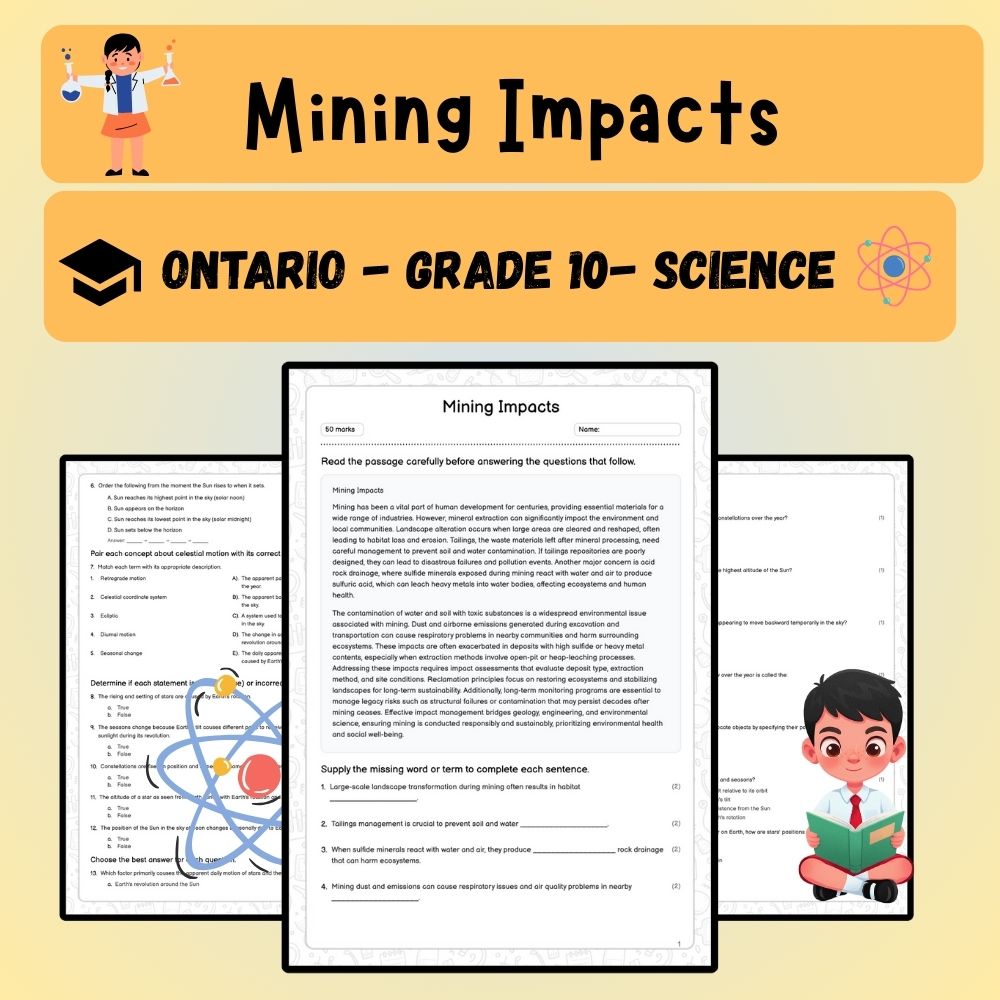
Grade 10 Science | Mining Impacts Worksheet + Answer Key – Ontario Standards (PDF)
Created byPrism Point LearningLearning Objectives
- Explain the environmental and social consequences of mineral extraction processes.
- Identify methods for impact assessment and reclamation in mining activities.
- Understand how deposit types and extraction methods influence environmental outcomes.
Also included in: Grade 10 Science UNIT Bundle | Earth Processes & Resources Ontario Standards +1 more
Instant download
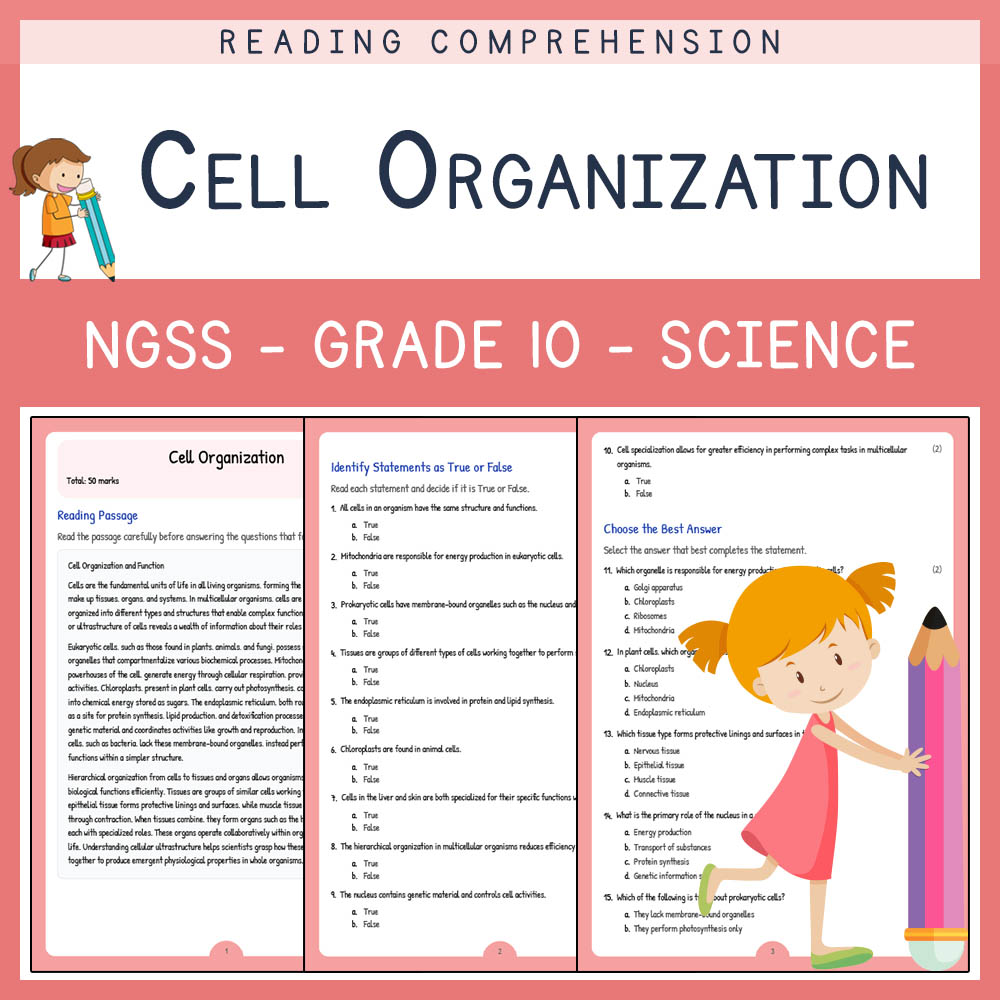
Grade 10 Science | Cell Organization Worksheet (PDF + Answer Key) NGSS-Aligned
 Created byLumora Learning
Learning Objectives
- Identify and describe the structure and function of membrane-bound organelles in eukaryotic cells.
- Compare cellular structures between eukaryotic and prokaryotic cells.
- Explain how cellular organization leads to tissue and organ function in multicellular organisms.
Instant download
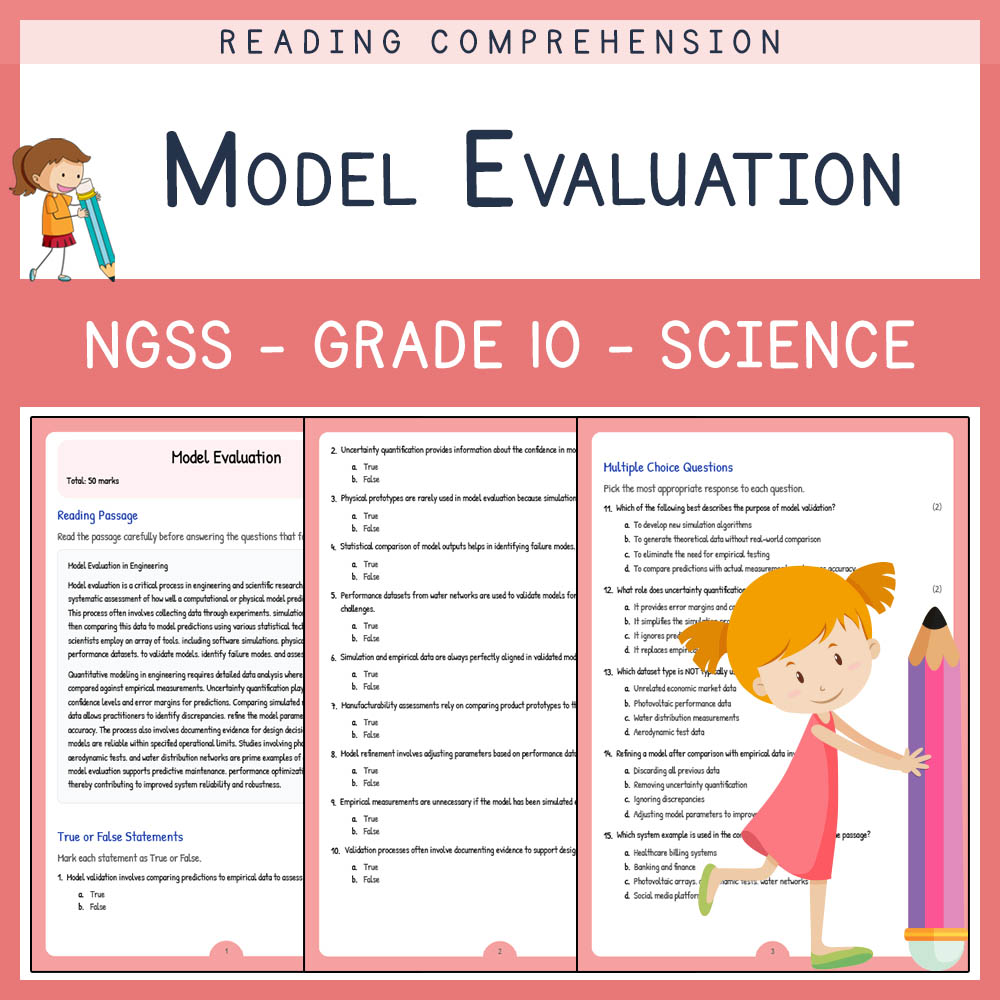
Grade 10 Science | Model Evaluation Worksheet & Answer Key NGSS Aligned (PDF)
Created byLumora LearningLearning Objectives
- Understand the principles of quantitative modeling and how to analyze prototype data.
- Learn to compare simulation results with empirical measurements for model validation.
- Apply statistical methods to assess model accuracy and quantify uncertainty.
Instant download
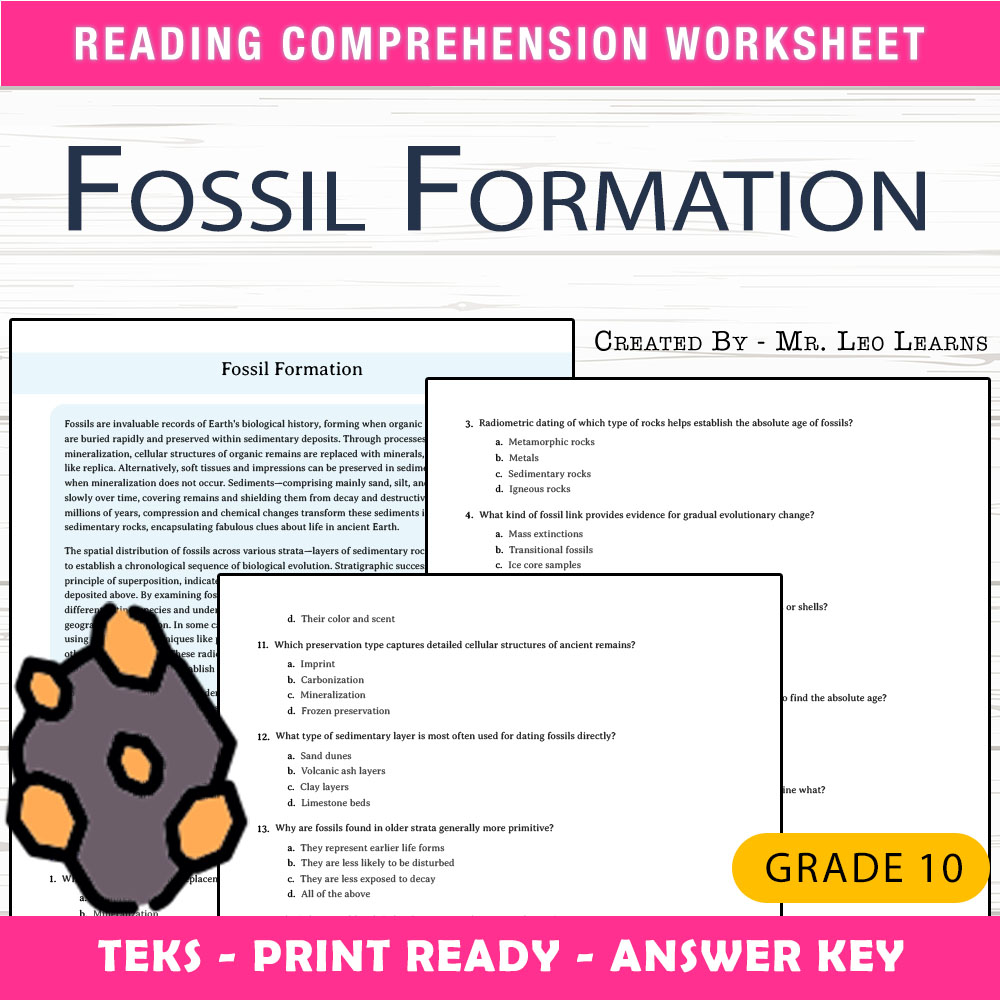
Grade 10 Science – Fossil Formation Worksheet for Mastery | PDF + Answer Key
Created byThe Resource HubLearning Objectives
- Describe the process of fossil formation including mineralization, compression, and imprint preservation.
- Explain how fossil distribution provides environmental and temporal context.
- Identify methods used to determine the age of fossils, including relative and radiometric dating.
Also included in: Grade 10 Science | Evolution & Heredity Worksheet Bundle (Mastery Skills Pack) +2 more
Instant download
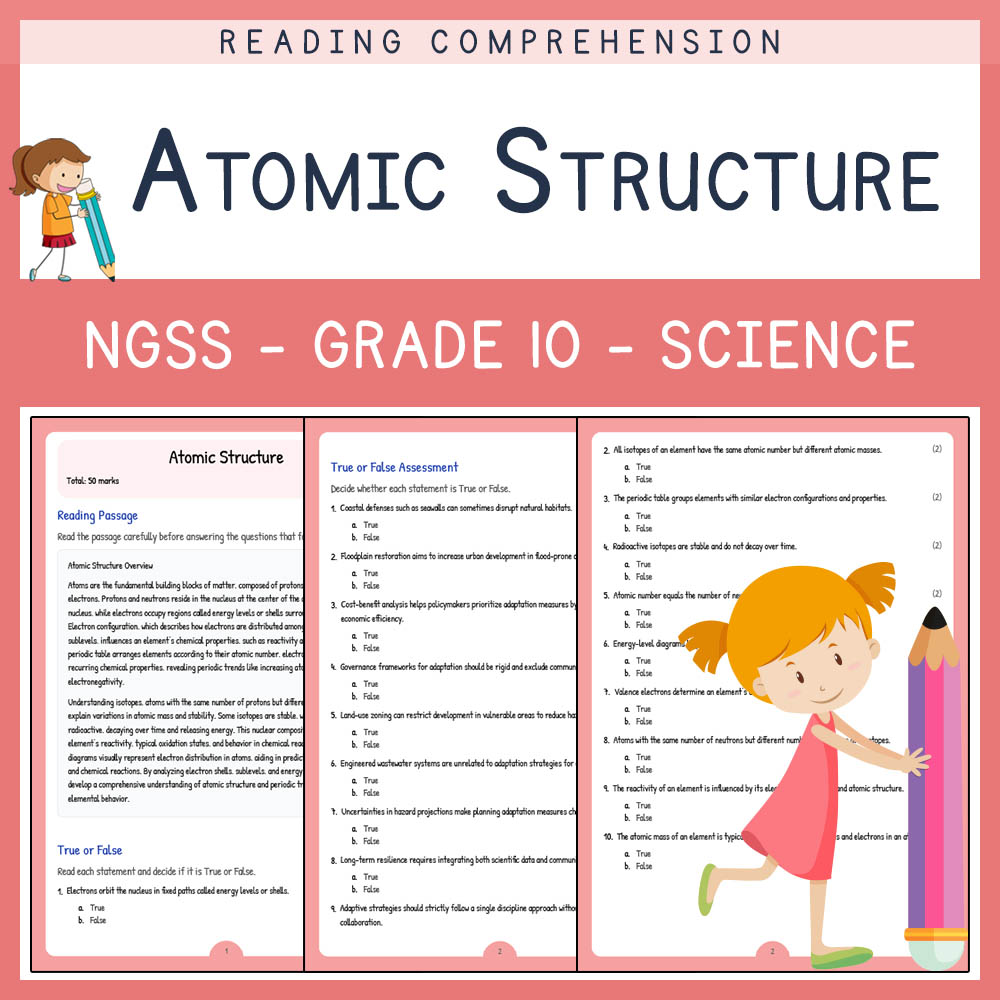
Grade S10 cience | Atomic Structure Worksheet & Answer Key (PDF)
Created byLumora LearningLearning Objectives
- Understand the electron configuration and how it relates to periodic trends and elemental properties.
- Interpret energy-level diagrams, electron shells, and sublevel occupancy to analyze atomic behaviors.
- Explain the relationship between isotopes, atomic mass, and reactivity.
Instant download
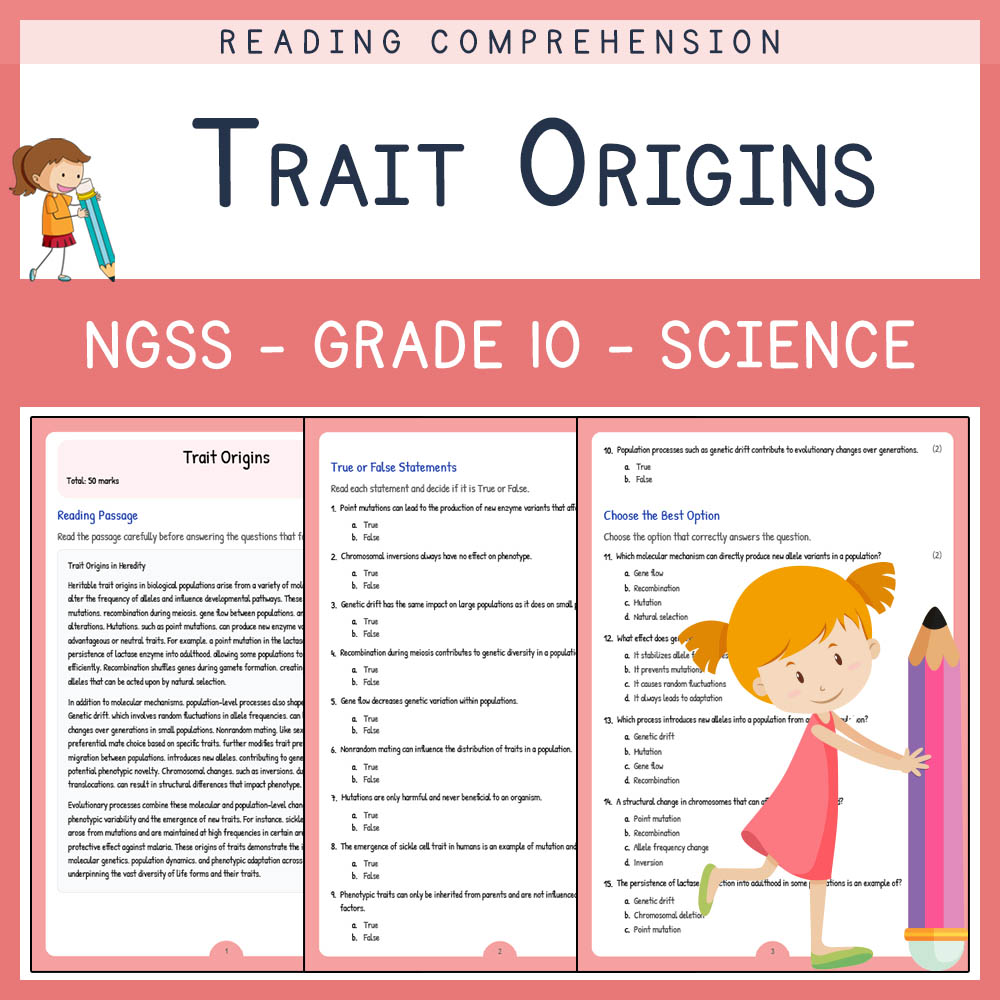
Grade 10 Science | Trait Origins Worksheet & Answer Key – NGSS Aligned
Created byLumora LearningLearning Objectives
- Explain how heritable traits originate from molecular mechanisms such as mutation, recombination, gene flow, and chromosomal changes.
- Identify various processes that modify trait distributions at the population level, including genetic drift and nonrandom mating.
- Connect molecular changes to observable phenotypic variations and understand their impact across generations.
Instant download
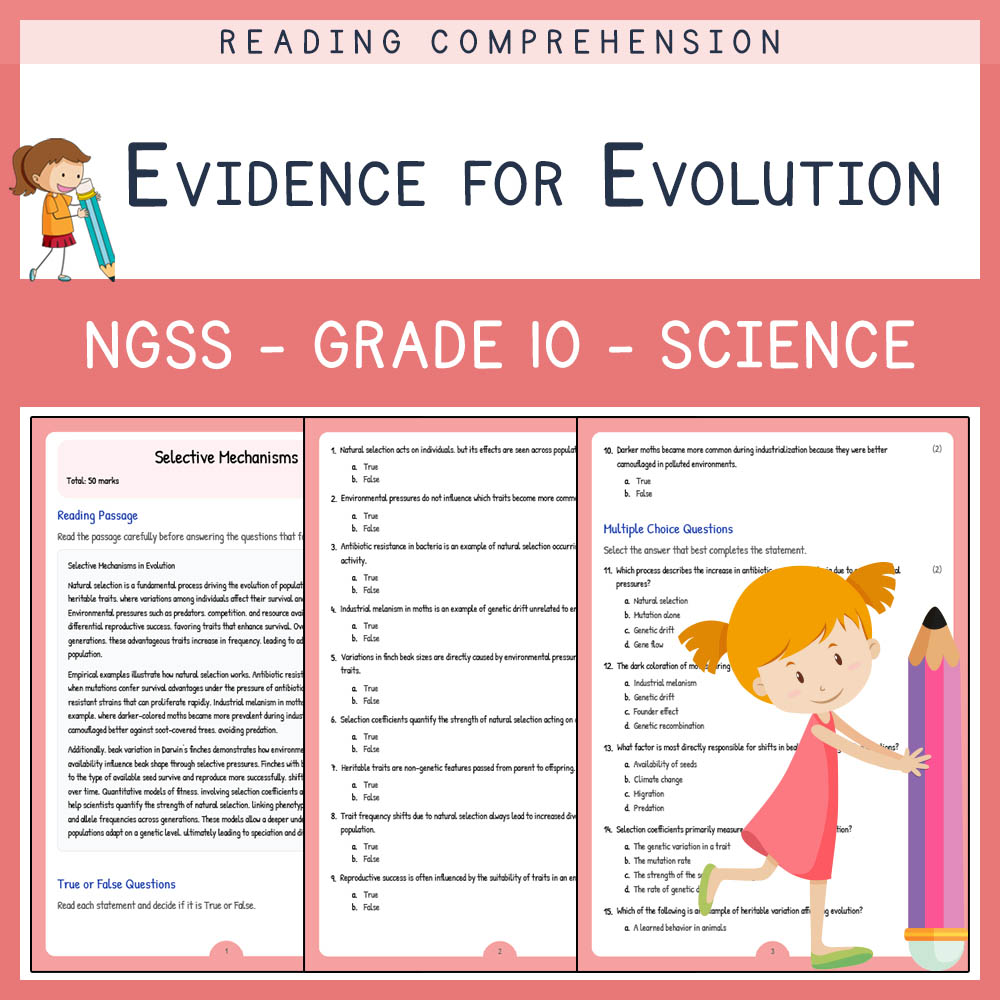
Grade 10 Science | Selective Mechanisms Worksheet (NGSS-Aligned + Answer Key)
Created byLumora LearningLearning Objectives
- Understand how natural selection causes populations to adapt through heritable trait variation.
- Identify real-world examples of natural selection such as antibiotic resistance, industrial melanism, and beak variation.
- Explain how environmental pressures influence reproductive success and trait frequency changes.
Instant download
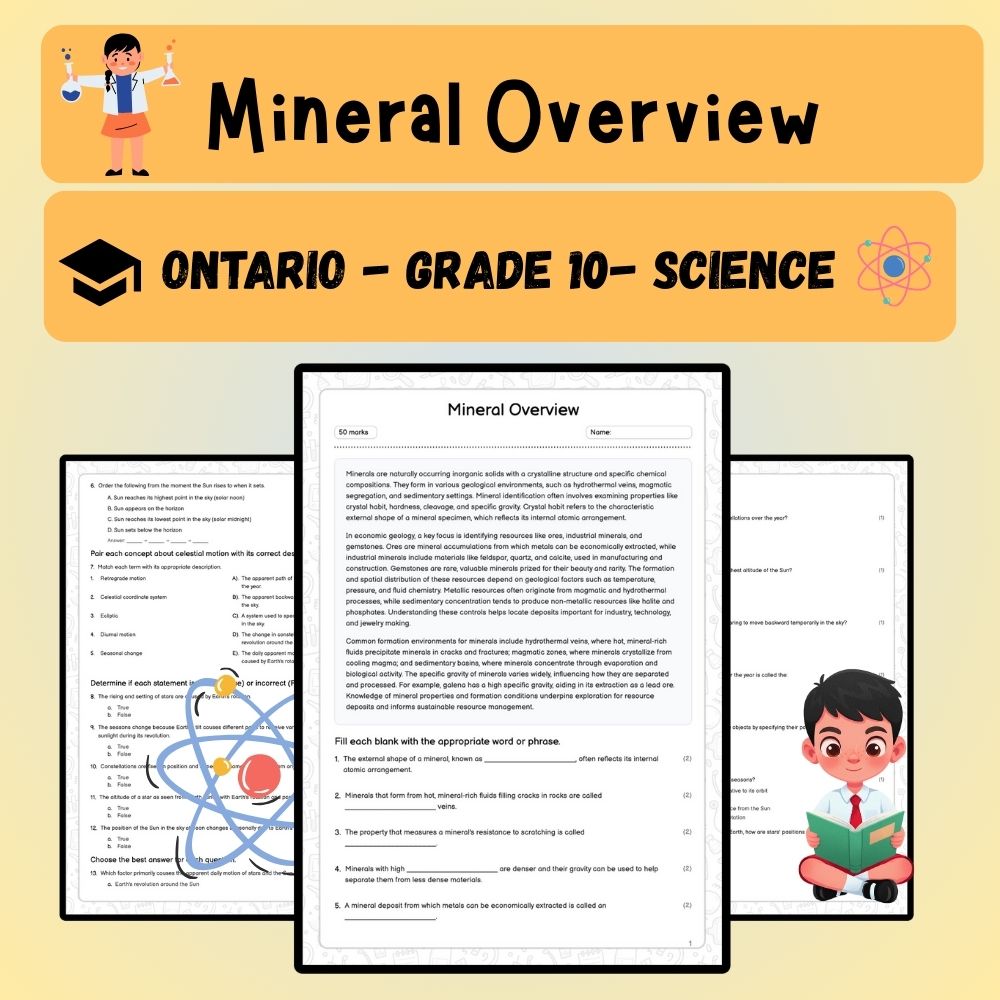
Grade 10 Science | Mineral Overview Worksheet (PDF) – Ontario Standards
Created byPrism Point LearningLearning Objectives
- Understand the classification and properties of minerals used in geology and industry.
- Identify different formation settings and their associated mineral resources.
- Differentiate between ores, industrial minerals, and gemstones based on their properties and uses.
Also included in: Grade 10 Science UNIT Bundle | Earth Processes & Resources Ontario Standards +1 more
Instant download
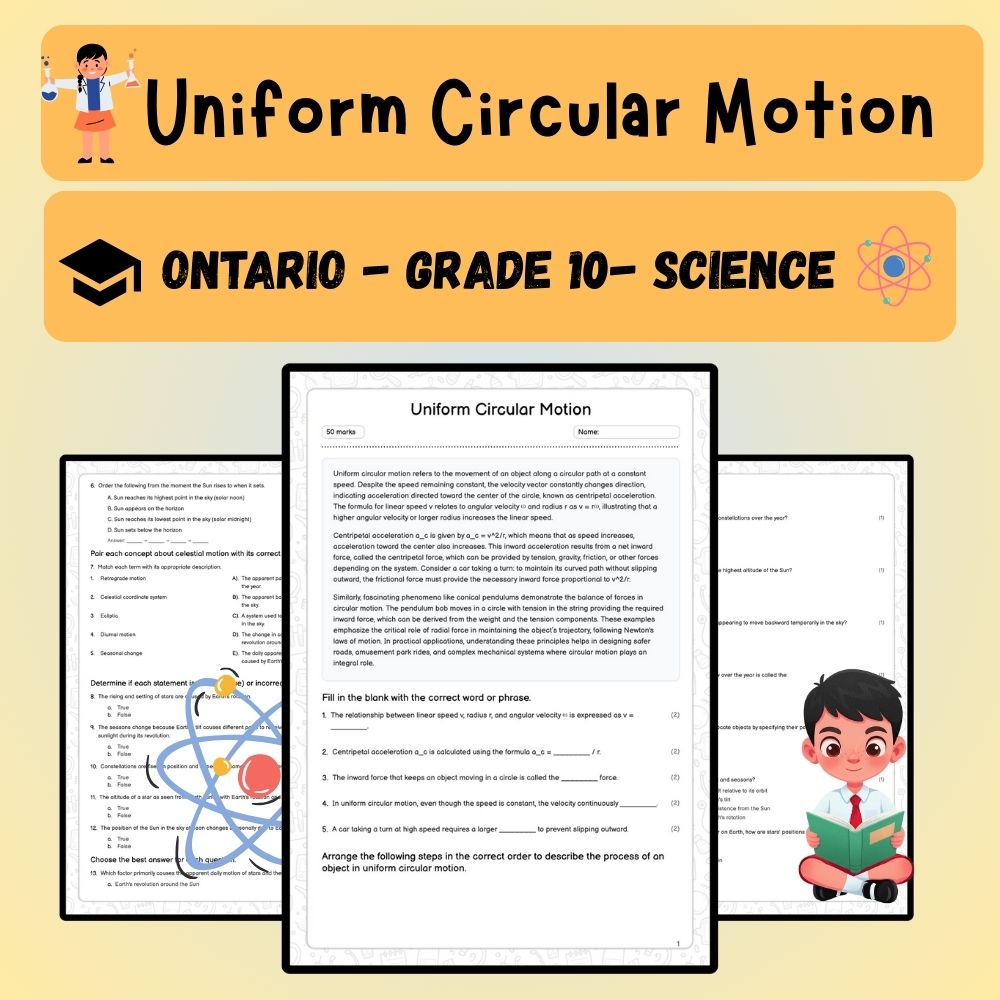
Grade 10 Science | Uniform Circular Motion Worksheet (PDF) for Ontario Standards
Created byPrism Point LearningLearning Objectives
- Explain the relationship between linear speed, angular velocity, and radius in uniform circular motion.
- Describe how centripetal acceleration depends on velocity and radius.
- Apply the formulas v = rω and a_c = v^2/r to solve problems involving circular motion.
Also included in: Grade 10 Science Unit Bundle | Motion, Forces & Mechanics Worksheets (Ontario Standards) +1 more
Instant download
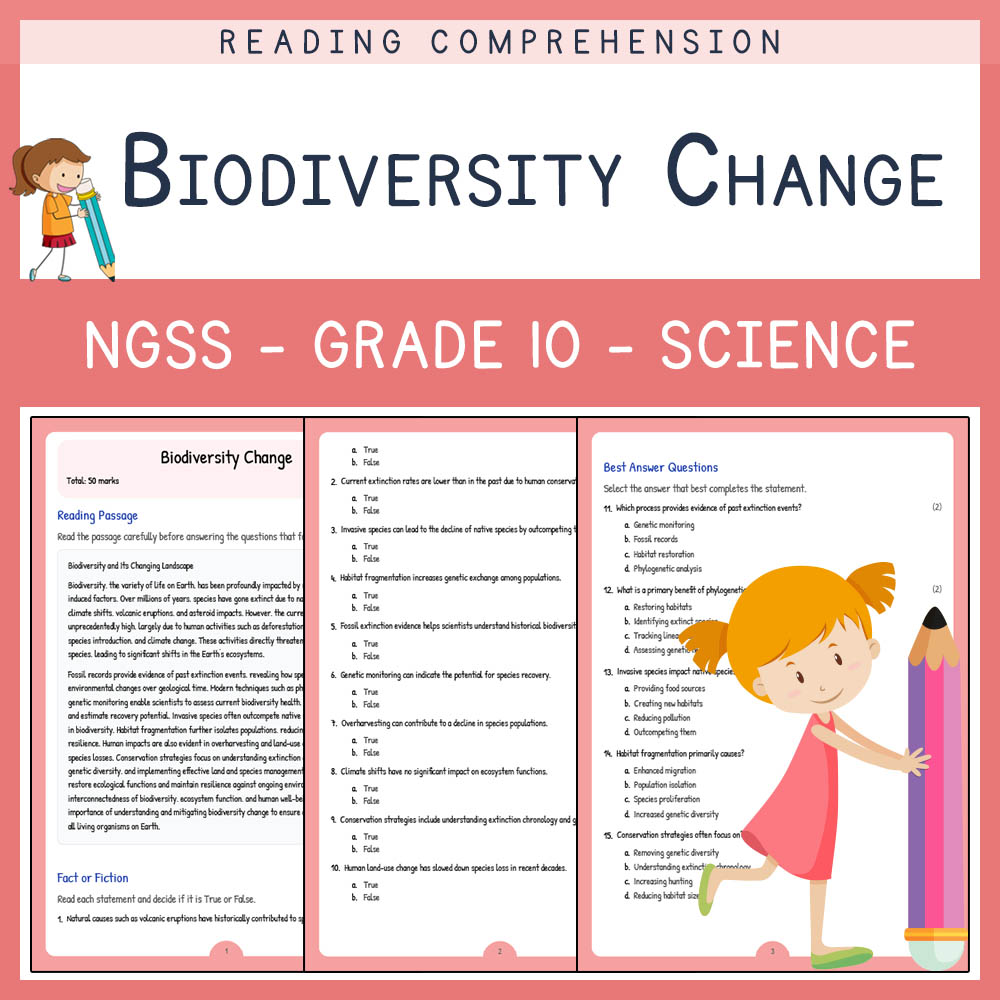
Grade 10 Science | Biodiversity Change Worksheet & Answer Key aligned with NGSS (PDF)
Created byLumora LearningLearning Objectives
- Understand the factors contributing to biodiversity loss, including fossil extinctions, invasive species, and habitat fragmentation.
- Analyze how human actions impact genetic diversity and ecosystem resilience.
- Evaluate conservation strategies and interpret evidence from fossil records and population monitoring.
Instant download
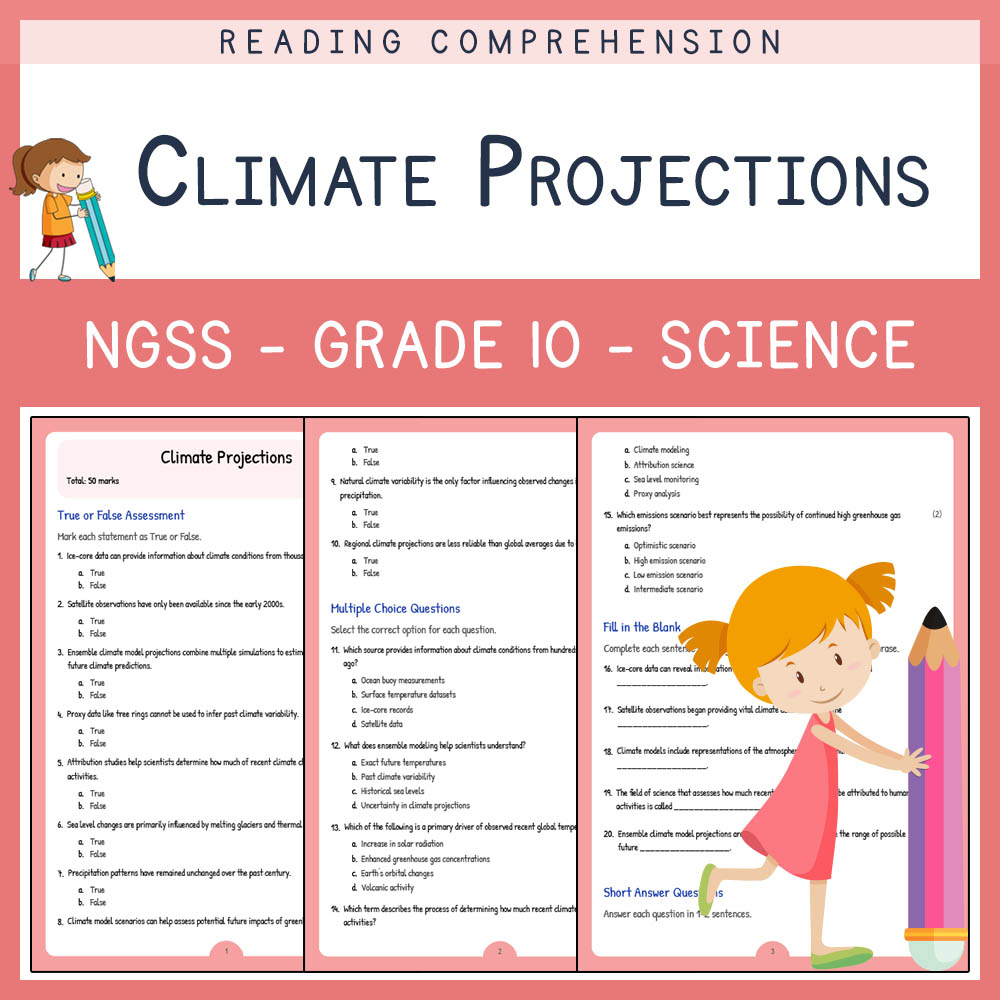
Grade 10 Science | Climate Projections Worksheet + Answer Key (NGSS-Aligned)
Created byLumora LearningLearning Objectives
- Understand methods used to analyze historical climate data and model outputs.
- Interpret trends and variability in global and regional temperature, precipitation, and sea level.
- Evaluate the sources of uncertainty in climate projections and their implications for future planning.
Instant download
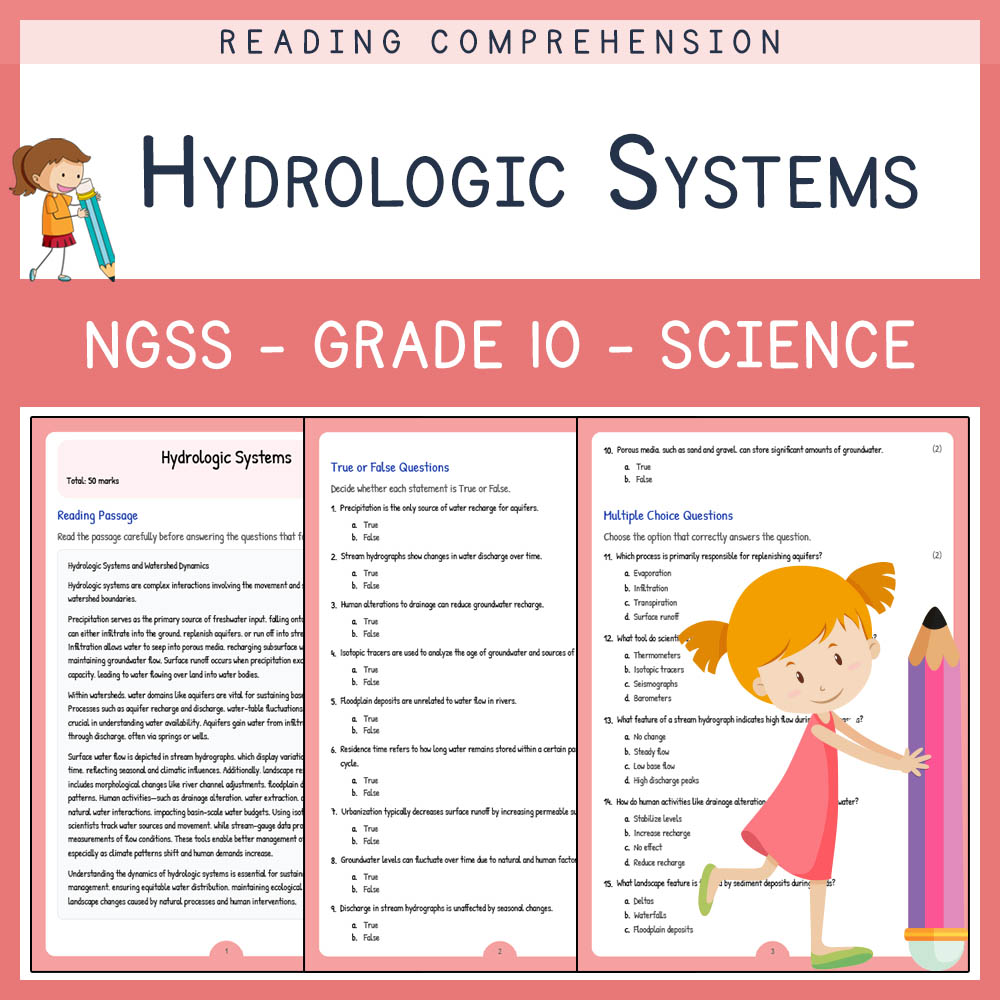
Grade 10 Science | Hydrologic Systems Worksheet (PDF + Answer Key) NGSS Aligned
Created byLumora LearningLearning Objectives
- Understand the key components and processes of hydrologic systems within watersheds.
- Analyze interactions among precipitation, surface runoff, infiltration, and groundwater in landscape responses.
- Evaluate the effects of human alterations on water budgets and river morphology.
Instant download
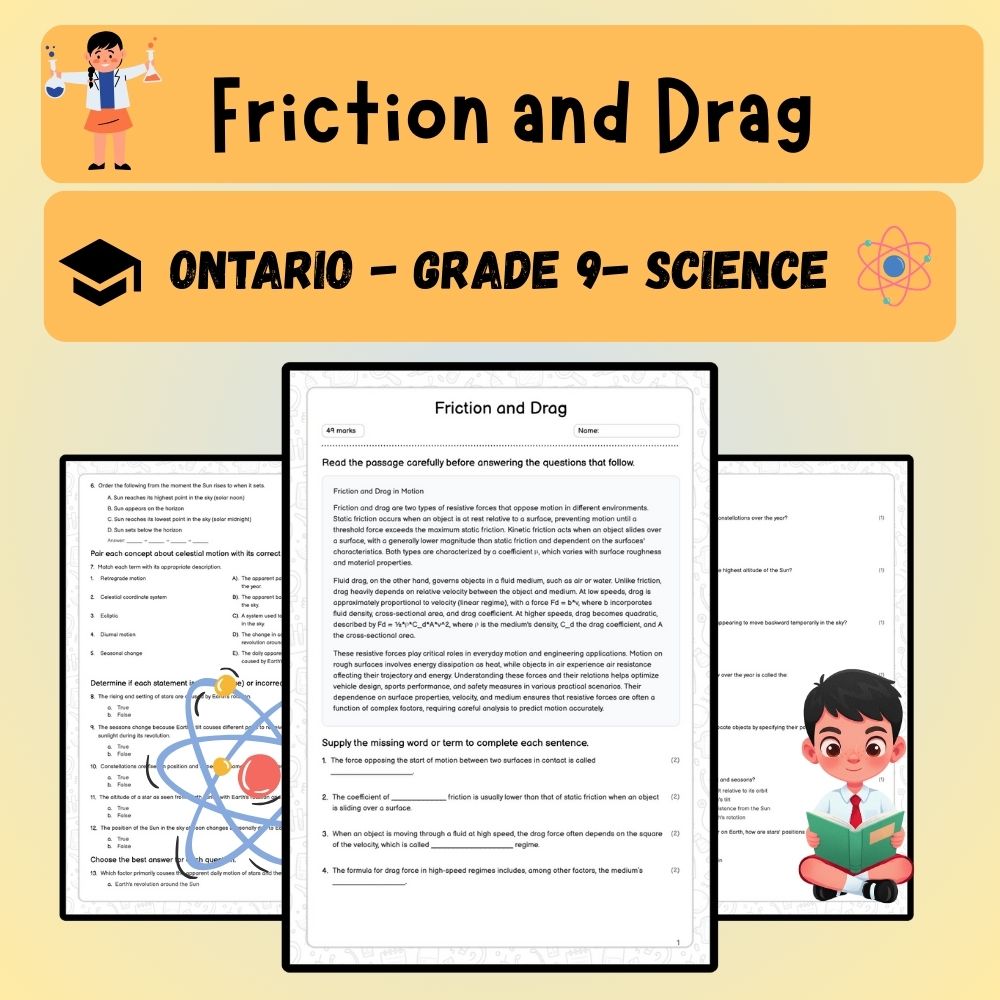
Grade 9 Science | Friction and Drag Worksheet (PDF) – Ontario Standards
Created byPrism Point LearningLearning Objectives
- Explain the differences between static and kinetic friction, including their dependence on surface properties and relative motion.
- Describe how fluid drag depends on velocity, cross-sectional area, and medium density, contrasting low-speed linear and high-speed quadratic regimes.
- Apply formulas involving frictional coefficients and drag dependencies to analyze real-world motion scenarios.
Also included in: Grade 9 Science Unit | Forces, Motion & Energy Worksheets (Ontario Standards) +1 more
Instant download
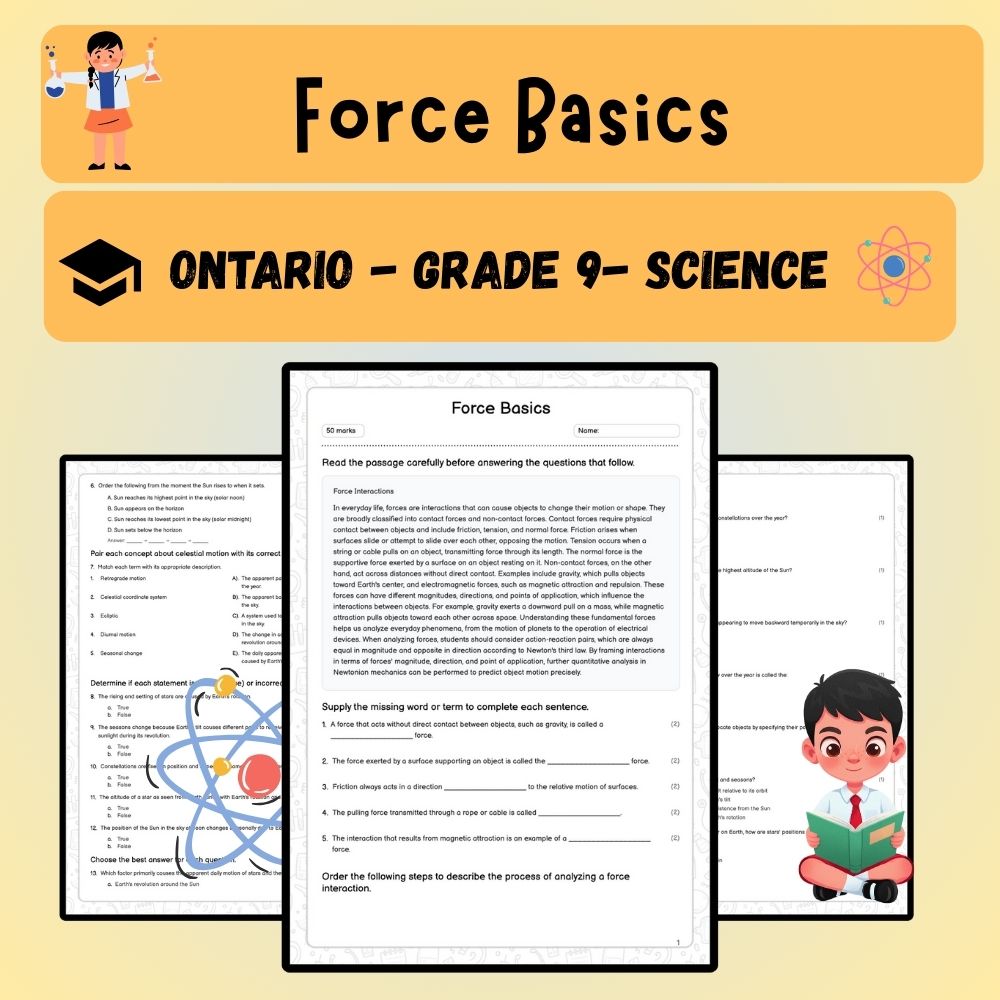
Grade 9 Science – Force Basics Worksheet (Answer Key) | Ontario Standard
Created byPrism Point LearningLearning Objectives
- Distinguish between contact and non-contact forces with examples.
- Describe the characteristics of forces including magnitude, direction, and point of application.
- Identify action-reaction pairs in various force interactions.
Also included in: Grade 9 Science Unit | Forces, Motion & Energy Worksheets (Ontario Standards) +1 more
Instant download
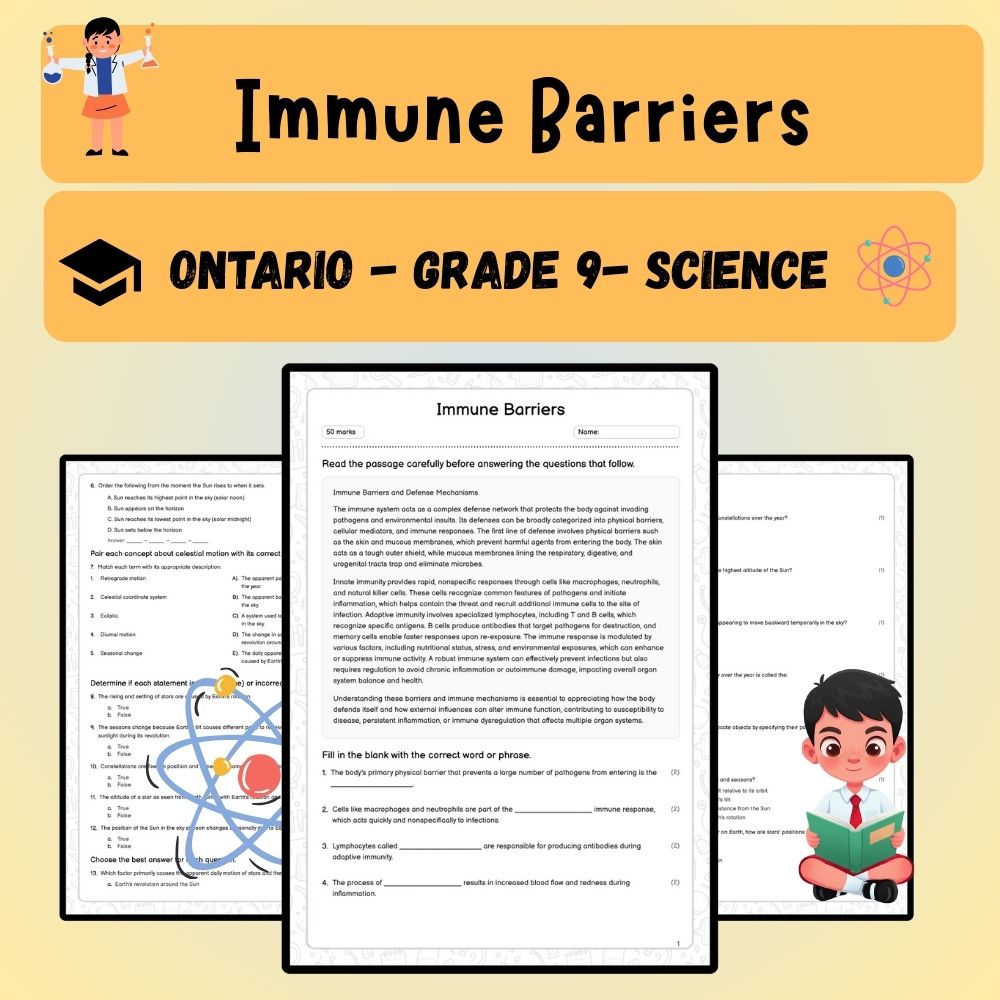
Grade 9 Science | Immune Barriers Worksheet (Answer Key) – Ontario Standards
Created byPrism Point LearningLearning Objectives
- Understand the different physical and cellular barriers of the immune system.
- Identify how innate and adaptive immune defenses function to protect against pathogens.
- Describe mechanisms such as inflammation and memory formation in immunity.
Also included in: Grade 9 Science Unit Bundle | Human Body Systems & Cell Functions +1 more
Instant download
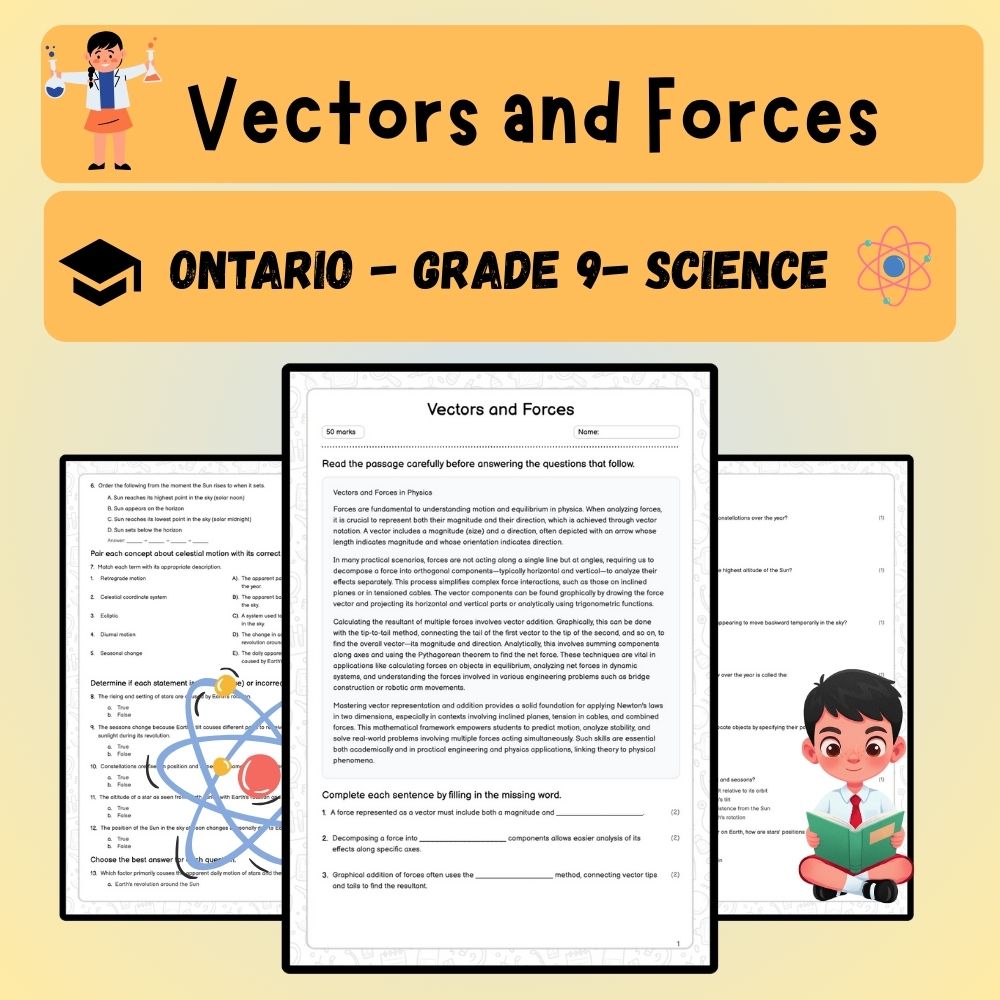
Grade 9 Science Vectors and Forces Worksheet – Ontario Standards (PDF)
Created byPrism Point LearningLearning Objectives
- Understand the representation of forces as vectors including magnitude and direction.
- Learn to resolve forces into components and calculate resultant vectors graphically and analytically.
- Apply the principles of vector addition to real-world force interactions such as inclined planes and cable tensions.
Also included in: Grade 9 Science Unit | Forces, Motion & Energy Worksheets (Ontario Standards) +1 more
Instant download
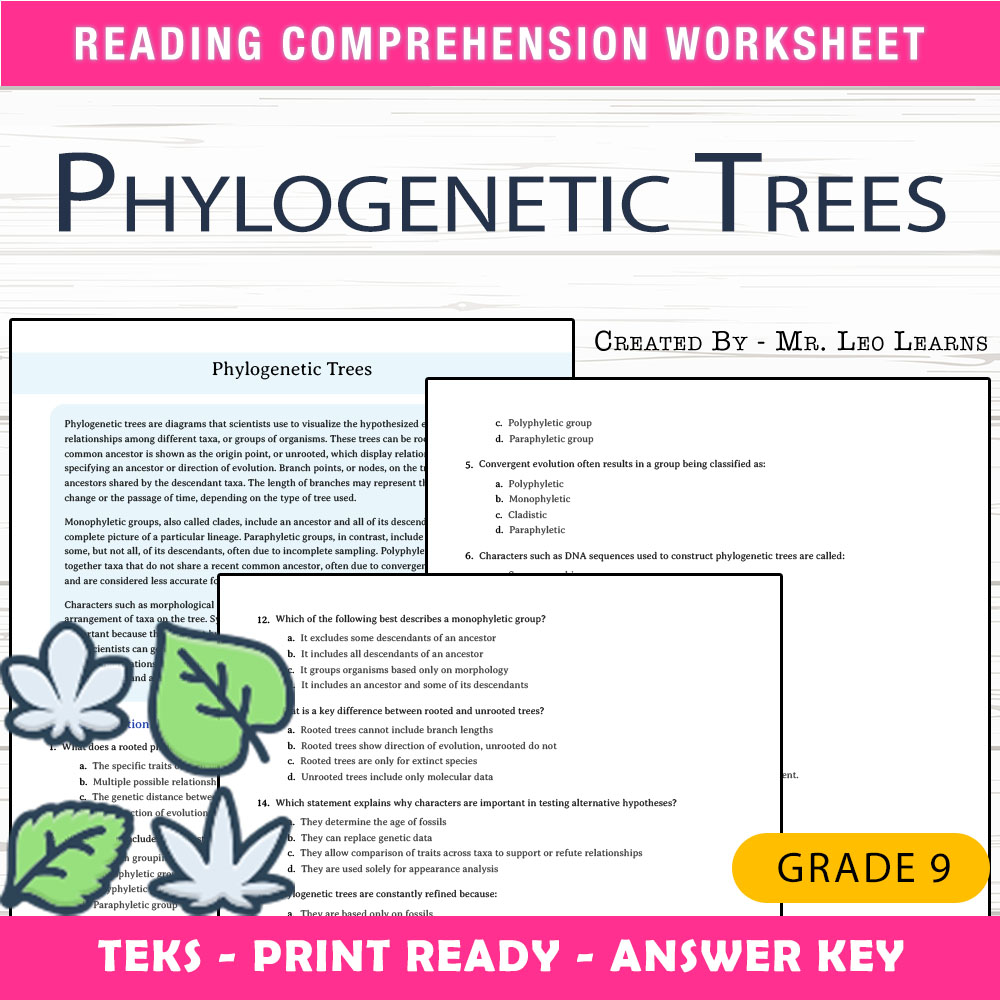
Grade 9 Science – Phylogenetic Trees Worksheet for Mastering Evolution
Created byThe Resource HubLearning Objectives
- Understand how phylogenetic trees depict evolutionary relationships among taxa.
- Identify features of rooted and unrooted trees and their interpretations.
- Explain the significance of monophyletic, paraphyletic, and polyphyletic groups.
Also included in: Grade 9 Science Evolution & Classification Unit Worksheet Pack +1 more
Instant download
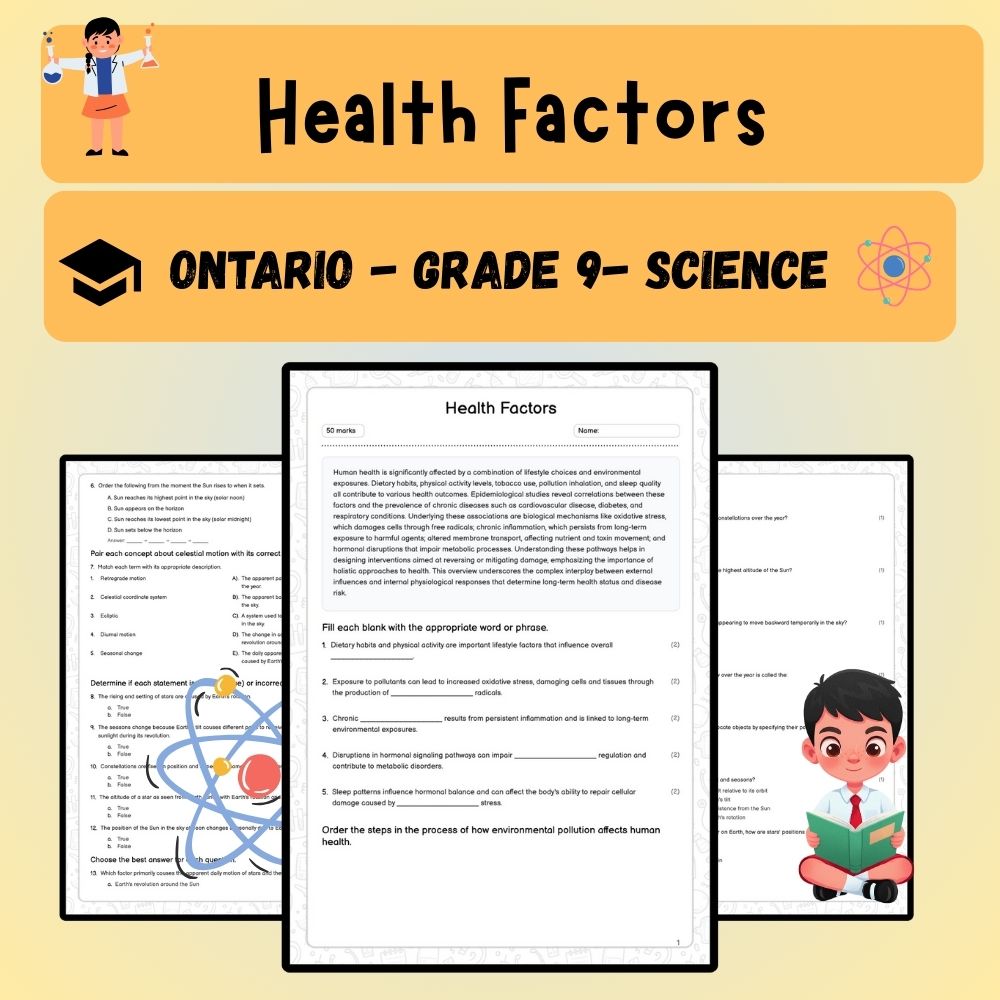
Grade 9 Science | Health Factors Worksheet (PDF) – Ontario Standards
Created byPrism Point LearningLearning Objectives
- Understand how lifestyle and environmental factors influence human health.
- Identify mechanisms like oxidative stress and inflammation that relate to chronic conditions.
- Interpret epidemiological data to discern causation from correlation.
Also included in: Grade 9 Science Unit Bundle | Human Body Systems & Cell Functions +1 more
Instant download
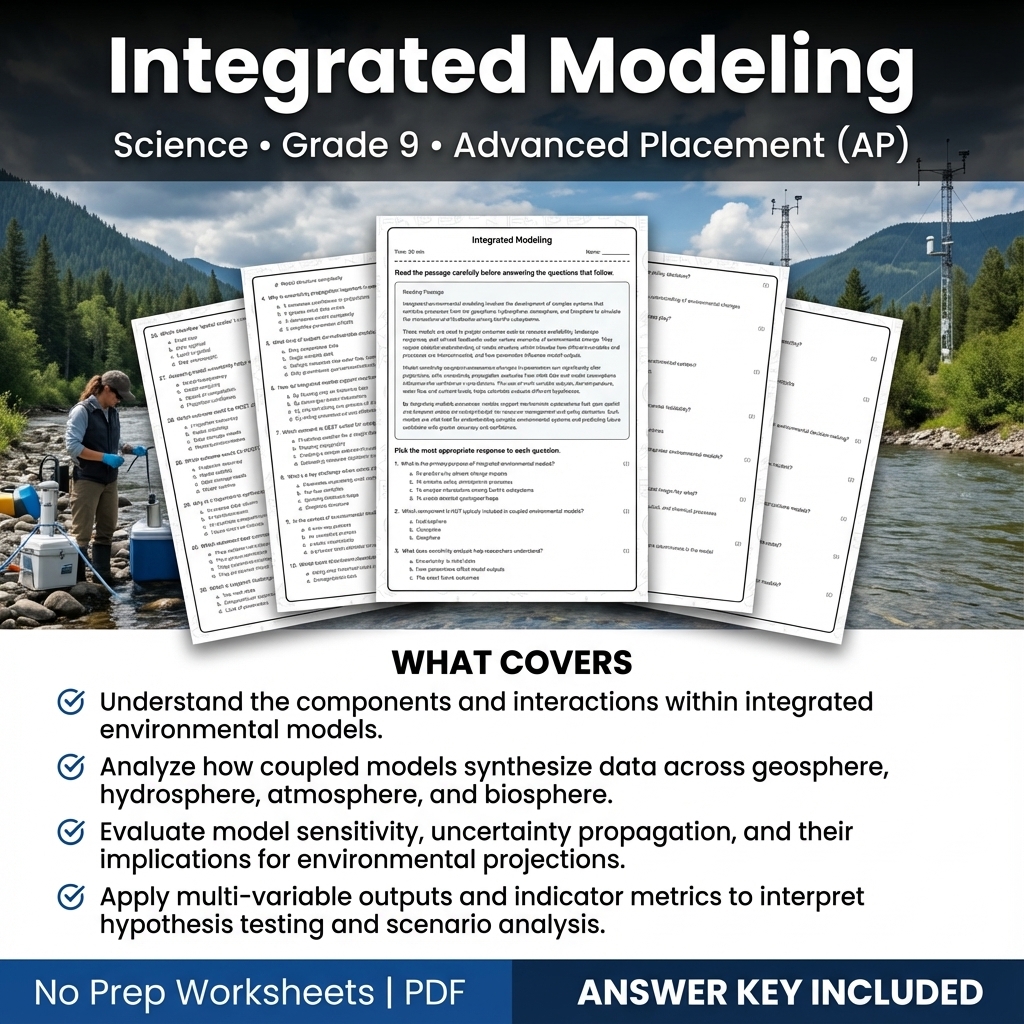
Grade 9 Science | Integrated Modeling Worksheet (Printable PDF + Answer Key)
Created byCoral Reef LearningLearning Objectives
- Understand the components and interactions within integrated environmental models.
- Analyze how coupled models synthesize data across geosphere, hydrosphere, atmosphere, and biosphere.
- Evaluate model sensitivity, uncertainty propagation, and their implications for environmental projections.
Also included in: Grade 9 Science Unit | Earth Processes & Climate Worksheets Pack (PDF & Answer Keys) +2 more
Instant download
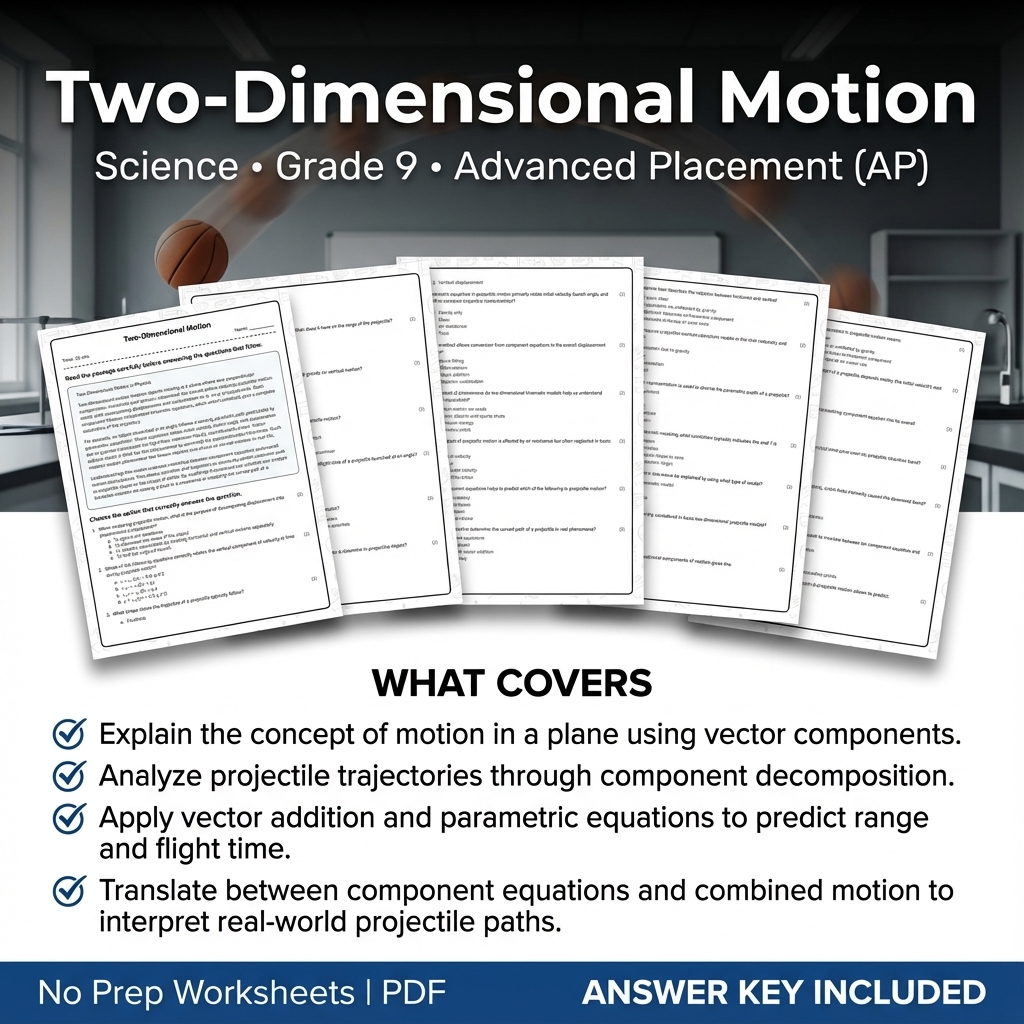
Grade 9 Science | Two-Dimensional Motion Worksheet (Printable PDF + Answer Key)
Created byCoral Reef LearningLearning Objectives
- Explain the concept of motion in a plane using vector components.
- Analyze projectile trajectories through component decomposition.
- Apply vector addition and parametric equations to predict range and flight time.
Also included in: Grade 9 Science Unit Bundle – Motion & Force Worksheets with Answer Keys +2 more
Instant download
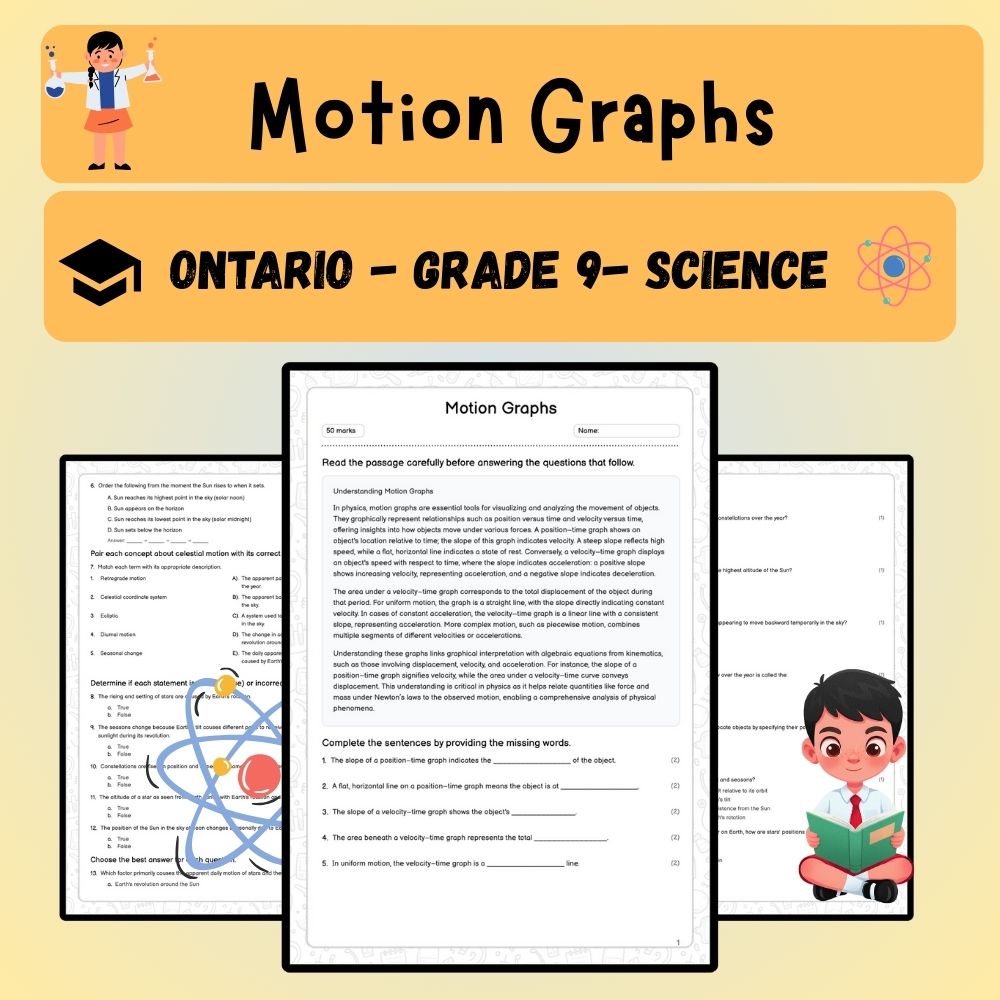
Grade 9 Science | Motion Graphs Worksheet (Answer Key) – Ontario Standards
Created byPrism Point LearningLearning Objectives
- Interpret position–time and velocity–time graphs in various motion scenarios.
- Understand how the slope of position–time graphs indicates velocity, and how the slope of velocity–time graphs indicates acceleration.
- Explain how the area under a velocity–time graph represents displacement.
Also included in: Grade 9 Science Unit | Forces, Motion & Energy Worksheets (Ontario Standards) +1 more
Instant download
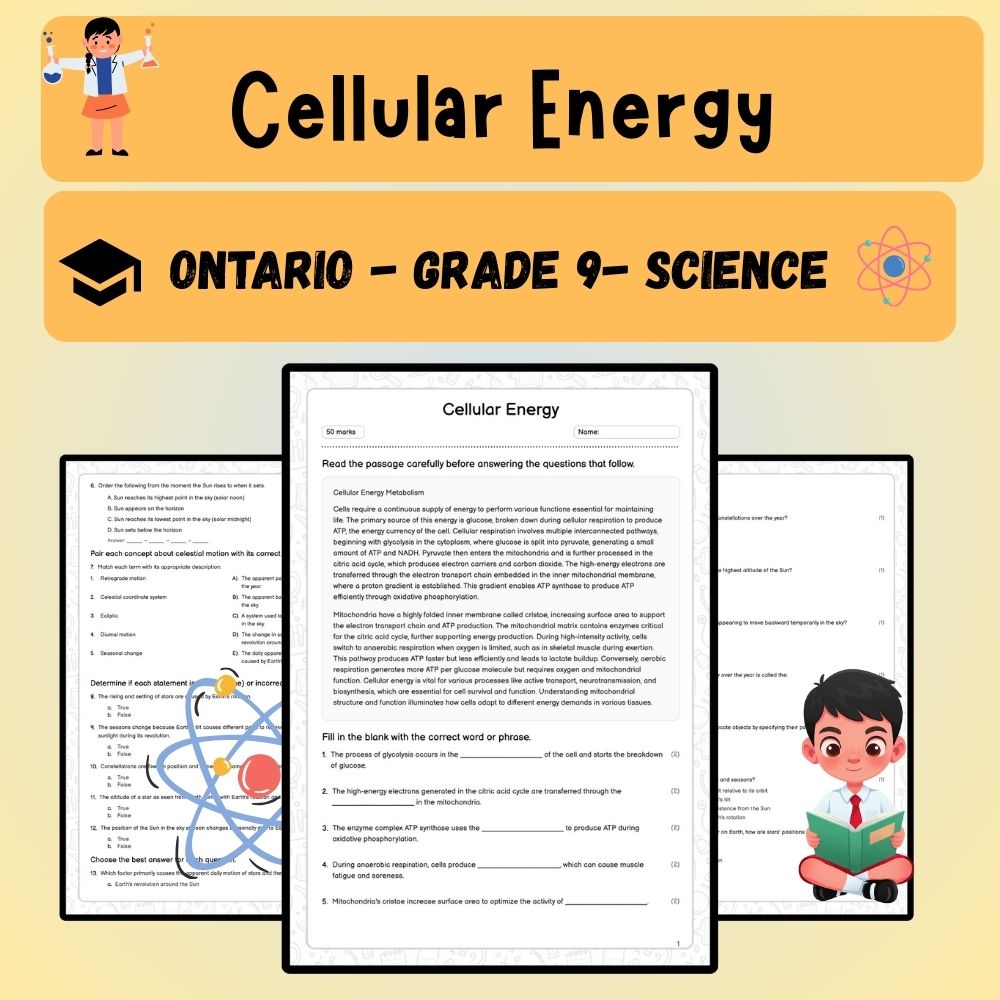
Grade 9 Science | Cellular Energy Worksheet (Answer Key) – Ontario Standards
Created byPrism Point LearningLearning Objectives
- Explain the processes of glycolysis, the citric acid cycle, and oxidative phosphorylation in cellular respiration.
- Describe how mitochondrial structure supports energy production, including proton gradients and ATP synthesis.
- Compare aerobic and anaerobic pathways and their tissue-specific relevance, such as skeletal muscle during exertion.
Also included in: Grade 9 Science Unit Bundle | Human Body Systems & Cell Functions +1 more
Instant download
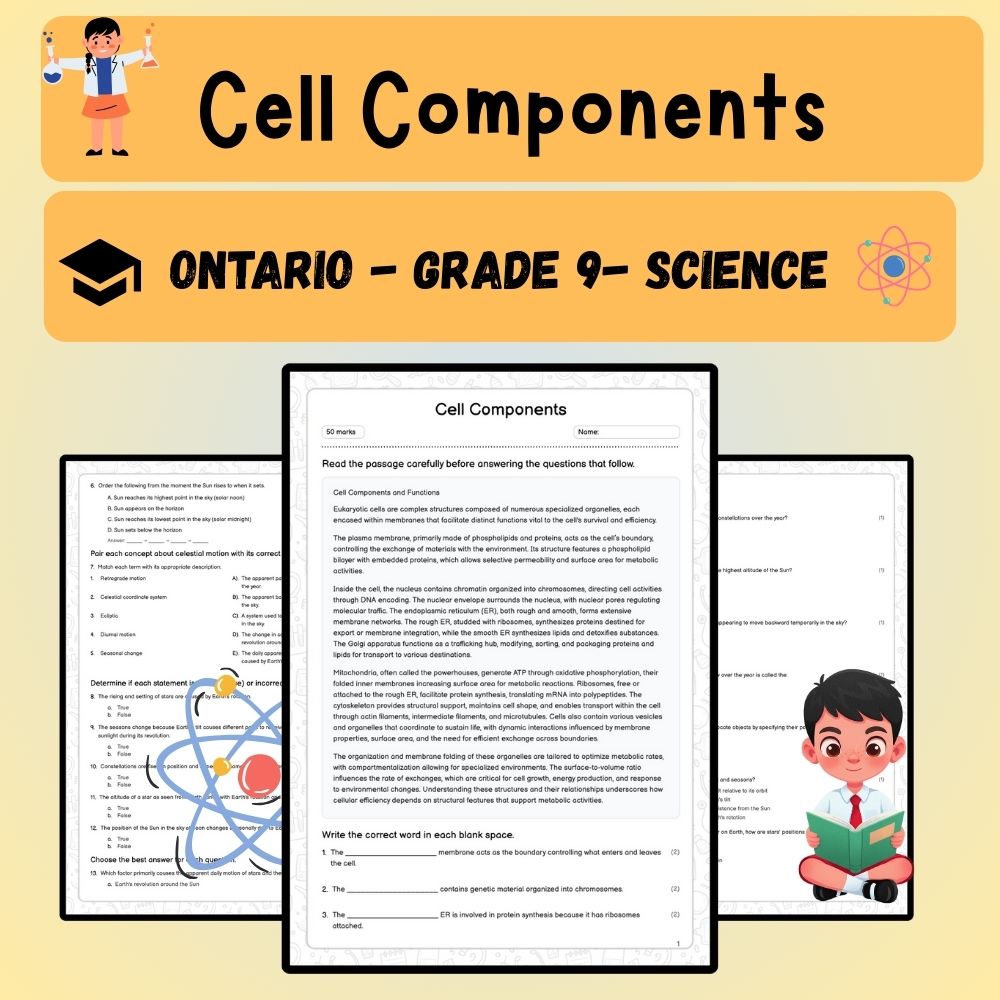
Grade 9 Science – Cell Components Worksheet (PDF) | Ontario Standards
Created byPrism Point LearningLearning Objectives
- Identify the major organelles of eukaryotic cells and describe their structural features.
- Explain how membrane folding, compartmentalization, and surface-to-volume ratios influence cellular functions.
- Relate the specific functions of cell organelles to their structures and organization.
Also included in: Grade 9 Science Unit Bundle | Human Body Systems & Cell Functions +1 more
Instant download
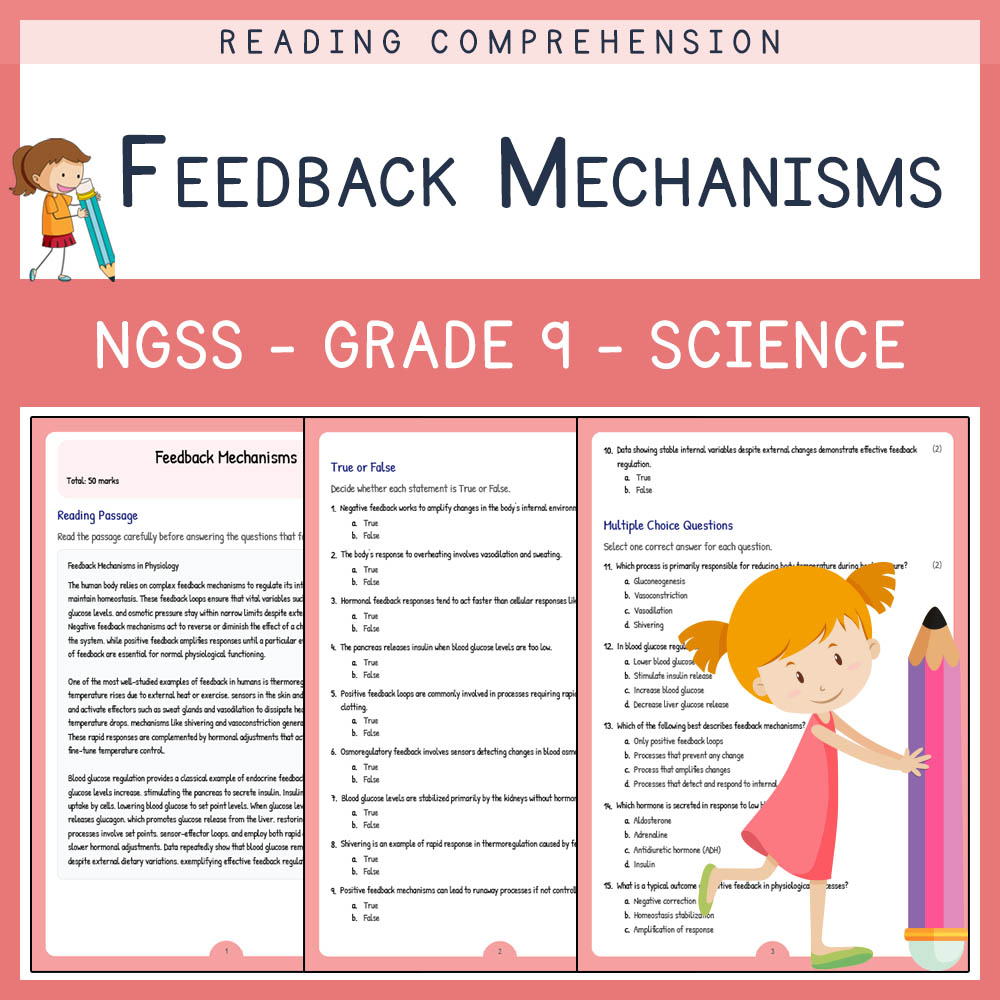
Grade 9 Science | Feedback Mechanisms Worksheet (Answer Key) - NGSS Aligned
Created byLumora LearningLearning Objectives
- Describe the concepts of negative and positive feedback and their roles in maintaining internal stability.
- Explain physiological examples of feedback mechanisms such as thermoregulation, blood glucose control, and osmoregulation.
- Differentiate between rapid and hormonal feedback responses based on empirical evidence.
Instant download
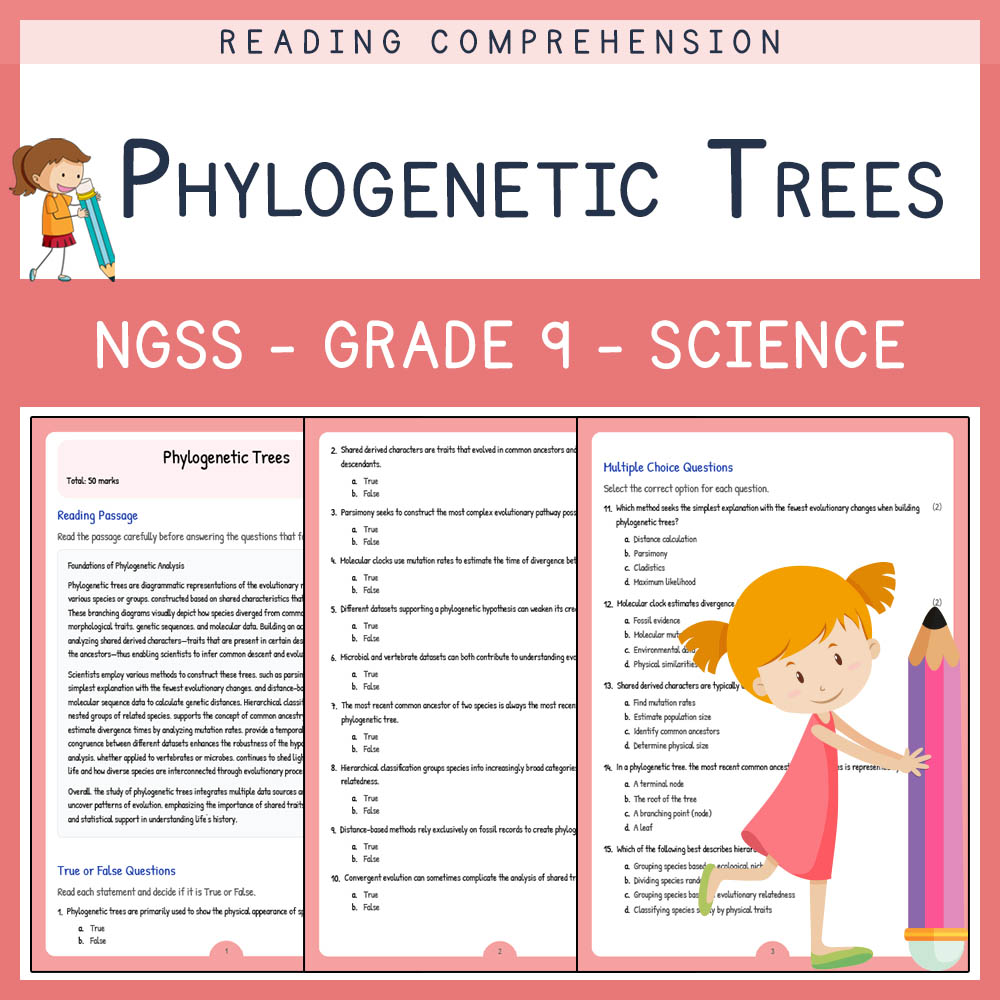
Grade 9 Science | Phylogenetic Trees Worksheet – NGSS Aligned (PDF + Answer Key)
Created byLumora LearningLearning Objectives
- Understand how phylogenetic trees represent evolutionary relationships.
- Interpret branch arrangements and shared traits in cladograms.
- Learn methods of constructing phylogenetic trees using morphological and molecular data.
Instant download
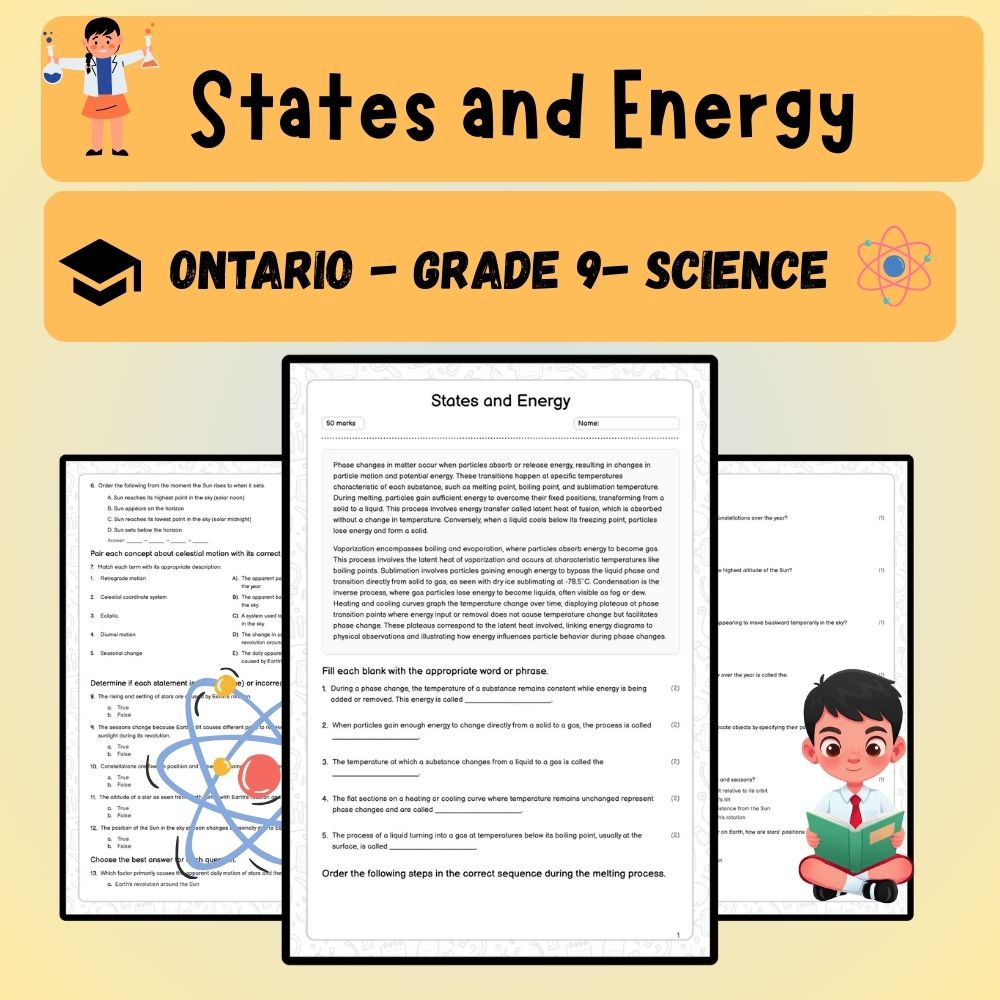
Grade 9 Science | States and Energy Worksheet (Answer Key) – Ontario Standard
Created byPrism Point LearningLearning Objectives
- Explain how phase changes involve energy transfer and particle motion.
- Describe the concepts of latent heat and characteristic transition temperatures.
- Differentiate between heating and cooling curves during phase transitions.
Also included in: Grade 9 Science UNIT Worksheet Pack | Chemical Properties, Energy & Reactions +1 more
Instant download
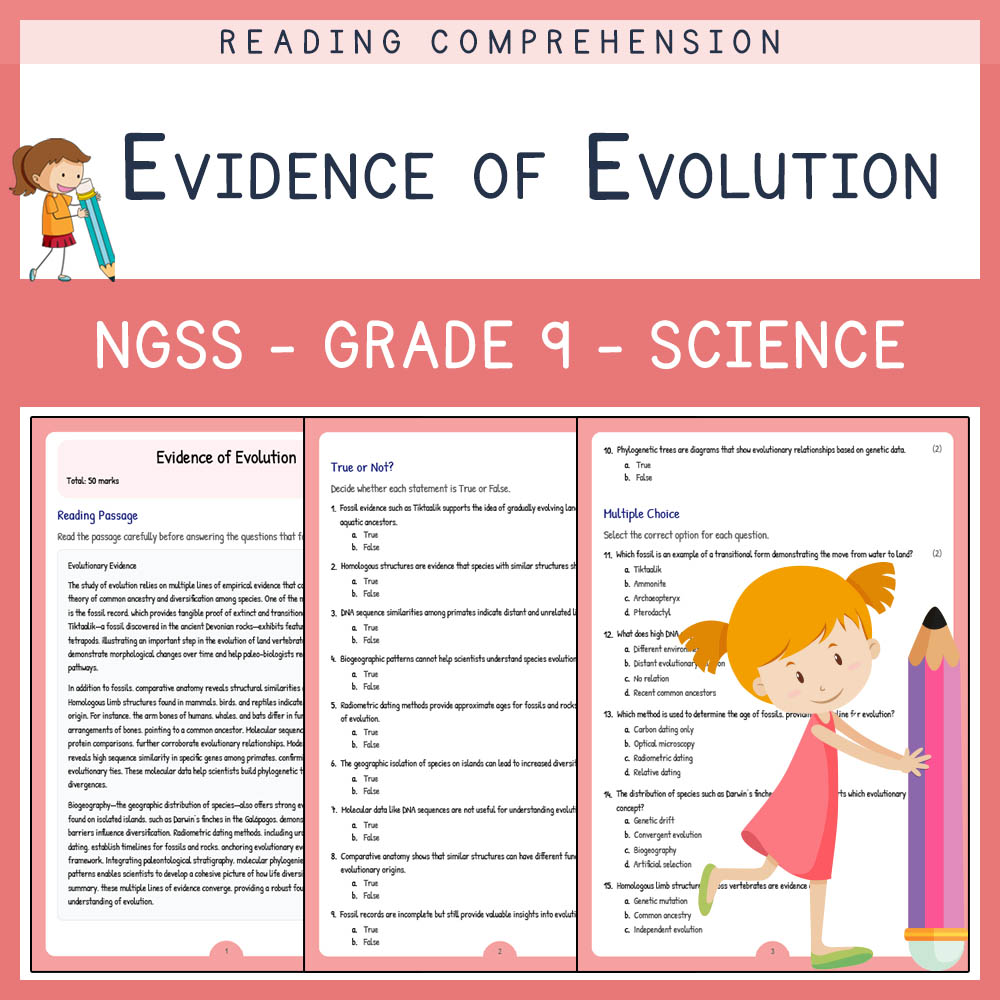
Grade 9 Science | Evidence of Evolution Worksheet (PDF + Answer Key)
Created byLumora LearningLearning Objectives
- Identify different types of empirical evidence supporting common ancestry.
- Understand how fossils, anatomy, and molecular data contribute to evolutionary science.
- Analyze examples such as transitional fossils, homologous structures, and DNA similarities.
Instant download
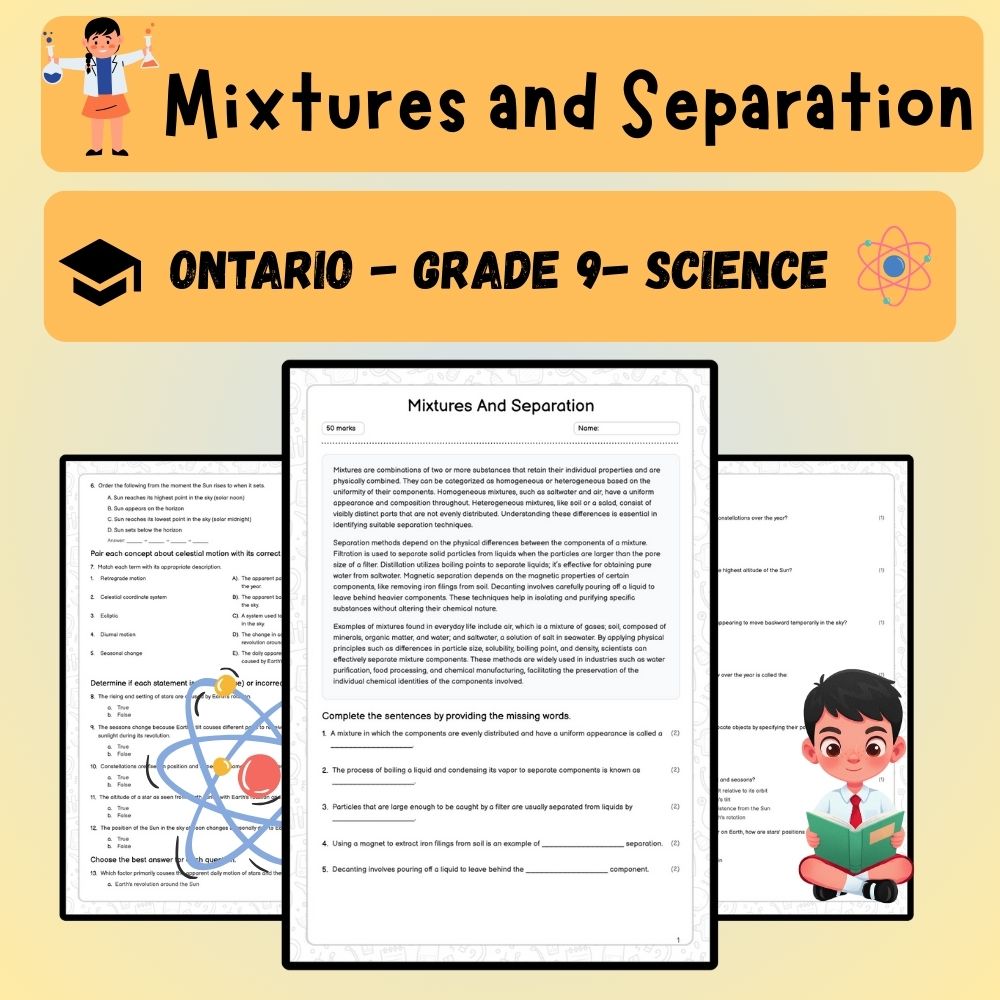
Grade 9 Science | Mixtures and Separation Worksheet – Ontario Standards (PDF)
Created byPrism Point LearningLearning Objectives
- Differentiate between homogeneous and heterogeneous mixtures.
- Describe physical methods of separating mixture components based on physical properties.
- Identify examples of mixtures such as saltwater, soil, and air.
Also included in: Grade 9 Science UNIT Worksheet Pack | Chemical Properties, Energy & Reactions +1 more
Instant download
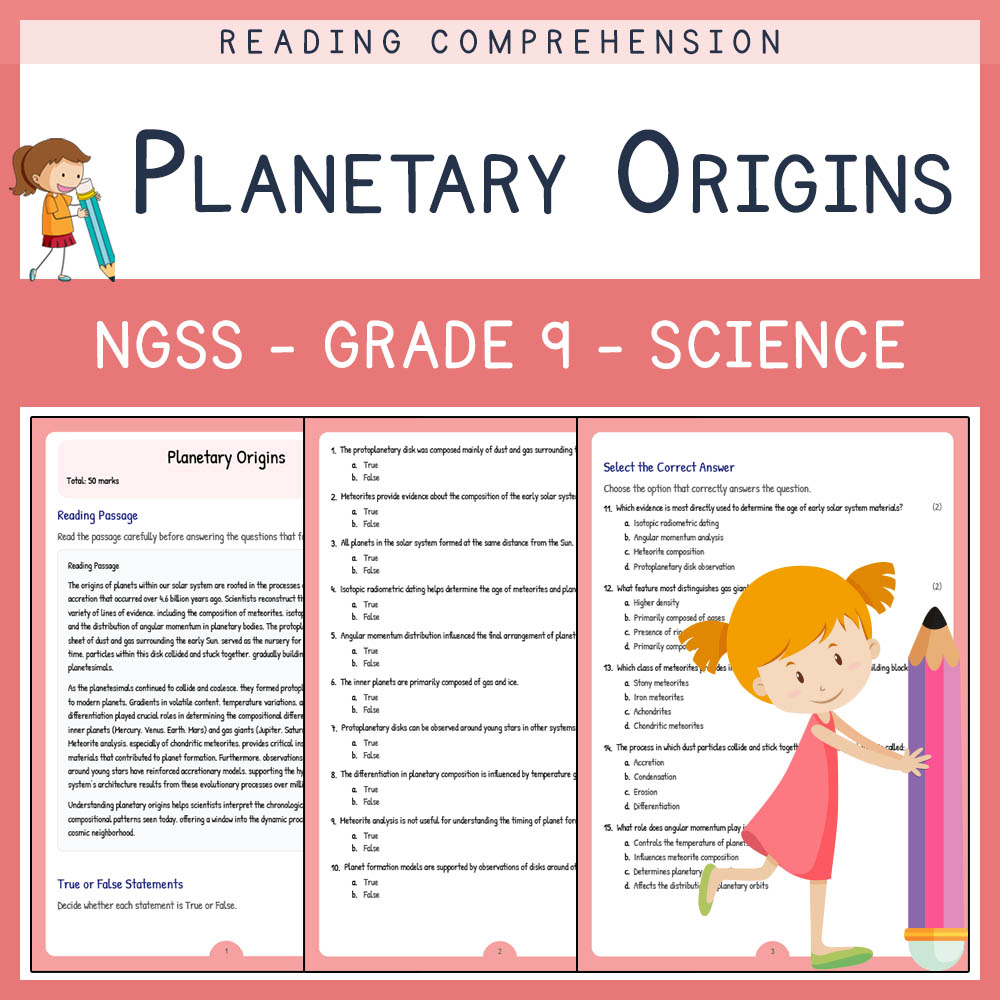
Grade 9 Science | Planetary Origins Worksheet (PDF + Answer Key) for NGSS Alignment
Created byLumora LearningLearning Objectives
- Explain the processes involved in the formation of the solar system based on current scientific evidence.
- Identify key features distinguishing inner rocky planets from outer gas giants.
- Describe the role of meteorites and isotopic dating in understanding planetary origins.
Instant download
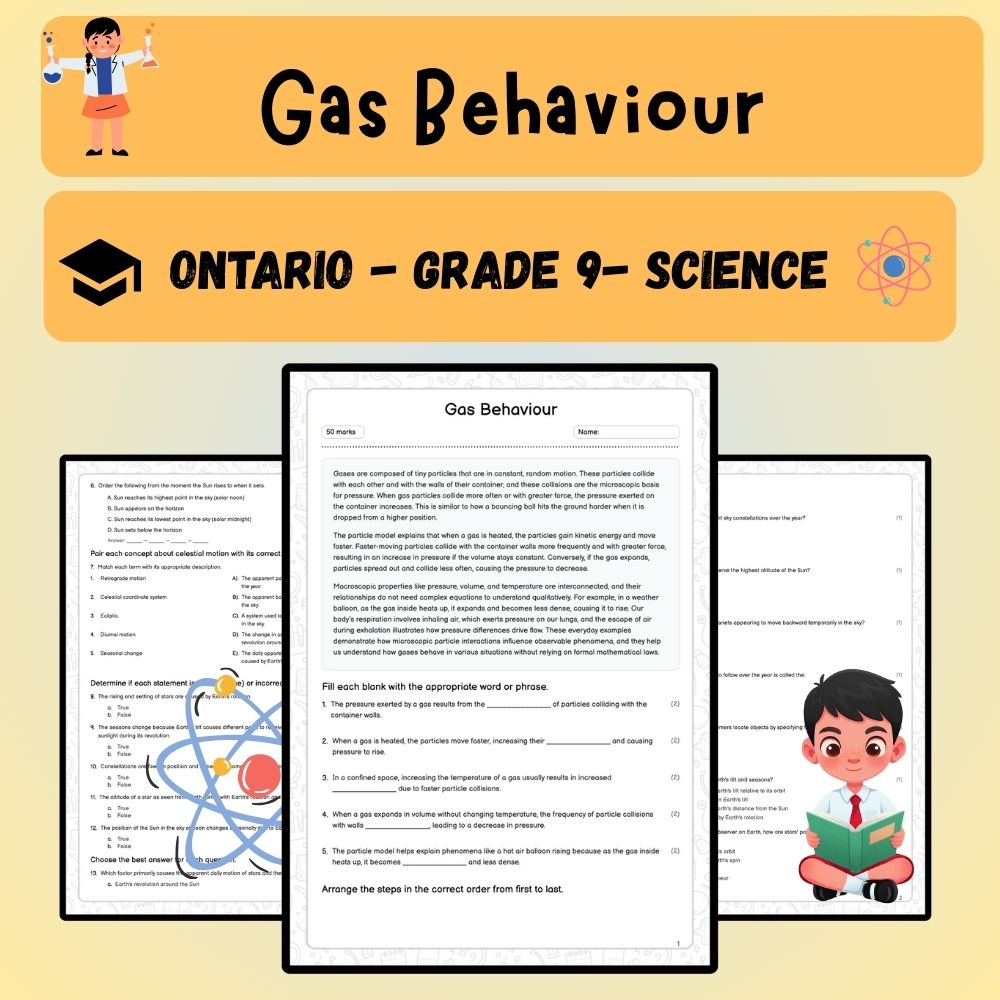
Grade 9 Science | Gas Behaviour Worksheet (Answer Key) - Ontario Standard
Created byPrism Point LearningLearning Objectives
- Explain how particle collisions relate to gas pressure using the particle model.
- Describe the relationship between temperature, volume, and pressure qualitatively in gases.
- Illustrate how macroscopic gas laws emerge from microscopic particle motion without using equations.
Also included in: Grade 9 Science UNIT Worksheet Pack | Chemical Properties, Energy & Reactions +1 more
Instant download
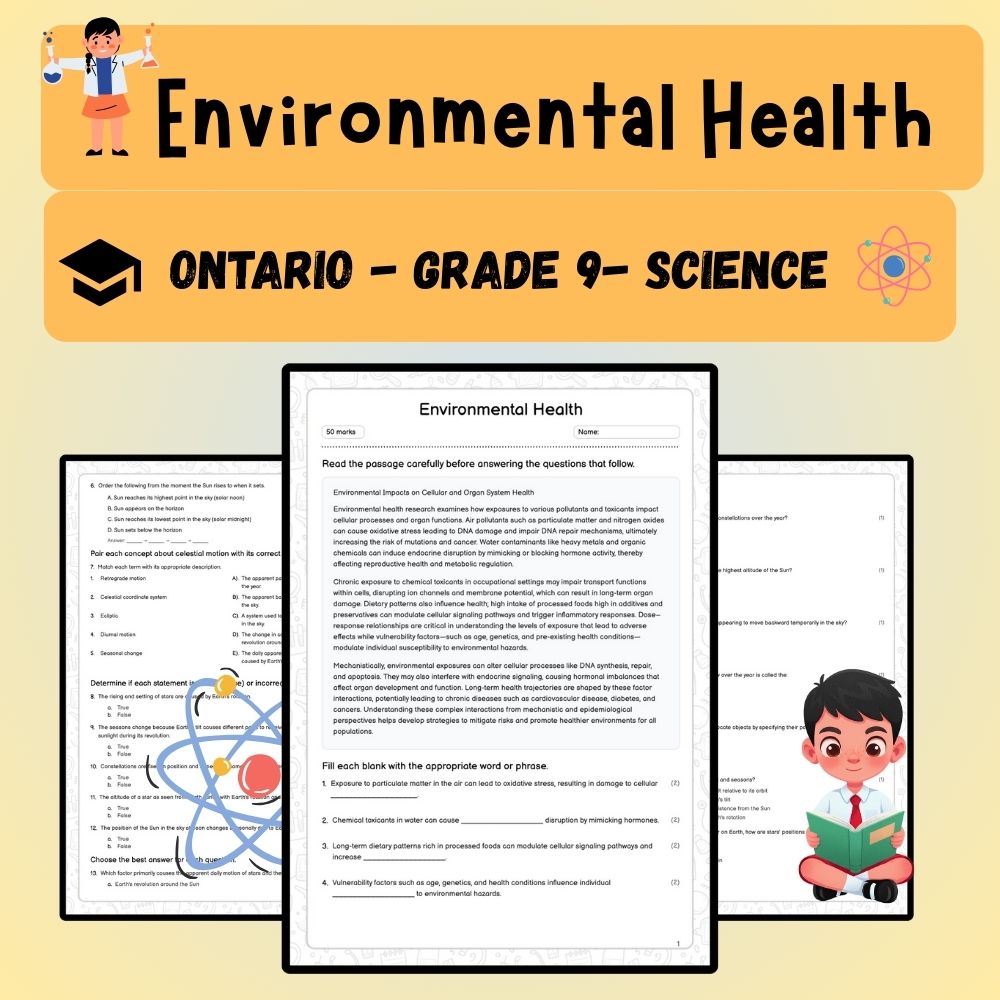
Grade 9 Science | Environmental Health Worksheet (Answer Key) - Ontario Standards
Created byPrism Point LearningLearning Objectives
- Understand how environmental exposures influence cellular and organ system health.
- Identify sources and effects of air and water pollutants on human health.
- Explain dose–response relationships and vulnerability factors related to environmental hazards.
Also included in: Grade 9 Science Unit Bundle | Human Body Systems & Cell Functions +1 more
Instant download
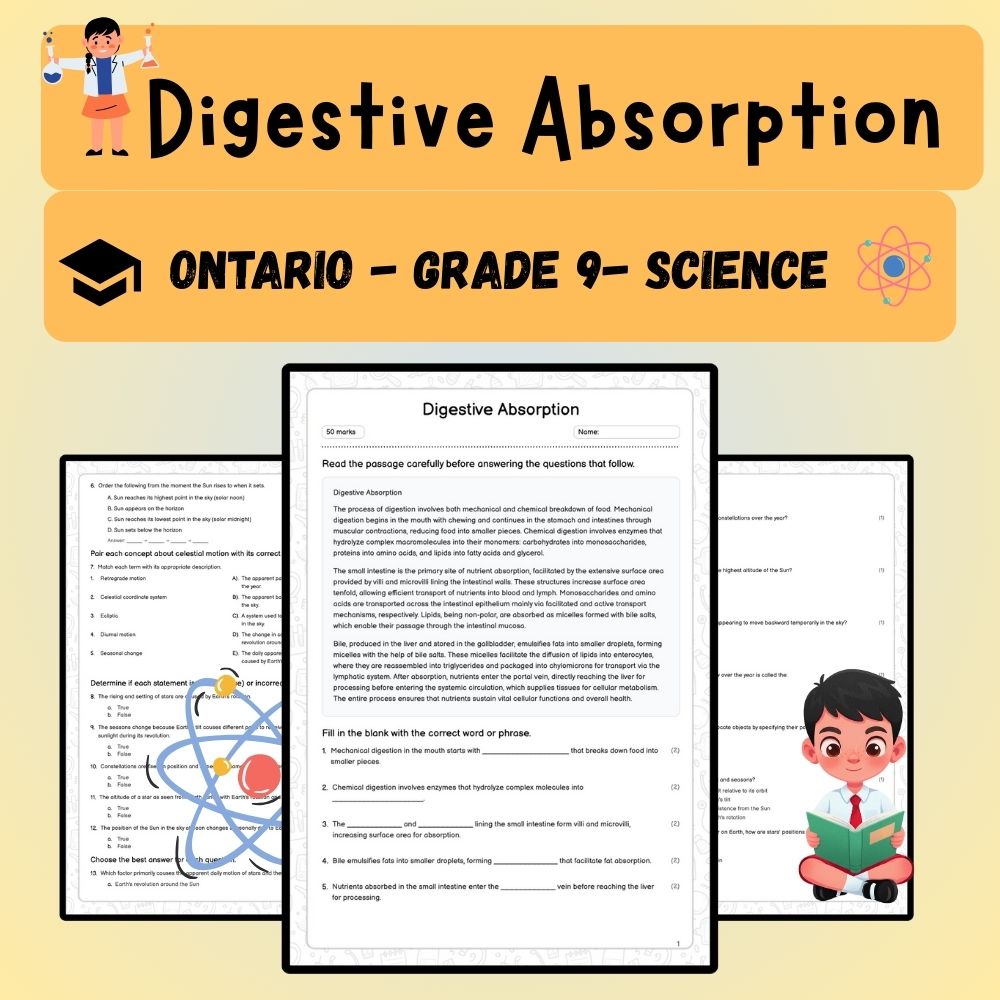
Grade 9 Science Worksheet | Digestive Absorption & Nutrient Transport (PDF)
Created byPrism Point LearningLearning Objectives
- Explain the mechanical and chemical breakdown of food in digestion.
- Describe how nutrients are absorbed across the intestinal epithelium, focusing on villi and microvilli.
- Identify the role of enzymes, bile, and micelles in nutrient digestion and absorption.
Also included in: Grade 9 Science Unit Bundle | Human Body Systems & Cell Functions +1 more
Instant download
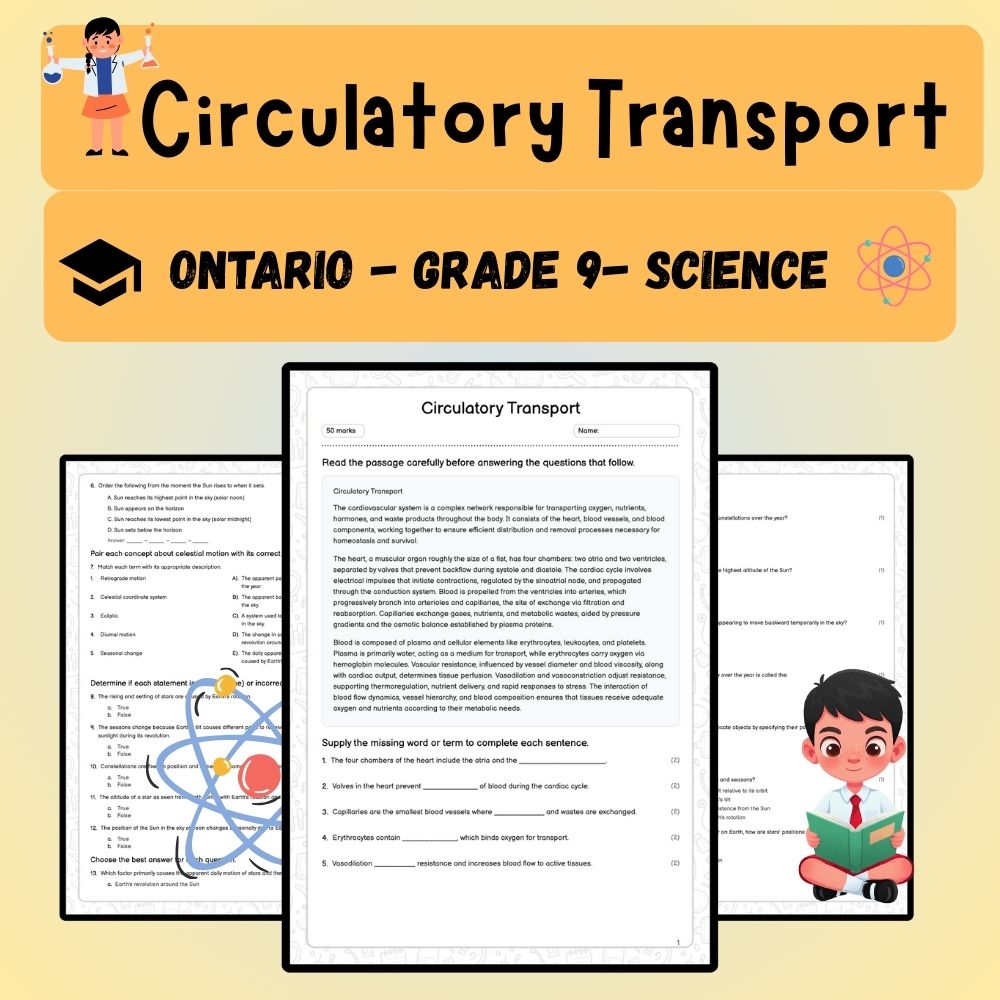
Grade 9 Science | Circulatory Transport Worksheet – Ontario Standard (PDF)
Created byPrism Point LearningLearning Objectives
- Describe the structural features of the heart and blood vessels involved in circulation.
- Explain the mechanisms of blood flow, including valve function and pressure regulation.
- Identify the roles of blood components in transport and regulation within the circulatory system.
Also included in: Grade 9 Science Unit Bundle | Human Body Systems & Cell Functions +1 more
Instant download
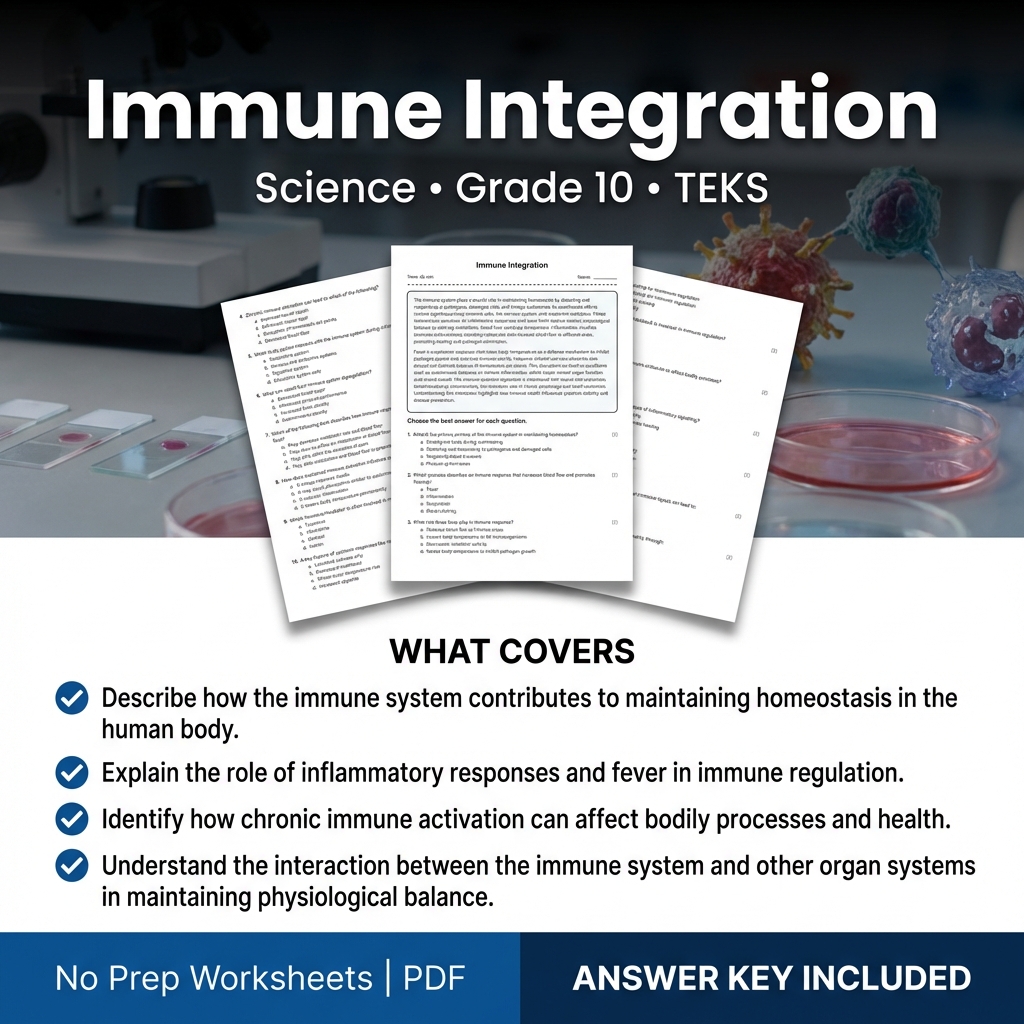
Grade 10 Science Worksheet on Immune Integration | TEKS Aligned
Created byCoral Reef LearningLearning Objectives
- Describe how the immune system contributes to maintaining homeostasis in the human body.
- Explain the role of inflammatory responses and fever in immune regulation.
- Identify how chronic immune activation can affect bodily processes and health.
Instant download
Browse more categories
About Reading comprehension Worksheets
Find reading comprehension worksheets for class practice, homework, or self-study. All 40,284 are instant PDF downloads.
Each resource here is built by an independent educator and reviewed for quality. Worksheets print straight from PDF and suit classroom use, homework, or extra practice; most come with answer keys, and you can preview before purchasing.