
Grade 10 Worksheets
9,388 grade resources
Energy Flow Worksheet | Science Assessment for Grade 10 TEKS
JCreated byJ.S SheetsLearning Objectives
- Explain how sunlight energy enters ecosystems through photosynthesis and moves through trophic levels.
- Describe how energy transfer between trophic levels decreases due to respiration and heat loss.
- Use food chains and food webs to trace energy flow and predict limits on biomass and population sizes.
Instant download

Grade 10 ELA – Development of Supporting Ideas Worksheet (Alberta Standards)
 Created byGolden Apple Studio
Learning Objectives
- Select evidence that is specific, credible, and directly connected to a controlling idea.
- Explain evidence with analysis that clarifies meaning, interprets results, or describes significance.
- Evaluate and synthesize multiple sources so that each detail clearly supports the same claim.
Also included in: Grade 10 Writing Process, Revision & Clarity ELA Lesson Bundle – Alberta +1 more
Instant download
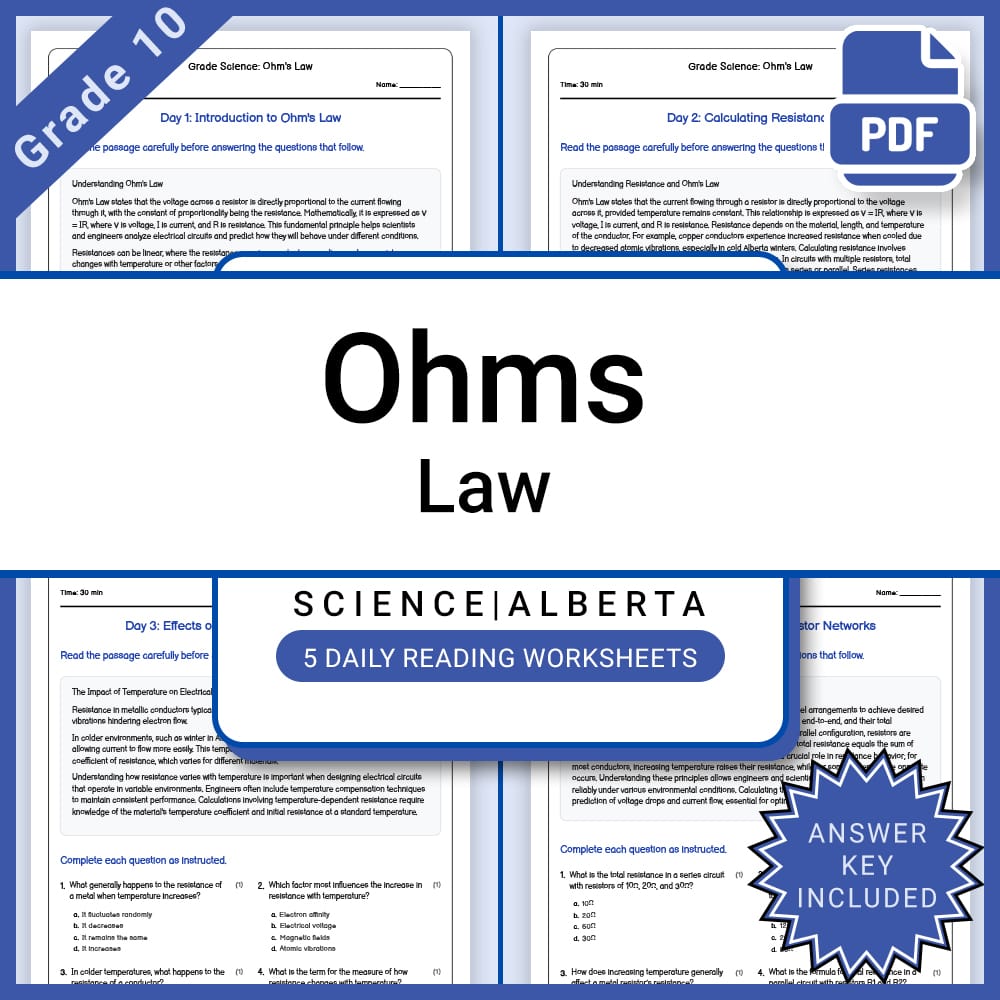
Grade 10 Science – Ohm's Law Daily Reading Worksheet + Answer Key
JCreated byJ.S SheetsLearning Objectives
- Understand the relationship between voltage, current, and resistance
- Identify linear and non-linear resistive behaviors
- Analyze how temperature influences resistance in conductors
Also included in: Grade 10 Science Lesson Group | Energy and Electricity Alberta Framework +1 more
Instant download

Grade 10 Science | Balanced Force Motion Worksheet Elena | California Standards
 Created byLumora Learning
Learning Objectives
- Explain how net force determines acceleration and how balanced forces lead to constant velocity or no change in motion
- Distinguish between individual forces acting on an object and the combined effect (net force)
- Use force diagrams and everyday scenarios to predict whether an object will speed up, slow down, or maintain the same motion
Instant download

Grade 10 Science – Energy Pathways Daily Reading Worksheet | AP Standards
 Created byBright Mind Resources
Learning Objectives
- Understand how solar energy is absorbed and reflected by Earth's surface.
- Explain the processes of sensible and latent heat transfer.
- Identify how oceanic heat transport influences regional climates.
Also included in: Grade 10 Earth Science Daily Reading Worksheets Lesson Bundle | AP +2 more
Instant download
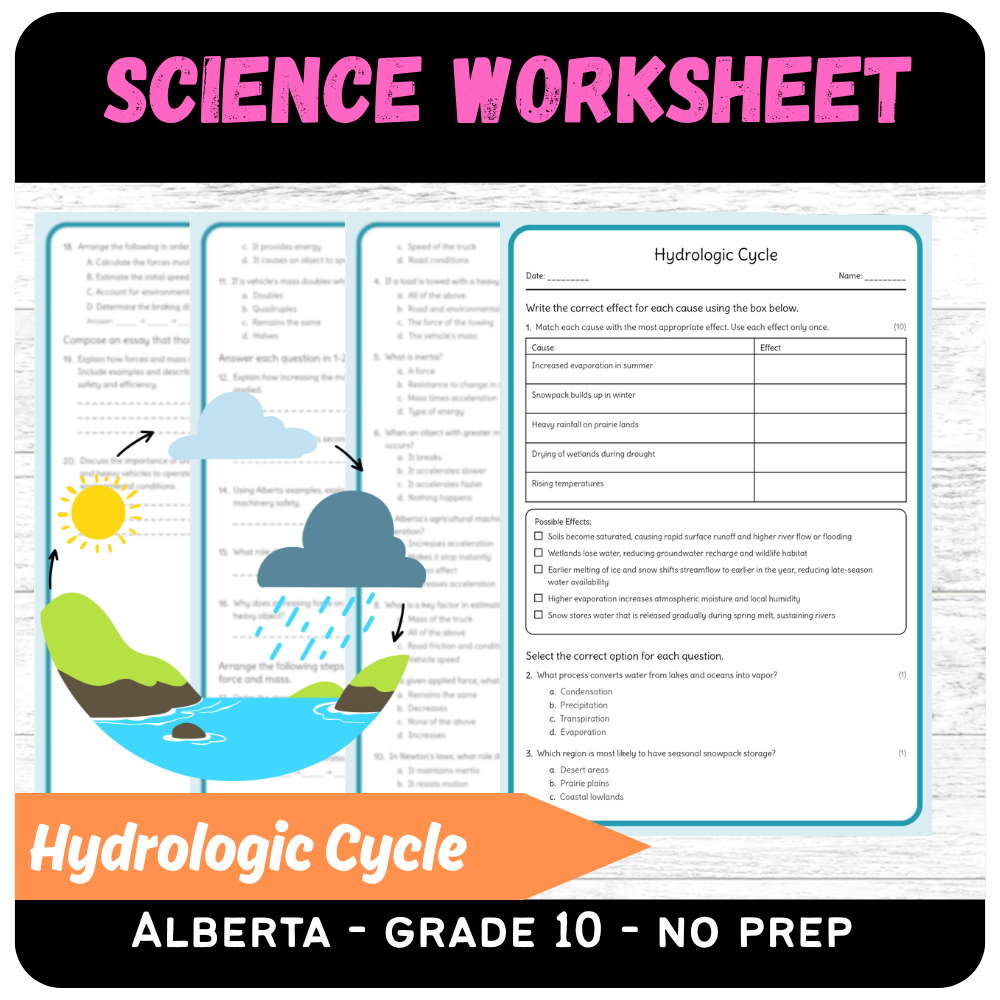
Grade 10 Science – Hydrologic Cycle Worksheet (PDF) – Alberta Standards
Created byBright Mind ResourcesLearning Objectives
- Describe the key processes of the hydrologic cycle and their roles in water movement.
- Explain the regional impacts of climate variability and watershed characteristics on water availability.
- Analyze how wetlands, groundwater, and streamflow interact within the water cycle.
Instant download

Grade 10 ELA Argument Thesis Worksheet (CCSS) PDF
Created byGolden Apple StudioLearning Objectives
- Write a clear argument thesis that states a claim and previews key reasons.
- Distinguish thesis statements from plot summary and simple personal opinion.
- Use evidence effectively by explaining how reasons connect to the claim.
Also included in: Grade 10 ELA Evidence-Based Argument & Synthesis Lesson Bundle | CCSS +1 more
Instant download

Grade 10 Worksheet B: Systems Analysis in Engineering Worksheet | NGSS
 Created byClear Sky Classroom
Learning Objectives
- Define system boundaries and identify subsystem interactions in multi-component engineering designs.
- Describe how energy, material, and information flows through a system and relate these flows to system performance.
- Use feedback loops and modeling interfaces to predict emergent behavior and troubleshoot constraints (e.g., bandwidth, mass, maintenance access).
Also included in: Grade 10 Trade-Off Optimization Science Lesson Bundle: NGSS +1 more
Instant download

Grade 10 Math – Distance and Location Worksheet (Ontario Standards PDF)
Created byClear Sky ClassroomLearning Objectives
- Calculate the distance between two points using the distance formula.
- Interpret distance calculations in real-world contexts like navigation and resource placement.
- Understand and apply the midpoint formula to determine optimal locations.
Also included in: Grade 10 Maths | Analytic Geometry Applied Lesson Bundle for Ontario +1 more
Instant download

Grade 10 Social Studies | Revolutionary Ideas Worksheet (TEKS) (PDF)
 Created bySunny Desk Resources
Learning Objectives
- Explain how Enlightenment ideas influenced revolutionary movements in the 18th to 20th centuries.
- Compare key goals and outcomes of the American and French Revolutions.
- Analyze how independence and social change movements challenged existing authority structures.
Also included in: Grade 10 Global Conflicts Social Studies Full-Year Worksheet Bundle – TEKS +1 more
Instant download

Physiological Systems Worksheet for Grade 10 Science | NGSS Practice
JCreated byJ.S SheetsLearning Objectives
- Compare the structure and function of the circulatory, respiratory, digestive, excretory, and integumentary systems.
- Identify key structural features such as vascular networks, alveolar surfaces, nephron architecture, and epithelial barriers.
- Explain how organ systems integrate in terms of flow rates, surface area-to-volume relationships, and transport kinetics.
Instant download

Grade 10 ELA | Synthesis of Meaning Worksheet — Reading & Critical Thinking
Created byGolden Apple StudioLearning Objectives
- Synthesize ideas from multiple parts of a text into a coherent central claim supported by evidence
- Differentiate evidence from inference and explain how that distinction strengthens meaning
- Analyze how authors’ choices and perspectives shape what readers conclude
Also included in: Grade 10 Evidence & Perspective ELA Lesson Bundle (Alberta Framework) +1 more
Instant download

Grade 10 ELA Worksheet | Register and Transfer Practice (PDF)
Created byGolden Apple StudioLearning Objectives
- Define academic register and explain how audience, purpose, and formality shape word choice in speaking and writing.
- Apply academic vocabulary accurately across formal discussions, presentations, and essays by maintaining consistent meaning.
- Analyze how precision and selective repetition improve clarity, credibility, and coherence in complex explanations and arguments.
Also included in: Grade 10 Academic Vocabulary & Word Analysis ELA Lesson Bundle: General ELA +1 more
Instant download

Grade 10 Science – Evidence-Based Communication & Scientific Explanation
Created byBright Mind ResourcesLearning Objectives
- Understand how to identify claims and evidence in scientific texts.
- Learn to interpret scientific data and representations.
- Develop skills to justify conclusions with evidence and reasoning.
Also included in: Measurement Uncertainty Grade 10 Science Reading Worksheets Bundle | General +1 more
Instant download

Grade 10 Holiday| National Aviation Day Worksheet for Mastery | PDF + Answer Key
 Created byShaNova Worksheets
Learning Objectives
- Explain key aviation milestones from early powered flight to modern aerial transport
- Describe how aviation supports humanitarian aid and global connectivity
- Identify major technologies and concepts (lift, propulsion, navigation, weather forecasting) used in flight
Instant download

Grade 10 Multiple Evidence Worksheet | Review & Assessment PDF
Created byClear Sky ClassroomLearning Objectives
- Explain how biological change over time is supported by converging evidence from multiple scientific sources.
- Identify and interpret examples of fossil, anatomical, molecular, and biogeographic evidence for evolution.
- Evaluate how consistent patterns across evidence strengthen evolutionary explanations despite limitations in any single dataset.
Instant download

Grade 10 Science | Predator Prey Dynamics - Daily Reading Comprehension
 Created byCoral Reef Learning
Learning Objectives
- Understand the basic concepts of predator-prey relationships
- Analyze how predator and prey populations affect each other
- Recognize the impact of predator-prey interactions on ecosystem stability
Instant download

Grade 10 Science – Statistical Reasoning & Data Analysis | Reading Worksheet
Created byBright Mind ResourcesLearning Objectives
- Understand and describe concepts such as central tendency, spread, and confidence intervals.
- Interpret and evaluate statistical data for scientific experiments.
- Apply basic hypothesis testing and null model concepts to real datasets.
Also included in: Grade 10 Scientific Reasoning Science Lesson Bundle | AP Daily Reading +2 more
Instant download

Grade 10 Science | Orbital Gravity Models Worksheet | California Standards
Created byLumora LearningLearning Objectives
- Explain how gravity can produce centripetal acceleration in orbital motion
- Connect orbital shape and periodic timing to evidence-based models of gravity
- Interpret how observations of planetary and satellite orbits support a unified force model
Instant download

Grade 10 Science | Atomic Models - Daily Reading Comprehension
Created byCoral Reef LearningLearning Objectives
- Describe the evolution of atomic models from Dalton to quantum mechanics.
- Identify key features of early atomic models.
- Understand how experiments like Rutherford’s gold foil experiment contributed to atomic theory.
Also included in: Matter and Chemical Change Lesson Bundle: Grade 10 Science Alberta +1 more
Instant download

Editing for Clarity Worksheet Practice | Grade 10 ELA Activities
Created bySunny Desk ResourcesLearning Objectives
- Revise sentences to improve clarity by correcting run-ons, fragments, and confusing word choices.
- Edit for surface-level accuracy, including capitalization, punctuation, and spelling.
- Maintain consistent verb tense to support accurate time relationships in writing.
Also included in: Grade 10 Writing Lesson Bundle – Alberta ELA Framework Practice +1 more
Instant download

Grade 10 Holiday Back To School | Orientation Origins PDF + Answer Key
Created byShaNova WorksheetsLearning Objectives
- Explain the purpose of school orientation programs and why they matter for new students.
- Analyze how orientation supports belonging, inclusion, and early community connections.
- Use evidence from a passage to answer comprehension questions and make inferences.
Instant download

Grade 10 Science | Battery Storage Worksheet (PDF) BC Standards
 Created byEvergreen Desk Education
Learning Objectives
- Explain how battery storage converts between chemical energy and electrical energy and describe key sources of loss
- Use ideas of stored energy, input energy, and dissipated heat to reason about round-trip efficiency
- Interpret charge–discharge cycles and state of charge (SoC) to describe how performance changes over time
Instant download

Grade 10 Science | Effective Charge Worksheet | AP Aligned
Created byLumora LearningLearning Objectives
- Understand the concept of effective nuclear charge (Zeff) and how it influences atomic properties.
- Analyze periodic trends such as atomic radius, ionization energy, and electron affinity in relation to Zeff.
- Apply simplified calculations to compare isoelectronic series and predict element behavior.
Instant download

Grade 10 Science | Genomic Technologies - Daily Reading Comprehension
Created byCoral Reef LearningLearning Objectives
- Understand the basic structure and function of DNA.
- Learn about key genomic technologies such as PCR, DNA sequencing, and CRISPR.
- Identify applications and implications of genomic techniques in science and society.
Instant download

Design Problem Constraints Assessment | General Grade 10 Science Standards
 Created byPrism Point Learning
Learning Objectives
- Understand how constraints such as time, cost, safety, energy use, and materials influence design solutions.
- Analyze how design choices meet specific requirements while limiting unwanted effects.
- Explain the connection between major design decisions and constraints to justify feasibility and appropriateness.
Instant download

Grade 10 Cell To Organism Worksheet | General Practice PDF
Created byClear Sky ClassroomLearning Objectives
- Explain how cell membranes and transport mechanisms move oxygen and nutrients toward cells
- Describe how cellular respiration produces ATP that supports organism-level functions
- Connect organ-level structures (gas-exchange surfaces and circulatory pathways) to faster exchange and delivery
Instant download
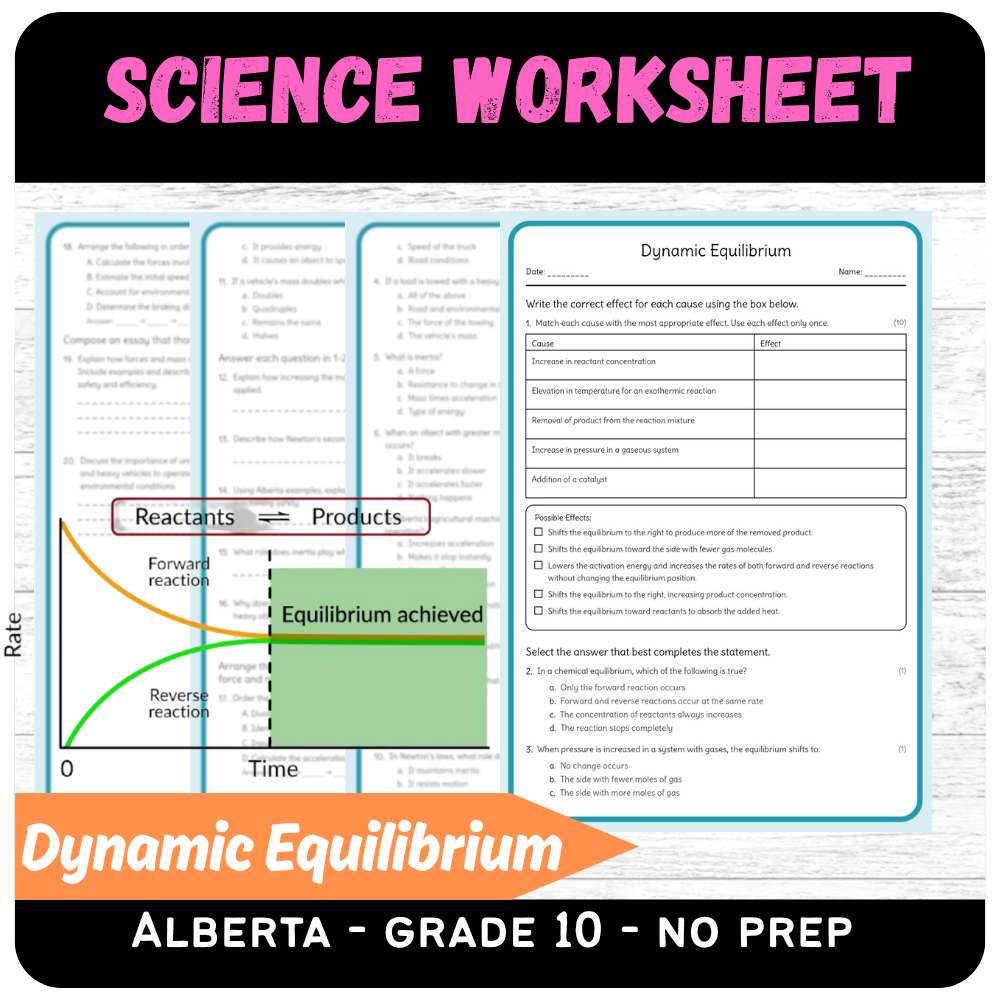
Grade 10 Science – Dynamic Equilibrium Worksheet (PDF) – Alberta Standards
Created byBright Mind ResourcesLearning Objectives
- Understand the concept of chemical dynamic equilibrium and its characteristics.
- Interpret equilibrium constants and predict shifts in equilibrium due to external changes.
- Apply quantitative methods to analyze equilibrium expressions.
Instant download
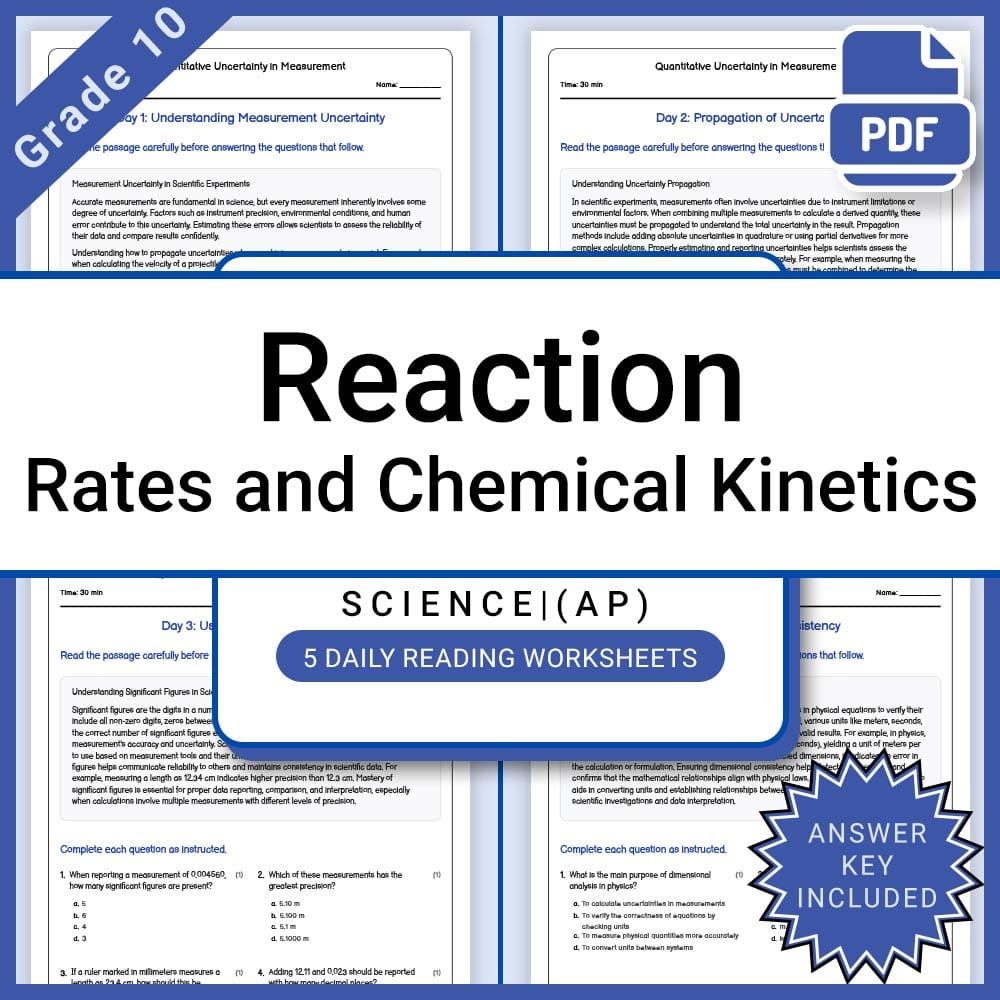
Grade 10 Science – Reaction Rates Daily Reading Worksheet + Answer Key
JCreated byJ.S SheetsLearning Objectives
- Identify factors that influence the speed of chemical reactions.
- Understand how collision frequency, orientation, and activation energy affect reaction rates.
- Interpret graphical representations of concentration versus time to determine reaction order.
Also included in: Grade 10 Science Lesson Group - AP Curriculum - Daily Reading Worksheets
Instant download

Grades 9 - 10 Holiday Worksheet | Celebrating Justice Assessment
Learning Objectives
- Analyze how laws, cultural attitudes, and activism interact to create social change.
- Explain how stories and holidays can build empathy and civic responsibility.
- Use critical-thinking questions (cause and effect) to evaluate issues related to human rights and inclusion.
Also included in: Loving Day Mega Bundle | Reading Comprehension Activities | Grades 6–12
Instant download

Grade 10 Electron Configuration Worksheet | Practice & AP Standard PDF
Created byClear Sky ClassroomLearning Objectives
- Explain how the four quantum numbers (n, l, m_l, and m_s) describe an electron’s energy, shape, orientation, and spin.
- Use orbital diagrams and configuration shorthand to represent how electrons fill orbitals in increasing energy order.
- Connect electron configurations and orbital-level changes to periodic trends, chemical valence, and basic magnetic properties.
Also included in: Grade 10 Science Full-Year Worksheet B Bundle, Advanced Placement (AP)
Instant download

Grade 10 Science – Uniform Circular Motion Worksheet (Ontario) PDF
Created byEvergreen Desk EducationLearning Objectives
- Explain how angular measures relate to linear speed in uniform circular motion using v = rω
- Connect net inward (centripetal) force to centripetal acceleration a_c = v^2/r and Newton’s second law
- Interpret and predict motion outcomes for real systems such as car turns and a conical pendulum
Also included in: Grade 10 Kinematics Forces & Mechanics Science Lesson Bundle Ontario Worksheets +1 more
Instant download

Grade 10 Cell Division, Checkpoints & Differentiation Worksheet | NGSS
 Created byAmber Owl Education
Learning Objectives
- Explain how mitosis and meiosis create genetically distinct outcomes for growth and reproduction
- Describe how the cell cycle and cyclin-dependent checkpoints help prevent damaged cells from dividing
- Connect dysregulated cell division to cancer and explain how apoptosis limits harm
Instant download
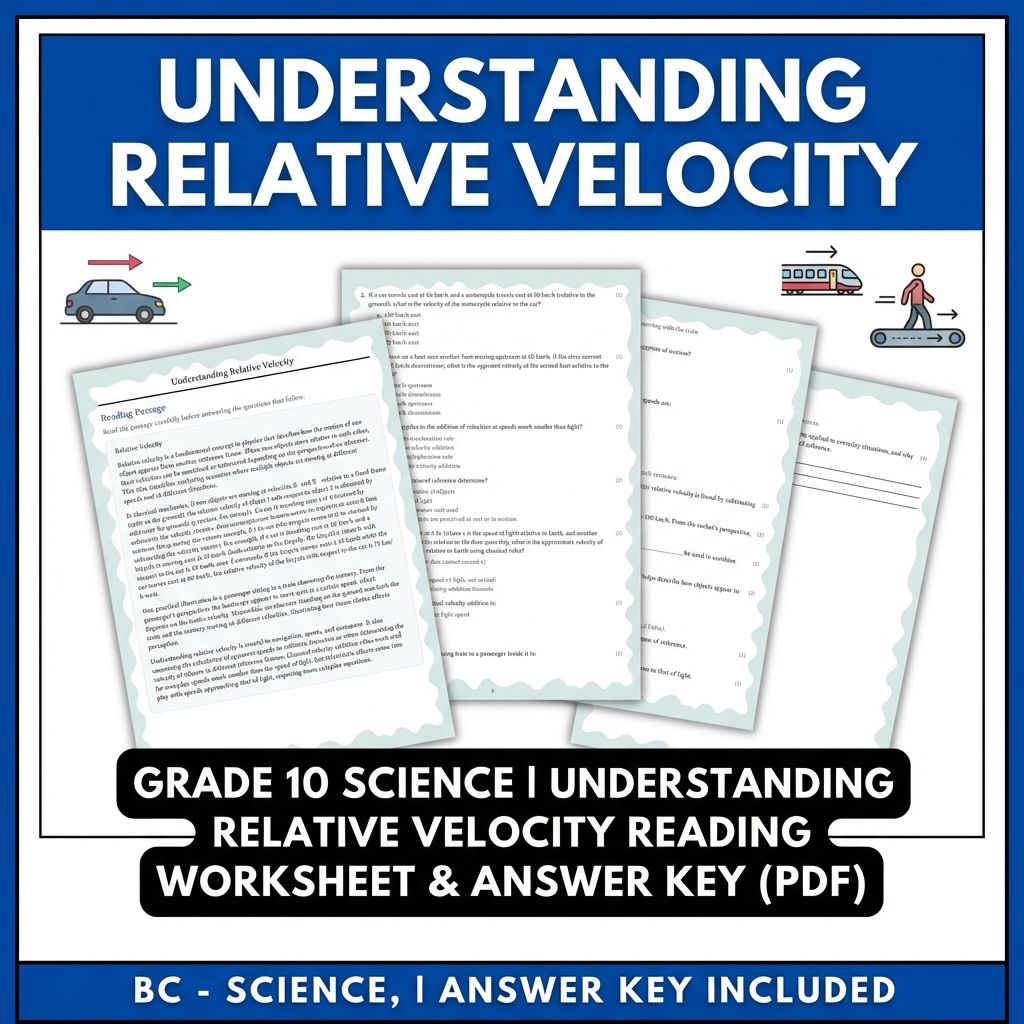
Grade 10 Science | Relative Velocity Reading Worksheet & Answer Key (PDF)
JCreated byJ.S SheetsLearning Objectives
- Explain the concept of relative velocity between objects in different frames of reference.
- Differentiate how motion appears to an observer on a moving vehicle versus an observer on the ground.
- Apply classical velocity addition rules to simple motion problems involving multiple reference frames.
Instant download
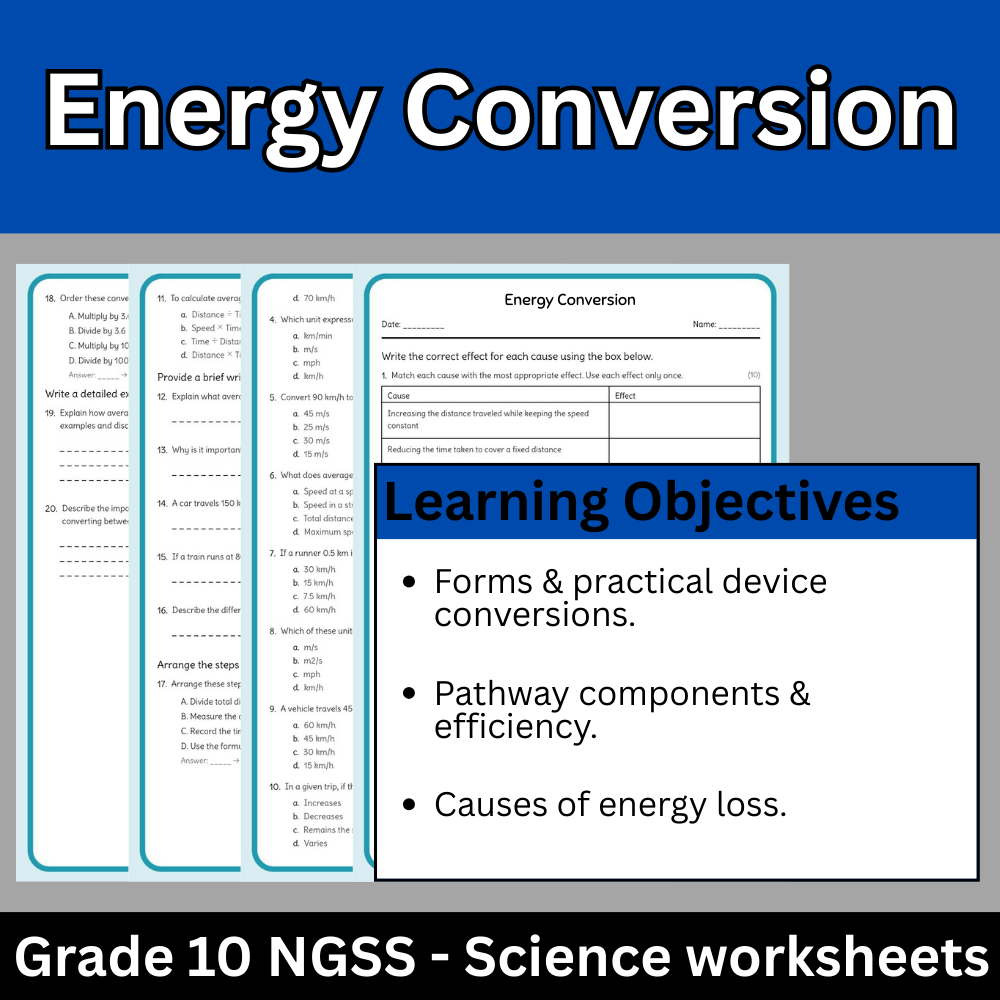
Grade 10 Science | Energy Conversion Worksheet (Answer Key) – NGSS Focused
Created byBright Mind ResourcesLearning Objectives
- Understand different energy forms and their conversions in practical devices.
- Identify key components involved in energy pathways and assess efficiency.
- Analyze causes of energy loss during conversion processes.
Instant download
Grade 10 Science – Laboratory Protocols Daily Reading Worksheet + Answer Key
JCreated byJ.S SheetsLearning Objectives
- Understand the importance of safety protocols in a laboratory.
- Identify proper laboratory attire and personal protective equipment.
- Recognize procedures for safe storage and handling of reagents.
Also included in: Grade 10 Science Lesson Bundle | Ontario Framework Reading Worksheets +1 more
Instant download

Grade 10 Science | DNA and Genes Worksheet Elena | Florida NGSSS
Created byLumora LearningLearning Objectives
- Explain how DNA stores genetic information and how genes use that information to produce proteins or functional RNA products
- Describe the organization of DNA in chromosomes and how gene activity depends on how information is read and converted
- Connect inherited traits and genetic variation to differences in DNA sequence and gene expression
Instant download

Grade 10 Science | Membrane Transport in Cells - Daily Reading Comprehension
Created byCoral Reef LearningLearning Objectives
- Describe different mechanisms by which materials cross cell membranes, including diffusion, osmosis, and facilitated transport.
- Explain the role of membrane proteins and lipids in regulating permeability.
- Relate membrane transport mechanisms to cellular homeostasis and organism health.
Also included in: Cells and Systems Lesson Bundle | Grade 10 Science | Alberta Framework +1 more
Instant download

Grade 10 Science | Kinematic Graphs - Daily Reading Comprehension
Created byCoral Reef LearningLearning Objectives
- Understand how to interpret position-time graphs
- Identify points of different velocities and accelerations from graphs
- Relate the slope of position-time graphs to velocity
Also included in: Energy, Motion and Electricity Lesson Bundle | Grade 10 Science | Alberta +1 more
Instant download

Grade 10 Science | Friction and Drag Worksheet (PDF) BC Standards
Created byEvergreen Desk EducationLearning Objectives
- Explain how friction and drag are resistance forces that oppose motion, and distinguish their physical origins.
- Use ideas of normal force and surface characteristics to predict changes in friction.
- Describe how drag depends on speed and how terminal velocity occurs when forces balance.
Instant download
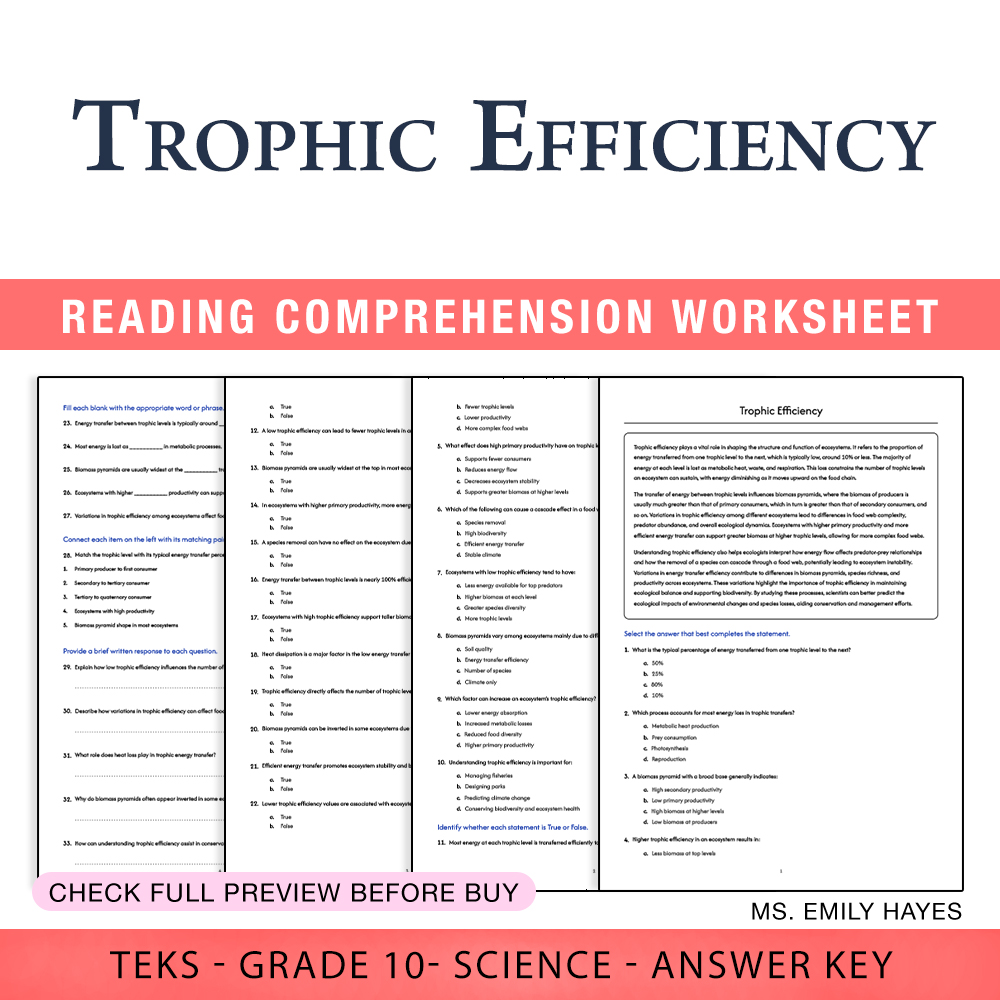
Grade 10 Science | Trophic Efficiency Worksheet (PDF+ Answer Key)
 Created byCopper Leaf Classroom
Learning Objectives
- Understand the concept of trophic efficiency and how energy transfer between trophic levels affects ecosystems.
- Analyze the factors influencing biomass pyramids and trophic levels in various ecosystems.
- Evaluate the ecological significance of variations in trophic efficiency and primary productivity.
Instant download
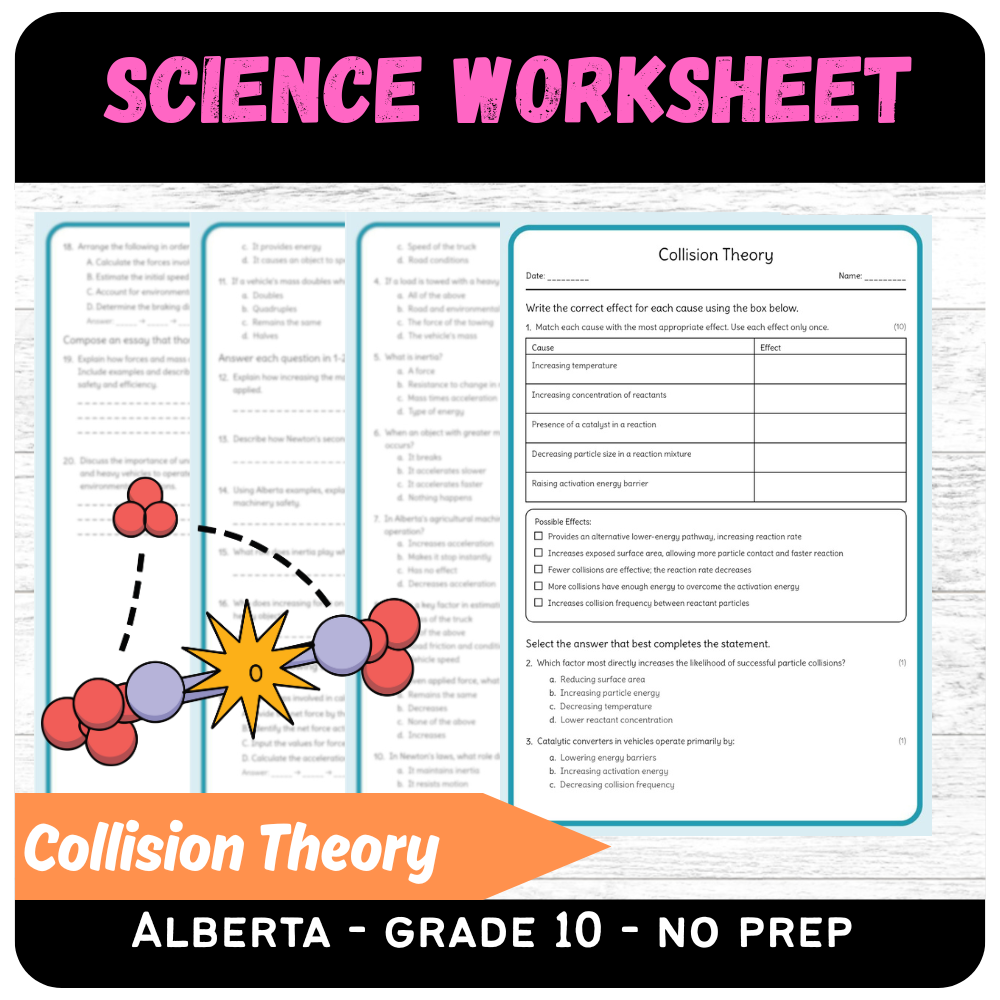
Grade 10 Science – Collision Theory Worksheet (PDF) - Alberta Standard
Created byBright Mind ResourcesLearning Objectives
- Explain how molecular collisions influence chemical reaction rates.
- Describe the role of activation energy and energy barriers in reactions.
- Analyze real-world examples such as catalytic converters and refinery catalysts to understand collision effects.
Instant download

Grade 10 Science – Motion Description Worksheet (PDF) Aligned with BC Standards
Created byEvergreen Desk EducationLearning Objectives
- Distinguish between position, displacement, speed, and velocity and explain how scalar/vector ideas apply to motion.
- Use time intervals and reference frames to interpret numerical motion values and motion graphs.
- Apply constant-acceleration relationships to predict future motion and explain acceleration using kinematic descriptions.
Instant download

Grade 10 Science | Mechanical Systems Worksheet (BC Standards) (PDF)
Created byEvergreen Desk EducationLearning Objectives
- Explain how mechanical systems transfer and transform energy using forces and motion.
- Analyze how mechanical advantage from levers, pulleys, and gears affects speed and force.
- Evaluate how friction and constraints (e.g., bearings, lubrication) reduce efficiency.
Instant download

Science Measurement Based Prototyping Worksheet for Grade 10 | Standards-Aligned
JCreated byJ.S SheetsLearning Objectives
- Explain how prototypes provide evidence for evaluating design performance using measurements.
- Connect design features to measurable outcomes and justify comparisons across test conditions.
- Describe sources of variation and limits of measurement and how they affect conclusions.
Also included in: Grade 10 Trade-Offs and Prototyping Science Lesson Bundle | General +1 more
Instant download
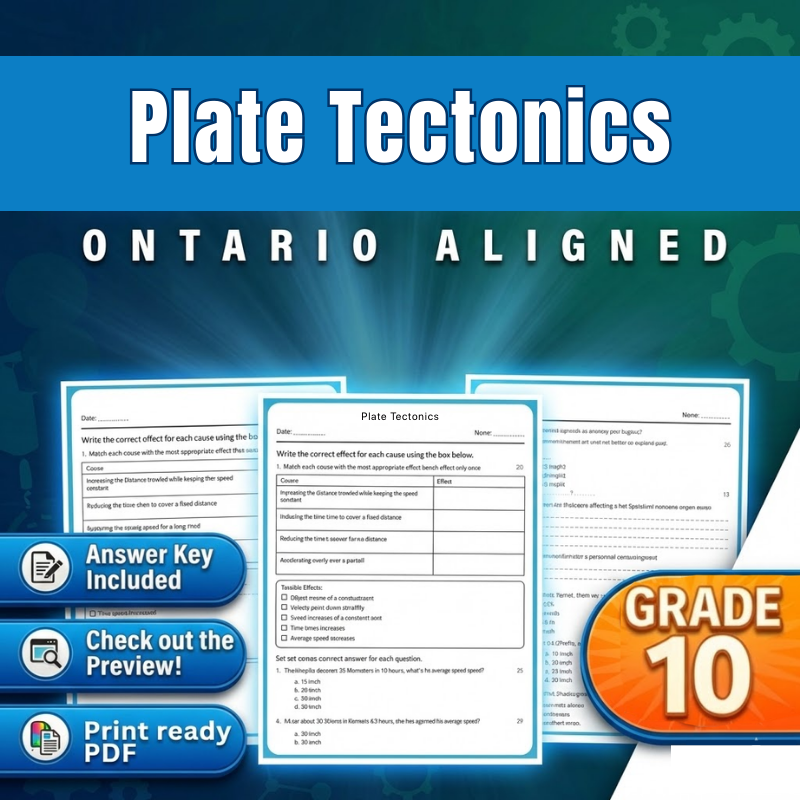
Grade 10 Science | Plate Tectonics Worksheet (Ontario Standards) (PDF)
Created byBright Mind ResourcesLearning Objectives
- Describe the different types of plate boundaries and their geological features.
- Explain the driving mechanisms that cause plate motions such as mantle convection and slab pull.
- Identify the geological outcomes of plate interactions including seafloor spreading, subduction, and orogeny.
Instant download

Tone and Style Worksheet for Grade 10 ELA | Standards-Aligned Practice
JCreated byJ.S SheetsLearning Objectives
- Identify how word choice (diction) and sentence rhythm create a specific tone (neutral, persuasive, reflective, formal).
- Revise sentences to maintain consistent voice and avoid mismatched formality or abrupt slang-like wording.
- Explain how modifiers and grammatical choices affect a writer’s attitude and the reader’s understanding.
Instant download

Grade 10 Science | Human Impacts on Biodiversity - Daily Reading Comprehension
Created byCoral Reef LearningLearning Objectives
- Understand how human activities contribute to habitat fragmentation and land-use change.
- Identify the effects of pollution, overexploitation, and invasive species on ecosystems.
- Recognize how climate change impacts species distribution and behavior.
Instant download
Browse more categories
About Grade 10 Worksheets
Find Grade 10 worksheets covering algebra, biology, literature, and history. All 9,388 resources download instantly as PDFs for classwork, homework, or review.
MyTeachingSheets worksheets are made by real teacher-authors and checked before they go live. Download any as a print-ready PDF for lessons, homework, or independent practice — most include answer keys, and previews are always free.