
Grade 7 Worksheets
8,459 grade resources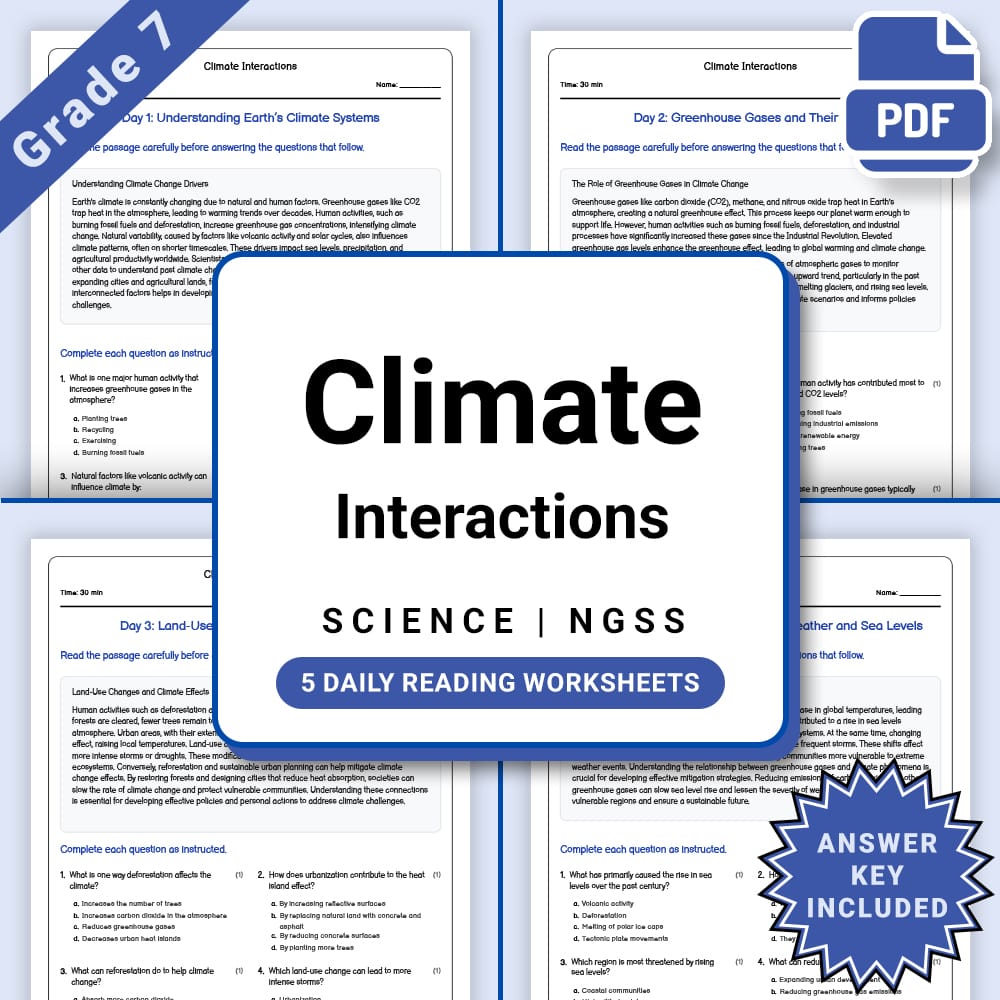
Grade 7 Science – Climate Interactions Worksheet(PDF + Answer Key)
 Created byCopper Leaf Classroom
Learning Objectives
- Analyze climate data such as temperature and CO2 records
- Identify patterns and drivers of climate change
- Assess impacts on sea levels, precipitation, and agriculture
Instant download
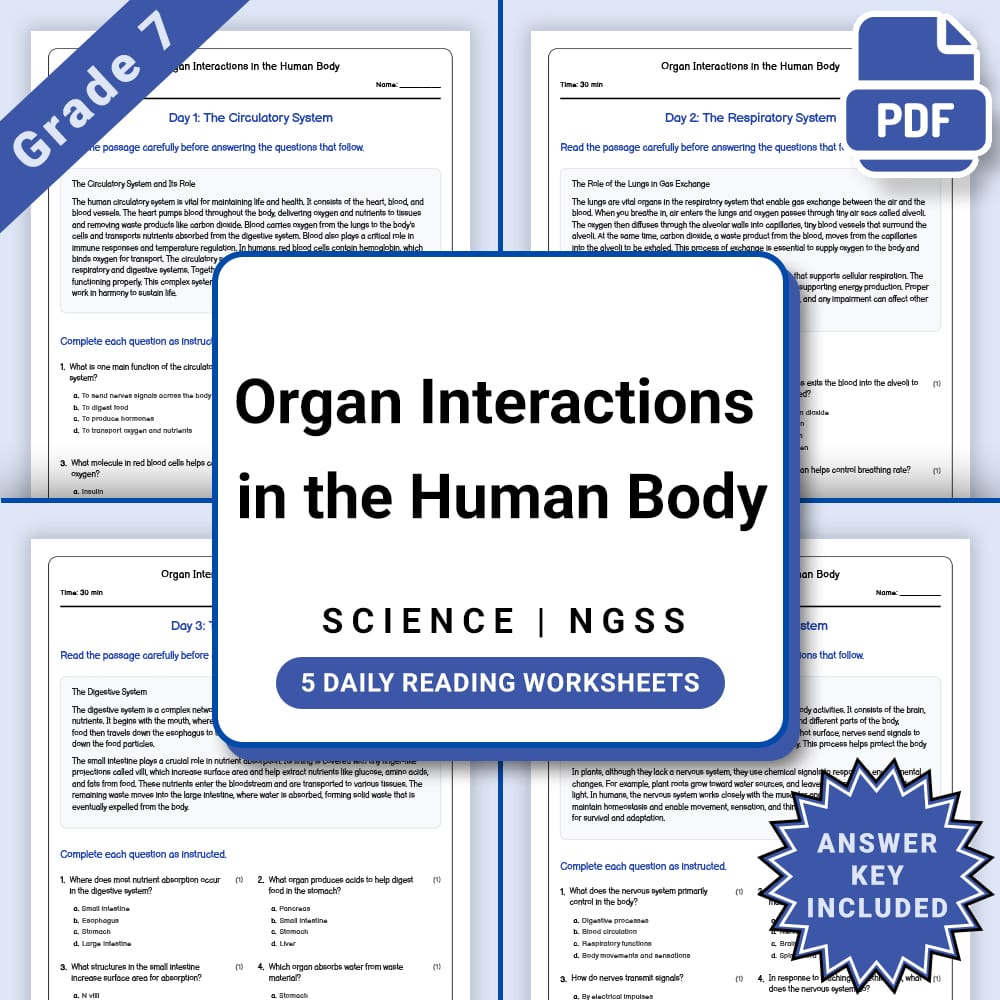
Grade 7 Science – Organ Interactions Daily Reading Worksheet(PDF + Answer Key)
Created byCopper Leaf ClassroomLearning Objectives
- Understand the structure and function of the human circulatory system.
- Explain how blood transports oxygen and nutrients to organs and tissues.
- Identify the roles of different blood components, including hemoglobin.
Instant download
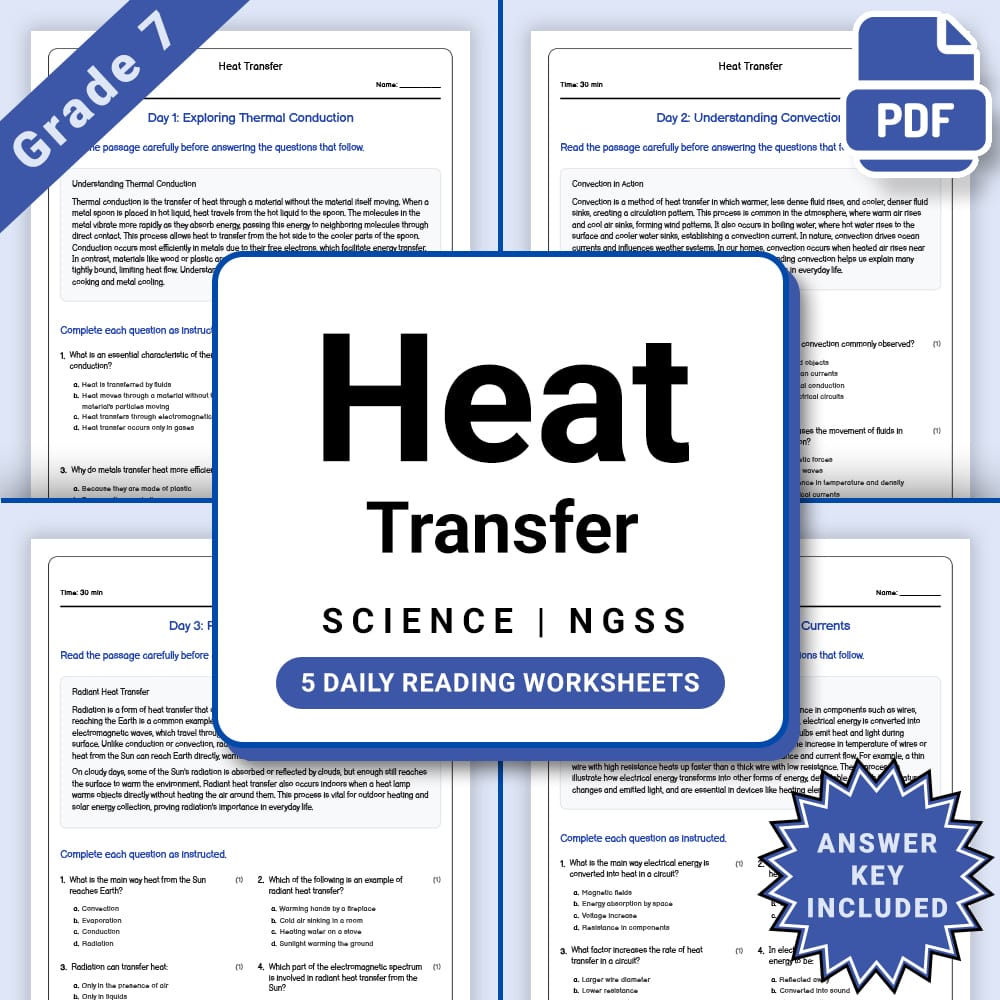
Grade 7 Science – Heat Transfer Daily Reading Worksheet(PDF + Answer Key)
Created byCopper Leaf ClassroomLearning Objectives
- Understand the concept of thermal conduction and how energy transfers through direct contact.
- Identify examples of conduction in everyday life.
- Explain how heat flows from hot to cold objects via conduction.
Instant download
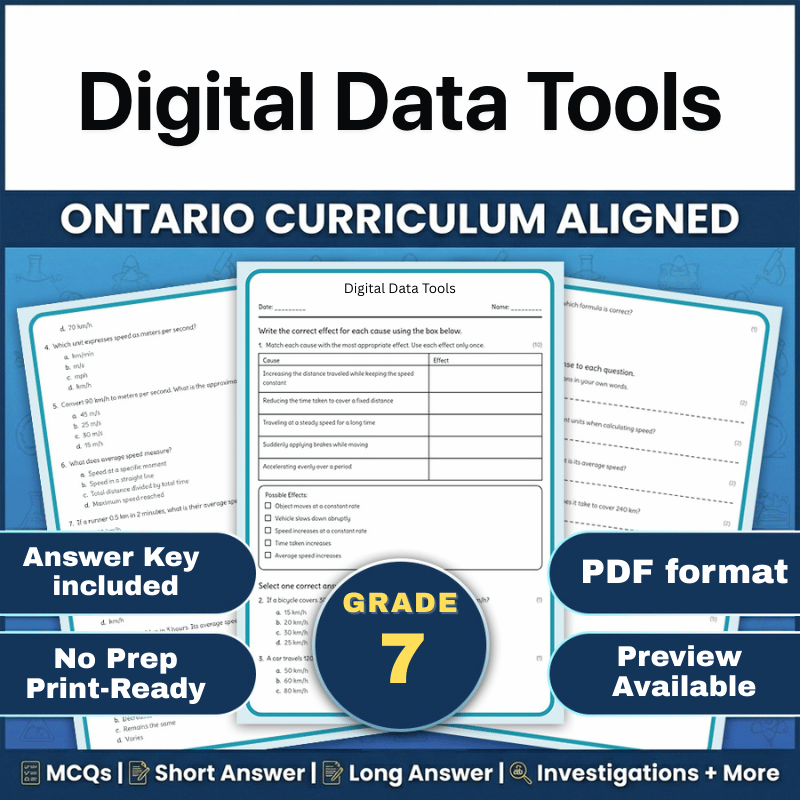
Grade 7 Science | Digital Data Tools Worksheet (Ontario) - PDF
 Created byBright Mind Resources
Learning Objectives
- Identify various digital tools used for data acquisition and organization.
- Understand formats such as CSV, timestamps, and metadata tags that facilitate data interoperability.
- Explain the advantages and limitations of automated logging systems.
Instant download
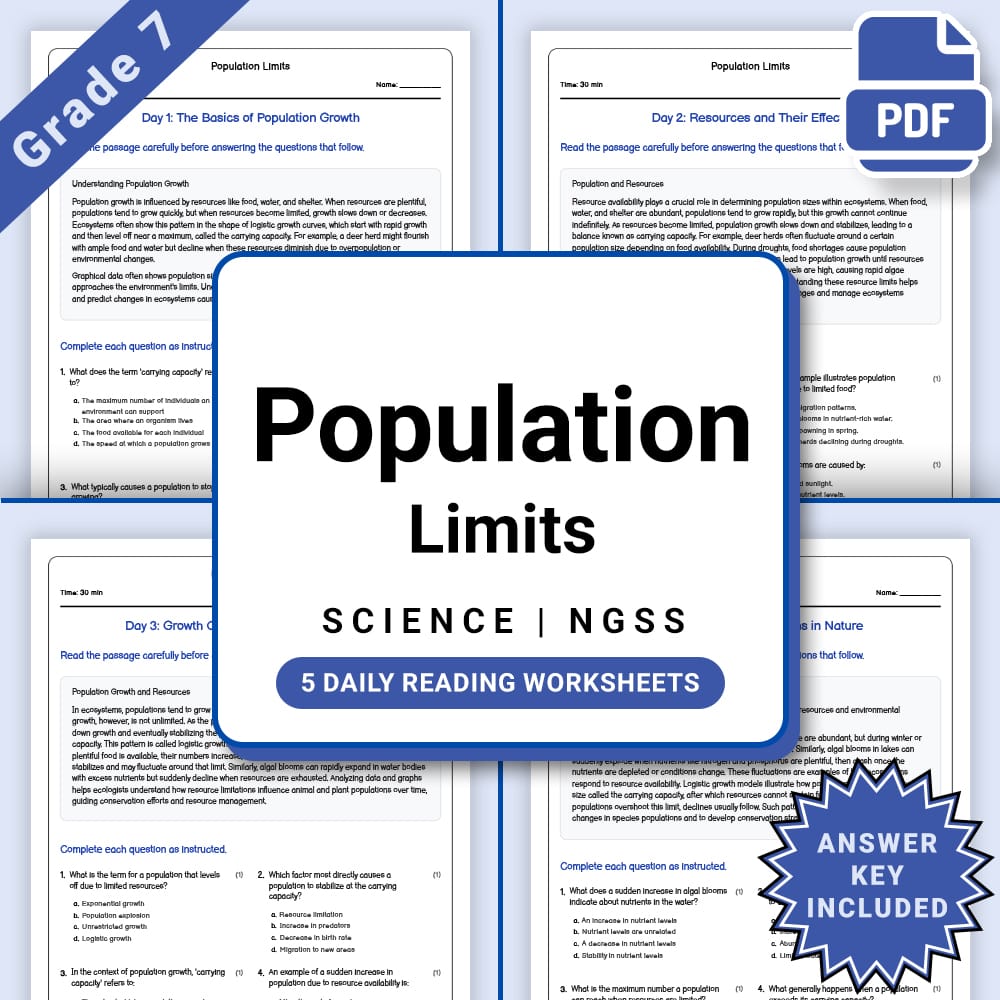
Grade 7 Science – Population Limits Daily Reading Worksheet(PDF + Answer Key)
Created byCopper Leaf ClassroomLearning Objectives
- Understand the concept of carrying capacity and how resource availability influences population size.
- Interpret simple graphical data depicting population changes over time.
- Explain how factors like food, water, and shelter affect animal populations.
Instant download
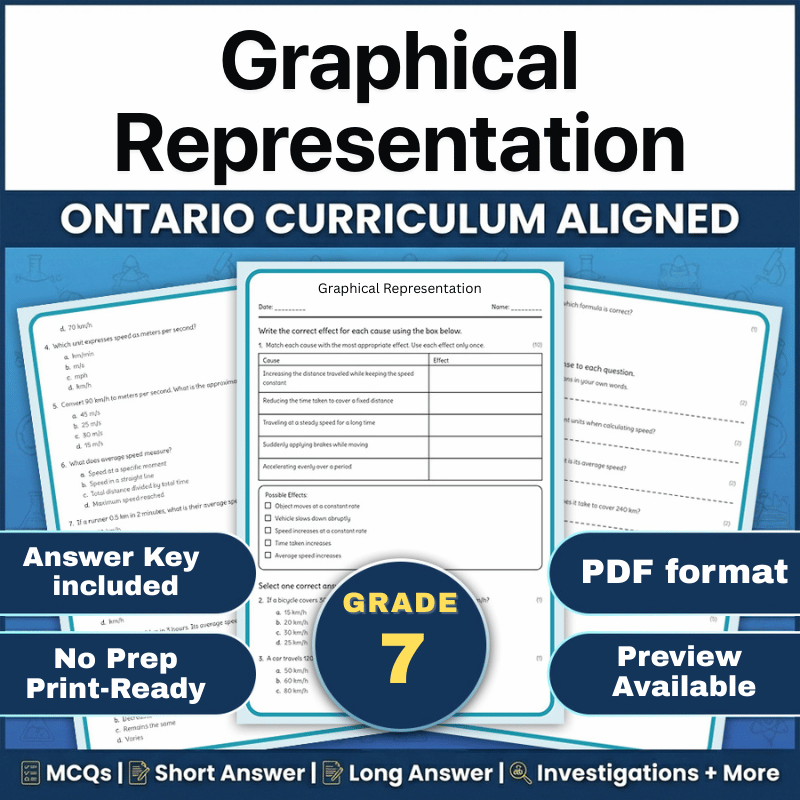
Grade 7 Science | Graphical Representation Worksheet (Ontario) (PDF)
Created byBright Mind ResourcesLearning Objectives
- Understand the different types of graphs and when to use each.
- Learn how to construct and interpret bar charts, histograms, line graphs, and scatter plots.
- Recognize the importance of axis scaling, error bars, trend lines, and annotations for clarity.
Instant download
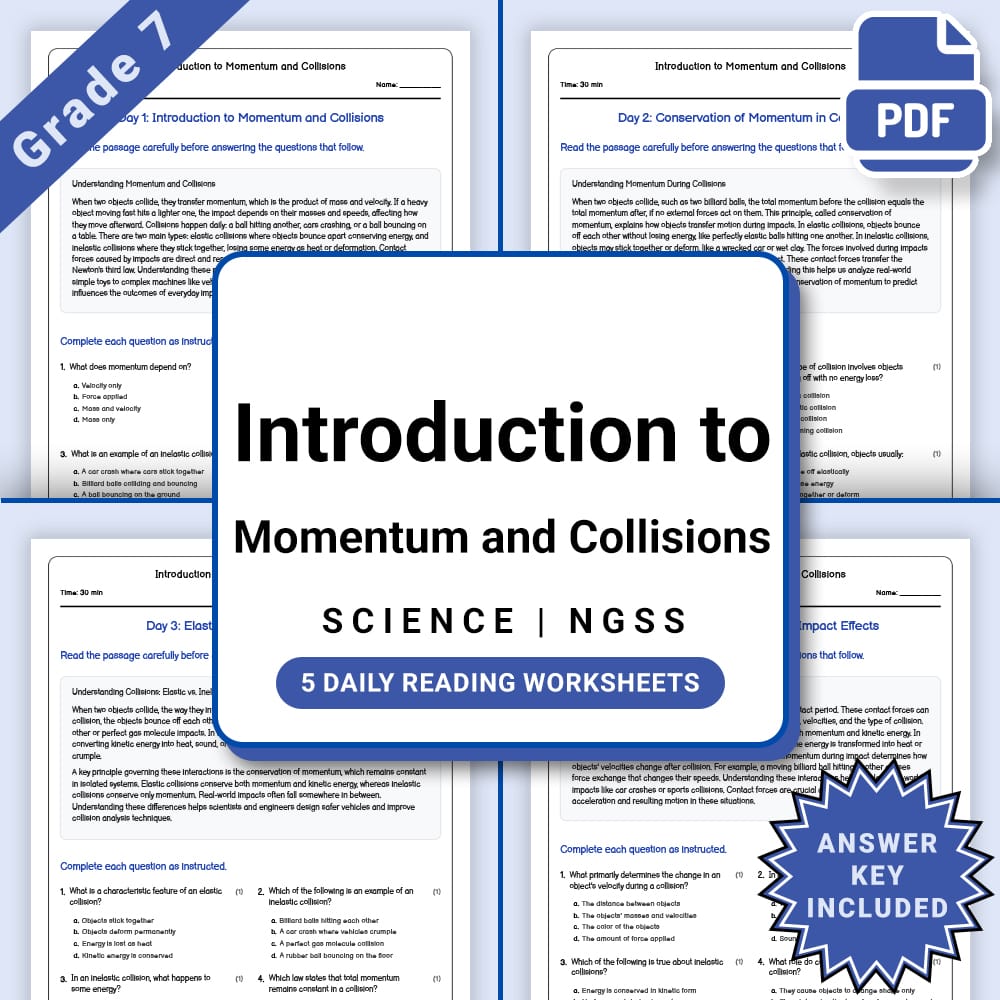
Grade 7 Science – Introduction to Momentum and Collisions (PDF + Answer Key)
Created byCopper Leaf ClassroomLearning Objectives
- Understand the basic concepts of momentum and collisions.
- Identify how momentum is transferred during impacts.
- Differentiate between elastic and inelastic collisions.
Instant download
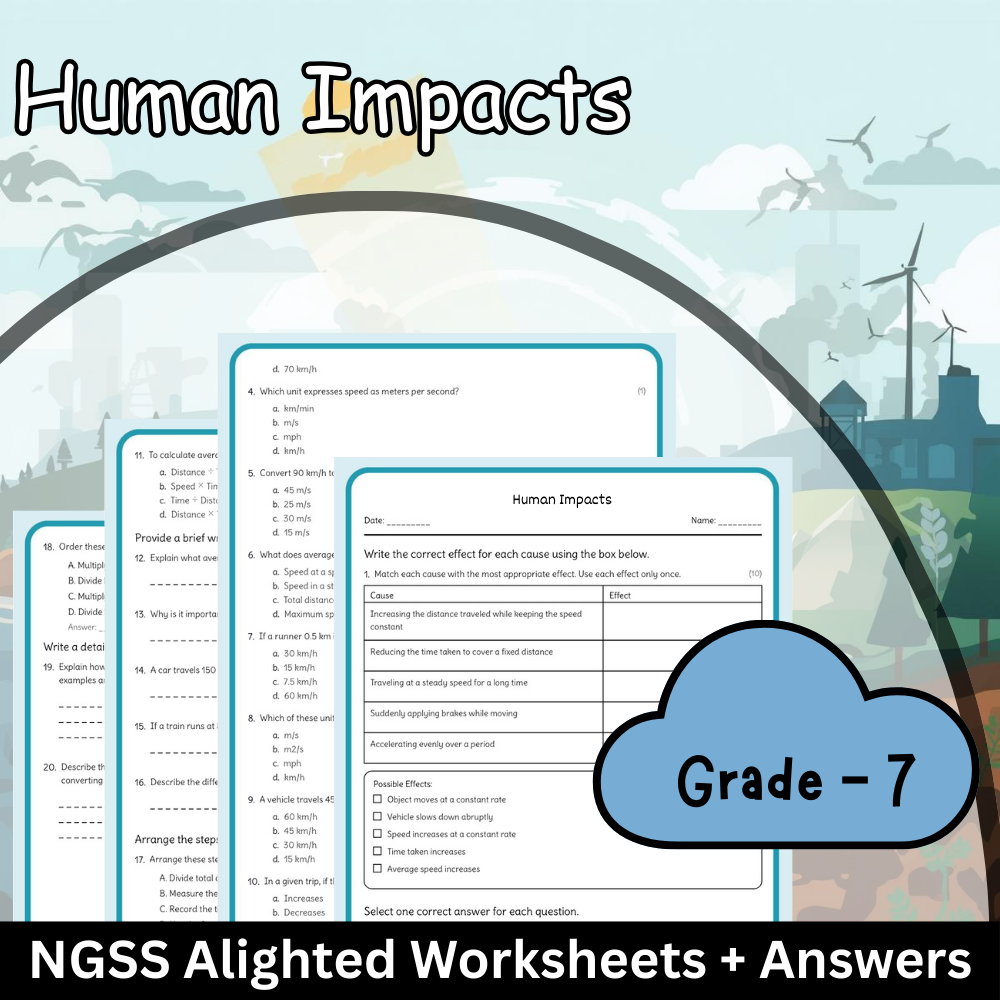
7th Grade Science | Human Impacts Worksheet (PDF) Aligned with NGSS
Created byBright Mind ResourcesLearning Objectives
- Understand the human activities that impact ecosystems and environment.
- Analyze how scientific indicators are used to monitor environmental changes.
- Evaluate mitigation strategies to reduce negative human impacts on ecosystems.
Instant download
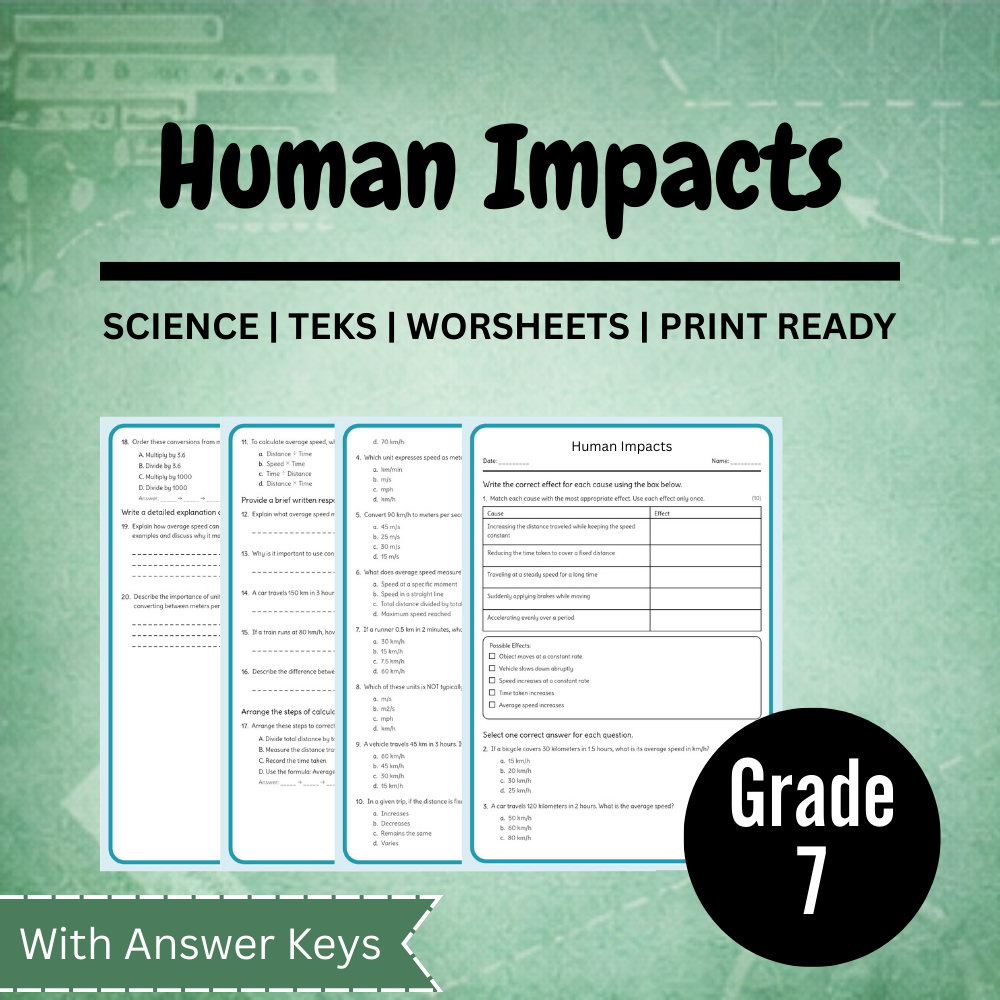
Grade 7 Science – Human Impacts Worksheet (Worksheet + Answer Key) – TEKS Aligned
Created byBright Mind ResourcesLearning Objectives
- Identify major human activities that alter ecosystems, such as habitat fragmentation and pollution.
- Explain how invasive species and pollution affect biodiversity and ecosystem resilience.
- Describe mitigation and restoration strategies for ecosystems impacted by human activities.
Also included in: Grade 7 Science Unit Bundle – Ecosystems, Adaptation & Environmental Impact +2 more
Instant download
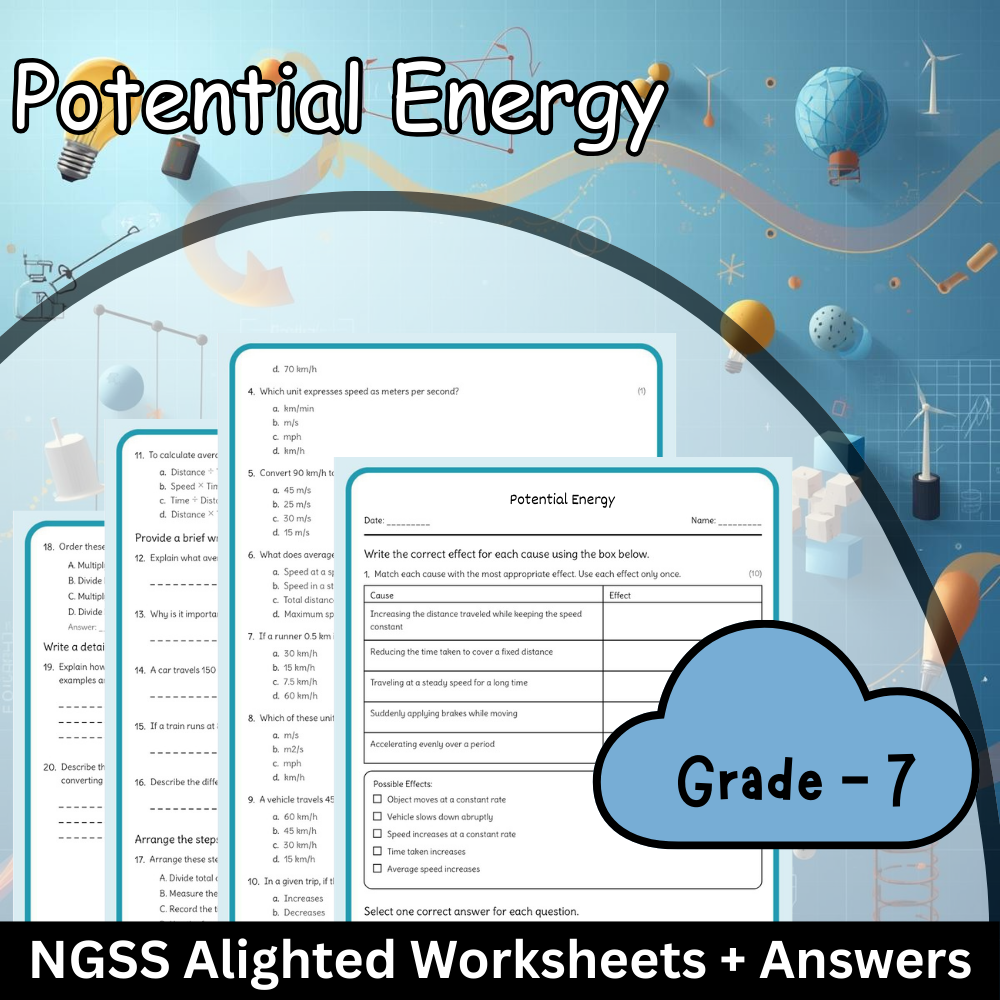
Grade 7 Science | Potential Energy Worksheet (Worksheet + Answer Key) NGSS
Created byBright Mind ResourcesLearning Objectives
- Understand the concept of potential energy and how it is stored in different systems.
- Identify examples of gravitational, elastic, and magnetic potential energy.
- Explain how spatial arrangements affect stored energy in systems.
Instant download
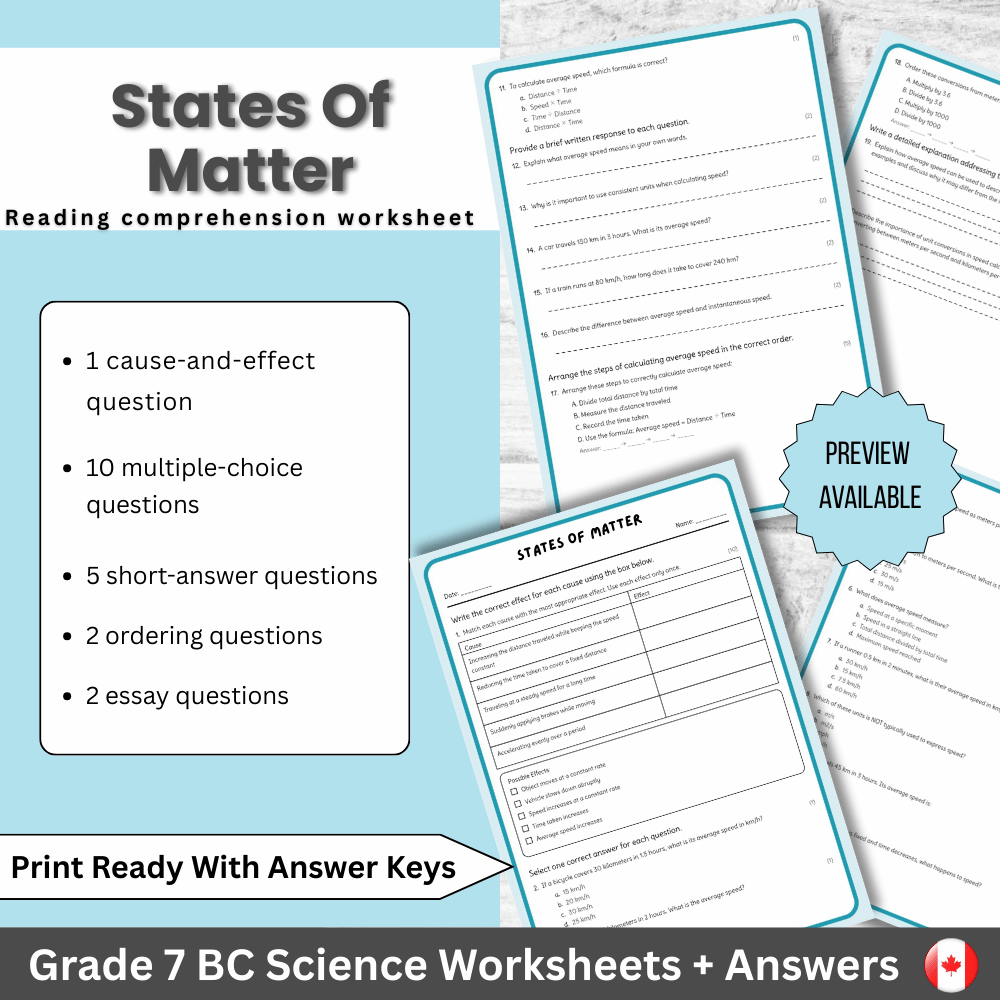
7th Grade Science | States of Matter Worksheet (Answer Key) – BC Standards
Created byBright Mind ResourcesLearning Objectives
- Understand the particle arrangements, spacing, and movement in solids, liquids, and gases.
- Describe how temperature and pressure influence state changes.
- Identify observable characteristics that classify substances as solids, liquids, or gases.
Instant download
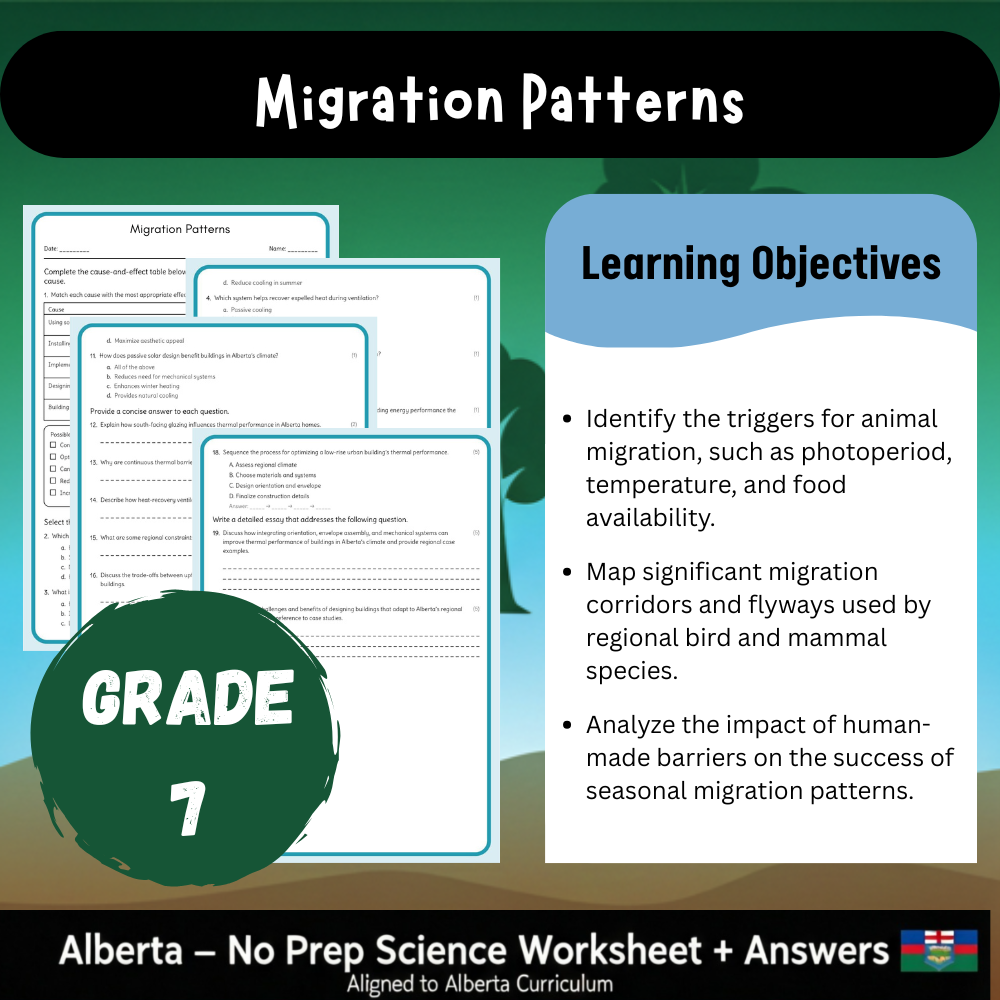
Grade 7 Science | Migration Patterns Worksheet (PDF) – Alberta Standards
Created byBright Mind ResourcesLearning Objectives
- Understand the factors that influence seasonal and annual animal migration
- Identify examples of migration corridors and flyways in Alberta
- Explain how migration connects ecosystems across regions
Instant download
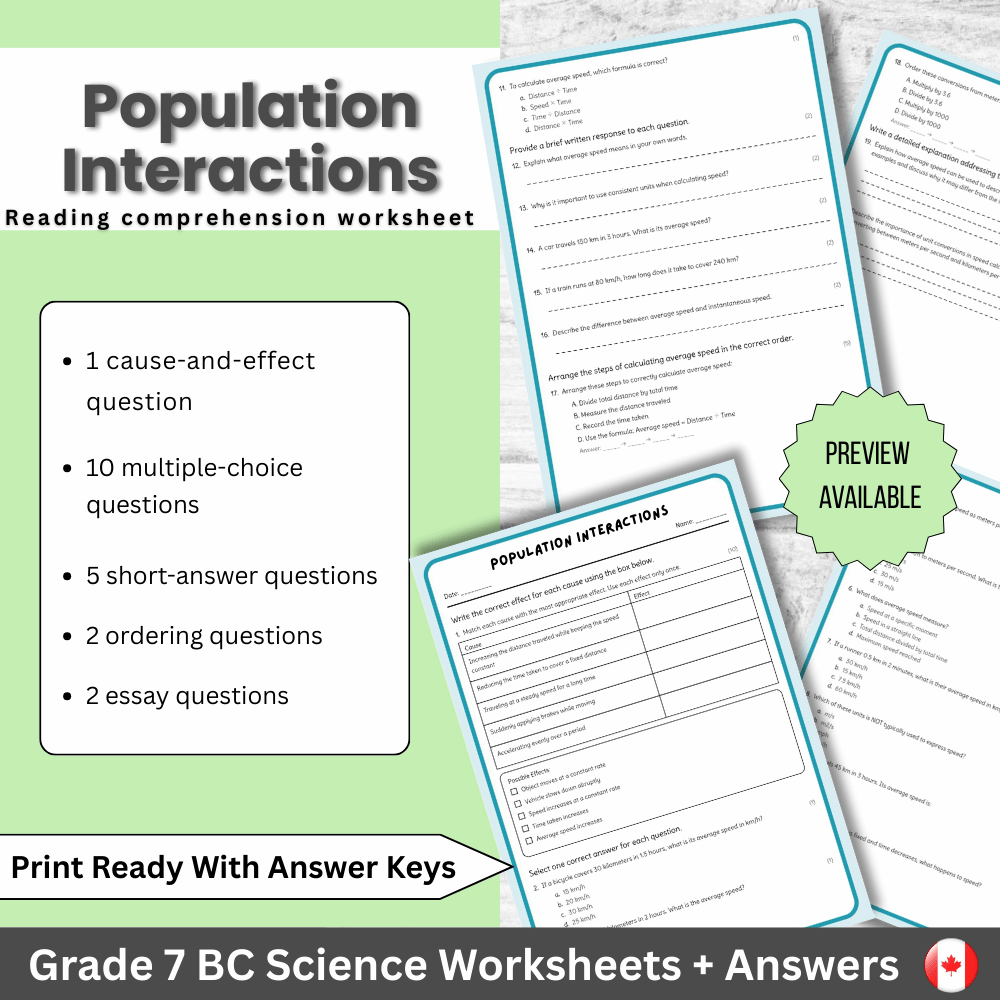
Grade 7 Science | Population Interactions Worksheet (Answer Key) – BC Standards
Created byBright Mind ResourcesLearning Objectives
- Identify and describe different types of population interactions such as competition, predation, and mutualism.
- Explain how species coexistence is facilitated through niche partitioning, temporal separation, or habitat differentiation.
- Analyze mechanisms that stabilize or destabilize populations within communities.
Instant download
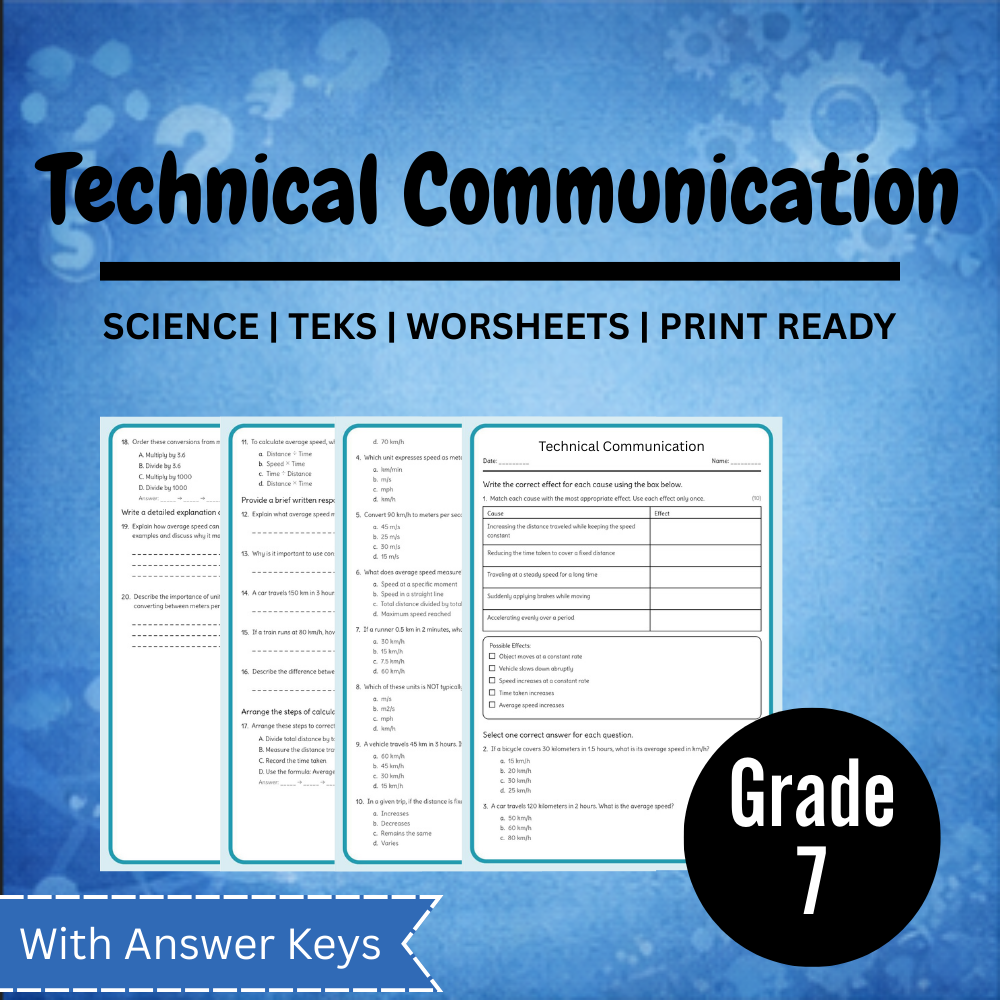
Grade 7 Science | Technical Communication Worksheet (Worksheet + Answer Key) – TEKS Aligned
Created byBright Mind ResourcesLearning Objectives
- Identify and understand the conventions used in technical drawings and diagrams.
- Recognize standardized symbols, units, and labels used in engineering documentation.
- Explain the importance of clarity and unambiguity in technical communication.
Also included in: Grade 7 Science Unit Bundle | Standards, Safety, Innovation & Systems Aligned TEKS +2 more
Instant download
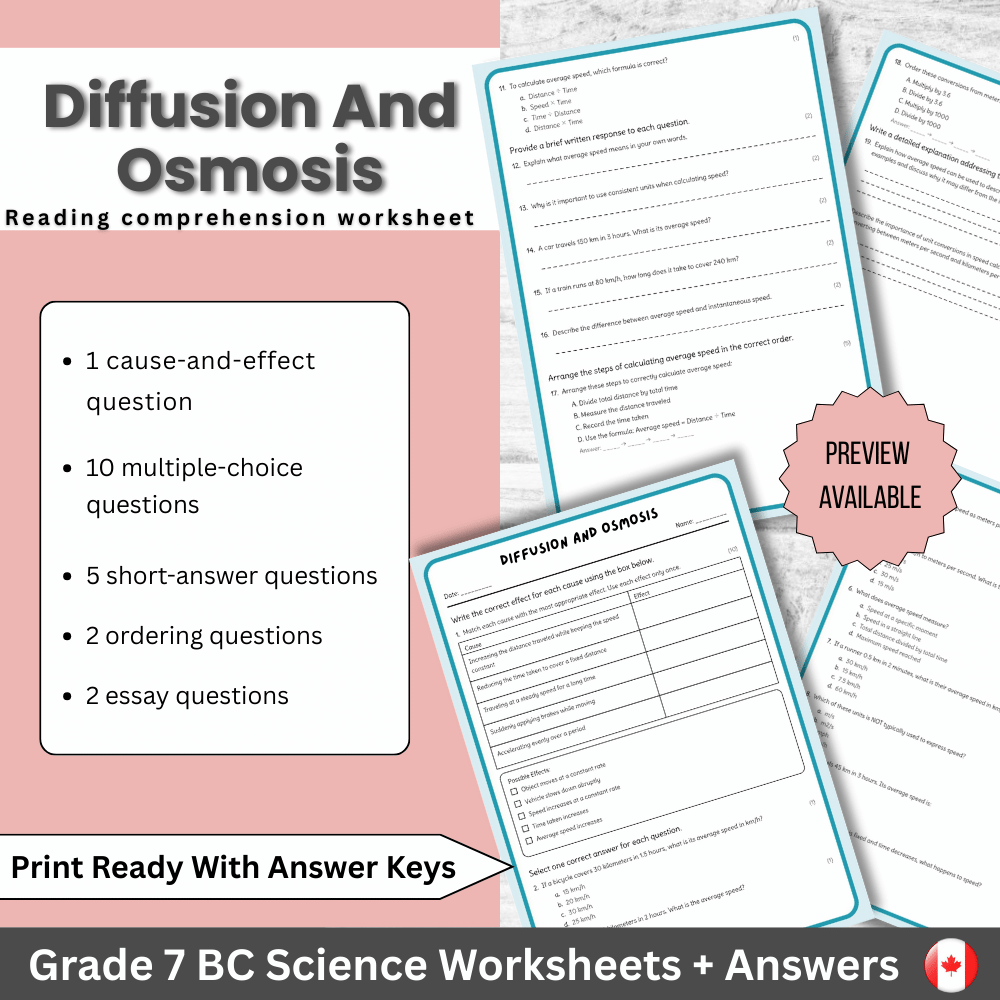
Grade 7 Science | Diffusion & Osmosis Worksheet – BC Standards (PDF)
Created byBright Mind ResourcesLearning Objectives
- Understand the processes of diffusion and osmosis as passive transport mechanisms.
- Identify factors influencing the rates of diffusion and osmosis.
- Explain how diffusion and osmosis affect cells and organisms.
Instant download
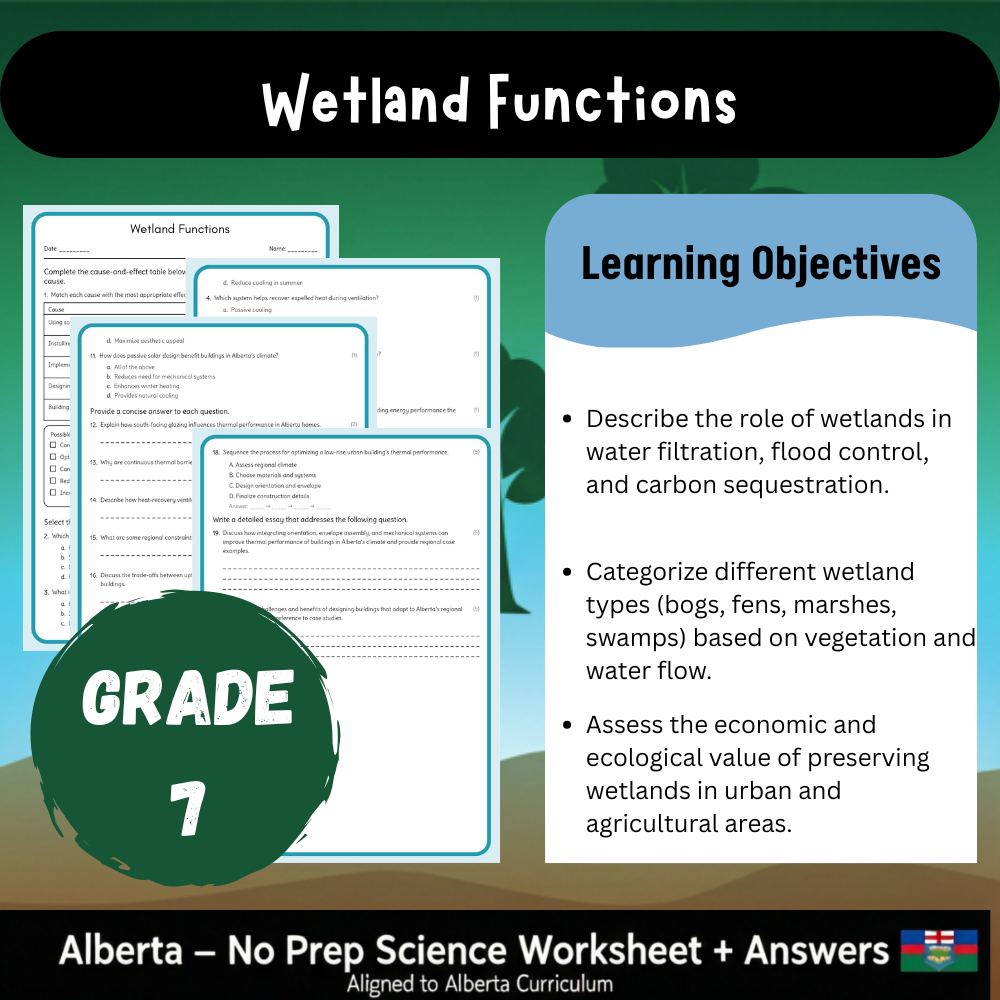
Grade 7 Science | Wetland Functions Worksheet (PDF) – Alberta Standards
Created byBright Mind ResourcesLearning Objectives
- Describe the hydrological, chemical, and biological functions of wetlands.
- Identify examples of wetland types and their ecological roles.
- Explain how wetlands contribute to landscape water regulation and biodiversity.
Instant download
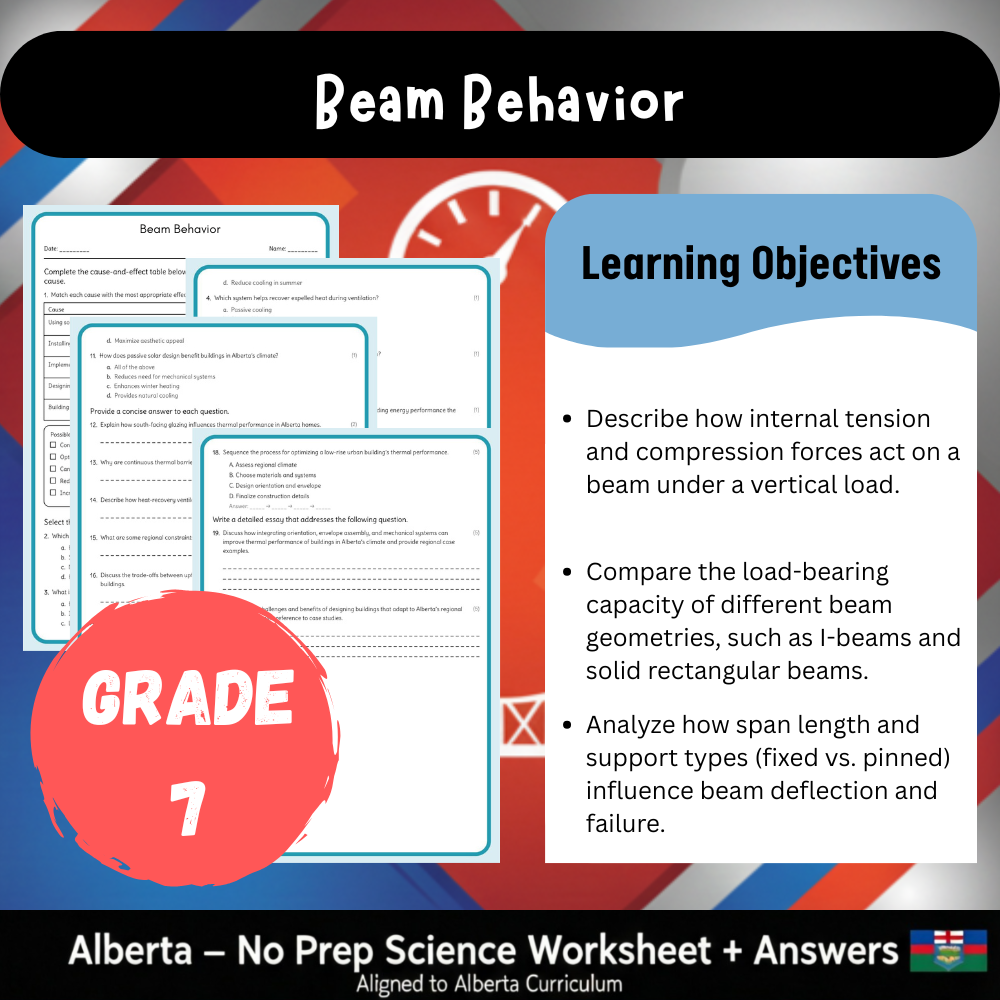
Grade 7 Science worksheet | Beam Behavior – Support & Load Analysis (PDF)
Created byBright Mind ResourcesLearning Objectives
- Understand the concepts of span, support conditions, and load types in beam performance.
- Identify how beam materials and geometries influence stability and comfort.
- Relate beam behavior to real-world examples like overpass girders and floor joists.
Instant download
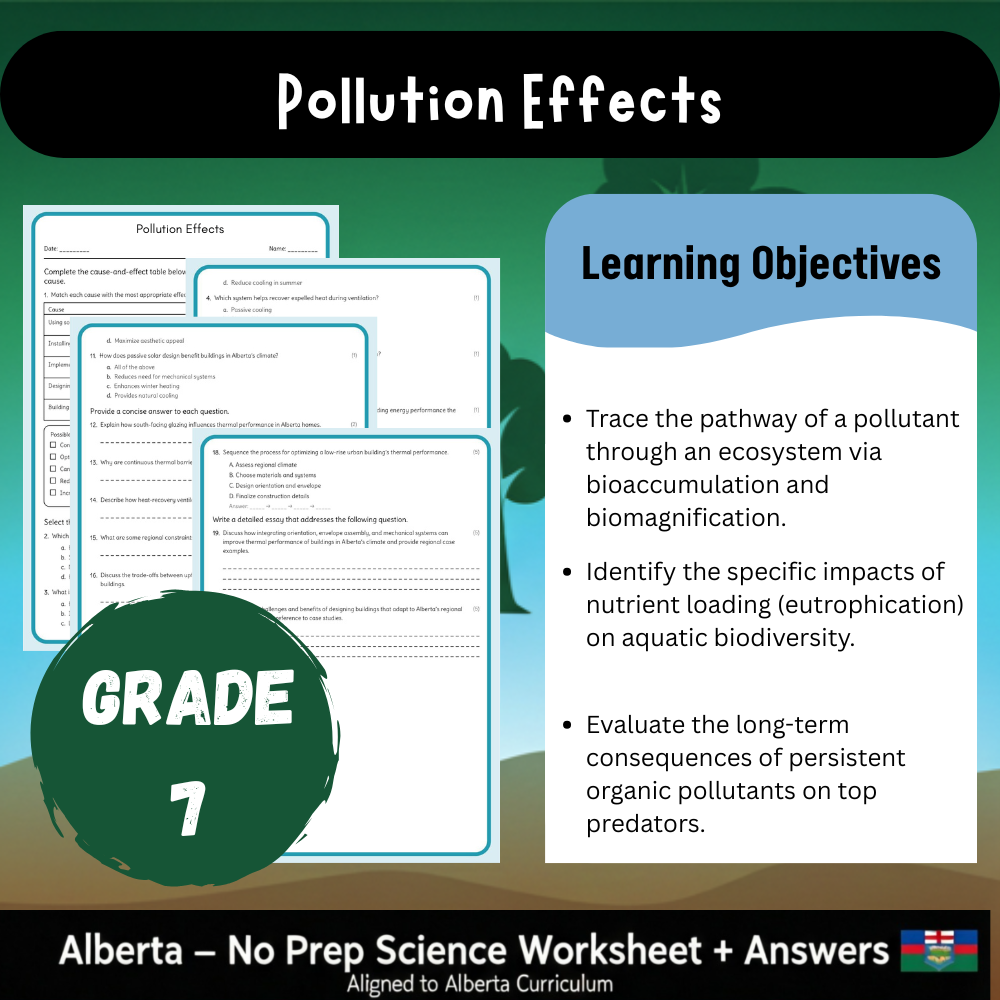
Grade 7 Science | Pollution Effects Worksheet (PDF) – Alberta Standards
Created byBright Mind ResourcesLearning Objectives
- Understand how different types of pollutants affect terrestrial and aquatic ecosystems.
- Identify sources of nutrient runoff, hydrocarbons, and airborne deposition in Alberta.
- Explain pathways of pollutant exposure and bioaccumulation risks.
Instant download
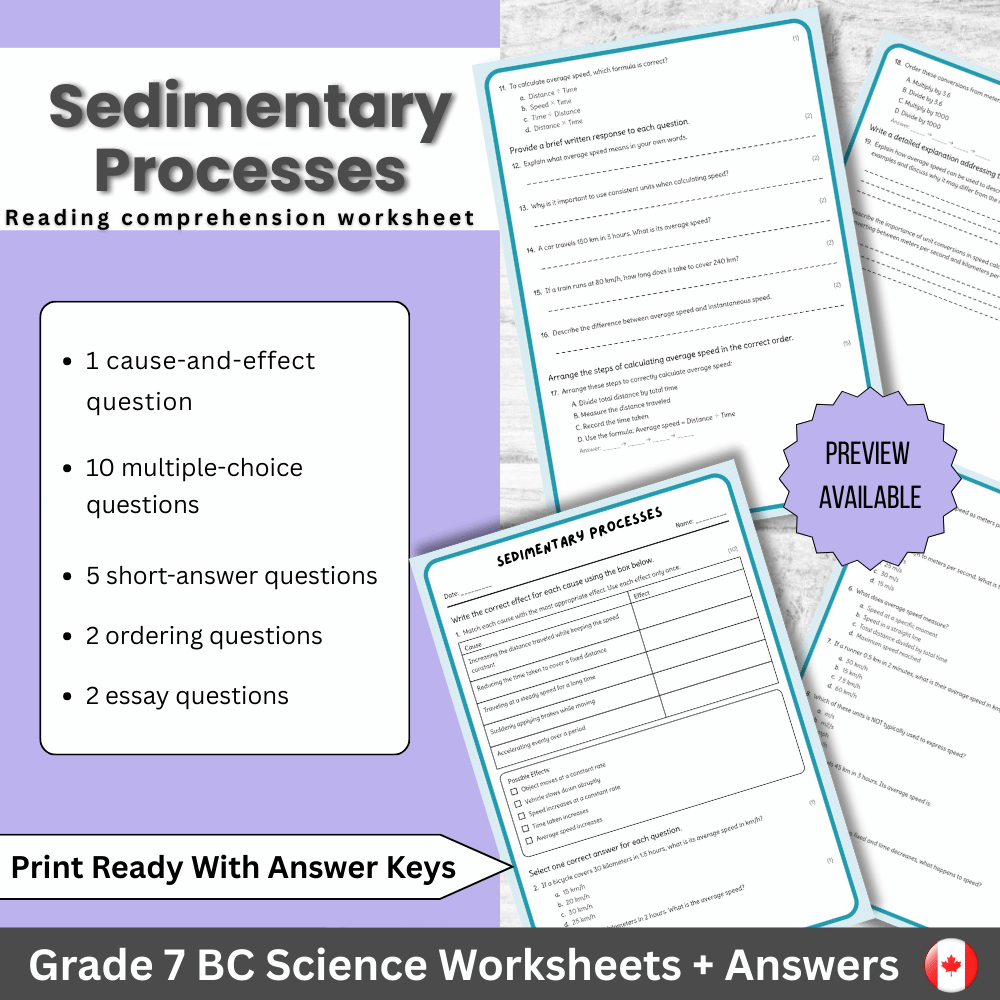
Grade 7 Science | Sedimentary Processes Worksheet (Answer Key) | BC Standards
Created byBright Mind ResourcesLearning Objectives
- Describe the steps involved in the formation of sedimentary rocks.
- Identify features of sedimentary environments such as bedding, fossils, and structures.
- Explain how mechanical and chemical weathering contribute to sediment formation.
Instant download
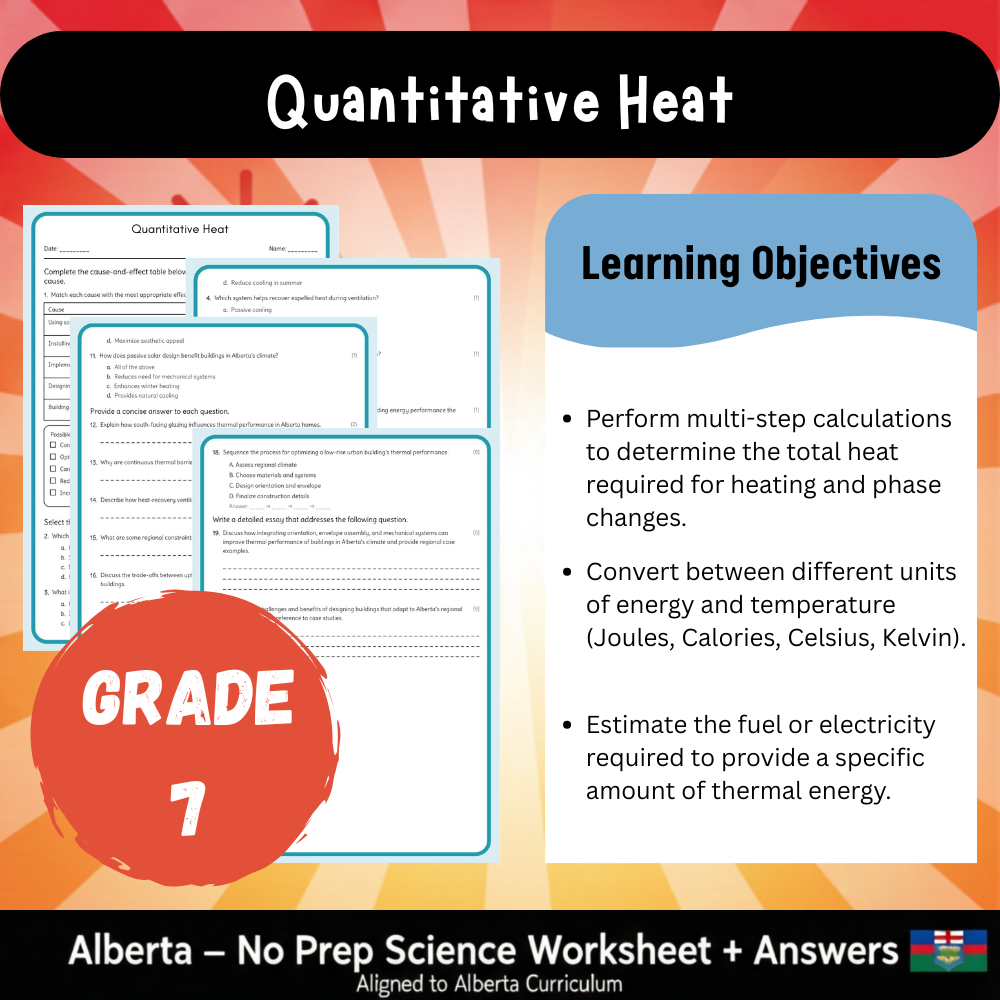
Grade 7 Science | Quantitative Heat Worksheet (PDF) – Alberta Standards
Created byBright Mind ResourcesLearning Objectives
- Understand how energy transfer in thermal processes is represented numerically.
- Apply formulas involving specific heat, mass, and temperature change to calculate energy transfer.
- Use practical examples to estimate energy needs in real-world settings like heating water or melting snow.
Instant download
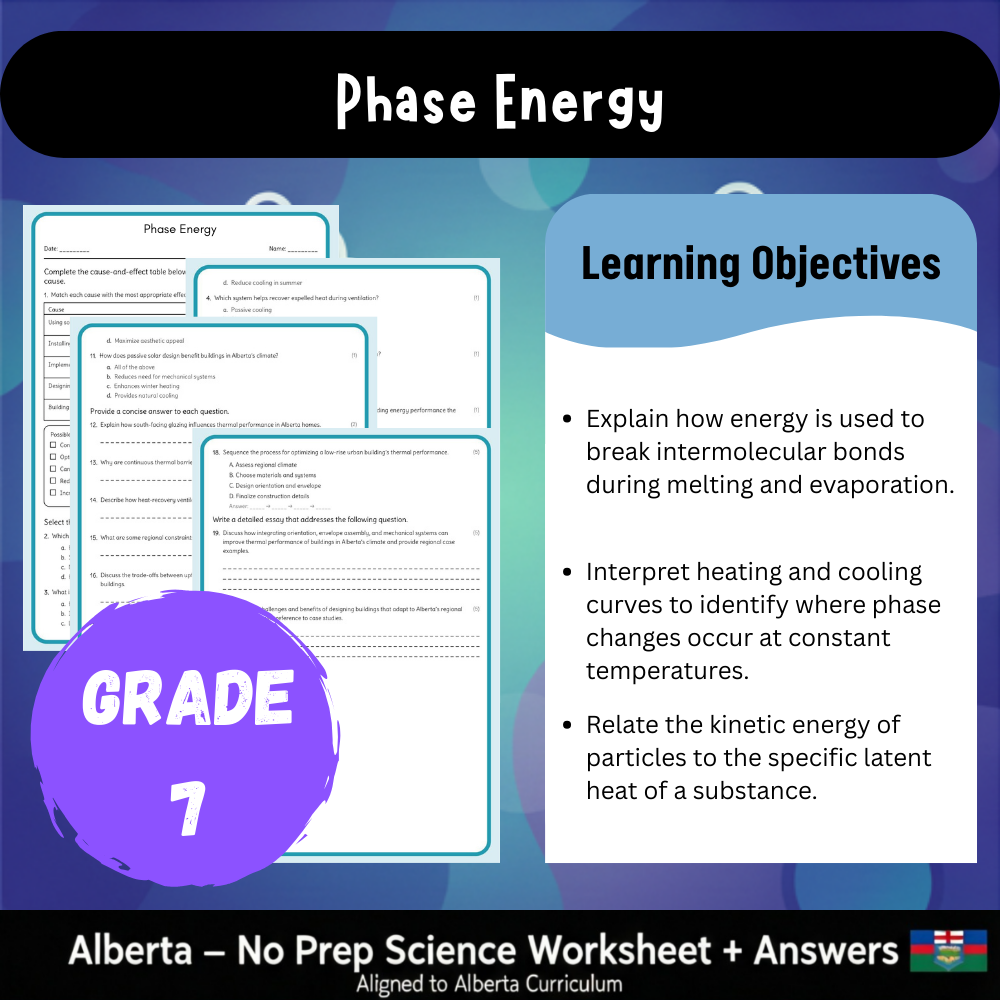
Grade 7 Science – Phase Energy Concept Worksheet (Worksheet + Answer Key) – Alberta Standards
Created byBright Mind ResourcesLearning Objectives
- Explain how phase changes reflect changes in particle kinetic and potential energy.
- Identify energy absorption and release during melting, freezing, evaporation, and condensation.
- Relate microscopic particle interactions to macroscopic energy phenomena.
Instant download
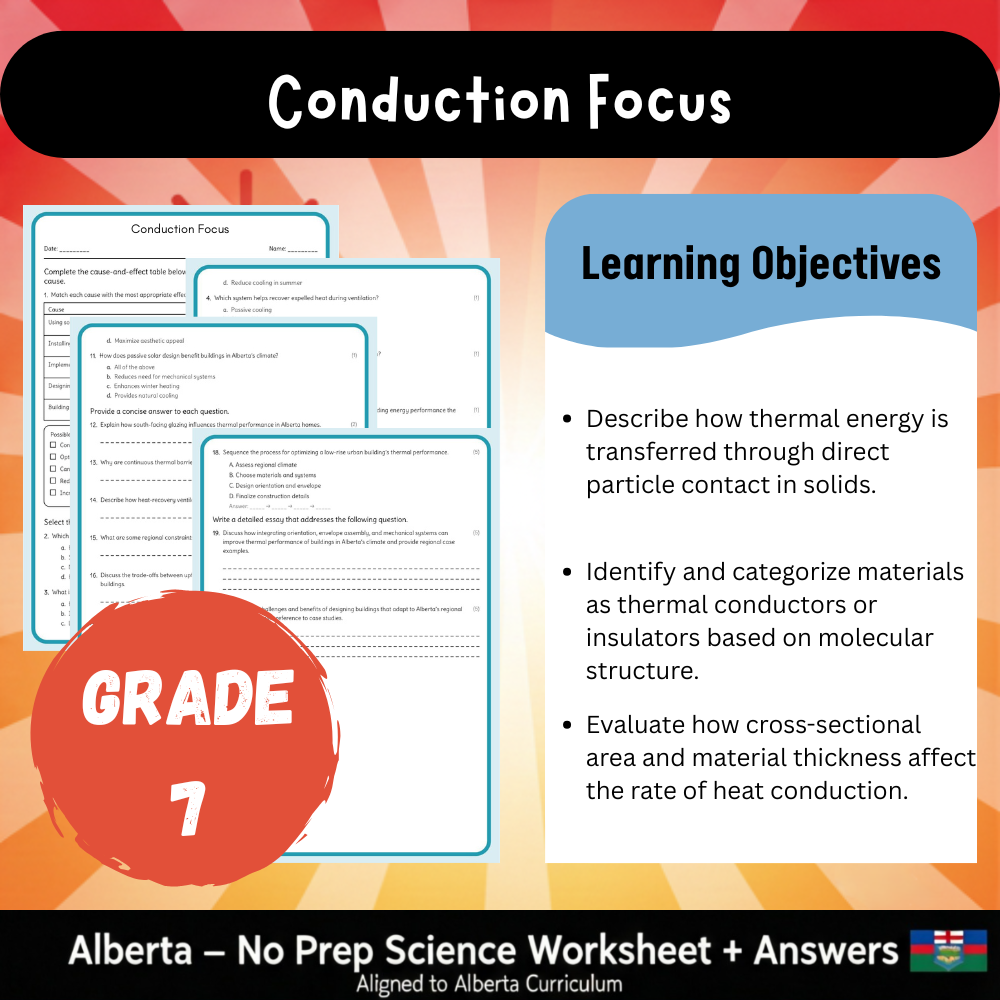
Grade 7 Science – Conduction Worksheet (PDF) Aligned with Alberta Standards
Created byBright Mind ResourcesLearning Objectives
- Understand the process of heat conduction and how it transfers energy within solids.
- Identify materials that are good conductors and insulators based on their properties.
- Explain how material properties influence heat transfer in regional structures.
Instant download
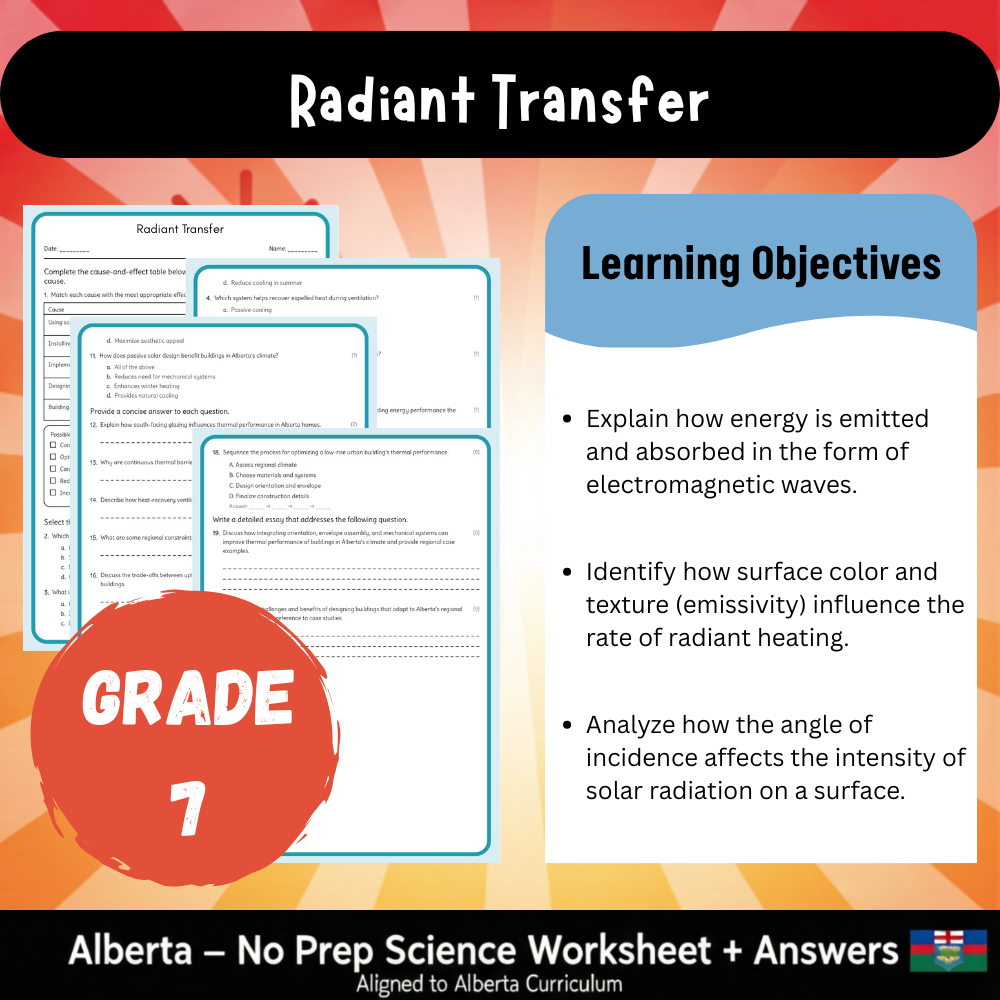
Grade 7 Science – Radiant Transfer Worksheet (PDF) | Alberta Standards
Created byBright Mind ResourcesLearning Objectives
- Explain the concept of radiant transfer and how energy moves through electromagnetic waves.
- Identify factors such as solar radiation intensity, surface absorptivity, and emissivity that affect radiative heating.
- Analyze how seasonal changes and surface types influence radiative balances and local microclimates.
Instant download
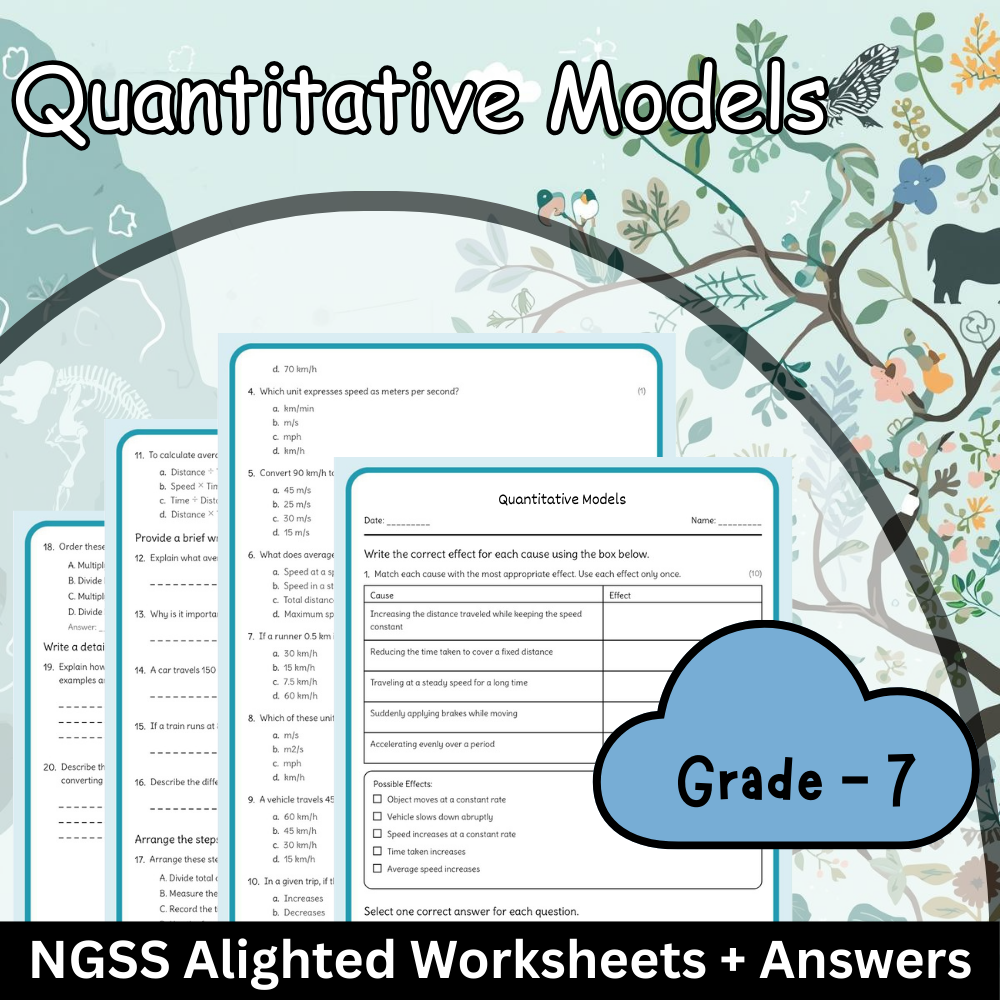
Grade 7 Science | Quantitative Models Worksheet (Answer Key) – NGSS Aligned
Created byBright Mind ResourcesLearning Objectives
- Understand how mathematical and statistical tools quantify traits, population dynamics, and evolutionary processes.
- Apply models like Hardy-Weinberg and probability-based inheritance to analyze genetic data.
- Interpret graphs and charts displaying fitness differentials and allele frequency changes.
Instant download
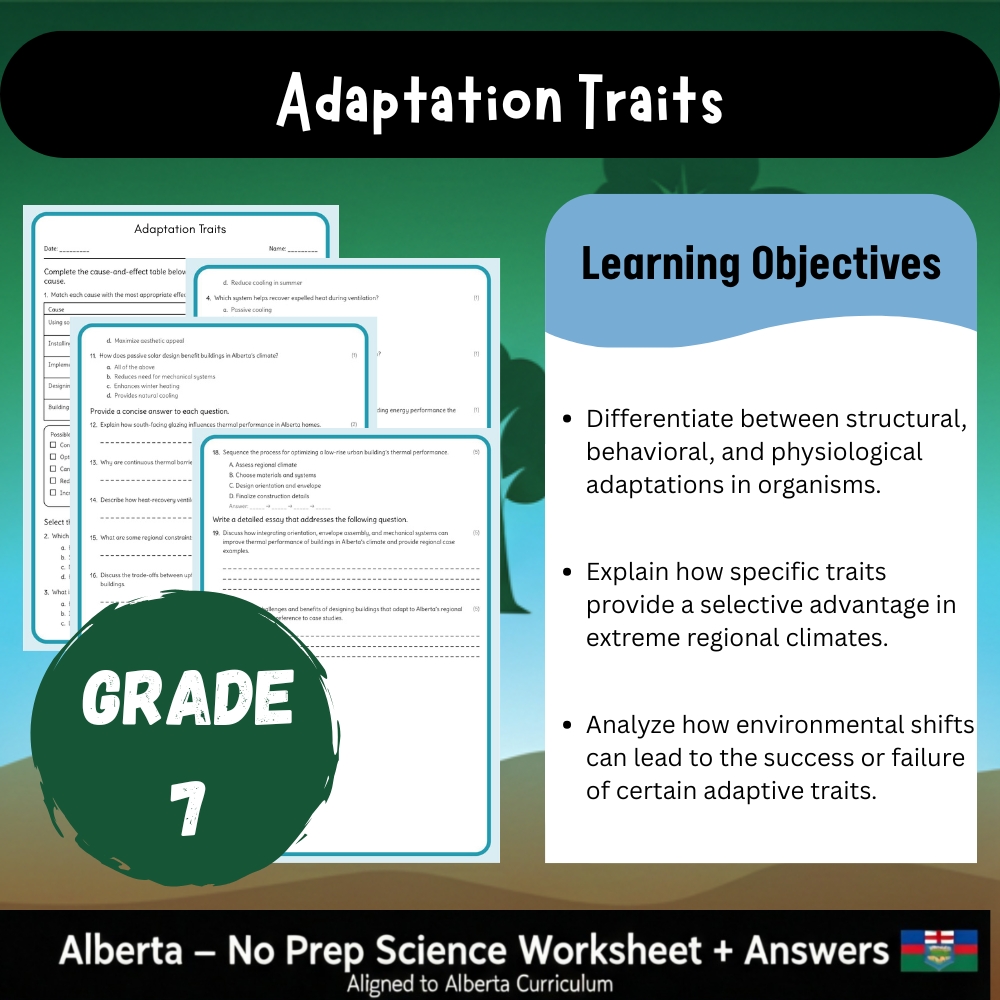
Grade 7 Science | Adaptation Traits Worksheet (PDF) – Alberta Standards
Created byBright Mind ResourcesLearning Objectives
- Define and identify structural, physiological, and behavioral adaptation traits in species.
- Explain how adaptive traits contribute to survival and reproduction in specific environments.
- Analyze examples of adaptation in boreal species, prairie plants, mammals, and root architectures.
Instant download
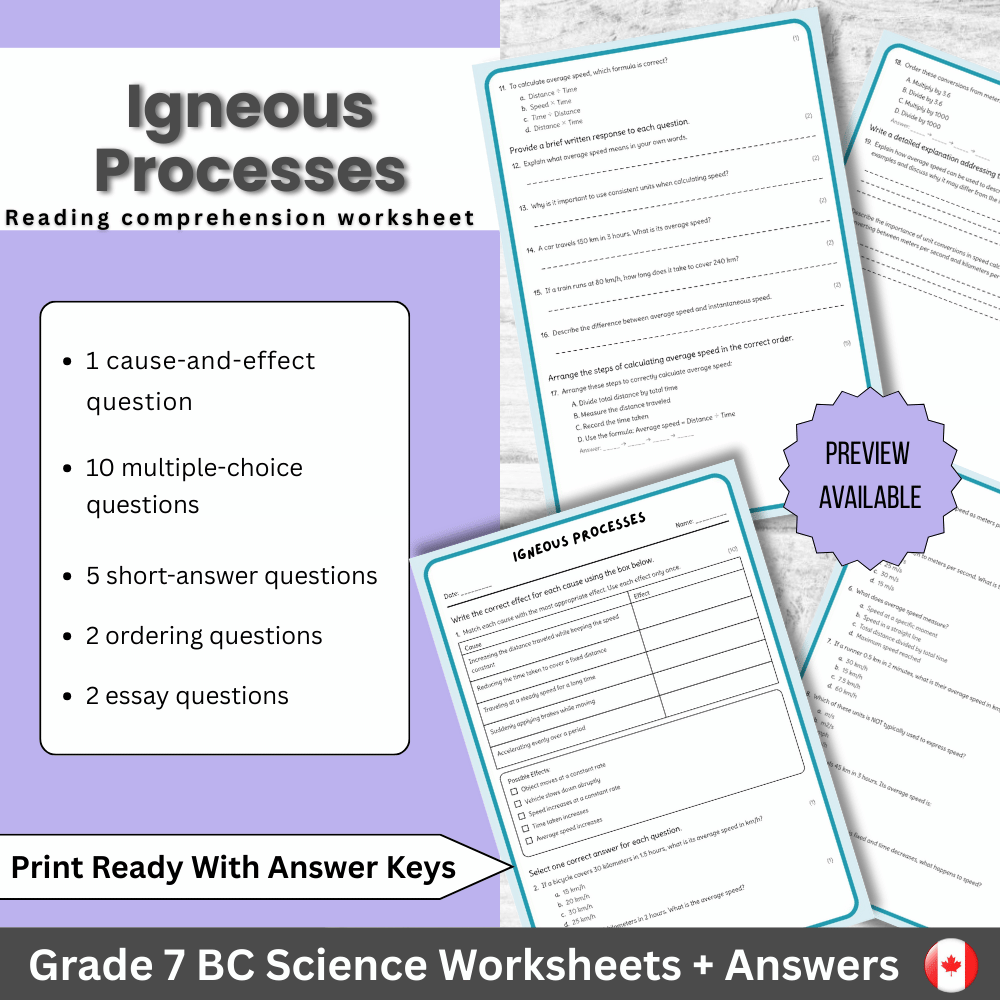
Grade 7 Science – Igneous Processes Worksheet (PDF) | Standard BC
Created byBright Mind ResourcesLearning Objectives
- Explain how magma forms through various geological processes.
- Describe how cooling rates affect igneous rock textures and mineral composition.
- Analyze the role of fractional crystallization and magma mixing in rock diversity.
Instant download
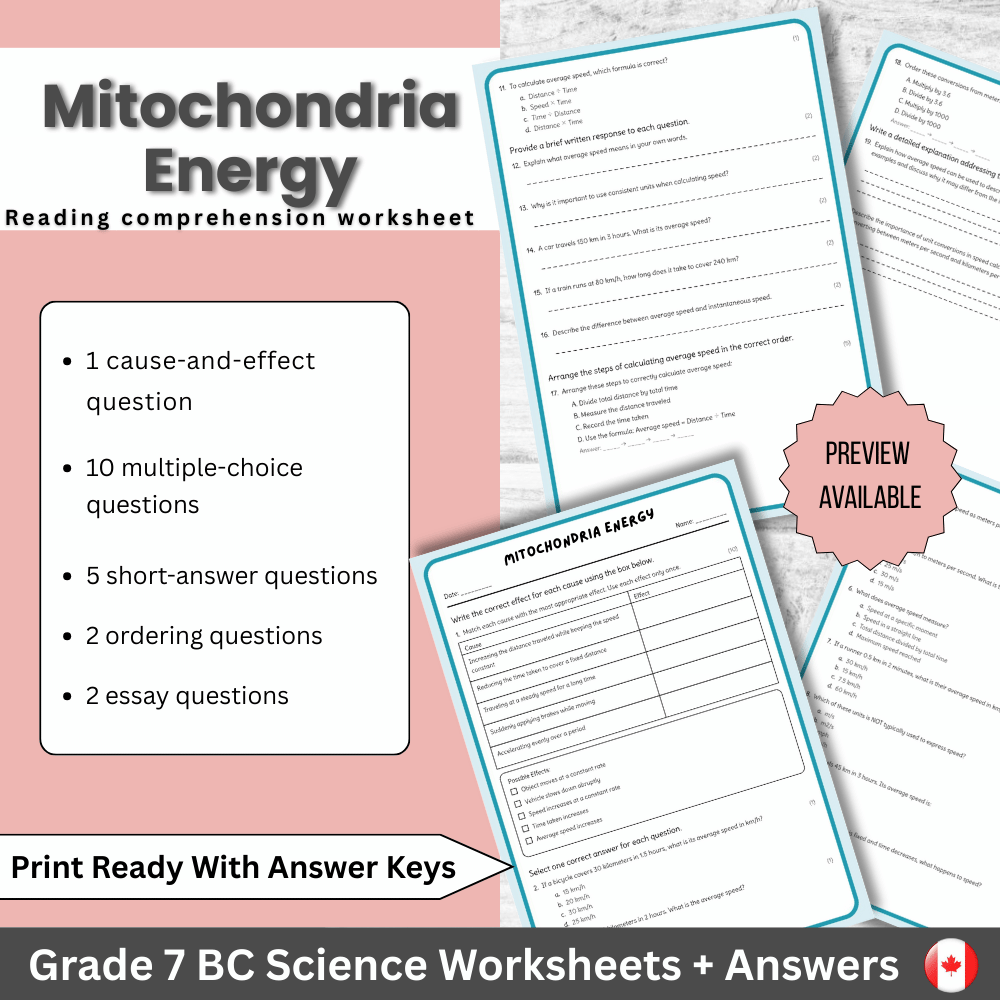
Grade 7 Science | Mitochondria Energy Concept Worksheet (Answers) – BC Standards
Created byBright Mind ResourcesLearning Objectives
- Explain the structure and function of mitochondria in energy production.
- Describe the process of cellular respiration and how mitochondria generate ATP.
- Identify the variations in mitochondrial activity in different cell types.
Instant download
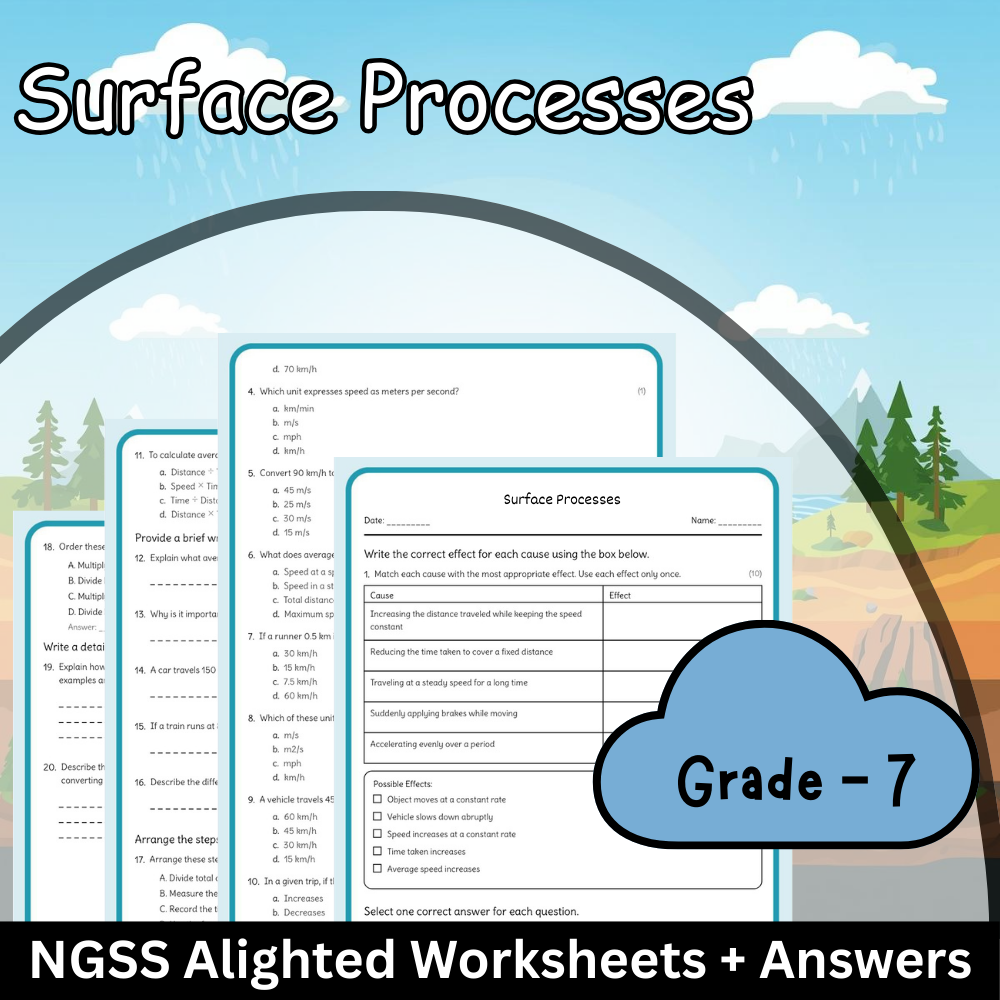
Grade 7 Science – Surface Processes Worksheet (NGSS Aligned) | PDF
Created byBright Mind ResourcesLearning Objectives
- Understand the key geologic processes that modify Earth's surface over time.
- Describe the differences between mechanical and chemical weathering.
- Identify landforms created by erosion, transportation, and deposition.
Instant download
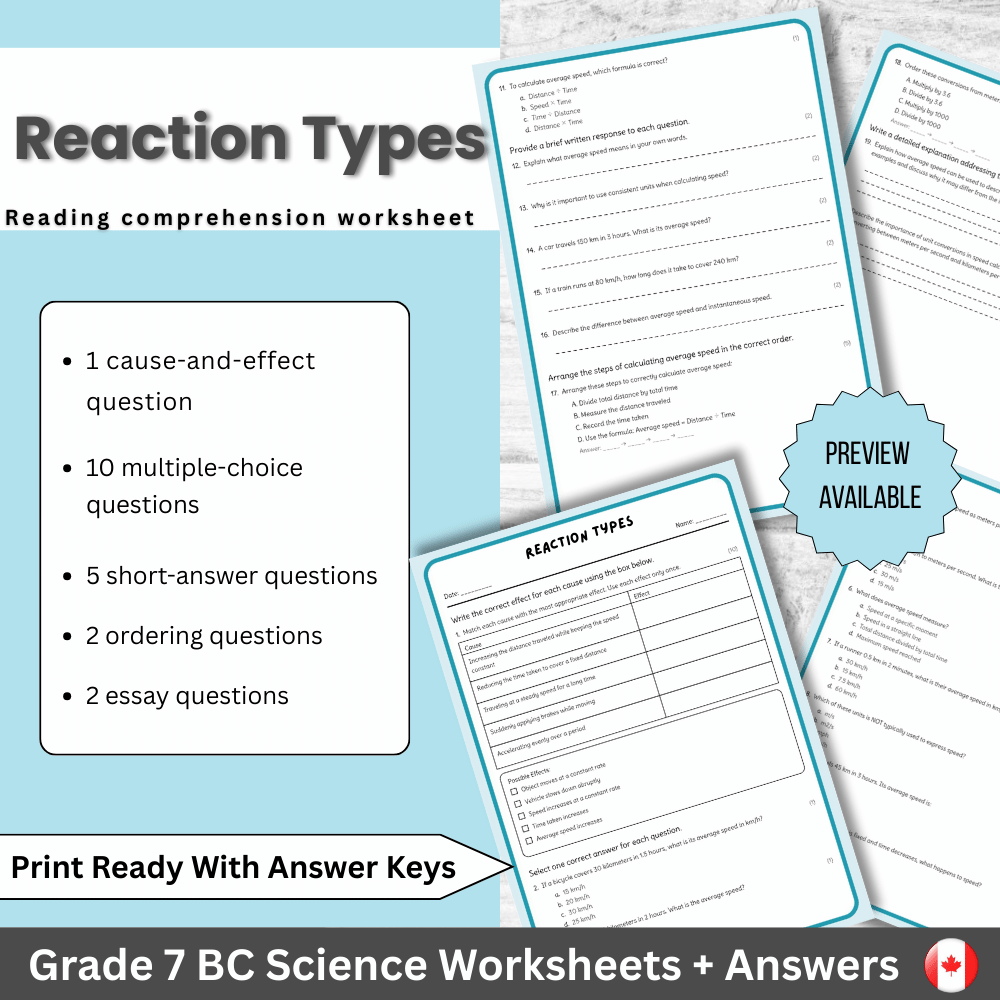
Grade 7 Science | Reaction Types Worksheet (PDF) for BC Standards
Created byBright Mind ResourcesLearning Objectives
- Identify and classify different reaction types such as synthesis, decomposition, displacement, acid-base, and combustion.
- Understand how bonds are broken and formed during chemical reactions and how atoms rearrange.
- Predict reaction products based on reaction type and recognize the conservation of atoms during reactions.
Instant download
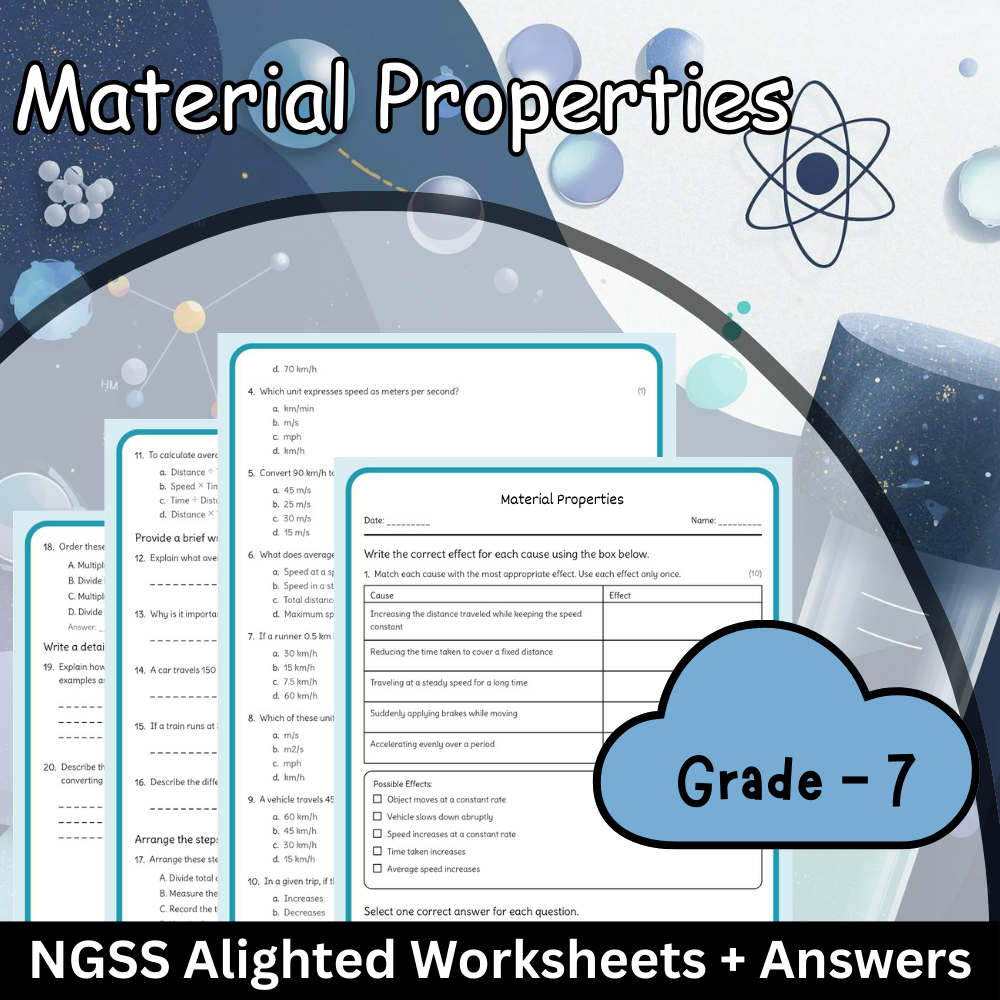
Grade 7 Science | Material Properties Worksheet (Answer Key) – NGSS Aligned
Created byBright Mind ResourcesLearning Objectives
- Distinguish between physical and chemical properties of materials.
- Identify measurable descriptors such as density, melting point, solubility, conductivity, reactivity, and flammability.
- Analyze property data to support material identification and separation strategies.
Instant download
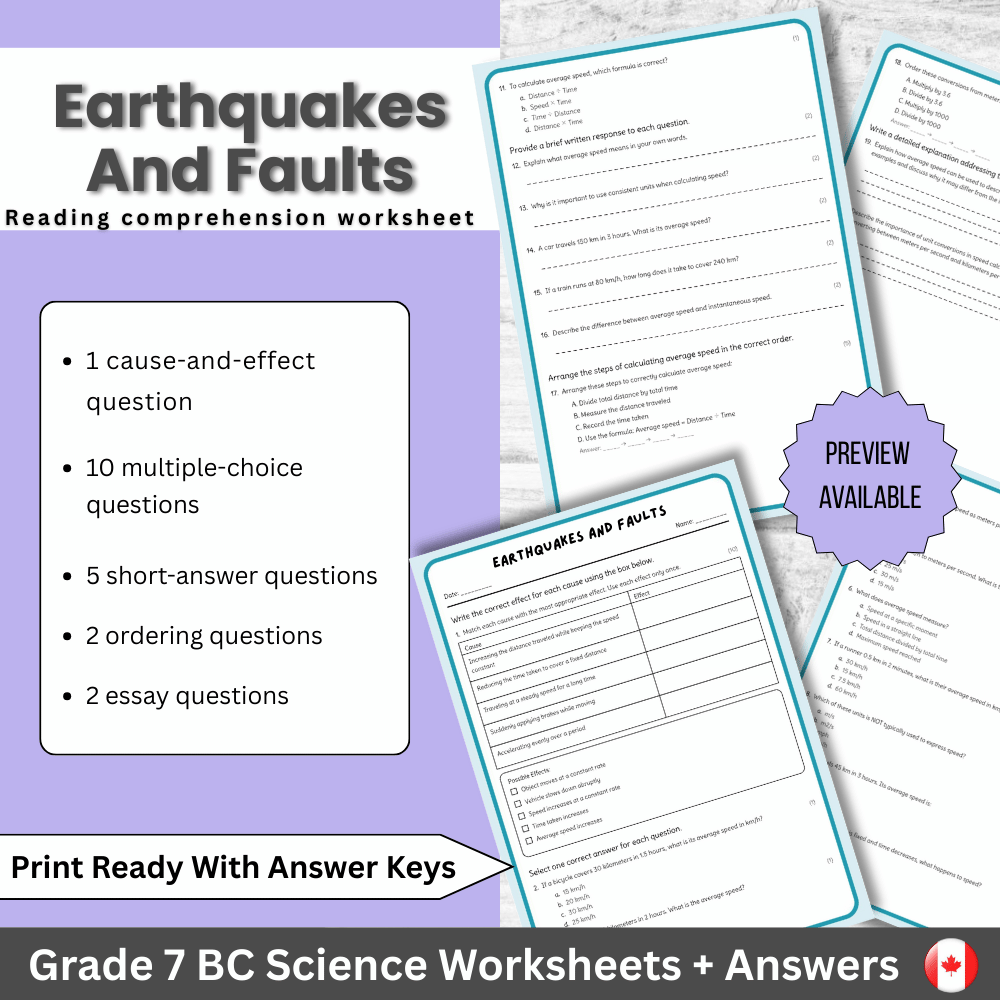
Grade 7 Science | Earthquakes, Faults & Seismic Activity Worksheet (PDF)
Created byBright Mind ResourcesLearning Objectives
- Explain how seismicity relates to fault movement and tectonic stress.
- Identify the different fault types and their seismic signatures.
- Describe how energy is released during earthquakes and what factors influence their intensity.
Instant download
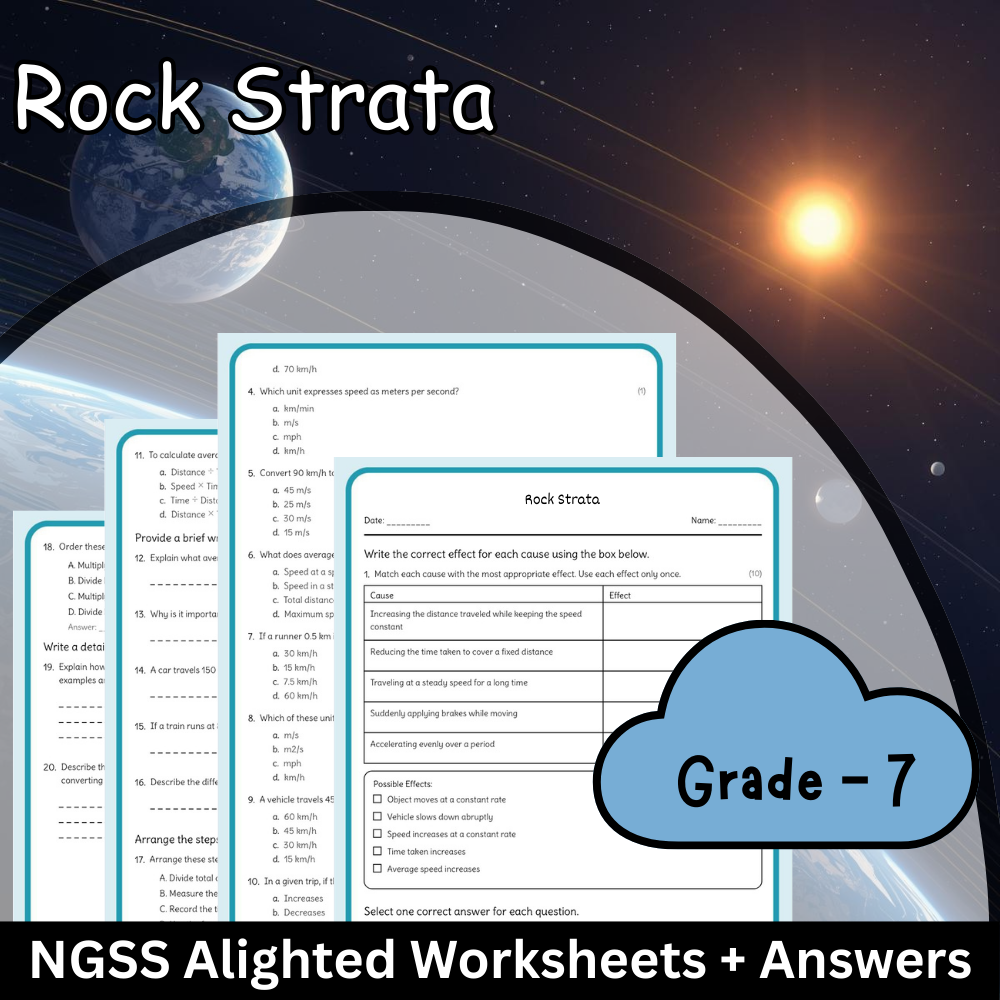
Grade 7 Science | Rock Strata & Stratigraphy NGSS Worksheet (PDF)
Created byBright Mind ResourcesLearning Objectives
- Understand the principles of relative dating such as superposition, original horizontality, and cross-cutting relationships.
- Identify key stratigraphic markers like fossils, unconformities, and intrusions used to correlate rock layers.
- Synthesize stratigraphic data and field observations to interpret Earth's geological history.
Instant download
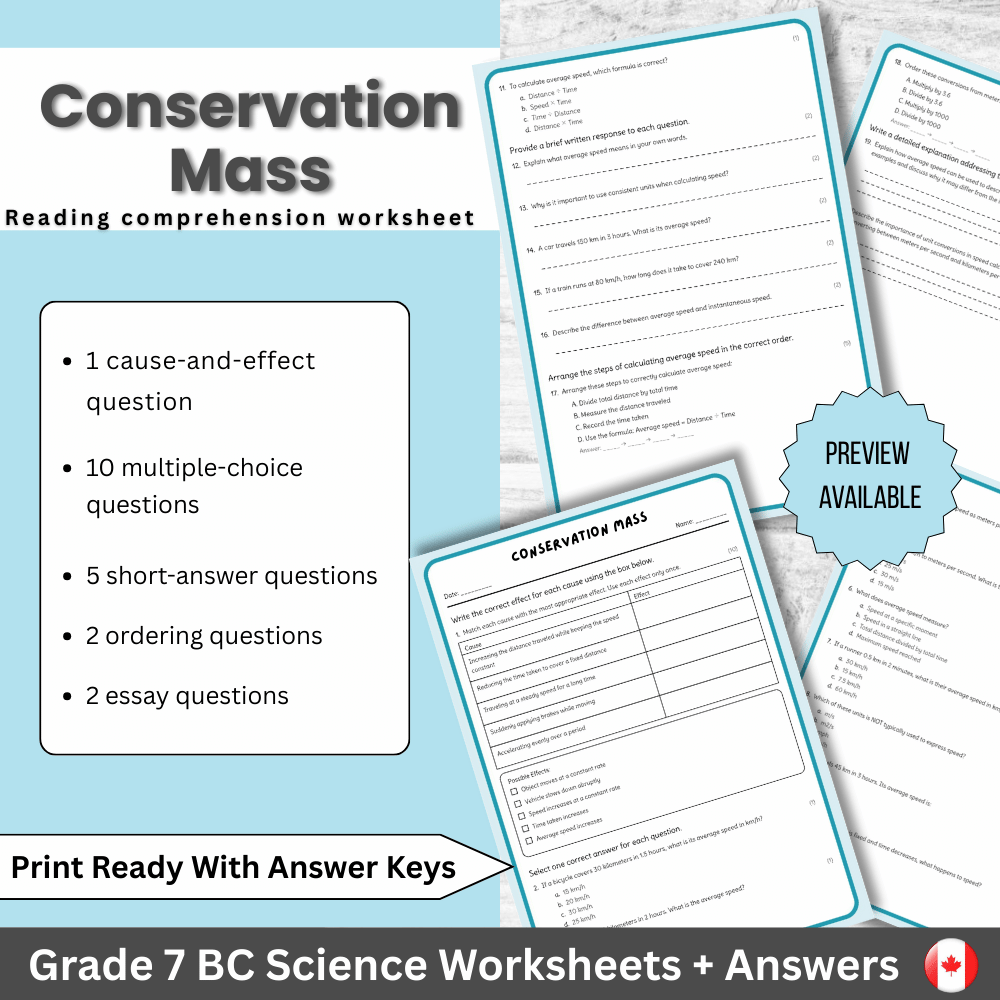
Grade 7 Science | Conservation of Mass Worksheet + Answer Key (PDF)
Created byBright Mind ResourcesLearning Objectives
- Understand the principle of conservation of mass in chemical reactions.
- Describe how atoms are conserved and rearranged during chemical changes.
- Explain the significance of closed systems in mass conservation.
Instant download
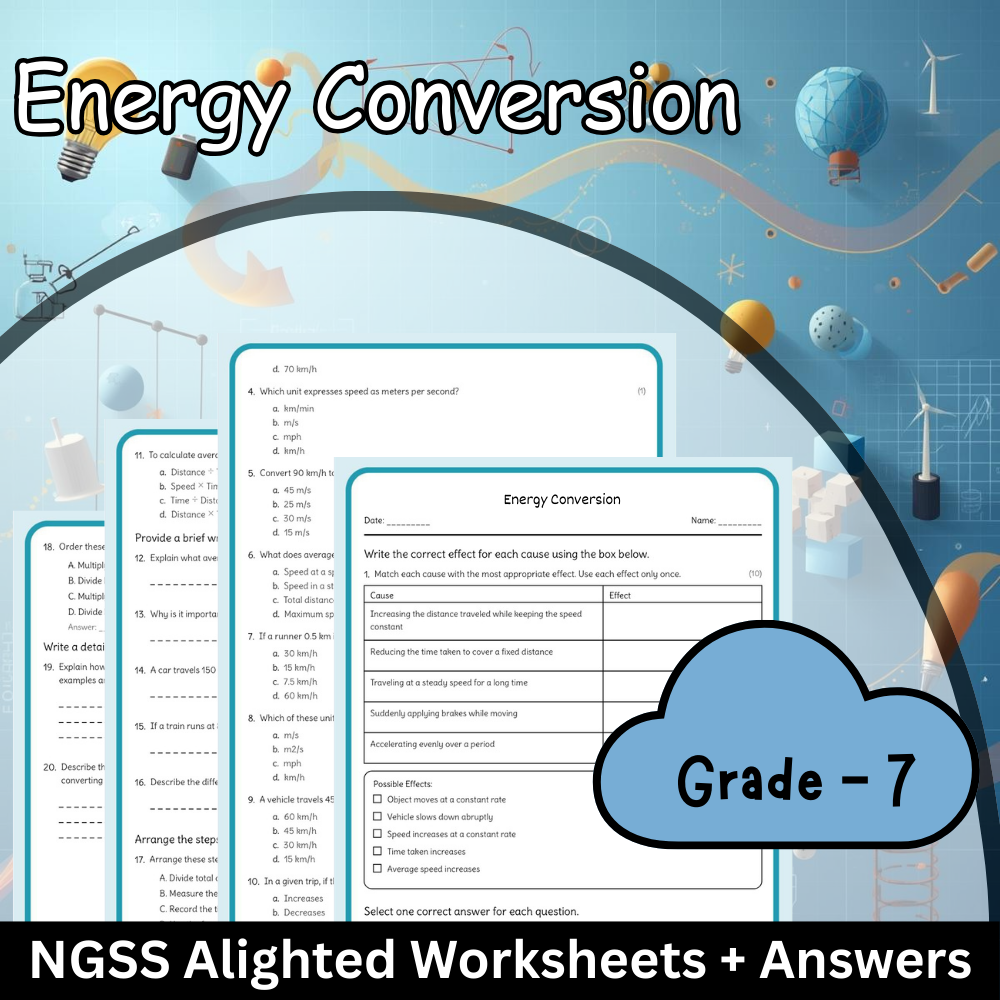
Grade 7 Science | Energy Conversion Worksheet – NGSS Aligned (PDF)
Created byBright Mind ResourcesLearning Objectives
- Explain how devices convert energy from one form to another.
- Identify examples of energy transformation in common devices.
- Understand the concepts of energy transfer, conservation, and thermal losses.
Instant download
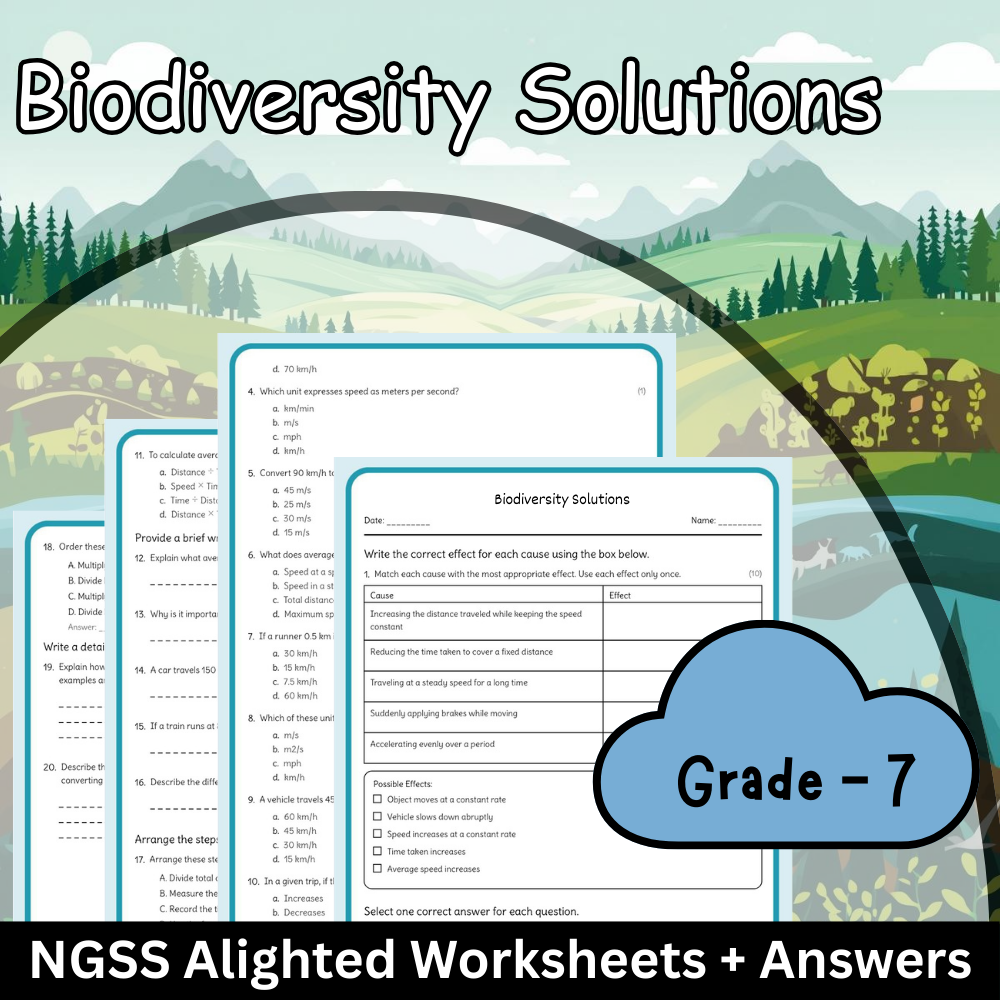
Grade 7 Science | Biodiversity Solutions Worksheet (NGSS-Aligned) – PDF
Created byBright Mind ResourcesLearning Objectives
- Evaluate various management strategies for maintaining biodiversity and ecosystem services.
- Analyze case examples such as wetland restoration and corridor establishment.
- Compare benefits and unintended consequences of different approaches.
Instant download
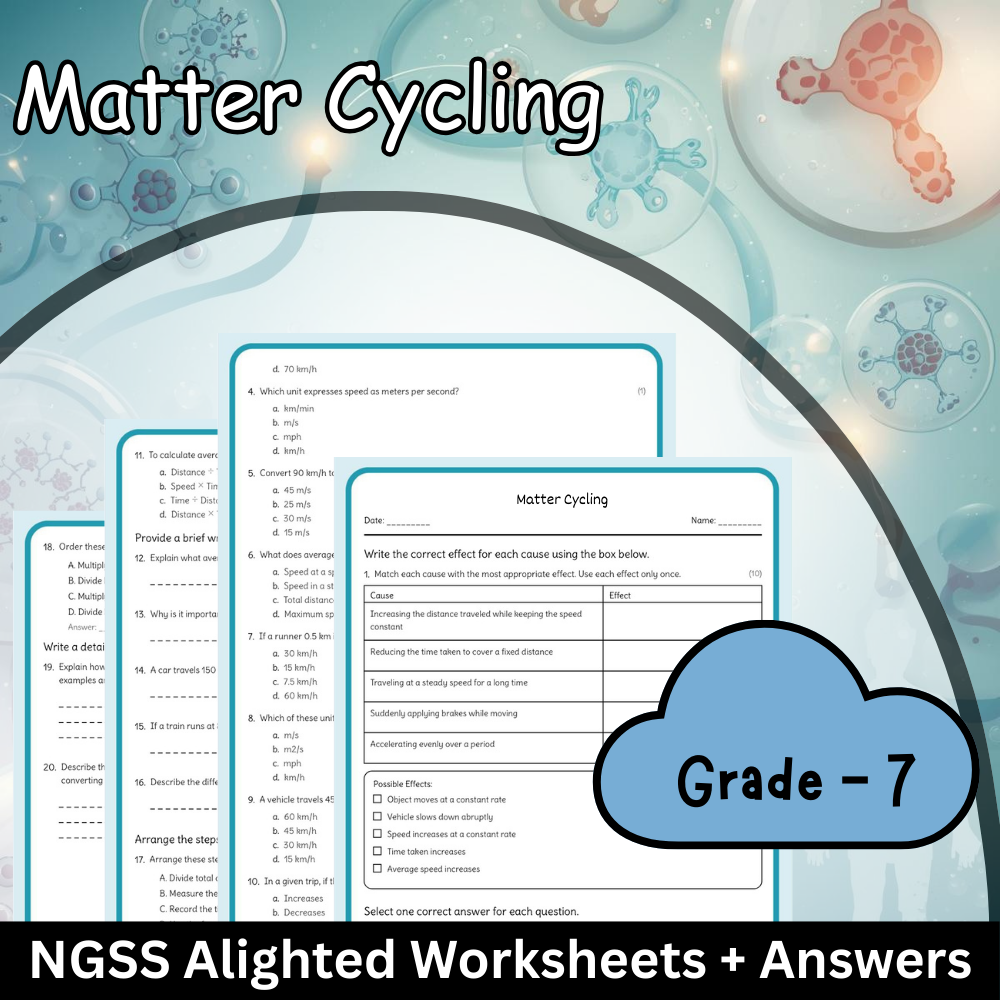
7th Grade Science | Matter Cycling Worksheet (NGSS) – Science PDF
Created byBright Mind ResourcesLearning Objectives
- Explain how matter is cycled within organisms during processes like digestion, biosynthesis, and respiration.
- Describe the flow of carbon and nitrogen through food into biomolecules and their eventual release or excretion.
- Identify biochemical pathways such as macromolecule synthesis and decomposition that demonstrate matter recycling.
Instant download
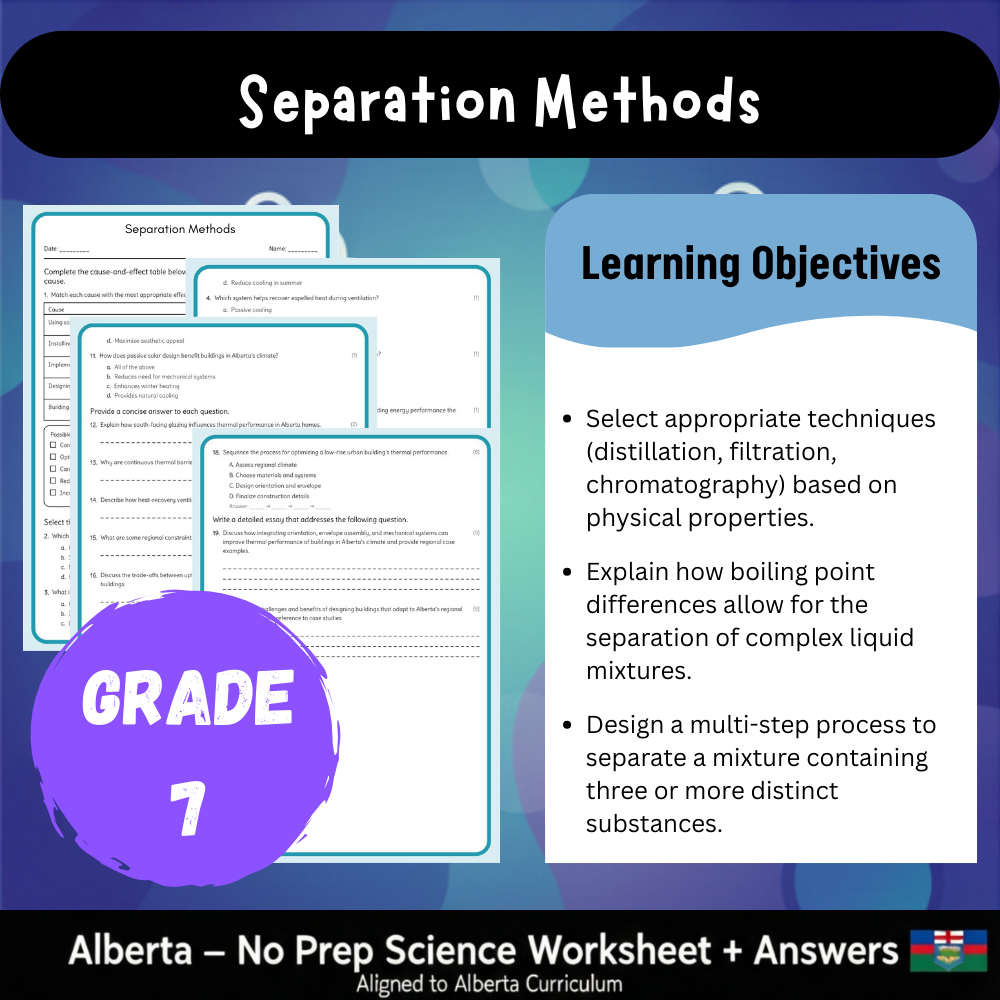
Grade 7 Science | Separation Methods Worksheet (PDF) – Alberta Standards
Created byBright Mind ResourcesLearning Objectives
- Understand various separation techniques based on physical properties.
- Identify suitable methods for separating different mixtures.
- Explain real-world applications of separation methods.
Instant download
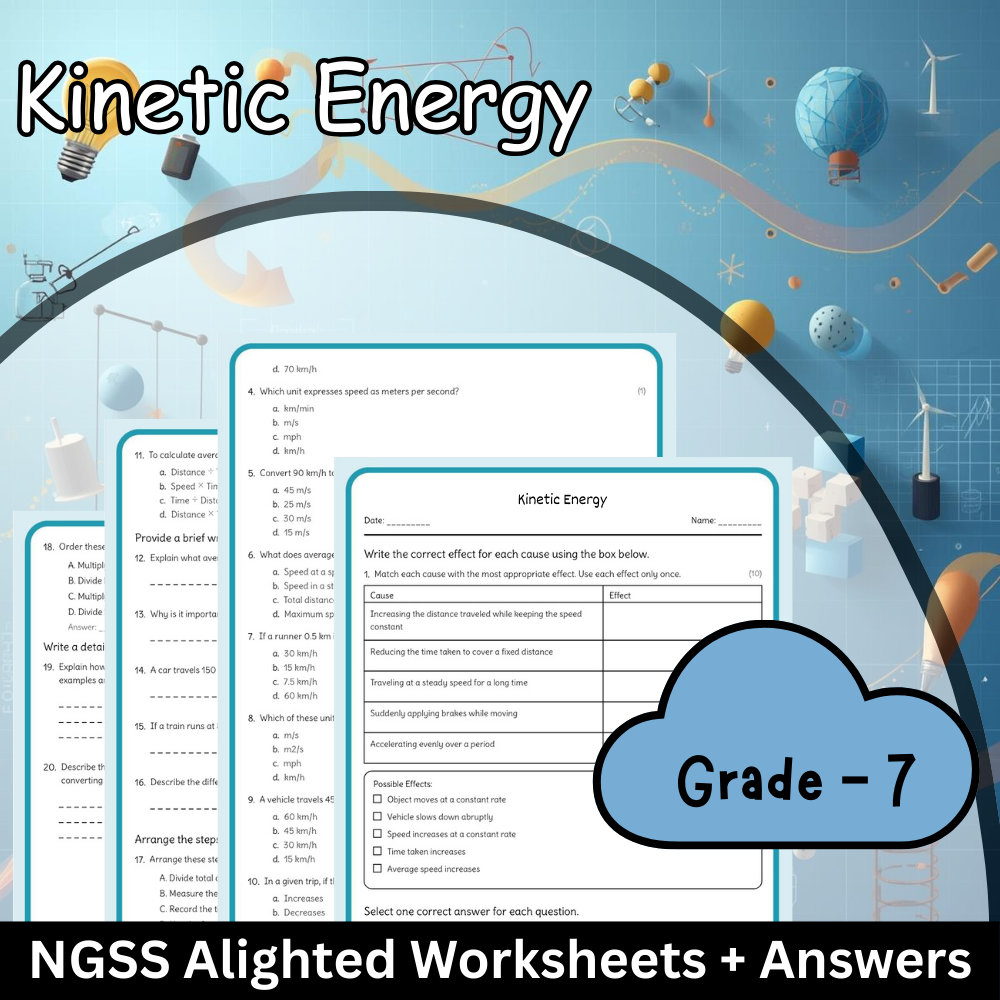
Grade 7 Science | Kinetic Energy Worksheet (Answer Key) – NGSS Standards
Created byBright Mind ResourcesLearning Objectives
- Construct and interpret graphical relationships between kinetic and potential energy, mass, and speed.
- Understand proportional and quantitative patterns in energy changes due to mass and speed doubling.
- Analyze energy calculations and relate graphs to motion scenarios such as a bicycle, pendulum, and roller-coaster.
Instant download
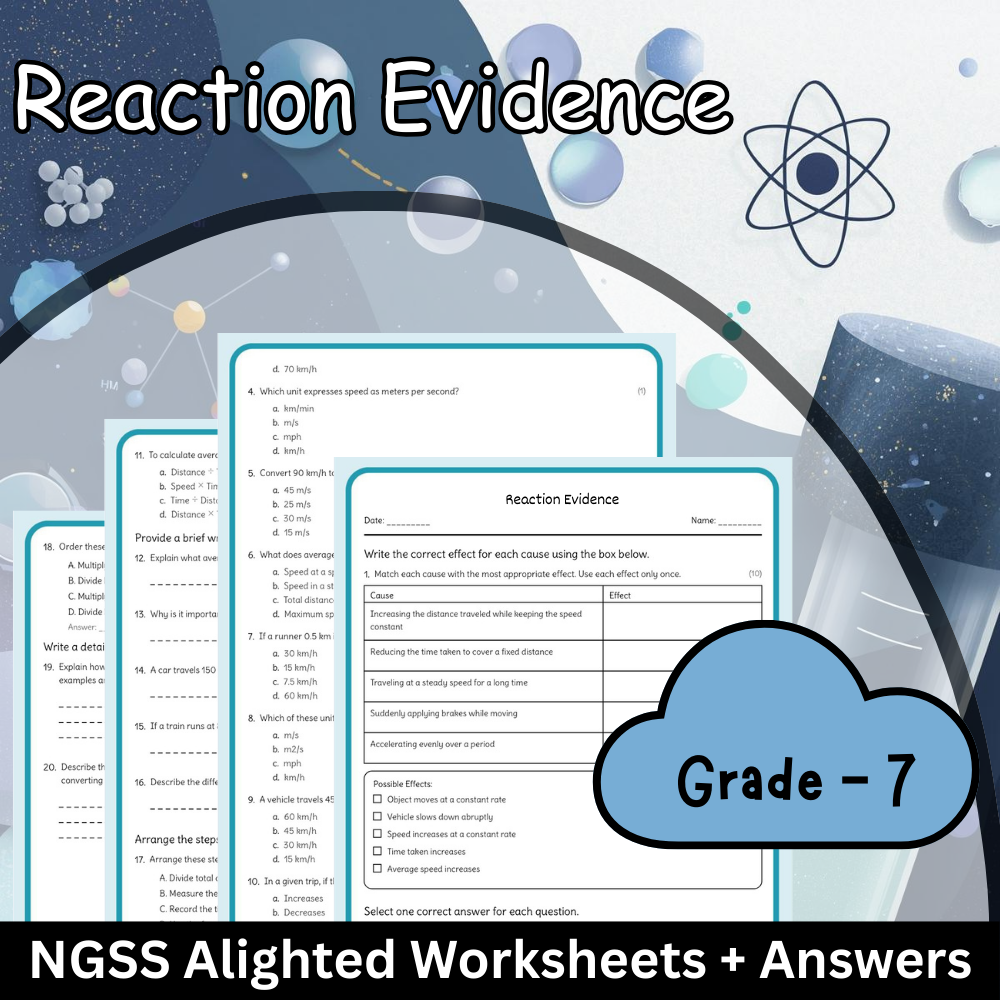
Grade 7 Science – Reaction Evidence Worksheet (PDF) | NGSS Standards
Created byBright Mind ResourcesLearning Objectives
- Identify different indicators that suggest a chemical reaction has taken place.
- Explain examples of chemical reactions based on observable signs like gas production, precipitate formation, color change, temperature change, and irreversibility.
- Understand how mass measurements in sealed systems relate to the conservation of mass principle in chemical reactions.
Instant download
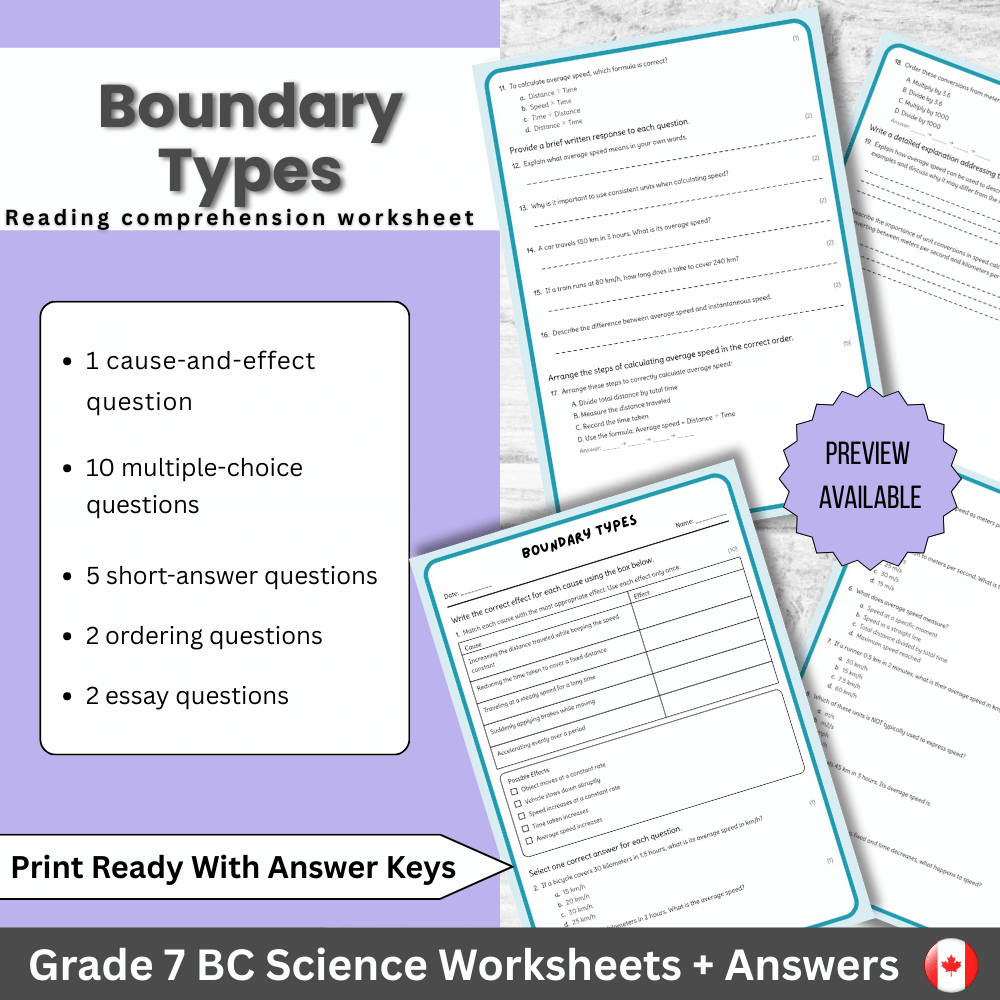
Grade 7 Science | Boundary Types Worksheet + Answer Key (PDF)
Created byBright Mind ResourcesLearning Objectives
- Identify the three principal boundary types and their characteristic landforms.
- Explain processes such as crustal extension, magma upwelling, subduction, and lateral motion.
- Describe how different boundary types influence topography, volcanic activity, and seismicity.
Instant download
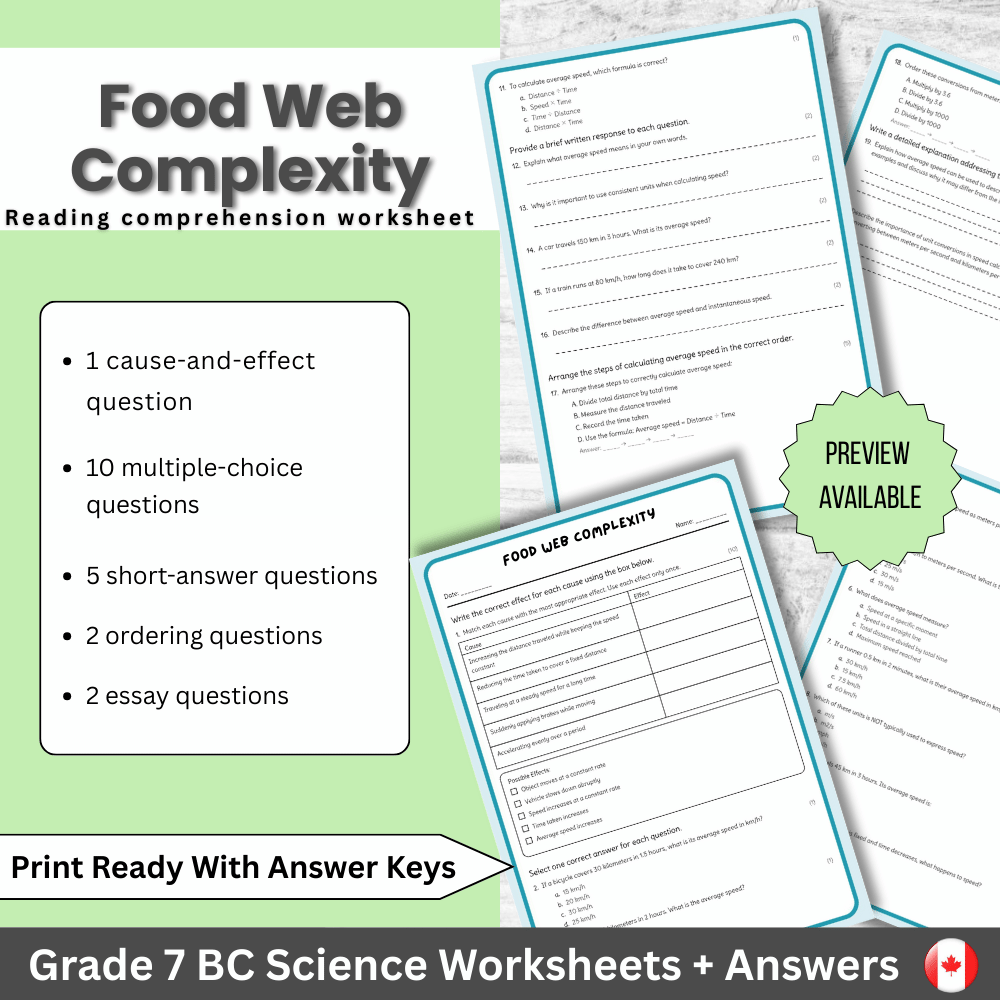
Grade 7 Science – Food Web Complexity Worksheet (Worksheet + Answer Key) PDF
Created byBright Mind ResourcesLearning Objectives
- Understand the structure and components of a food web, including producers, consumers, and decomposers.
- Explain how interconnected feeding relationships contribute to ecosystem stability.
- Analyze how changes to species affect energy flow and ecological resilience.
Instant download
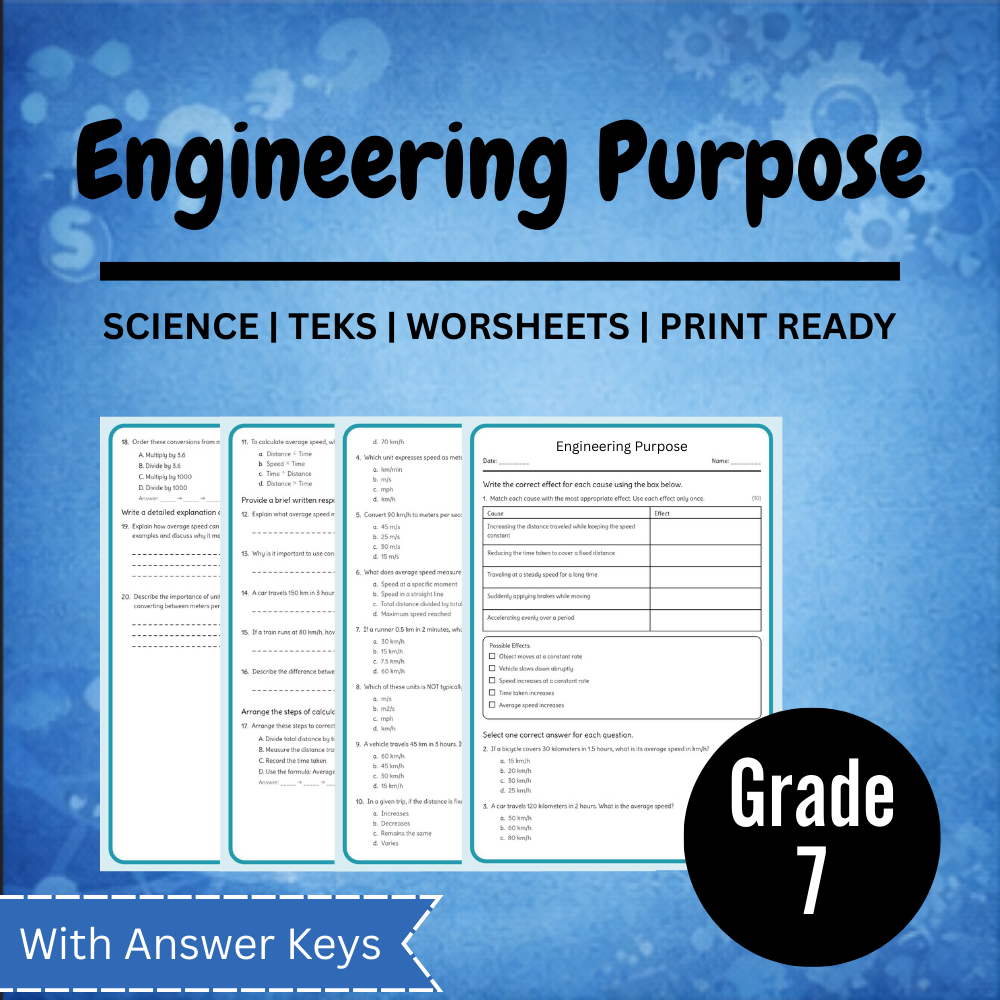
Grade 7 Science | Engineering Purpose TEKS-Aligned Worksheet (PDF)
Created byBright Mind ResourcesLearning Objectives
- Understand how engineering designs respond to system purpose and constraints
- Identify key features of structural, mechanical, and electrical systems
- Analyze trade-offs in engineering design such as cost, reliability, and performance
Also included in: Grade 7 Science Unit Bundle | Standards, Safety, Innovation & Systems Aligned TEKS +2 more
Instant download
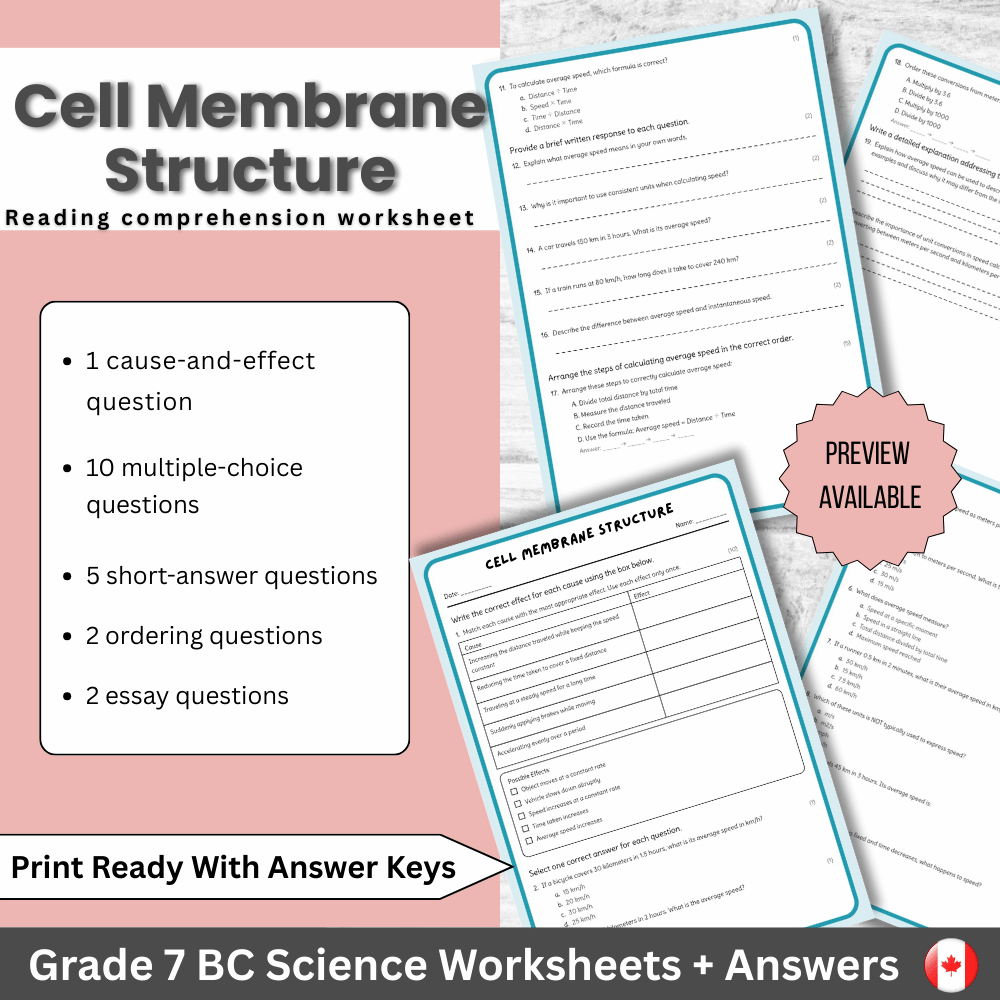
Grade 7 Science | Cell Membrane Structure Worksheet (Answer Key) – BC Standards
Created byBright Mind ResourcesLearning Objectives
- Understand the organization and components of the cell membrane as a fluid mosaic.
- Identify the functions of phospholipids, proteins, cholesterol, and carbohydrates in the membrane.
- Explain how the structure of the membrane maintains selective permeability and cellular communication.
Instant download
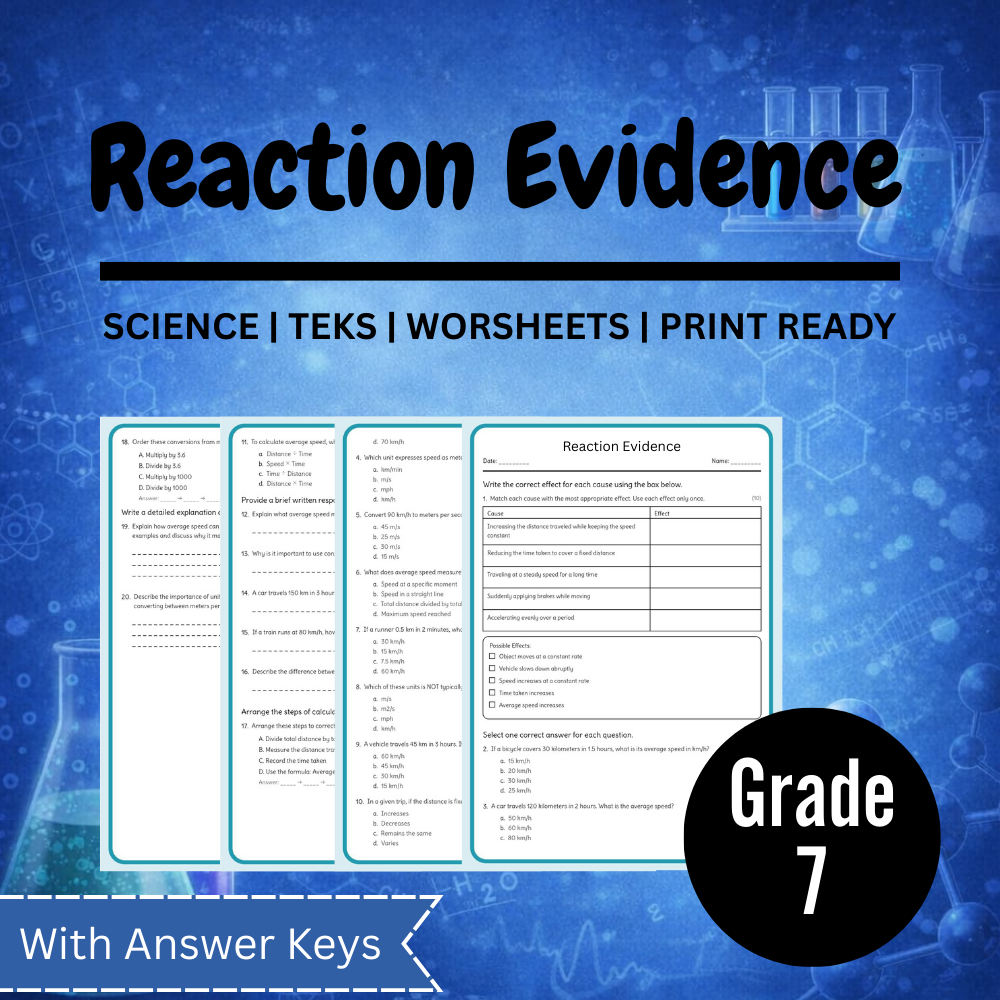
Grade 7 Science | Reaction Evidence Worksheet (PDF) – TEKS Standards & Practice
Created byBright Mind ResourcesLearning Objectives
- Identify observable indicators of chemical reactions such as gas evolution, precipitate formation, color change, and temperature change.
- Connect qualitative evidence to underlying mass and energy relationships.
- Recognize examples like acid–carbonate effervescence and precipitation reactions and interpret their indicators.
Also included in: Grade 7 Science Unit Bundle | States of Matter & Atomic Structure Worksheets +2 more
Instant download
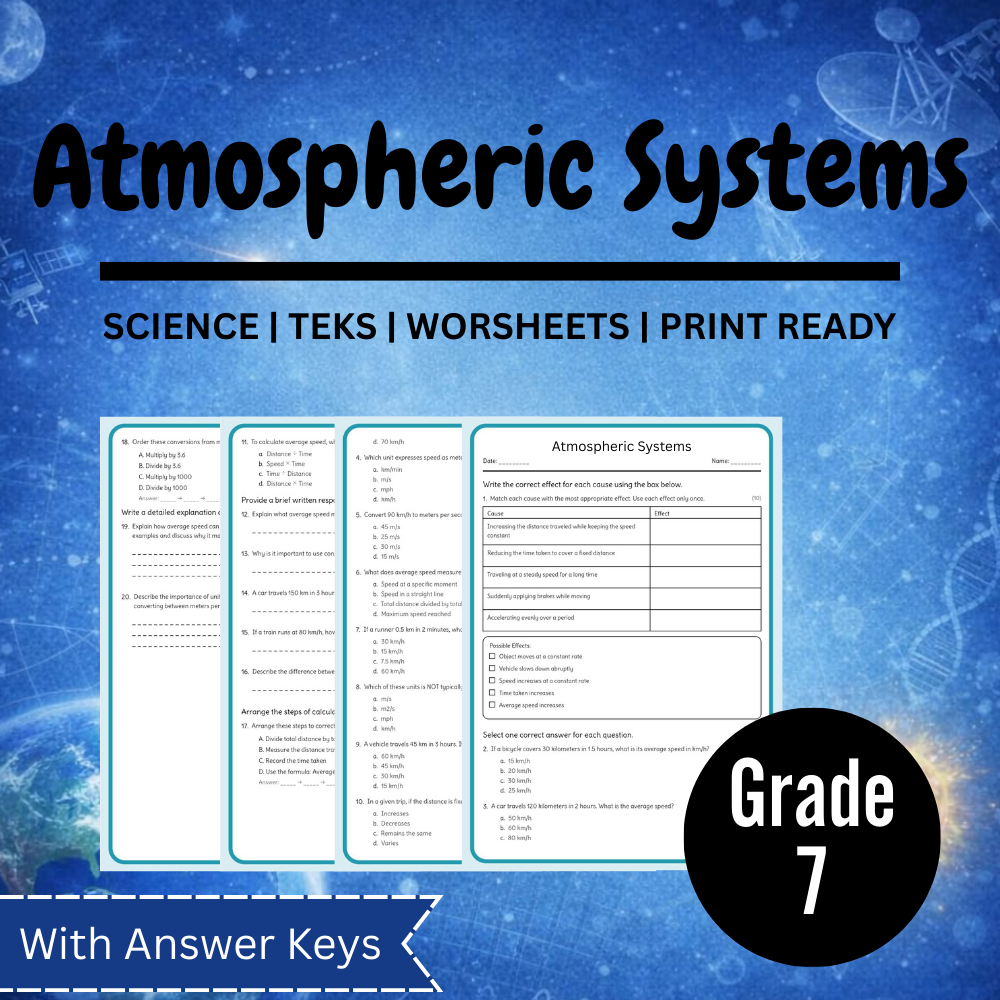
Grade 7 Science | Atmospheric Systems Worksheet + Answer Key (PDF) — TEKS Aligned
Created byBright Mind ResourcesLearning Objectives
- Describe the processes involved in atmospheric energy transfer and convection.
- Identify large-scale circulation patterns such as Hadley cells, jet streams, and pressure systems.
- Explain how air mass movement influences weather variability and climate.
Also included in: Grade 7 Science Unit Bundle | Earth's Processes, Space & Resources TEKS Aligned +2 more
Instant download
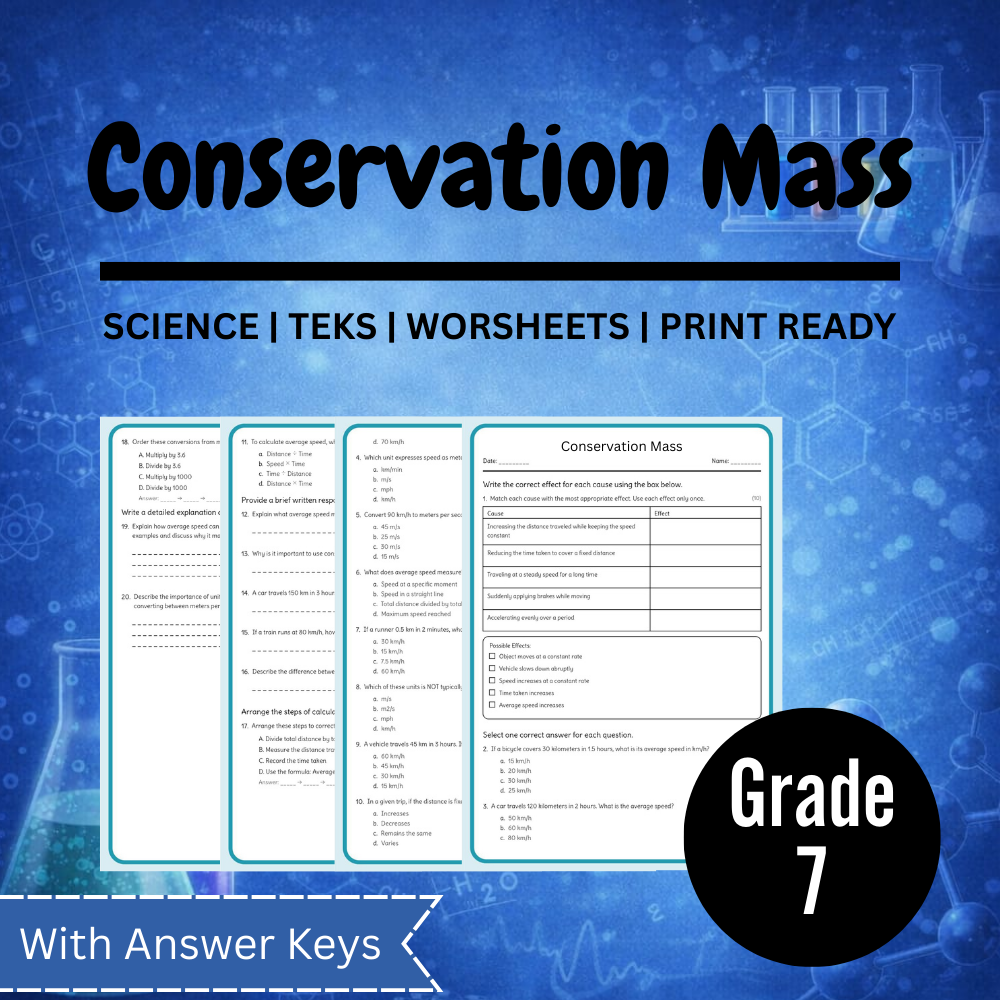
Grade 7 Science | Conservation of Mass Worksheet (Answer Key) – TEKS-Aligned
Created byBright Mind ResourcesLearning Objectives
- Understand the principle of conservation of mass in physical and chemical changes.
- Apply mass accounting to reactions and processes within a closed system.
- Balance simple chemical formulas to illustrate mass relationships.
Also included in: Grade 7 Science Unit Bundle | States of Matter & Atomic Structure Worksheets +2 more
Instant download
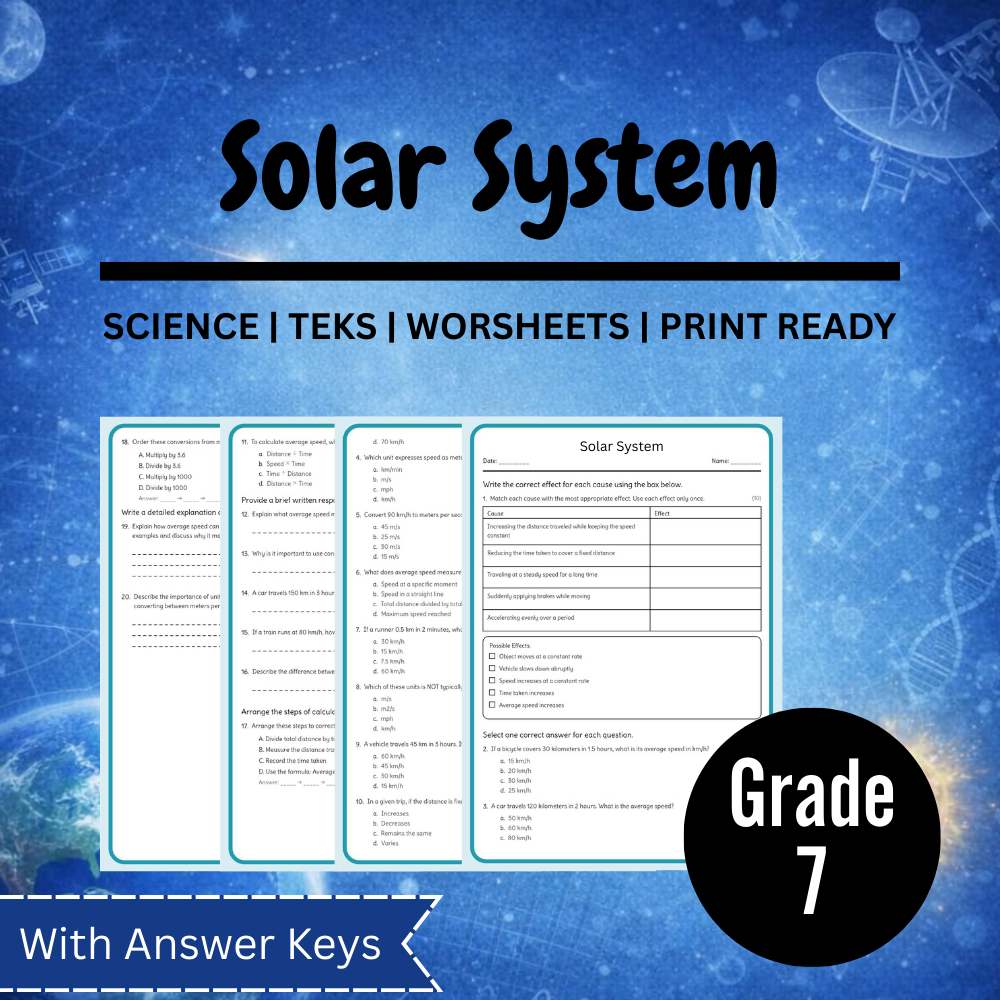
Grade 7 Science | Solar System Key Concepts Worksheet (Worksheet + Answer Key)
Created byBright Mind ResourcesLearning Objectives
- Describe the formation and origin of the solar system.
- Identify key properties of planets and their orbital features.
- Compare terrestrial planets with gas giants based on their features.
Also included in: Grade 7 Science Unit Bundle | Earth's Processes, Space & Resources TEKS Aligned +2 more
Instant download
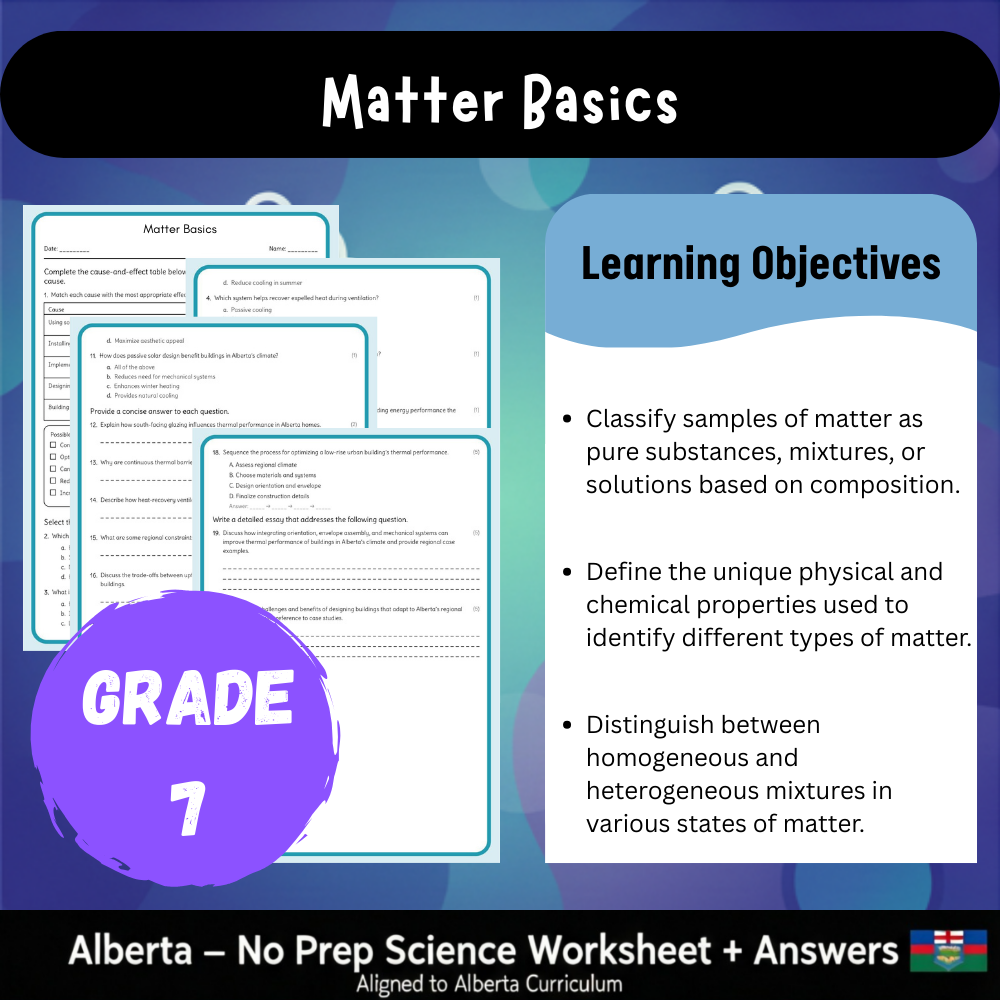
Grade 7 Science – Matter Basics Worksheet (PDF) – Alberta Standards
Created byBright Mind ResourcesLearning Objectives
- Explain the classification of matter into pure substances, mixtures, and solutions.
- Identify properties that distinguish elements and compounds as pure substances.
- Understand the differences between variable and fixed composition in mixtures and solutions.
Instant download
Browse more categories
About Grade 7 Worksheets
Find Grade 7 worksheets covering math, ELA, science, and social studies. All 8,459 resources download instantly as PDFs for classwork, homework, or review.
MyTeachingSheets worksheets are made by real teacher-authors and checked before they go live. Download any as a print-ready PDF for lessons, homework, or independent practice — most include answer keys, and previews are always free.