
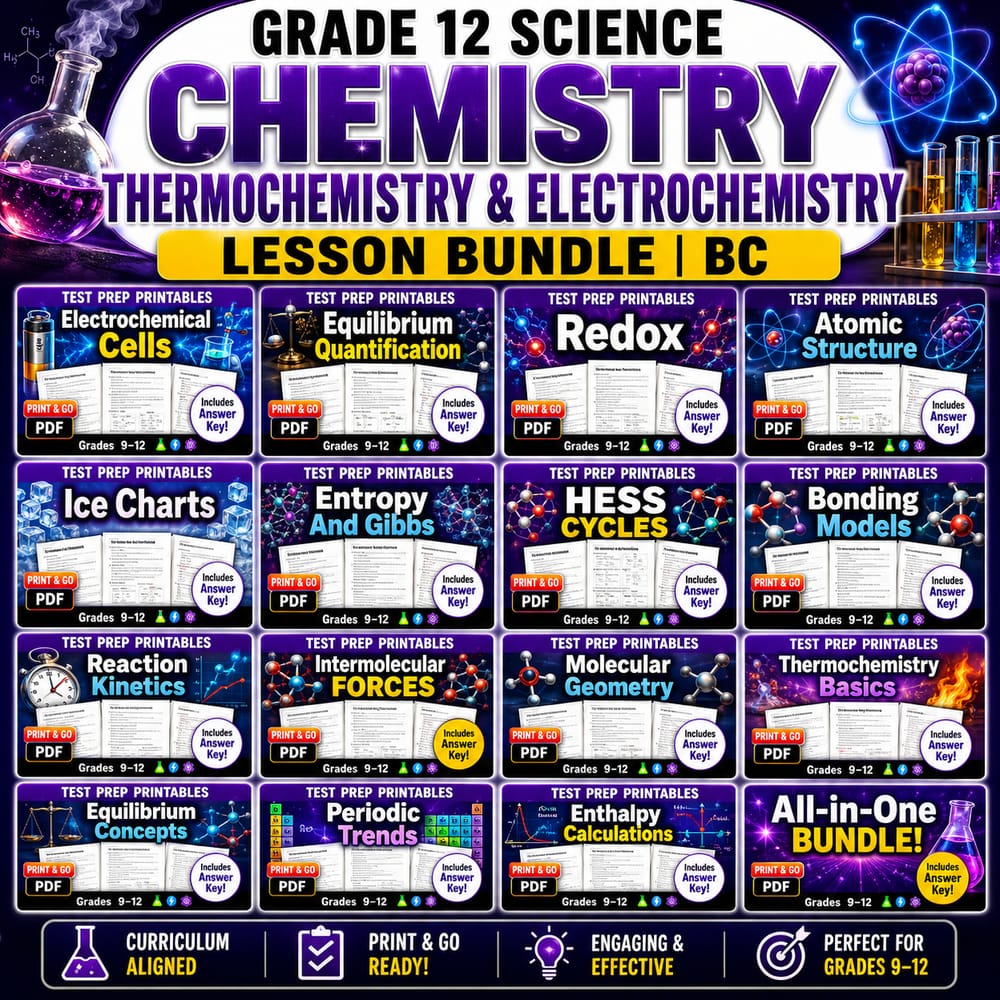


Grade 12 Science Chemistry Thermochemistry & Electrochemistry Lesson Bundle | Bc
$60.00$75.00Save $15.00
Prism Point Learning
·2 followers·13 sales
SubjectScienceGradeGrade 12
What’s included
15 worksheets · Save $15.00 (20%) · prices shown inside the bundle
 Electrochemical Cells Worksheet | Grade 12 Science Practice
- Differentiate galvanic and electrolytic electrochemical cells using anode/cathode roles and spontaneity.
- Use standard reduction potentials and electrode conventions to determine overall cell potential.
- Explain how salt bridges and electrode connections support redox reactions and charge balance.
$4.00$5.00 Equilibrium Quantification Worksheet | Grade 12 Science Practice
- Use equilibrium constants to quantify reactant and product activity ratios at steady state.
- Compare reaction quotient Q with equilibrium constant K to predict the direction of net reaction.
- Relate temperature changes to shifts in equilibrium constants and link thermodynamics to equilibrium using Gibbs free energy.
$4.00$5.00 Redox Fundamentals Worksheet | Grade 12 Science Practice
- Explain oxidation and reduction in terms of electron transfer and relate them to oxidation states.
- Identify oxidizing and reducing agents in common redox scenarios.
- Use oxidation-state reasoning and half-reaction ideas to analyze and balance redox reactions.
$4.00$5.00 Atomic Structure Worksheet | Grade 12 Science Activities
- Explain how protons, neutrons, and electrons are arranged in an atom using nucleus and electron cloud ideas.
- Use quantum numbers to describe electron energy levels, subshells, orbitals, and electron configurations.
- Predict trends in ionization energy and atomic radius using effective nuclear charge and valence electrons.
$4.00$5.00 Le Chatelier Worksheet | Grade 12 Science Activities
- Apply Le Chatelier’s principle to predict how equilibrium shifts when concentration, pressure, or temperature changes.
- Determine which side of a gaseous equilibrium will be favored based on relative moles of gas and pressure changes.
- Explain how temperature changes depend on reaction enthalpy and how catalysts affect reaction rates without changing equilibrium position.
$4.00$5.00 Entropy and Gibbs Worksheet Pack | Grade 12 Science Activities
- Explain how entropy relates to energy dispersal and the number of accessible microstates.
- Use Gibbs free energy (ΔG = ΔH − TΔS) to predict spontaneity under constant pressure and temperature.
- Connect changes in Gibbs free energy to equilibrium constants and chemical composition at equilibrium.
$4.00$5.00 Hess Cycles Worksheet | Grade 12 Science Activities
- Explain how Hess’s law uses conservation of enthalpy to relate reaction energetics across multiple pathways.
- Use thermochemical cycle ideas to show how enthalpy changes cancel and add to give an overall ΔH.
- Connect Hess cycles to indirect determination of difficult quantities such as lattice energy.
$4.00$5.00 Bonding Models Worksheet Grade 12 Science Practice Assessment
- Compare ionic, covalent, and metallic bonding using electron-transfer, electron-sharing, and delocalization ideas
- Use electronegativity differences to predict bond polarity and relate bond order/bond energy to bond length and strength
- Explain how lattice energy affects ionic solid properties and connect bonding models to electron structure
$4.00$5.00 Reaction Kinetics Worksheet | Grade 12 Science Activities
- Explain how collision theory, activation energy, and temperature influence reaction rates.
- Use rate laws and experimental reaction orders to predict how concentration affects reaction rates.
- Relate temperature changes to rate constants using the Arrhenius equation concepts.
$4.00$5.00 Intermolecular Forces Worksheet | Grade 12 Science Activities
- Distinguish between London dispersion forces, dipole-dipole interactions, and hydrogen bonding and identify which occurs in different substances.
- Explain how intermolecular forces affect melting points, boiling points, surface tension, and solubility.
- Use molecular polarity and hydrogen-bonding criteria (N, O, F bonded to H) to predict qualitative behavior in condensed phases.
$4.00$5.00
Reviews & Feedback
Loading reviews...
Questions & Answers
Loading questions…
About this bundle
Related categories
Frequently asked questions
Who is Grade 12 Science Chemistry Thermochemistry & Electrochemistry Lesson Bundle | Bc designed for?
Grade 12 Science Chemistry Thermochemistry & Electrochemistry Lesson Bundle | Bc is designed for Grade 12 students and Science learners and can be used in classrooms, homeschool, or independent practice.
How do I download Grade 12 Science Chemistry Thermochemistry & Electrochemistry Lesson Bundle | Bc?
Add it to your cart and complete checkout. After payment, you can download immediately from your account, and you'll also receive a download link by email.
Similar Products

Grade 10 Chemistry Lesson Bundle – AP Chemistry Concepts & Practice
$52.00$65.00

Grade 10 Science Chemistry Foundations Lesson Bundle for AP Curriculum
$31.20$39.00

Grade 11 Science Chemistry Lesson Bundle | Ontario
$48.00$60.00

Grade 10 Chemistry Lesson Bundle | Alberta Science Reaction & Analysis
$36.00$45.00

Grade 10 AP Science Chemistry Thermochemistry & Atomic Structure Lesson Bundle
$52.00$65.00