
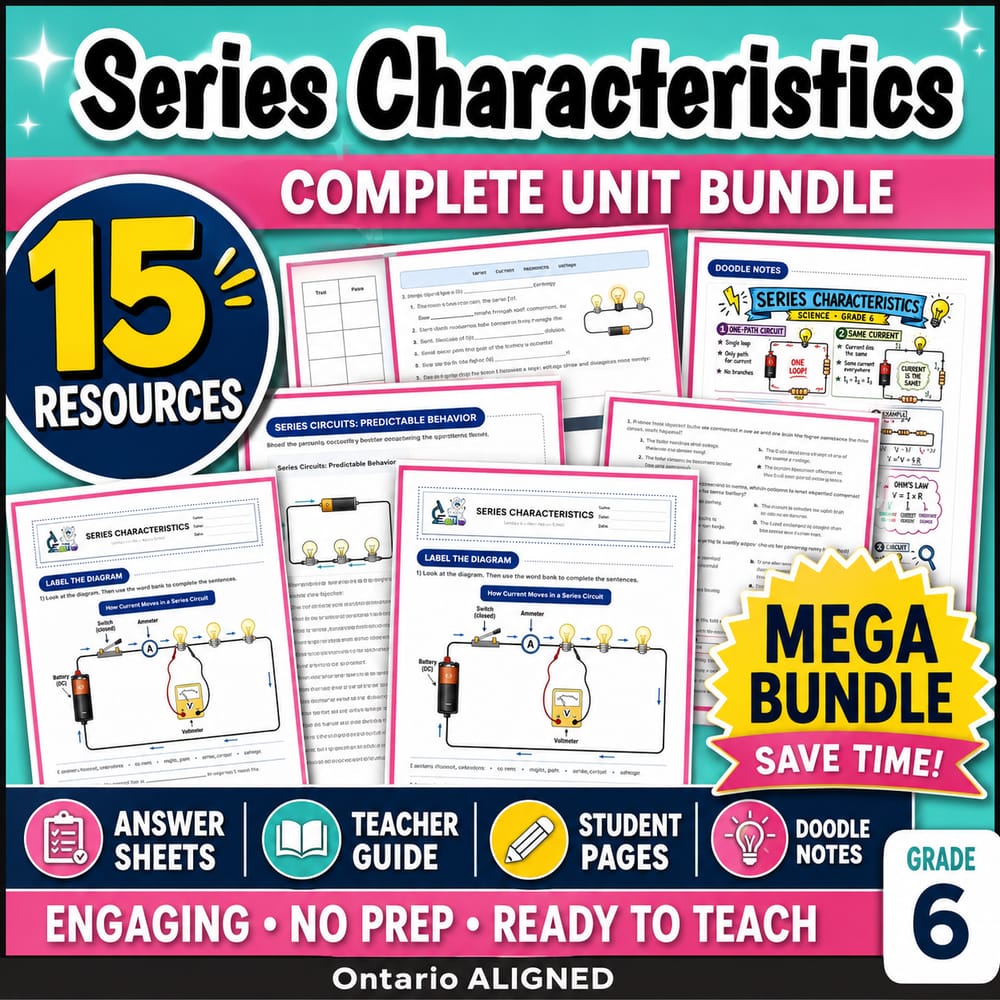


Grade 6 Science Circuits & Electricity Lesson Bundle | Ontario
$60.00$75.00Save $15.00
Chalk and Compass
·5 followers·13 sales
SubjectScienceGradeGrade 6Pages229 Pages
What’s included
15 worksheets · 229 pages · Save $15.00 (20%) · prices shown inside the bundle
 Insulator Comparisons Worksheet | Electricity & Conductors Grade 6
- Explain why insulators resist electric charge flow using the ideas of bound electrons and lack of free charge carriers.
- Compare common insulating materials (rubber, glass, dry wood) based on their electron behavior and safety uses.
- Distinguish bulk insulating properties from how charges can behave on a material’s surface.
$4.00$5.00 Grade 6 Charge Concepts Worksheet | Static & Current Electricity
- Define electric charge and explain how charge separation leads to static electricity.
- Compare static electricity with current electricity using conductor vs. insulator behavior.
- Explain why charge imbalance can cause attractions (like hair) and sometimes produce sparks.
$4.00$5.00 Measuring Circuits Worksheet Grade 6 Science | Voltage & Current
- Explain how measuring current and voltage helps characterize how a circuit performs
- Describe conceptually where instruments should be placed to measure current and voltage
- Interpret typical measurement patterns to reason about relative resistance in a circuit
$4.00$5.00 Combined Circuits Worksheet Grade 6 Science | Series & Parallel Circuits
- Explain how combined (series-parallel) circuits can be broken into simpler series and parallel subcircuits
- Describe how current and voltage distribute in mixed series-parallel configurations
- Predict and diagnose changes in brightness or readings when a component is removed or fails
$4.00$5.00 Quantitative Circuits Worksheet Grade 6 Science | Ontario + Doodle Note
- Explain how voltage, current, and resistance are related in a simple circuit using proportional reasoning.
- Use measured values to calculate or predict how circuit variables change when resistance changes.
- Compare how current and resistance behave in series versus parallel circuits using qualitative quantitative relationships.
$4.00$5.00 Series Circuits Worksheet Grade 6 Science | Current & Voltage
- Explain how a series circuit forms a single-path (one-loop) configuration for current.
- Describe why the current is the same through each element in a series circuit.
- Use the idea of voltage division to predict how voltage is shared across series components.
$4.00$5.00 Grade 6 Science Component Functions Worksheet | Circuits & Symbols
- Describe the function of common circuit components, including power sources, resistive loads, switches, and connectors
- Match physical circuit components to their typical schematic symbols
- Predict qualitative effects of component function on current and voltage in simple circuits
$4.00$5.00 Electrostatic Phenomena Worksheet Grade 6 Science | Ontario + Doodle Note
- Explain how charge transfer (electron movement) happens when materials rub
- Use the triboelectric series idea to predict which material is more likely to become charged
- Describe attractions, repulsions, and electrostatic discharge (spark) in terms of charge buildup and release
$4.00$5.00 Conductor Properties Science Worksheet Grade 6 Electricity Ontario
- Explain how free electrons in metals allow electrical charge to move (conductivity).
- Compare how material type, temperature, and cross-sectional area affect conductivity.
- Describe why high-conductivity materials are useful in real electrical devices.
$4.00$5.00 Parallel Circuits Characteristics Worksheet Grade 6 Science Ontario
- Explain how parallel circuits split current into multiple branching pathways.
- Describe why each parallel branch has the same potential difference (voltage).
- Use current relationships to predict how overall current relates to branch currents.
$4.00$5.00
Reviews & Feedback
Loading reviews...
Questions & Answers
Loading questions…
About this bundle
Related categories
Frequently asked questions
Who is Grade 6 Science Circuits & Electricity Lesson Bundle | Ontario designed for?
Grade 6 Science Circuits & Electricity Lesson Bundle | Ontario is designed for Grade 6 students and Science learners and can be used in classrooms, homeschool, or independent practice.
How do I download Grade 6 Science Circuits & Electricity Lesson Bundle | Ontario?
Add it to your cart and complete checkout. After payment, you can download immediately from your account, and you'll also receive a download link by email.
Similar Products

Grade 9 Electrical Circuits & Electromagnetism Science Lesson Bundle | Alberta
$48.00$60.00

Grade 6 Electricity Circuits Science Lesson Bundle for Ontario Worksheets
$48.00$60.00

Grade 6 Electricity and Circuits Science lesson bundle: Ontario framework
$60.00$75.00

Grade 8 Science Lesson Bundle — Electricity, Circuits & Energy
$36.00$45.00

Grade 8 Electricity & Circuits Science Lesson Bundle: Alberta Framework
$60.00$75.00