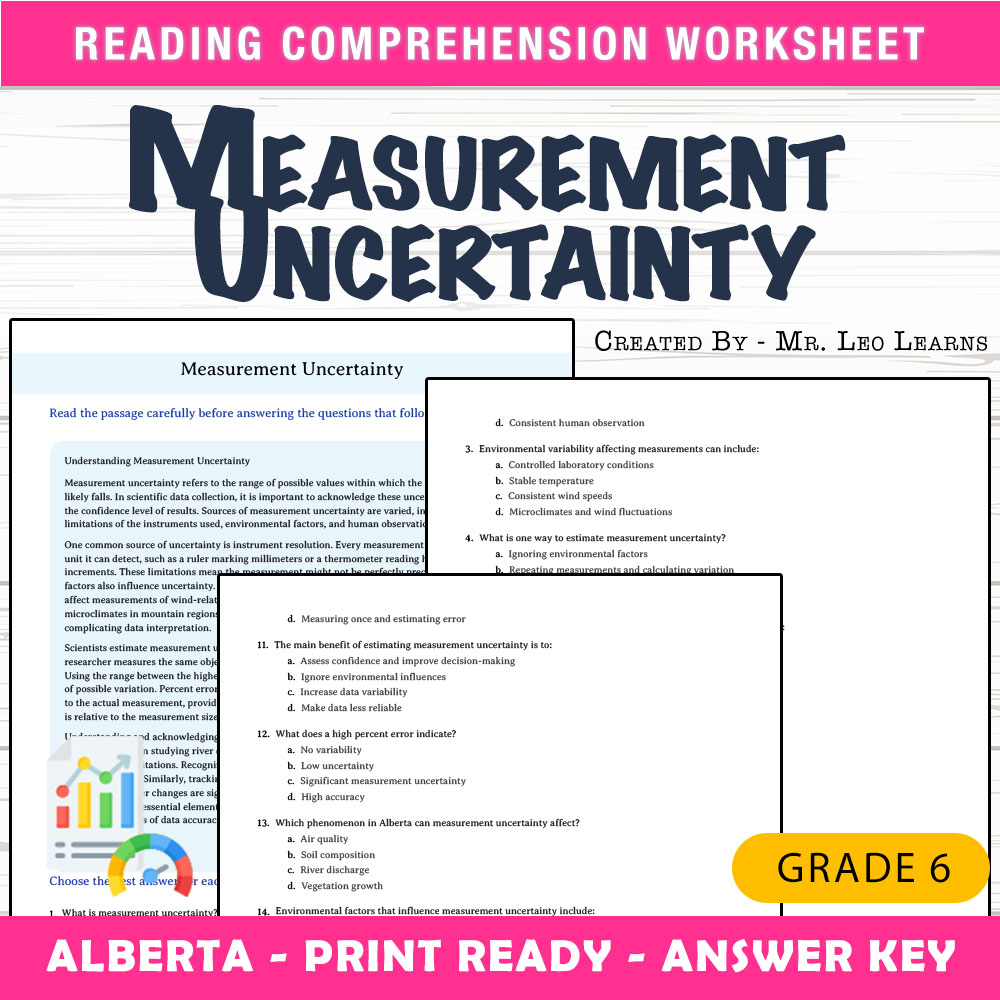
Imagine standing in your classroom, students engaged in measuring objects with a variety of tools. Some students are confident in their measurements, while others struggle to understand why different measurements can vary slightly. They might be questioning what constitutes measurement uncertainty and how to recognize it in practical scenarios. This worksheet provides a straightforward way to address those questions, offering clear, focused practice that helps students grasp the concept of measurement uncertainty and its importance in science.
What This Resource Helps Students Do
This worksheet is designed to guide students through understanding the idea of measurement uncertainty in a simple, organized manner. It helps them identify sources of uncertainty, interpret measurement data, and recognize the variability that can occur in real measurements. By working through the multiple choice questions and reading passage, students improve their comprehension of how measurement uncertainty influences scientific data and experiments. This resource builds confidence in analyzing measurement results and understanding the inherent limitations of measurement tools, enabling students to approach scientific data with a more critical eye.
Inside the PDF
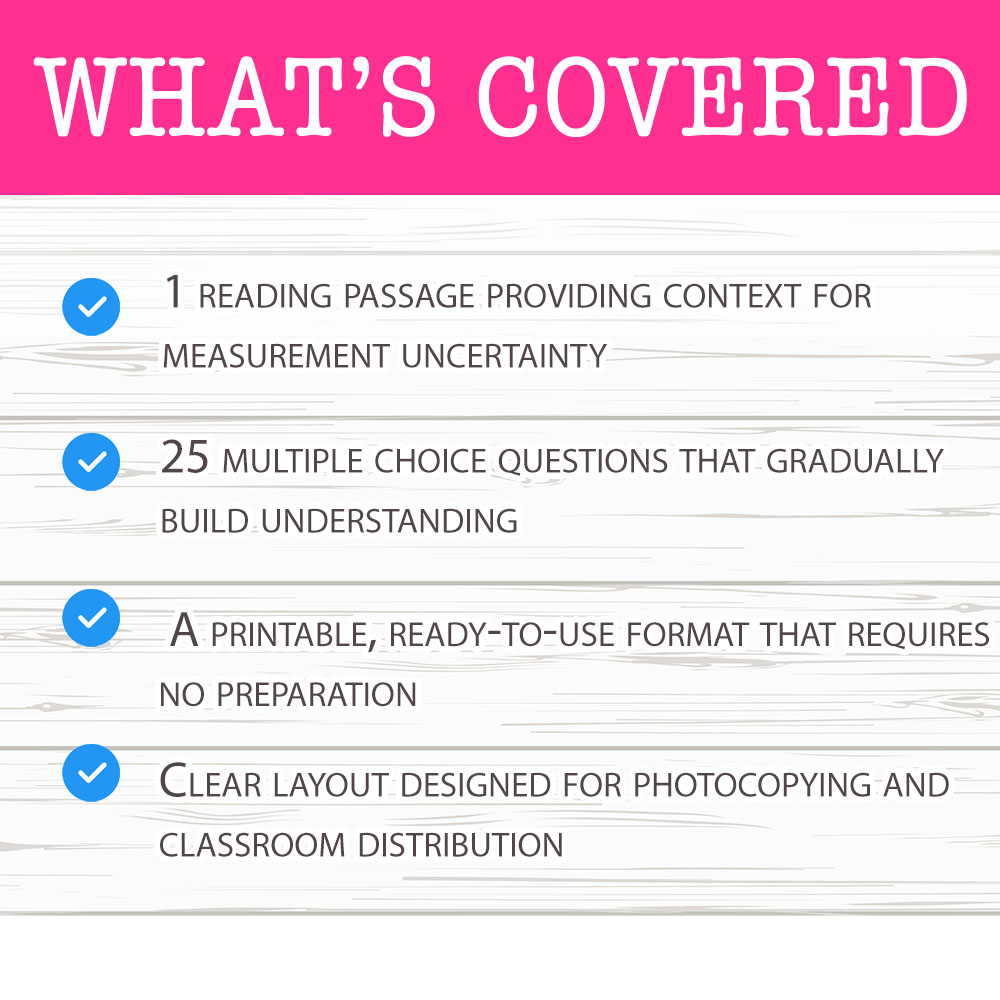
• 1 reading passage providing context for measurement uncertainty
• 25 multiple choice questions that gradually build understanding
• A printable, ready-to-use format that requires no preparation
• Clear layout designed for photocopying and classroom distribution
How It Improves Learning
This worksheet enhances learning by engaging students with familiar scenarios and highlighting the practical implications of measurement uncertainty. The reading passage introduces the concept in an accessible way, setting a foundation for the multiple choice questions. The variety of questions prompts students to think critically about sources of measurement error and how measurement tools can influence data accuracy. As students select their answers, they reinforce key ideas, leading to better retention and comprehension. The structured format encourages independent practice, helping students develop confidence in analyzing scientific measurements and understanding their limitations. Overall, this resource supports the development of analytical skills essential for scientific inquiry and data interpretation.
Core Skills Students Will Develop
- ➡️ identifying sources of measurement uncertainty
- ➡️ analyzing measurement data for variability
- ➡️ understanding the role of measurement tools and methods
- ➡️ applying reasoning to interpret measurement results
Ways Teachers Use This Worksheet
This printable worksheet is useful for classwork, providing a structured activity for students during lessons on measurement or scientific data. It also works well as an assessment tool to gauge student understanding after instruction or as reinforcement for students who need extra practice. Teachers may assign it as homework or use it in small-group settings to foster discussion about measurement accuracy. It’s ideal for early finishers or as part of review sessions, helping students solidify their understanding in a practical context without needing extensive preparation.
Why This PDF Saves Time
This PDF is ready to print and distribute immediately, requiring no additional formatting or preparation. Its clear layout facilitates quick photocopying and classroom setup, allowing teachers to focus more on instruction rather than planning or customizing resources. The included answer key with rubric offers a reliable and consistent way to review student responses, saving time during grading and assessment processes. The print-and-go format ensures a straightforward, stress-free addition to your teaching toolkit, enabling more effective use of classroom time.
By using this resource, teachers can confidently deliver lessons on measurement uncertainty, knowing the activity is designed to support student understanding with minimal fuss. It’s a practical addition that helps students build necessary skills for scientific accuracy and measurement literacy. And with its straightforward format, it’s always ready to support your teaching goals. 😊