
Reading comprehension Worksheets
40,241 type resources
Grade 6 Science | Circulatory Transport Worksheet | General Standard
 Created byLumora Learning
Learning Objectives
- Describe how the heart’s rhythmic pumping creates pressure that moves blood through the body
- Compare the roles and structures of arteries, veins, and capillaries
- Explain how capillaries support exchange of oxygen, nutrients, and wastes between blood and body cells
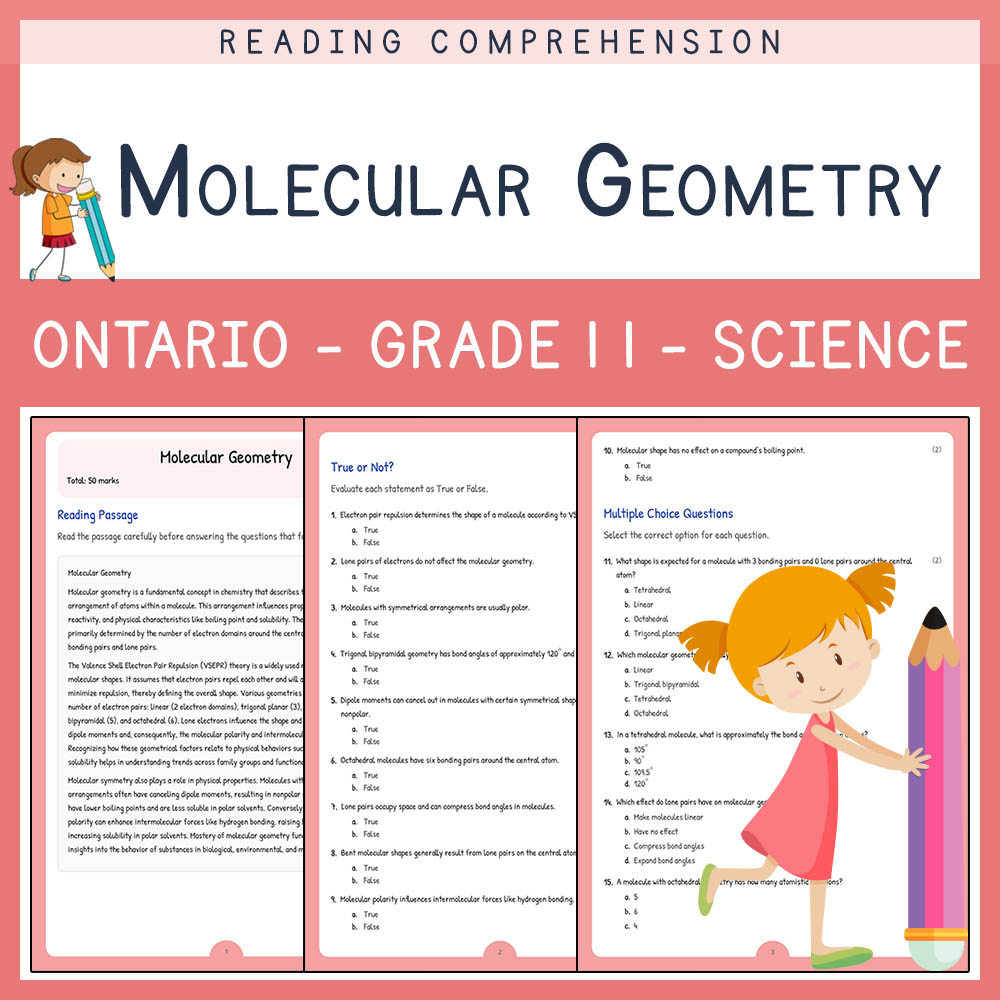
Grade 11 Science Assessment | Molecular Geometry Worksheet Elena | Ontario
Created byLumora LearningLearning Objectives
- Understand the electron-domain and VSEPR models for predicting molecular shapes.
- Identify various molecular geometries and their bond angles.
- Analyze effects of lone pairs and symmetry on molecular polarity and physical properties.
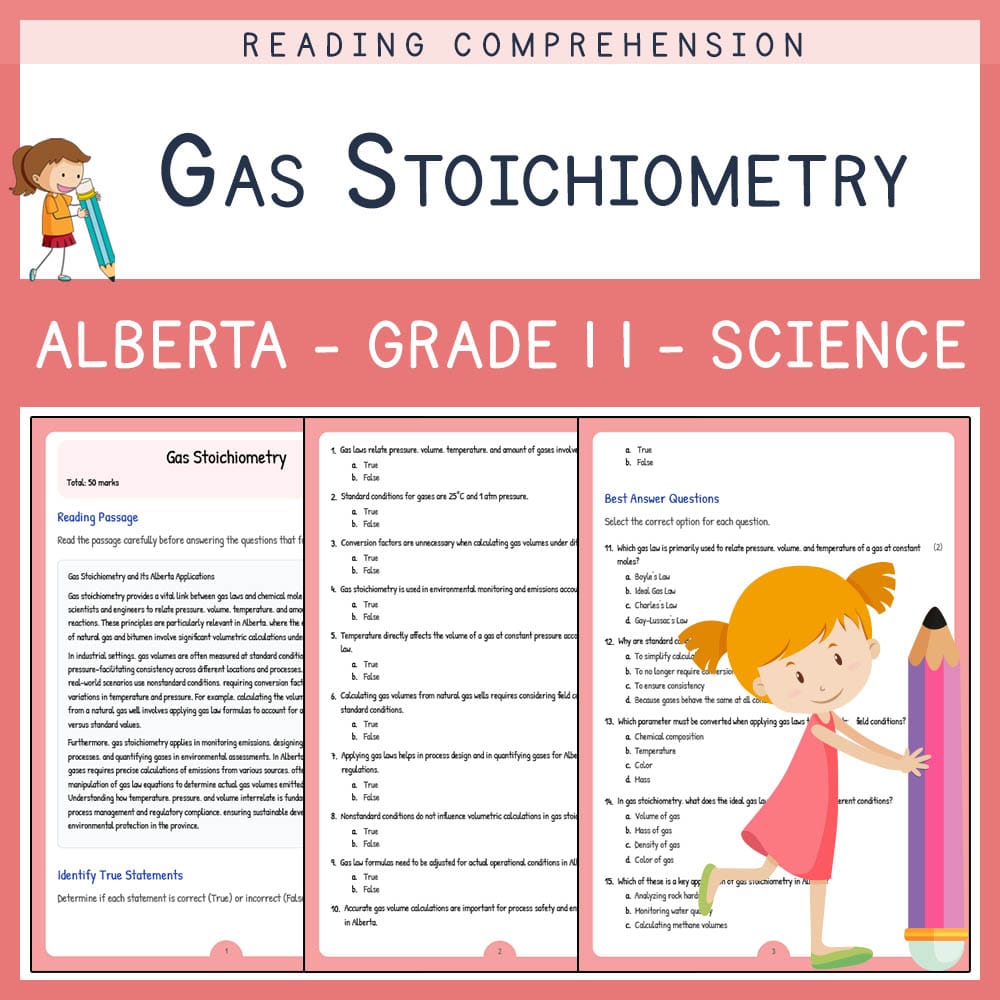
Grade 11 Science | Gas Stoichiometry Worksheet | Alberta Standards
Created byLumora LearningLearning Objectives
- Understand the principles of gas laws and how they relate to mole relationships in gas stoichiometry.
- Apply gas law equations to calculate pressures, volumes, and temperatures of gases in chemical reactions.
- Analyze how standard and nonstandard conditions impact volumetric conversions in industrial contexts.

Grade 10 Science | Stoichiometric Ratios Worksheet | BC Aligned
Created byLumora LearningLearning Objectives
- Understand how molar ratios connect reactants and products in chemical reactions.
- Apply the mole concept to translate between mass and amount of substance.
- Utilize balanced chemical equations to determine proportional relationships in reactions.

Grade 11 Science | Ionic Strength Worksheet | Alberta Standards
Created byLumora LearningLearning Objectives
- Explain the concept of ionic strength and its impact on activity coefficients.
- Describe how high ionic strength reduces the activity of ions in solutions.
- Discuss the effects of ionic strength on solubility and equilibrium in natural and industrial aqueous systems.

Grade 6 Science | Cycles Of Matter Model Worksheet | General Standard
Created byLumora LearningLearning Objectives
- Explain how matter cycles through living and non-living parts of an ecosystem
- Describe carbon and water movement among reservoirs using the cycles of matter model
- Interpret processes (photosynthesis, respiration, feeding, decomposition) as flows in a matter cycle
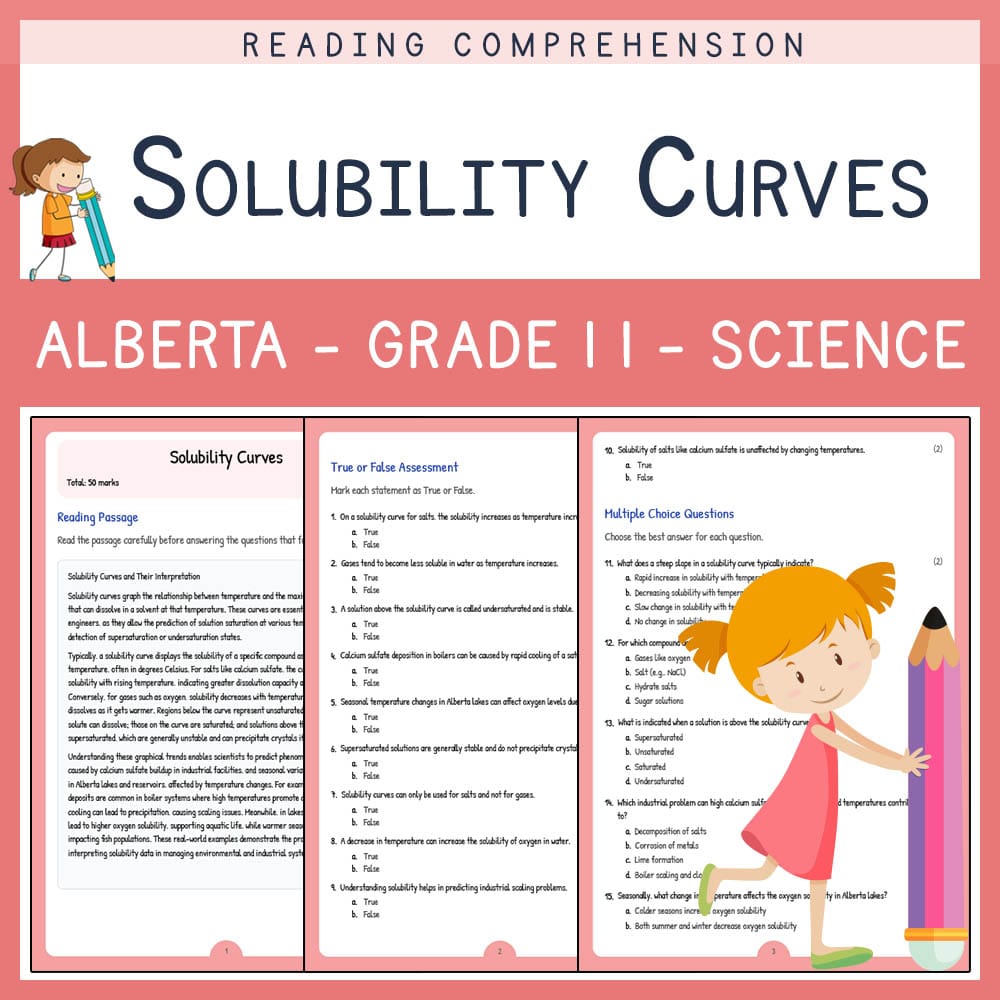
Grade 11 Science | Solubility Curves Worksheet | Alberta Standards
Created byLumora LearningLearning Objectives
- Understand how to read and interpret solubility curves for different compounds.
- Identify regions of unsaturated, saturated, and supersaturated solutions on a graph.
- Connect graphical trends to molecular interactions and predict solution states.
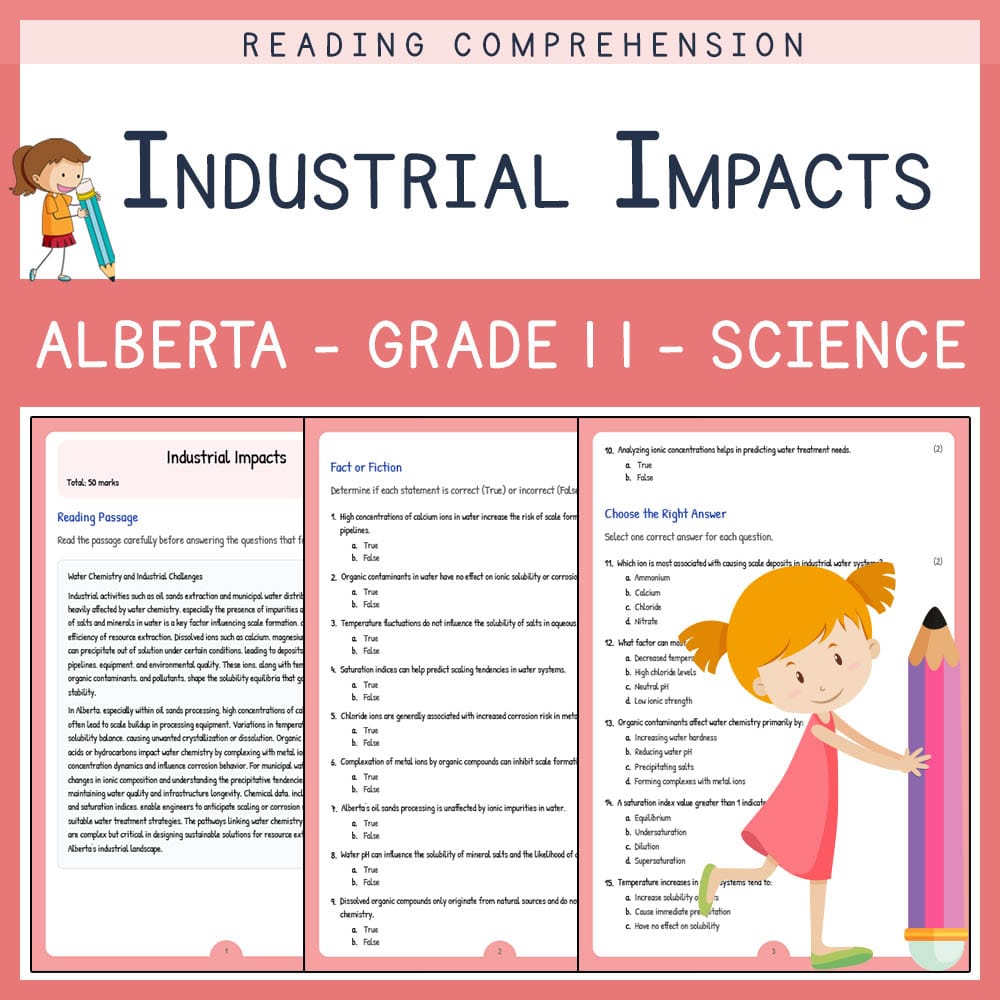
Grade 11 Science | Industrial Impacts Worksheet | Alberta Standards
Created byLumora LearningLearning Objectives
- Understand how dissolved ions, temperature shifts, and organic contaminants influence solubility equilibria in water systems.
- Interpret chemical data to evaluate operational challenges related to scale formation, corrosion, and impurity effects.
- Analyze the impact of environmental impurities on infrastructure, especially in Alberta's oil sands processing and municipal water systems.
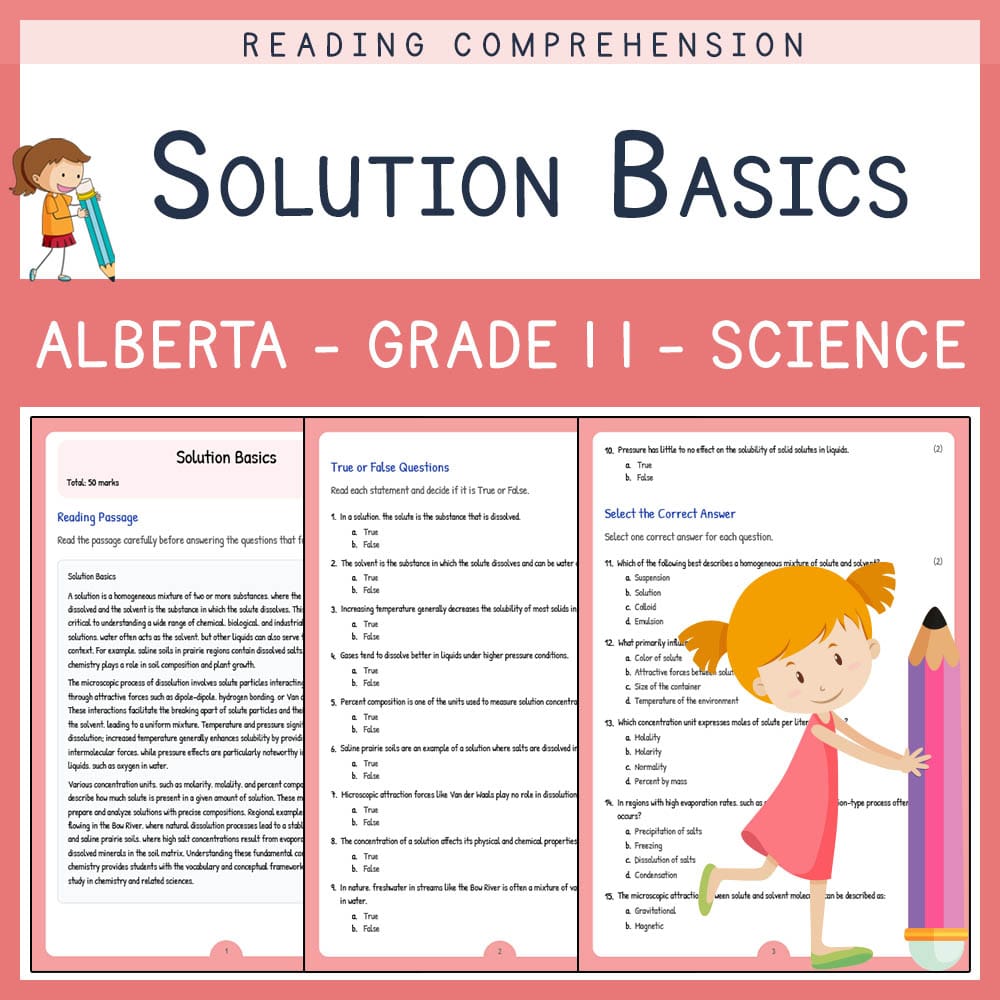
Grade 11 Science | Solution Basics Worksheet | Alberta Standards
Created byLumora LearningLearning Objectives
- Define solute and solvent in the context of solutions.
- Understand concentration units and how they describe solution strength.
- Explain the microscopic interactions during dissolution and how temperature and pressure affect solution formation.
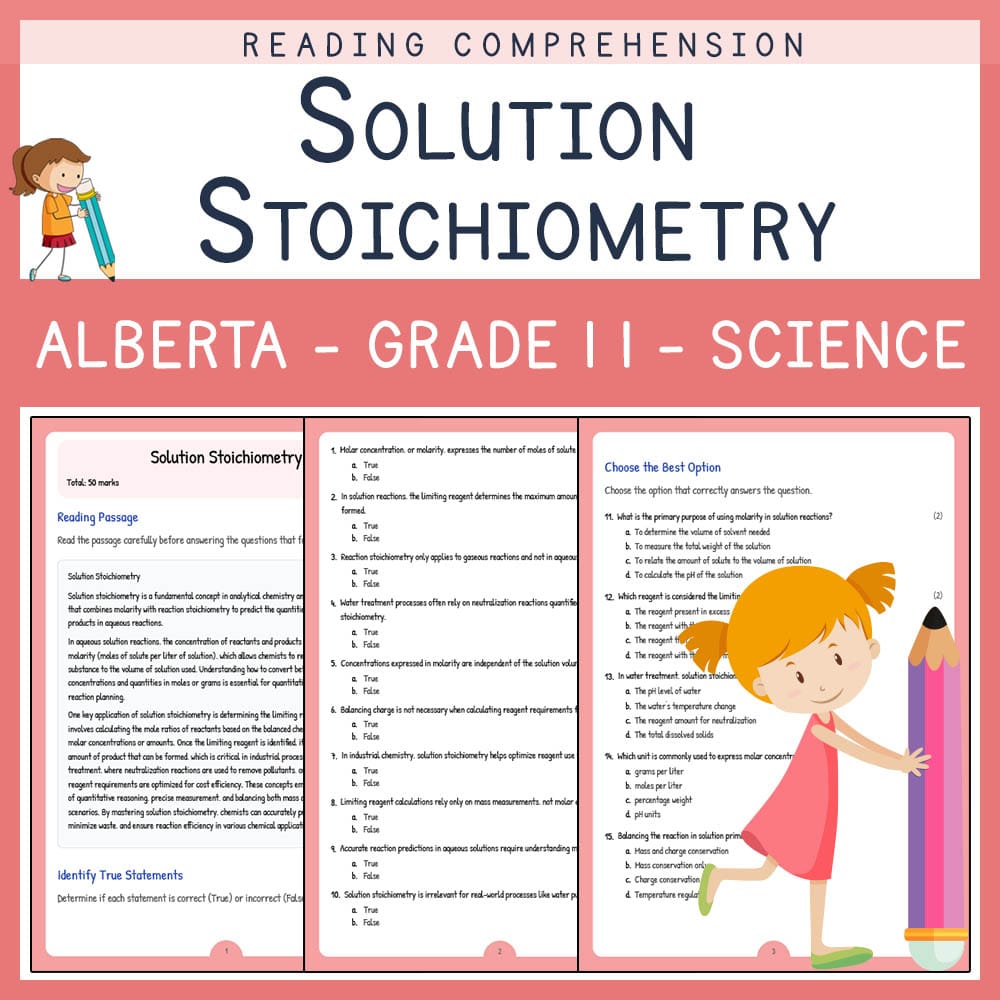
Grade 11 Science | Solution Stoichiometry Worksheet | Alberta Standards
Created byLumora LearningLearning Objectives
- Understand the concept of concentration and how it relates to molar ratios in aqueous reactions.
- Apply mole–mole relationships to predict reactant and product amounts in solution.
- Identify limiting reagents in solution-phase reactions through stoichiometric calculations.
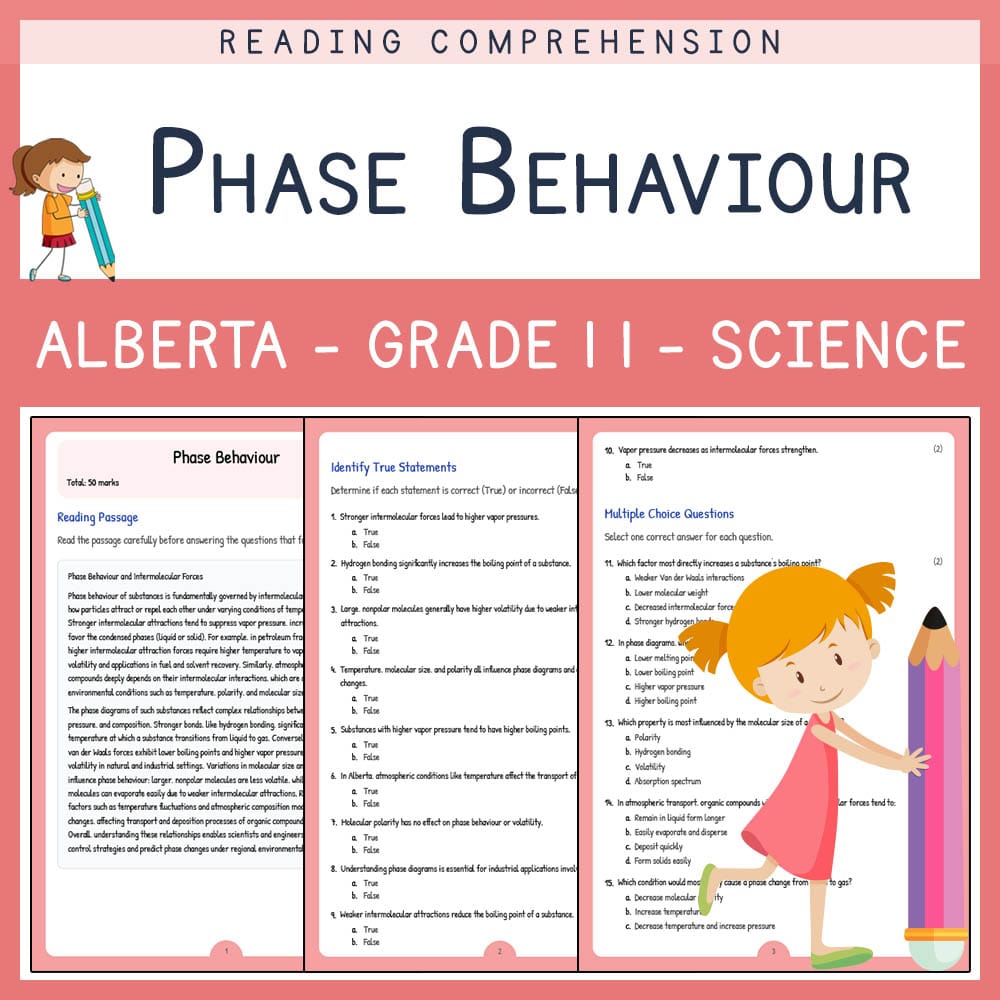
Grade 11 Science Worksheet | Phase Behaviour | Alberta Standards
Created byLumora LearningLearning Objectives
- Understand how intermolecular forces influence phase transitions, vapor pressure, and volatility.
- Explain the connection between intermolecular attractions and physical properties like boiling point and vapor pressure.
- Apply knowledge of phase diagrams considering temperature, molecular size, and polarity in regional environmental contexts.
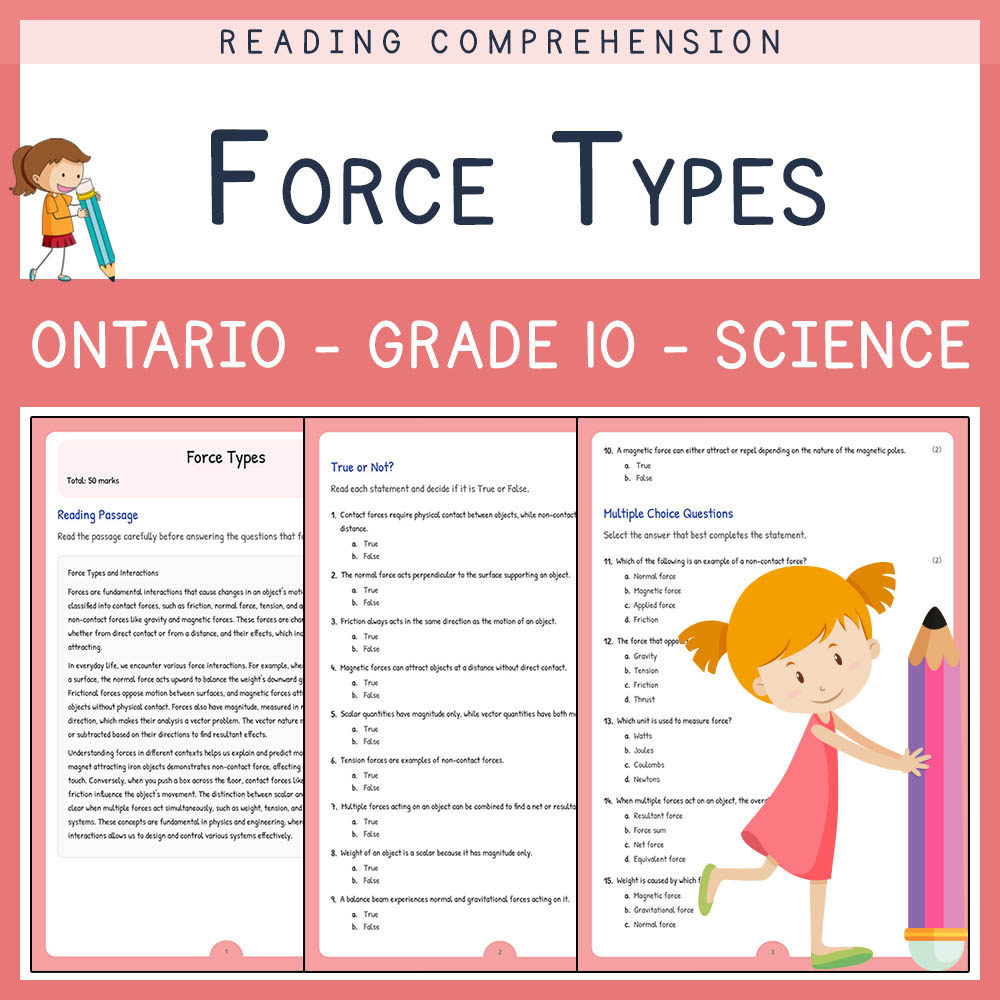
Grade 10 Science | Force Types Worksheet Elena | Ontario Standard
Created byLumora LearningLearning Objectives
- Describe different types of contact and non-contact forces.
- Explain how forces have magnitude and direction, illustrating their vector nature.
- Identify examples of force interactions in real-world contexts like weights on supports and magnetic attraction.
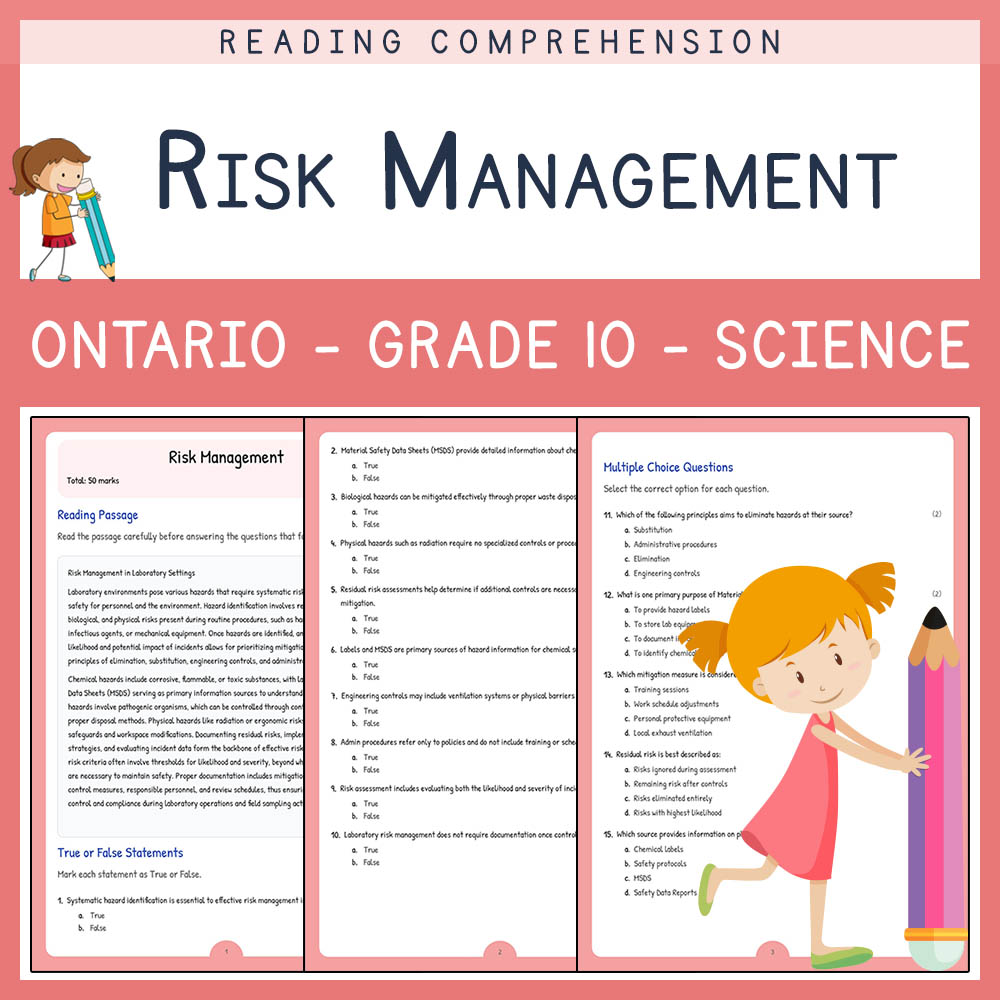
Grade 10 Science | Risk Management Worksheet | Ontario Standards
Created byLumora LearningLearning Objectives
- Understand systematic hazard identification and risk assessment methods in laboratory settings.
- Identify chemical, biological, and physical hazards and appropriate mitigation strategies.
- Explain principles of hazard elimination, substitution, engineering controls, and administrative procedures.
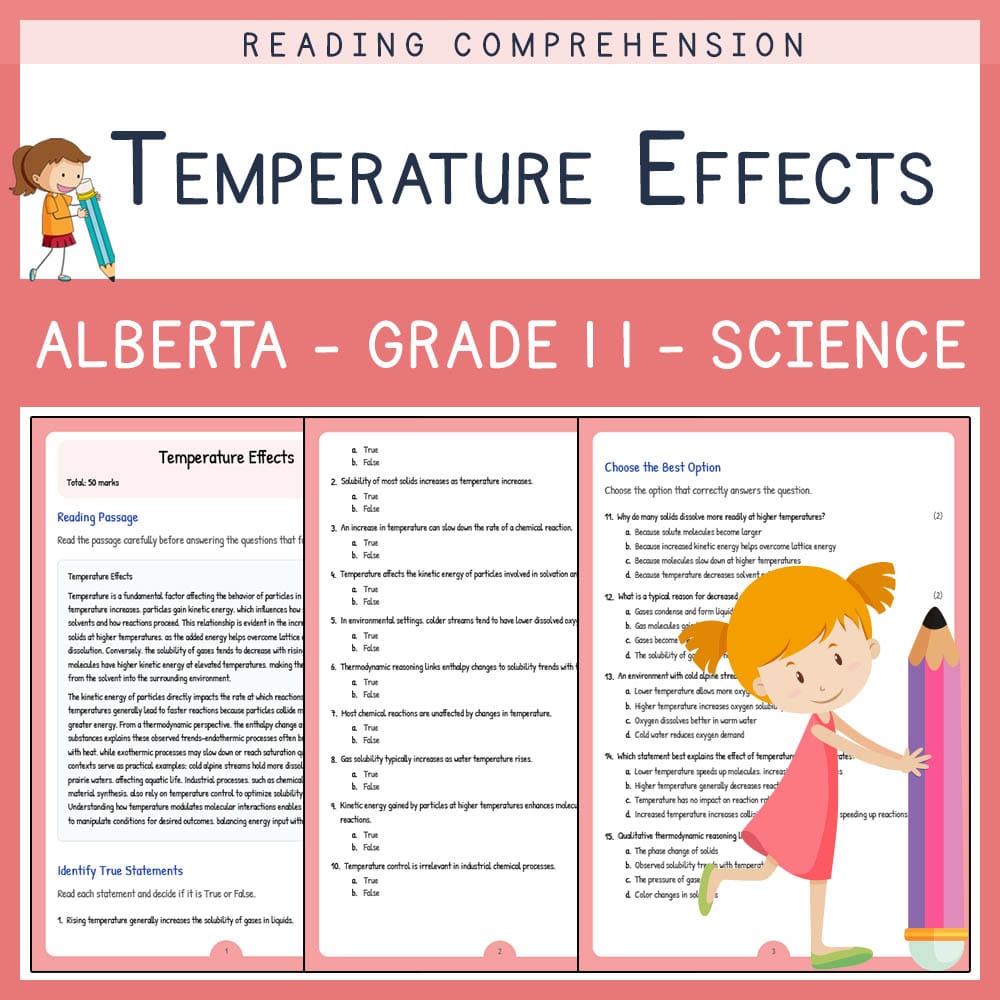
Grade 11 Science | Temperature Effects Worksheet | Alberta Standards
Created byLumora LearningLearning Objectives
- Describe how temperature influences the kinetic energy of particles and solvent–solute interactions.
- Explain why solids dissolve more readily at higher temperatures and why gas solubility decreases with increasing temperature.
- Apply qualitative thermodynamic reasoning to analyze solubility and reaction rate trends with temperature.

Grade 10 Science | Sphere Connections Worksheet | AP Aligned
Created byLumora LearningLearning Objectives
- Understand how the geosphere, hydrosphere, atmosphere, and biosphere interact through coupled processes.
- Identify examples of systems thinking and flow diagrams in Earth systems.
- Explain how perturbations propagate across Earth's spheres and affect observable indicators.

Grade 6 Science | States of Matter Worksheet | NGSSS Aligned
Created byLumora LearningLearning Objectives
- Explain how the shape and volume of solids, liquids, and gases differ due to particle behavior.
- Use models of particle motion to describe changes in state and connect them to energy changes.
- Classify everyday materials as solids, liquids, or gases based on observed properties.
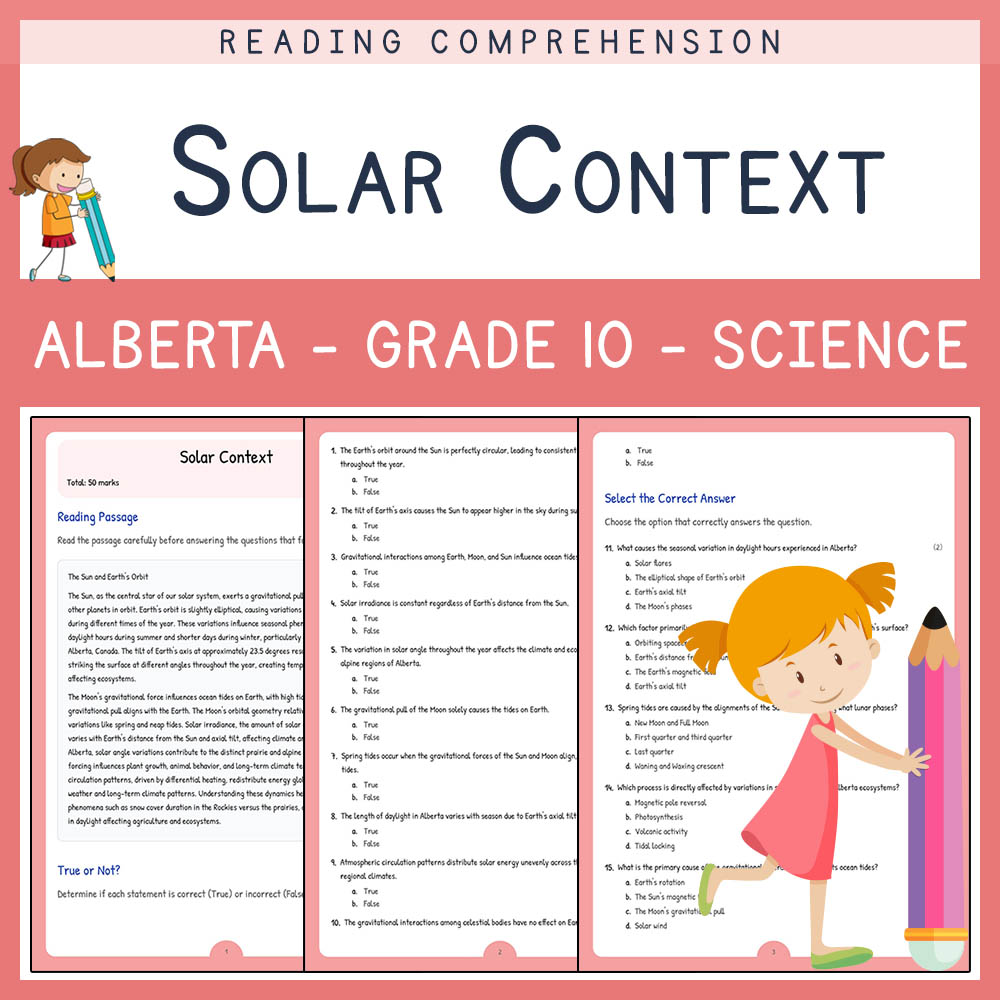
Grade 10 Science Worksheet | Solar Context | Alberta Standards
Created byLumora LearningLearning Objectives
- Describe the orbital motions of Earth, Moon, and Sun, and how these influence seasonal and daily patterns on Earth.
- Explain the concept of solar irradiance and its effect on regional ecosystems, particularly in Alberta.
- Analyze the gravitational interactions among Earth, Moon, and Sun and their impact on tides and orbital dynamics.
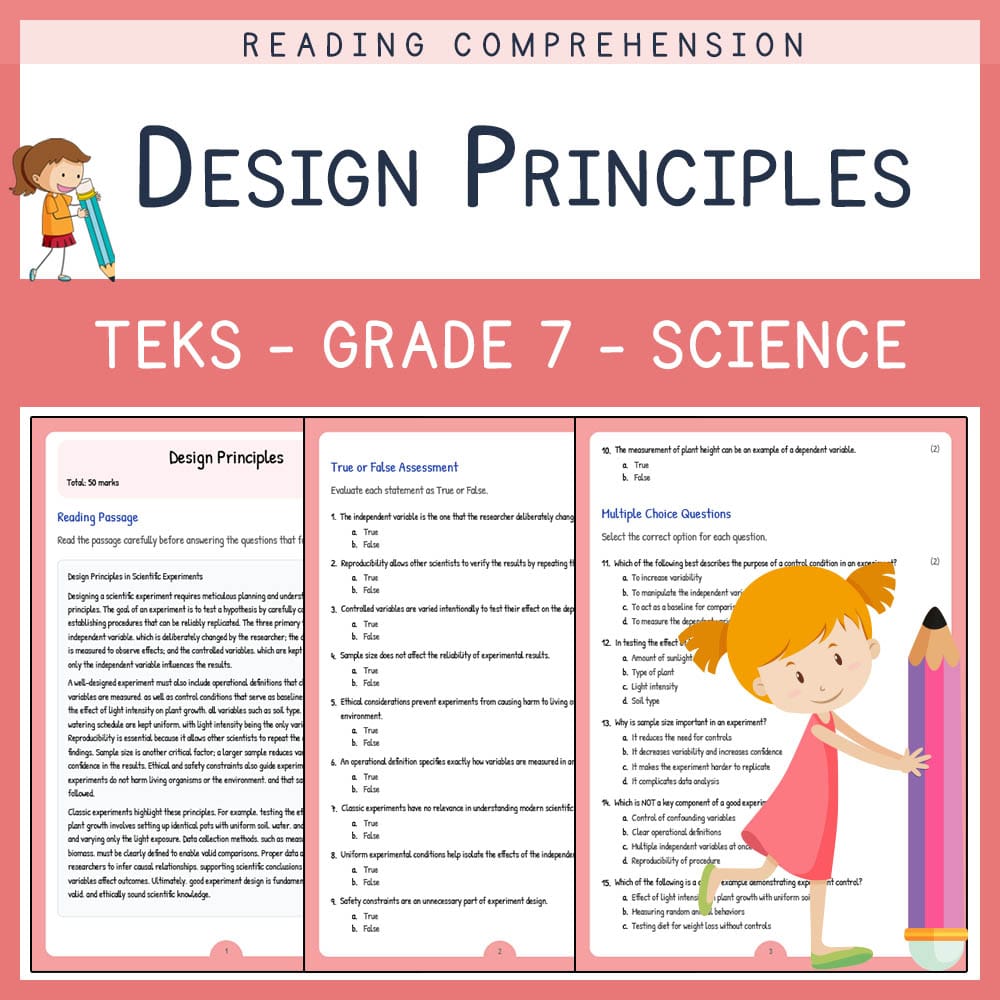
Grade 7 Science | Design Principles Worksheet | TEKS-Aligned
Created byLumora LearningLearning Objectives
- Understand the key elements of designing a fair experiment.
- Identify and define variables in experimental setups.
- Learn the importance of reproducibility, sample size, and safety considerations.
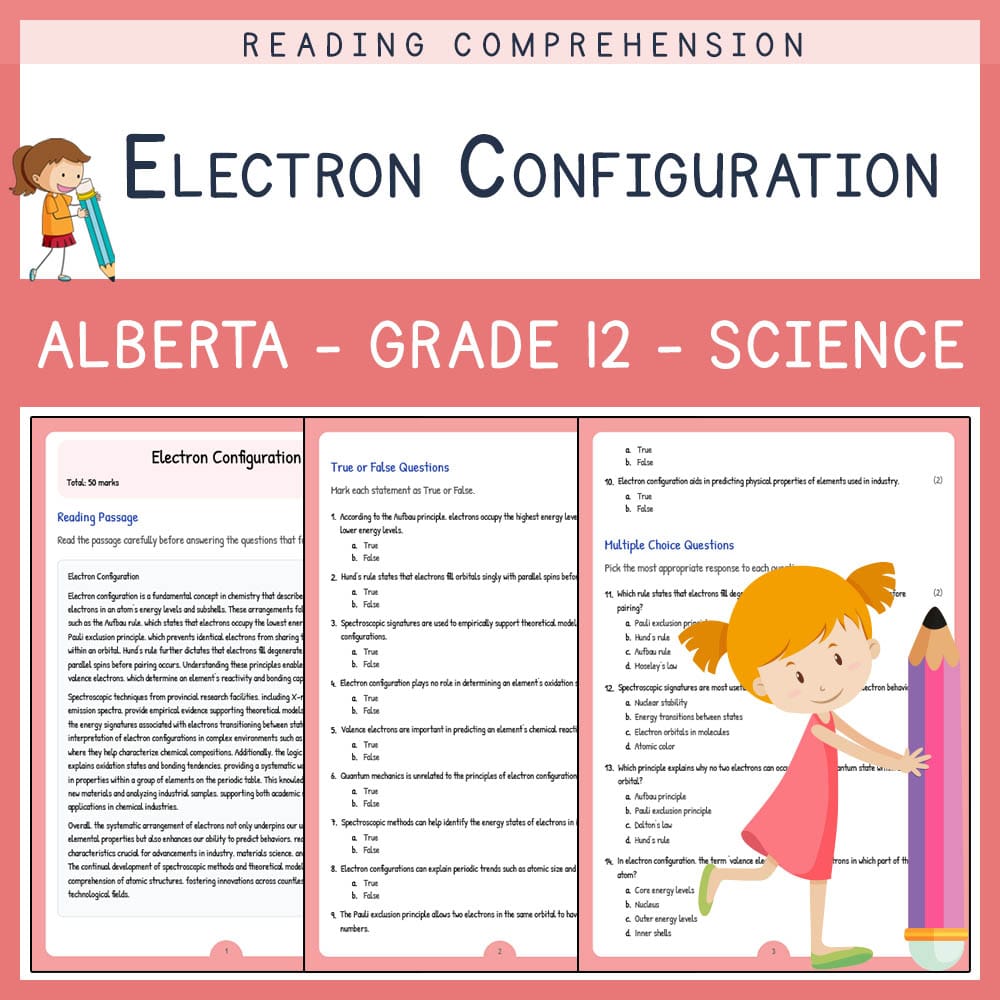
Grade 12 Science | Electron Configuration Worksheet | Alberta Standard
Created byLumora LearningLearning Objectives
- Explain the principles behind electron configuration, including Aufbau, Pauli exclusion, and Hund's rules.
- Predict element valence and chemical behavior based on electron configurations.
- Understand how spectroscopic signatures support electron configuration theories in research.
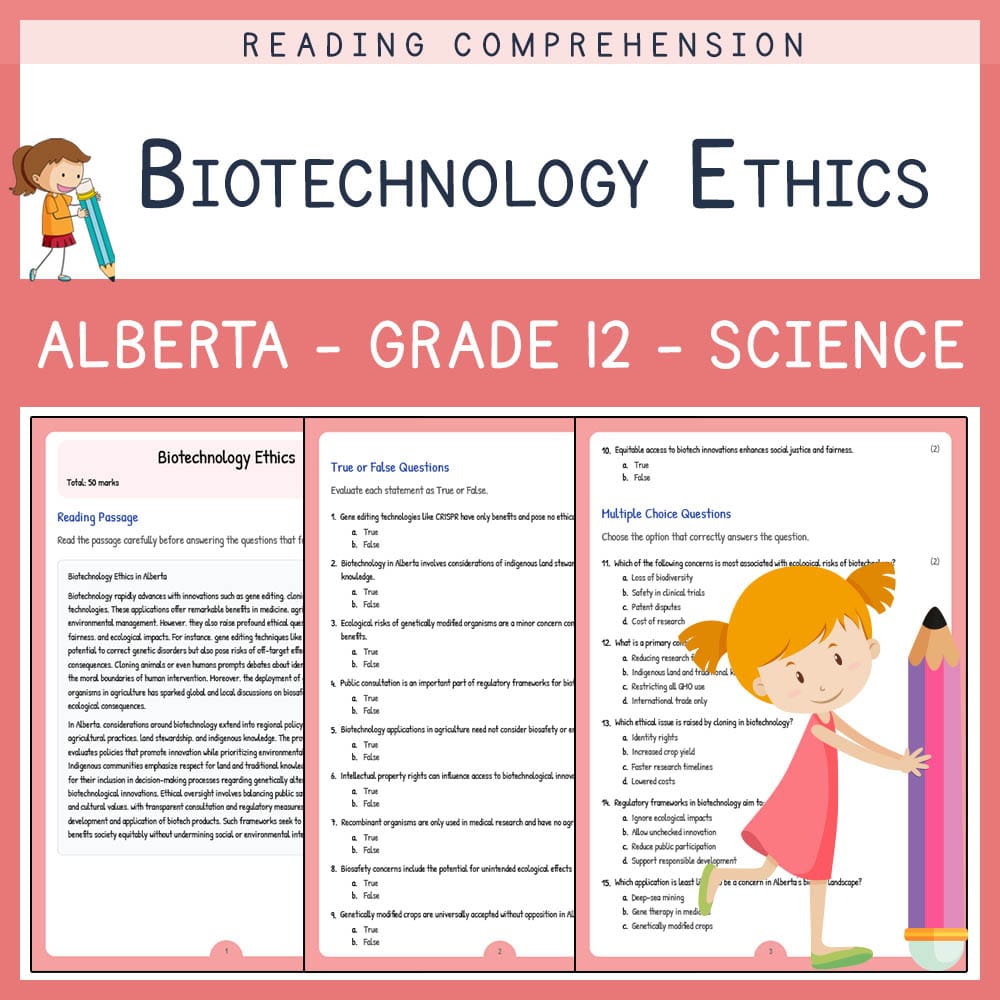
Grade 12 Science | Biotechnology Ethics Worksheet | Alberta Standards
Created byLumora LearningLearning Objectives
- Understand the ethical, legal, and social issues related to biotechnology applications.
- Analyze considerations such as biosafety, intellectual property, and ecological risks.
- Evaluate regulatory frameworks and public consultation processes shaping biotechnology deployment.
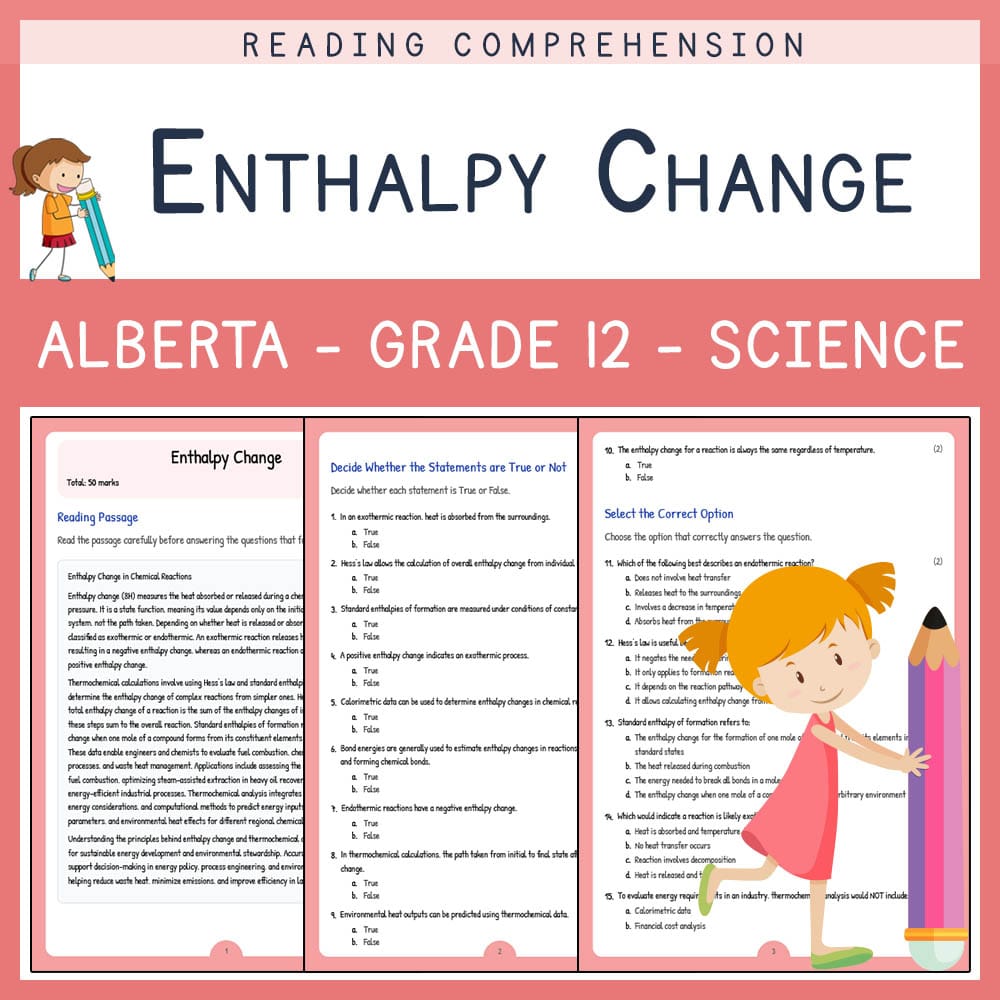
Grade 12 Science | Enthalpy Change Worksheet | Alberta Standards
Created byLumora LearningLearning Objectives
- Understand the concept of enthalpy change and its significance in chemical processes.
- Identify the signs and conventions for exothermic and endothermic reactions.
- Apply Hess’s law and standard enthalpies of formation to calculate reaction enthalpies.
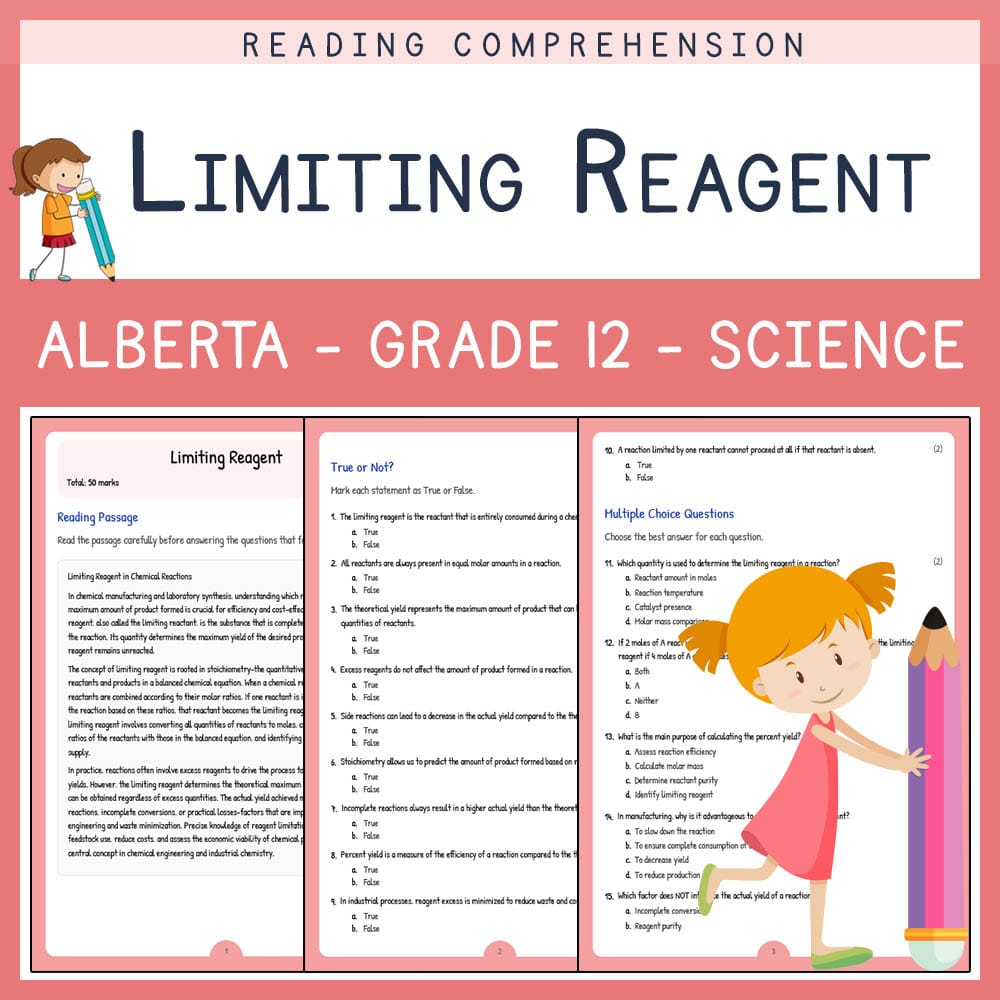
Grade 12 Science | Chemistry Limiting Reagent Worksheet | Alberta Standards
Created byLumora LearningLearning Objectives
- Understand the concept of limiting reagent in chemical reactions.
- Identify the limiting reagent from balanced chemical equations.
- Calculate theoretical and percent yields based on reagent limitations.
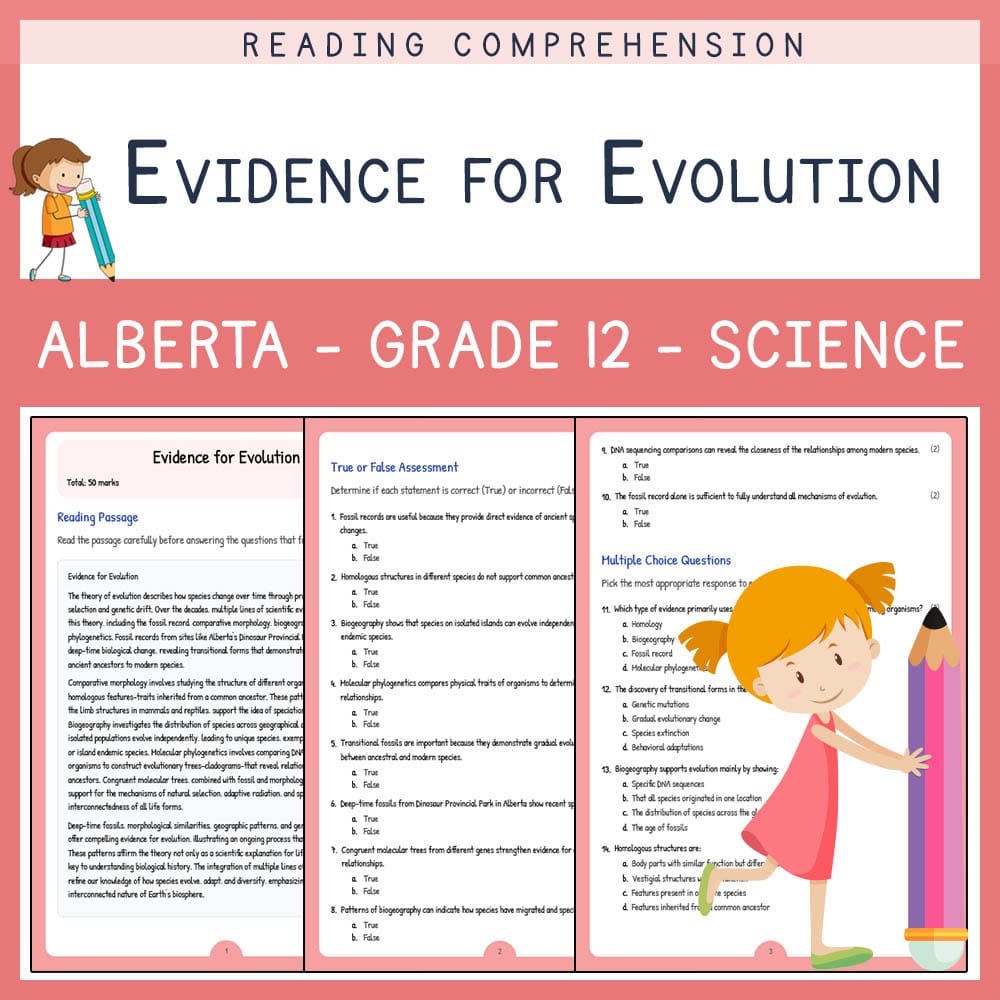
Grade 12 Science | Evidence for Evolution Worksheet | Alberta Standards
Created byLumora LearningLearning Objectives
- Understand the different types of evidence supporting the theory of evolution.
- Identify examples of fossil records, morphological similarities, and molecular data.
- Explain how biogeography and genetic analyses contribute to understanding evolutionary relationships.
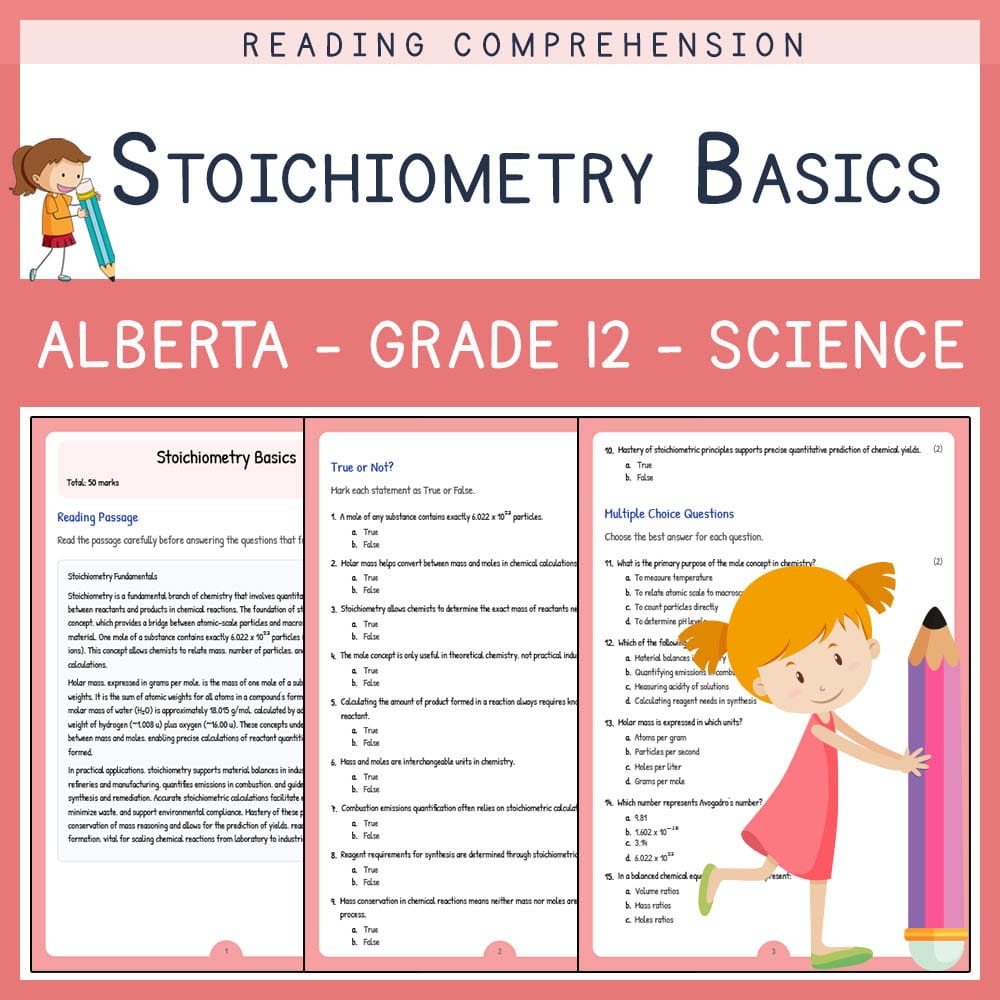
Grade 12 Science | Stoichiometry Basics Worksheet | Alberta Standards
Created byLumora LearningLearning Objectives
- Understand the mole concept and its significance in chemical calculations.
- Learn to calculate molar mass and convert between mass and moles.
- Apply mass and mole relationships to balanced chemical equations.

Grade 12 Science | Data Analysis in Scientific Research Worksheet | TEKS Aligned
Created byLumora LearningLearning Objectives
- Interpret and analyze data visualizations including graphs and plots.
- Select appropriate models and assess their fit using statistical metrics.
- Evaluate residuals and understand uncertainty representation in data.
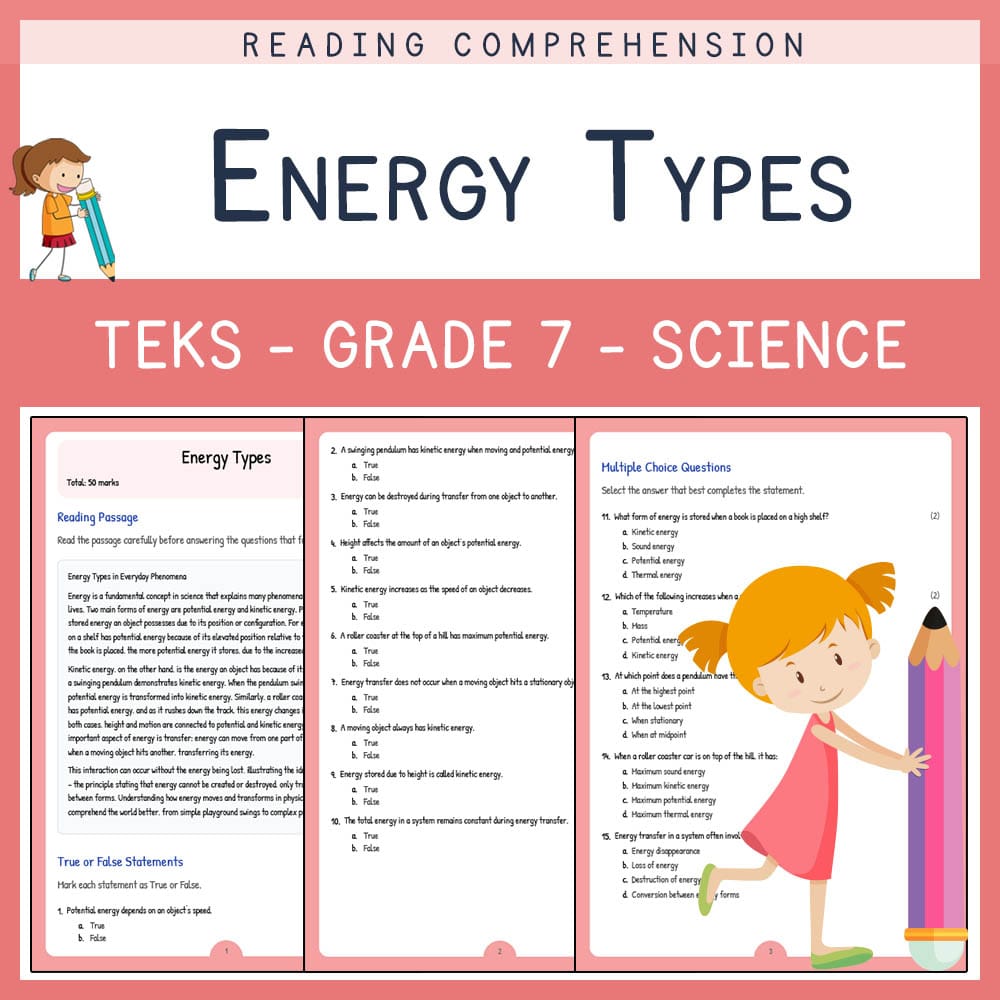
Grade 7 Science | Energy Types Worksheet | TEKS Aligned
Created byLumora LearningLearning Objectives
- Define kinetic and potential energy using everyday phenomena.
- Explain how height and motion influence energy forms.
- Illustrate energy transfer among system components.
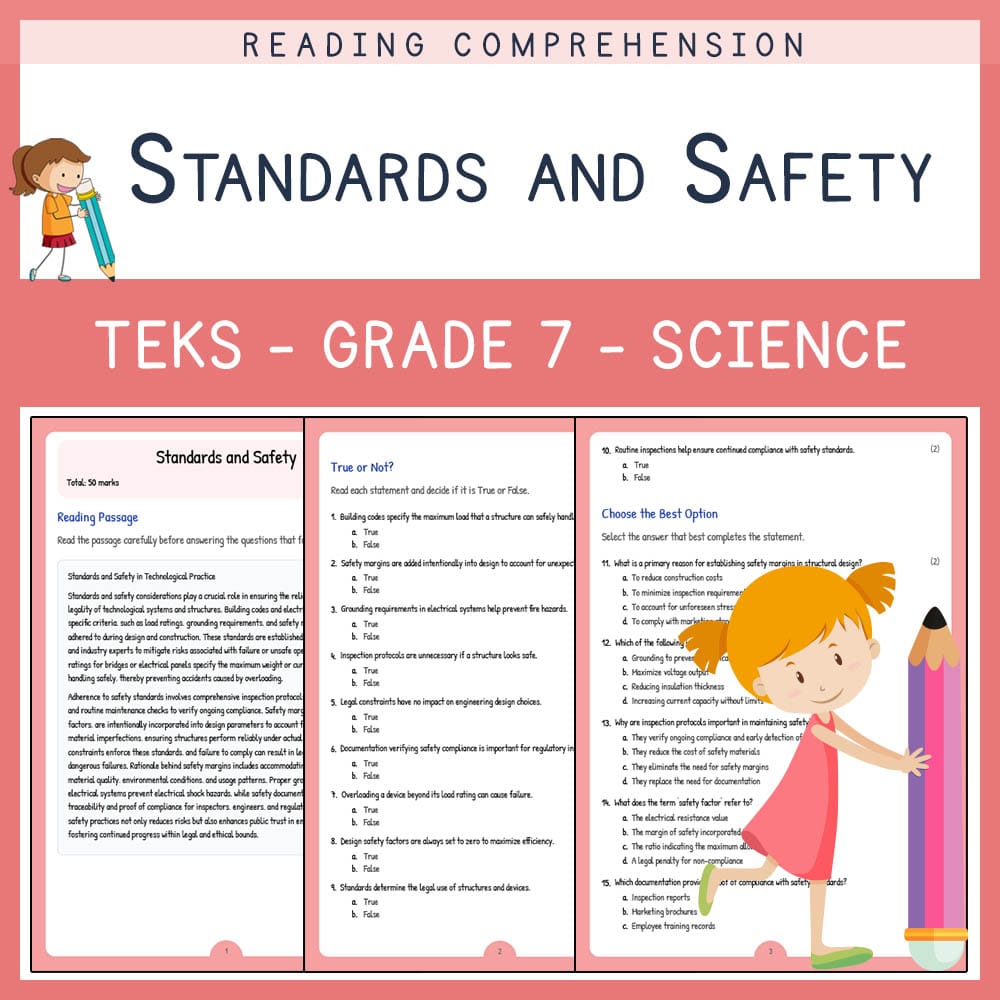
Grade 7 Science | Standards and Safety Worksheet | TEKS Alligned
Created byLumora LearningLearning Objectives
- Understand the role of building codes and safety standards in technological practice.
- Identify key safety measures such as grounding requirements and load ratings.
- Explain the importance of safety margins, inspection protocols, and documentation for safety compliance.
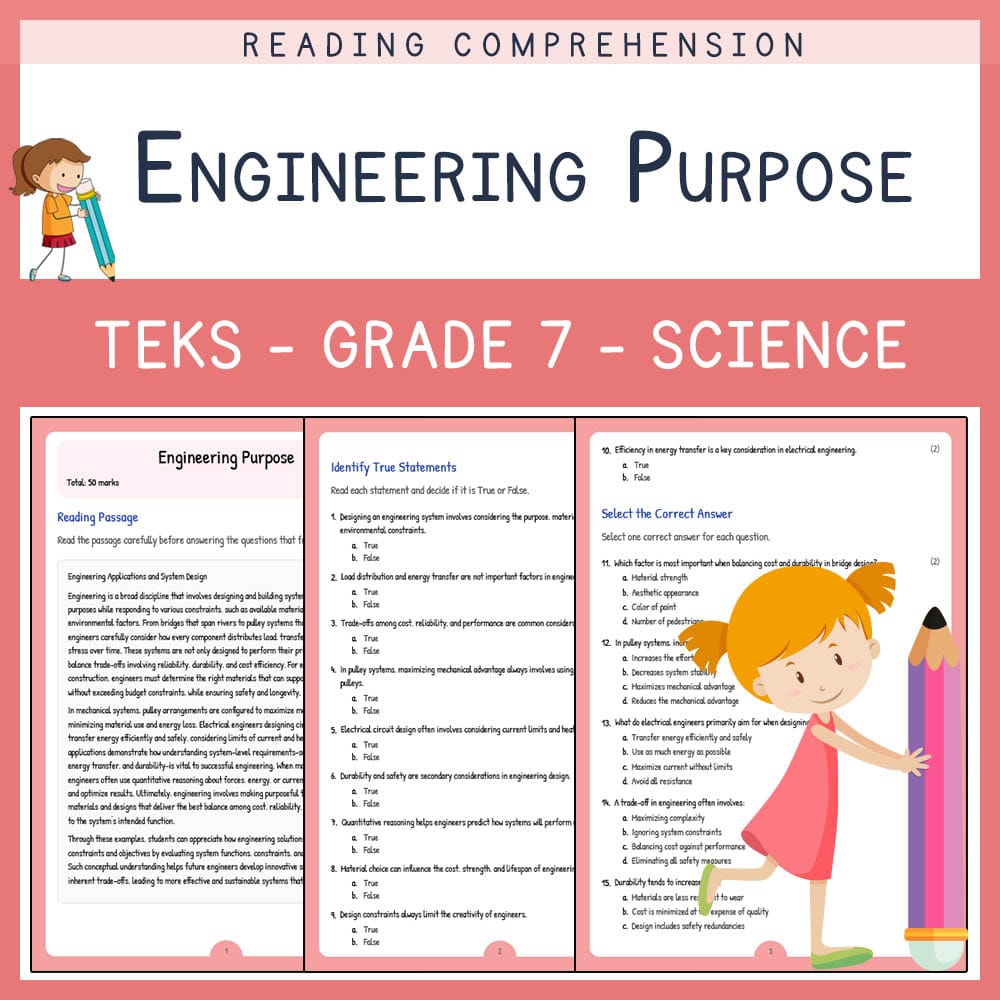
Grade 7 Science | Engineering Purpose Worksheet | TEKS Alligned
Created byLumora LearningLearning Objectives
- Understand how engineering design responds to system purpose, constraints, and materials.
- Identify examples of engineering systems in structural, mechanical, and electrical contexts.
- Evaluate trade-offs among cost, performance, and reliability in engineering projects.
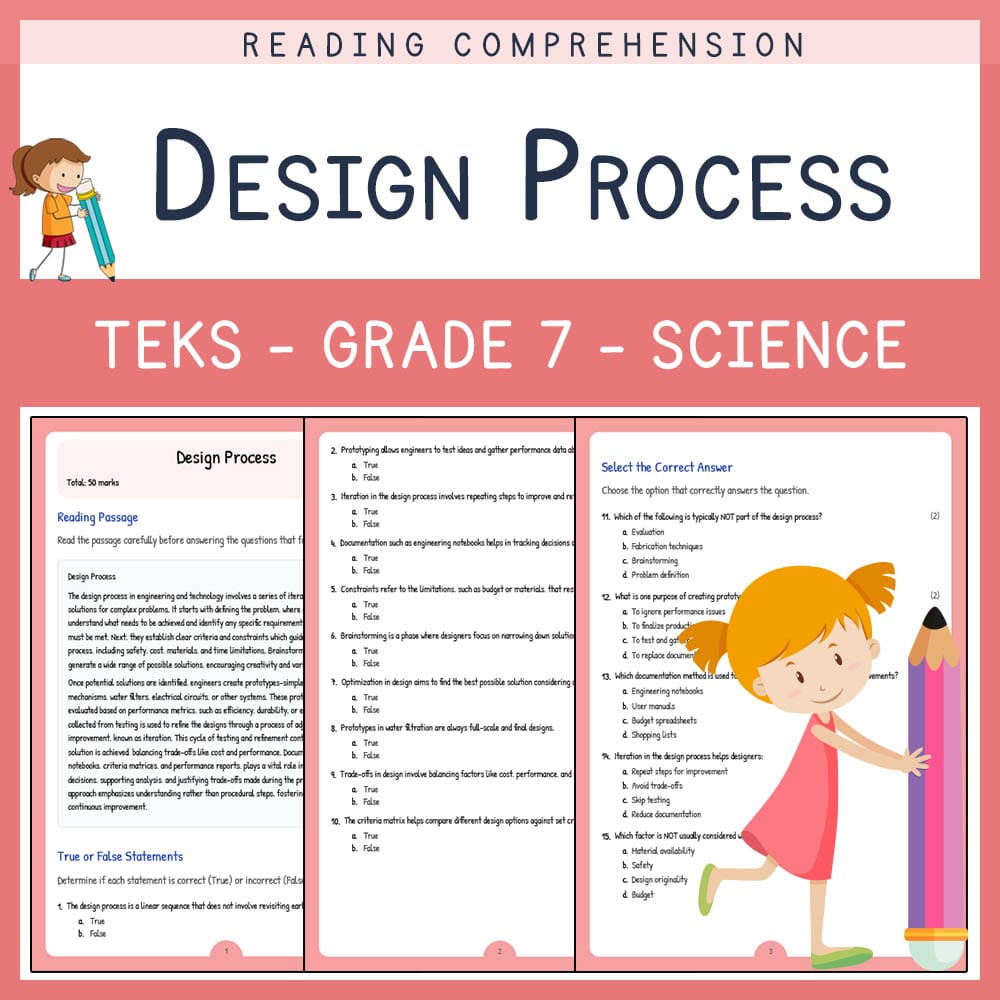
Grade 7 Science | Design Process Worksheet | TEKS Alligned
Created byLumora LearningLearning Objectives
- Understand the key steps in the technological design process including problem definition, criteria and constraints, brainstorming, prototyping, evaluation, and optimization.
- Recognize examples of simple design prototypes such as mechanisms, water filtration models, and electrical circuits.
- Explain the importance of documentation methods like engineering notebooks and criteria matrices in supporting design decisions.
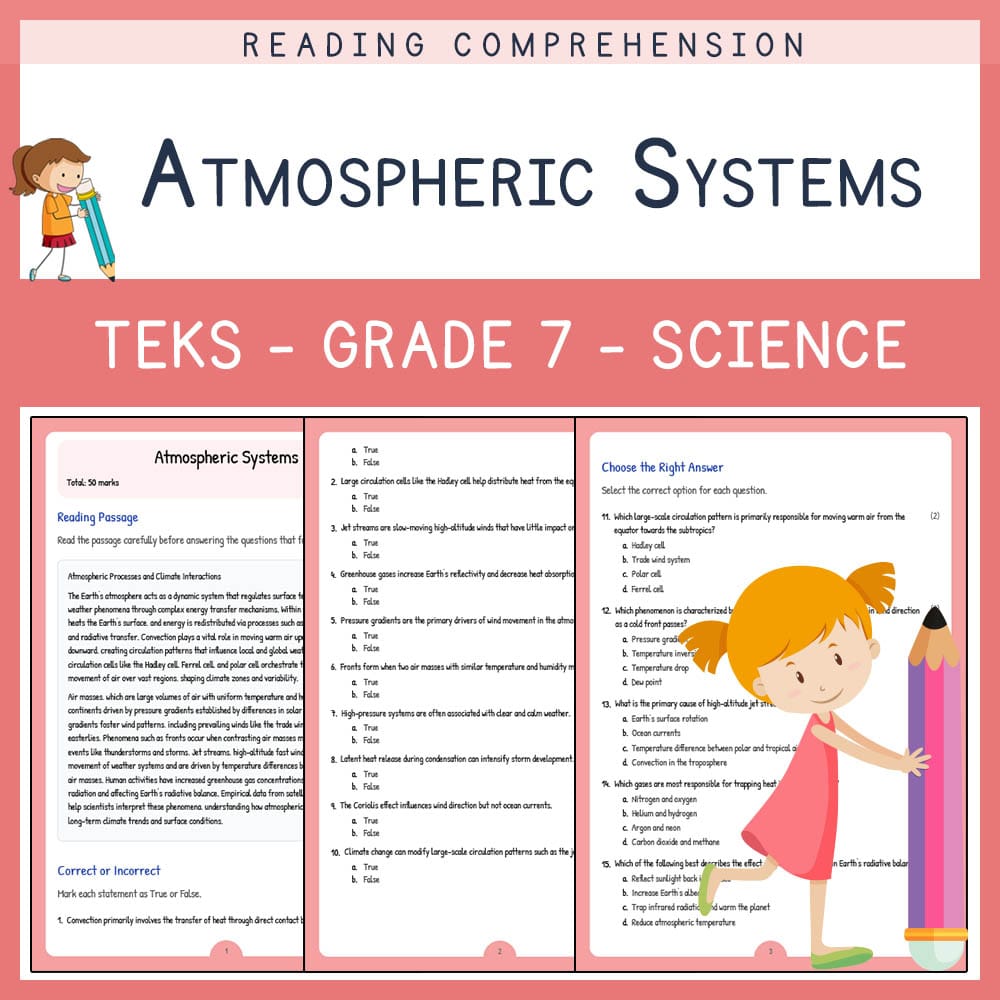
Grade 7 Science | Atmospheric Systems Worksheet Elena | TEKS-Aligned
Created byLumora LearningLearning Objectives
- Describe the processes involved in atmospheric energy transfer and circulation.
- Explain how air masses, pressure gradients, and large-scale circulation affect weather and climate.
- Identify observational phenomena like fronts and jet streams and their impacts.
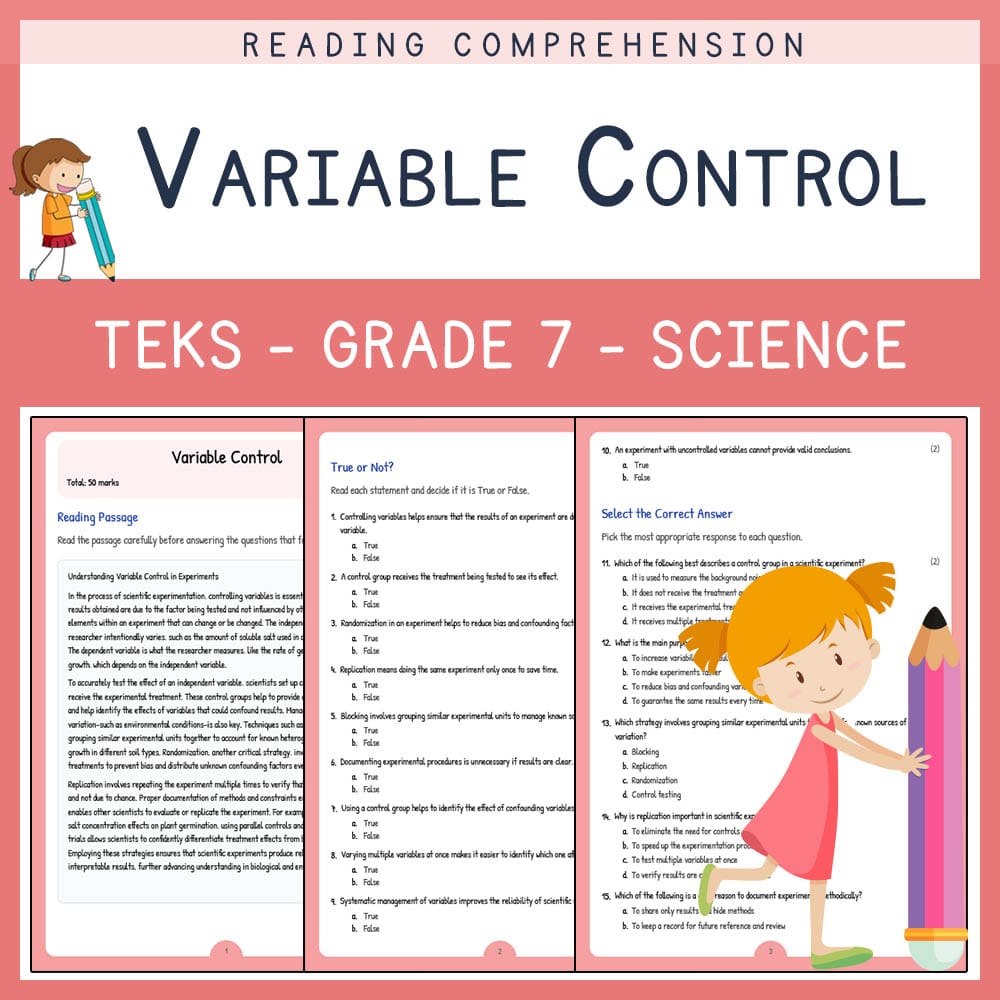
Grade 7 Science | Variable Control Worksheet | TEKS Alligned
Created byLumora LearningLearning Objectives
- Identify and describe the purpose of variables in controlled experiments.
- Understand methods for managing variables, including control groups, randomization, and replication.
- Explain how systematic variable management reduces confounding influences.
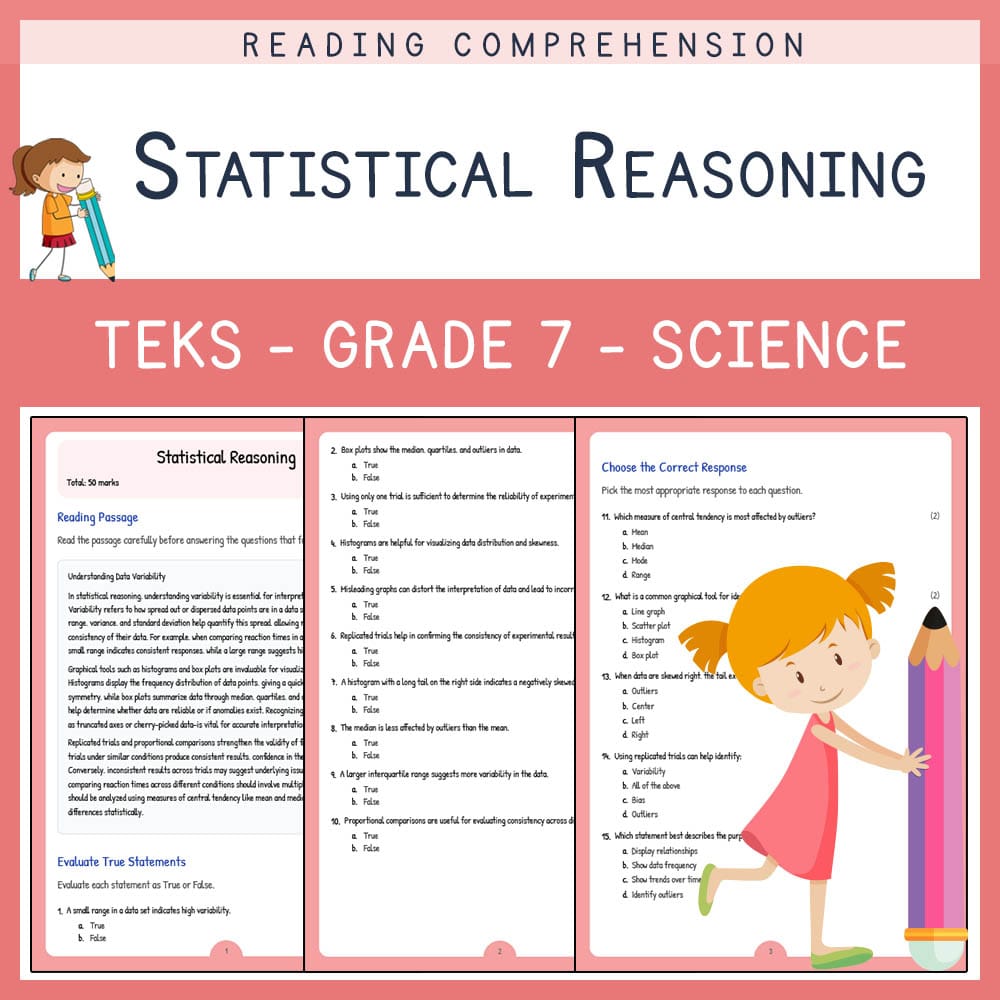
Grade 7 Science | Statistical Reasoning Worksheet | TEKS-Aligned
Created byLumora LearningLearning Objectives
- Interpret variability and measures of central tendency to assess data consistency
- Use graphical cues such as box plots and histograms to evaluate reliability and significance
- Compare and calculate mean, median, and range across data sets

Grade 7 Science | Survival Structures Worksheet | General Standard Aligned
Created byLumora LearningLearning Objectives
- Explain how internal structures and external features help organisms survive, grow, and reproduce
- Identify how different traits increase an organism’s chance of obtaining resources and avoiding danger
- Use functional relationships to describe how structures support transport, digestion, and coordination
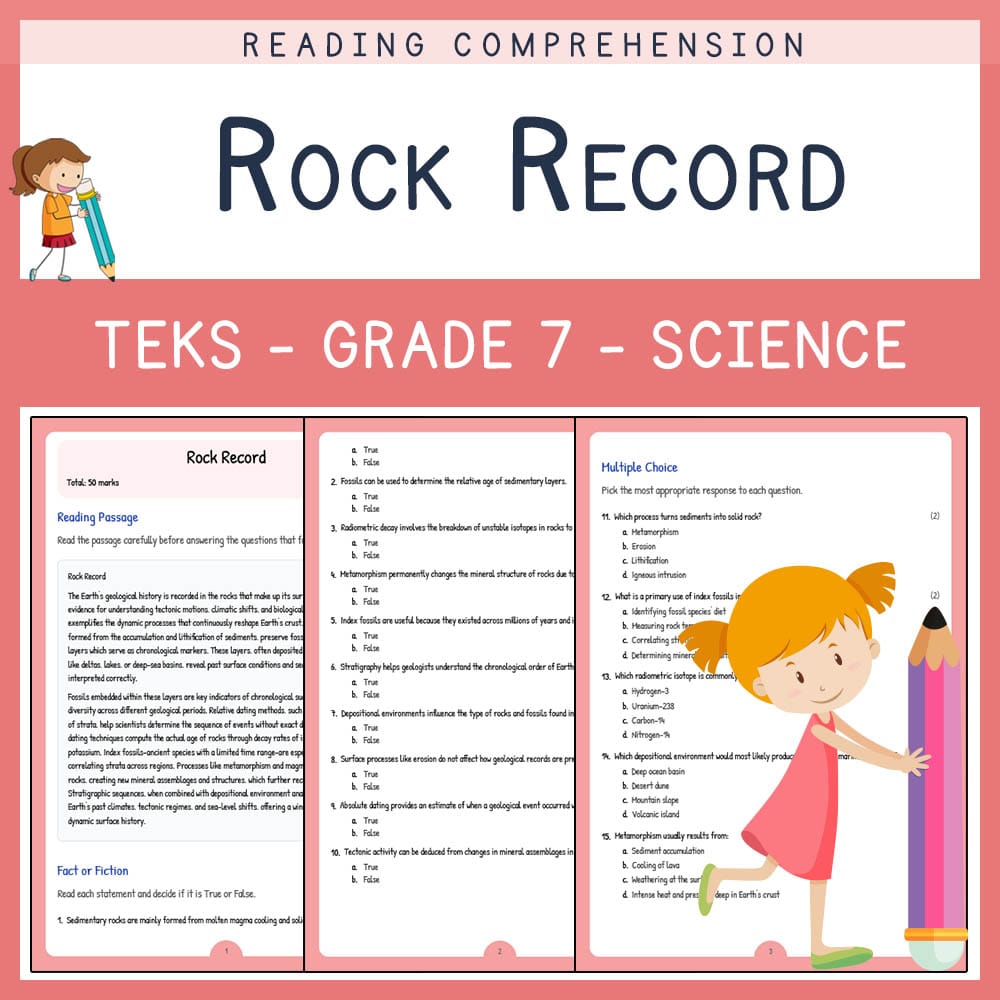
Grade 7 Science | Rock Record Worksheet | TEKS-Aligned
Created byLumora LearningLearning Objectives
- Understand the processes of the rock cycle, including sedimentation, lithification, metamorphism, and magmatism.
- Explain how fossils and stratigraphy serve as evidence of Earth's history and surface change.
- Identify relative and absolute dating techniques, including index fossils and radiometric decay methods.
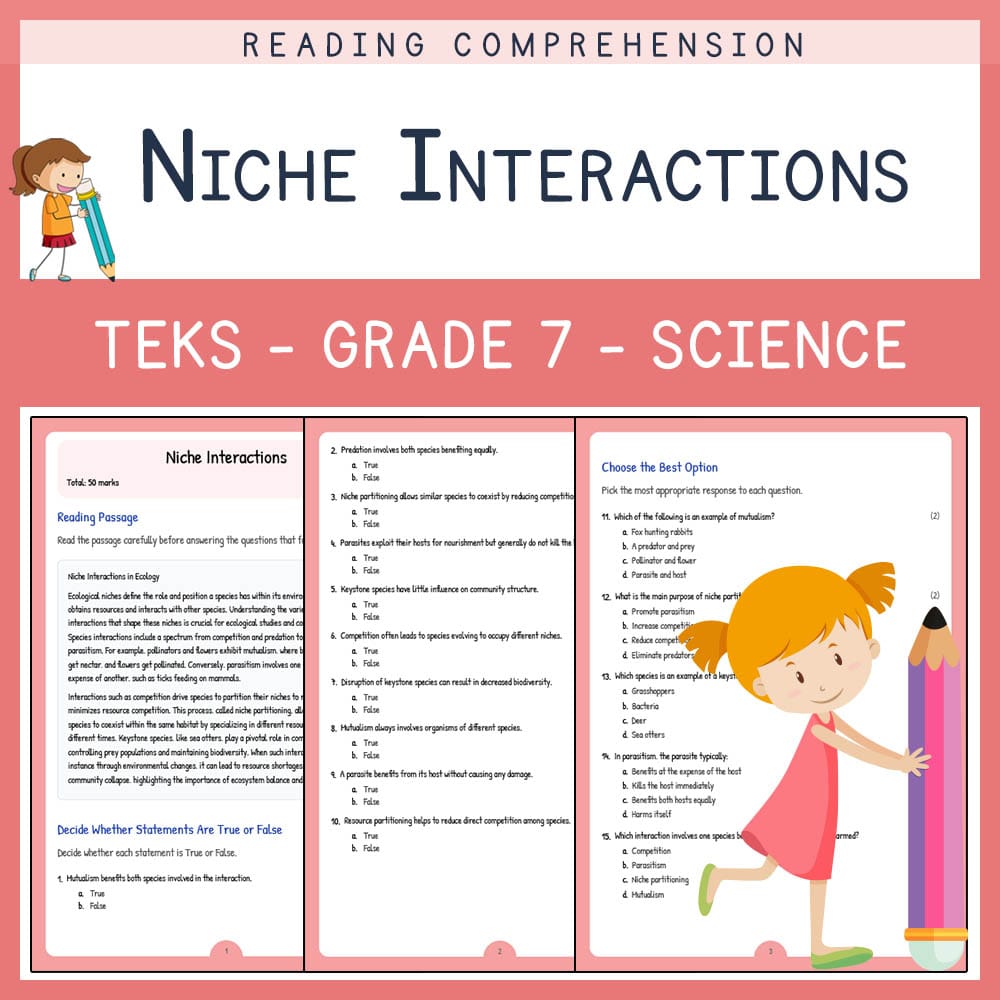
Grade 7 Science | Niche Interactions Worksheet Elena | TEKS-Aligned
Created byLumora LearningLearning Objectives
- Describe different species interactions that influence ecological niches.
- Identify examples of mutualism, predation, competition, and parasitism in ecosystems.
- Explain how niche partitioning reduces competition among species.
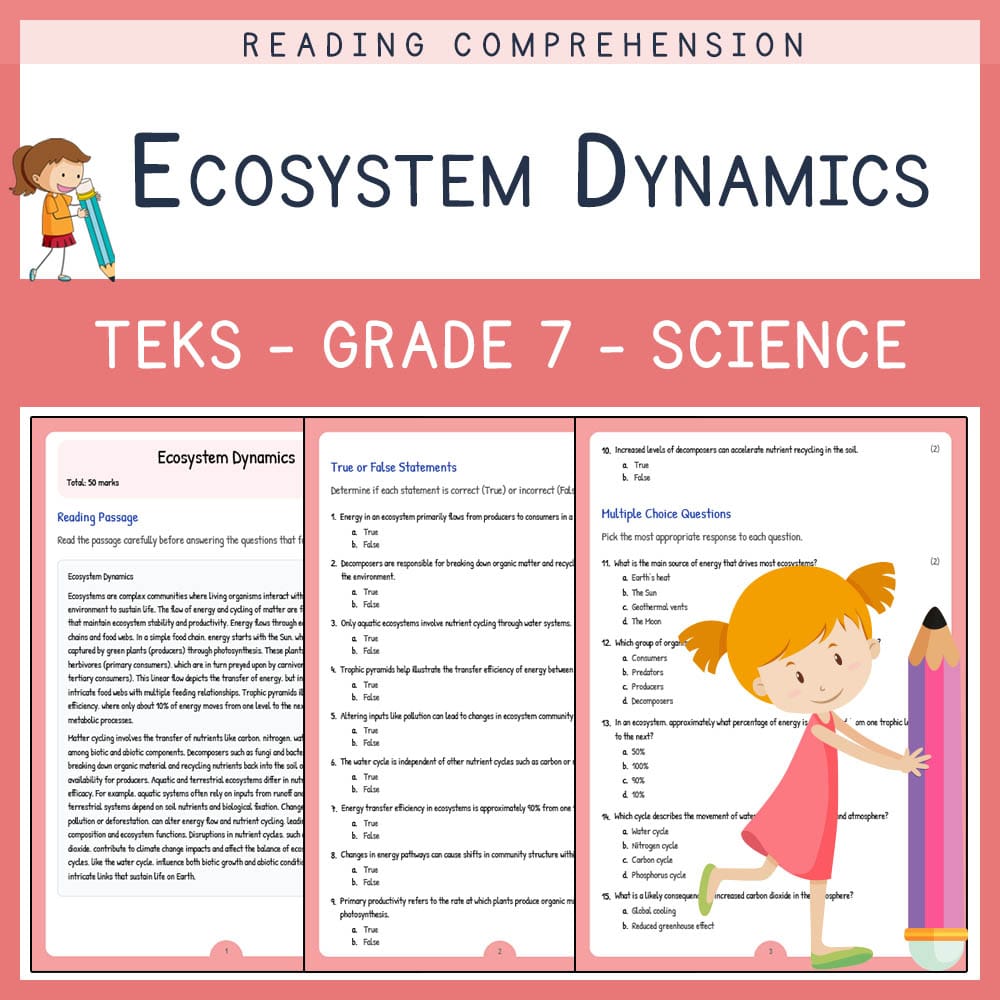
Grade 7 Science | Ecosystem Dynamics Worksheet | TEKS Alligned
Created byLumora LearningLearning Objectives
- Explain how energy flows within ecosystems through food chains, webs, and trophic pyramids.
- Describe the cycling of matter, including nutrients like carbon and water, in different ecosystems.
- Analyze how changes in energy pathways or inputs affect community structure and ecosystem processes.
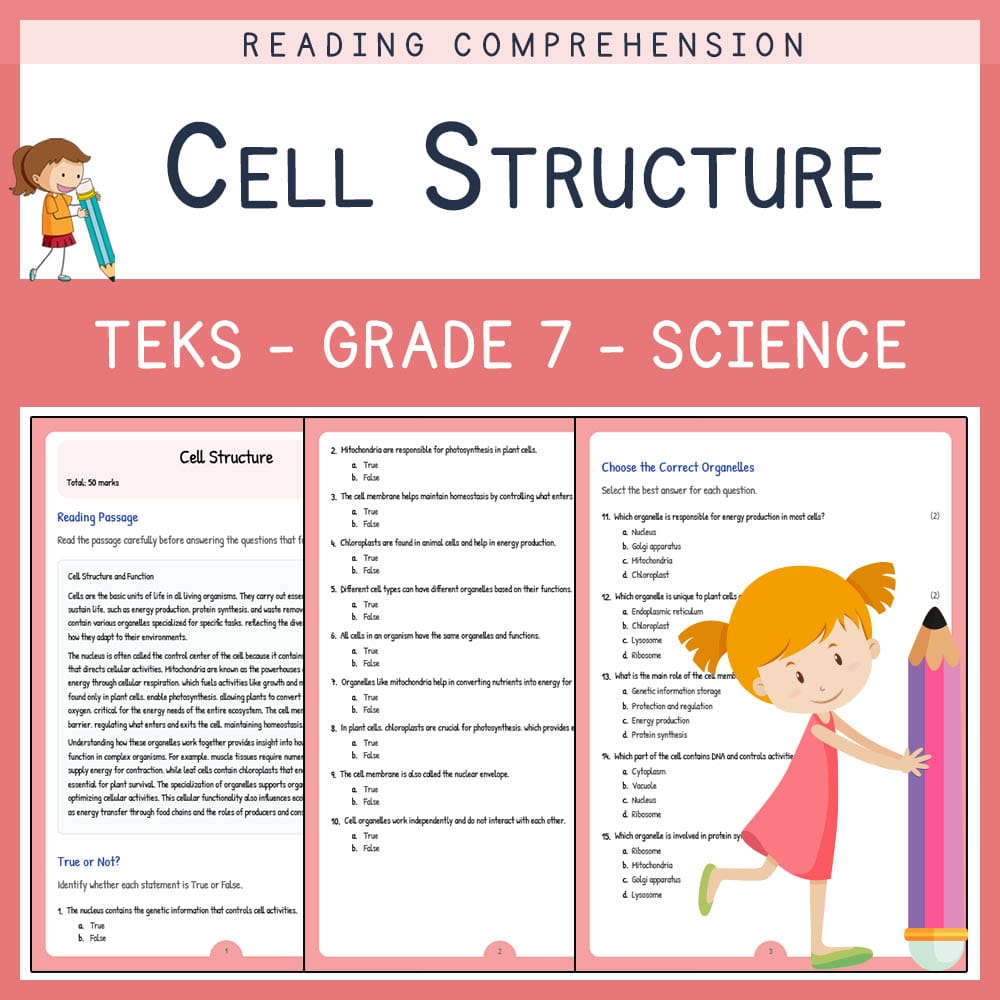
Grade 7 Science | Cell Structure Worksheet Elena | TEKS Aligned
Created byLumora LearningLearning Objectives
- Identify the major organelles within a cell and describe their functions.
- Compare the roles of different organelles such as nucleus, mitochondria, chloroplasts, and cell membranes.
- Explain how cellular structures relate to tissue and organ function in multicellular organisms.
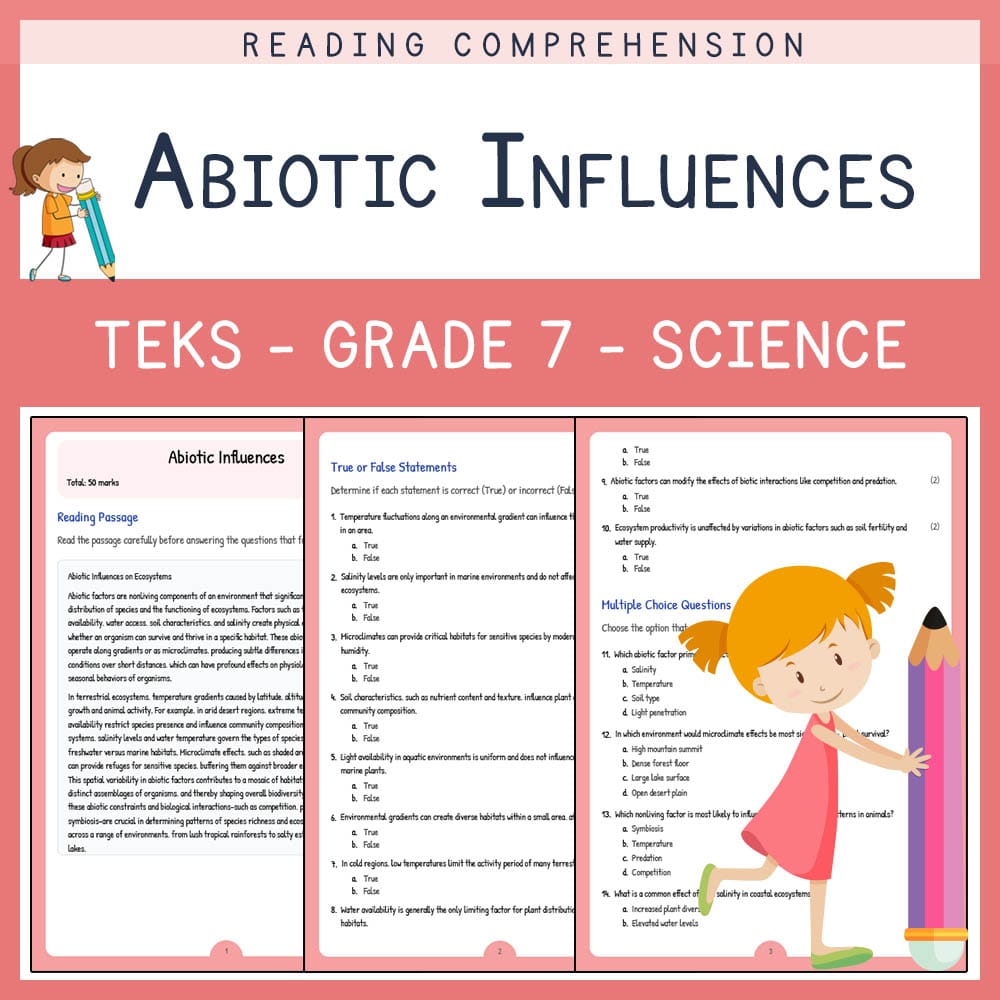
Grade 7 Science | Abiotic Influences Worksheet | TEKS Alligned
Created byLumora LearningLearning Objectives
- Understand how nonliving factors such as temperature, light, water, soil, and salinity influence species distributions and ecosystems.
- Explain the concept of environmental gradients and microclimate effects on organism tolerances.
- Describe how abiotic factors interact with biotic relationships to shape biodiversity and community structure.
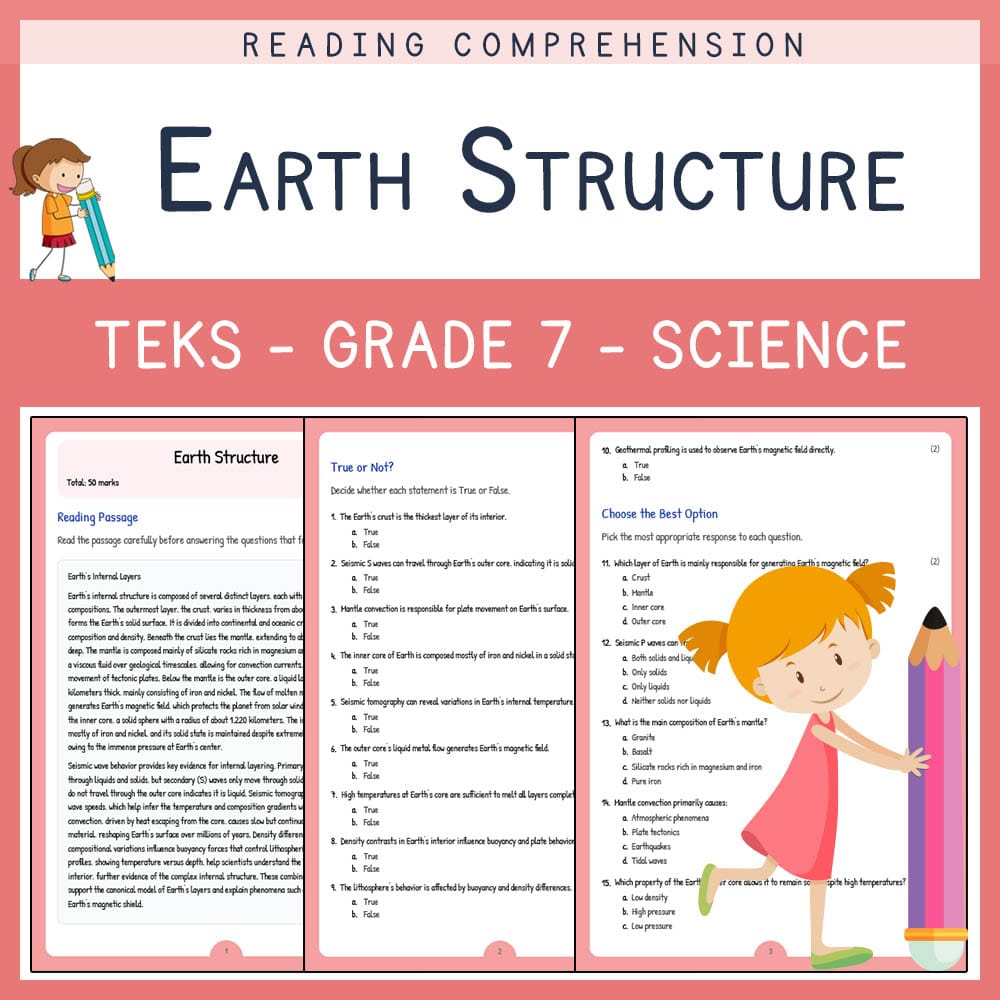
Grade 7 Science | Earth Structure Worksheet | TEKS-Aligned
Created byLumora LearningLearning Objectives
- Describe Earth's internal layering and the properties of each layer.
- Explain seismic wave behavior as evidence for Earth's internal structure.
- Understand mantle convection and its role in plate motion.

Grade 7 Science | Climate Drivers Over Time Worksheet | Assessment
Created byLumora LearningLearning Objectives
- Describe how natural climate records (ice cores, sediment layers, and tree rings) can be used to infer past temperature and precipitation.
- Explain how modern instruments provide evidence of recent climate trends.
- Identify major climate drivers over time and describe how they can change Earth’s energy balance and circulation.
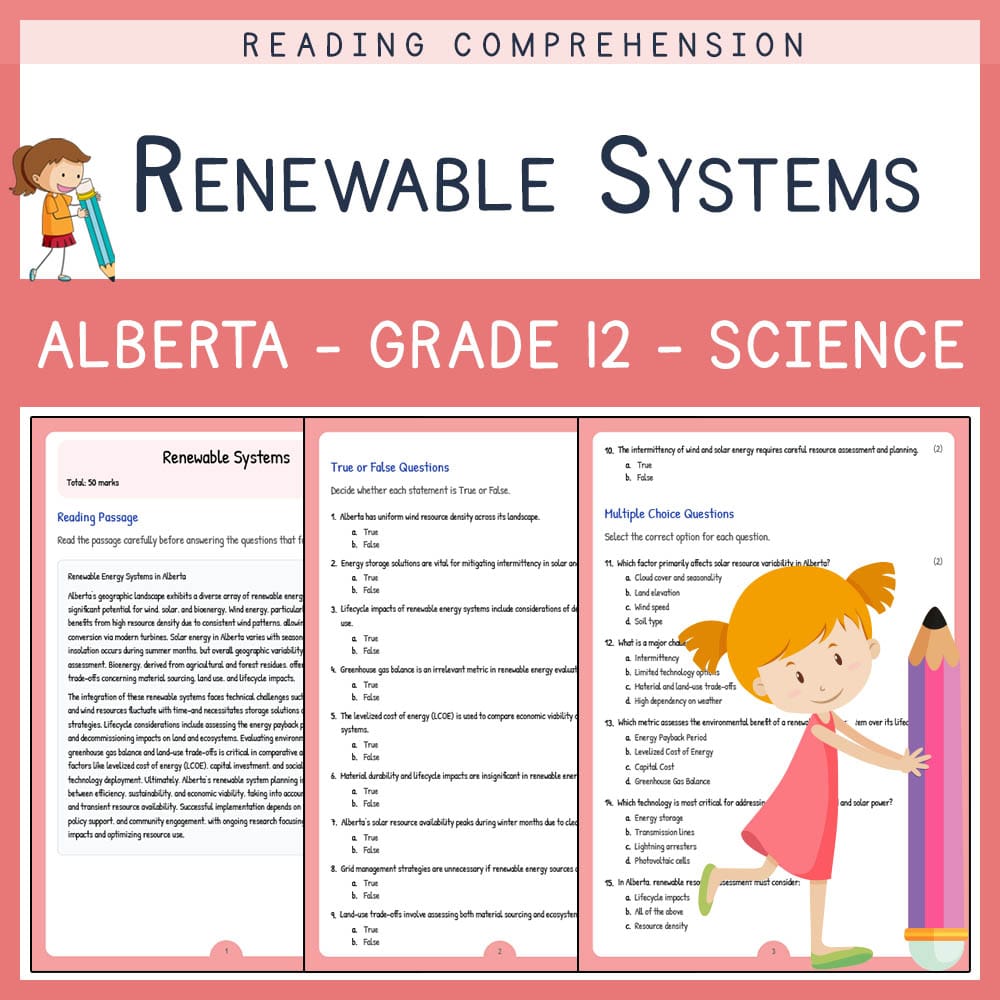
Grade 12 Science | Renewable Systems Worksheet | Alberta Standards
Created byLumora LearningLearning Objectives
- Understand the key concepts of resource assessment and conversion technologies for renewable energy in Alberta.
- Analyze challenges and lifecycle considerations of wind, solar, and bioenergy systems.
- Evaluate environmental and economic metrics used to compare renewable energy options.
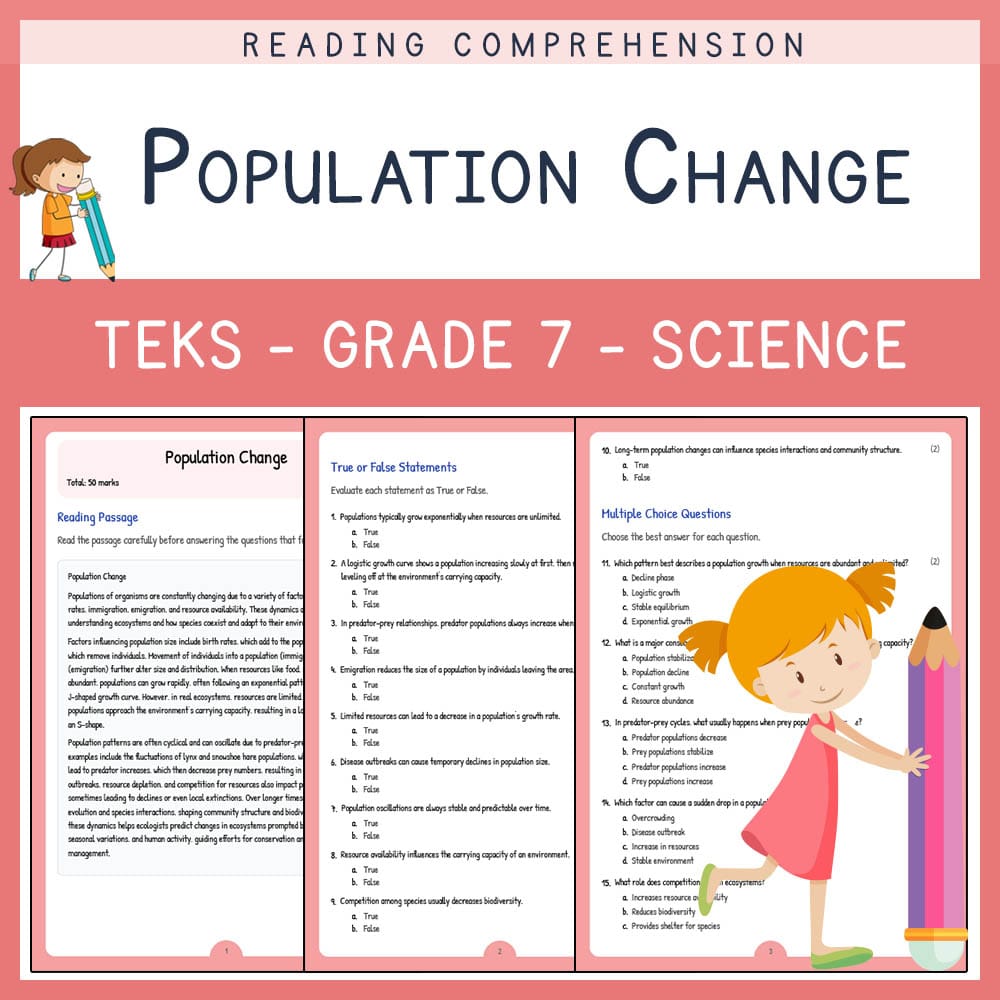
Grade 7 Science | Population Change Worksheet | TEKS-Aligned
Created byLumora LearningLearning Objectives
- Understand the factors that influence population size and distribution.
- Explain the patterns of exponential and logistic growth in populations.
- Identify the effects of limiting factors, disease, resources, and competition on populations.
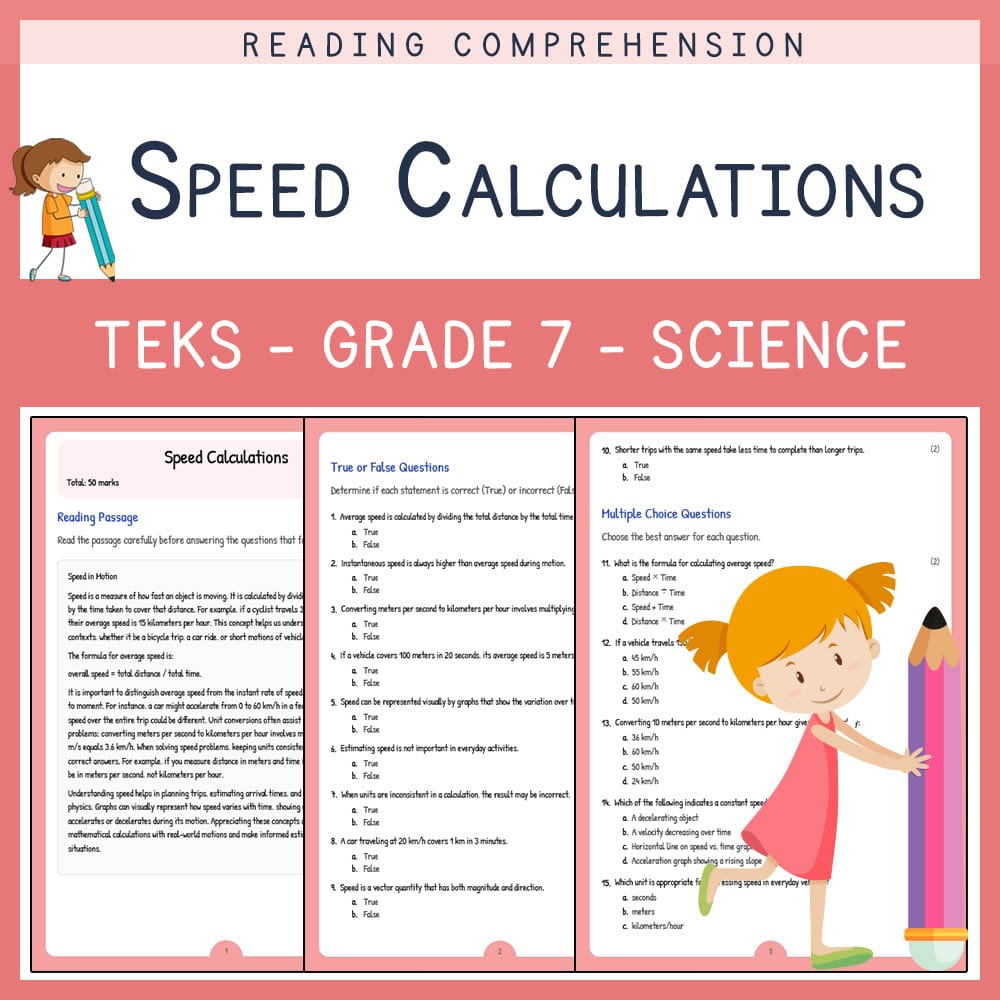
Grade 7 Science | Speed Calculations Worksheet | TEKS-Aligned
Created byLumora LearningLearning Objectives
- Understand how to compute average speed using distance and time data.
- Differentiate between average speed and instantaneous rate.
- Apply unit conversions between meters per second and kilometers per hour.
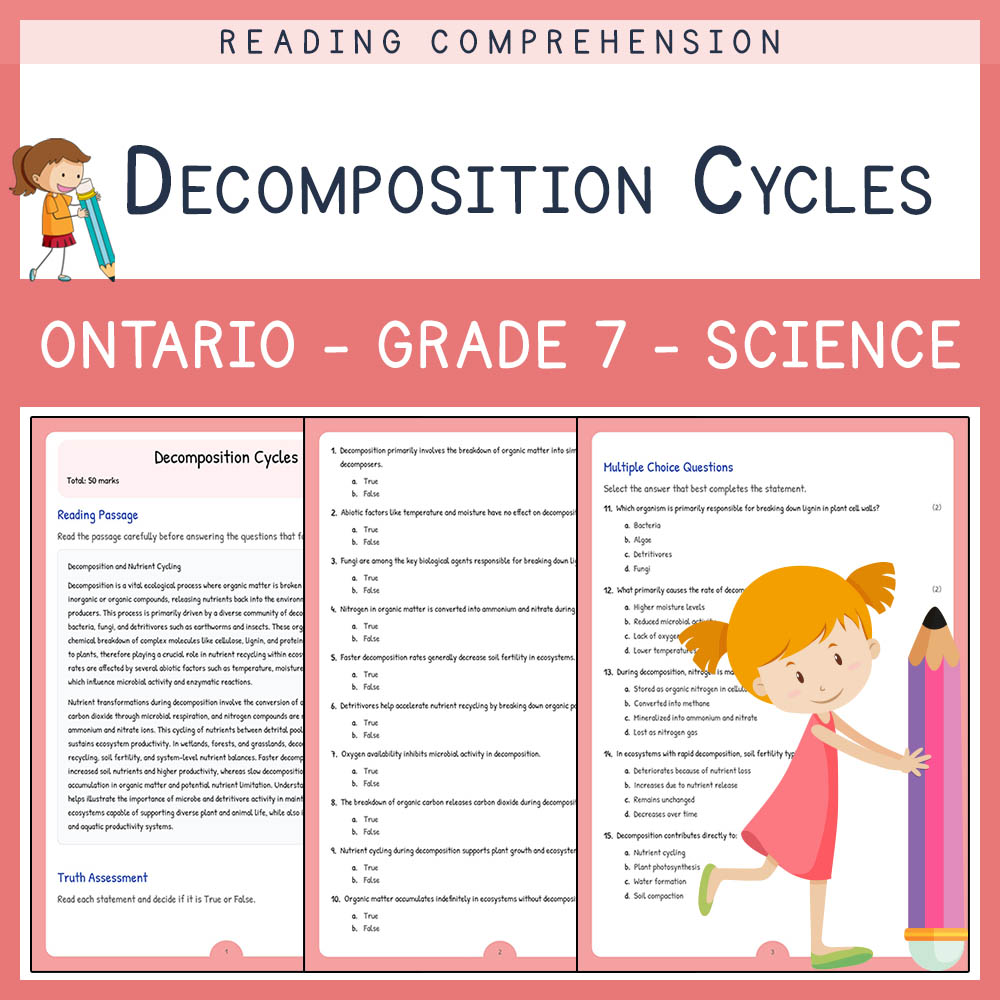
Grade 7 Science | Decomposition Cycles Worksheet & Answer Key (PDF)
Created byLumora LearningLearning Objectives
- Understand the processes involved in decomposition and nutrient cycling.
- Identify roles of detritivores, fungi, bacteria, and abiotic factors in decomposition.
- Describe carbon and nitrogen transformations during organic matter breakdown.
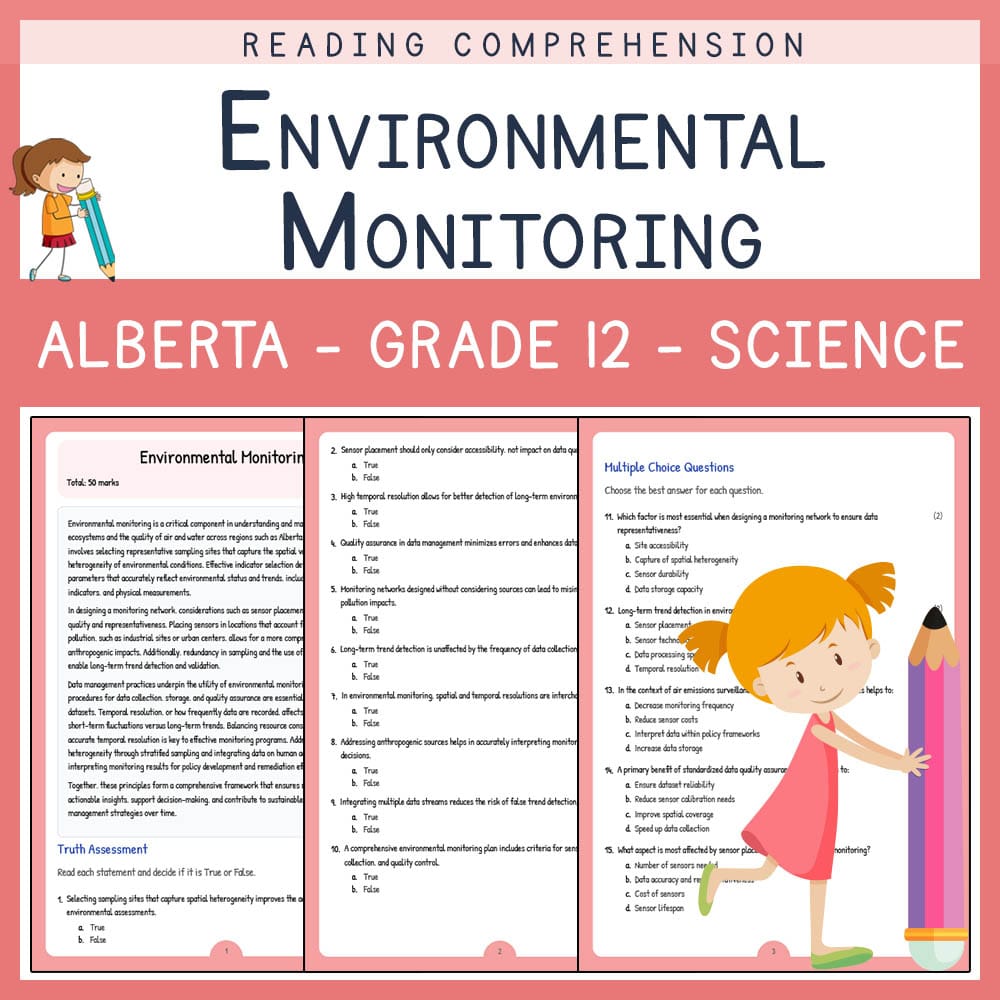
Grade 12 Science | Environmental Monitoring Worksheet | Alberta Standards
Created byLumora LearningLearning Objectives
- Understand the principles of environmental network design, indicator selection, and data management.
- Identify criteria for representative sampling and sensor placement in environmental monitoring.
- Analyze how spatial heterogeneity and anthropogenic sources influence monitoring interpretation.
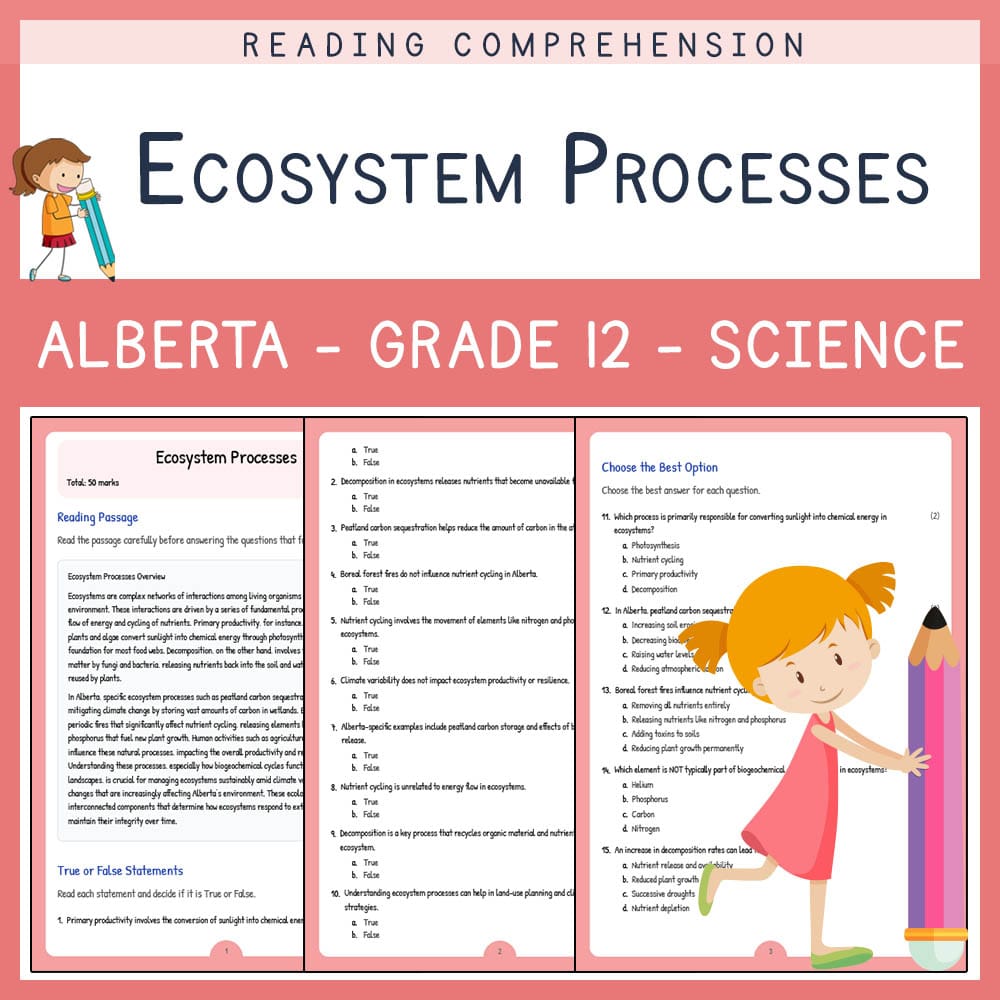
Grade 12 Science | Ecosystem Processes Worksheet | Alberta Standards
Created byLumora LearningLearning Objectives
- Describe key ecosystem processes such as primary productivity, decomposition, and nutrient cycling.
- Explain biogeochemical cycles of carbon, nitrogen, and phosphorus and their ecological significance.
- Identify Alberta-specific examples of ecosystem processes like peatland carbon sequestration and boreal fire effects.
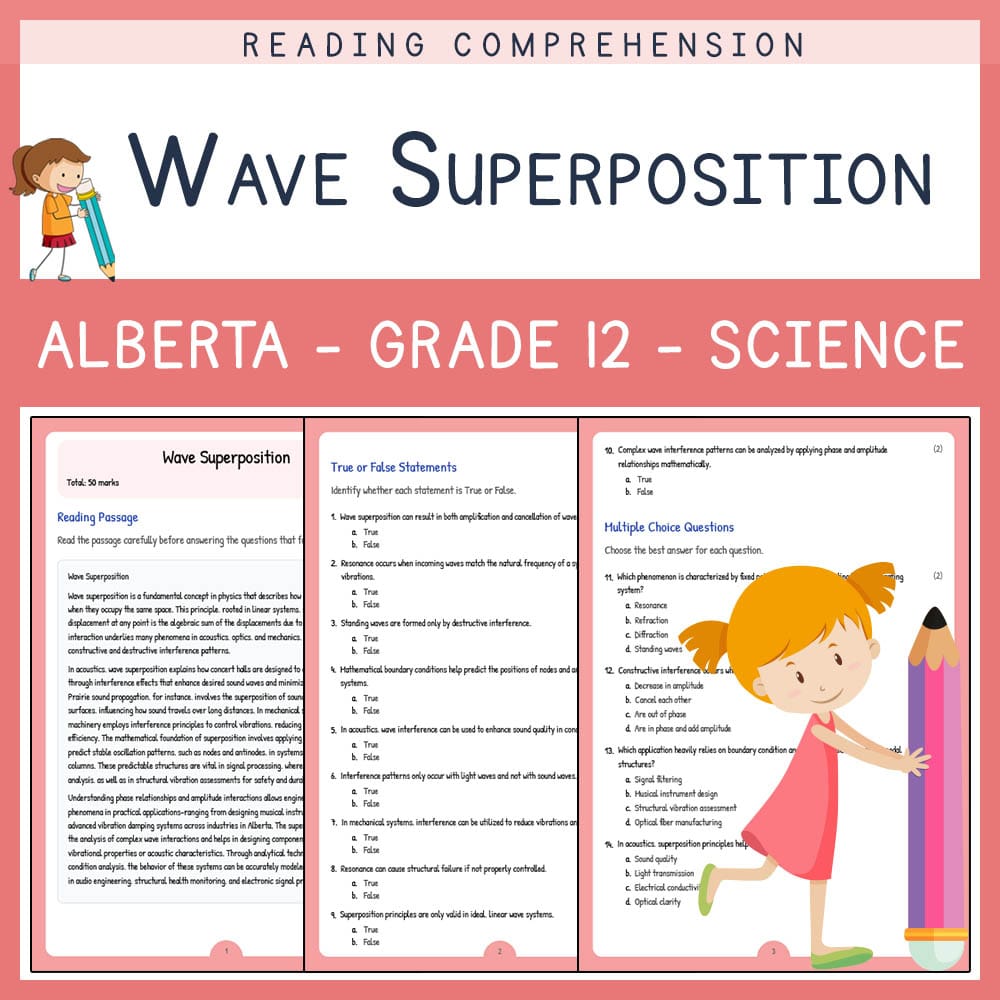
Grade 12 Science | Wave Superposition Worksheet | Alberta Standards
Created byLumora LearningLearning Objectives
- Analyze the principles of wave superposition, including interference patterns and phase relationships.
- Understand how constructive and destructive interference influence standing waves and resonance phenomena.
- Apply mathematical boundary condition analysis to predict nodal and antinodal structures in various wave systems.
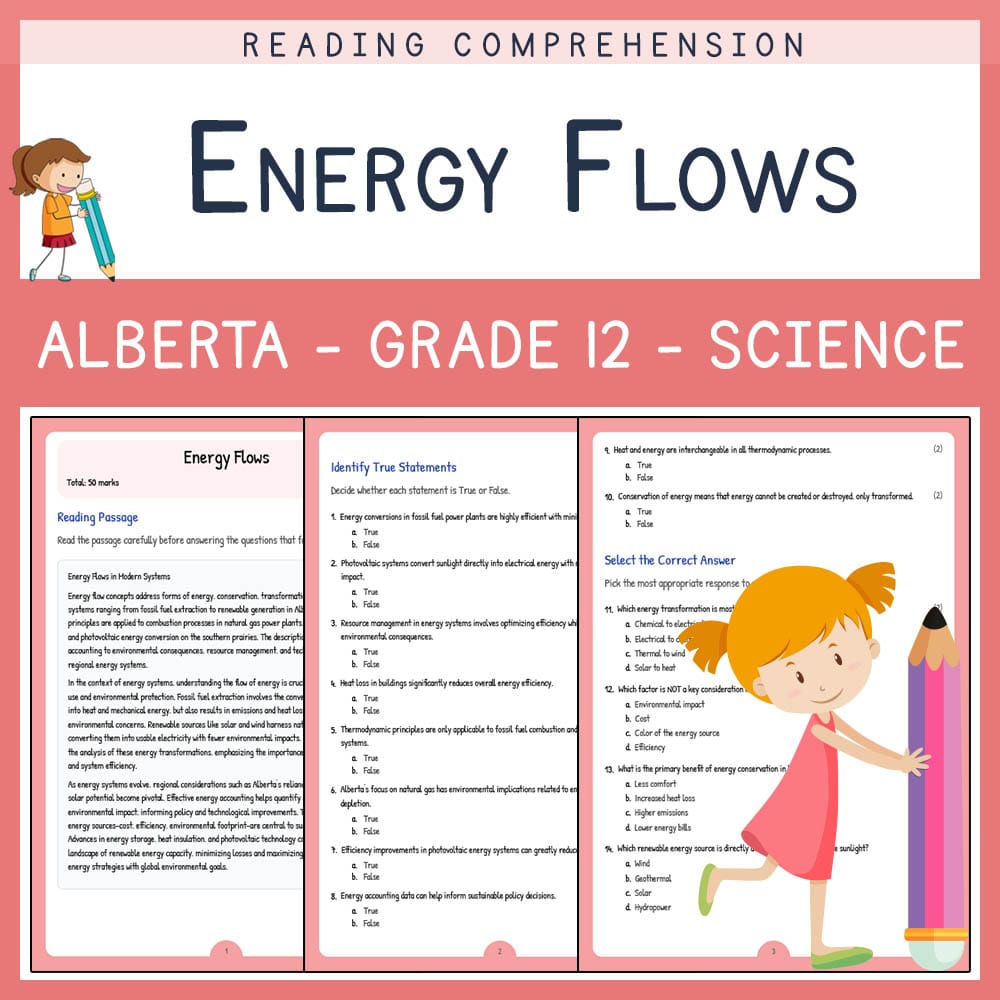
Grade 12 Science | Energy Flows Worksheet | Alberta Standards
Created byLumora LearningLearning Objectives
- Understand the different forms and transformations of energy in various systems.
- Explain the principles of energy conservation and efficiency in environmental contexts.
- Apply thermodynamic concepts to real-world energy systems such as power plants and renewable systems.
Browse more categories
About Reading comprehension Worksheets
Find reading comprehension worksheets for class practice, homework, or self-study. All 40,241 are instant PDF downloads.
Each resource here is built by an independent educator and reviewed for quality. Worksheets print straight from PDF and suit classroom use, homework, or extra practice; most come with answer keys, and you can preview before purchasing.