
Reading comprehension Worksheets
40,289 type resources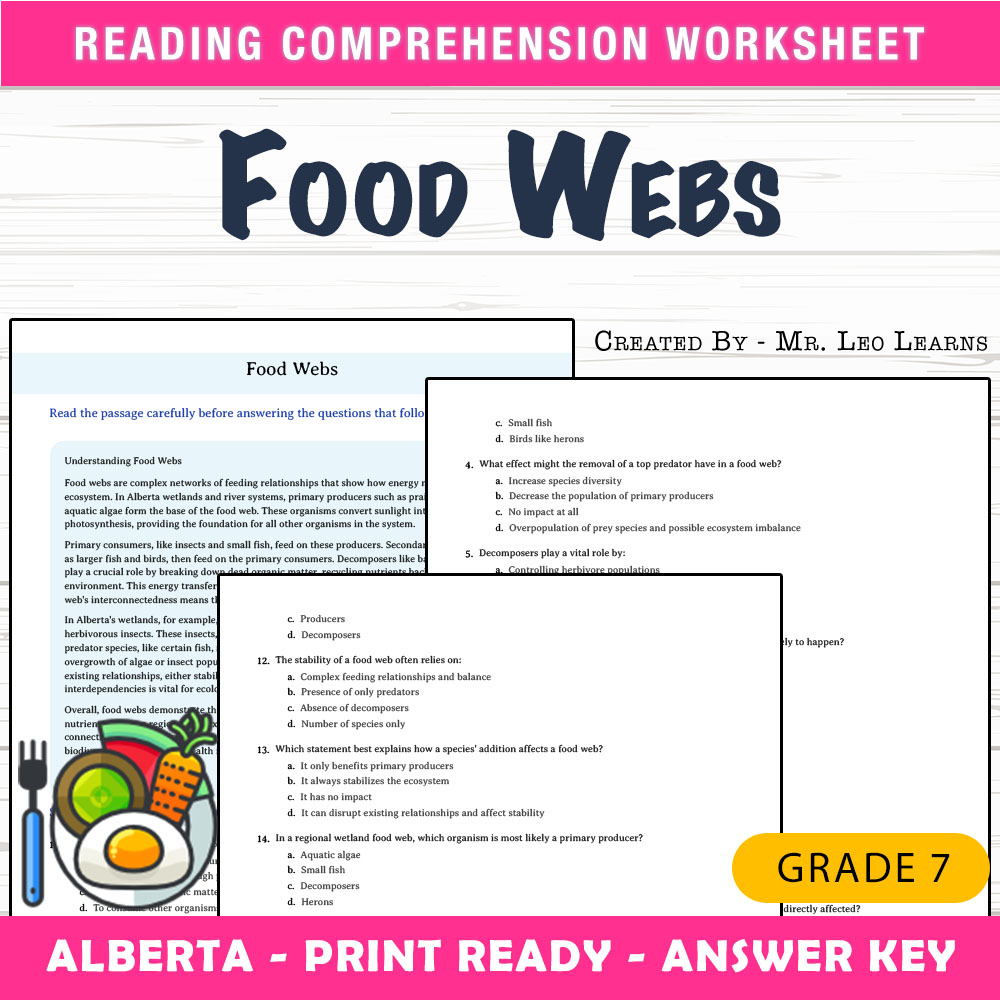
Grade 7 Science — Food Webs Worksheet MCQ Paper for Mastery
 Created byThe Resource Hub
Learning Objectives
- Understand the components of food webs including producers, consumers, and decomposers.
- Explain the direction of energy flow in food webs and how species interactions affect ecosystem stability.
- Identify regional examples of food web relationships in Alberta wetlands and river systems.
Also included in: Grade 7 Science Alberta Ecosystems & Interactions Worksheet Collection +1 more
Instant download
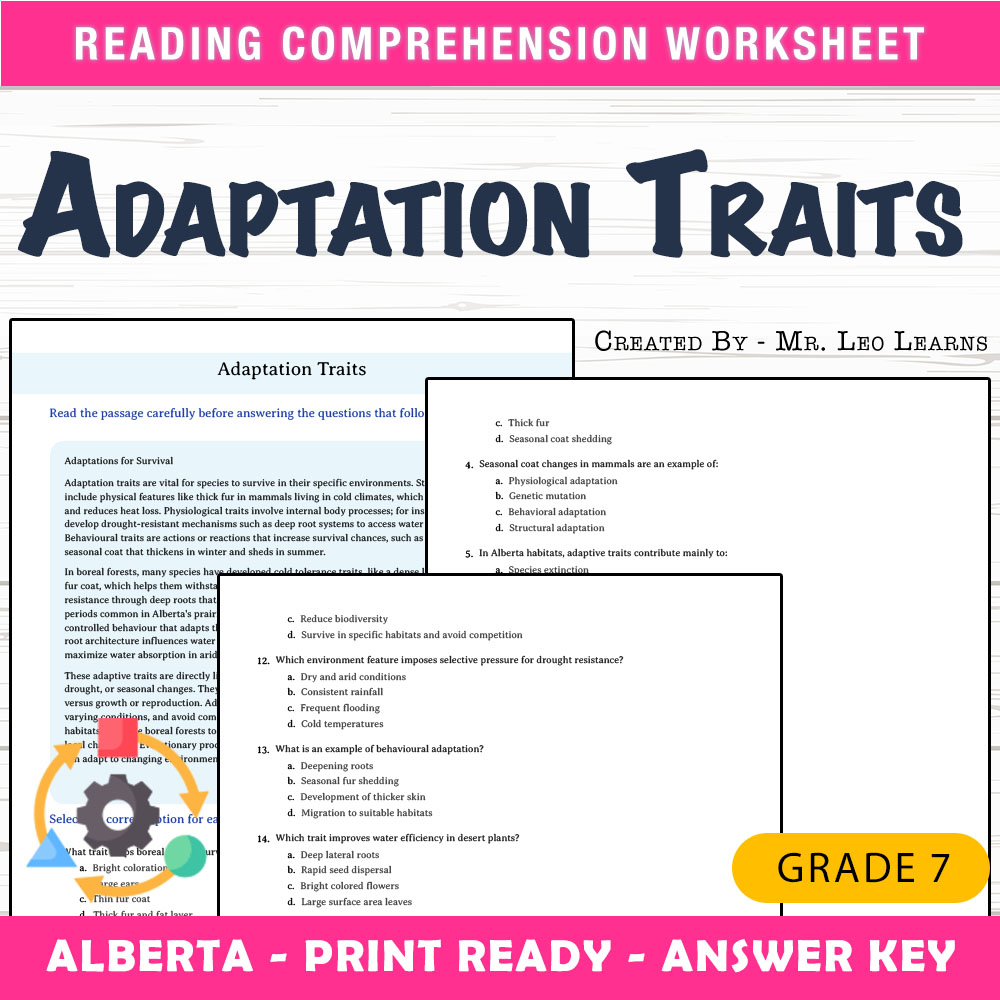
Grade 7 Science — Adaptation Traits Worksheet MCQ Paper
Created byThe Resource HubLearning Objectives
- Understand different types of adaptive traits in various species.
- Identify how environmental pressures influence trait development.
- Explain the role of traits in niche occupation and species survival.
Also included in: Grade 7 Science Alberta Ecosystems & Interactions Worksheet Collection +1 more
Instant download
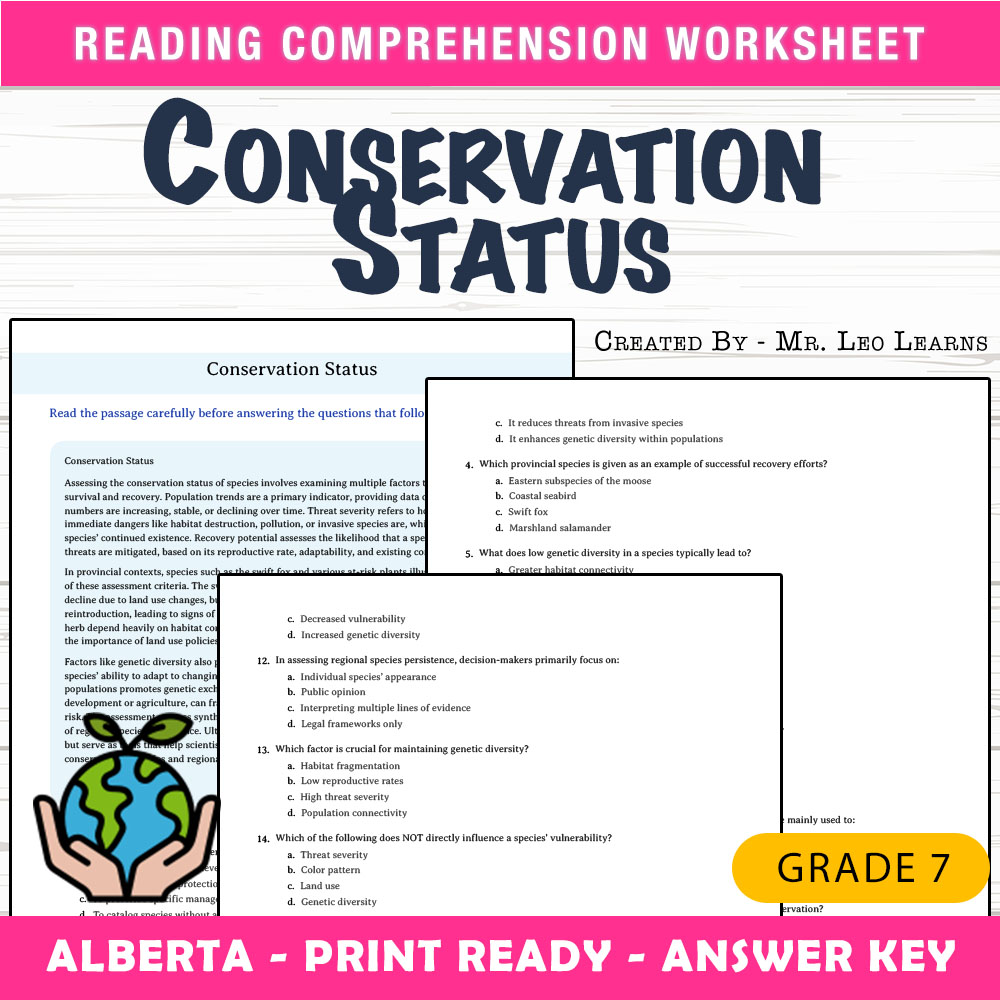
Grade 7 Science — Conservation Status Worksheet MCQ Paper
Created byThe Resource HubLearning Objectives
- Understand the criteria used to assess the conservation status of species.
- Interpret evidence related to population trends, threats, and recovery potential.
- Identify factors such as land use, genetic diversity, and connectivity that influence species vulnerability.
Also included in: Grade 7 Science Alberta Ecosystems & Interactions Worksheet Collection +1 more
Instant download
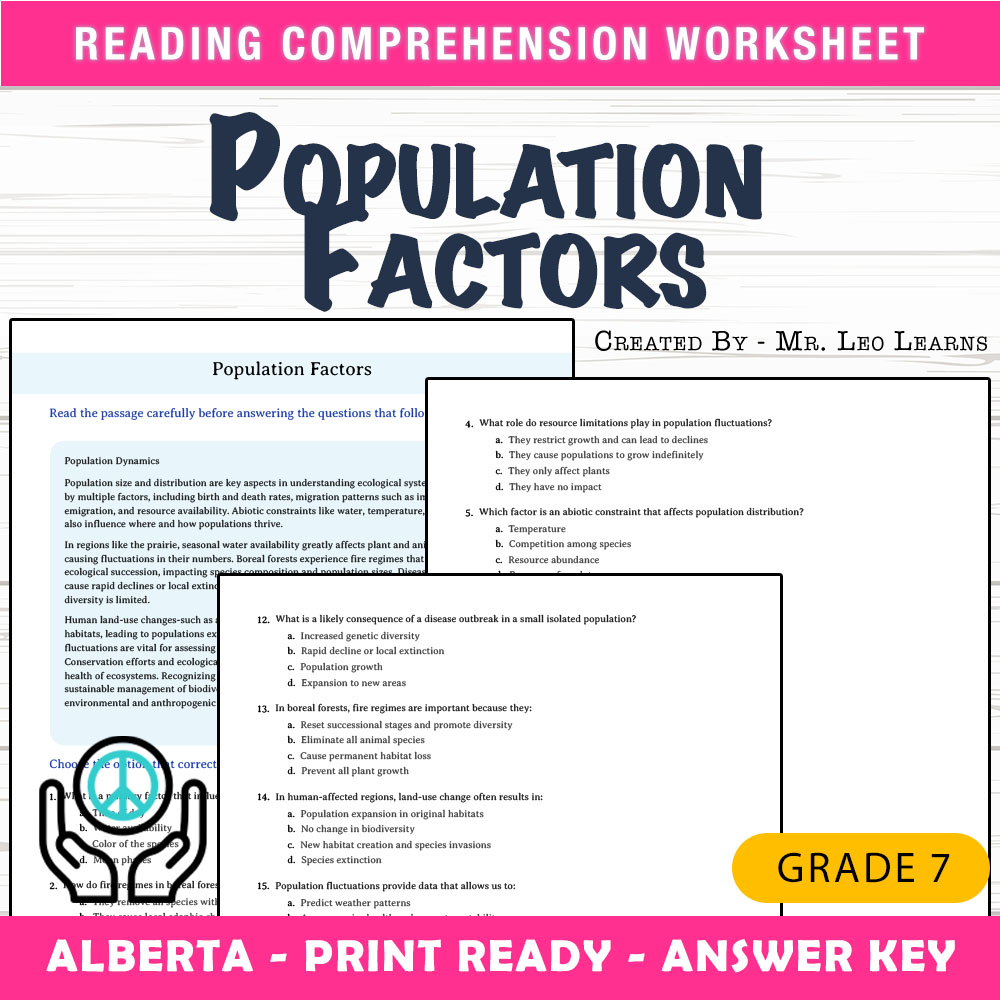
Grade 7 Science — Population Factors Worksheet MCQ Paper for Mastery
Created byThe Resource HubLearning Objectives
- Understand the main factors influencing population size and distribution.
- Identify how environmental and human activities affect regional biodiversity.
- Analyze the impact of resource availability, climate, and land use on populations.
Also included in: Grade 7 Science Alberta Ecosystems & Interactions Worksheet Collection +1 more
Instant download
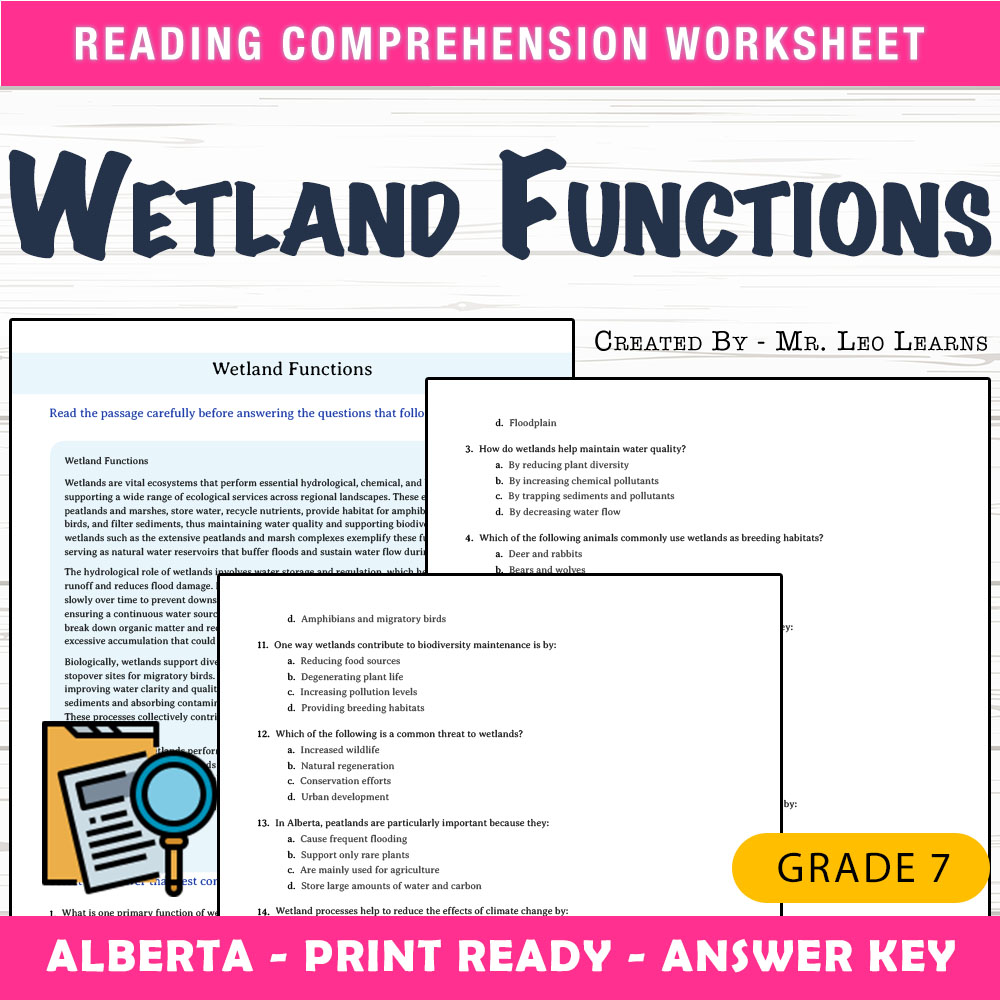
Grade 7 Science — Wetland Functions Worksheet MCQ Paper
Created byThe Resource HubLearning Objectives
- Understand the hydrological, chemical, and biological functions of wetlands.
- Identify examples of wetland processes such as water storage, nutrient cycling, and filtration.
- Recognize the role of wetlands in supporting biodiversity and landscape water regulation.
Also included in: Grade 7 Science Alberta Ecosystems & Interactions Worksheet Collection +1 more
Instant download
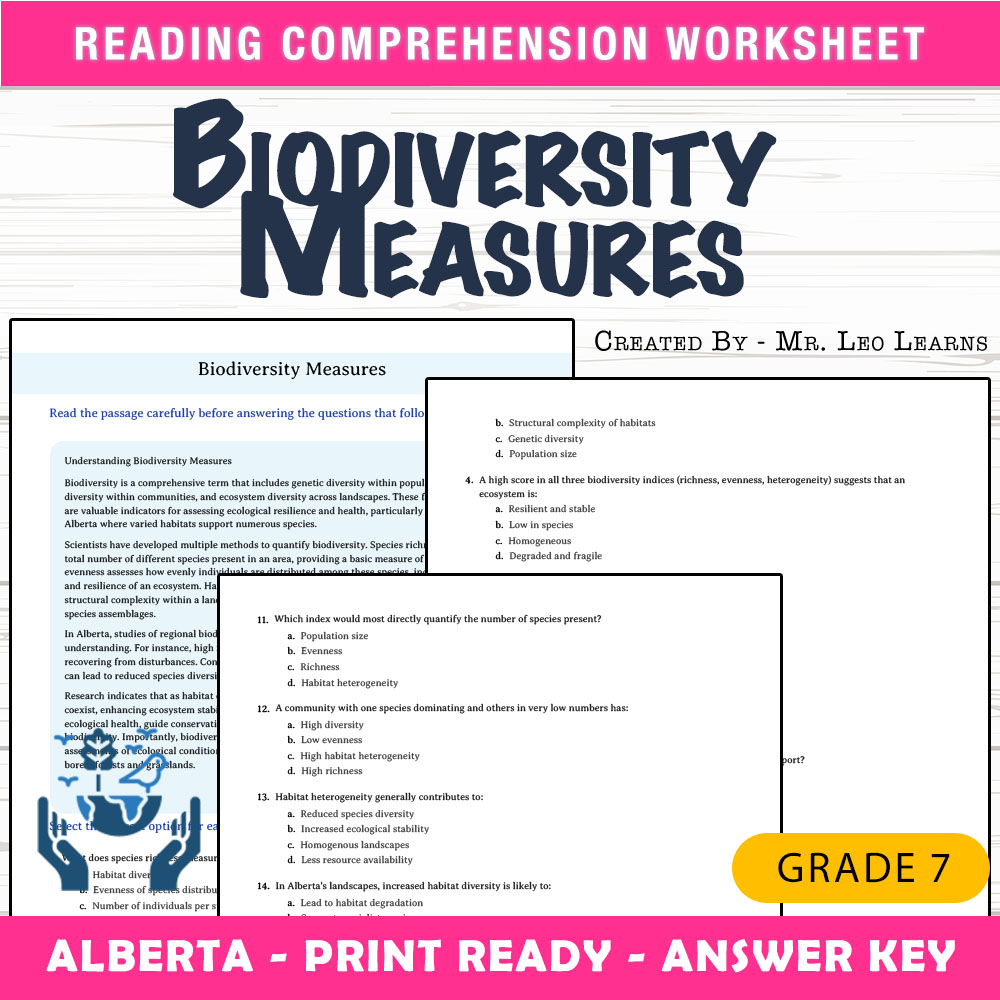
Grade 7 Science — Biodiversity Measures Worksheet MCQ Paper
Created byThe Resource HubLearning Objectives
- Understand the various measures used to assess biodiversity, including richness, evenness, and habitat heterogeneity.
- Interpret what different biodiversity metrics reveal about ecosystem resilience and health.
- Evaluate the relationship between habitat complexity and species assemblages in Alberta contexts.
Also included in: Grade 7 Science Alberta Ecosystems & Interactions Worksheet Collection +1 more
Instant download
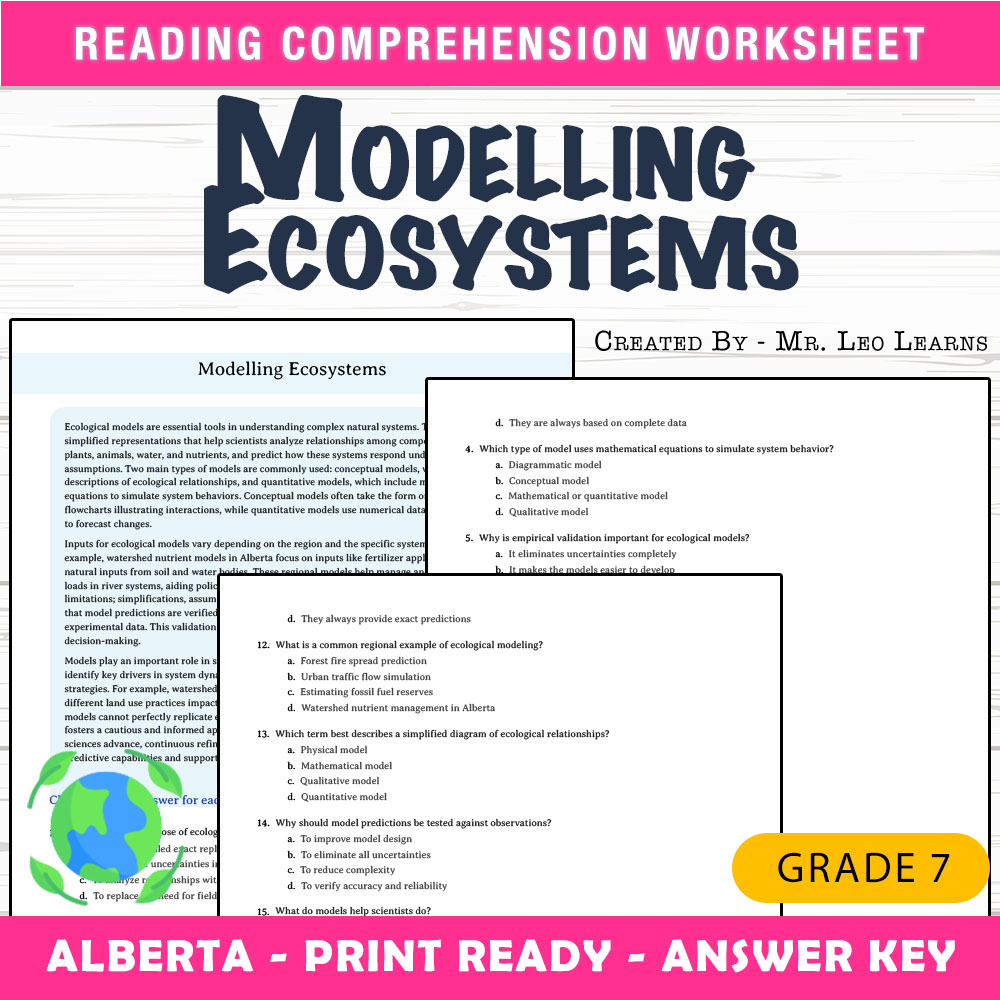
Grade 7 Science — Modelling Ecosystems Worksheet MCQ Paper
Created byThe Resource HubLearning Objectives
- Understand the concept of ecological models and their applications.
- Identify different types of modelling approaches and their uses.
- Recognize regional examples of ecological models, such as watershed nutrient models.
Also included in: Grade 7 Science Alberta Ecosystems & Interactions Worksheet Collection +1 more
Instant download

Population Ecology Worksheet | Grade 9 Science Practice
 Created byPrism Point Learning
Learning Objectives
- Explain how birth/reproduction, death/mortality, immigration, and emigration change population size over time
- Differentiate density-dependent and density-independent factors affecting population growth
- Connect population-level changes to carrying capacity and community structure
Instant download
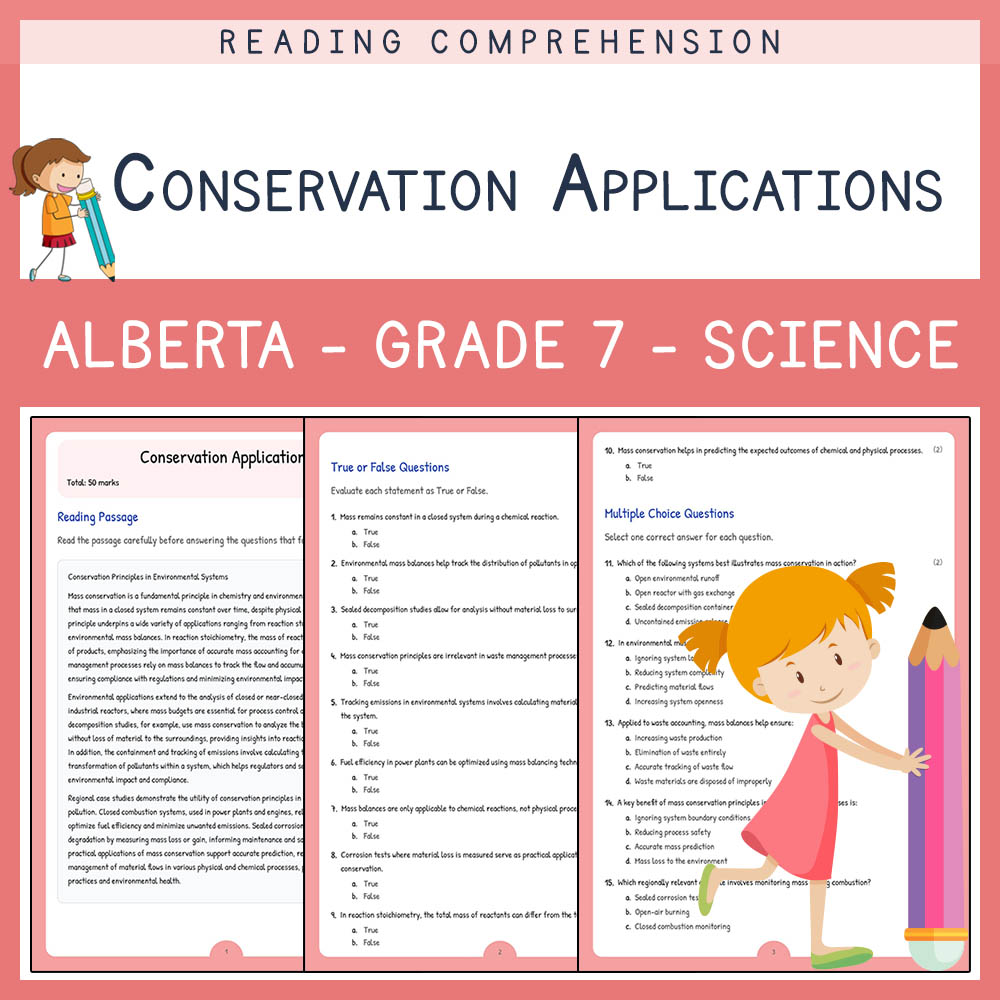
Grade 7 Science | Conservation Applications Worksheet Elena | Alberta
 Created byLumora Learning
Learning Objectives
- Understand the principles of mass conservation in chemical and environmental systems.
- Identify practical examples and applications of mass balancing in real-world scenarios.
- Explain how conservation principles are used in waste management and environmental monitoring.
Instant download
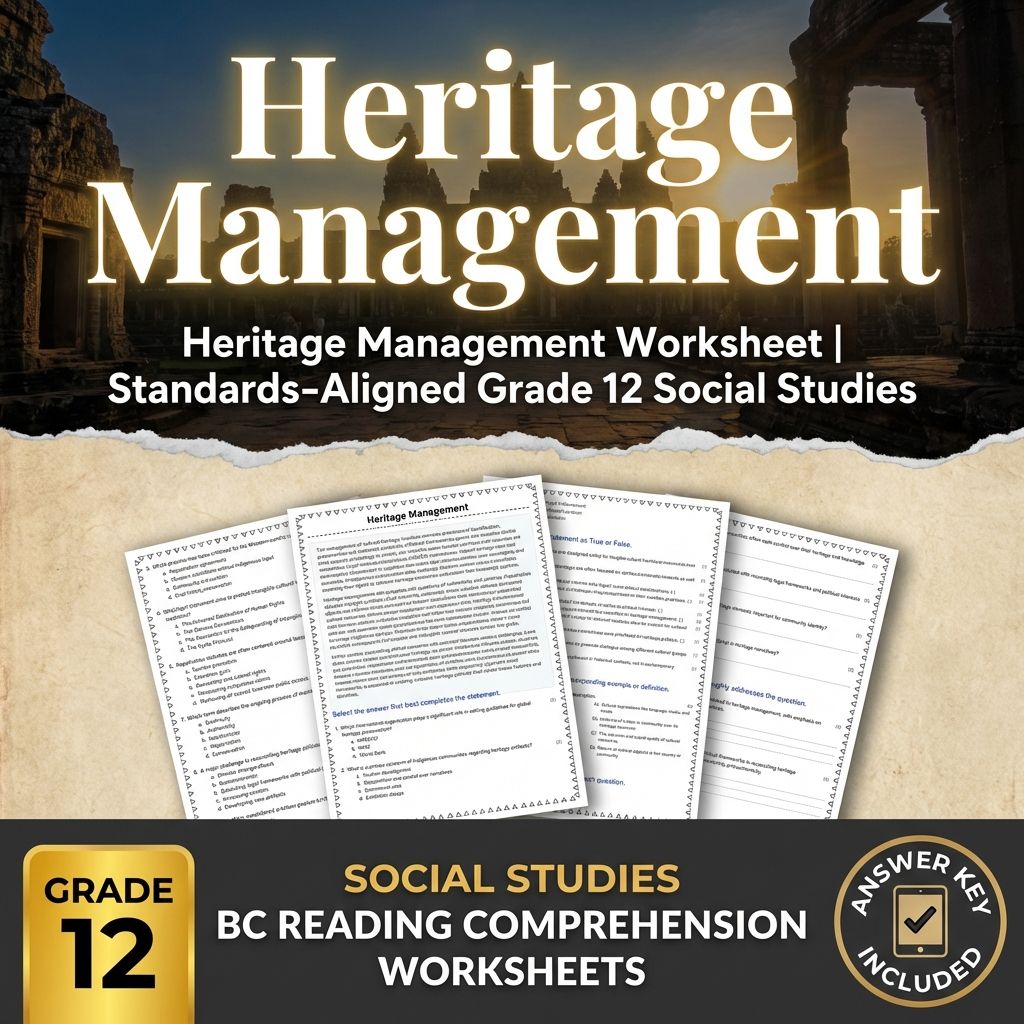
Heritage Management Worksheet | Standards-Aligned Grade 12 Social Studies
JCreated byJ.S SheetsLearning Objectives
- Understand key concepts related to cultural heritage and its stewardship.
- Analyze legal and ethical frameworks governing heritage preservation.
- Evaluate conflicts and debates surrounding repatriation and indigenous claims.
Instant download
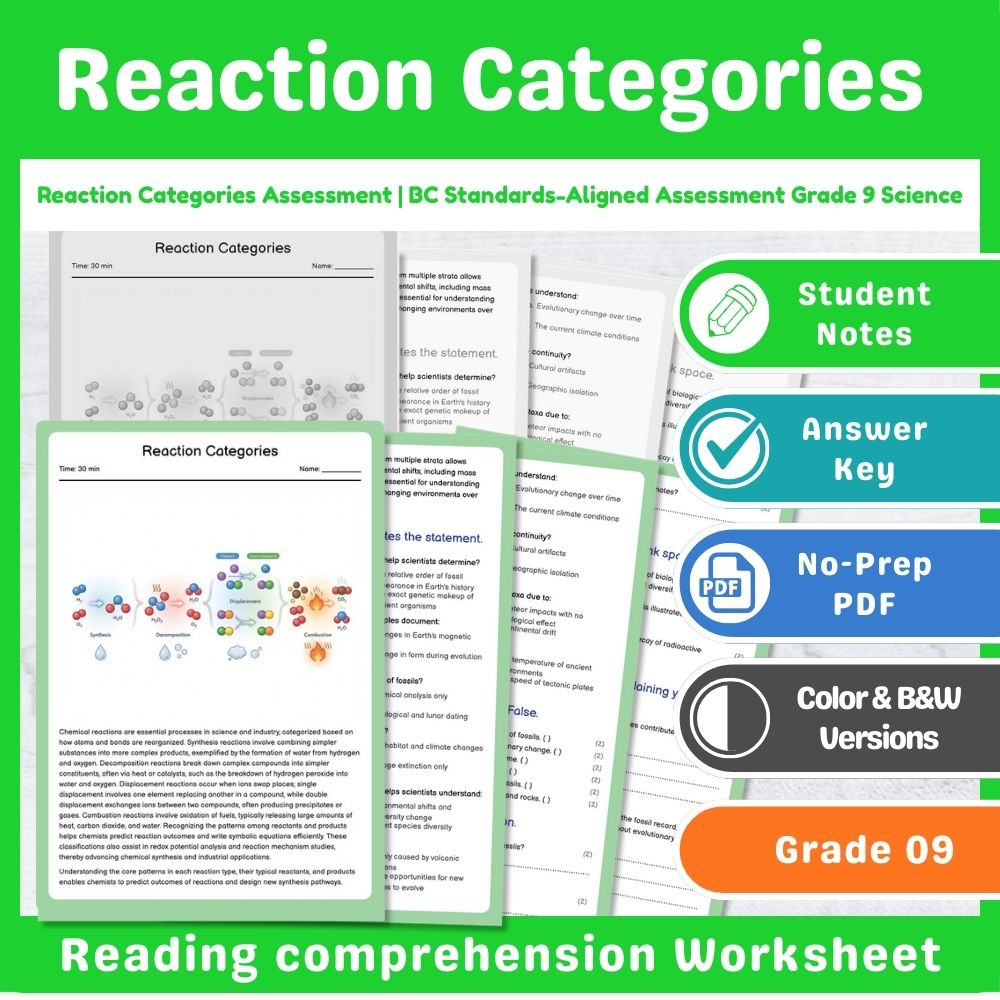
Reaction Categories Assessment | BC Standards-Aligned Assessment Grade 9 Science
Created byPrism Point LearningLearning Objectives
- Identify and describe the main types of chemical reactions: synthesis, decomposition, single displacement, double displacement, and combustion.
- Recognize patterns and characteristic reactants and products of each reaction category.
- Classify given chemical reactions into categories based on reactant and product clues.
Instant download
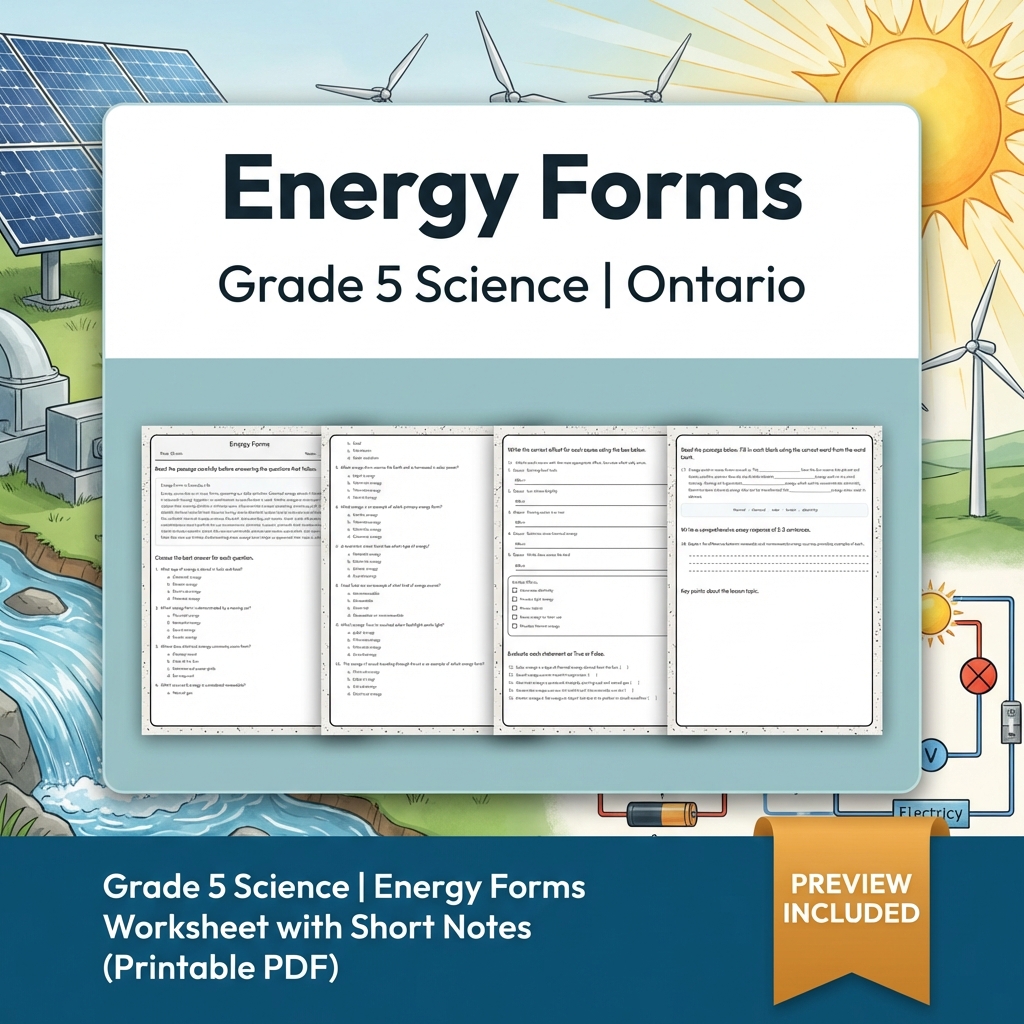
Grade 5 Science | Energy Forms Worksheet with Short Notes (Printable PDF)
 Created byMeadowlark Worksheets
Learning Objectives
- Identify and describe the primary forms of energy in everyday life.
- Distinguish between renewable and nonrenewable energy sources.
- Understand different sources of thermal, kinetic, potential, electrical, light, and sound energy.
Also included in: Grade 5 Science Lesson Group | Energy, Circuits, Sustainability & More +1 more
Instant download

Grade 6 Science | Flight Forces - Daily Reading Comprehension Practice
 Created byCoral Reef Learning
Learning Objectives
- Understand the four primary aerodynamic forces: lift, drag, thrust, and weight.
- Identify how each force affects an object's motion in flight.
- Recognize the interaction of forces during steady, climbing, and descending flight.
Instant download
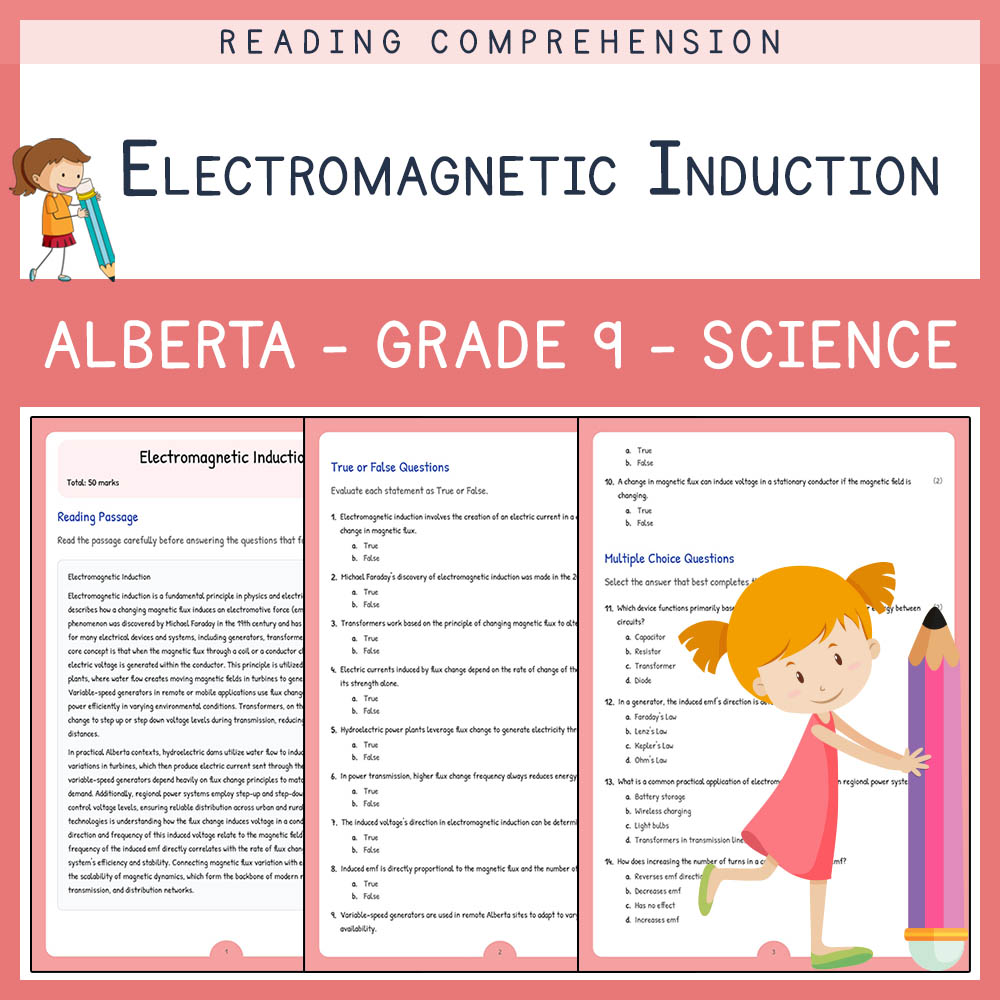
Grade 9 Science | Electromagnetic Induction Worksheet | Alberta Standards
Created byLumora LearningLearning Objectives
- Explain the principle of electromagnetic induction and how changing magnetic flux induces voltage.
- Identify the relationship between flux change and induced voltage in electrical systems.
- Describe practical applications of electromagnetic induction in regional power systems, such as hydroelectric generators and transformers.
Instant download
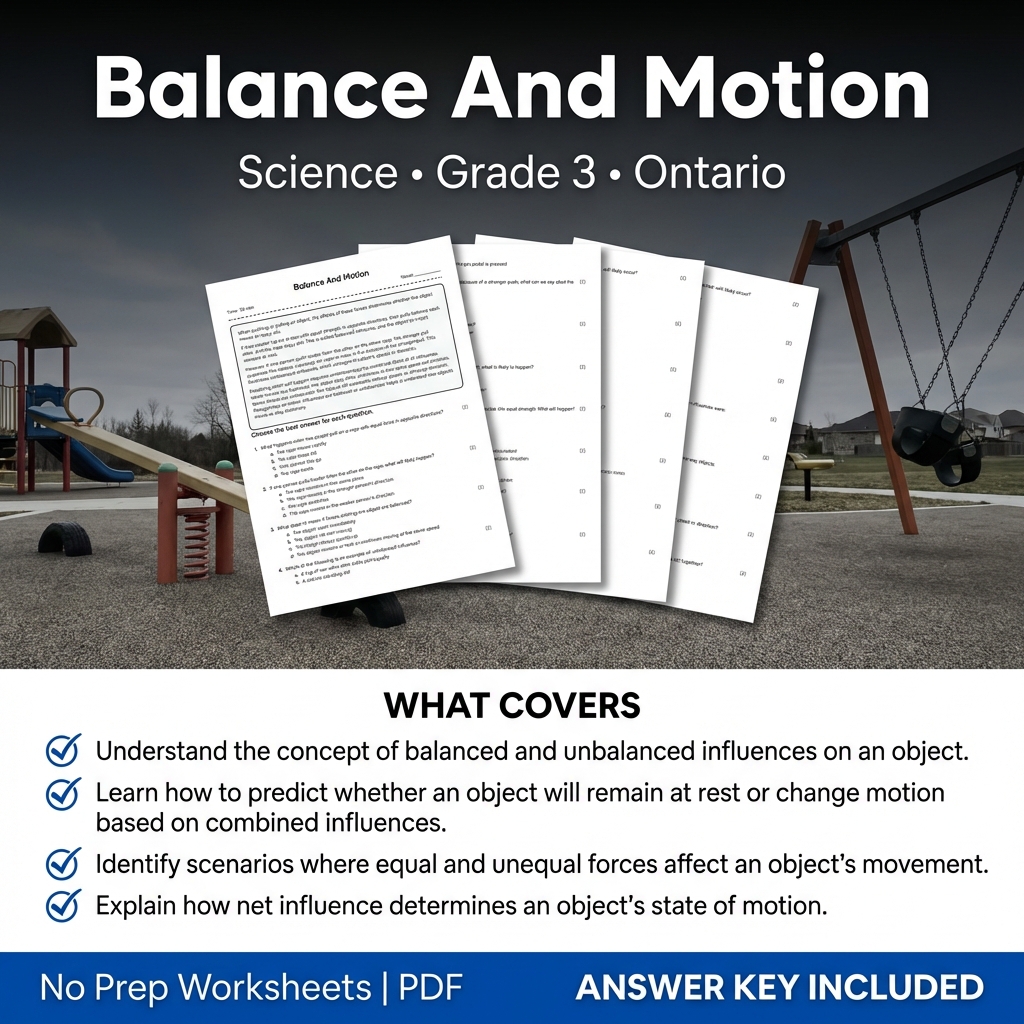
Balance And Motion Grade 3 Science Worksheet | Ontario Standards
Created byCoral Reef LearningLearning Objectives
- Understand the concept of balanced and unbalanced influences on an object.
- Learn how to predict whether an object will remain at rest or change motion based on combined influences.
- Identify scenarios where equal and unequal forces affect an object's movement.
Instant download

Grade 10 Science | Pattern Analysis Reading Worksheets with Answer Key (PDF)
JCreated byJ.S SheetsLearning Objectives
- Understand methods for identifying temporal and spatial patterns in Earth and space phenomena.
- Recognize the importance of data quality, sampling frequency, and statistical summaries in pattern detection.
- Analyze regional climate records, river discharge data, and meteorological series to interpret regularities and anomalies.
Also included in: Grade 10 Science Unit Bundle – Earth Systems, Climate & Remote Sensing Worksheets +1 more
Instant download
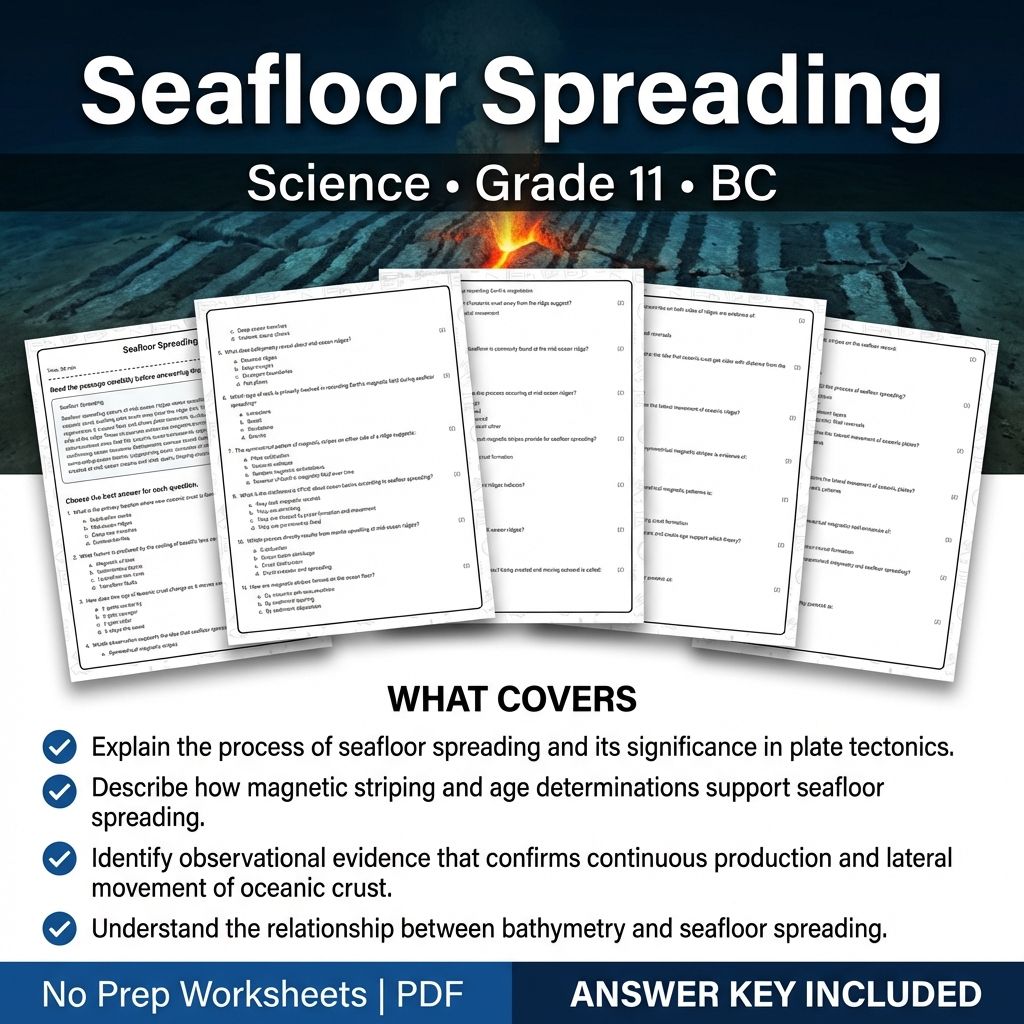
Grade 11 Science | Seafloor Spreading Worksheet & Answer Key (Printable PDF)
Created byCoral Reef LearningLearning Objectives
- Explain the process of seafloor spreading and its significance in plate tectonics.
- Describe how magnetic striping and age determinations support seafloor spreading.
- Identify observational evidence that confirms continuous production and lateral movement of oceanic crust.
Instant download
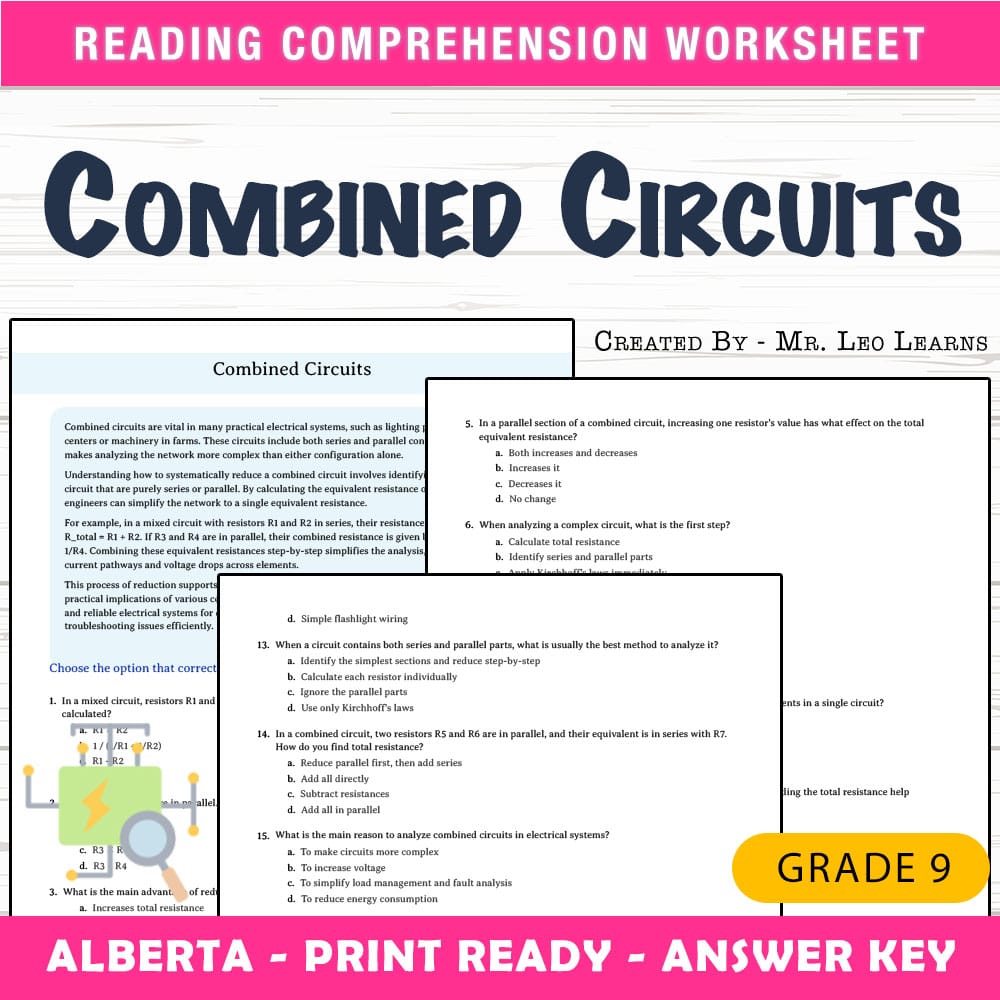
Grade 9 Science — Worksheet MCQ Paper for Mastering Combined Circuits
Created byThe Resource HubLearning Objectives
- Understand the structure of combined series and parallel circuits.
- Learn to simplify complex circuits by reducing series and parallel components.
- Identify equivalent resistances in mixed networks.
Also included in: Grade 9 Science Electricity and Magnetism Worksheet Bundle | Alberta Curriculum +1 more
Instant download

Chemical Fate Grade 12 Chemistry Worksheet Alberta Curriculum + Key
 Created byEvergreen Desk Education
Learning Objectives
- Explain how dissolution, sorption, volatilization, and biodegradation affect chemical fate in soil and water.
- Compare kinetic vs. equilibrium processes and describe how they influence contaminant partitioning and distribution.
- Apply fate-and-transport ideas to Alberta-relevant contamination scenarios and suggest monitoring/remediation implications.
Instant download
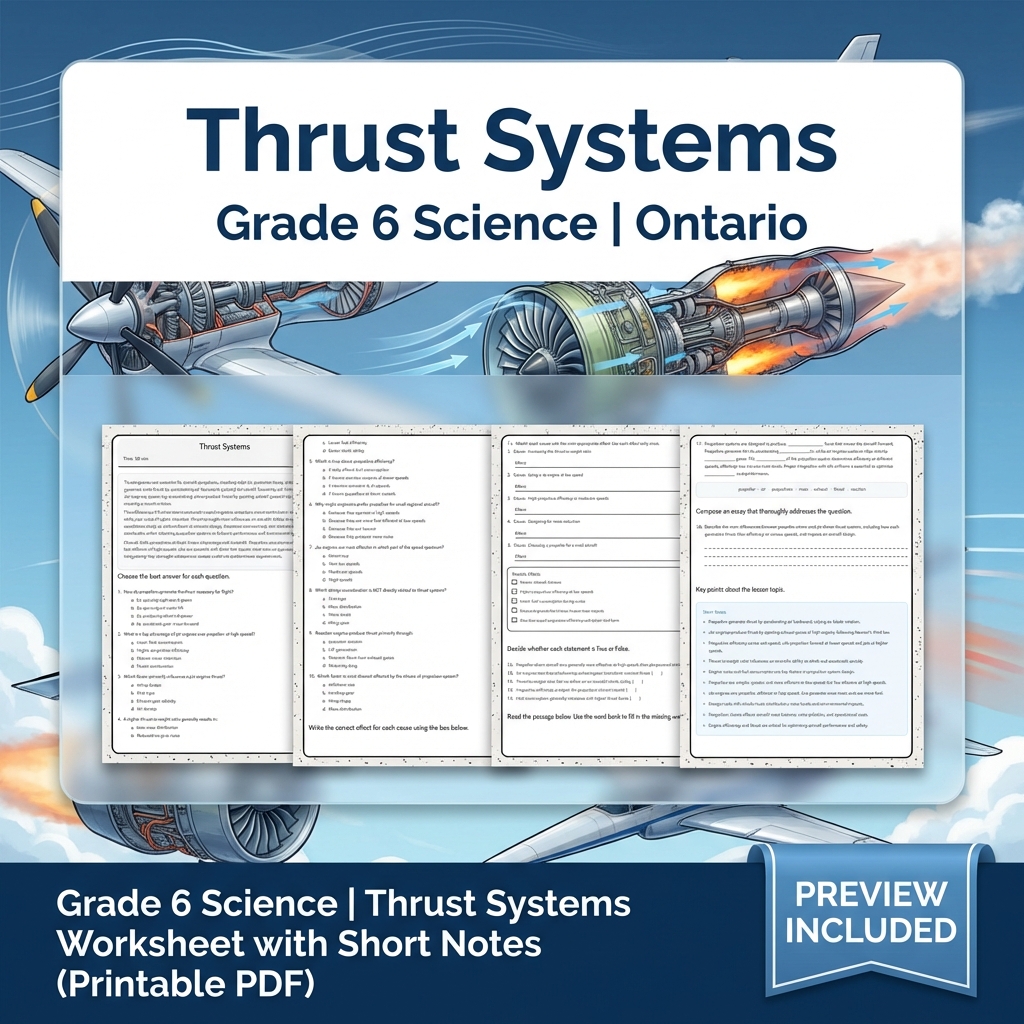
Grade 6 Science | Thrust Systems Worksheet with Short Notes (Printable PDF)
Created byMeadowlark WorksheetsLearning Objectives
- Understand the principles behind propeller-driven and jet-driven propulsion methods.
- Compare how axial and reaction thrusts are generated in different propulsion systems.
- Analyze the impact of thrust-to-weight ratio on aircraft climb and acceleration.
Also included in: Grade 6 Science Lesson Group Bundle – Ontario Framework Worksheets +1 more
Instant download
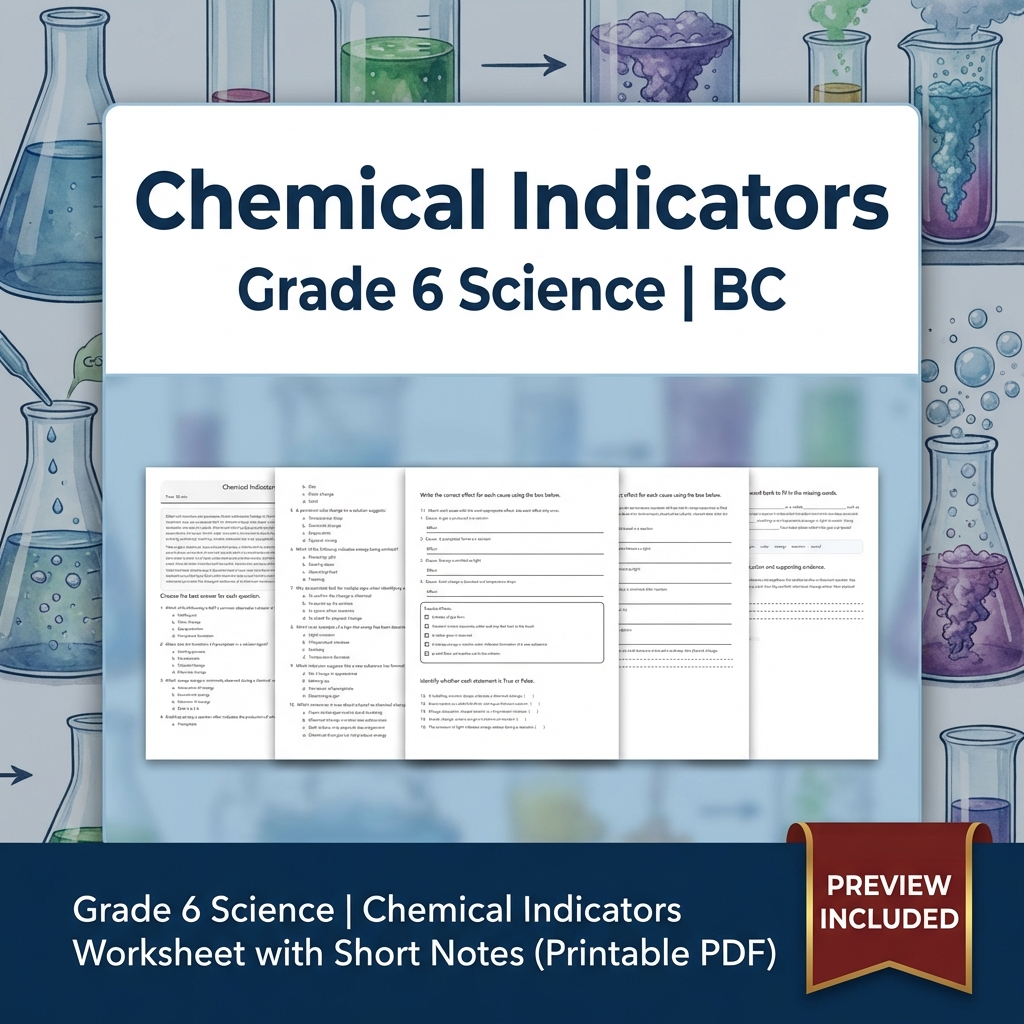
Grade 6 Science | Chemical Indicators Worksheet with Short Notes (Printable PDF)
Created byMeadowlark WorksheetsLearning Objectives
- Identify observable signs that indicate a chemical reaction has occurred.
- Understand various chemical indicators such as gas production, precipitates, and energy changes.
- Explain why multiple indicators provide stronger evidence of chemical change.
Also included in: Grade 6 Science | Matter, Properties & Change UNIT Worksheet Bundle +1 more
Instant download
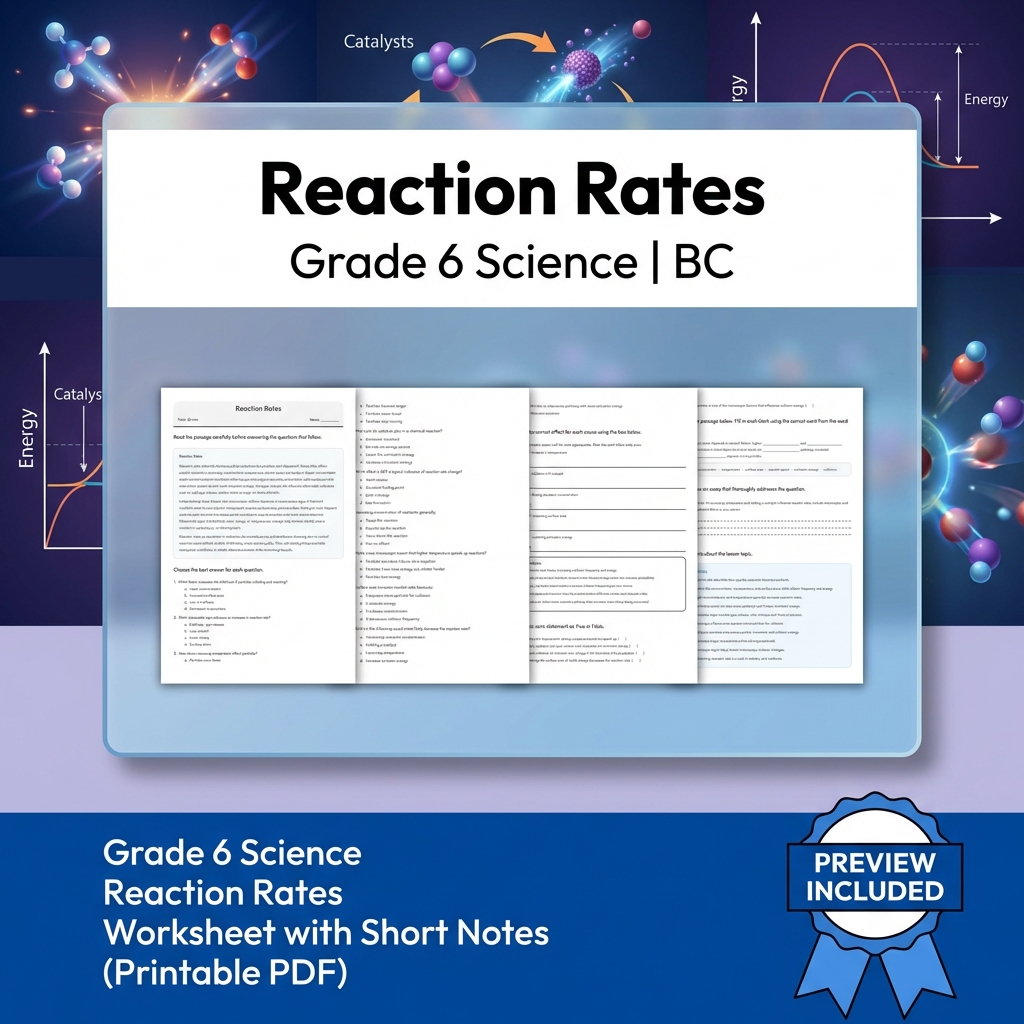
Grade 6 Science Reaction Rates Worksheet with Short Notes (Printable PDF)
Created byMeadowlark WorksheetsLearning Objectives
- Explain how factors like concentration, temperature, surface area, and catalysts influence reaction rates.
- Describe microscopic collision dynamics and relate them to observable macroscopic signs of reactions.
- Identify experimental indicators of reaction rate changes.
Also included in: Grade 6 Science | Matter, Properties & Change UNIT Worksheet Bundle +1 more
Instant download
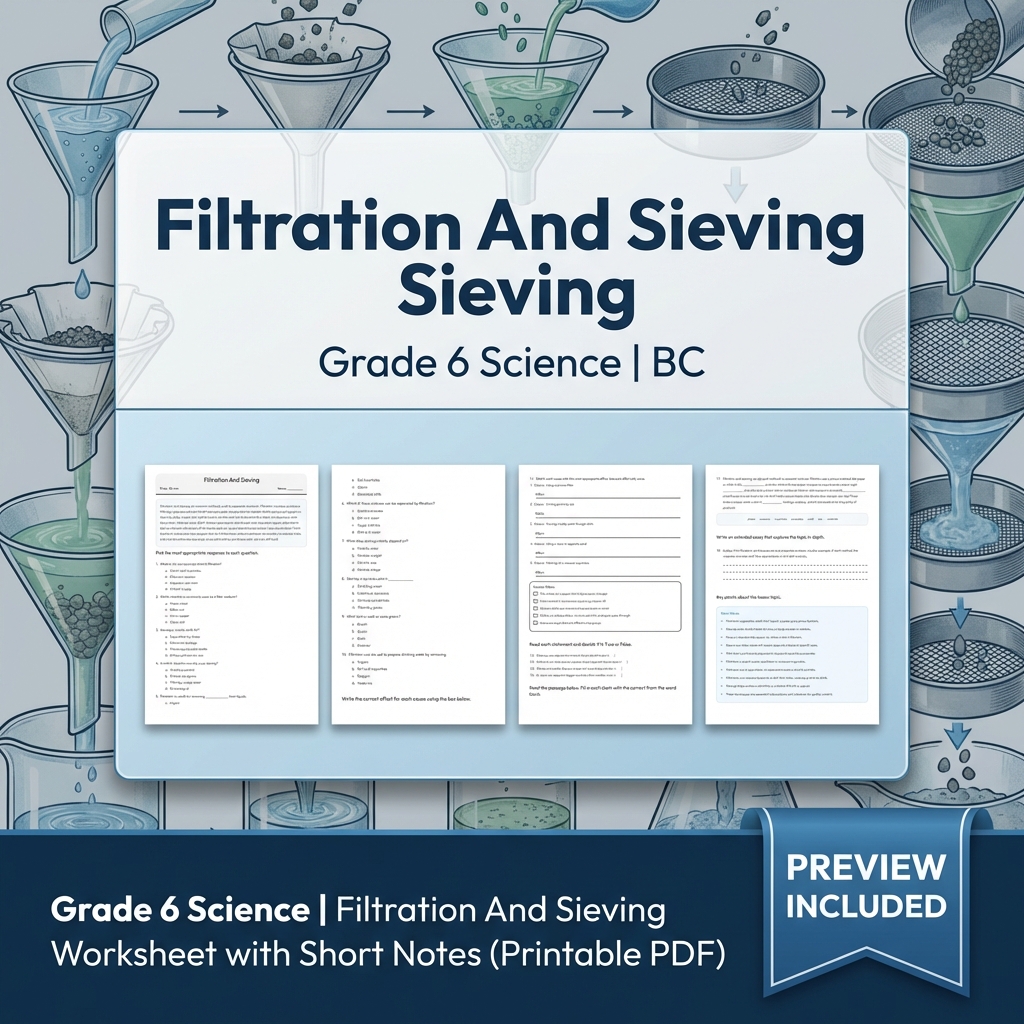
Grade 6 Science | Filtration And Sieving Worksheet with Short Notes (PDF)
Created byMeadowlark WorksheetsLearning Objectives
- Understand the processes of filtration and sieving in separating mixtures.
- Identify different methods used to separate mixtures based on particle size and phase.
- Explain how porous materials help in filtration and sieving.
Also included in: Grade 6 Science | Matter, Properties & Change UNIT Worksheet Bundle +1 more
Instant download

Grade 6 Science | Diffusion Rates Worksheet with Short Notes (Printable PDF)
Created byMeadowlark WorksheetsLearning Objectives
- Understand how diffusion occurs and the factors that influence its rate.
- Connect microscopic particle motion to observable phenomena like scent spreading.
- Identify variables such as temperature, particle size, and viscosity that affect diffusion speed.
Also included in: Grade 6 Science | Matter, Properties & Change UNIT Worksheet Bundle +1 more
Instant download
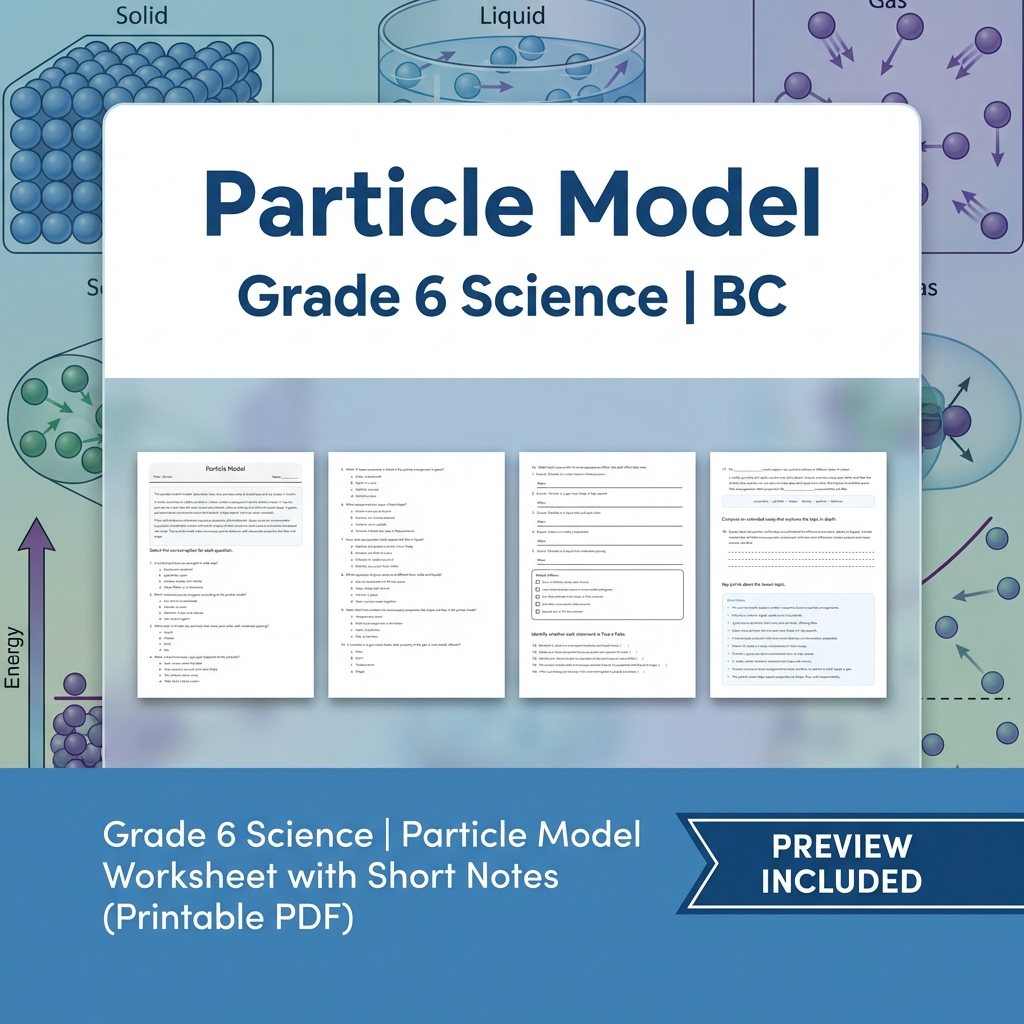
Grade 6 Science | Particle Model Worksheet with Short Notes (Printable PDF)
Created byMeadowlark WorksheetsLearning Objectives
- Understand the basic idea of the particle model and how it explains states of matter.
- Identify differences in particle arrangements in solids, liquids, and gases.
- Describe how microscopic particle behaviour relates to macroscopic properties like shape, volume, and flow.
Also included in: Grade 6 Science | Matter, Properties & Change UNIT Worksheet Bundle +1 more
Instant download
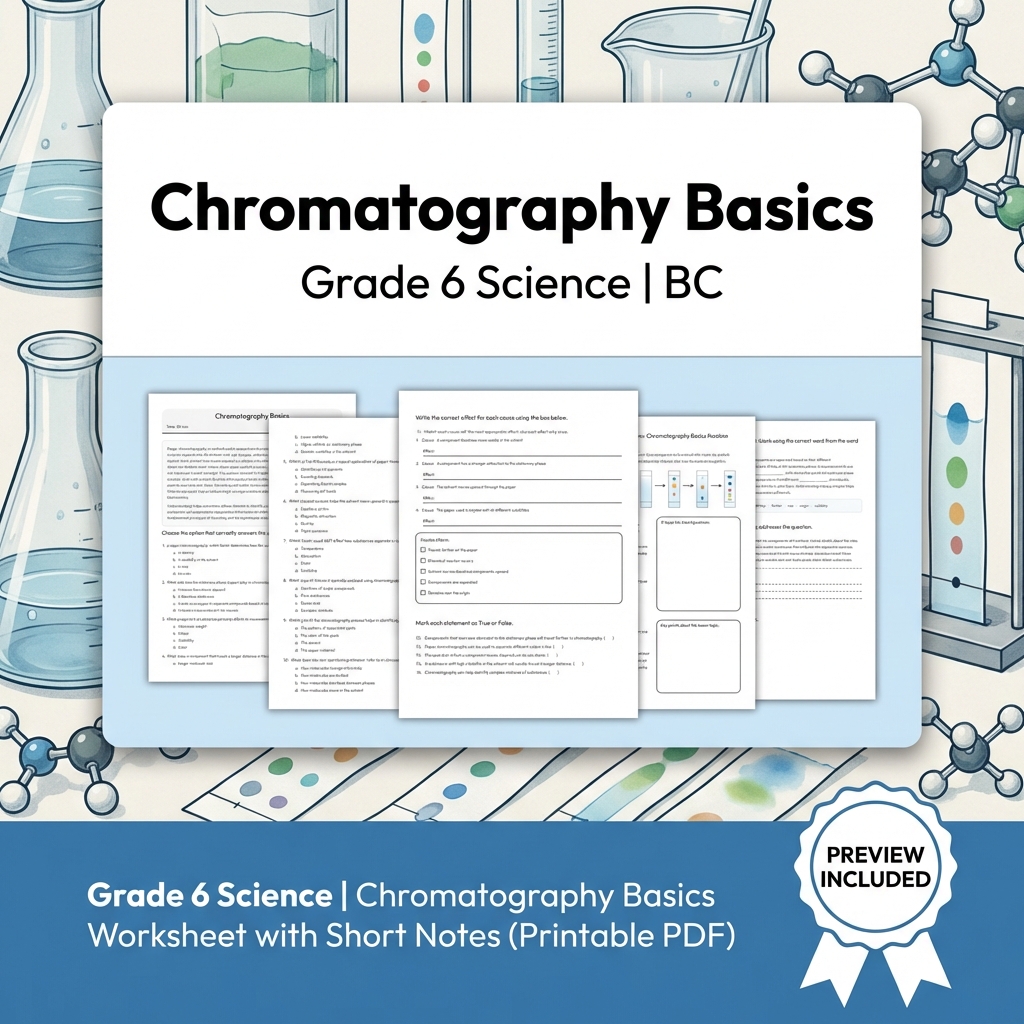
Grade 6 Science | Chromatography Basics Worksheet with Short Notes (PDF)
Created byMeadowlark WorksheetsLearning Objectives
- Understand the principle of paper chromatography and how it separates mixture components.
- Identify the factors influencing the movement of substances in chromatography.
- Interpret chromatograms to analyze mixture compositions.
Also included in: Grade 6 Science | Matter, Properties & Change UNIT Worksheet Bundle +1 more
Instant download
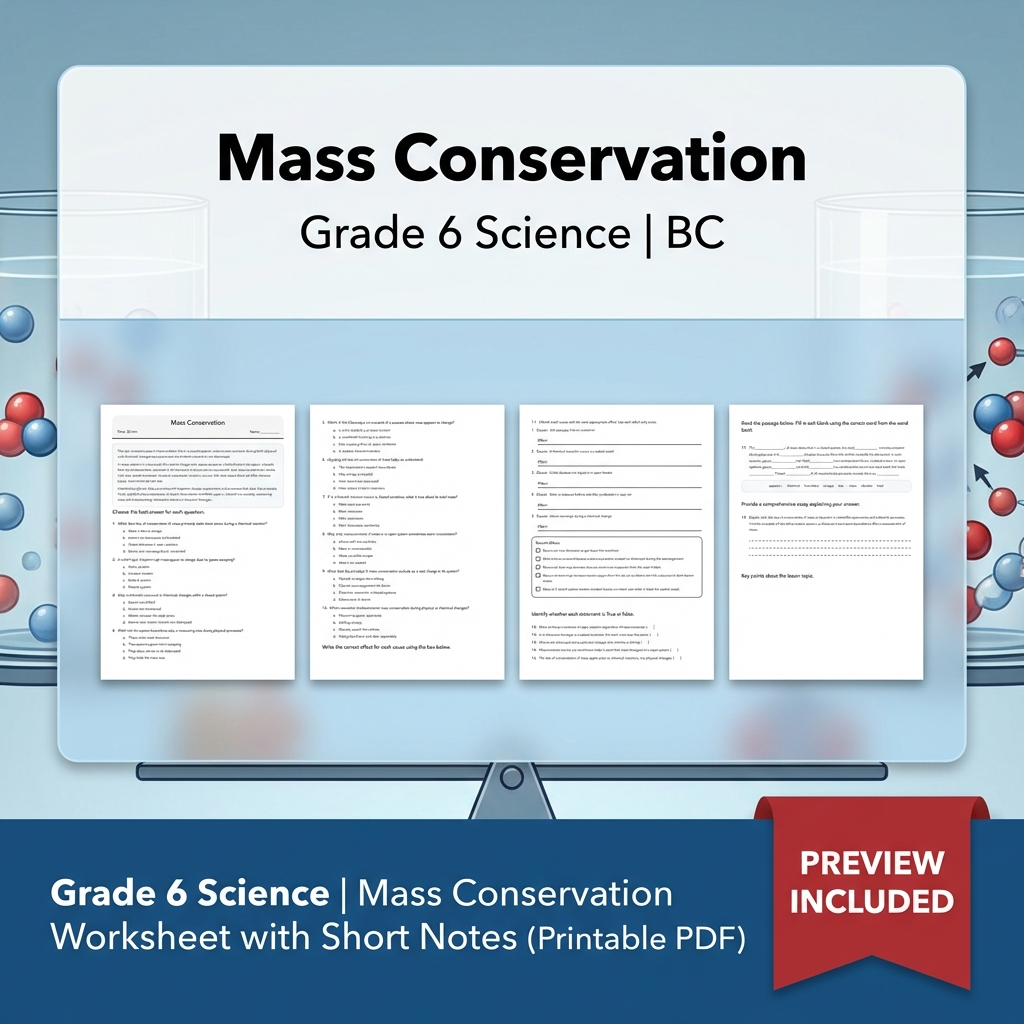
Grade 6 Science | Mass Conservation Worksheet with Short Notes (Printable PDF)
Created byMeadowlark WorksheetsLearning Objectives
- Understand the law of conservation of mass and how it applies to closed and open systems.
- Identify differences between physical and chemical processes in terms of mass.
- Apply principles of mass conservation to real-world experiments and observations.
Also included in: Grade 6 Science | Matter, Properties & Change UNIT Worksheet Bundle +1 more
Instant download

Grade 6 Science | Crystal Structures Worksheet with Short Notes (Printable PDF)
Created byMeadowlark WorksheetsLearning Objectives
- Understand the arrangement of particles in crystalline and amorphous solids.
- Explain how particle bonding and order relate to the properties of solids.
- Compare microscopic structure differences to observable behaviors like melting points and brittleness.
Also included in: Grade 6 Science | Matter, Properties & Change UNIT Worksheet Bundle +1 more
Instant download
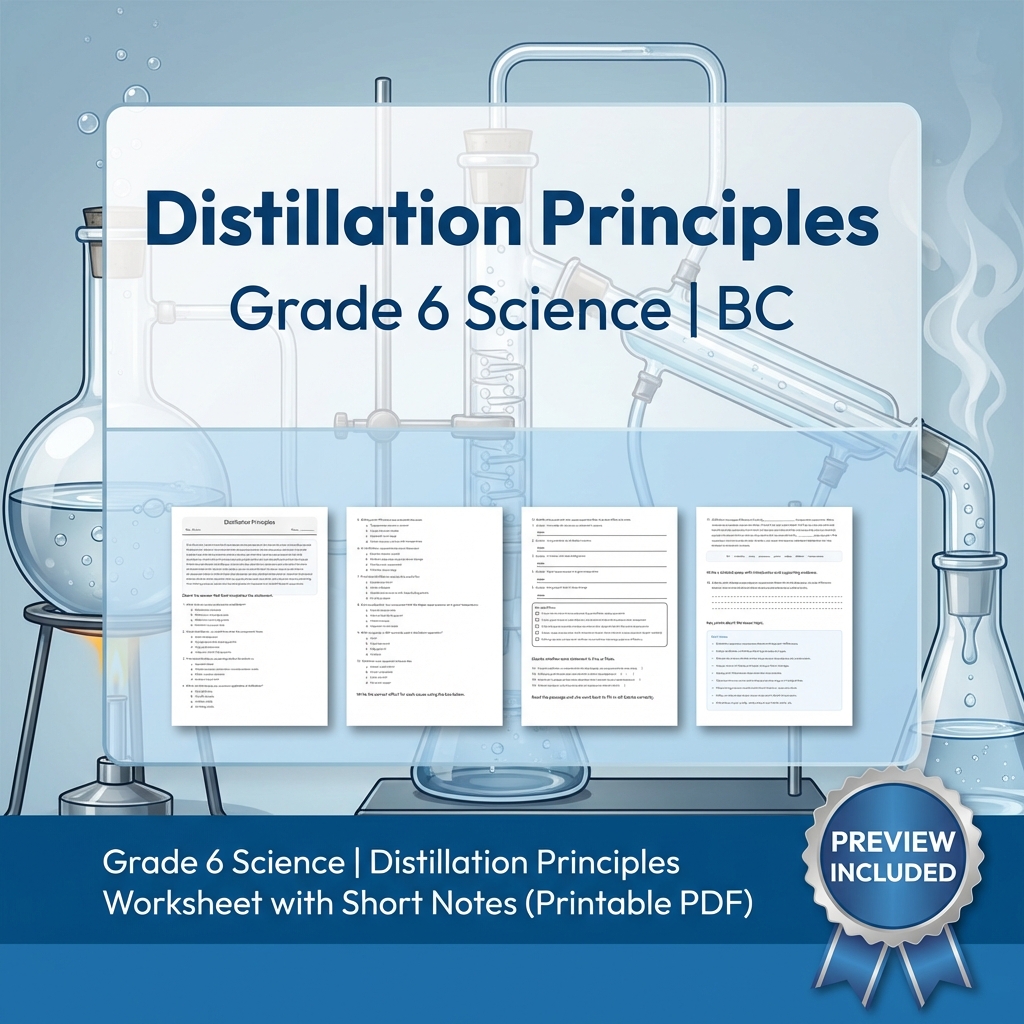
Grade 6 Science | Distillation Principles Worksheet with Short Notes (PDF)
Created byMeadowlark WorksheetsLearning Objectives
- Understand the basic principles of distillation and phase changes
- Differentiate between simple and fractional distillation techniques
- Identify real-world applications of distillation in separating liquids
Also included in: Grade 6 Science | Matter, Properties & Change UNIT Worksheet Bundle +1 more
Instant download
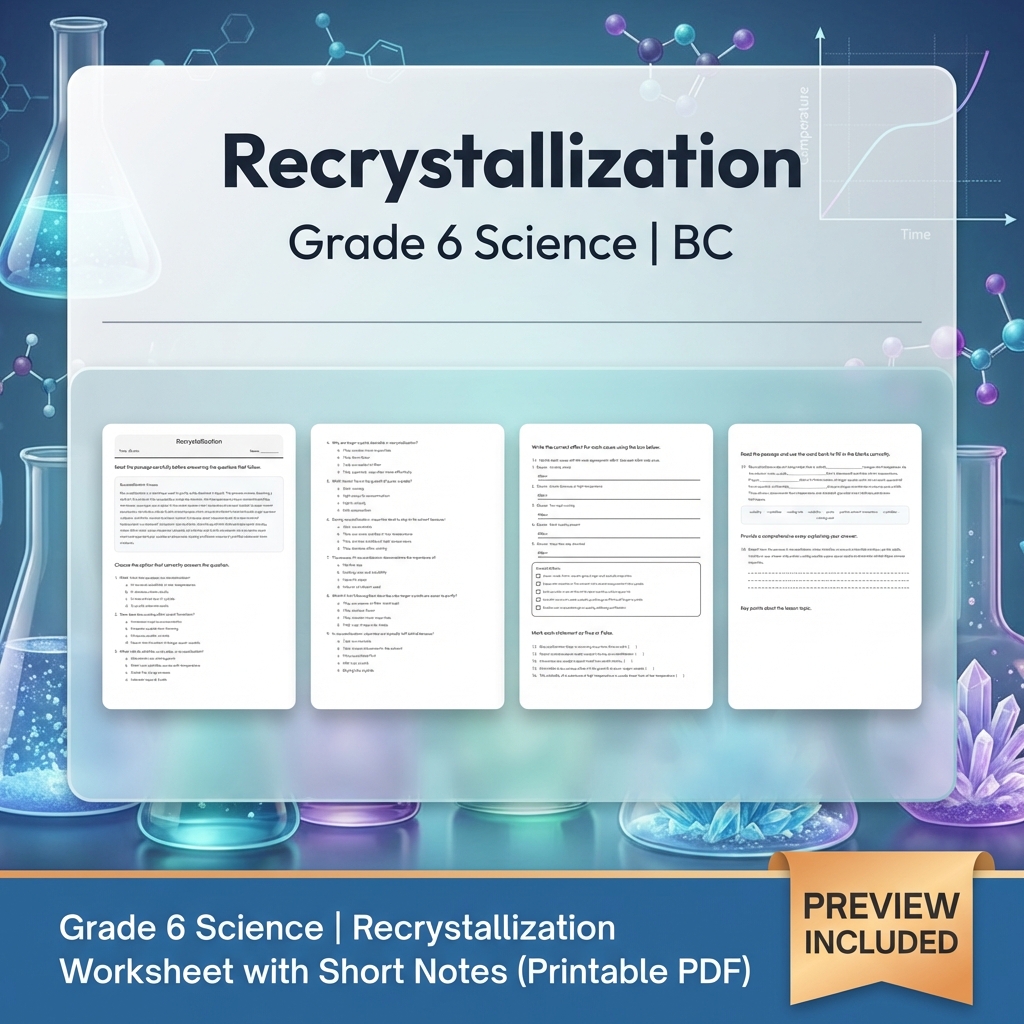
Grade 6 Science | Recrystallization Worksheet with Short Notes (Printable PDF)
Created byMeadowlark WorksheetsLearning Objectives
- Understand the process of recrystallization and its role in purifying solids.
- Explain how temperature changes affect solubility and crystal formation.
- Identify factors that influence the size and purity of crystals during recrystallization.
Also included in: Grade 6 Science | Matter, Properties & Change UNIT Worksheet Bundle +1 more
Instant download
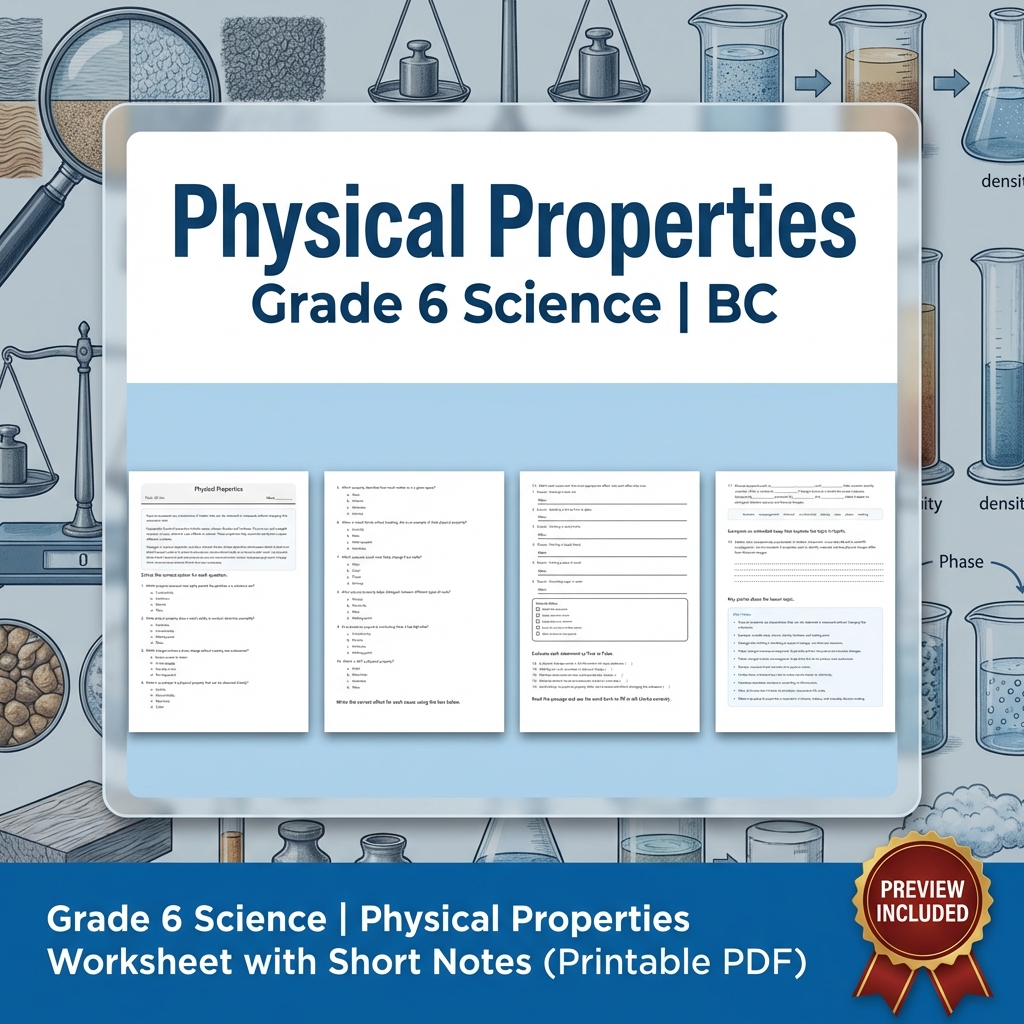
Grade 6 Science | Physical Properties Worksheet with Short Notes (Printable PDF)
Created byMeadowlark WorksheetsLearning Objectives
- Understand observable and measurable characteristics of matter such as mass, volume, density, conductivity, melting point, and hardness.
- Distinguish between physical changes and chemical changes based on properties and observations.
- Identify physical properties in real-world examples and understand their significance in scientific analysis.
Also included in: Grade 6 Science | Matter, Properties & Change UNIT Worksheet Bundle +1 more
Instant download
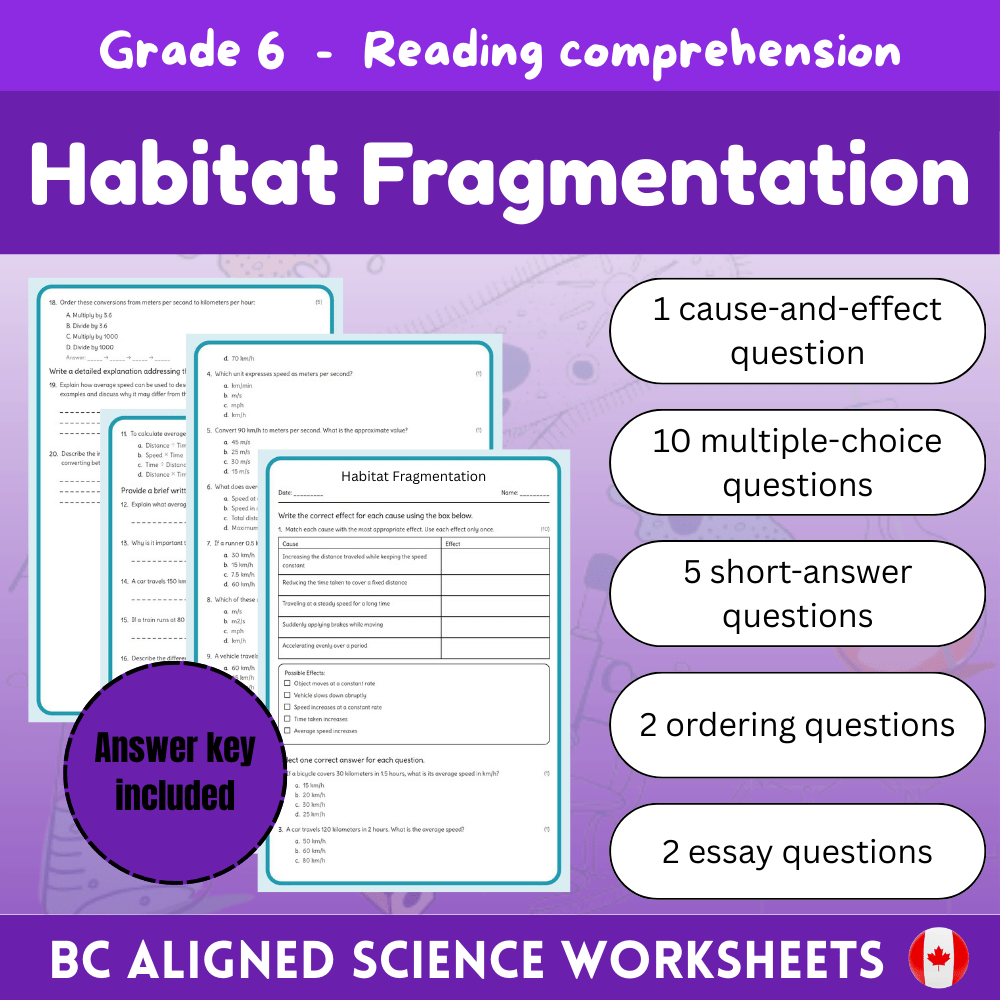
6th Grade Science | Habitat Fragmentation Worksheet (PDF) – BC Standards
 Created byBright Mind Resources
Learning Objectives
- Understand what habitat fragmentation is and how it affects ecosystems.
- Identify causes and effects of habitat fragmentation.
- Recognize strategies to mitigate habitat fragmentation impacts.
Instant download

Grade 9 Science | Mass Conservation Worksheet | Ontario Standards
Created byLumora LearningLearning Objectives
- Understand the principle of conservation of mass in closed systems during chemical reactions.
- Recognize scenarios where mass appears to change due to gas exchange versus true mass conservation.
- Explain how mass is conserved in processes like combustion in sealed containers and precipitate formation.
Instant download
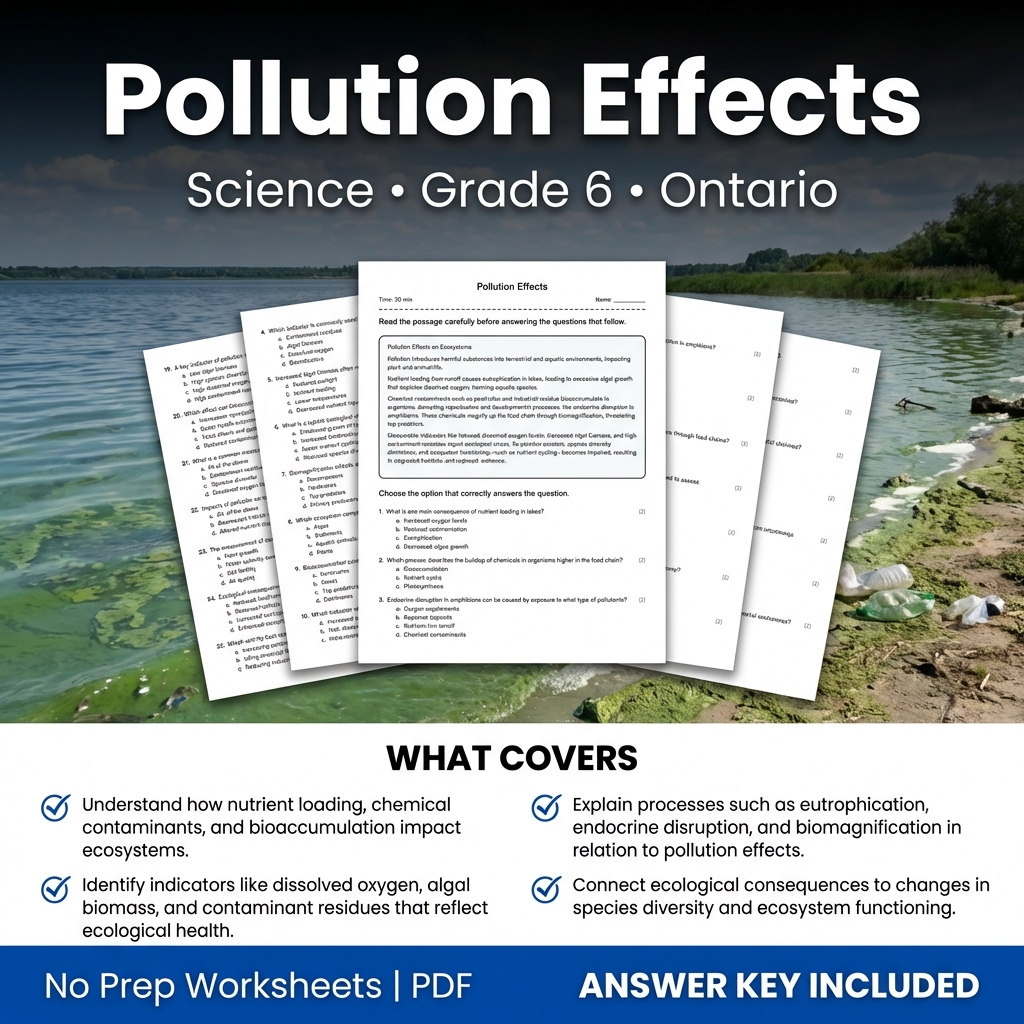
Pollution Effects Worksheet for Grade 6 Science | Ontario Standards
Created byCoral Reef LearningLearning Objectives
- Understand how nutrient loading, chemical contaminants, and bioaccumulation impact ecosystems.
- Identify indicators like dissolved oxygen, algal biomass, and contaminant residues that reflect ecological health.
- Explain processes such as eutrophication, endocrine disruption, and biomagnification in relation to pollution effects.
Instant download
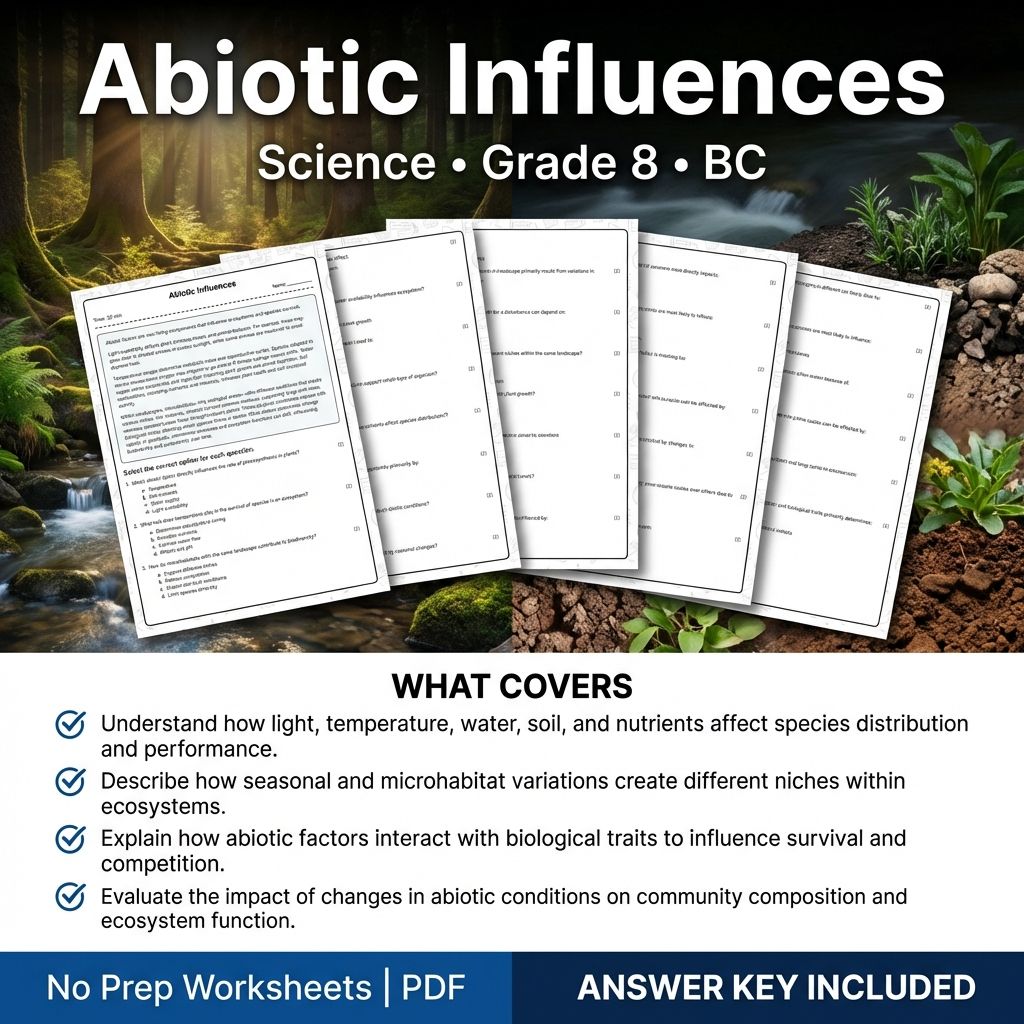
Grade 8 Science Worksheet | Abiotic Influences on Ecosystems (PDF + Answer Key)
Created byCoral Reef LearningLearning Objectives
- Understand how light, temperature, water, soil, and nutrients affect species distribution and performance.
- Describe how seasonal and microhabitat variations create different niches within ecosystems.
- Explain how abiotic factors interact with biological traits to influence survival and competition.
Instant download
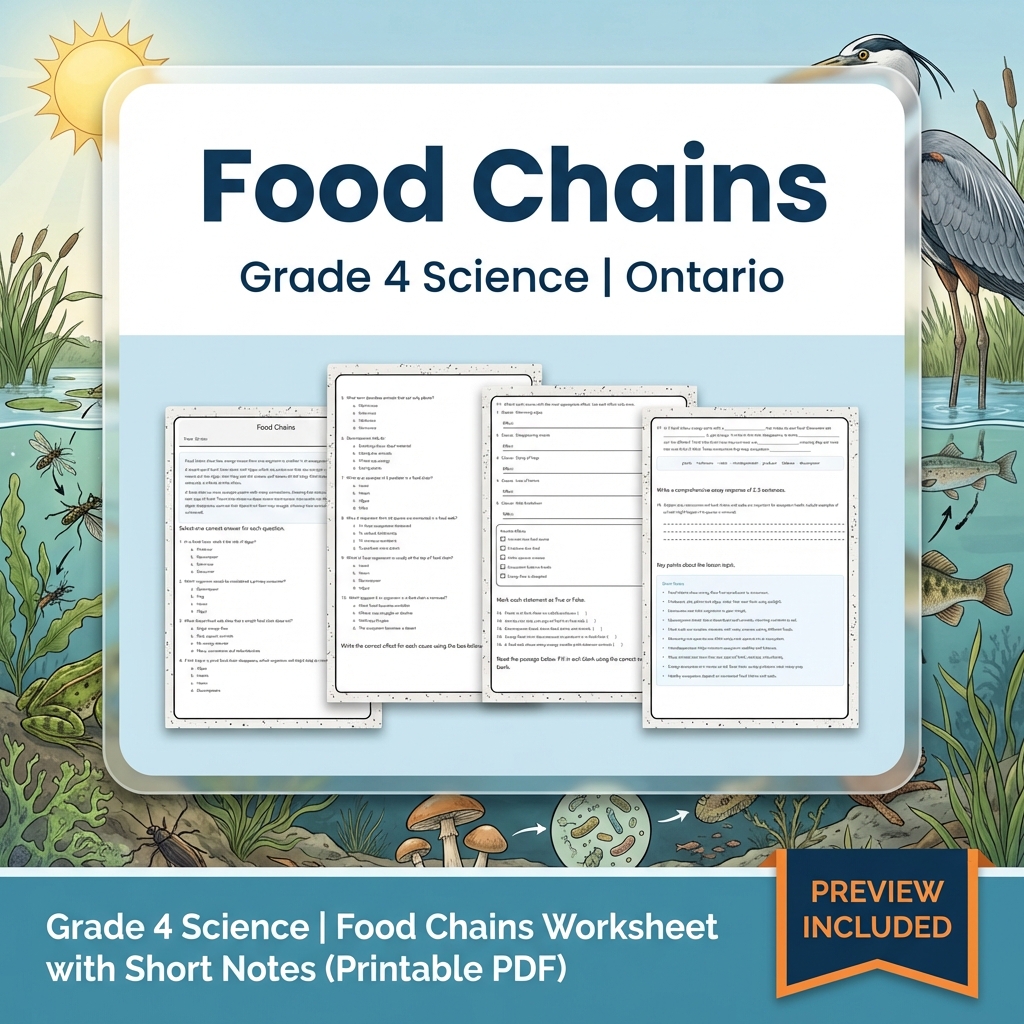
Grade 4 Science | Food Chains Worksheet with Short Notes (Printable PDF)
Created byMeadowlark WorksheetsLearning Objectives
- Understand the basic structure of food chains and webs in ecosystems.
- Identify producers, consumers, and decomposers in a food chain.
- Explain how energy flows from one organism to another in a food chain.
Also included in: Grade 4 Science Lesson Group Bundle – Ontario Framework Units +1 more
Instant download
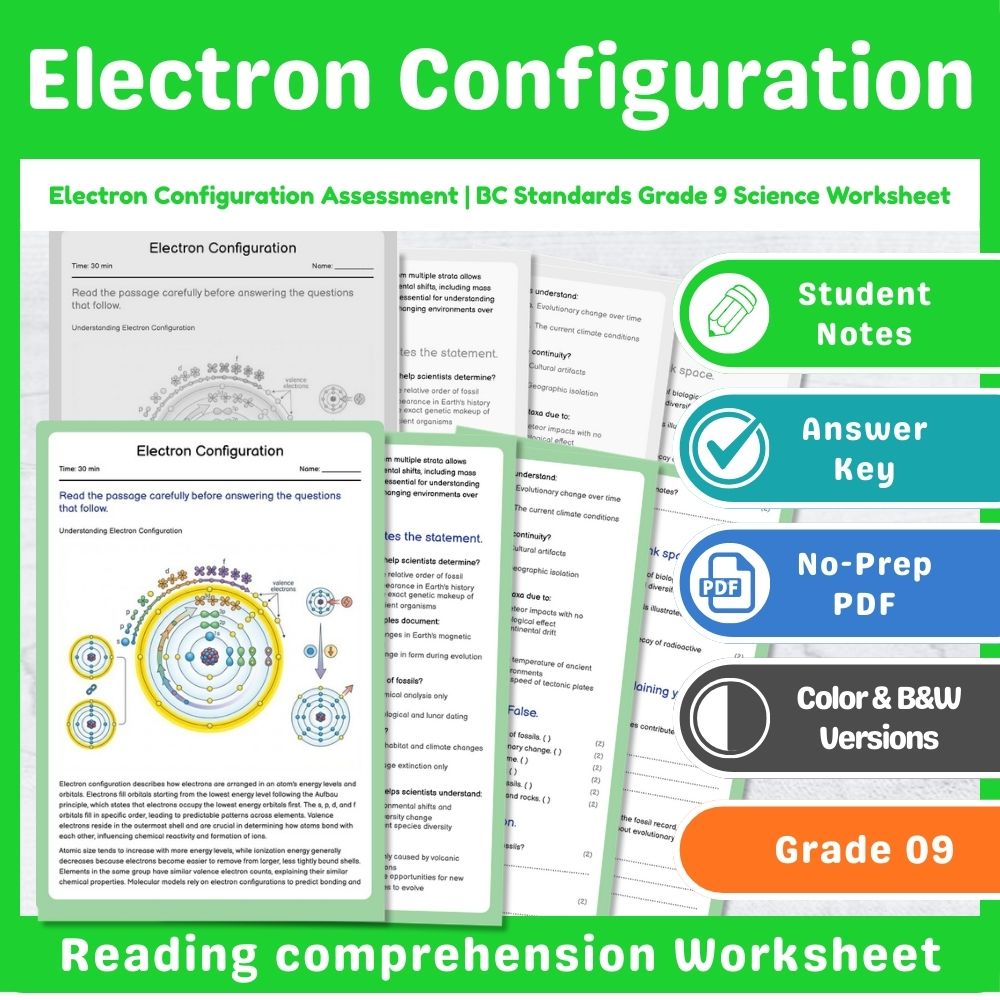
Electron Configuration Assessment | BC Standards Grade 9 Science Worksheet
Created byPrism Point LearningLearning Objectives
- Describe the distribution of electrons in atoms using electron configuration notation.
- Explain the significance of valence electrons in chemical bonding and reactivity.
- Identify trends in atomic size and ionization energy based on electron configurations.
Instant download
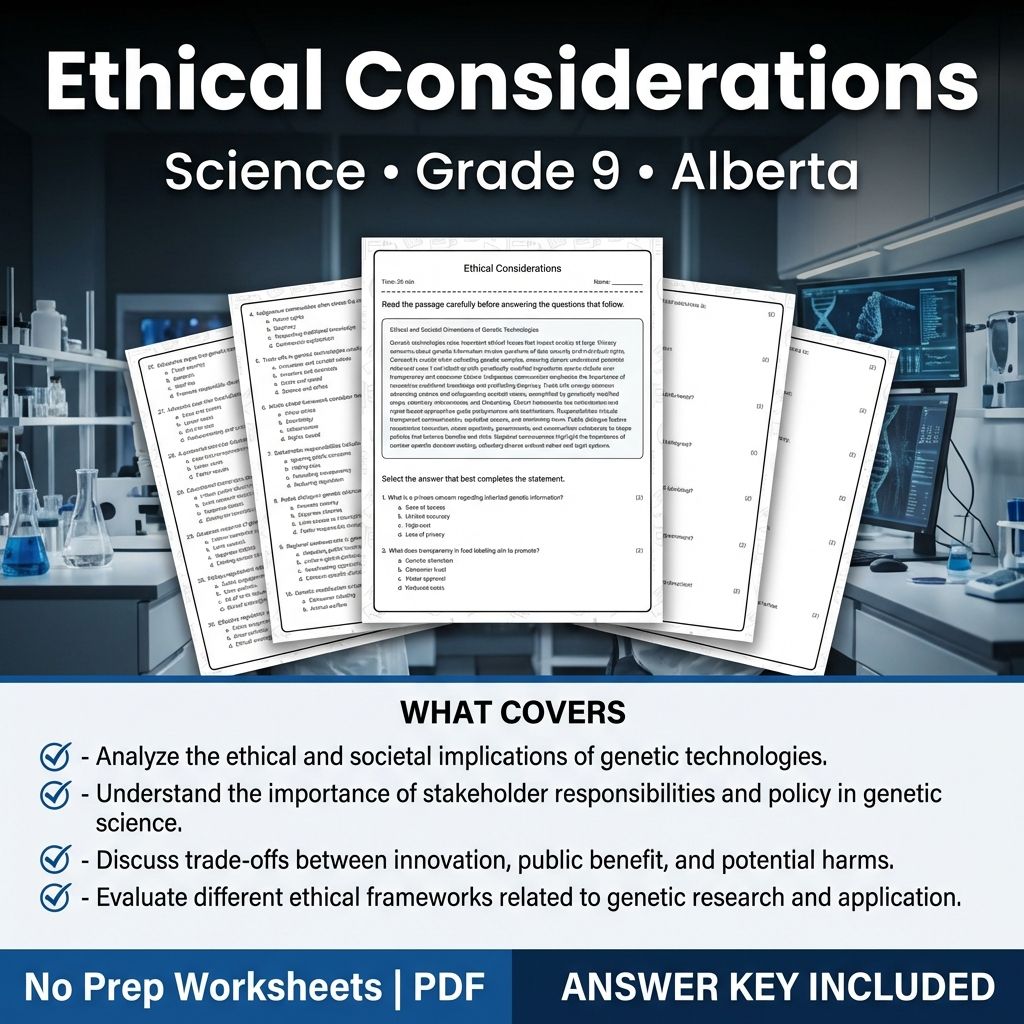
Grade 9 Science Worksheet on Ethical Considerations for Alberta Standards
Created byCoral Reef LearningLearning Objectives
- Analyze the ethical and societal implications of genetic technologies.
- Understand the importance of stakeholder responsibilities and policy in genetic science.
- Discuss trade-offs between innovation, public benefit, and potential harms.
Instant download
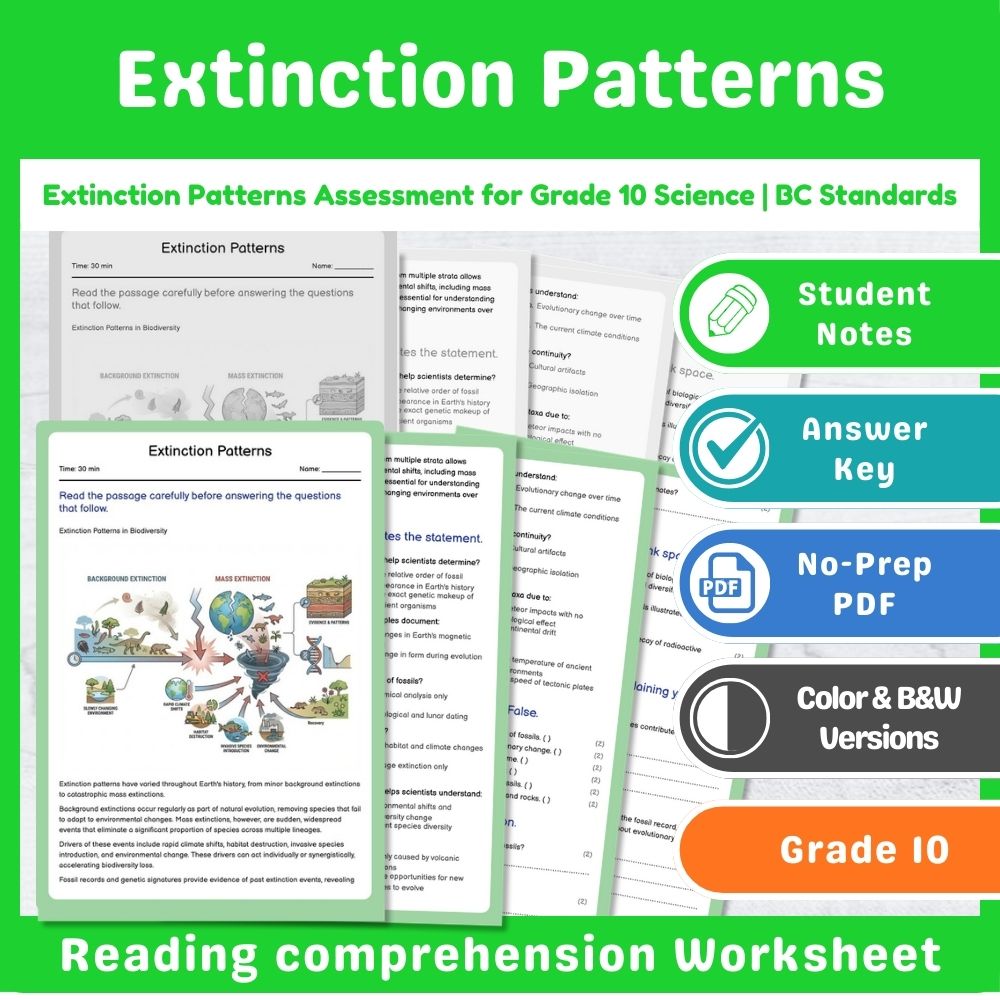
Extinction Patterns Assessment for Grade 10 Science | BC Standards
Created byPrism Point LearningLearning Objectives
- Understand various extinction patterns from background losses to mass extinctions.
- Identify causes and drivers of extinction events such as environmental changes and invasive species.
- Explain how fossil and genetic signatures reveal past biodiversity crises.
Instant download

Periodic Trends Assessment | BC Standards-Aligned Grade 10 Science
Created byPrism Point LearningLearning Objectives
- Understand the concept of periodic trends such as atomic radius, ionization energy, and electronegativity.
- Explain how nuclear charge and electron shielding influence these trends.
- Apply knowledge of periodic trends to predict atom behavior in bonding and reactions.
Instant download
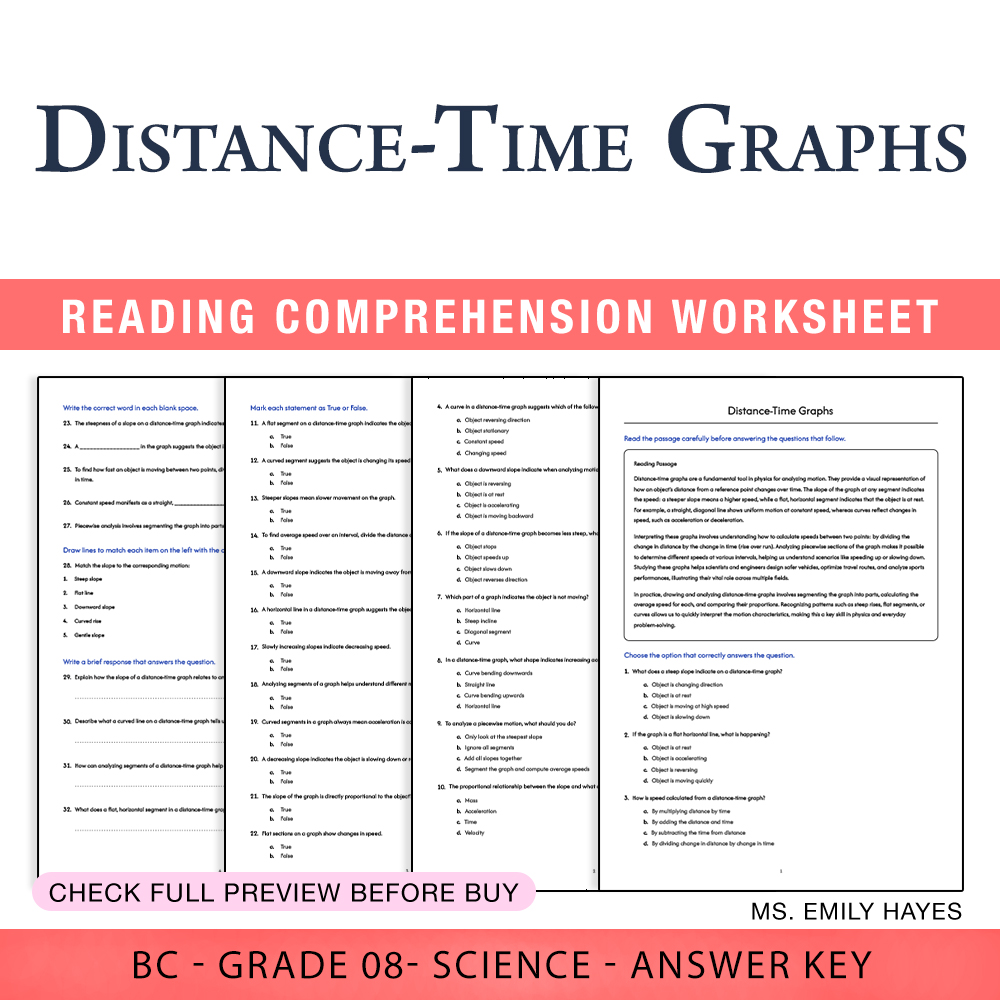
Grade 8 Science | Distance-Time Graphs Worksheet (PDF+ Answer Key)
 Created byCopper Leaf Classroom
Learning Objectives
- Understand how to interpret distance-time graphs and what information they convey about motion.
- Learn to calculate speed using the slope of a distance-time graph and analyze different types of motion such as constant, increasing, or decreasing speed.
Also included in: Grade 8 Science Worksheets Bundle | Forces, Motion & Energy (PDF + Answer Keys) +1 more
Instant download
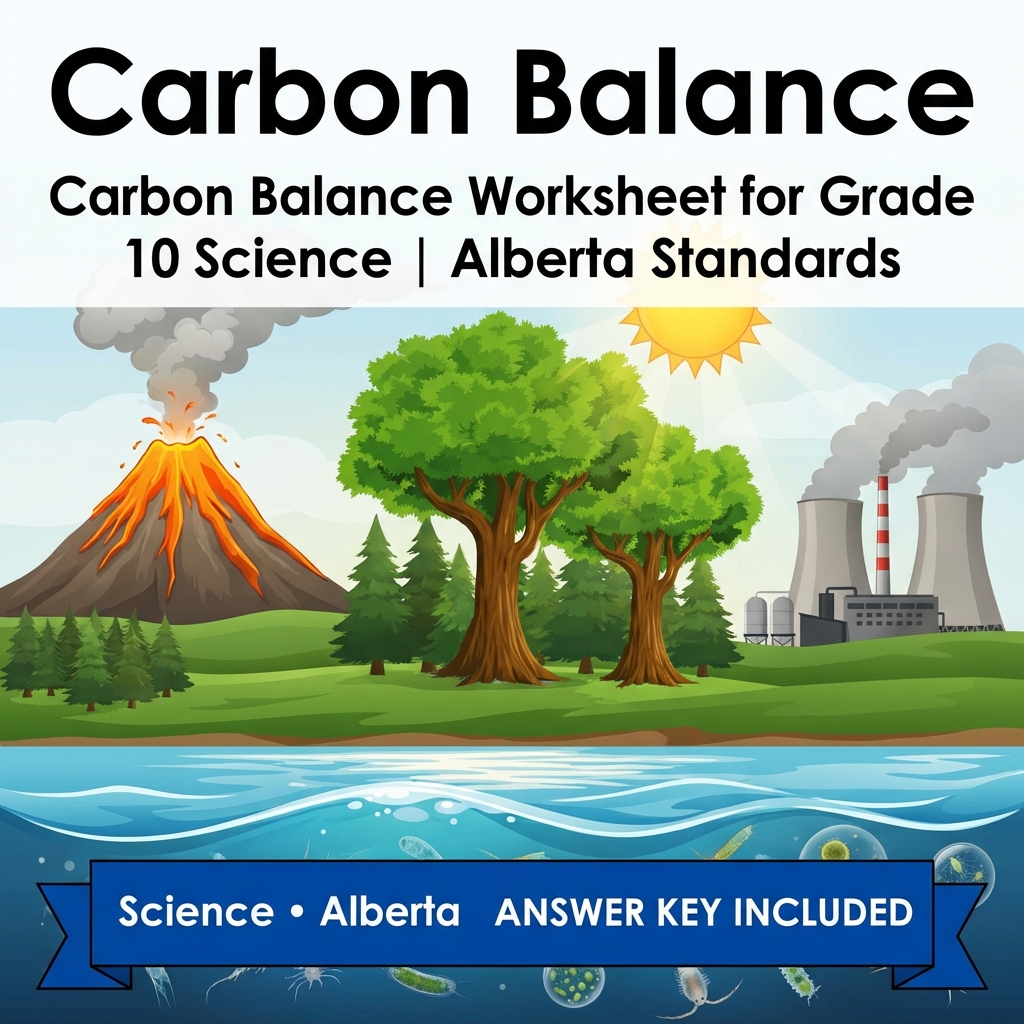
Carbon Balance Worksheet for Grade 10 Science | Alberta Standards
Created byCoral Reef LearningLearning Objectives
- Understand the major components and fluxes involved in the Earth's carbon cycle.
- Identify regional examples of carbon storage and release, such as in Alberta ecosystems.
- Explain the natural and human-driven factors that influence carbon fluxes and climate feedbacks.
Instant download
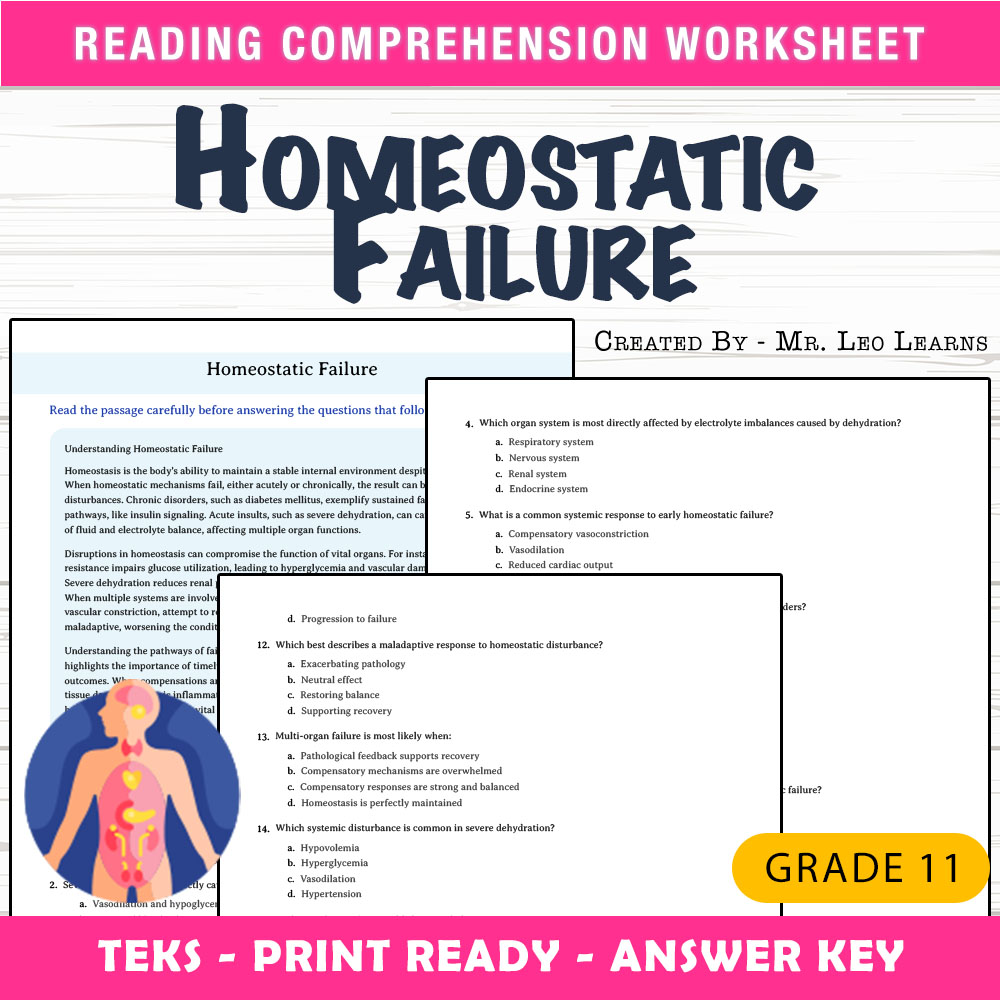
Grade 11 Science – Homeostatic Failure Worksheet for Mastery
Created byThe Resource HubLearning Objectives
- Understand how chronic disorders and acute insults disrupt systemic regulatory networks.
- Identify key pathways through which homeostatic failure leads to multi-organ dysfunction.
- Recognize examples like insulin resistance and dehydration and their systemic consequences.
Also included in: Grade 11 Science | Human Body Systems & Physiology Worksheet Bundle +1 more
Instant download
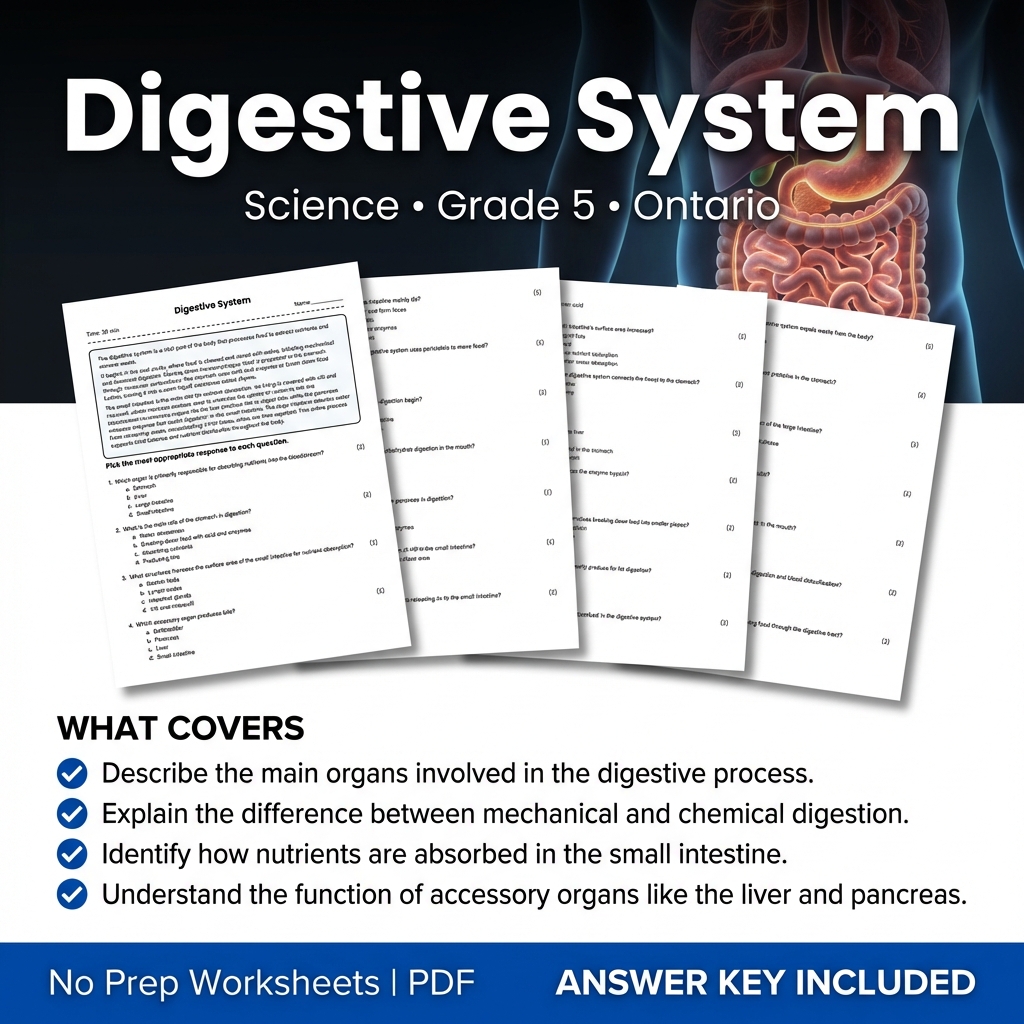
Digestive System Science Worksheet | Grade 5 Standard Practice PDF
Created byCoral Reef LearningLearning Objectives
- Describe the main organs involved in the digestive process.
- Explain the difference between mechanical and chemical digestion.
- Identify how nutrients are absorbed in the small intestine.
Instant download
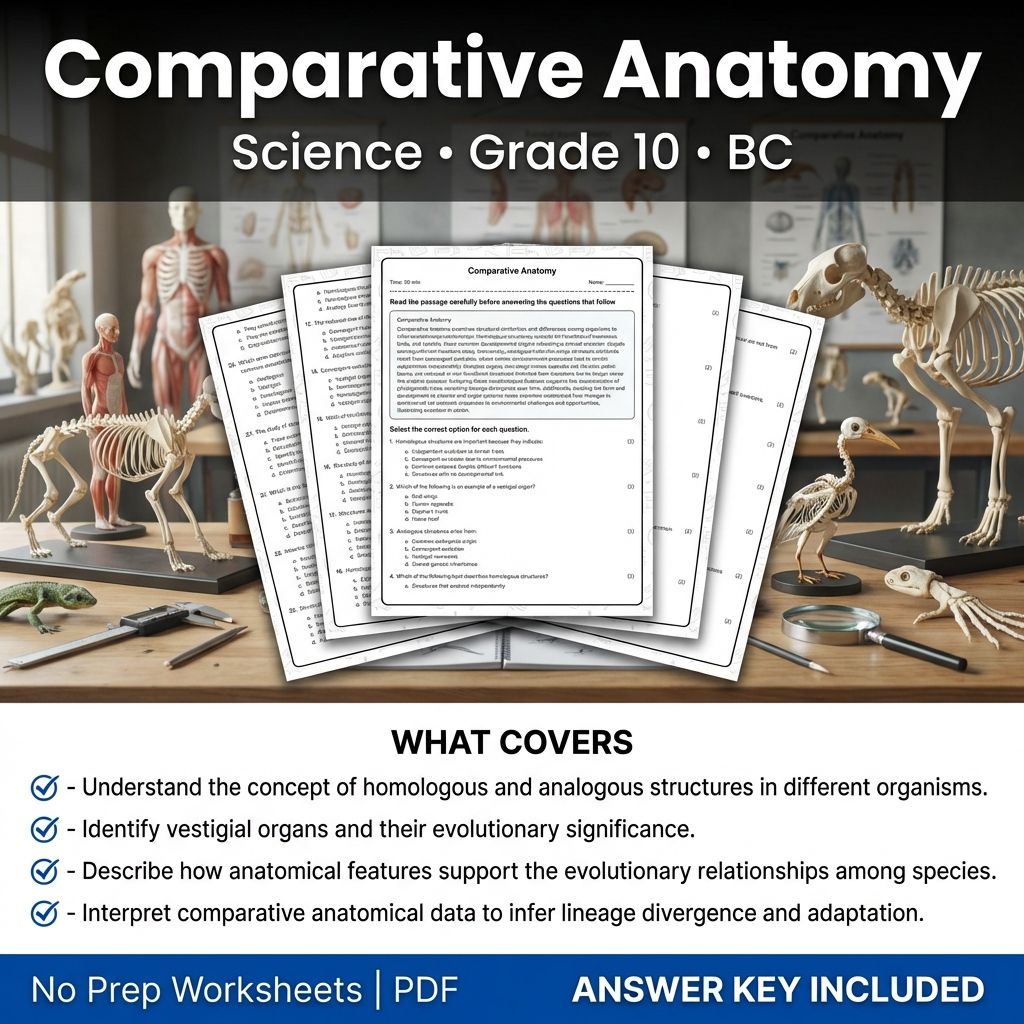
Grade 10 Science Worksheet | Comparative Anatomy Practice with Answer Key (PDF)
Created byCoral Reef LearningLearning Objectives
- Understand the concept of homologous and analogous structures in different organisms.
- Identify vestigial organs and their evolutionary significance.
- Describe how anatomical features support the evolutionary relationships among species.
Instant download
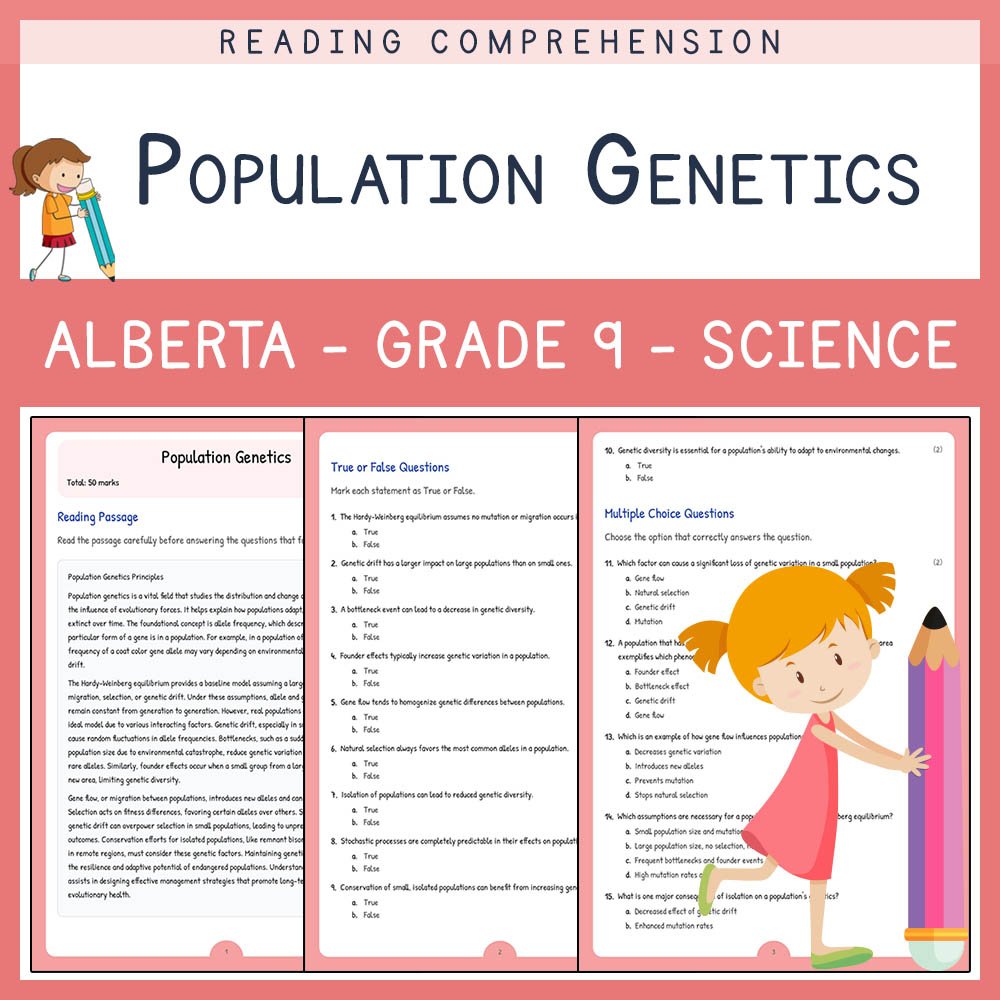
Grade 9 Science | Population Genetics Worksheet | Alberta Standards
Created byLumora LearningLearning Objectives
- Understand the core principles of population genetics, including allele frequency and genetic drift.
- Describe the assumptions of Hardy-Weinberg equilibrium and factors that disrupt it.
- Explain the effects of bottlenecks, founder effects, and gene flow on genetic diversity.
Instant download
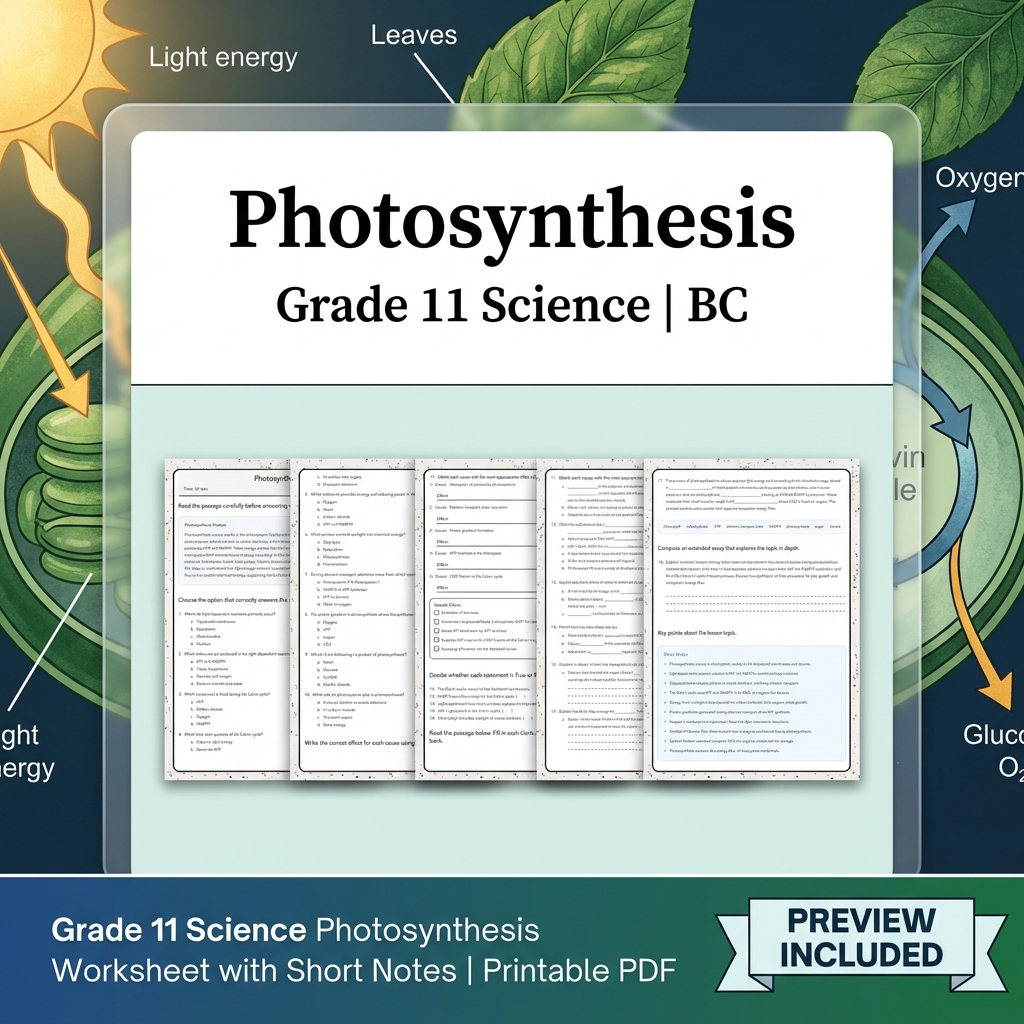
Grade 11 Science Photosynthesis Worksheet with Short Notes | Printable PDF
Created byMeadowlark WorksheetsLearning Objectives
- Explain the process of photosynthesis including light-dependent reactions and the Calvin cycle.
- Identify the roles of photosystems, ATP, and NADPH in photosynthesis.
- Describe how light energy is transformed into chemical energy in plants.
Also included in: Grade 11 Science Lesson Bundle BC Framework Worksheets for Biology and Genetics +1 more
Instant download
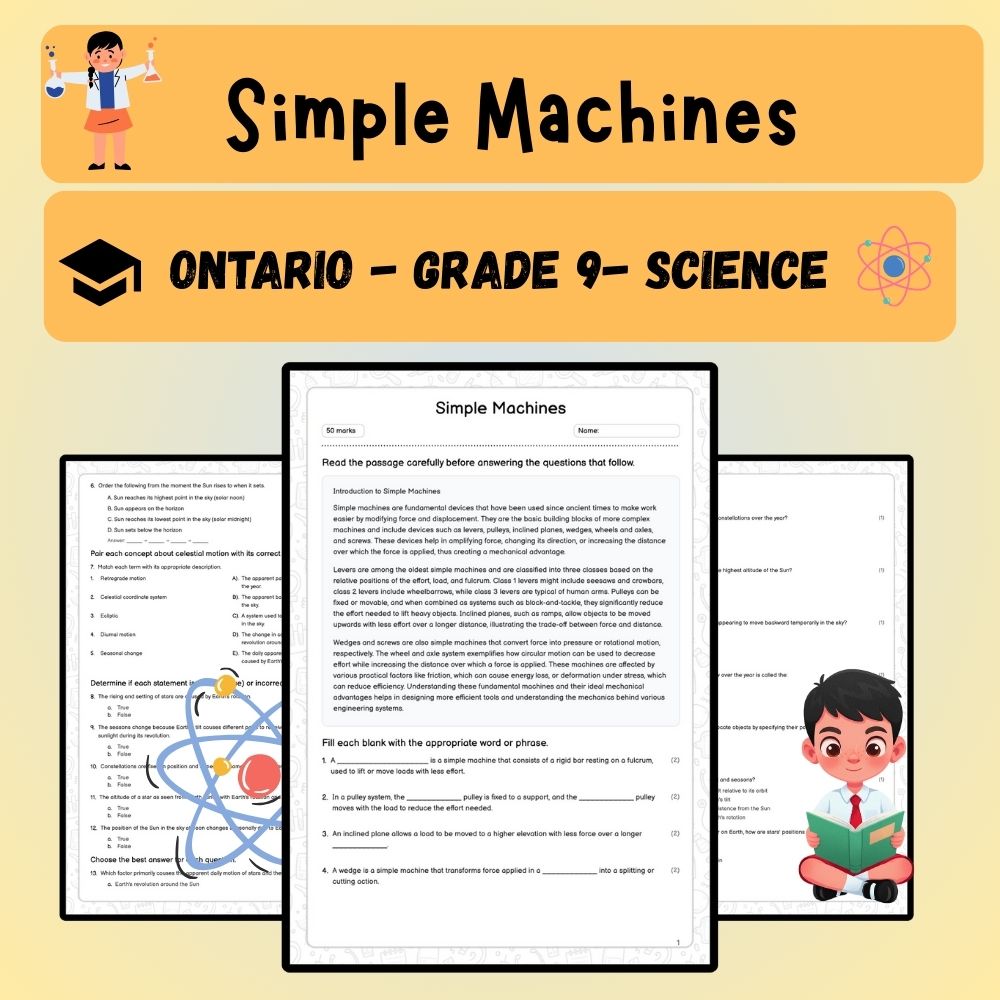
Grade 9 Science | Simple Machines Worksheet (Ontario Standard) – Practice & Assessment (PDF)
Created byPrism Point LearningLearning Objectives
- Understand the basic types of simple machines and their functions.
- Analyze how simple machines modify force and displacement to achieve mechanical advantage.
- Identify different classes of levers, pulley systems, and other simple machine configurations.
Also included in: Grade 9 Science Unit | Forces, Motion & Energy Worksheets (Ontario Standards) +1 more
Instant download
Browse more categories
About Reading comprehension Worksheets
Find reading comprehension worksheets for class practice, homework, or self-study. All 40,289 are instant PDF downloads.
Each resource here is built by an independent educator and reviewed for quality. Worksheets print straight from PDF and suit classroom use, homework, or extra practice; most come with answer keys, and you can preview before purchasing.