
Reading comprehension Worksheets
40,284 type resources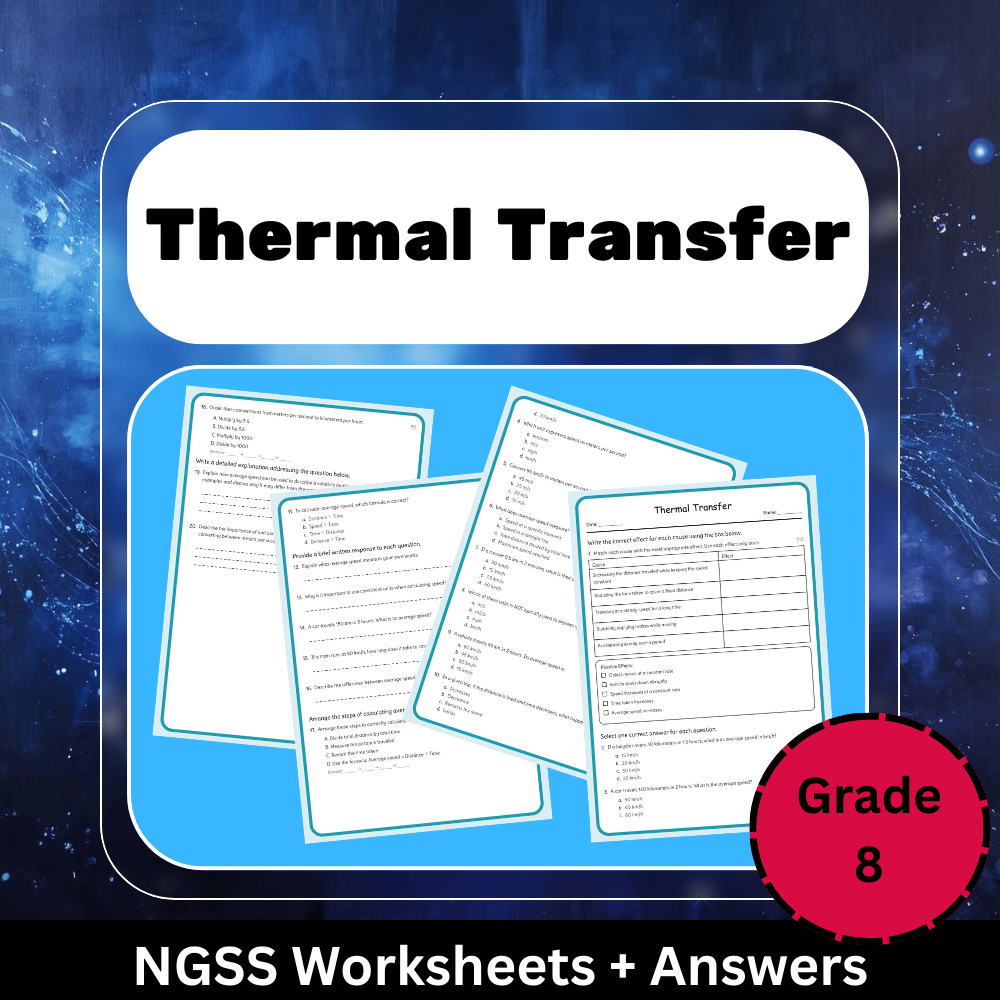
Grade 8 Science | Thermal Transfer Worksheet (Answer Key) – NGSS Aligned
 Created byBright Mind Resources
Learning Objectives
- Understand the basic principles of conduction, convection, and radiation in thermal transfer.
- Identify materials and systems that maximize or minimize heat flow.
- Explain how material properties, geometry, and contact area influence thermal energy exchange.
Also included in: Grade 8 Science | Energy Transfer & Conservation Unit Worksheets (NGSS Aligned) +2 more
Instant download
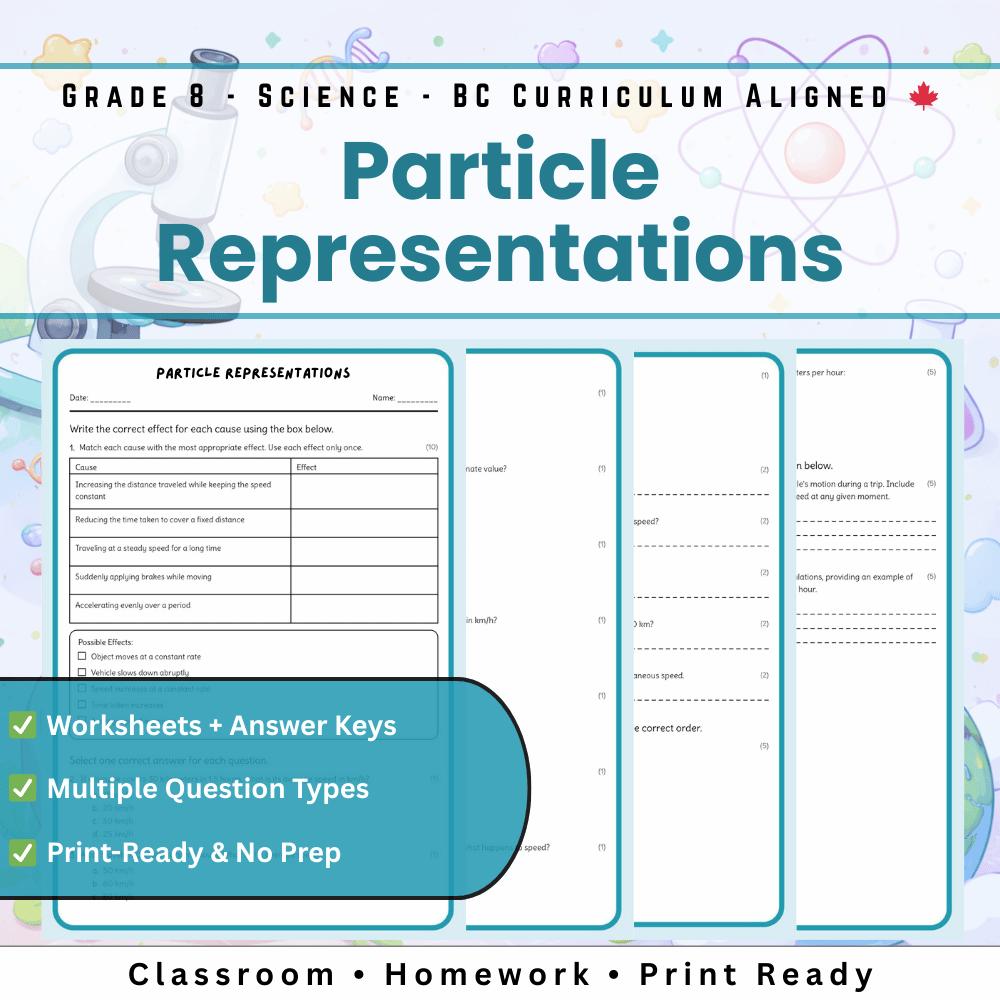
Grade 8 Science | Particle Representations Worksheet (PDF) for BC Standards
Created byBright Mind ResourcesLearning Objectives
- Understand how particle models depict atoms and molecules during chemical reactions.
- Interpret particle diagrams that illustrate bond breaking and formation.
- Explain how atomic rearrangements account for observable changes in mass and properties.
Instant download
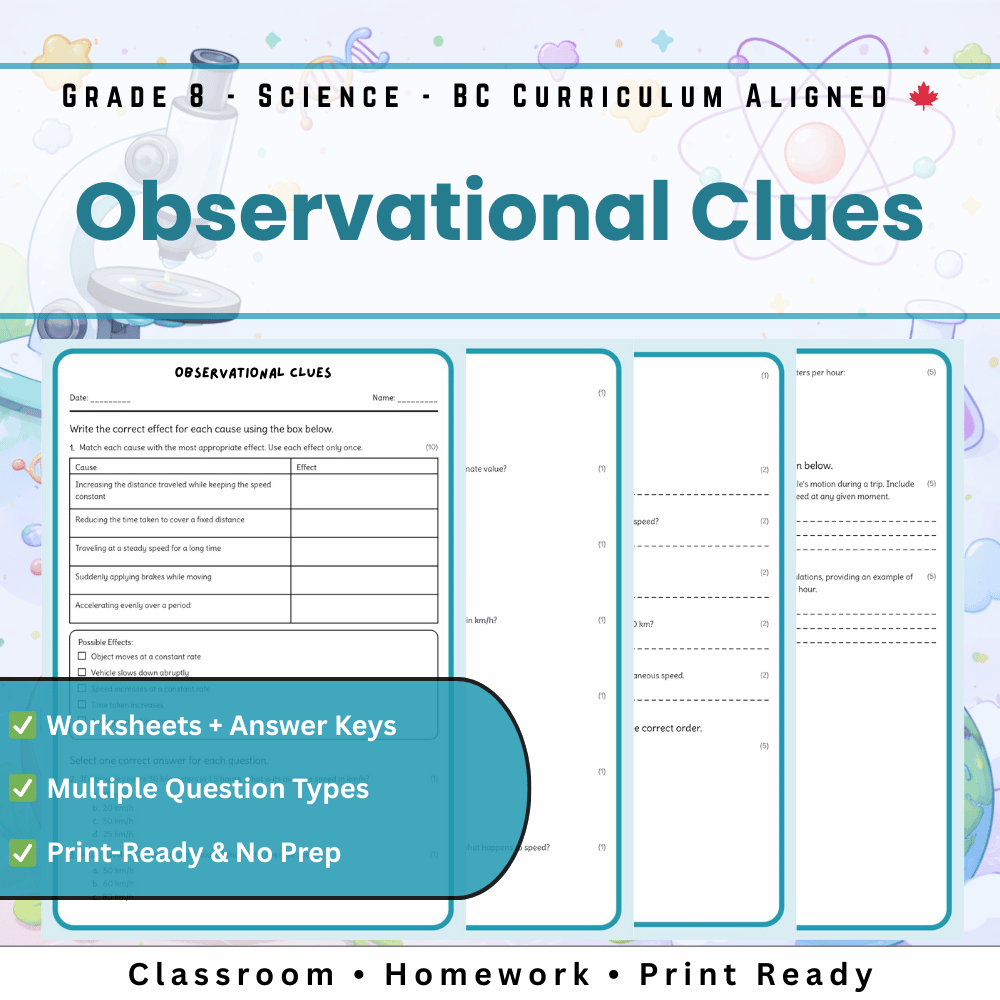
Grade 8 Science | Observational Clues Worksheet (PDF) BC Standards
Created byBright Mind ResourcesLearning Objectives
- Identify and differentiate between physical and chemical changes based on observable clues.
- Recognize indicators such as gas evolution, precipitate formation, color change, and temperature shifts as signs of chemical change.
- Understand that reversible state changes and size alterations typically indicate physical change.
Instant download
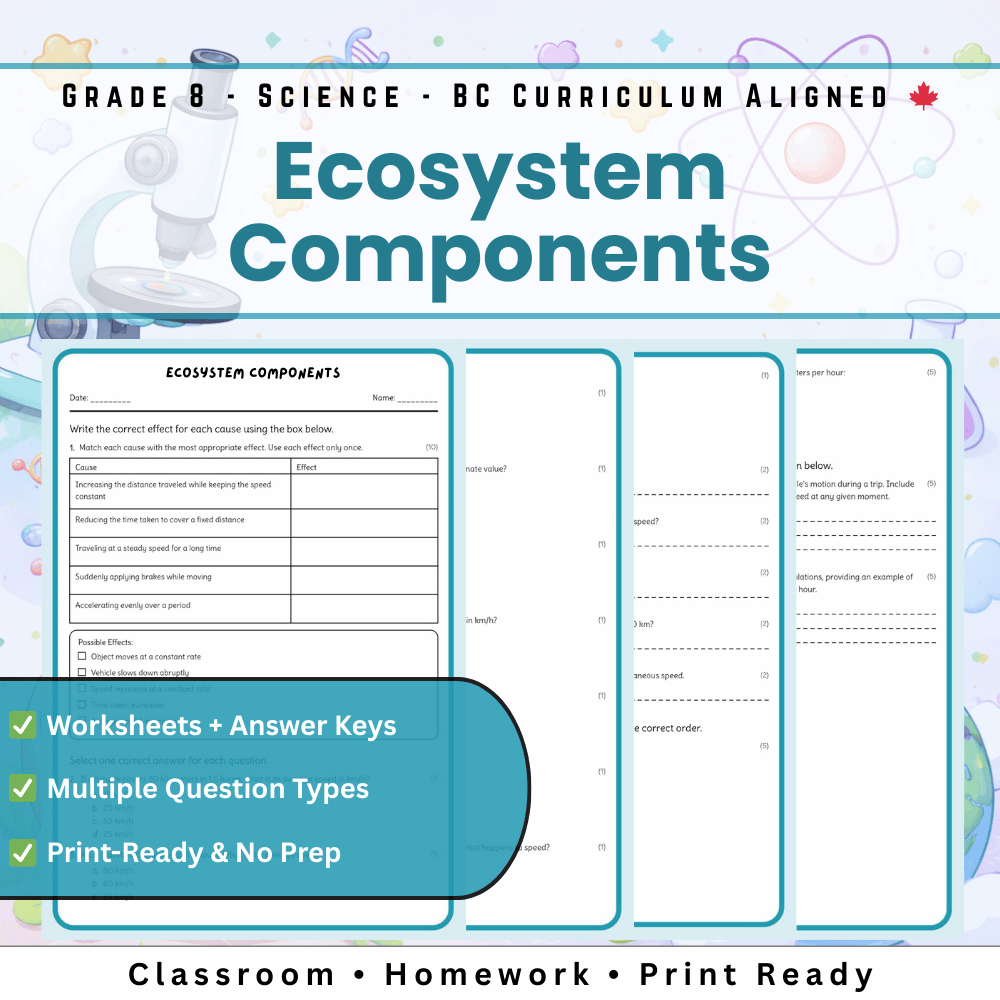
Grade 8 Science | Ecosystem Components Worksheet (PDF) – BC Standards
Created byBright Mind ResourcesLearning Objectives
- Identify the main components of an ecosystem and their roles.
- Understand the difference between biotic and abiotic factors in ecosystems.
- Describe how energy flows and matter cycles in an ecosystem.
Instant download
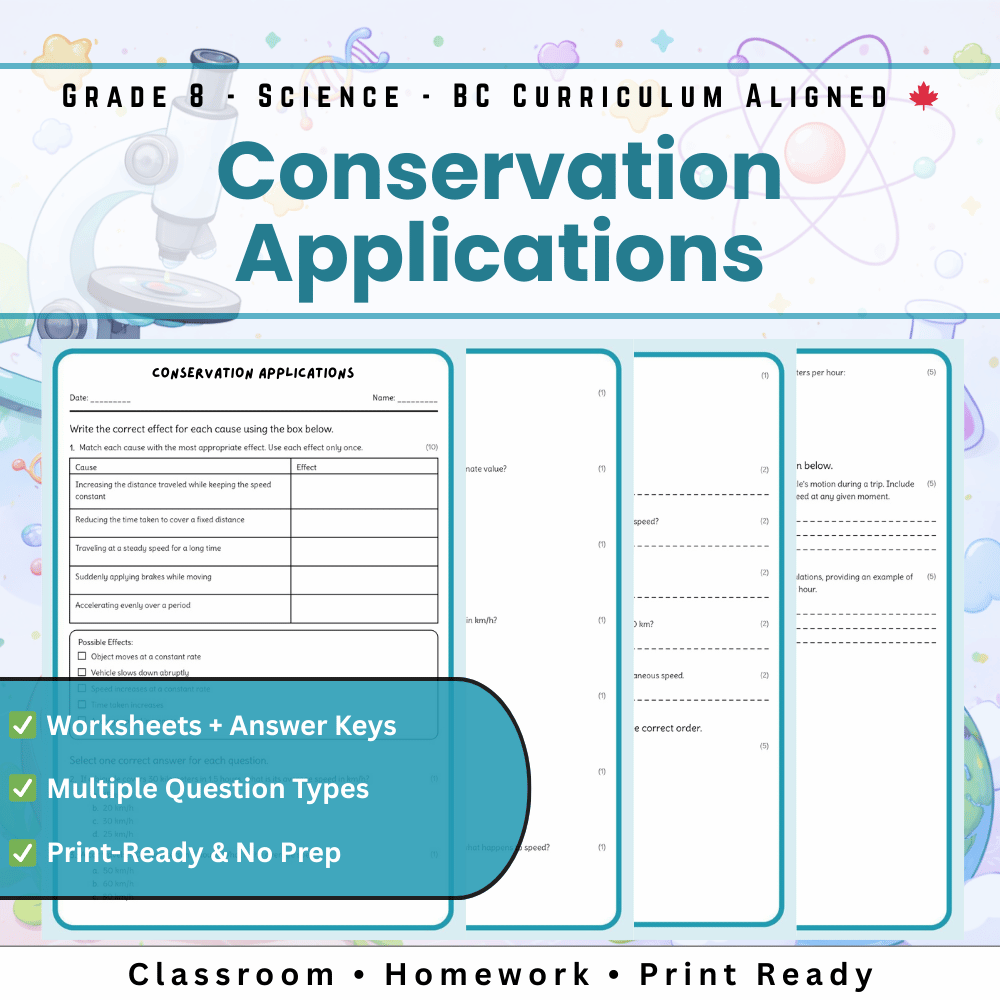
Grade 8 Science | Conservation Applications Worksheet (PDF) – BC Standards
Created byBright Mind ResourcesLearning Objectives
- Understand the importance of conservation of mass in physical systems.
- Apply quantitative methods to track reactants and products in chemical reactions.
- Distinguish between open and closed systems regarding mass transfer and losses.
Instant download
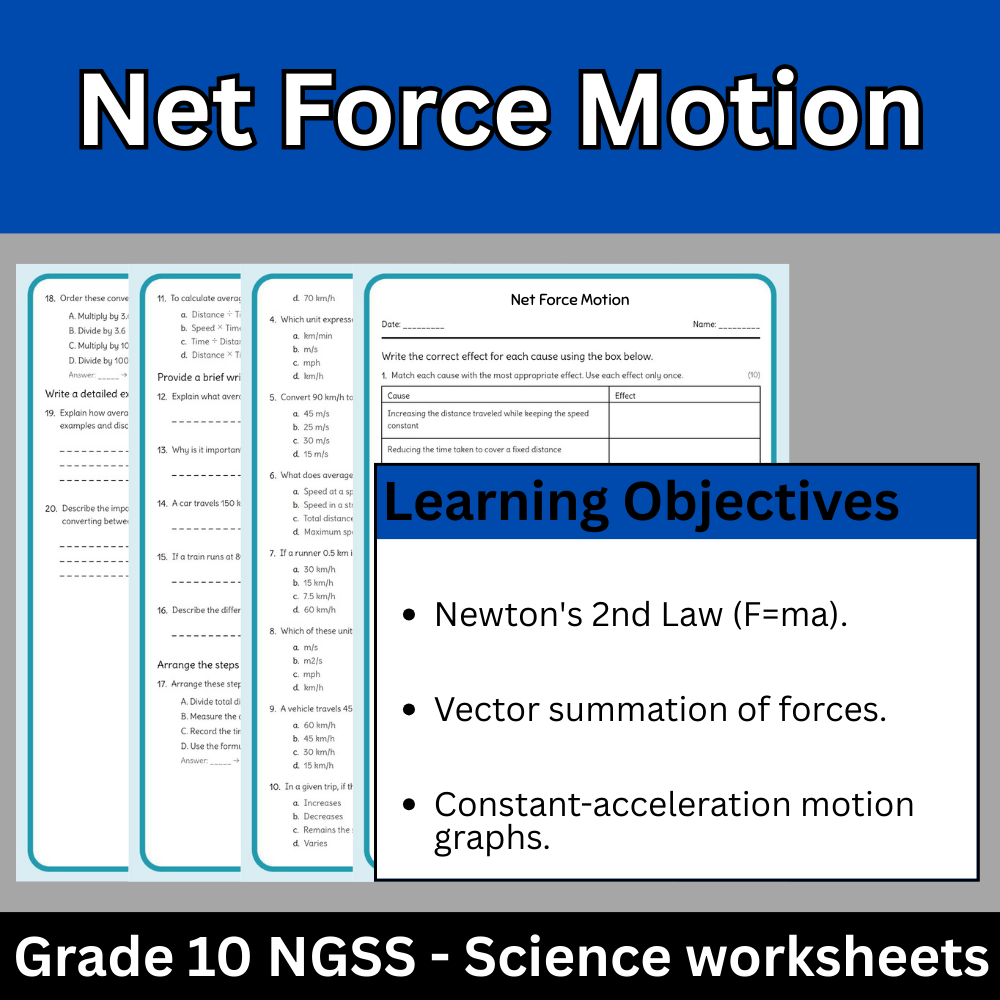
Grade 10 Science | Understanding Net Force & Motion Worksheet (Answer Key)
Created byBright Mind ResourcesLearning Objectives
- Analyze the relationship between net force, mass, and acceleration using Newton's second law.
- Apply vector summation to determine net forces in different scenarios.
- Understand how constant-acceleration motion relates to net force through graphs and measurements.
Instant download
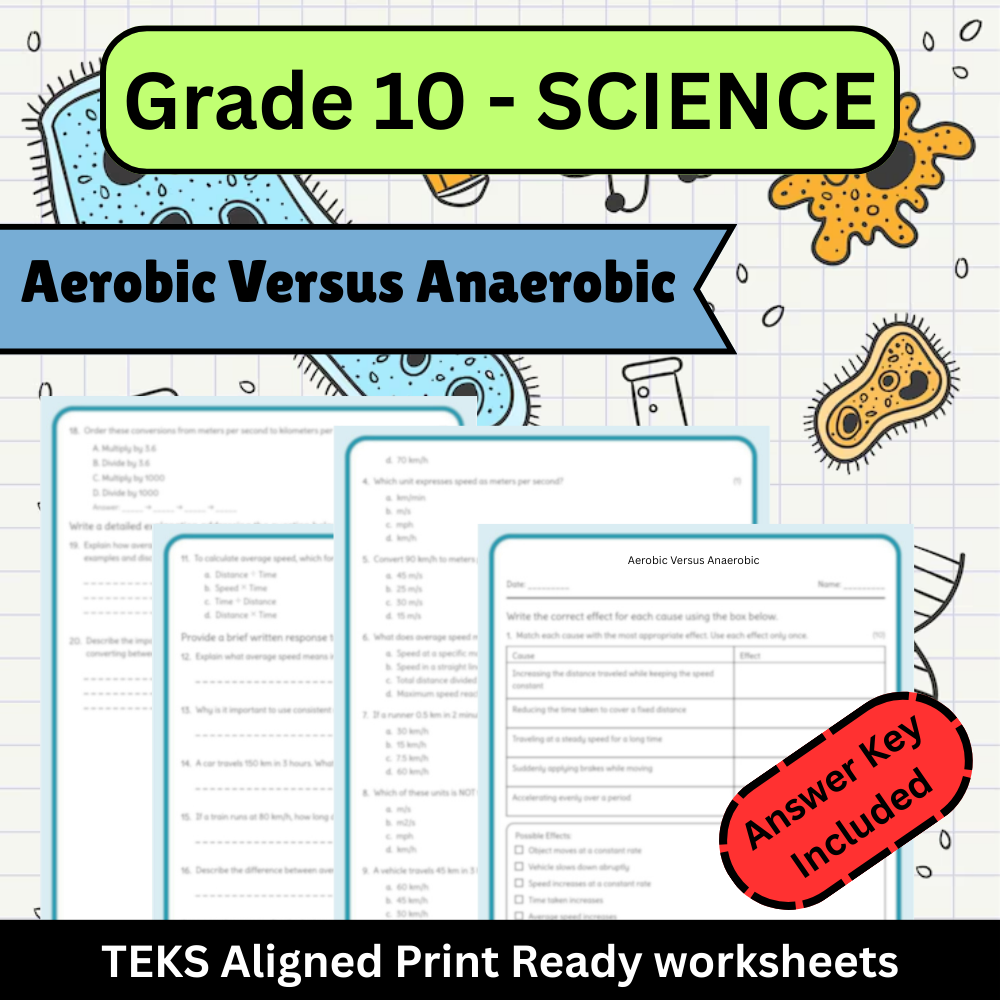
Grade 10 Science – Aerobic vs Anaerobic Respiration Worksheet (Answer Key) | TEKS Aligned
Created byBright Mind ResourcesLearning Objectives
- Explain the differences between aerobic and anaerobic respiration in terms of process, energy yield, and end products.
- Identify conditions and organisms where aerobic or anaerobic pathways are dominant.
- Evaluate the ecological and metabolic significance of aerobic and anaerobic pathways.
Also included in: Grade 10 Science Unit Bundle – Photosynthesis, Respiration & Energy TEKS +5 more
Instant download
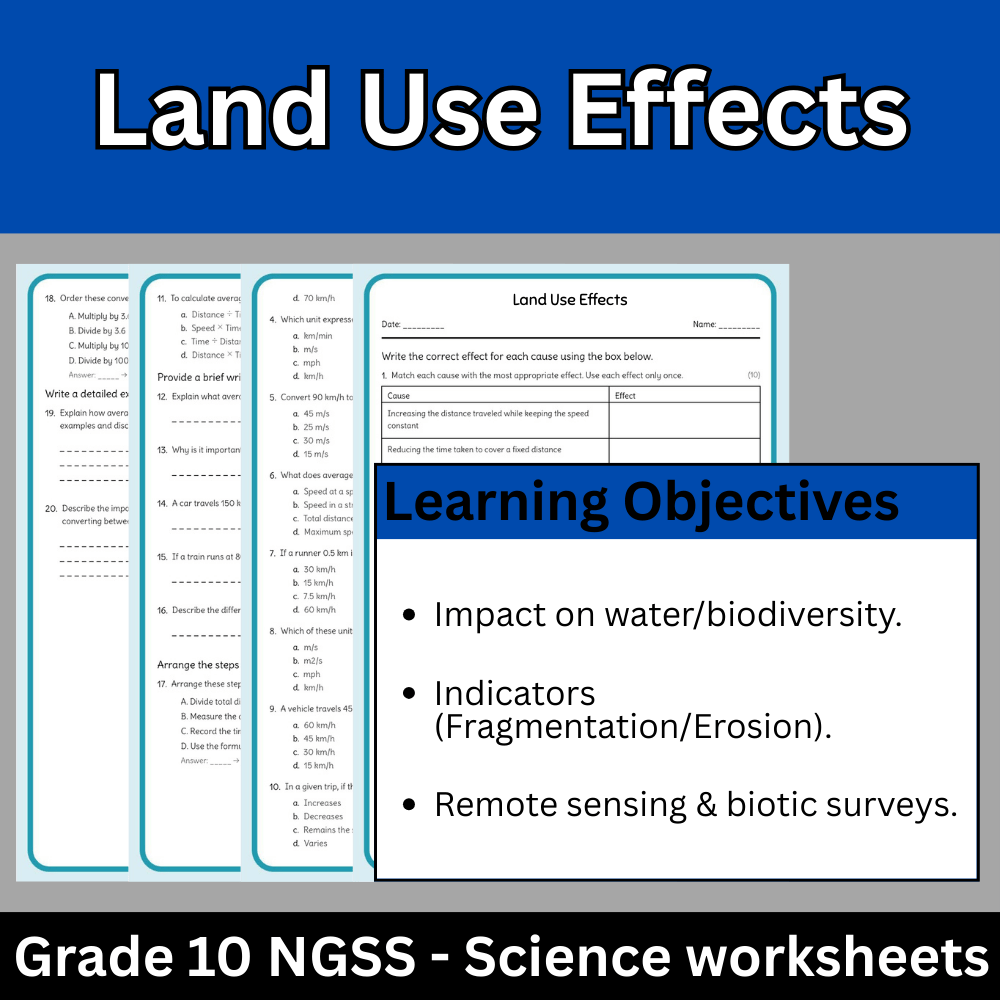
Grade 10 Science | Land Use Effects Worksheet ( Answer Key) – NGSS Aligned
Created byBright Mind ResourcesLearning Objectives
- Understand how human land-use changes affect ecosystems, water cycles, and biodiversity.
- Identify indicators of land use impacts such as habitat fragmentation, soil erosion, and coastal degradation.
- Analyze empirical data from land-cover maps, remote sensing, and biotic surveys to evaluate ecological consequences.
Instant download
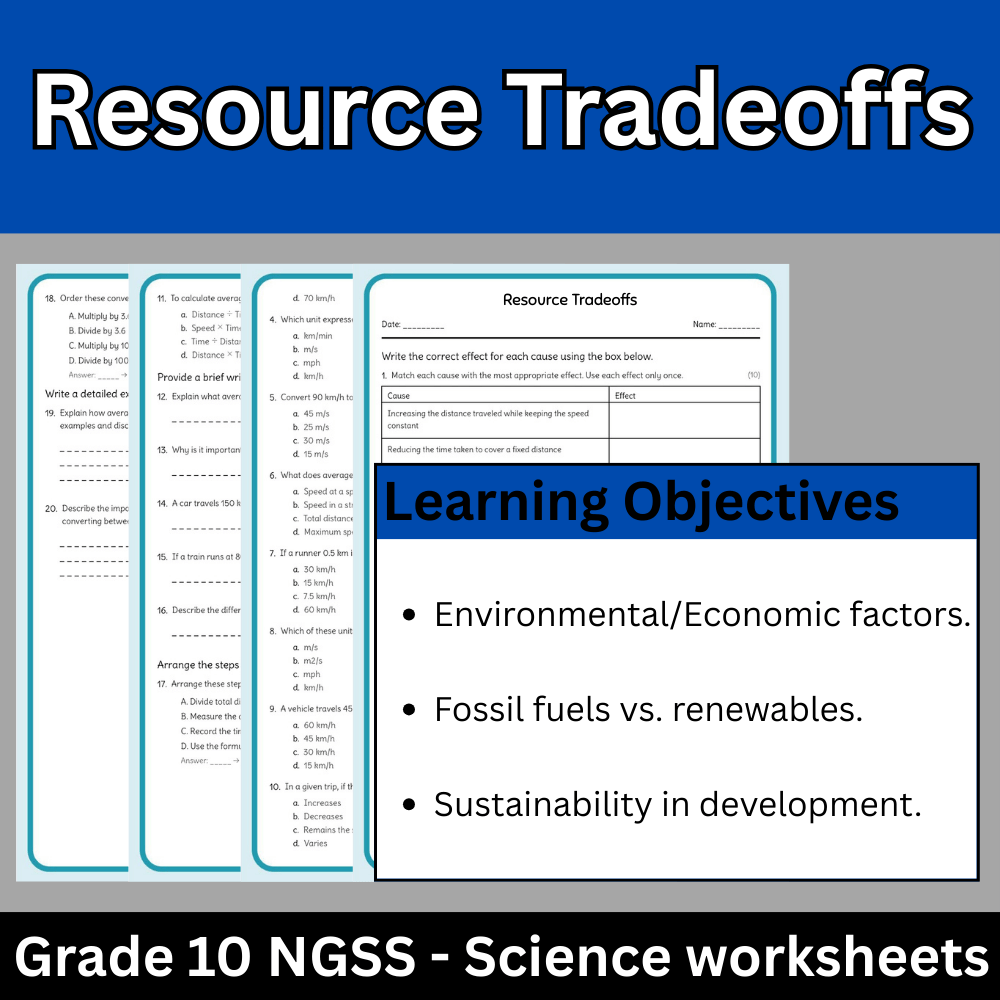
Grade 10 Science | Resource Tradeoffs Worksheet – NGSS Standards (PDF)
Created byBright Mind ResourcesLearning Objectives
- Analyze environmental, economic, and sustainability factors in resource management strategies.
- Evaluate trade-offs involved in developing energy and mineral resources.
- Compare impacts of fossil fuels versus renewable energy sources like solar and wind.
Instant download
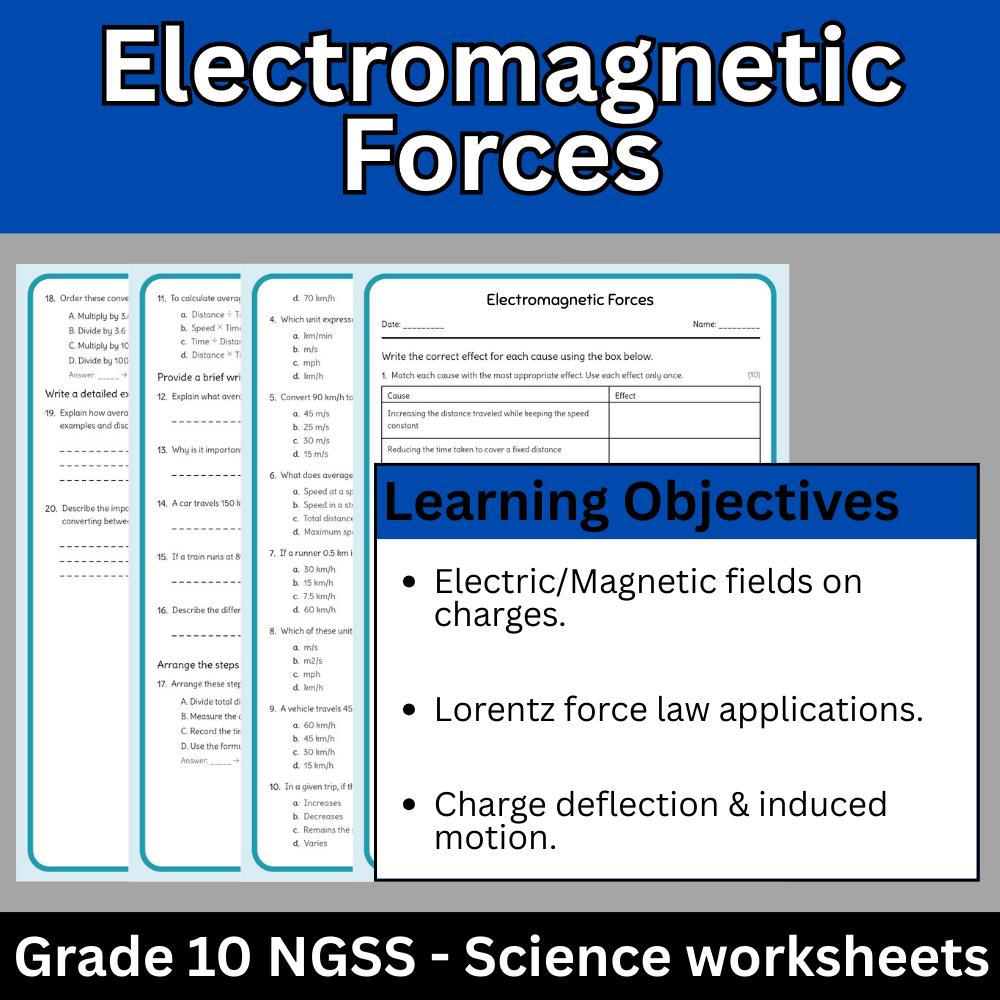
Grade 10 Science | Force Interactions Worksheet (NGSS Aligned) PDF
Created byBright Mind ResourcesLearning Objectives
- Classify contact and noncontact forces and represent them using vectors.
- Understand Newton's third law and pairwise interactions.
- Interpret free-body diagrams, vector addition, and equilibrium conditions.
Instant download
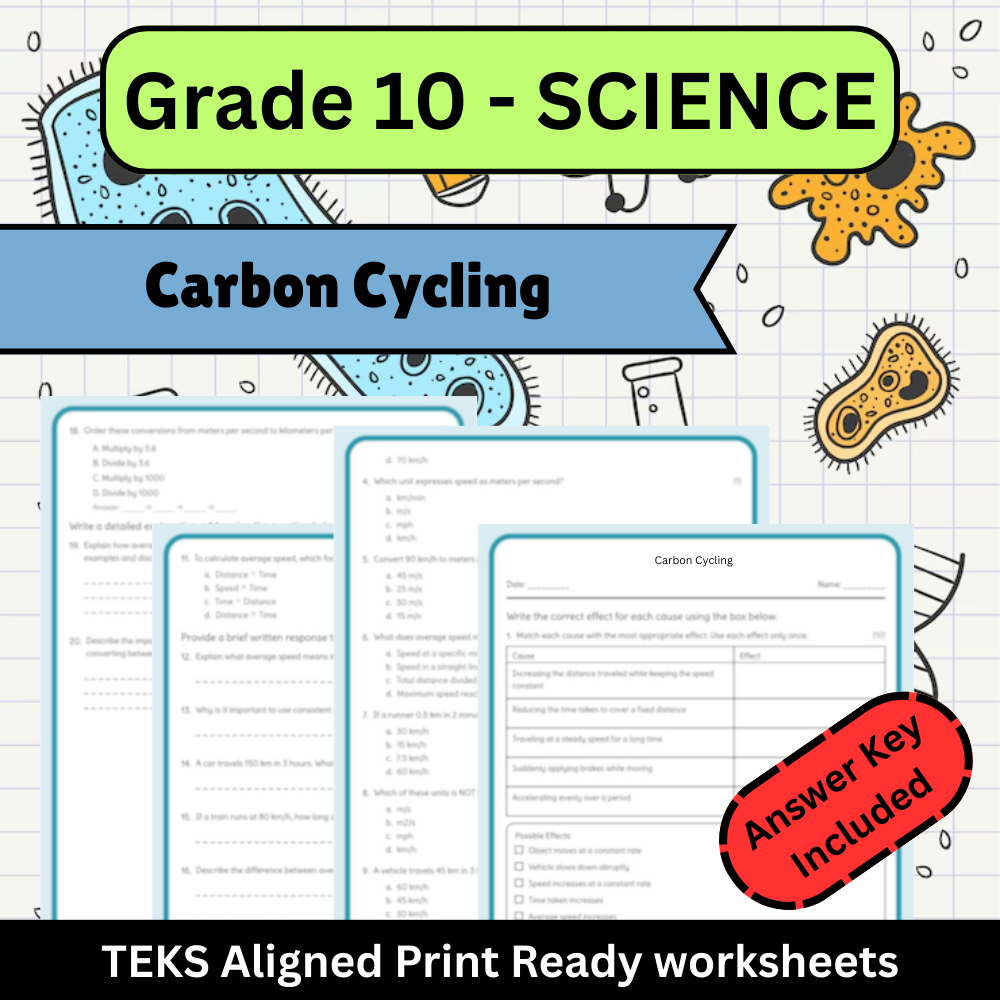
Grade 10 Science – Carbon Cycling Worksheet (Worksheet + Answer Key) | TEKS Aligned
Created byBright Mind ResourcesLearning Objectives
- Describe the pathways of carbon movement among the atmosphere, biosphere, hydrosphere, and geosphere.
- Explain the processes of photosynthesis and respiration in the carbon cycle.
- Identify human impacts on the carbon cycle and their effects on climate change.
Also included in: Grade 10 Science Unit Bundle – Photosynthesis, Respiration & Energy TEKS +5 more
Instant download
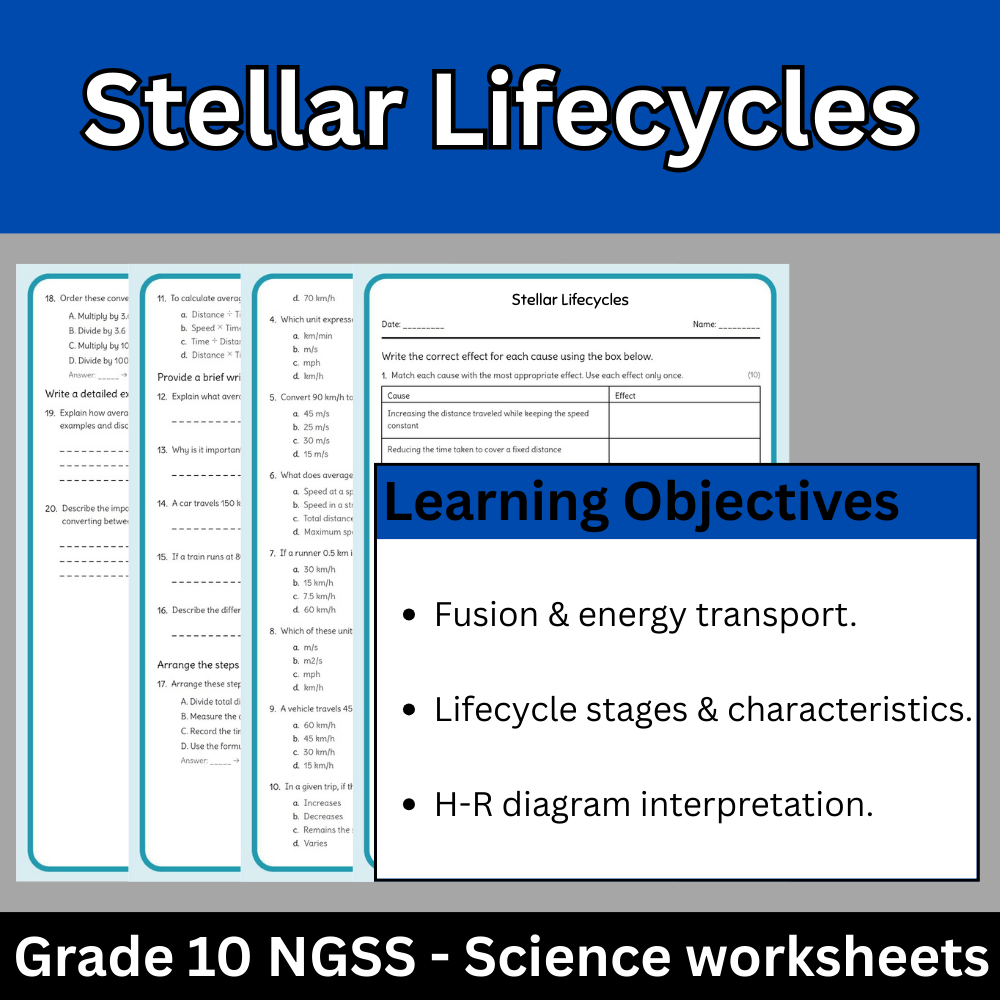
Grade 10 Science | Stellar Lifecycles Worksheet (PDF) – NGSS Standards
Created byBright Mind ResourcesLearning Objectives
- Understand the key processes involved in stellar evolution, including nuclear fusion and energy transport mechanisms.
- Identify the main stages of stellar lifecycle and their characteristics.
- Use the Hertzsprung-Russell diagram to interpret changes in star luminosity and temperature over time.
Instant download
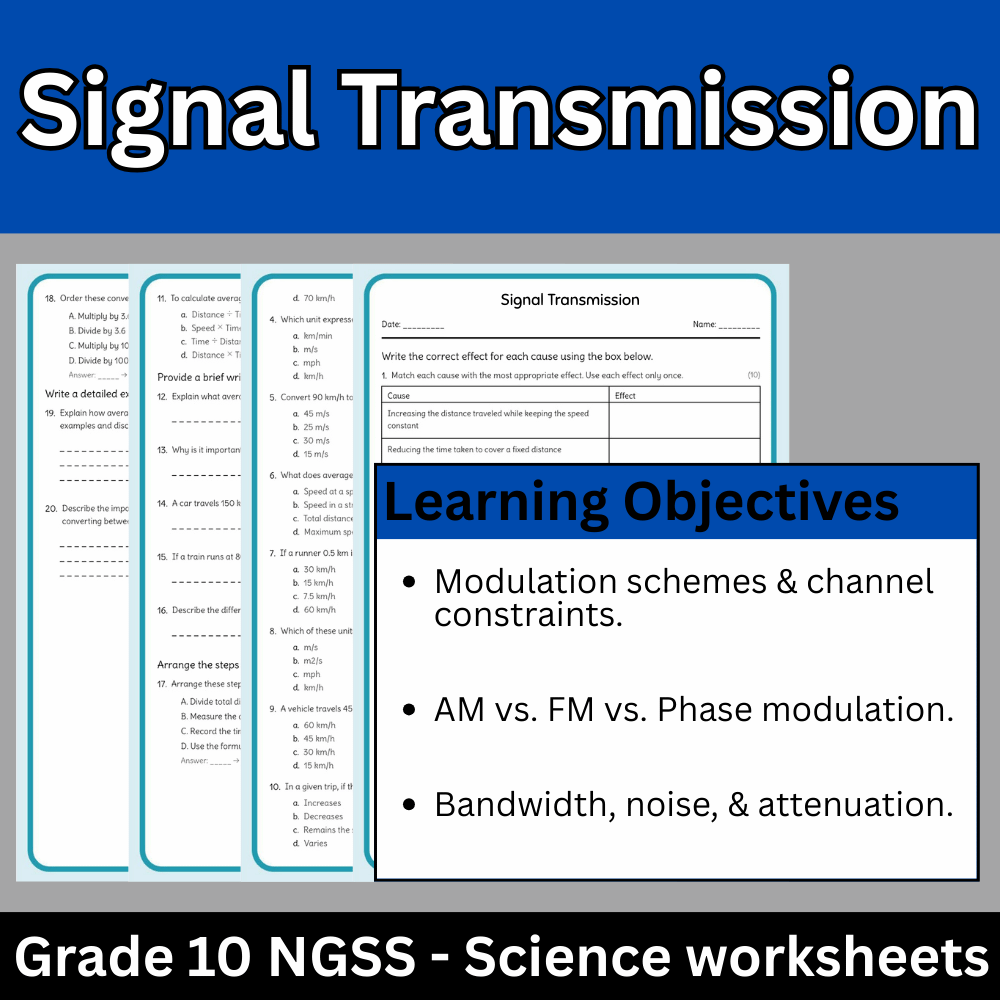
Grade 10 Science | Signal Transmission Worksheet + Answer Key (NGSS)
Created byBright Mind ResourcesLearning Objectives
- Understand the key modulation schemes and channel constraints involved in signal transmission.
- Compare amplitude, frequency, and phase modulation techniques and their respective advantages and limitations.
- Identify factors such as bandwidth, noise, attenuation, and dispersion that impact transmission quality and capacity.
Instant download
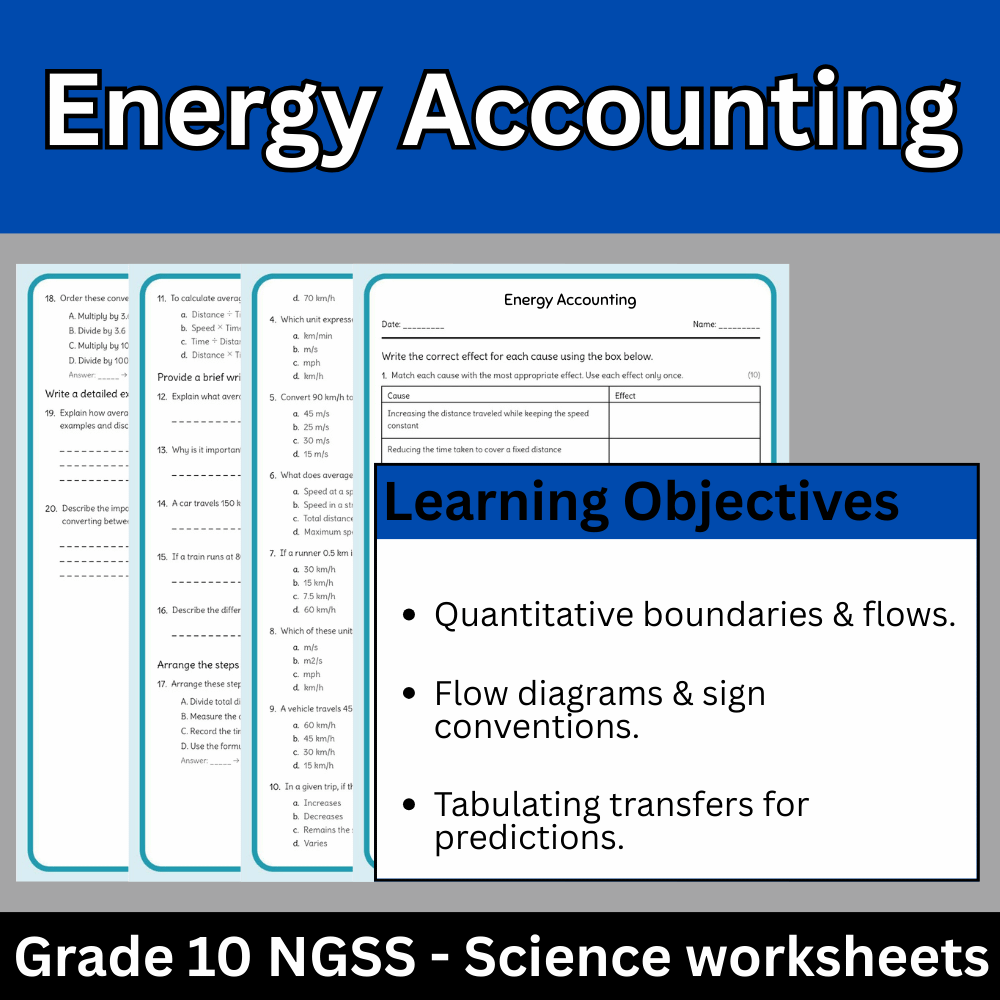
Grade 10 Science | Energy Accounting Worksheet (Answer Key) – NGSS Standard
Created byBright Mind ResourcesLearning Objectives
- Understand the principles of quantitative energy accounting including system boundaries and energy flows.
- Interpret energy flow diagrams and simple models to analyze energy transfers in various systems.
- Apply sign conventions and tabulate energy transfers to support energy distribution predictions.
Instant download
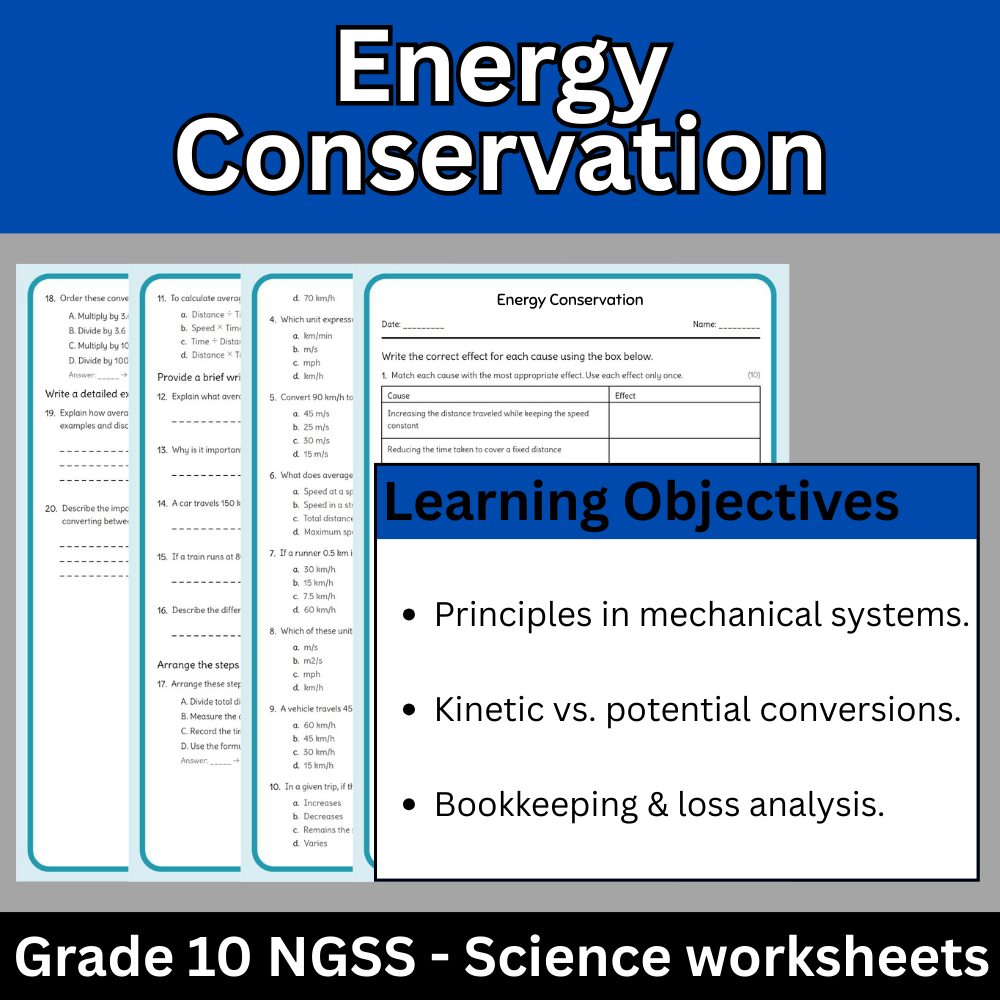
Grade 10 Science – Energy Conservation Worksheet (NGSS Aligned) PDF
Created byBright Mind ResourcesLearning Objectives
- Understand the principles of energy conservation in mechanical systems.
- Identify energy conversions between kinetic and potential stores.
- Analyze energy losses and the concept of energy bookkeeping across system boundaries.
Instant download
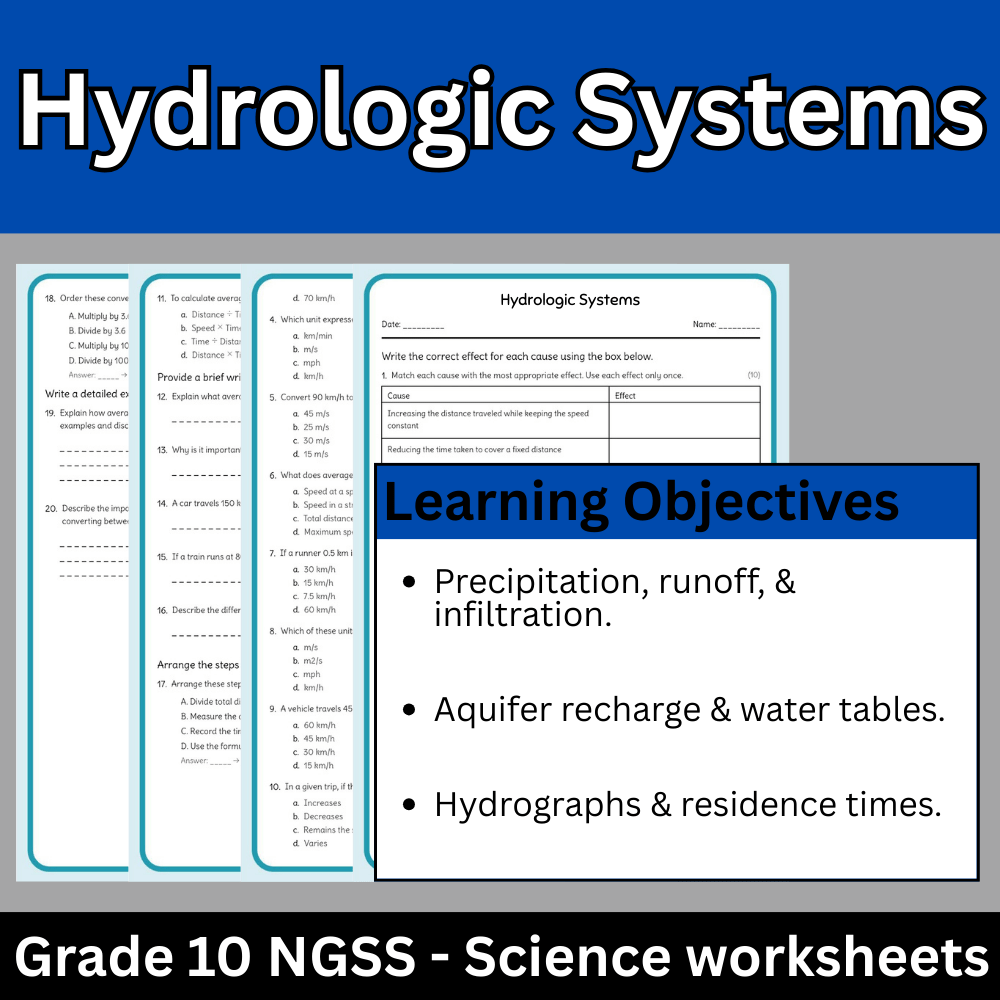
Grade 10 Science | Hydrologic Systems Worksheet(NGSS Aligned + Answer Key) (PDF)
Created byBright Mind ResourcesLearning Objectives
- Explain the interactions among precipitation, runoff, infiltration, and groundwater storage within watersheds.
- Describe the concepts of aquifer recharge, discharge, and water-table fluctuations.
- Interpret stream hydrographs and understand residence times in porous media.
Instant download
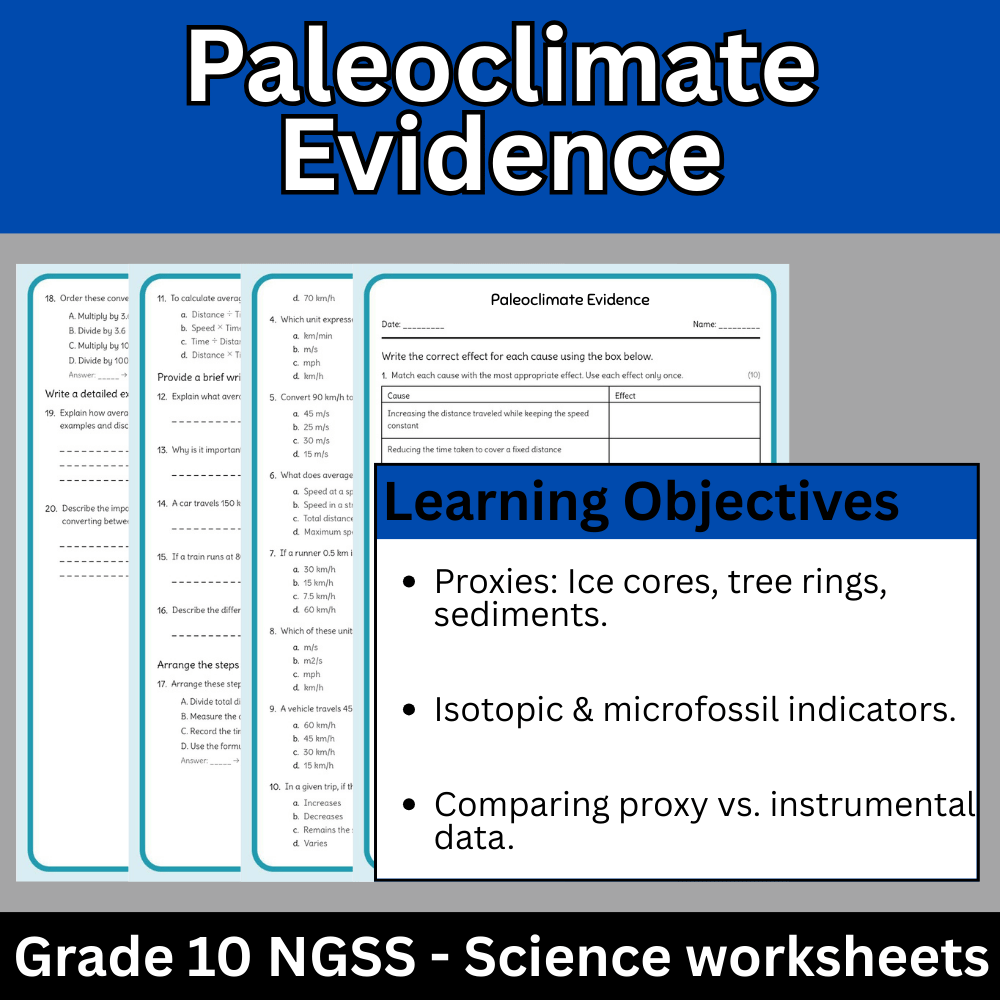
Grade 10 Science | Paleoclimate Evidence Worksheet (PDF) – NGSS Aligned
Created byBright Mind ResourcesLearning Objectives
- Understand how proxy records such as ice cores, tree rings, sediments, and speleothems are used to reconstruct past climate.
- Identify key isotopic and microfossil indicators that provide insights into past temperature and atmospheric conditions.
- Compare paleoclimate records with instrumental data to interpret recent climate trends and variability.
Instant download
Grade 9 Science | Organ Systems Worksheet (PDF) – TEKS Aligned Practice
Created byBright Mind ResourcesLearning Objectives
- Describe the major organ systems and their functions.
- Explain how organ systems collaborate to maintain physiological stability.
- Identify cross-system communication mechanisms involved in homeostasis.
Also included in: Grade 9 Science Unit | Human Body Systems Worksheets & TEKS Aligned Bundle +3 more
Instant download
Grade 9 Science | Classification Foundations Worksheet (Answer Key) – TEKS Aligned
Created byBright Mind ResourcesLearning Objectives
- Understand the hierarchical structure of biological classification systems.
- Identify key taxonomic ranks and their characteristics.
- Differentiate between traditional and modern classification approaches.
Also included in: Grade 9 Science Unit | Evolution, Speciation & Genetics Worksheet Pack - TEKS +3 more
Instant download
Grade 9 Science | Phylogenetic Trees Worksheet (Answer Key) – TEKS Aligned
Created byBright Mind ResourcesLearning Objectives
- Understand the concept of phylogenetic trees and their purpose in illustrating evolutionary relationships.
- Interpret different types of phylogenetic trees, including rooted and unrooted trees.
- Identify monophyletic, paraphyletic, and polyphyletic groups within trees.
Also included in: Grade 9 Science Unit | Evolution, Speciation & Genetics Worksheet Pack - TEKS +3 more
Instant download
Grade 9 Science – Light Reactions Worksheet (Worksheet + Answer Key) | TEKS Aligned
Created byBright Mind ResourcesLearning Objectives
- Understand the process of light reactions occurring in thylakoid membranes
- Identify key steps in photon absorption and electron transport
- Explain how a proton gradient leads to ATP synthesis and NADPH production
Also included in: Grade 9 Science | Photosynthesis & Metabolic Pathways Unit Bundle (TEKS Aligned) +3 more
Instant download
Grade 9 Science | Newtonian Motion Worksheet (Answer Key) – NGSS Aligned
Created byBright Mind ResourcesLearning Objectives
- Understand the relationship between net force, mass, and acceleration as described by Newton's laws.
- Analyze free-body diagrams and force components in various motion scenarios.
- Apply proportionality between net force and acceleration to solve problems involving constant mass systems.
Instant download
Grade 9 Science | Producers & Consumers NGSS Worksheet (PDF) – Science
Created byBright Mind ResourcesLearning Objectives
- Explain the roles of producers and consumers in the ecosystem.
- Describe how photosynthesis and respiration transfer energy and cycle oxygen and carbon.
- Analyze the impact of net primary productivity and biomass on energy flow.
Instant download
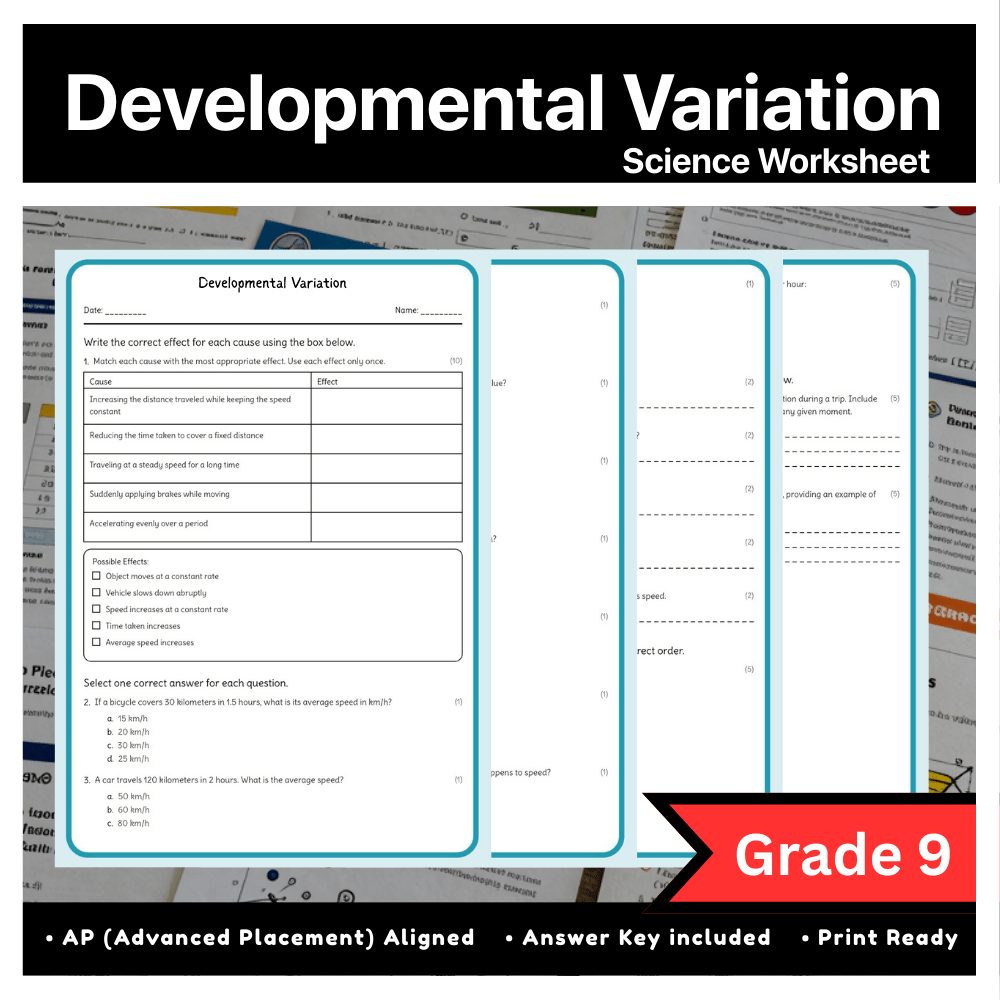
Grade 9 Science | Developmental Variation Worksheet (AP Standards + Answer Key)
Created byBright Mind ResourcesLearning Objectives
- Explain how genetic and epigenetic mechanisms contribute to phenotypic diversity.
- Identify different developmental processes that influence morphological and physiological traits.
- Compare developmental pathways to understand convergent evolution and developmental bias.
Instant download
Grade 9 Science | Molecular Regulation Worksheet (Answer Key) NGSS-Aligned
Created byBright Mind ResourcesLearning Objectives
- Understand the mechanisms of gene expression regulation and signal transduction pathways.
- Identify key molecular components involved in intercellular communication.
- Analyze how mutations and pharmacological inhibitors affect cellular signaling and systemic functions.
Instant download
Grade 9 Science | Integrated Physiology Worksheet (Answer Key) - NGSS Aligned
Created byBright Mind ResourcesLearning Objectives
- Understand how molecular and cellular interactions influence organ system function.
- Link genetic variations to physiological responses and clinical outcomes.
- Interpret biochemical, histological, and organ performance data related to organism health.
Instant download
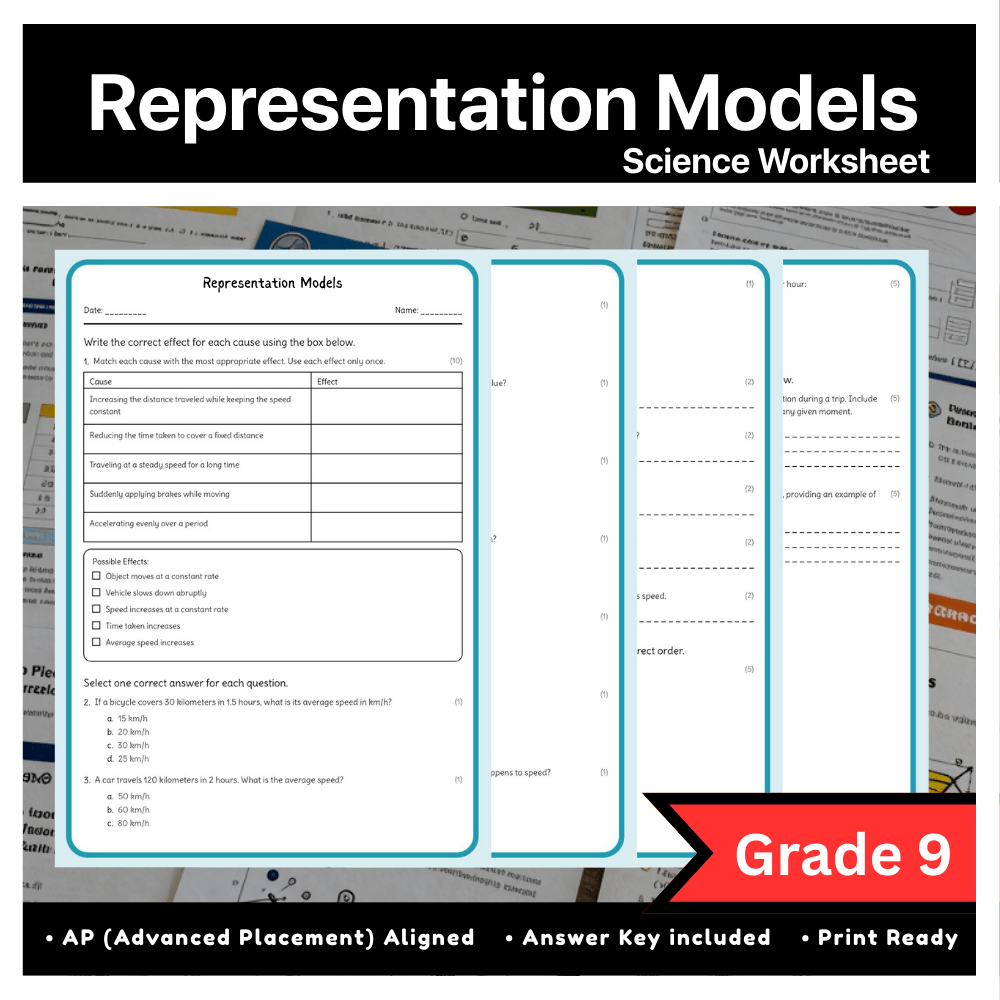
Grade 9 Science | Representation Models Worksheet (AP Standard) – PDF
Created byBright Mind ResourcesLearning Objectives
- Identify different types of models used in science, including mathematical, graphical, schematic, and computational representations.
- Understand how models are selected based on fidelity, simplicity, and predictive ability.
- Explain how mapping model components to measurements helps interpret system behaviors.
Instant download
Grade 9 Science | Crystal Lattices Worksheet (Answer Key) - BC Standards
Created byBright Mind ResourcesLearning Objectives
- Explain the concept of crystal lattices and their atomic arrangements.
- Identify different types of lattice structures such as ionic, metallic, and covalent networks.
- Describe how lattice types influence material properties like hardness, conductivity, and melting points.
Instant download
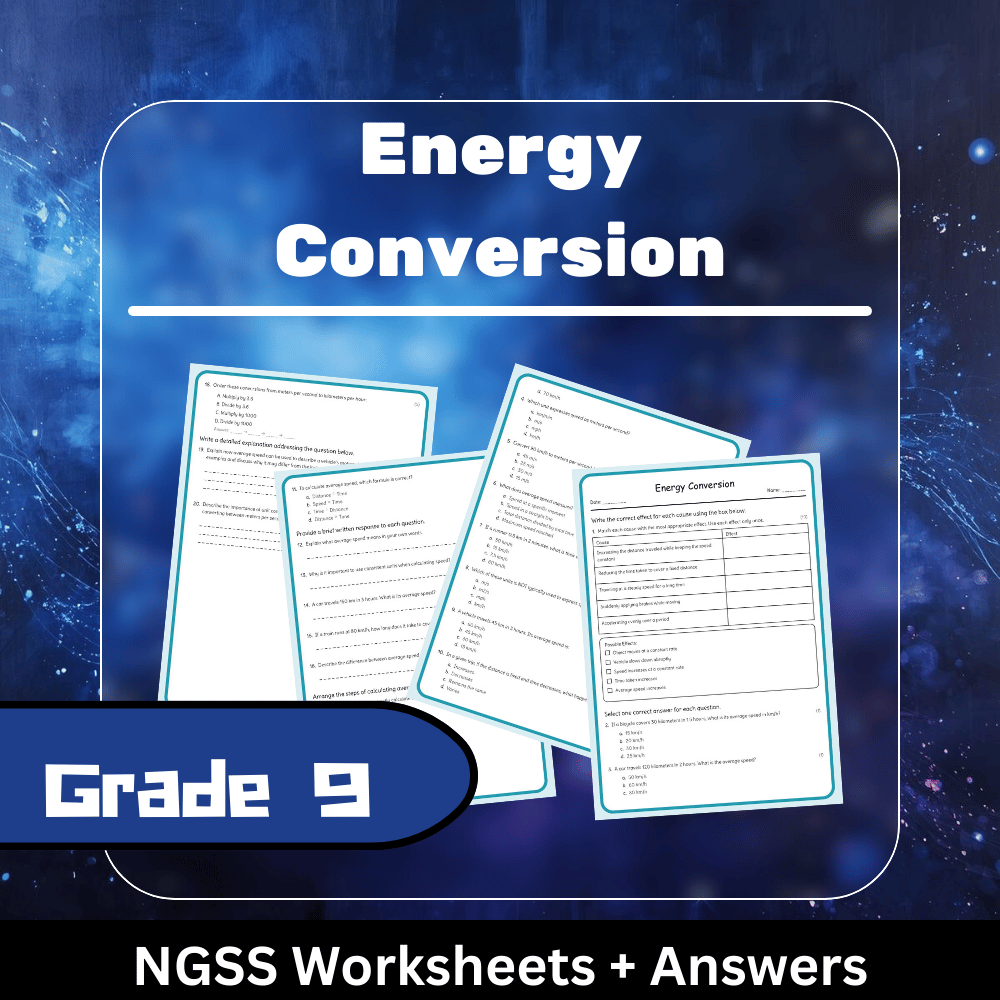
Grade 9 Science | Energy Conversion Worksheet (Answer Key) NGSS-Aligned
Created byBright Mind ResourcesLearning Objectives
- Understand different types of energy conversion devices and processes.
- Identify key examples of energy conversion such as photovoltaic cells, thermoelectric modules, and electrochemical cells.
- Analyze energy efficiency and account for losses during conversion.
Instant download
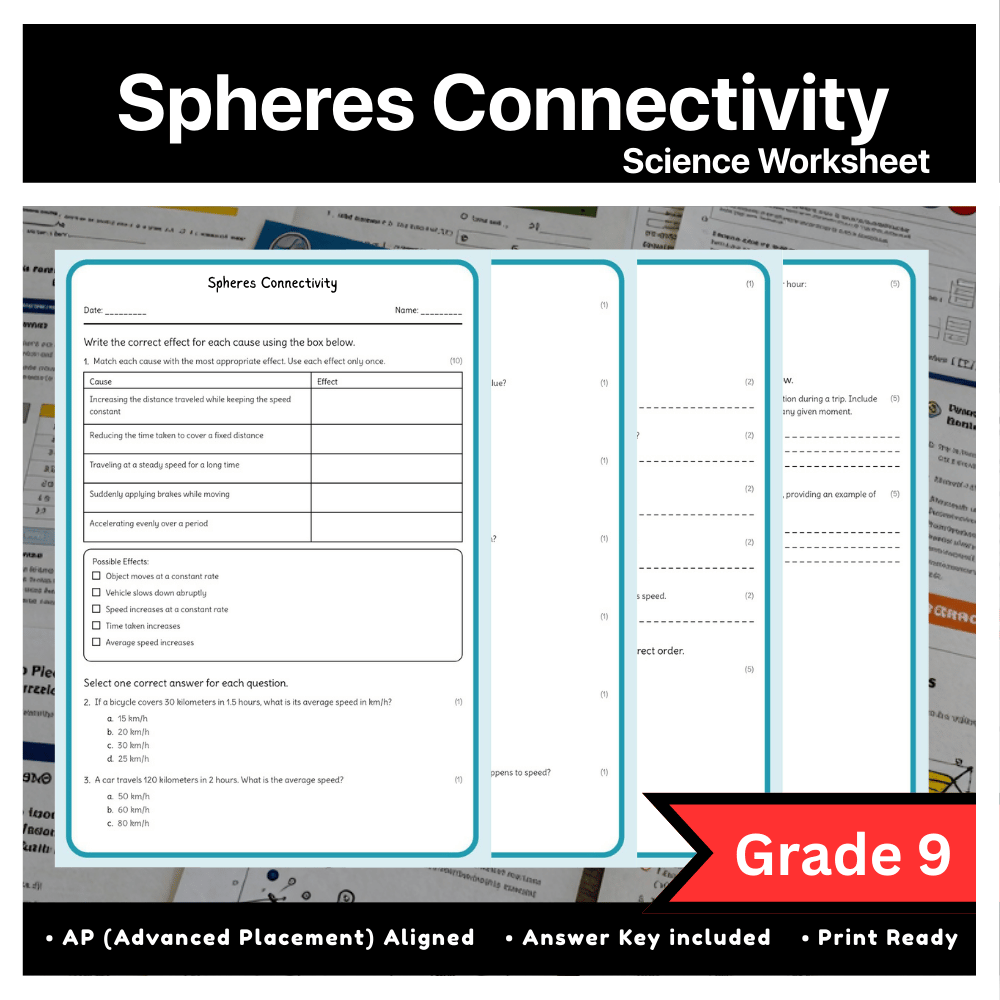
Grade 9 Science | Spheres Connectivity Worksheet (AP Standard, PDF)
Created byBright Mind ResourcesLearning Objectives
- Explain the interactions among the geosphere, hydrosphere, atmosphere, and biosphere using models and diagrams.
- Identify material and energy exchanges such as nutrient transport, gas fluxes, and ocean upwelling.
- Analyze how surface processes affect transient environmental signals through spatial and causal frameworks.
Instant download
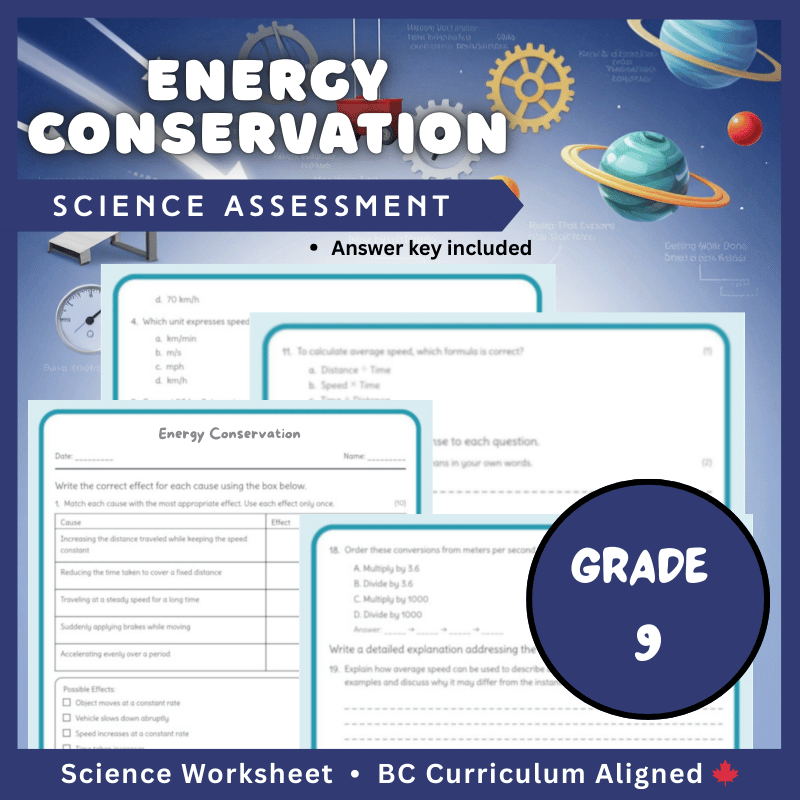
Grade 9 Science – Energy Conservation Worksheet with Answer Key (PDF)
Created byBright Mind ResourcesLearning Objectives
- Understand the principle of conservation of energy in isolated systems.
- Identify how energy shifts between kinetic and potential forms in real-world scenarios.
- Explain the role of nonconservative forces like friction in dissipating mechanical energy.
Instant download
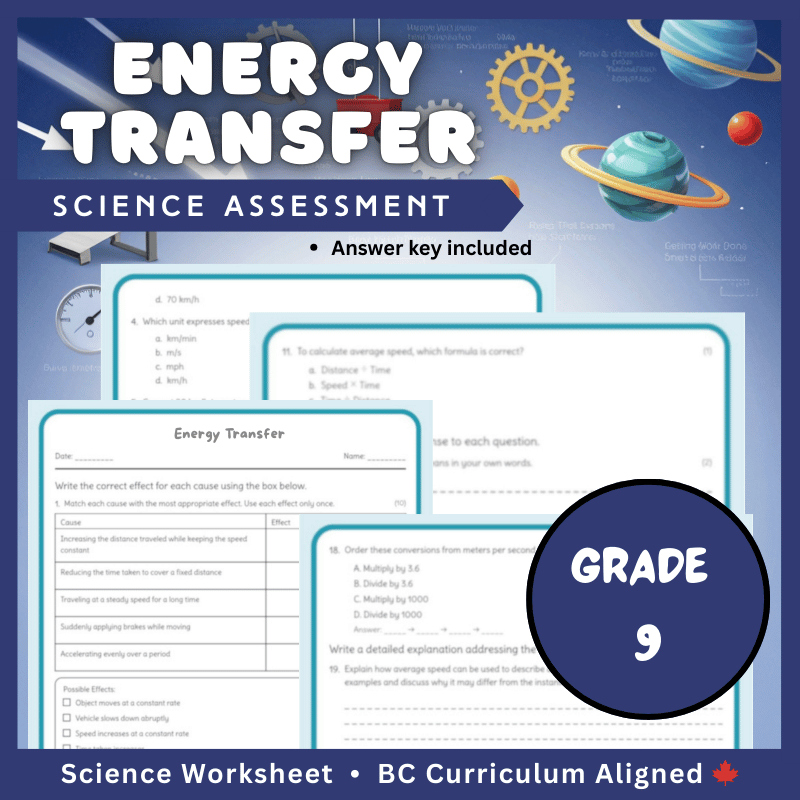
Grade 9 Science | Energy Transfer Worksheets + Answer Key – BC Standards
Created byBright Mind ResourcesLearning Objectives
- Understand how mechanical systems transfer energy through work, collisions, and friction.
- Explain how energy is gained or lost in motion and the transformation of energy into heat.
- Identify real-world examples illustrating energy conversion pathways and energy accounting.
Instant download
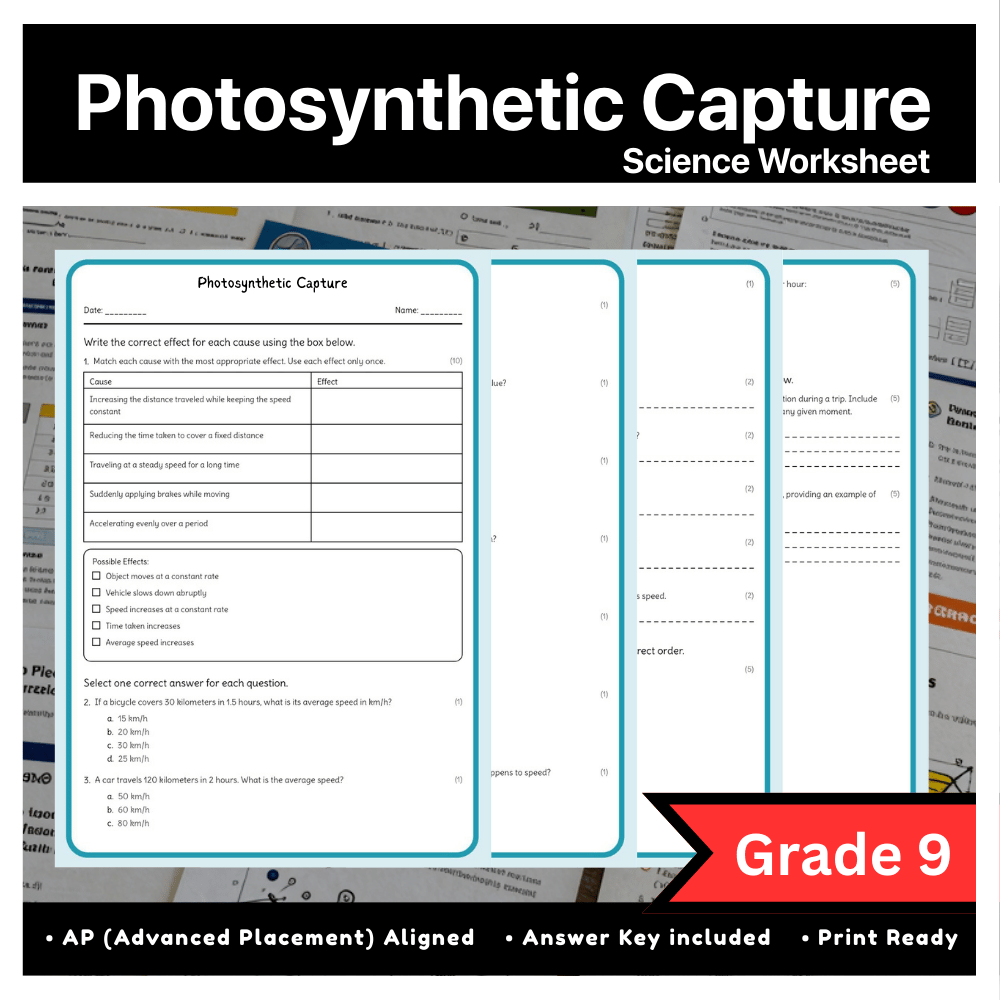
Grade 9 Science | Photosynthetic Capture Worksheet (Answer Key) – AP Standard
Created byBright Mind ResourcesLearning Objectives
- Describe the molecular basis of photosynthetic light capture.
- Explain pigment absorption spectra and energy transfer among pigments.
- Discuss how reaction centers convert light energy into chemical energy.
Instant download
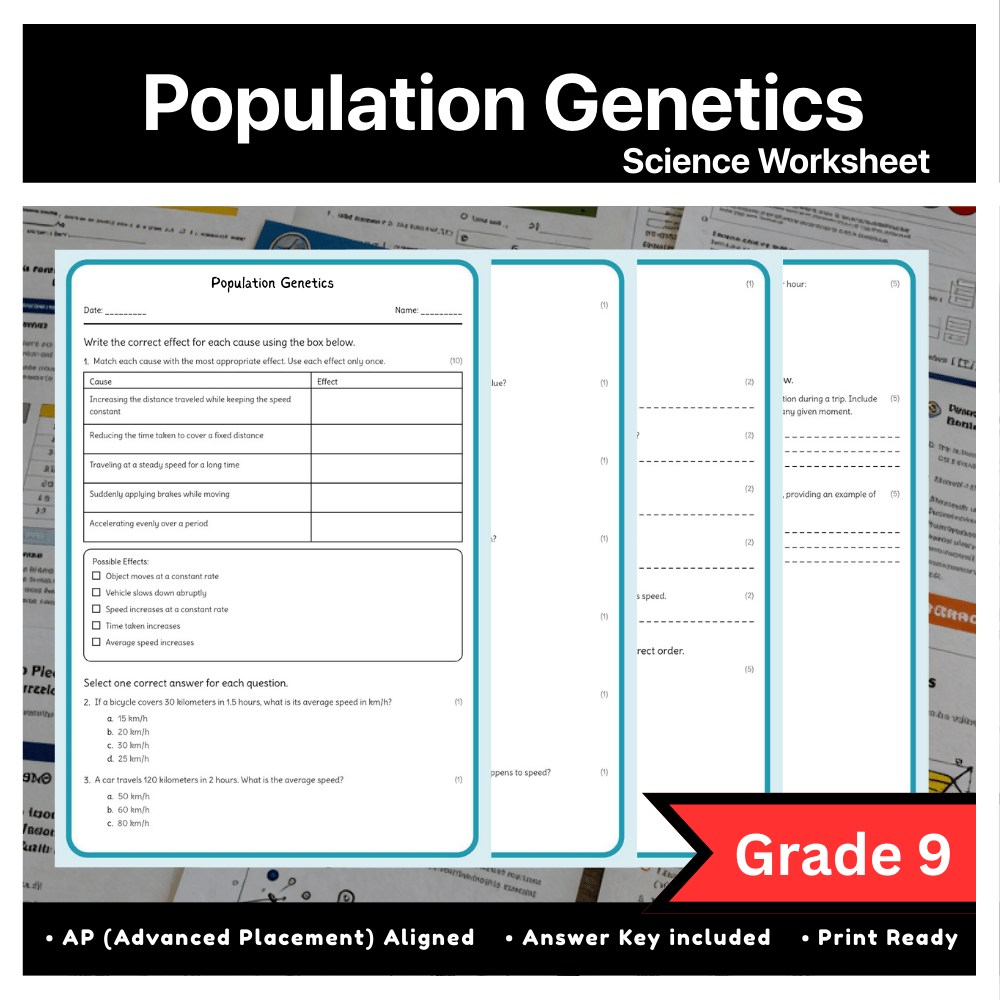
Grade 9 Science | Population Genetics Worksheet + Answer Key (AP Standard)
Created byBright Mind ResourcesLearning Objectives
- Describe how allele frequencies change under selection, drift, migration, and mutation.
- Explain the Hardy-Weinberg equilibrium as a null model for populations.
- Analyze the effects of bottlenecks and founder events on genetic variation.
Instant download
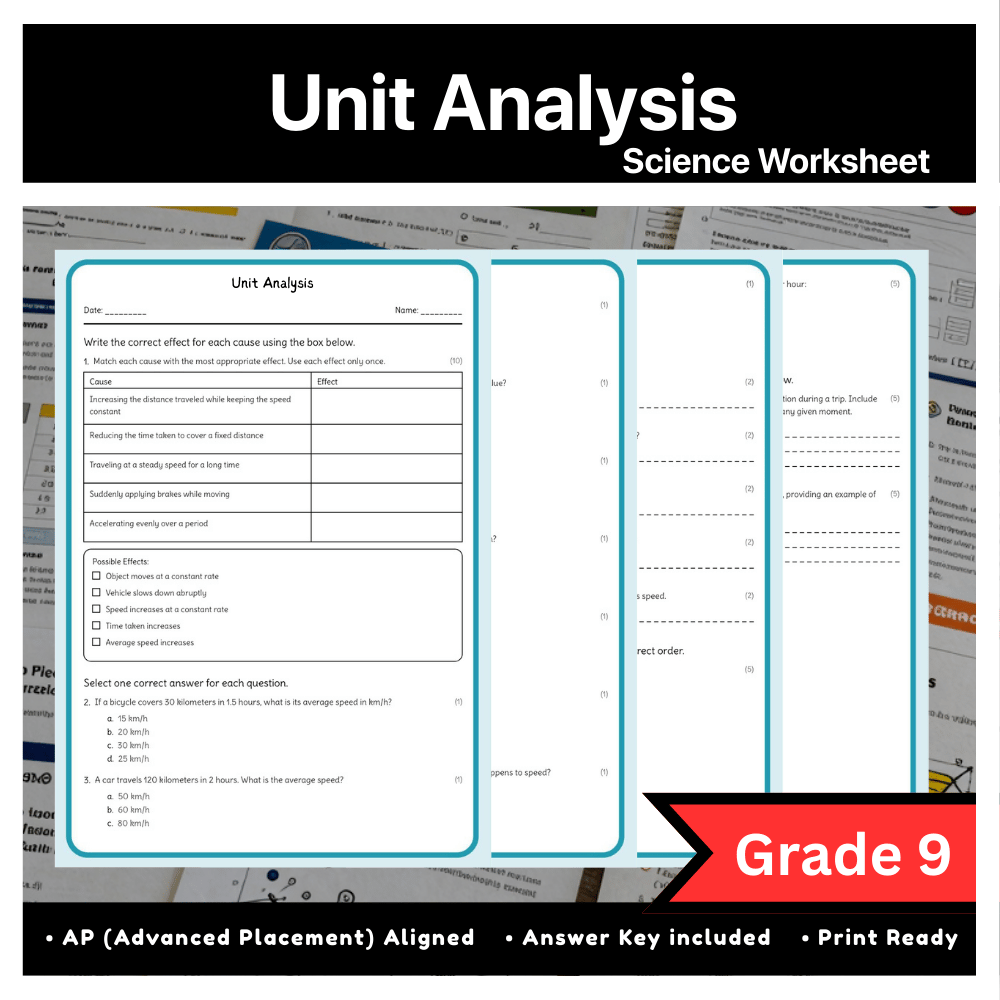
Grade 9 Science | Unit Analysis Worksheet (PDF) | AP Standards Practice
Created byBright Mind ResourcesLearning Objectives
- Understand and apply the principles of dimensional analysis to check the consistency of physical quantities.
- Recognize how unit-checking helps identify algebraic errors and constrains possible models.
- Derive relationships and scale laws using units to verify plausibility of equations.
Instant download
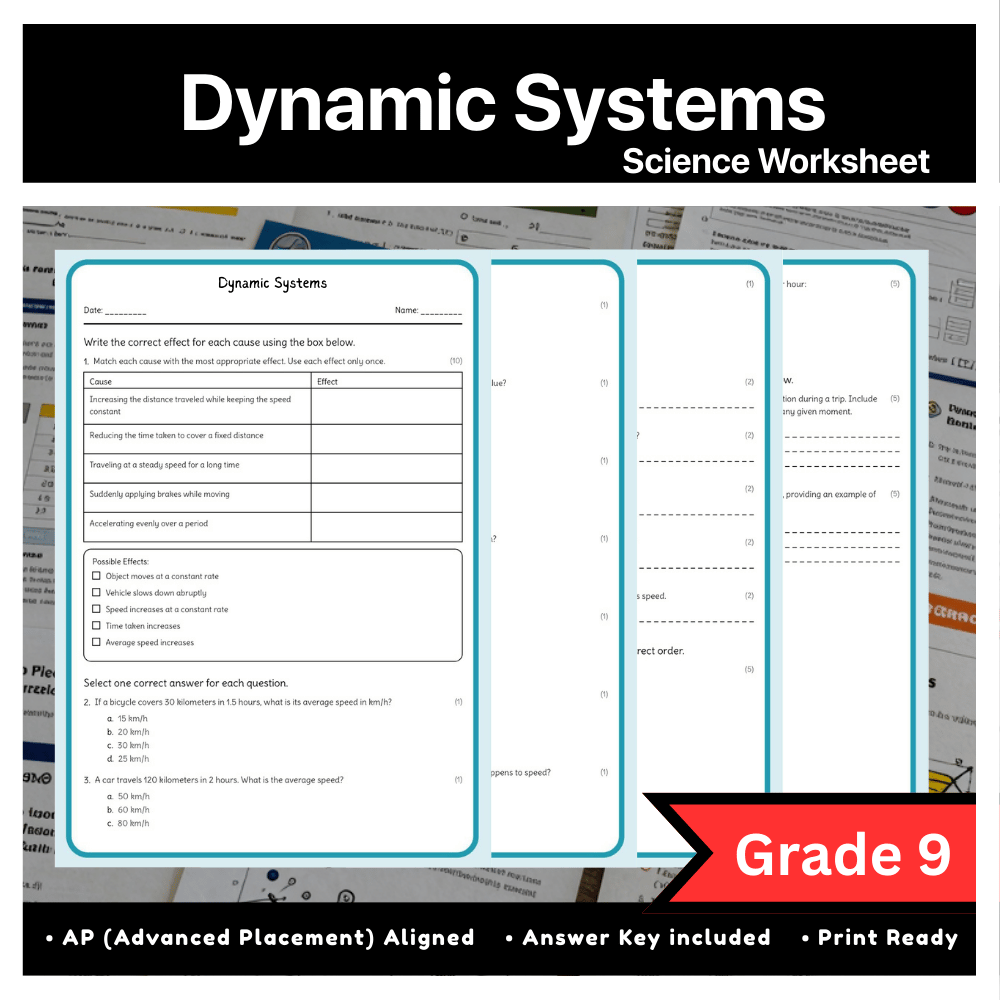
Grade 9 Science | Dynamic Systems Worksheet (AP Standard + Answer Key) (PDF)
Created byBright Mind ResourcesLearning Objectives
- Describe how temporal data reflects rates, feedback loops, and equilibrium in dynamic systems.
- Interpret time-series data and simple phase diagrams to identify transient and steady-state behaviors.
- Understand how causal structures manifest in temporal patterns and how models constrain data interpretation.
Instant download
Grade 9 Science – Evolutionary Evidence Worksheet (NGSS Aligned) PDF
Created byBright Mind ResourcesLearning Objectives
- Identify different lines of empirical evidence supporting evolution, including fossil, anatomical, and molecular data.
- Explain how comparative anatomy and genetic sequences provide evidence for common ancestry.
- Describe the significance of transitional fossils and biogeographic distributions in understanding evolution.
Instant download
Grade 9 Science | Human Impacts Worksheet (Answer Key) – NGSS Aligned
Created byBright Mind ResourcesLearning Objectives
- Analyze how land-use change, invasive species, pollution, and resource extraction affect biodiversity and ecosystems.
- Interpret empirical data from case studies such as deforestation and coral reef degradation.
- Evaluate trade-offs among conservation, ecosystem services, and socioecological outcomes.
Instant download
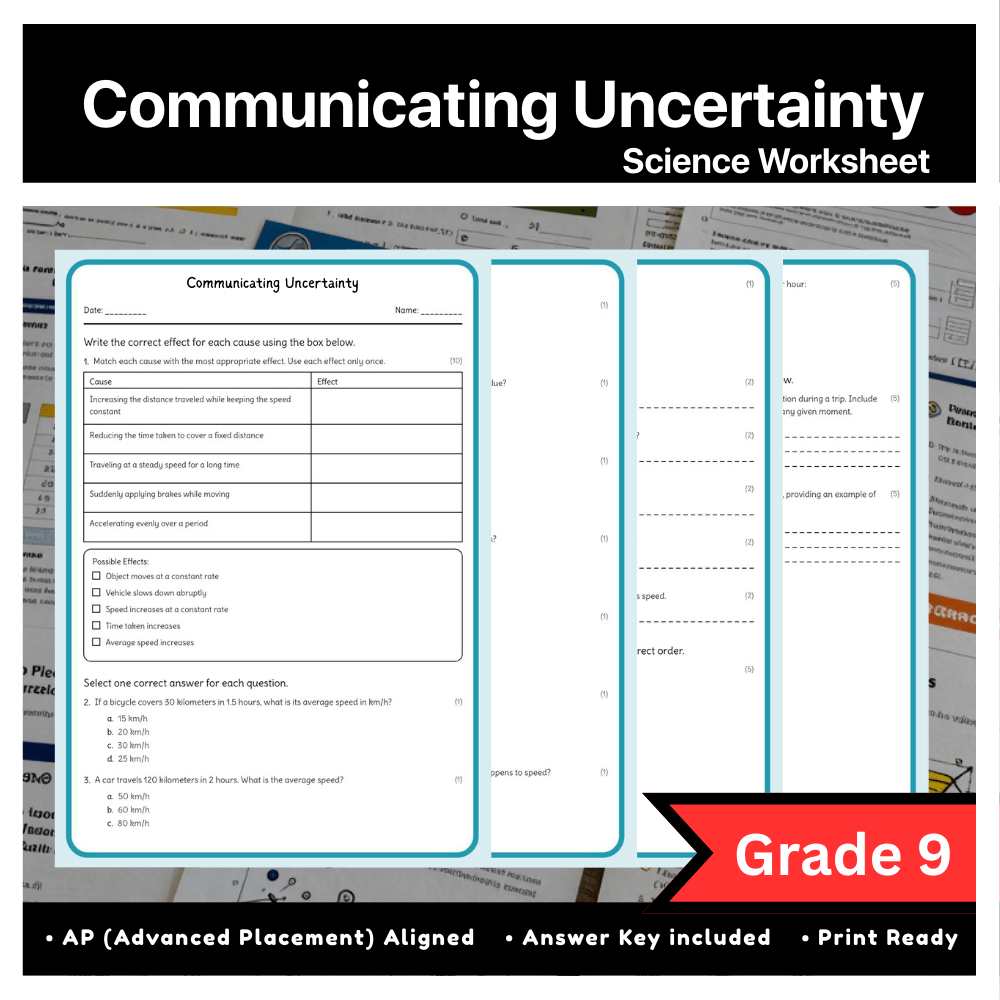
Grade 9 Science | Communicating Scientific Uncertainty Worksheet (AP Standard)
Created byBright Mind ResourcesLearning Objectives
- Understand the conventions for conveying quantitative uncertainty and confidence in scientific reports.
- Identify different methods for representing variability, effect sizes, and likelihoods.
- Evaluate how assumptions and limitations affect interpretations of models and data.
Instant download
Grade 9 Science | Rock Transformations Worksheet (NGSS Aligned, PDF)
Created byBright Mind ResourcesLearning Objectives
- Describe the processes involved in the rock cycle, including melting, crystallization, erosion, and metamorphism.
- Identify examples of rock transformations, such as basalt formation and sandstone deposition.
- Explain how pressure, temperature, and time influence mineral and rock changes.
Instant download
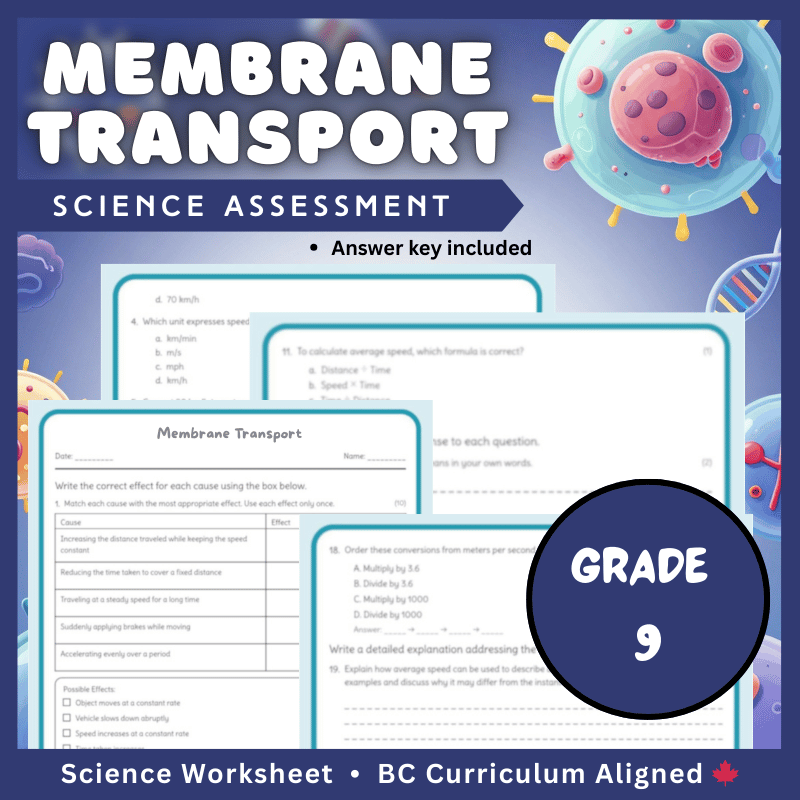
Grade 9 Science | Membrane Transport Worksheet (Answer Key) – BC Standards
Created byBright Mind ResourcesLearning Objectives
- Describe the structure of the plasma membrane and its role in selective permeability.
- Differentiate between passive and active transport processes across membranes.
- Identify various membrane proteins involved in transport and communication.
Instant download
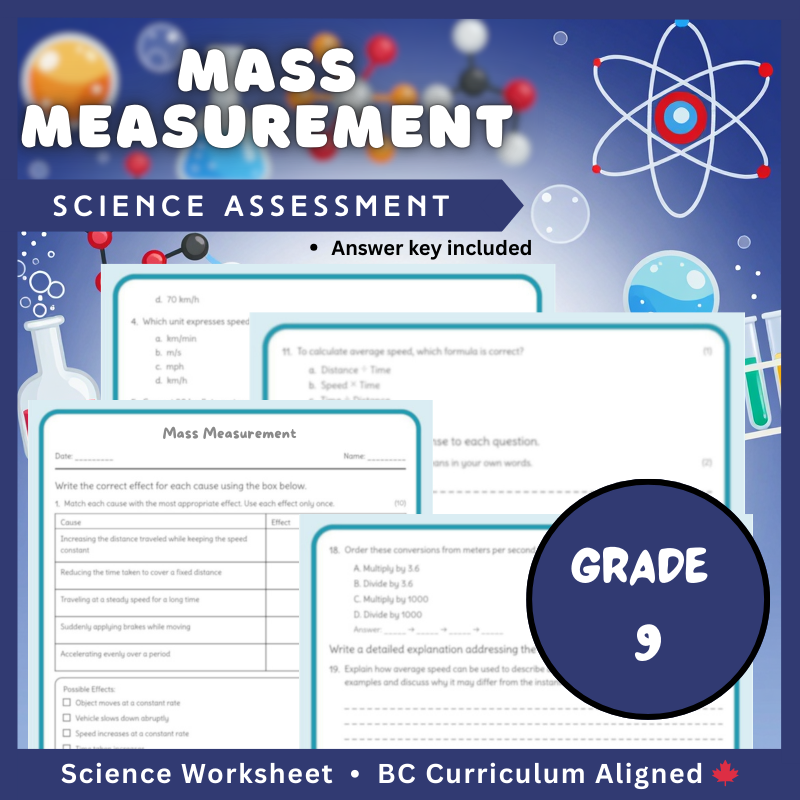
Grade 9 Science | Mass Measurement Worksheet (PDF) – BC Standards & Practice
Created byBright Mind ResourcesLearning Objectives
- Explain how measured mass changes during chemical reactions reflect the conservation of atoms within system boundaries.
- Identify causes of apparent mass loss in open systems involving gaseous products.
- Describe methods to account for all phases and containment to verify mass conservation.
Instant download
Grade 9 Science | Natural Hazards Worksheet + Answer Key (NGSS-Aligned, PDF)
Created byBright Mind ResourcesLearning Objectives
- Understand the different types of natural hazards and their triggers.
- Analyze geologic and atmospheric indicators used to assess hazards.
- Interpret hazard maps, recurrence intervals, and paleoevidence to evaluate risks.
Instant download
Grade 9 Science | Earth's Interior NGSS Worksheet (Worksheet + Answer Key)
Created byBright Mind ResourcesLearning Objectives
- Describe the layered structure of Earth's interior based on seismic, gravity, and heat-flow evidence.
- Interpret the behavior of P-waves and S-waves and their implications for Earth's composition and structure.
- Explain how density contrasts and mantle temperature gradients drive convective processes within Earth.
Instant download
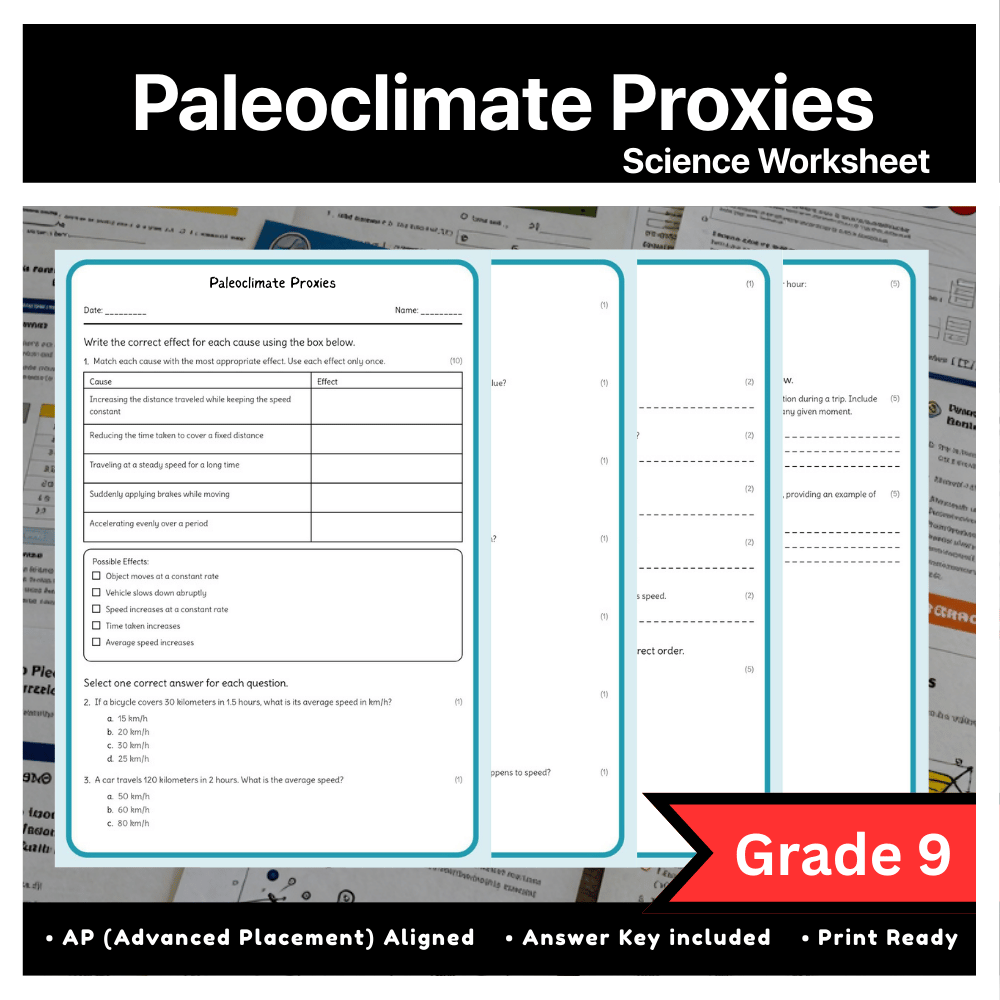
Grade 9 Science – Paleoclimate Proxies Worksheet (AP Standard, PDF)
Created byBright Mind ResourcesLearning Objectives
- Interpret paleoclimate evidence from various proxy indicators such as isotopic ratios, growth increments, and microfossil assemblages.
- Relate proxy records to past climate patterns including glacial-interglacial cycles and abrupt events.
- Employ age models and quantify uncertainty to link proxy signals to climate forcing mechanisms.
Instant download
Grade 12 Science | Variable Mass Rocket Propulsion Worksheet (Answer Key)
Created byBright Mind ResourcesLearning Objectives
- Understand how momentum conservation applies to systems with changing mass.
- Explain how ejection or accretion of mass influences momentum balance.
- Derive the qualitative basis of the rocket equation through momentum exchange analysis.
Instant download
Grade 12 Science | Sea-Floor Spreading Worksheet (PDF) with Answer Key
Created byBright Mind ResourcesLearning Objectives
- Explain the process of sea-floor spreading at mid-ocean ridges.
- Analyze magnetic stripe patterns to understand seafloor age and plate movement.
- Recognize how magnetic anomalies and radiometric data support plate tectonics theory.
Instant download
Grade 12 Science | Hardy-Weinberg Population Genetics Worksheet (PDF)
Created byBright Mind ResourcesLearning Objectives
- Understand the assumptions and conditions of the Hardy-Weinberg principle.
- Apply the Hardy-Weinberg equations to calculate allele and genotype frequencies.
- Interpret deviations from expected frequencies to identify evolutionary forces.
Instant download
Browse more categories
About Reading comprehension Worksheets
Find reading comprehension worksheets for class practice, homework, or self-study. All 40,284 are instant PDF downloads.
Each resource here is built by an independent educator and reviewed for quality. Worksheets print straight from PDF and suit classroom use, homework, or extra practice; most come with answer keys, and you can preview before purchasing.