
Reading comprehension Worksheets
40,284 type resources
Grade 9 Science | Solution Behaviour Worksheet (Ontario Standards) (PDF)
 Created byBright Mind Resources
Learning Objectives
- Understand the process of solution formation and the interactions between solutes and solvents.
- Identify factors that influence the solubility of substances, such as temperature and agitation.
- Differentiate between saturated, unsaturated, and supersaturated solutions with examples.
Instant download
Grade 9 Science | Fluid Balance Worksheet & Answer Key (PDF) – BC Standards
Created byBright Mind ResourcesLearning Objectives
- Understand how the kidneys regulate water and ion balance through various processes.
- Describe the roles of hormones like antidiuretic hormone and aldosterone in osmoregulation.
- Explain how the nephron adjusts solute and water movement to maintain homeostasis.
Instant download
Grade 9 Science | Cell Type Differences Worksheet (Answer Key) PDF
Created byBright Mind ResourcesLearning Objectives
- Compare the structural differences between prokaryotic and eukaryotic cells.
- Identify key components of prokaryotic and eukaryotic cells.
- Explain how cellular organization affects the functions of cells in living organisms.
Instant download
Grade 9 Science | Simple Machines Worksheet (Ontario Standard) (PDF)
Created byBright Mind ResourcesLearning Objectives
- Understand the basic types and functions of simple machines.
- Explain how simple machines modify force and displacement to achieve mechanical advantage.
- Identify examples of simple machines in real-world applications.
Instant download
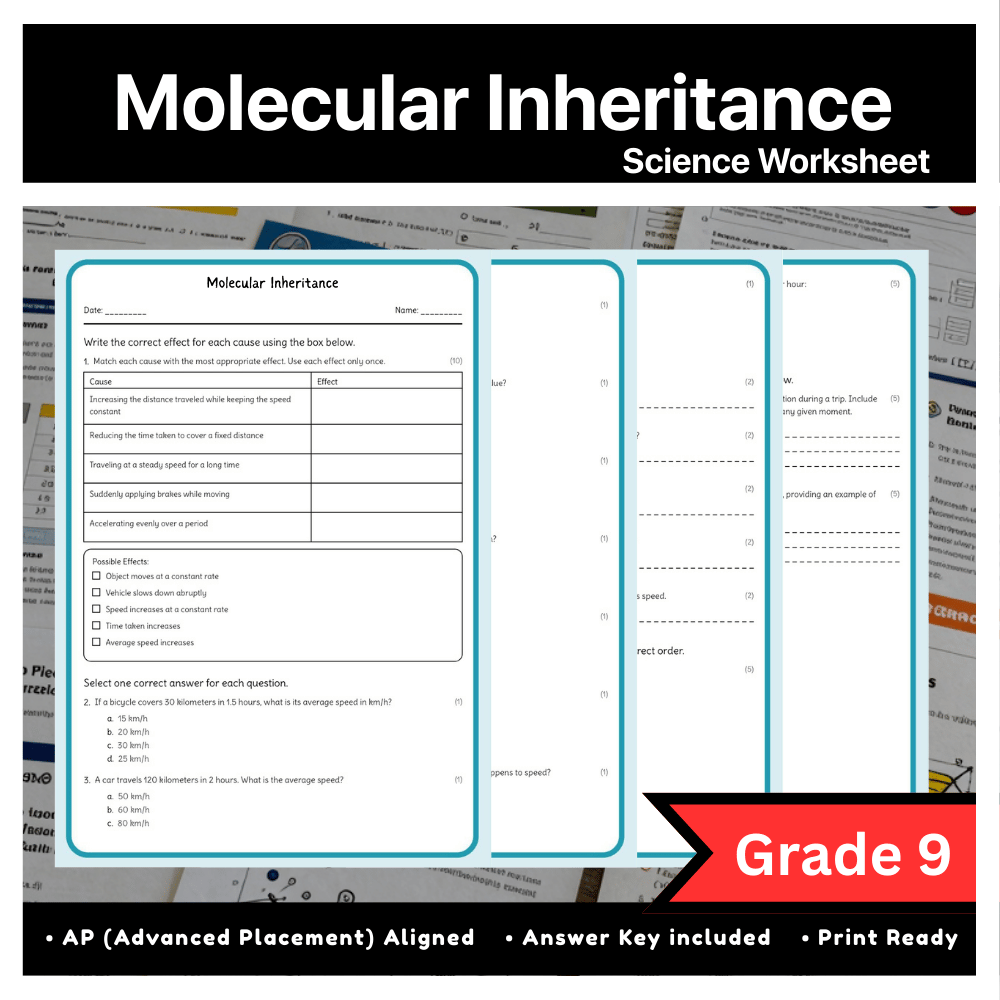
Grade 9 Science | Molecular Inheritance AP Worksheet (PDF) with Answer Key
Created byBright Mind ResourcesLearning Objectives
- Explain how DNA replication maintains fidelity and its impact on genetic information.
- Describe the processes of transcription and translation and their roles in gene expression.
- Identify how sequence variations and mutations can alter protein function and phenotype.
Instant download
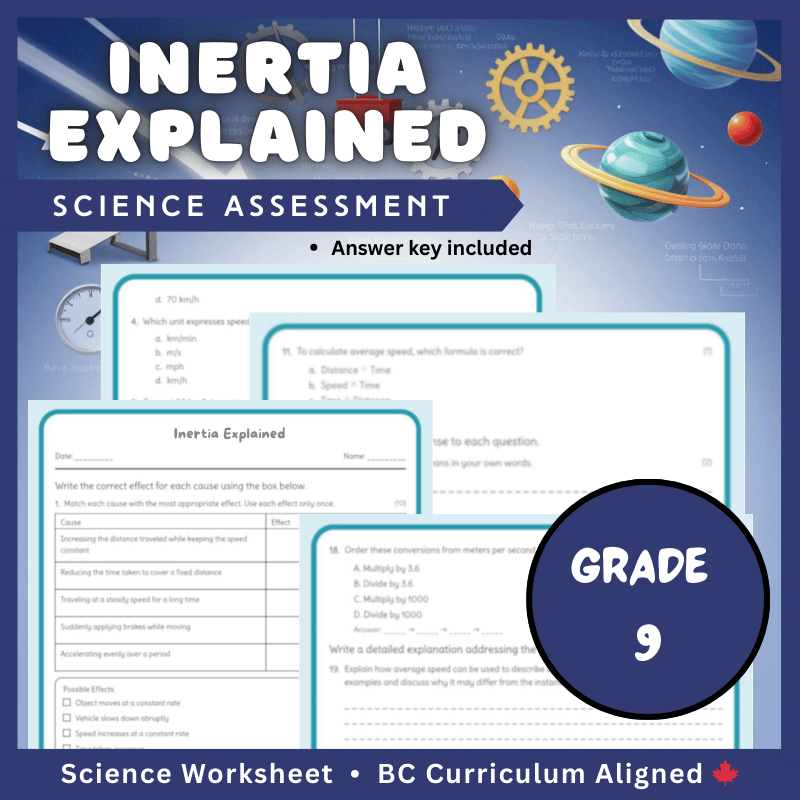
Grade 9 Science | Inertia Explained Worksheet (Answer Key) – BC Standards
Created byBright Mind ResourcesLearning Objectives
- Understand the concept of inertia as resistance to change in motion.
- Relate inertia to an object's mass and its effect on acceleration.
- Identify real-world examples demonstrating inertia.
Instant download
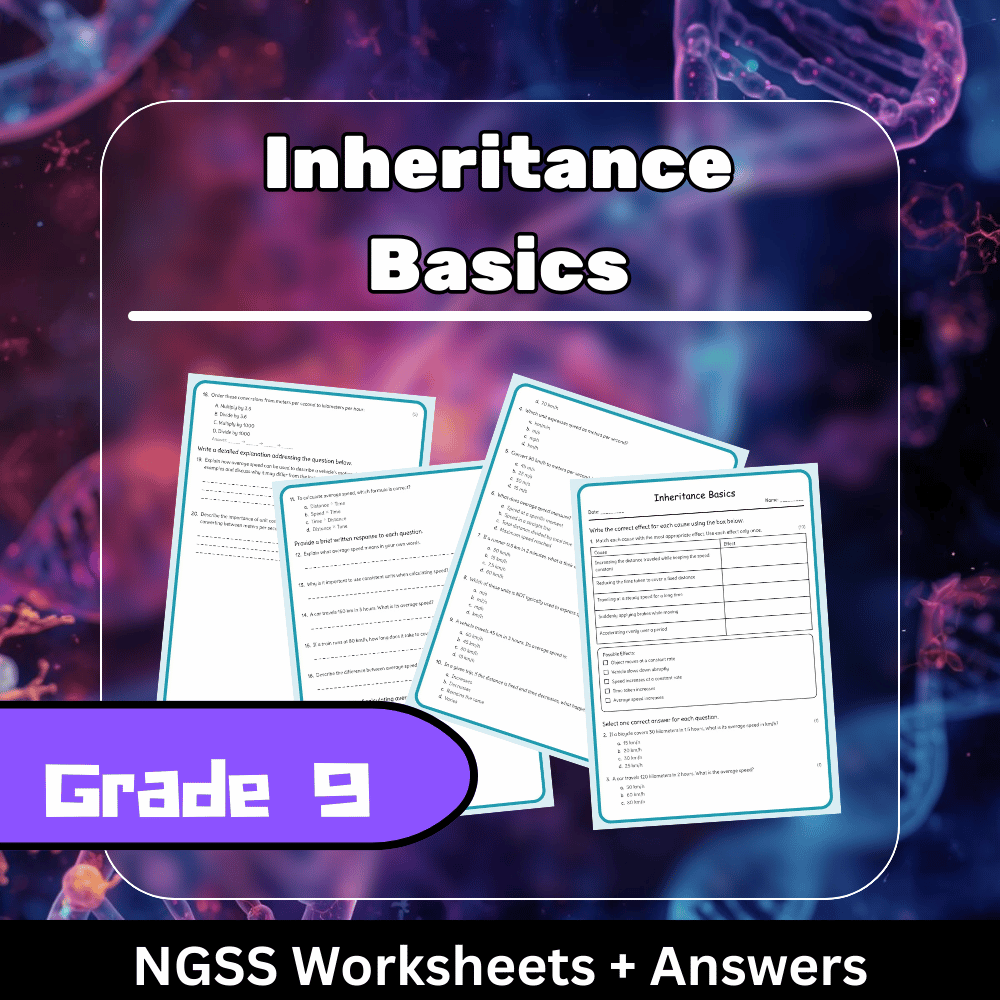
Grade 9 Science | Inheritance Basics Worksheet (Answer Key) – NGSS Aligned
Created byBright Mind ResourcesLearning Objectives
- Understand the structure of DNA and its role in inheritance.
- Describe the process of chromosome transmission during meiosis.
- Explain how genetic information is passed from parents to offspring.
Instant download
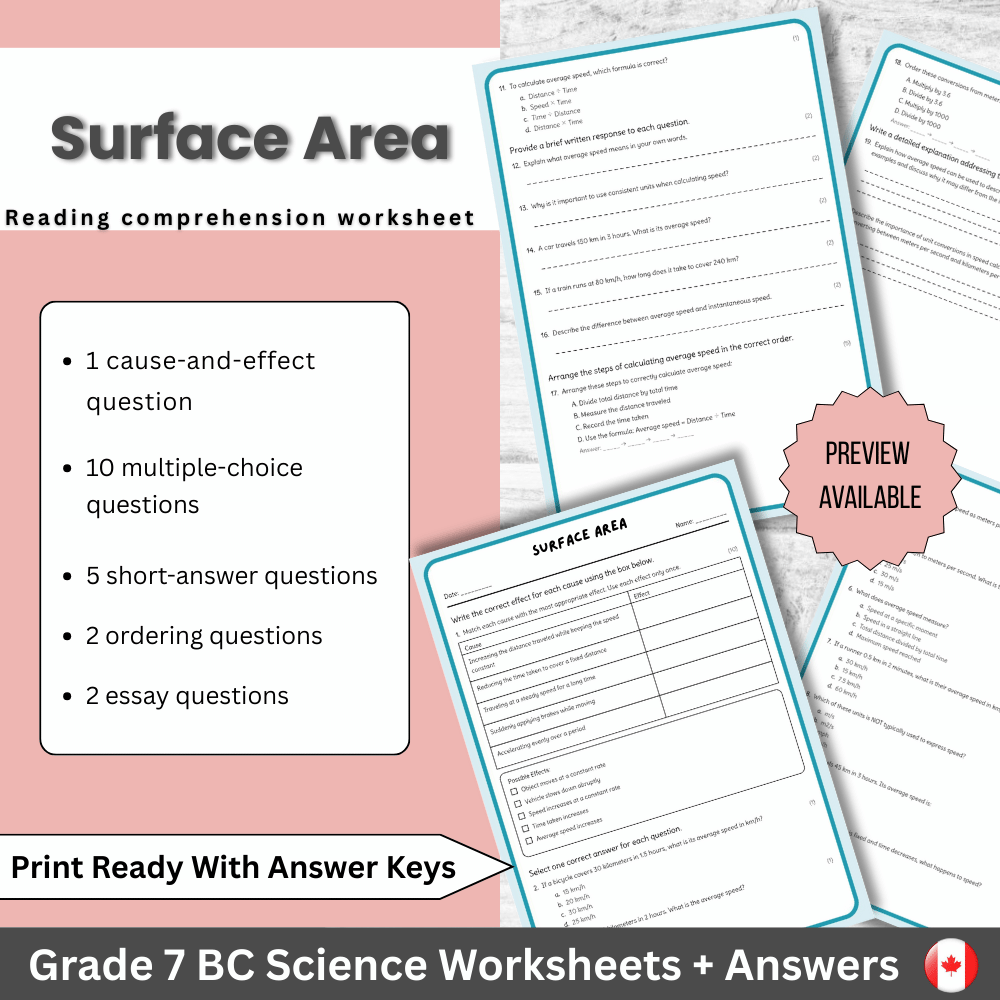
Grade 7 Science Surface Area Worksheet – Cell Size & Adaptations (PDF)
Created byBright Mind ResourcesLearning Objectives
- Explain how surface-area-to-volume ratio affects cell size and function.
- Identify adaptations that increase exchange surface area in cells and organisms.
- Describe how multicellular organisms overcome surface area limitations through specialized structures.
Instant download
Grade 7 Science | Nucleus Function Worksheet + Answer Key | for BC Standards
Created byBright Mind ResourcesLearning Objectives
- Understand the role of the nucleus in cellular activities.
- Identify structures related to genetic material inside the nucleus.
- Explain how the nuclear envelope and pores regulate activity.
Instant download
Grade 7 Science – Biodiversity Measures Worksheet (PDF) – Alberta Standard
Created byBright Mind ResourcesLearning Objectives
- Define different metrics of biodiversity such as richness, evenness, and habitat heterogeneity.
- Interpret what various biodiversity metrics reveal about ecosystem resilience and function.
- Evaluate the relationship between habitat complexity and species assemblages.
Instant download
Grade 7 Science – Surface Processes Worksheet (Worksheet + Answer Key) | TEKS Aligned
Created byBright Mind ResourcesLearning Objectives
- Describe the physical and chemical processes shaping Earth's surface including weathering, erosion, and deposition.
- Identify driving forces such as water flow, wind, glaciers, and gravity that influence surface changes.
- Link observable landforms like deltas, canyons, and dunes to surface processes.
Also included in: Grade 7 Science Unit Bundle | Earth's Processes, Space & Resources TEKS Aligned +2 more
Instant download
Grade 7 Science | Chloroplast Role Worksheet with Answer Key (PDF)
Created byBright Mind ResourcesLearning Objectives
- Describe the function of chloroplasts in photosynthesis.
- Explain how pigments in thylakoid membranes absorb light energy.
- Identify the process of carbon fixation in the stroma of chloroplasts.
Instant download
Grade 7 Science – Mixtures and Solutions Worksheet + Answer Key | NGSS-Aligned
Created byBright Mind ResourcesLearning Objectives
- Differentiate between homogeneous and heterogeneous mixtures, solutions, colloids, and suspensions.
- Explain solubility, saturation, and colligative effects in mixtures and solutions.
- Identify real-world examples of mixtures and solutions, including saltwater, emulsions, and granular mixtures.
Instant download
Grade 7 Science | Resource Distribution Worksheet (NGSS) - PDF
Created byBright Mind ResourcesLearning Objectives
- Understand how geologic processes influence the uneven distribution of mineral, energy, and groundwater resources.
- Connect plate tectonics, sedimentation, weathering, and biological activity to resource locations.
- Evaluate the impacts of resource extraction and consider sustainability and access issues.
Instant download
Grade 7 Science – Atomic Models Worksheet (Worksheet + Answer Key) NGSS Aligned
Created byBright Mind ResourcesLearning Objectives
- Describe how atoms are represented in particle, ball-and-stick, and lattice models.
- Explain the significance of covalent and ionic bonding in molecular and extended structures.
- Connect subatomic particles and atomic number to material properties and formula notation.
Instant download
7th Grade Science | Net Force Worksheet (Worksheet + Answer Key) – NGSS Aligned
Created byBright Mind ResourcesLearning Objectives
- Define net force as the vector sum of all forces acting on an object.
- Explain how unbalanced forces can change an object's motion.
- Describe the relationship between net force, mass, and acceleration through examples and diagrams.
Instant download
Grade 7 Science – Stoichiometry Worksheet (Answer Key) | NGSS Aligned
Created byBright Mind ResourcesLearning Objectives
- Understand how to interpret and use balanced symbolic equations in stoichiometry.
- Calculate molar and mass ratios of reactants and products in chemical reactions.
- Apply conservation principles to predict reagent needs and product yields.
Instant download
Grade 7 Science – States of Matter Worksheet (Worksheet + Answer Key) | TEKS Aligned
Created byBright Mind ResourcesLearning Objectives
- Define and characterize the three main states of matter: solid, liquid, and gas.
- Explain the processes of phase changes such as melting, freezing, vaporization, condensation, and sublimation.
- Relate temperature and pressure to phase transitions and measurable properties like density and viscosity.
Also included in: Grade 7 Science Unit Bundle | States of Matter & Atomic Structure Worksheets +2 more
Instant download
Grade 7 Science | Mountain Building Worksheet + Answer Key (PDF)
Created byBright Mind ResourcesLearning Objectives
- Explain the processes involved in mountain building through plate tectonics.
- Identify key features of orogeny, including crustal deformation, uplift, and volcanic activity.
- Describe surface processes like erosion and isostatic adjustment that shape mountain ranges.
Instant download
Grade 9 Science | Evidence Overview Worksheet (Worksheet + Answer Key) - TEKS Aligned
Created byBright Mind ResourcesLearning Objectives
- Understand how fossil, anatomical, and molecular evidence support evolutionary relationships.
- Analyze different lines of evidence to infer common ancestry among organisms.
- Interpret data from fossil records, anatomical comparisons, and molecular sequences.
Also included in: Grade 9 Science Unit | Evolution, Speciation & Genetics Worksheet Pack - TEKS +3 more
Instant download
Grade 9 Science – Mechanical Advantage Worksheet (PDF) – Alberta Standards
Created byBright Mind ResourcesLearning Objectives
- Understand the concept of mechanical advantage and how it is calculated.
- Identify different types of machines that utilize mechanical advantage.
- Analyze the trade-offs between force reduction and displacement in pulley and lever systems.
Instant download
Grade 9 Science – Element Symbols & Chemical Formulas Worksheet (PDF)
Created byBright Mind ResourcesLearning Objectives
- Understand the meaning and structure of element symbols and chemical formulas.
- Identify common chemical formulas such as H2O, NaCl, and CaCO3.
- Explain how chemical formulas represent the composition of substances.
Instant download
Grade 9 Science | Balancing Equations Worksheet (PDF) – Alberta Standards
Created byBright Mind ResourcesLearning Objectives
- Understand the importance of balancing chemical equations to conserve atoms and mass.
- Learn how to balance simple and complex chemical equations accurately.
- Recognize the relationship between formula notation and measurable mass.
Instant download
Grade 9 Science | Renal Regulation Worksheet (PDF) Aligns with TEKS
Created byBright Mind ResourcesLearning Objectives
- Describe the processes of glomerular filtration, tubular reabsorption, and secretion in the kidneys.
- Explain how hormones like antidiuretic hormone and the renin-angiotensin-aldosterone system regulate fluid and electrolyte balance.
- Understand the mechanisms the body uses to maintain blood pressure and osmolarity through renal control.
Also included in: Grade 9 Science Unit | Human Body Systems Worksheets & TEKS Aligned Bundle +3 more
Instant download
Grade 9 Science | Atomic Structure Worksheet (PDF) - Alberta Standards
Created byBright Mind ResourcesLearning Objectives
- Describe the composition of atoms in terms of protons, neutrons, and electrons.
- Understand how atomic number and mass number define isotopes and element identity.
- Explain models of atomic nuclei and electron shells to predict chemical behavior.
Instant download
Grade 9 Science – Predicting Products Worksheet (PDF) | Alberta Standards
Created byBright Mind ResourcesLearning Objectives
- Apply patterns of chemical behaviour to predict products of reactions.
- Use conservation principles to foresee likely reaction outcomes.
- Identify product formation in common reaction types such as synthesis and decomposition.
Instant download
Grade 9 Science | Organelles Interactions Worksheet – TEKS Standards (PDF)
Created byBright Mind ResourcesLearning Objectives
- Understand how different organelles coordinate to support cellular functions.
- Identify the pathway of genetic information and protein trafficking within a cell.
- Explain the roles of mitochondria, lysosomes, and peroxisomes in maintaining homeostasis.
Also included in: Grade 9 Science Unit | Cell Structures & Transport Mechanisms Pack(TEKS-Aligned) +3 more
Instant download
Grade 9 Science – Natural Selection Worksheets (Worksheet + Answer Key) | TEKS Aligned
Created byBright Mind ResourcesLearning Objectives
- Describe the process of natural selection and how it leads to evolutionary change.
- Identify examples of natural selection such as beak variation and antibiotic resistance.
- Differentiate between types of selection: directional, stabilizing, and disruptive.
Also included in: Grade 9 Science Unit | Evolution, Speciation & Genetics Worksheet Pack - TEKS +3 more
Instant download
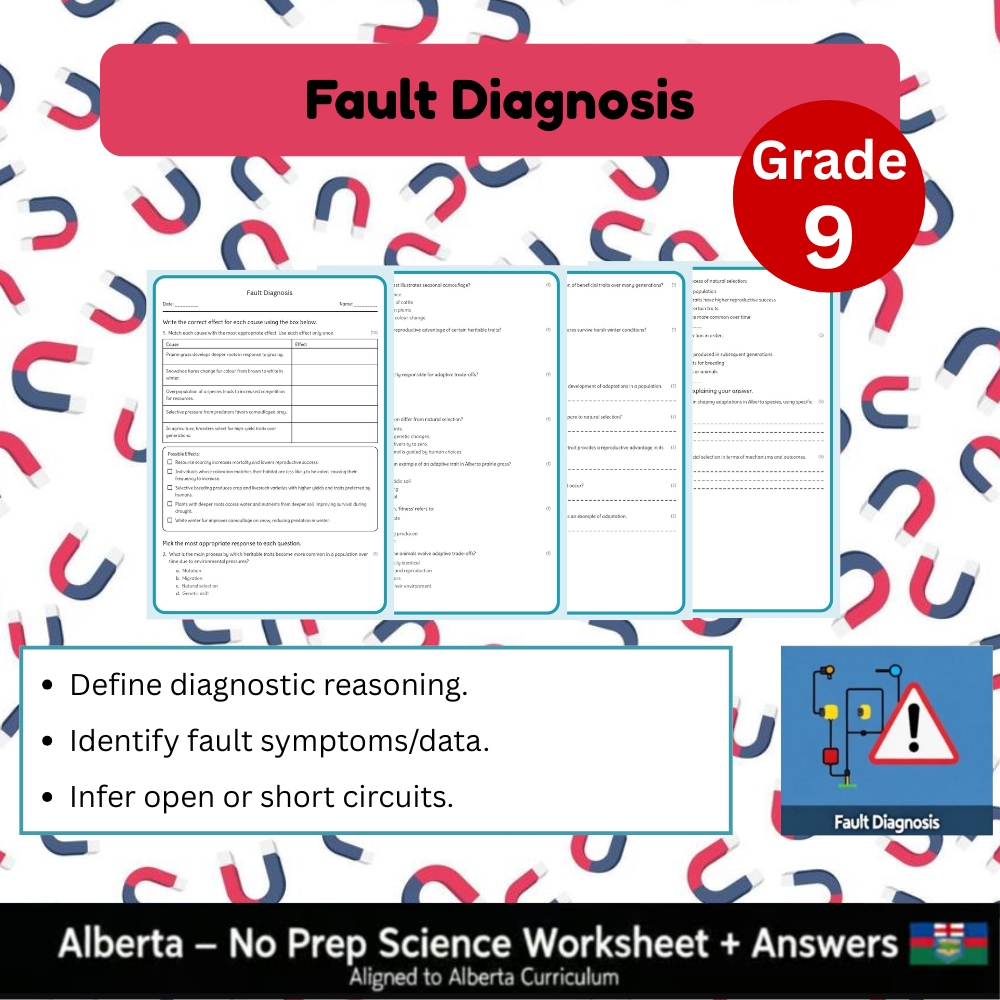
Grade 9 Science | Fault Diagnosis Worksheet (PDF) – Alberta Standards
Created byBright Mind ResourcesLearning Objectives
- Understand the principles of diagnostic reasoning for electrical faults.
- Identify symptoms and measurement data associated with common faults.
- Apply logical inference to determine probable failure modes such as open circuits, short circuits, or component degradation.
Instant download
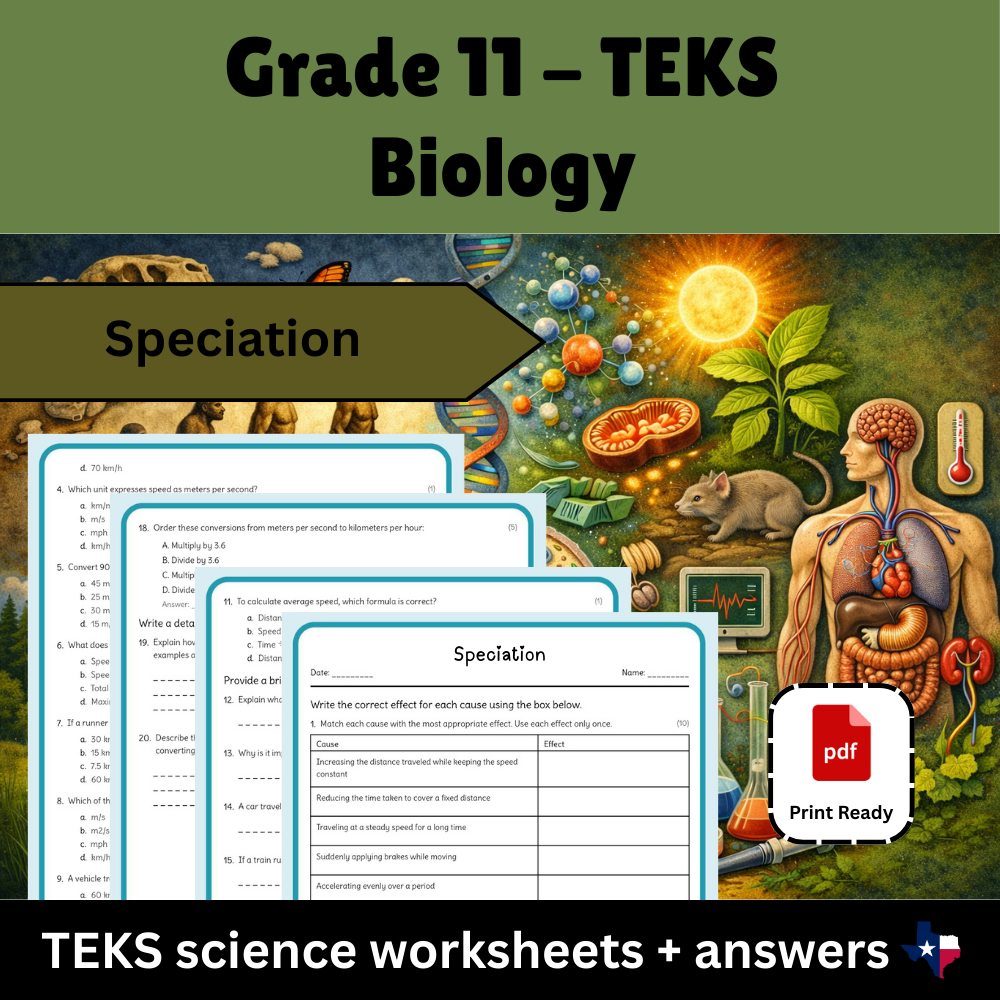
Grade 11 Science | Speciation Mechanisms Worksheet (Answer Key) – TEKS Aligned
Created byBright Mind ResourcesLearning Objectives
- Explain how reproductive isolation leads to speciation
- Identify different mechanisms and barriers involved in speciation
- Distinguish between geographic, ecological, and environmental gradient speciation
Also included in: Grade 11 Science | Evolution & Phylogenetics Worksheet Bundle (TEKS Aligned) +2 more
Instant download
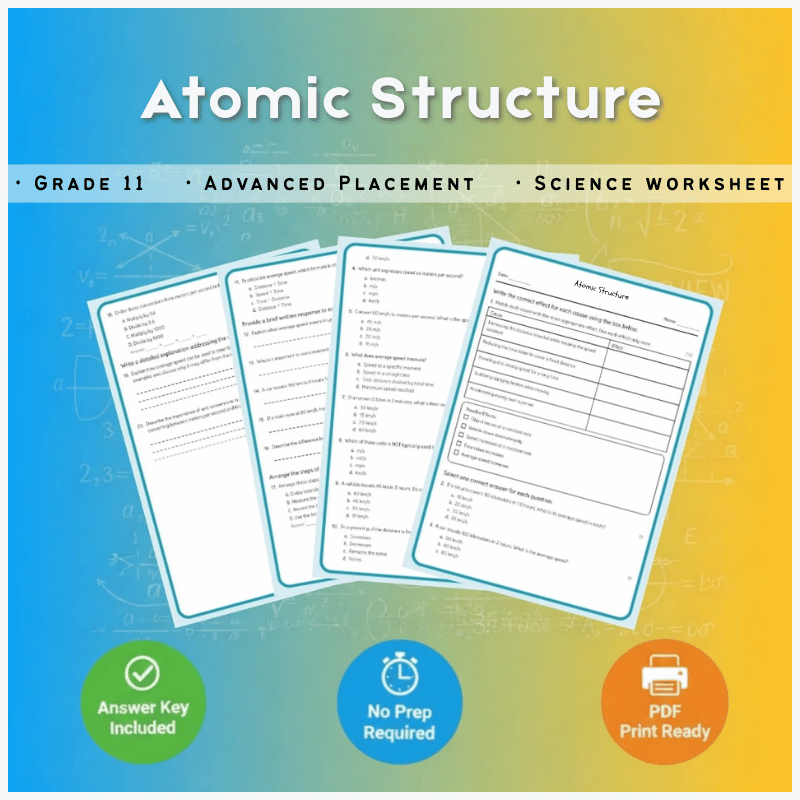
Grade 11 Science | Atomic Structure Worksheet (AP Standard PDF)
Created byBright Mind ResourcesLearning Objectives
- Identify the fundamental subatomic particles and their roles within an atom.
- Explain how evidence from emission spectra and mass spectrometry supports discrete energy levels and isotopic variation.
- Describe quantum numbers and electron orbital models as representations of electron distribution.
Instant download
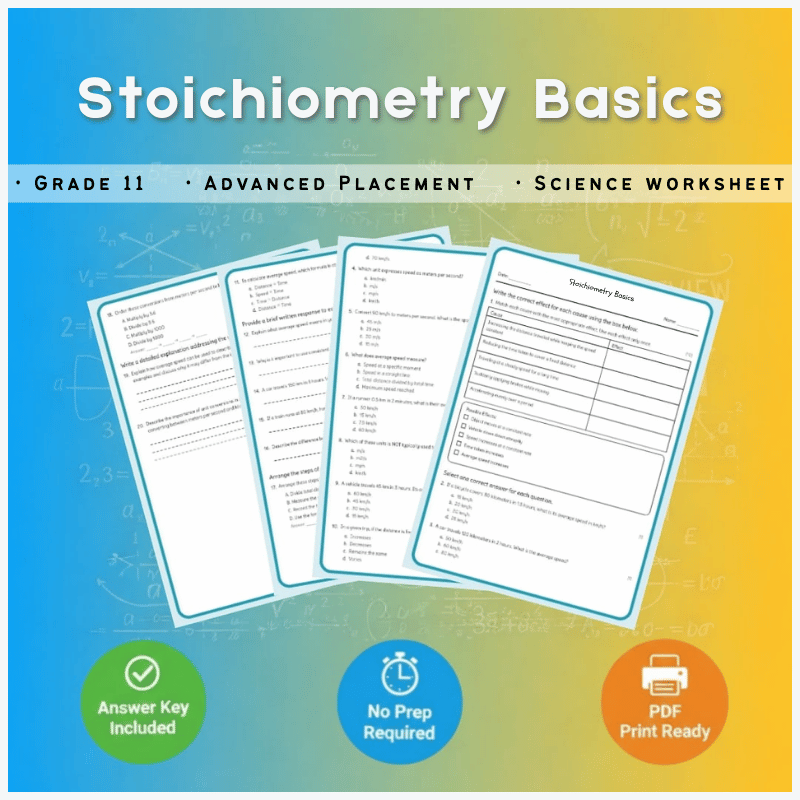
Grade 11 Science | Stoichiometry Basics Worksheet (Answer Key) - AP Standards
Created byBright Mind ResourcesLearning Objectives
- Understand mole relationships, molar mass, and their applications in chemical equations.
- Interpret balanced equations to determine quantities and mass relationships.
- Calculate limiting reagents, percent yield, and derive empirical/molecular formulas.
Instant download
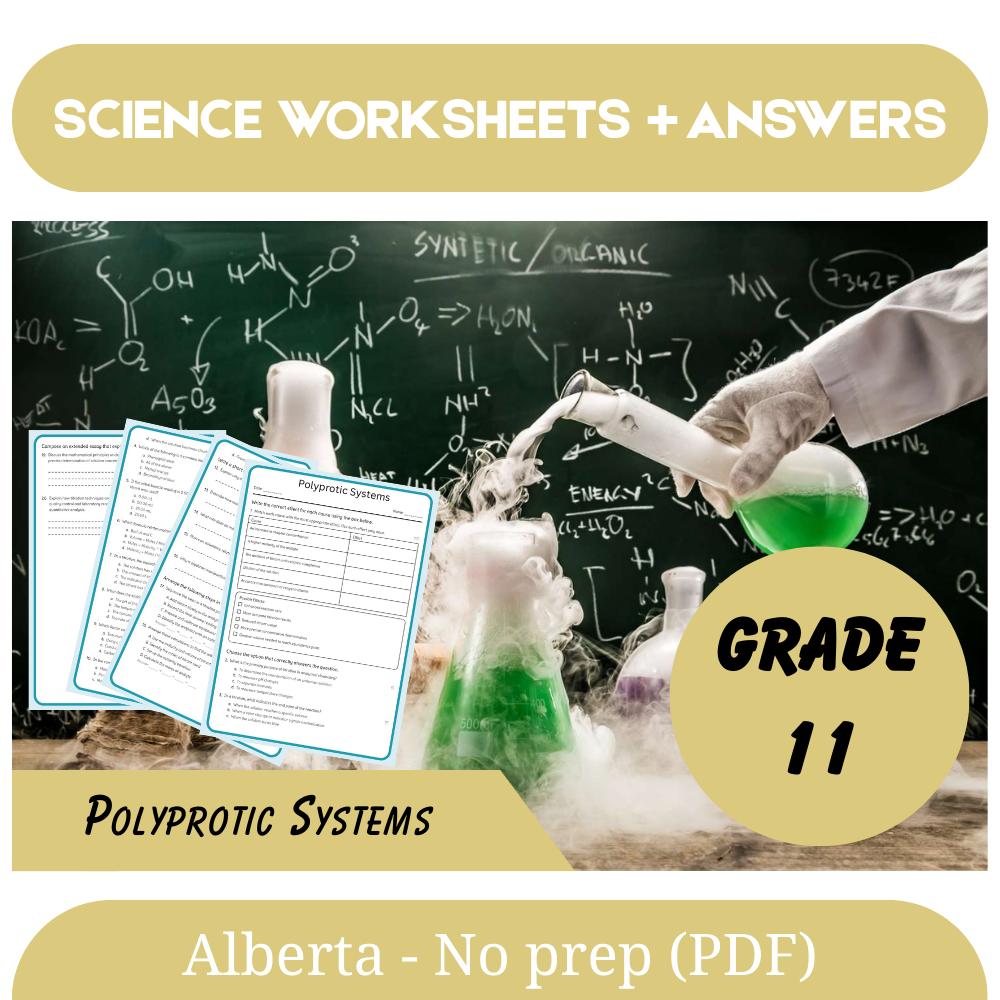
Grade 11 Science – Polyprotic Systems Worksheet (PDF) – Alberta Standards
Created byBright Mind ResourcesLearning Objectives
- Describe the concept of polyprotic acids and their dissociation steps.
- Calculate stepwise and cumulative acidity in polyprotic systems.
- Interpret titration curves involving polyprotic acids and determine equivalence points.
Instant download
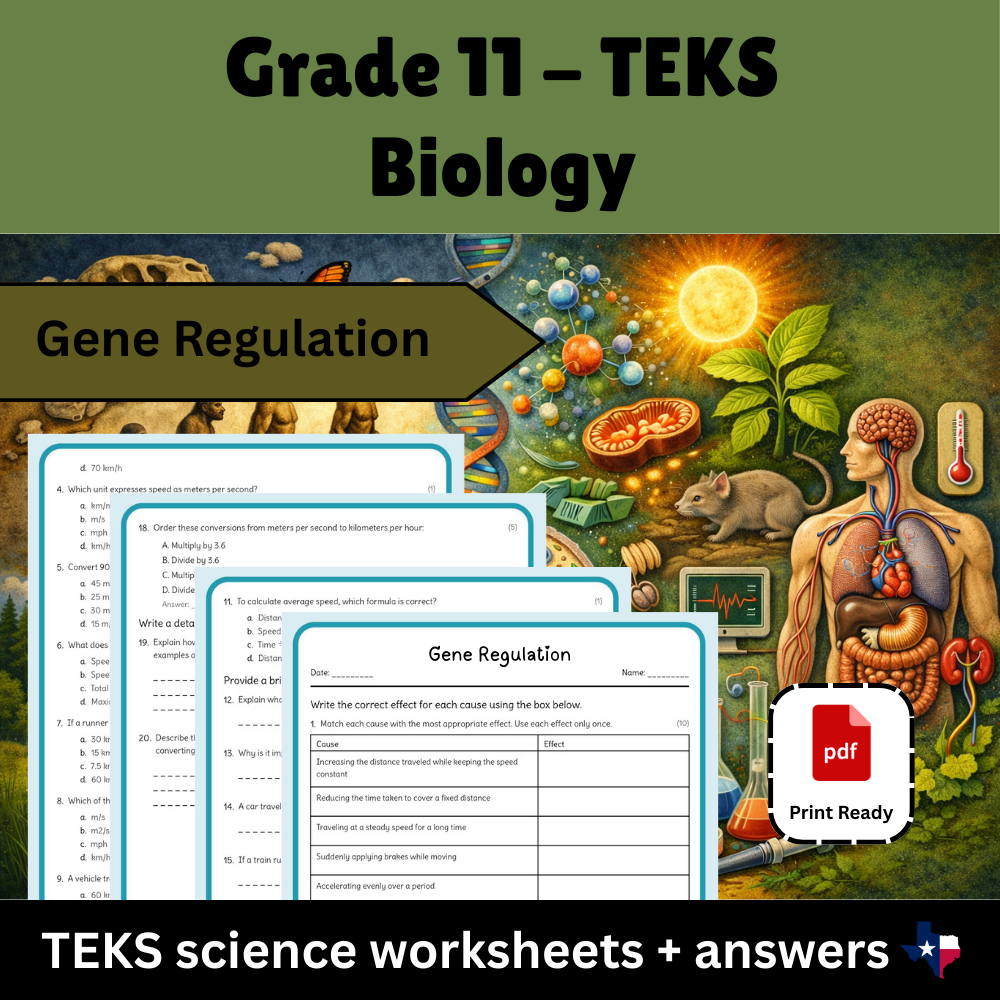
Grade 11 Science | Gene Regulation Worksheet (Answer Key) – TEKS Aligned
Created byBright Mind ResourcesLearning Objectives
- Understand the mechanisms controlling gene expression, including cis-regulatory elements, chromatin modifications, and post-transcriptional processes.
- Identify the roles of promoters, enhancers, DNA methylation, and histone modifications in gene regulation.
- Explain how gene regulation influences cell differentiation, development, and response to environmental stimuli.
Also included in: Grade 11 Science DNA & Genetics Unit Worksheet Pack+ Answer Key (TEKS-Aligned) +2 more
Instant download
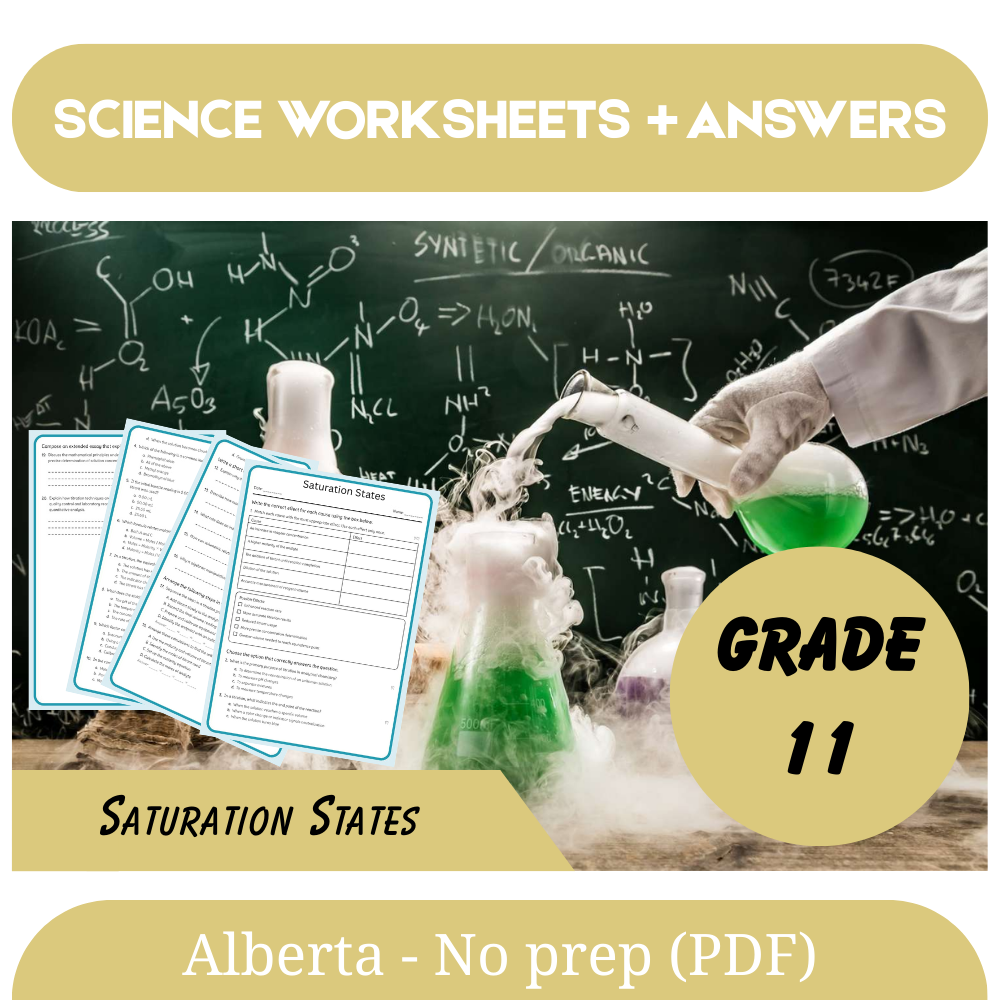
Grade 11 Science – Saturation States Worksheet (PDF) – Alberta Standard
Created byBright Mind ResourcesLearning Objectives
- Understand the concept of saturation states as unsaturated, saturated, and supersaturated solutions.
- Identify conditions leading to precipitation, dissolution, and nucleation in natural and industrial contexts.
- Describe the dynamic equilibrium between dissolved ions and solid phases.
Instant download
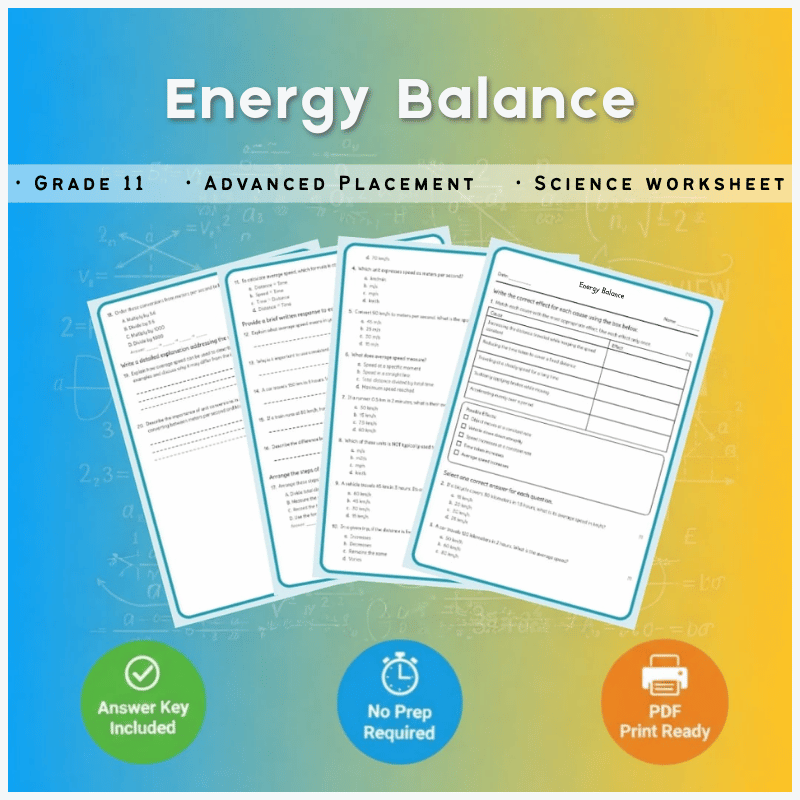
Grade 11 Science | Energy Balance Worksheet (AP Standards) – Science (PDF)
Created byBright Mind ResourcesLearning Objectives
- Explain the concept of Earth's energy budget and the role of radiative forcing in climate variability.
- Interpret phenomena such as seasonal cycles and polar amplification through differential heating and feedback mechanisms.
- Analyze observational data from satellites and surface records to evaluate climate models' energy transport and surface temperature responses.
Instant download
Grade 11 Science – Hazard Management Worksheet (Answer Key) | BC Standards
Created byBright Mind ResourcesLearning Objectives
- Understand techniques used in hazard susceptibility mapping and risk assessment.
- Identify mitigation measures for natural hazards such as earthquakes, volcanic eruptions, landslides, and tsunamis.
- Evaluate the balance between economic benefits and hazard exposure in planning and resource management.
Instant download
Grade 11 Science – Atmospheric Structure Worksheet (AP Standard + PDF)
Created byBright Mind ResourcesLearning Objectives
- Describe the vertical and horizontal layers of Earth's atmosphere including composition, pressure, and temperature profiles.
- Interpret sounding profiles, pressure maps, and radiative balance diagrams to understand weather and climate zones.
- Connect thermodynamic principles with phenomena like lapse rates and inversion layers to explain atmospheric responses.
Instant download
Grade 11 Science – Newtonian Forces Worksheet (Science 1) Ontario Standard (PDF)
Created byBright Mind ResourcesLearning Objectives
- Understand Newton's three laws of motion and their application to forces.
- Interpret free-body diagrams and identify contact, normal, frictional, tension, and gravitational forces.
- Explain the concepts of static and kinetic friction, including coefficients and limiting conditions.
Instant download
Grade 11 Science – Intermolecular Forces Worksheet (AP Standards) – PDF
Created byBright Mind ResourcesLearning Objectives
- Describe different types of intermolecular forces: dispersion, dipole–dipole, and hydrogen bonding.
- Explain how intermolecular forces influence boiling point, vapor pressure, and solubility.
- Relate molecular polarity and surface interactions to phase behavior and macroscopic trends.
Instant download
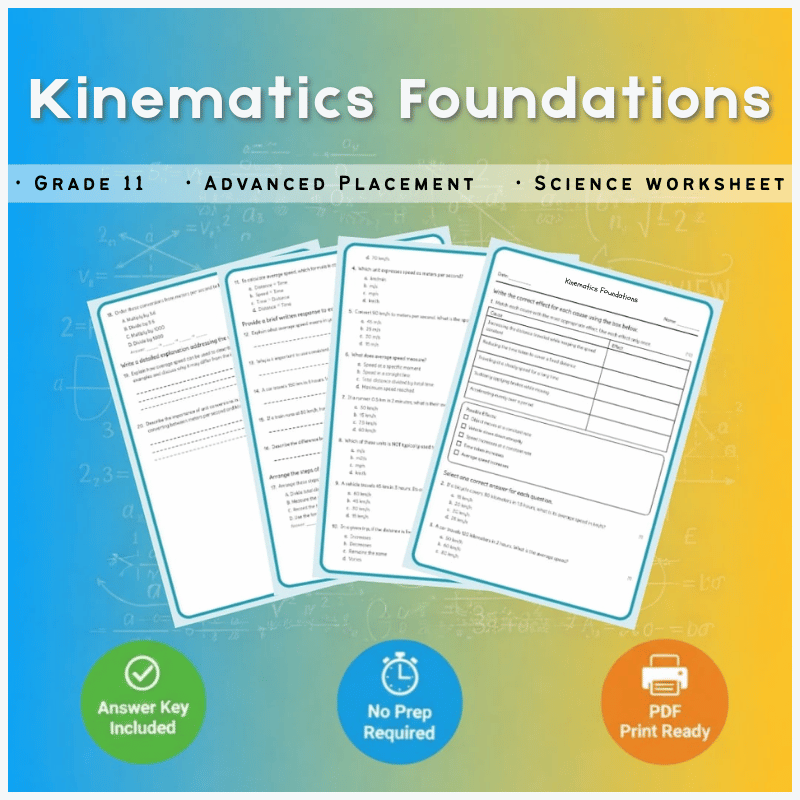
Grade 11 Science – Kinematics Foundations Worksheet (AP Standard) (PDF)
Created byBright Mind ResourcesLearning Objectives
- Define and distinguish between position, displacement, speed, velocity, and acceleration in linear motion.
- Apply algebraic formulas and graphical representations including position–time and velocity–time graphs to analyze motion.
- Use constant-acceleration equations to solve problems involving uniformly accelerated motion.
Instant download
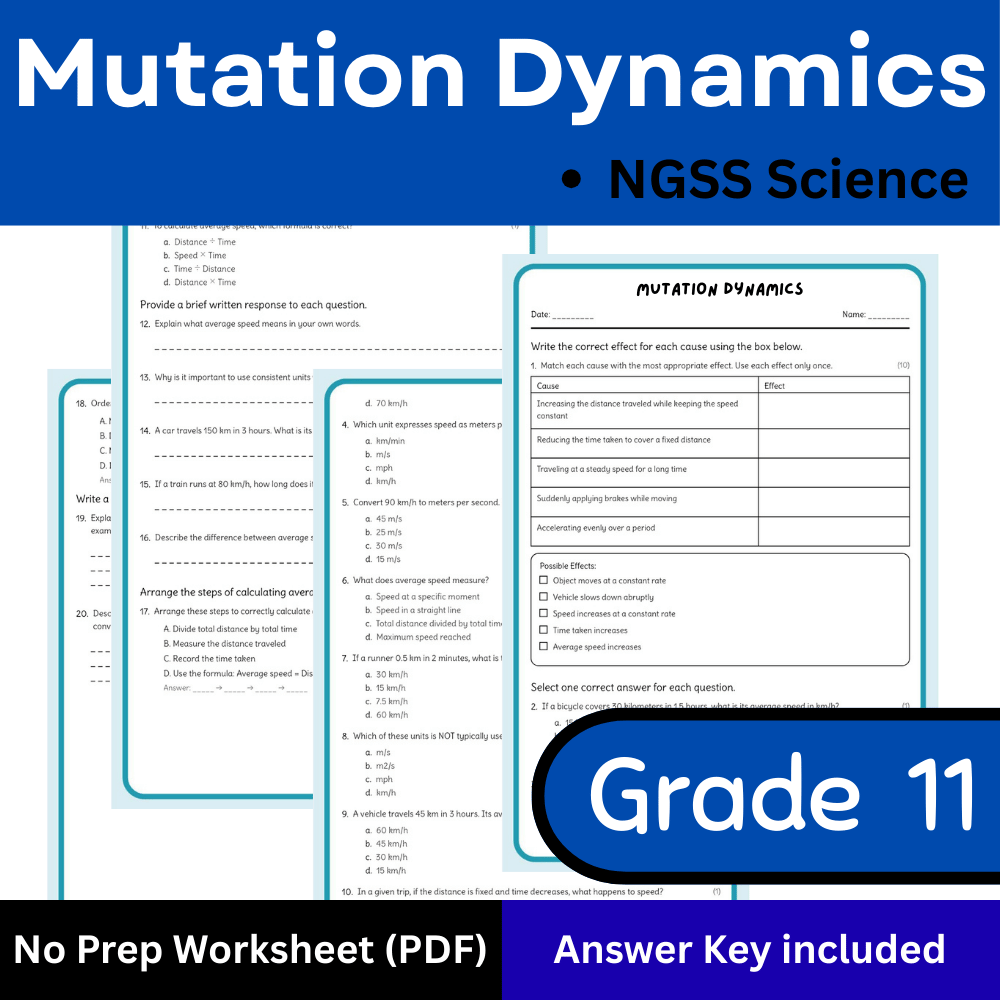
Grade 11 Science – Mutation Dynamics Worksheet (NGSS Aligned PDF)
Created byBright Mind ResourcesLearning Objectives
- Describe sources and mechanisms of genetic mutations and chromosomal alterations.
- Identify different types of mutations and their effects on proteins.
- Explain how mutation rates influence genetic variation within populations.
Instant download
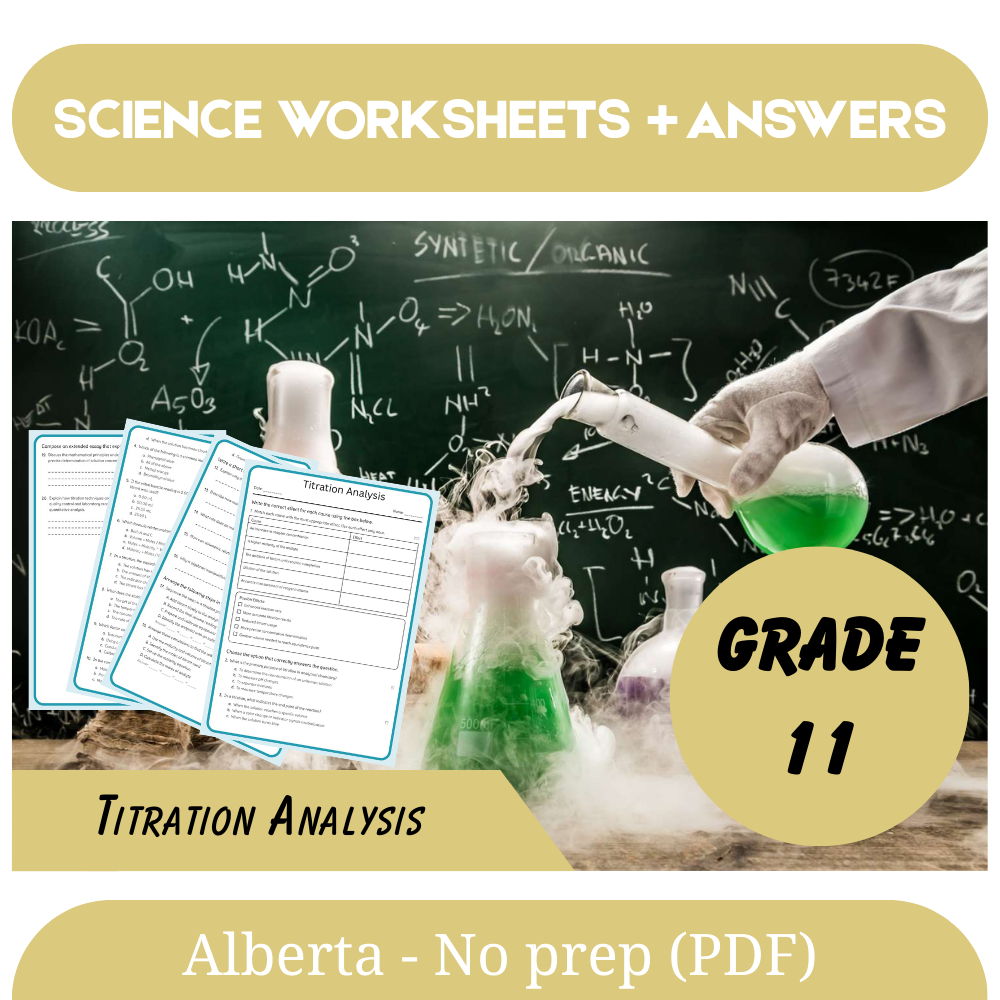
Grade 11 Science – Titration Analysis Worksheet (PDF) | Alberta Standards
Created byBright Mind ResourcesLearning Objectives
- Understand the mathematical basis of titration calculations using molarity and reaction stoichiometry.
- Apply algebraic manipulation to determine unknown concentrations in titration scenarios.
- Interpret equivalence relationships to understand the quantitative connections in titration analysis.
Instant download
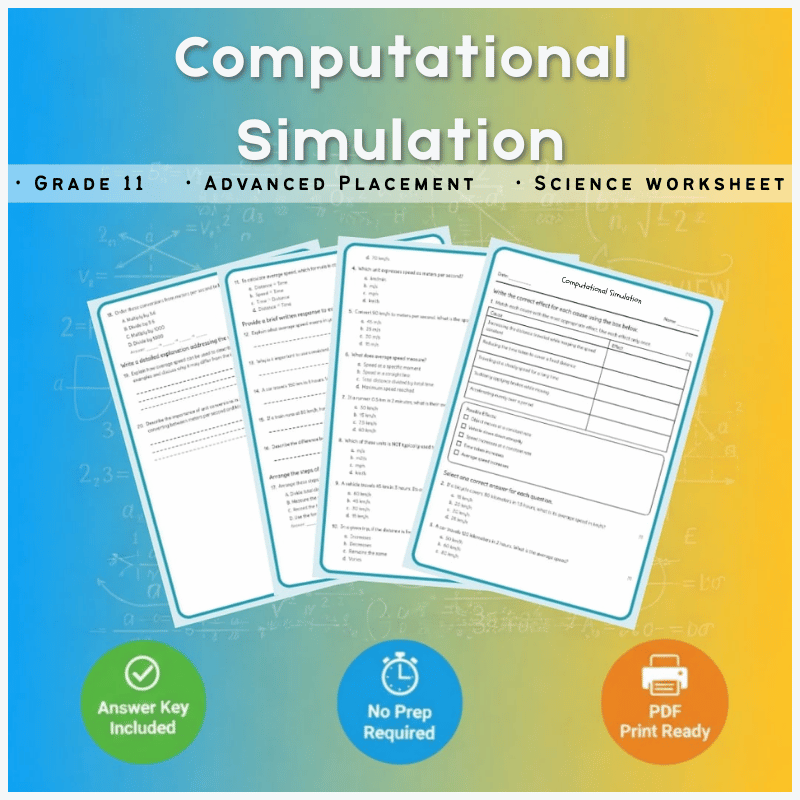
Grade 11 Science | Computational Simulation Worksheet (AP Standard) - PDF
Created byBright Mind ResourcesLearning Objectives
- Understand the basic numerical methods used to simulate dynamic systems.
- Identify sources of numerical error and their impact on simulation fidelity.
- Compare simulated outputs with analytical solutions and observational data.
Instant download
Grade 11 Science – Kinetics Principles Worksheet (AP Standard) | PDF
Created byBright Mind ResourcesLearning Objectives
- Describe and interpret rate laws, reaction order, and integrated rate expressions.
- Connect collision theory and transition-state ideas to temperature dependence and activation energy.
- Relate Arrhenius parameters to observable rate changes.
Instant download
Grade 11 Science | Membrane Energetics Worksheet (AP Standard) PDF
Created byBright Mind ResourcesLearning Objectives
- Understand the principles of bioenergetics related to membrane energy transduction.
- Describe how proton gradients and electron transport chains generate ATP in aerobic and photosynthetic systems.
- Analyze electrochemical potentials and redox diagrams to relate electron flow to ATP yield.
Instant download
Grade 11 Science – Molecular Phylogeny Worksheet + Answer Key (TEKS Aligned)
Created byBright Mind ResourcesLearning Objectives
- Understand how DNA, RNA, and protein sequences are used to infer evolutionary relationships.
- Describe the process of sequence alignment and its importance in molecular phylogeny.
- Explain models of molecular evolution and how they account for substitution rates.
Also included in: Grade 11 Science | Evolution & Phylogenetics Worksheet Bundle (TEKS Aligned) +2 more
Instant download
Grade 11 Science | Phase Behavior Worksheet (AP Standard) with Answer Key (PDF)
Created byBright Mind ResourcesLearning Objectives
- Interpret phase diagrams, vapor pressure curves, and colligative property trends in relation to intermolecular interactions.
- Connect solute–solvent interactions, vapor–liquid equilibria, and freezing-point depression to cohesive forces.
- Use quantitative relations for boiling point elevation and osmotic behavior while considering deviations due to molecular interactions.
Instant download
Browse more categories
About Reading comprehension Worksheets
Find reading comprehension worksheets for class practice, homework, or self-study. All 40,284 are instant PDF downloads.
Each resource here is built by an independent educator and reviewed for quality. Worksheets print straight from PDF and suit classroom use, homework, or extra practice; most come with answer keys, and you can preview before purchasing.