
Reading comprehension Worksheets
40,284 type resources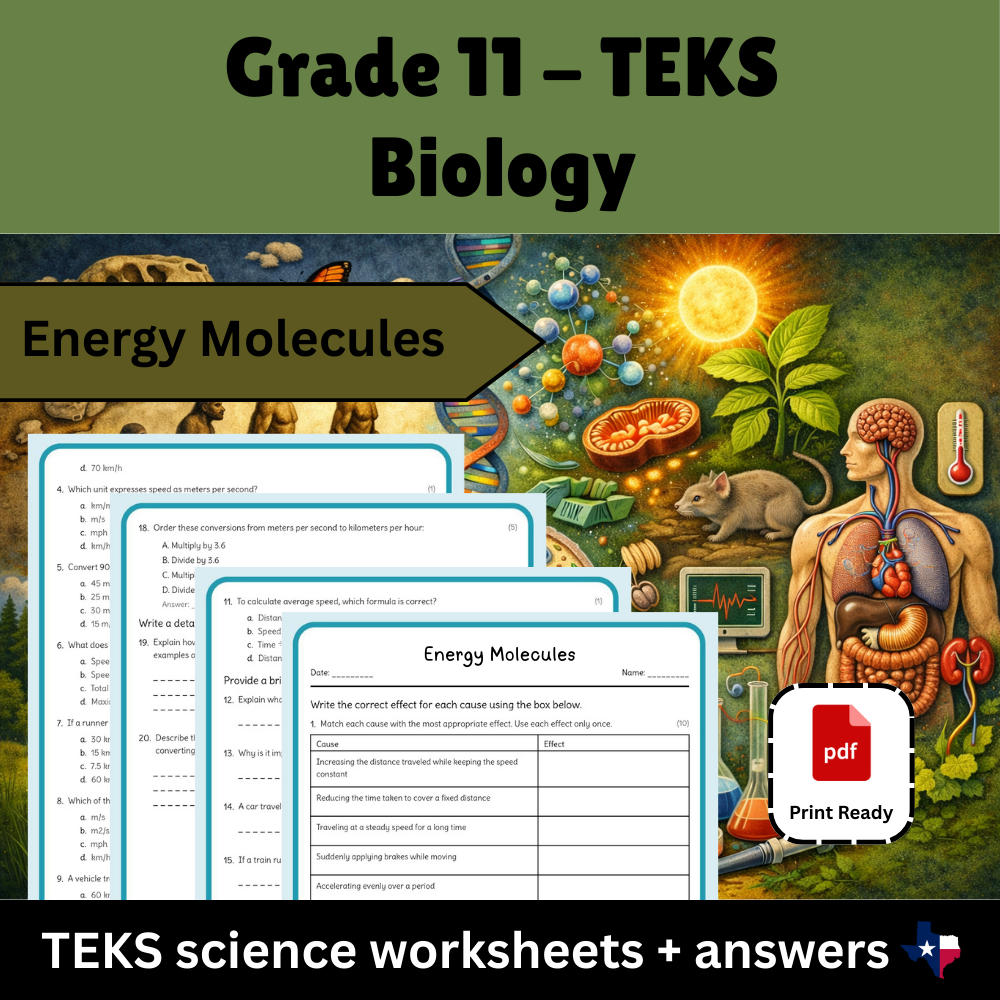
Grade 11 Science | Energy Molecules TEKS Worksheet (PDF) with Answer Key
 Created byBright Mind Resources
Learning Objectives
- Describe the function of ATP as the primary energy carrier in cells.
- Explain how cells produce ATP through different metabolic pathways.
- Identify the processes that utilize ATP energy for cellular functions.
Also included in: Grade 11 Science Unit Bundle – Cell Function, Respiration & Photosynthesis-TEKS +2 more
Instant download
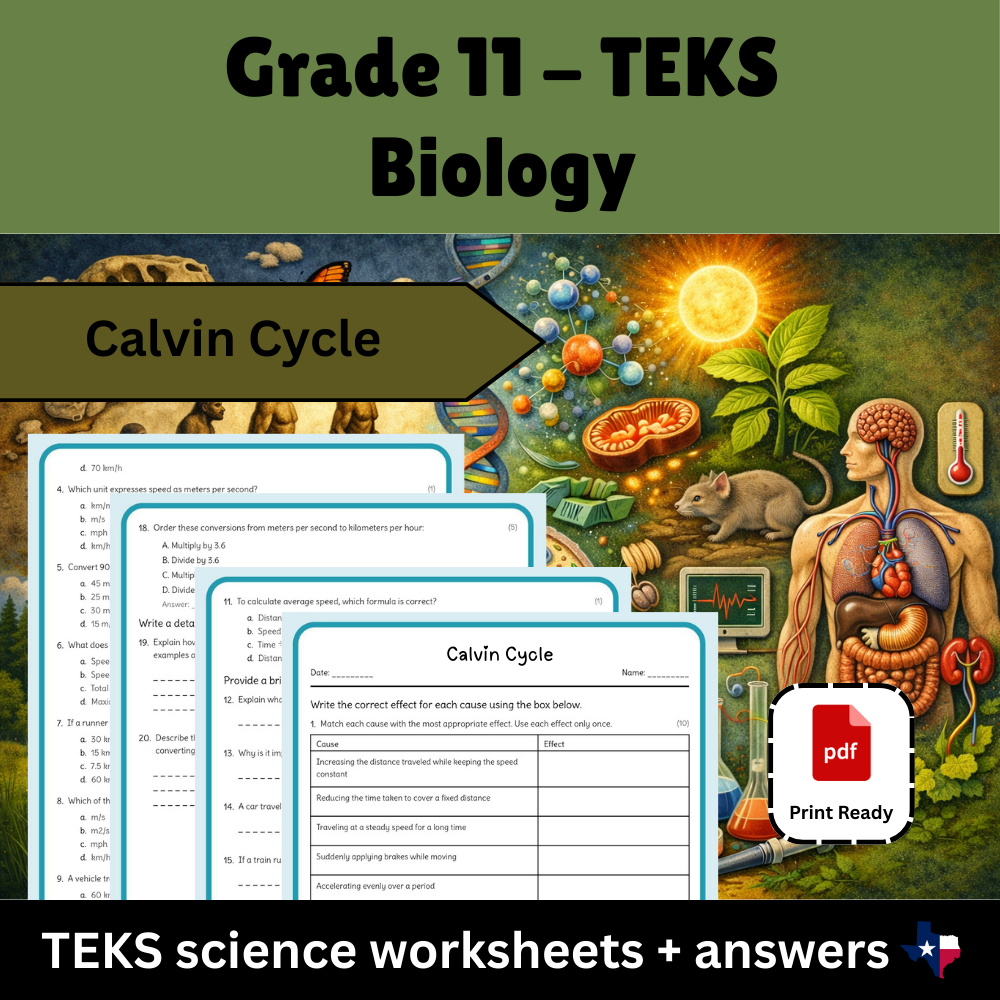
Grade 11 Science | Calvin Cycle Worksheet (Answer Key) – TEKS Aligned
Created byBright Mind ResourcesLearning Objectives
- Explain the key steps and enzyme functions involved in the Calvin cycle.
- Identify the molecules and energy sources utilized in the process.
- Describe the output products formed from the Calvin cycle and their significance.
Also included in: Grade 11 Science Unit Bundle – Cell Function, Respiration & Photosynthesis-TEKS +2 more
Instant download
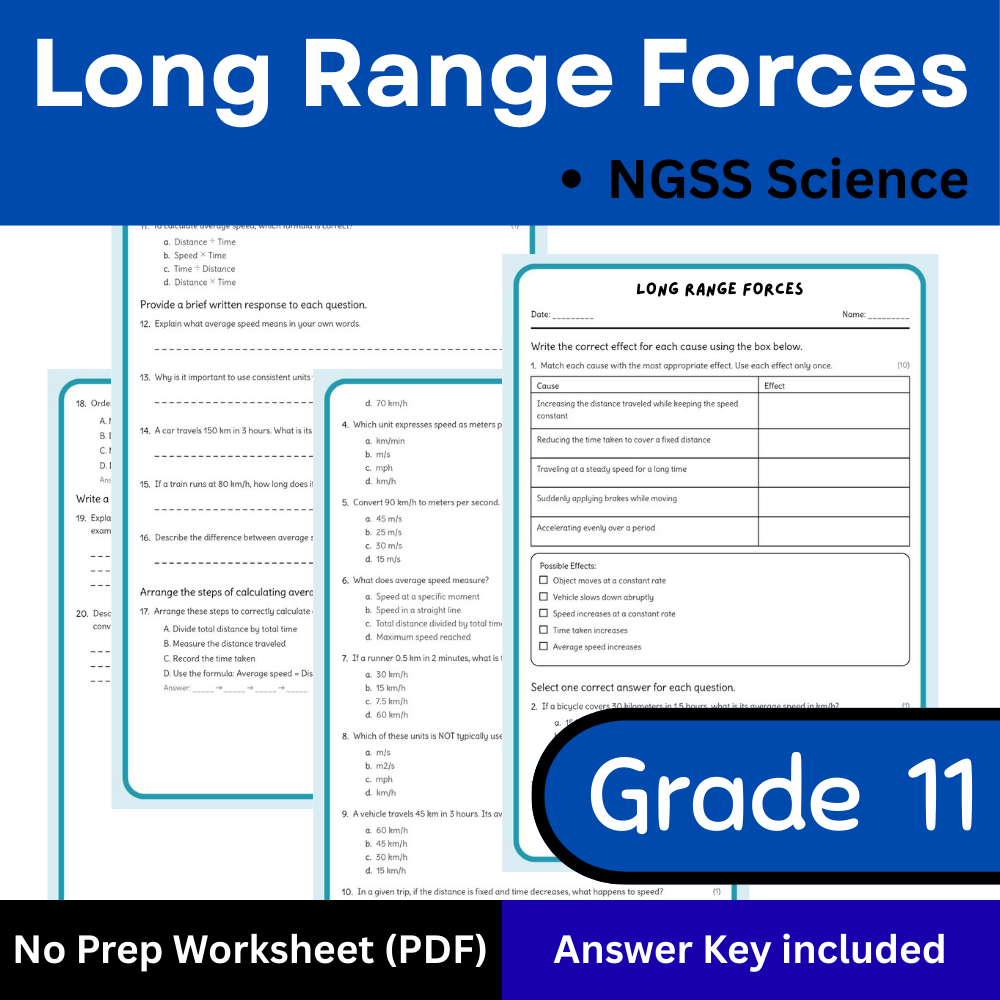
Grade 11 Science | Long Range Forces Worksheet + Answer Key (NGSS Aligned)
Created byBright Mind ResourcesLearning Objectives
- Understand and apply Newton's law of universal gravitation and Coulomb's law using inverse-square relationships.
- Use vector addition to compute net forces and predict particle motion.
- Analyze complex systems of interacting bodies, including two-body, multi-body, and point-charge arrangements.
Instant download
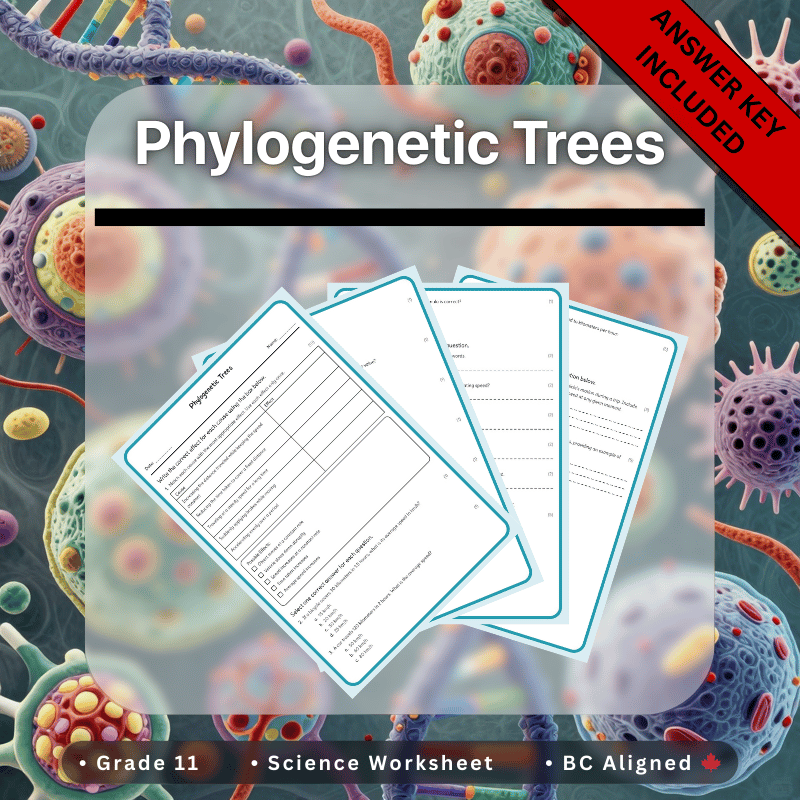
Grade 11 Science | Phylogenetic Trees Worksheet (Answer Key) – BC Standards
Created byBright Mind ResourcesLearning Objectives
- Understand how phylogenetic trees illustrate hypotheses of evolutionary relationships.
- Identify different methods used to infer evolutionary histories, such as parsimony and molecular clock.
- Distinguish between homologous traits and analogous traits in evolutionary analysis.
Instant download
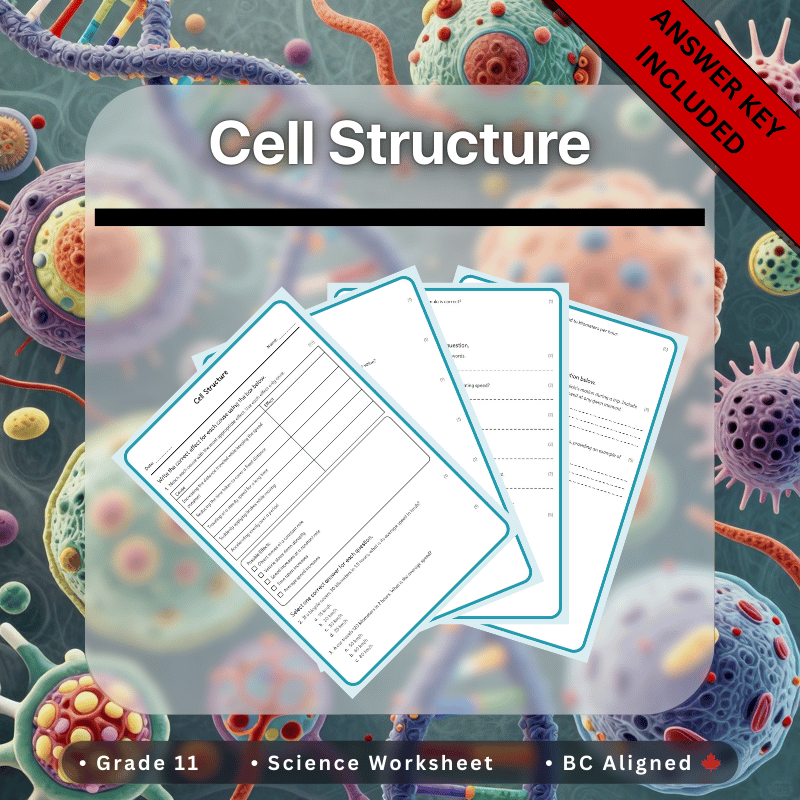
Grade 11 Science – Cell Structure Worksheet (PDF) | BC Standard & Answer Key
Created byBright Mind ResourcesLearning Objectives
- Identify the key components of a cell and their functions.
- Explain differences between prokaryotic and eukaryotic cells.
- Understand how microscopy and models represent cellular structures.
Instant download
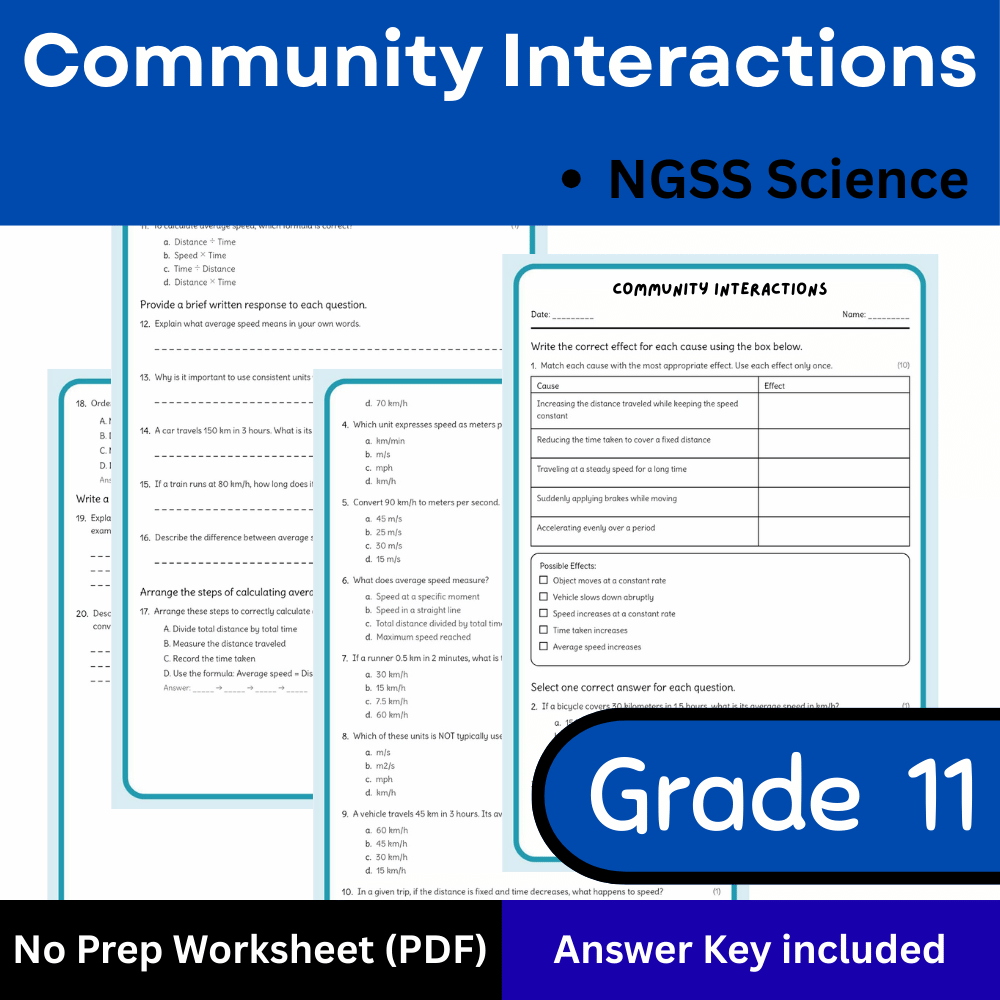
Grade 11 Science | Community Interactions Worksheets (NGSS Aligned + PDF)
Created byBright Mind ResourcesLearning Objectives
- Analyze various species interactions such as competition, mutualism, predation, parasitism, facilitation, and niche partitioning.
- Understand the roles of keystone species and trophic cascades in shaping community structure.
- Examine real-world examples like sea otter-kelp forest dynamics and pollinator networks.
Instant download
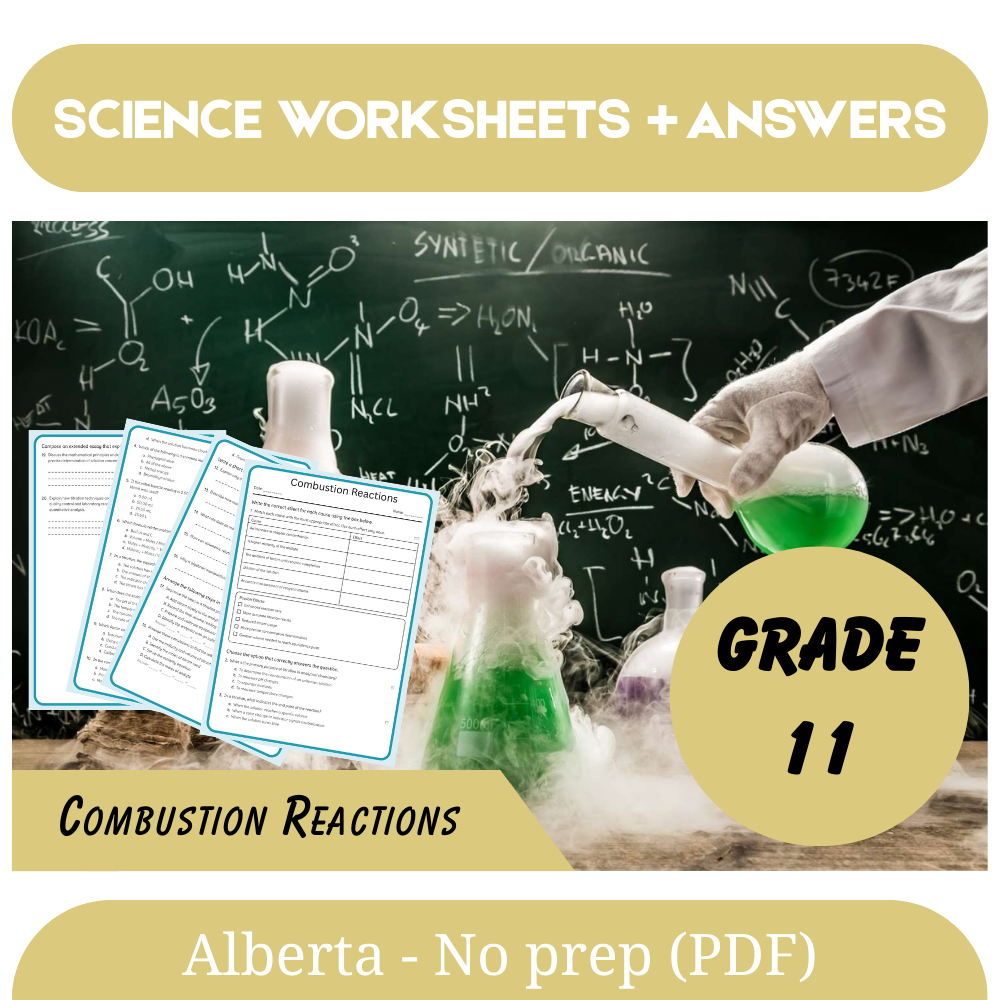
Grade 11 Science – Combustion Reactions Worksheet (PDF) – Alberta Standards
Created byBright Mind ResourcesLearning Objectives
- Understand the process of combustion and oxidation of fuels
- Identify the pollutants generated during combustion and their environmental impact
- Calculate oxygen demand and interpret emissions data for combustion processes
Instant download
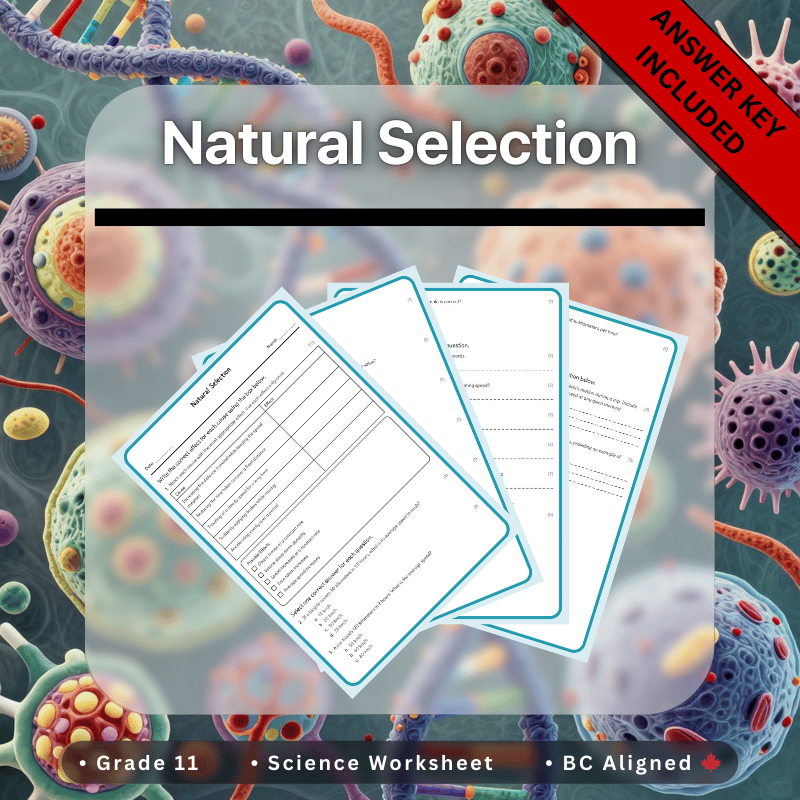
Grade 11 Science | Natural Selection Worksheet + Answer Key (PDF) – BC Standard
Created byBright Mind ResourcesLearning Objectives
- Explain how natural selection acts on heritable variation within populations.
- Identify different modes of selection: directional, stabilizing, and disruptive.
- Describe environmental factors that influence selection regimes.
Instant download
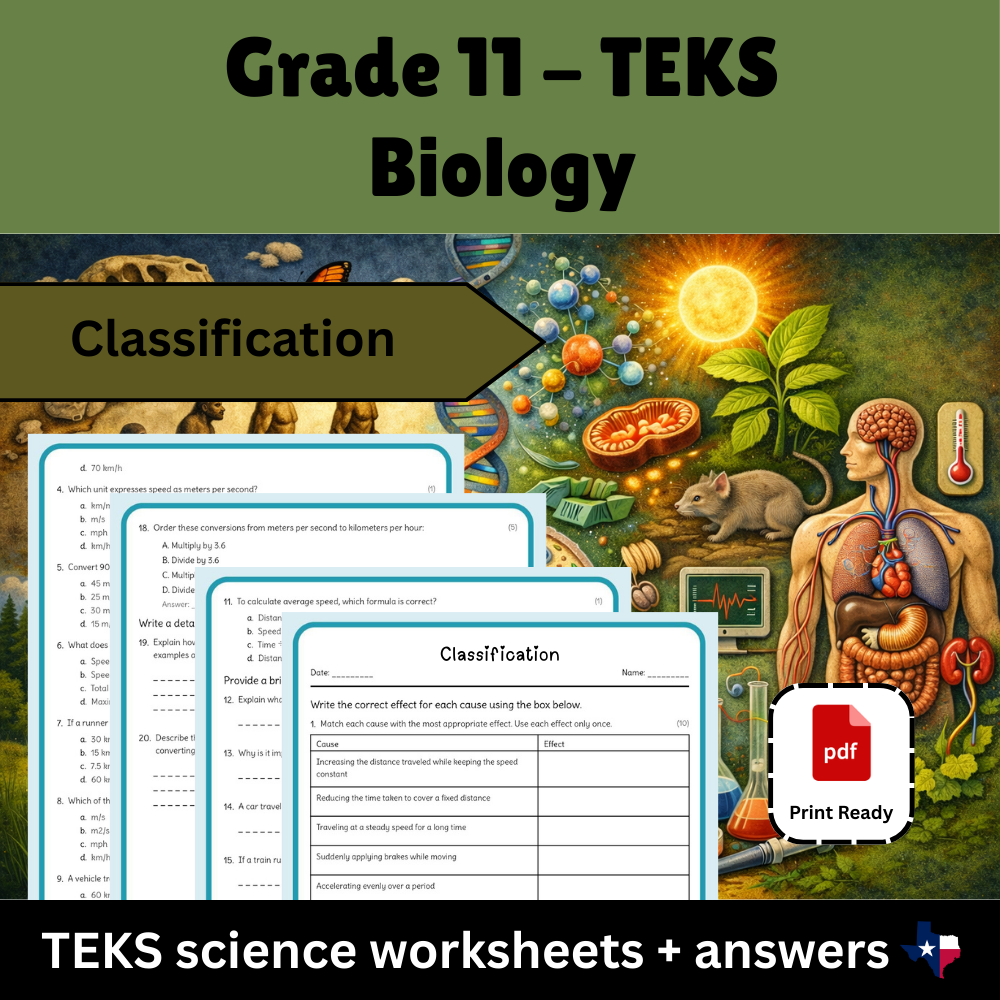
Grade 11 Science | Classification Methods Worksheet (Answer Key) – TEKS-Aligned
Created byBright Mind ResourcesLearning Objectives
- Understand different approaches used in biological classification such as morphological, molecular, and computational methods.
- Describe how cladistic analysis identifies monophyletic groups based on shared derived characters.
- Compare phenetic and cladistic approaches to taxonomy and classification.
Also included in: Grade 11 Science | Evolution & Phylogenetics Worksheet Bundle (TEKS Aligned) +2 more
Instant download
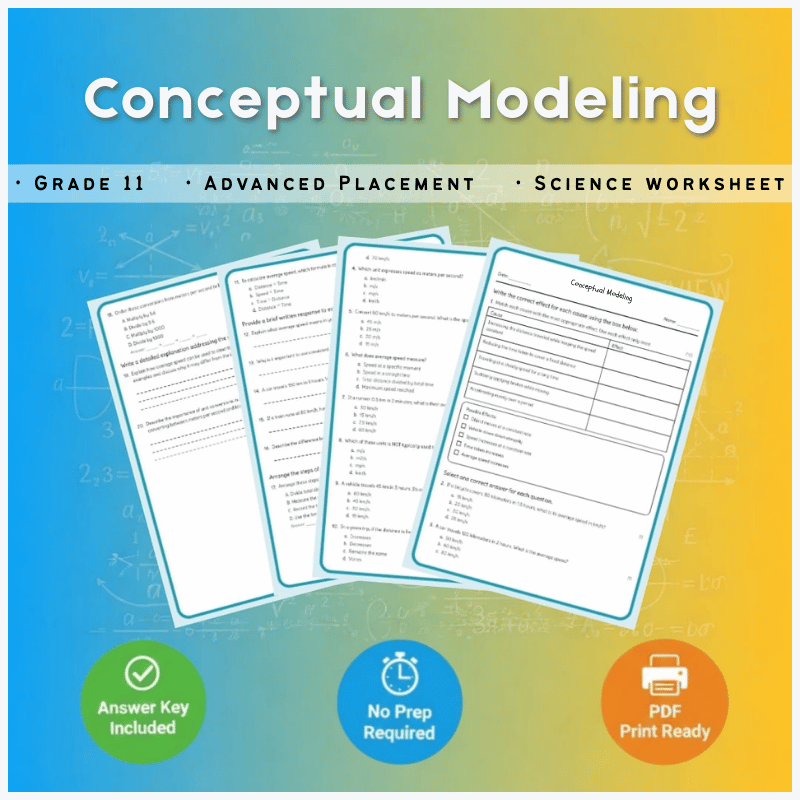
Grade 11 Science | Conceptual Modeling Worksheet (AP Standards) – PDF
Created byBright Mind ResourcesLearning Objectives
- Understand what a conceptual model represents and how it connects mechanisms to observable phenomena.
- Identify components, assumptions, scope, and qualitative predictions in conceptual models.
- Differentiate between discrete and continuous formulations in modeling.
Instant download
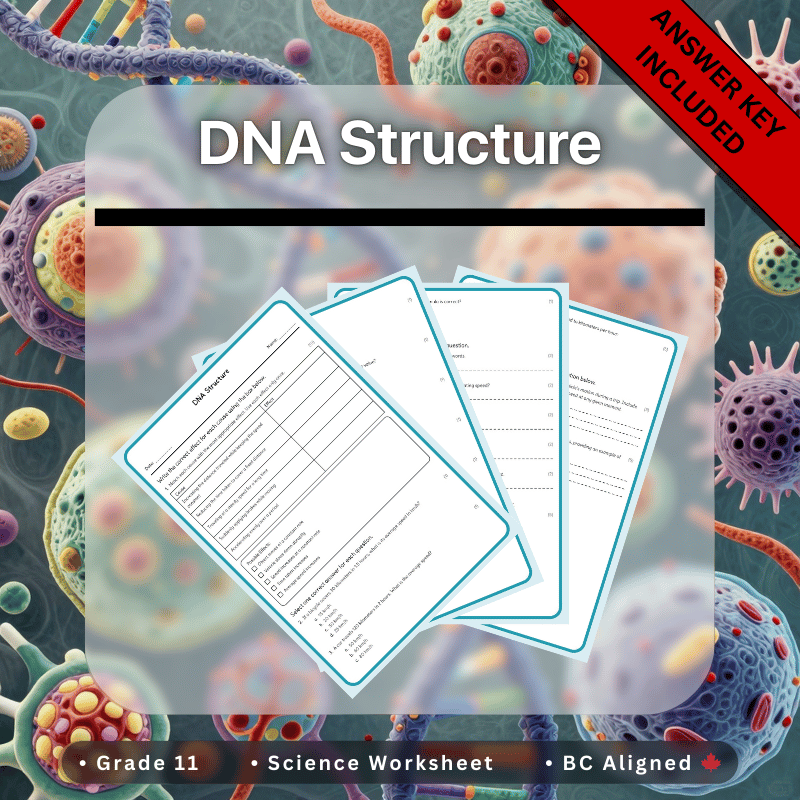
Grade 11 Science | DNA Structure Worksheet + Answer Key – BC Standards (PDF)
Created byBright Mind ResourcesLearning Objectives
- Describe the fundamental components of DNA and their functions.
- Explain the significance of complementary base pairing and the double helix structure.
- Analyze how mutations such as substitutions, insertions, and deletions affect genetic information.
Instant download
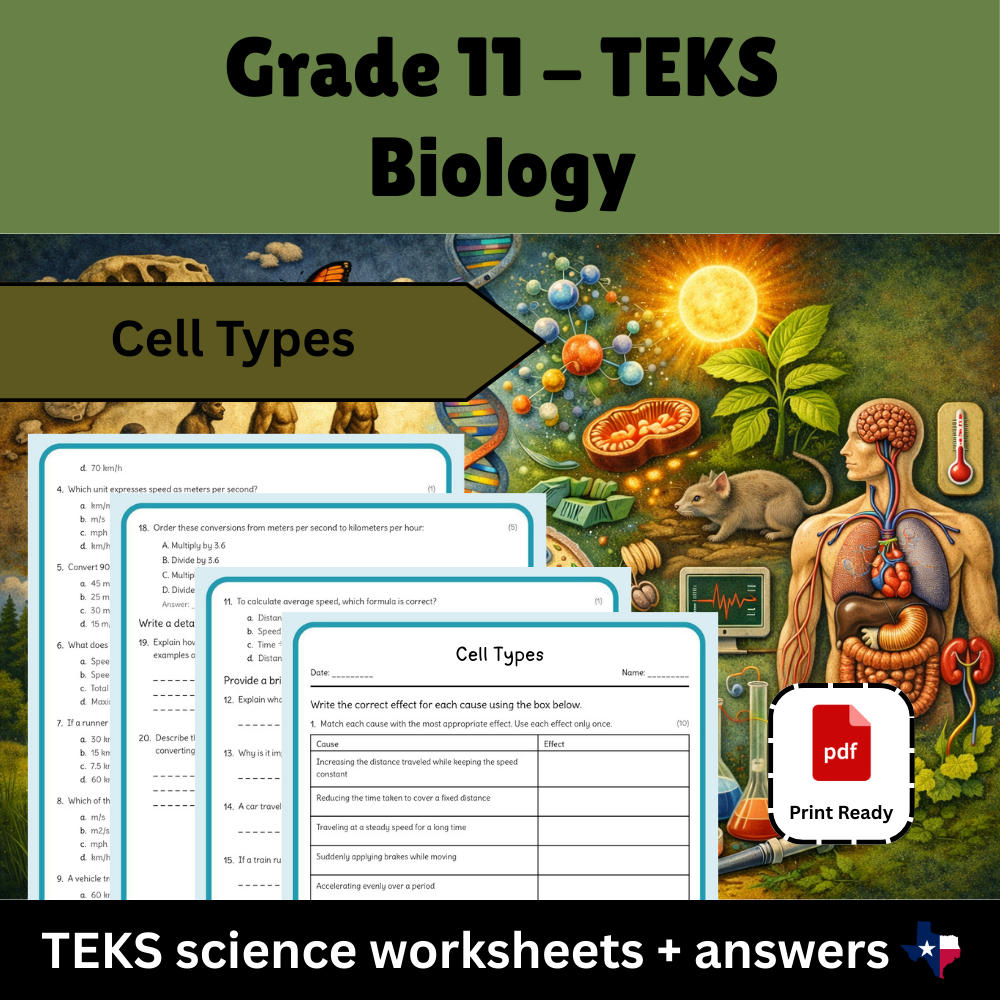
Grade 11 Science | Cell Types Worksheet (TEKS) – Science 1 PDF
Created byBright Mind ResourcesLearning Objectives
- Differentiate between prokaryotic and eukaryotic cell structures.
- Identify key features of prokaryotic and eukaryotic cells.
- Explain how cell complexity affects function and ecology.
Also included in: Grade 11 Science | Cell & Systems Dynamics Unit Worksheet Bundle (TEKS-Aligned) +2 more
Instant download
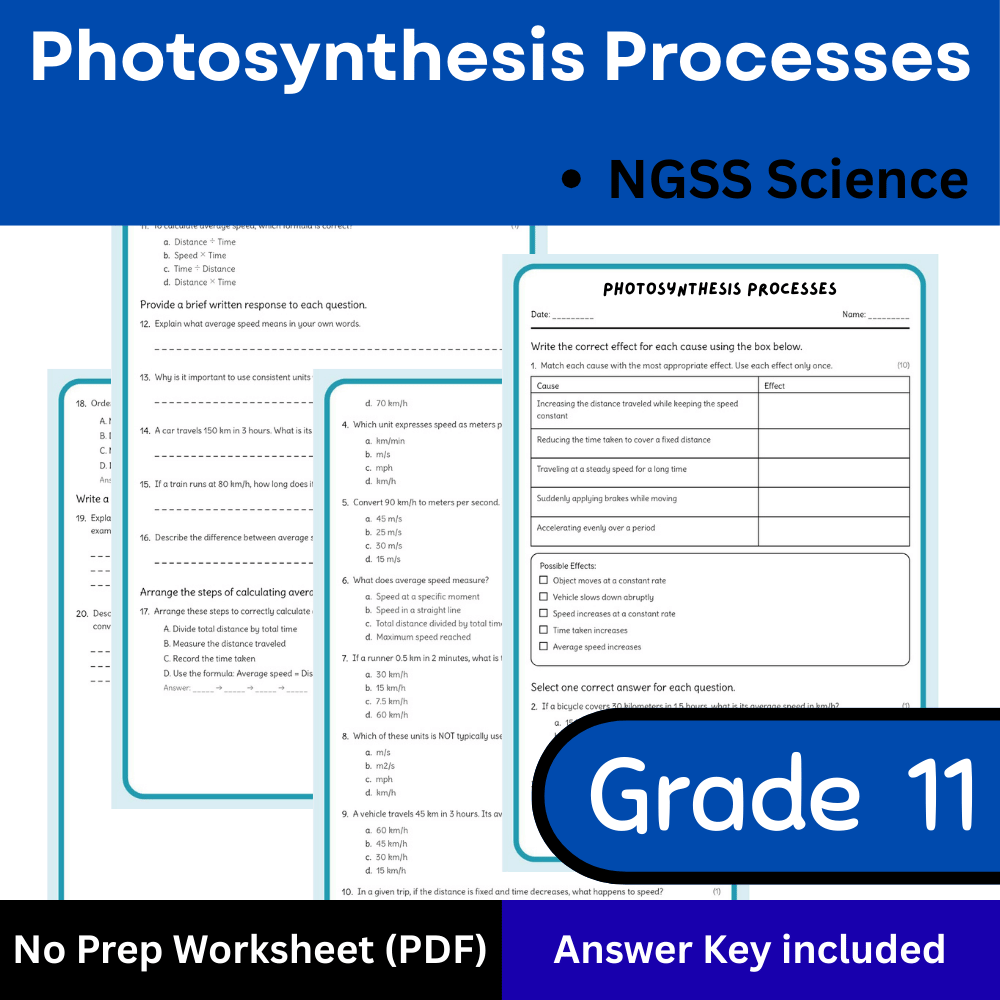
Grade 11 Science – Photosynthesis Processes Worksheet (NGSS Aligned, PDF)
Created byBright Mind ResourcesLearning Objectives
- Explain the light-driven and biochemical stages of photosynthesis, including electron transport, photophosphorylation, and the Calvin cycle.
- Describe the roles of chloroplasts, mitochondria, and gas exchange in energy transfer and metabolism.
- Understand the stoichiometry of CO2 uptake and O2 release during photosynthesis and respiration.
Instant download
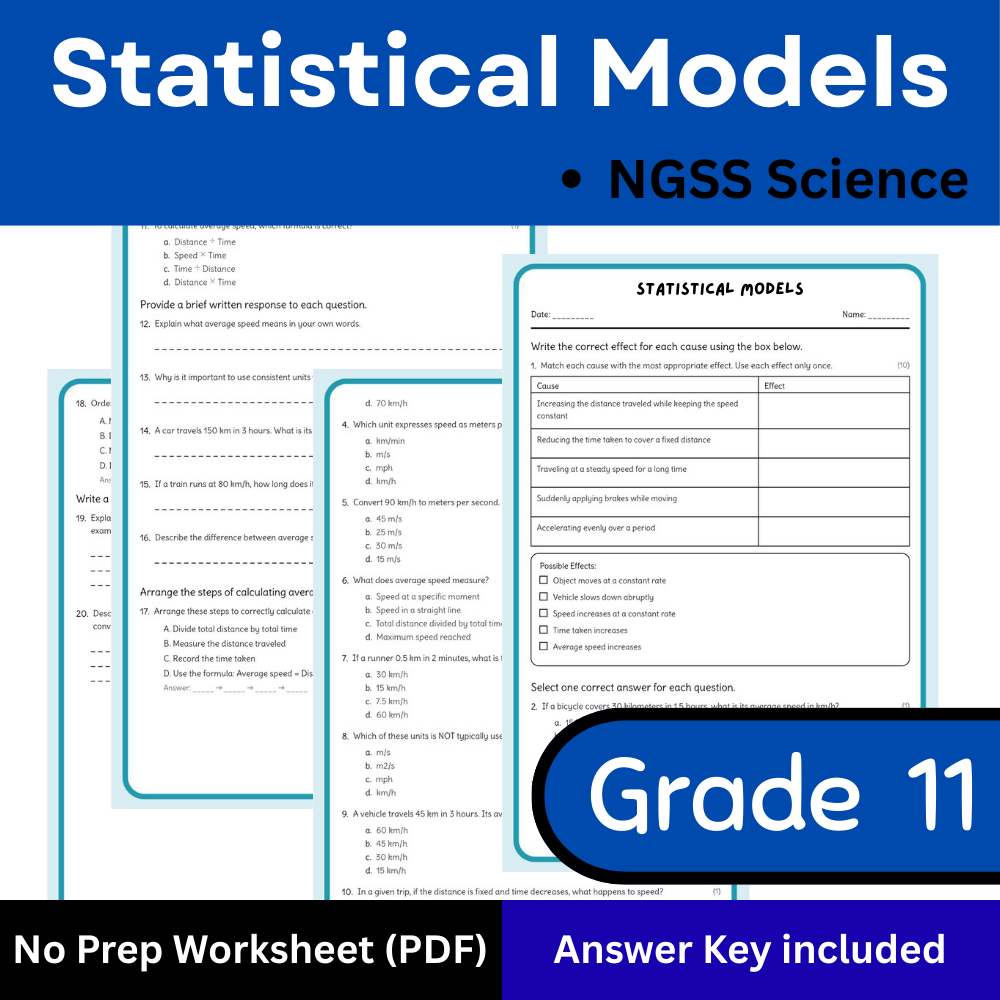
Grade 11 Science | Statistical Models & Population Genetics Worksheet (PDF)
Created byBright Mind ResourcesLearning Objectives
- Understand how statistical and probabilistic methods apply to allele frequencies and trait distributions.
- Develop and interpret Hardy–Weinberg equilibrium conditions and calculations.
- Use chi-square tests and confidence intervals to evaluate genetic data departures from expectations.
Instant download
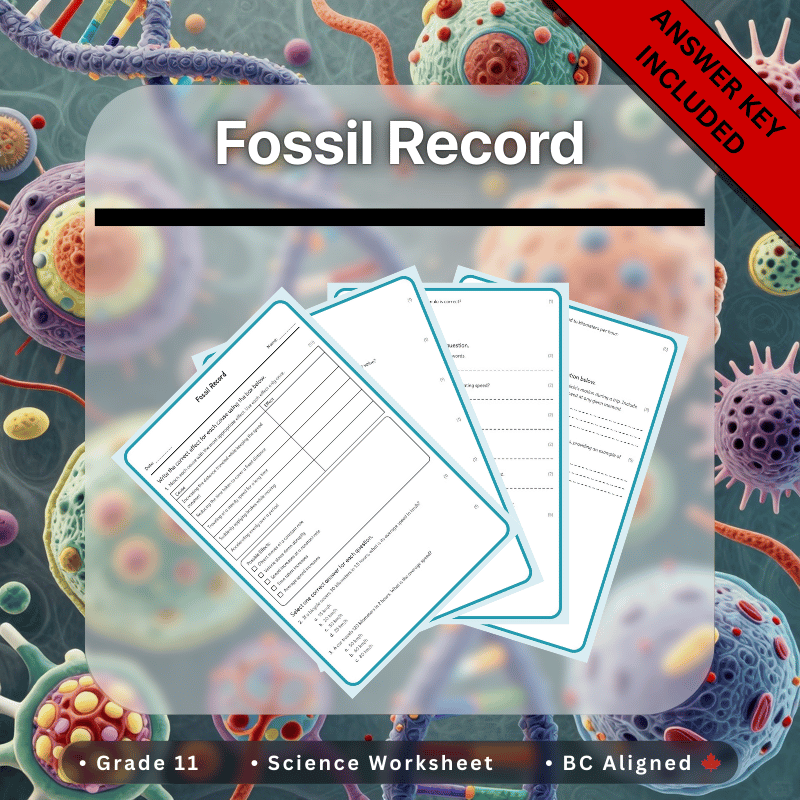
Grade 11 Science | Fossil Record Analysis Worksheet (Answer Key) – BC Standards
Created byBright Mind ResourcesLearning Objectives
- Understand how the fossil record documents evolutionary change over deep time.
- Identify key methods used to date fossils and establish temporal sequences.
- Explain the significance of transitional fossils in supporting descent with modification.
Instant download
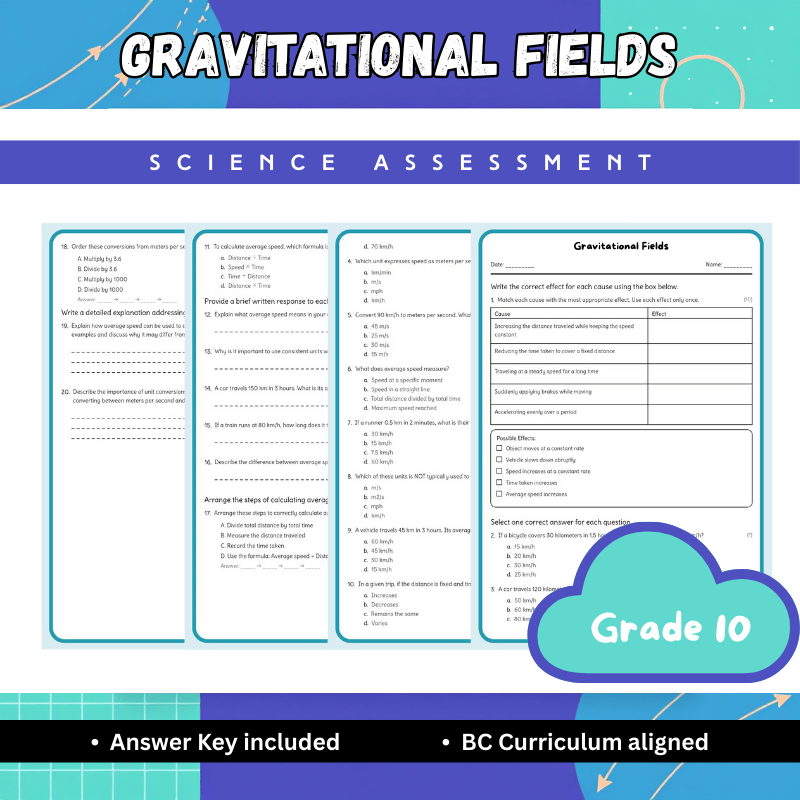
Grade 10 Science – Gravitational Fields Worksheet (PDF) | BC Standards
Created byBright Mind ResourcesLearning Objectives
- Understand the concept of gravitational fields and their influence on space.
- Describe how field strength decreases with distance according to an inverse-square law.
- Explain the effects of gravitational fields on orbital motion.
Instant download
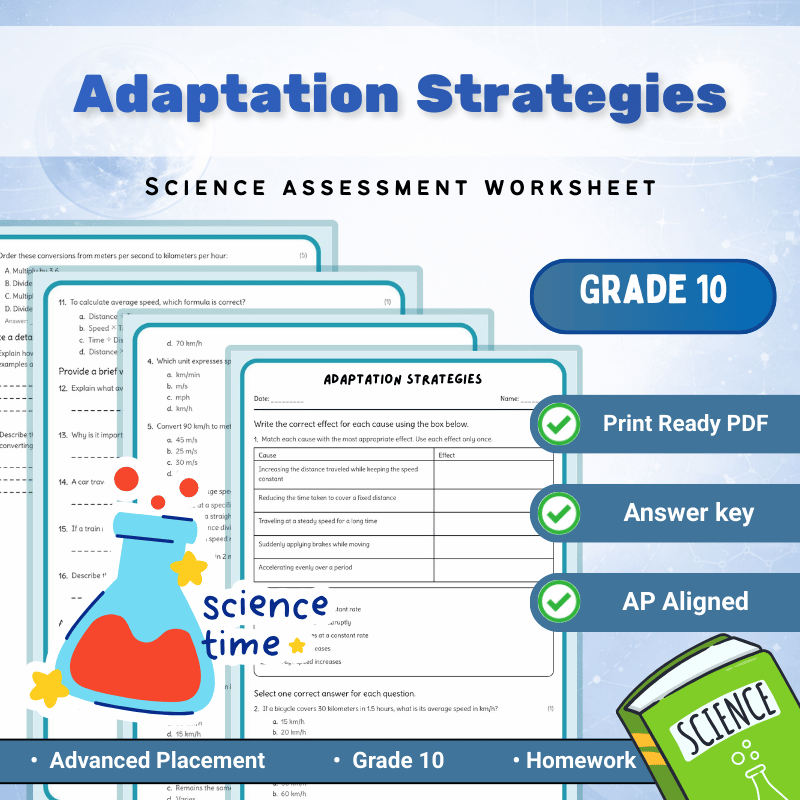
Grade 10 Science | Adaptation Strategies Worksheet (AP Standard) – PDF
Created byBright Mind ResourcesLearning Objectives
- Understand different adaptation strategies for Earth systems and their potential effects.
- Evaluate the trade-offs involved in carbon management, resilience, conservation, and land-use policies.
- Apply systems diagrams and scenario comparison techniques to assess intervention effectiveness.
Instant download
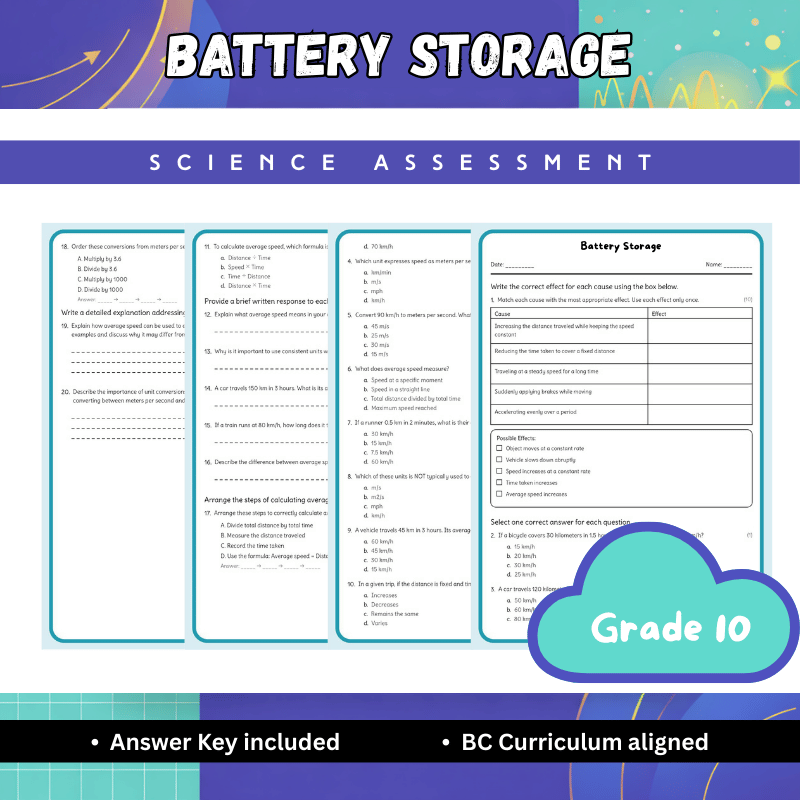
Grade 10 Science | Battery Storage Concepts Worksheet (Worksheet + Answer Key)
Created byBright Mind ResourcesLearning Objectives
- Understand how battery storage converts chemical energy to electrical energy and vice versa.
- Explain factors affecting battery efficiency and capacity over charge–discharge cycles.
- Analyze the impact of internal resistance, heat, and side reactions on battery performance.
Instant download
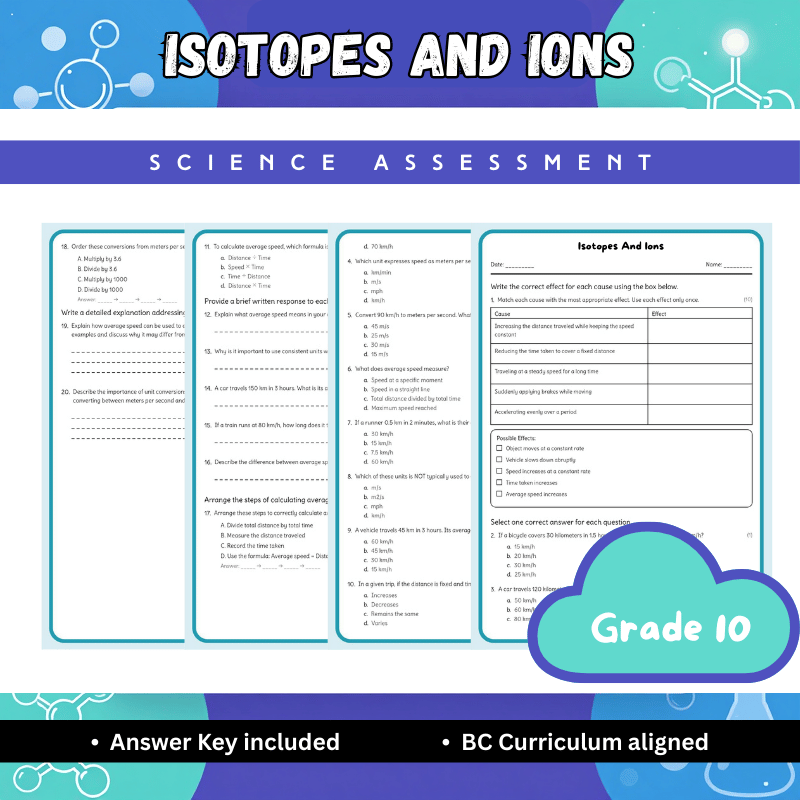
Grade 10 Science | Isotopes and Ions Worksheet (Answer Key) – BC Standards
Created byBright Mind ResourcesLearning Objectives
- Understand the concept of isotopes and how they differ from each other
- Recognize how ions are formed and how they differ from neutral atoms
- Explain the significance of isotopic variation in atomic mass and spectral signatures
Instant download
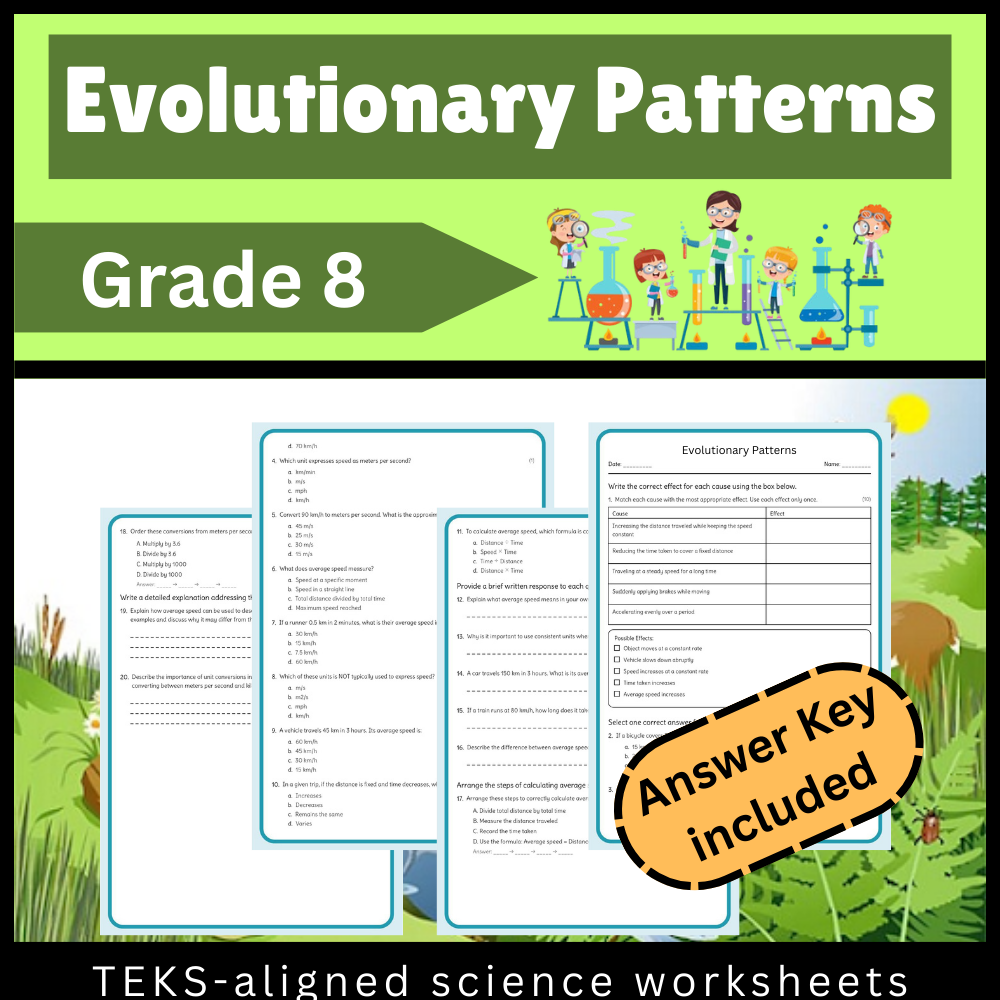
Grade 8 Science – Evolutionary Patterns Worksheet (PDF) | TEKS Standards
Created byBright Mind ResourcesLearning Objectives
- Identify sources of genetic variation and understand their role in evolution
- Explain how selective pressures influence trait distribution over generations
- Differentiate between natural selection and artificial selection
Also included in: Grade 8 Science Unit Bundle | Ecosystems,Evolution & Cell Processes TEKS Aligned +1 more
Instant download
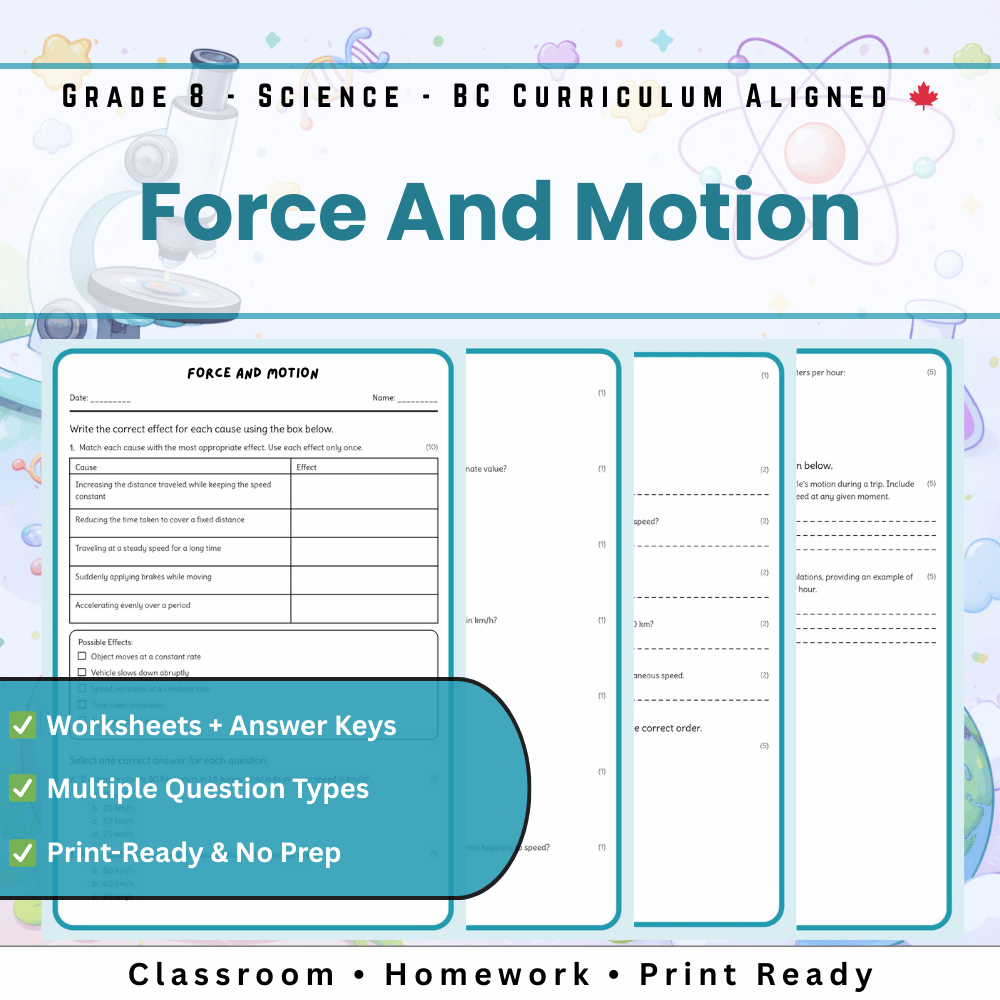
Grade 8 Science | Force & Motion Worksheets (Worksheet + Answer Key) PDF
Created byBright Mind ResourcesLearning Objectives
- Understand how net force affects the change in motion of an object.
- Explain the relationship between mass, force, and acceleration.
- Predict how doubling force or tripling mass influences an object's movement.
Instant download
Grade 8 Science | Genetic Diversity Worksheet + Answer Key (PDF) – BC Standards
Created byBright Mind ResourcesLearning Objectives
- Explain the importance of genetic diversity within populations.
- Identify factors that influence genetic variation among species.
- Analyze the consequences of low genetic diversity on species survival.
Instant download
Grade 8 Science Resource Distribution | NGSS-Aligned Worksheet (PDF)
Created byBright Mind ResourcesLearning Objectives
- Understand geological processes that affect resource formation and distribution.
- Identify different types of mineral, energy, and groundwater resources.
- Analyze how resource accessibility and quality vary regionally.
Also included in: Grade 8 Science Unit | Climate & Environment NGSS Worksheets & Resources +2 more
Instant download
Grade 8 Science | Material Origins Worksheet (NGSS Aligned PDF)
Created byBright Mind ResourcesLearning Objectives
- Understand how natural resources are transformed into synthetic materials.
- Identify the properties and applications of materials derived from different sources.
- Explore environmental and resource considerations in material sourcing and processing.
Also included in: Grade 8 Science | Molecular Structures & Energy Effects Unit Worksheet Pack-NGSS +2 more
Instant download
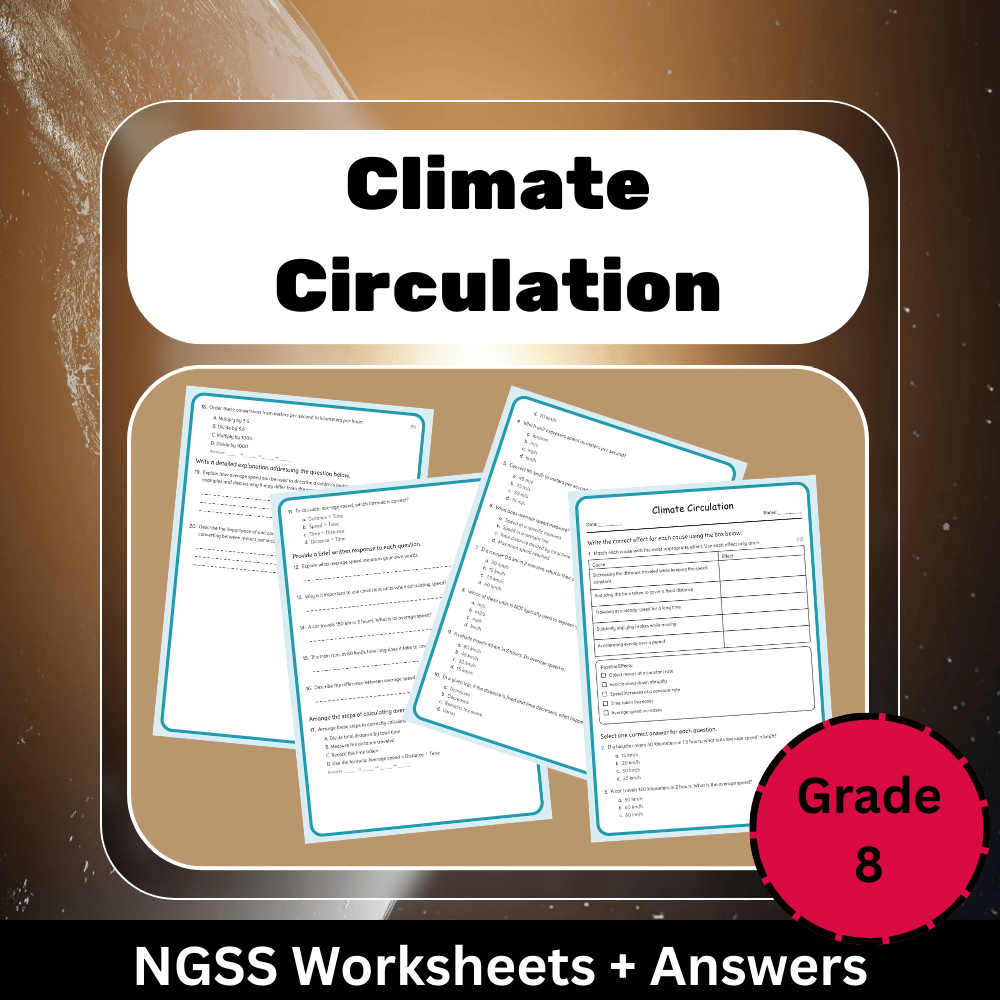
Grade 8 Science | Climate Circulation Concepts & NGSS Aligned Worksheet (PDF)
Created byBright Mind ResourcesLearning Objectives
- Explain the patterns of atmospheric and oceanic circulation driven by unequal solar heating and planetary rotation.
- Describe the functions of Hadley, Ferrel, and polar cells and their influence on regional climates.
- Analyze how Coriolis effect influences wind direction and ocean currents such as gyres and thermohaline circulation.
Also included in: Grade 8 Science Unit | Weather, Water Cycle & Climate Circulation Worksheets +2 more
Instant download
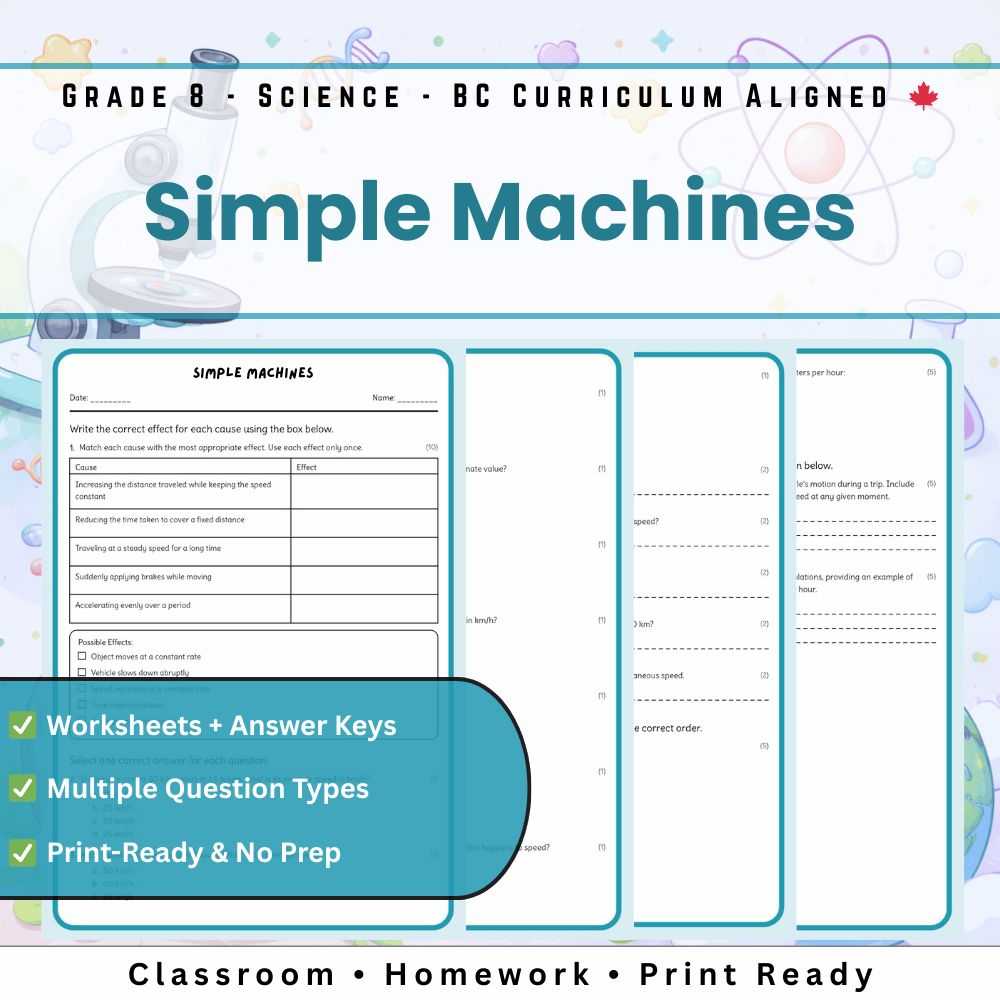
Grade 8 Science | Simple Machines Worksheet (Answer Key) – BC Standards
Created byBright Mind ResourcesLearning Objectives
- Understand how simple machines transfer energy through mechanical advantage.
- Identify the functions of levers, pulleys, and gears in mechanical systems.
- Explain how energy is conserved and losses occur in simple machines.
Instant download
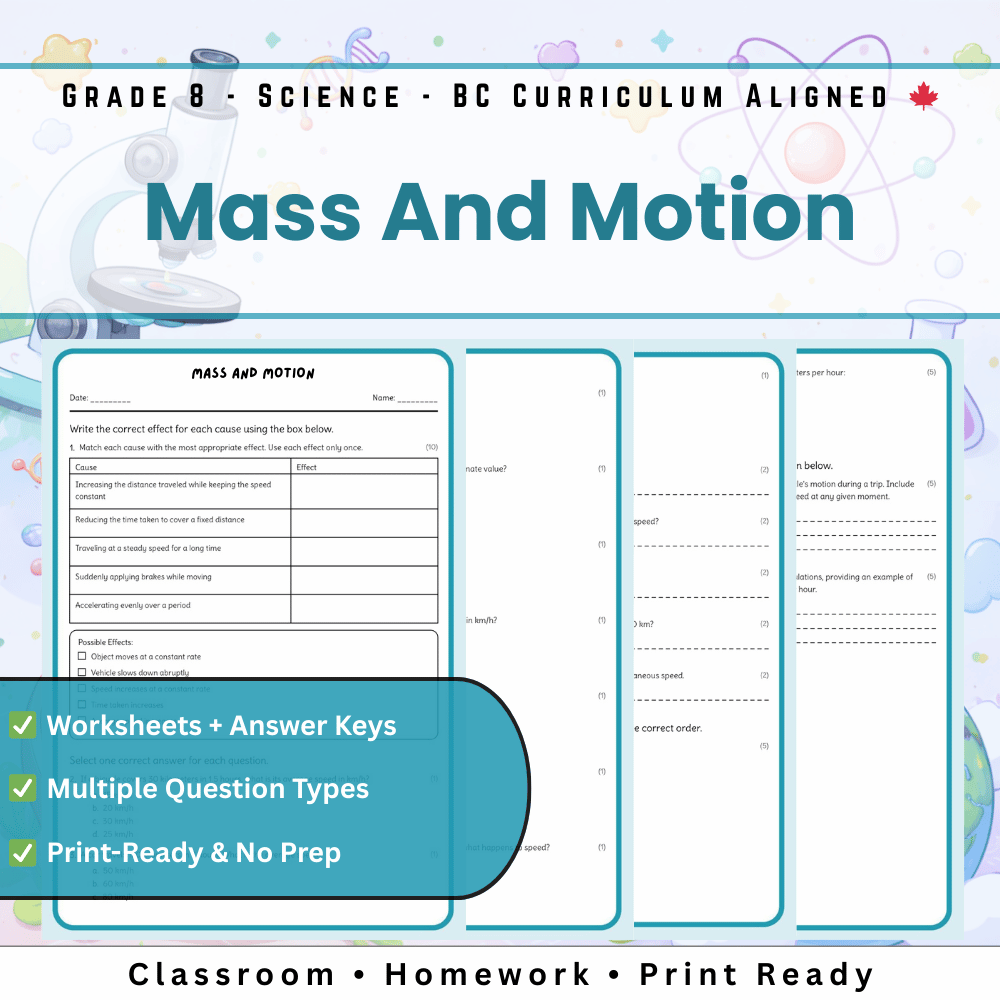
Grade 8 Science | Mass and Motion Worksheet (Answer Key) – BC Standard
Created byBright Mind ResourcesLearning Objectives
- Understand how mass influences the response to net force and motion.
- Explain the inverse relationship between mass and acceleration for a given net force.
- Compare the effects of the same applied force on objects of different masses.
Instant download
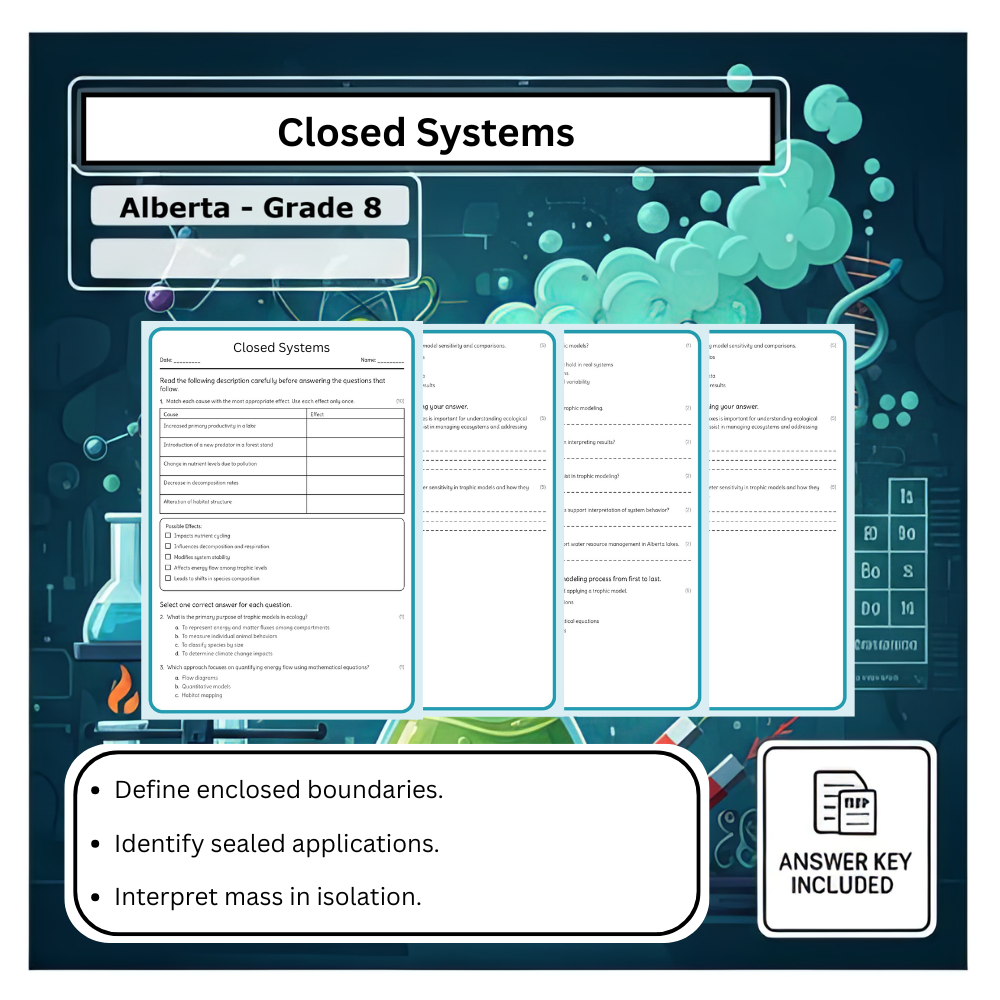
Grade 8 Science – Closed Systems Worksheet (Worksheet + Answer Key) | Alberta Standards
Created byBright Mind ResourcesLearning Objectives
- Understand the concept of closed-system analysis and its significance in chemical and environmental processes.
- Identify examples and applications of closed systems in real-world scenarios.
- Interpret mass conservation principles within enclosed systems.
Instant download
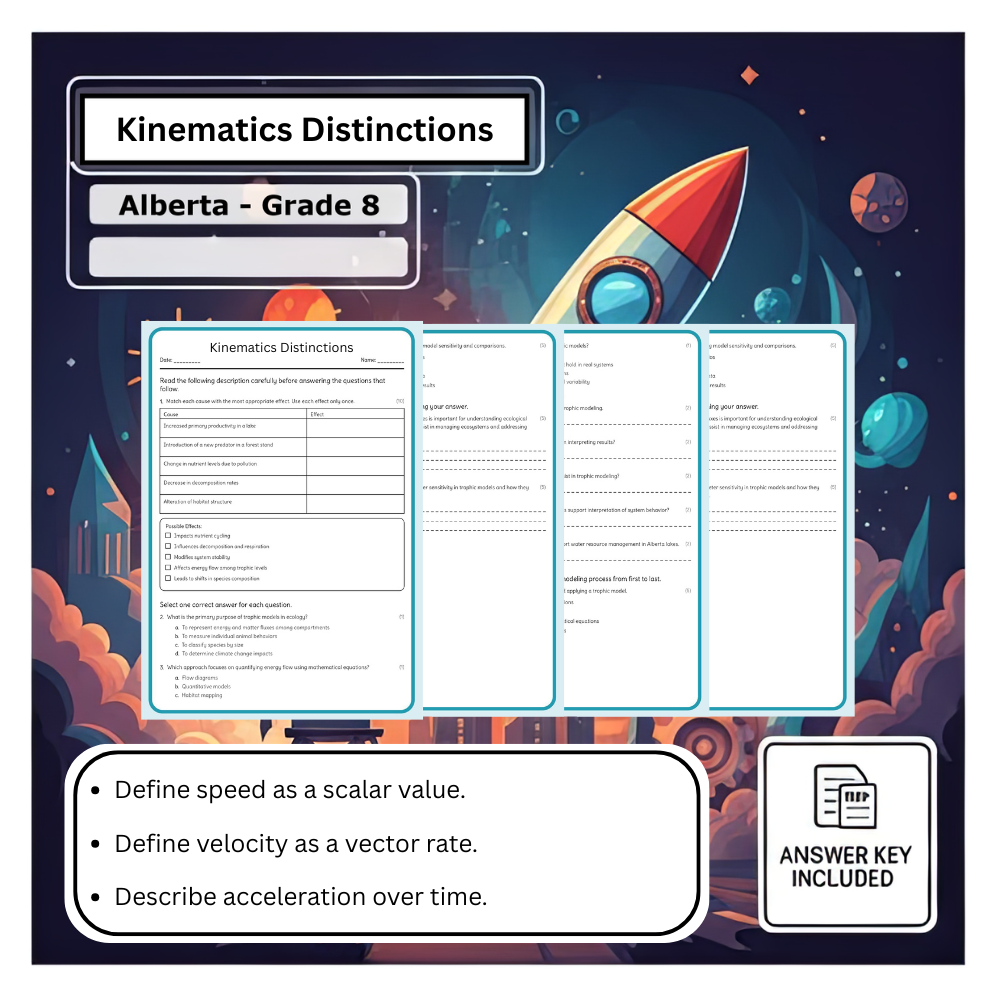
Grade 8 Science – Kinematics Distinctions Worksheet (PDF) – Alberta Standards
Created byBright Mind ResourcesLearning Objectives
- Define speed as a scalar quantity representing how fast an object moves.
- Explain velocity as a rate of change of position with both magnitude and direction.
- Describe acceleration as the rate at which velocity changes over time.
Instant download
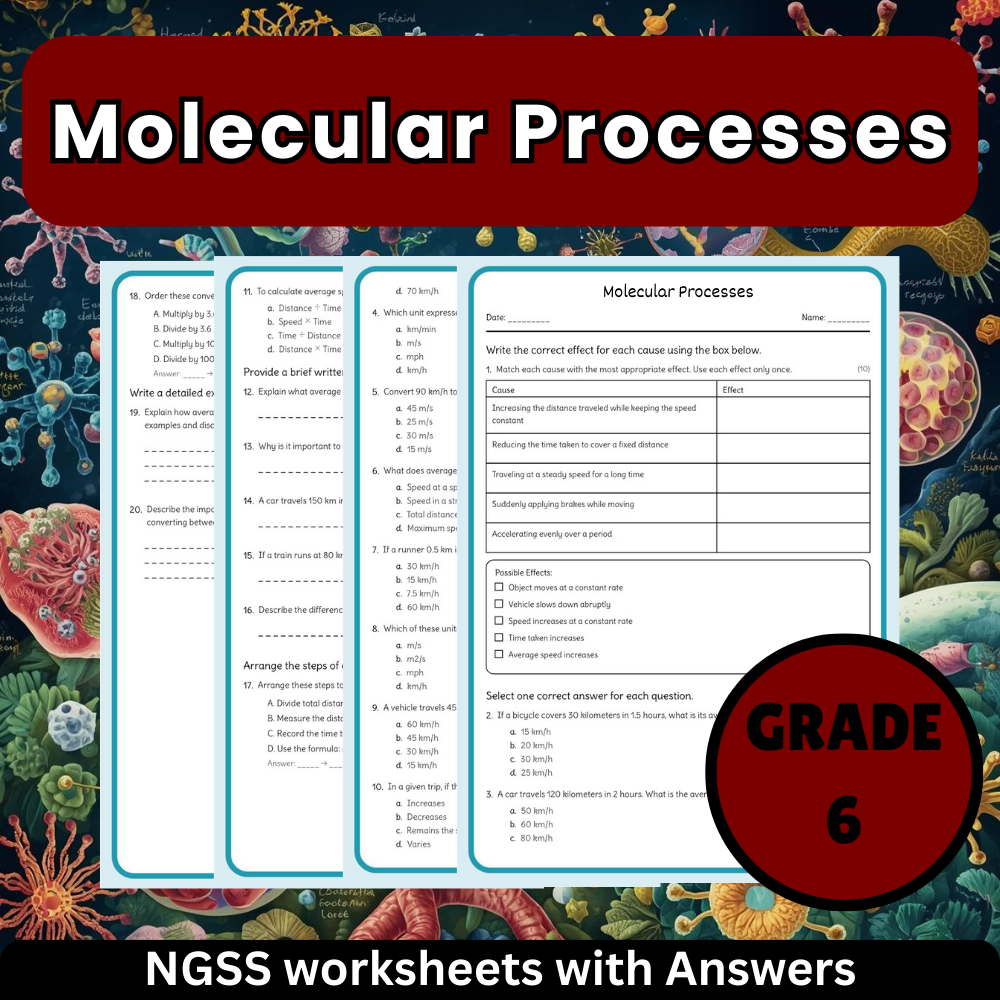
Grade 6 Science | Molecular Processes Worksheet (NGSS-Aligned, PDF)
Created byBright Mind ResourcesLearning Objectives
- Identify the key molecular building blocks such as amino acids, nucleotides, fatty acids, and monosaccharides.
- Explain how monomers assemble into polymers through condensation reactions.
- Describe the roles of macromolecules—proteins, nucleic acids, lipids, and carbohydrates—in biological structure and function.
Also included in: Grade 6 Science UNIT Bundle | Cell Functions, Energy & Systems NGSS Worksheets +2 more
Instant download
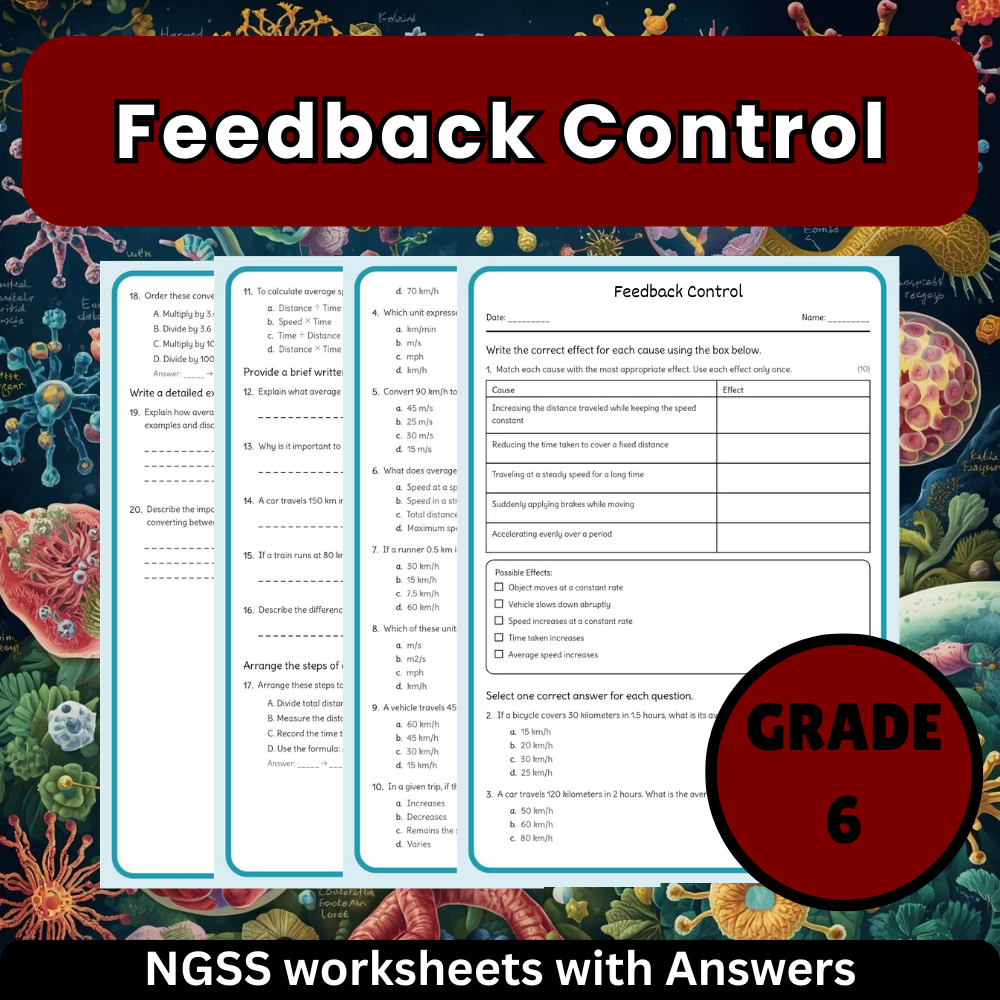
Grade 6 Science – Feedback Control Worksheet (PDF) | NGSS-Aligned & Engaging
Created byBright Mind ResourcesLearning Objectives
- Explain how feedback mechanisms regulate internal stability in the human body.
- Differentiate between negative and positive feedback processes with examples.
- Describe how disruption in feedback control systems can affect organ function and homeostasis.
Also included in: Grade 6 Science UNIT Bundle | Cell Functions, Energy & Systems NGSS Worksheets +2 more
Instant download
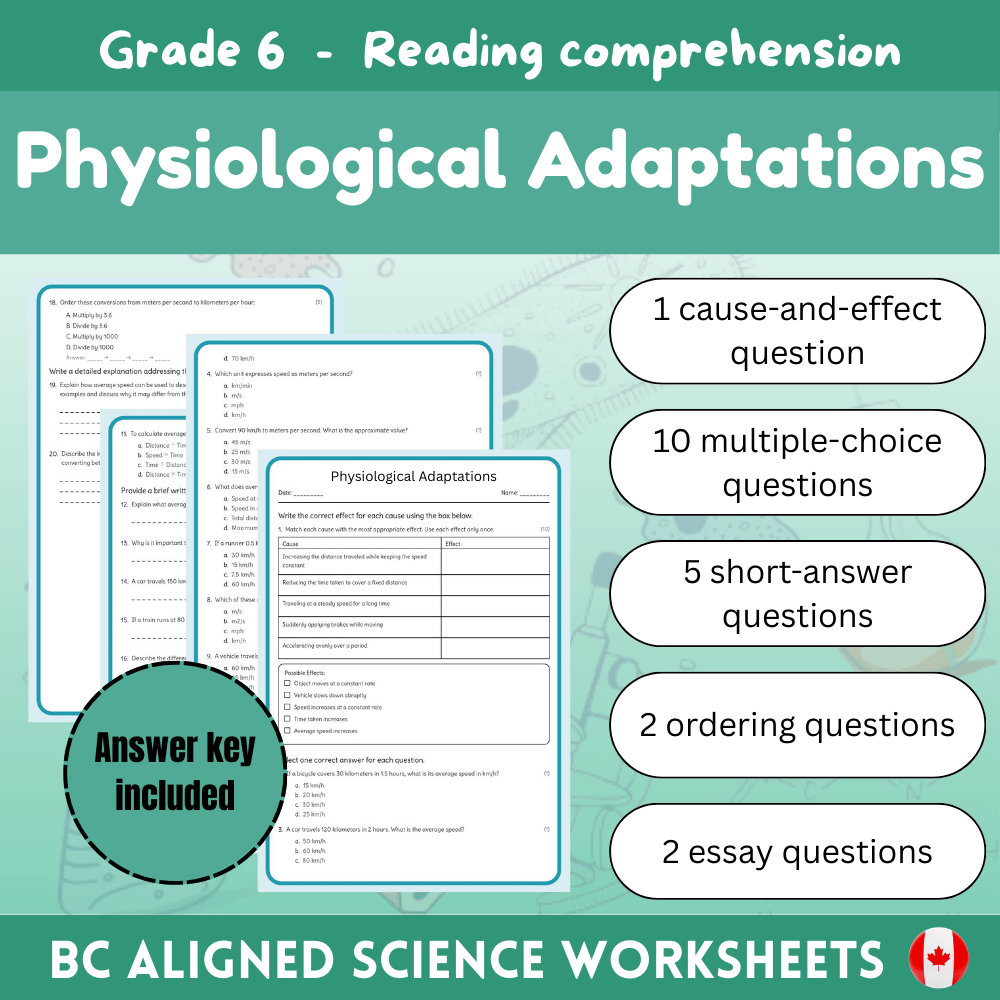
Grade 6 Science | Physiological Adaptations Worksheet(Answer Key) - BC Standards
Created byBright Mind ResourcesLearning Objectives
- Understand internal processes that enable animals to survive in extreme environments.
- Identify examples of physiological adaptations such as heat exchange, urine concentration, and metabolic regulation.
- Explain how hormonal mechanisms help regulate body temperature, hydration, and energy during challenging conditions.
Instant download
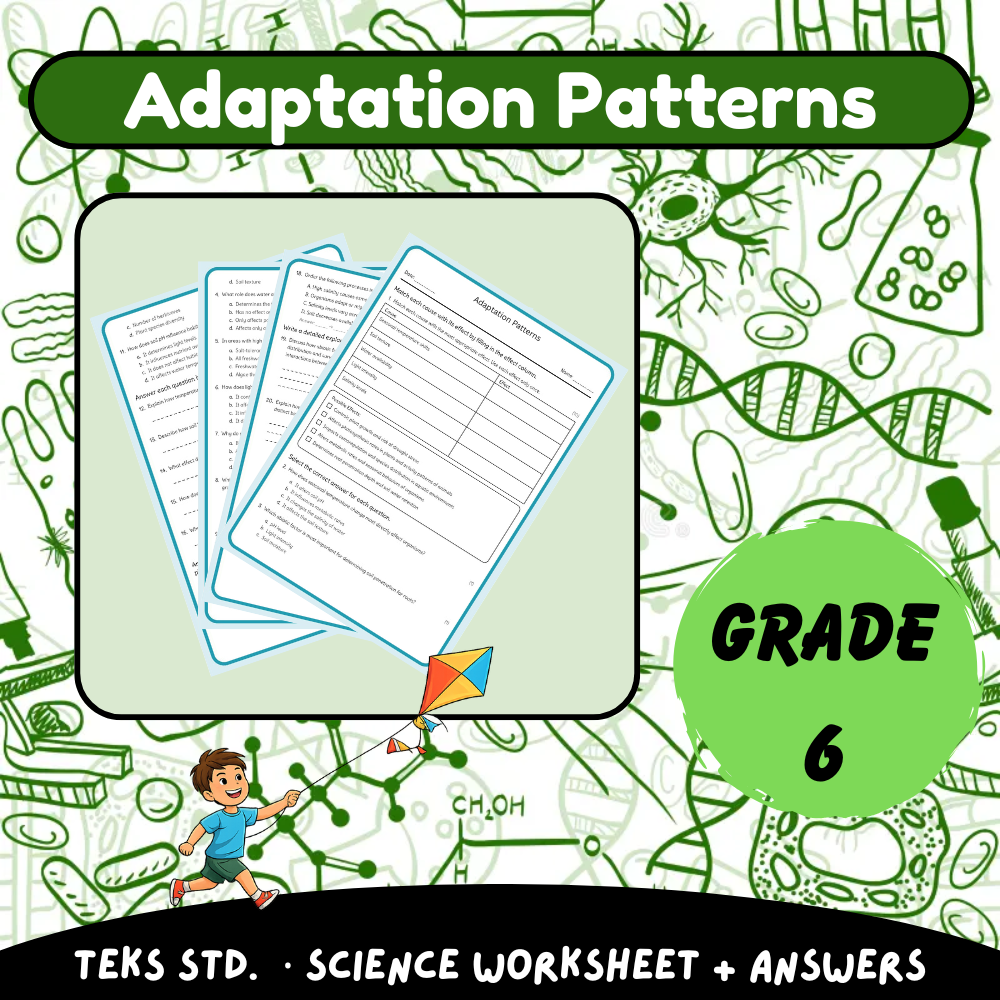
6th Grade Science | Adaptation Patterns Worksheet (PDF) — TEKS Aligned
Created byBright Mind ResourcesLearning Objectives
- Identify different types of adaptations such as morphological, physiological, and behavioral.
- Understand how adaptations help organisms survive in specific environments.
- Explain examples of traits like succulent stems, leaf modifications, fur insulation, and beak variation.
Instant download
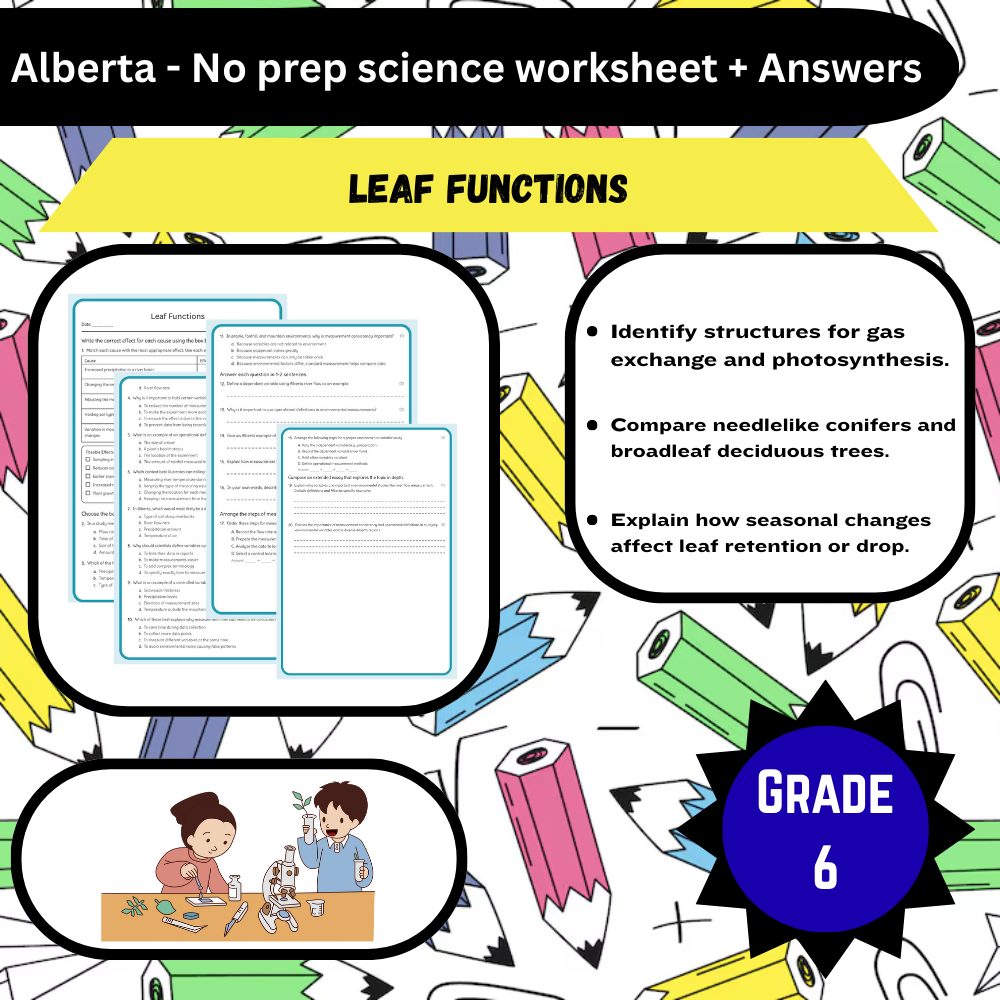
Grade 6 Science | Leaf Functions Worksheet – Photosynthesis & Adaptations (PDF)
Created byBright Mind ResourcesLearning Objectives
- Identify the different structures of leaves and their functions in gas exchange, photosynthesis, and transpiration.
- Compare leaf adaptations between needlelike conifers and broadleaf deciduous trees.
- Explain how seasonal changes affect leaf retention and leaf drop in Alberta's tree species.
Instant download
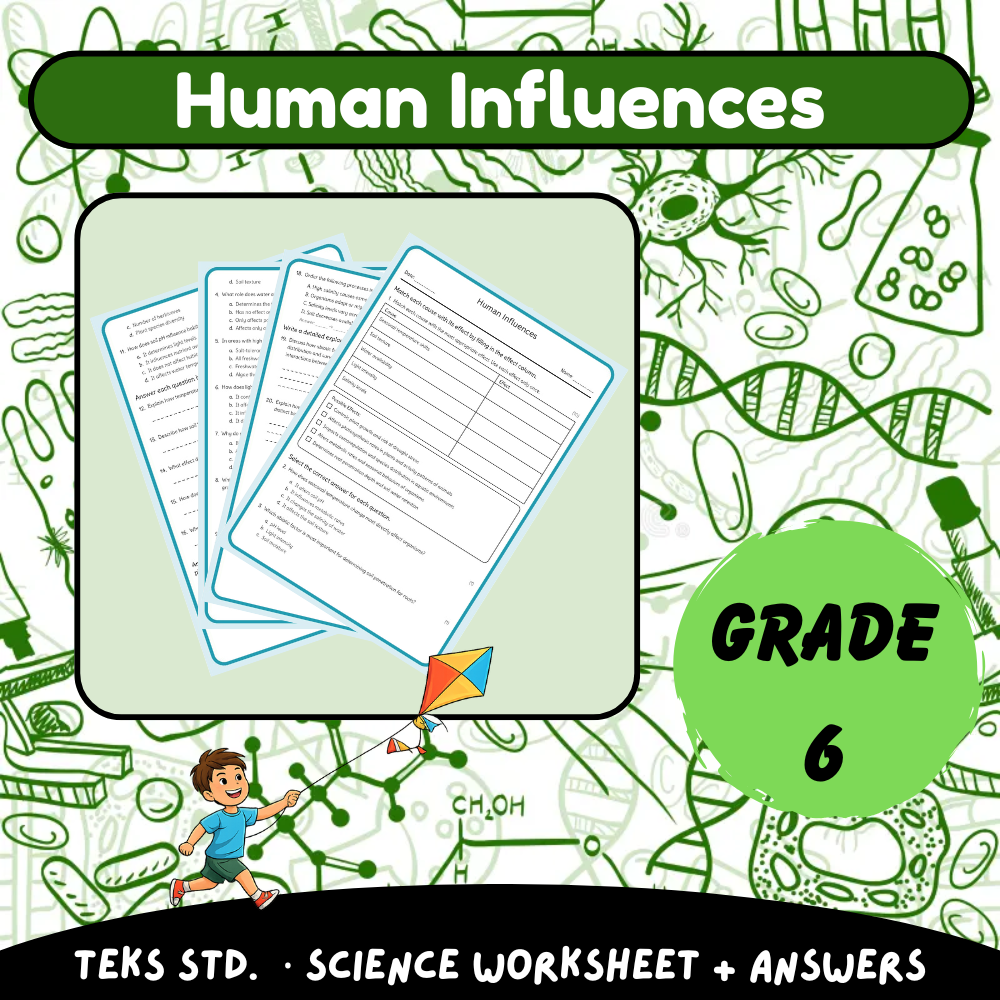
6th Grade Science | Human Influences Worksheet (PDF) – TEKS Standards
Created byBright Mind ResourcesLearning Objectives
- Identify different human activities that impact natural ecosystems.
- Explain effects of habitat fragmentation, pollution, and resource extraction.
- Recognize mitigation strategies such as conservation and restoration.
Instant download
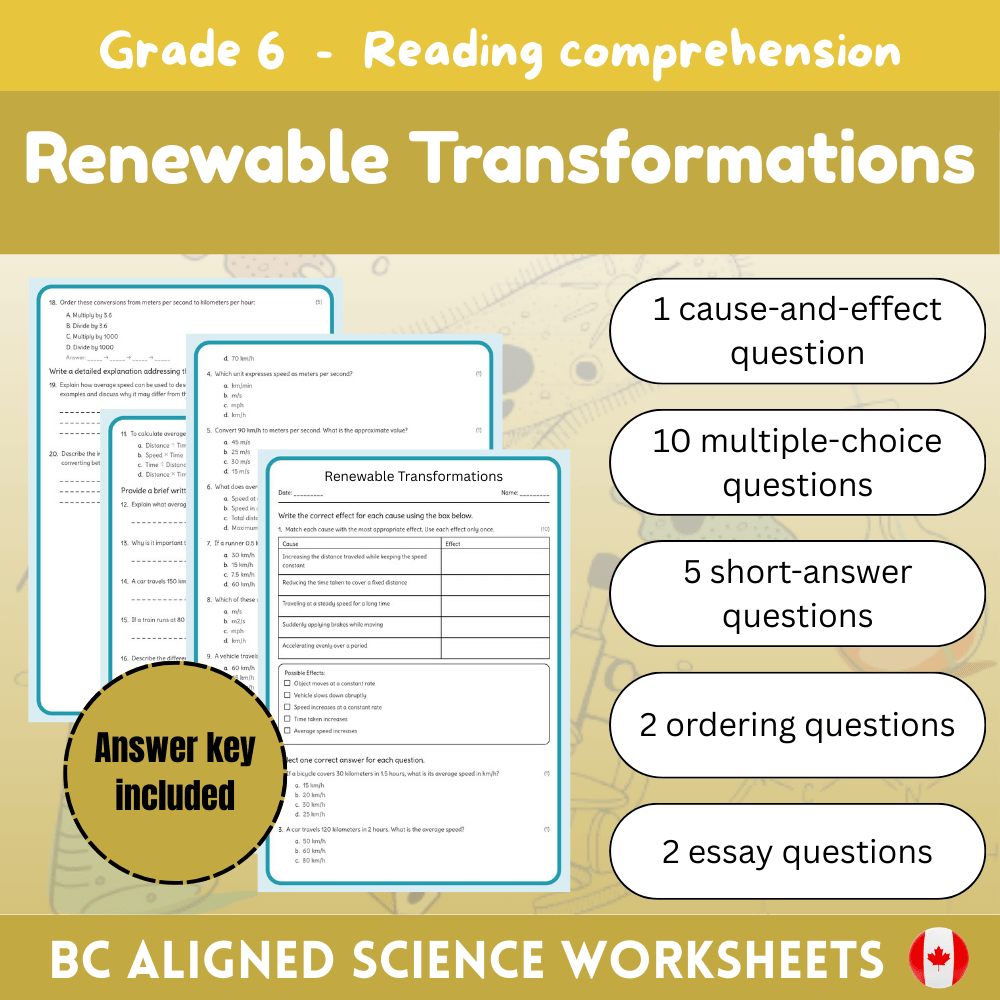
Grade 6 Science | Renewable Transformations Worksheet (PDF) — BC Standard
Created byBright Mind ResourcesLearning Objectives
- Describe how photovoltaic cells, wind turbines, and hydro systems convert environmental sources into electrical energy.
- Explain the energy losses involved at each stage of renewable energy transformations.
- Analyze how storage and conversion choices impact net usable energy in renewable systems.
Instant download
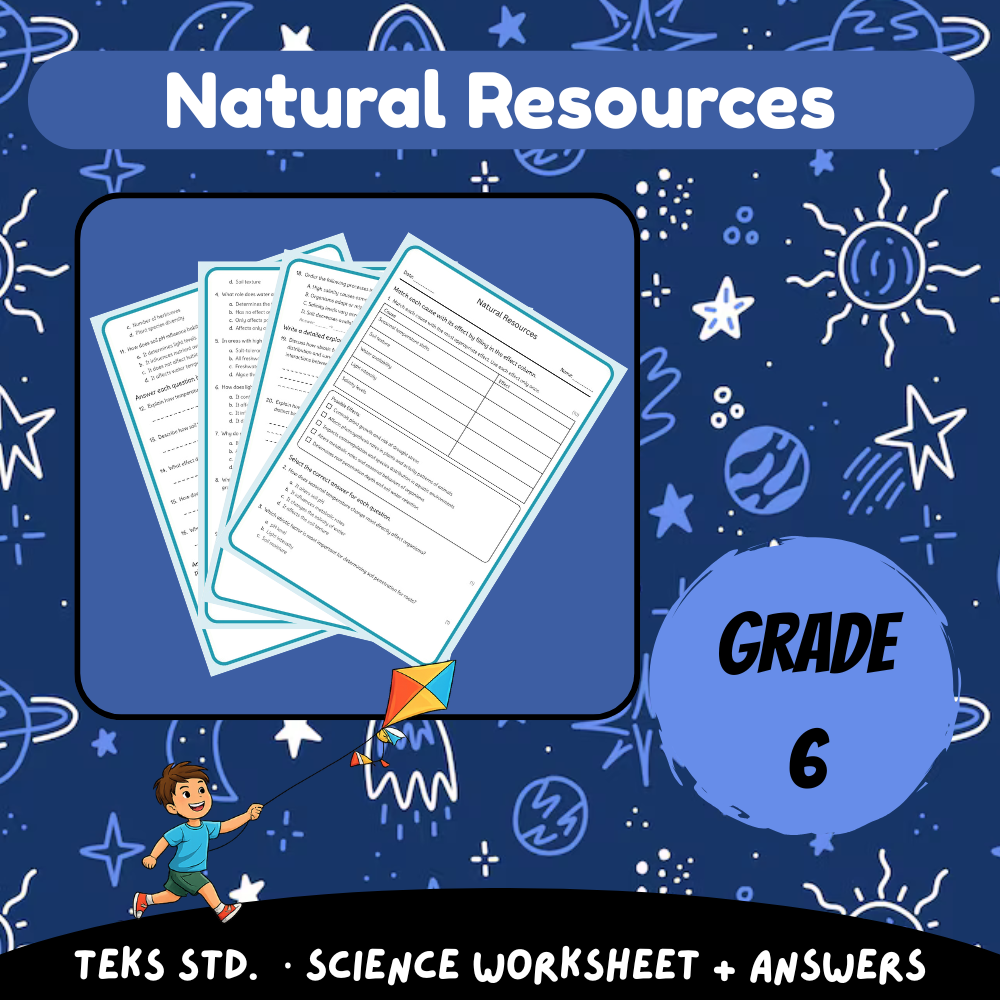
6th Grade Science | Natural Resources (Worksheet + Answer Key) - TEKS-Aligned
Created byBright Mind ResourcesLearning Objectives
- Identify different types of natural resources and understand their origins and distributions.
- Analyze the environmental and economic implications of renewable and nonrenewable resources.
- Evaluate sustainable resource use principles and trade-offs involved in resource development.
Instant download
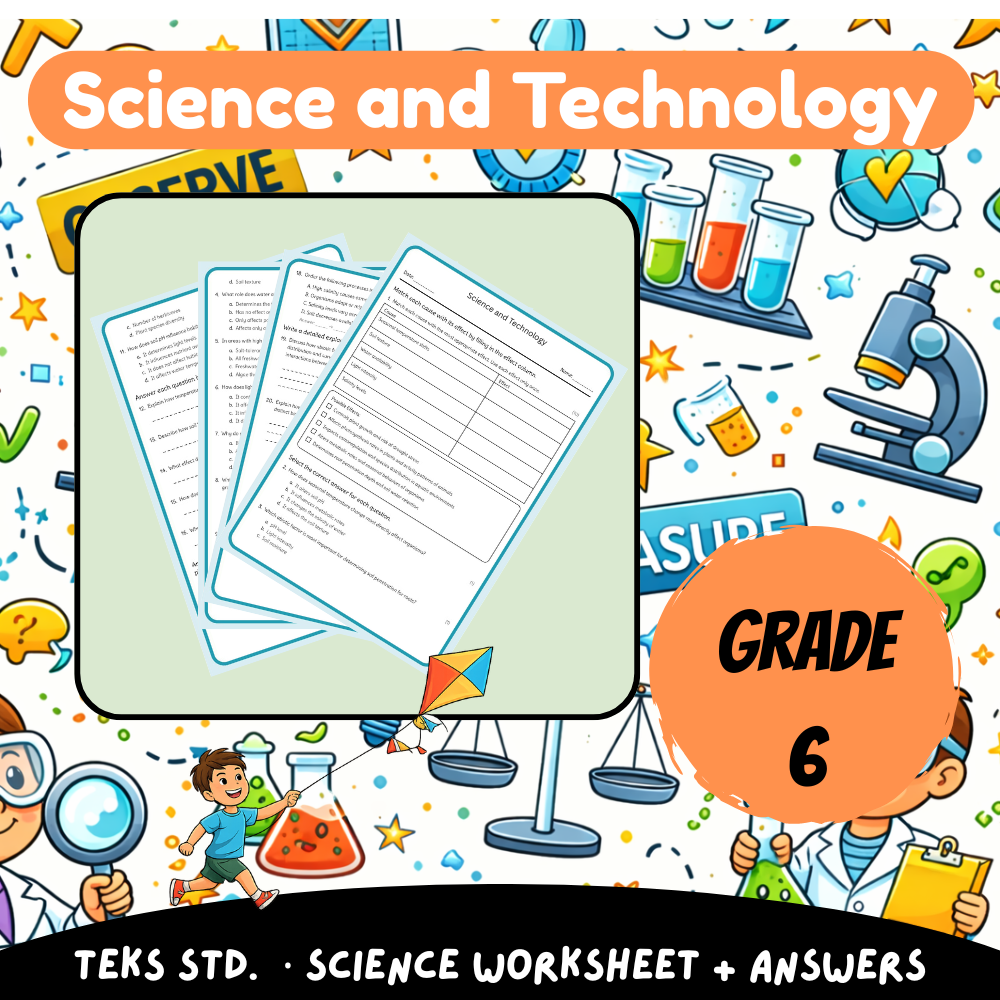
Grade 6 Science | Technology in Science Worksheet (Worksheet + Answer Key) PDF
Created byBright Mind ResourcesLearning Objectives
- Understand how scientific investigation drives technological development.
- Identify tools and instruments used in scientific observation and measurement.
- Explain the reciprocal relationship between science and technology, including cause-and-effect.
Instant download
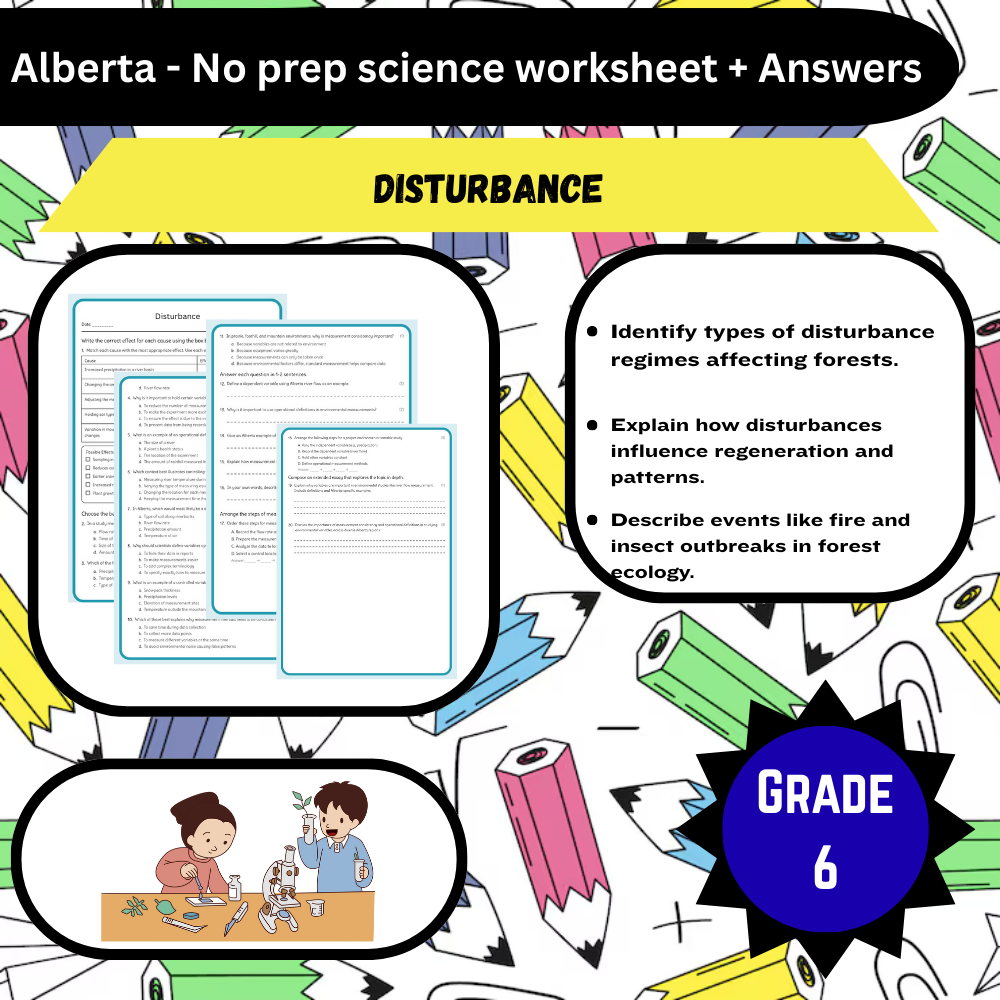
6th Grade Science – Disturbance Regimes Worksheet (PDF)
Created byBright Mind ResourcesLearning Objectives
- Identify different types of disturbance regimes that affect forests
- Explain how disturbance characteristics influence forest regeneration and landscape patterns
- Describe specific disturbance events such as fire and insect outbreaks in forest ecology
Instant download
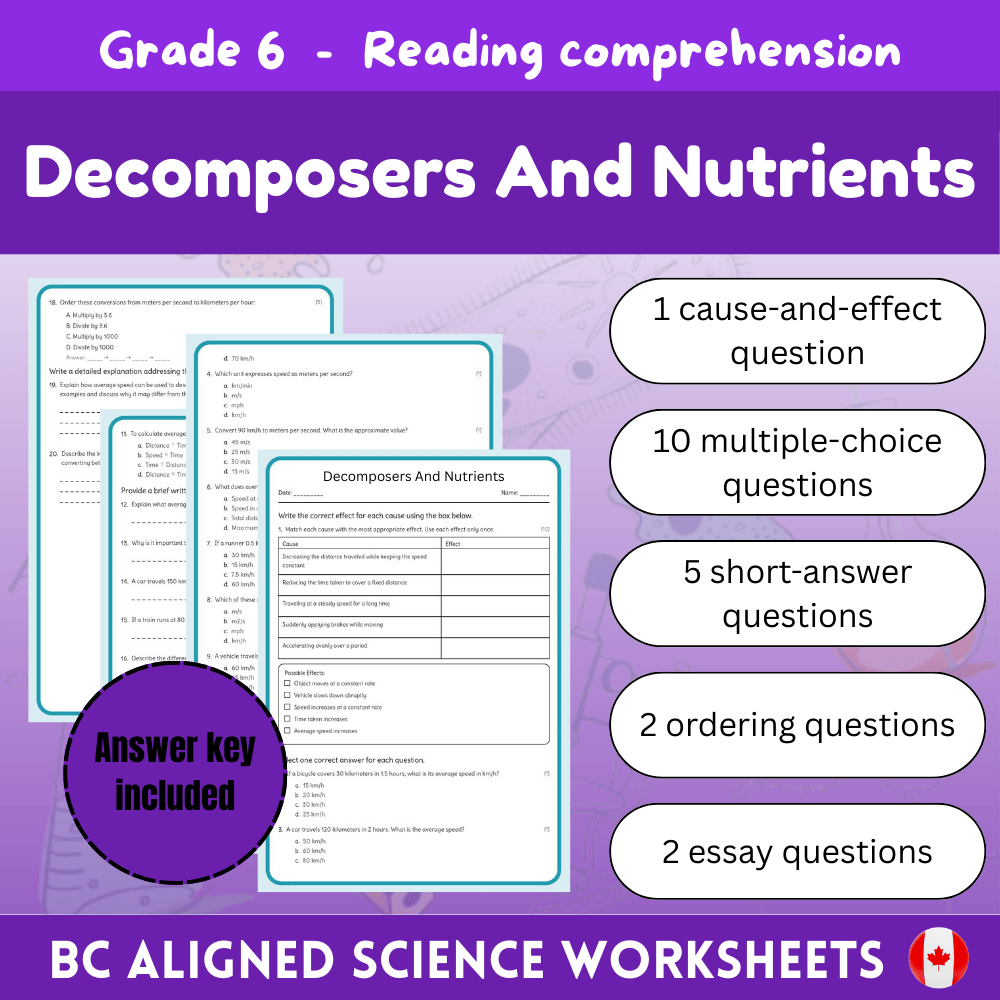
6th Grade Science | Decomposers and Nutrients Experiment Worksheet (PDF)
Created byBright Mind ResourcesLearning Objectives
- Understand the role of decomposers in breaking down organic matter and returning nutrients to the environment.
- Identify environmental factors that affect decomposer efficiency.
- Explain how decomposer activity influences soil health, nutrient cycling, and ecosystem balance.
Instant download
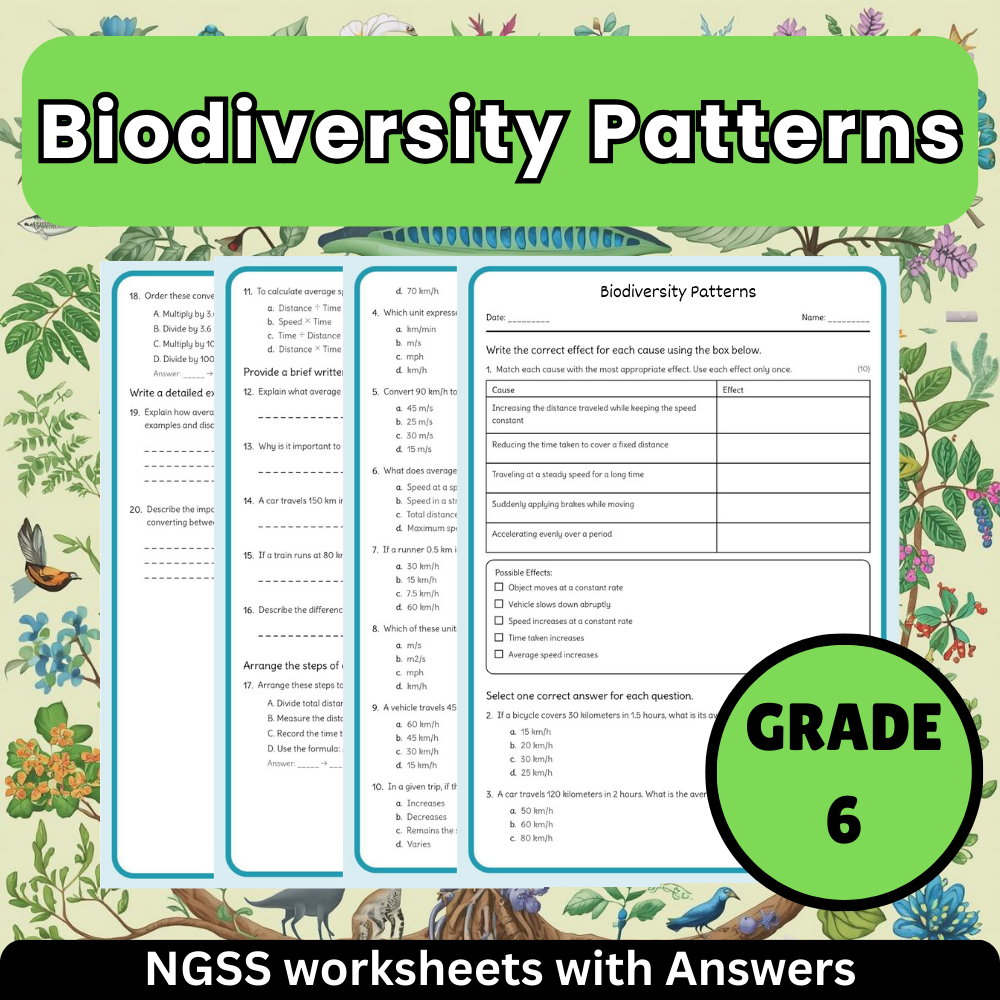
Grade 6 Science | Biodiversity Patterns Worksheet (Answer Key) - NGSS Aligned
Created byBright Mind ResourcesLearning Objectives
- Understand how spatial and temporal data reveal biodiversity patterns across ecosystems.
- Identify factors influencing species diversity and endemism.
- Analyze ecological and historical factors affecting community composition.
Also included in: Grade 6 Science Unit Bundle | Evolution, Genetics & Biodiversity NGSS Worksheets +2 more
Instant download
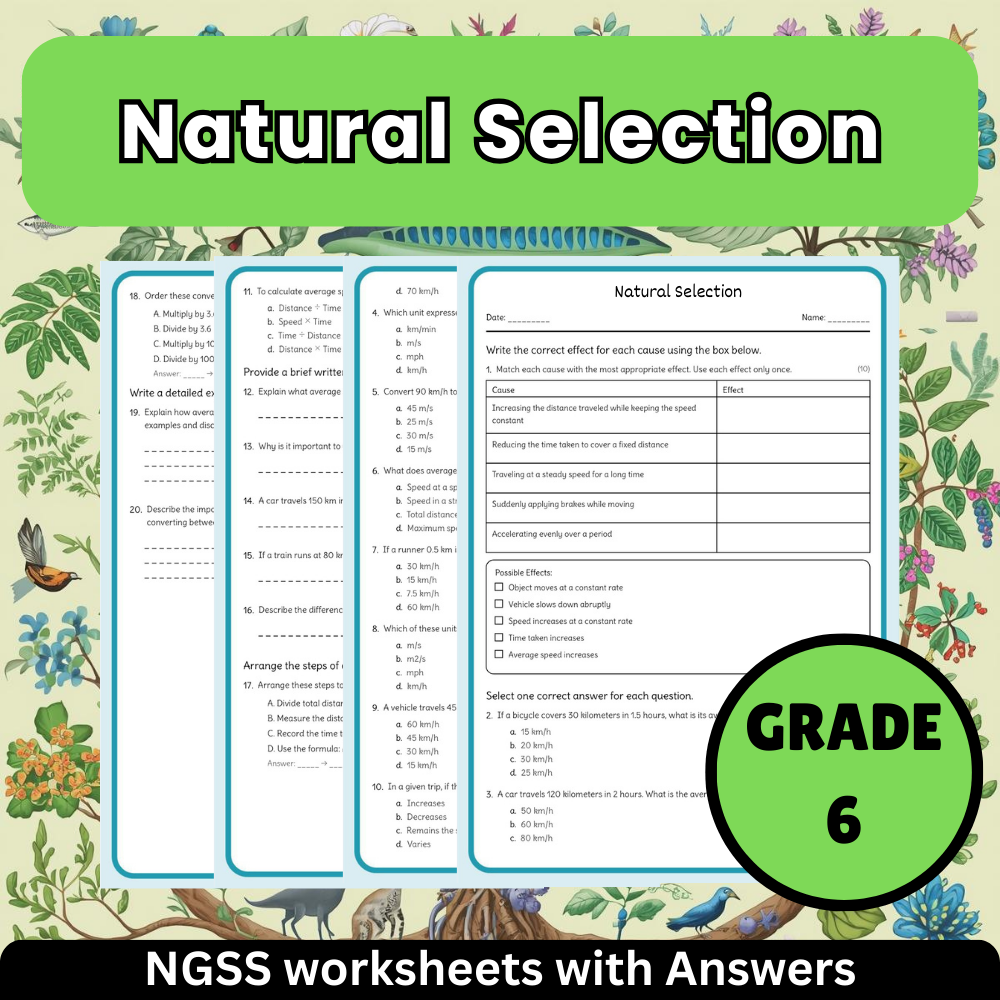
6th Grade Science | Natural Selection Worksheet + Answer Key (NGSS Aligned)
Created byBright Mind ResourcesLearning Objectives
- Understand how variation in heritable traits influences survival and reproduction.
- Identify examples of natural selection affecting populations.
- Explain the linkage between trait advantage and population-level genetic changes.
Also included in: Grade 6 Science Unit Bundle | Evolution, Genetics & Biodiversity NGSS Worksheets +2 more
Instant download
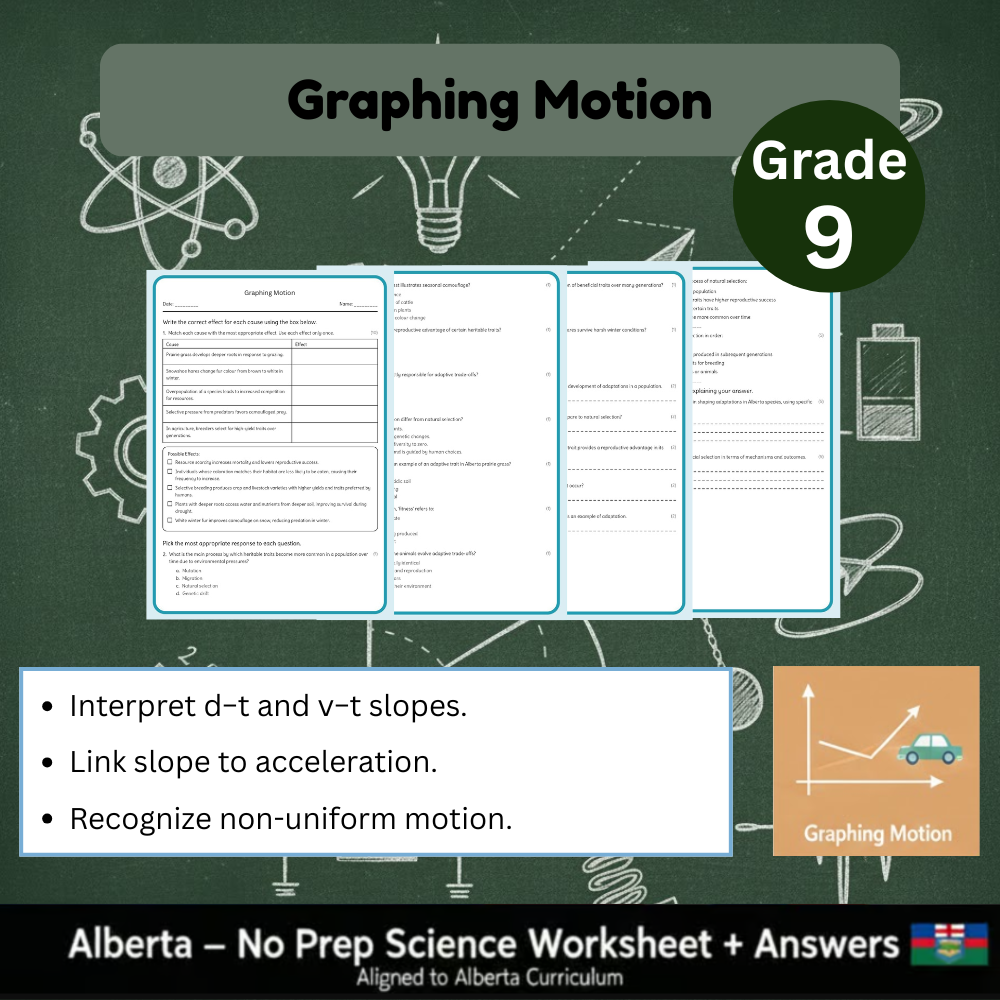
Grade 9 Science | Graphing Motion (Worksheet + Answer Key) – Alberta Standards
Created byBright Mind ResourcesLearning Objectives
- Understand how to interpret displacement–time, velocity–time, and acceleration–time graphs.
- Learn how the slope of a graph relates to physical quantities like speed and acceleration.
- Identify curved segments on graphs to recognize changing acceleration.
Instant download
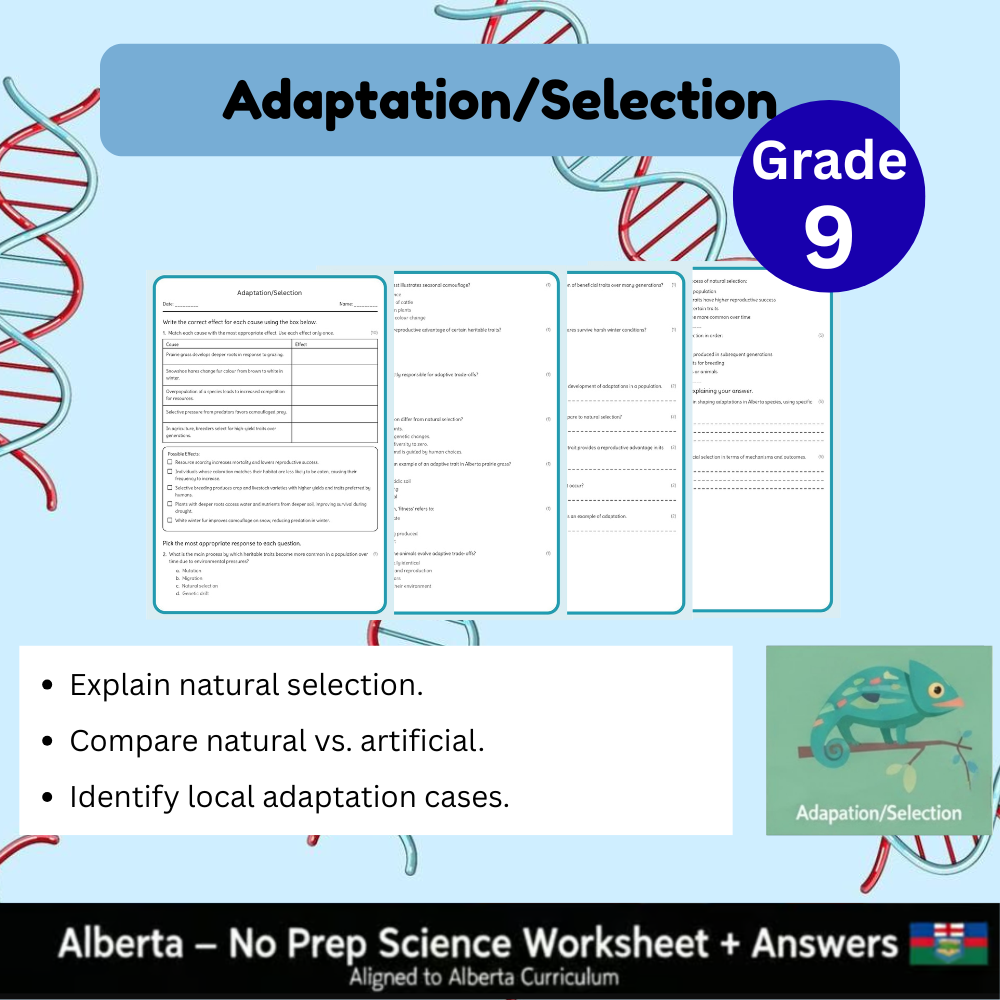
Grade 9 Science – Adaptation and Selection Worksheet (PDF)
Created byBright Mind ResourcesLearning Objectives
- Explain the process of natural selection and how heritable traits influence reproductive success.
- Distinguish between natural selection and artificial selection in shaping populations.
- Identify examples of adaptation in Alberta species such as prairie grass resilience and snowshoe hare camouflage.
Instant download
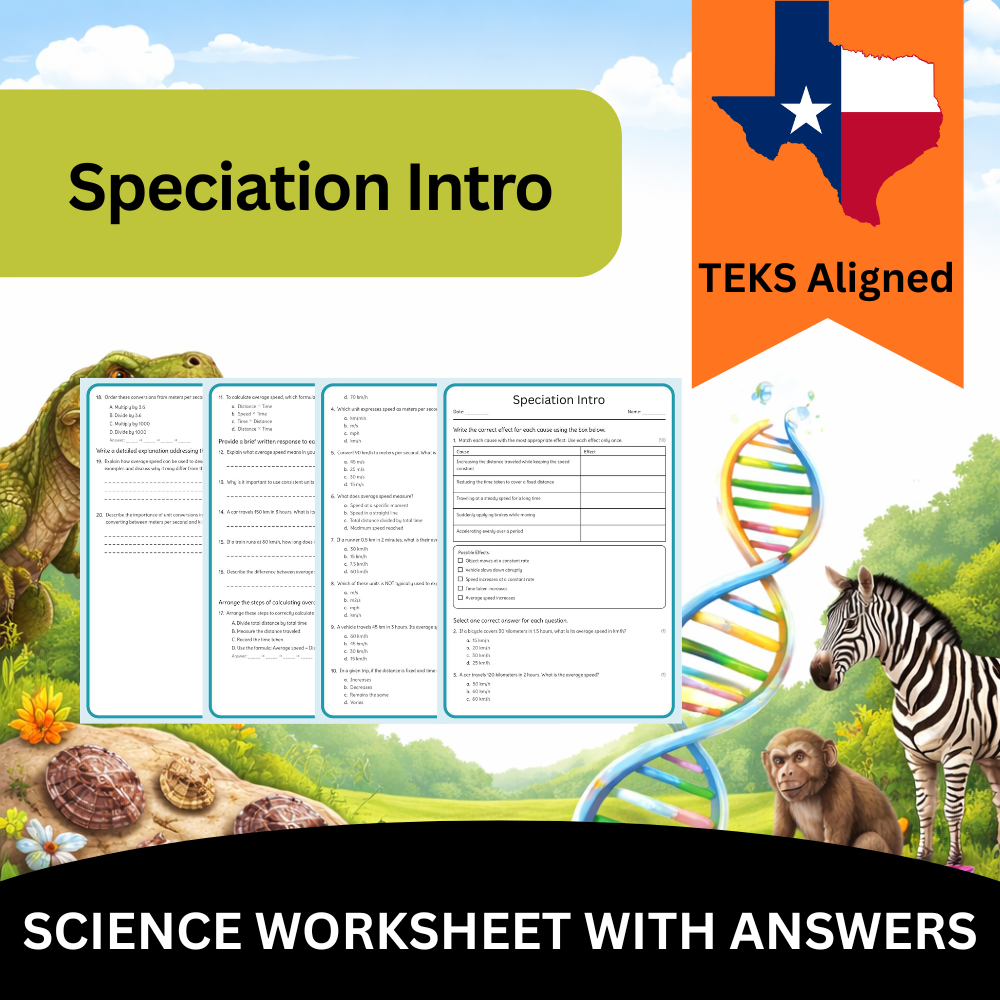
Grade 9 Science | Speciation Introduction Worksheet (Answer Key) – TEKS Aligned
Created byBright Mind ResourcesLearning Objectives
- Understand the process of speciation and how it contributes to biodiversity.
- Identify different reproductive barriers and mechanisms involved in speciation.
- Differentiate between allopatric and sympatric speciation and their causes.
Also included in: Grade 9 Science Unit | Evolution, Speciation & Genetics Worksheet Pack - TEKS +3 more
Instant download
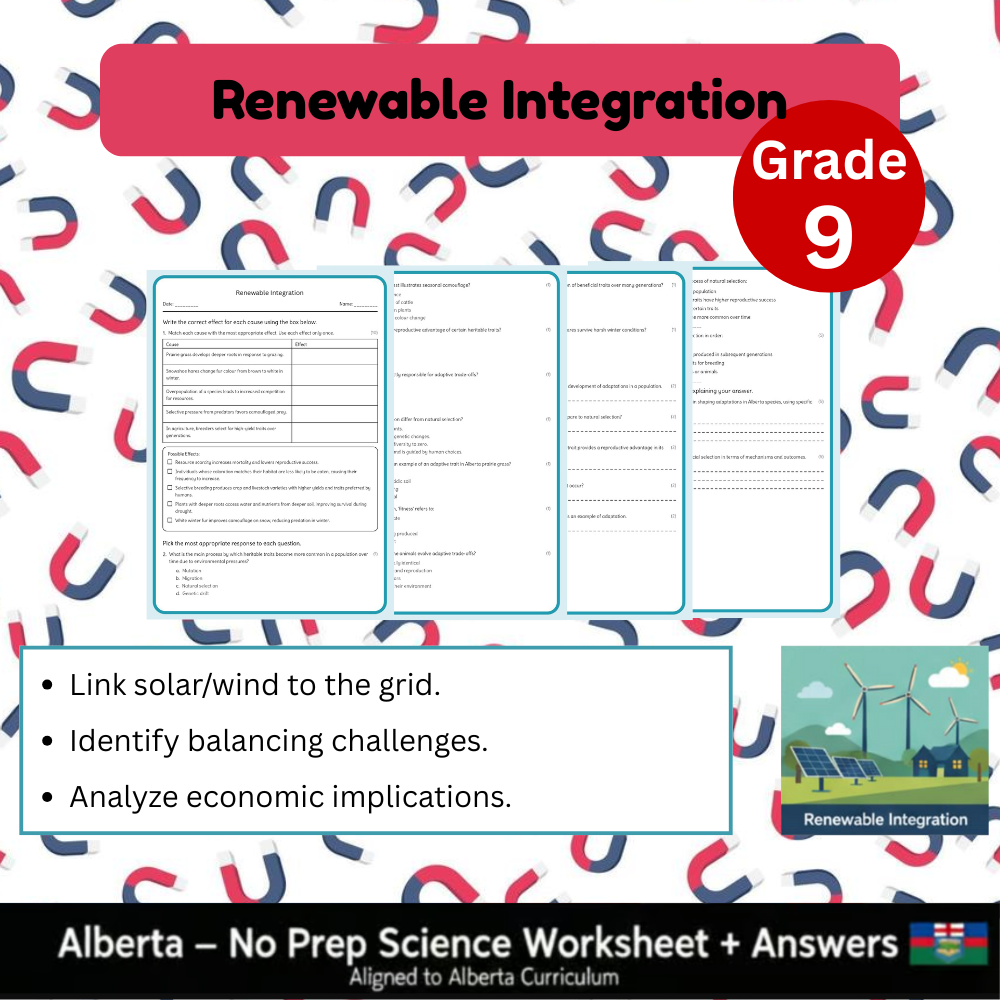
Grade 9 Science – Renewable Integration Worksheet (PDF) – Alberta Standards
Created byBright Mind ResourcesLearning Objectives
- Understand how wind and solar resources are integrated into the electrical grid.
- Identify challenges such as intermittency and balancing mechanisms.
- Analyze the environmental and economic implications of renewable energy sources.
Instant download
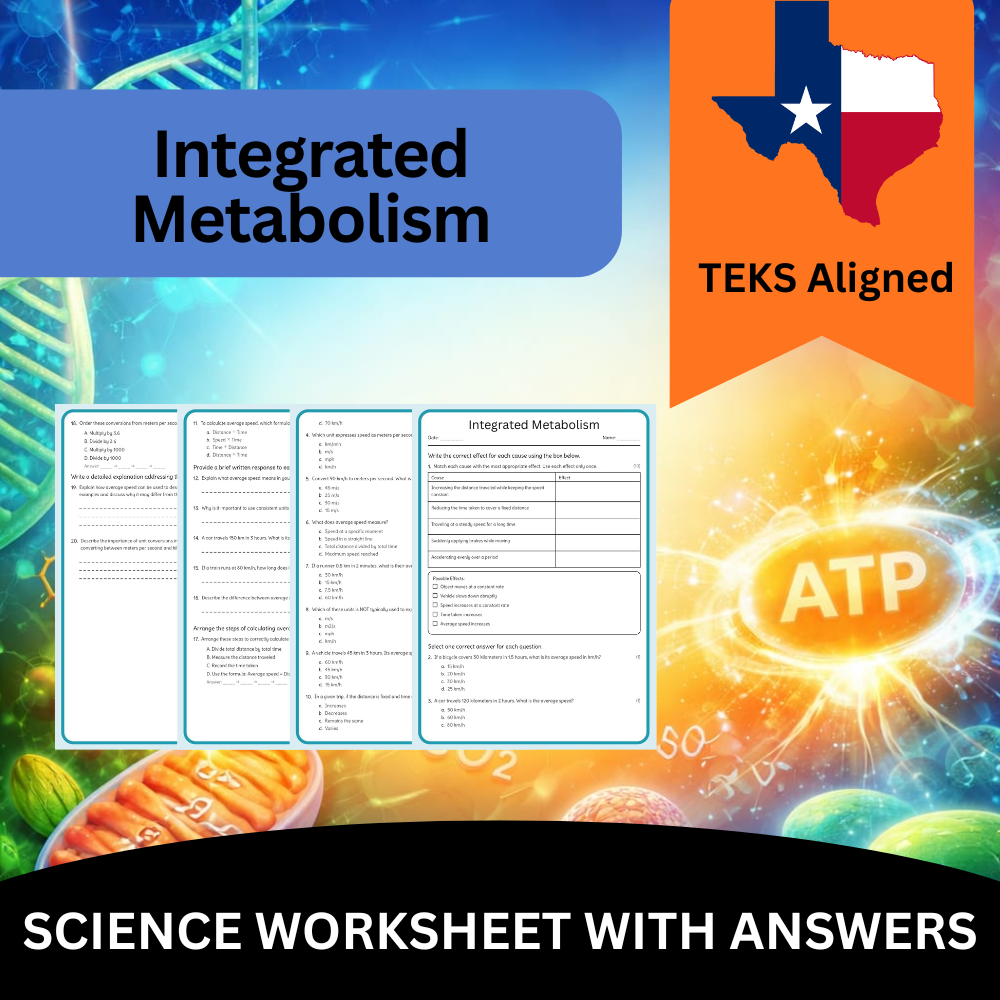
Grade 9 Science | Integrated Metabolism Worksheet – TEKS Standards (PDF)
Created byBright Mind ResourcesLearning Objectives
- Understand how catabolic and anabolic pathways are interconnected
- Explain how hormonal signals and nutrient availability influence metabolism
- Describe rapid and long-term metabolic regulation mechanisms
Also included in: Grade 9 Science | Photosynthesis & Metabolic Pathways Unit Bundle (TEKS Aligned) +3 more
Instant download
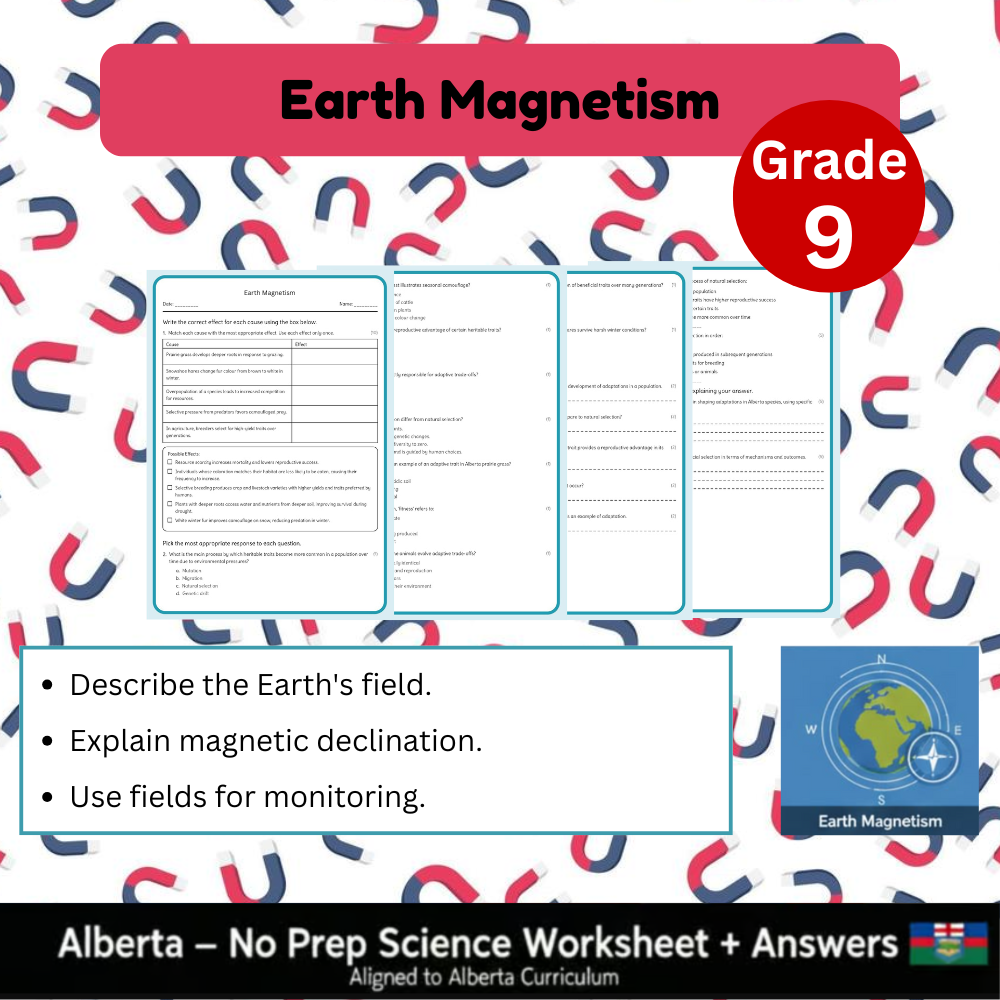
Grade 9 Science | Earth Magnetism (Worksheet + Answer Key) – Alberta Standards
Created byBright Mind ResourcesLearning Objectives
- Understand the origin and nature of Earth's magnetic field.
- Describe regional variation in magnetic declination and its implications.
- Explain how magnetic field measurements are used in geological and environmental monitoring.
Instant download
Browse more categories
About Reading comprehension Worksheets
Find reading comprehension worksheets for class practice, homework, or self-study. All 40,284 are instant PDF downloads.
Each resource here is built by an independent educator and reviewed for quality. Worksheets print straight from PDF and suit classroom use, homework, or extra practice; most come with answer keys, and you can preview before purchasing.