
Reading comprehension Worksheets
40,284 type resources
Radiometric Dating Assessment | Florida NGSSS Standards Grade 10 Science
 Created byPrism Point Learning
Learning Objectives
- Explain how radiometric dating uses radioactive decay of parent isotopes to estimate geologic time
- Interpret the relationship between half-life and the fraction of parent isotopes remaining
- Describe key assumptions (initial conditions and closed-system behavior) that affect the reliability of radiometric dates
Also included in: Grade 10 Earth and Space Systems Science Lesson Bundle – Florida NGSSS +1 more
Instant download

Physical Properties Assessment | Alberta Standards Grade 10 Science
Created byPrism Point LearningLearning Objectives
- Differentiate between intensive and extensive physical properties of substances.
- Identify examples of physical and chemical properties in real-world materials.
- Explain how property classification influences material selection and environmental behavior.
Also included in: Grade 10 Matter and Chemical Change Science Lesson Bundle: Alberta +1 more
Instant download

Carbon Balance Assessment for Grade 10 Science | Alberta Standards
Created byPrism Point LearningLearning Objectives
- Explain the major carbon pools, flux pathways, and their roles in regional and global climate.
- Identify natural and anthropogenic drivers affecting carbon transfer among atmosphere, vegetation, soil, and ocean.
- Analyze regional examples like boreal forest succession, peatland accumulation, and soil disturbance impacts.
Also included in: Grade 10 Earth and Space Systems Science Lesson Bundle for Alberta +1 more
Instant download

Hydrologic Cycle Assessment for Grade 10 Science | Alberta Standards
Created byPrism Point LearningLearning Objectives
- Explain the processes involved in the hydrologic cycle including evaporation, transpiration, condensation, and runoff.
- Describe water movement from mountain snowpack to regional aquifers and rivers.
- Analyze how climate variability and watershed characteristics affect regional water resources.
Also included in: Grade 10 Earth and Space Systems Science Lesson Bundle for Alberta +1 more
Instant download

Circuit Fundamentals Assessment | Alberta Grade 10 Science Standards
Created byPrism Point LearningLearning Objectives
- Define current, voltage, and resistance and explain their interrelationships.
- Understand Ohm's law and its application in simple circuits.
- Differentiate between series and parallel electrical circuits.
Also included in: Grade 10 Energy, Motion and Electricity Science Lesson Bundle: Alberta +1 more
Instant download

Motors And Generators Assessment for Grade 10 Science | Alberta Standards
Created byPrism Point LearningLearning Objectives
- Explain the operational principles of electric motors and generators.
- Describe how electromagnetic interactions produce rotation in coils within magnetic fields.
- Identify applications of motors and generators in regional power and industry.
Also included in: Grade 10 Energy, Motion and Electricity Science Lesson Bundle: Alberta +1 more
Instant download

Transmission Losses Assessment for Grade 10 Science | Alberta Standards
Created byPrism Point LearningLearning Objectives
- Understand how current, resistance, and voltage affect energy losses in power transmission.
- Identify strategies used to minimize transmission losses over long distances.
- Explain the role of transformers in voltage regulation and their impact on power efficiency.
Also included in: Grade 10 Energy, Motion and Electricity Science Lesson Bundle: Alberta +1 more
Instant download

Mechanical Calculations Assessment | Alberta Grade 10 Science Standards
Created byPrism Point LearningLearning Objectives
- Understand energy conservation principles involving potential and kinetic energy in systems with friction, springs, and gravity.
- Apply numerical methods to solve energy transfer problems in real-world contexts.
- Analyze the effects of non-conservative work such as friction on energy calculations.
Also included in: Grade 10 Energy, Motion and Electricity Science Lesson Bundle: Alberta +1 more
Instant download

Dynamic Equilibrium Assessment for Grade 10 Science – Alberta Standards
Created byPrism Point LearningLearning Objectives
- Understand the concept of dynamic equilibrium and the factors influencing it.
- Interpret equilibrium constant expressions and predict system shifts due to external changes.
- Apply principles of chemical equilibrium to industrial and environmental contexts.
Also included in: Grade 10 Matter and Chemical Change Science Lesson Bundle: Alberta +1 more
Instant download
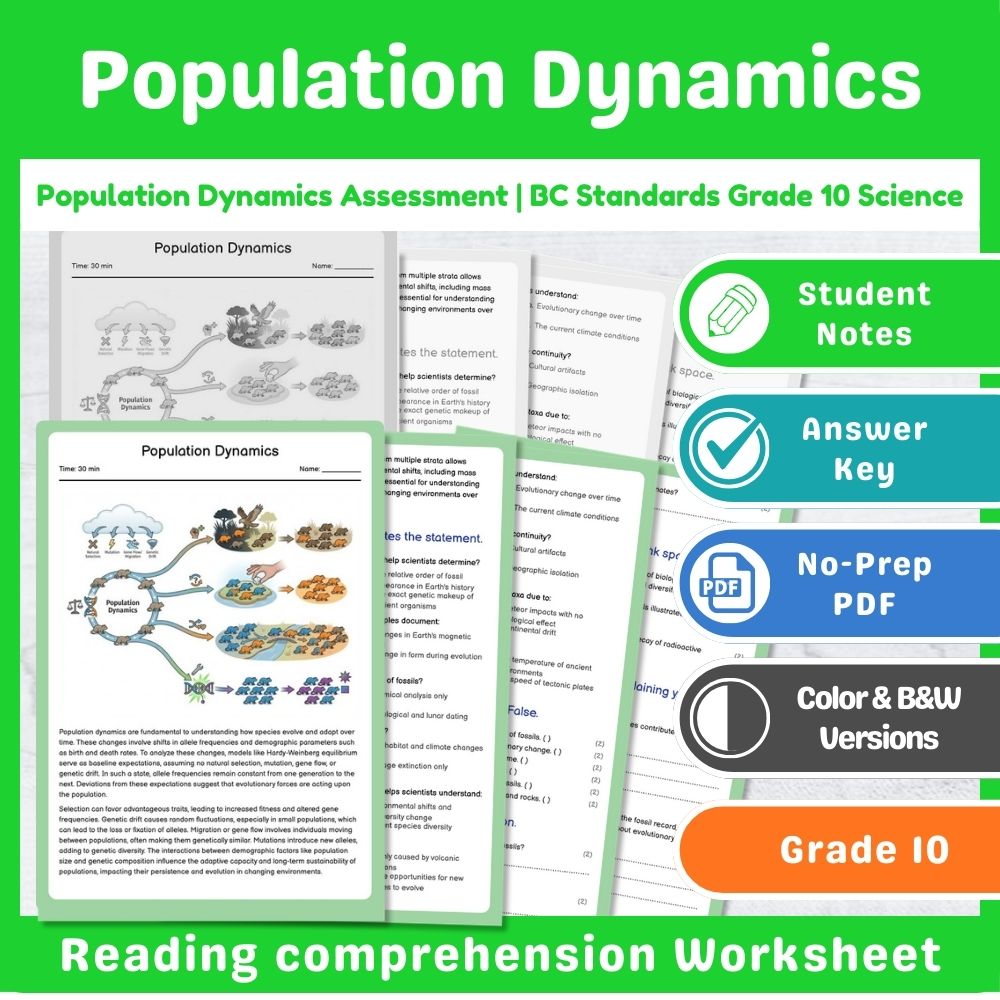
Population Dynamics Assessment | BC Standards Grade 10 Science
Created byPrism Point LearningLearning Objectives
- Understand basic concepts of population dynamics and evolutionary forces.
- Identify the role of models like Hardy-Weinberg equilibrium in population studies.
- Analyze how factors such as selection, mutation, migration, and drift influence genetic variation.
Instant download
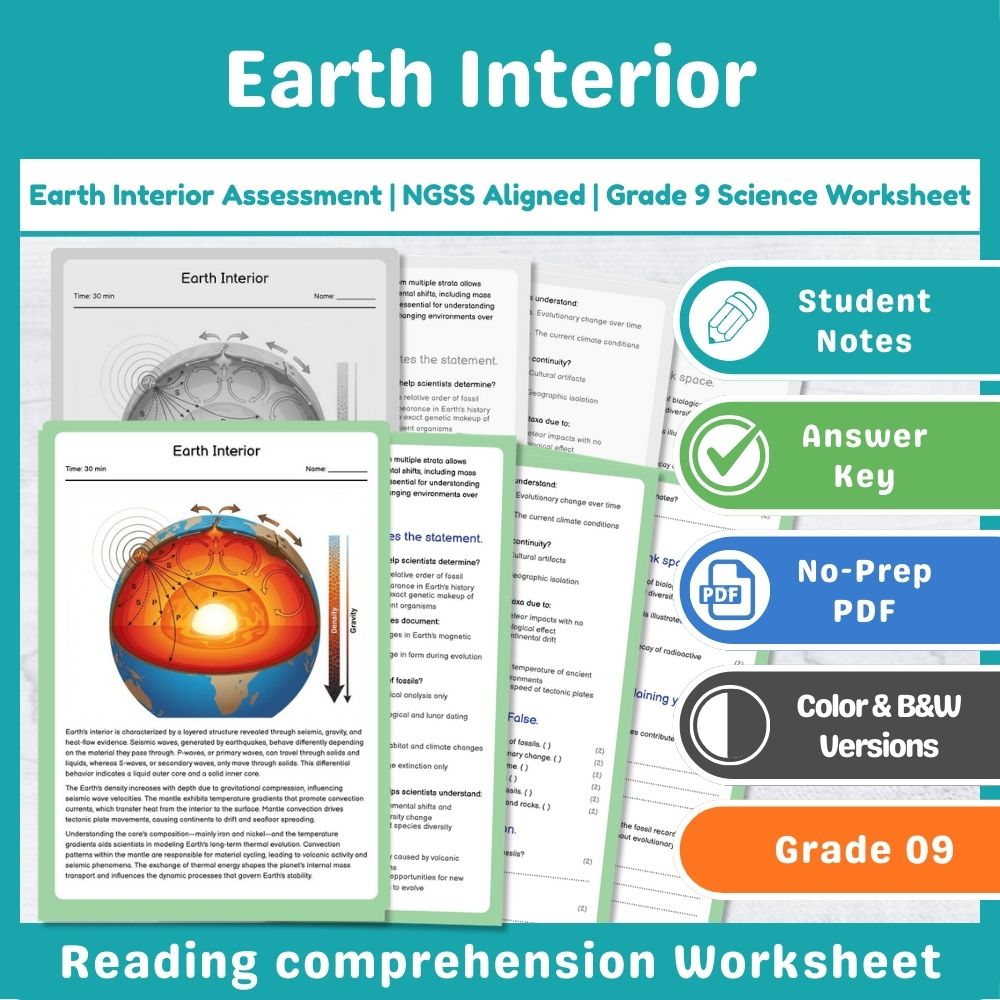
Earth Interior Assessment | NGSS Aligned | Grade 9 Science Worksheet
Created byPrism Point LearningLearning Objectives
- Describe the layered structure of Earth's interior based on seismic evidence.
- Interpret the behaviors of P-waves and S-waves to understand Earth's composition.
- Explain the transfer of thermal energy within Earth and its impact on planetary processes.
Instant download
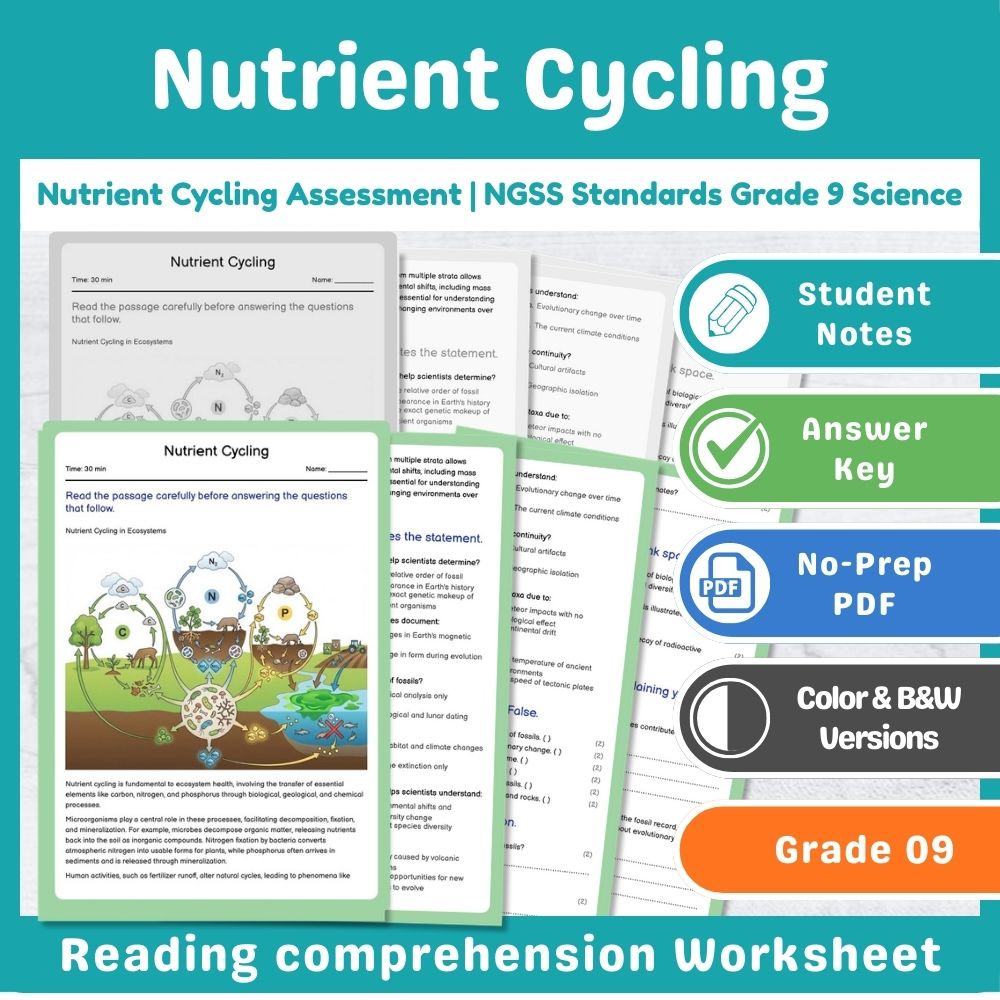
Nutrient Cycling Assessment | NGSS Standards Grade 9 Science
Created byPrism Point LearningLearning Objectives
- Understand the processes involved in the cycling of carbon, nitrogen, and phosphorus within ecosystems.
- Identify human activities that disrupt nutrient cycles and recognize their ecological impacts.
- Explain how changes in nutrient cycling rates influence ecosystem productivity and soil carbon storage.
Instant download

Species Interactions Assessment for Grade 8 Science | Florida NGSSS
Created byPrism Point LearningLearning Objectives
- Explain how competition, predation, mutualism, commensalism, and parasitism affect survival and reproduction
- Describe how species interactions can change population sizes over time
- Use evidence from examples to identify the type of species interaction and its ecosystem impact
Also included in: Grade 8 Evolution and Genetics Science Lesson Bundle | Florida NGSSS
Instant download

Population Regulation Assessment | NGSS Standards-Aligned Grade 9 Science
Created byPrism Point LearningLearning Objectives
- Understand the factors influencing population sizes, including carrying capacity and density-dependent effects.
- Analyze mathematical models like logistic growth and predator-prey cycles.
- Evaluate the impact of human activities on population dynamics and ecosystem resilience.
Instant download
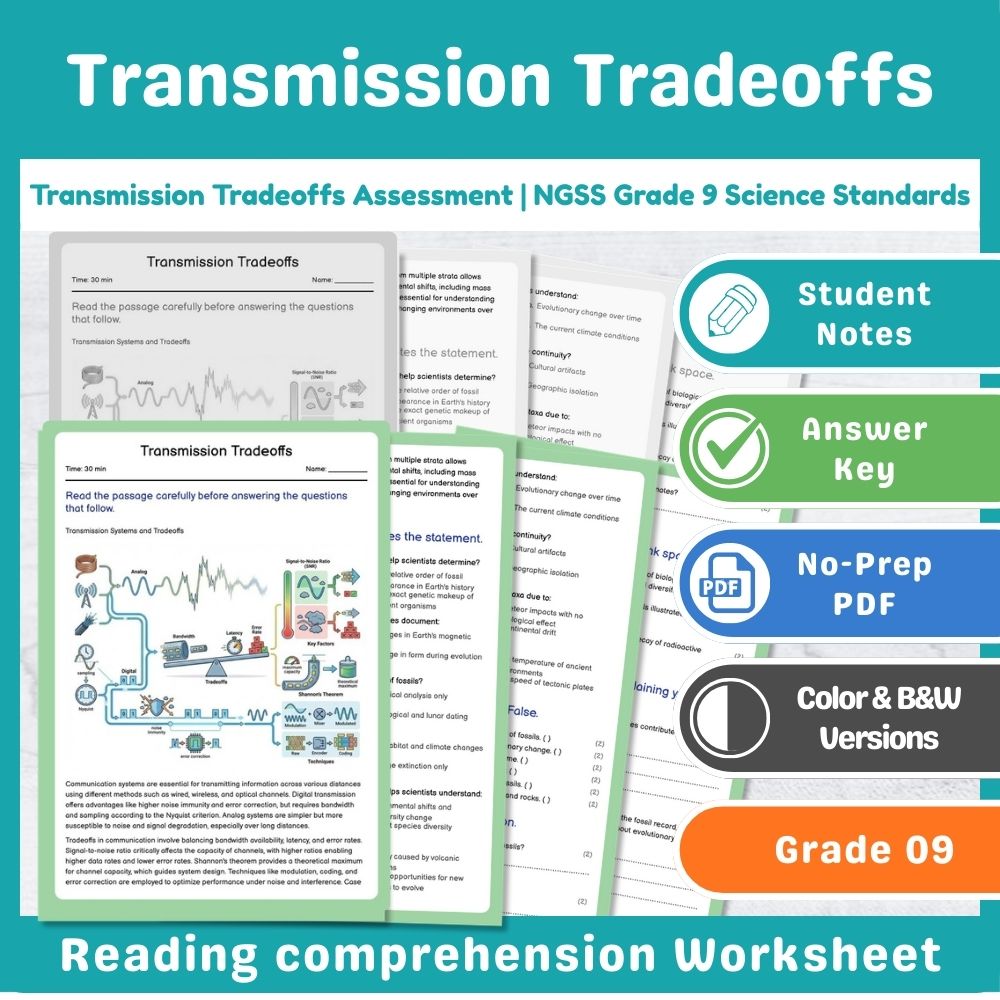
Transmission Tradeoffs Assessment | NGSS Grade 9 Science Standards
Created byPrism Point LearningLearning Objectives
- Understand the tradeoffs involved in digital and analog communication systems.
- Analyze the impact of bandwidth constraints, signal-to-noise ratio, and sampling criteria on transmission quality.
- Evaluate error-correcting techniques and their effect on data integrity in noisy environments.
Instant download
Reaction Stoichiometry Assessment for Grade 9 Science NGSS Standards
Created byPrism Point LearningLearning Objectives
- Understand the principles of mole ratios in balanced chemical equations.
- Apply molar mass conversions to relate mass and moles in reactions.
- Analyze limiting reagents and determine theoretical yields in chemical reactions.
Instant download

Net Force Acceleration Assessment | NGSSS Standards Grade 8 Science
Created byPrism Point LearningLearning Objectives
- Define net force and determine its direction when forces act in opposite directions
- Explain how a nonzero net force causes changes in velocity (speed and/or direction)
- Use force values to predict acceleration for a cart moving on a track
Instant download
Reaction Design Assessment for Grade 9 Science | NGSS Standards
Created byPrism Point LearningLearning Objectives
- Understand how temperature, pressure, concentration, and catalysts influence chemical reactions.
- Apply principles of equilibrium and kinetics to optimize reaction conditions.
- Use quantitative tools like equilibrium constants and reaction-rate expressions to predict product distribution.
Instant download
Reaction Rates Assessment | NGSS Standards Grade 9 Science Worksheet
Created byPrism Point LearningLearning Objectives
- Explain how collision frequency, activation energy, and reaction pathways influence reaction rates.
- Describe how temperature, concentration, and catalysts alter energy distributions and affect reaction speeds.
- Interpret rate laws and determine reaction order from experimental data.
Instant download
Surface Processes Assessment for Grade 9 Science NGSS Standards
Created byPrism Point LearningLearning Objectives
- Understand the different types of surface processes that shape landscapes.
- Analyze the factors influencing the rates and patterns of weathering, erosion, and sediment transport.
- Evaluate examples of geomorphic change like coastal erosion and alluvial fan formation.
Instant download
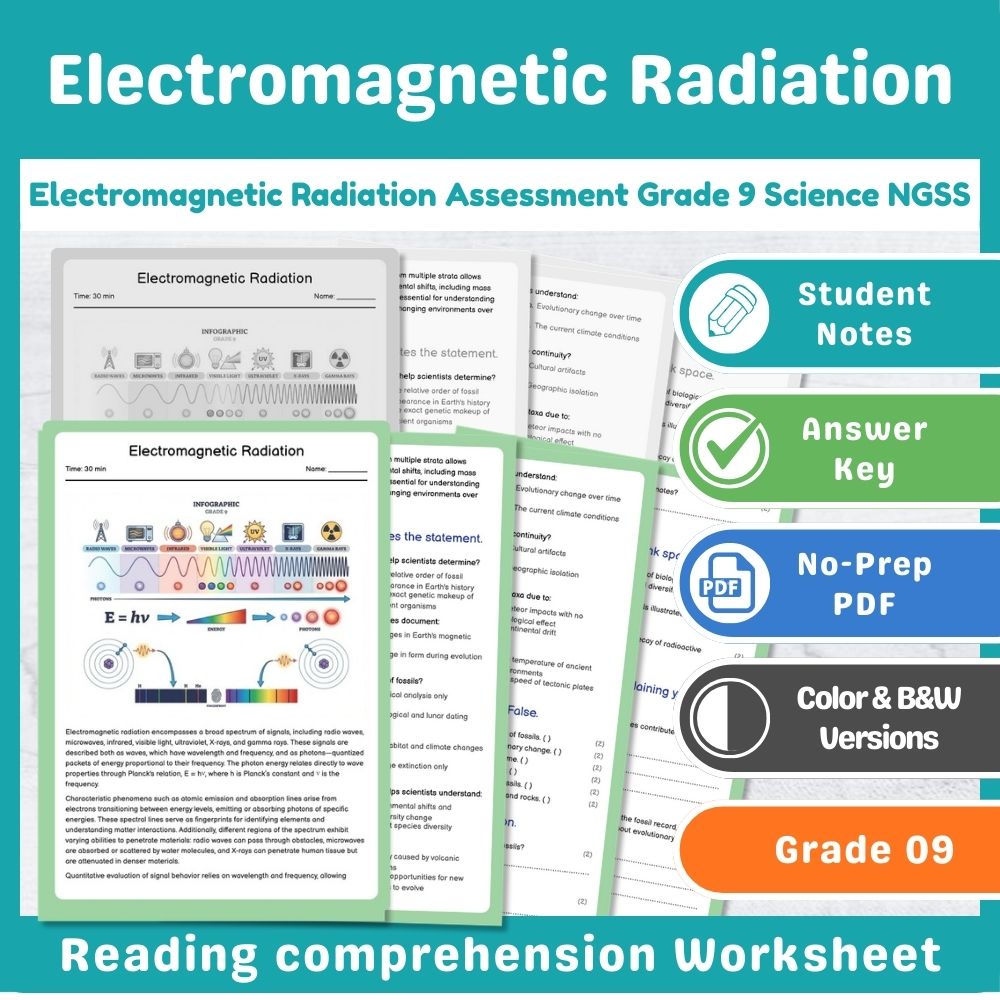
Electromagnetic Radiation Assessment Grade 9 Science NGSS
Created byPrism Point LearningLearning Objectives
- Explain the wave and photon descriptions of electromagnetic signals across the spectrum.
- Relate frequency to photon energy and their interactions with matter.
- Identify characteristic phenomena such as atomic emission and absorption lines, and spectral attenuation.
Instant download
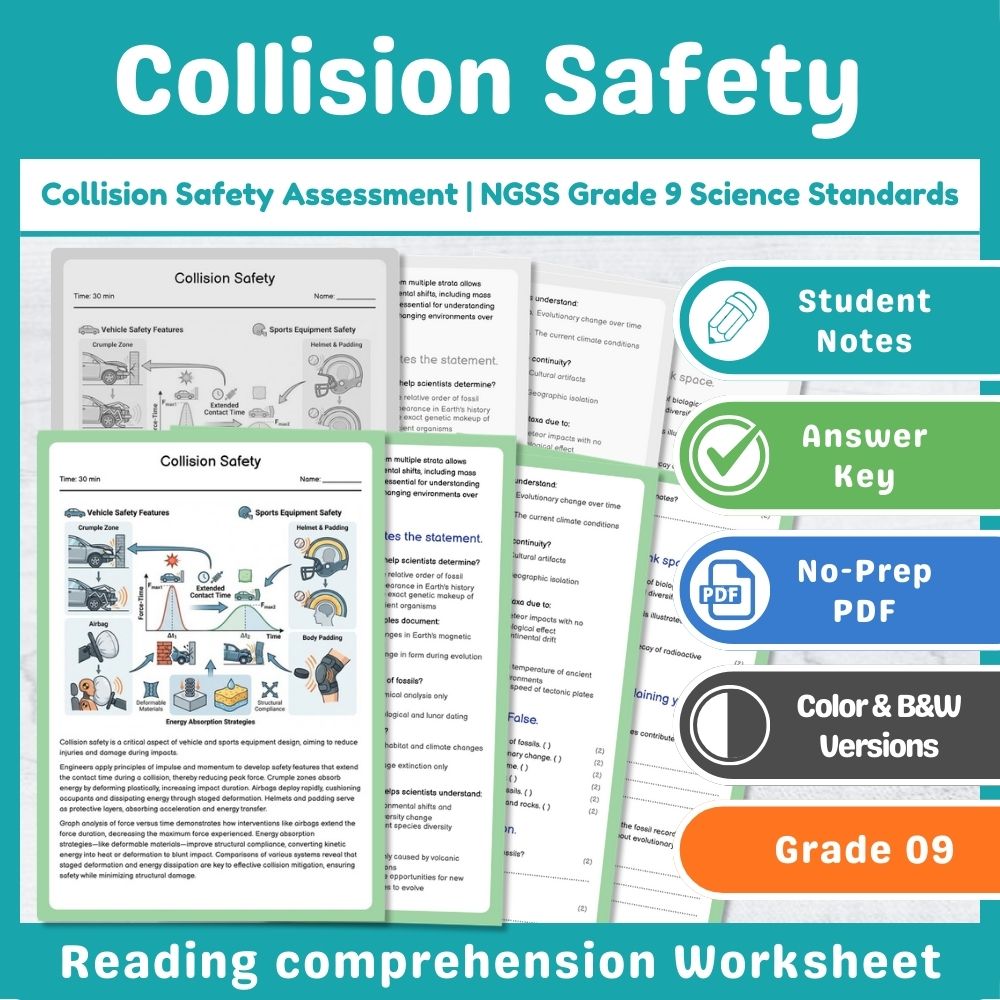
Collision Safety Assessment | NGSS Grade 9 Science Standards
Created byPrism Point LearningLearning Objectives
- Understand how impulse and force-time tradeoffs influence collision mitigation strategies.
- Identify engineering design features such as crumple zones, airbags, and helmets for safer high-impact interactions.
- Analyze force-time graphs and energy absorption techniques to evaluate shock absorption effectiveness.
Instant download

Rock Transformations Assessment for Grade 9 Science | NGSS Standards
Created byPrism Point LearningLearning Objectives
- Describe the processes involved in the rock cycle, including melting, crystallization, erosion, and metamorphism.
- Identify examples of rock cycle processes, such as basalt formation, sandstone deposition, and metamorphic rocks.
- Explain how temperature, pressure, and fluid flow influence rock transformation and geologic timescales.
Instant download

Energy Conservation Assessment | NGSS Standards Grade 9 Science
Created byPrism Point LearningLearning Objectives
- Explain the principles of energy conservation in closed and open systems.
- Identify system boundaries and perform energy bookkeeping calculations.
- Use energy flow diagrams to analyze energy transfer within systems.
Instant download
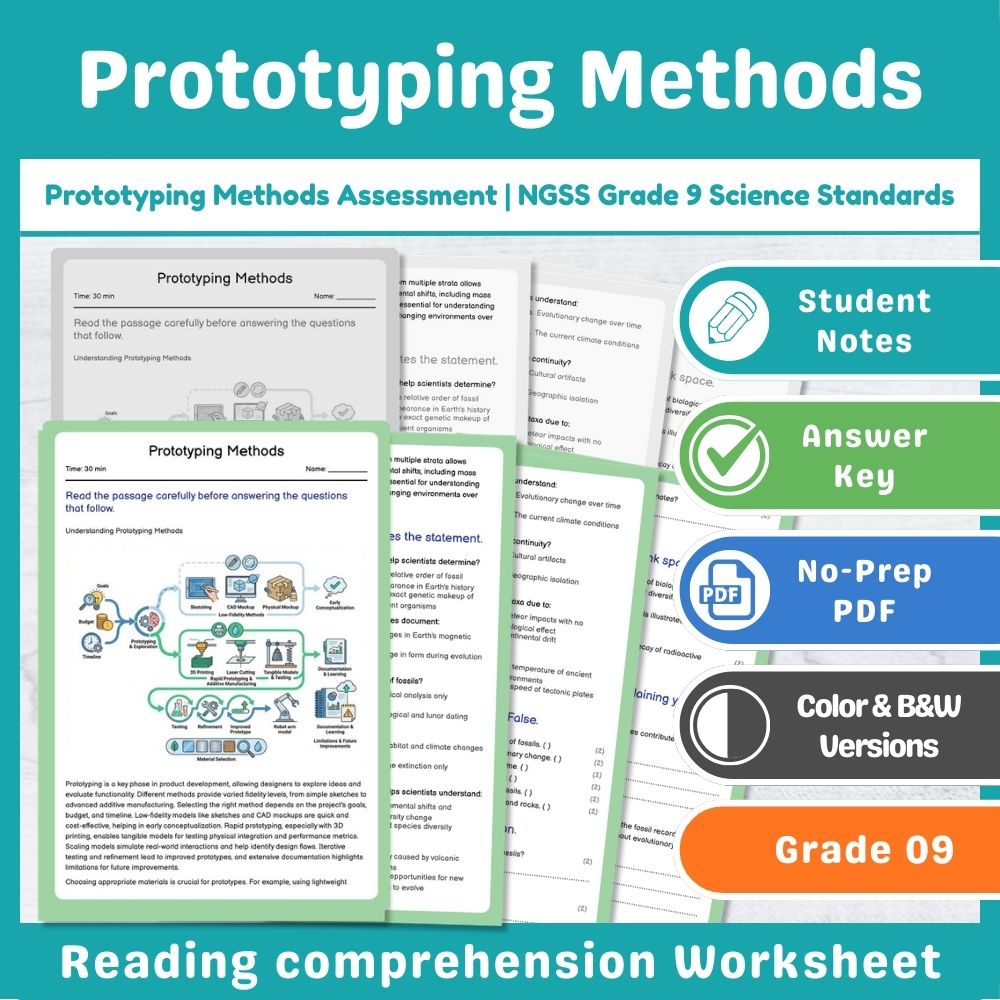
Prototyping Methods Assessment | NGSS Grade 9 Science Standards
Created byPrism Point LearningLearning Objectives
- Identify various prototyping methods and their applications.
- Understand how to select appropriate fidelity levels and materials for prototypes.
- Describe testing protocols and measures used during prototyping.
Instant download
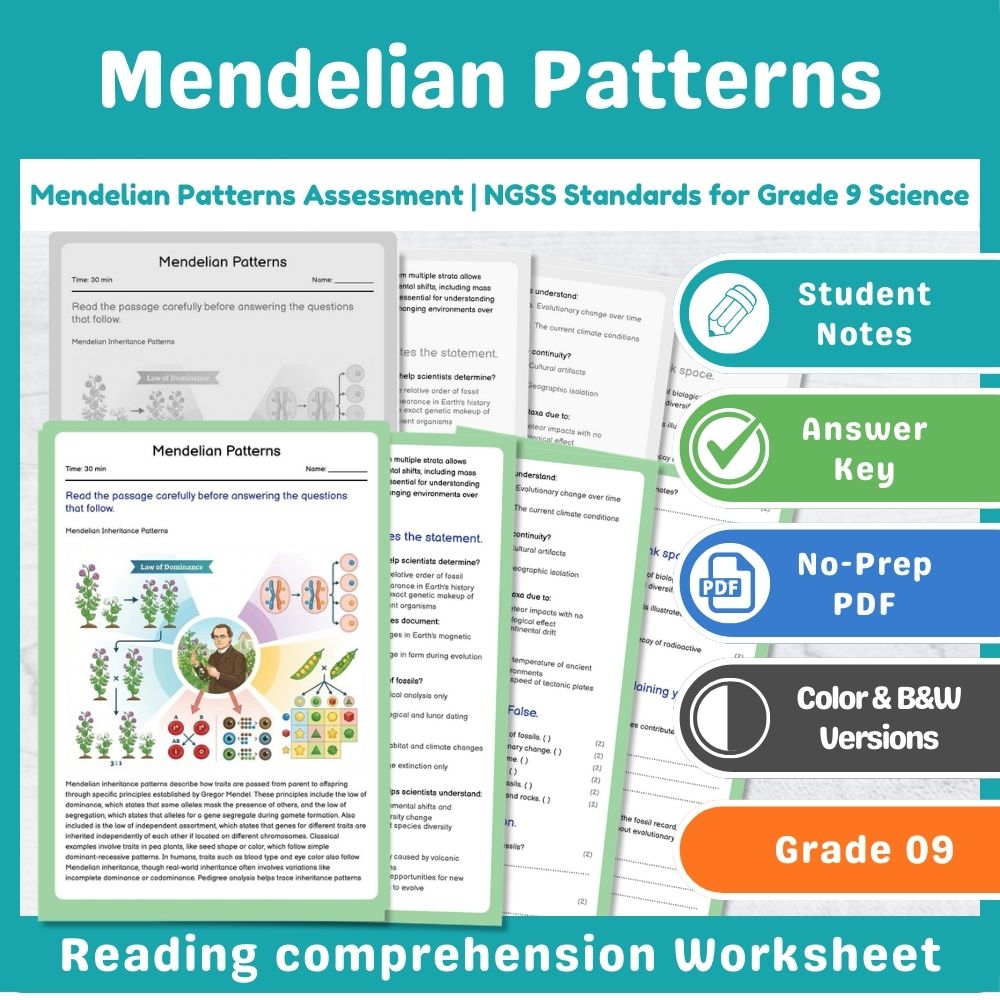
Mendelian Patterns Assessment | NGSS Standards for Grade 9 Science
Created byPrism Point LearningLearning Objectives
- Describe the basic principles of Mendelian inheritance, including dominance, segregation, and independent assortment.
- Use Punnett squares to predict genotype and phenotype ratios of monohybrid and dihybrid crosses.
- Interpret pedigree charts to analyze inheritance patterns.
Instant download
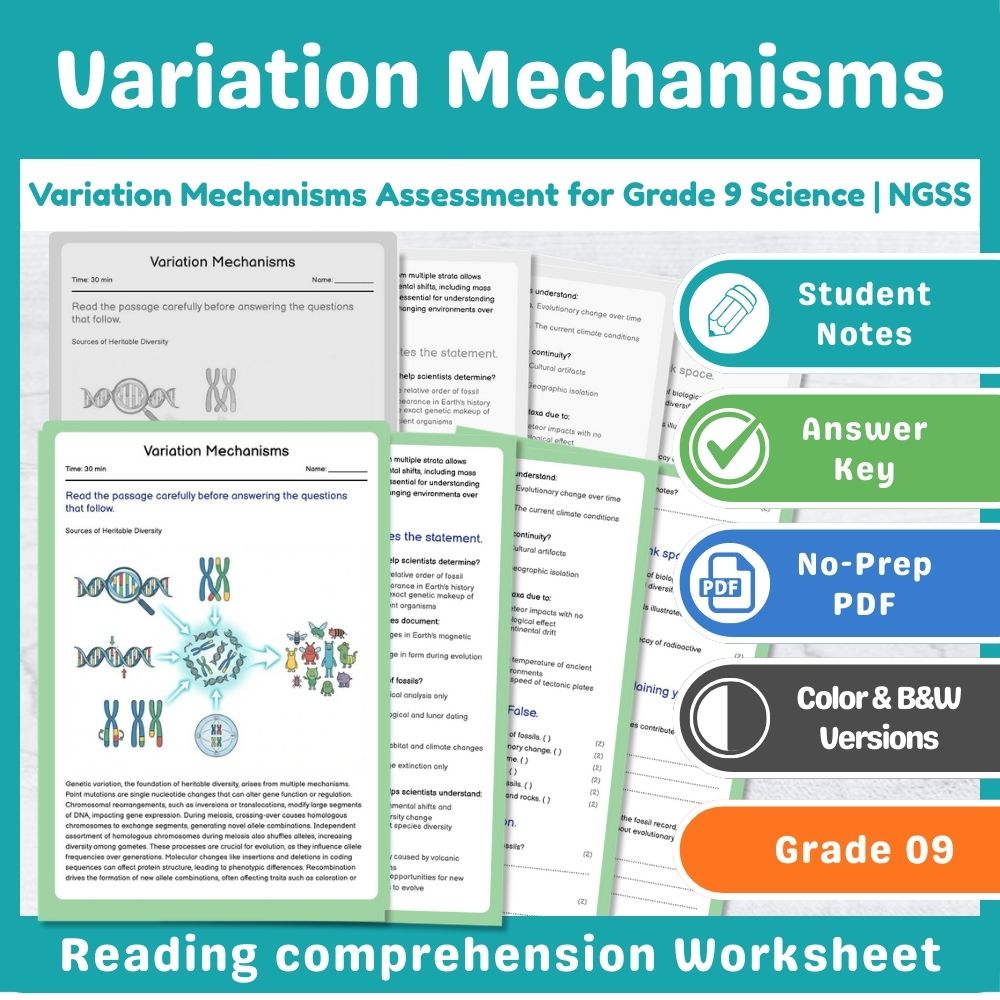
Variation Mechanisms Assessment for Grade 9 Science | NGSS
Created byPrism Point LearningLearning Objectives
- Describe the main sources of heritable genetic variation such as point mutations, chromosomal rearrangements, and recombination.
- Explain how mechanisms like crossing-over and independent assortment contribute to allelic and phenotypic diversity.
- Connect molecular changes to effects on gene expression, protein function, and trait variation at the population level.
Instant download
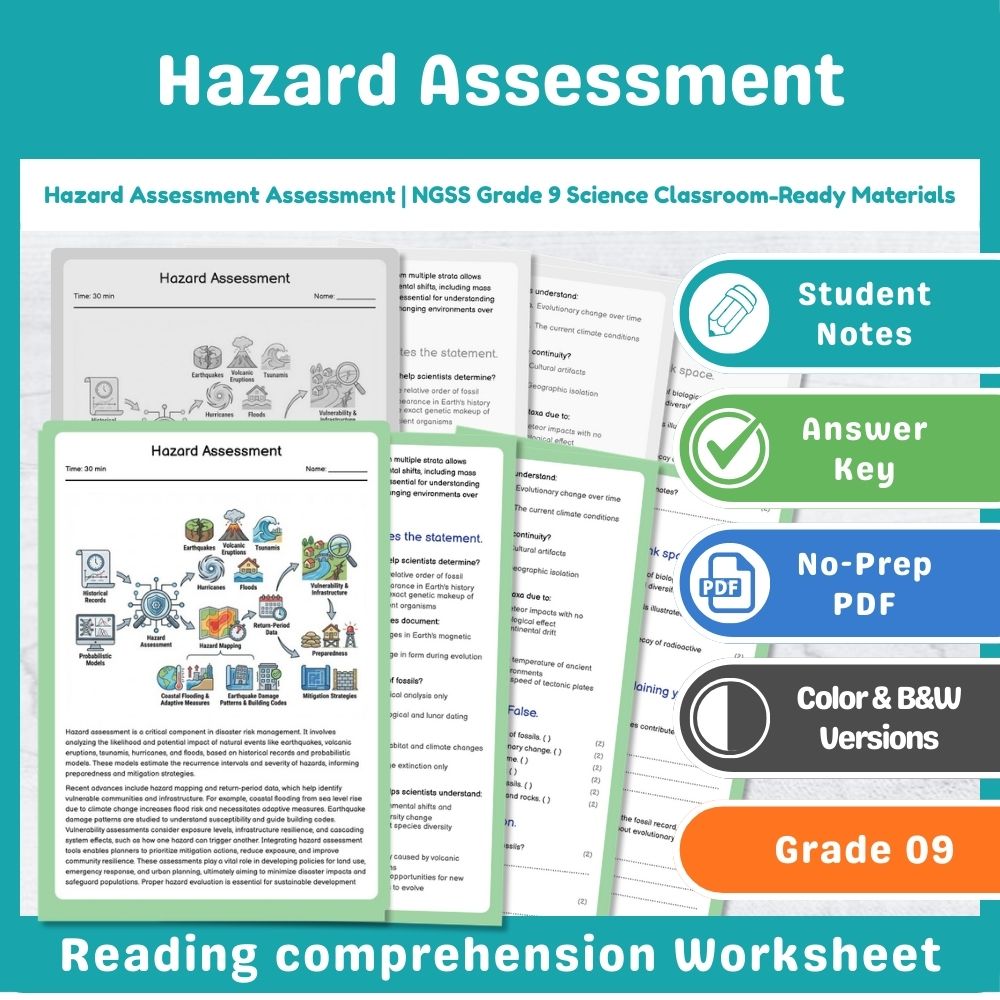
Hazard Assessment Assessment | NGSS Grade 9 Science Classroom-Ready Materials
Created byPrism Point LearningLearning Objectives
- Understand the methods used to evaluate hazard risks such as earthquakes, volcanoes, tsunamis, hurricanes, and floods.
- Analyze hazard occurrence, frequency, and consequences using historical data and probabilistic models.
- Recognize the importance of hazard mapping, return-period data, and mitigation strategies in assessing community susceptibility.
Instant download

Comparative Evaluation Assessment for Grade 9 Science | NGSS Standards
Created byPrism Point LearningLearning Objectives
- Understand the principles of comparative evaluation in engineering design.
- Identify quantitative and qualitative performance metrics for system assessment.
- Apply decision frameworks and matrices to evaluate design trade-offs.
Instant download

Atomic Structure Assessment for Grade 9 Science NGSS Standards
Created byPrism Point LearningLearning Objectives
- Describe the subatomic particles involved in atomic structure including protons, neutrons, and electrons.
- Explain electron configurations and the concept of quantized energy levels.
- Understand how the periodic table arranges elements based on valence electrons and how this influences chemical behavior.
Instant download
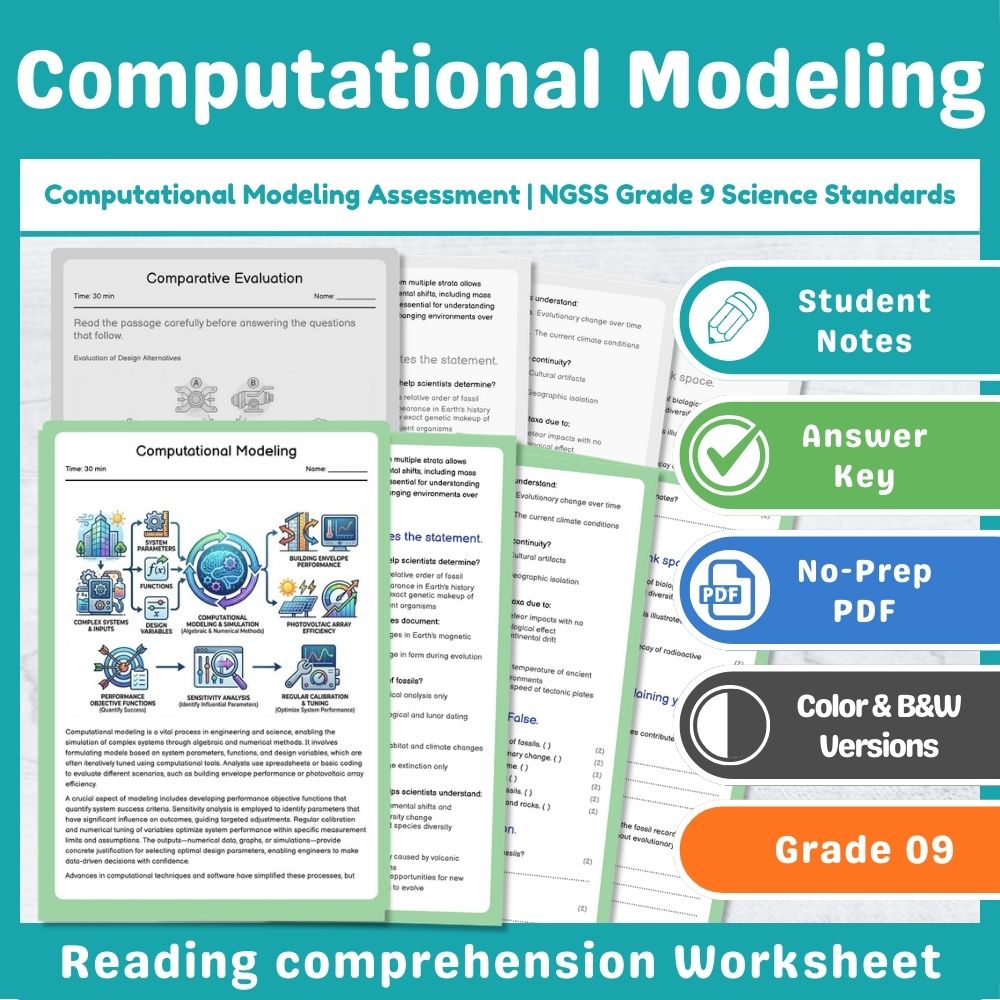
Computational Modeling Assessment | NGSS Grade 9 Science Standards
Created byPrism Point LearningLearning Objectives
- Understand the application of mathematical and computational methods in system modeling.
- Analyze how parameters and variables influence system performance.
- Develop and evaluate models using spreadsheets and simple code simulations.
Instant download
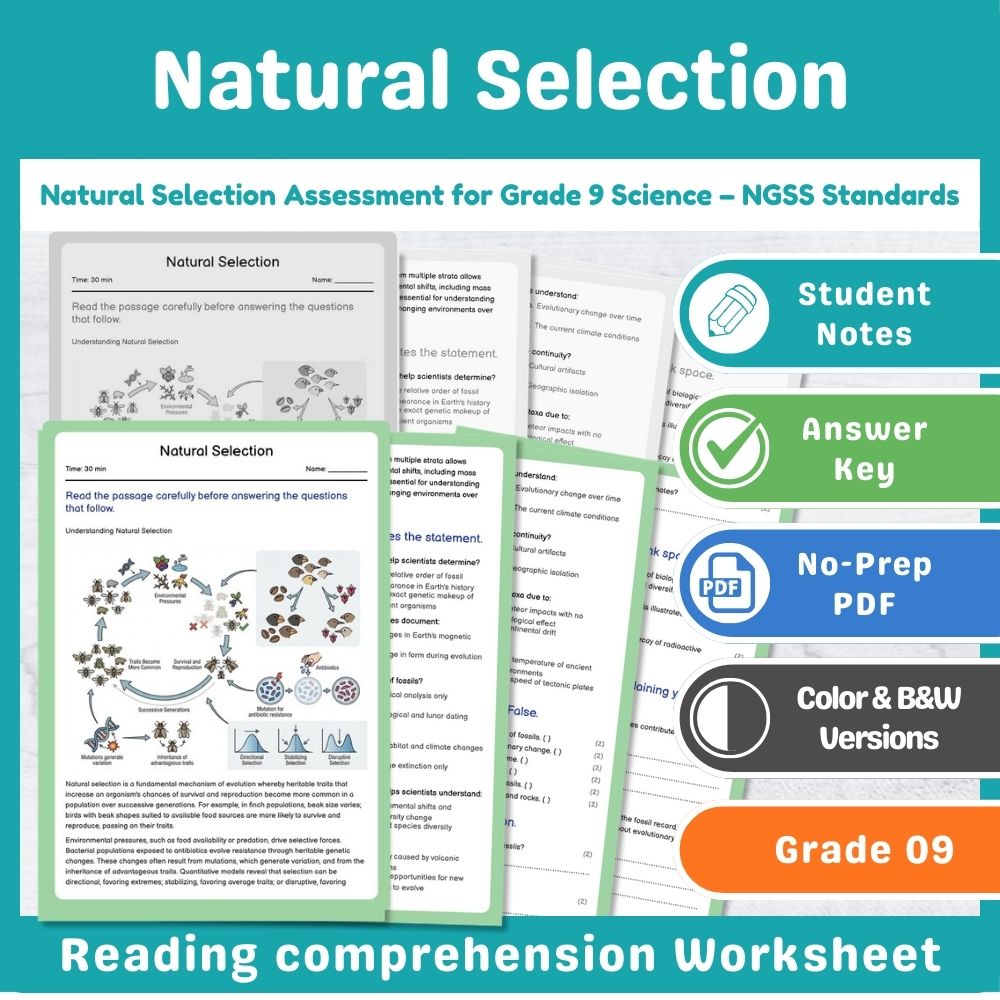
Natural Selection Assessment for Grade 9 Science – NGSS Standards
Created byPrism Point LearningLearning Objectives
- Explain the mechanisms of natural selection, including variation, inheritance, and selection pressures.
- Identify classic examples of natural selection, such as finch beak morphology and bacterial resistance.
- Describe how models of fitness and allele frequency determine different types of selection.
Instant download
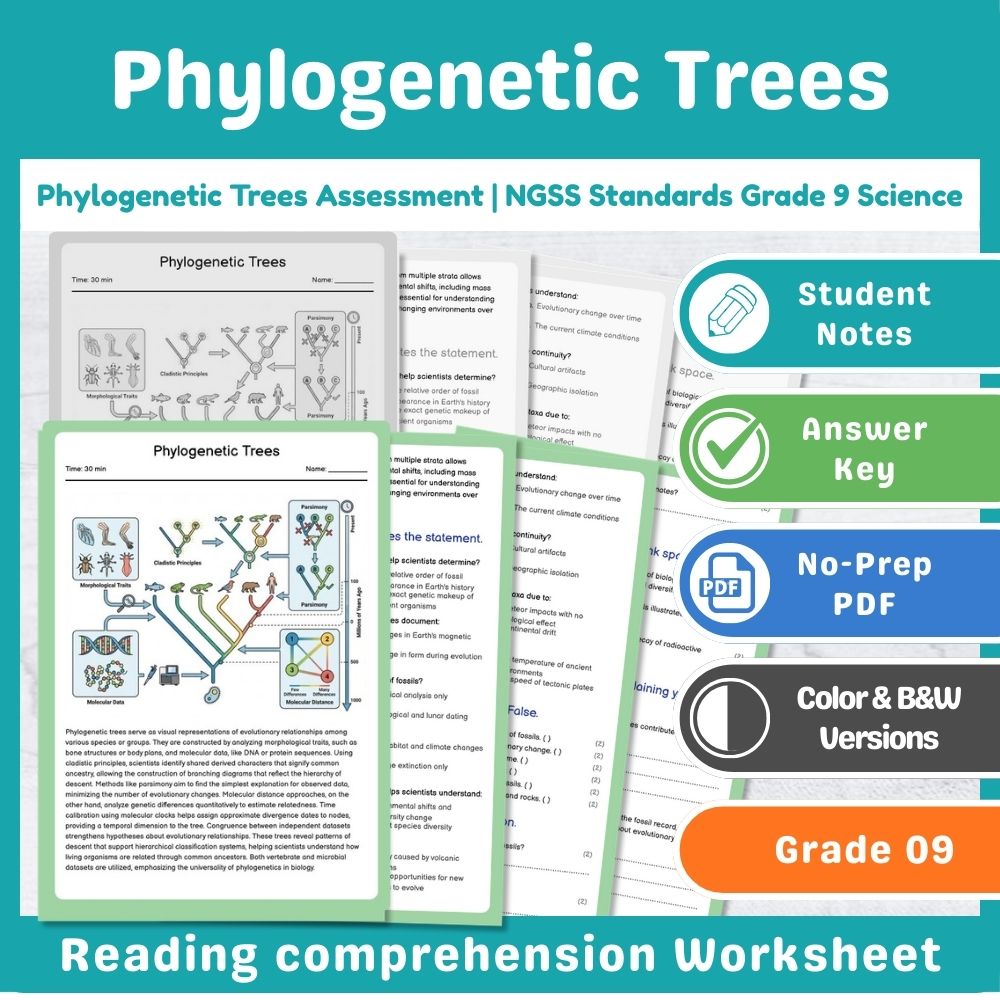
Phylogenetic Trees Assessment | NGSS Standards Grade 9 Science
Created byPrism Point LearningLearning Objectives
- Understand the construction principles of phylogenetic trees and their significance in evolutionary biology.
- Interpret branching diagrams to identify common ancestors and shared derived characters.
- Learn different methods of tree-building such as parsimony and molecular distance analyses.
Instant download
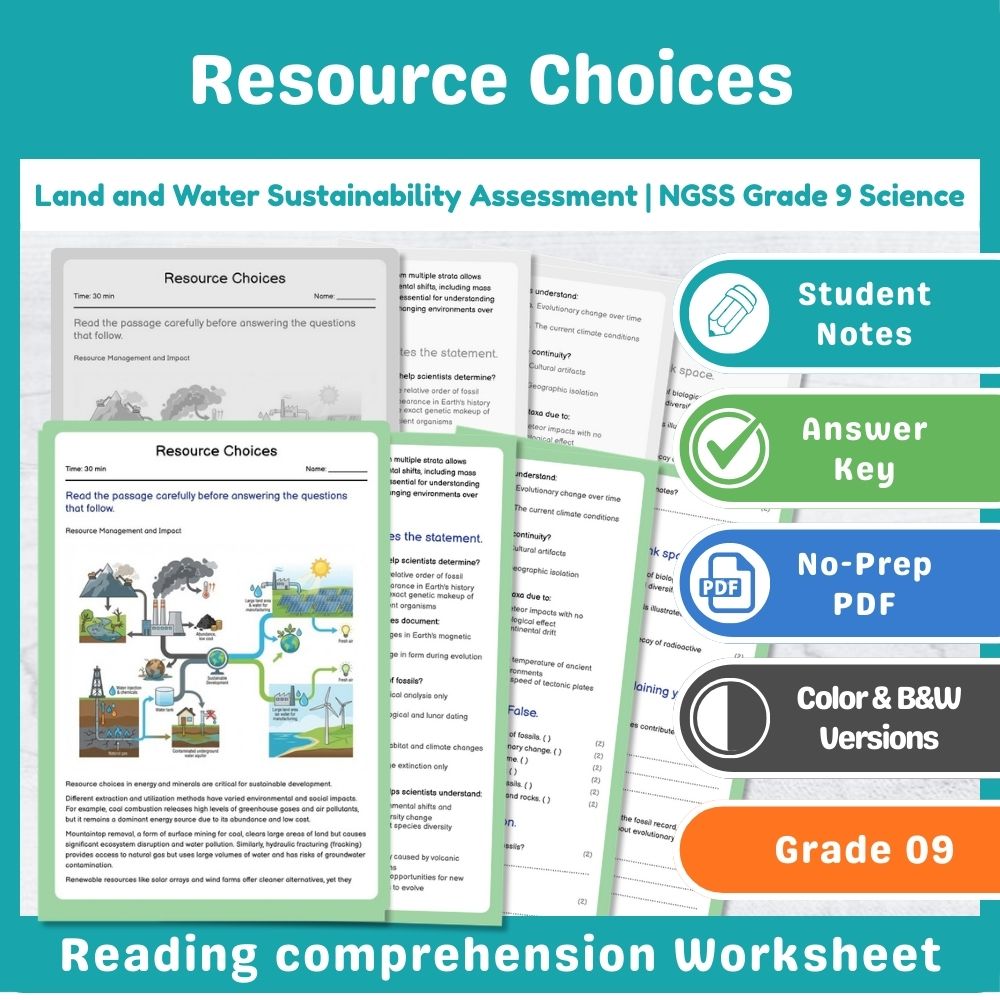
Resource Choices Assessment | NGSS Standards-Based Assessment for Grade 9 Science
Created byPrism Point LearningLearning Objectives
- Compare and evaluate different energy and mineral resource options.
- Analyze impacts of resource extraction methods on environment and society.
- Understand trade-offs related to resource management, sustainability, and lifecycle costs.
Instant download

Climate Data Trends Assessment for Grade 8 Science | NGSSS Standards
Created byPrism Point LearningLearning Objectives
- Interpret climate indicators by comparing temperature, precipitation, and storm-frequency data over time.
- Distinguish long-term climate trends from short-term weather variability and single extreme events.
- Explain how El Niño and La Niña can affect rainfall patterns using evidence from data records.
Also included in: Grade 8 Earth Systems Science Lesson Bundle: Florida NGSSS Assessment
Instant download
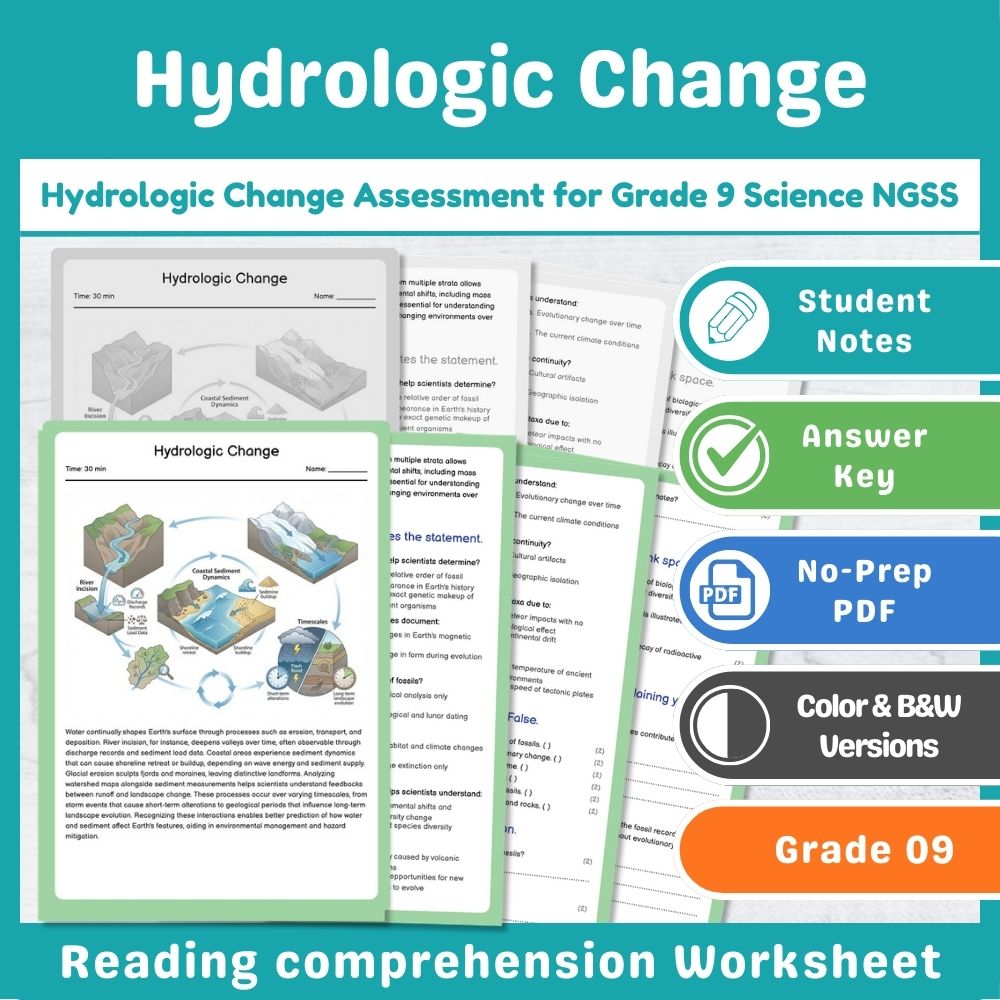
Hydrologic Change Assessment for Grade 9 Science NGSS
Created byPrism Point LearningLearning Objectives
- Analyze and interpret hydrologic data related to erosion, transport, and deposition.
- Identify how river incision, coastal sediment dynamics, and glacial erosion shape landscapes.
- Understand how discharge records, sediment load measurements, and watershed maps support hydrologic studies.
Instant download
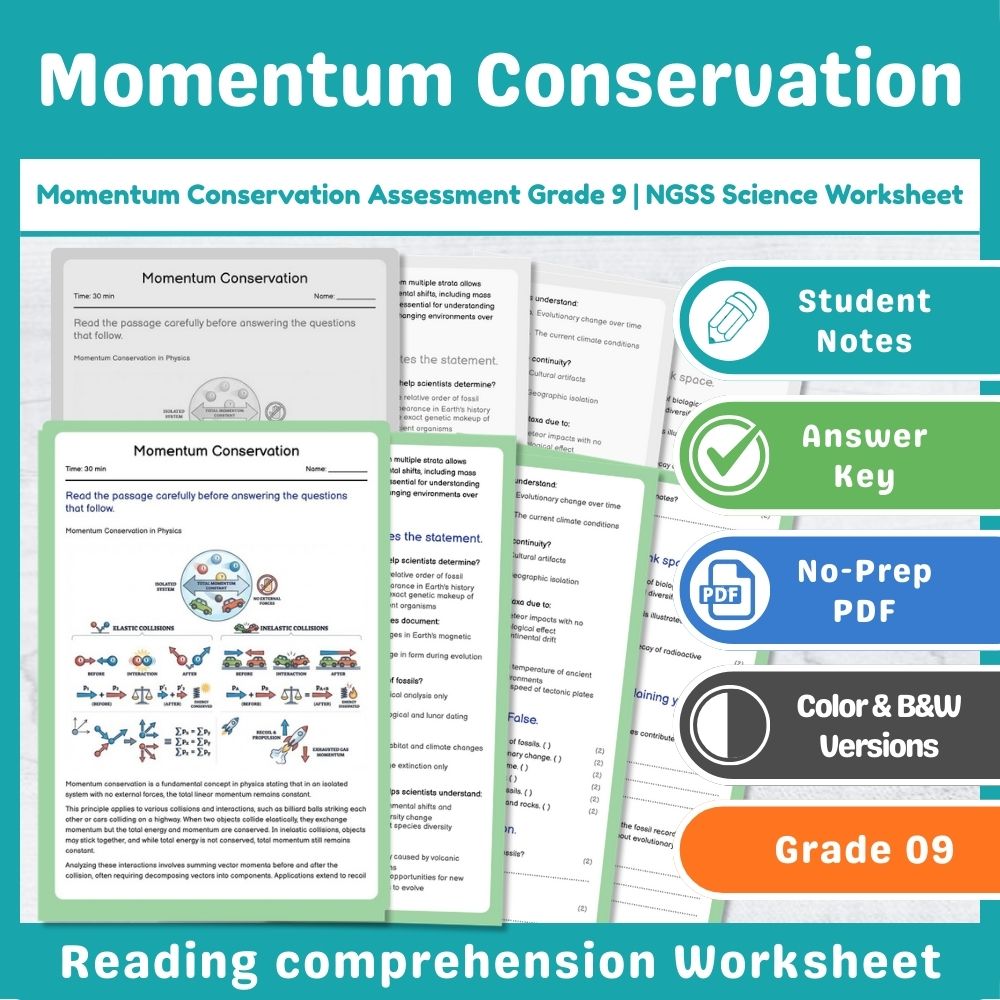
Momentum Conservation Assessment Grade 9 | NGSS Science Worksheet
Created byPrism Point LearningLearning Objectives
- Understand the principle of conservation of linear momentum in isolated systems.
- Differentiate between elastic and inelastic collisions using vector sums.
- Calculate total momentum before and after interactions in various scenarios.
Instant download

Speciation And Change Assessment for Grade 8 Science | NGSSS Standards
Created byPrism Point LearningLearning Objectives
- Explain how reproductive isolation can lead to speciation over many generations
- Describe how geographic barriers, habitat changes, or behavioral differences reduce gene flow
- Use natural selection and genetic variation to predict how traits may diverge in separated populations
Also included in: Grade 8 Evolution and Genetics Science Lesson Bundle | Florida NGSSS
Instant download
Field Dynamics Assessment | NGSS Standards Grade 9 Science
Created byPrism Point LearningLearning Objectives
- Understand the concepts of electric and magnetic fields and how they influence forces on charges and currents.
- Interpret field vectors and maps, and utilize field lines to represent direction and magnitude.
- Apply principles of superposition, forces, and motion curvature in uniform magnetic fields.
Instant download
Human Influence and Climate Change Assessment | NGSS Grade 9 Science
Created byPrism Point LearningLearning Objectives
- Analyze historical atmospheric CO2 records and land-use change data.
- Identify the effects of anthropogenic activities on the biosphere and hydrosphere.
- Evaluate evidence linking human emissions to climate variable alterations.
Instant download
Seasonal Cycles Assessment | Alberta Standards-Aligned Grade 7 Science
Created byPrism Point LearningLearning Objectives
- Understand how seasonal thermal cycles influence energy storage and release in landscapes.
- Identify the main factors driving seasonal energy fluxes, including solar input and albedo changes.
- Describe the pathways of energy transformation such as radiative, latent, and sensible heat processes.
Also included in: Lesson Grade 7 Science Mini Bundle | Energy, Heat & Thermal Processes +1 more
Instant download
Embryonic Patterns Assessment for Grade 7 Science NGSS Standards
Created byPrism Point LearningLearning Objectives
- Compare embryonic development stages across different taxa to identify conserved features.
- Analyze morphological similarities in embryonic structures such as pharyngeal pouches and limb buds.
- Understand how developmental timing aids in reconstructing evolutionary relationships.
Also included in: Grade 7 Science Mini Bundle – Biological Evolution: Unity & Diversity +1 more
Instant download

Surface Process Evidence Assessment | General Grade 7 Science
Created byPrism Point LearningLearning Objectives
- Understand how Earth's surface is shaped by internal and external processes.
- Identify evidence of surface processes in landform patterns and rock formations.
- Explain how landforms such as deltas and floodplains are formed through external processes.
Also included in: Grade 7 Earth & Space Science Lesson Bundle: General Science Framework
Instant download

Climate Drivers Over Time Assessment | General Grade 7 Science
Created byPrism Point LearningLearning Objectives
- Understand how natural records and measurements are used to assess past and present climate conditions.
- Identify key climate drivers that influence long-term climate change.
- Explain how factors like greenhouse gases, ocean currents, and volcanic activity affect Earth's energy balance.
Also included in: Grade 7 Earth & Space Science Lesson Bundle: General Science Framework
Instant download

Investigation Variables Assessment | General Standards Grade 7 Science
Created byPrism Point LearningLearning Objectives
- Identify the different types of variables in scientific investigations.
- Understand how to design investigation plans with clear variables and evidence.
- Distinguish between independent, dependent, and controlled variables in experiments.
Also included in: Grade 7 Scientific Inquiry Practices Science Lesson Bundle: General
Instant download

Fossil Patterns NGSS Assessment | Standards-Aligned Grade 7 Science
Created byPrism Point LearningLearning Objectives
- Analyze patterns in the fossil record to understand evolution and extinction events.
- Identify different types of fossils and their significance in reconstructing ancestry.
- Interpret stratigraphic sequences and evolutionary transitions in the geological record.
Also included in: Grade 7 Science Mini Bundle – Biological Evolution: Unity & Diversity +1 more
Instant download

Adaptation Evidence Assessment | Florida NGSSS Grade 7 Science
Created byPrism Point LearningLearning Objectives
- Explain what adaptations are and how they can improve survival or reproduction in specific environments
- Identify evidence for adaptation using observations of trait differences among populations, fossil records, and documented environmental changes
- Use examples (such as peppered moth coloration) to connect environmental pressures to changes in traits
Instant download

Biotic and Abiotic Factors Assessment | Florida NGSSS Grade 7 Science
Created byPrism Point LearningLearning Objectives
- Differentiate between biotic factors and abiotic factors in an ecosystem.
- Explain how abiotic changes can affect biotic interactions and population sizes.
- Use evidence from an ecosystem scenario to predict changes in community composition.
Instant download
Browse more categories
About Reading comprehension Worksheets
Find reading comprehension worksheets for class practice, homework, or self-study. All 40,284 are instant PDF downloads.
Each resource here is built by an independent educator and reviewed for quality. Worksheets print straight from PDF and suit classroom use, homework, or extra practice; most come with answer keys, and you can preview before purchasing.