
Reading comprehension Worksheets
40,284 type resources
Newtonian Forces Assessment for Grade 10 Science | Florida NGSSS
 Created byPrism Point Learning
Learning Objectives
- Explain how net force affects an object’s motion, including changes in velocity and constant velocity in the absence of net force.
- Use proportionality ideas to predict acceleration changes when net force or mass changes.
- Connect equilibrium to balanced forces and interpret outcomes using free-body diagram reasoning.
Also included in: Grade 10 Waves Energy Forces Science Lesson Mini Bundle | Florida NGSSS +1 more
Instant download

Motion Graphs Assessment for Grade 10 Science | Standards-Aligned Assessment
Created byPrism Point LearningLearning Objectives
- Interpret position-time graphs to determine velocity from slope and identify changes in motion from curvature.
- Interpret velocity-time graphs to determine acceleration from slope and identify changes in acceleration from sign changes or curvature.
- Connect graph features (flat sections, straight lines, sign changes) to real physical motion over time.
Also included in: Grade 10 Waves Energy Forces Science Lesson Mini Bundle | Florida NGSSS +1 more
Instant download

Friction And Drag Assessment | NGSSS Standards Grade 10 Science
Created byPrism Point LearningLearning Objectives
- Explain how nonconservative forces like friction and drag oppose motion and remove mechanical energy
- Analyze how friction and drag affect acceleration and velocity over time
- Relate real-world observations (slowing down, reaching terminal velocity) to the concept of net force
Also included in: Grade 10 Waves Energy Forces Science Lesson Mini Bundle | Florida NGSSS +1 more
Instant download

Stellar Evolution Assessment | Florida NGSSS Grade 10 Science Worksheet
Created byPrism Point LearningLearning Objectives
- Explain how a star’s mass influences its main-sequence life and later evolutionary stages
- Describe how fusion changes as a star’s fuel supply decreases
- Connect stellar deaths (red giant, planetary nebula, supernova) to element production and enrichment of space
Also included in: Grade 10 Earth and Space Systems Science Lesson Bundle – Florida NGSSS +1 more
Instant download

Radiometric Dating Assessment | Florida NGSSS Standards Grade 10 Science
Created byPrism Point LearningLearning Objectives
- Explain how radiometric dating uses radioactive decay of parent isotopes to estimate geologic time
- Interpret the relationship between half-life and the fraction of parent isotopes remaining
- Describe key assumptions (initial conditions and closed-system behavior) that affect the reliability of radiometric dates
Also included in: Grade 10 Earth and Space Systems Science Lesson Bundle – Florida NGSSS +1 more
Instant download

Physical Properties Assessment | Alberta Standards Grade 10 Science
Created byPrism Point LearningLearning Objectives
- Differentiate between intensive and extensive physical properties of substances.
- Identify examples of physical and chemical properties in real-world materials.
- Explain how property classification influences material selection and environmental behavior.
Also included in: Grade 10 Matter and Chemical Change Science Lesson Bundle: Alberta +1 more
Instant download

Carbon Balance Assessment for Grade 10 Science | Alberta Standards
Created byPrism Point LearningLearning Objectives
- Explain the major carbon pools, flux pathways, and their roles in regional and global climate.
- Identify natural and anthropogenic drivers affecting carbon transfer among atmosphere, vegetation, soil, and ocean.
- Analyze regional examples like boreal forest succession, peatland accumulation, and soil disturbance impacts.
Also included in: Grade 10 Earth and Space Systems Science Lesson Bundle for Alberta +1 more
Instant download

Hydrologic Cycle Assessment for Grade 10 Science | Alberta Standards
Created byPrism Point LearningLearning Objectives
- Explain the processes involved in the hydrologic cycle including evaporation, transpiration, condensation, and runoff.
- Describe water movement from mountain snowpack to regional aquifers and rivers.
- Analyze how climate variability and watershed characteristics affect regional water resources.
Also included in: Grade 10 Earth and Space Systems Science Lesson Bundle for Alberta +1 more
Instant download

Circuit Fundamentals Assessment | Alberta Grade 10 Science Standards
Created byPrism Point LearningLearning Objectives
- Define current, voltage, and resistance and explain their interrelationships.
- Understand Ohm's law and its application in simple circuits.
- Differentiate between series and parallel electrical circuits.
Also included in: Grade 10 Energy, Motion and Electricity Science Lesson Bundle: Alberta +1 more
Instant download

Motors And Generators Assessment for Grade 10 Science | Alberta Standards
Created byPrism Point LearningLearning Objectives
- Explain the operational principles of electric motors and generators.
- Describe how electromagnetic interactions produce rotation in coils within magnetic fields.
- Identify applications of motors and generators in regional power and industry.
Also included in: Grade 10 Energy, Motion and Electricity Science Lesson Bundle: Alberta +1 more
Instant download

Transmission Losses Assessment for Grade 10 Science | Alberta Standards
Created byPrism Point LearningLearning Objectives
- Understand how current, resistance, and voltage affect energy losses in power transmission.
- Identify strategies used to minimize transmission losses over long distances.
- Explain the role of transformers in voltage regulation and their impact on power efficiency.
Also included in: Grade 10 Energy, Motion and Electricity Science Lesson Bundle: Alberta +1 more
Instant download

Mechanical Calculations Assessment | Alberta Grade 10 Science Standards
Created byPrism Point LearningLearning Objectives
- Understand energy conservation principles involving potential and kinetic energy in systems with friction, springs, and gravity.
- Apply numerical methods to solve energy transfer problems in real-world contexts.
- Analyze the effects of non-conservative work such as friction on energy calculations.
Also included in: Grade 10 Energy, Motion and Electricity Science Lesson Bundle: Alberta +1 more
Instant download

Dynamic Equilibrium Assessment for Grade 10 Science – Alberta Standards
Created byPrism Point LearningLearning Objectives
- Understand the concept of dynamic equilibrium and the factors influencing it.
- Interpret equilibrium constant expressions and predict system shifts due to external changes.
- Apply principles of chemical equilibrium to industrial and environmental contexts.
Also included in: Grade 10 Matter and Chemical Change Science Lesson Bundle: Alberta +1 more
Instant download
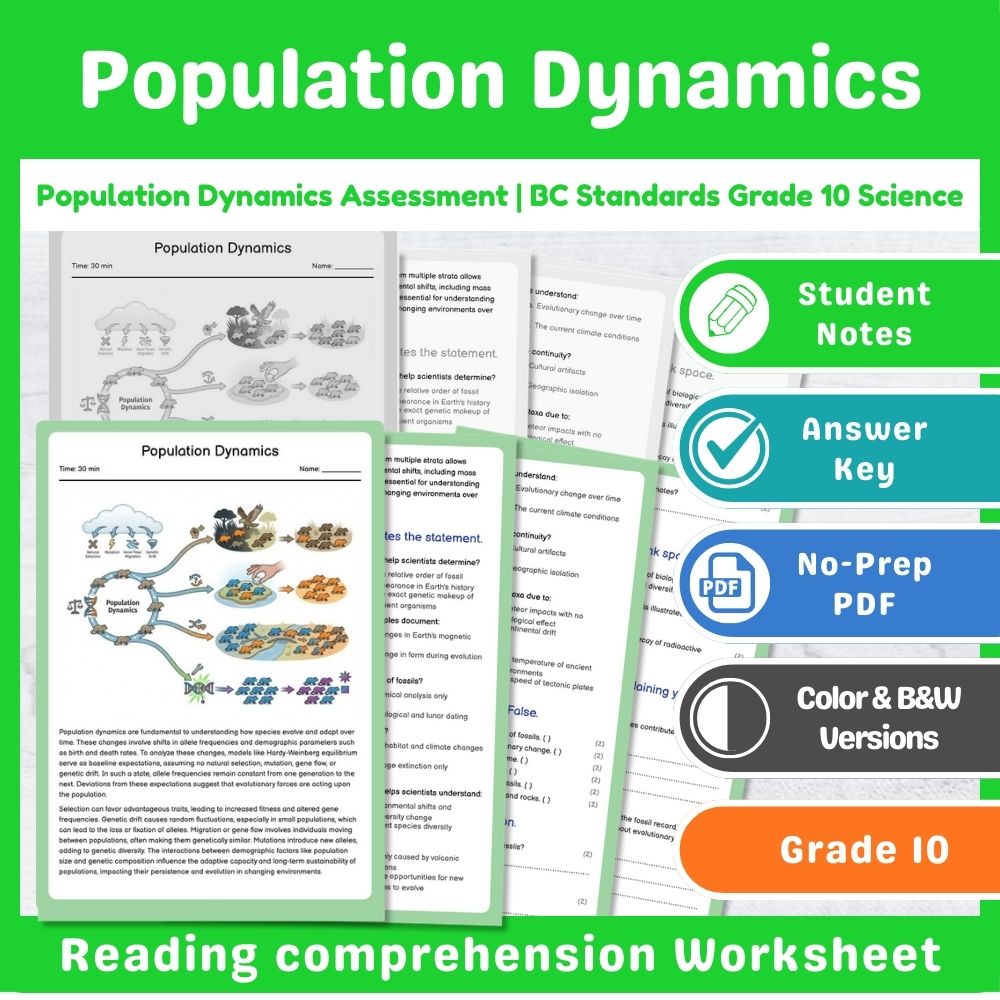
Population Dynamics Assessment | BC Standards Grade 10 Science
Created byPrism Point LearningLearning Objectives
- Understand basic concepts of population dynamics and evolutionary forces.
- Identify the role of models like Hardy-Weinberg equilibrium in population studies.
- Analyze how factors such as selection, mutation, migration, and drift influence genetic variation.
Instant download

Gravity Shaping Orbits Assessment | California Standards Grade 7 Science
Created byPrism Point LearningLearning Objectives
- Explain how gravity provides the centripetal force that keeps objects in orbital paths.
- Describe why planets follow curved, often elliptical trajectories instead of straight lines.
- Connect the balance of gravity and motion to predictable, repeating patterns in orbital systems.
Also included in: Grade 7 Earth Systems Science Lesson Bundle Assessments | California Standards +1 more
Instant download

Clouds and Precipitation Assessment | California Standards Grade 7 Science
Created byPrism Point LearningLearning Objectives
- Explain how cooling air leads to condensation and cloud formation.
- Describe how temperature and moisture determine cloud type and precipitation type.
- Connect energy transfers during phase changes to weather patterns.
Also included in: Grade 7 Earth Systems Science Lesson Bundle Assessments | California Standards +1 more
Instant download

Air Masses Fronts Assessment | California Standards Grade 7 Science
Created byPrism Point LearningLearning Objectives
- Explain how air masses with different temperature and moisture properties interact to create weather changes
- Describe how fronts form boundaries where air rises, cools, and can produce clouds and precipitation
- Interpret how wind shifts and temperature changes often occur near a front
Also included in: Grade 7 Earth Systems Science Lesson Bundle Assessments | California Standards +1 more
Instant download

Thermal Expansion Assessment Grade 7 Science California Standards
Created byPrism Point LearningLearning Objectives
- Explain how increasing temperature affects particle motion and spacing in solids, liquids, and gases
- Describe and predict contraction and expansion when materials are heated or cooled
- Connect thermal expansion to real-world situations such as tight metal fits and gas pressure in sealed containers
Also included in: Grade 7 Forces and Matter Science Lesson Bundle: California Standards +1 more
Instant download

Resource Availability Assessment | California Standards Grade 7 Science Worksheet
Created byPrism Point LearningLearning Objectives
- Explain how limited resources affect population survival and reproduction in ecosystems.
- Describe how changes in food, water, space, and shelter influence the size of populations over time.
- Use evidence from an ecosystem to predict how population numbers may change when resources become scarce or abundant.
Also included in: Grade 7 Energy Flow and Matter Cycling Science lesson bundle – California Standards +1 more
Instant download

Particle Model Assessment for Grade 7 | California Standards - Science
Created byPrism Point LearningLearning Objectives
- Explain how the particle model describes matter as tiny particles in constant motion.
- Relate temperature to the average kinetic energy (motion) of particles.
- Use particle ideas to predict how changes in temperature affect properties such as diffusion and pressure.
Also included in: Grade 7 Forces and Matter Science Lesson Bundle: California Standards +1 more
Instant download

Net Force Effects Assessment | California Standards Grade 7 Science
Created byPrism Point LearningLearning Objectives
- Explain how forces add to create a net force using both magnitude and direction
- Predict how an unbalanced net force changes an object’s speed and/or direction
- Determine when forces are balanced and describe the resulting motion
Also included in: Grade 7 Forces and Matter Science Lesson Bundle: California Standards +1 more
Instant download

Trophic Energy Transfer Assessment | California Standards Grade 7 Science
Created byPrism Point LearningLearning Objectives
- Explain how energy moves through trophic levels in a food chain or food web.
- Describe why only a few trophic levels are typically supported in ecosystems.
- Use energy transfer efficiency to predict how biomass changes across trophic levels.
Also included in: Grade 7 Energy Flow and Matter Cycling Science lesson bundle – California Standards +1 more
Instant download

Physical Chemical Changes Assessment | Florida NGSSS Grade 7 Science
Created byPrism Point LearningLearning Objectives
- Differentiate between physical changes and chemical changes using evidence from observations.
- Identify indicators of chemical change such as gas production, precipitate formation, color change, or temperature change.
- Explain how matter can change form or state without creating a new substance.
Also included in: Grade 7 Matter, Forces & Energy Science Lesson Bundle | Florida NGSSS
Instant download

Matter Classification Assessment for Grade 7 Science | Florida NGSSS
Created byPrism Point LearningLearning Objectives
- Distinguish elements, compounds, and mixtures based on composition and how particles are combined
- Classify mixtures as homogeneous or heterogeneous using visible and uniform properties
- Explain how matter classification helps predict what will happen during physical and chemical changes
Also included in: Grade 7 Matter, Forces & Energy Science Lesson Bundle | Florida NGSSS
Instant download

Conservation Of Matter Assessment | NGSSS Standards Grade 7 Science
Created byPrism Point LearningLearning Objectives
- Explain the conservation of matter principle using the idea that total mass is conserved in a closed system
- Identify evidence for conservation of matter, such as constant mass in sealed-container experiments
- Use particle/atom thinking to describe chemical reactions as rearrangements rather than creation or destruction
Also included in: Grade 7 Matter, Forces & Energy Science Lesson Bundle | Florida NGSSS
Instant download

Weather vs Climate Grade 7 Science Assessment | NGSSS Standards
Created byPrism Point LearningLearning Objectives
- Distinguish weather from climate using examples and evidence
- Identify key weather variables such as temperature, precipitation, humidity, and wind
- Explain how climate is influenced by geography and long-term energy patterns
Also included in: Grade 7 Earth and Climate Systems Science Lesson Bundle: Florida NGSSS
Instant download

Climate Drivers Assessment | NGSSS Standards Grade 7 Science
Created byPrism Point LearningLearning Objectives
- Explain how latitude affects the angle of incoming sunlight and leads to regional temperature differences
- Describe how elevation, distance from water, and ocean currents influence climate and precipitation
- Use climate driver concepts to interpret how deserts, rain forests, and seasonal weather patterns form
Also included in: Grade 7 Earth and Climate Systems Science Lesson Bundle: Florida NGSSS
Instant download

Population Dynamics Assessment for Grade 7 Science – NGSSS Standards
Created byPrism Point LearningLearning Objectives
- Explain how births, deaths, immigration, and emigration affect population size over time
- Identify limiting factors and predict how they influence population growth
- Use predator–prey relationships to describe how populations can fluctuate (oscillate)
Instant download

Inherited Traits Assessment | NGSSS Florida Grade 7 Science Standards
Created byPrism Point LearningLearning Objectives
- Explain how inherited traits are passed from parents to offspring through genetic information in reproductive cells
- Identify how alleles influence traits and why offspring may differ from their parents
- Use observations to make predictions about inheritance patterns
Instant download

Biotic and Abiotic Factors Assessment | Florida NGSSS Grade 7 Science
Created byPrism Point LearningLearning Objectives
- Differentiate between biotic factors and abiotic factors in an ecosystem.
- Explain how abiotic changes can affect biotic interactions and population sizes.
- Use evidence from an ecosystem scenario to predict changes in community composition.
Instant download

Adaptation Evidence Assessment | Florida NGSSS Grade 7 Science
Created byPrism Point LearningLearning Objectives
- Explain what adaptations are and how they can improve survival or reproduction in specific environments
- Identify evidence for adaptation using observations of trait differences among populations, fossil records, and documented environmental changes
- Use examples (such as peppered moth coloration) to connect environmental pressures to changes in traits
Instant download
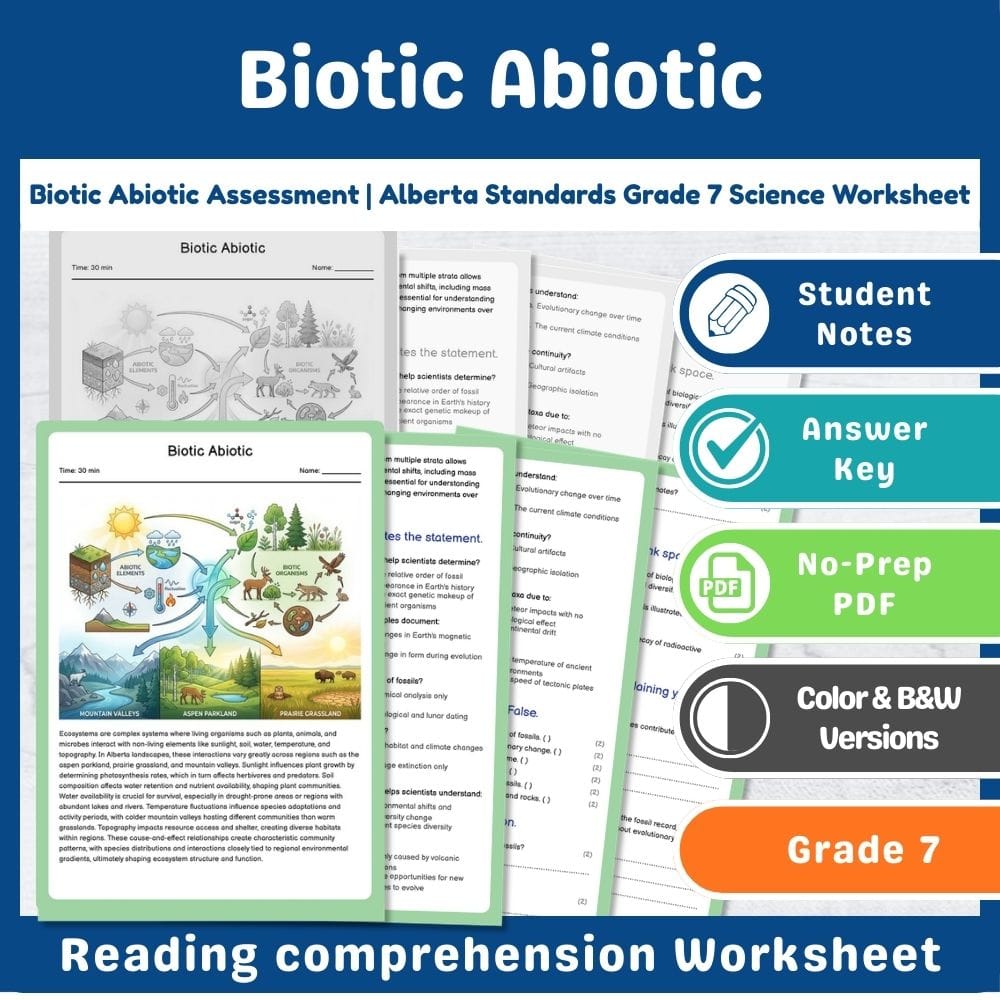
Biotic Abiotic Assessment | Alberta Standards Grade 7 Science Worksheet
Created byPrism Point LearningLearning Objectives
- Understand how sunlight, soil, water, temperature, and topography influence ecosystems.
- Identify the relationships between living organisms and non-living environmental factors.
- Explain how cause-and-effect links shape community patterns in Alberta landscapes.
Also included in: Lesson Bundle Grade 7 Science - Interactions and Ecosystems +1 more
Instant download
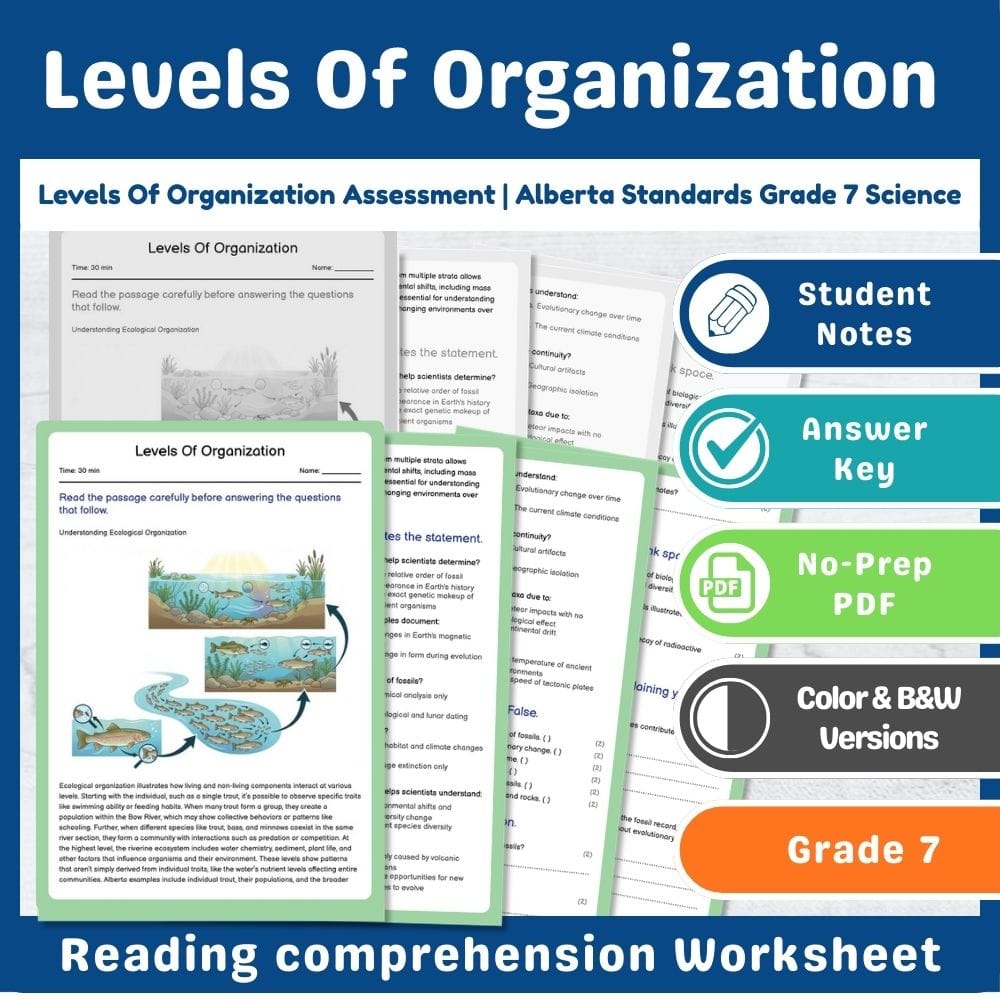
Levels Of Organization Assessment | Alberta Standards Grade 7 Science
Created byPrism Point LearningLearning Objectives
- Describe the different levels of ecological organization from individual organisms to ecosystems.
- Explain how properties and processes emerge at higher levels that are not evident at individual levels.
- Use Alberta examples to differentiate among levels such as individual trout, trout populations, communities, and ecosystems.
Also included in: Lesson Bundle Grade 7 Science - Interactions and Ecosystems +1 more
Instant download
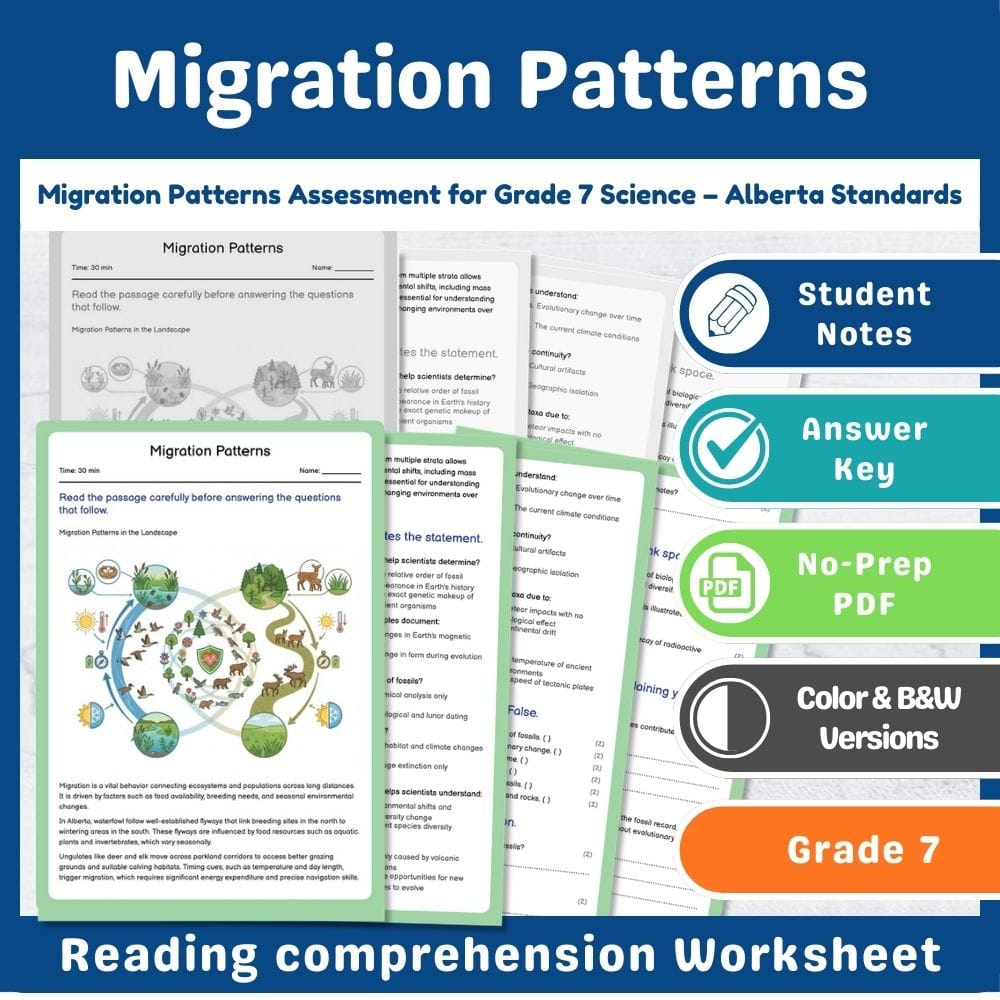
Migration Patterns Assessment for Grade 7 Science – Alberta Standards
Created byPrism Point LearningLearning Objectives
- Understand the drivers and timing of animal migration across landscapes.
- Describe how migration connects ecosystems and supports biodiversity.
- Identify examples of migration in Alberta, including waterfowl flyways and ungulate movements.
Also included in: Lesson Bundle Grade 7 Science - Interactions and Ecosystems +1 more
Instant download
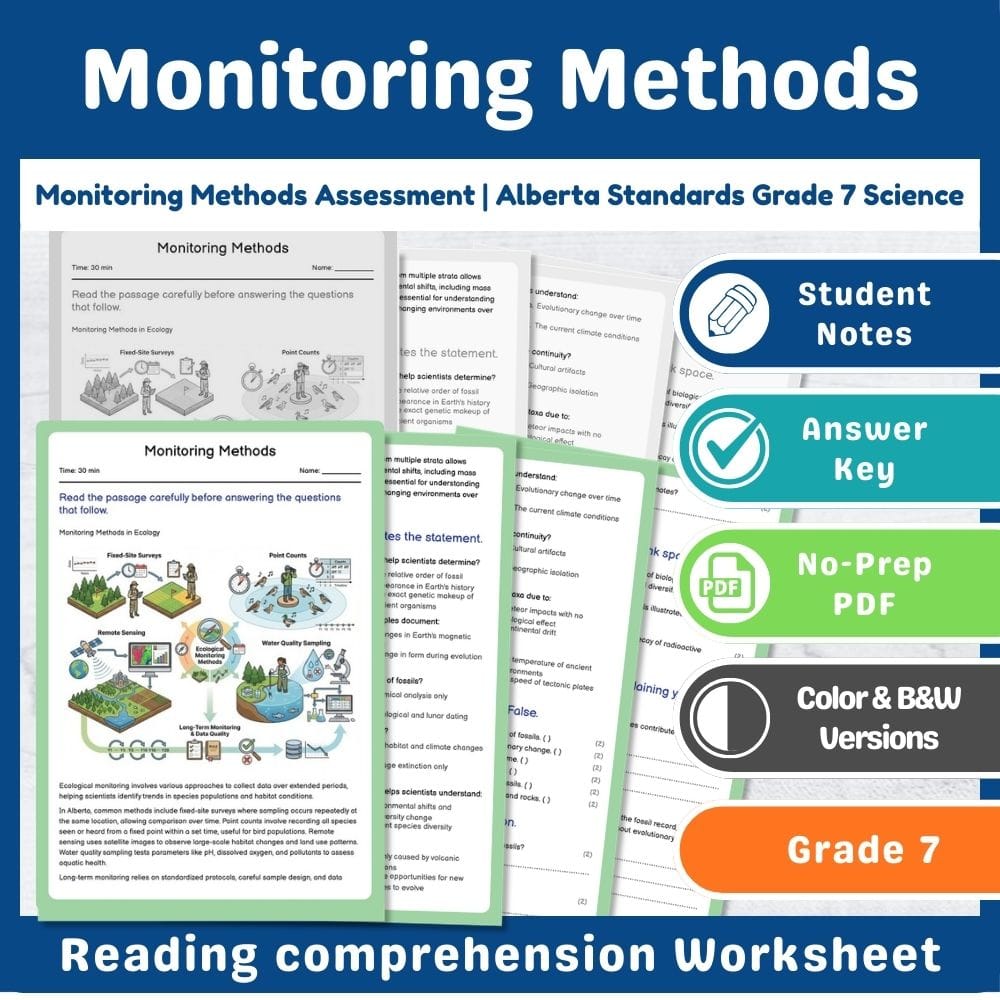
Monitoring Methods Assessment | Alberta Standards Grade 7 Science
Created byPrism Point LearningLearning Objectives
- Understand different methods used in ecological monitoring.
- Identify the importance of data consistency and data quality in long-term studies.
- Describe various sampling techniques such as fixed-site surveys, point counts, remote sensing, and water quality sampling.
Also included in: Lesson Bundle Grade 7 Science - Interactions and Ecosystems +1 more
Instant download
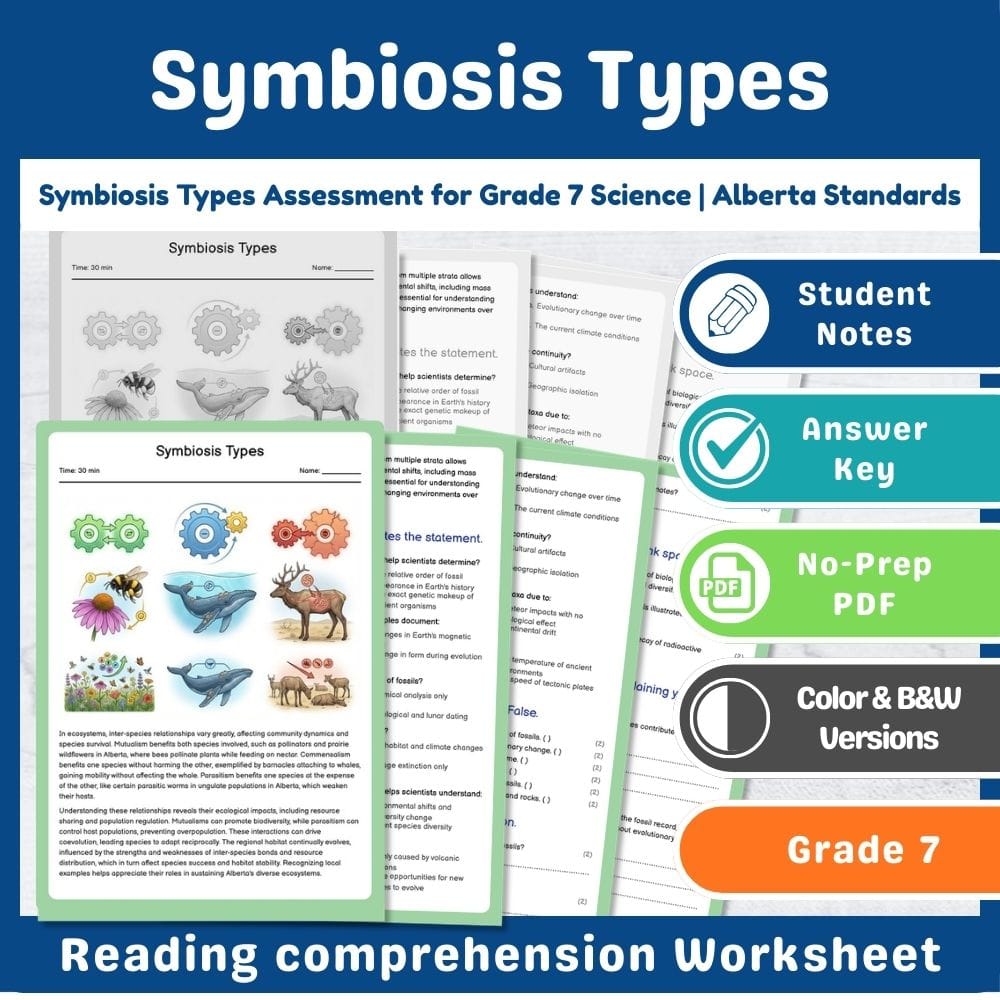
Symbiosis Types Assessment for Grade 7 Science | Alberta Standards
Created byPrism Point LearningLearning Objectives
- Define and differentiate among mutualism, commensalism, and parasitism.
- Identify Alberta-relevant examples of inter-species relationships.
- Explain ecological consequences of different symbiosis types on populations and habitats.
Also included in: Lesson Bundle Grade 7 Science - Interactions and Ecosystems +1 more
Instant download
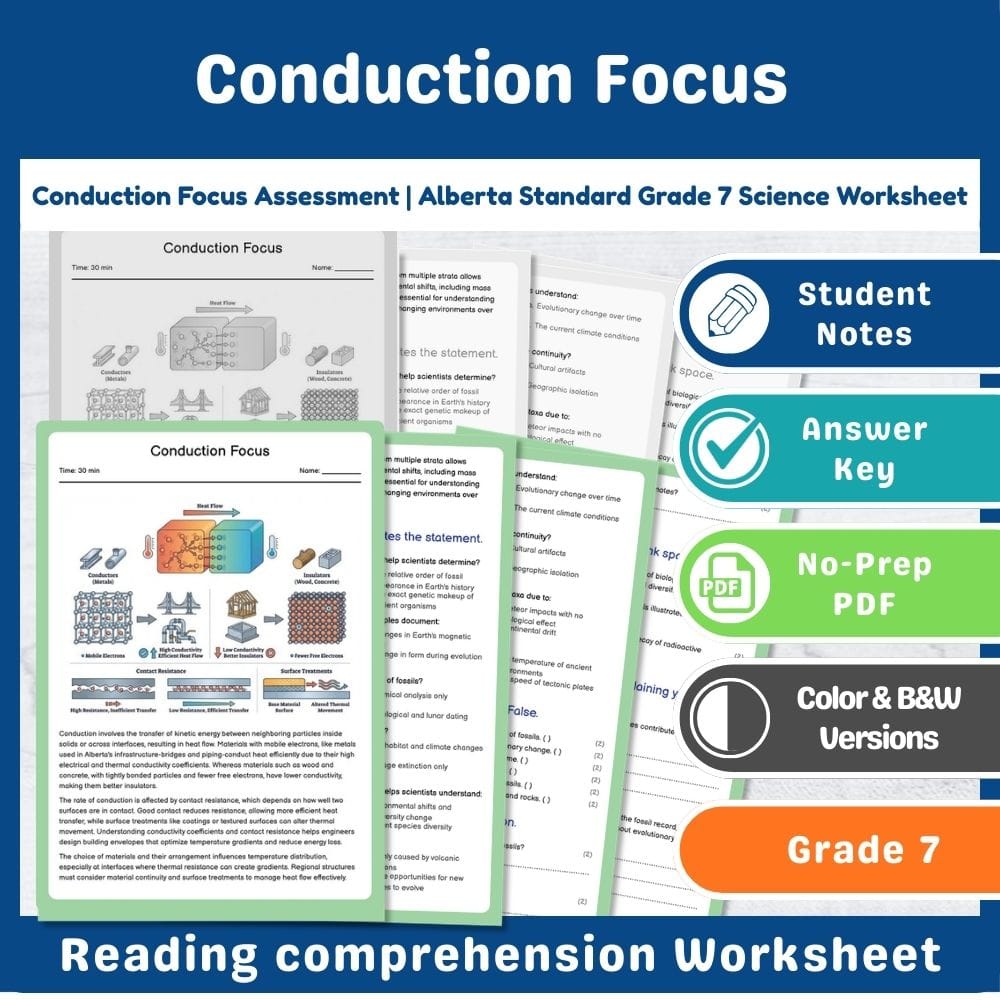
Conduction Focus Assessment | Alberta Standard Grade 7 Science Worksheet
Created byPrism Point LearningLearning Objectives
- Explain how energy is transferred through conduction in solids.
- Identify materials with high and low thermal conductivity and their applications.
- Describe the effects of contact resistance and surface treatments on heat flow in structures.
Also included in: Lesson Grade 7 Science Mini Bundle | Energy, Heat & Thermal Processes +1 more
Instant download
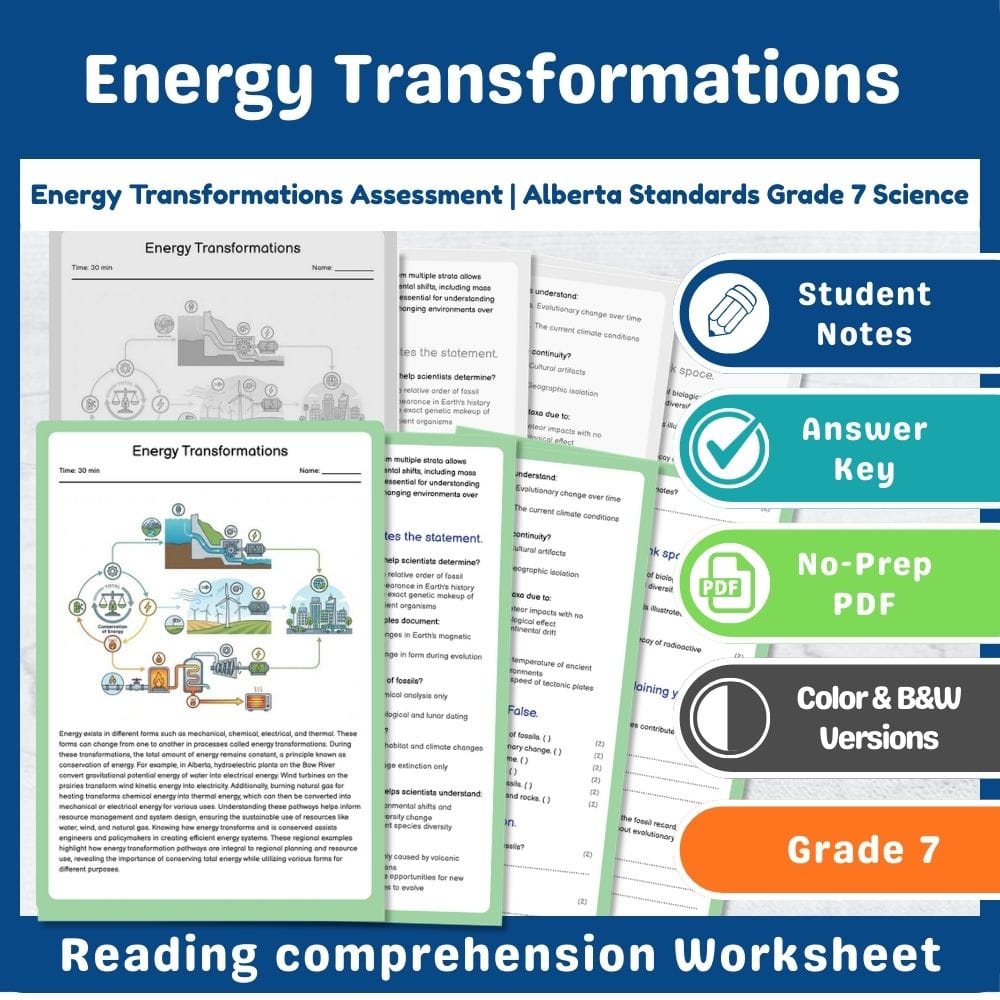
Energy Transformations Assessment | Alberta Standards Grade 7 Science
Created byPrism Point LearningLearning Objectives
- Understand the various forms of energy and how they interconvert during processes.
- Recognize examples of energy transformation in Alberta's regional resources.
- Explain the principle of energy conservation during transformations.
Also included in: Lesson Grade 7 Science Mini Bundle | Energy, Heat & Thermal Processes +1 more
Instant download
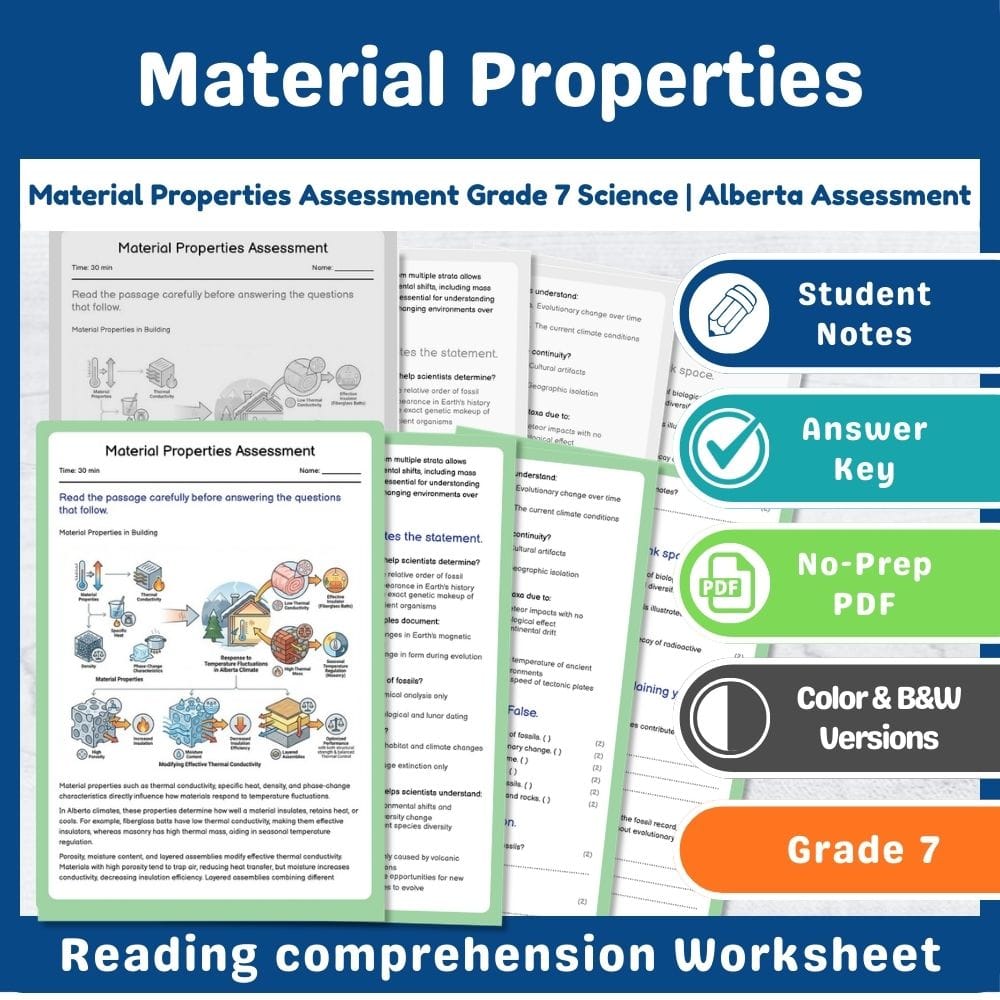
Material Properties Assessment Grade 7 Science | Alberta Assessment
Created byPrism Point LearningLearning Objectives
- Understand how intrinsic properties like thermal conductivity, specific heat, and density affect material behavior.
- Compare construction materials based on their thermal resistance and structural features.
- Explain how porosity, moisture, and layered assemblies influence thermal performance.
Also included in: Lesson Grade 7 Science Mini Bundle | Energy, Heat & Thermal Processes +1 more
Instant download
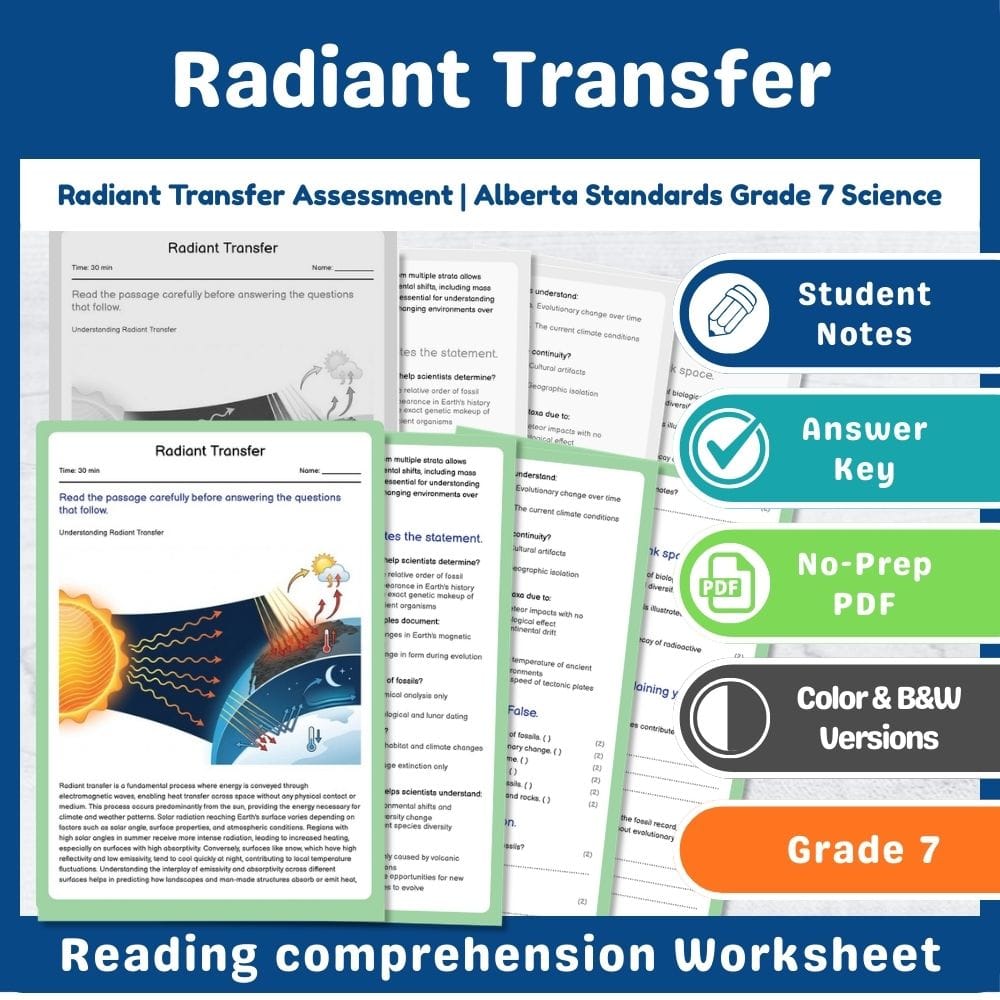
Radiant Transfer Assessment | Alberta Standards Grade 7 Science
Created byPrism Point LearningLearning Objectives
- Explain the concept of radiant transfer and how energy moves through electromagnetic waves without needing a medium.
- Identify factors such as solar radiation intensity, surface absorptivity, and emissivity that influence radiative heating.
- Describe how seasonal variations and surface types affect radiative balances and microclimates.
Also included in: Lesson Grade 7 Science Mini Bundle | Energy, Heat & Thermal Processes +1 more
Instant download
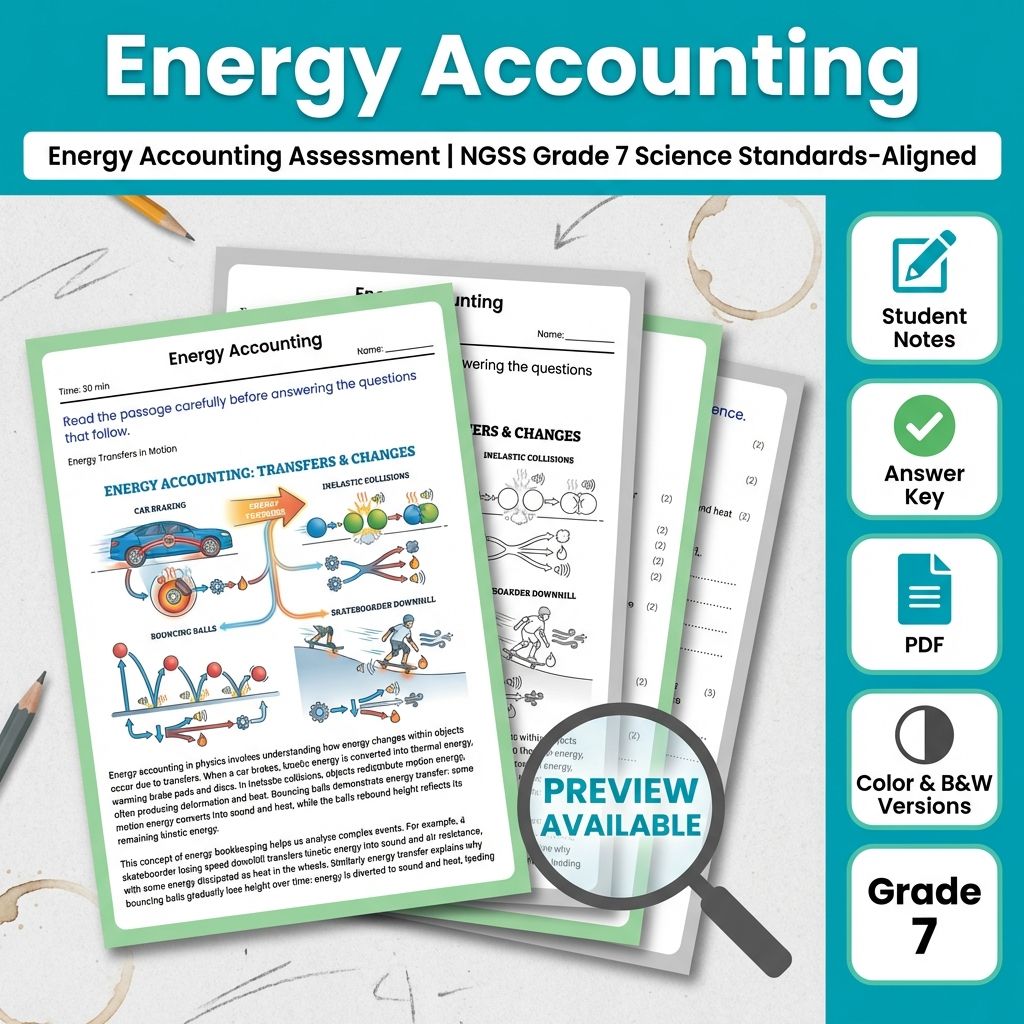
Energy Accounting Assessment | NGSS Grade 7 Science Standards-Aligned
Created byPrism Point LearningLearning Objectives
- Explain how changes in an object's motion energy are linked to energy transfers into or out of the object.
- Identify real-world scenarios where energy transformation occurs, such as braking a car or bouncing a ball.
- Quantitatively and qualitatively analyze energy transfers during different physical events.
Also included in: Grade 7 Science Mini Bundle | Energy Unit & NGSS Standards-Aligned Resources +1 more
Instant download
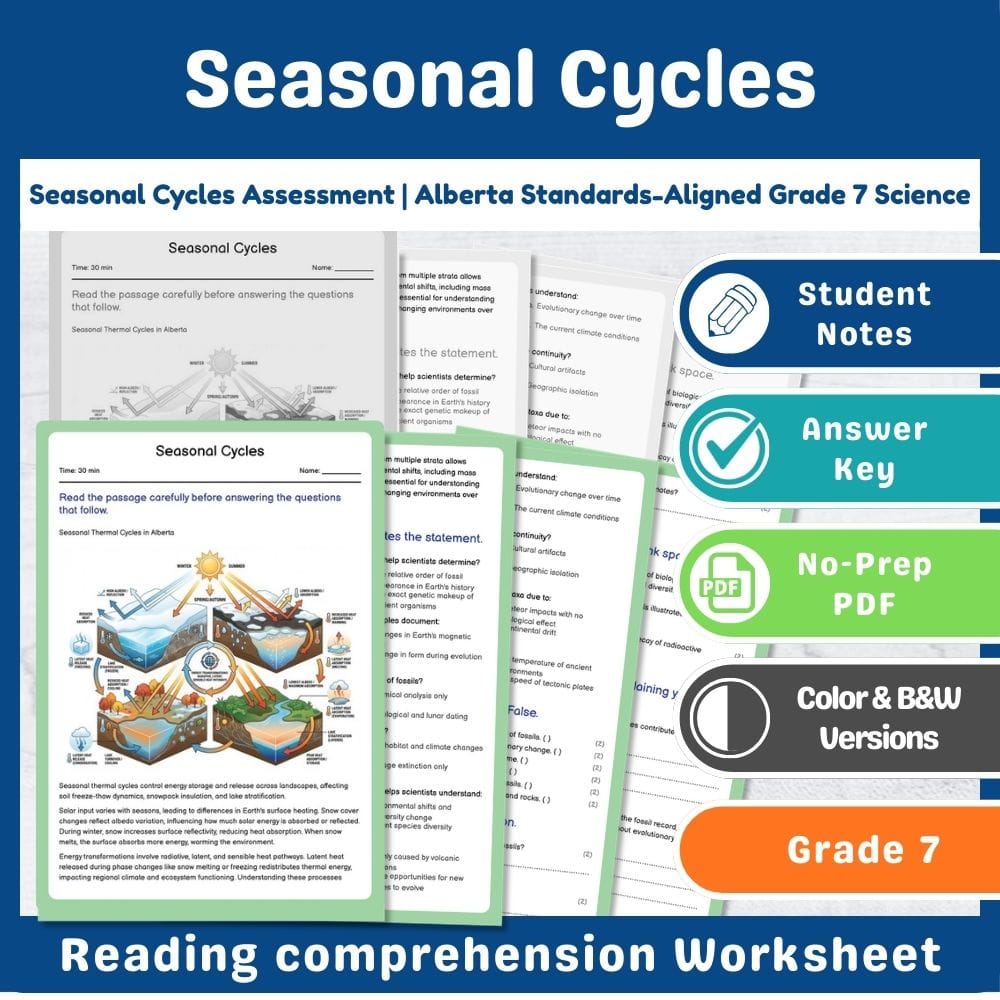
Seasonal Cycles Assessment | Alberta Standards-Aligned Grade 7 Science
Created byPrism Point LearningLearning Objectives
- Understand how seasonal thermal cycles influence energy storage and release in landscapes.
- Identify the main factors driving seasonal energy fluxes, including solar input and albedo changes.
- Describe the pathways of energy transformation such as radiative, latent, and sensible heat processes.
Also included in: Lesson Grade 7 Science Mini Bundle | Energy, Heat & Thermal Processes +1 more
Instant download
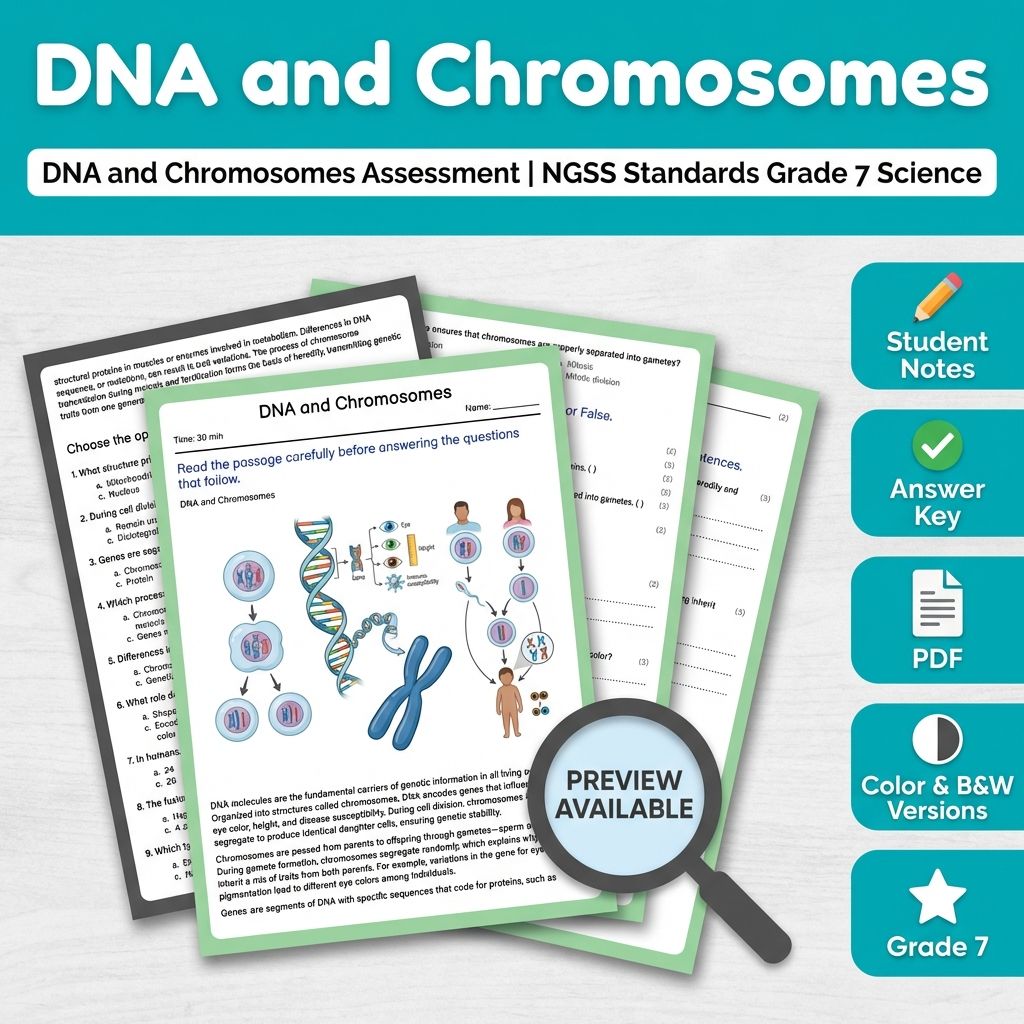
DNA and Chromosomes Assessment | NGSS Standards Grade 7 Science
Created byPrism Point LearningLearning Objectives
- Explain the role of DNA molecules in encoding genetic traits.
- Describe how chromosomes organize and transmit genetic information during cell division.
- Illustrate the process of chromosome segregation during gamete formation and fusion.
Also included in: Grade 7 Science Mini Bundle – Heredity: Inheritance and Variation of Traits +1 more
Instant download
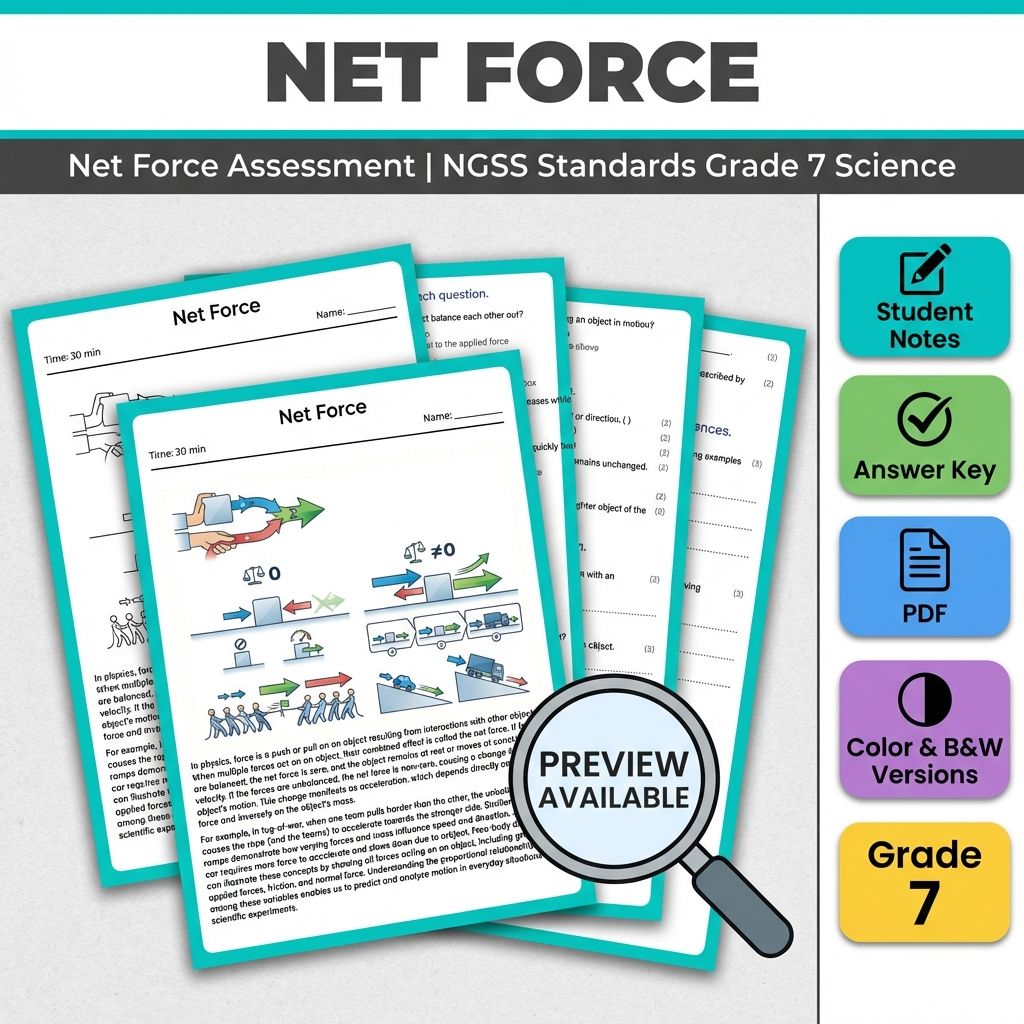
Net Force Assessment | NGSS Standards Grade 7 Science
Created byPrism Point LearningLearning Objectives
- Define net force as the vector sum of forces acting on an object.
- Explain how unbalanced forces cause changes in motion using free-body diagrams.
- Relate net force, mass, and acceleration proportionally through quantitative reasoning.
Also included in: Grade 7 Science Mini Bundle – Forces & Interactions NGSS Unit (Printable) +1 more
Instant download
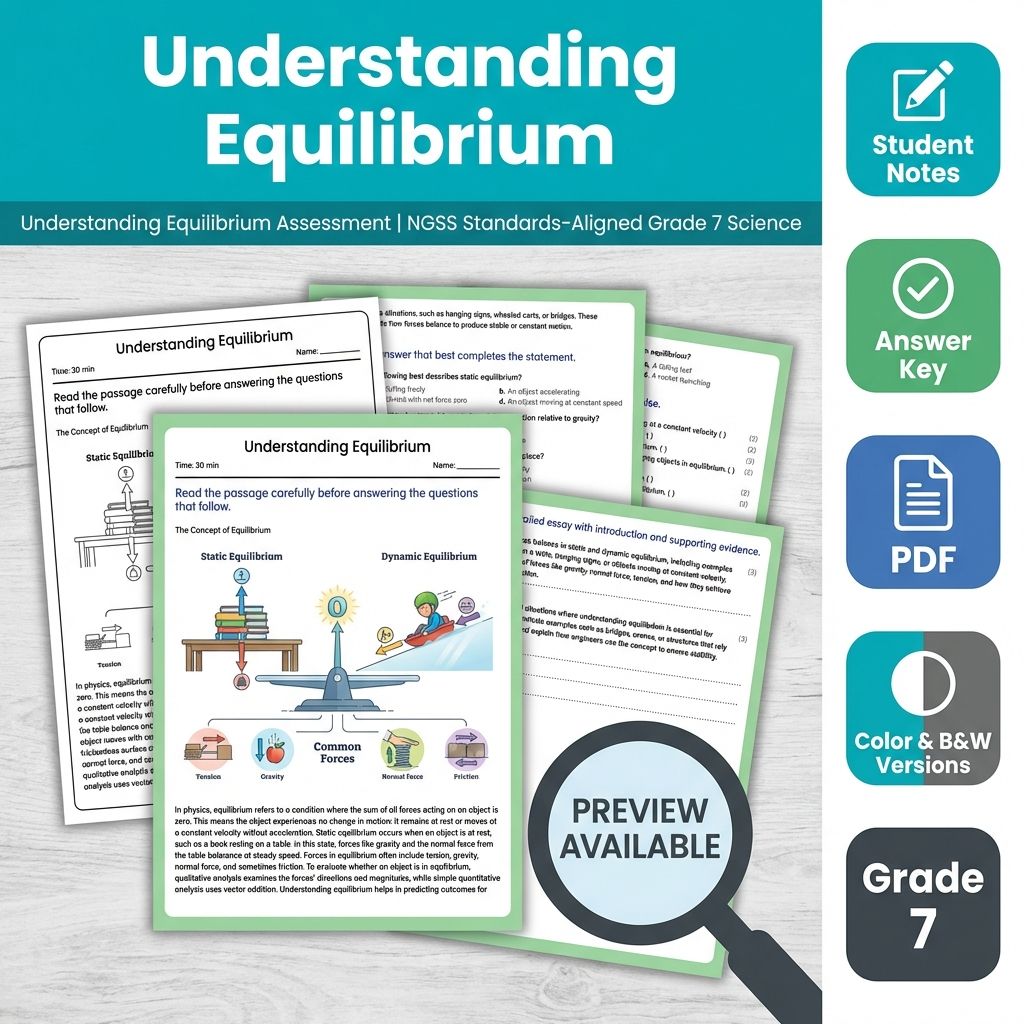
Understanding Equilibrium Assessment | NGSS Standards-Aligned Grade 7 Science
Created byPrism Point LearningLearning Objectives
- Explain the concept of equilibrium as the balance of forces in an object.
- Differentiate between static and dynamic equilibrium in real-world scenarios.
- Apply qualitative and simple quantitative analyses to predict objects' behavior at rest or moving with constant velocity.
Also included in: Grade 7 Science Mini Bundle – Forces & Interactions NGSS Unit (Printable) +1 more
Instant download
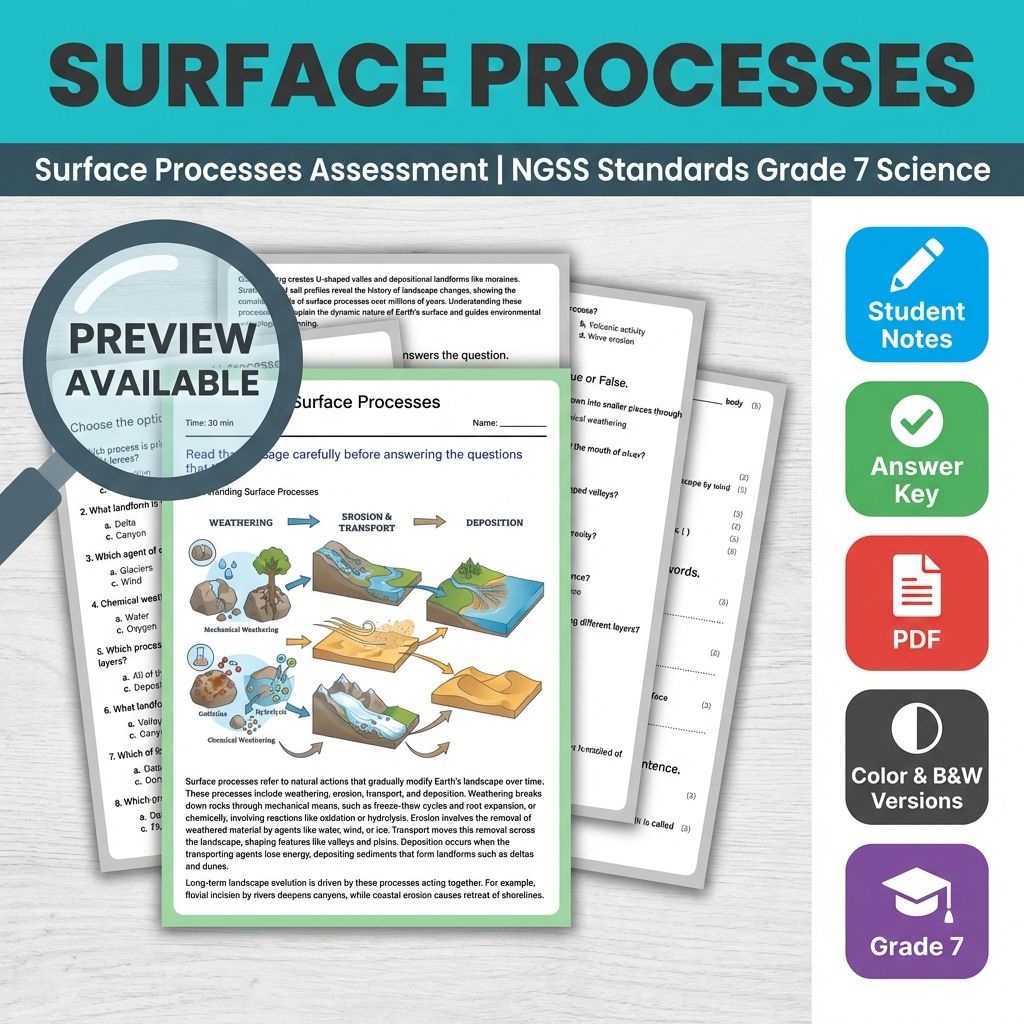
Surface Processes Assessment | NGSS Standards Grade 7 Science
Created byPrism Point LearningLearning Objectives
- Describe key surface geological processes such as weathering, erosion, transport, and deposition.
- Differentiate between mechanical and chemical weathering mechanisms.
- Explain how landforms like canyons, deltas, and moraines are formed by these processes.
Also included in: Grade 7 Science Lesson | Earth's Systems NGSS Not specified Unit +1 more
Instant download
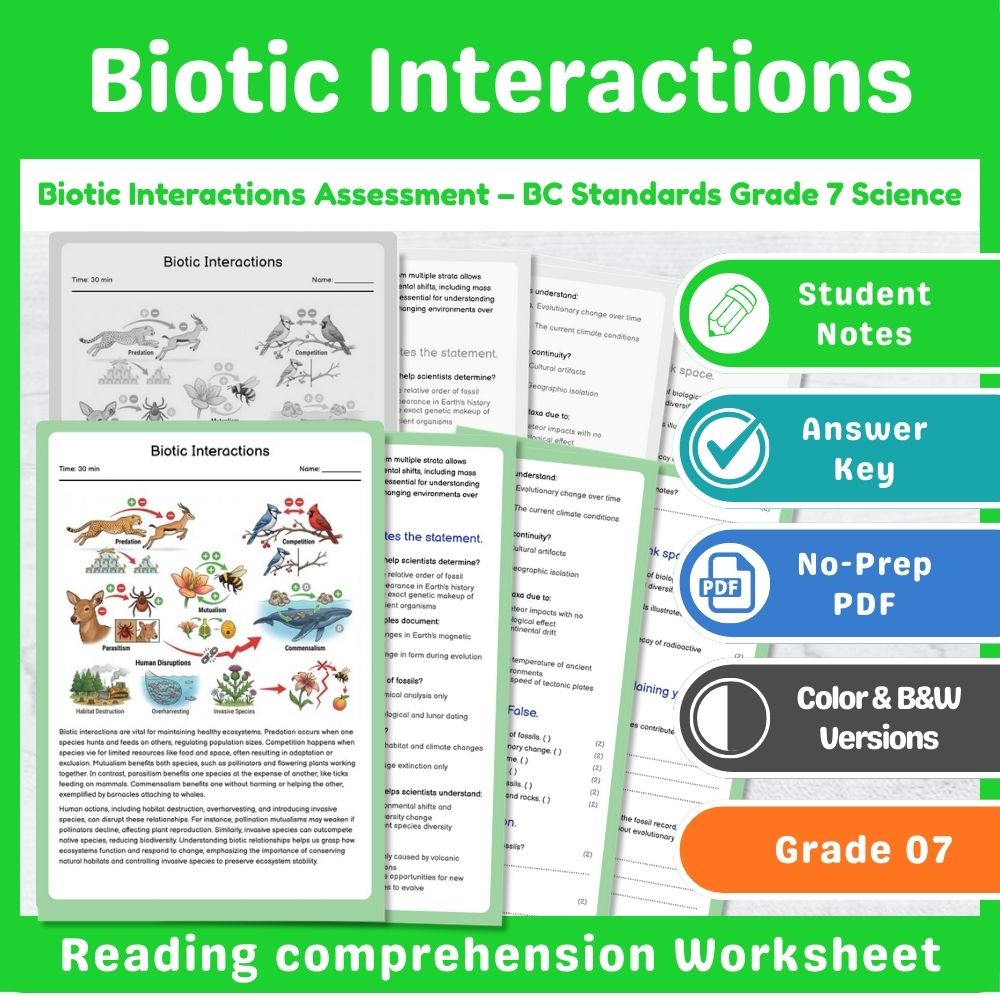
Biotic Interactions Assessment – BC Standards Grade 7 Science
Created byPrism Point LearningLearning Objectives
- Understand the different types of biotic interactions such as predation, competition, mutualism, commensalism, and parasitism.
- Explain how human activities can disrupt biotic relationships and affect ecosystems.
- Describe how changes in one species can influence community structure and biodiversity.
Instant download
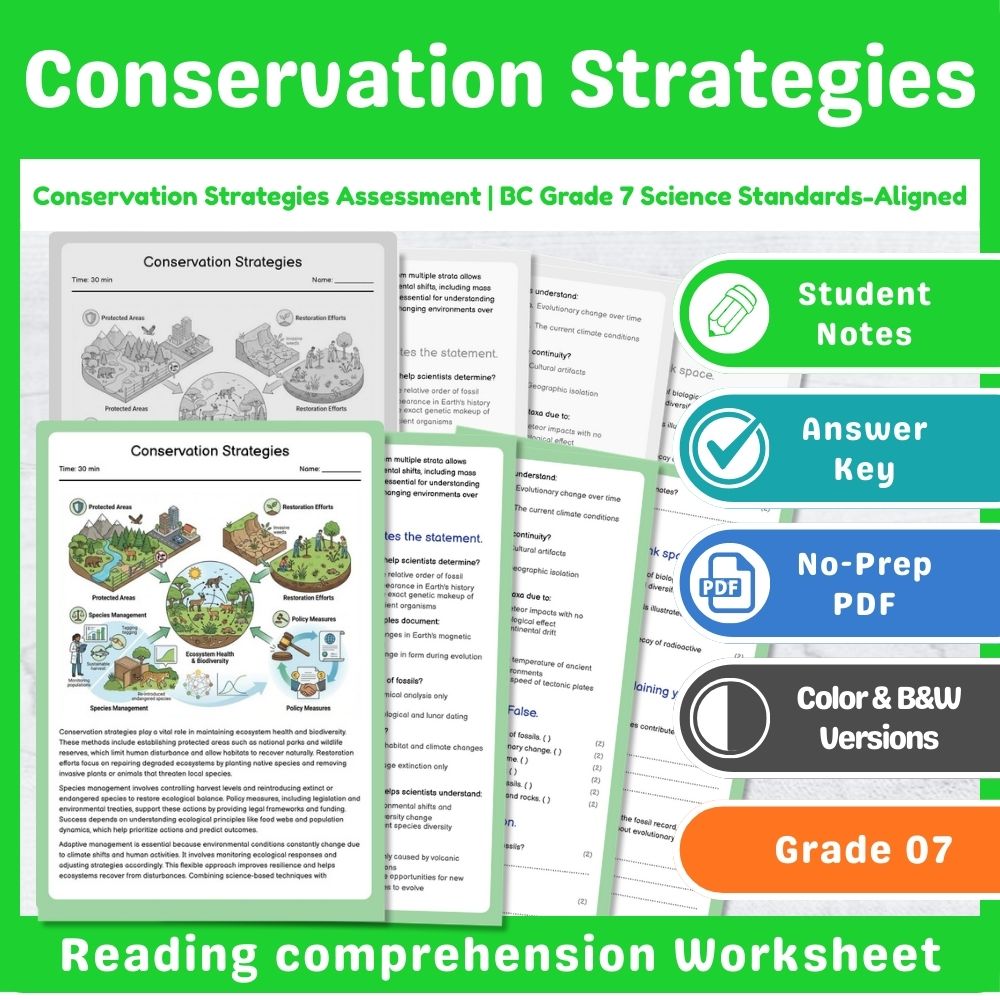
Conservation Strategies Assessment for Grade 7 Science | BC Standards
Created byPrism Point LearningLearning Objectives
- Understand various conservation strategies used to protect ecosystems.
- Identify key actions involved in habitat restoration and management.
- Explain how adaptive approaches help sustain biodiversity.
Instant download
Browse more categories
About Reading comprehension Worksheets
Find reading comprehension worksheets for class practice, homework, or self-study. All 40,284 are instant PDF downloads.
Each resource here is built by an independent educator and reviewed for quality. Worksheets print straight from PDF and suit classroom use, homework, or extra practice; most come with answer keys, and you can preview before purchasing.