
Reading comprehension Worksheets
40,284 type resources
Homeostasis Basics Assessment | TEKS Grade 10 Science Worksheet
 Created byPrism Point Learning
Learning Objectives
- Understand the fundamental processes involved in maintaining internal stability via homeostasis.
- Identify key components such as set points, sensors, and effectors in physiological regulation.
- Explain how different organ systems coordinate to regulate temperature, fluid balance, and chemical composition.
Also included in: Grade 10 Homeostasis and Feedback Science Lesson Bundle | TEKS
Instant download
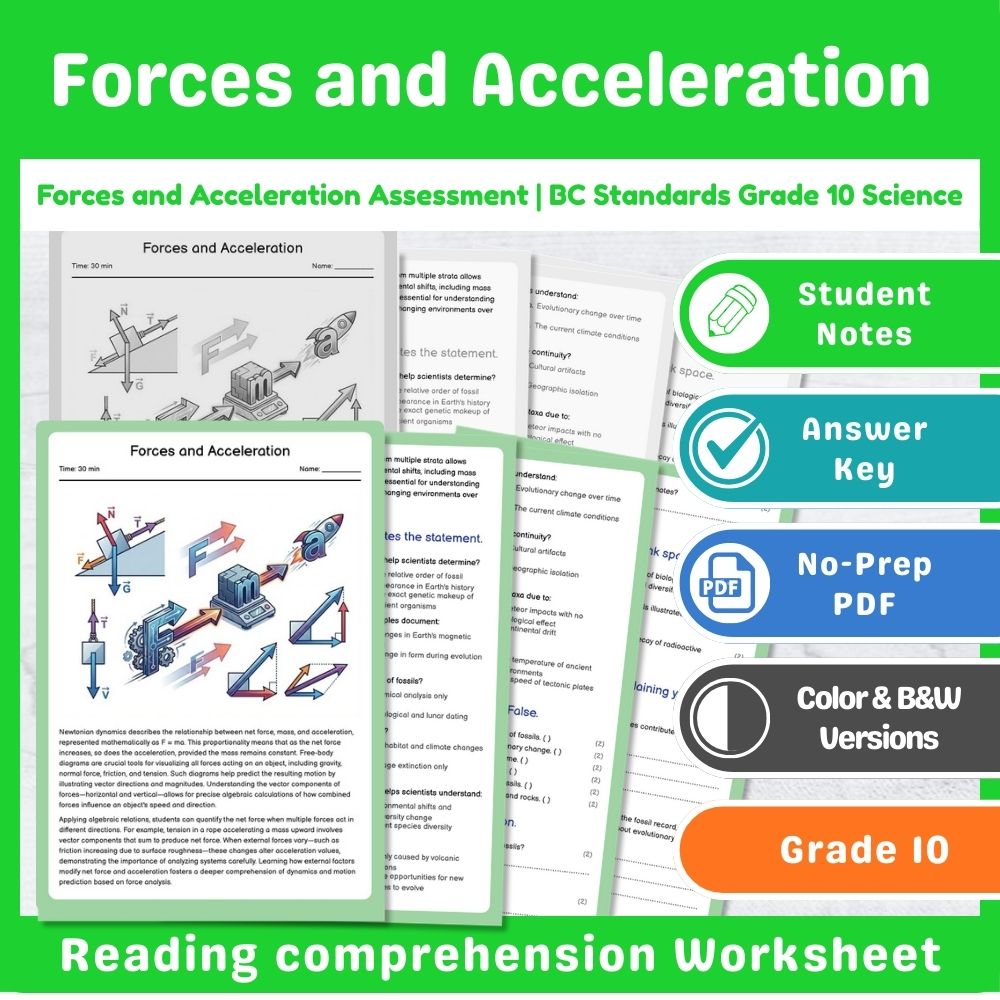
Forces and Acceleration Assessment | BC Standards Grade 10 Science
Created byPrism Point LearningLearning Objectives
- Understand how net force affects acceleration according to Newton's Second Law.
- Identify and interpret free-body diagrams representing forces like gravity, normal force, friction, and tension.
- Apply algebraic and vector methods to analyze how forces combine to change motion.
Instant download
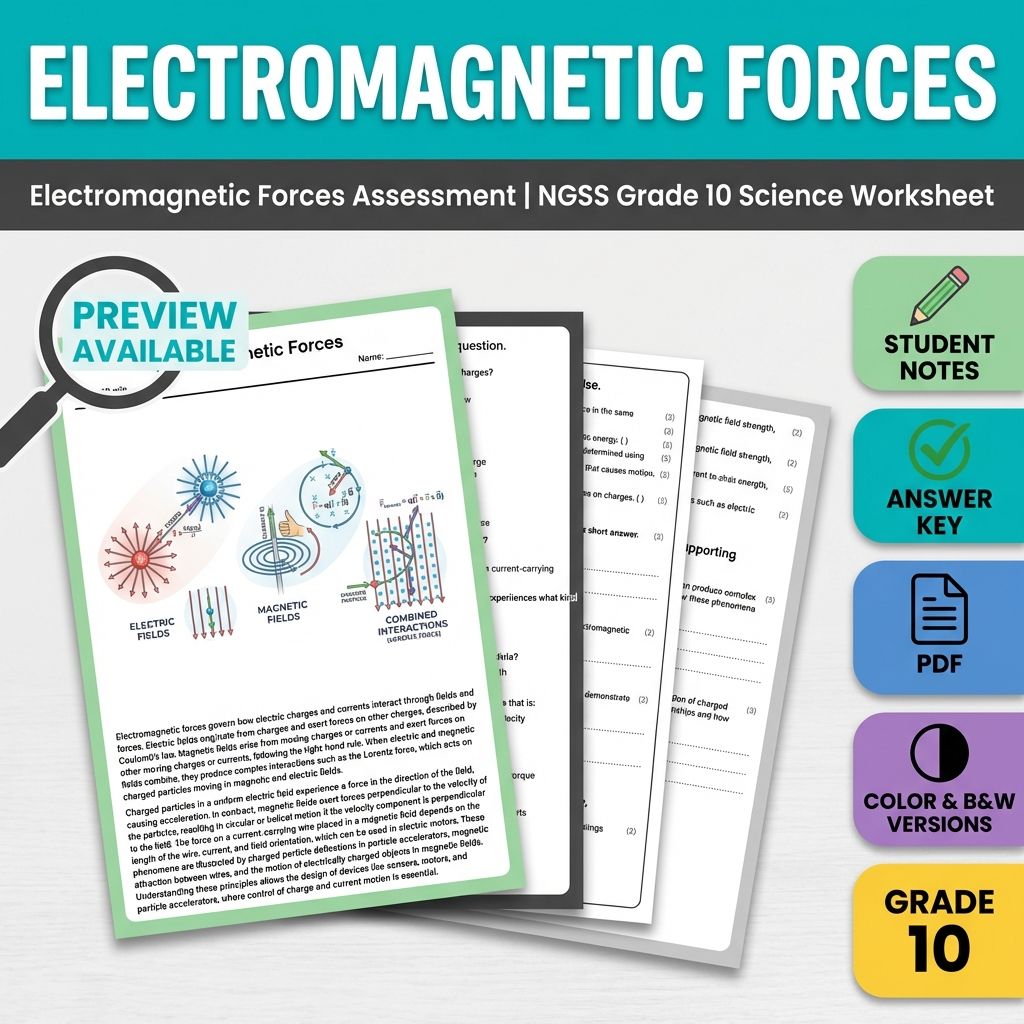
Electromagnetic Forces Assessment | NGSS Grade 10 Science Worksheet
Created byPrism Point LearningLearning Objectives
- Understand how electric and magnetic fields influence charged particles and current-carrying wires.
- Describe the forces exerted on charges in uniform electric and magnetic fields.
- Explain the Lorentz force law and its applications in real-world phenomena.
Instant download
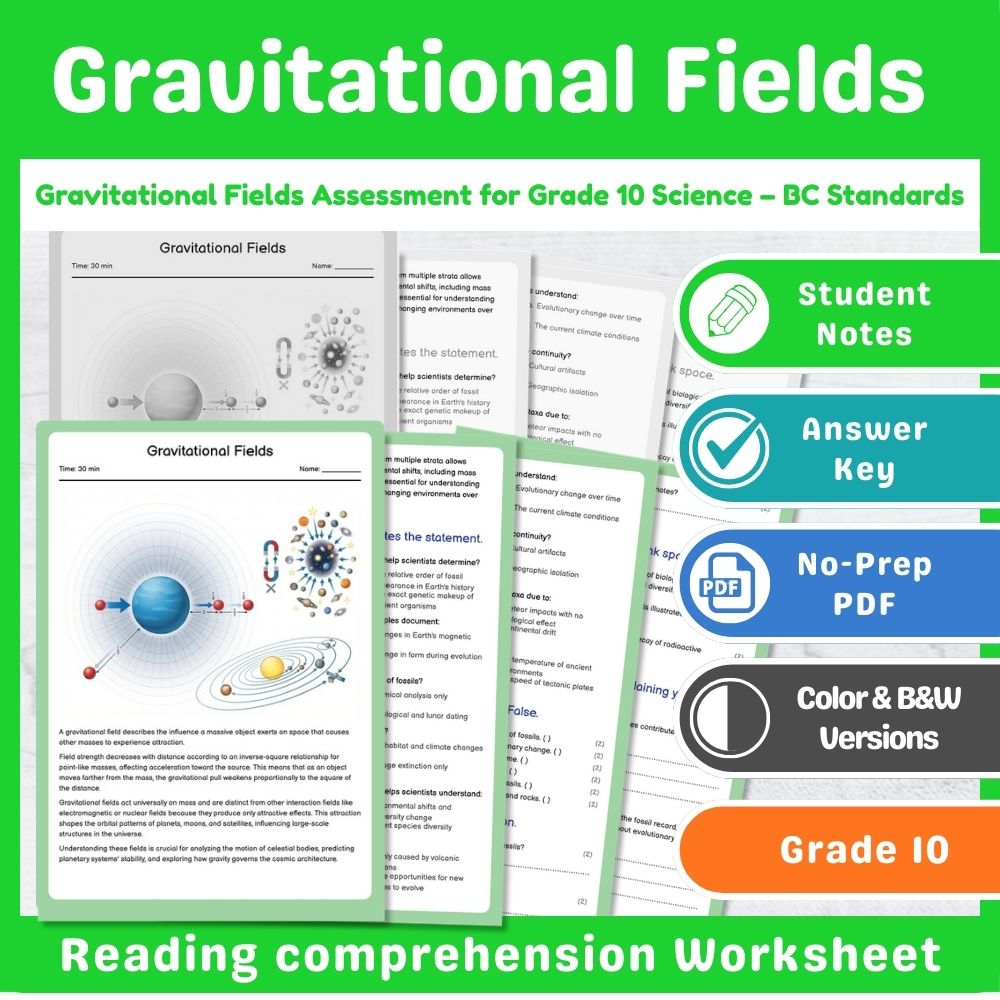
Gravitational Fields Assessment for Grade 10 Science – BC Standards
Created byPrism Point LearningLearning Objectives
- Understand the concept of gravitational fields and their influence.
- Explain how field strength varies with distance.
- Describe the effects of gravitational fields on objects in space.
Instant download
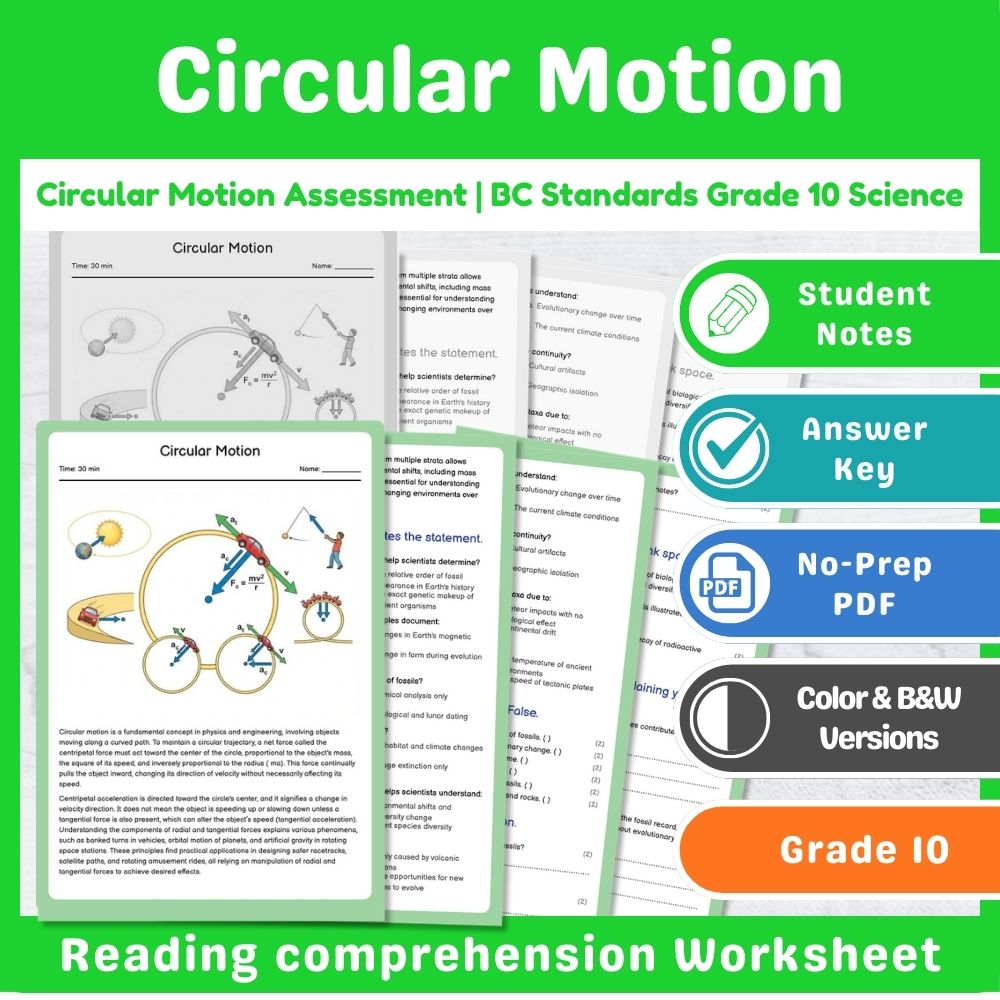
Circular Motion Assessment | BC Standards Grade 10 Science
Created byPrism Point LearningLearning Objectives
- Explain the concept of centripetal force and its role in circular motion.
- Differentiate between centripetal acceleration and tangential acceleration.
- Describe how radial and tangential components explain phenomena like banked turns and orbital motion.
Instant download
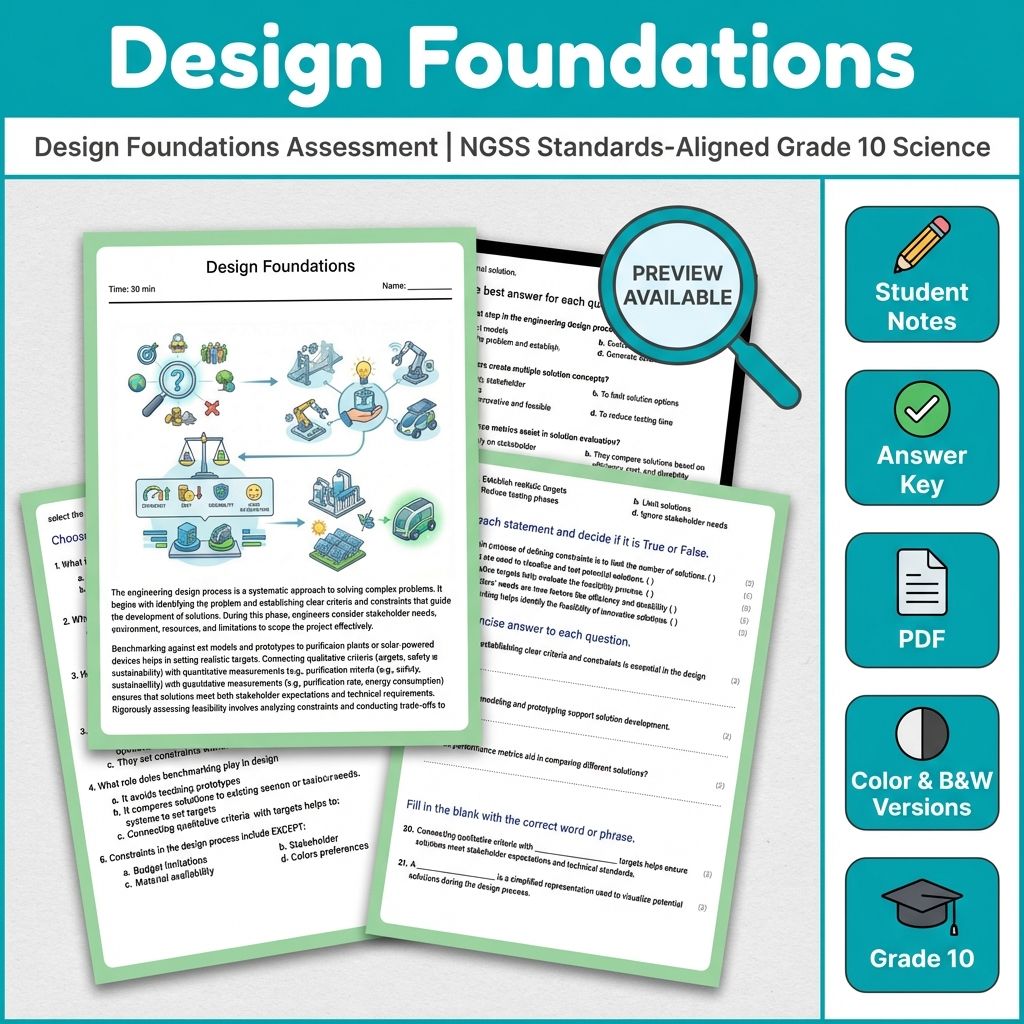
Design Foundations Assessment | NGSS Standards-Aligned Grade 10 Science
Created byPrism Point LearningLearning Objectives
- Understand the steps of the engineering design process for complex problems.
- Define criteria and constraints, and learn how to construct models.
- Develop multiple solution concepts and evaluate them against performance metrics.
Also included in: Grade 10 Science Assessment Mini Bundle | Engineering Design & Systems
Instant download
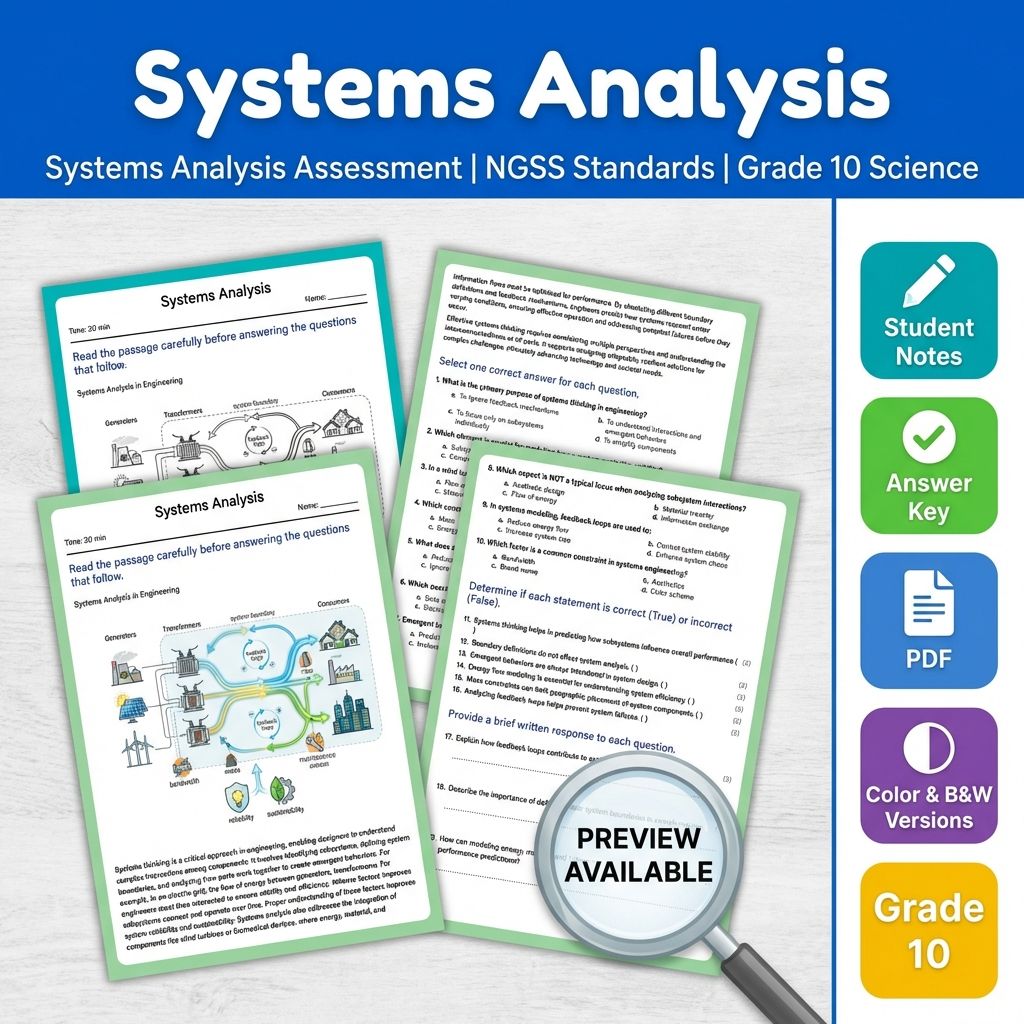
Systems Analysis Assessment | NGSS Standards | Grade 10 Science
Created byPrism Point LearningLearning Objectives
- Understand systems thinking principles and their application to engineering problems.
- Identify interactions between subsystems and define system boundaries accurately.
- Analyze emergent behaviors and feedback loops within complex systems.
Also included in: Grade 10 Science Assessment Mini Bundle | Engineering Design & Systems
Instant download
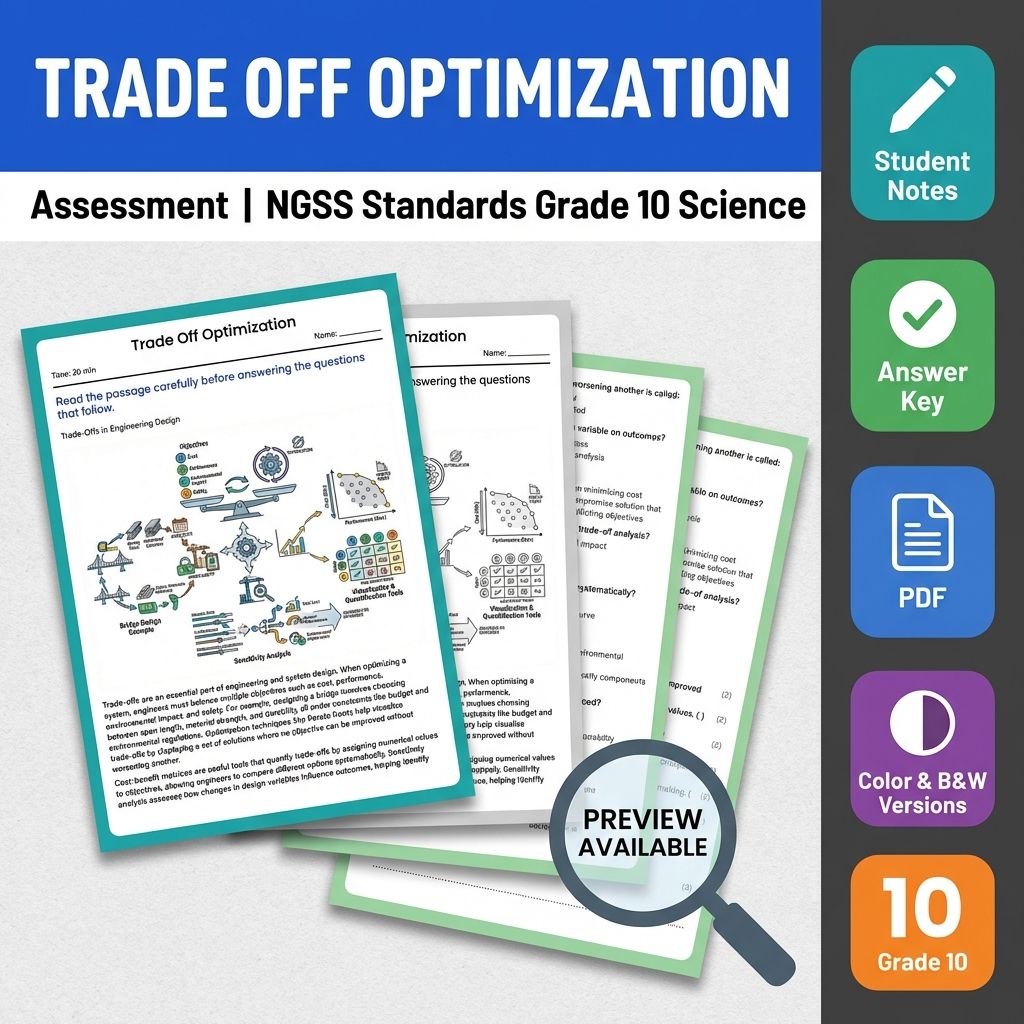
Trade Off Optimization Assessment | NGSS Standards Grade 10 Science
Created byPrism Point LearningLearning Objectives
- Understand how to analyze trade-offs and make optimization decisions in engineering design.
- Learn to use cost-benefit matrices, Pareto fronts, and sensitivity analysis to evaluate options.
- Apply concepts of performance metrics, constraints, and objective weighting to real-world problems.
Also included in: Grade 10 Science Assessment Mini Bundle | Engineering Design & Systems
Instant download
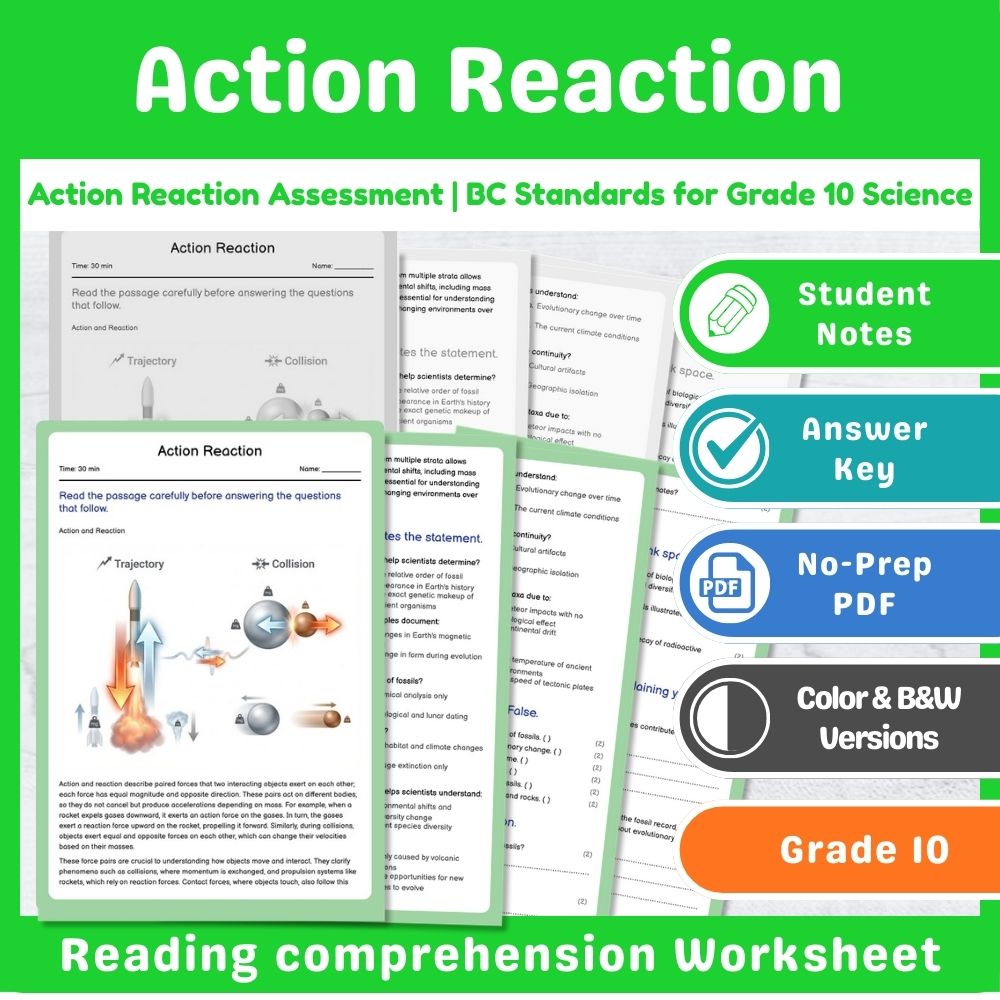
Action Reaction Assessment | BC Standards for Grade 10 Science
Created byPrism Point LearningLearning Objectives
- Explain the concept of Newton's third law of motion in terms of action-reaction pairs.
- Identify real-life examples of action-reaction forces such as collisions and rocket thrust.
- Describe how forces act on different objects and result in acceleration depending on mass.
Instant download
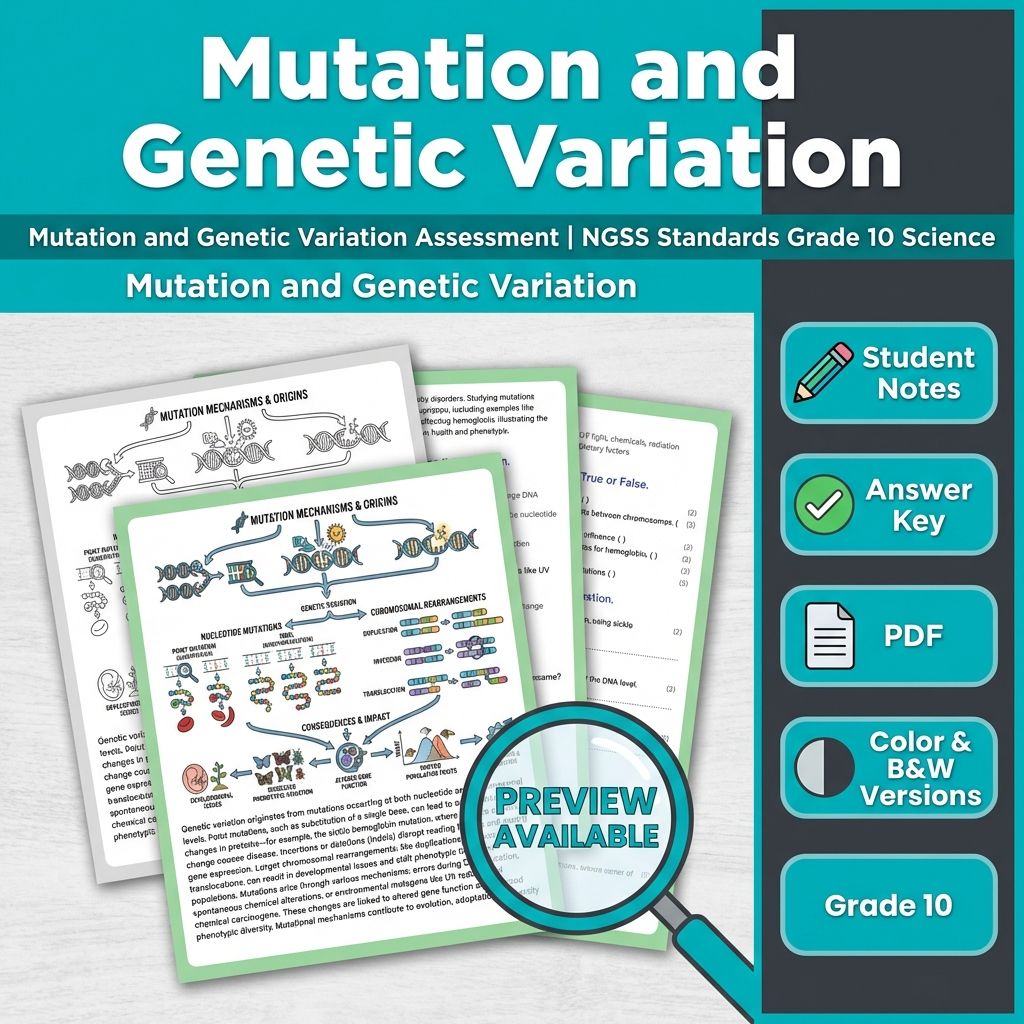
Mutation and Genetic Variation Assessment | NGSS Standards Grade 10 Science
Created byPrism Point LearningLearning Objectives
- Understand the mechanisms of genetic mutations at nucleotide and chromosomal levels.
- Identify different types of mutations and their effects on gene function and phenotype.
- Analyze examples of mutations, such as sickle hemoglobin, to understand their biological significance.
Also included in: Grade 10 Science | DNA, Mendelian Patterns & Mutation NGSS Assessment
Instant download
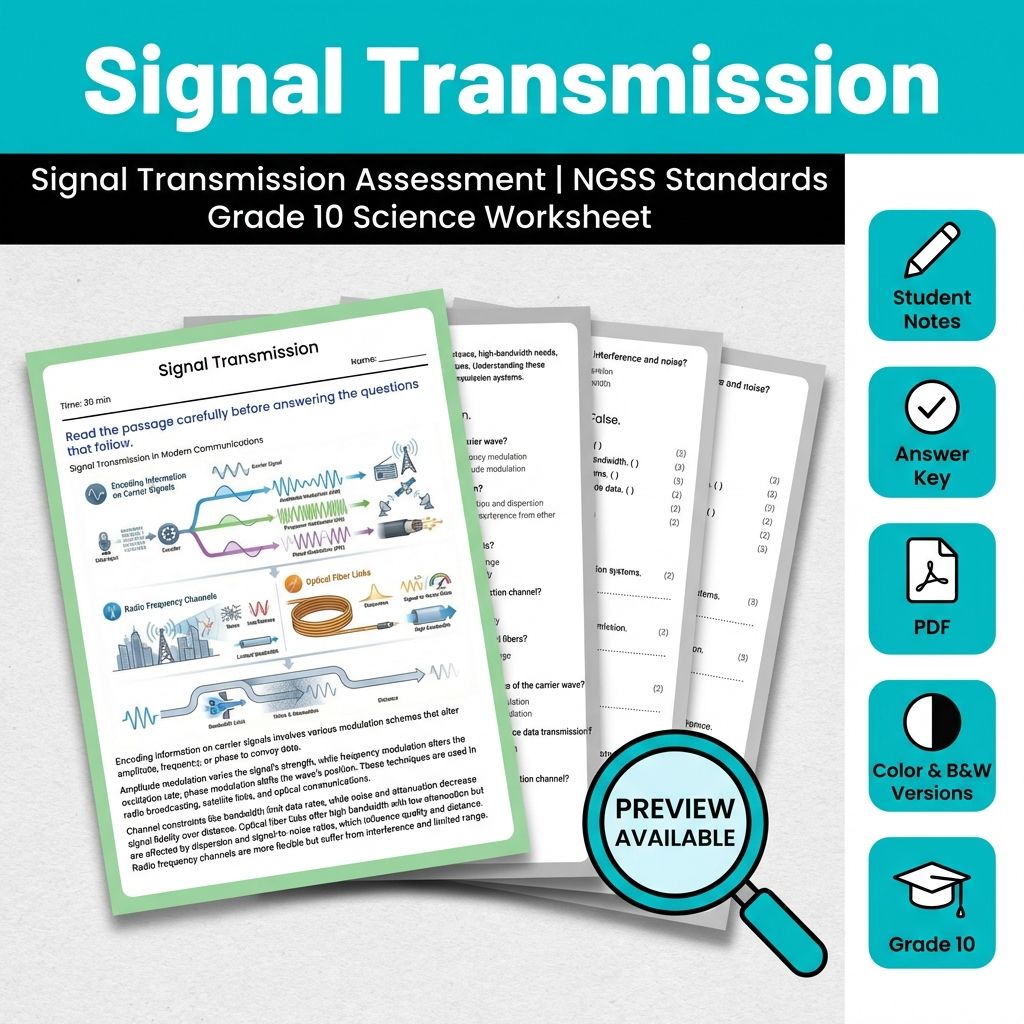
Signal Transmission Assessment | NGSS Standards Grade 10 Science Worksheet
Created byPrism Point LearningLearning Objectives
- Describe various modulation schemes used in encoding information on carrier signals.
- Evaluate the trade-offs between bandwidth, noise, and signal fidelity in different transmission modes.
- Explain how channel constraints such as attenuation and dispersion affect communication systems.
Instant download
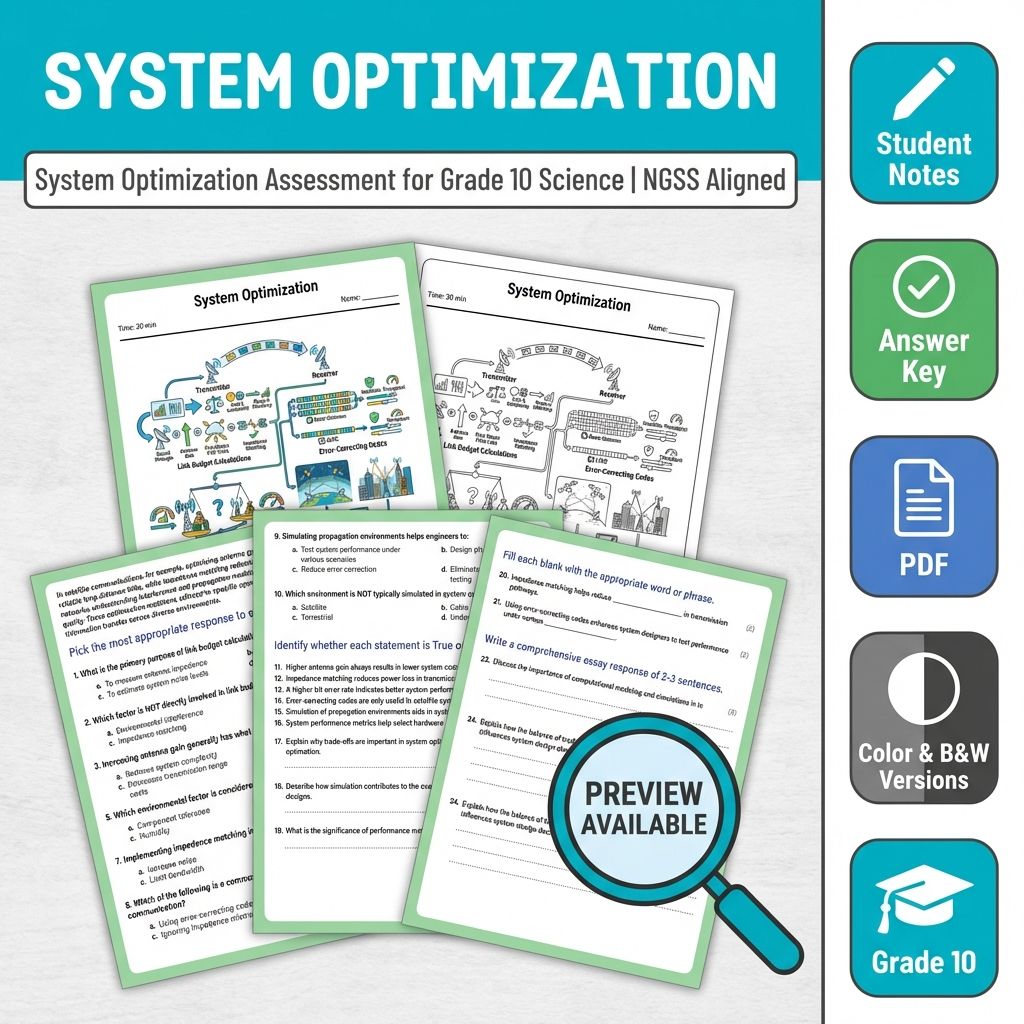
System Optimization Assessment for Grade 10 Science | NGSS Aligned
Created byPrism Point LearningLearning Objectives
- Understand mathematical models used for system optimization in communication networks.
- Analyze trade-offs among range, throughput, and reliability in system design.
- Apply concepts of antenna gain, impedance matching, and error correction to optimize performance.
Instant download
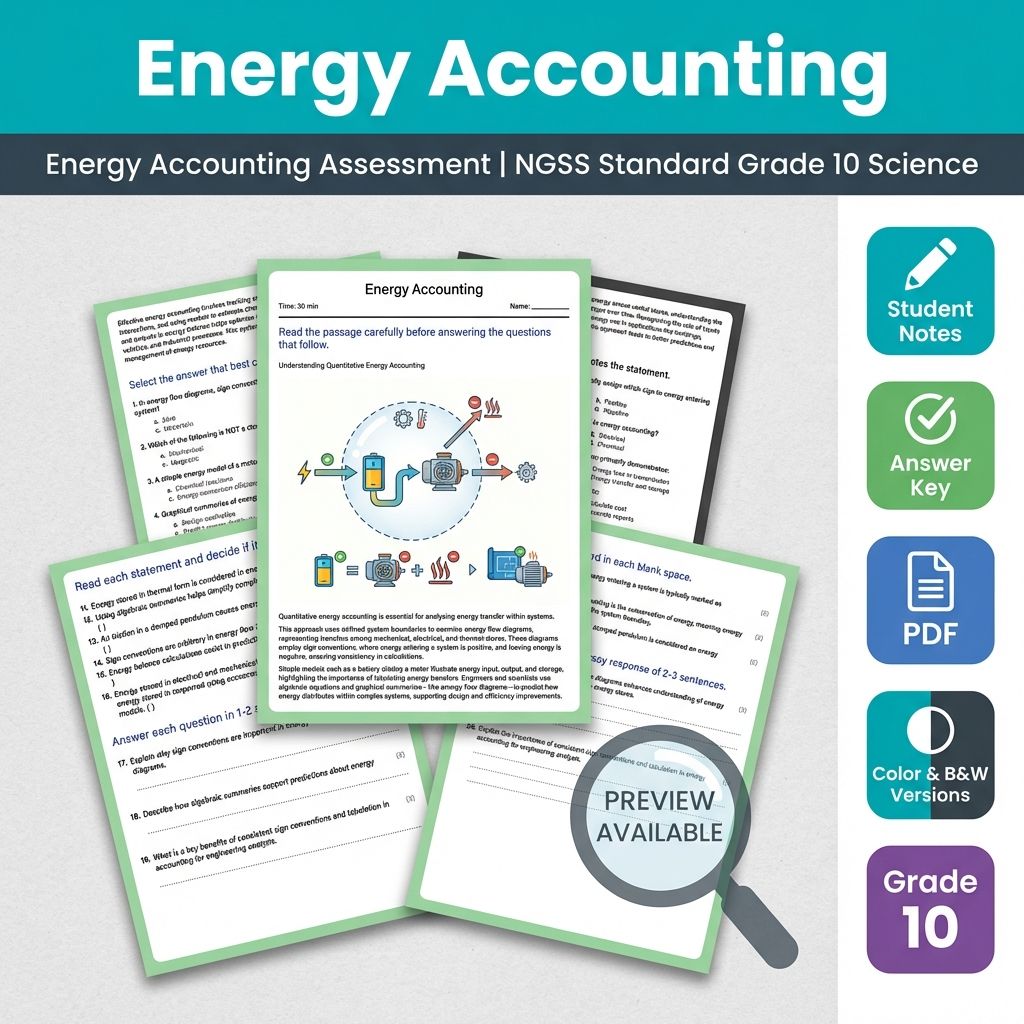
Energy Accounting Assessment | NGSS Standard Grade 10 Science
Created byPrism Point LearningLearning Objectives
- Understand and apply system boundaries, energy flow diagrams, and computational models in energy accounting.
- Identify energy transfer processes among mechanical, electrical, and thermal stores.
- Use sign conventions and tabulate energy transfers to analyze system energy distribution.
Also included in: Grade 10 Science | Work & Power NGSS Assessment Mini Bundle – Printable
Instant download
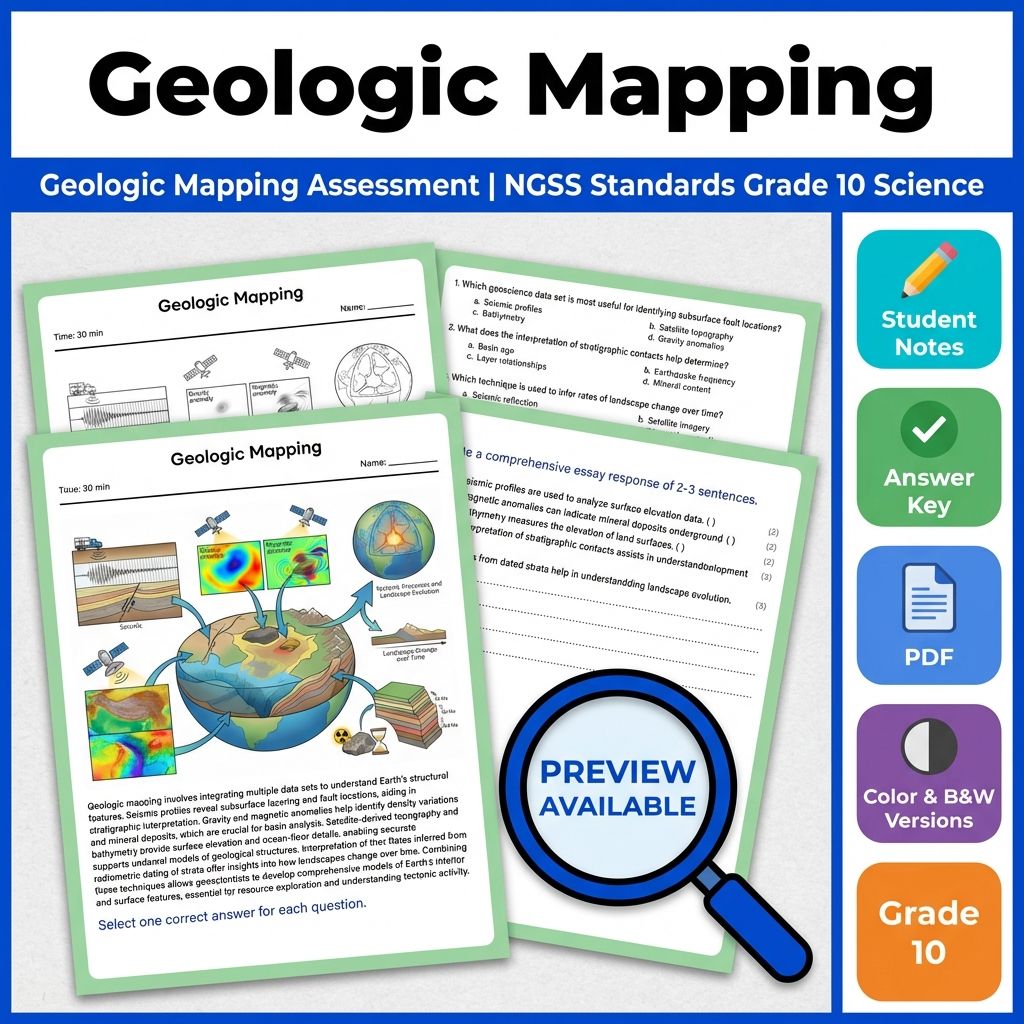
Geologic Mapping Assessment | NGSS Standards Grade 10 Science
Created byPrism Point LearningLearning Objectives
- Understand the components and data sources used in geologic mapping.
- Interpret stratigraphic contacts, fault systems, and basin structures from geological data.
- Explain how rates from geochronology support landscape evolution models.
Instant download
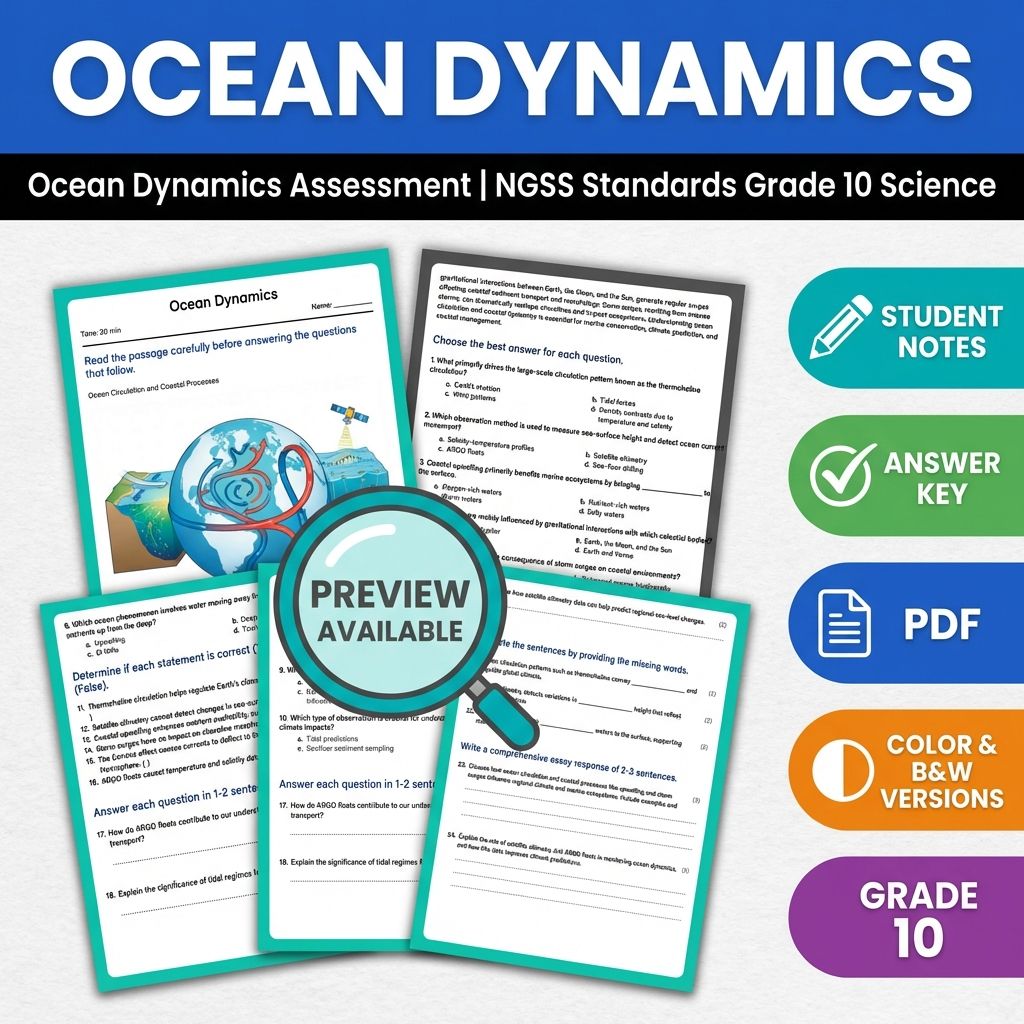
Ocean Dynamics Assessment | NGSS Standards Grade 10 Science
Created byPrism Point LearningLearning Objectives
- Describe the key circulation patterns driven by ocean dynamics, including thermohaline circulation, gyres, and coastal upwelling.
- Explain how observations from ARGO floats, satellite altimetry, and salinity-temperature profiles help understand heat and mass transport in oceans.
- Analyze the influence of tidal regimes and storm surges on coastal sediment transport, shoreline morphology, and ecosystems.
Instant download

Process Comparison Assessment for Grade 10 Science TEKS Standards
Created byPrism Point LearningLearning Objectives
- Understand the biochemical processes of photosynthesis and cellular respiration.
- Compare the inputs and outputs of photosynthesis and respiration.
- Explain the reciprocal relationship between energy and matter in biological systems.
Instant download
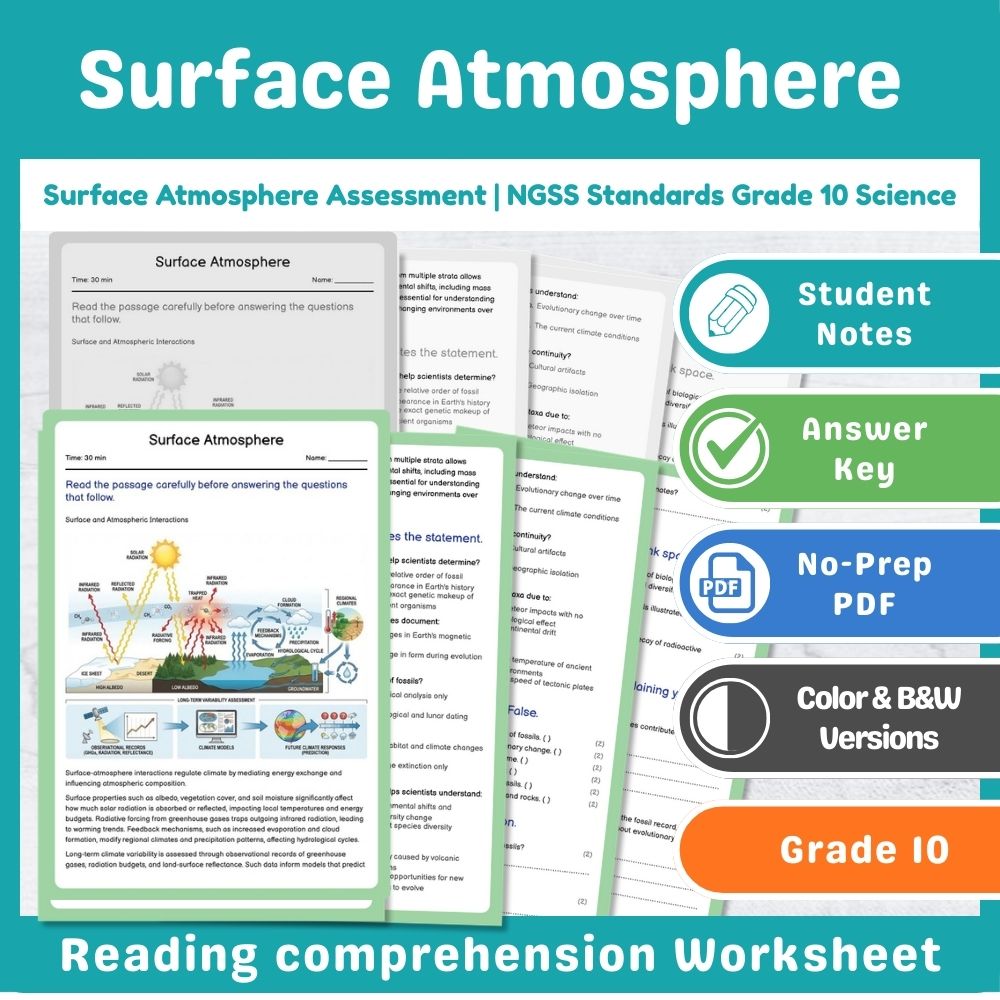
Surface Atmosphere Assessment | NGSS Standards Grade 10 Science
Created byPrism Point LearningLearning Objectives
- Explain the interactions between surface properties and atmospheric processes.
- Describe the concepts of energy exchange, albedo effects, and radiative forcing.
- Analyze the coupling of atmospheric circulation with surface processes such as evapotranspiration.
Instant download
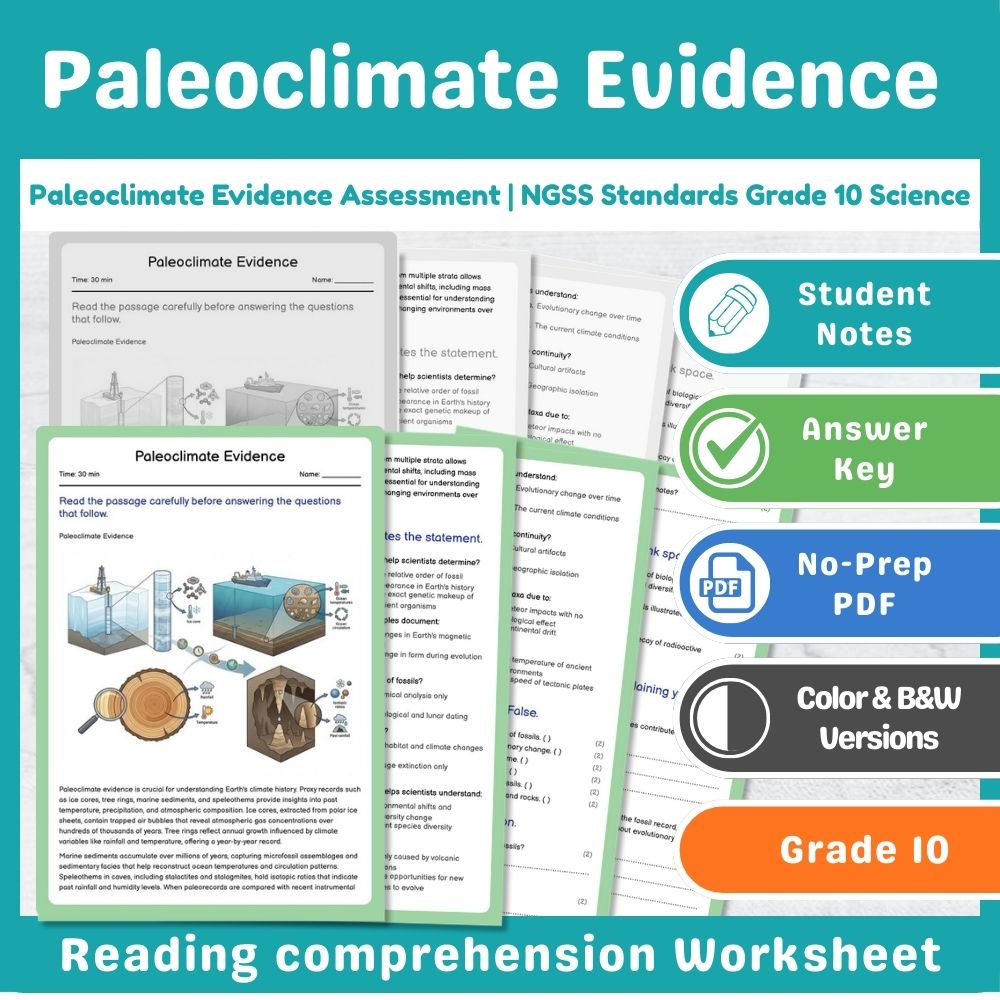
Paleoclimate Evidence Assessment | NGSS Standards Grade 10 Science
Created byPrism Point LearningLearning Objectives
- Understand different types of proxy records used to analyze past climate conditions.
- Identify how isotopic ratios, microfossil assemblages, and sedimentary facies provide clues about historical climate shifts.
- Compare paleoclimate reconstructions with recent instrumental data to analyze climate variability.
Instant download

Metabolic Regulation Assessment | TEKS Standards Grade 10 Science
Created byPrism Point LearningLearning Objectives
- Explain how enzyme activity is modulated through allosteric regulation and feedback inhibition.
- Describe the role of covalent modifications in enzyme activity control.
- Understand the influence of hormones like insulin and glucagon on carbohydrate metabolism.
Instant download

Aerobic Versus Anaerobic Assessment | TEKS Grade 10 Science Printable
Created byPrism Point LearningLearning Objectives
- Compare and contrast aerobic and anaerobic respiration pathways.
- Identify the products and energy yields of aerobic and anaerobic processes.
- Explain the significance of oxygen in cellular respiration.
Instant download

Variation and Heredity Assessment | TEKS Standards Grade 10 Science
Created byPrism Point LearningLearning Objectives
- Understand how genetic variation arises from mutation, recombination, and gene flow.
- Explain how heritable traits influence survival and reproduction in populations.
- Describe the process of natural selection and its role in changing allele frequencies.
Also included in: Grade 10 Evolution and Heredity Science Lesson Bundle for TEKS Standards
Instant download
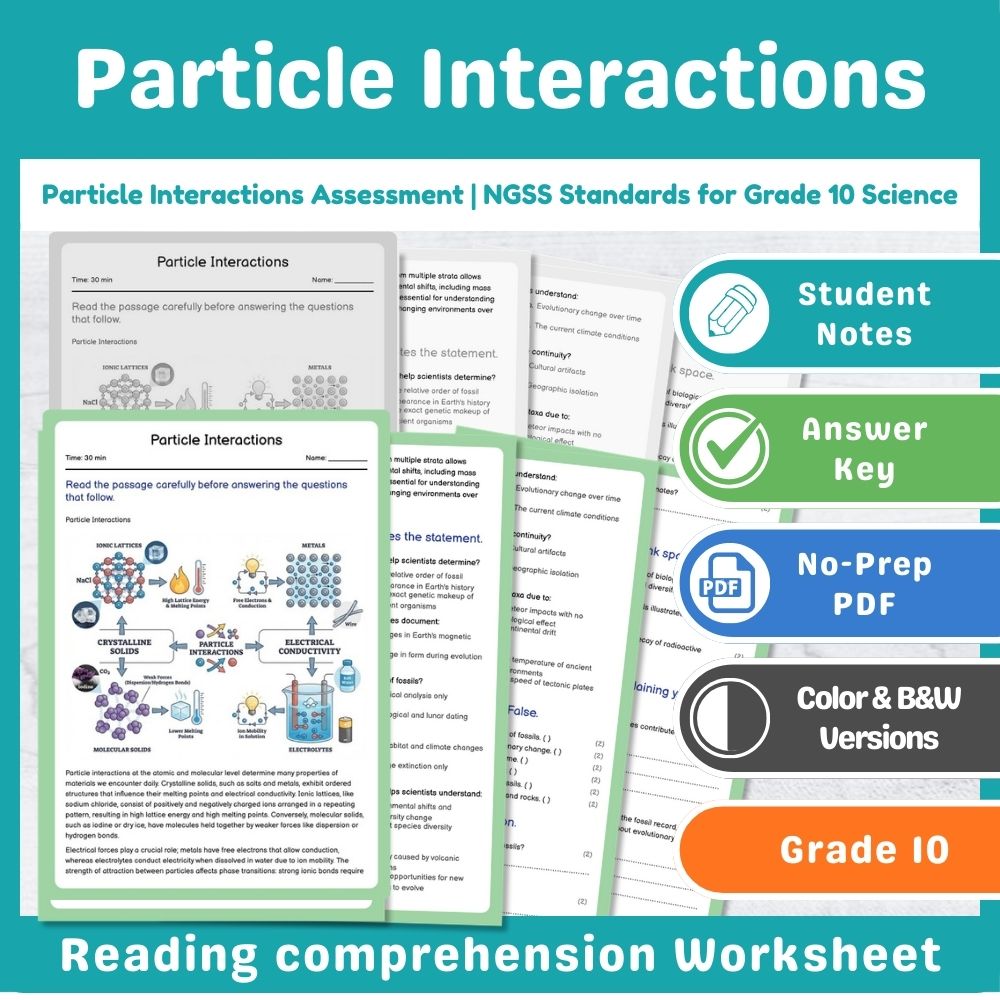
Particle Interactions Assessment | NGSS Standards for Grade 10 Science
Created byPrism Point LearningLearning Objectives
- Analyze how crystal structures, molecular interactions, and electrical forces influence bulk material properties.
- Differentiate between ionic lattices and molecular solids based on melting points, solubility, and electrical conductivity.
- Explain how lattice energy, dispersion forces, and hydrogen bonding affect phase transitions and physical properties.
Instant download
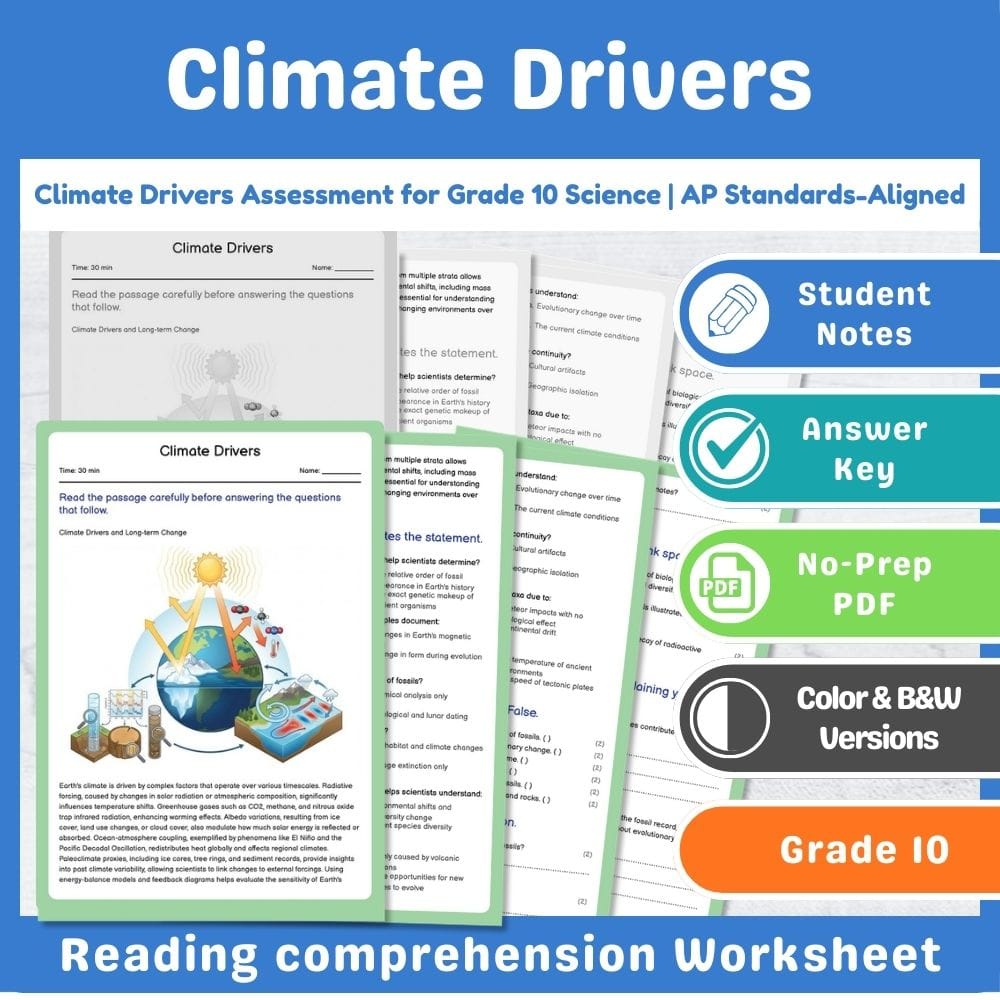
Climate Drivers Assessment for Grade 10 Science | AP Standards-Aligned
Created byPrism Point LearningLearning Objectives
- Explain the main factors influencing Earth's climate, including radiative forcing and greenhouse gases.
- Analyze the role of albedo variations and ocean-atmosphere interactions in climate systems.
- Interpret energy-balance models, feedback diagrams, and proxy records to assess climate change.
Also included in: Lesson Bundle | Grade 10 Science Earth and Space Standards-Aligned
Instant download

Phylogenetic Trees Assessment Grade 10 Science TEKS | Printable Worksheet
Created byPrism Point LearningLearning Objectives
- Understand the concept of phylogenetic trees and their role in evolutionary biology.
- Identify shared derived traits, molecular data, and fossil evidence used to construct trees.
- Interpret branching diagrams to analyze relationships among species.
Also included in: Grade 10 Evolution and Heredity Science Lesson Bundle for TEKS Standards
Instant download
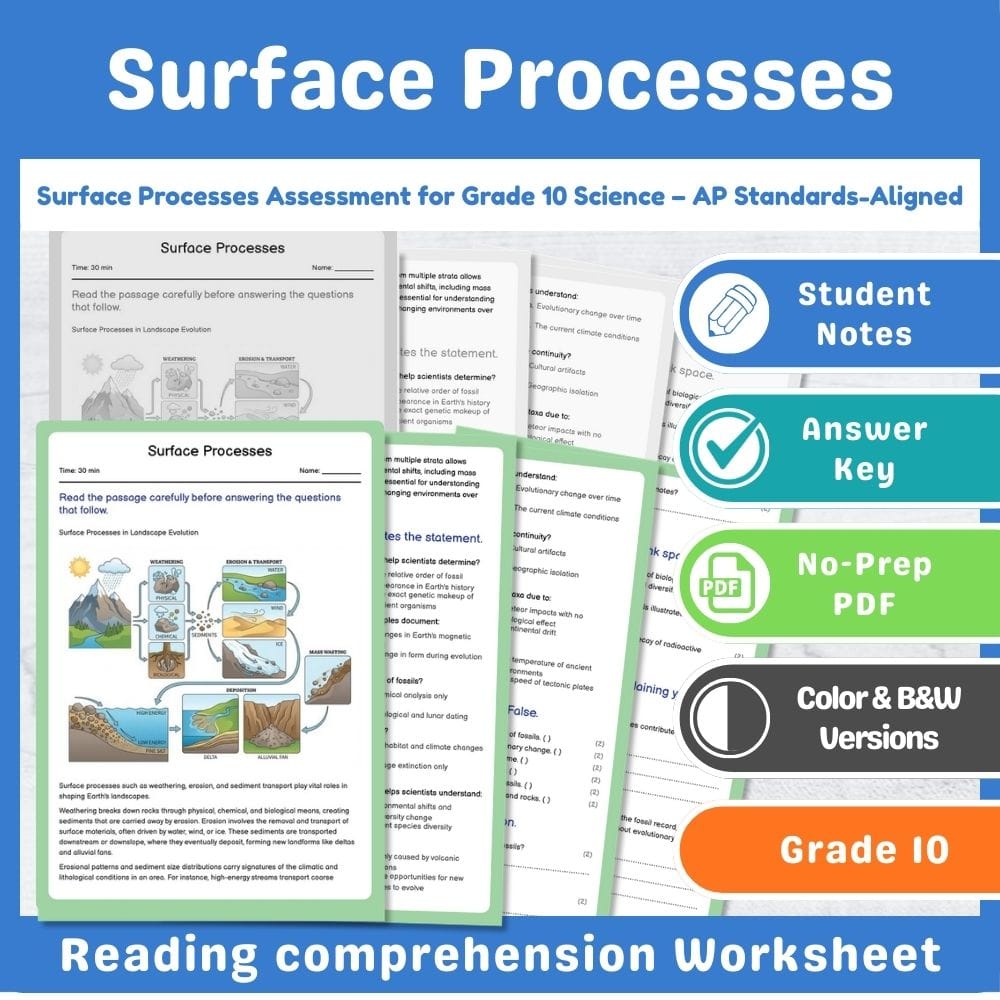
Surface Processes Assessment for Grade 10 Science – AP Standards-Aligned
Created byPrism Point LearningLearning Objectives
- Explain the key surface processes of weathering, erosion, sediment transport, and deposition.
- Interpret landscape changes using concepts like fluvial incision and mass wasting.
- Relate surface process signatures, such as sediment size and channel profiles, to environmental factors.
Also included in: Lesson Bundle | Grade 10 Science Earth and Space Standards-Aligned
Instant download
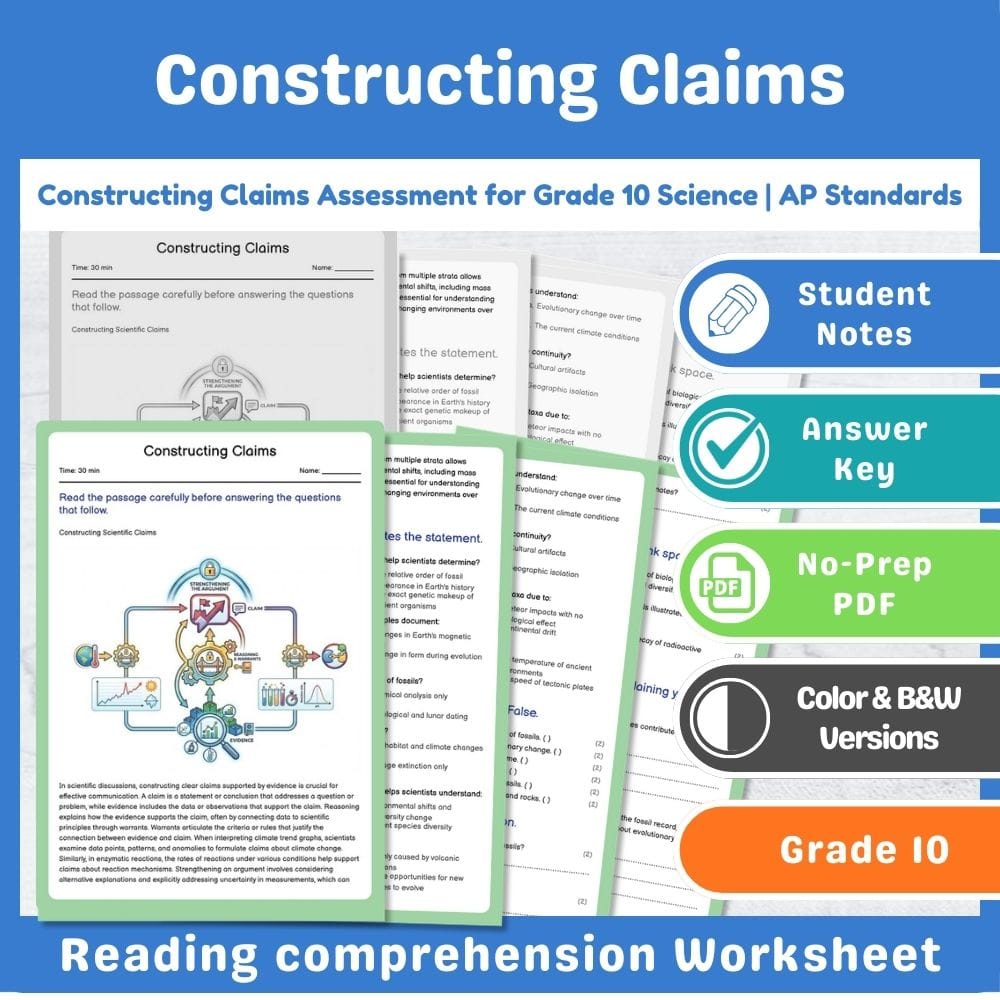
Constructing Claims Assessment for Grade 10 Science | AP Standards
Created byPrism Point LearningLearning Objectives
- Understand the structure and components of evidence-based claims, including claim, evidence, and reasoning.
- Distinguish between claim, evidence, and warrant in constructing scientific arguments.
- Apply the claim-evidence-reasoning framework to interpret data such as climate graphs and enzyme reaction rates.
Instant download
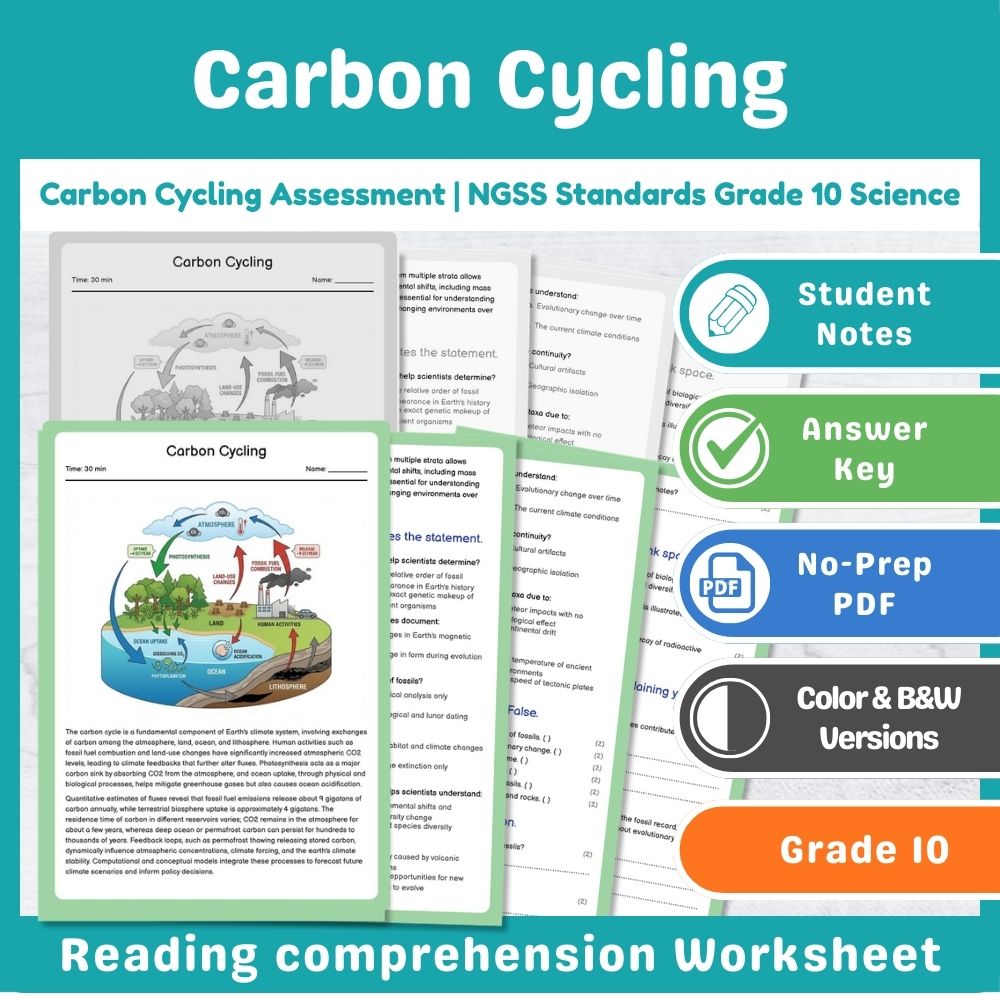
Carbon Cycling Assessment | NGSS Standards Grade 10 Science
Created byPrism Point LearningLearning Objectives
- Describe the components of the global carbon cycle, including sources and sinks.
- Explain feedback mechanisms influencing atmospheric CO2 concentrations.
- Quantify the flux magnitudes, residence times, and their impact on climate.
Also included in: Grade 10 Science Resource Tradeoffs Assessment | NGSS Standards-Aligned
Instant download
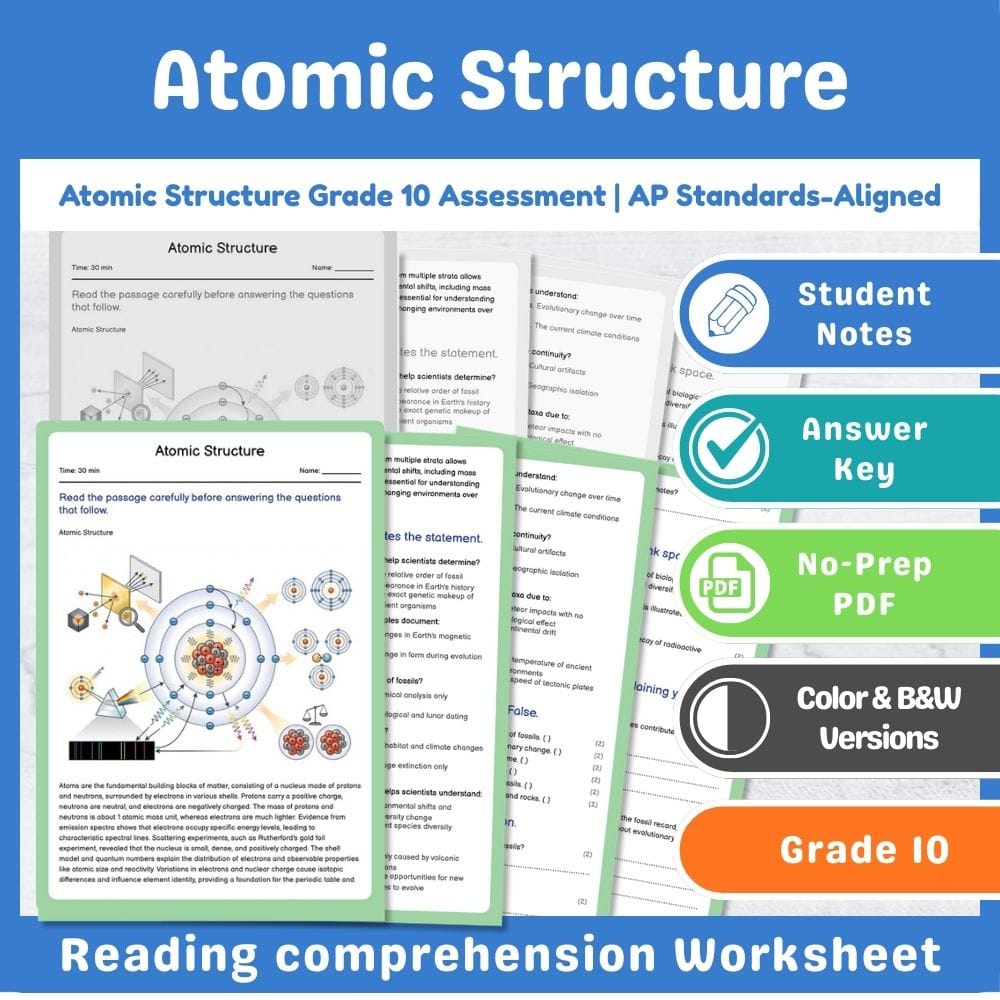
Atomic Structure Grade 10 Assessment | AP Standards-Aligned
Created byPrism Point LearningLearning Objectives
- Describe the subatomic particles that make up atoms and their relative masses.
- Explain how emission spectra and scattering experiments provide evidence for atomic models.
- Connect shell models and quantum numbers to observable atomic properties.
Also included in: Lesson Bundle | Grade 10 Science Assessment Paired with AP Standards
Instant download
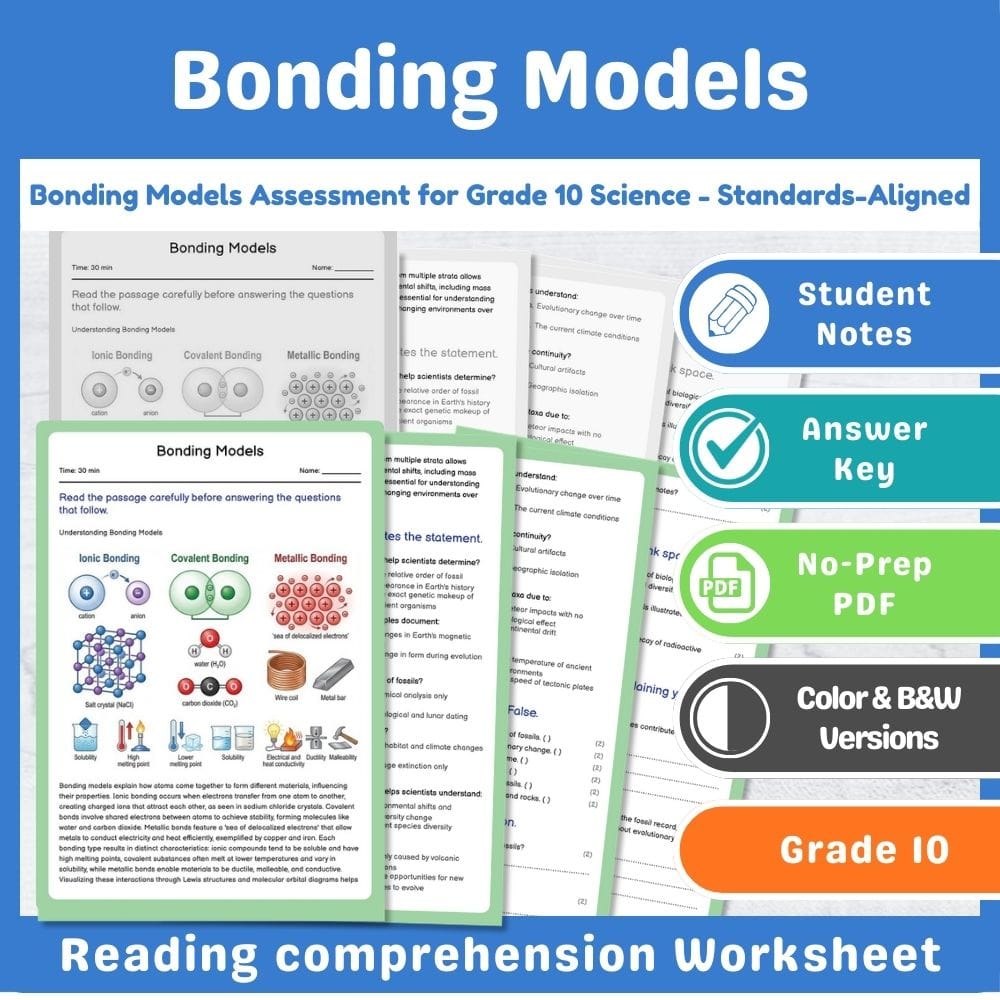
Bonding Models Assessment for Grade 10 Science - Standards-Aligned
Created byPrism Point LearningLearning Objectives
- Identify and distinguish the major types of bonding: ionic, covalent, and metallic.
- Relate bonding frameworks to material properties such as conductivity, melting point, and solubility.
- Understand Lewis structures, electron-sharing, and electron-transfer representations.
Also included in: Lesson Bundle | Grade 10 Science Assessment Paired with AP Standards
Instant download
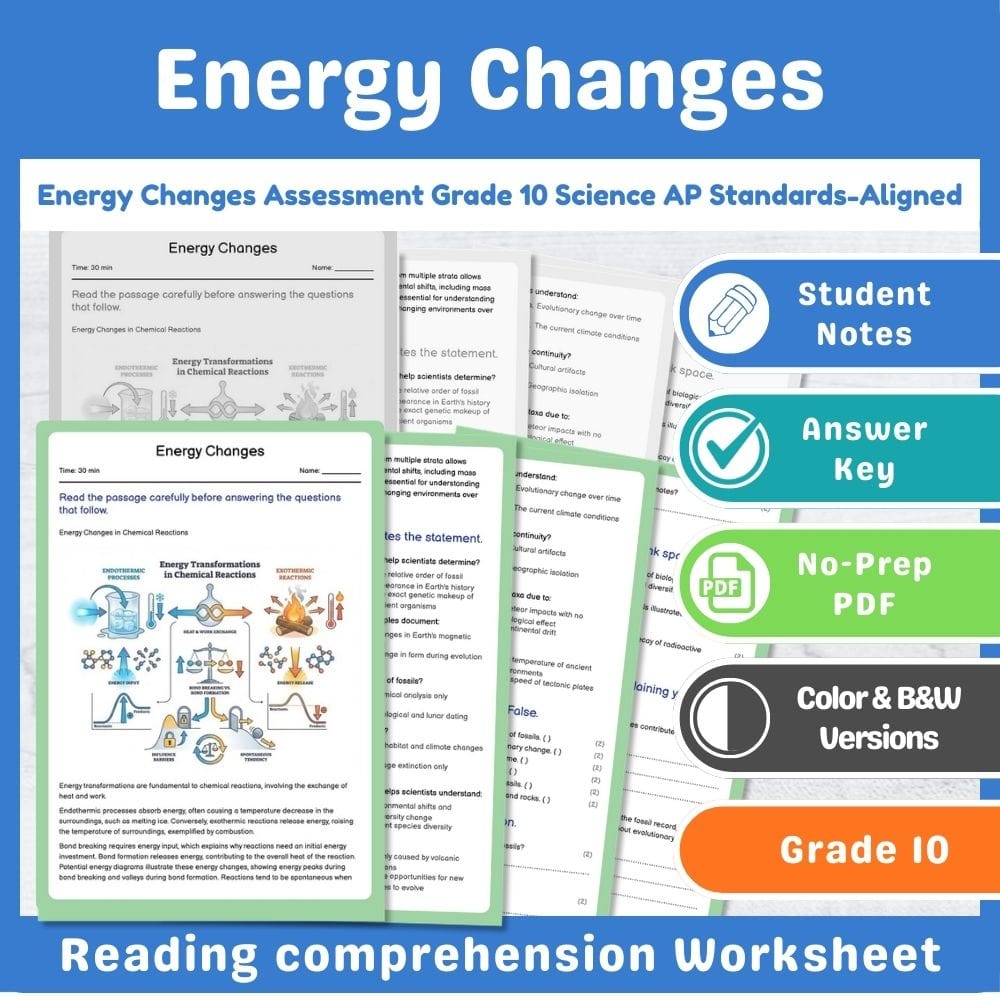
Energy Changes Assessment Grade 10 Science AP Standards-Aligned
Created byPrism Point LearningLearning Objectives
- Describe the differences between endothermic and exothermic processes.
- Understand how bond breaking and formation relate to reaction heat.
- Explain the concepts of enthalpy and potential energy diagrams.
Also included in: Lesson Bundle | Grade 10 Science Assessment Paired with AP Standards
Instant download
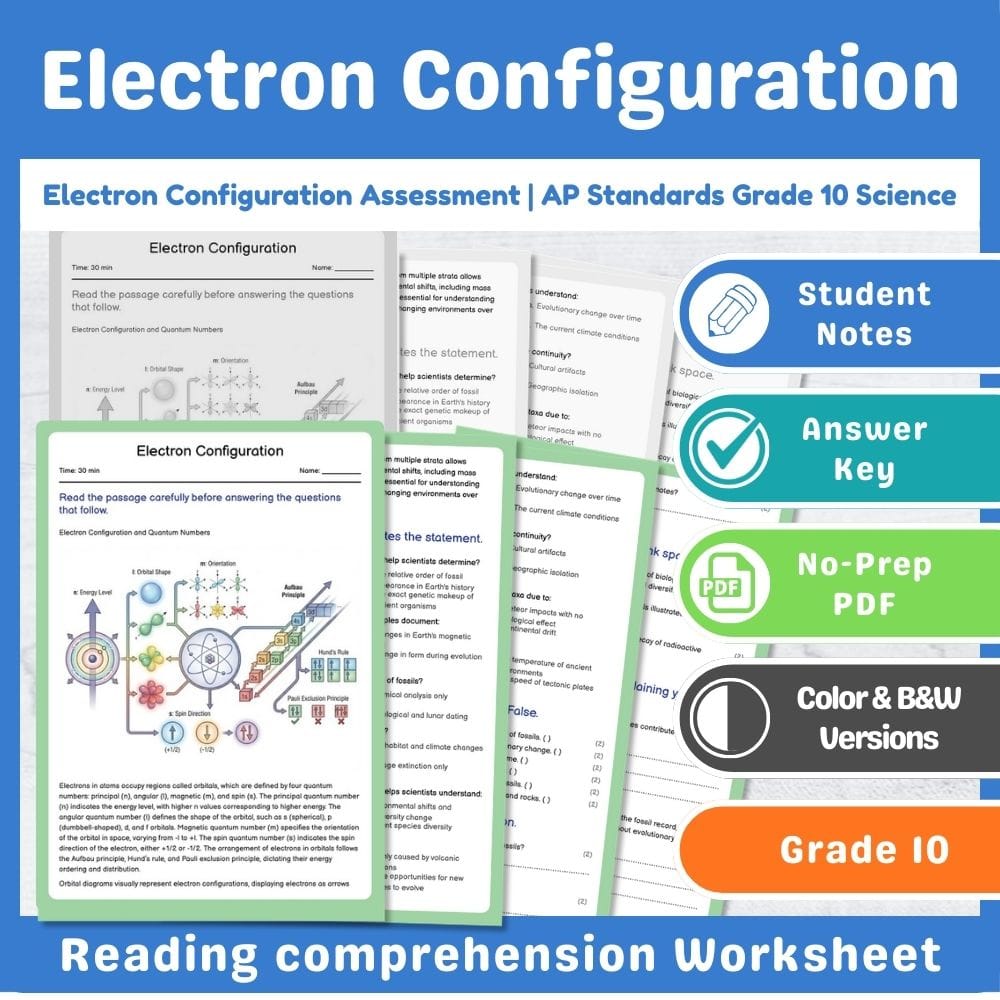
Electron Configuration Assessment | AP Standards Grade 10 Science
Created byPrism Point LearningLearning Objectives
- Understand quantum numbers and how they describe electron distribution in atoms
- Identify orbital shapes and energy ordering for electrons in atoms
- Link microscopic electron arrangements to spectral lines and chemical properties
Also included in: Lesson Bundle | Grade 10 Science Assessment Paired with AP Standards
Instant download
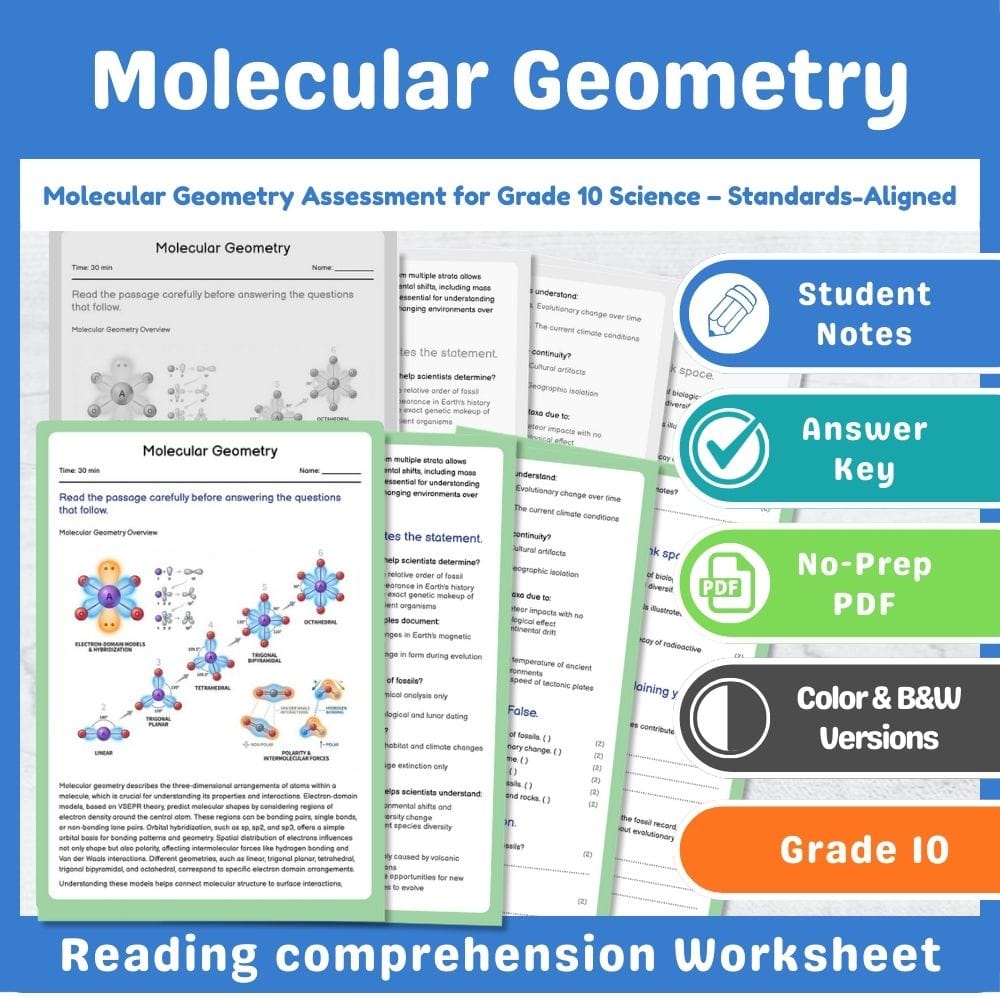
Molecular Geometry Assessment for Grade 10 Science – Standards-Aligned
Created byPrism Point LearningLearning Objectives
- Define molecular geometry using electron-domain models and orbital hybridization.
- Explain how electron domain arrangements determine molecular shapes and polarity.
- Connect molecular structures to intermolecular forces and macroscopic properties.
Also included in: Lesson Bundle | Grade 10 Science Assessment Paired with AP Standards
Instant download
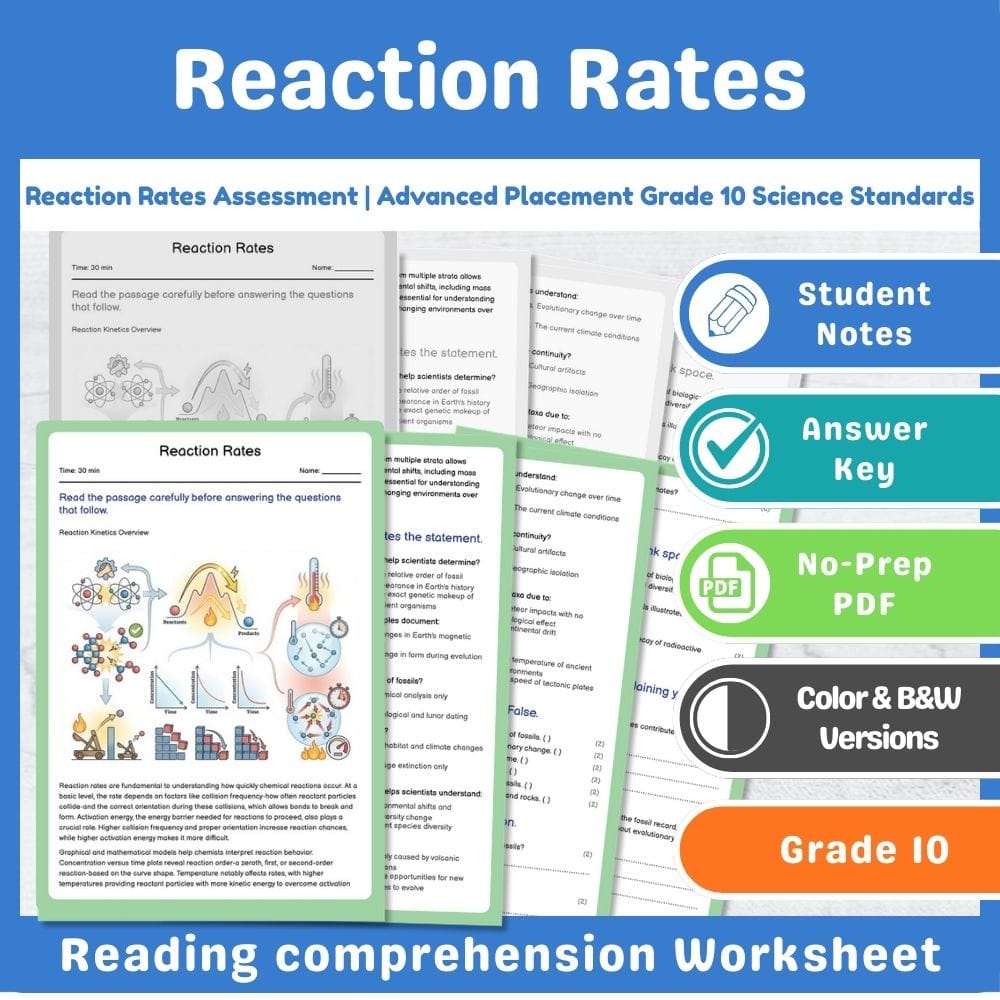
Reaction Rates Assessment | Advanced Placement Grade 10 Science Standards
Created byPrism Point LearningLearning Objectives
- Describe how collision frequency, orientation, and activation energy influence reaction rates.
- Interpret graphical and mathematical models of concentration versus time to determine reaction order.
- Explain the effects of temperature and catalysts on reaction pathways without advanced formalism.
Also included in: Lesson Bundle | Grade 10 Science Assessment Paired with AP Standards
Instant download
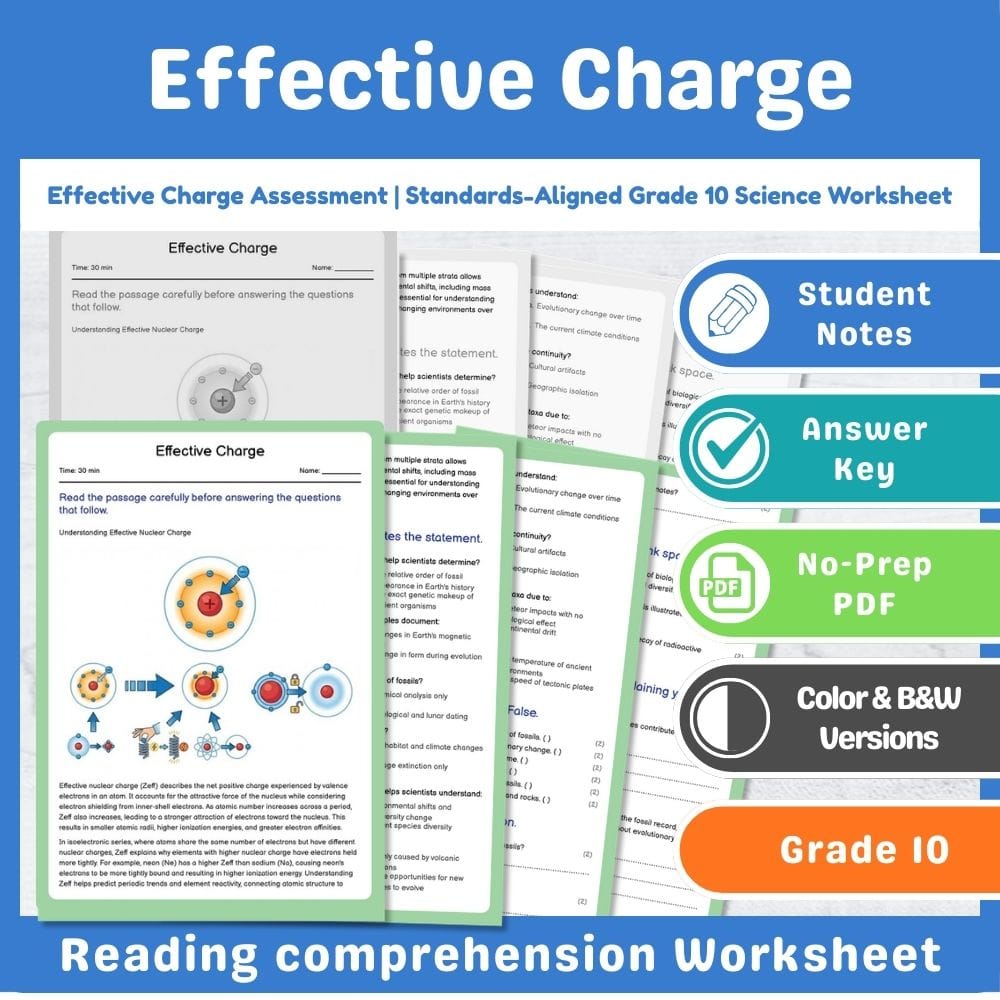
Effective Charge Assessment | Standards-Aligned Grade 10 Science Worksheet
Created byPrism Point LearningLearning Objectives
- Understand the concept of effective nuclear charge (Zeff) and its role in atomic structure.
- Analyze periodic trends such as atomic radius, ionization energy, and electron affinity in relation to Zeff.
- Compare isoelectronic series to see how nuclear charge and shielding affect valence electrons.
Also included in: Lesson Bundle | Grade 10 Science Assessment Paired with AP Standards
Instant download

Specialized Cells Assessment | Florida NGSSS Standards - Grade 10 Science
Created byPrism Point LearningLearning Objectives
- Explain how specialized cell structures relate to specific functions in multicellular organisms
- Identify examples of cell specialization for transport, protection, absorption, and signaling
- Interpret how surface characteristics and cell connections affect tissue and system performance
Also included in: Grade 10 Cells, Genetics & Evolution Science Lesson Bundle | Florida NGSSS +1 more
Instant download
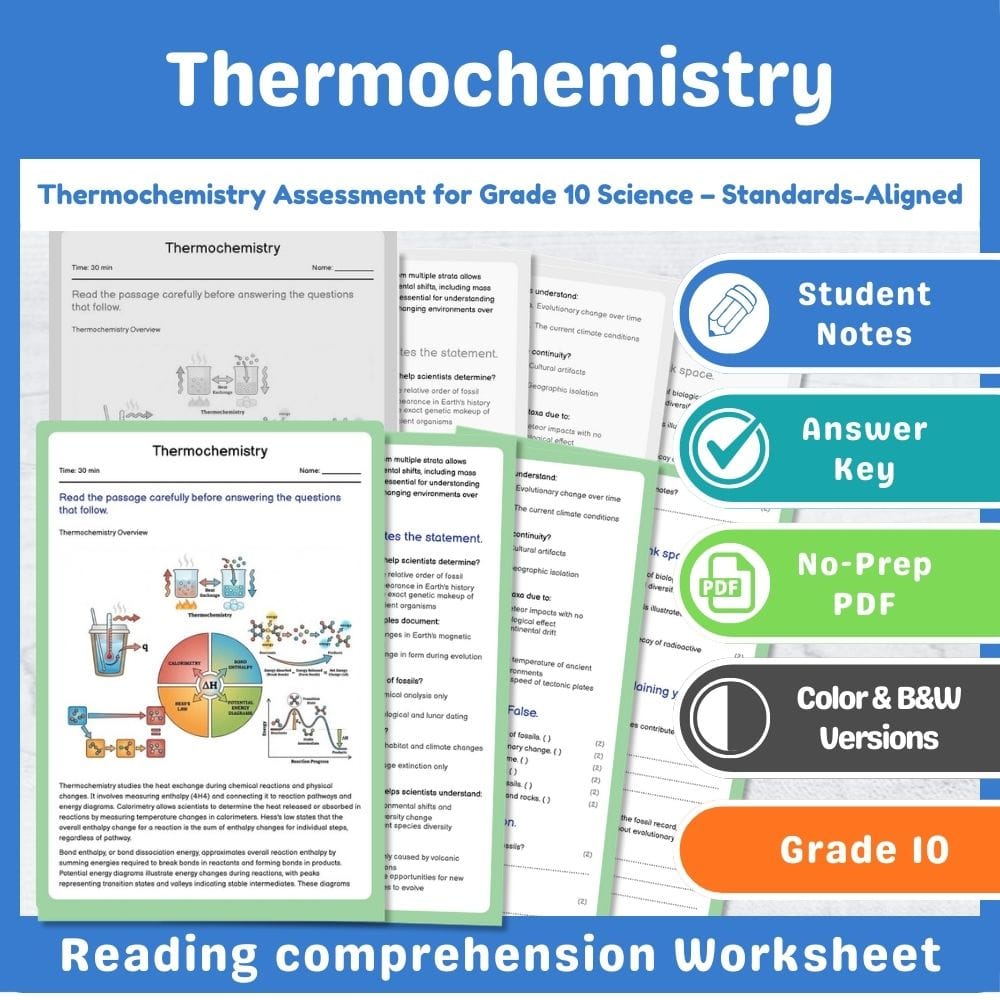
Thermochemistry Assessment for Grade 10 Science – Standards-Aligned
Created byPrism Point LearningLearning Objectives
- Describe thermochemical representations and calculations connecting enthalpy changes to reaction stoichiometry.
- Interpret calorimetric energy accounting and Hess's law for pathway decomposition.
- Relate bond enthalpy approximations to overall reaction enthalpy and analyze potential energy diagrams.
Also included in: Lesson Bundle | Grade 10 Science Assessment Paired with AP Standards
Instant download
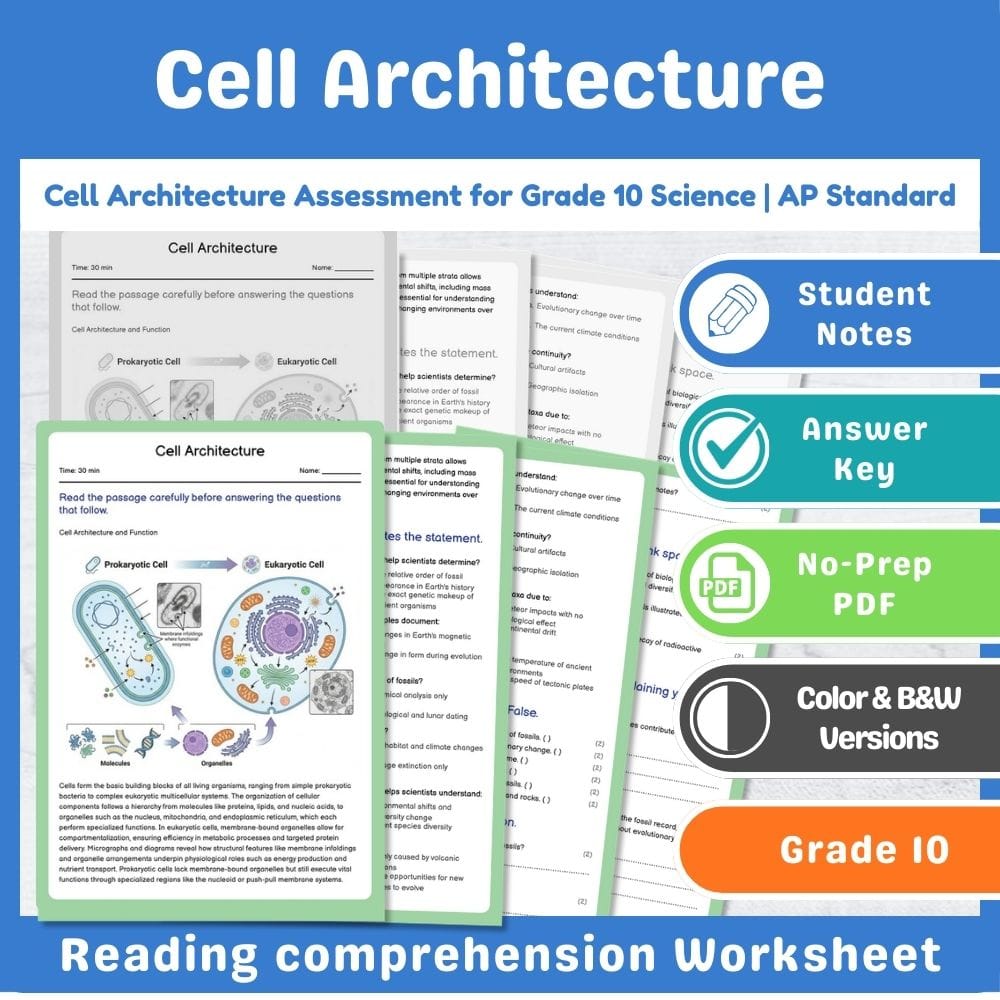
Cell Architecture Assessment for Grade 10 Science | AP Standard
Created byPrism Point LearningLearning Objectives
- Describe the hierarchical organization of cell components from macromolecules to organ systems.
- Compare and contrast prokaryotic and eukaryotic cellular structures and functions.
- Explain how ultrastructural features relate to cellular physiological roles such as compartmentalization and protein targeting.
Also included in: Lesson Grade 10 Science Assessment Bundle | AP Standards-Aligned
Instant download

Meiosis and Variation Assessment | Florida NGSSS Grade 10 Science
Created byPrism Point LearningLearning Objectives
- Explain how meiosis reduces chromosome number and produces gametes with half the genetic material
- Describe how homologous chromosome separation and genetic recombination generate variation among gametes
- Connect heritable genetic variation to natural selection and population change over time
Also included in: Grade 10 Cells, Genetics & Evolution Science Lesson Bundle | Florida NGSSS +1 more
Instant download
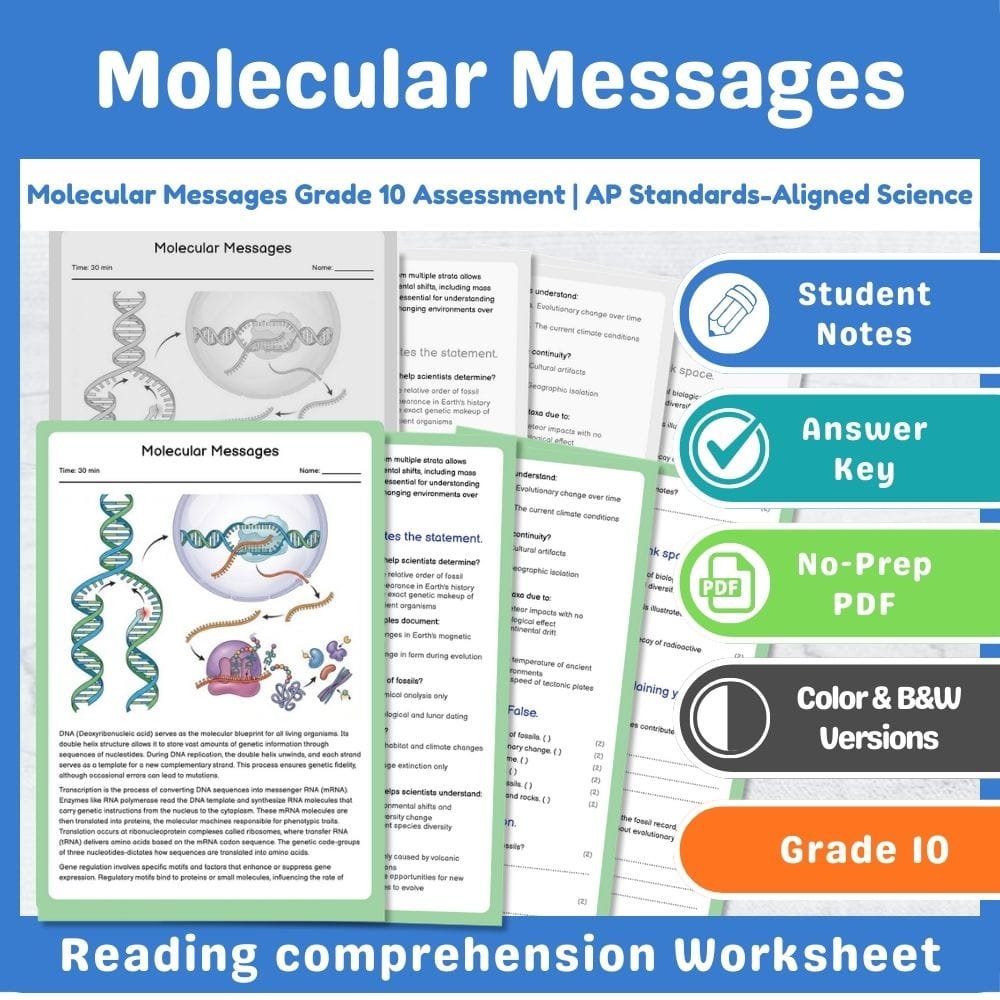
Molecular Messages Grade 10 Assessment | AP Standards-Aligned Science
Created byPrism Point LearningLearning Objectives
- Understand the structure and function of DNA and how genetic information is stored.
- Describe the processes of DNA replication, transcription, and translation.
- Explain how molecular mechanisms contribute to phenotypic expression and regulation within cells.
Also included in: Lesson Grade 10 Science Assessment Bundle | AP Standards-Aligned
Instant download
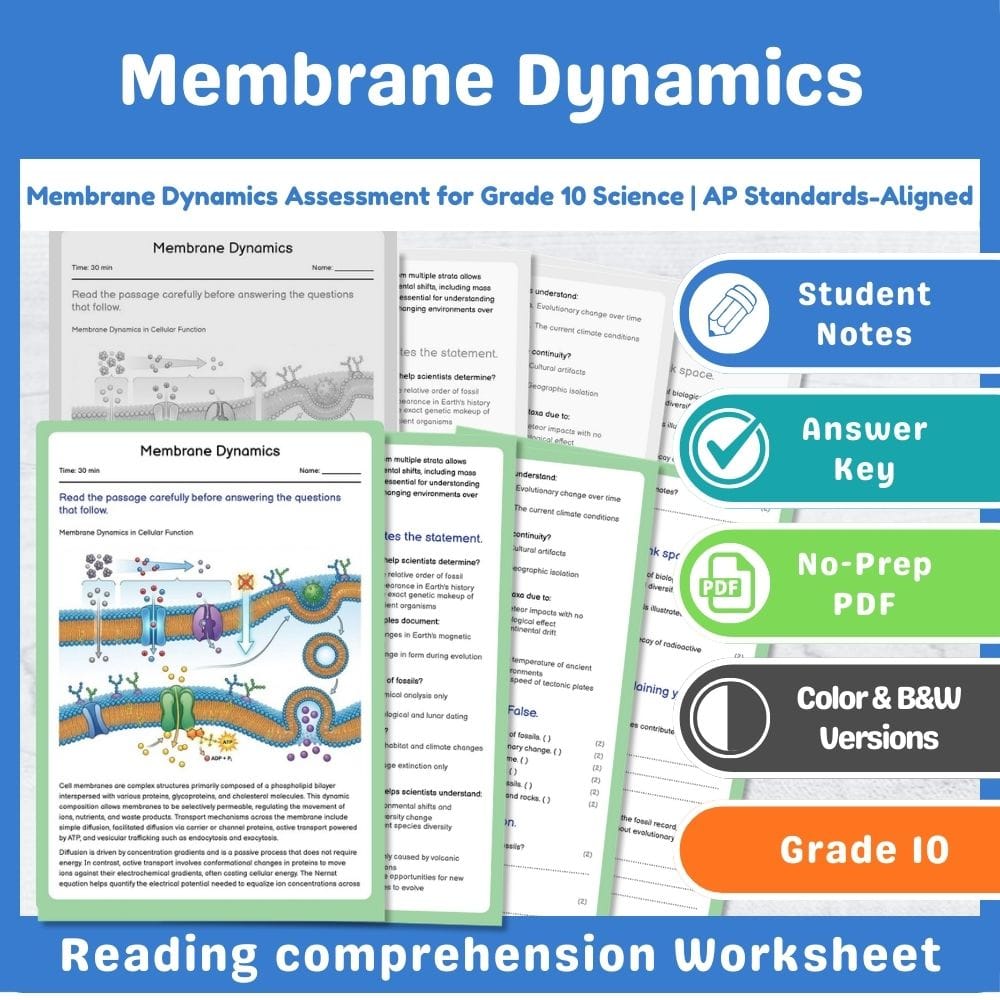
Membrane Dynamics Assessment for Grade 10 Science | AP Standards-Aligned
Created byPrism Point LearningLearning Objectives
- Understand key concepts related to Science
- Apply knowledge through practice questions
- Demonstrate comprehension of the material
Also included in: Lesson Grade 10 Science Assessment Bundle | AP Standards-Aligned
Instant download
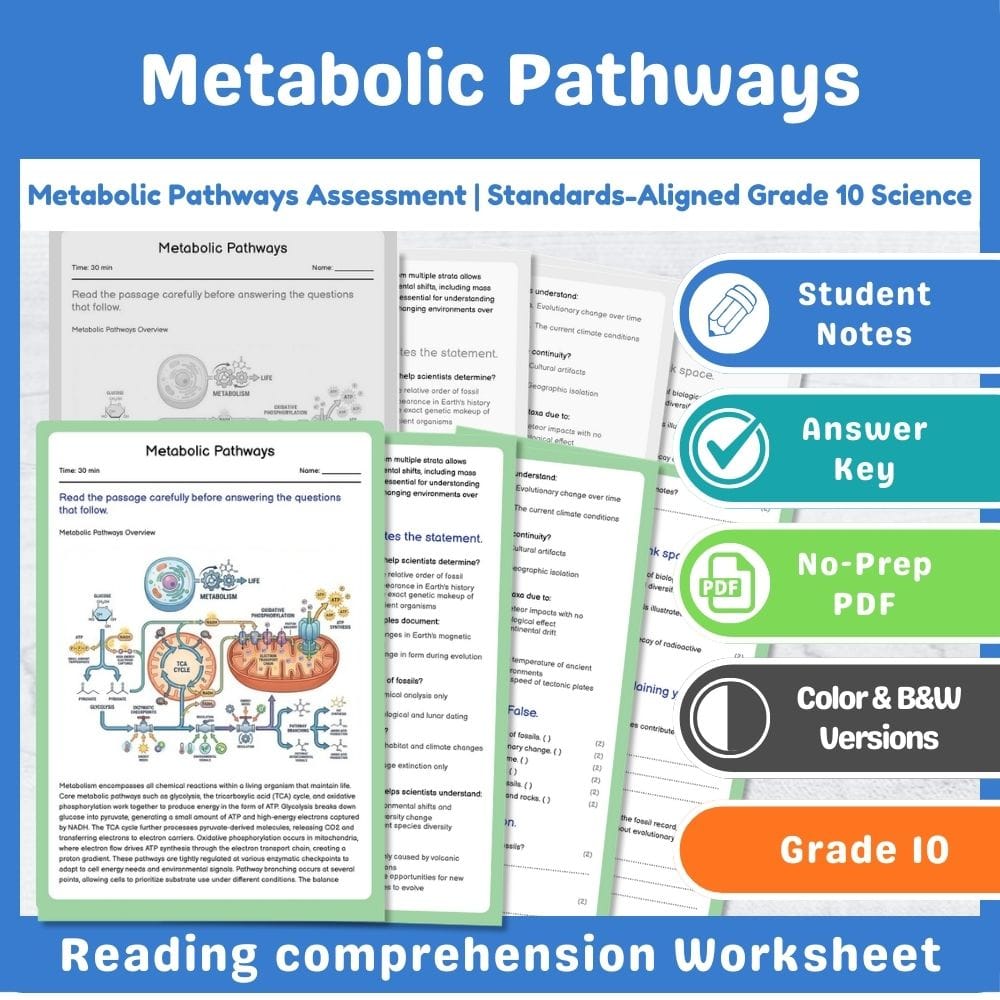
Metabolic Pathways Assessment | Standards-Aligned Grade 10 Science
Created byPrism Point LearningLearning Objectives
- Describe the main metabolic pathways including glycolysis, the tricarboxylic acid cycle, and oxidative phosphorylation.
- Explain how cells generate ATP and conserve energy through electron flow and intermediate transformations.
- Identify regulatory checkpoints and pathway branching points that control cellular metabolism.
Also included in: Lesson Grade 10 Science Assessment Bundle | AP Standards-Aligned
Instant download
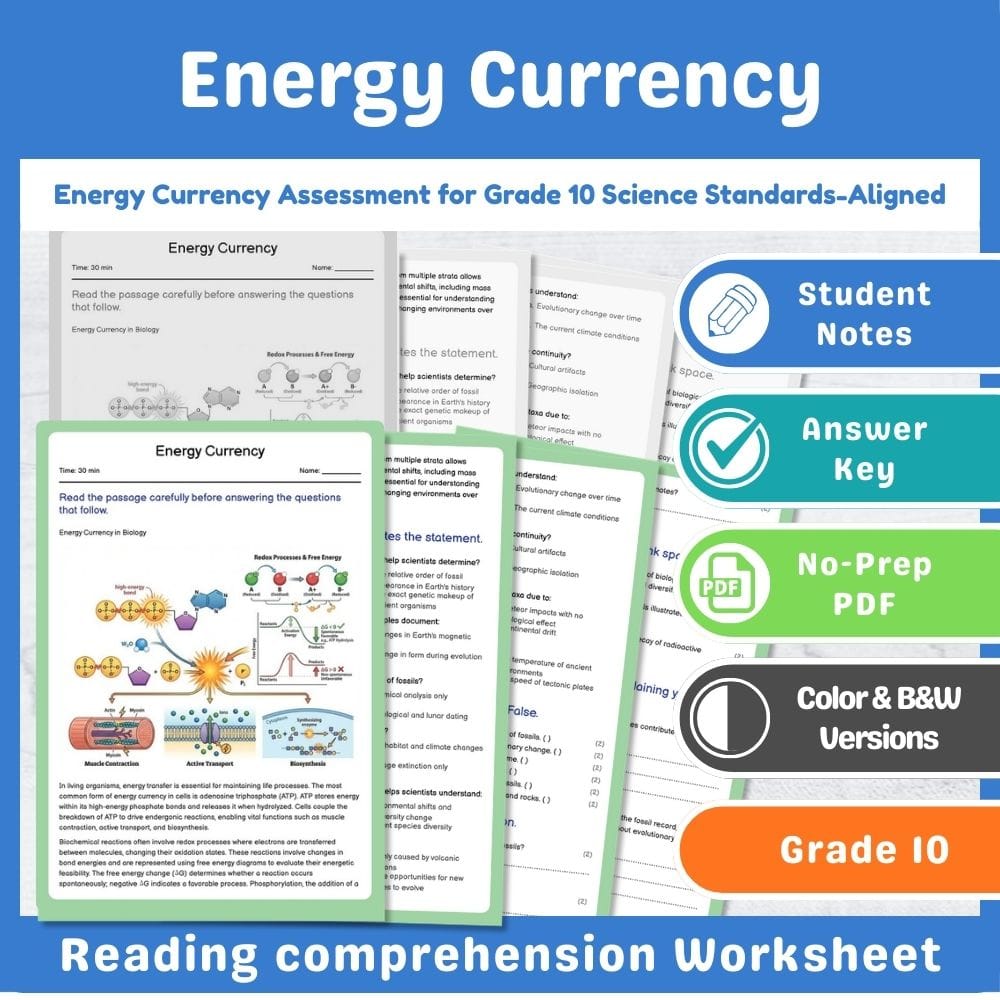
Energy Currency Assessment for Grade 10 Science Standards-Aligned
Created byPrism Point LearningLearning Objectives
- Understand the role of adenosine triphosphate (ATP) in biological energy transfer.
- Compare different types of biochemical reactions, including redox and energy changes.
- Explain how energy currency maintains cellular functions and organization.
Also included in: Lesson Grade 10 Science Assessment Bundle | AP Standards-Aligned
Instant download
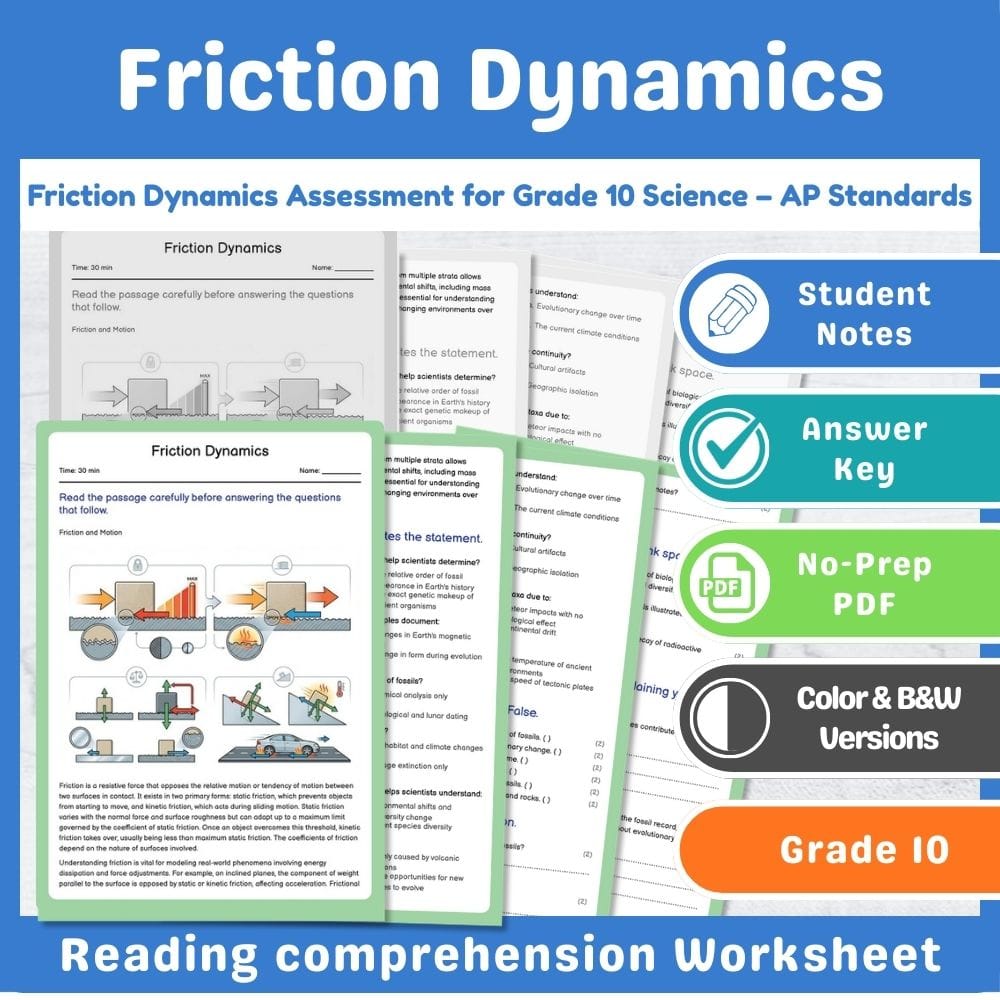
Friction Dynamics Assessment for Grade 10 Science – AP Standards
Created byPrism Point LearningLearning Objectives
- Describe the differences between static and kinetic friction and their dependence on normal force and surface properties.
- Apply coefficients of friction to predict motion and analyze energy dissipation during surface contact.
- Model the effects of frictional forces on motion using inclined-plane and surface-contact examples.
Also included in: Lesson Grade 10 Science Assessment Bundle | AP Standards-Aligned
Instant download
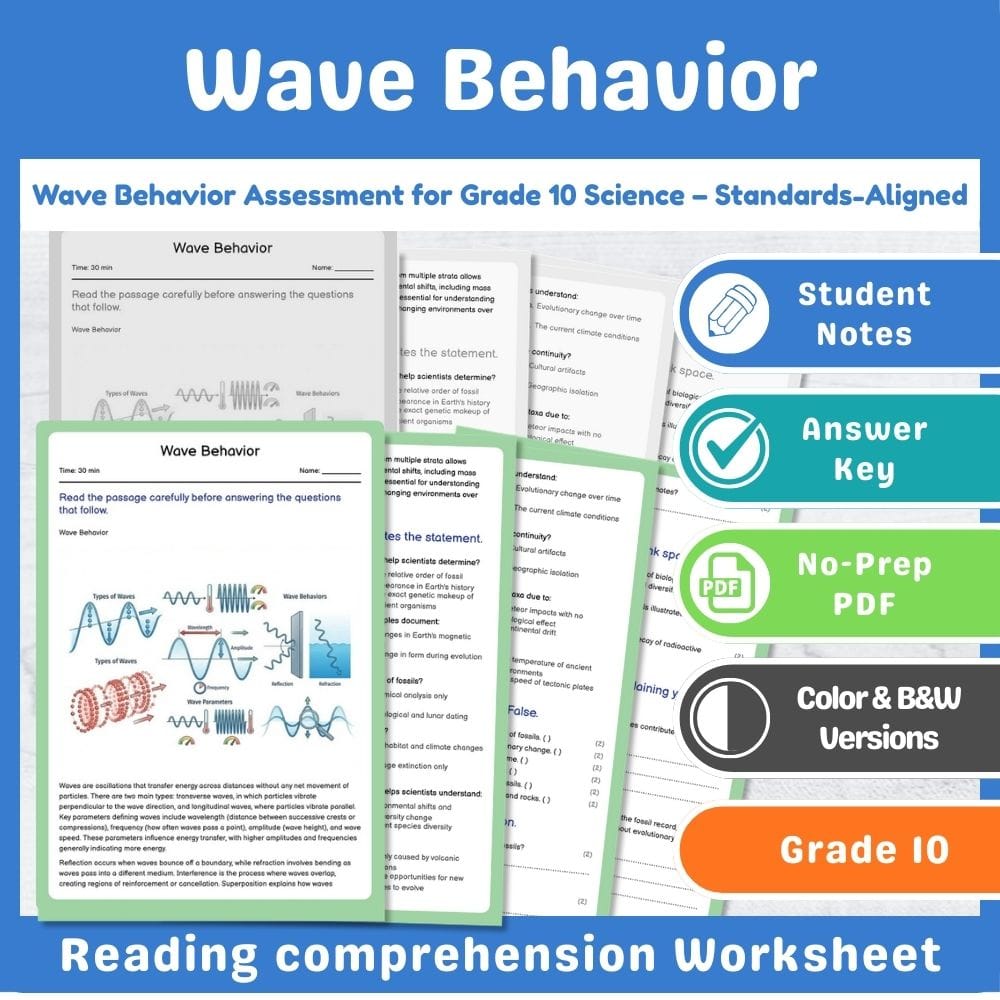
Wave Behavior Assessment for Grade 10 Science – Standards-Aligned
Created byPrism Point LearningLearning Objectives
- Describe the characteristics and parameters of transverse and longitudinal waves, including wavelength, frequency, amplitude, and wave speed.
- Explain how waves transfer energy and information through reflection, refraction, interference, and superposition.
- Analyze wave phenomena such as standing waves, boundary effects, and spectral representations using graphical and mathematical descriptions.
Also included in: Lesson Grade 10 Science Assessment Bundle | AP Standards-Aligned
Instant download
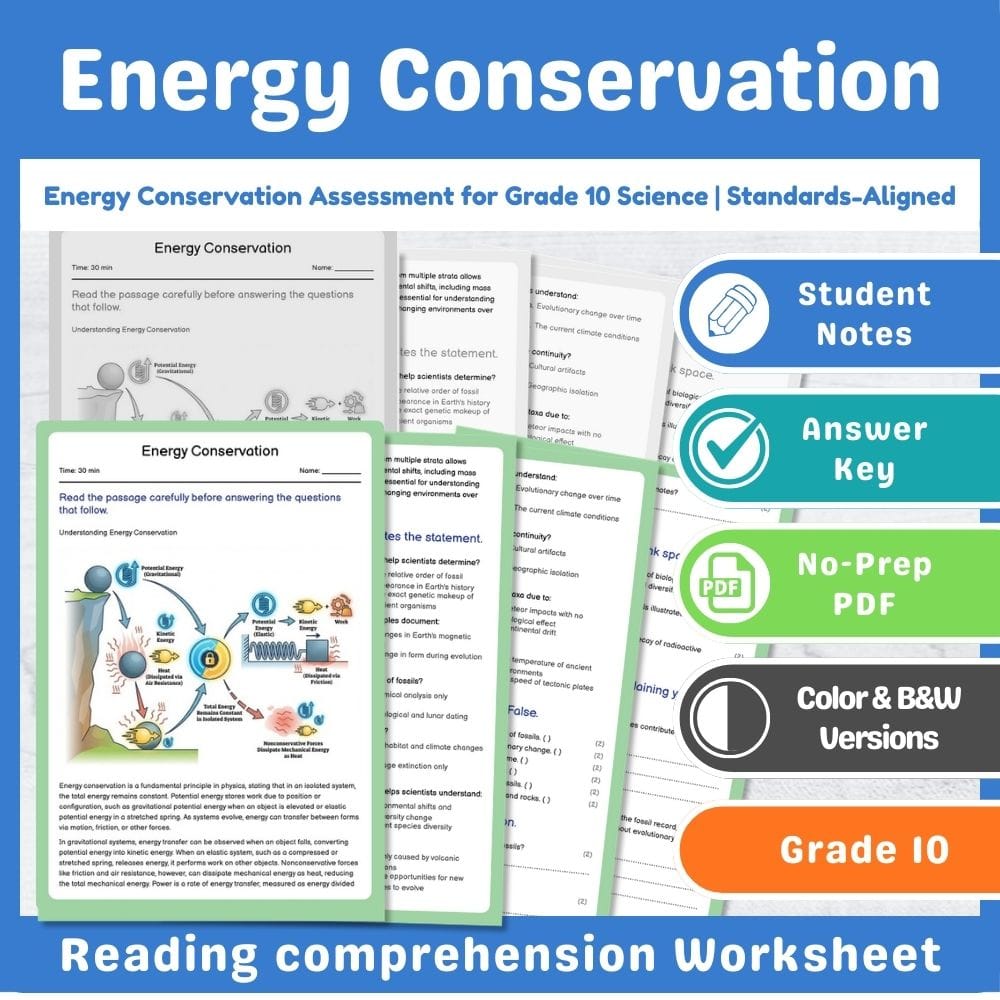
Energy Conservation Assessment for Grade 10 Science | Standards-Aligned
Created byPrism Point LearningLearning Objectives
- Explain the principles of potential energy in gravitational and elastic systems.
- Describe energy transfer and conversion processes in mechanical systems.
- Analyze the effect of nonconservative forces on mechanical energy.
Also included in: Lesson Grade 10 Science Assessment Bundle | AP Standards-Aligned
Instant download

Chromosomes and Inheritance Assessment | Florida NGSSS Grade 10 Science
Created byPrism Point LearningLearning Objectives
- Explain how chromosomes carry genes and how alleles at specific loci influence inherited traits.
- Describe how meiosis and fertilization connect chromosome transmission to offspring genotypes.
- Distinguish between simple dominance patterns and inheritance patterns involving multiple genes.
Also included in: Grade 10 Cells, Genetics & Evolution Science Lesson Bundle | Florida NGSSS +1 more
Instant download
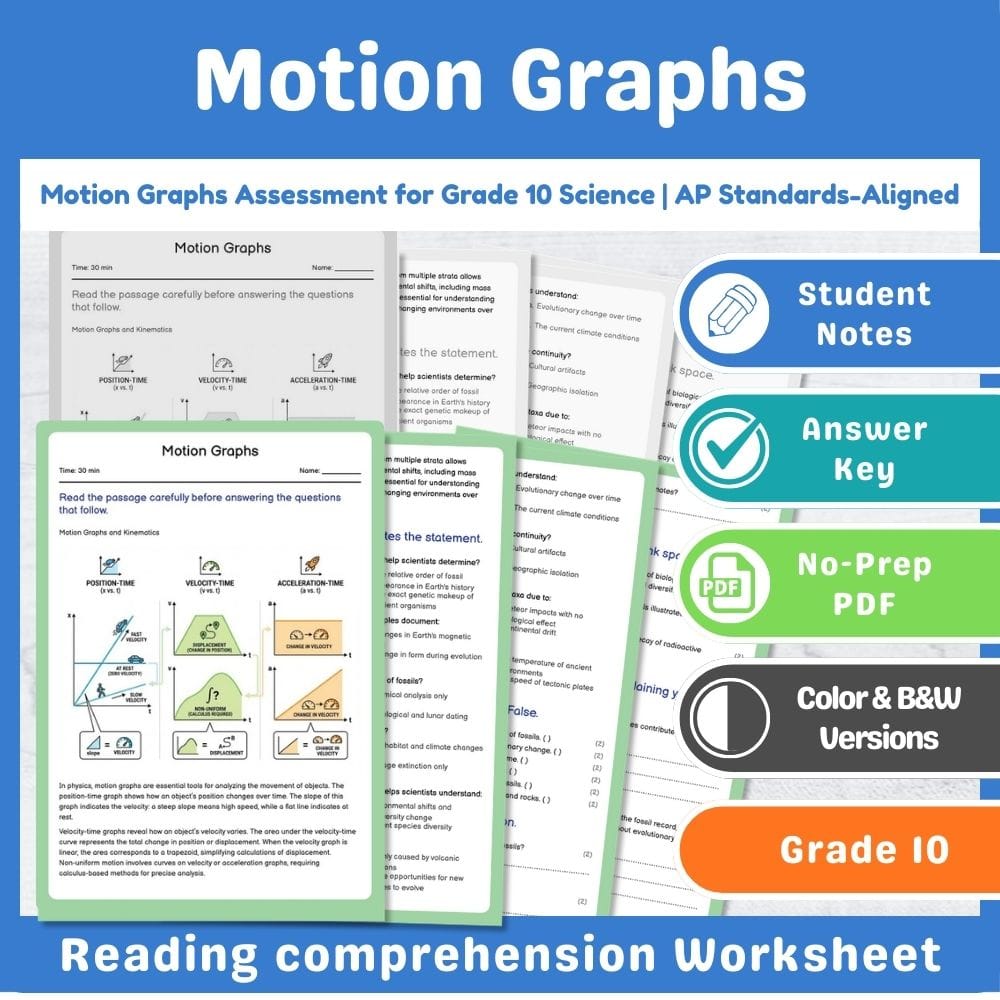
Motion Graphs Assessment for Grade 10 Science | AP Standards-Aligned
Created byPrism Point LearningLearning Objectives
- Understand how the slope of a motion graph relates to velocity and acceleration.
- Interpret areas under motion graphs to determine total displacement and change in velocity.
- Connect features of position, velocity, and acceleration graphs to physical quantities in motion analysis.
Also included in: Lesson Grade 10 Science Assessment Bundle | AP Standards-Aligned
Instant download

Cell Structure Assessment | Florida NGSSS Grade 10 Science Standard
Created byPrism Point LearningLearning Objectives
- Explain how eukaryotic and prokaryotic cell structures differ and how those differences support life processes
- Identify major cell components (cell membrane, cytoplasm, nucleus, genetic material) and describe their functions
- Analyze how cell specialization relates to the presence or activity of specific structures
Also included in: Grade 10 Cells, Genetics & Evolution Science Lesson Bundle | Florida NGSSS +1 more
Instant download
Browse more categories
About Reading comprehension Worksheets
Find reading comprehension worksheets for class practice, homework, or self-study. All 40,284 are instant PDF downloads.
Each resource here is built by an independent educator and reviewed for quality. Worksheets print straight from PDF and suit classroom use, homework, or extra practice; most come with answer keys, and you can preview before purchasing.