
Reading comprehension Worksheets
40,284 type resources
The Mole Concept Assessment | BC Standards Grade 11 Science
 Created byPrism Point Learning
Learning Objectives
- Explain the fundamental principles of the mole concept and its relation to Avogadro's number.
- Convert between mass, number of particles, and volume using molar mass and molar relationships.
- Perform calculations involving moles, gases, and mass for quantitative analysis in chemistry.
Also included in: Grade 11 Science | Thermochemistry Assessment Bundle – Standards-Aligned
Instant download
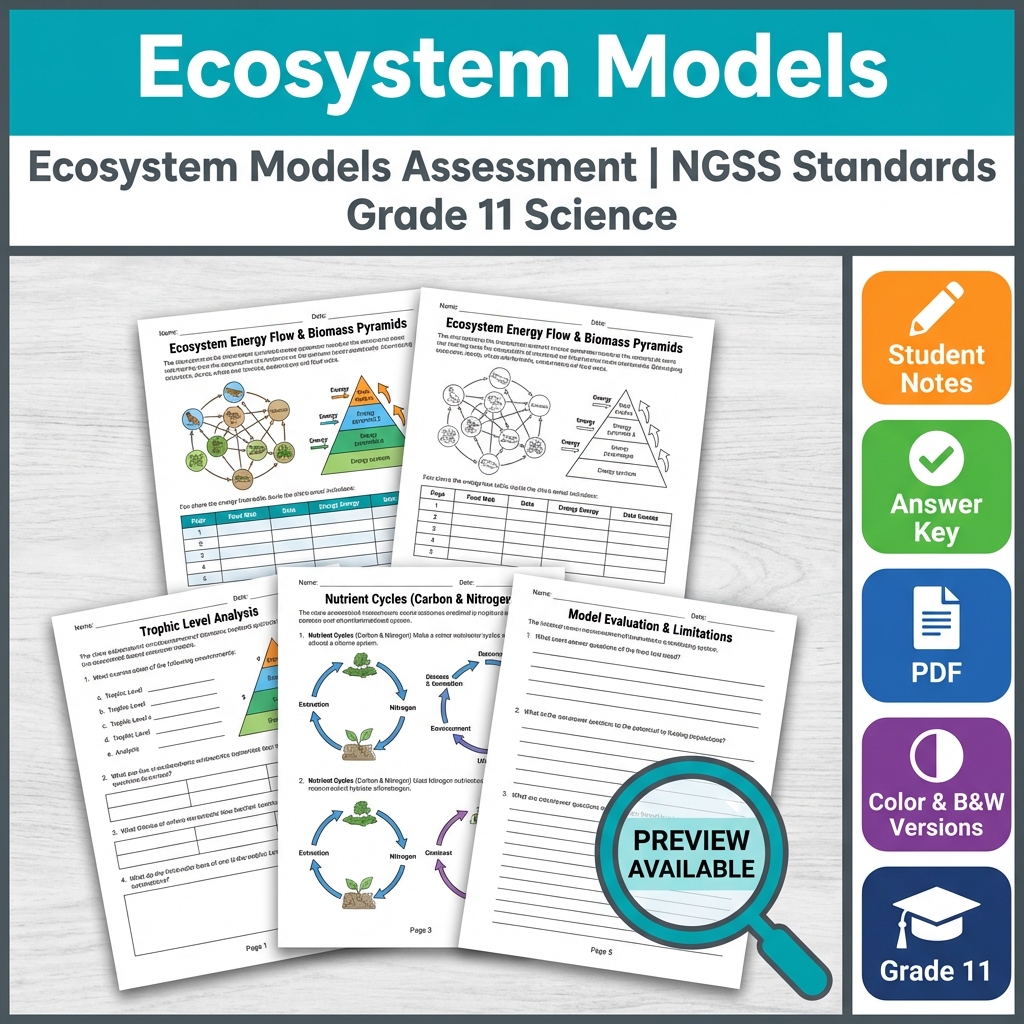
Ecosystem Models Assessment | NGSS Standards Grade 11 Science
Created byPrism Point LearningLearning Objectives
- Understand different types of ecosystem models and their applications.
- Analyze how models represent ecological interactions and predict system behavior.
- Evaluate the parameters and feedback mechanisms in ecosystem modeling.
Also included in: Grade 11 Science Mini Bundle | Ecosystems Interactions & Energy NGSS
Instant download

Newton Second Law Assessment Grade 11 Science NGSSS Standards
Created byPrism Point LearningLearning Objectives
- Explain Newton’s second law using the relationship between net force, mass, and acceleration
- Predict the direction and relative magnitude of acceleration based on net force and mass
- Apply Newton’s second law to situations involving identical pushes on different masses and multiple forces acting together
Also included in: Lesson Grade 11 Forces Energy & Chemistry Science Assessment Lesson Bundle | Florida (NGSSS) +1 more
Instant download
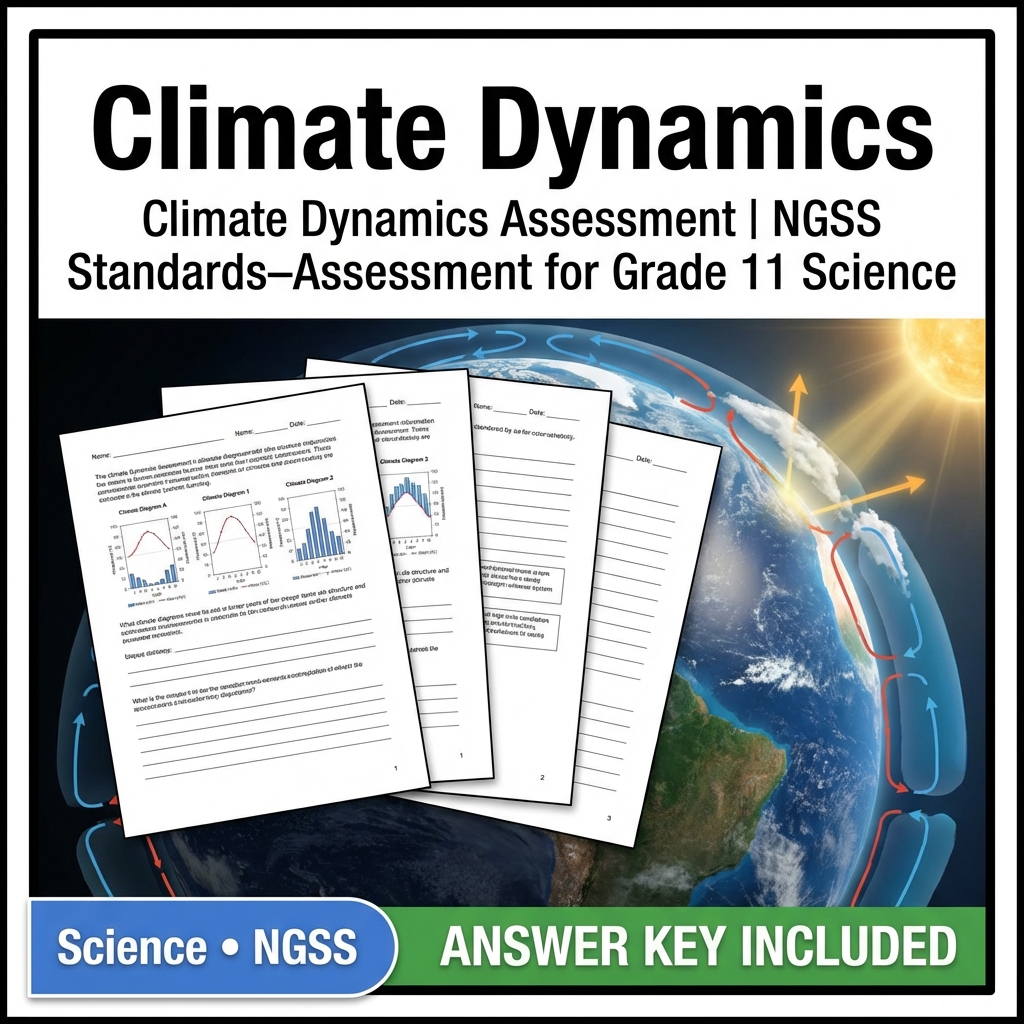
Climate Dynamics Assessment | NGSS Standards–Assessment for Grade 11 Science
Created byPrism Point LearningLearning Objectives
- Understand the components influencing climate variability, including atmospheric composition and large-scale circulation patterns.
- Analyze mechanisms such as greenhouse gas forcing, albedo feedbacks, and ocean-atmosphere interactions.
- Evaluate the evidence from instrumental records, satellite data, and paleoclimate proxies related to climate change.
Instant download
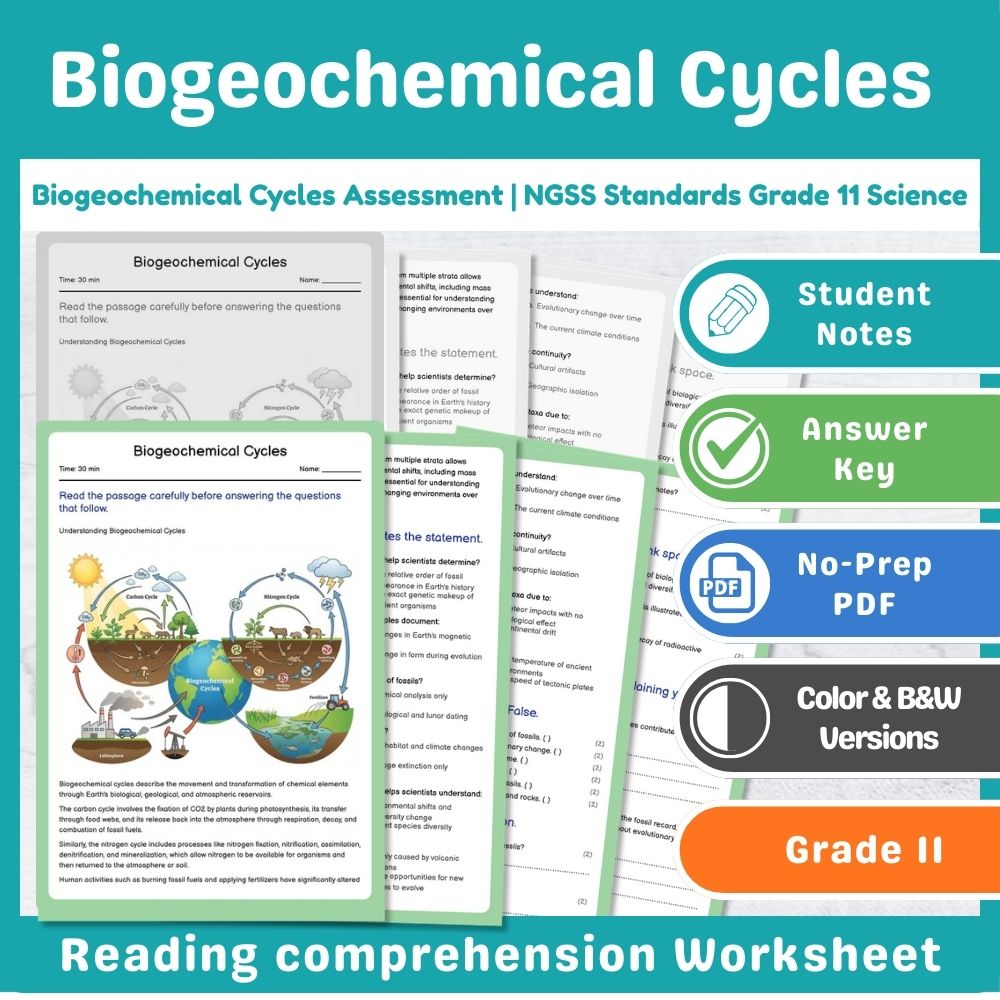
Biogeochemical Cycles Assessment | NGSS Standards Grade 11 Science
Created byPrism Point LearningLearning Objectives
- Understand the key processes involved in biogeochemical cycles such as carbon, nitrogen, phosphorus, and water.
- Identify the reservoirs and flow pathways of elements through biological, geological, and atmospheric systems.
- Explain human impacts like fossil fuel combustion and fertilizer use on nutrient pools and fluxes.
Also included in: Grade 11 Science Mini Bundle | Ecosystems Interactions & Energy NGSS
Instant download
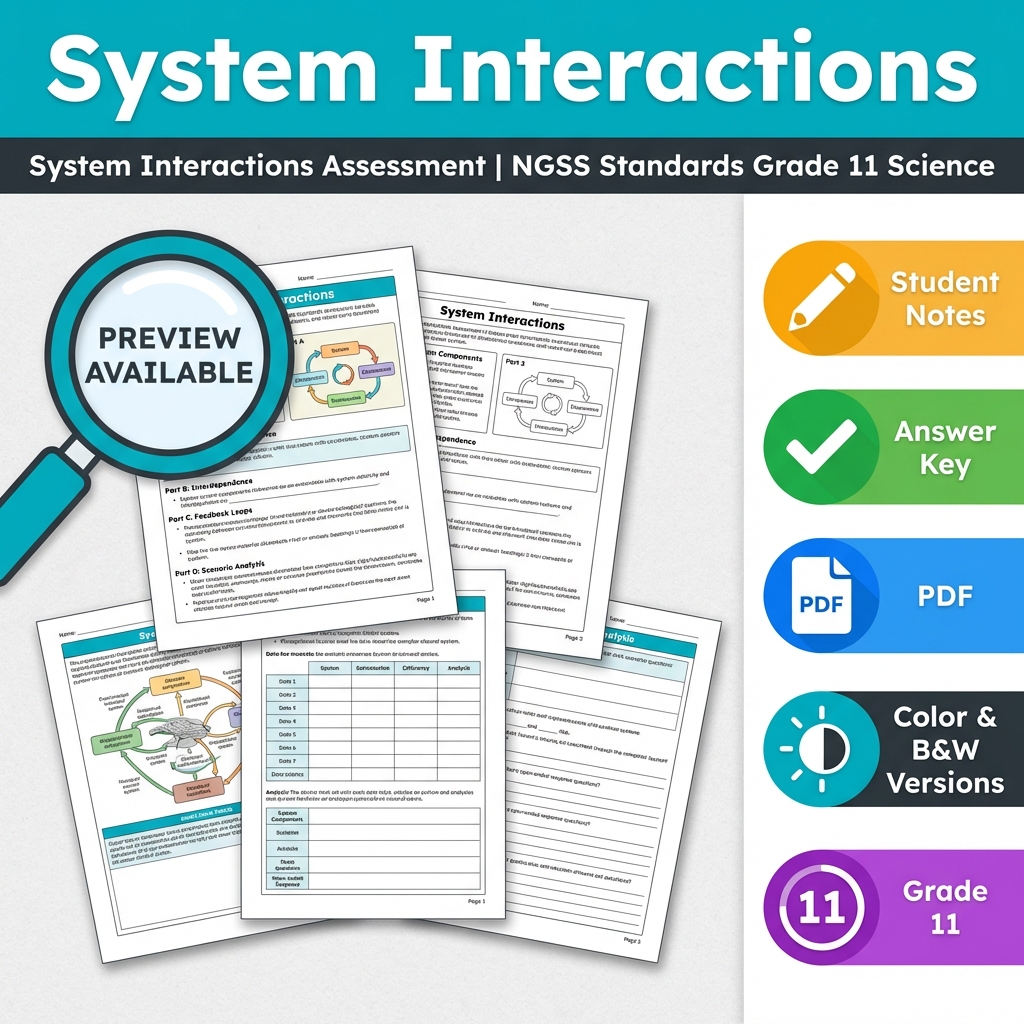
System Interactions Assessment | NGSS Standards Grade 11 Science
Created byPrism Point LearningLearning Objectives
- Understand Earth's major reservoirs and energy exchanges among atmosphere, hydrosphere, geosphere, and biosphere.
- Analyze the role of solar energy input and radiative balance in Earth's system.
- Describe mechanisms of heat transfer and feedbacks that influence system states over different timescales.
Instant download
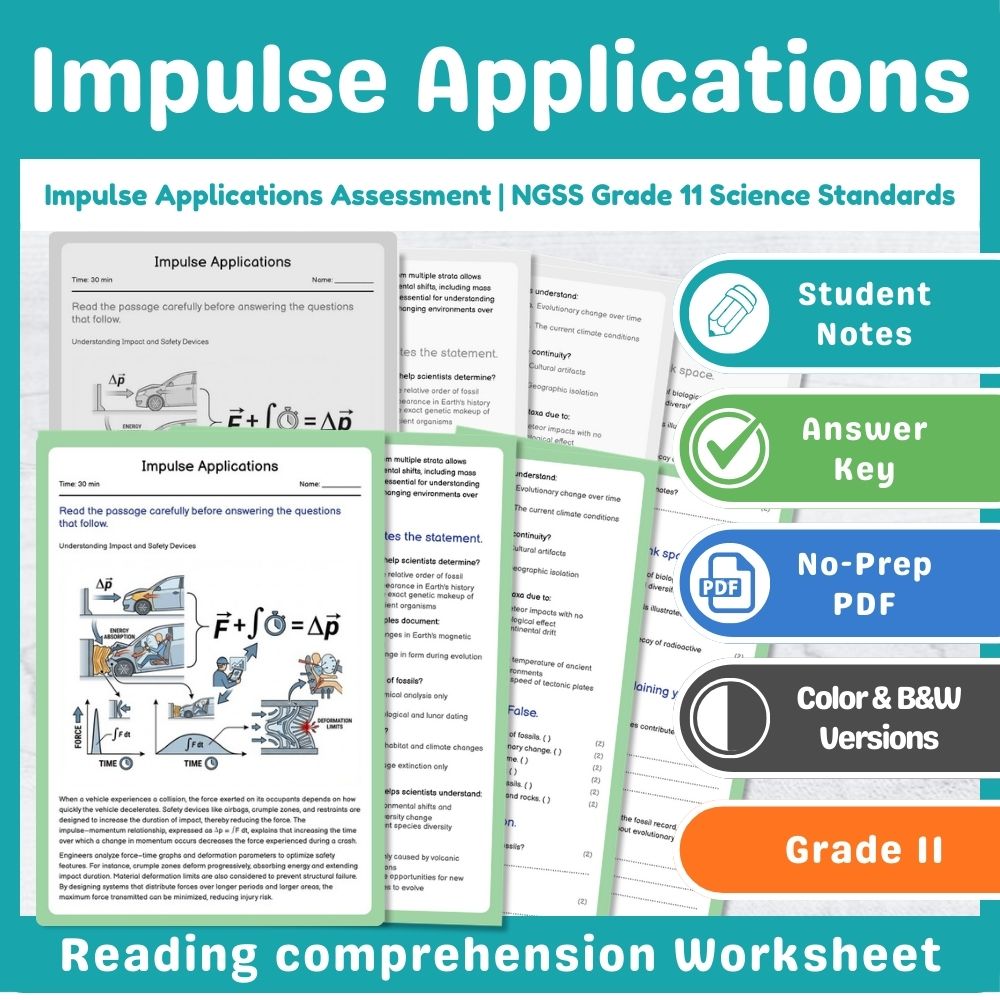
Impulse Applications Assessment | NGSS Grade 11 Science Standards
Created byPrism Point LearningLearning Objectives
- Understand the relationship between impulse and momentum in collision scenarios.
- Apply the impulse–momentum theorem to analyze crash-protection systems.
- Evaluate and refine design parameters to minimize forces during collisions.
Also included in: Grade 11 Physics Mini Bundle – Impulse, Forces & Conservation Assessment
Instant download
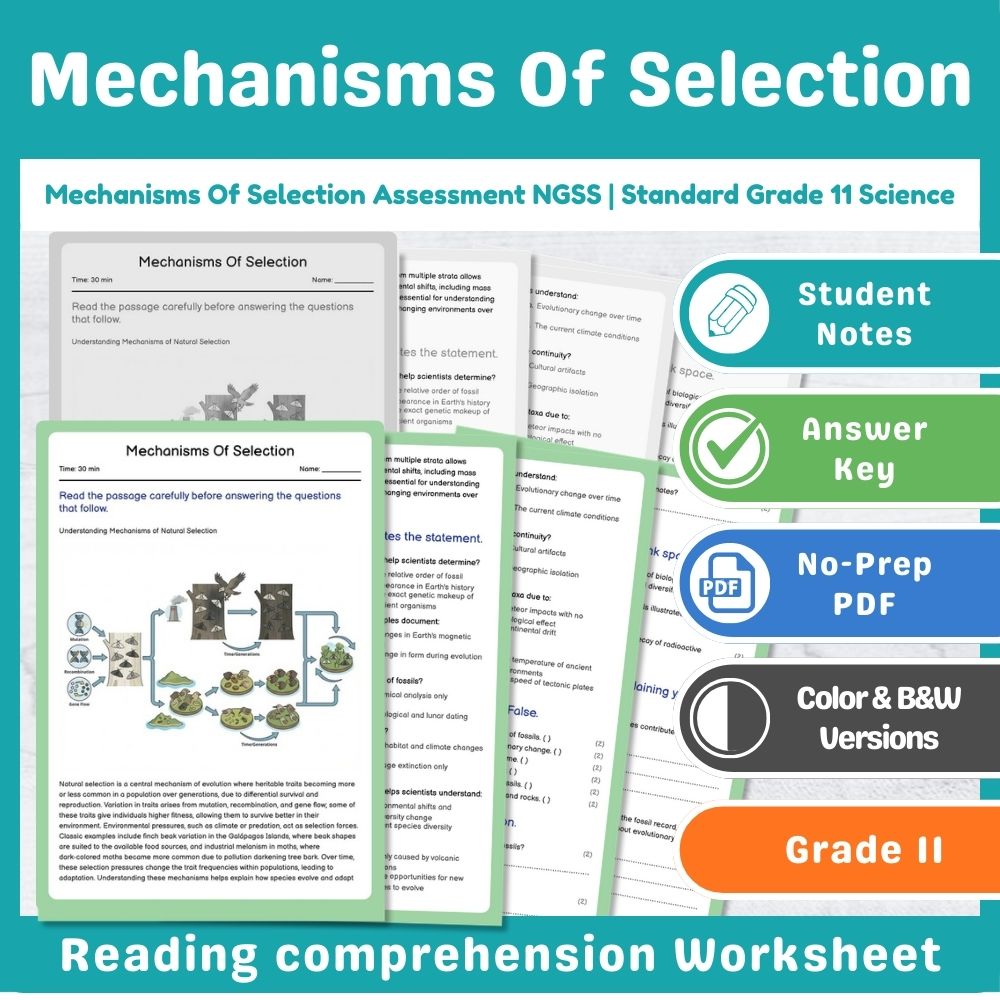
Mechanisms Of Selection Assessment NGSS | Standard Grade 11 Science
Created byPrism Point LearningLearning Objectives
- Explain the key concepts of natural selection, including heritable variation and differential survival.
- Analyze factors influencing selection pressure, such as mutation, recombination, and environment.
- Use examples like finch beak variation and industrial melanism to illustrate evolutionary mechanisms.
Instant download

Producers & Energy Assessment | Alberta Standards Grade 8 Science
Created byPrism Point LearningLearning Objectives
- Explain the role of primary producers in ecological energy pathways.
- Compare photosynthetic efficiency among grasses, shrubs, and boreal trees in Alberta.
- Identify factors influencing primary productivity such as soil nutrients and light.
Also included in: Grade 8 Science Mini Bundle | Interactions and Ecosystems Curriculum
Instant download

Ecosystem Matter Cycling Assessment | Standards-Aligned Grade 8 Science
Created byPrism Point LearningLearning Objectives
- Understand how matter cycles through ecosystems involving living and nonliving components.
- Identify processes such as decomposition, gas exchange, and nutrient transformation that return elements to the environment.
- Explain how producers and consumers transfer matter within ecosystems over time.
Also included in: Grade 8 Life Science Science Lesson Bundle – General Framework Resources
Instant download

Energy Flow in Ecosystems Assessment | General Grade 8 Science
Created byPrism Point LearningLearning Objectives
- Explain how energy flows through trophic levels in an ecosystem.
- Identify the roles of producers, consumers, and decomposers in energy transfer.
- Describe why energy decreases as it moves along a food chain.
Also included in: Grade 8 Life Science Science Lesson Bundle – General Framework Resources
Instant download

Particles Meet Energy Assessment | General Grade 8 Science
Created byPrism Point LearningLearning Objectives
- Explain how particle interactions relate to energy changes during reactions.
- Identify observable changes indicating particle rearrangements and energy shifts.
- Connect temperature changes to energy transfer in chemical reactions.
Also included in: Grade 8 Physical Science Science Lesson Bundle – General Framework
Instant download

Transport Systems Assessment | BC Standards Grade 8 Science
Created byPrism Point LearningLearning Objectives
- Understand the structure and function of vascular networks and circulatory systems in animals.
- Identify key structural features like vessels, valves, and capillary beds that enable directional flow.
- Explain the roles of cellular components such as blood cells, xylem, and phloem in transport.
Instant download

Organ Systems Assessment | BC Standards Grade 8 Science
Created byPrism Point LearningLearning Objectives
- Describe the structure and function of major human organ systems.
- Explain how organs coordinate within systems to maintain internal stability.
- Identify key features that enable cellular specialization to support organ functions.
Instant download
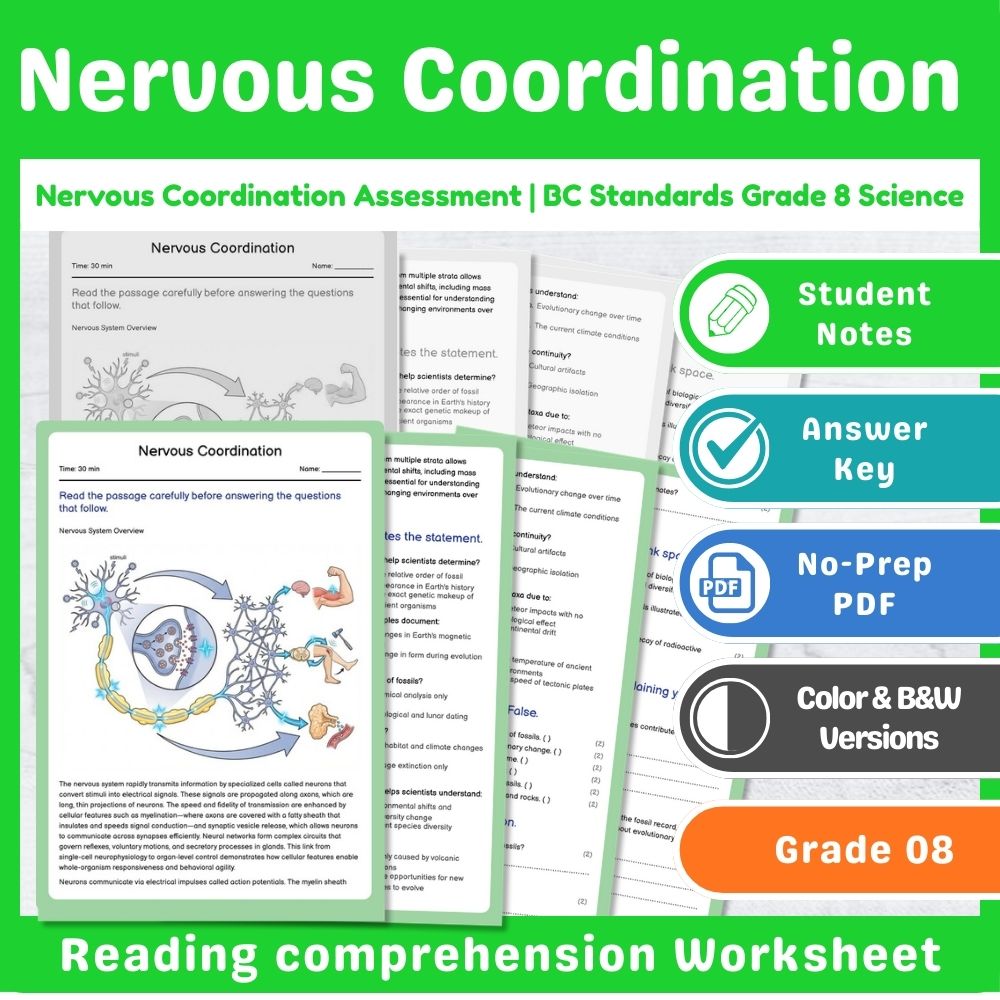
Nervous Coordination Assessment | BC Standards Grade 8 Science
Created byPrism Point LearningLearning Objectives
- Understand how neurons transmit electrical signals for nervous communication.
- Identify cellular features that enhance the speed and fidelity of nerve signaling.
- Explain the neural circuits involved in reflexes, voluntary movements, and gland secretion.
Instant download

Immune Defense Assessment for Grade 8 Science | BC Standards
Created byPrism Point LearningLearning Objectives
- Describe the components and functions of the innate and adaptive immune systems.
- Identify the roles of different immune cells such as phagocytes, lymphocytes, and antigen-presenting cells.
- Explain how tissues and organs coordinate immune responses to maintain internal balance during infection.
Instant download

Muscle Contraction Assessment | BC Standards Grade 8 Science Worksheet
Created byPrism Point LearningLearning Objectives
- Explain how actin and myosin filaments interact during muscle contraction.
- Describe the role of ATP and calcium in muscle contraction regulation.
- Identify how sarcomere organization influences contraction strength and speed.
Instant download
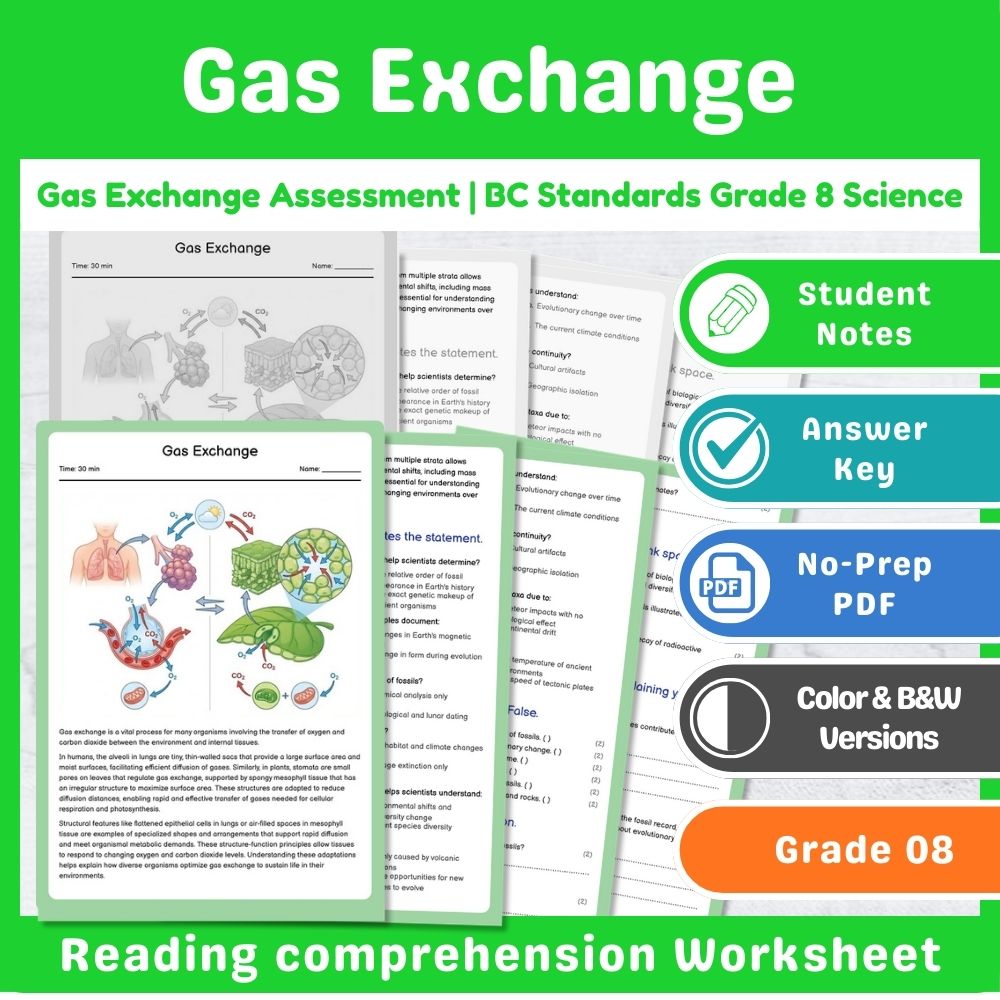
Gas Exchange Assessment | BC Standards Grade 8 Science
Created byPrism Point LearningLearning Objectives
- Understand how thin, moist surfaces facilitate gas exchange in organisms.
- Identify different structures involved in gas exchange, such as alveoli and stomata.
- Explain structural adaptations that support efficient diffusion of gases.
Instant download
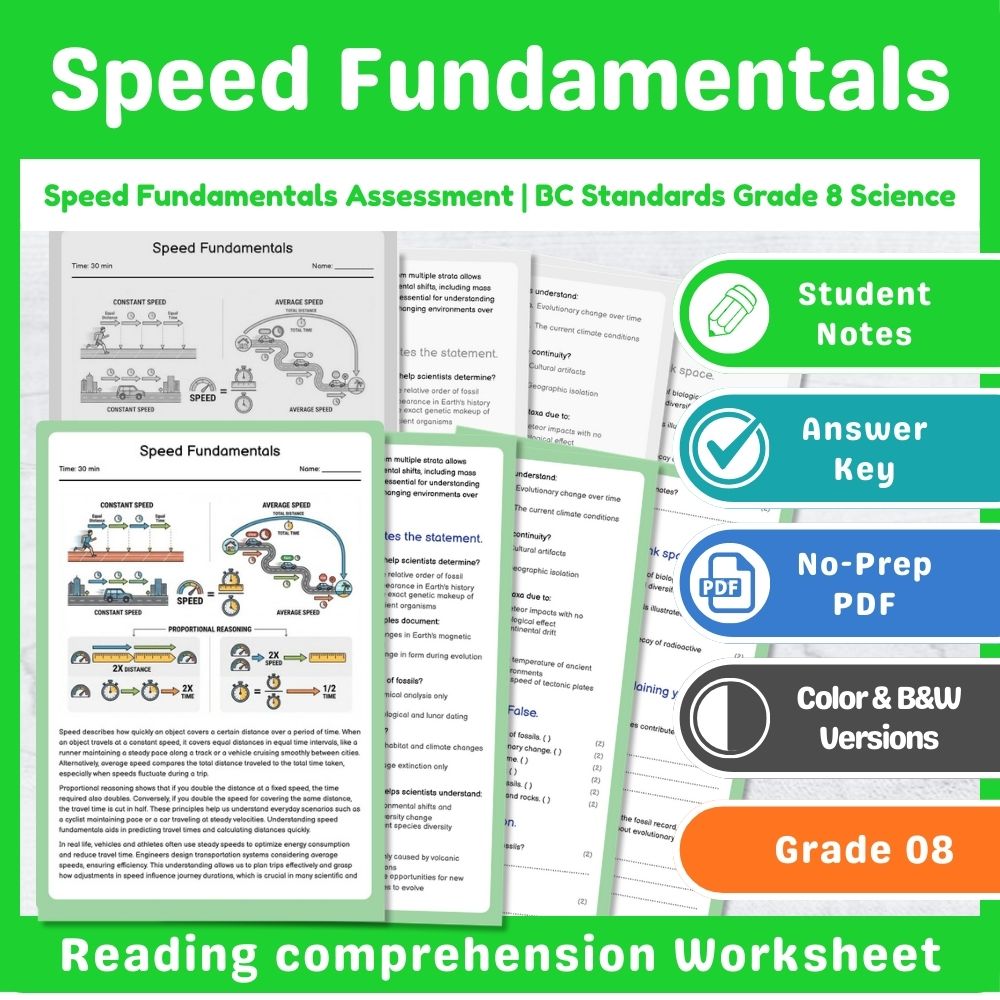
Speed Fundamentals Assessment | BC Standards Grade 8 Science
Created byPrism Point LearningLearning Objectives
- Define speed as the ratio of distance over time.
- Differentiate between constant and average speed.
- Apply proportional reasoning to solve speed, distance, and time problems.
Instant download

Pendulum Energy Assessment | BC Standards Grade 8 Science
Created byPrism Point LearningLearning Objectives
- Explain how a pendulum demonstrates energy transformation between potential and kinetic energy.
- Identify factors that influence the period of a pendulum.
- Describe how energy dissipation occurs due to air resistance and friction.
Instant download

Friction and Drag Assessment for Grade 8 Science | BC Standards
Created byPrism Point LearningLearning Objectives
- Explain the concepts of friction and fluid drag as resistive forces.
- Identify factors that affect the magnitude of friction and drag.
- Describe how resistive forces influence acceleration and motion.
Instant download
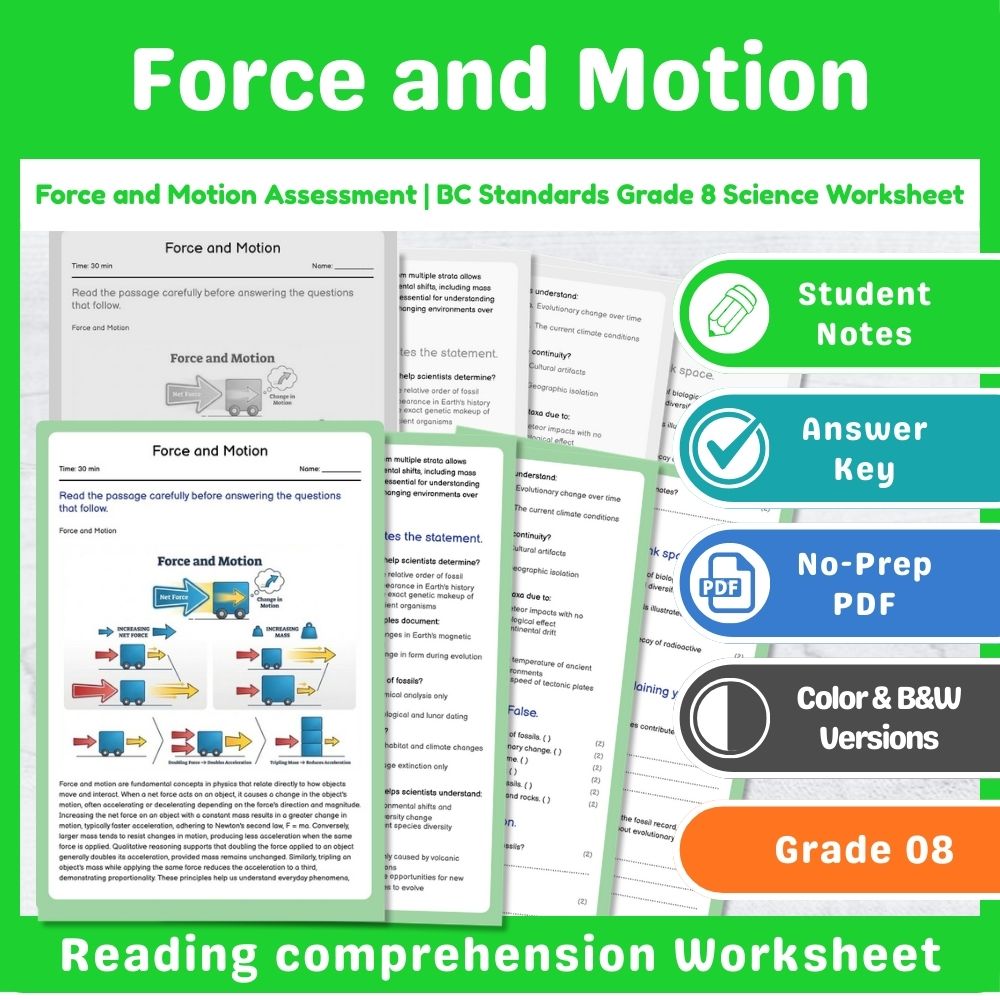
Force and Motion Assessment | BC Standards Grade 8 Science Worksheet
Created byPrism Point LearningLearning Objectives
- Understand the relationship between net force, mass, and acceleration.
- Explain qualitatively how increasing net force affects motion.
- Describe the effect of increased mass on acceleration under the same force.
Instant download
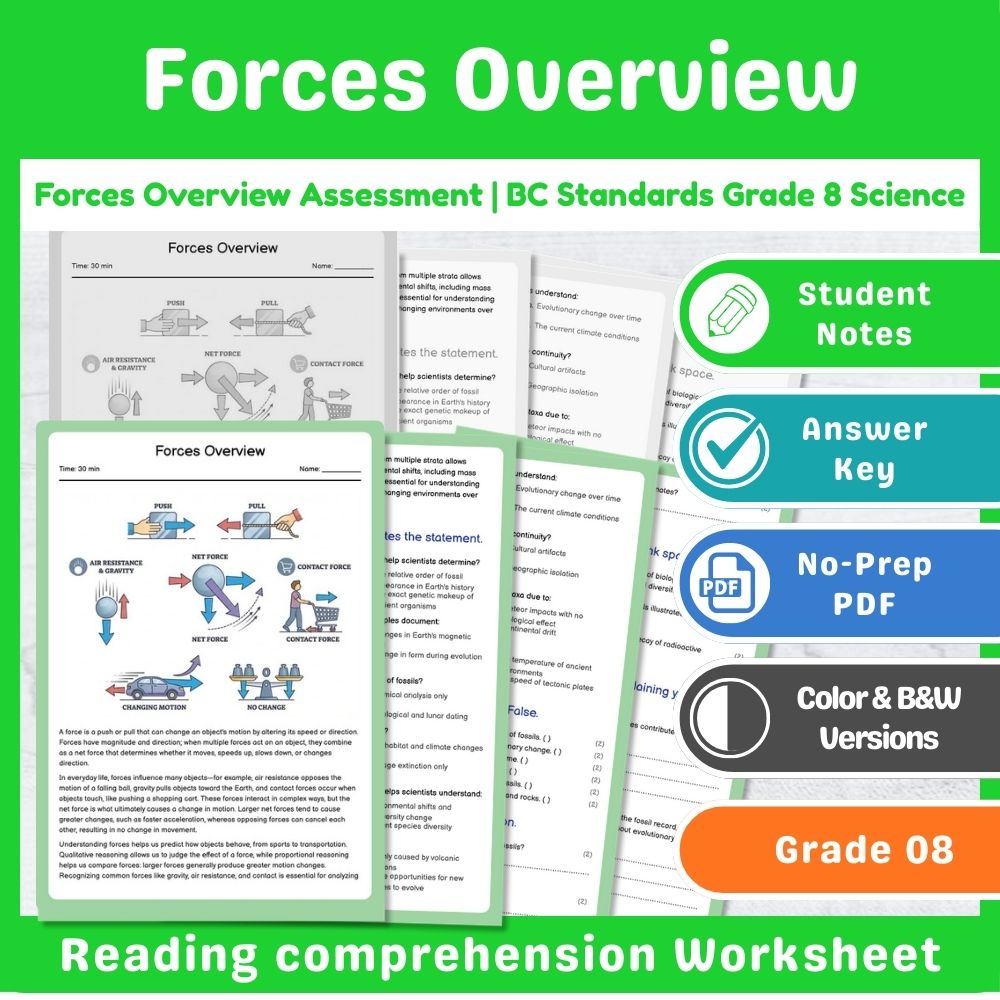
Forces Overview Assessment | BC Standards Grade 8 Science
Created byPrism Point LearningLearning Objectives
- Define what a force is and identify different types of forces
- Explain how net force affects an object's motion
- Describe everyday forces like gravity and air resistance
Instant download

Energy Basics Assessment | BC Standards Grade 8 Science
Created byPrism Point LearningLearning Objectives
- Understand the forms of mechanical energy, including kinetic and potential energy.
- Explain how energy transfers occur through work and force interactions.
- Describe how friction and air resistance transform mechanical energy into thermal energy.
Instant download

Distance-Time Graphs Assessment | BC Grade 8 Science Standards
Created byPrism Point LearningLearning Objectives
- Understand how to interpret distance-time graphs and what the slope indicates about speed.
- Calculate average speed between two points on a distance-time graph.
- Identify segments of graphs representing constant, increasing, or decreasing speed.
Instant download
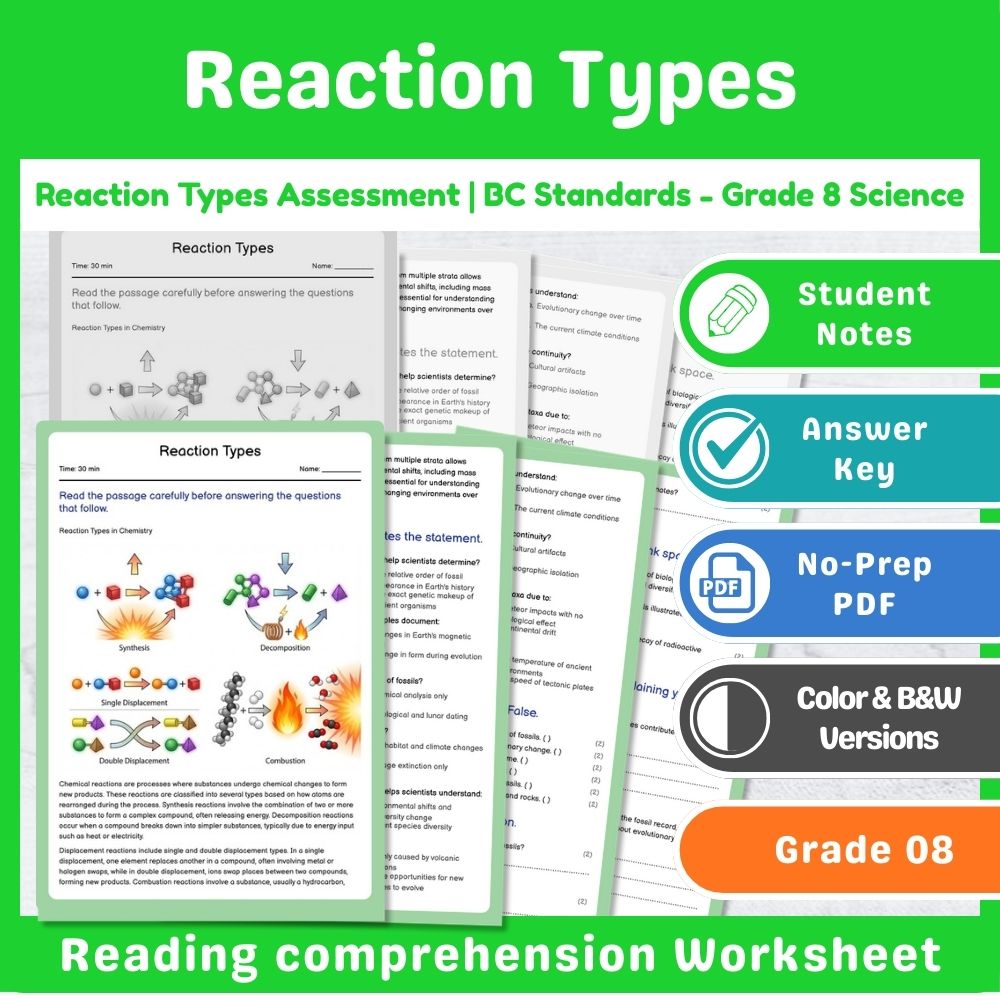
Reaction Types Assessment | BC Standards - Grade 8 Science
Created byPrism Point LearningLearning Objectives
- Identify the various types of chemical reactions and their characteristic patterns.
- Explain how atoms rearrange during synthesis, decomposition, displacement, and combustion reactions.
- Predict possible products based on reaction type.
Also included in: Grade 8 Science Lesson – Reaction Types & Evidence Assessment Bundle
Instant download
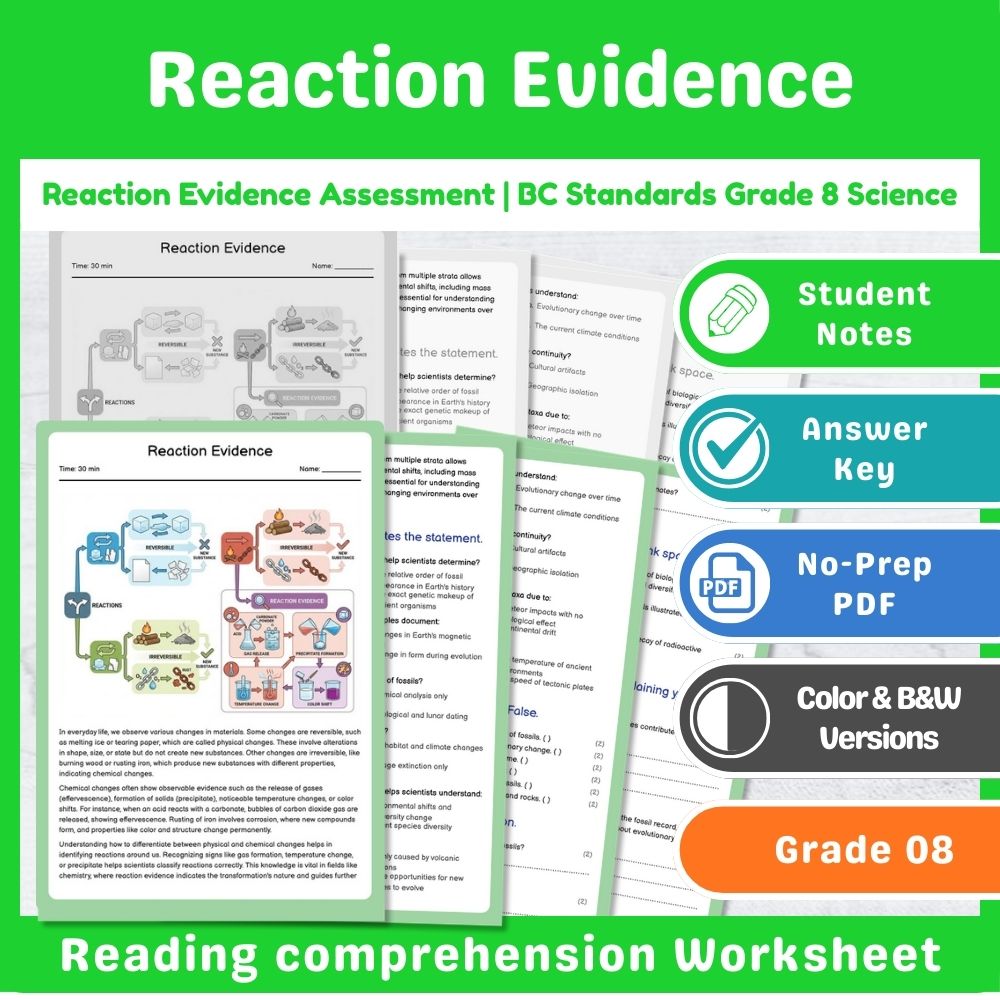
Reaction Evidence Assessment | BC Standards Grade 8 Science
Created byPrism Point LearningLearning Objectives
- Distinguish between physical and chemical changes using observable evidence.
- Identify examples of physical and chemical transformations based on reaction evidence.
- Understand how properties such as gas formation, precipitate, temperature change, and color shift indicate chemical or physical changes.
Also included in: Grade 8 Science Lesson – Reaction Types & Evidence Assessment Bundle
Instant download

Particle Representations Assessment | BC Standards Grade 8 Science
Created byPrism Point LearningLearning Objectives
- Understand how particle-level diagrams illustrate atoms and molecules during reactions.
- Interpret particle diagrams to analyze how atoms are rearranged without changing their identity or count.
- Translate macroscopic observations into atomic explanations using particle models.
Also included in: Grade 8 Science Lesson – Reaction Types & Evidence Assessment Bundle
Instant download

Factors Influencing Reaction Rate Assessment for Grade 8 Science – BC
Created byPrism Point LearningLearning Objectives
- Identify key factors that affect the rate of chemical reactions.
- Explain how temperature, concentration, surface area, and catalysts influence particle collisions.
- Relate microscopic collision dynamics to macroscopic reaction speed.
Also included in: Grade 8 Science Lesson – Reaction Types & Evidence Assessment Bundle
Instant download

Observational Clues Assessment | BC Standards + Grade 8 Science
Created byPrism Point LearningLearning Objectives
- Identify observable indicators of physical and chemical changes.
- Differentiate between physical and chemical changes based on clues.
- Understand properties that change during chemical reactions.
Also included in: Grade 8 Science Lesson – Reaction Types & Evidence Assessment Bundle
Instant download
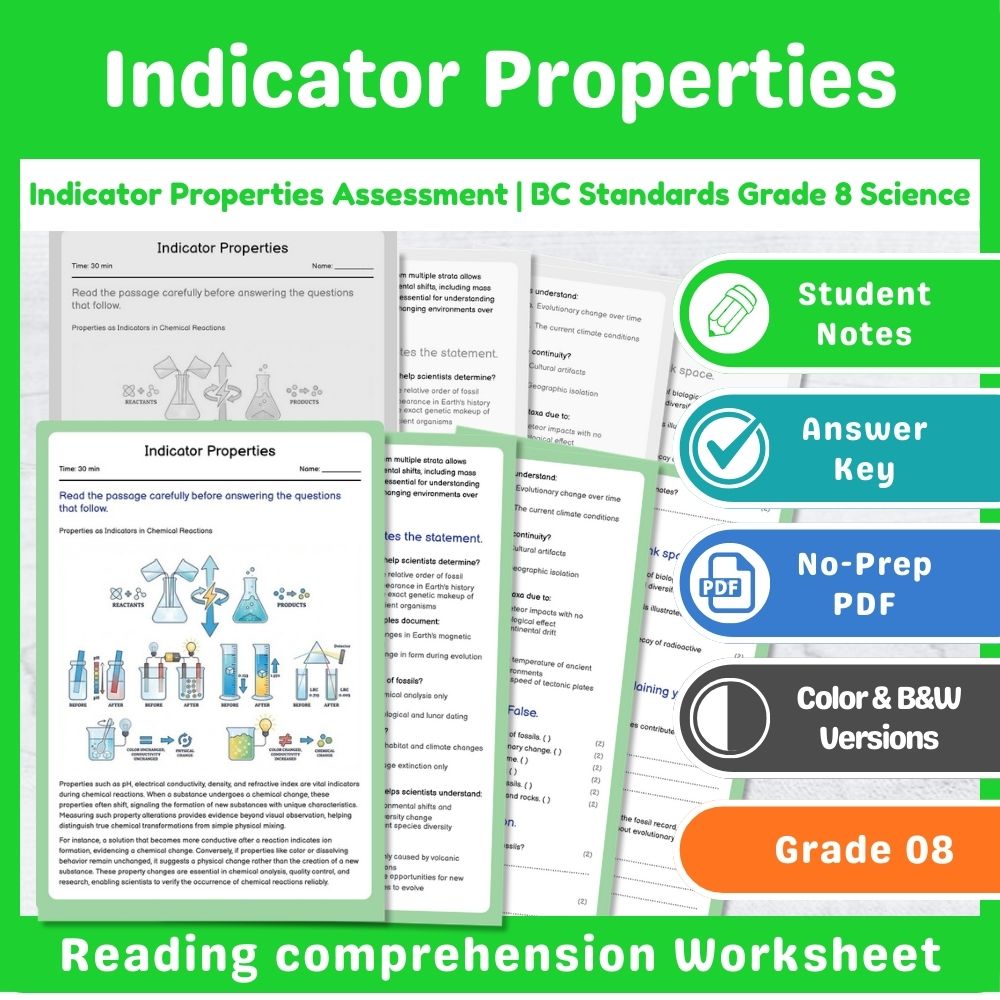
Indicator Properties Assessment | BC Standards Grade 8 Science
Created byPrism Point LearningLearning Objectives
- Understand how properties such as pH, conductivity, density, and refractive index change during chemical reactions.
- Identify property shifts indicating formation of new substances with distinct traits.
- Differentiate between physical and chemical changes using property measurements.
Also included in: Grade 8 Science Lesson – Reaction Types & Evidence Assessment Bundle
Instant download
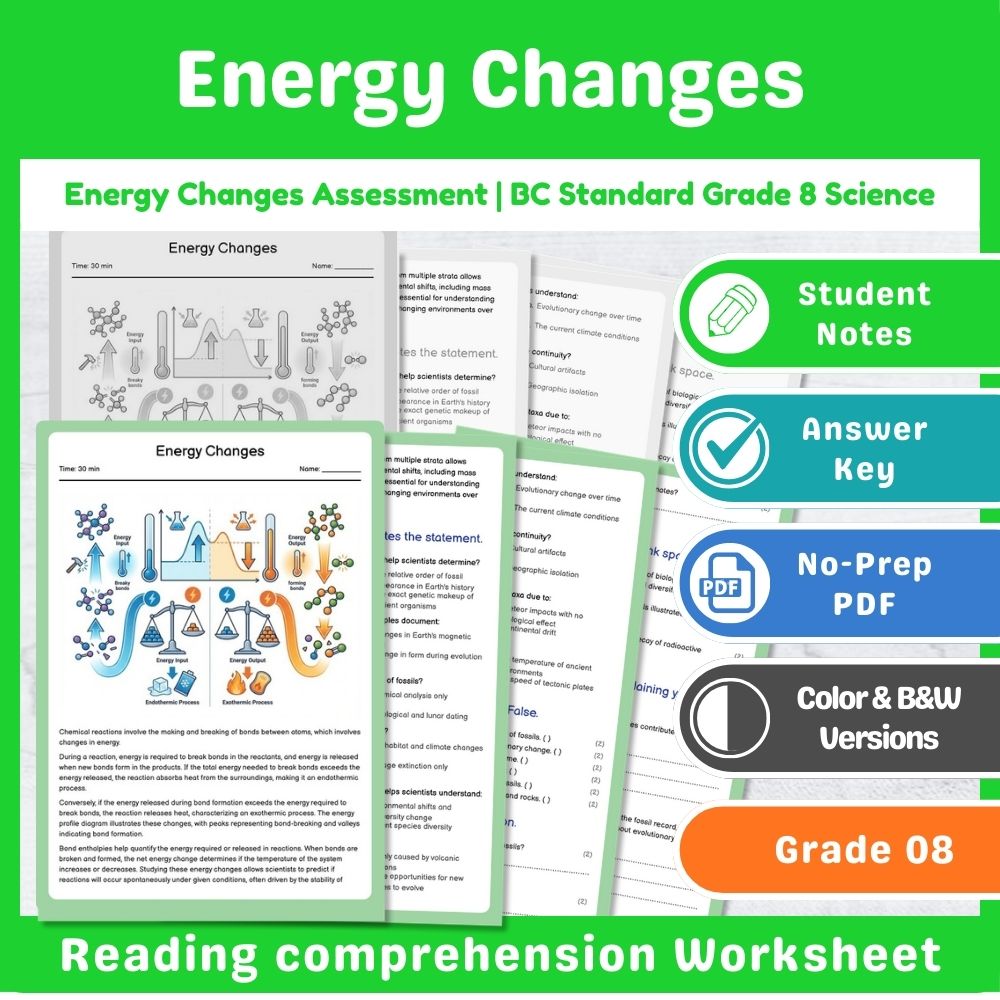
Energy Changes Assessment | BC Standard Grade 8 Science
Created byPrism Point LearningLearning Objectives
- Understand how chemical bonds involve energy changes during reactions.
- Differentiate between endothermic and exothermic reactions based on energy transfer.
- Interpret energy profiles and bond enthalpy diagrams to explain temperature changes.
Also included in: Grade 8 Science Lesson – Reaction Types & Evidence Assessment Bundle
Instant download
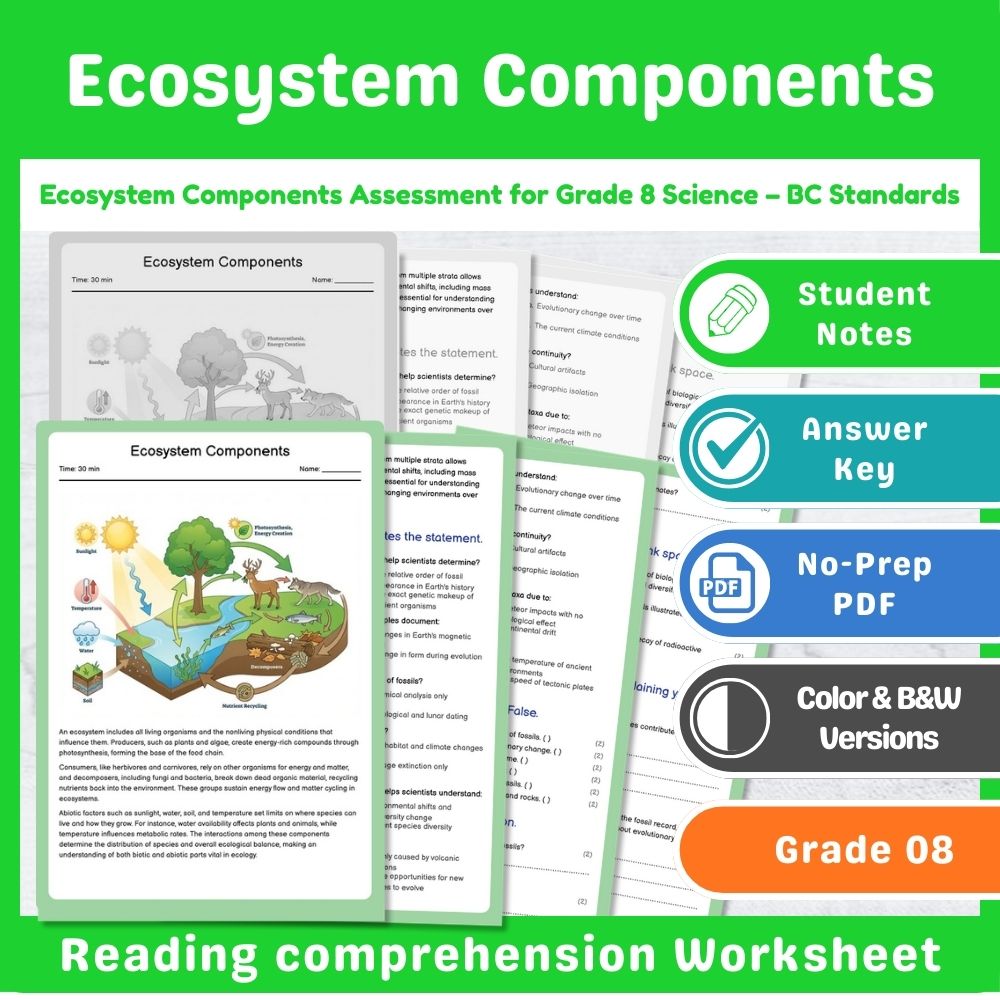
Ecosystem Components Assessment for Grade 8 Science – BC Standards
Created byPrism Point LearningLearning Objectives
- Identify the key parts of an ecosystem, including both living and nonliving elements.
- Explain the roles of producers, consumers, and decomposers in energy cycling.
- Describe how abiotic factors such as sunlight, water, soil, and temperature influence ecosystems.
Instant download
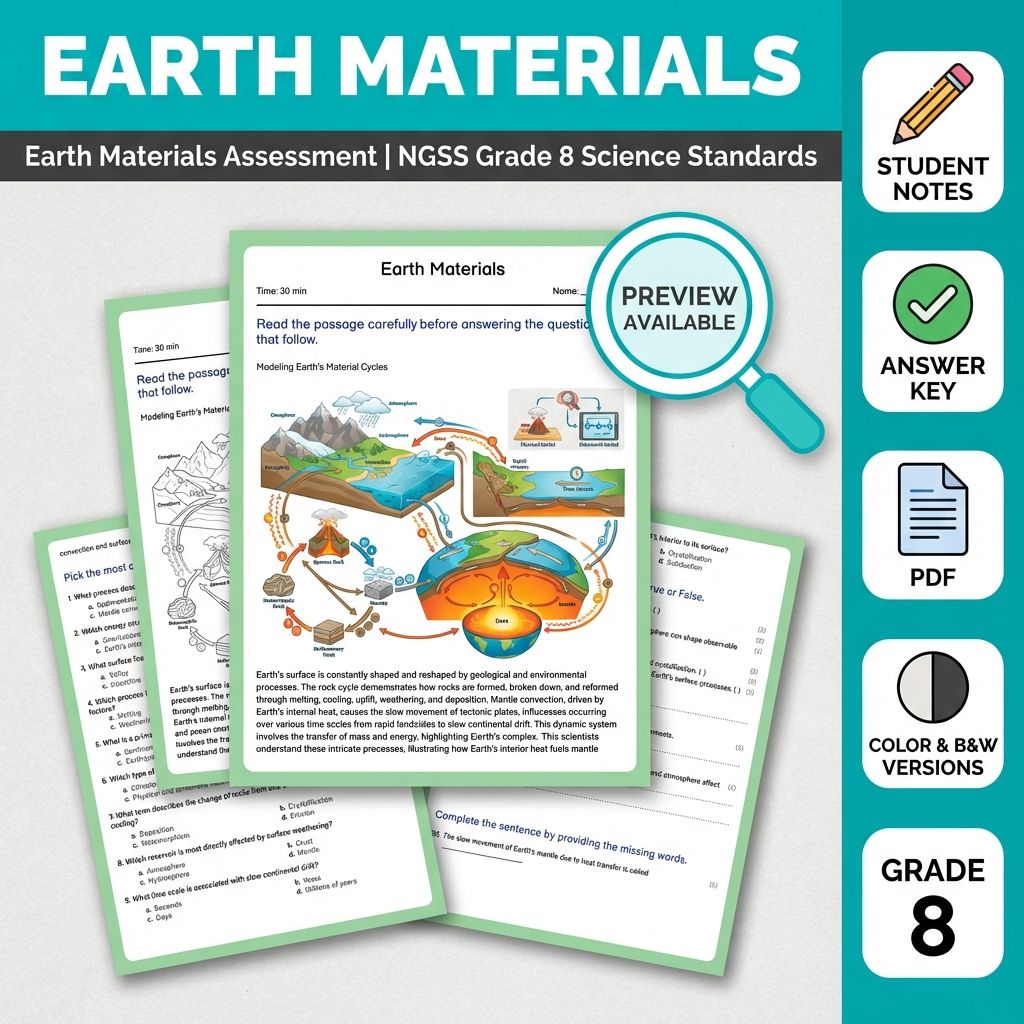
Earth Materials Assessment | NGSS Grade 8 Science Standards
Created byPrism Point LearningLearning Objectives
- Describe the processes involved in Earth's material cycles, including melting, crystallization, uplift, weathering, transport, and deposition.
- Explain the energy sources driving Earth's geosphere, such as internal heat and gravitational potential.
- Model the interactions between Earth's geosphere, hydrosphere, and atmosphere in surface processes and material flow.
Also included in: Grade 8 Science Mini Bundle – Earth's Systems & NGSS Standards-Aligned +1 more
Instant download
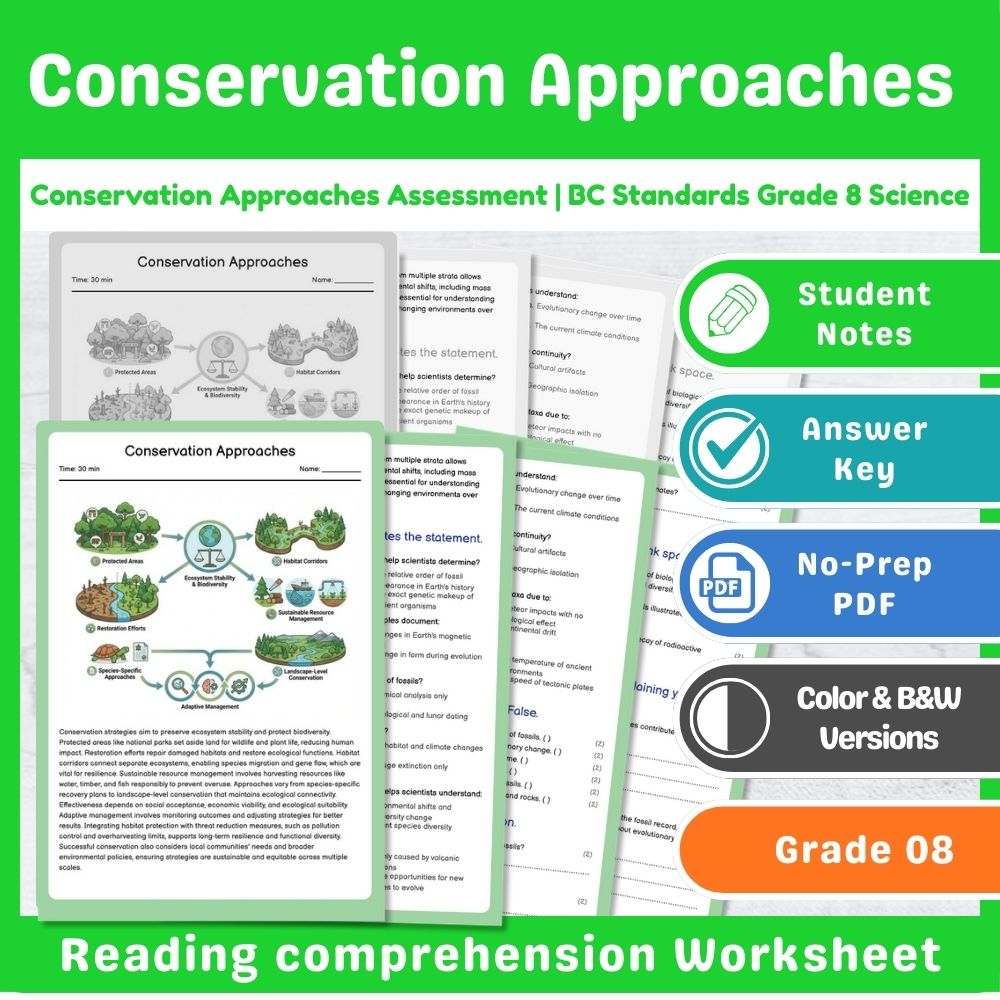
Conservation Approaches Assessment | BC Standards Grade 8 Science
Created byPrism Point LearningLearning Objectives
- Understand various conservation strategies such as protected areas, habitat corridors, and sustainable resource management.
- Identify factors that influence the effectiveness of conservation efforts.
- Explain the role of social, economic, and ecological contexts in conservation planning.
Instant download
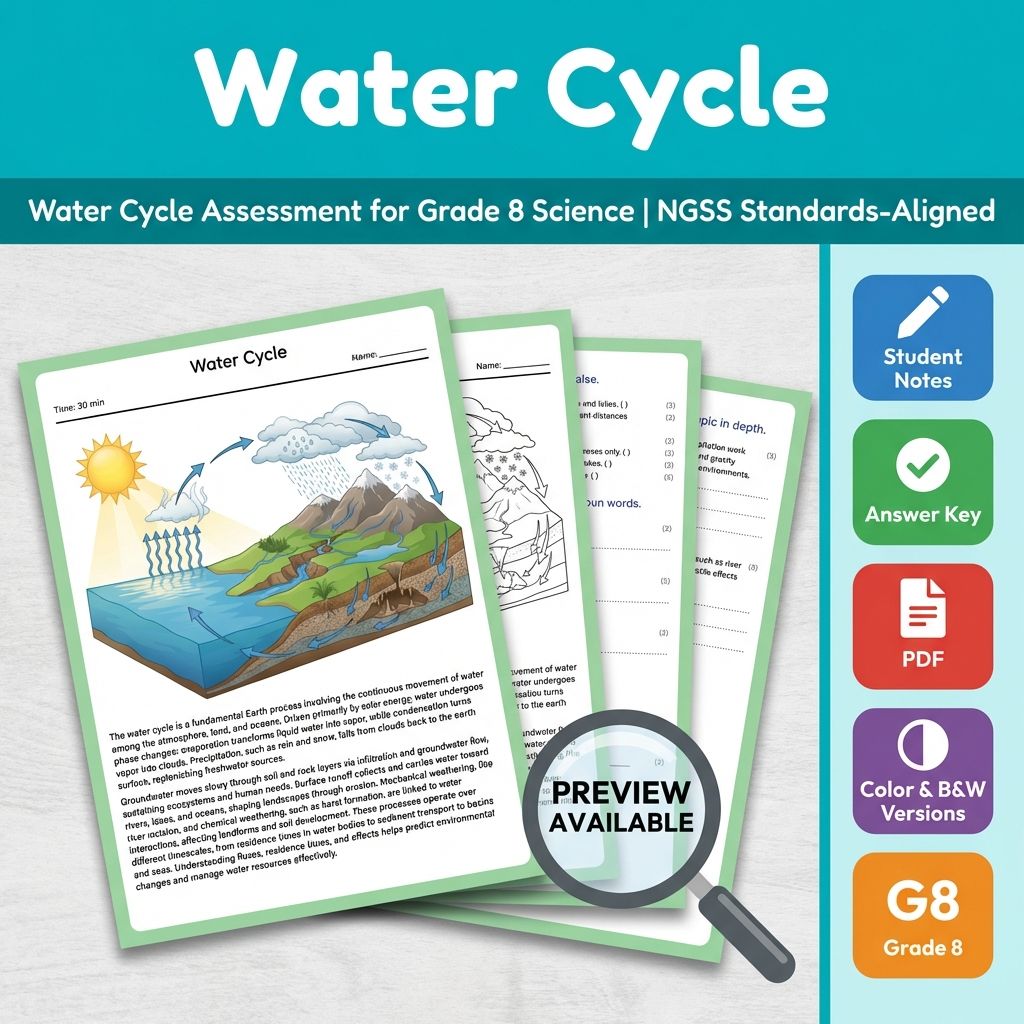
Water Cycle Assessment for Grade 8 Science | NGSS Standards-Aligned
Created byPrism Point LearningLearning Objectives
- Describe the processes involved in the global and local water cycle, including phase changes, evaporation, condensation, and precipitation.
- Explain the roles of sunlight and gravity in driving hydrologic processes such as infiltration, runoff, and groundwater flow.
- Connect processes of the water cycle to mechanical and chemical weathering phenomena like river incision, karst formation, and coastal erosion.
Also included in: Grade 8 Science Mini Bundle – Earth's Systems & NGSS Standards-Aligned +1 more
Instant download
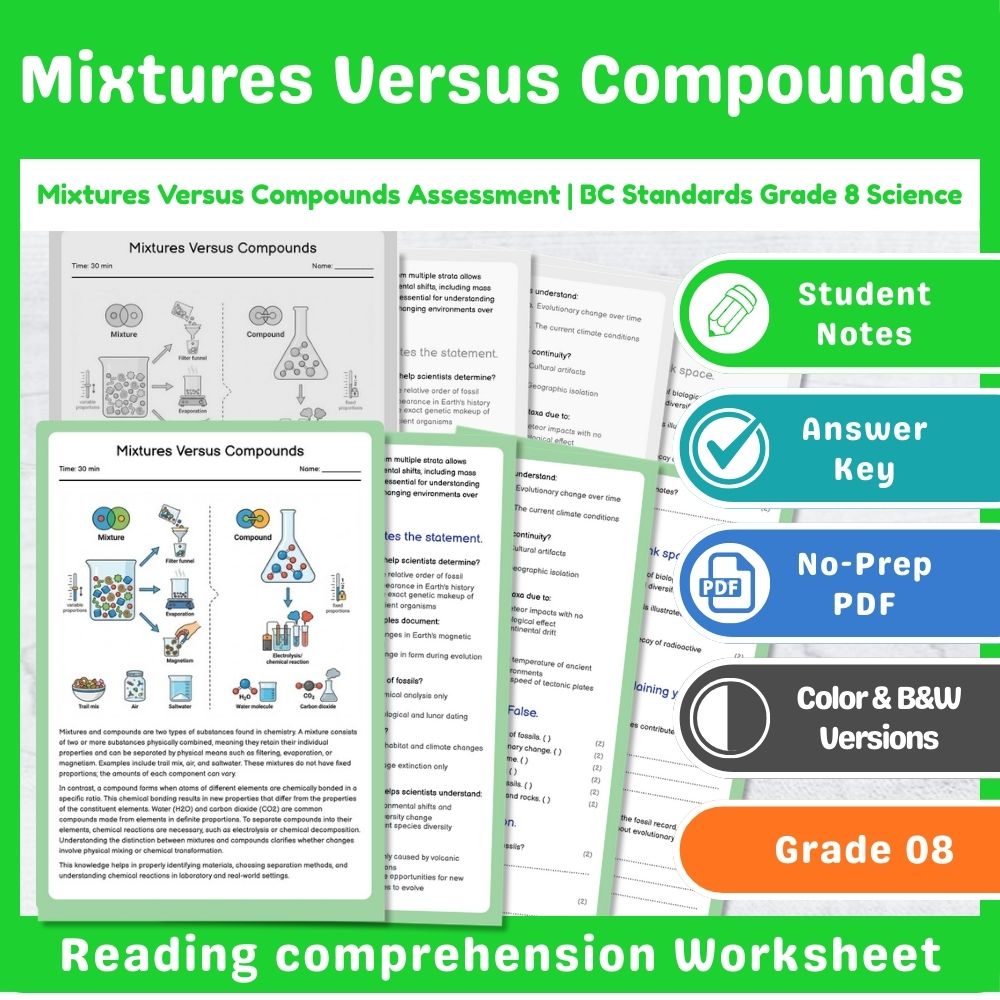
Mixtures Versus Compounds Assessment | BC Standards Grade 8 Science
Created byPrism Point LearningLearning Objectives
- Understand the differences between mixtures and compounds.
- Identify examples of mixtures and compounds in everyday life.
- Explain how mixtures can be separated physically and compounds require chemical change.
Also included in: Grade 8 Science Lesson – Reaction Types & Evidence Assessment Bundle
Instant download
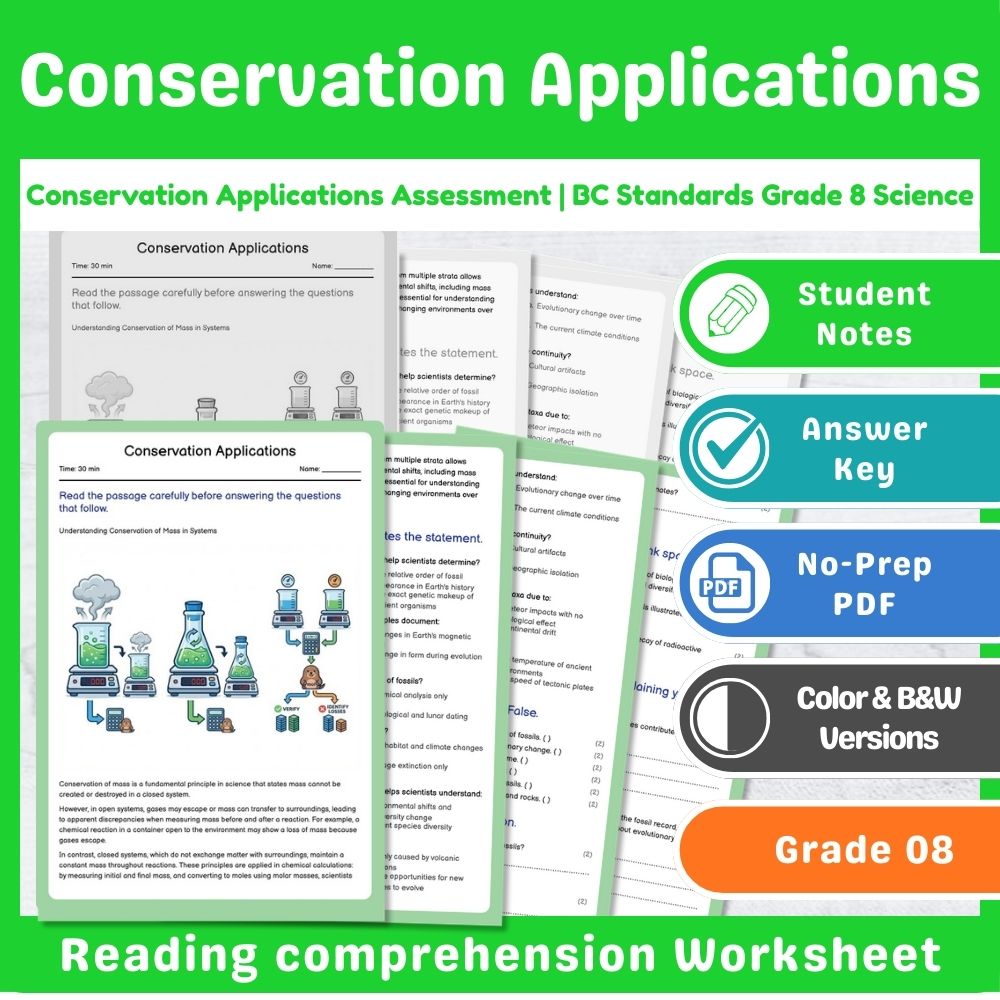
Conservation Principle Assessment | BC Standards Grade 8 Science
Created byPrism Point LearningLearning Objectives
- Understand the law of conservation of mass and its implications in chemical reactions.
- Explain how balanced chemical equations reflect mass conservation.
- Link mass measurements with mole concepts for predicting reaction outcomes.
Also included in: Grade 8 Science Lesson – Reaction Types & Evidence Assessment Bundle
Instant download
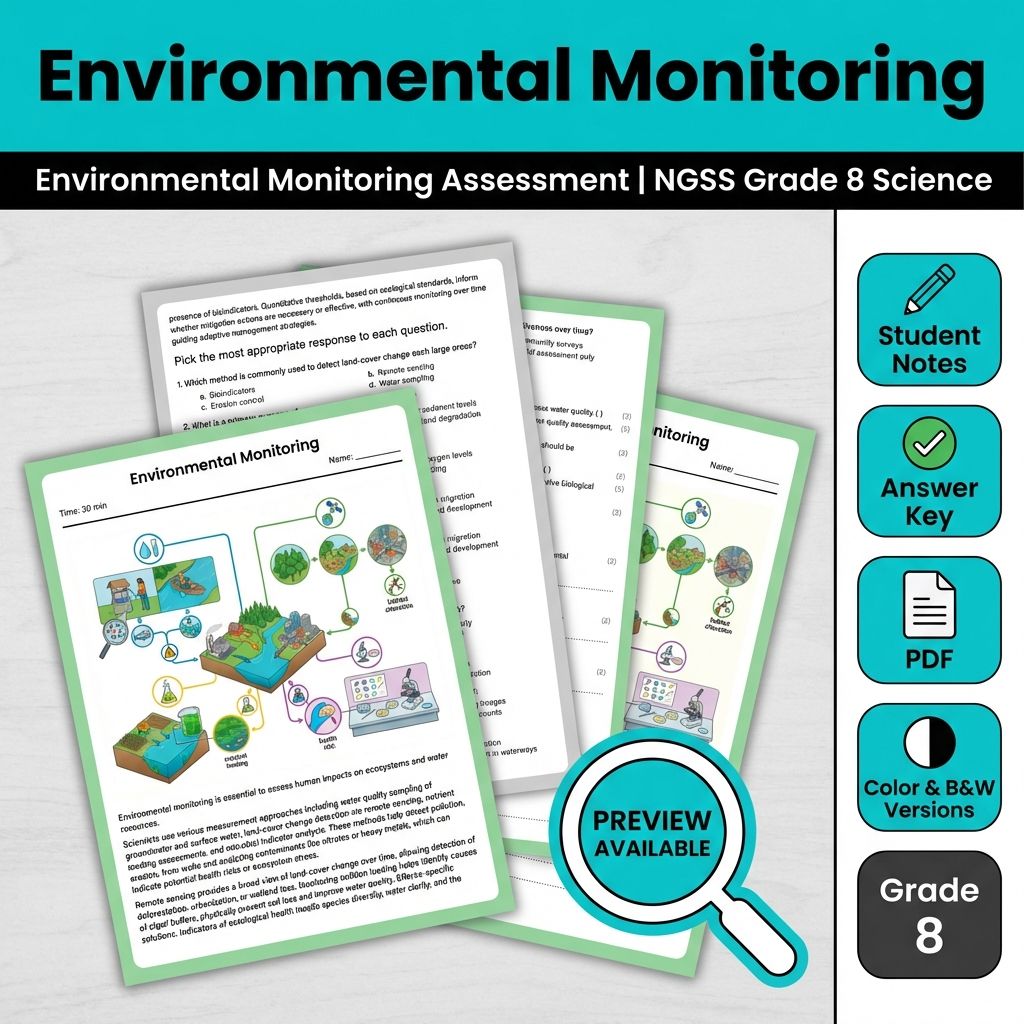
Environmental Monitoring Assessment | NGSS Grade 8 Science
Created byPrism Point LearningLearning Objectives
- Understand scientific principles used in monitoring ecosystems and water resources.
- Identify measurement approaches and indicators of ecological health.
- Evaluate mitigation options and intervention effectiveness over time.
Also included in: Lesson Grade 8 Science Mini Bundle – Earth & Human Activity Standards-Aligned +1 more
Instant download
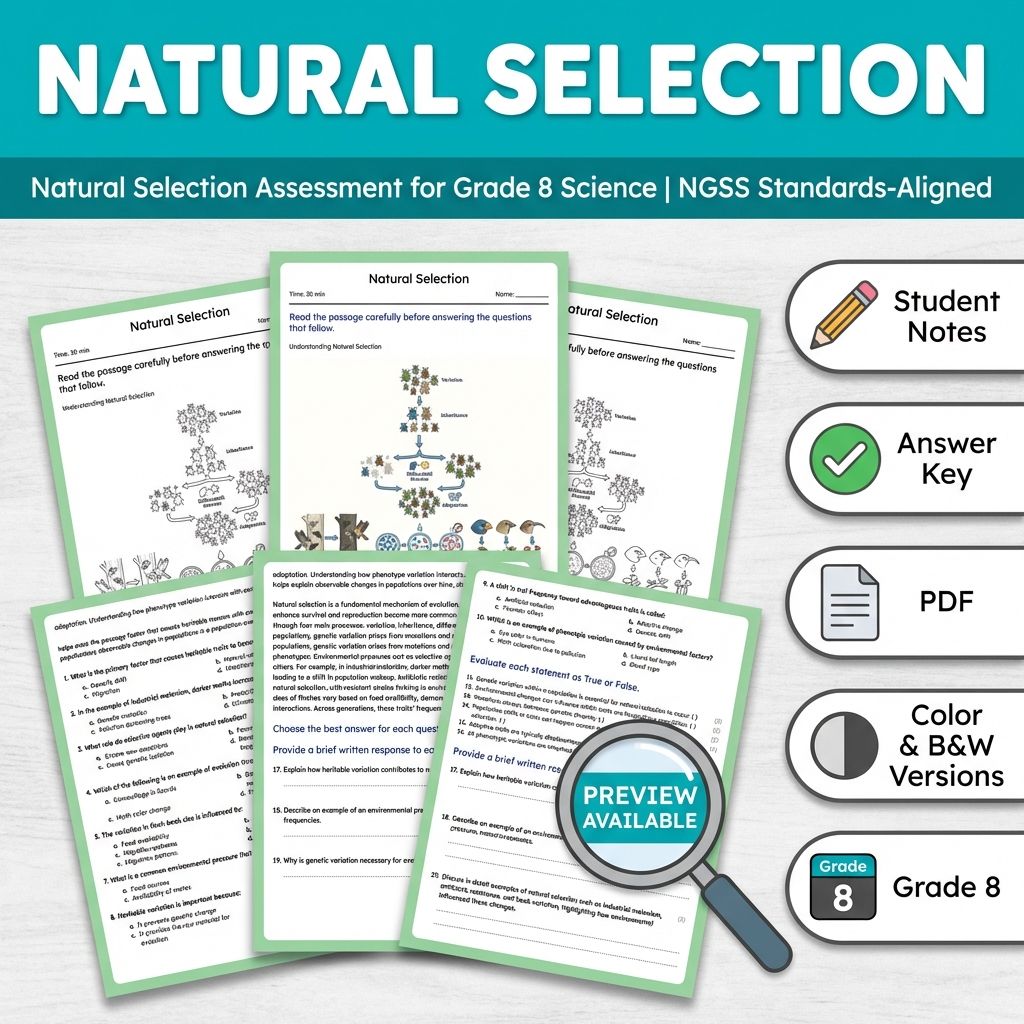
Natural Selection Assessment for Grade 8 Science | NGSS Standards-Aligned
Created byPrism Point LearningLearning Objectives
- Understand the mechanisms of variation and natural selection that drive adaptive change in populations.
- Identify examples of natural selection such as industrial melanism, antibiotic resistance, and beak variation.
- Link phenotypic variation and environmental factors to changes in trait frequencies over generations.
Also included in: Grade 8 Science Mini Bundle | Biological Evolution & Diversity Standards-Aligned +1 more
Instant download
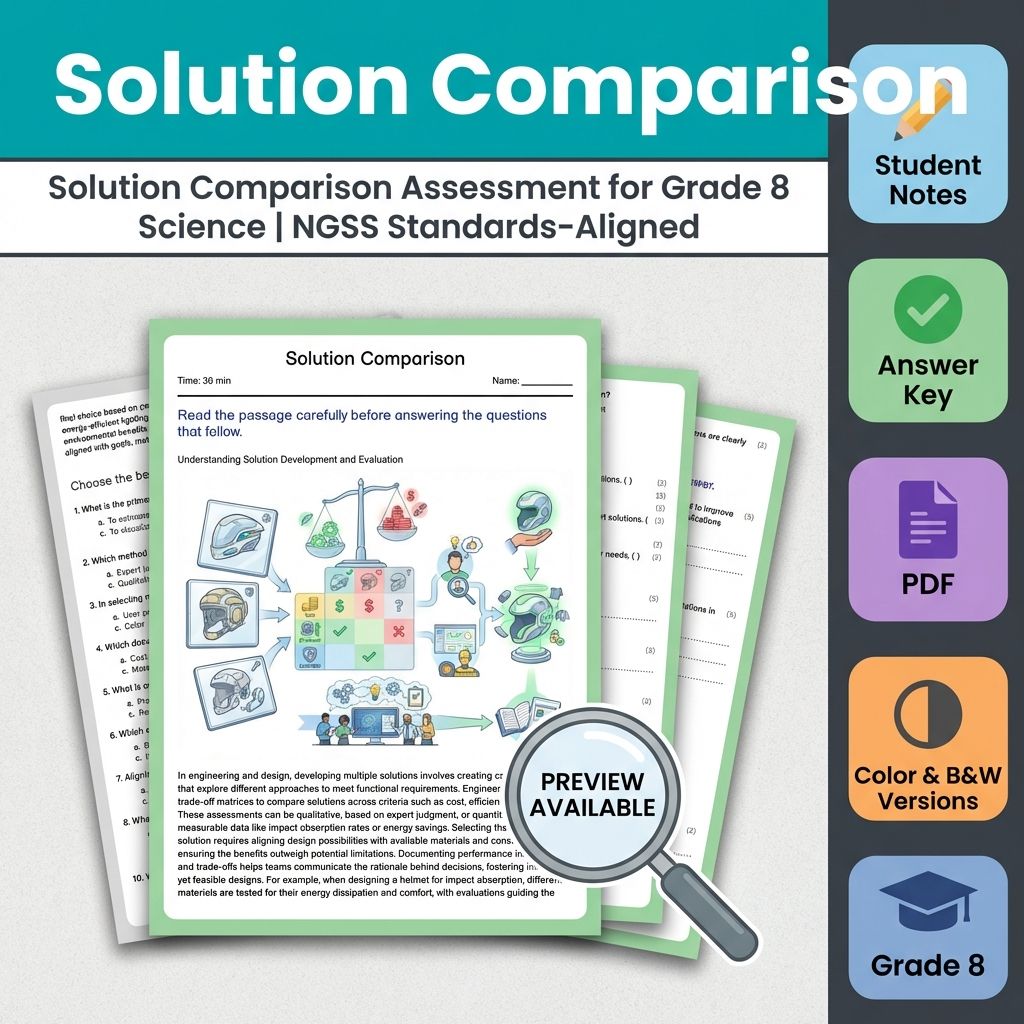
Solution Comparison Assessment for Grade 8 Science | NGSS Standards-Aligned
Created byPrism Point LearningLearning Objectives
- Understand the principles of designing and evaluating multiple solutions based on criteria and constraints.
- Learn to develop concept sketches, trade-off matrices, and compare solutions qualitatively and quantitatively.
- Identify key performance indicators and document benefits and limitations of design concepts.
Also included in: Grade 8 Science Mini Bundle – Engineering Design Unit & Assessments +1 more
Instant download
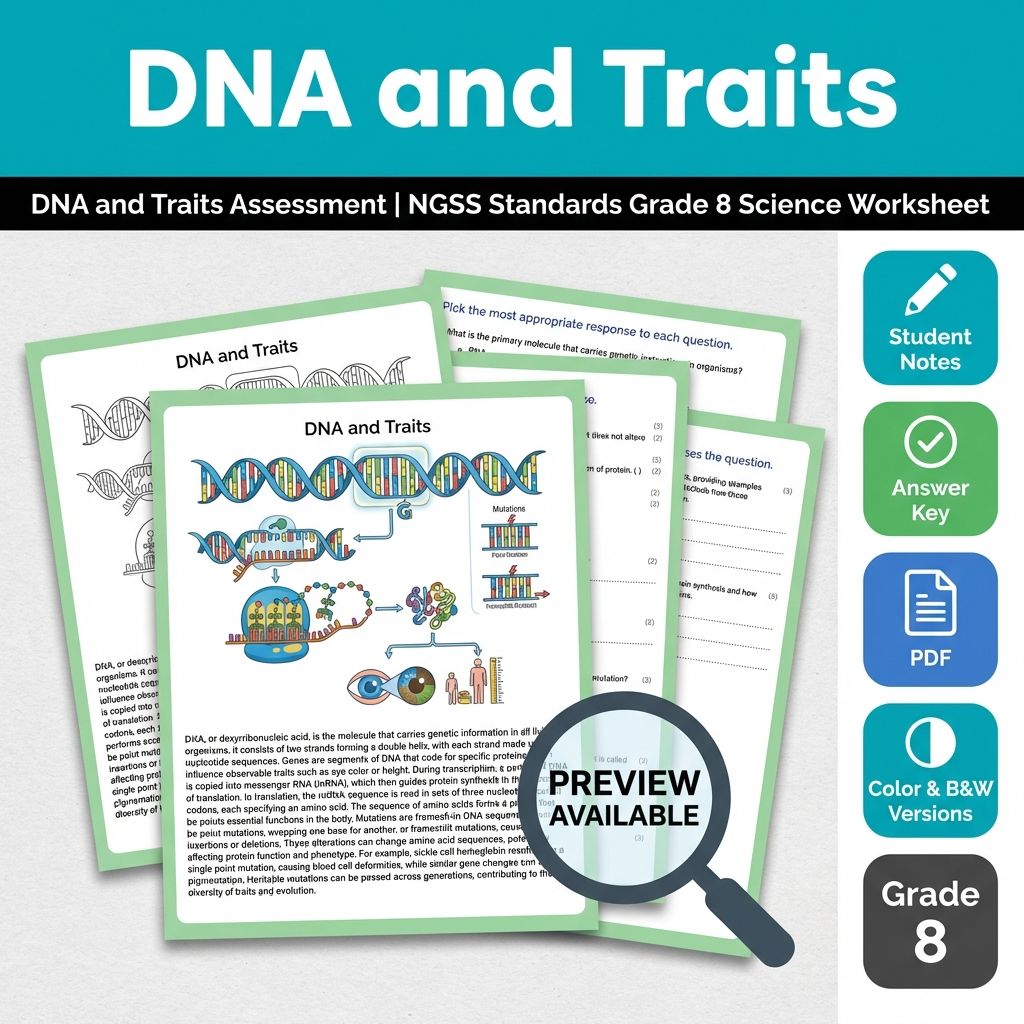
DNA and Traits Assessment | NGSS Standards Grade 8 Science Worksheet
Created byPrism Point LearningLearning Objectives
- Explain the relationship between DNA sequences and protein synthesis.
- Identify how mutations can alter amino acid sequences and affect traits.
- Describe gene structure, transcription, translation, and mutation effects.
Also included in: Grade 8 Science Mini Bundle – Heredity: Inheritance and Variation Not specified +1 more
Instant download
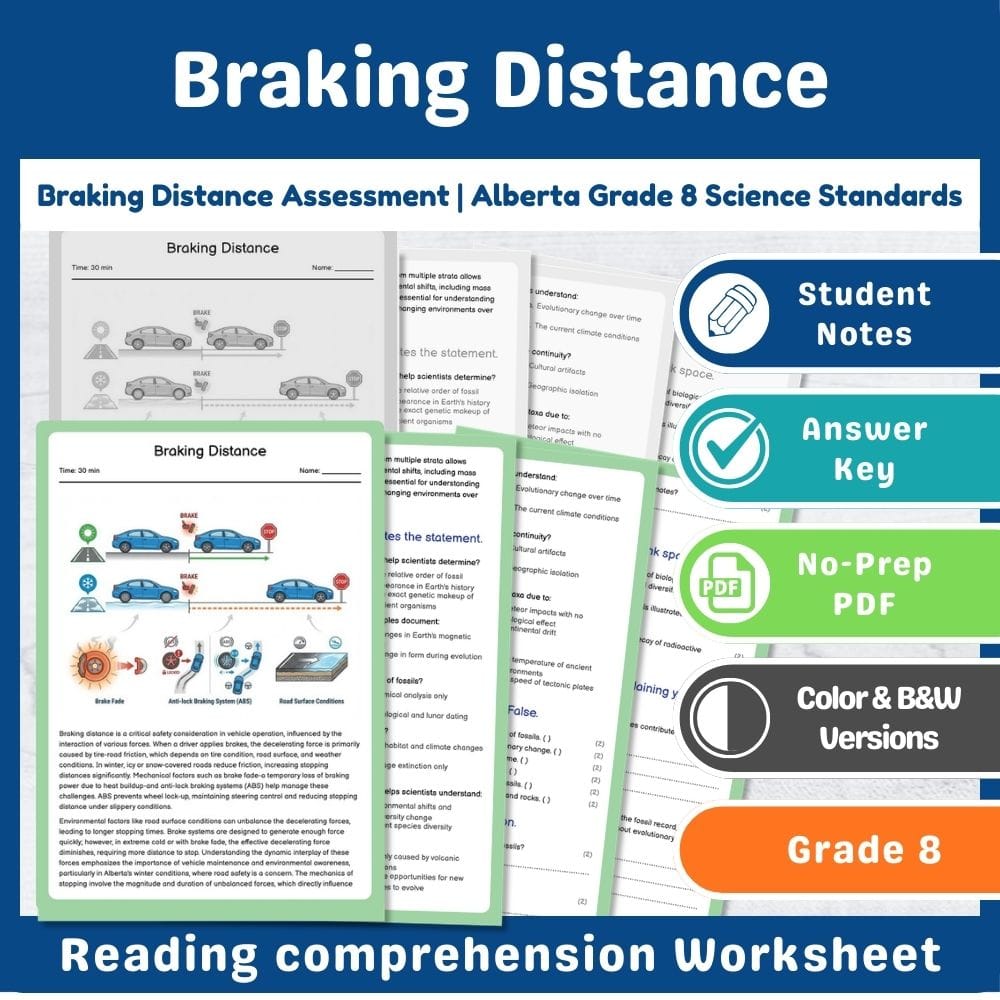
Braking Distance Assessment | Alberta Grade 8 Science Standards
Created byPrism Point LearningLearning Objectives
- Understand the factors affecting stopping distance during braking.
- Explain the role of tire-road friction and mechanical systems in deceleration.
- Analyze how environmental conditions influence braking effectiveness.
Also included in: Lesson Grade 8 Science Mini Bundle | Forces and Motion Alberta Standards
Instant download
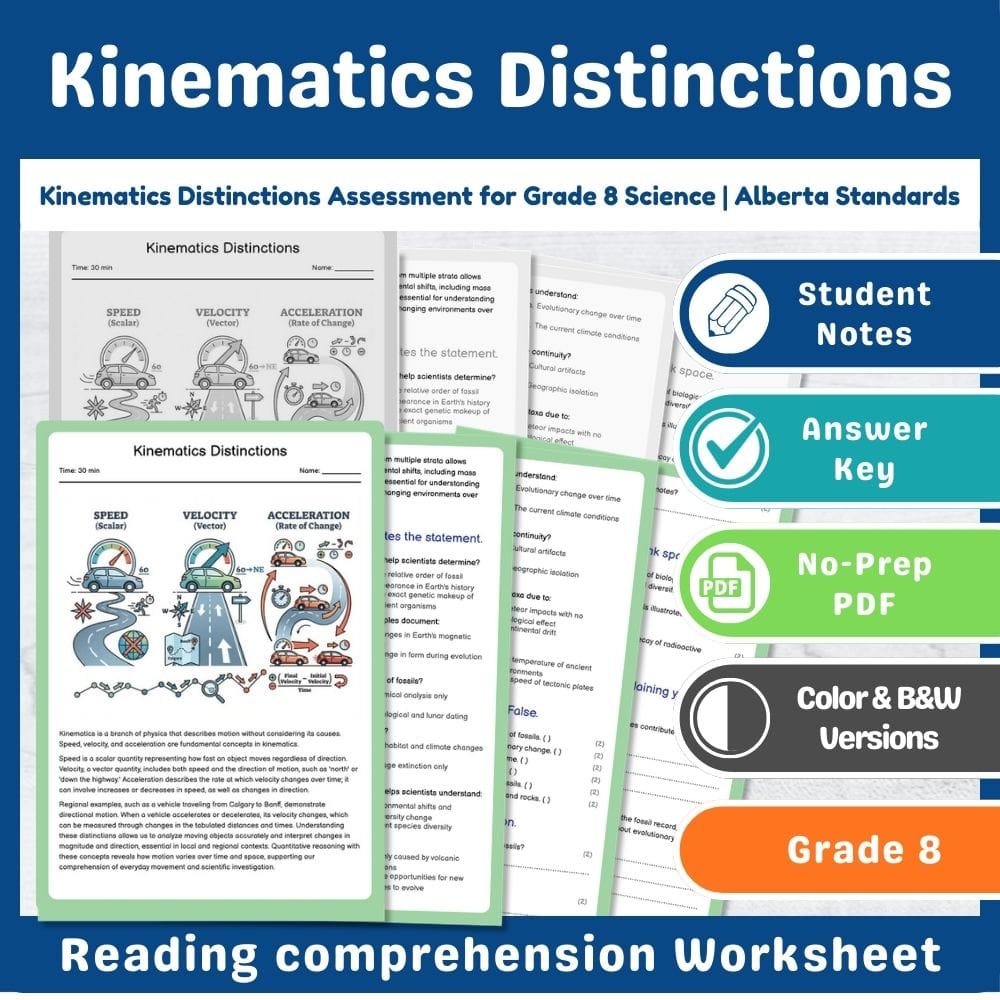
Kinematics Distinctions Assessment for Grade 8 Science | Alberta Standards
Created byPrism Point LearningLearning Objectives
- Define speed, velocity, and acceleration with precision and clarity.
- Differentiate between scalar and vector quantities in motion.
- Interpret real-world examples of directional motion in the context of regions such as Calgary and Banff.
Also included in: Lesson Grade 8 Science Mini Bundle | Forces and Motion Alberta Standards
Instant download
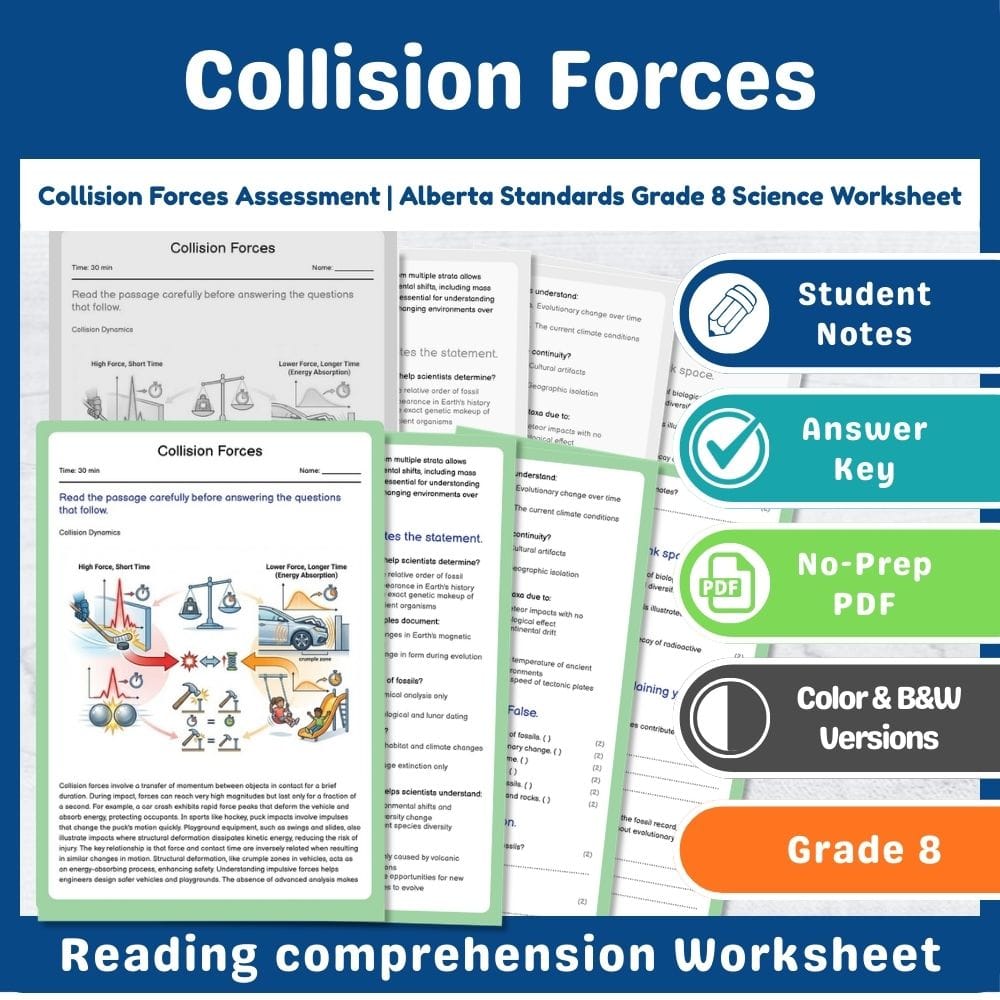
Collision Forces Assessment | Alberta Standards Grade 8 Science Worksheet
Created byPrism Point LearningLearning Objectives
- Understand the relationship between force magnitude and contact time during collisions.
- Explain how structural deformation absorbs energy in impact events.
- Analyze real-world collision scenarios to identify impulse effects and observable outcomes.
Also included in: Lesson Grade 8 Science Mini Bundle | Forces and Motion Alberta Standards
Instant download

Force Balance Assessment for Grade 8 Science | Alberta Standards
Created byPrism Point LearningLearning Objectives
- Understand the concept of balanced and unbalanced forces and how they affect motion or equilibrium.
- Analyze force vectors, support reactions, and their role in static and dynamic systems.
- Identify real-world examples of force balance and describe their behavior.
Also included in: Lesson Grade 8 Science Mini Bundle | Forces and Motion Alberta Standards
Instant download
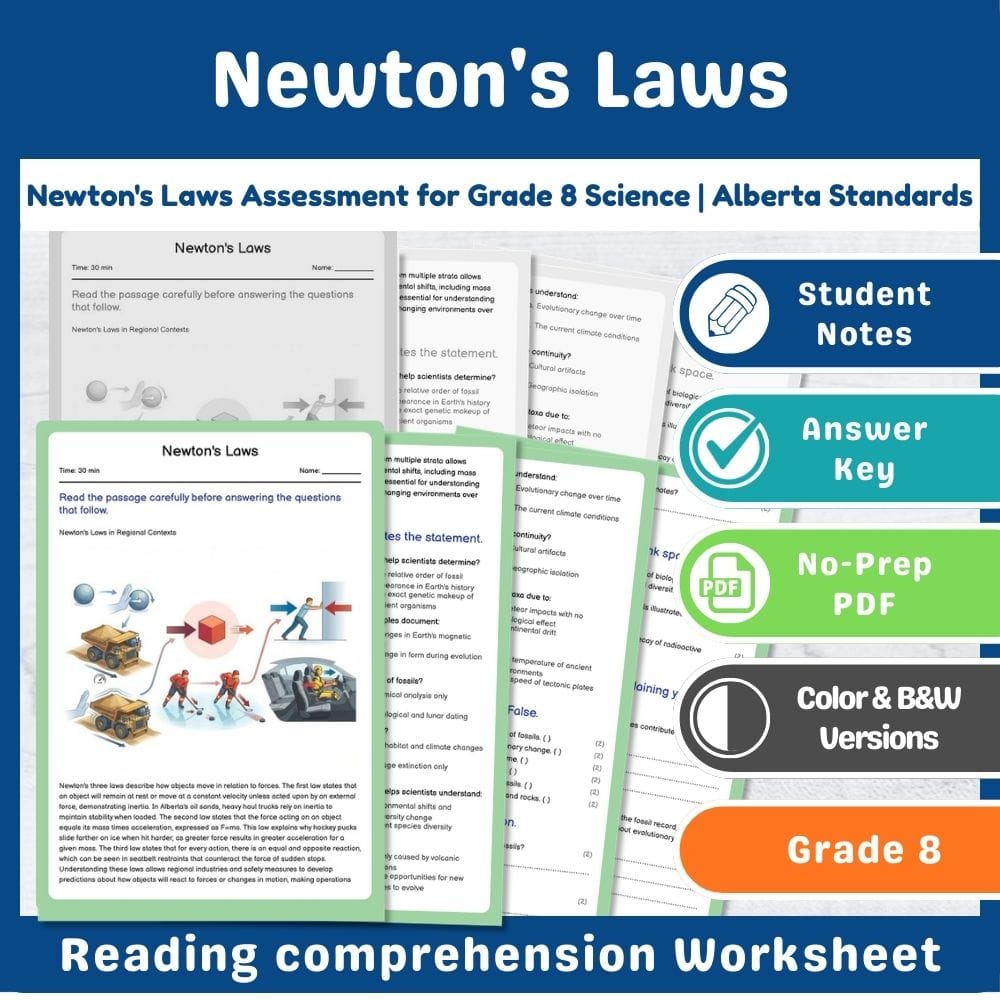
Newton's Laws Assessment for Grade 8 Science | Alberta Standards
Created byPrism Point LearningLearning Objectives
- Explain Newton's three laws of motion and how they relate to force, mass, and acceleration.
- Apply Newton's laws to regional scenarios such as heavy haul trucks, hockey puck motion, and seatbelt restraints.
- Predict the direction and magnitude of objects' motion based on applied forces.
Also included in: Lesson Grade 8 Science Mini Bundle | Forces and Motion Alberta Standards
Instant download
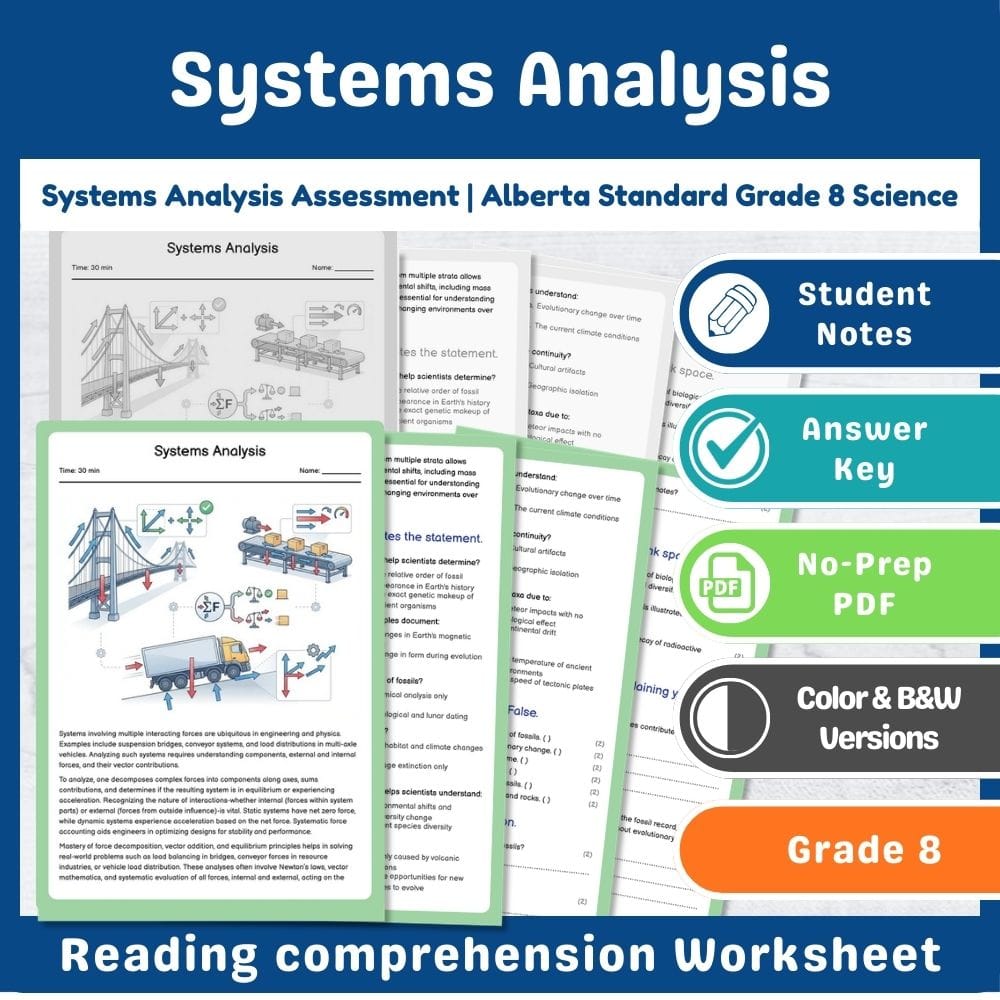
Systems Analysis Assessment | Alberta Standard Grade 8 Science
Created byPrism Point LearningLearning Objectives
- Identify the key components of complex systems involving multiple forces.
- Understand how to decompose system forces into vector components.
- Analyze static versus dynamic behavior by summing forces.
Also included in: Lesson Grade 8 Science Mini Bundle | Forces and Motion Alberta Standards
Instant download
Browse more categories
About Reading comprehension Worksheets
Find reading comprehension worksheets for class practice, homework, or self-study. All 40,284 are instant PDF downloads.
Each resource here is built by an independent educator and reviewed for quality. Worksheets print straight from PDF and suit classroom use, homework, or extra practice; most come with answer keys, and you can preview before purchasing.