
Reading comprehension Worksheets
40,284 type resources
Population Dynamics Worksheet Practice Test | Grade 11 Science
 Created byPrism Point Learning
Learning Objectives
- Explain how exponential and logistic growth models differ and identify the role of carrying capacity.
- Interpret demographic parameters (birth rate, death rate, age structure, sex ratio) in population trajectories.
- Describe density-dependent and density-independent factors and predict how they affect population size.
Also included in: Grade 11 Ecology and Sustainability Science Lesson Bundle – Ontario
Instant download

Orbital Mechanics Practice Worksheet | Grade 11 Science NGSS Review
Created byPrism Point LearningLearning Objectives
- Explain how Kepler’s laws describe planetary motion and connect them to orbital geometry (semi-major axis, eccentricity).
- Use conservation of angular momentum and gravitational attraction to reason about changes in orbital speed and direction.
- Analyze how resonances and perturbations (eccentricity, inclination, and resonance with other bodies) can affect long-term stability.
Also included in: Grade 11 Orbital Mechanics & Timescales Science Lesson Bundle NGSS
Instant download

Oscillations And Waves Practice Worksheet | Grade 11 Science Review
Created byPrism Point LearningLearning Objectives
- Explain simple harmonic motion (SHM) using amplitude, period, angular frequency, and phase.
- Relate wave speed, frequency, and wavelength using v = fλ for waves in a linear medium.
- Differentiate transverse and longitudinal mechanical waves and describe how dispersion affects wave behavior qualitatively.
Also included in: Grade 11 Science Review & Test Prep Lesson Bundle for Ontario
Instant download

Work And Energy Worksheet | Grade 11 Science Review & Practice
Created byPrism Point LearningLearning Objectives
- Use the work–energy theorem to relate net work to changes in kinetic energy
- Differentiate kinetic, gravitational potential, and elastic potential energy and compute each from appropriate conditions
- Explain how conservative and non-conservative forces affect energy conservation and the role of friction
Also included in: Grade 11 Science Review & Test Prep Lesson Bundle for Ontario
Instant download

Biological Organization Worksheet Practice | Grade 11 Science NGSS
Created byPrism Point LearningLearning Objectives
- Explain hierarchical organization from organelles to organ systems and how each level supports the next
- Describe how specialized cell types and tissue integration enable nutrient distribution and communication
- Use models to predict how circulatory and other systems coordinate to maintain internal balance at cellular interfaces
Also included in: Cellular Processes & Energy Flows Grade 11 Science Lesson Bundle NGSS
Instant download

Newtonian Forces Test Prep Worksheets | Grade 11 Science Review
Created byPrism Point LearningLearning Objectives
- Apply Newton’s three laws to relate net force, mass, and acceleration in translational motion.
- Use free-body diagrams to identify contact forces, normal force, friction, tension, and gravitational weight.
- Analyze static and kinetic friction using coefficients and the conditions for impending or ongoing motion.
Also included in: Grade 11 Science Review & Test Prep Lesson Bundle for Ontario
Instant download

Acid Strength Factors Worksheet | Grade 11 Science Practice
Created byPrism Point LearningLearning Objectives
- Explain how molecular structure factors influence acid strength in water.
- Use trends such as bond polarity, electronegativity, atom size, resonance stabilization, and oxidation state to predict acidity.
- Relate electron-withdrawing groups in oxyacids and halogen-substituted acids to acidity trends.
Instant download

Microscopic Energy Practice Worksheets | Grade 11 Science
Created byPrism Point LearningLearning Objectives
- Explain how microscopic particle motion and interactions relate to macroscopic temperature and thermal expansion.
- Model internal energy changes in gases using particle kinetic energy and interparticle potential energy.
- Compare how energy appears at the microscopic level in gases versus solids using ideas like vibrational motion.
Also included in: Grade 11 Energy Transfer & Conservation Science Lesson Bundle (NGSS)
Instant download

Homeostatic Failure Worksheet | Grade 11 Science Assessment
Created byPrism Point LearningLearning Objectives
- Explain how chronic disorders and acute insults can disrupt homeostatic regulatory networks.
- Describe mechanisms by which insulin resistance or dehydration can lead to systemic damage.
- Identify how compensatory responses can fail or worsen disease through positive feedback.
Also included in: Homeostasis & Body Systems Lesson Bundle | Grade 11 Science | Texas TEKS
Instant download

Long Range Forces Worksheet Review Printable | Grade 11 Science
Created byPrism Point LearningLearning Objectives
- Use inverse-square relationships to express gravitational and electrostatic force magnitudes between objects.
- Apply vector addition to determine a net force direction from multiple long-range interactions.
- Predict how net force influences motion, including orbital dynamics and curved charged-particle paths.
Instant download
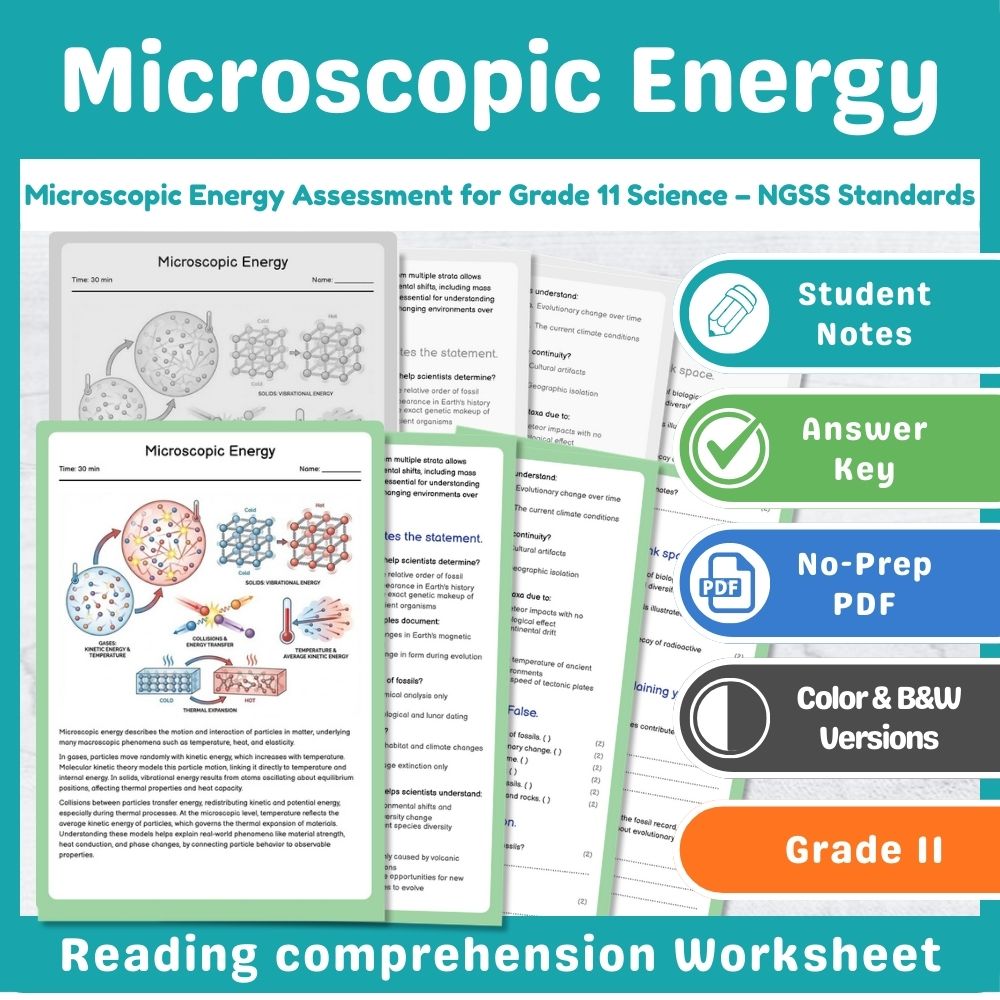
Microscopic Energy Assessment for Grade 11 Science – NGSS Standards
Created byPrism Point LearningLearning Objectives
- Explain the representation of energy at the microscopic scale and how it relates to macroscopic phenomena.
- Describe molecular kinetic theory and how it connects particle motion to temperature.
- Analyze energy redistribution during collisions in gases and vibrations in solids.
Instant download

Carbon Pathways Assessment | AP Standards for Grade 11 Science
Created byPrism Point LearningLearning Objectives
- Explain how carbon is stored and transferred among air, ocean, terrestrial biosphere, and sediments.
- Utilize flux diagrams and isotopic tracers to distinguish natural from anthropogenic carbon sources.
- Analyze the impact of ocean uptake, soil carbon, and fossil fuel emissions on atmospheric CO2 levels.
Also included in: Lesson Grade 11 Science Assessment Bundle | Earth Systems & Climate
Instant download
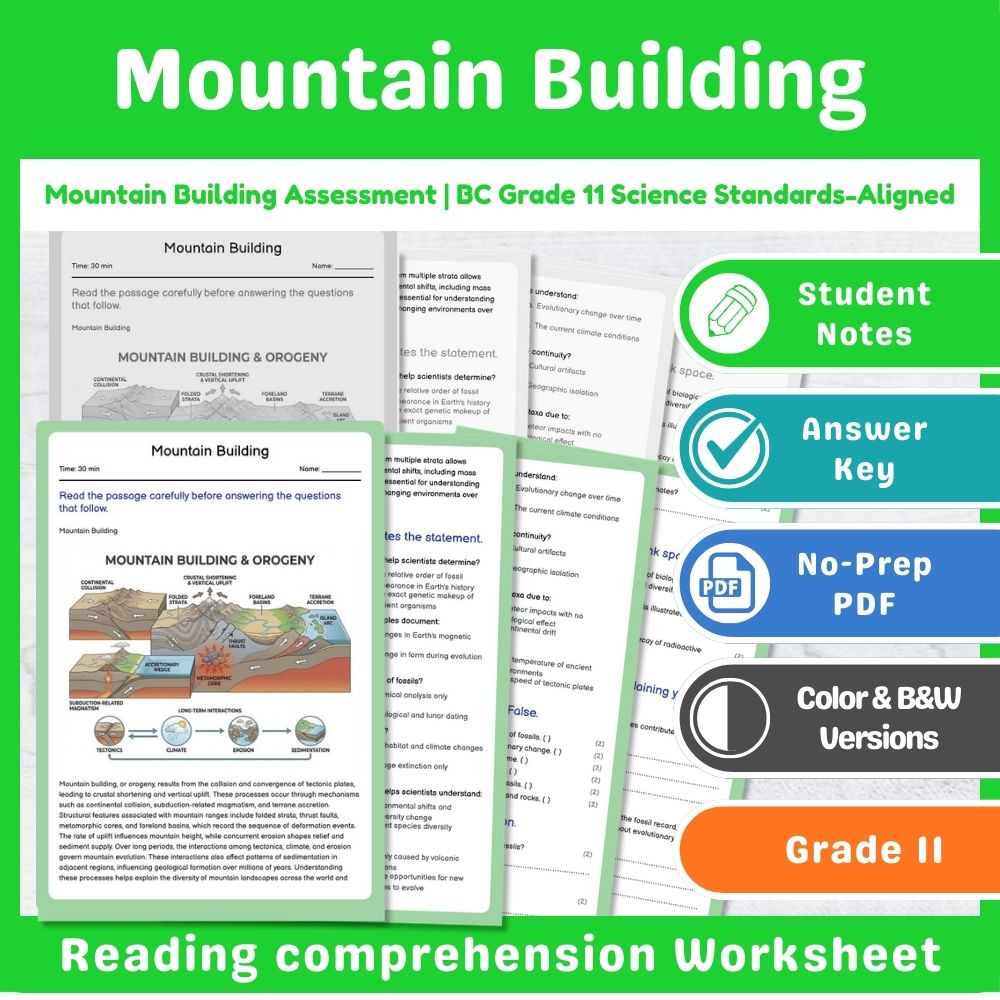
Mountain Building Assessment | BC Grade 11 Science Standards-Aligned
Created byPrism Point LearningLearning Objectives
- Explain the geological processes involved in mountain formation, including tectonic convergence, crustal shortening, and uplift.
- Identify structural features such as folded strata, thrust faults, metamorphic cores, and foreland basins associated with mountain ranges.
- Describe how rates of uplift and erosion influence mountain evolution and sediment distribution.
Also included in: Grade 11 Science Assessment | Plate Tectonics BC Standards Mini Bundle
Instant download
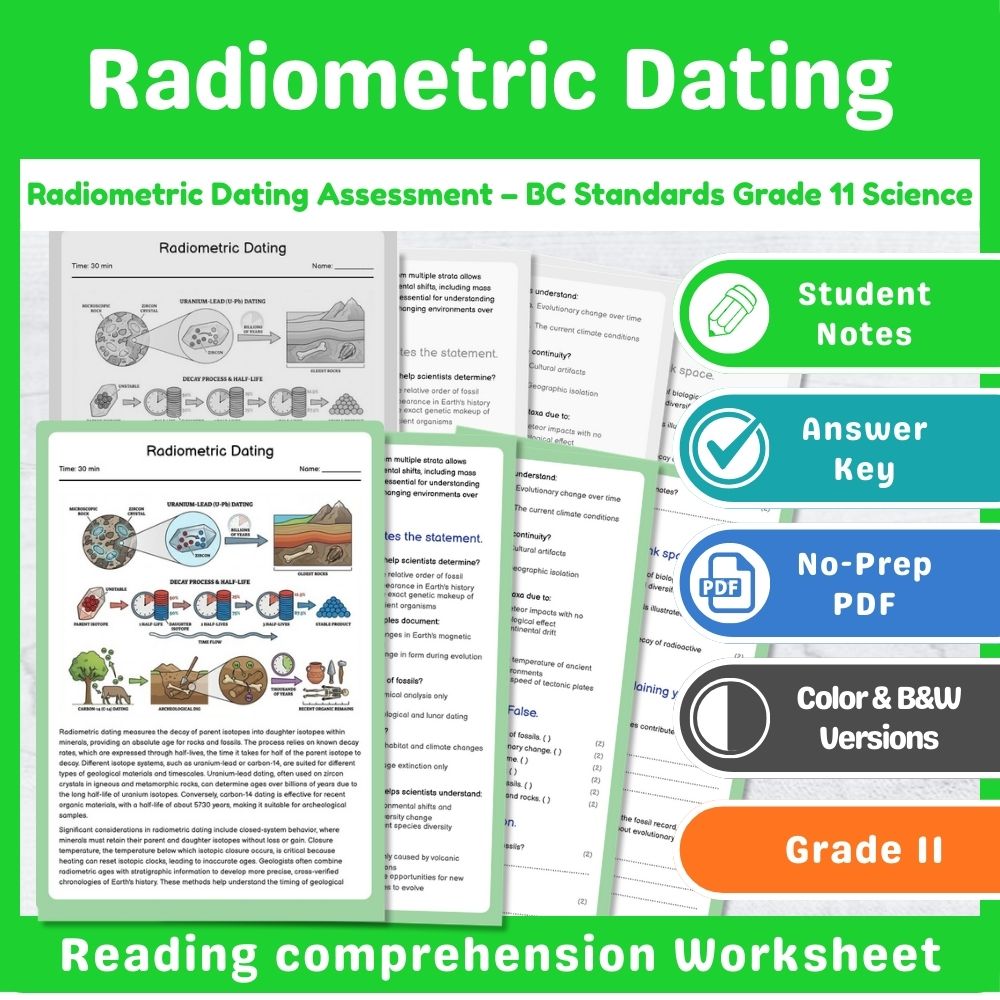
Radiometric Dating Assessment – BC Standards Grade 11 Science
Created byPrism Point LearningLearning Objectives
- Understand the principles of radiometric dating and how isotopic decay is used to determine geological ages.
- Identify different parent-daughter isotope systems suitable for various timescales and rock types.
- Explain the significance of closure temperature and how it affects isotopic retention in rocks.
Also included in: Grade 11 Science Assessment | Plate Tectonics BC Standards Mini Bundle
Instant download

pH Fundamentals Assessment | Alberta Standards + Grade 11 Science
Created byPrism Point LearningLearning Objectives
- Understand key concepts related to Science
- Apply knowledge through practice questions
- Demonstrate comprehension of the material
Also included in: Grade 11 Acids, Bases & pH Chemistry Science Lesson Bundle | Alberta +1 more
Instant download
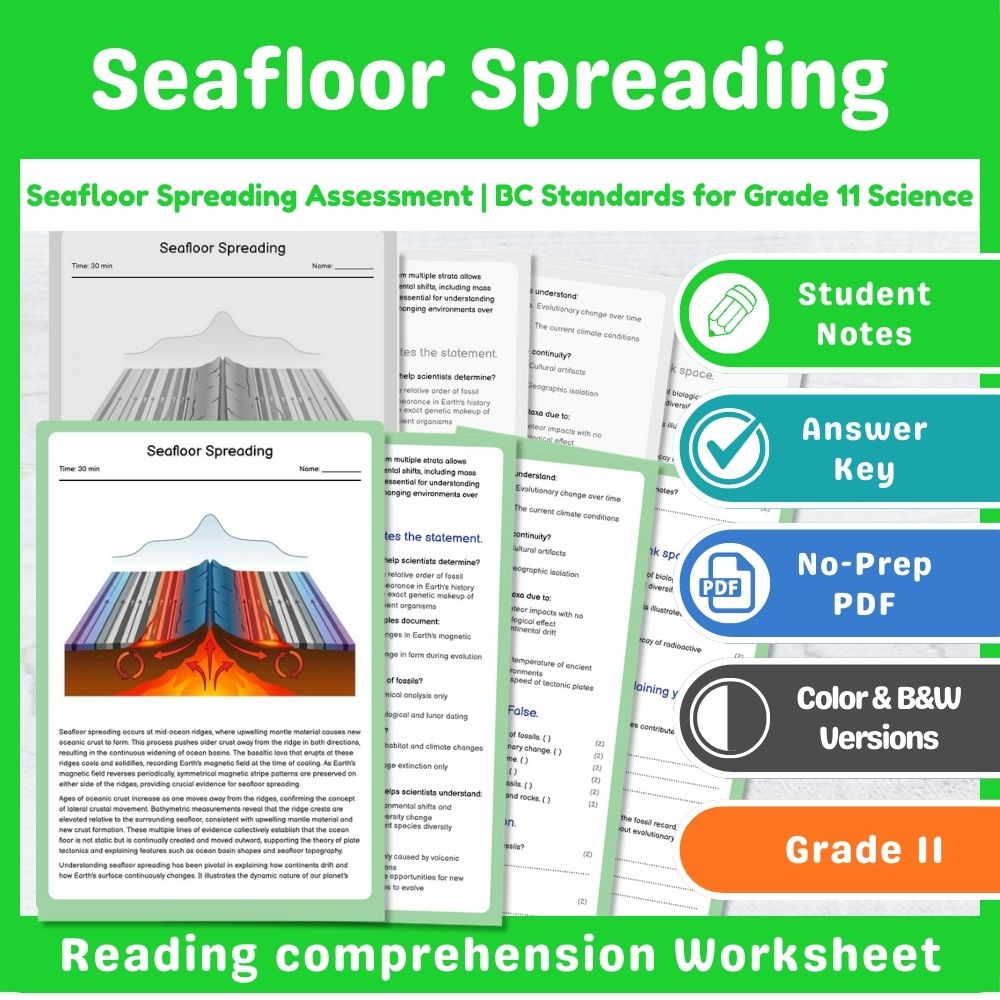
Seafloor Spreading Assessment | BC Standards for Grade 11 Science
Created byPrism Point LearningLearning Objectives
- Describe the process of seafloor spreading and how it shapes ocean basins.
- Explain how magnetic stripe patterns provide evidence for seafloor spreading.
- Analyze how age and bathymetric data support plate tectonic theory.
Also included in: Grade 11 Science Assessment | Plate Tectonics BC Standards Mini Bundle
Instant download

Stratigraphic Columns Assessment for Grade 11 Science | BC Standards
Created byPrism Point LearningLearning Objectives
- Understand the components and significance of stratigraphic columns in geology.
- Identify how lithology, fossils, and sedimentary structures help interpret past environments.
- Explain the concepts of correlation, unconformities, and facies changes within stratigraphy.
Also included in: Grade 11 Science Assessment | Plate Tectonics BC Standards Mini Bundle
Instant download

DNA Information Assessment for Grade 11 Science | NGSSS Standards
Created byPrism Point LearningLearning Objectives
- Explain how DNA stores genetic information and how that information leads to protein production
- Describe the structure of DNA and the importance of complementary base pairing
- Analyze how accurate DNA replication preserves inheritance during cell division
Also included in: Grade 11 Population, Genetics & Energy Systems Science Lesson Bundle: Florida NGSSS +1 more
Instant download

Temperature Effects Assessment | Alberta Standards Grade 11 Science
Created byPrism Point LearningLearning Objectives
- Understand key concepts related to Science
- Apply knowledge through practice questions
- Demonstrate comprehension of the material
Also included in: Grade 11 Solutions and Solubility Science Lesson Bundle | Alberta Framework +1 more
Instant download

Carrying Capacity Assessment for Grade 11 Science | NGSSS Standards
Created byPrism Point LearningLearning Objectives
- Explain how birth rate, death rate, immigration, and emigration affect population change over time
- Define carrying capacity and describe how limiting factors slow population growth
- Interpret how competition, predation, and disease influence survival and reproduction
Also included in: Grade 11 Population, Genetics & Energy Systems Science Lesson Bundle: Florida NGSSS +1 more
Instant download

Solution Stoichiometry Assessment | Alberta Standards Grade 11 Science
Created byPrism Point LearningLearning Objectives
- Explain the concept of molarity and its role in solution stoichiometry.
- Calculate reactant and product quantities using mole-mole relationships in aqueous solutions.
- Identify limiting reagents in solution reactions based on concentration and stoichiometry.
Also included in: Grade 11 Solutions and Solubility Science Lesson Bundle | Alberta Framework +1 more
Instant download
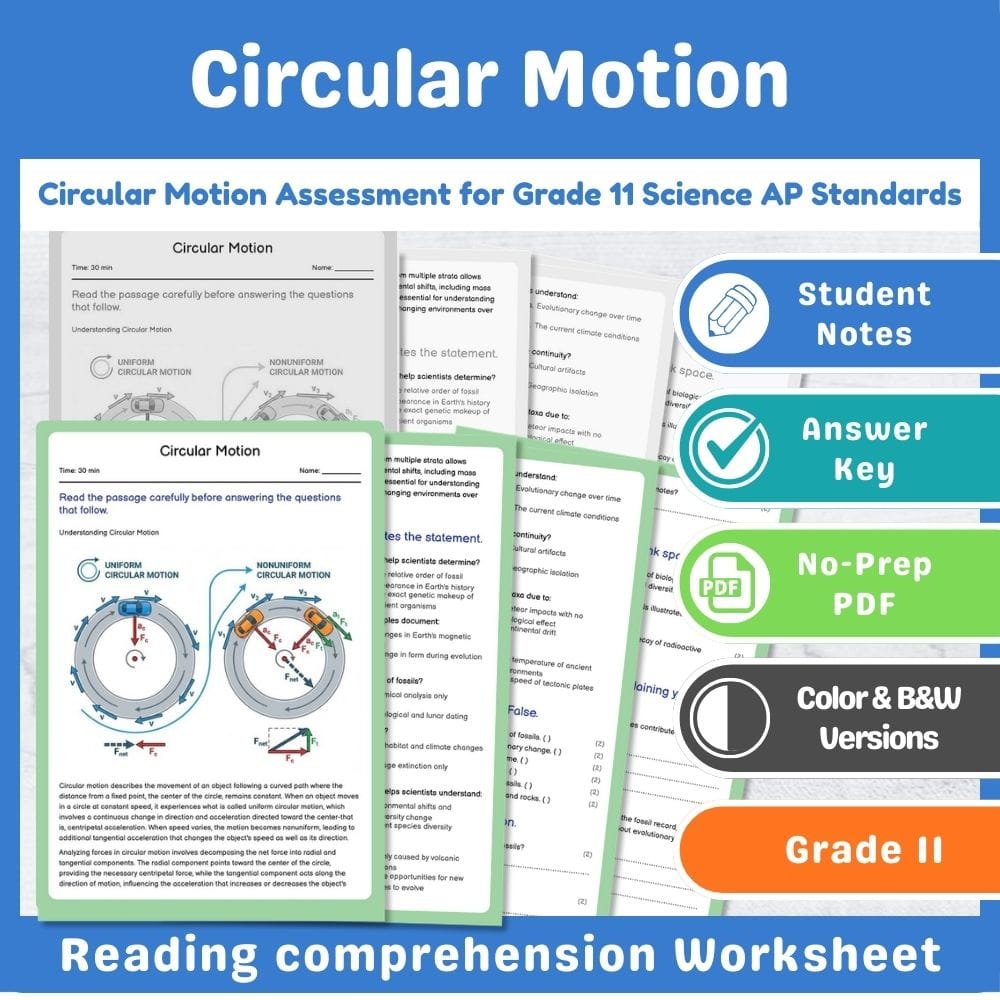
Circular Motion Assessment for Grade 11 Science AP Standards
Created byPrism Point LearningLearning Objectives
- Describe uniform and nonuniform circular motion with emphasis on centripetal and tangential accelerations.
- Model net forces in circular motion by analyzing radial and tangential components.
- Express acceleration vectors in polar coordinates and relate them to the change in velocity direction.
Instant download

Concentration Calculations Assessment Grade 11 Science | Alberta
Created byPrism Point LearningLearning Objectives
- Understand how to convert between ion concentrations and pH or pOH using logarithmic relationships.
- Apply procedures for calculating [H+] from pH, [OH-] from pOH, and use Kw to find related concentrations.
- Relate ionic concentrations to real-world water samples such as river water in Alberta for environmental assessments.
Also included in: Grade 11 Acids, Bases & pH Chemistry Science Lesson Bundle | Alberta +1 more
Instant download

Tissue Organization Assessment | BC Standards Grade 11 Science
Created byPrism Point LearningLearning Objectives
- Understand how multicellular organisms organize cells into tissues, organs, and systems.
- Identify the roles of cellular differentiation in tissue specialization.
- Explain models of tissue architecture and intercellular communication.
Also included in: Grade 11 Science Lesson Assessment Bundle | Photosynthesis & Genetics
Instant download

Lewis Structures Assessment | Alberta Standard Assessment Grade 11 Science
Created byPrism Point LearningLearning Objectives
- Understand the concept of Lewis electron-dot structures for molecules.
- Identify how to represent shared electrons and bonds.
- Interpret Lewis structures to predict molecular shapes and properties.
Also included in: Grade 11 Matter and Chemical Bonding Science Lesson Bundle for Alberta +1 more
Instant download

Phase Behaviour Assessment | Alberta Standard Grade 11 Science
Created byPrism Point LearningLearning Objectives
- Understand the concept of phase behaviour and phase diagrams.
- Identify the different phases of matter and their transitions under varying conditions.
- Interpret phase diagrams to determine phase changes at specific temperature and pressure points.
Also included in: Grade 11 Matter and Chemical Bonding Science Lesson Bundle for Alberta +1 more
Instant download
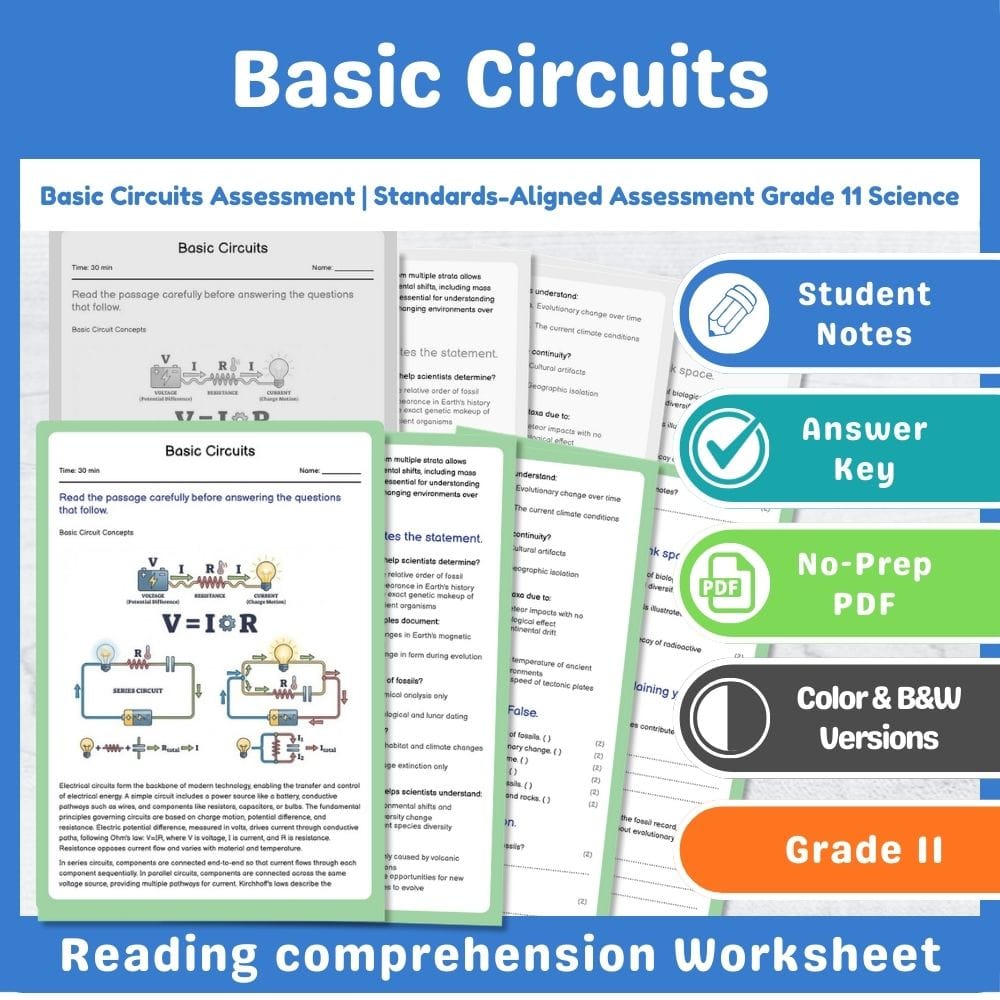
Basic Circuits Assessment | Standards-Aligned Assessment Grade 11 Science
Created byPrism Point LearningLearning Objectives
- Explain the concepts of electric potential difference, current, resistance, and energy transfer in DC circuits.
- Apply Ohm's law and Kirchhoff's laws to analyze series and parallel circuits.
- Calculate power dissipation and energy in simple electrical systems using algebraic methods.
Instant download

Geologic Change Assessment | NGSS Standards for Grade 11 Science
Created byPrism Point LearningLearning Objectives
- Understand and interpret stratigraphic, sedimentary, and metamorphic evidence of Earth's surface and subsurface processes.
- Apply radiometric dating, fossil correlation, and sedimentary facies analysis to time Earth's major geologic events.
- Analyze depositional sequences, unconformities, and regional metamorphic belts to reconstruct Earth's geologic history.
Instant download
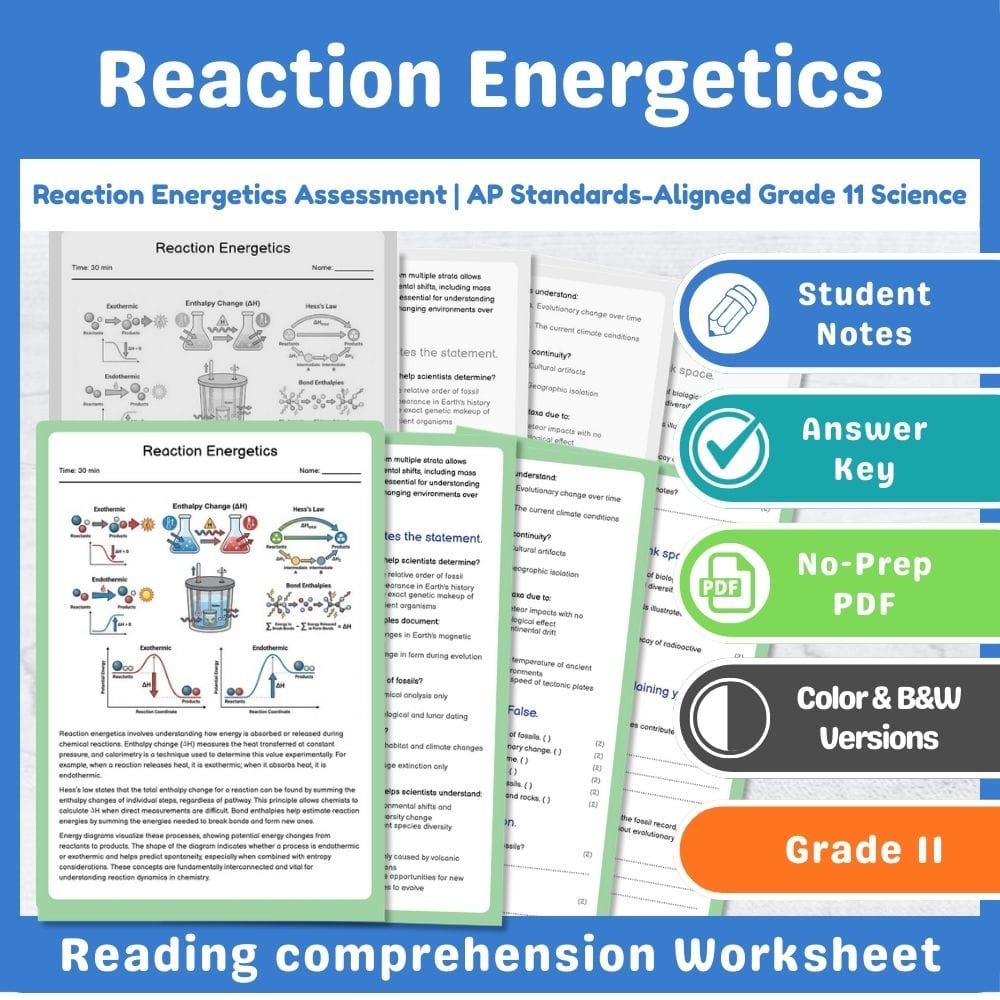
Reaction Energetics Assessment | AP Standards-Aligned Grade 11 Science
Created byPrism Point LearningLearning Objectives
- Explain the concepts of enthalpy changes and calorimetric methods in measuring reaction heat.
- Apply Hess’s law to determine overall reaction energies from individual steps.
- Relate bond enthalpies and formation energies to macroscopic enthalpy and chemical stability.
Instant download
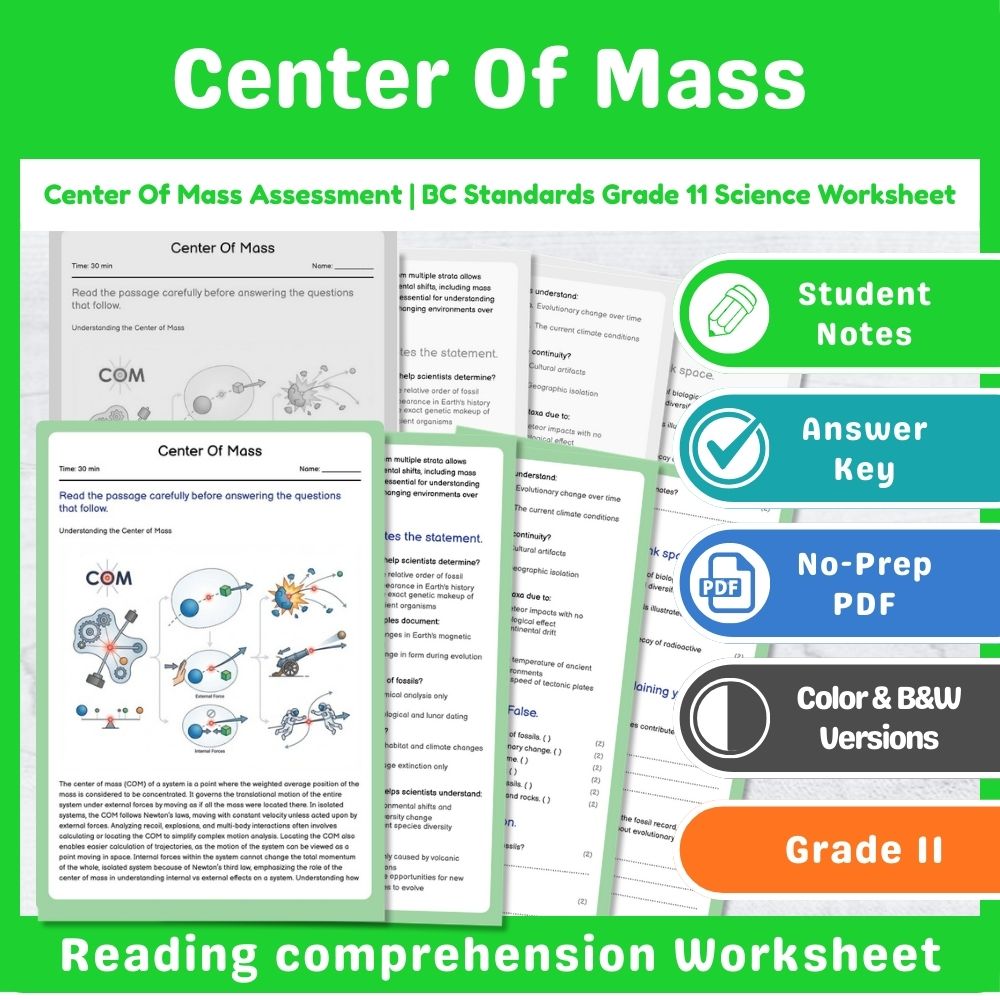
Center Of Mass Assessment | BC Standards Grade 11 Science Worksheet
Created byPrism Point LearningLearning Objectives
- Understand the concept of the center of mass in physical systems.
- Apply the principles of momentum conservation relative to the center of mass.
- Analyze system trajectories and internal forces using the center of mass concept.
Also included in: Grade 11 Science Assessment Bundle | Classical Mechanics & Motion Topics
Instant download

Physiological Regulation Assessment for Grade 11 Science TEKS
Created byPrism Point LearningLearning Objectives
- Describe the mechanisms involved in maintaining internal stability in the human body.
- Explain the roles of sensors, control centers, and effectors in physiological regulation.
- Identify examples of negative and positive feedback mechanisms in human physiology.
Also included in: Grade 11 Homeostasis & Human Body Systems Science: Lesson Bundle TEKS
Instant download

Protein Synthesis Assessment for Grade 11 Science TEKS Standards
Created byPrism Point LearningLearning Objectives
- Explain the process of transcription and translation in protein synthesis.
- Identify the roles of RNA polymerase, mRNA, tRNA, ribosomes, and amino acids.
- Describe the significance of codon redundancy and wobble in genetic decoding.
Also included in: Grade 11 Molecular Genetics Science Lesson Bundle: TEKS Assessments
Instant download

Renal Regulation Assessment | TEKS Grade 11 Science Standards
Created byPrism Point LearningLearning Objectives
- Understand how the kidneys regulate fluid, electrolyte, and acid-base balance.
- Identify the hormonal controls involved in renal function, such as aldosterone and antidiuretic hormone.
- Describe the processes of filtration, reabsorption, secretion, and excretion in nephrons.
Also included in: Grade 11 Homeostasis & Human Body Systems Science: Lesson Bundle TEKS
Instant download
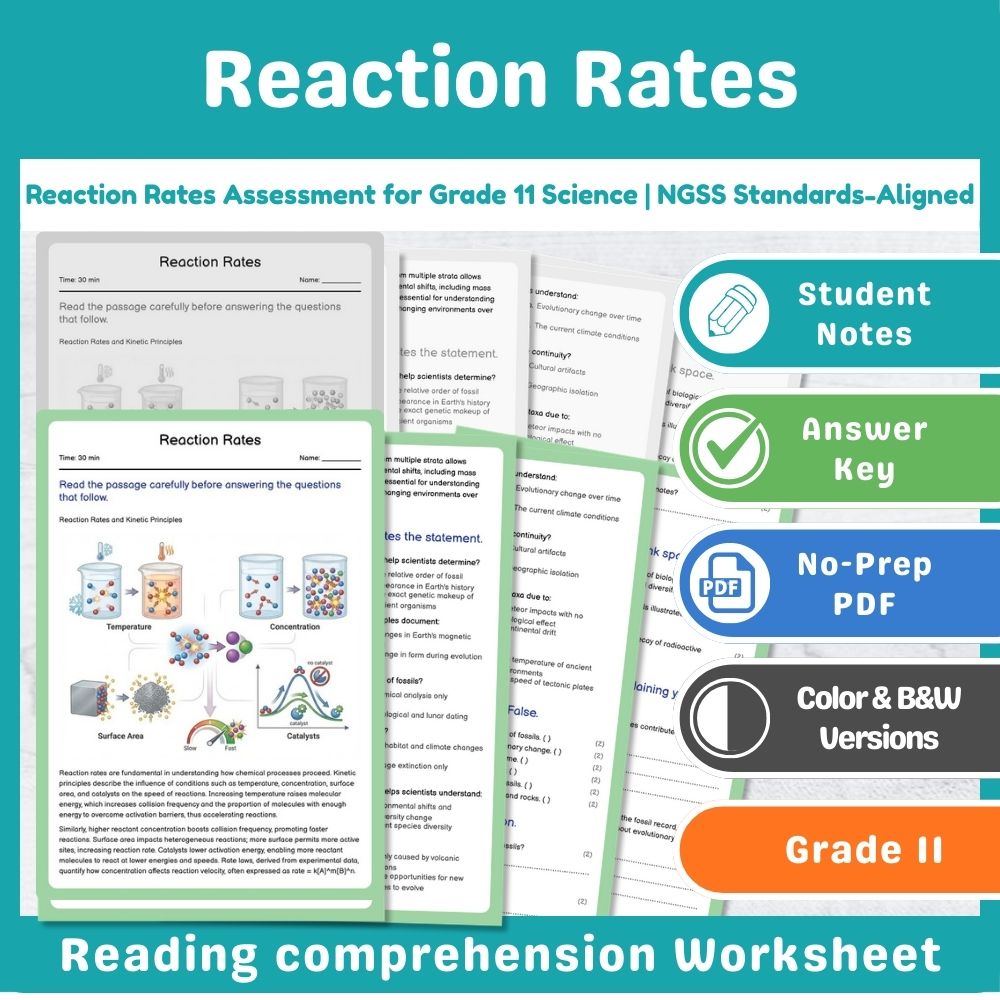
Reaction Rates Assessment for Grade 11 Science | NGSS Standards-Aligned
Created byPrism Point LearningLearning Objectives
- Explain how temperature, concentration, surface area, and catalysts influence reaction rates through collision and activation energies.
- Apply rate laws and concentration dependencies to elementary reaction steps.
- Interpret potential energy diagrams and Arrhenius parameters to understand temperature's effect on reaction rates.
Also included in: Grade 11 Science Mini Bundle – Matter and Its Interactions NGSS Unit
Instant download
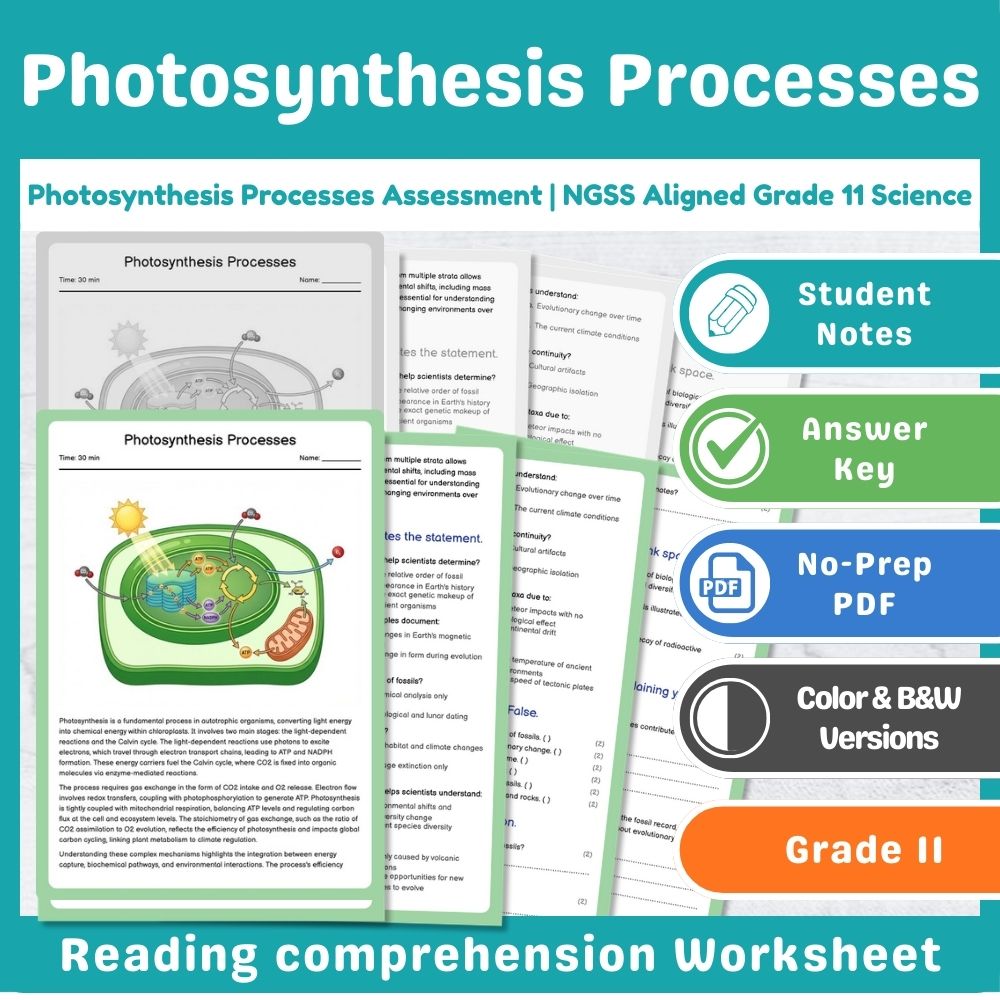
Photosynthesis Processes Assessment | NGSS Aligned Grade 11 Science
Created byPrism Point LearningLearning Objectives
- Explain the light-driven and biochemical stages of photosynthesis, including electron transport, photophosphorylation, and the Calvin cycle.
- Describe the integration of photosynthesis with mitochondrial respiration, focusing on gas exchange, ATP balance, and carbon flux.
- Analyze the stoichiometry of CO2 uptake and O2 release during photosynthesis and respiration.
Instant download

Period Trends and Chemical Interactions Assessment | Alberta Grade 11 Science
Created byPrism Point LearningLearning Objectives
- Explain how atomic radius, ionization energy, and electronegativity vary across the periodic table.
- Describe how these trends influence element bonding preferences and material properties.
- Connect periodic patterns to practical examples like corrosion and alloy selection.
Also included in: Grade 11 Matter and Chemical Bonding Science Lesson Bundle for Alberta +1 more
Instant download
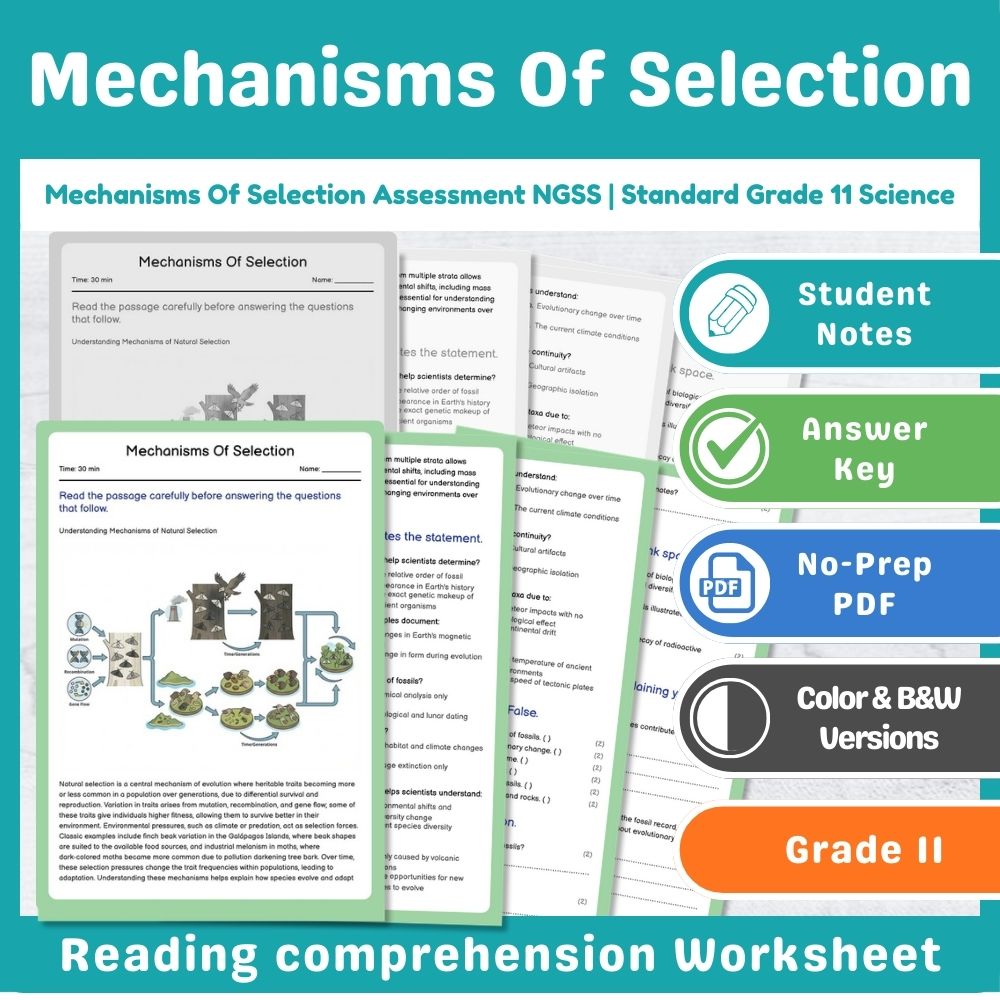
Mechanisms Of Selection Assessment NGSS | Standard Grade 11 Science
Created byPrism Point LearningLearning Objectives
- Explain the key concepts of natural selection, including heritable variation and differential survival.
- Analyze factors influencing selection pressure, such as mutation, recombination, and environment.
- Use examples like finch beak variation and industrial melanism to illustrate evolutionary mechanisms.
Instant download

Collisions Types Assessment | BC Standards Grade 11 Science
Created byPrism Point LearningLearning Objectives
- Explain the difference between elastic and inelastic collisions in terms of energy and momentum conservation.
- Apply conservation laws to analyze one- and two-dimensional collision scenarios.
- Use center-of-mass frames to determine final velocities after collisions in various situations.
Also included in: Grade 11 Science Assessment Bundle | Classical Mechanics & Motion Topics
Instant download
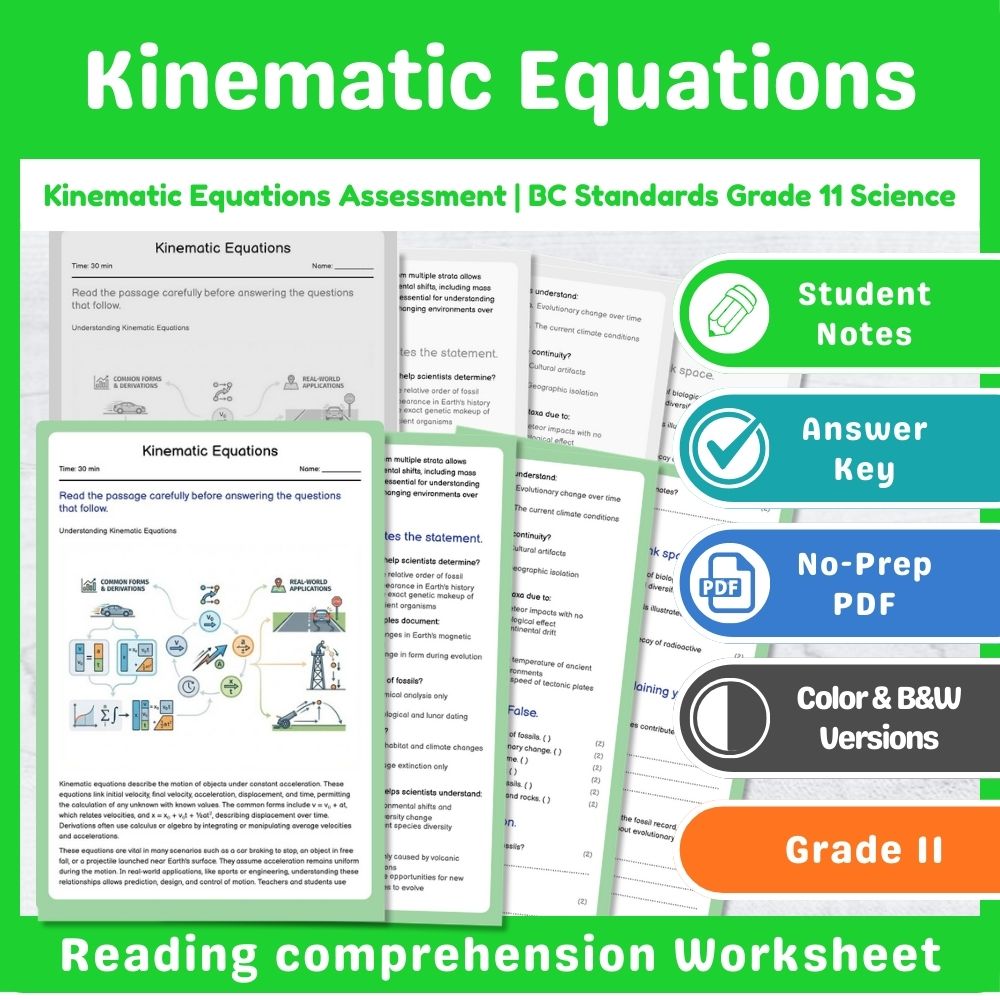
Kinematic Equations Assessment | BC Standards Grade 11 Science
Created byPrism Point LearningLearning Objectives
- Understand the fundamental kinematic equations used for constant acceleration motion.
- Apply the equations to solve for displacement, velocity, acceleration, and time in one-dimensional motion.
- Derive the equations using algebraic and calculus methods.
Also included in: Grade 11 Science Assessment Bundle | Classical Mechanics & Motion Topics
Instant download

Henderson Equation Assessment | Alberta Standard Grade 11 Science
Created byPrism Point LearningLearning Objectives
- Understand the Henderson–Hasselbalch equation and its relation to buffer pH.
- Apply the Henderson–Hasselbalch equation to calculate buffer component ratios.
- Analyze environmental and industrial buffer systems using the equation.
Also included in: Grade 11 Acids, Bases & pH Chemistry Science Lesson Bundle | Alberta +1 more
Instant download
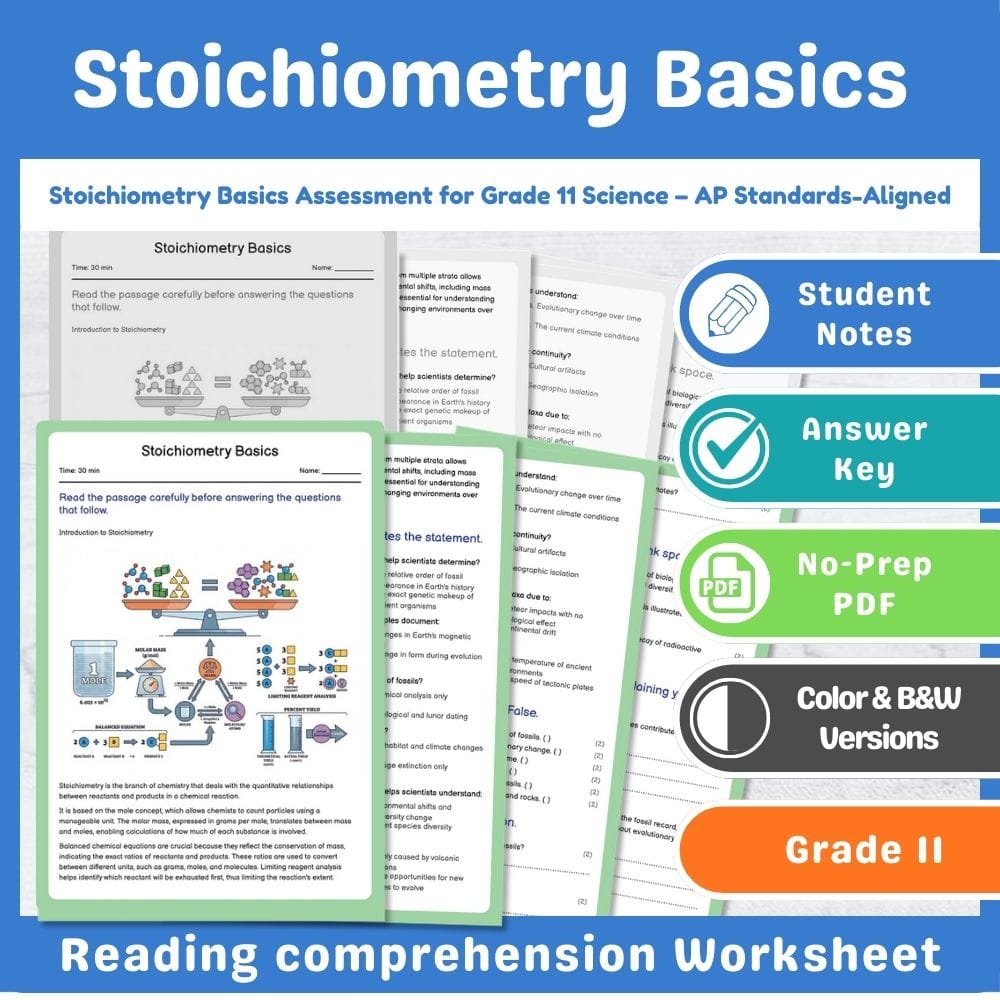
Stoichiometry Basics Assessment for Grade 11 Science – AP Standards-Aligned
Created byPrism Point LearningLearning Objectives
- Understand mole relationships and molar masses for chemical calculations.
- Interpret and balance chemical equations for mass and mole conversions.
- Apply limiting reagent concepts and calculate percent yield.
Instant download
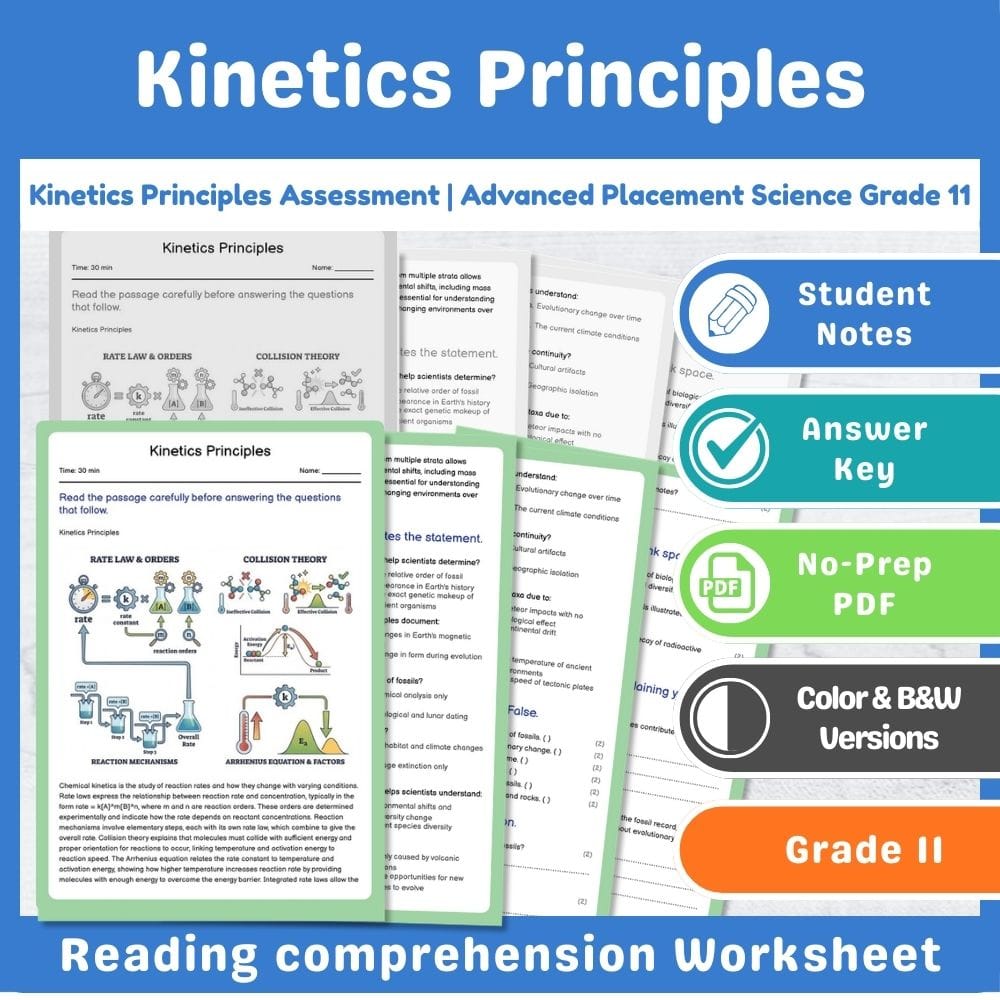
Kinetics Principles Assessment | Advanced Placement Science Grade 11
Created byPrism Point LearningLearning Objectives
- Understand how rate laws and reaction orders describe the speed of chemical reactions.
- Interpret integrated rate expressions and concentration–time graphs.
- Connect collision theory and transition state concepts to temperature dependence and activation energy.
Instant download
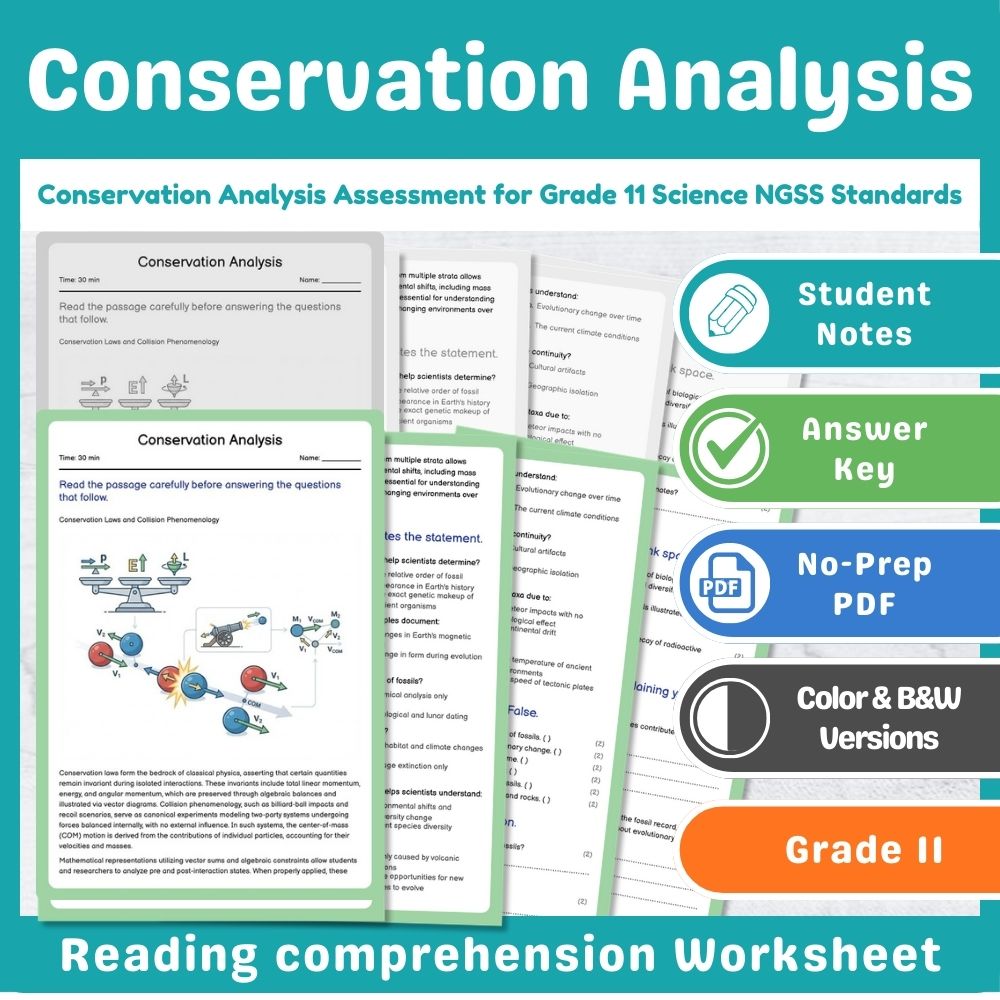
Conservation Analysis Assessment for Grade 11 Science NGSS Standards
Created byPrism Point LearningLearning Objectives
- Understand the principles of conservation laws in physics.
- Analyze collision phenomenology using algebraic balances and vector diagrams.
- Extract center-of-mass motion from system contributions and constraints.
Also included in: Grade 11 Physics Mini Bundle – Impulse, Forces & Conservation Assessment
Instant download

Model Validation Assessment for Grade 11 Science | AP Standards-Aligned
Created byPrism Point LearningLearning Objectives
- Understand methods for evaluating the credibility of scientific models.
- Identify techniques such as cross-validation, residual analysis, and dataset comparison.
- Evaluate the risks of overfitting and the importance of identifying limitations in models.
Also included in: Grade 11 Science Mini Bundle | AP Science Practices & Skills
Instant download
System Interactions Assessment | NGSS Standards Grade 11 Science
Created byPrism Point LearningLearning Objectives
- Understand Earth's major reservoirs and energy exchanges among atmosphere, hydrosphere, geosphere, and biosphere.
- Analyze the role of solar energy input and radiative balance in Earth's system.
- Describe mechanisms of heat transfer and feedbacks that influence system states over different timescales.
Instant download

Atomic Structure Assessment for Grade 11 Science | Alberta Standards
Created byPrism Point LearningLearning Objectives
- Describe the organization of protons, neutrons, and electrons within atoms.
- Explain how electron arrangements, including shells and valence electrons, influence reactivity and bonding.
- Identify atomic features of Alberta elements used in industry and their macroscopic chemical behaviors.
Also included in: Grade 11 Matter and Chemical Bonding Science Lesson Bundle for Alberta +1 more
Instant download
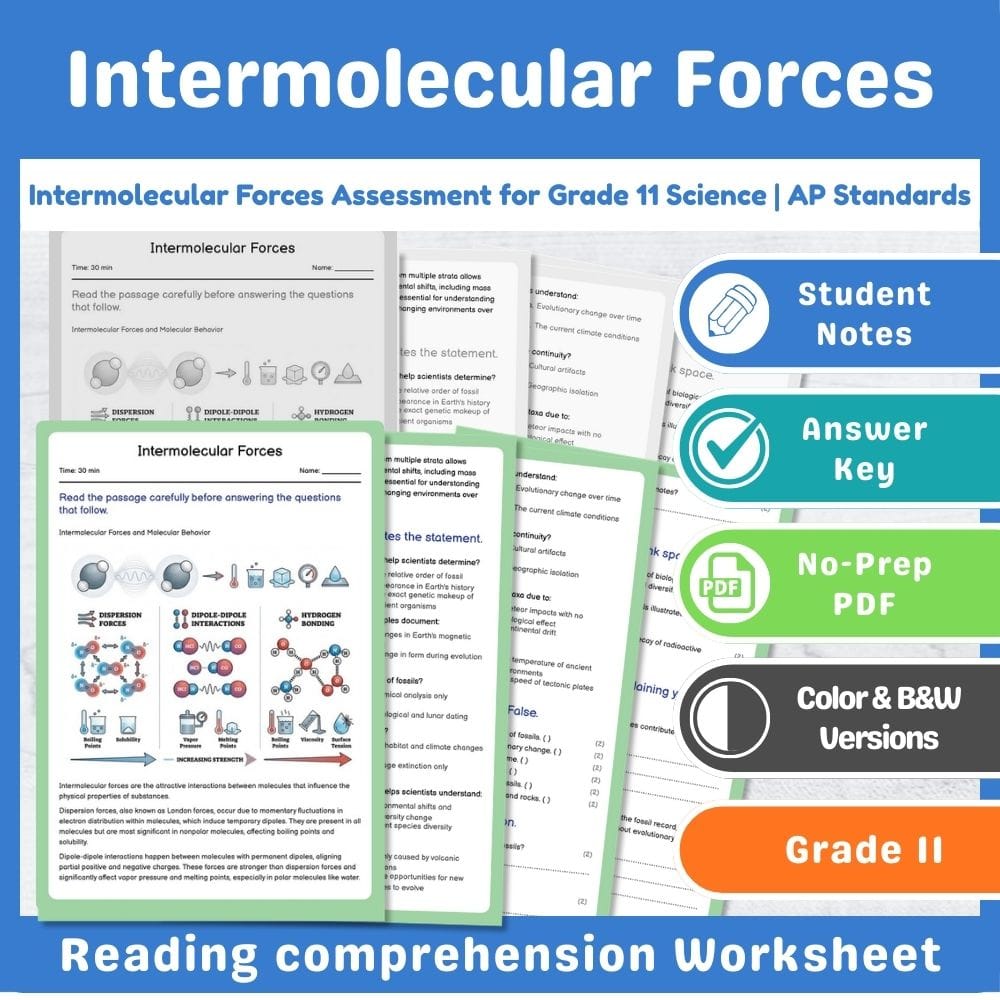
Intermolecular Forces Assessment for Grade 11 Science | AP Standards
Created byPrism Point LearningLearning Objectives
- Describe the different types of intermolecular forces: dispersion, dipole-dipole, and hydrogen bonding.
- Explain how intermolecular forces influence boiling point, vapor pressure, and solubility.
- Relate molecular polarity and surface interactions to phase behavior and macroscopic trends.
Instant download

Bonding Types Assessment | Alberta Standard Grade 11 Science Worksheet
Created byPrism Point LearningLearning Objectives
- Compare electron transfer, sharing, and delocalized models in bonding.
- Identify structural motifs linked to ionic, covalent, and metallic bonds.
- Relate bond types to properties such as electrical conductivity, hardness, and solubility.
Also included in: Grade 11 Matter and Chemical Bonding Science Lesson Bundle for Alberta +1 more
Instant download
Browse more categories
About Reading comprehension Worksheets
Find reading comprehension worksheets for class practice, homework, or self-study. All 40,284 are instant PDF downloads.
Each resource here is built by an independent educator and reviewed for quality. Worksheets print straight from PDF and suit classroom use, homework, or extra practice; most come with answer keys, and you can preview before purchasing.