
Reading comprehension Worksheets
40,284 type resources
Bonding Types Assessment | Alberta Standard Grade 11 Science Worksheet
 Created byPrism Point Learning
Learning Objectives
- Compare electron transfer, sharing, and delocalized models in bonding.
- Identify structural motifs linked to ionic, covalent, and metallic bonds.
- Relate bond types to properties such as electrical conductivity, hardness, and solubility.
Also included in: Grade 11 Matter and Chemical Bonding Science Lesson Bundle for Alberta +1 more
Instant download

Bond Polarity Assessment | Alberta Standards Grade 11 Science
Created byPrism Point LearningLearning Objectives
- Understand the concept of bond polarity and how it relates to partial charges and dipoles.
- Distinguish between polar bonds and polar molecules using examples like HCl and H2O.
- Explain the implications of bond polarity for solubility, pollutant transport, and solvent selection.
Also included in: Grade 11 Matter and Chemical Bonding Science Lesson Bundle for Alberta +1 more
Instant download

Advanced Models Assessment | Alberta Standards Grade 11 Science
Created byPrism Point LearningLearning Objectives
- Explain how molecular orbital theory accounts for delocalization, metallic conduction, and semiconductor behavior.
- Describe how band structure and molecular symmetry influence the spectroscopic features and reactivity of transition metal complexes.
- Assess the electronic properties of materials used in energy technologies through advanced bonding models.
Also included in: Grade 11 Matter and Chemical Bonding Science Lesson Bundle for Alberta +1 more
Instant download

Dispersion Forces Assessment for Grade 11 Science – Alberta Standards
Created byPrism Point LearningLearning Objectives
- Explain the concept of London dispersion forces and how they arise from transient electron fluctuations.
- Describe how atomic and molecular size and shape influence the strength of dispersion forces.
- Link the microscopic interactions of dispersion forces to macroscopic properties such as melting points, viscosity, and phase behavior in nonpolar substances.
Also included in: Grade 11 Matter and Chemical Bonding Science Lesson Bundle for Alberta +1 more
Instant download

Dipole Interactions Assessment for Grade 11 Science | Alberta Standards
Created byPrism Point LearningLearning Objectives
- Explain the concept of molecular polarity and its influence on intermolecular forces.
- Analyze how dipole-dipole interactions affect physical properties like boiling point and solubility.
- Describe real-world applications of dipole interactions in refinery processes and atmospheric chemistry.
Also included in: Grade 11 Matter and Chemical Bonding Science Lesson Bundle for Alberta +1 more
Instant download

VSEPR and Forces Assessment | Alberta Standards Grade 11 Science
Created byPrism Point LearningLearning Objectives
- Describe the VSEPR model and predict molecular geometries based on electron pair arrangements.
- Explain how molecular shapes influence intermolecular forces such as dipole interactions and hydrogen bonding.
- Relate molecular shape to physical properties like boiling and melting points, with real-world examples.
Also included in: Grade 11 Matter and Chemical Bonding Science Lesson Bundle for Alberta +1 more
Instant download

Empirical Formulas Assessment | Alberta Standards Grade 11 Science
Created byPrism Point LearningLearning Objectives
- Understand the concept of empirical formulas and how they represent the simplest whole-number ratio of elements in a compound.
- Learn how to convert mass percent data into mole ratios for empirical formula determination.
- Apply molar calculations to derive empirical and molecular formulas from compositional data.
Also included in: Grade 11 Chemical Reactions & Stoichiometry Science Lesson Bundle – Alberta +1 more
Instant download

Gas Stoichiometry Assessment for Grade 11 Science | Alberta Standards
Created byPrism Point LearningLearning Objectives
- Understand the application of gas laws in stoichiometric calculations involving gases.
- Relate pressure, volume, and temperature conditions to mole quantities of gases.
- Calculate gas volumes under standard and non-standard conditions for industrial or environmental contexts.
Also included in: Grade 11 Chemical Reactions & Stoichiometry Science Lesson Bundle – Alberta +1 more
Instant download

Solution Stoichiometry Assessment | Alberta Standards Grade 11 Science
Created byPrism Point LearningLearning Objectives
- Understand how to use concentration measures like molarity to determine quantities of reactants and products in aqueous reactions.
- Apply mole relationships and equivalence principles to solve solution-based stoichiometry problems.
- Use mass conservation and volume-mole conversions to predict outcomes of chemical reactions in solution.
Also included in: Grade 11 Chemical Reactions & Stoichiometry Science Lesson Bundle – Alberta +1 more
Instant download

Titration Theory Assessment for Grade 11 Science | Alberta Standards
Created byPrism Point LearningLearning Objectives
- Explain the principles and process of titration in quantitative analysis.
- Identify the importance of proper calibration and indicator selection during titration.
- Calculate unknown concentrations using titrant volume and concentration relationships.
Also included in: Grade 11 Chemical Reactions & Stoichiometry Science Lesson Bundle – Alberta +1 more
Instant download

Ionic Strength Assessment | Alberta Standards Grade 11 Science
Created byPrism Point LearningLearning Objectives
- Understand the concept of ionic strength and how it relates to ion concentration and charge.
- Explain how ionic strength affects activity coefficients and solubility in solutions.
- Analyze real-world examples of ionic strength effects in natural waters and industrial processes.
Also included in: Grade 11 Solutions and Solubility Science Lesson Bundle | Alberta Framework +1 more
Instant download

Temperature Effects Assessment | Alberta Standards Grade 11 Science
Created byPrism Point LearningLearning Objectives
- Understand key concepts related to Science
- Apply knowledge through practice questions
- Demonstrate comprehension of the material
Also included in: Grade 11 Solutions and Solubility Science Lesson Bundle | Alberta Framework +1 more
Instant download

Solution Stoichiometry Assessment | Alberta Standards Grade 11 Science
Created byPrism Point LearningLearning Objectives
- Explain the concept of molarity and its role in solution stoichiometry.
- Calculate reactant and product quantities using mole-mole relationships in aqueous solutions.
- Identify limiting reagents in solution reactions based on concentration and stoichiometry.
Also included in: Grade 11 Solutions and Solubility Science Lesson Bundle | Alberta Framework +1 more
Instant download

Lewis Structures Assessment | Alberta Standard Assessment Grade 11 Science
Created byPrism Point LearningLearning Objectives
- Understand the concept of Lewis electron-dot structures for molecules.
- Identify how to represent shared electrons and bonds.
- Interpret Lewis structures to predict molecular shapes and properties.
Also included in: Grade 11 Matter and Chemical Bonding Science Lesson Bundle for Alberta +1 more
Instant download

Phase Behaviour Assessment | Alberta Standard Grade 11 Science
Created byPrism Point LearningLearning Objectives
- Understand the concept of phase behaviour and phase diagrams.
- Identify the different phases of matter and their transitions under varying conditions.
- Interpret phase diagrams to determine phase changes at specific temperature and pressure points.
Also included in: Grade 11 Matter and Chemical Bonding Science Lesson Bundle for Alberta +1 more
Instant download

Period Trends and Chemical Interactions Assessment | Alberta Grade 11 Science
Created byPrism Point LearningLearning Objectives
- Explain how atomic radius, ionization energy, and electronegativity vary across the periodic table.
- Describe how these trends influence element bonding preferences and material properties.
- Connect periodic patterns to practical examples like corrosion and alloy selection.
Also included in: Grade 11 Matter and Chemical Bonding Science Lesson Bundle for Alberta +1 more
Instant download

Adaptive Radiation Assessment | TEKS Standards Grade 11 Science
Created byPrism Point LearningLearning Objectives
- Understand the concept of adaptive radiation and its role in biodiversity.
- Identify ecological factors that trigger adaptive radiation.
- Analyze morphological and behavioral adaptations in different species.
Also included in: Grade 11 Evolution, Speciation & Phylogeny Science Lesson Bundle | TEKS
Instant download

Genetic Drift Assessment | TEKS Standards Grade 11 Science
Created byPrism Point LearningLearning Objectives
- Understand the concept of genetic drift and how it causes changes in allele frequencies.
- Identify the effects of bottleneck and founder events on populations.
- Differentiate between genetic drift and natural selection in evolutionary processes.
Also included in: Grade 11 Evolution, Speciation & Phylogeny Science Lesson Bundle | TEKS
Instant download

Calvin Cycle Assessment for Grade 11 Science TEKS Standards
Created byPrism Point LearningLearning Objectives
- Understand the steps and enzymes involved in the Calvin cycle.
- Explain the role of ATP and NADPH in carbon fixation and reduction.
- Identify the output molecules of the Calvin cycle and their significance.
Also included in: Grade 11 Photosynthesis and Respiration Science Lesson Bundle | TEKS
Instant download

Grade 11 Science | Momentum Conservation Worksheet | California Standards
 Created byLumora Learning
Learning Objectives
- Explain momentum as a vector quantity and use p = mv to predict direction and magnitude of motion.
- Apply conservation of momentum to analyze collisions and interactions in isolated systems.
- Connect impulse to changes in momentum and interpret action–reaction force pairs.
Instant download

Grade 6 Science | Decomposition Recycling Worksheet | NGSSS Aligned
Created byLumora LearningLearning Objectives
- Explain how decomposers (fungi and bacteria) break down dead organisms and waste
- Describe how decomposition returns nutrients to the environment for producers to use again
- Identify factors that affect the rate of decomposition (oxygen, moisture, temperature, and surface area)
Instant download

Grade 10 Science | Optimizing Design Worksheet Elena | California Standards
Created byLumora LearningLearning Objectives
- Explain how optimization uses criteria and constraints to guide engineering design choices
- Identify trade-offs involved in bridge truss optimization (strength, weight, cost, and constructability)
- Apply optimization reasoning to evaluate whether a design meets required limits
Instant download

Grade 12 Science | Natural Selection Worksheet Elena | California Standards
Created byLumora LearningLearning Objectives
- Explain how heritable variation and differential reproductive success drive changes in allele frequencies over generations.
- Analyze how environmental pressures (climate, predators, pathogens, and competition) can shift trait distributions within populations.
- Differentiate natural selection from the idea that organisms adapt by changing their genes during their lifetimes.
Instant download
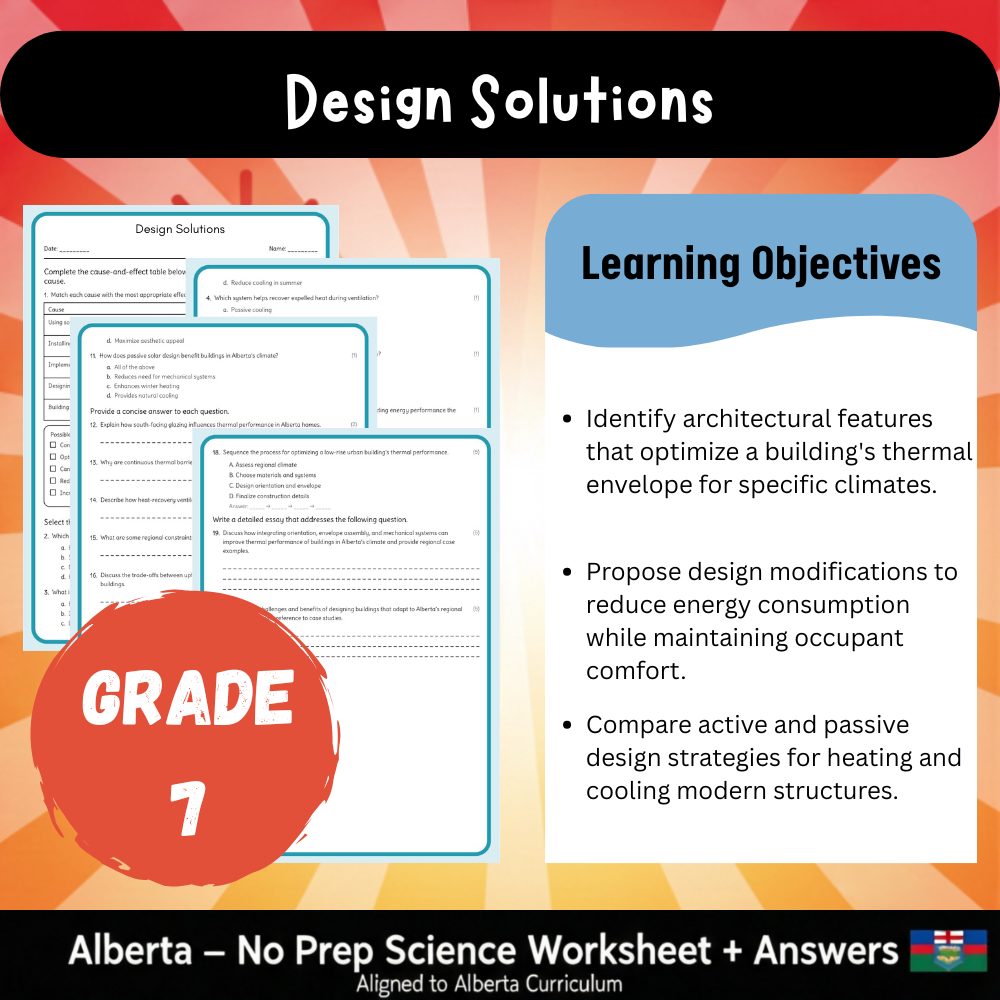
Grade 7 Science | Design Solutions Worksheet (PDF) – Alberta Standards
 Created byBright Mind Resources
Learning Objectives
- Understand how building design strategies influence thermal performance in Alberta's climate zones.
- Identify specific design components such as passive solar gains, thermal barriers, and ventilation.
- Evaluate case examples illustrating trade-offs between materials, energy, and comfort.
Instant download

Grade 7 Science | Introduction to Net Force - Daily Reading Comprehension
 Created byCoral Reef Learning
Learning Objectives
- Understand the concept of net force as the vector sum of all forces acting on an object.
- Identify different types of forces such as frictional and applied forces.
- Explain how unbalanced forces cause changes in motion.
Instant download

Grade 7 Science | Freshwater Dynamics - Daily Reading Comprehension
Created byCoral Reef LearningLearning Objectives
- Identify major features of freshwater ecosystems
- Understand stratification, oxygen gradients, and light penetration in ponds and lakes
- Explain how abiotic gradients influence community composition and vertical zonation
Instant download

Grade 7 Science | Decomposition Cycles in Ecosystems - Reading Comprehension
Created byCoral Reef LearningLearning Objectives
- Understand the process of decomposition and its role in nutrient cycling.
- Identify key organisms involved in decomposition such as detritivores, fungi, and bacteria.
- Explain how abiotic factors influence decomposition rates.
Instant download

Grade 7 Science | Invasive Species Impacts - Daily Reading Comprehension
Created byCoral Reef LearningLearning Objectives
- Understand what invasive species are and how they enter new environments.
- Identify pathways of invasive species introduction.
- Recognize ecological and economic consequences of invasive species.
Instant download

Grade 7 Science | Population Limits - Daily Reading Comprehension
Created byCoral Reef LearningLearning Objectives
- Understand the basic concepts of population growth models such as exponential and logistic growth.
- Identify limiting factors that influence population size, including food availability, predation, disease, and environmental stresses.
- Distinguish between density-dependent and density-independent factors affecting populations.
Instant download

Grade 7 Science | Human Impacts on Environment - Daily Reading Comprehension
Created byCoral Reef LearningLearning Objectives
- Understand the causes of deforestation and how it affects ecosystems.
- Analyze data and scientific indicators related to human impacts.
- Evaluate various mitigation strategies to reduce environmental damage.
Instant download

Grade 7 Science | Cell Evidence Exploring Plant Cells - Daily Reading Practice
Created byCoral Reef LearningLearning Objectives
- Identify and describe the key structures of plant cells observed under a microscope.
- Differentiate between cell boundaries such as plasma membranes and cell walls.
- Understand the hierarchical organization from cells to tissues and organs.
Instant download

Grade 7 Science | Effects of Disturbance on Ecosystems - Reading Comprehension
Created byCoral Reef LearningLearning Objectives
- Understand how wildfires impact forest ecosystems.
- Identify the mechanisms of ecosystem resilience and resistance.
- Interpret data on population changes following disturbances.
Instant download

Grade 7 Science | Materials in Modern Construction - Reading Comprehension
Created byCoral Reef LearningLearning Objectives
- Understand the microstructure of engineered timber and its influence on strength and durability.
- Identify different advanced construction materials such as cross-laminated timber, fibre-reinforced polymers, and high-performance concrete.
- Explain how manufacturing processes affect the properties and performance of novel materials.
Instant download

Grade 7 Science | Durability Factors in Materials - Daily Reading Comprehension
Created byCoral Reef LearningLearning Objectives
- Understand the factors that lead to corrosion in metals
- Identify environmental conditions that affect material durability
- Learn preventive measures for material degradation
Instant download

Grade 7 Science | Plate Tectonics - Daily Reading Comprehension
Created byCoral Reef LearningLearning Objectives
- Understand key concepts related to Science
- Apply knowledge through practice questions
- Demonstrate comprehension of the material
Instant download

Grade 7 Science | Load Path Basics Daily Reading Comprehension
Created byCoral Reef LearningLearning Objectives
- Understand the concept of load paths in structures.
- Identify the primary components involved in load transfer.
- Distinguish between dead loads and live loads.
Instant download

Grade 7 Science | Member Behaviour in Structural Engineering - Comprehension
Created byCoral Reef LearningLearning Objectives
- Understand how structural members respond to various loads through bending, shear, axial force, and torsion.
- Relate the geometry and support conditions of beams and columns to internal force distribution.
- Describe the effects of bending moment and shear force on beam deflection and serviceability.
Instant download

Grade 7 Science | Surface Processes - Daily Reading Comprehension
Created byCoral Reef LearningLearning Objectives
- Understand the different types of weathering that modify Earth's surface.
- Identify examples of mechanical and chemical weathering.
- Describe how erosion and deposition shape landforms over time.
Instant download

Grade 7 Science | Structural Optimization in Engineering - Reading Comprehension
Created byCoral Reef LearningLearning Objectives
- Understand the basic principles of structural optimization in engineering.
- Recognize different strategies used to optimize structural designs for efficiency, cost, and performance.
- Learn about topology and form optimization, life-cycle assessment, and constructability constraints.
Instant download

Grade 7 Science | Convection & Fluids - Daily Reading Comprehension
Created byCoral Reef LearningLearning Objectives
- Understand the concept of convection and how it transfers heat in fluids.
- Recognize examples of convection in natural environments such as air and water.
- Explain the roles of buoyancy, density variations, and temperature gradients in convection.
Instant download

Grade 7 Science | Gravitational Forces - Daily Reading Comprehension
Created byCoral Reef LearningLearning Objectives
- Learn how gravity is a long-range force that acts without contact.
- Understand how mass and distance influence gravitational attraction.
- Recognize examples of gravity in everyday life, such as falling objects and planetary motion.
Instant download

Grade 7 Science | Instrumentation Accuracy in Temperature Measurement
Created byCoral Reef LearningLearning Objectives
- Understand different types of temperature sensors used in environmental contexts.
- Identify factors affecting sensor response time and measurement accuracy.
- Learn about calibration, uncertainty, and error sources in temperature measurements.
Instant download

Grade 7 Science | Insulation Principles - Daily Reading Comprehension
Created byCoral Reef LearningLearning Objectives
- Identify different types of thermal insulation materials
- Explain how insulation reduces heat transfer
- Compare the effectiveness of fibreglass, foam, and reflective foil
Instant download

Grade 7 Science | Modes of Transfer - Daily Reading Comprehension
Created byCoral Reef LearningLearning Objectives
- Identify and describe conduction as a mode of heat transfer
- Understand the molecular mechanisms behind conduction
- Differentiate conduction from convection and radiation
Instant download

Grade 7 Science | Reflective Surfaces & Radiative Heat Management -Comprehension
Created byCoral Reef LearningLearning Objectives
- Understand the properties of reflective and emissive surfaces.
- Identify different materials and coatings used for reflection.
- Explain the impact of surface color and coatings on heat absorption.
Instant download

Grade 7 Science | Understanding Speed - Daily Reading Comprehension
Created byCoral Reef LearningLearning Objectives
- Define average speed and distinguish it from instantaneous speed.
- Calculate average speed using distance and time data.
- Convert speed units between meters per second and kilometers per hour.
Instant download

Grade 7 Science | Understanding Net Force - Daily Reading Comprehension
Created byCoral Reef LearningLearning Objectives
- Define net force and explain its role in motion.
- Identify different forces acting on systems such as an elevator, tug-of-war, and a cart on a ramp.
- Describe how vector addition determines net force in simple systems.
Instant download

Grade 7 Science | Technical Communication in Science - Reading Comprehension
Created byCoral Reef LearningLearning Objectives
- Understand the purpose and different types of technical drawings.
- Identify common conventions used in schematic symbols and orthographic drawings.
- Recognize standardized units, labels, and notation in technical documentation.
Instant download
Browse more categories
About Reading comprehension Worksheets
Find reading comprehension worksheets for class practice, homework, or self-study. All 40,284 are instant PDF downloads.
Each resource here is built by an independent educator and reviewed for quality. Worksheets print straight from PDF and suit classroom use, homework, or extra practice; most come with answer keys, and you can preview before purchasing.