
Reading comprehension Worksheets
40,284 type resources
Work And Power Assessment for Grade 12 Science – Florida NGSSS
 Created byPrism Point Learning
Learning Objectives
- Explain how work depends on force magnitude and the angle between force and displacement
- Use the relationship between work and changes in mechanical energy to interpret real situations
- Calculate power from energy transfer rate and connect it to how quickly work is done
Also included in: Grade 12 Momentum, Energy, and Reactions Science Assessment Lesson Bundle – Florida NGSSS +1 more
Instant download
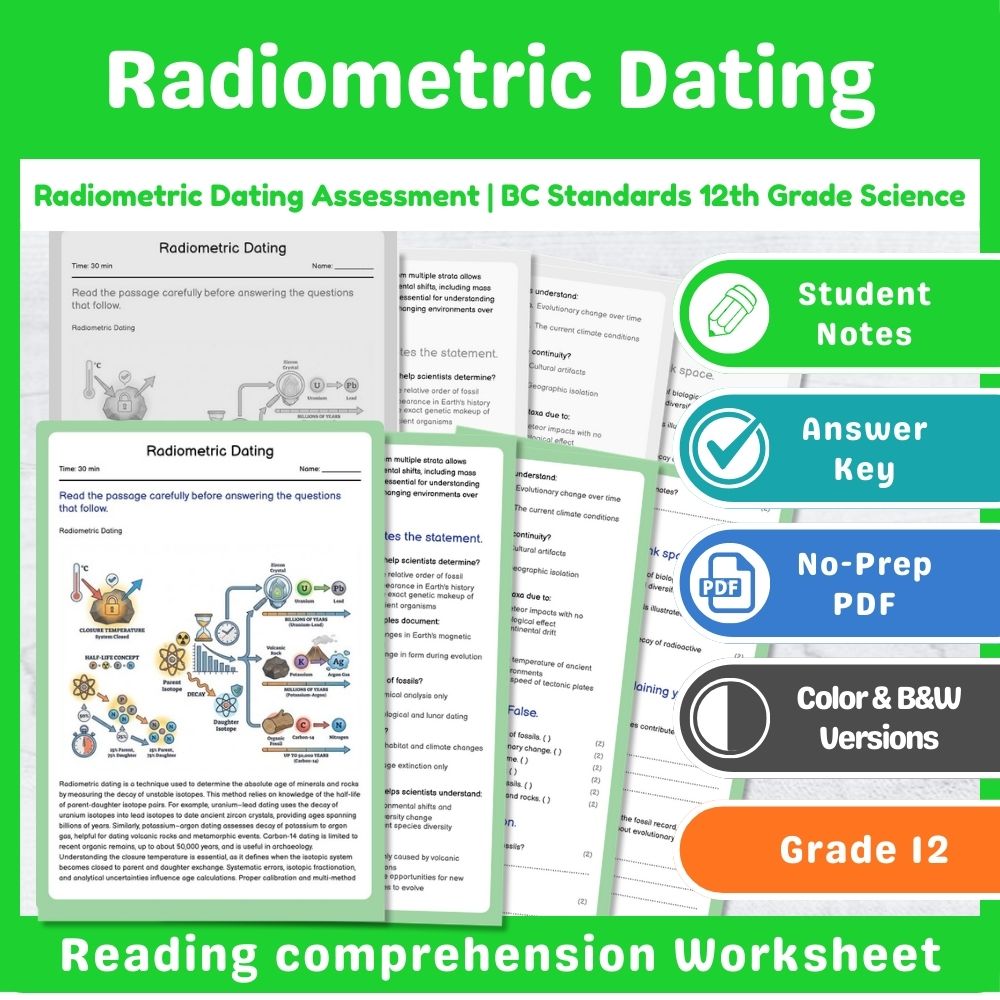
Radiometric Dating Assessment | BC Standards 12th Grade Science
Created byPrism Point LearningLearning Objectives
- Understand the principles of radiometric dating and isotopic decay.
- Identify different radiometric dating methods and their applications.
- Analyze factors affecting the accuracy of radiometric age determinations.
Also included in: Grade 12 Science Mini Bundle – Plate Tectonics & Geoscience Assessment
Instant download

Momentum Collisions Assessment | NGSSS Standards Grade 12 Science
Created byPrism Point LearningLearning Objectives
- Explain momentum conservation in a closed system and how direction (sign) affects calculations.
- Differentiate elastic and inelastic collisions using kinetic energy and momentum conservation.
- Use conservation of momentum to predict post-collision velocities in one-dimensional scenarios.
Also included in: Grade 12 Momentum, Energy, and Reactions Science Assessment Lesson Bundle – Florida NGSSS +1 more
Instant download
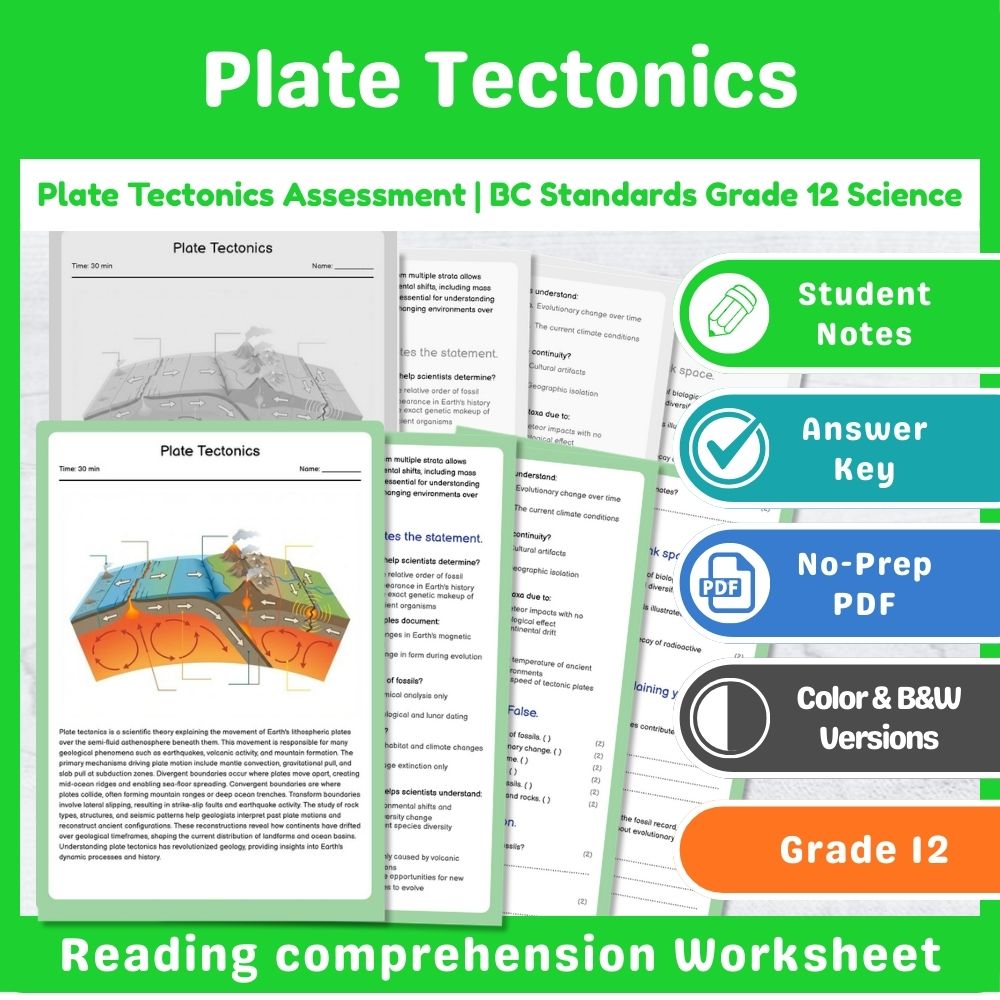
Plate Tectonics Assessment | BC Standards Grade 12 Science
Created byPrism Point LearningLearning Objectives
- Understand the fundamental concepts of plate tectonics and the mechanisms driving the movement of Earth's lithospheric plates.
- Identify different types of plate boundaries and associated geological features.
- Interpret structural relationships and distribution of rocks to reconstruct past plate configurations.
Also included in: Grade 12 Science Mini Bundle – Plate Tectonics & Geoscience Assessment
Instant download

Adaptation Over Time Assessment – NGSSS Standards-Aligned for Grade 12 Science
Created byPrism Point LearningLearning Objectives
- Explain how heritable variation and differential fitness lead to changes in allele frequencies over generations
- Distinguish directional selection from habitat-dependent variation in adaptation
- Analyze how ecological context influences which traits become more common in a population
Also included in: Lesson Bundle Grade 12 Genetics and Evolution Science: Florida NGSSS +1 more
Instant download

Societal Tradeoffs Assessment for Grade 12 Science TEKS Standards
Created byPrism Point LearningLearning Objectives
- Analyze societal implications of scientific and technological choices.
- Evaluate trade-offs related to benefits, harms, and distributional effects.
- Assess case examples such as energy transitions, vaccine distribution, and data privacy.
Also included in: Grade 12 Science Technology and Society Science Lesson Bundle: TEKS
Instant download
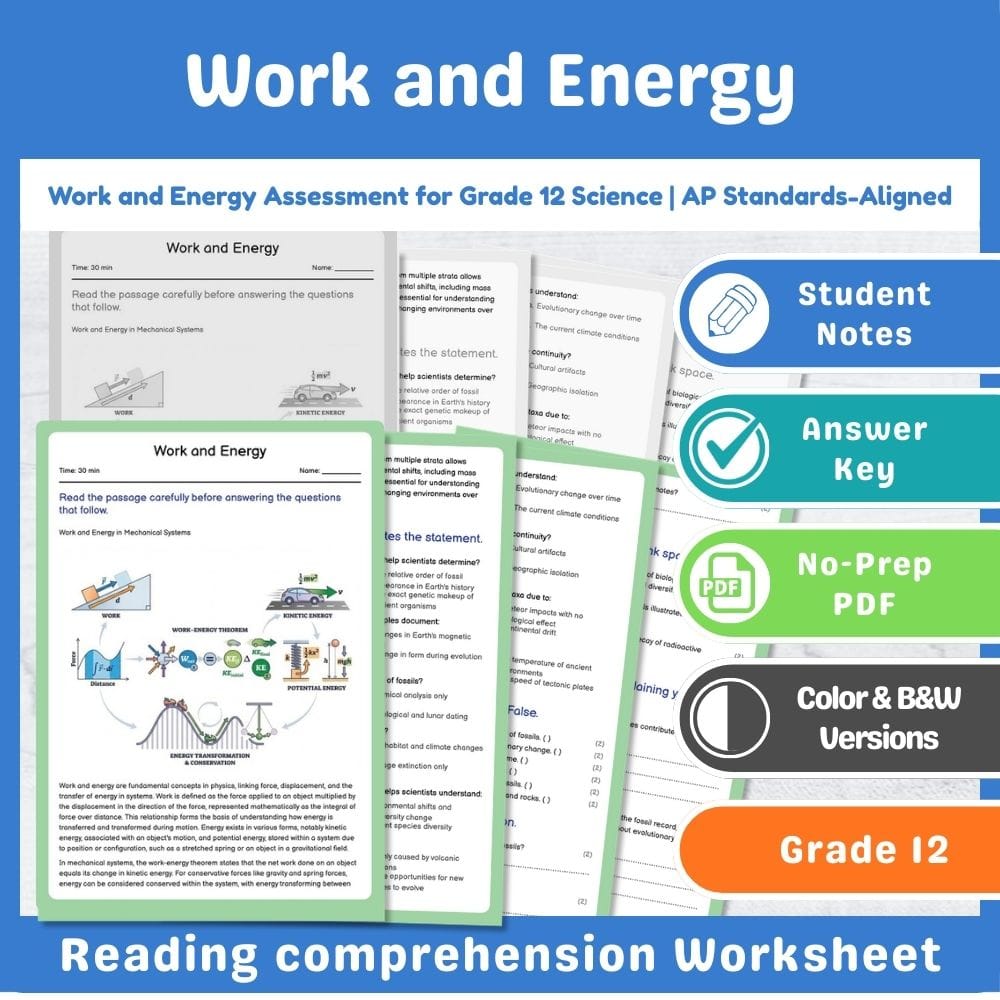
Work and Energy Assessment for Grade 12 Science | AP Standards-Aligned
Created byPrism Point LearningLearning Objectives
- Understand the concepts of work, energy, and power in mechanical systems.
- Apply force-displacement integrals to derive kinetic and potential energy.
- Differentiate between conservative and nonconservative forces and their effects on energy.
Also included in: Grade 12 Science Mini Bundle | Physics Principles AP Standards-Aligned
Instant download

Iterative Design Cycles Assessment | General Standards Grade 12 Science
Created byPrism Point LearningLearning Objectives
- Explain how iterative design cycles use criteria, constraints, and evidence to improve a solution.
- Identify the difference between early assumptions and evidence-based revisions in an engineering design process.
- Apply iterative design reasoning to a real-world product problem, such as preventing leaks in a sports water bottle lid.
Instant download
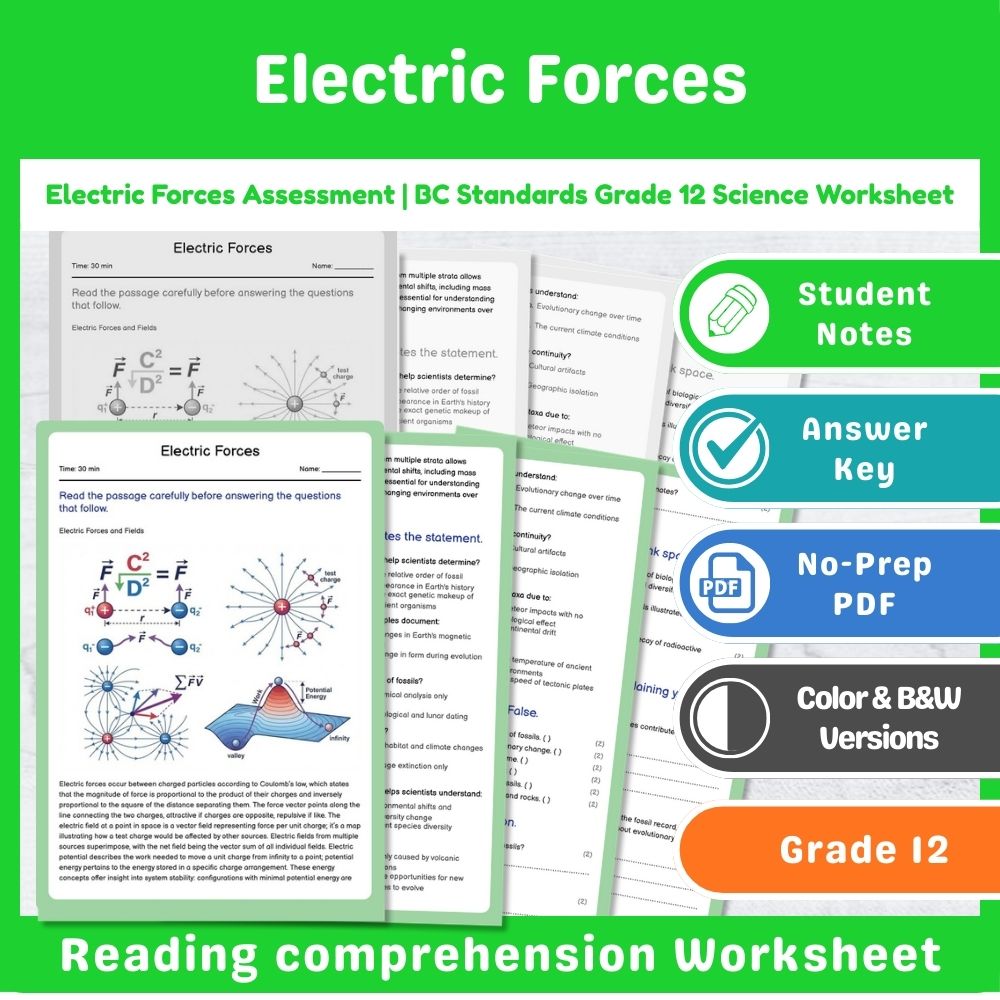
Electric Forces Assessment | BC Standards Grade 12 Science Worksheet
Created byPrism Point LearningLearning Objectives
- Explain Coulomb’s law and how it determines the magnitude and direction of electric forces between point charges.
- Describe the concept of electric field as a spatial force distribution and understand superposition of fields.
- Define electric potential and potential energy, and analyze energy configurations of charged systems.
Also included in: Grade 12 Science Wave & Quantum Assessment Mini Bundle – BC Standards
Instant download
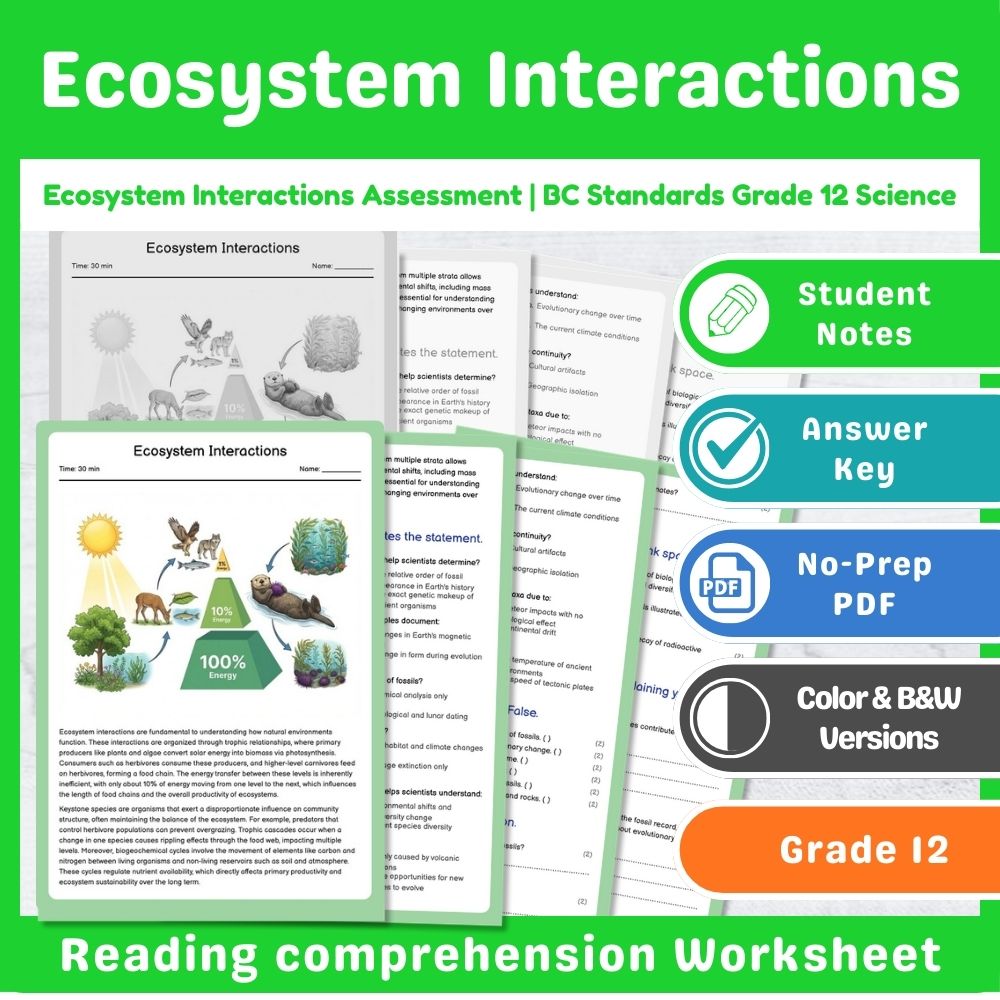
Ecosystem Interactions Assessment | BC Standards Grade 12 Science
Created byPrism Point LearningLearning Objectives
- Explain the flow of energy through trophic levels and its impact on ecosystem productivity.
- Identify key species and their roles within ecological communities, including keystone species.
- Describe trophic cascades and how changes at one level affect others.
Also included in: Grade 12 Science Mini Bundle – Genetics & Evolution Assessment Pack
Instant download
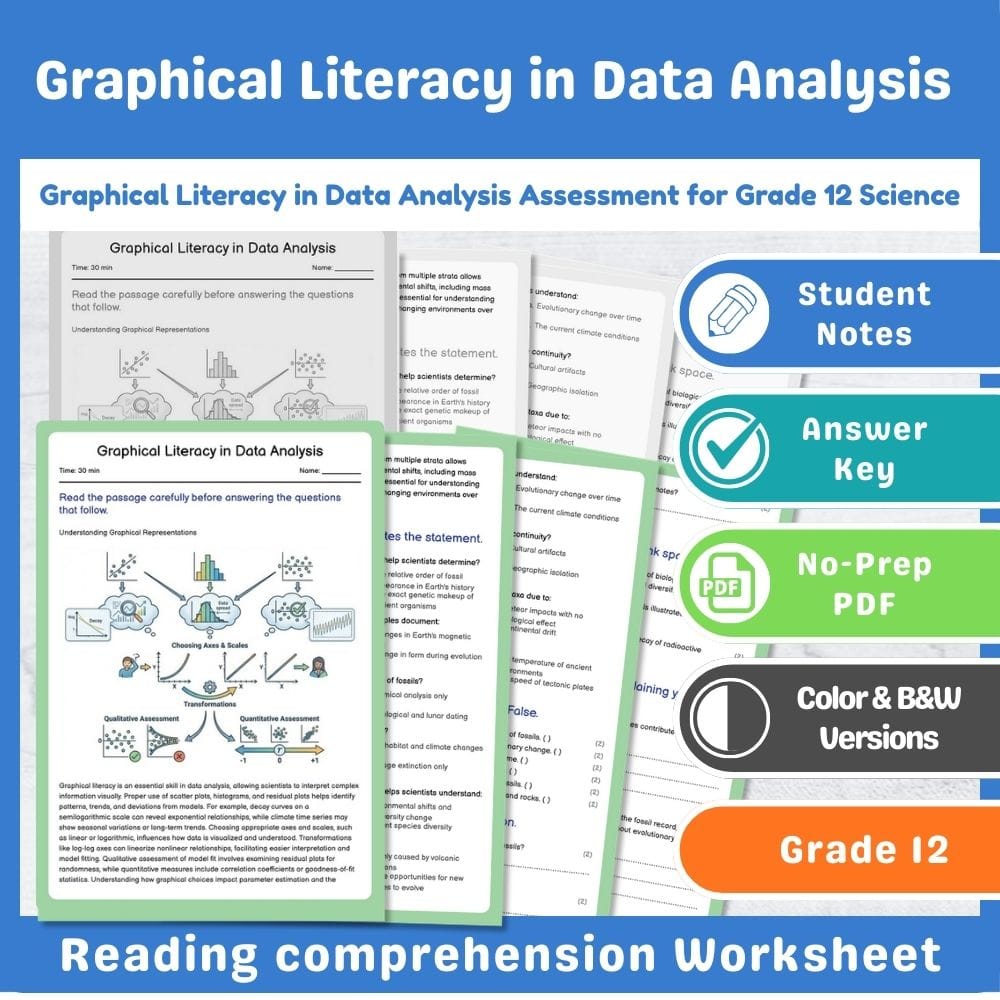
Graphical Literacy in Data Analysis Assessment for Grade 12 Science
Created byPrism Point LearningLearning Objectives
- Explain and interpret conventions used in various graphical representations such as scatter plots, histograms, and residual plots.
- Identify trends, scale choices, and transformations in graphical data to make informed conclusions.
- Assess the quality of model fits visually and quantitatively, understanding how graphical choices affect analysis outcomes.
Instant download

Genetic Variation Assessment for Grade 12 Science BC Standards
Created byPrism Point LearningLearning Objectives
- Understand the mechanisms that generate genetic variation, including mutations and recombination.
- Explain how genetic variation influences phenotypes and evolution.
- Compare Mendelian inheritance with polygenic inheritance and gene interactions.
Also included in: Grade 12 Science Mini Bundle – Genetics & Evolution Assessment Pack
Instant download

Innovation Pathways Assessment | TEKS Standards Grade 12 Science
Created byPrism Point LearningLearning Objectives
- Understand the process of translating scientific discoveries into market-ready technologies.
- Identify key components such as intellectual property, patenting, and commercialization models.
- Analyze the roles of research funding, industry partnerships, and regulatory constraints in innovation.
Also included in: Grade 12 Science Technology and Society Science Lesson Bundle: TEKS
Instant download
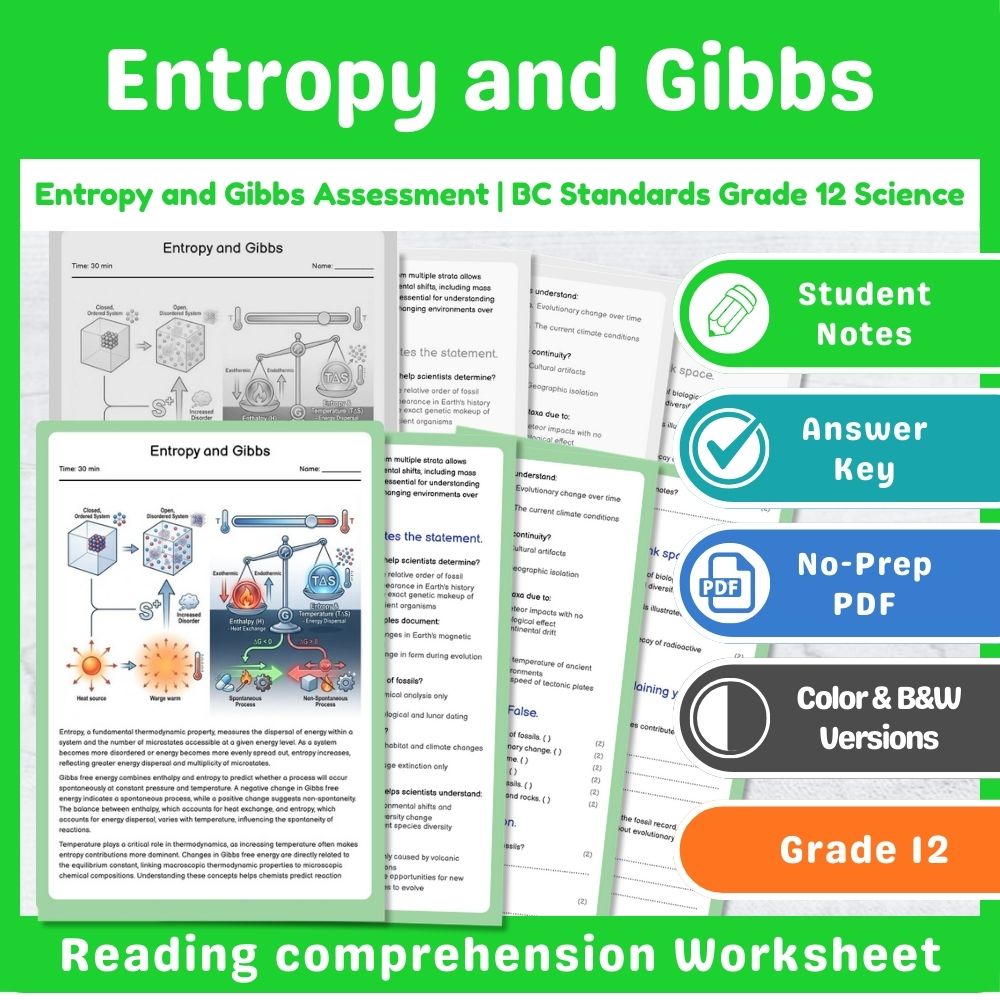
Entropy and Gibbs Assessment | BC Standards Grade 12 Science
Created byPrism Point LearningLearning Objectives
- Explain the concept of entropy and how it relates to energy dispersal and microstates.
- Describe Gibbs free energy and its role in predicting the spontaneity of chemical reactions.
- Analyze how enthalpy and entropy contributions influence temperature-dependent spontaneity.
Also included in: Grade 12 Science Mini Bundle – Thermochemistry & Equilibrium Assessment
Instant download

Historical Context in Science Assessment | TEKS Grade 12 Science
Created byPrism Point LearningLearning Objectives
- Analyze how historical events influenced scientific development and societal change.
- Identify key examples of scientific advancements and their societal impacts.
- Evaluate the patterns of technological diffusion and public perception over time.
Also included in: Grade 12 Science Technology and Society Science Lesson Bundle: TEKS
Instant download

Systems Overview Assessment | AP Science Grade 12 Standards-Aligned
Created byPrism Point LearningLearning Objectives
- Describe the major components of Earth's systems and their interactions.
- Explain the flow of energy and mass across atmosphere, hydrosphere, biosphere, and geosphere.
- Interpret conceptual models of steady-state and transient responses in Earth systems.
Instant download
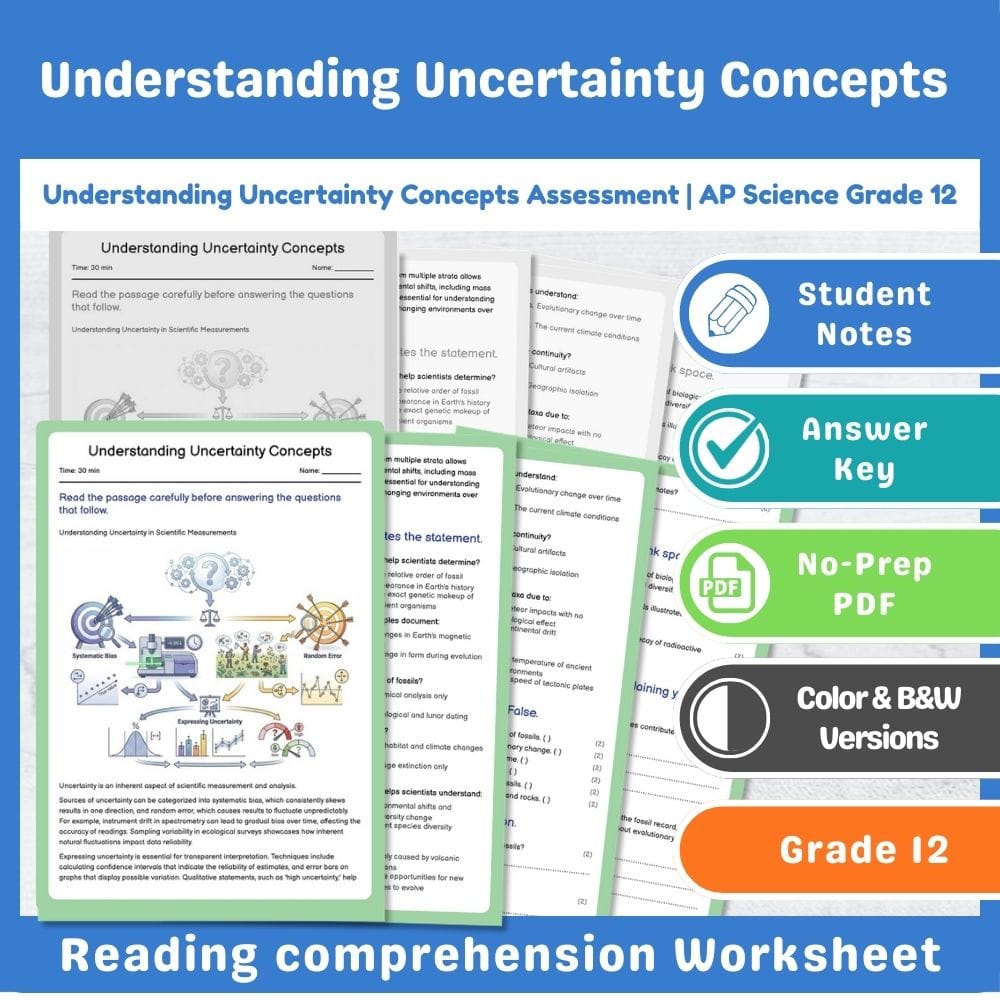
Understanding Uncertainty Concepts Assessment | AP Science Grade 12
Created byPrism Point LearningLearning Objectives
- Identify different sources and types of uncertainty in scientific contexts.
- Distinguish between systematic bias, random error, and conceptual model uncertainty.
- Explain exemplars such as instrument drift and sampling variability to illustrate propagation effects.
Instant download
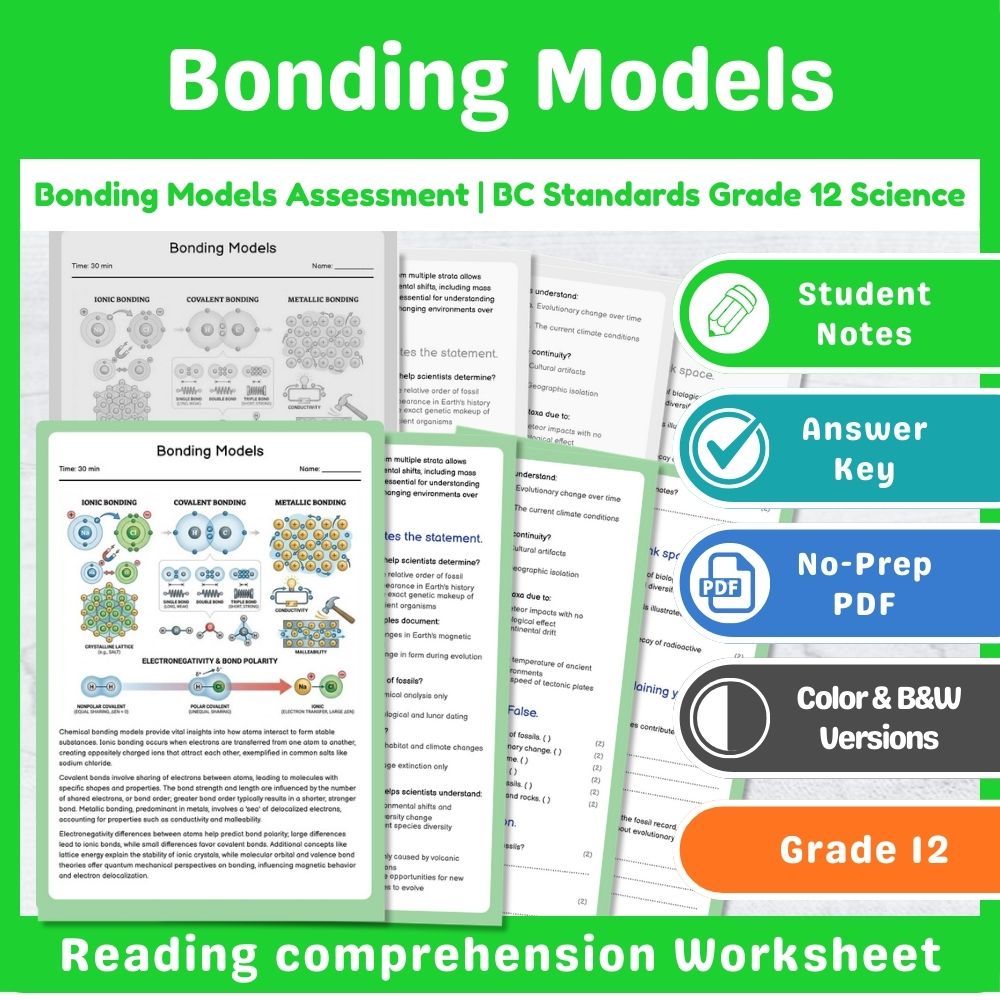
Bonding Models Assessment | BC Standards Grade 12 Science
Created byPrism Point LearningLearning Objectives
- Understand different models of chemical bonding and how they explain the behavior of atoms in molecules.
- Identify the principles behind ionic, covalent, and metallic bonding, including how electrons are shared or transferred.
- Explain how electronegativity differences predict bond polarity and how bond order and energy relate to bond length and strength.
Also included in: Grade 12 Science Mini Bundle – Thermochemistry & Equilibrium Assessment
Instant download
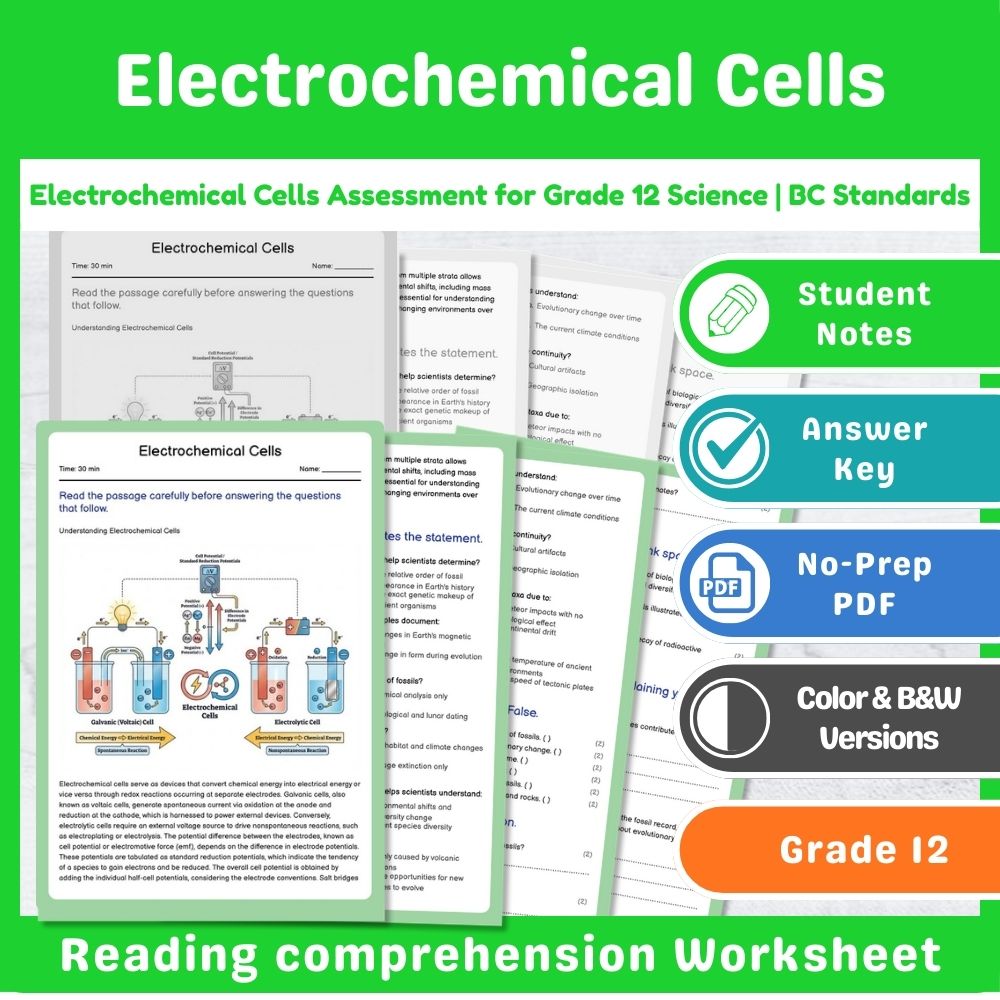
Electrochemical Cells Assessment for Grade 12 Science | BC Standards
Created byPrism Point LearningLearning Objectives
- Understand the principles of galvanic and electrolytic cells, including redox reactions and electrode processes.
- Calculate cell potential using standard reduction potentials and understand how to analyze galvanic and electrolytic systems.
- Explain the roles of salt bridges, electrode conventions, and potential differences in electrochemical reactions.
Also included in: Grade 12 Science Mini Bundle – Thermochemistry & Equilibrium Assessment
Instant download
Cellular Energy Pathways Assessment | NGSS-Aligned Grade 11 Science
Created byPrism Point LearningLearning Objectives
- Describe the sequence of energy transformations during cellular respiration, including glycolysis, pyruvate oxidation, the citric acid cycle, and oxidative phosphorylation.
- Explain the role of electron transport chains and proton gradients in ATP production within mitochondria.
- Calculate the approximate energy yield from different substrates used in cellular respiration and relate this to organism metabolic rates and resource consumption.
Instant download
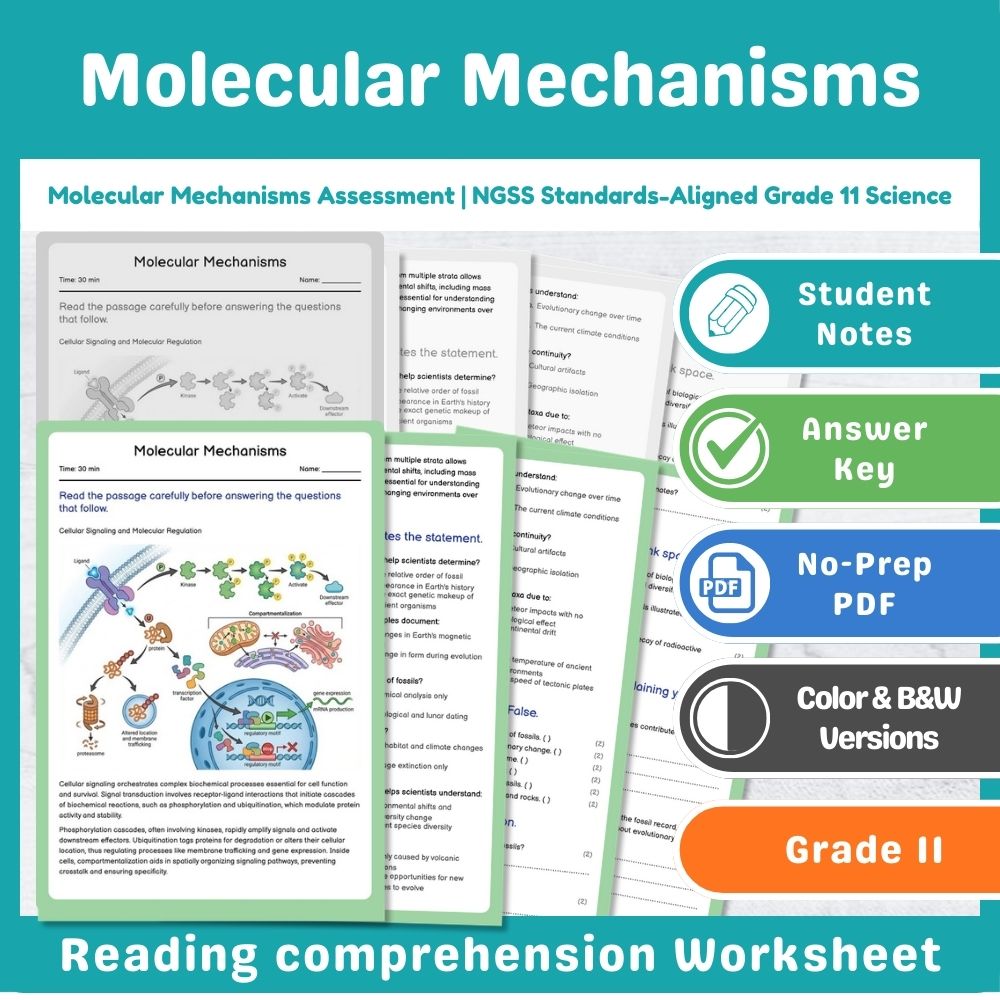
Molecular Mechanisms Assessment | NGSS Standards-Aligned Grade 11 Science
Created byPrism Point LearningLearning Objectives
- Explain the biochemical mechanisms involved in cellular signaling pathways.
- Identify key motifs and processes such as phosphorylation cascades, ubiquitination, and transcriptional regulation.
- Describe how intracellular compartmentalization and membrane transport influence molecular mechanisms.
Instant download
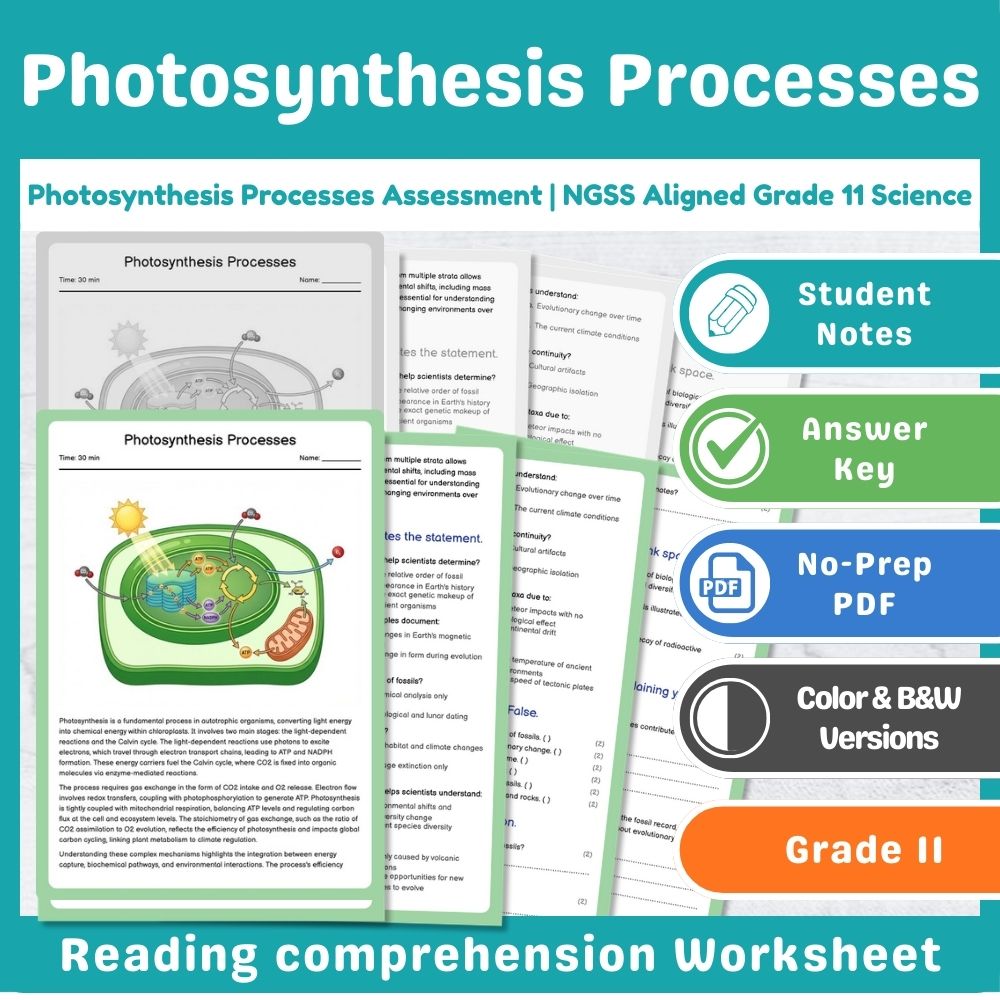
Photosynthesis Processes Assessment | NGSS Aligned Grade 11 Science
Created byPrism Point LearningLearning Objectives
- Explain the light-driven and biochemical stages of photosynthesis, including electron transport, photophosphorylation, and the Calvin cycle.
- Describe the integration of photosynthesis with mitochondrial respiration, focusing on gas exchange, ATP balance, and carbon flux.
- Analyze the stoichiometry of CO2 uptake and O2 release during photosynthesis and respiration.
Instant download
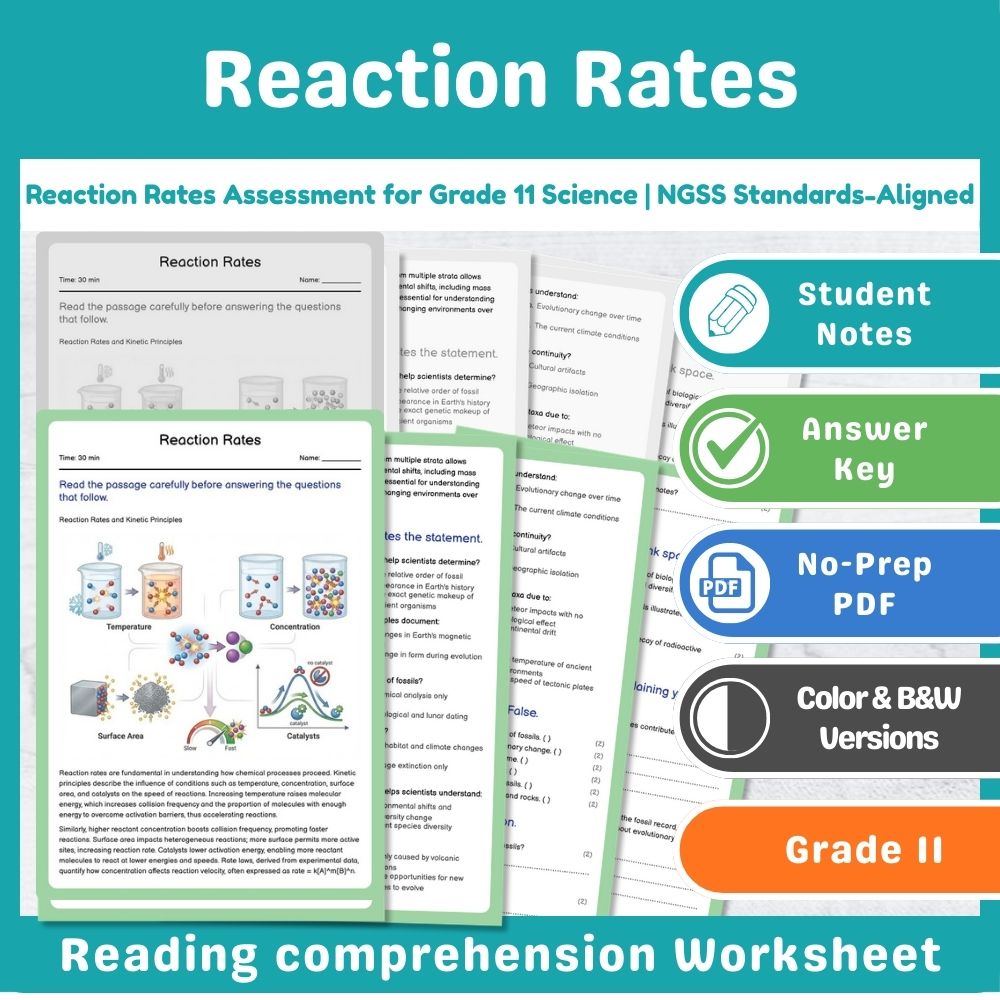
Reaction Rates Assessment for Grade 11 Science | NGSS Standards-Aligned
Created byPrism Point LearningLearning Objectives
- Explain how temperature, concentration, surface area, and catalysts influence reaction rates through collision and activation energies.
- Apply rate laws and concentration dependencies to elementary reaction steps.
- Interpret potential energy diagrams and Arrhenius parameters to understand temperature's effect on reaction rates.
Also included in: Grade 11 Science Mini Bundle – Matter and Its Interactions NGSS Unit
Instant download
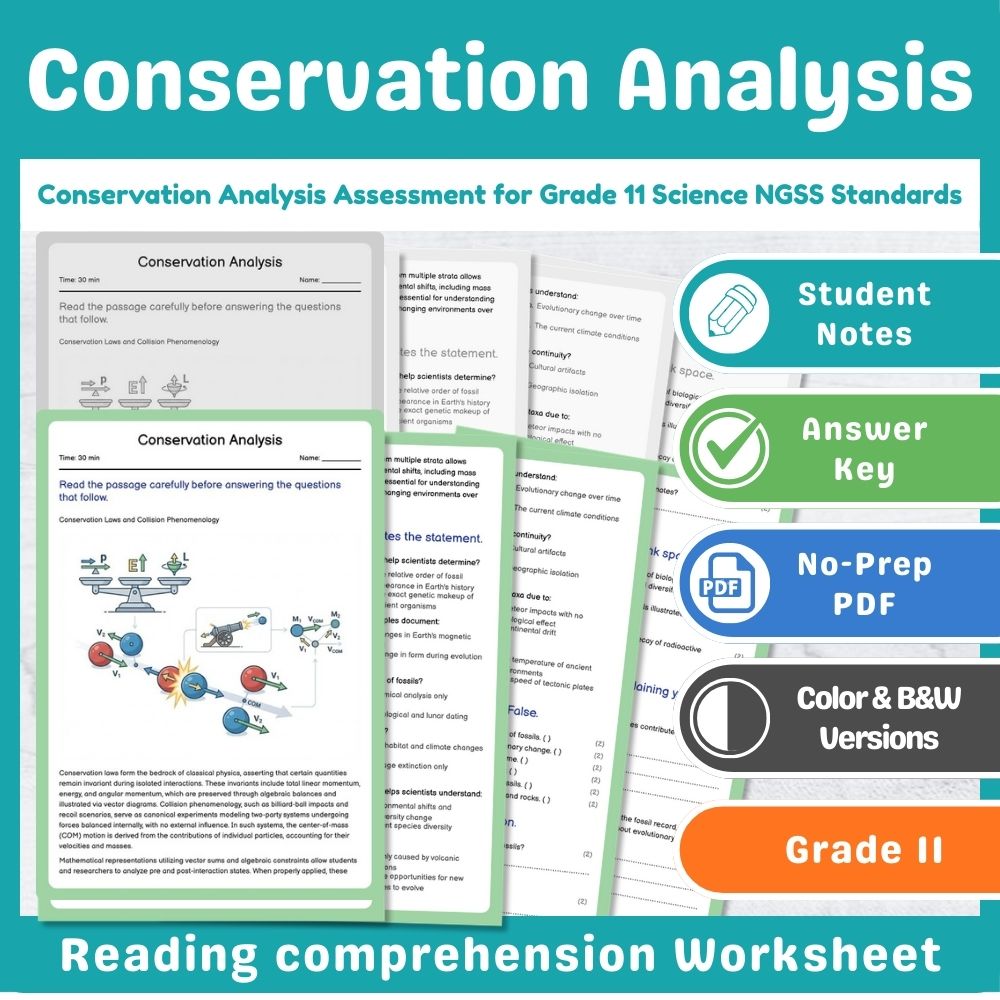
Conservation Analysis Assessment for Grade 11 Science NGSS Standards
Created byPrism Point LearningLearning Objectives
- Understand the principles of conservation laws in physics.
- Analyze collision phenomenology using algebraic balances and vector diagrams.
- Extract center-of-mass motion from system contributions and constraints.
Also included in: Grade 11 Physics Mini Bundle – Impulse, Forces & Conservation Assessment
Instant download
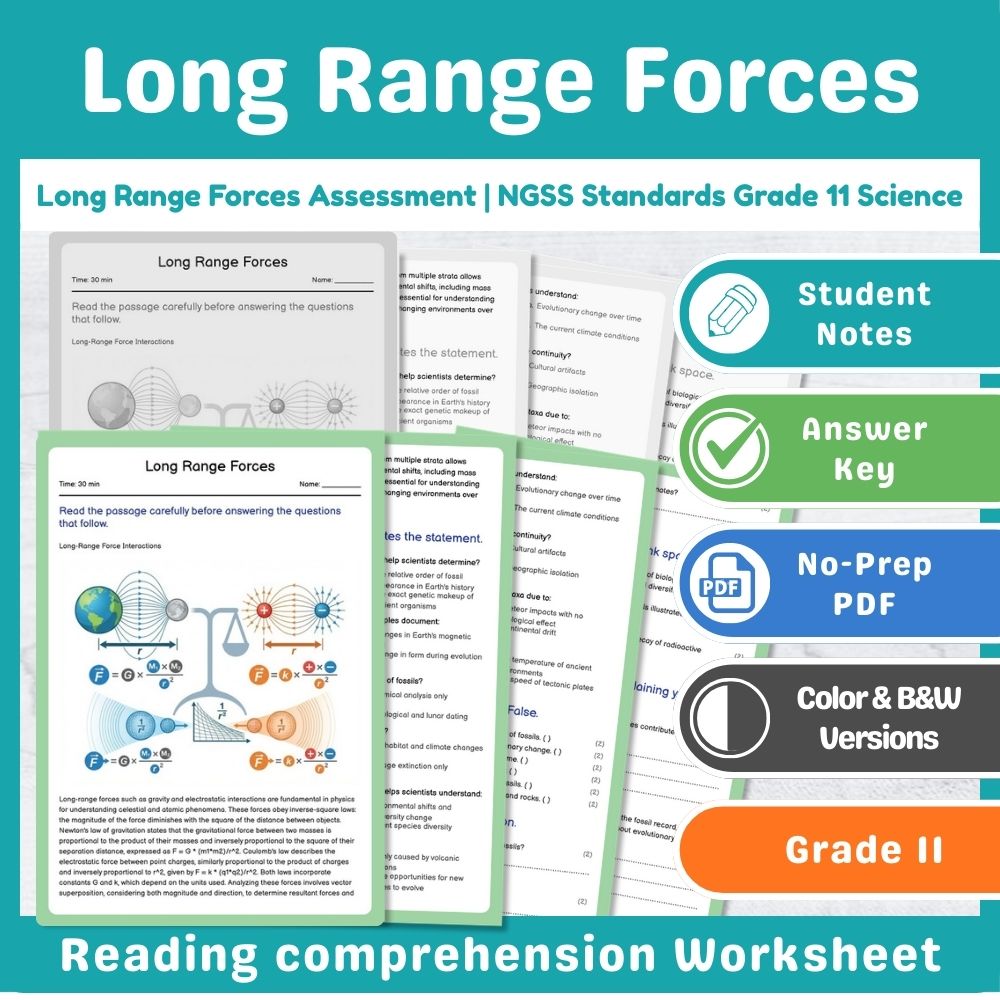
Long Range Forces Assessment | NGSS Standards Grade 11 Science
Created byPrism Point LearningLearning Objectives
- Understand how inverse-square laws describe gravitational and electrostatic forces.
- Apply Newton's law of universal gravitation and Coulomb's law to solve force problems.
- Use vector addition to determine net forces and predict motion trajectories.
Also included in: Grade 11 Physics Mini Bundle – Impulse, Forces & Conservation Assessment
Instant download
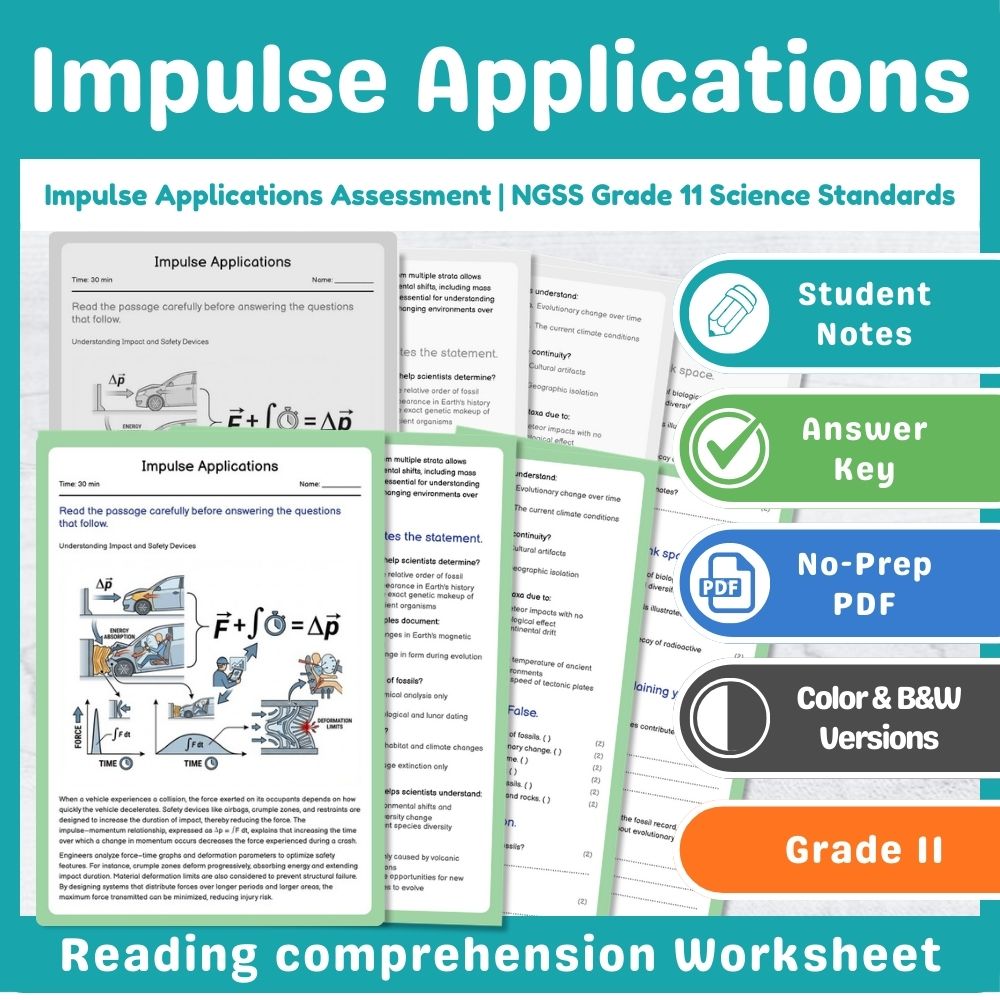
Impulse Applications Assessment | NGSS Grade 11 Science Standards
Created byPrism Point LearningLearning Objectives
- Understand the relationship between impulse and momentum in collision scenarios.
- Apply the impulse–momentum theorem to analyze crash-protection systems.
- Evaluate and refine design parameters to minimize forces during collisions.
Also included in: Grade 11 Physics Mini Bundle – Impulse, Forces & Conservation Assessment
Instant download
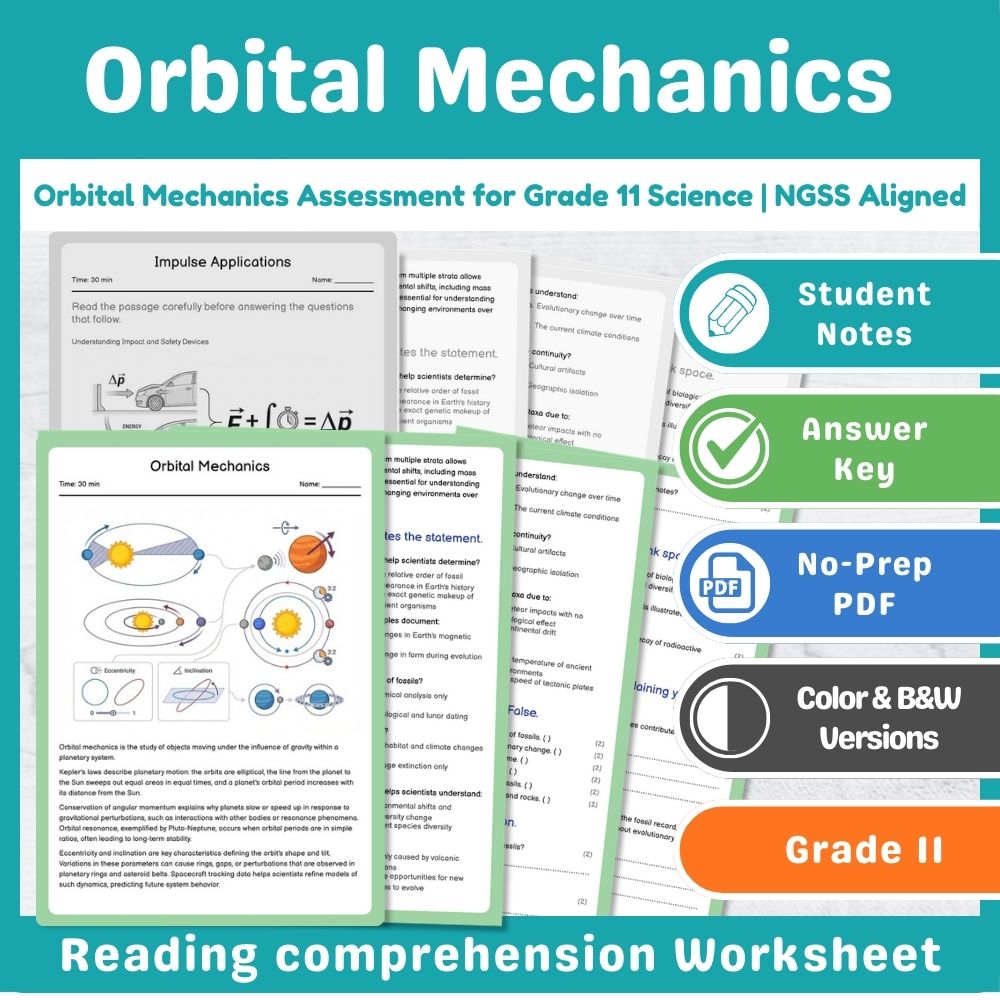
Orbital Mechanics Assessment for Grade 11 Science | NGSS Aligned
Created byPrism Point LearningLearning Objectives
- Explain the fundamental principles of orbital motion and Kepler's laws.
- Analyze the effects of gravitational interactions and orbital perturbations.
- Describe phenomena such as orbital resonance, eccentricity, and inclination.
Also included in: Grade 11 Science Mini Bundle | Cosmic/Orbital Mechanics Assessment NGSS
Instant download
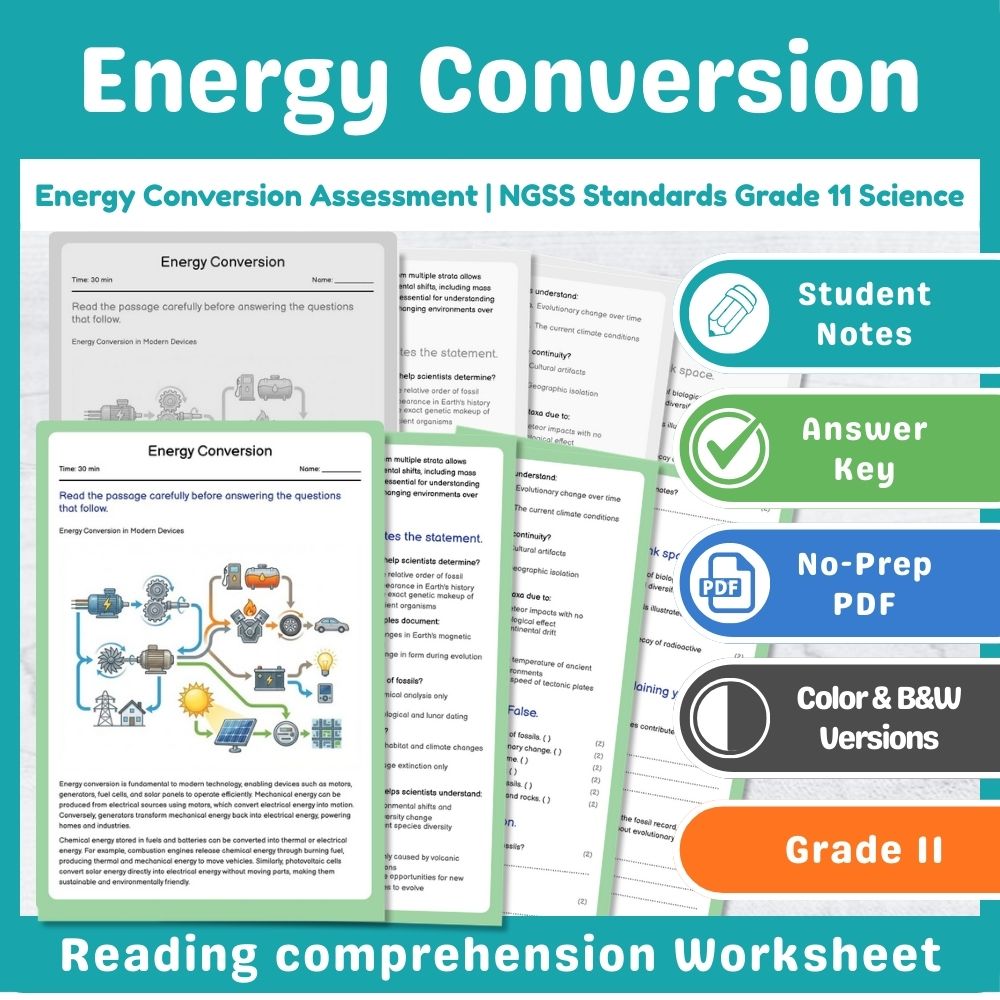
Energy Conversion Assessment | NGSS Standards Grade 11 Science
Created byPrism Point LearningLearning Objectives
- Understand the different forms of energy and their conversions
- Design and evaluate devices that convert energy between mechanical, electrical, chemical, and thermal forms
- Analyze efficiency and energy losses in energy conversion systems
Instant download
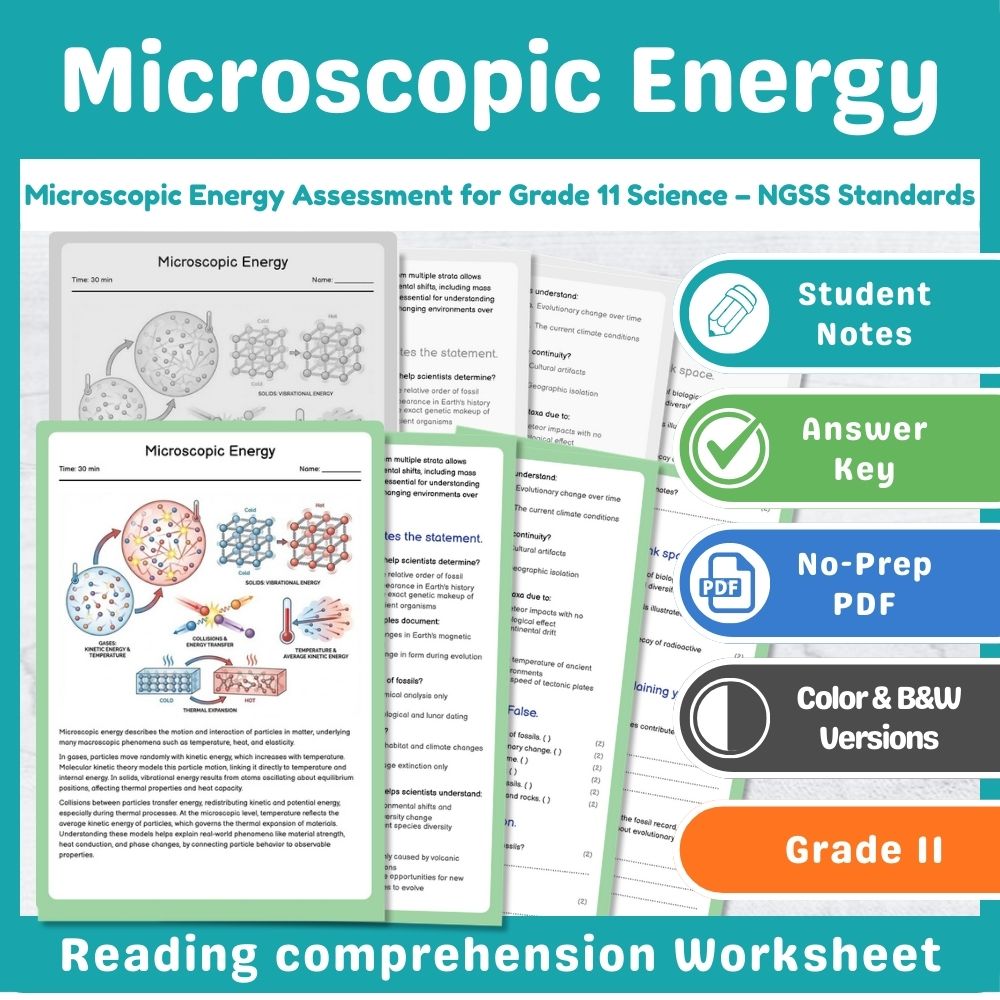
Microscopic Energy Assessment for Grade 11 Science – NGSS Standards
Created byPrism Point LearningLearning Objectives
- Explain the representation of energy at the microscopic scale and how it relates to macroscopic phenomena.
- Describe molecular kinetic theory and how it connects particle motion to temperature.
- Analyze energy redistribution during collisions in gases and vibrations in solids.
Instant download
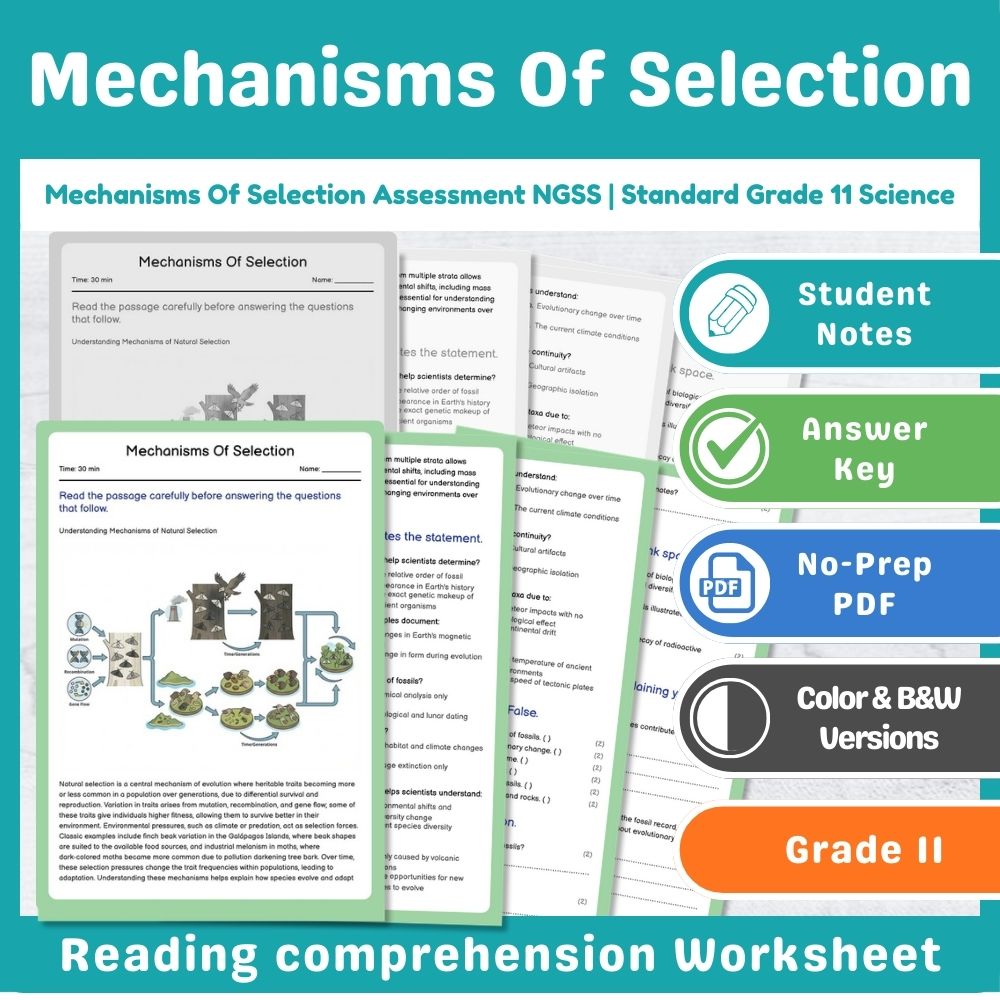
Mechanisms Of Selection Assessment NGSS | Standard Grade 11 Science
Created byPrism Point LearningLearning Objectives
- Explain the key concepts of natural selection, including heritable variation and differential survival.
- Analyze factors influencing selection pressure, such as mutation, recombination, and environment.
- Use examples like finch beak variation and industrial melanism to illustrate evolutionary mechanisms.
Instant download
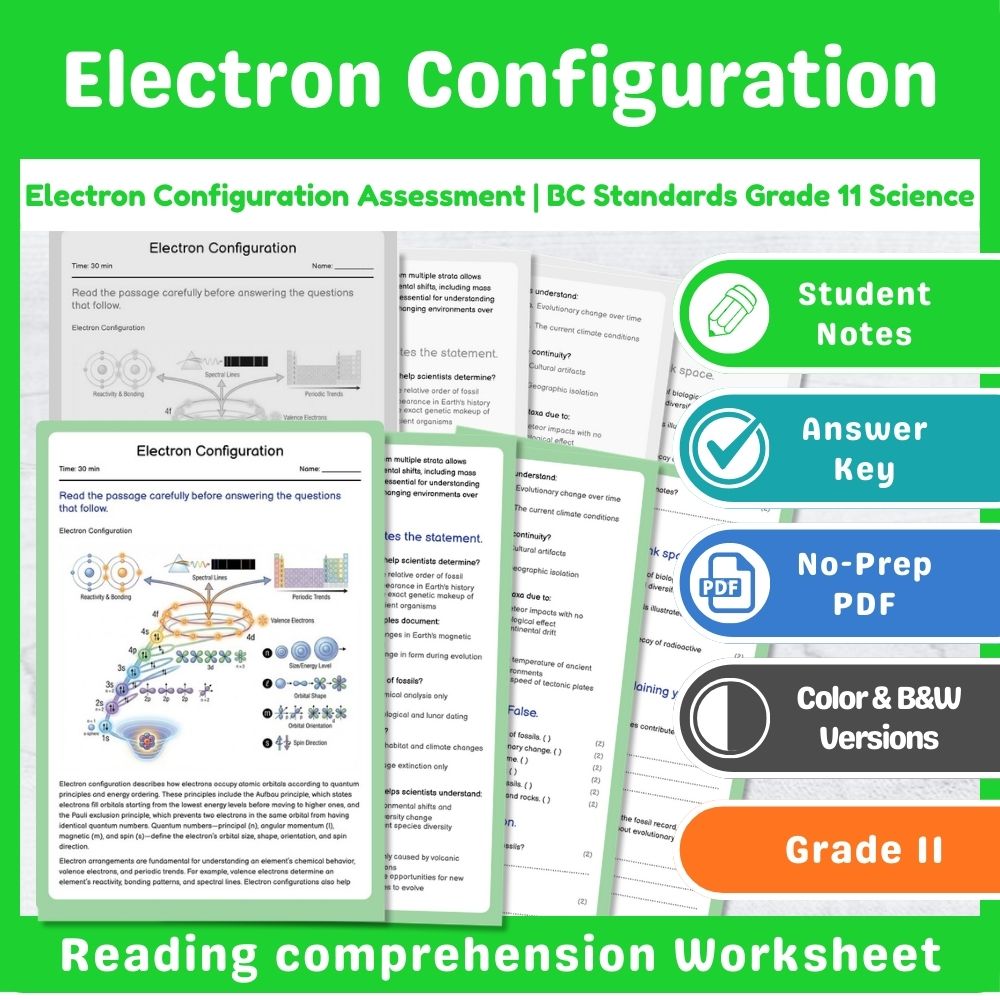
Electron Configuration Assessment | BC Standards Grade 11 Science
Created byPrism Point LearningLearning Objectives
- Explain how electrons occupy atomic orbitals according to quantum principles.
- Describe the role of quantum numbers, Pauli exclusion, and Aufbau principles in electron filling.
- Relate electron arrangements to elemental chemical behavior, valence electrons, and periodic trends.
Also included in: Grade 11 Science | Thermochemistry Assessment Bundle – Standards-Aligned
Instant download

Chemical Equilibrium Assessment for Grade 11 Science | BC Standards
Created byPrism Point LearningLearning Objectives
- Understand the concept of chemical equilibrium and the factors that affect it.
- Learn how to write and interpret equilibrium constant expressions.
- Apply Le Chatelier’s principle to predict shifts in equilibrium in response to concentration, temperature, and pressure changes.
Also included in: Grade 11 Science | Thermochemistry Assessment Bundle – Standards-Aligned
Instant download

The Mole Concept Assessment | BC Standards Grade 11 Science
Created byPrism Point LearningLearning Objectives
- Explain the fundamental principles of the mole concept and its relation to Avogadro's number.
- Convert between mass, number of particles, and volume using molar mass and molar relationships.
- Perform calculations involving moles, gases, and mass for quantitative analysis in chemistry.
Also included in: Grade 11 Science | Thermochemistry Assessment Bundle – Standards-Aligned
Instant download
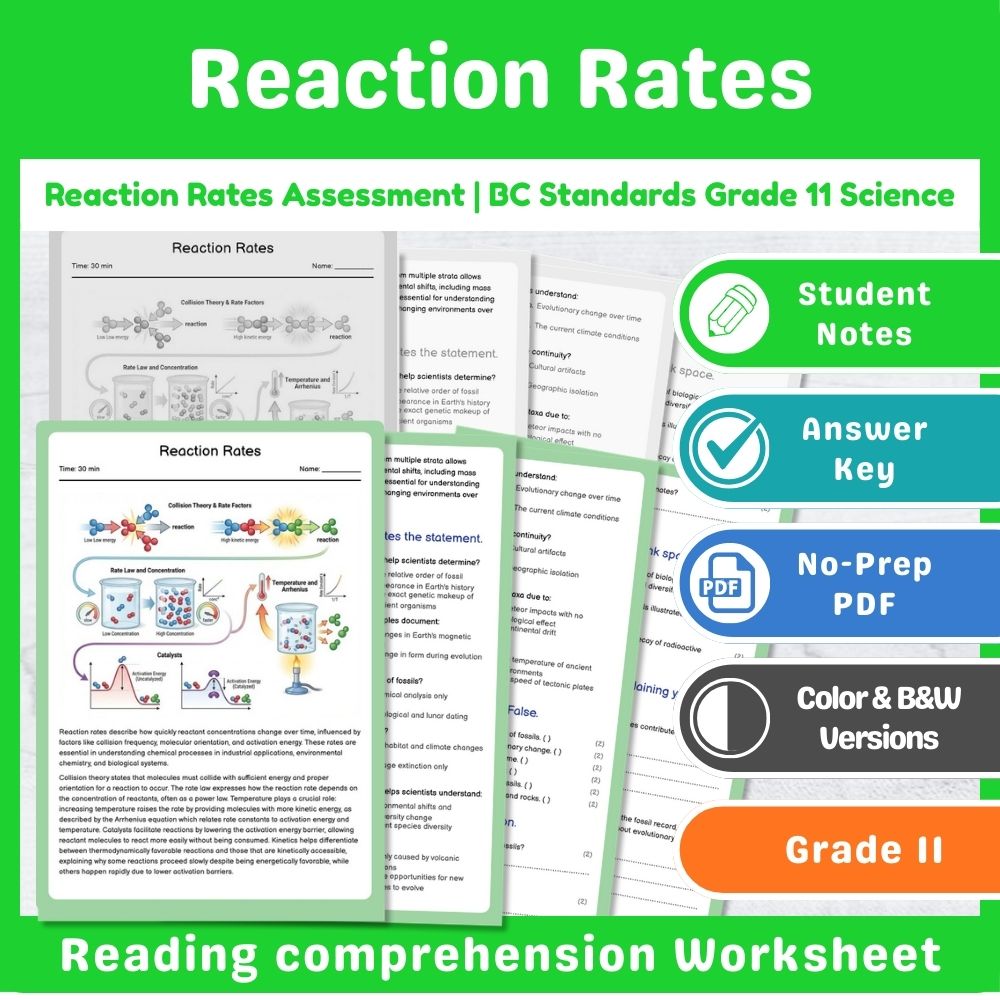
Reaction Rates Assessment | BC Standards Grade 11 Science
Created byPrism Point LearningLearning Objectives
- Explain the factors influencing reaction rates, including collision frequency, molecular orientation, and activation energy.
- Describe rate laws and how they relate reactant concentrations to reaction speed.
- Understand the Arrhenius equation and how temperature affects rate constants.
Also included in: Grade 11 Science | Thermochemistry Assessment Bundle – Standards-Aligned
Instant download

Thermochemistry Assessment for Grade 11 Science Standards-Aligned
Created byPrism Point LearningLearning Objectives
- Understand the concept of enthalpy and its role in chemical reactions.
- Identify differences between endothermic and exothermic processes.
- Calculate reaction enthalpies using bond energies and standard enthalpies of formation.
Also included in: Grade 11 Science | Thermochemistry Assessment Bundle – Standards-Aligned
Instant download

Groundwater Systems Assessment for Grade 11 Science | BC Standards
Created byPrism Point LearningLearning Objectives
- Understand the concepts of aquifers, porosity, and permeability in groundwater systems.
- Differentiate between confined and unconfined aquifers and their responses to recharge and pumping.
- Identify factors affecting groundwater flow, quality, and sustainability.
Also included in: Grade 11 Science Assessment | Plate Tectonics BC Standards Mini Bundle
Instant download

Mantle Convection Assessment for Grade 11 Science – Standards-Aligned
Created byPrism Point LearningLearning Objectives
- Understand the process of mantle convection and how it drives plate tectonics.
- Identify geophysical techniques used to observe mantle flow and dynamics.
- Explain the roles of slab pull, ridge push, and mantle plumes in Earth's geological activity.
Also included in: Grade 11 Science Assessment | Plate Tectonics BC Standards Mini Bundle
Instant download
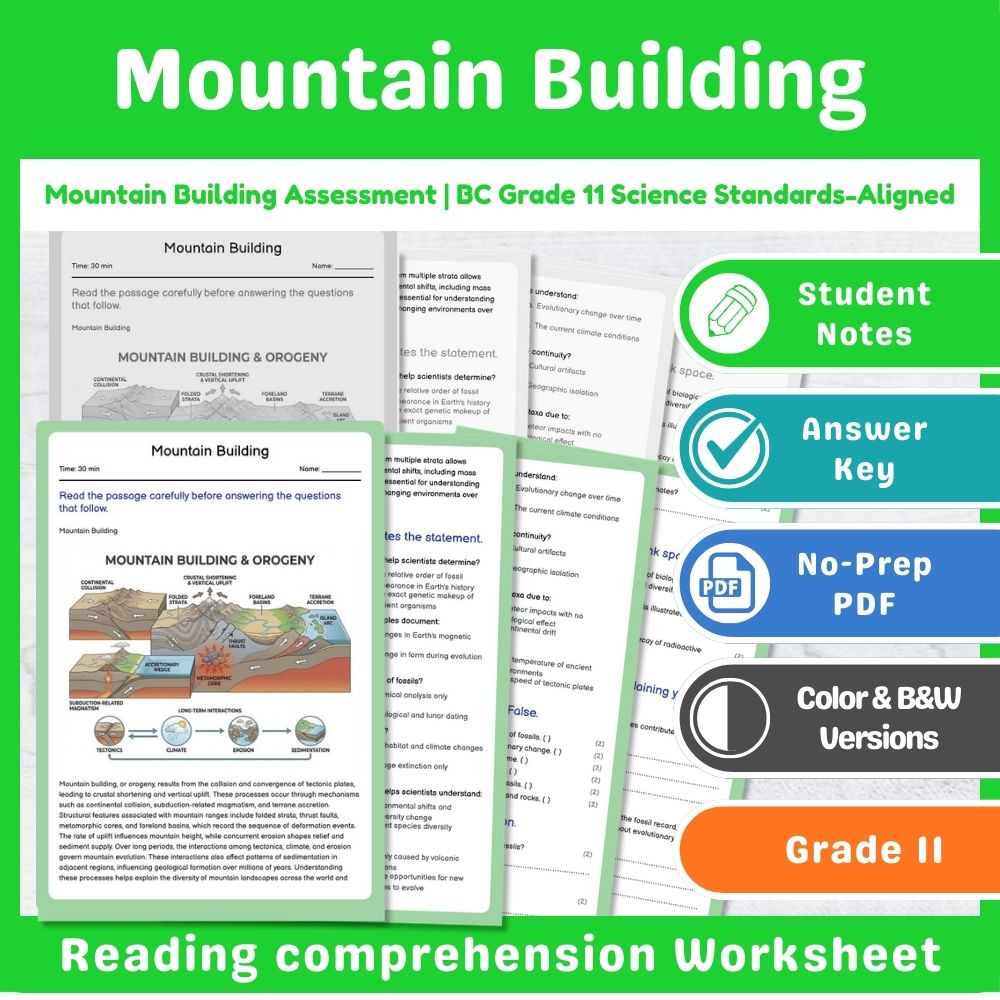
Mountain Building Assessment | BC Grade 11 Science Standards-Aligned
Created byPrism Point LearningLearning Objectives
- Explain the geological processes involved in mountain formation, including tectonic convergence, crustal shortening, and uplift.
- Identify structural features such as folded strata, thrust faults, metamorphic cores, and foreland basins associated with mountain ranges.
- Describe how rates of uplift and erosion influence mountain evolution and sediment distribution.
Also included in: Grade 11 Science Assessment | Plate Tectonics BC Standards Mini Bundle
Instant download
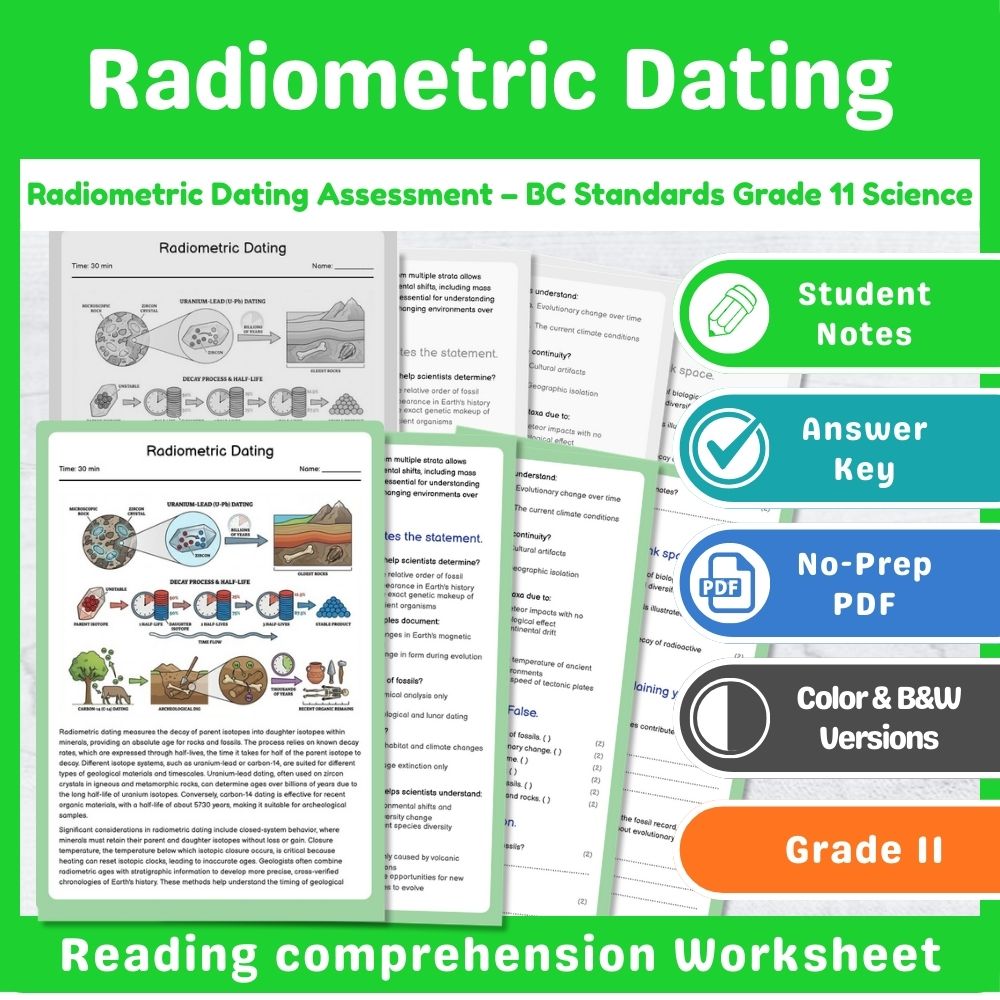
Radiometric Dating Assessment – BC Standards Grade 11 Science
Created byPrism Point LearningLearning Objectives
- Understand the principles of radiometric dating and how isotopic decay is used to determine geological ages.
- Identify different parent-daughter isotope systems suitable for various timescales and rock types.
- Explain the significance of closure temperature and how it affects isotopic retention in rocks.
Also included in: Grade 11 Science Assessment | Plate Tectonics BC Standards Mini Bundle
Instant download
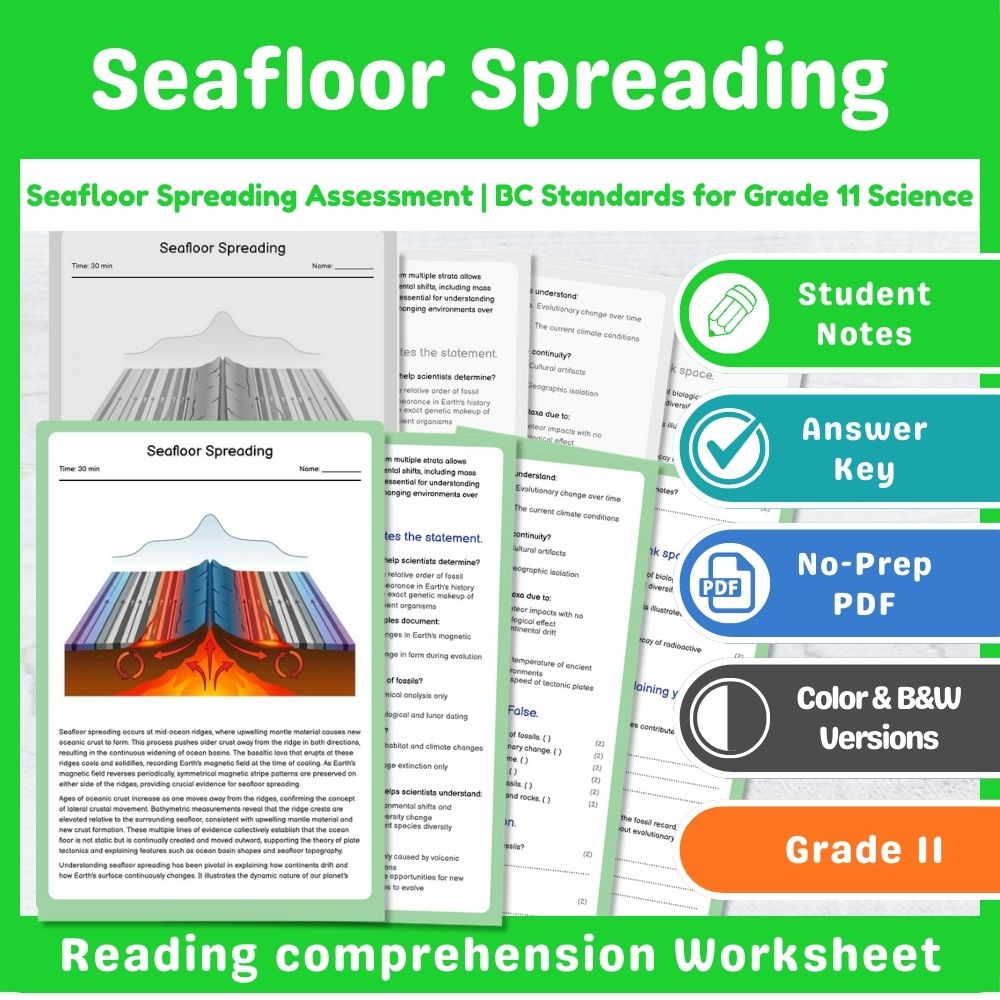
Seafloor Spreading Assessment | BC Standards for Grade 11 Science
Created byPrism Point LearningLearning Objectives
- Describe the process of seafloor spreading and how it shapes ocean basins.
- Explain how magnetic stripe patterns provide evidence for seafloor spreading.
- Analyze how age and bathymetric data support plate tectonic theory.
Also included in: Grade 11 Science Assessment | Plate Tectonics BC Standards Mini Bundle
Instant download

Stratigraphic Columns Assessment for Grade 11 Science | BC Standards
Created byPrism Point LearningLearning Objectives
- Understand the components and significance of stratigraphic columns in geology.
- Identify how lithology, fossils, and sedimentary structures help interpret past environments.
- Explain the concepts of correlation, unconformities, and facies changes within stratigraphy.
Also included in: Grade 11 Science Assessment | Plate Tectonics BC Standards Mini Bundle
Instant download

Tissue Organization Assessment | BC Standards Grade 11 Science
Created byPrism Point LearningLearning Objectives
- Understand how multicellular organisms organize cells into tissues, organs, and systems.
- Identify the roles of cellular differentiation in tissue specialization.
- Explain models of tissue architecture and intercellular communication.
Also included in: Grade 11 Science Lesson Assessment Bundle | Photosynthesis & Genetics
Instant download
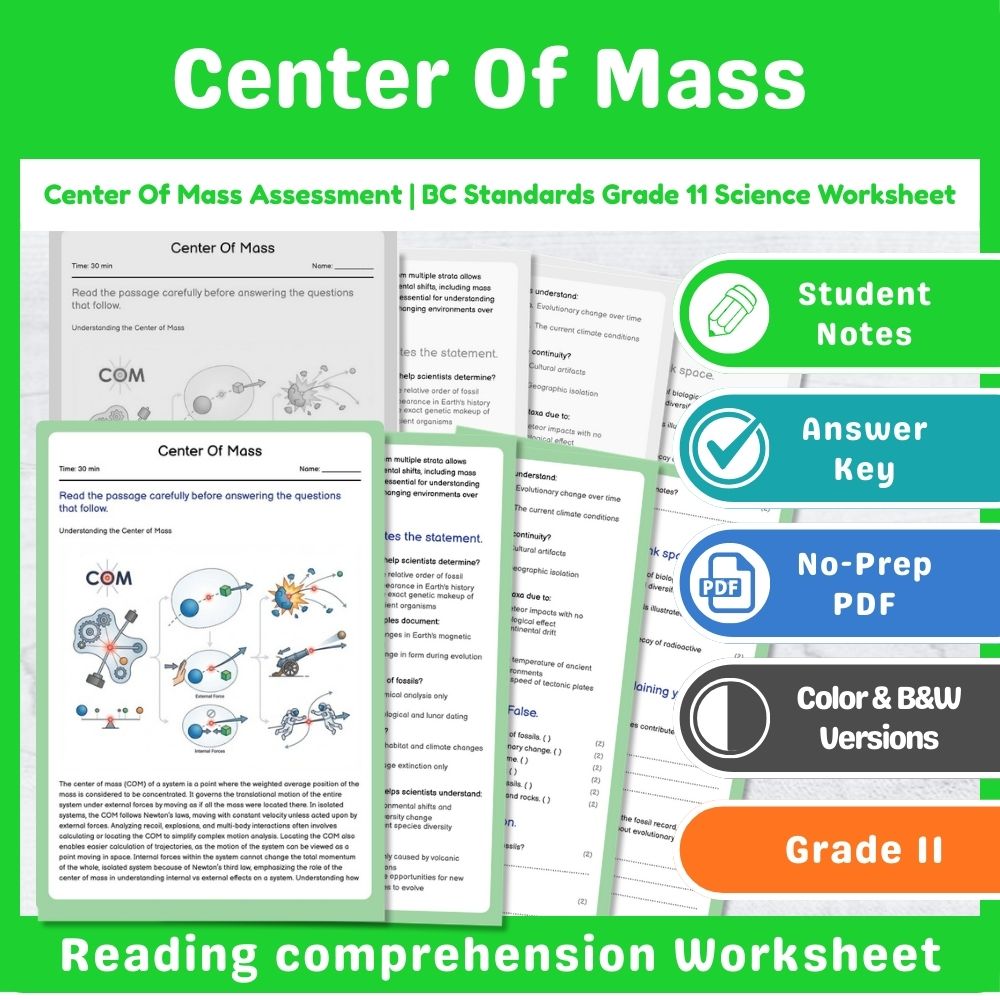
Center Of Mass Assessment | BC Standards Grade 11 Science Worksheet
Created byPrism Point LearningLearning Objectives
- Understand the concept of the center of mass in physical systems.
- Apply the principles of momentum conservation relative to the center of mass.
- Analyze system trajectories and internal forces using the center of mass concept.
Also included in: Grade 11 Science Assessment Bundle | Classical Mechanics & Motion Topics
Instant download

Collisions Types Assessment | BC Standards Grade 11 Science
Created byPrism Point LearningLearning Objectives
- Explain the difference between elastic and inelastic collisions in terms of energy and momentum conservation.
- Apply conservation laws to analyze one- and two-dimensional collision scenarios.
- Use center-of-mass frames to determine final velocities after collisions in various situations.
Also included in: Grade 11 Science Assessment Bundle | Classical Mechanics & Motion Topics
Instant download
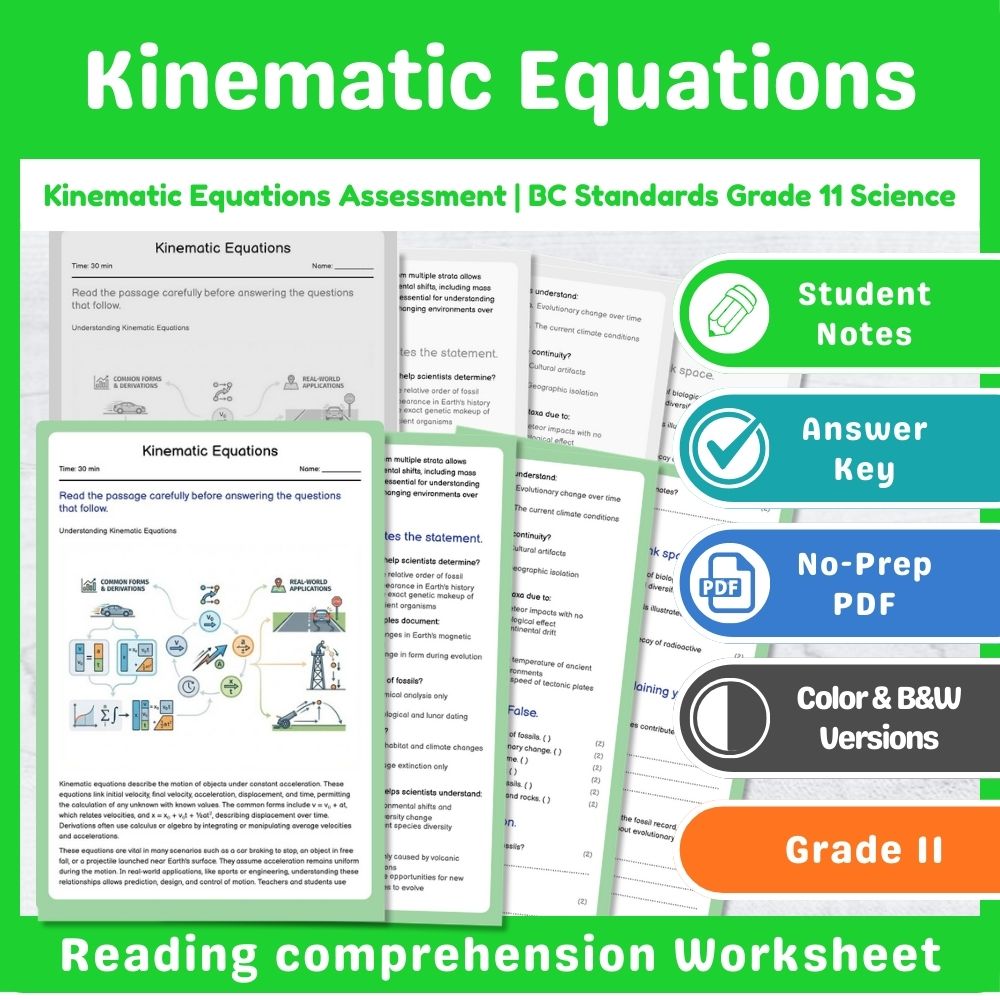
Kinematic Equations Assessment | BC Standards Grade 11 Science
Created byPrism Point LearningLearning Objectives
- Understand the fundamental kinematic equations used for constant acceleration motion.
- Apply the equations to solve for displacement, velocity, acceleration, and time in one-dimensional motion.
- Derive the equations using algebraic and calculus methods.
Also included in: Grade 11 Science Assessment Bundle | Classical Mechanics & Motion Topics
Instant download

Testable Hypotheses Assessment | General Standards Grade 11 Science
Created byPrism Point LearningLearning Objectives
- Understand key concepts related to Science
- Apply knowledge through practice questions
- Demonstrate comprehension of the material
Also included in: Grade 11 Scientific Evidence & Modeling Science Lesson Bundle: General
Instant download

Inheritance Patterns Assessment for Grade 11 Science | Standards-Aligned
Created byPrism Point LearningLearning Objectives
- Explain how observable traits are connected to genetic inheritance patterns across generations.
- Describe the role of Punnett squares in predicting offspring genotypes and phenotypes.
- Differentiate between autosomal and sex-linked inheritance, including dominance and recessiveness.
Also included in: Grade 11 Biological Evidence Science Lesson Bundle | General Framework
Instant download

Feedback Control Loops Assessment | General Standards-Aligned Assessment Grade 11 Science
Created byPrism Point LearningLearning Objectives
- Understand the concept of feedback mechanisms in maintaining homeostasis.
- Differentiate between negative and positive feedback loops.
- Identify real-life examples of feedback control in the human body.
Also included in: Grade 11 Biological Evidence Science Lesson Bundle | General Framework
Instant download
Browse more categories
About Reading comprehension Worksheets
Find reading comprehension worksheets for class practice, homework, or self-study. All 40,284 are instant PDF downloads.
Each resource here is built by an independent educator and reviewed for quality. Worksheets print straight from PDF and suit classroom use, homework, or extra practice; most come with answer keys, and you can preview before purchasing.