
Grade 10 Worksheets
9,385 grade resources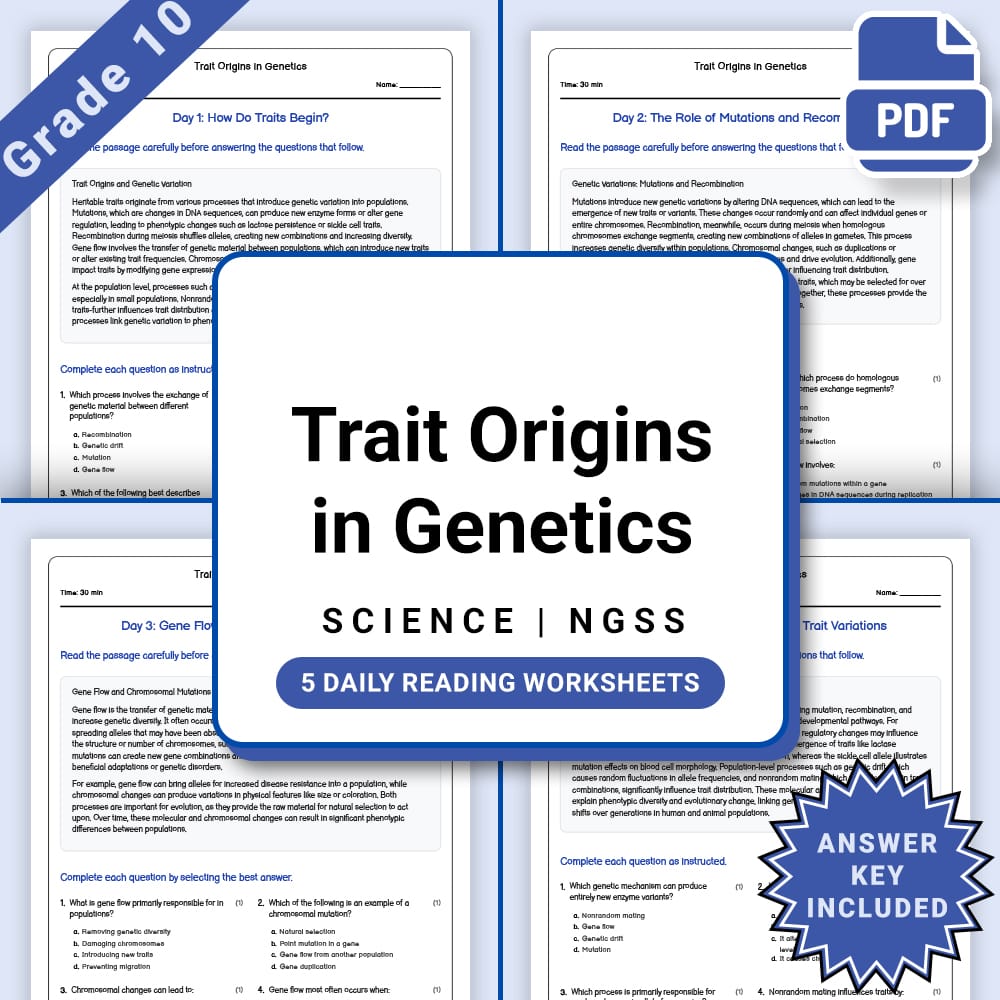
Grade 10 Science – Trait Origins in Genetics Worksheet (PDF +Answer Key)
 Created byCopper Leaf Classroom
Learning Objectives
- Understand the sources of genetic variation such as mutation, recombination, gene flow, and chromosomal changes.
- Recognize how these variations influence trait development and phenotypic diversity.
- Identify examples of mutations that result in new enzyme variants or regulatory changes affecting traits.
Instant download
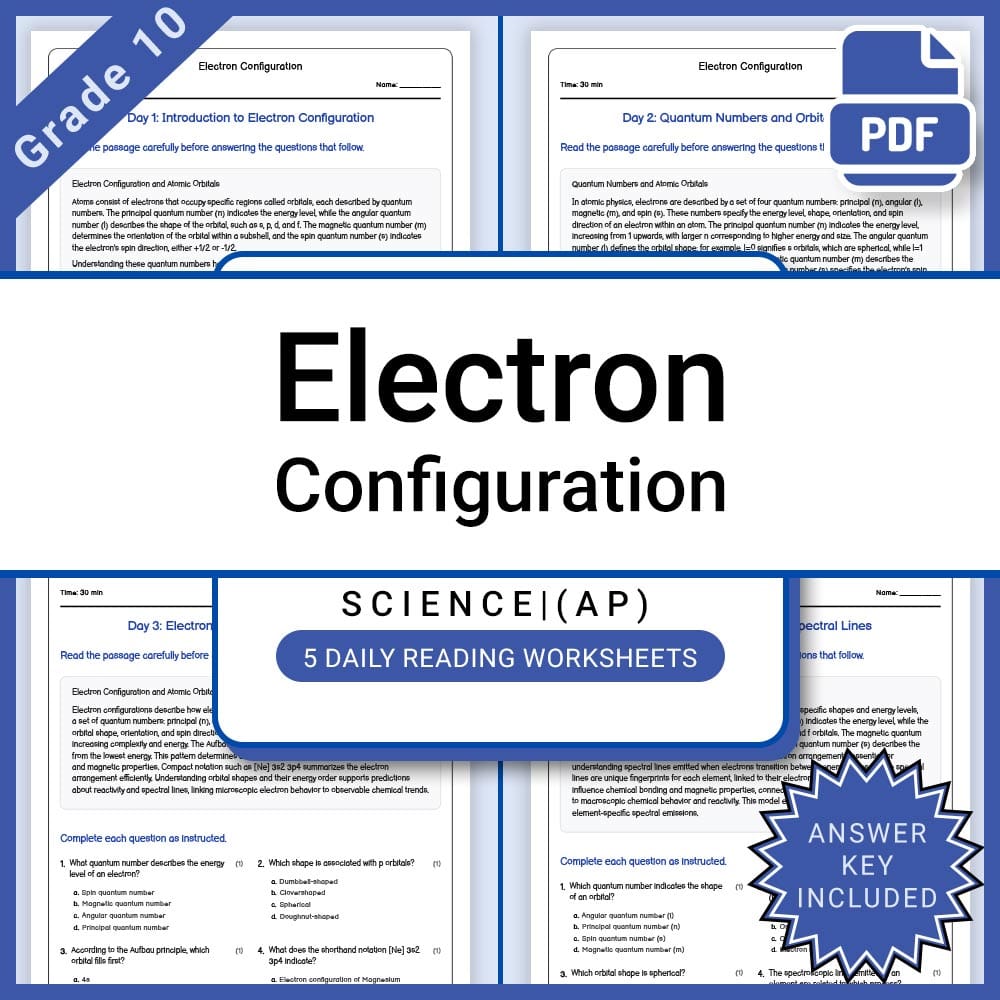
Grade 10 Science – Electron Configuration Daily Reading Worksheet + Answer Key
JCreated byJ.S SheetsLearning Objectives
- Understand key concepts related to Science
- Apply knowledge through practice questions
- Demonstrate comprehension of the material
Also included in: Grade 10 Science Lesson Group - AP Curriculum - Daily Reading Worksheets
Instant download
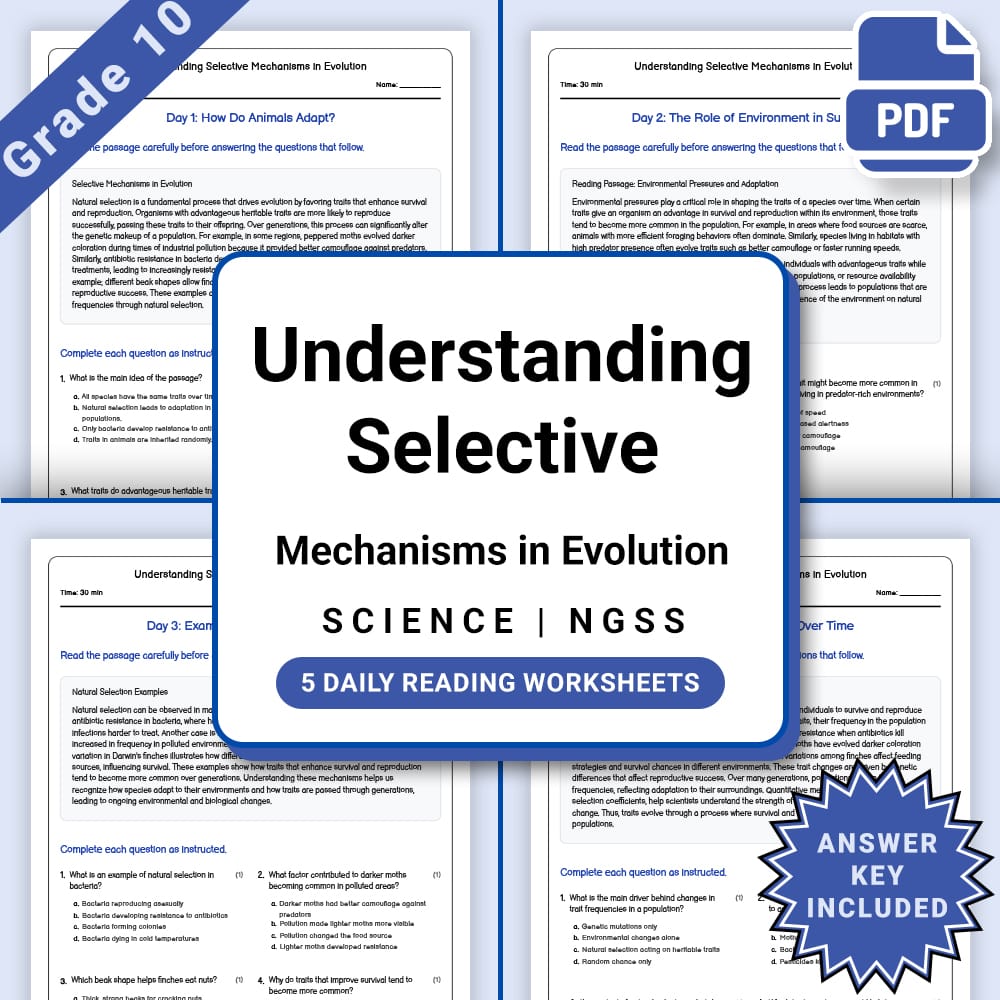
Grade 10 Science –Understanding Selective Mechanisms Worksheet (PDF +Answer Key)
Created byCopper Leaf ClassroomLearning Objectives
- Explain how natural selection favors certain traits over others.
- Identify examples of adaptive traits in different species.
- Describe how environmental pressures influence trait frequencies.
Instant download
Grade 10 Science – Ore Formation Worksheet (Ontario) (PDF)
 Created byBright Mind Resources
Learning Objectives
- Describe principal ore-forming processes such as magmatic differentiation, hydrothermal circulation, sedimentary concentration, and metamorphic remobilization.
- Identify spatial controls influencing ore deposits including structural traps, permeability contrasts, and host-rock chemistry.
- Recognize typical mineral assemblages associated with different deposit types and tectonic settings.
Instant download
Grade 10 Science | Volcanism and Orogeny Worksheet (Ontario Standards) (PDF)
Created byBright Mind ResourcesLearning Objectives
- Explain the process of magma generation and ascent in volcanoes.
- Differentiate between effusive and explosive volcanic eruptions.
- Describe volcanic landforms and their formation processes.
Instant download
Grade 10 Science | Variable Isolation Worksheet (Ontario) (PDF)
Created byBright Mind ResourcesLearning Objectives
- Understand the principles of variable isolation in experimental design.
- Identify factors influencing multifactor inquiry outcomes.
- Evaluate trade-offs in experimental complexity versus clarity of results.
Instant download
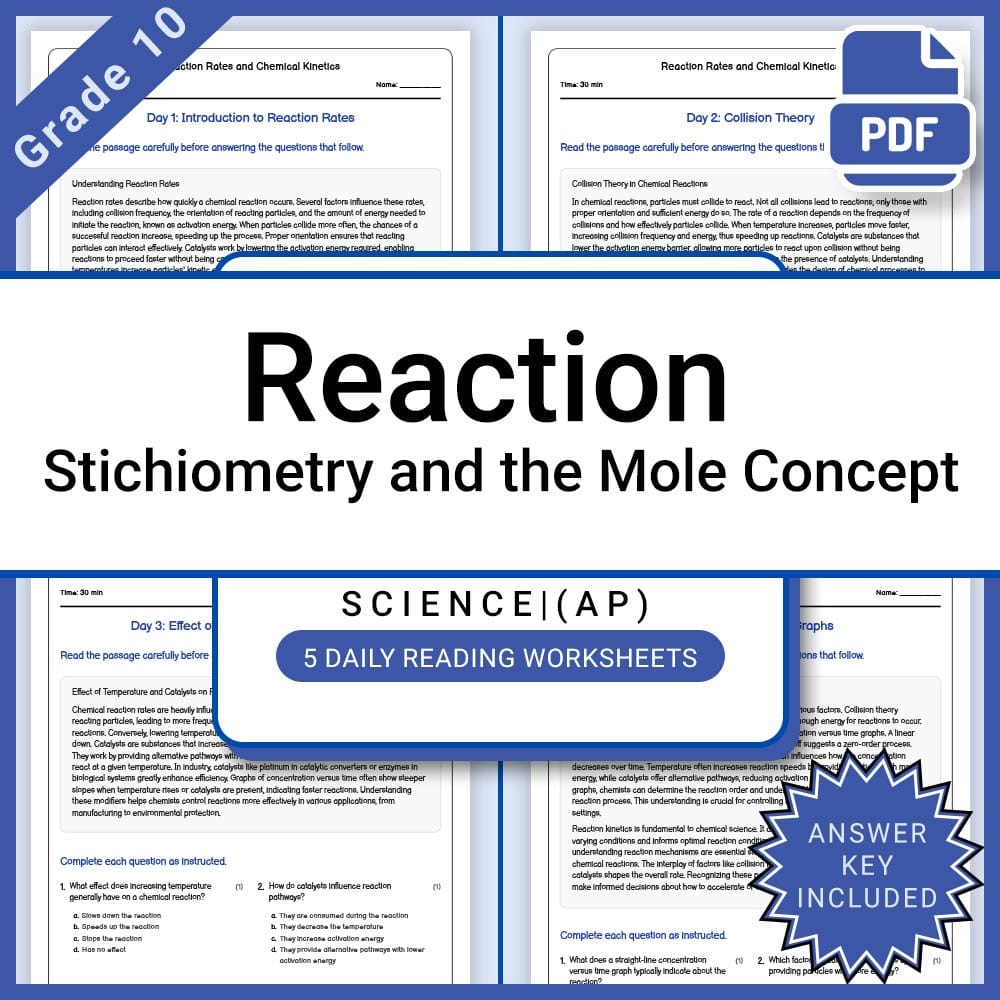
Grade 10 Science – Reaction Stoichiometry Daily Reading Worksheet + Answer Key
JCreated byJ.S SheetsLearning Objectives
- Understand the definition of a mole and molar mass
- Interpret chemical equations in terms of mole ratios
- Apply stoichiometric calculations to mass and gas volume conversions
Also included in: Grade 10 Science Lesson Group - AP Curriculum - Daily Reading Worksheets
Instant download
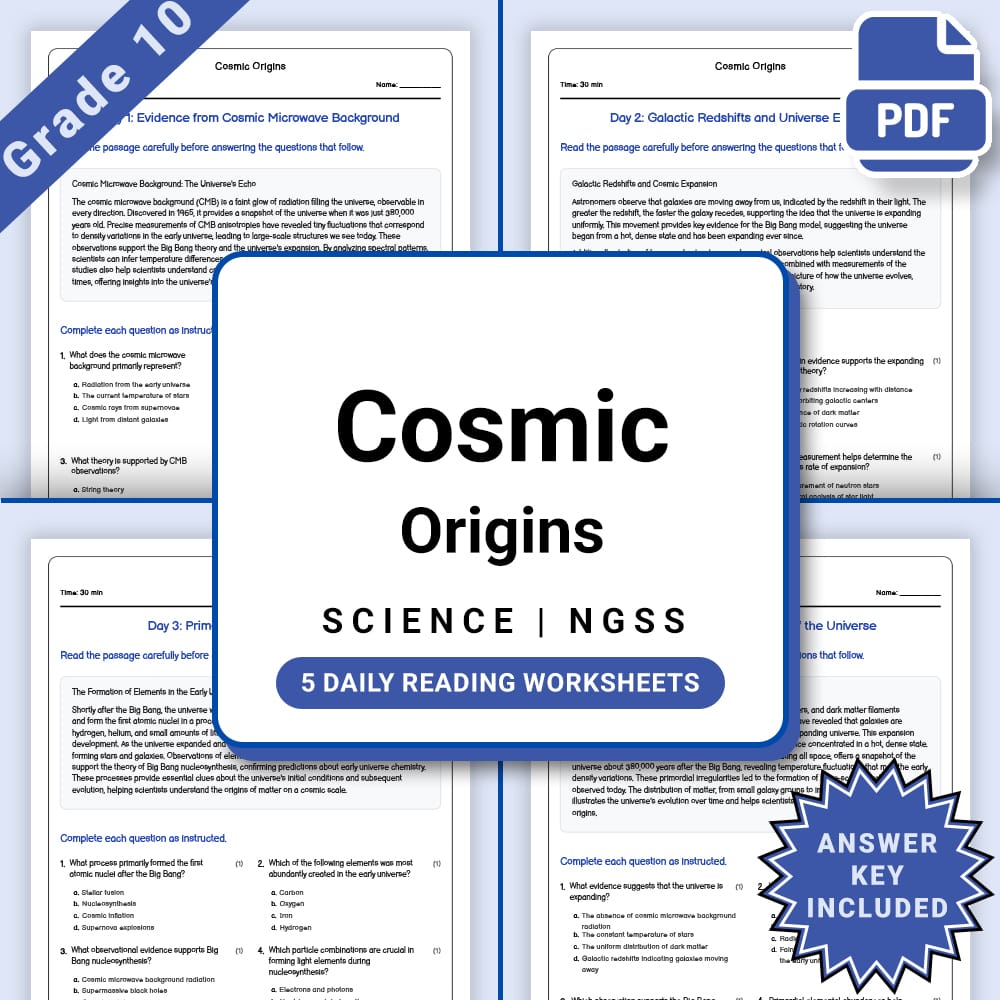
Grade 10 Science – Cosmic Origins Daily Reading Worksheet(PDF +Answer Key)
Created byCopper Leaf ClassroomLearning Objectives
- Interpret data from cosmic microwave background radiation.
- Understand how galactic redshifts support an expanding universe.
- Analyze elemental abundances to learn about early universe conditions.
Instant download
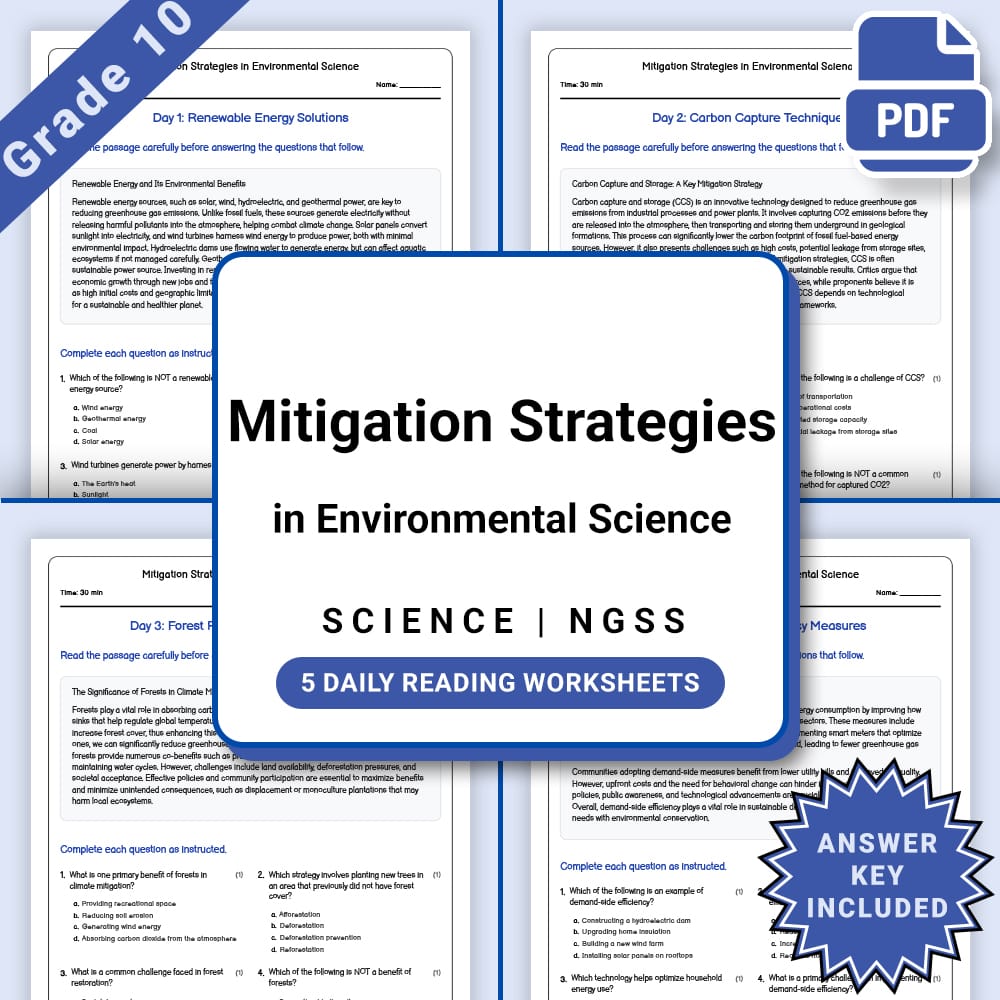
Grade 10 Science – Mitigation Strategies Worksheet (PDF +Answer Key)
Created byCopper Leaf ClassroomLearning Objectives
- Understand different renewable energy options and their environmental benefits.
- Analyze how renewable energy contributes to reducing pollution and greenhouse gases.
- Evaluate the advantages and challenges of implementing renewable energy solutions.
Instant download
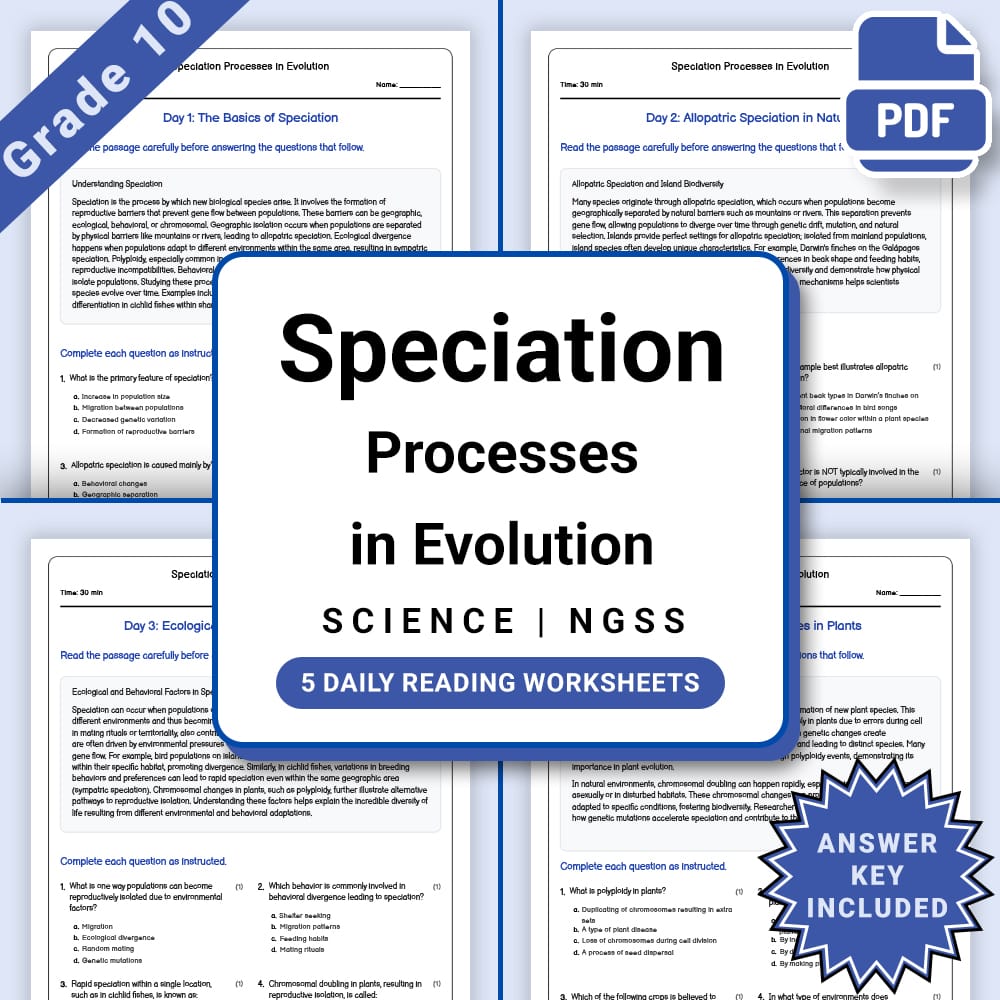
Grade 10 Science – Speciation Processes Worksheet (PDF +Answer Key)
Created byCopper Leaf ClassroomLearning Objectives
- Understand different mechanisms that lead to the formation of new species.
- Identify real-world examples of speciation.
- Explain how geographic, ecological, polyploidy, and behavioral factors contribute to reproductive isolation.
Instant download
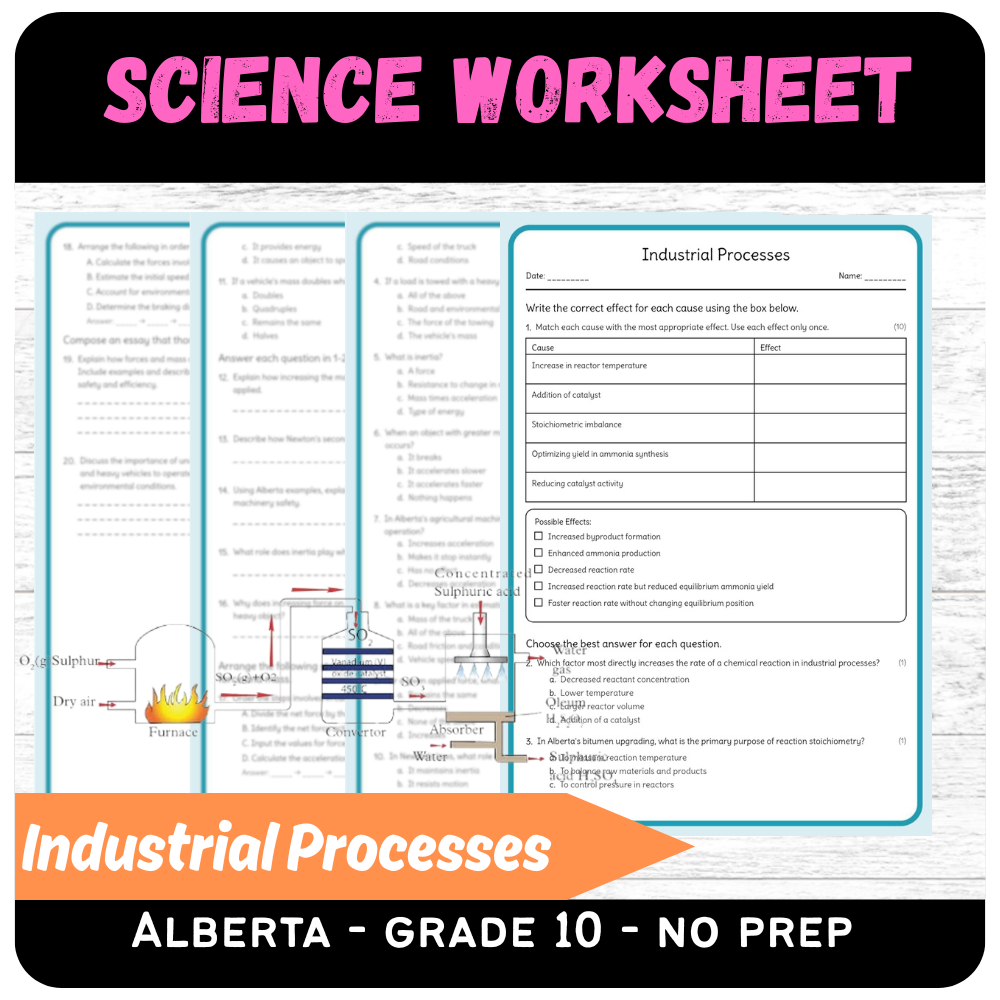
Grade 10 Science | Industrial Processes Worksheet (PDF) – Alberta Standards
Created byBright Mind ResourcesLearning Objectives
- Understand the principles of mass conservation and reaction stoichiometry in industrial chemical processes.
- Analyze Alberta-specific examples such as bitumen upgrading, hydrogen production, and ammonia synthesis.
- Apply concepts of process optimization and kinetics to real-world industrial scenarios.
Instant download
Grade 10 Science | One-Dimensional Motion Worksheet (Ontario, PDF)
Created byBright Mind ResourcesLearning Objectives
- Define and relate fundamental kinematic quantities such as displacement, speed, velocity, and acceleration.
- Understand algebraic expressions for motion along a single axis.
- Apply constant-acceleration equations to scenarios like free-fall and uniformly accelerated vehicles.
Instant download
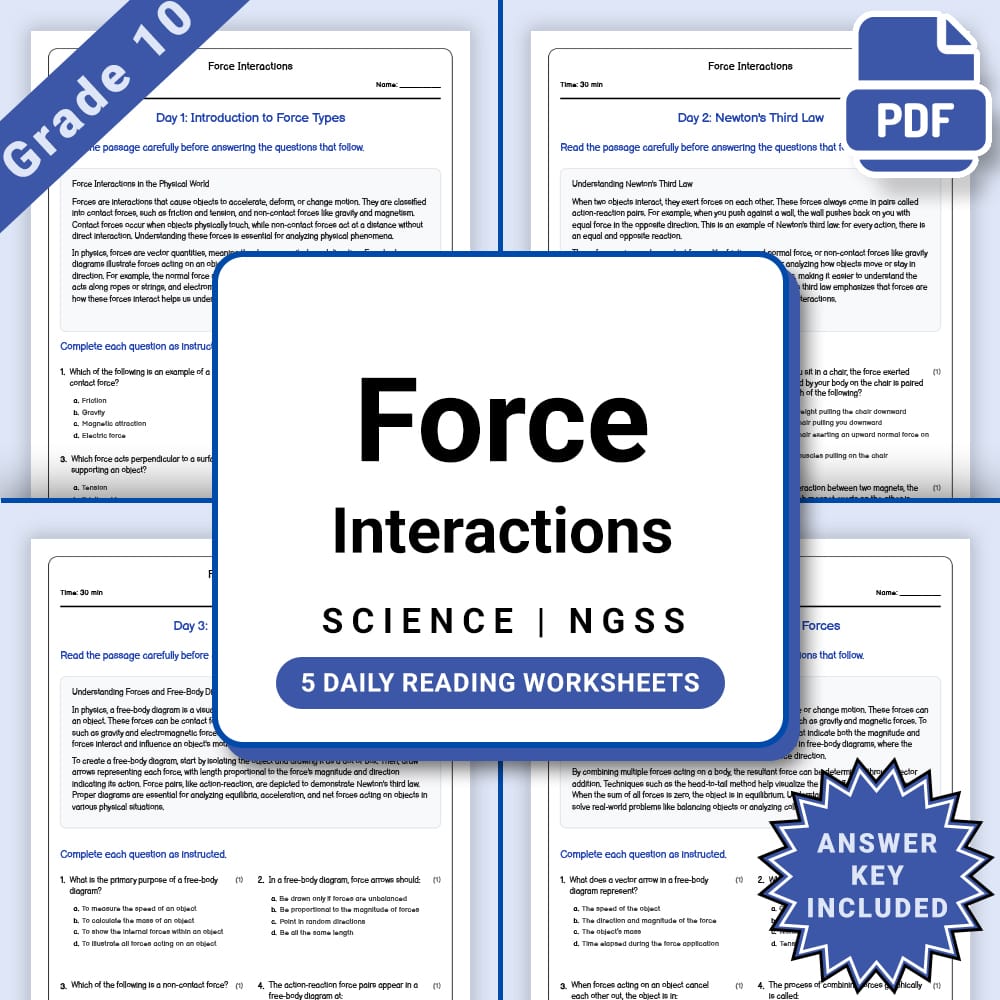
Grade 10 Science – Force Interactions Worksheet (PDF +Answer Key)
Created byCopper Leaf ClassroomLearning Objectives
- Differentiate between contact and non-contact forces.
- Understand Newton's third law of action and reaction.
- Interpret free-body diagrams for various forces.
Instant download
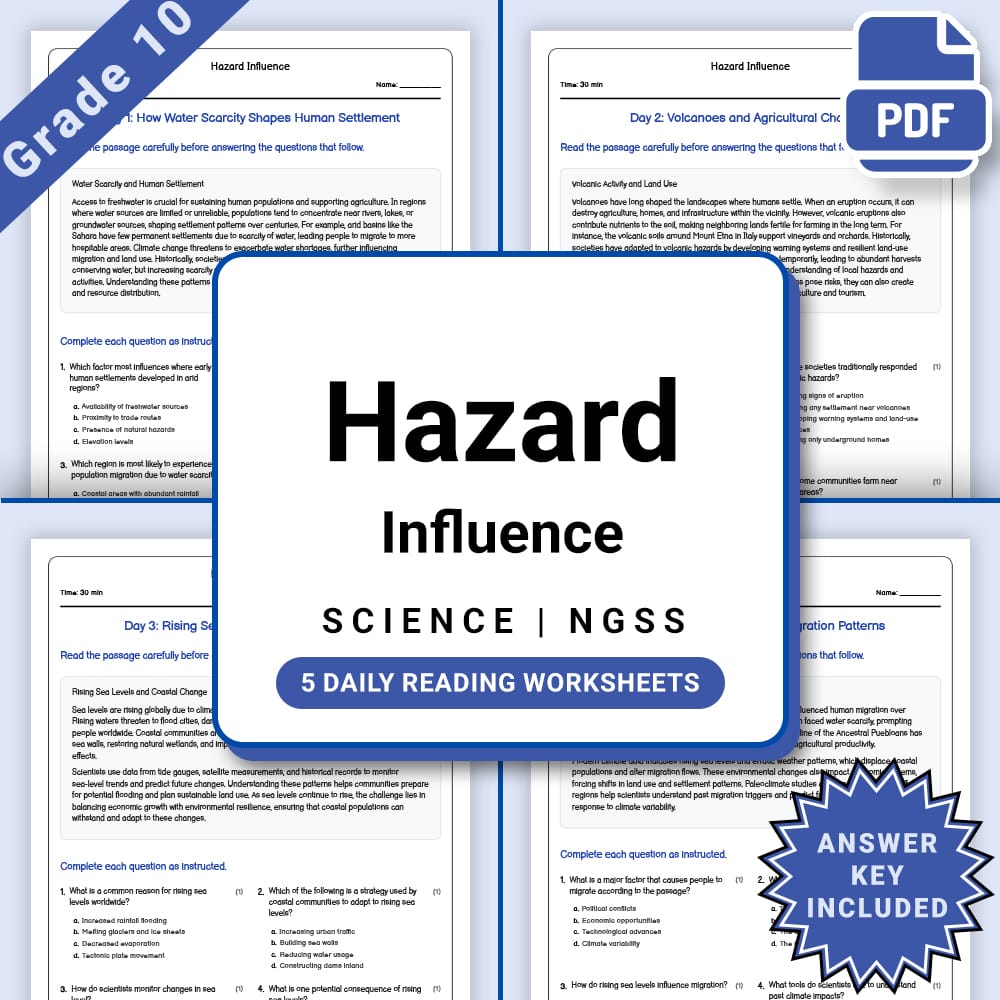
Grade 10 Science – Hazard Influence Worksheet (PDF +Answer Key)
Created byCopper Leaf ClassroomLearning Objectives
- Understand how freshwater availability affects human settlement patterns.
- Analyze the impact of natural hazards like volcanic eruptions and flooding on land use.
- Examine how climate variability influences economic systems and migration.
Instant download
Grade 10 Science – Enzymes And Rates Worksheet (Ontario) PDF
Created byBright Mind ResourcesLearning Objectives
- Understand the properties and functions of enzymes in cellular metabolism.
- Describe factors affecting enzyme activity such as temperature, pH, substrate concentration, and inhibitors.
- Explain the concepts of allosteric regulation and feedback inhibition as mechanisms of enzyme activity control.
Instant download
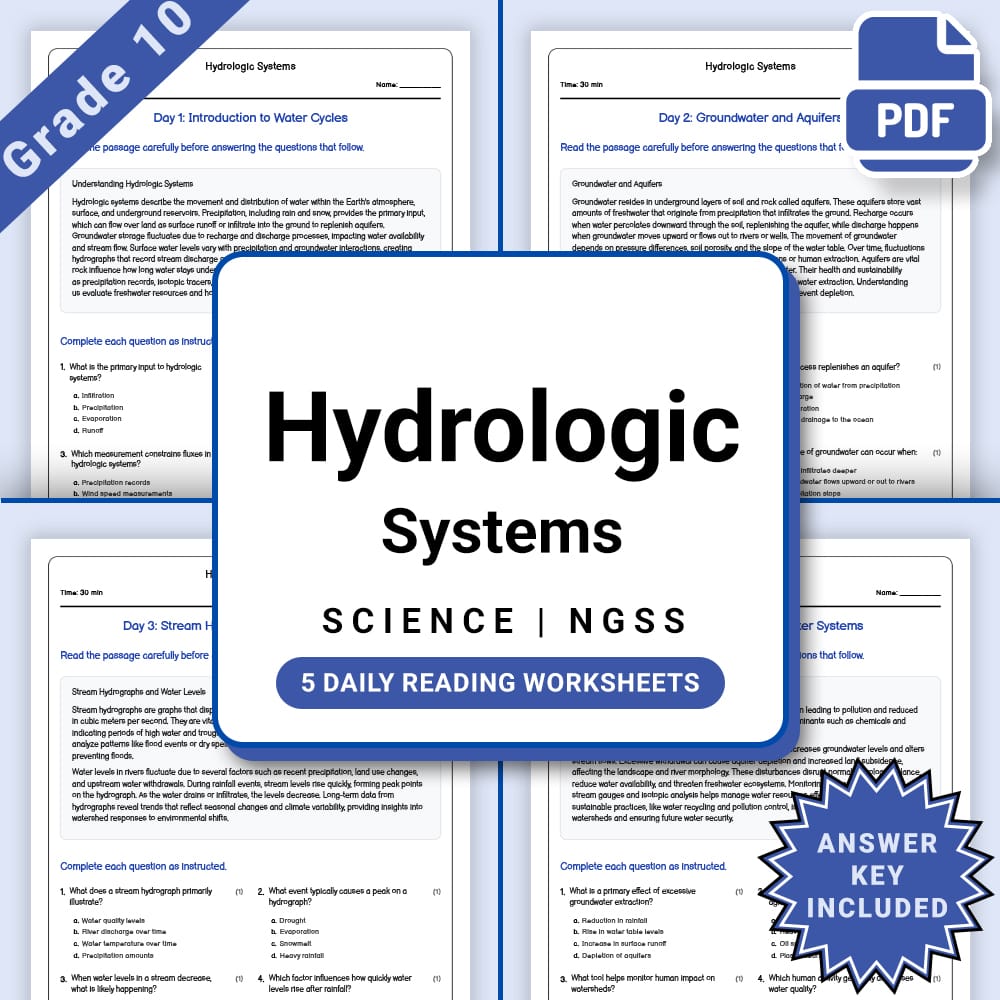
Grade 10 Science – Hydrologic Systems Worksheet (PDF +Answer Key)
Created byCopper Leaf ClassroomLearning Objectives
- Identify components of the water cycle such as precipitation, runoff, infiltration, and groundwater storage.
- Understand the concepts of aquifer recharge and discharge and their effects on water resources.
- Explain water-table fluctuations, stream hydrographs, and residence times in porous media.
Instant download
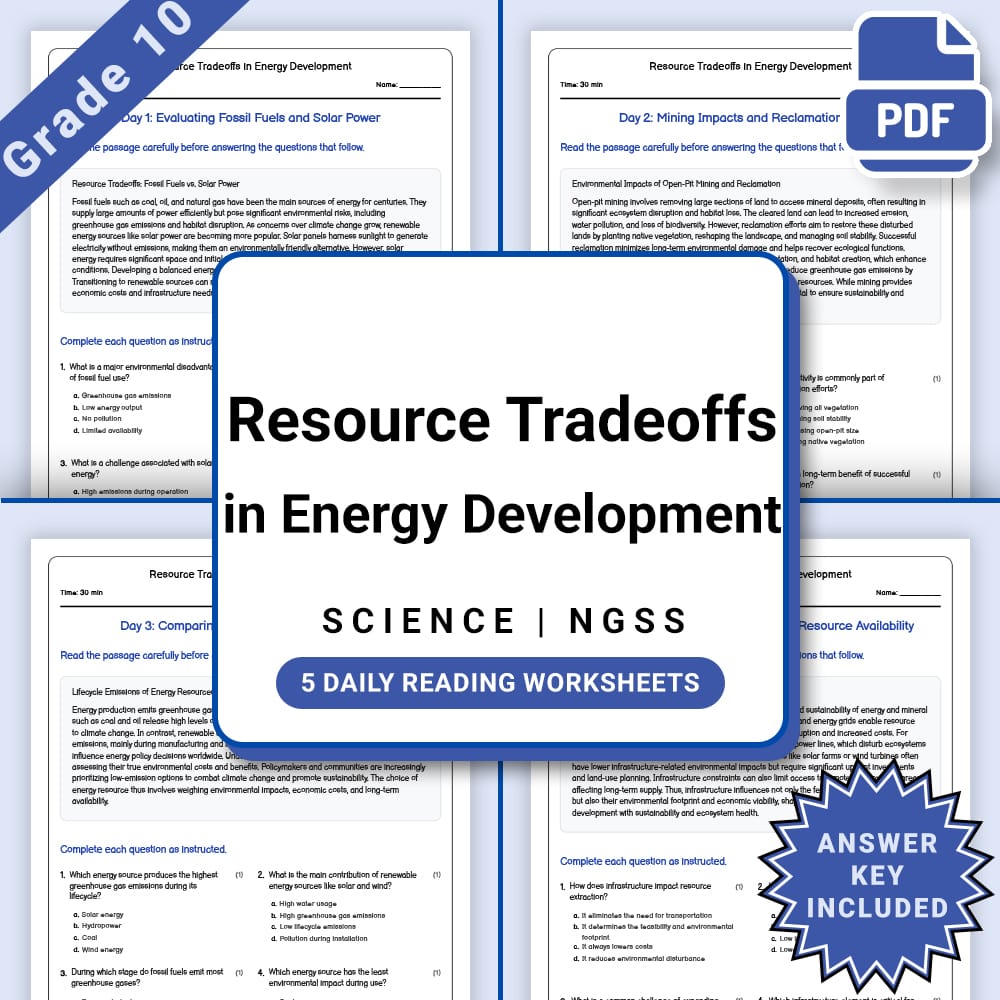
Grade 10 Science – Resource Tradeoffs in Energy Development (PDF +Answers)
Created byCopper Leaf ClassroomLearning Objectives
- Compare different energy resources based on environmental and sustainability factors.
- Evaluate the trade-offs between fossil fuel use and renewable energy deployment.
- Analyze case studies related to resource management and environmental impact.
Instant download
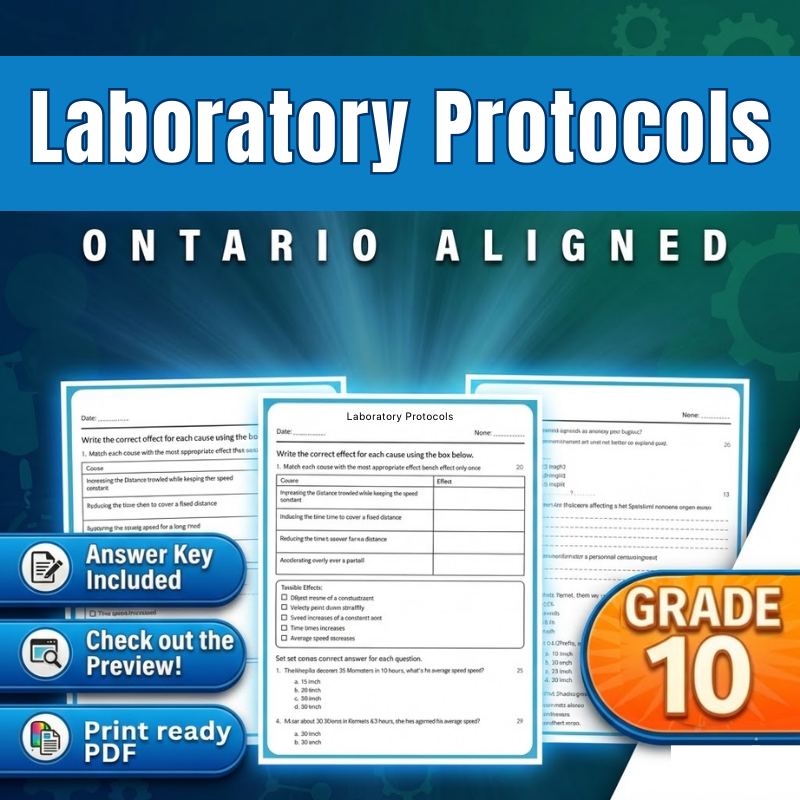
Grade 10 Science | Laboratory Protocols Worksheet (Ontario, PDF)
Created byBright Mind ResourcesLearning Objectives
- Identify essential safety protocols and proper laboratory attire.
- Recognize appropriate use of personal protective equipment (PPE).
- Understand storage and segregation of incompatible reagents.
Instant download
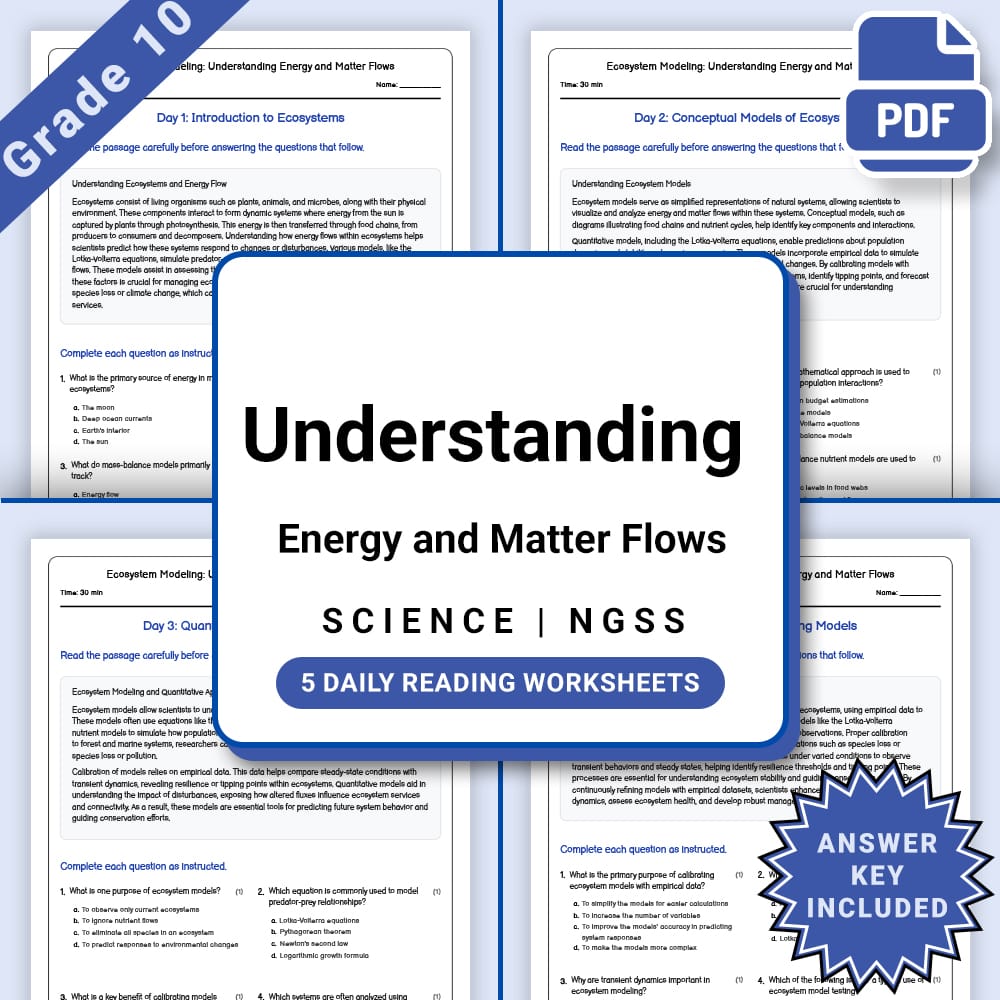
Grade 10 Science – Ecosystem Modeling Worksheet (PDF +Answer Key)
Created byCopper Leaf ClassroomLearning Objectives
- Describe the basic components of ecosystems and how energy flows through them.
- Explain different models used to predict ecosystem responses, including Lotka–Volterra equations and mass-balance models.
- Interpret the significance of system stability, resilience, and tipping points in ecosystems.
Instant download
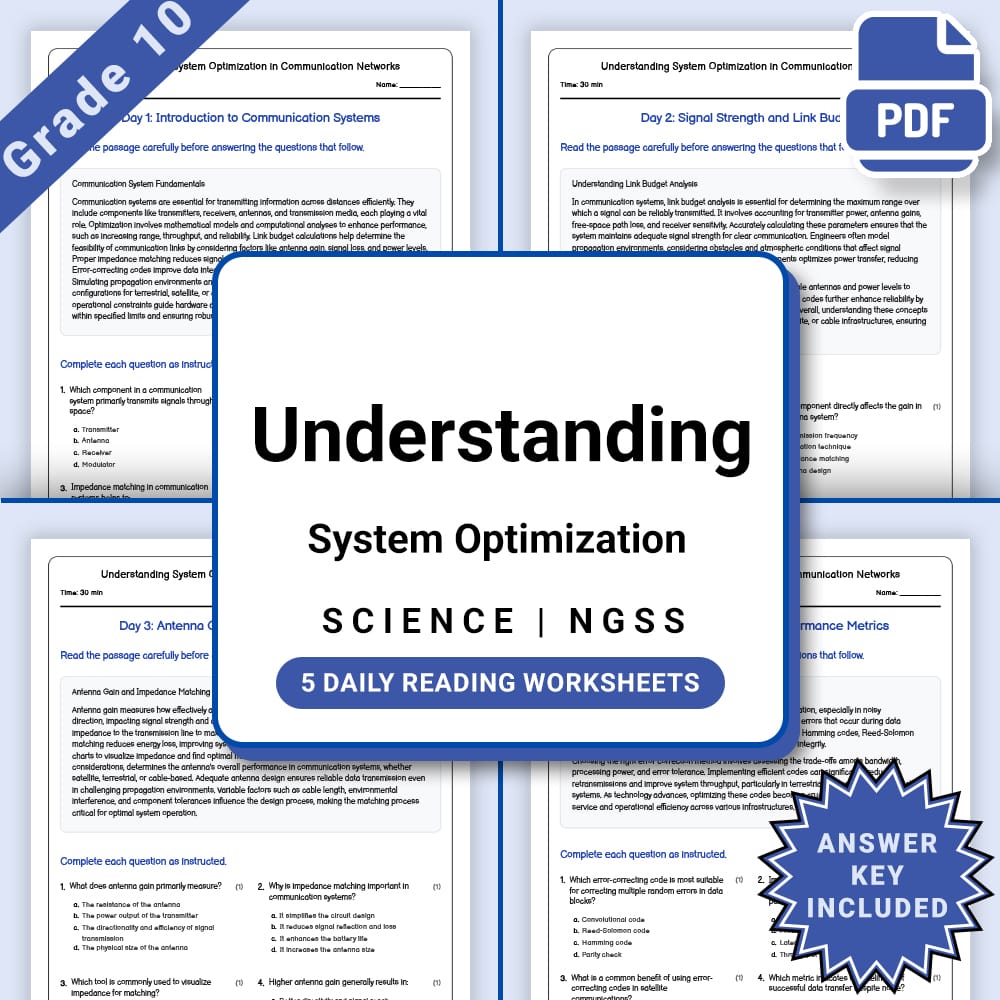
Grade 10 Science – Understanding System Optimization Worksheet (PDF +Answer Key)
Created byCopper Leaf ClassroomLearning Objectives
- Understand key concepts related to Science
- Apply knowledge through practice questions
- Demonstrate comprehension of the material
Instant download
Grade 10 Science | Seismic Tomography Worksheet (Ontario) (Science 1)
Created byBright Mind ResourcesLearning Objectives
- Understand the types of seismic waves and how they travel through Earth's interior.
- Interpret seismic wave velocities, travel times, and attenuation to infer subsurface structures.
- Explain how seismic data are used to map crustal and mantle features such as subduction slabs and mantle plumes.
Instant download
Grade 10 Science | Photosynthesis Basics Worksheet (Ontario Standards) (PDF)
Created byBright Mind ResourcesLearning Objectives
- Explain the main stages of photosynthesis, including light-dependent reactions and the Calvin cycle.
- Identify the roles of chloroplast structures and pigments in capturing light energy.
- Describe how environmental factors like light intensity, CO2, and temperature affect photosynthesis.
Instant download
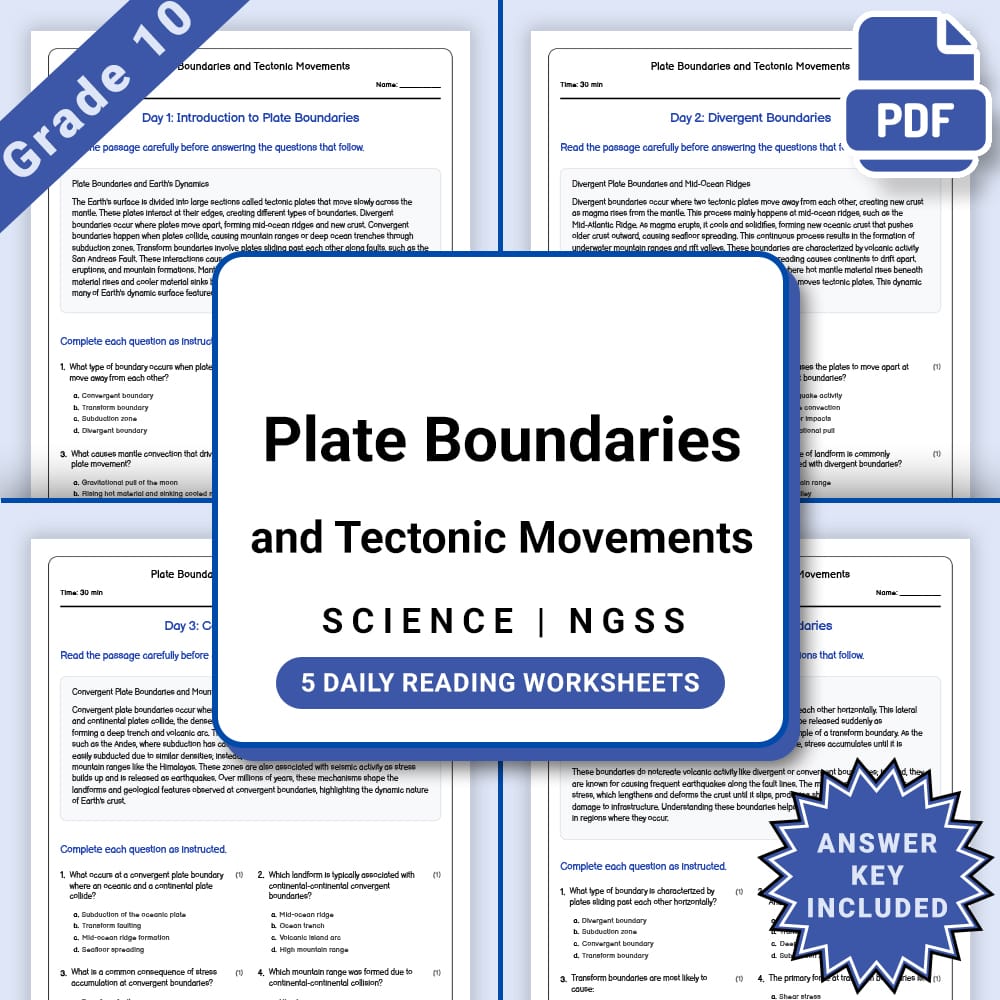
Grade 10 Science – Plate Boundaries Worksheet (PDF +Answer Key)
Created byCopper Leaf ClassroomLearning Objectives
- Identify and describe the three main types of plate boundaries: divergent, convergent, and transform.
- Understand the geological features associated with each boundary type, such as mid-ocean ridges, subduction zones, and fault lines.
- Explain how mantle convection and stress accumulation lead to earthquakes and volcanic activity.
Instant download
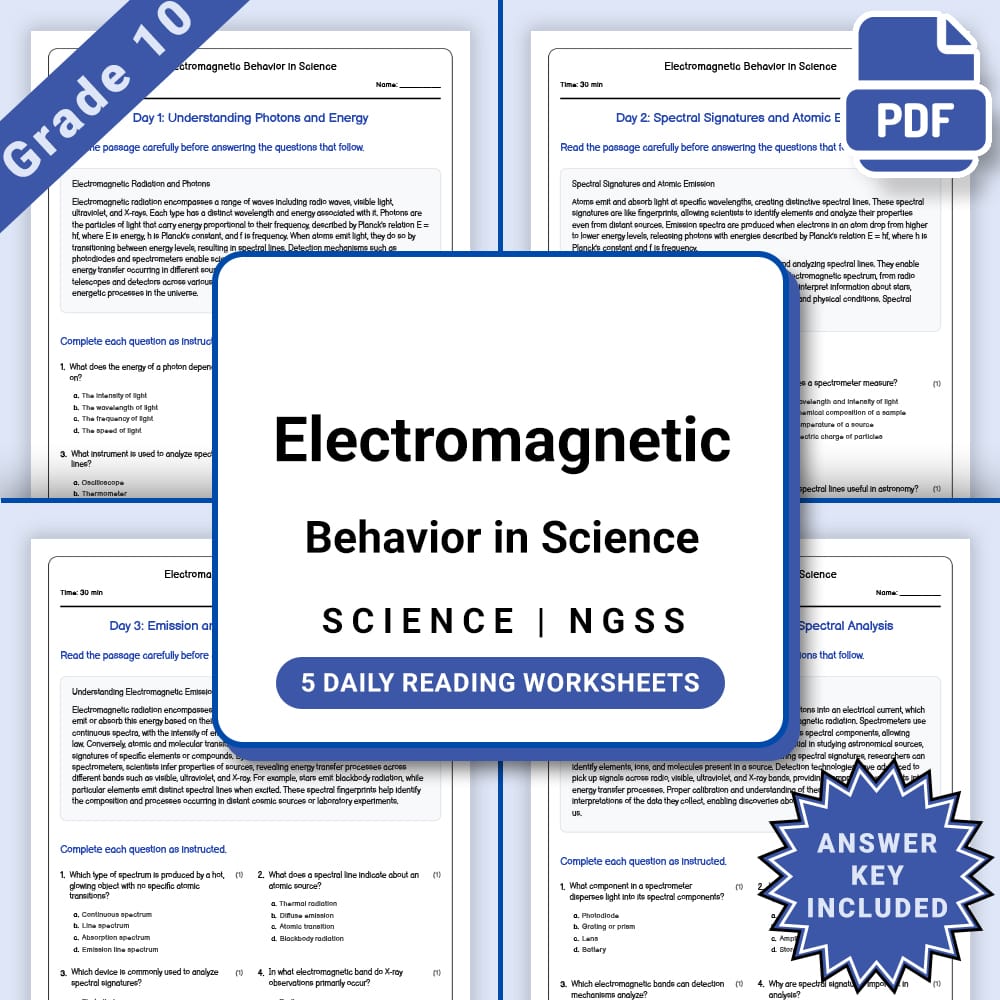
Grade 10 Science – Electromagnetic Behavior Worksheet (PDF +Answer Key)
Created byCopper Leaf ClassroomLearning Objectives
- Understand the properties of electromagnetic radiation.
- Explain photon energy using Planck’s relation E = hf.
- Interpret spectral signatures and emission spectra.
Instant download
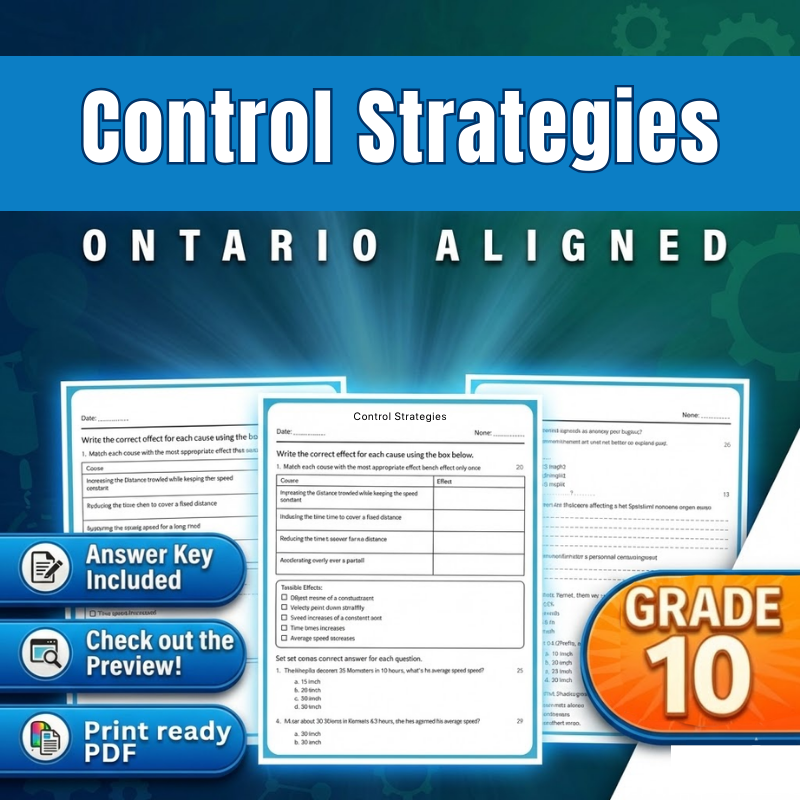
Grade 10 Science – Control Strategies Worksheet (Ontario) (PDF)
Created byBright Mind ResourcesLearning Objectives
- Understand the purpose and application of control groups, randomization, blocking, and replication in experiments.
- Identify common sources of bias and confounding factors in experimental design.
- Explain rationale for selecting controls and levels of control in scientific procedures.
Instant download
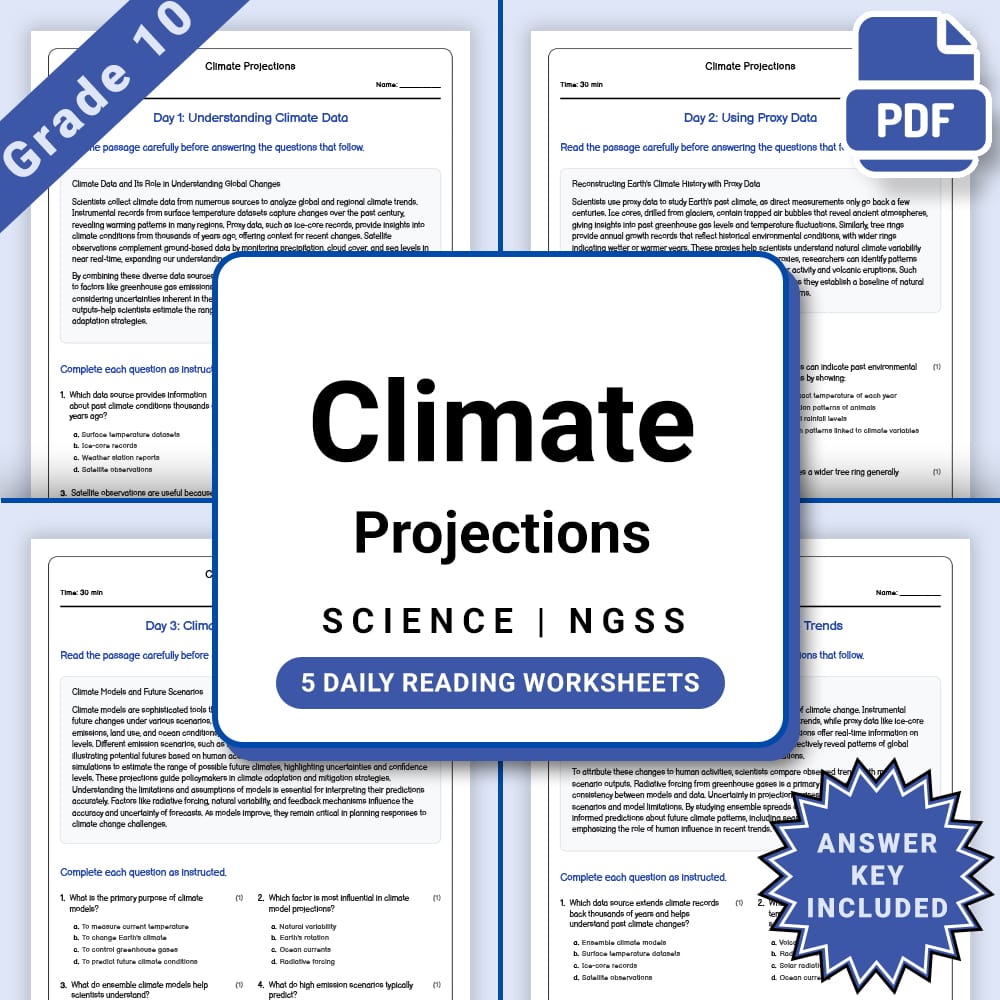
Grade 10 Science – Climate Projections Worksheet (PDF +Answer Key)
Created byCopper Leaf ClassroomLearning Objectives
- Understand key concepts related to Science
- Apply knowledge through practice questions
- Demonstrate comprehension of the material
Instant download
Grade 10 Science | Ethics and Safety Worksheet (PDF) – Ontario Standards
Created byBright Mind ResourcesLearning Objectives
- Understand the importance of ethical responsibilities in maintaining safety and integrity in scientific work.
- Identify key ethical considerations such as data honesty, consent, humane treatment, and reporting obligations.
- Evaluate how ethical practices influence the credibility and trustworthiness of scientific findings.
Instant download
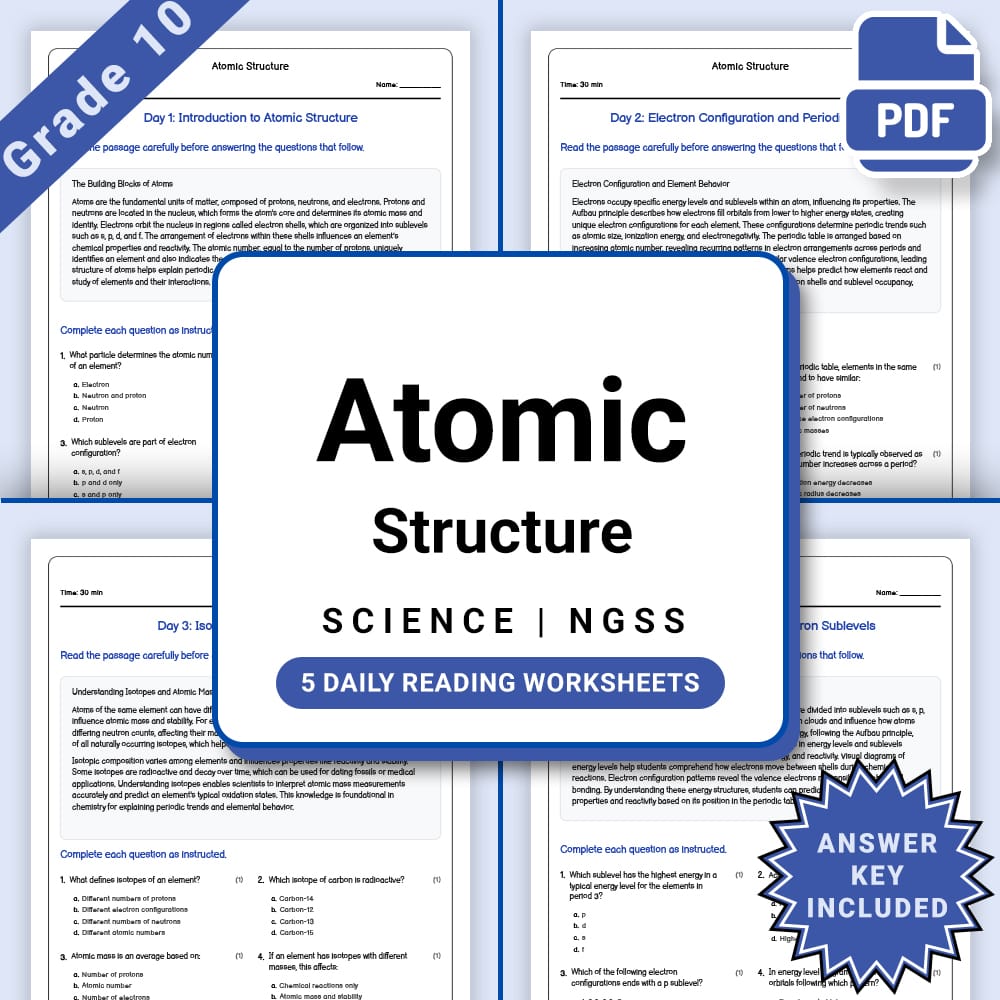
Grade 10 Science – Atomic Structure Worksheet (PDF +Answer Key)
Created byCopper Leaf ClassroomLearning Objectives
- Understand the basic components of an atom, including protons, neutrons, and electrons.
- Describe electron shells, sublevels, and how electrons are arranged in an atom.
- Explain the significance of atomic number and atomic mass in element properties.
Instant download
Grade 10 Science – Reaction Yield Worksheet (Ontario) with Answer Key
Created byBright Mind ResourcesLearning Objectives
- Understand the concept of limiting reagent and how it affects reaction yield.
- Calculate theoretical and actual yields based on chemical equations and measurements.
- Compute percent yield and analyze factors impacting reaction efficiency.
Instant download
Grade 10 Science | Science Careers Pathways Worksheet (Ontario, PDF)
Created byBright Mind ResourcesLearning Objectives
- Identify various scientific careers and their roles within laboratory and research settings.
- Understand the credential pathways and certifications required for science-related careers.
- Explore transferable skills such as measurement, safety, and reporting in scientific work.
Instant download
Grade 10 Science | Balancing Equations Worksheet – Ontario (PDF)
Created byBright Mind ResourcesLearning Objectives
- Understand the principle of conservation of mass in chemical reactions.
- Learn how to systematically balance chemical equations with coefficients.
- Distinguish between coefficients and subscripts in chemical formulas.
Instant download
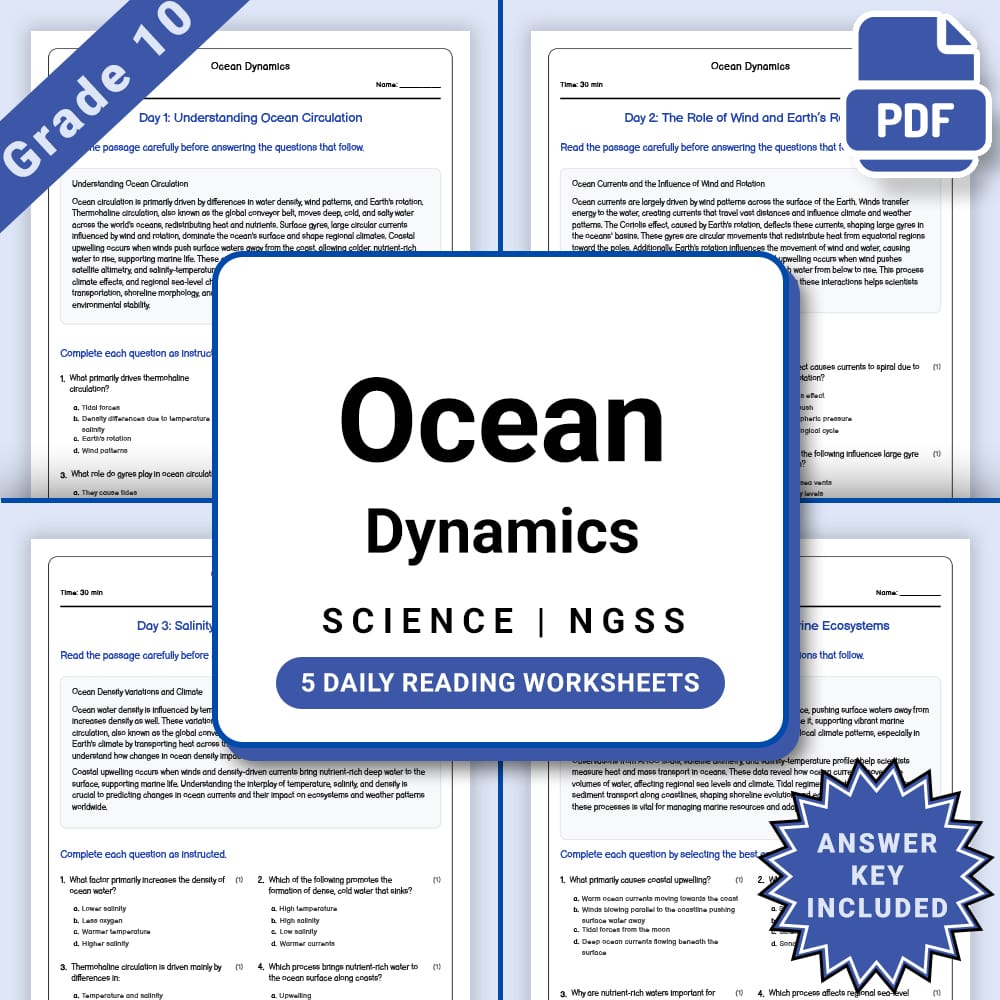
Grade 10 Science – Ocean Dynamics Worksheet (PDF +Answer Key)
Created byCopper Leaf ClassroomLearning Objectives
- Understand the key circulation patterns in ocean dynamics
- Interpret data from ocean observation tools
- Identify the impact of ocean movement on climate and coastal features
Instant download
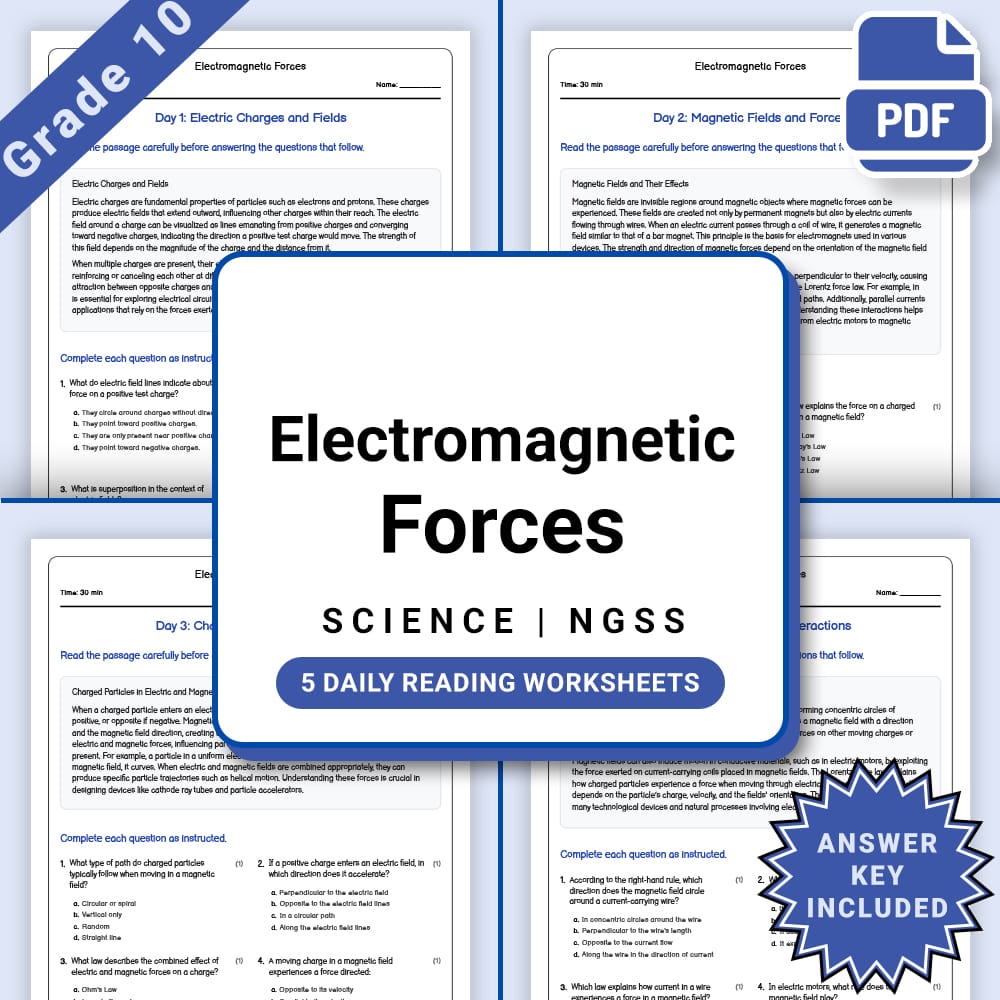
Grade 10 Science – Electromagnetic Forces Worksheet (PDF +Answer Key)
Created byCopper Leaf ClassroomLearning Objectives
- Understand how electric charges create electric fields around them.
- Explain the interaction between magnetic fields and electric currents.
- Describe the principles of the Lorentz force law in simple contexts.
Instant download
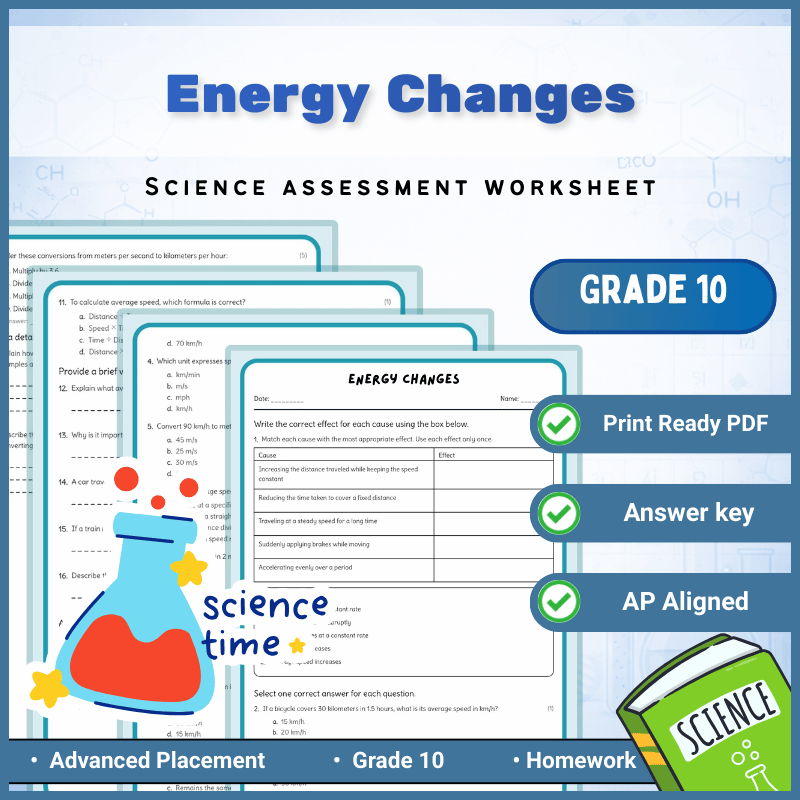
Grade 10 Science | Energy Changes Worksheet (AP Standard + Answer Key) (PDF)
Created byBright Mind ResourcesLearning Objectives
- Explain the concepts of endothermic and exothermic reactions in terms of energy transfer.
- Describe how bond breaking and forming influence reaction heat and potential energy diagrams.
- Understand the basic ideas of enthalpy and reaction spontaneity.
Instant download
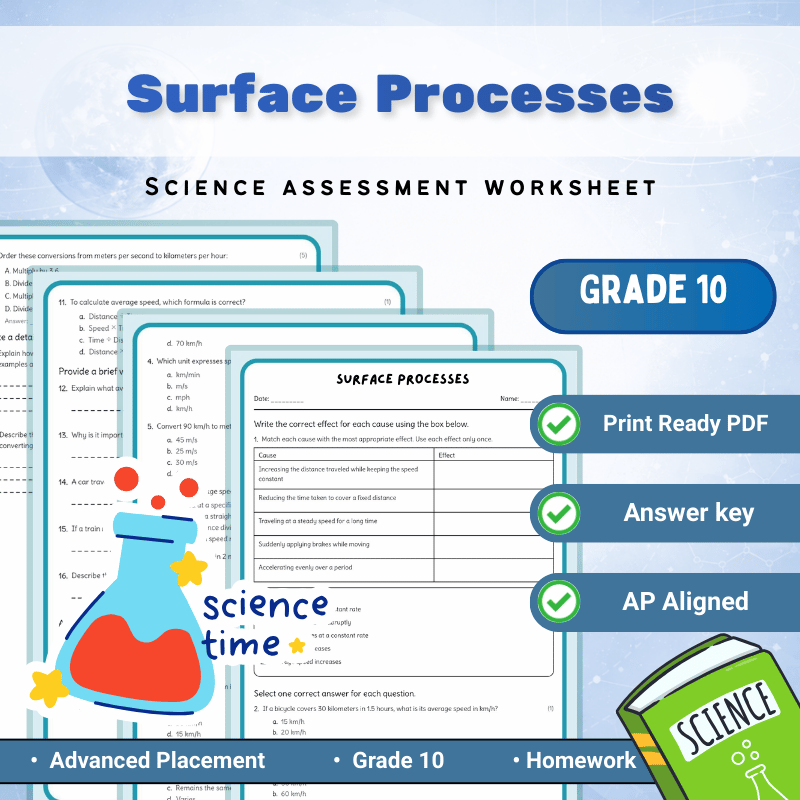
Grade 10 Science Surface Processes Worksheet | AP Standards (PDF) Practice Set
Created byBright Mind ResourcesLearning Objectives
- Understand key surface processes such as weathering, erosion, sediment transport, and deposition.
- Interpret how climate, lithology, and human activity influence landscape evolution.
- Identify observable signatures of surface processes, including sediment grain-size distributions and channel profiles.
Instant download
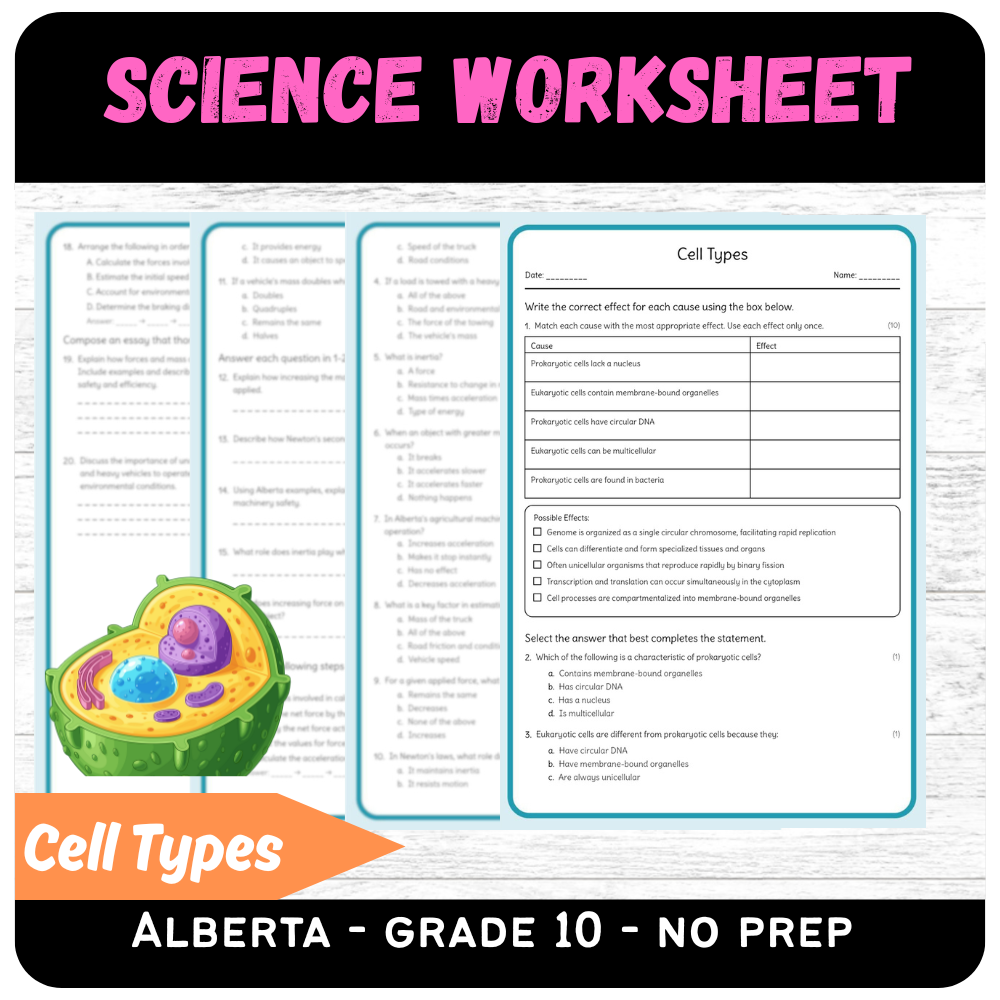
Grade 10 Science - Cell Types Worksheet (Worksheet) | Alberta Standards
Created byBright Mind ResourcesLearning Objectives
- Identify the structural differences between prokaryotic and eukaryotic cells.
- Explain how cell structure influences cellular functions such as reproduction and genetic control.
- Compare examples of prokaryotic and eukaryotic organisms within regional ecological contexts.
Instant download
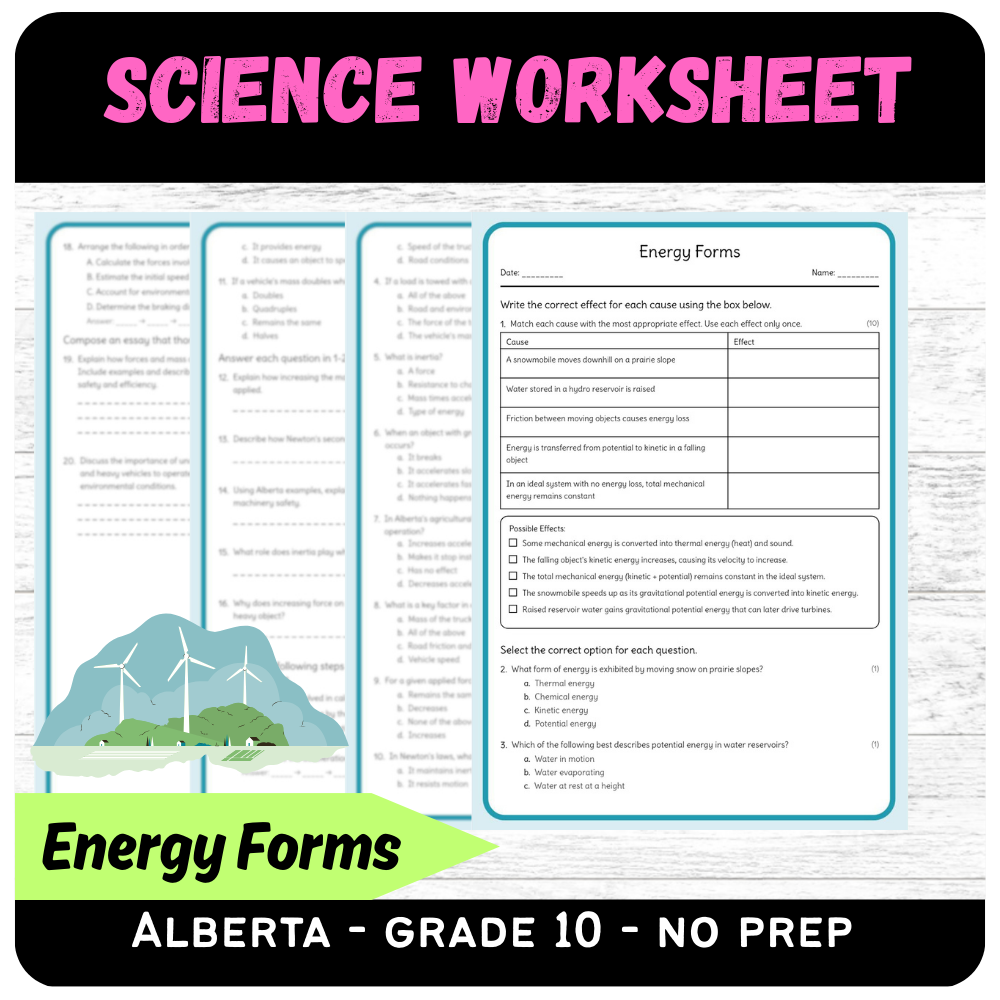
Grade 10 Science – Energy Forms Worksheet | Alberta Standards
Created byBright Mind ResourcesLearning Objectives
- Define kinetic and potential energy with real-world examples.
- Explain the conservation of mechanical energy in idealized systems.
- Describe how non-conservative forces affect energy distribution.
Instant download
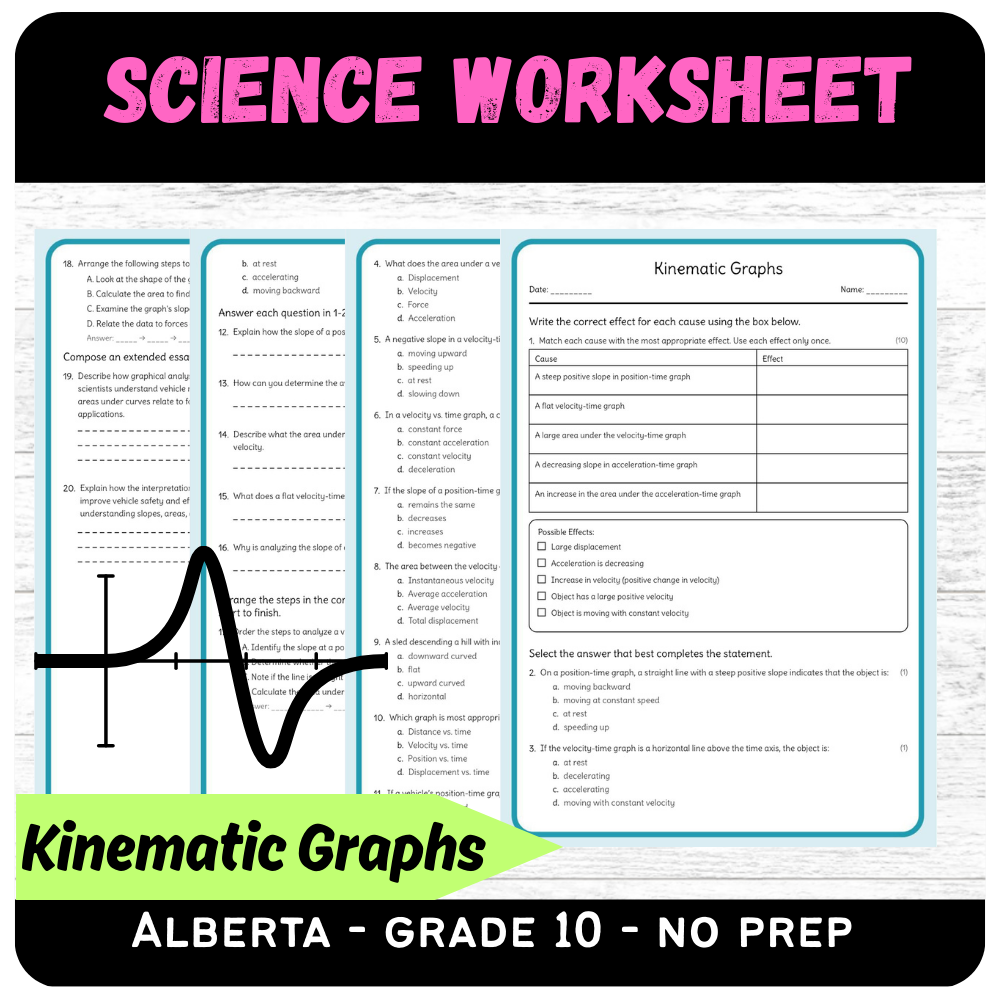
Grade 10 Science – Kinematic Graphs Worksheets (PDF) | Alberta Standards
Created byBright Mind ResourcesLearning Objectives
- Understand how position, velocity, and acceleration graphs represent motion.
- Learn to interpret slopes and areas under kinematic curves to analyze instantaneous and average quantities.
- Apply graphical analysis to real-world vehicle and sled motion scenarios.
Instant download
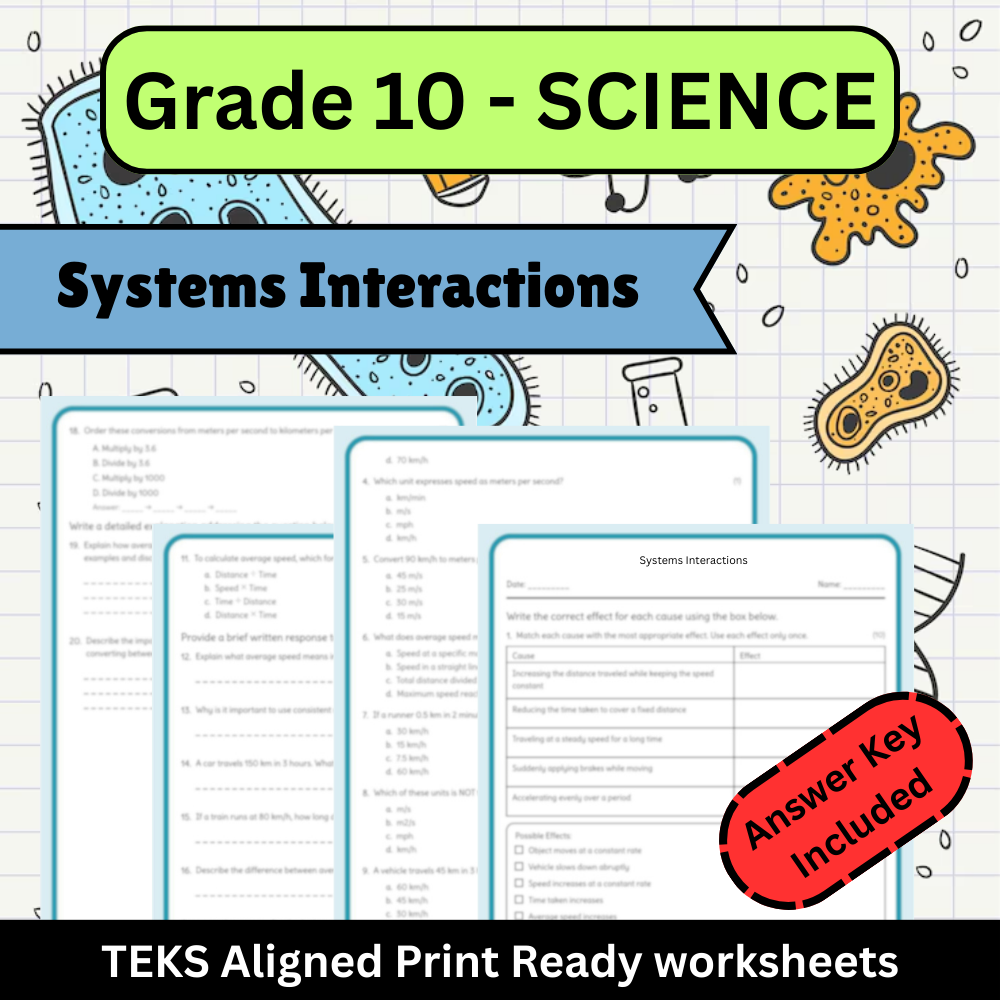
Grade 10 Science – Systems Interactions Worksheet (Worksheet + Answer Key) | TEKS Aligned
Created byBright Mind ResourcesLearning Objectives
- Describe how multiple organ systems coordinate to maintain homeostasis during physiological challenges.
- Identify signaling pathways and feedback mechanisms involved in organ system interactions.
- Explain the concept of emergent properties arising from combined system actions.
Also included in: Grade 10 Science | Body Systems & Homeostasis Worksheet Bundle (TEKS Aligned) +5 more
Instant download
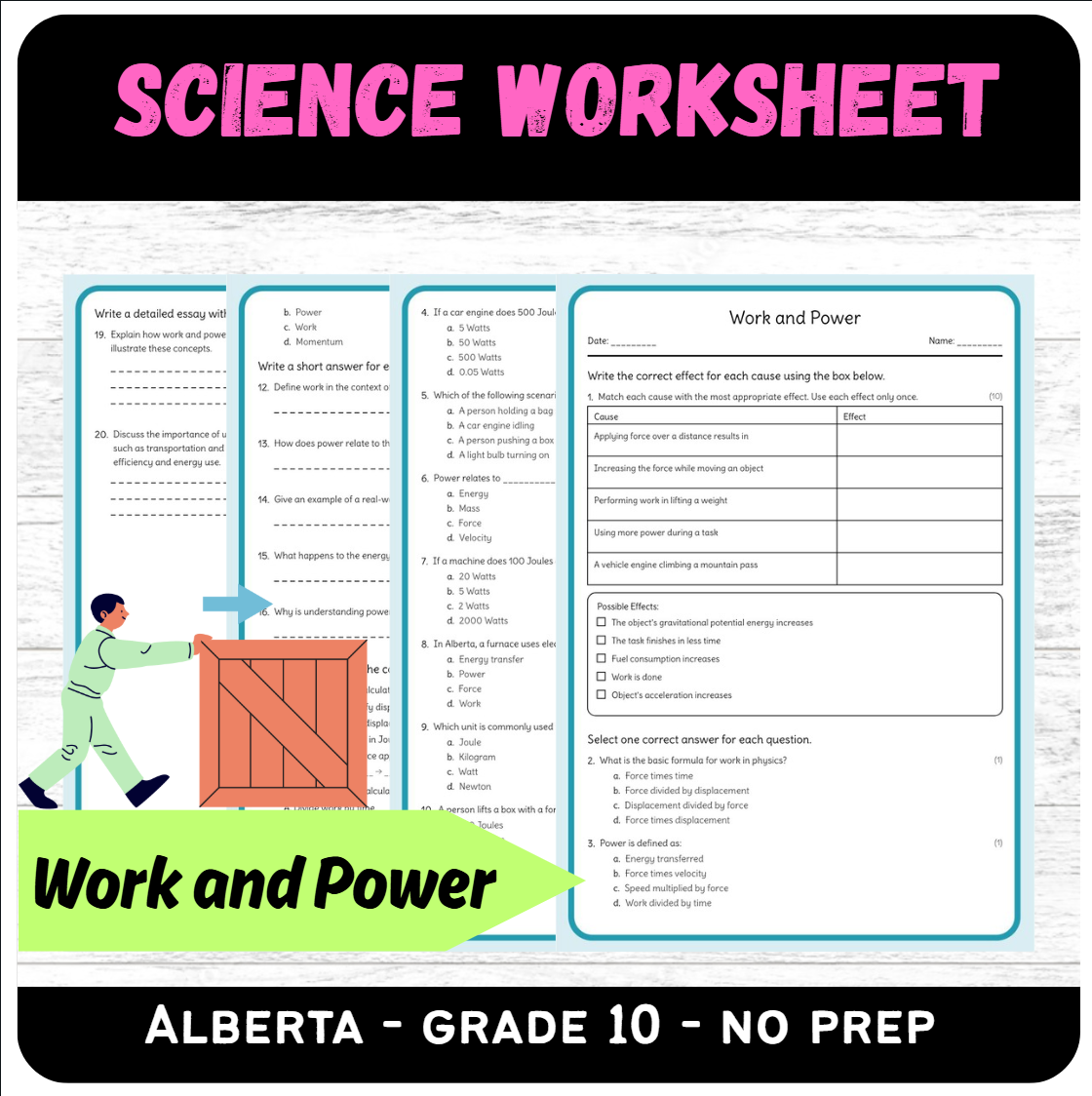
Grade 10 Science | Work and Power Worksheet – Alberta Standards (PDF)
Created byBright Mind ResourcesLearning Objectives
- Understand the definitions of work and power in physics.
- Calculate work done based on force and displacement.
- Explain how power relates to energy transfer over time.
Instant download
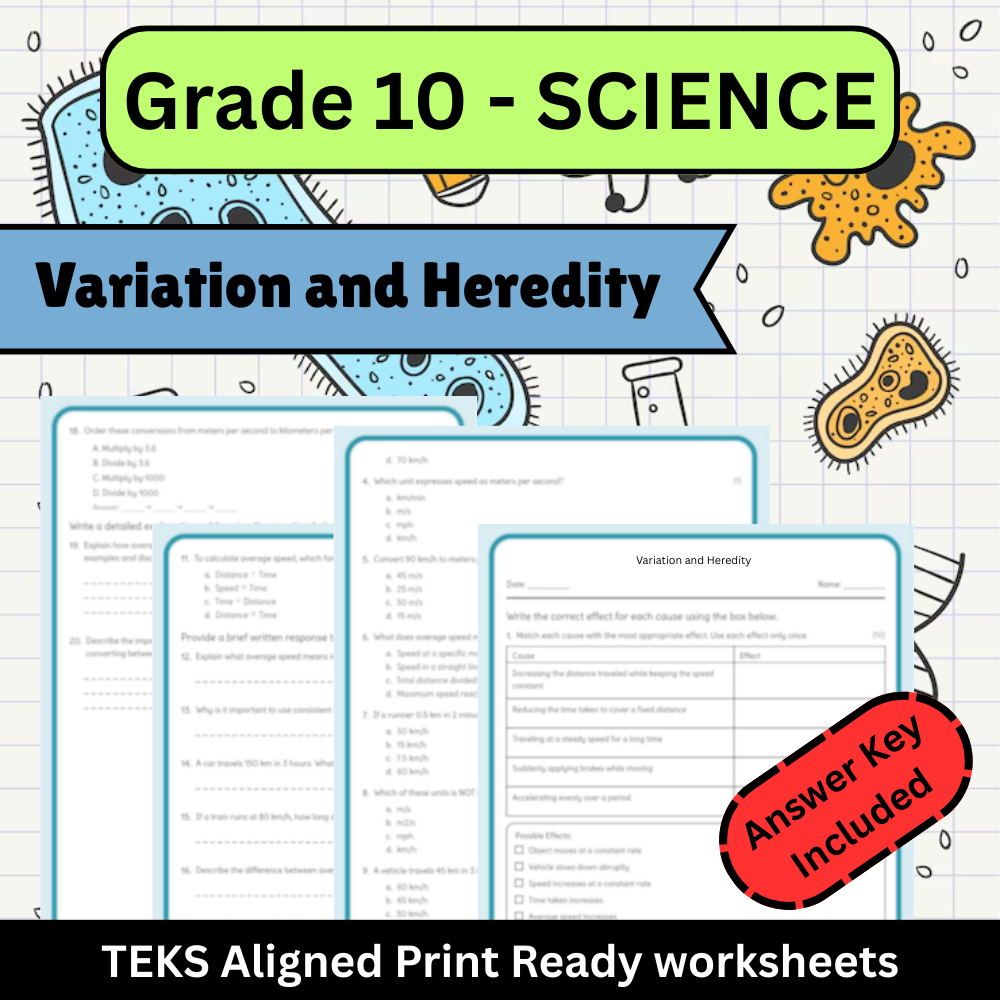
Grade 10 Science | Variations and Heredity Worksheet (Worksheet + Answer Key) – TEKS Aligned
Created byBright Mind ResourcesLearning Objectives
- Understand how genetic variation arises from mutation, recombination, and gene flow.
- Explain how heritable traits influence organism survival and reproduction.
- Describe how natural selection acts on existing variation to change populations over generations.
Also included in: Grade 10 Science | Evolution & Heredity Unit Worksheet Bundle (TEKS Aligned) +5 more
Instant download
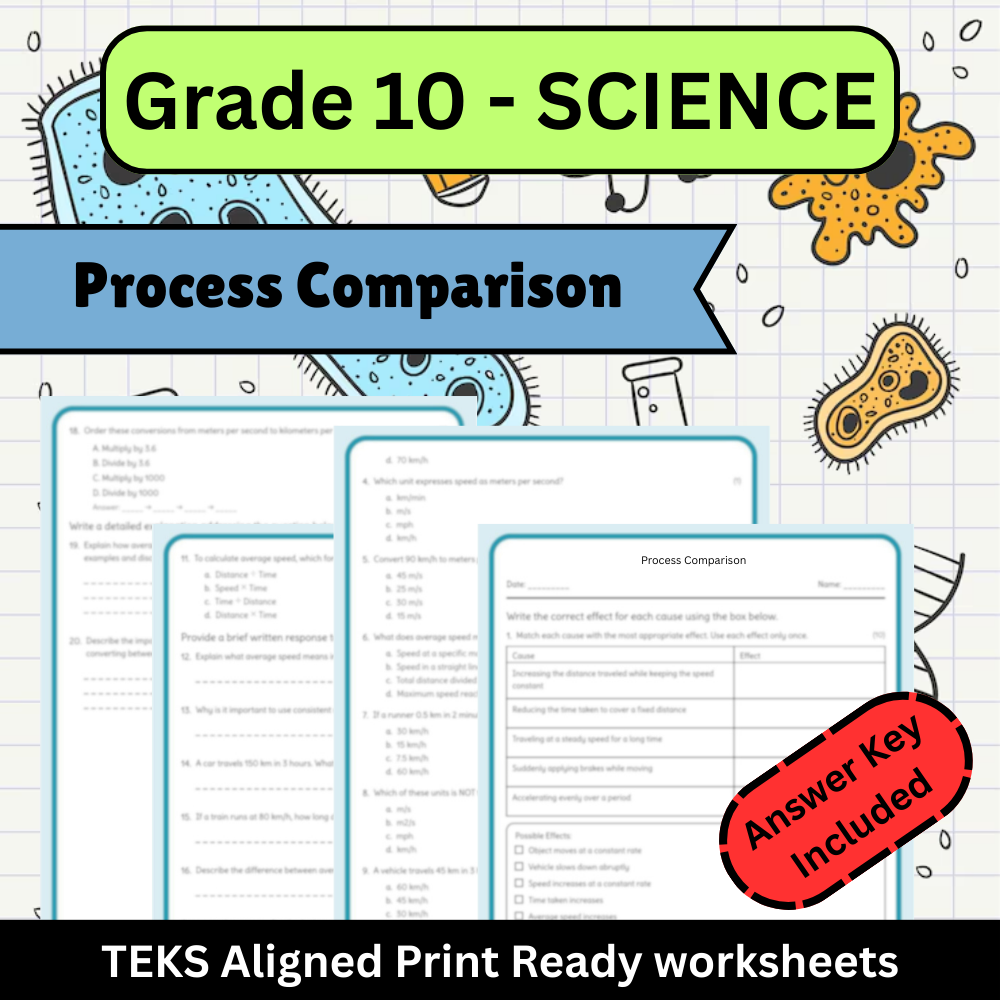
Grade 10 Science – Comparing Photosynthesis & Cellular Respiration Worksheet (PDF)
Created byBright Mind ResourcesLearning Objectives
- Compare the inputs and outputs of photosynthesis and cellular respiration.
- Identify the roles of carbon and energy flow in biological systems.
- Explain reciprocal relationships between autotrophs and heterotrophs in ecosystems.
Also included in: Grade 10 Science Unit Bundle – Photosynthesis, Respiration & Energy TEKS +5 more
Instant download
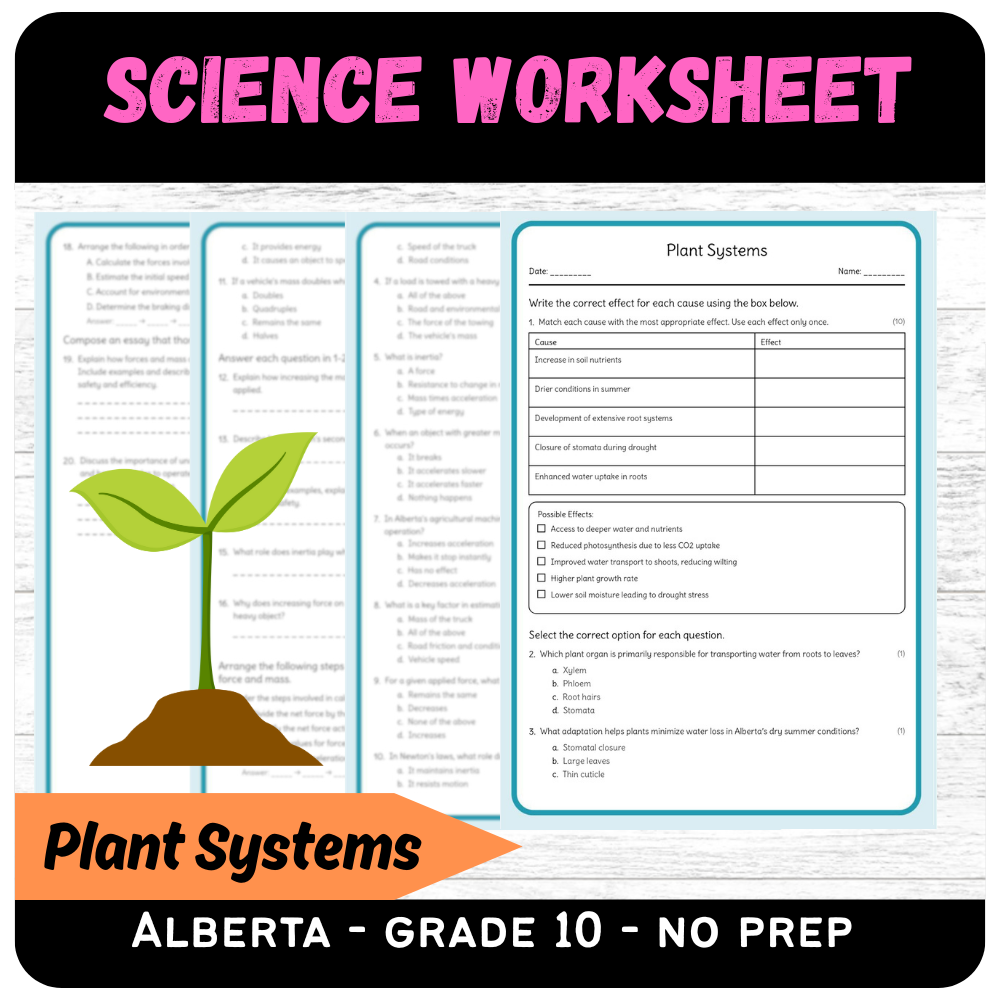
Grade 10 Science | Plant Systems Worksheet (Answer Key) – Alberta Standard
Created byBright Mind ResourcesLearning Objectives
- Describe the structure and function of key plant organ systems in resource acquisition, transport, and reproduction.
- Explain how plant systems adapt to different environmental conditions, particularly in Alberta's regional landscapes.
- Analyze the relationship between plant anatomy and environmental responses or agricultural practices.
Instant download
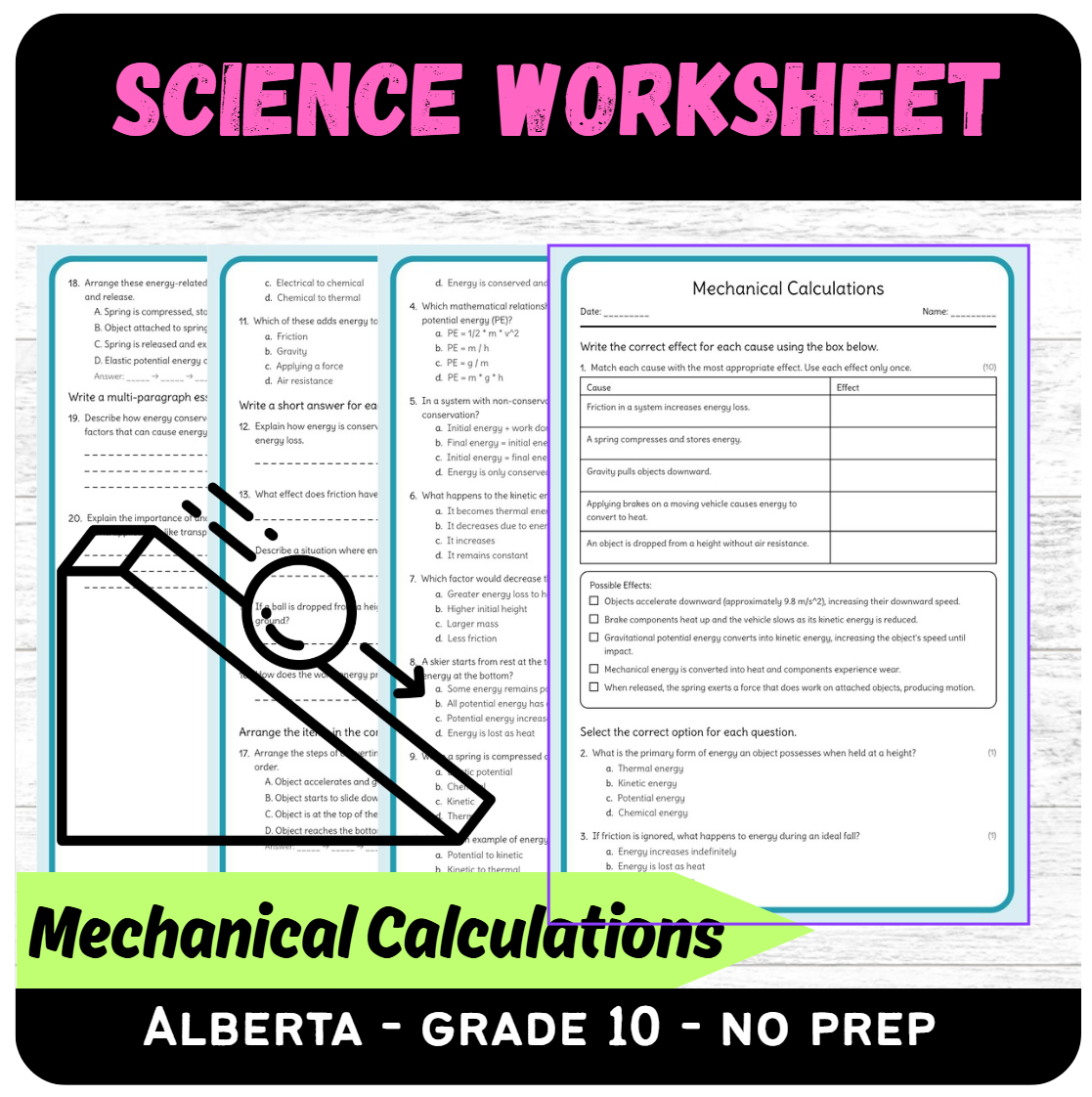
Grade 10 Science – Mechanical Calculations Worksheet (PDF) – Alberta Standards
Created byBright Mind ResourcesLearning Objectives
- Understand how energy is conserved and transformed in mechanical systems involving friction, springs, and gravity.
- Apply mathematical formulas to calculate potential and kinetic energy in real-world scenarios.
- Analyze the effects of non-conservative forces like friction on energy transfer.
Instant download
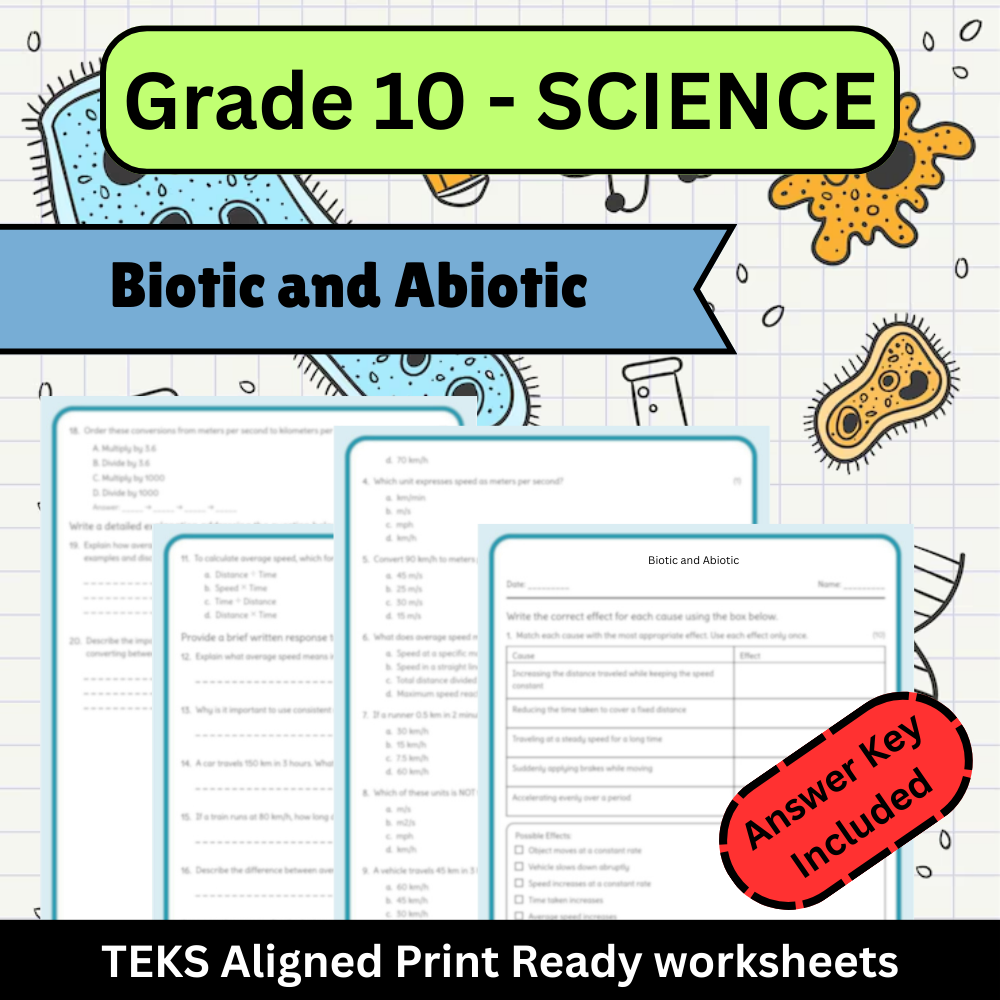
Grade 10 Science – Biotic and Abiotic Factors Worksheet (Answer Key) | TEKS
Created byBright Mind ResourcesLearning Objectives
- Identify the differences between biotic and abiotic factors in ecosystems.
- Explain how biotic and abiotic factors interact to influence habitats and communities.
- Describe how abiotic gradients affect species ranges and populations.
Also included in: Grade 10 Science | Ecosystems & Biodiversity Unit Worksheet Bundle(TEKS-Aligned) +5 more
Instant download
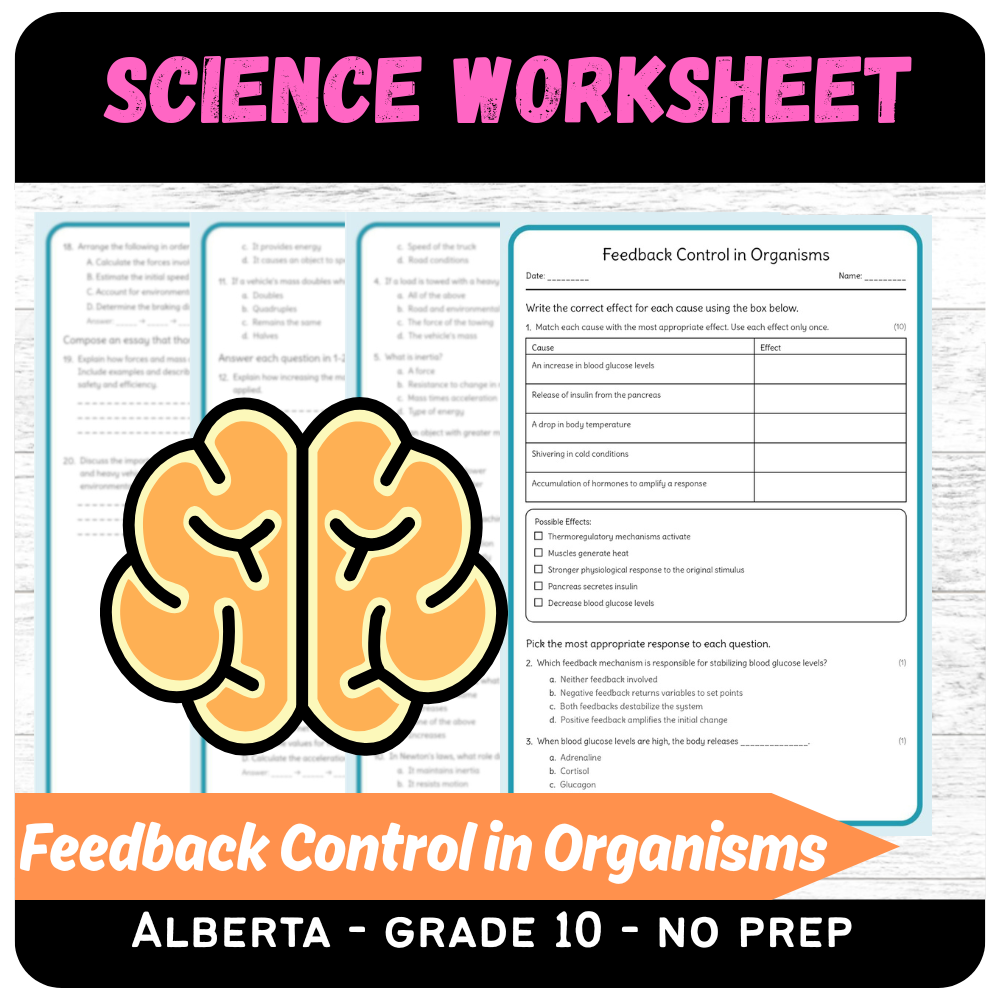
Grade 10 Science | Feedback Control in Organisms Worksheet (PDF)
Created byBright Mind ResourcesLearning Objectives
- Explain the mechanisms of negative and positive feedback in physiological processes.
- Compare different feedback loops and their roles in homeostasis and physiological regulation.
- Illustrate the consequences of failure in feedback regulation for organism health and ecosystems.
Instant download
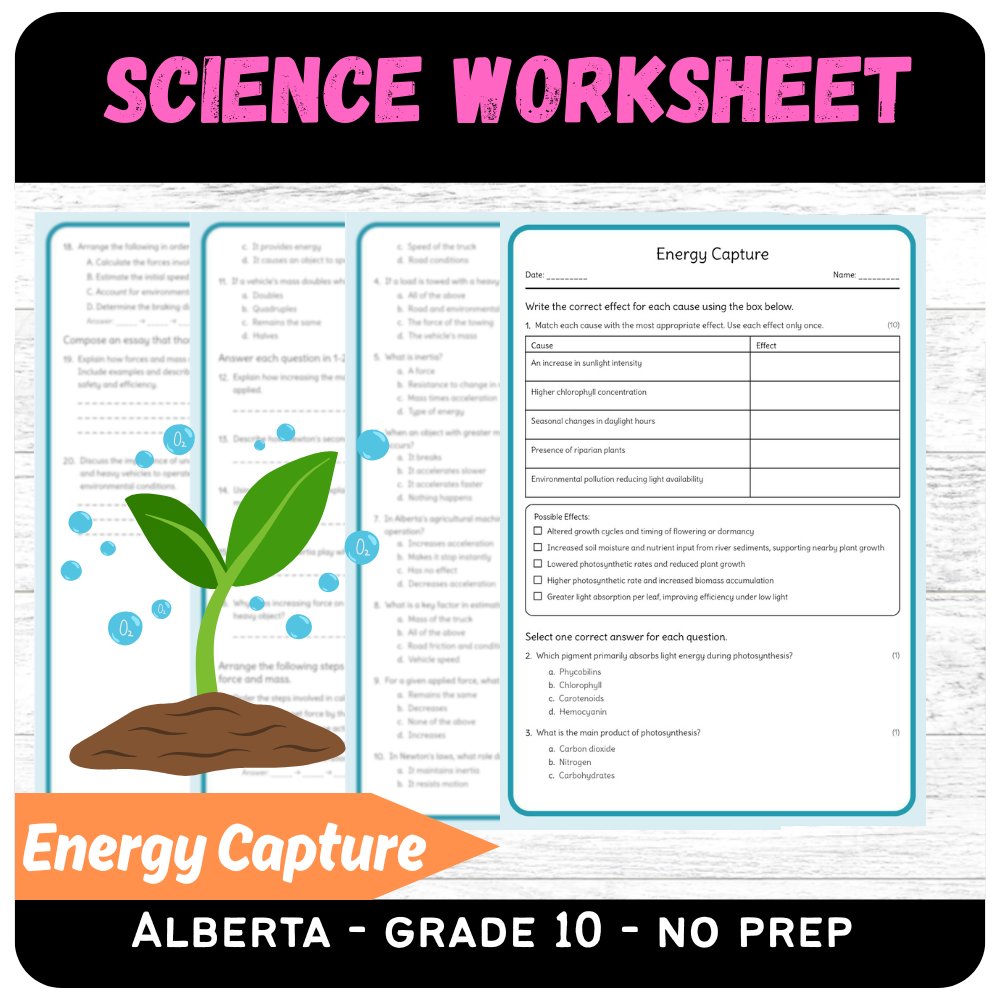
Grade 10 Science – Energy Capture Worksheet (PDF) | Alberta Standards
Created byBright Mind ResourcesLearning Objectives
- Explain the process of photosynthesis and how light energy is converted into chemical energy.
- Identify the roles of chlorophyll and other pigments in capturing light energy.
- Describe environmental influences on energy capture efficiency in plants.
Instant download
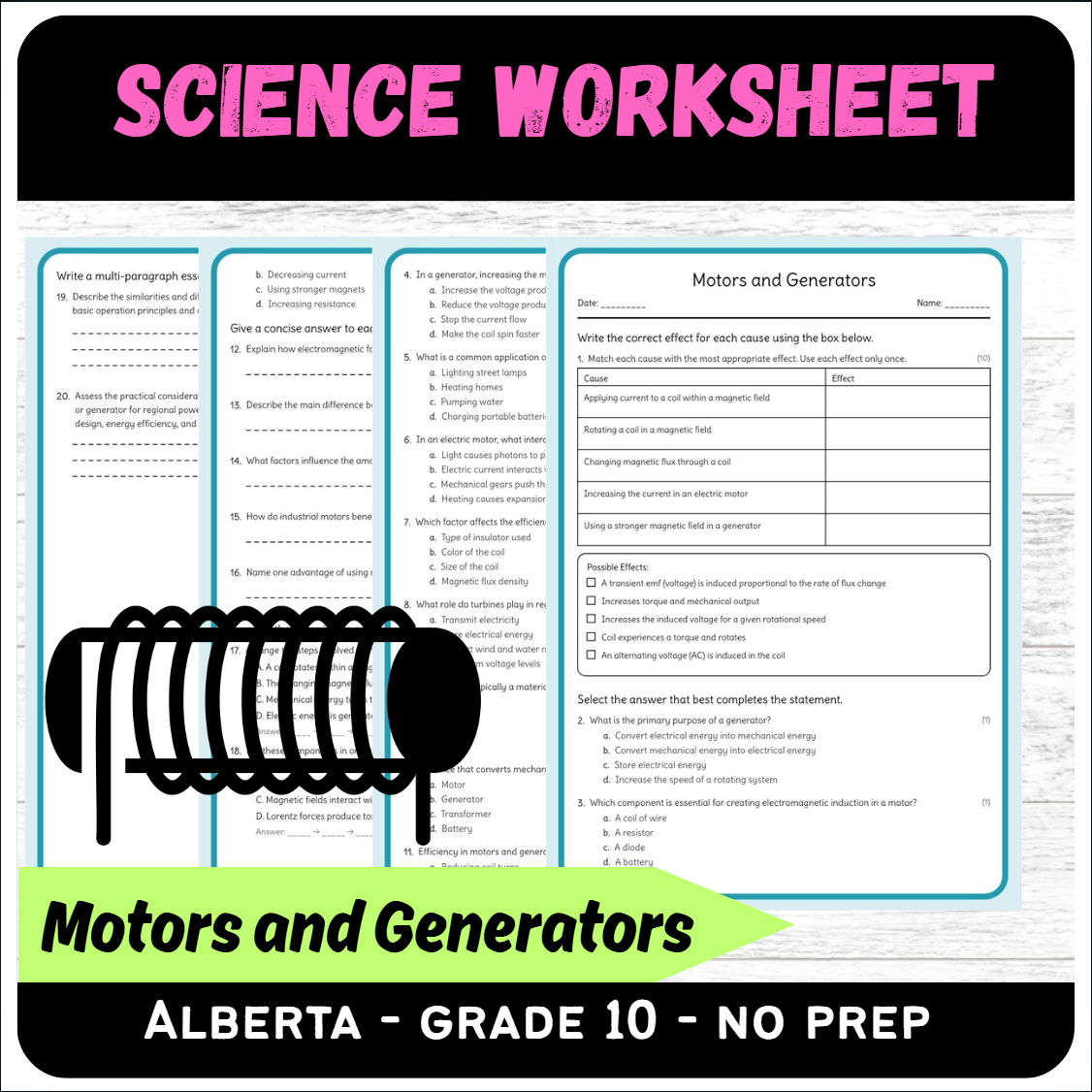
Grade 10 Science | Motors and Generators Worksheet (PDF) – Alberta Standards
Created byBright Mind ResourcesLearning Objectives
- Understand how motors and generators convert electrical energy into mechanical energy and vice versa.
- Explain the principles of electromagnetic induction involved in motor and generator operation.
- Analyze the relationship between electrical current, magnetic fields, and mechanical output in electromechanical devices.
Instant download
Browse more categories
About Grade 10 Worksheets
Find Grade 10 worksheets covering algebra, biology, literature, and history. All 9,385 resources download instantly as PDFs for classwork, homework, or review.
MyTeachingSheets worksheets are made by real teacher-authors and checked before they go live. Download any as a print-ready PDF for lessons, homework, or independent practice — most include answer keys, and previews are always free.