
Grade 10 Worksheets
9,385 grade resources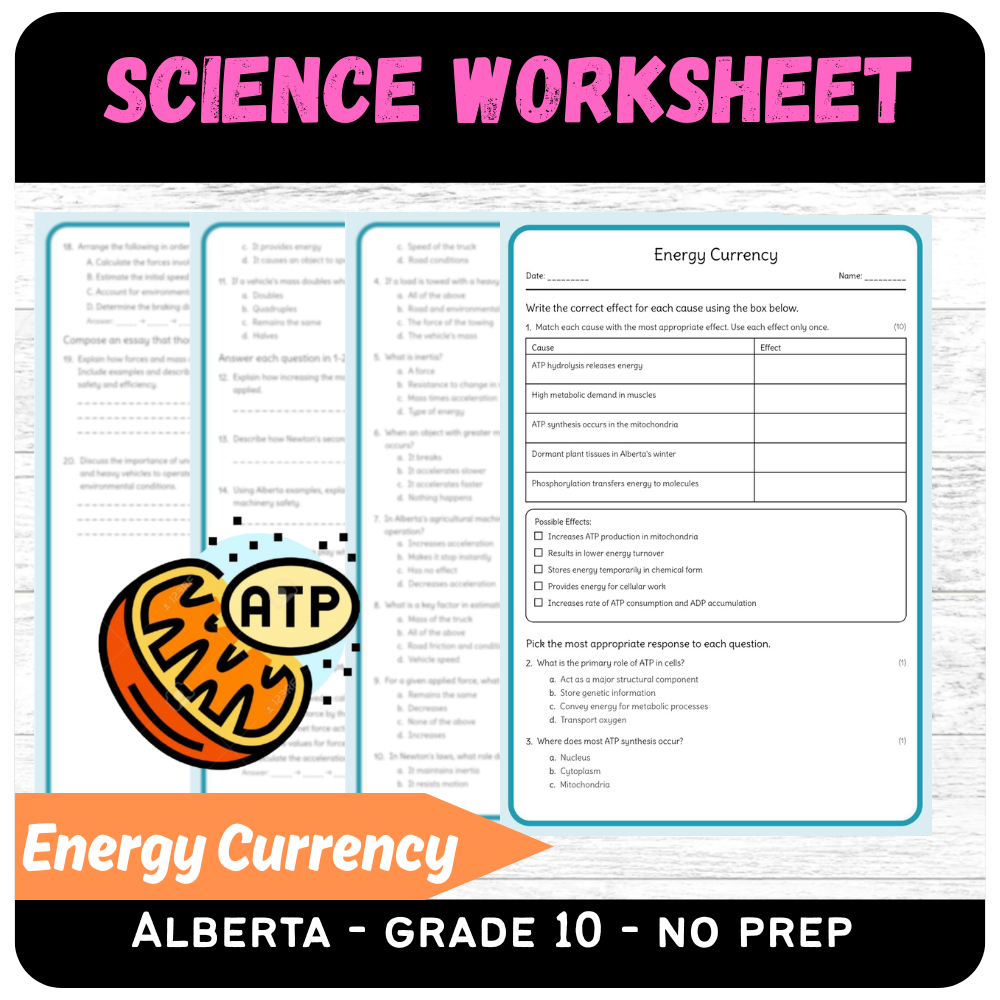
Grade 10 Science | Energy Currency Worksheet (PDF) – Alberta Standards
 Created byBright Mind Resources
Learning Objectives
- Explain the role of ATP as the primary energy currency in cellular processes.
- Describe how ATP synthesis and hydrolysis support metabolic reactions.
- Analyze differences in ATP turnover rates in various tissues and environments.
Instant download
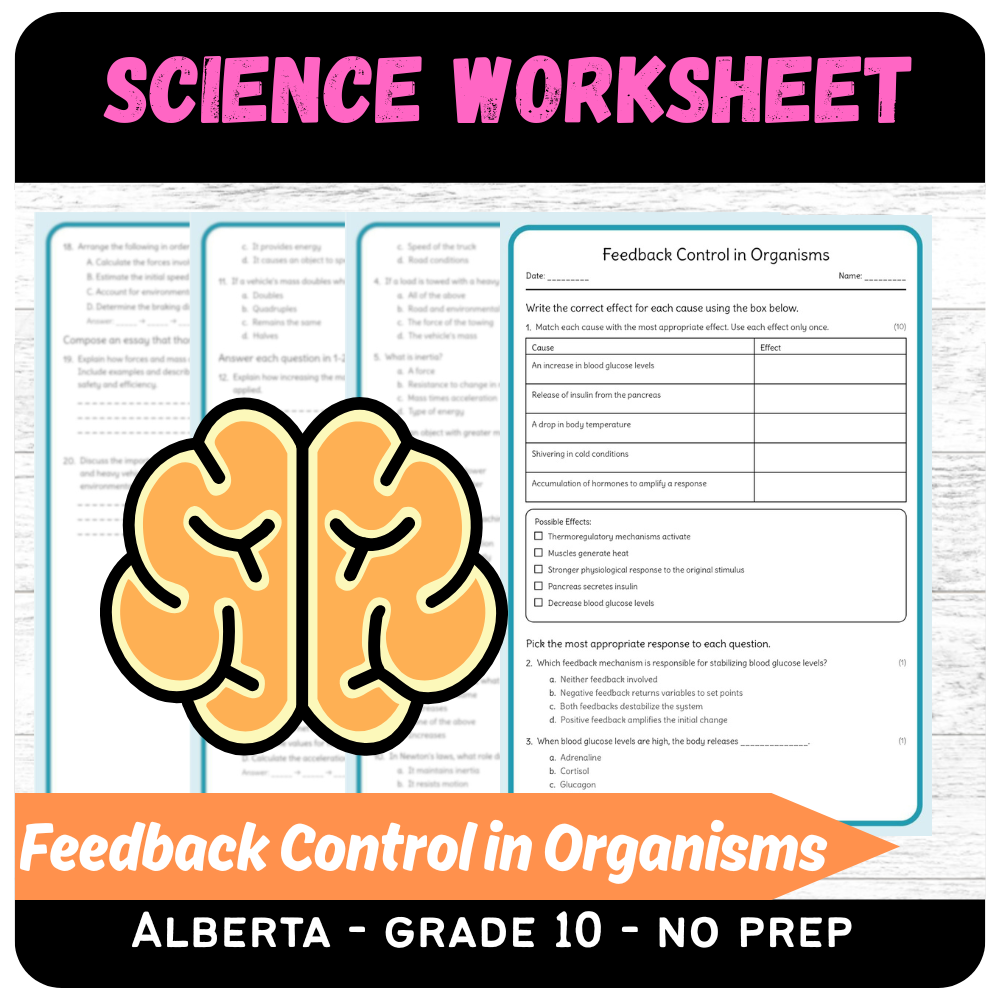
Grade 10 Science | Feedback Control in Organisms Worksheet (PDF)
Created byBright Mind ResourcesLearning Objectives
- Explain the mechanisms of negative and positive feedback in physiological processes.
- Compare different feedback loops and their roles in homeostasis and physiological regulation.
- Illustrate the consequences of failure in feedback regulation for organism health and ecosystems.
Instant download
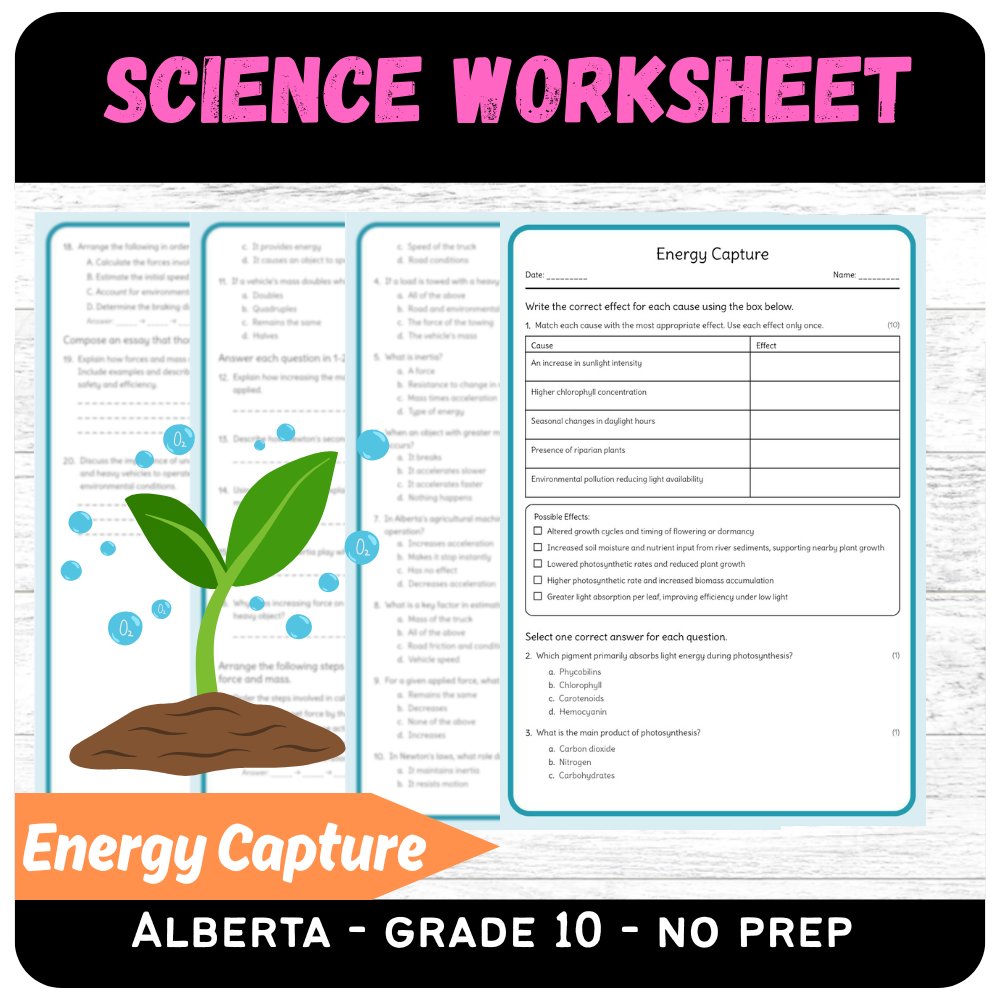
Grade 10 Science – Energy Capture Worksheet (PDF) | Alberta Standards
Created byBright Mind ResourcesLearning Objectives
- Explain the process of photosynthesis and how light energy is converted into chemical energy.
- Identify the roles of chlorophyll and other pigments in capturing light energy.
- Describe environmental influences on energy capture efficiency in plants.
Instant download
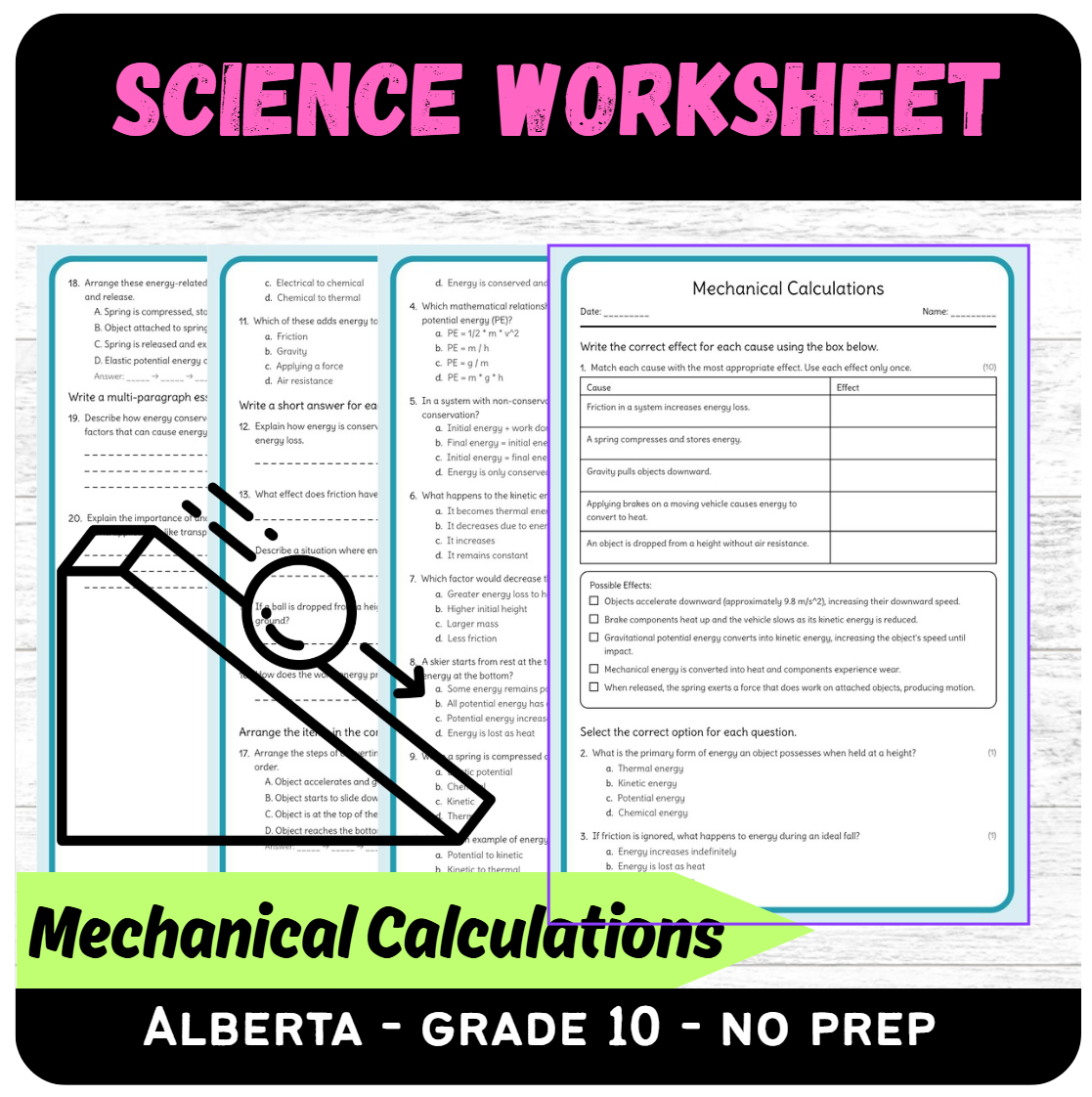
Grade 10 Science – Mechanical Calculations Worksheet (PDF) – Alberta Standards
Created byBright Mind ResourcesLearning Objectives
- Understand how energy is conserved and transformed in mechanical systems involving friction, springs, and gravity.
- Apply mathematical formulas to calculate potential and kinetic energy in real-world scenarios.
- Analyze the effects of non-conservative forces like friction on energy transfer.
Instant download
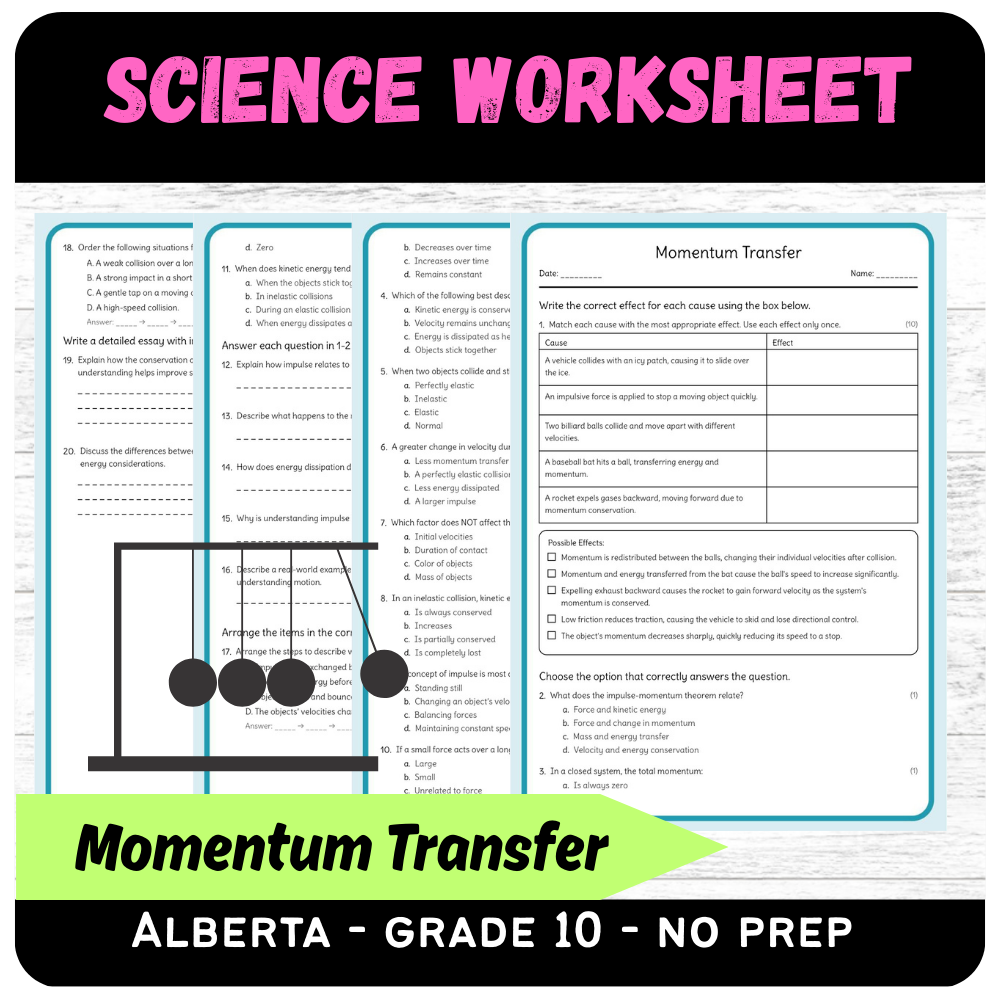
Grade 10 Science – Momentum Transfer Worksheet (Answer Key) | Alberta Standards
Created byBright Mind ResourcesLearning Objectives
- Understand the principle of conservation of momentum in closed systems.
- Analyze collisions and interactions where forces act over time.
- Explain the relationship between impulse and momentum during collisions.
Instant download
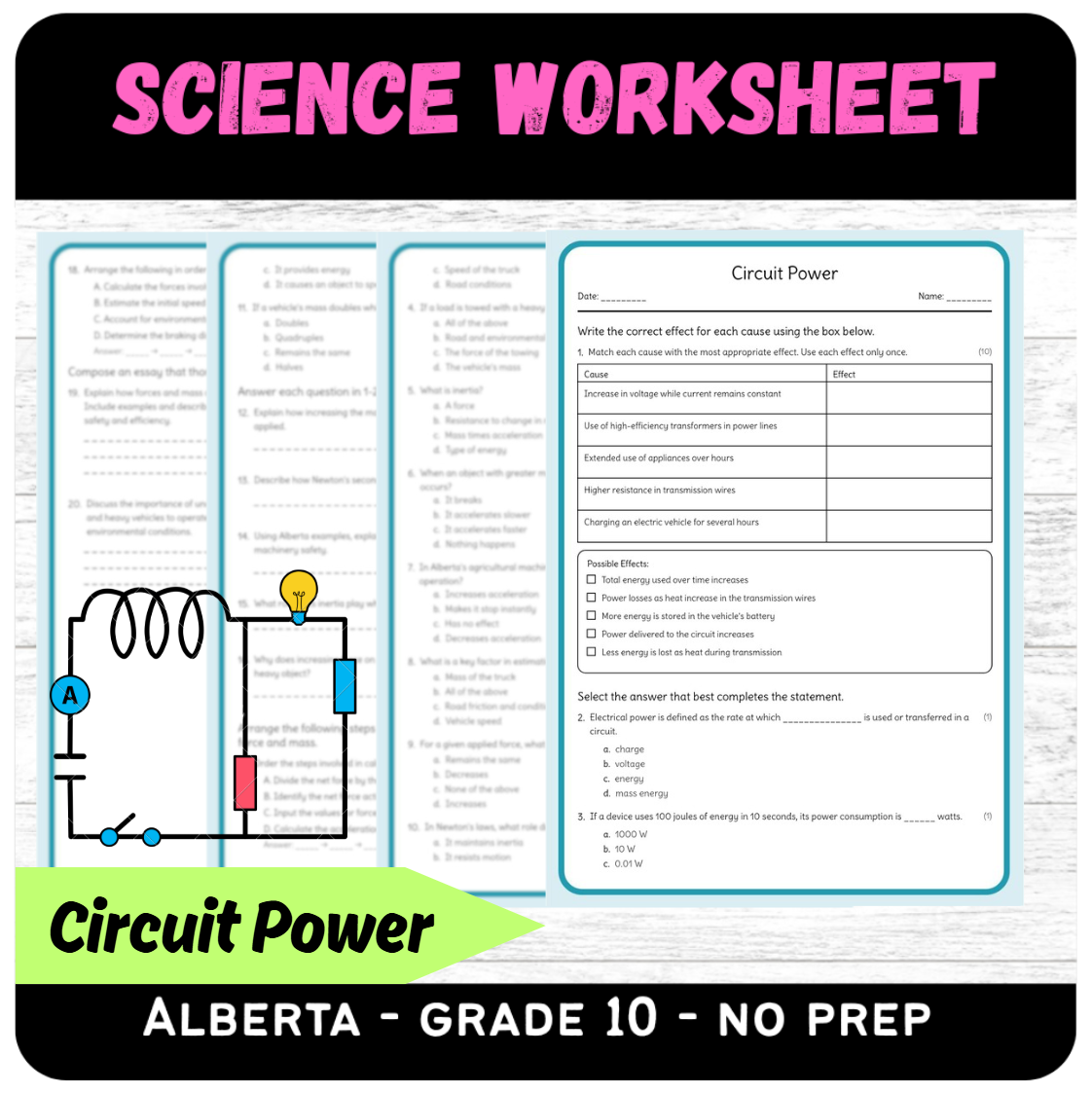
Grade 10 Science | Circuit Power Worksheet (PDF) – Alberta Standards
Created byBright Mind ResourcesLearning Objectives
- Understand the concept of electrical power in circuits and how voltage and current relate to energy consumption.
- Calculate electrical energy used over time in household and regional contexts.
- Apply the principles of power and energy to practical examples such as heating loads and electric vehicle charging.
Instant download
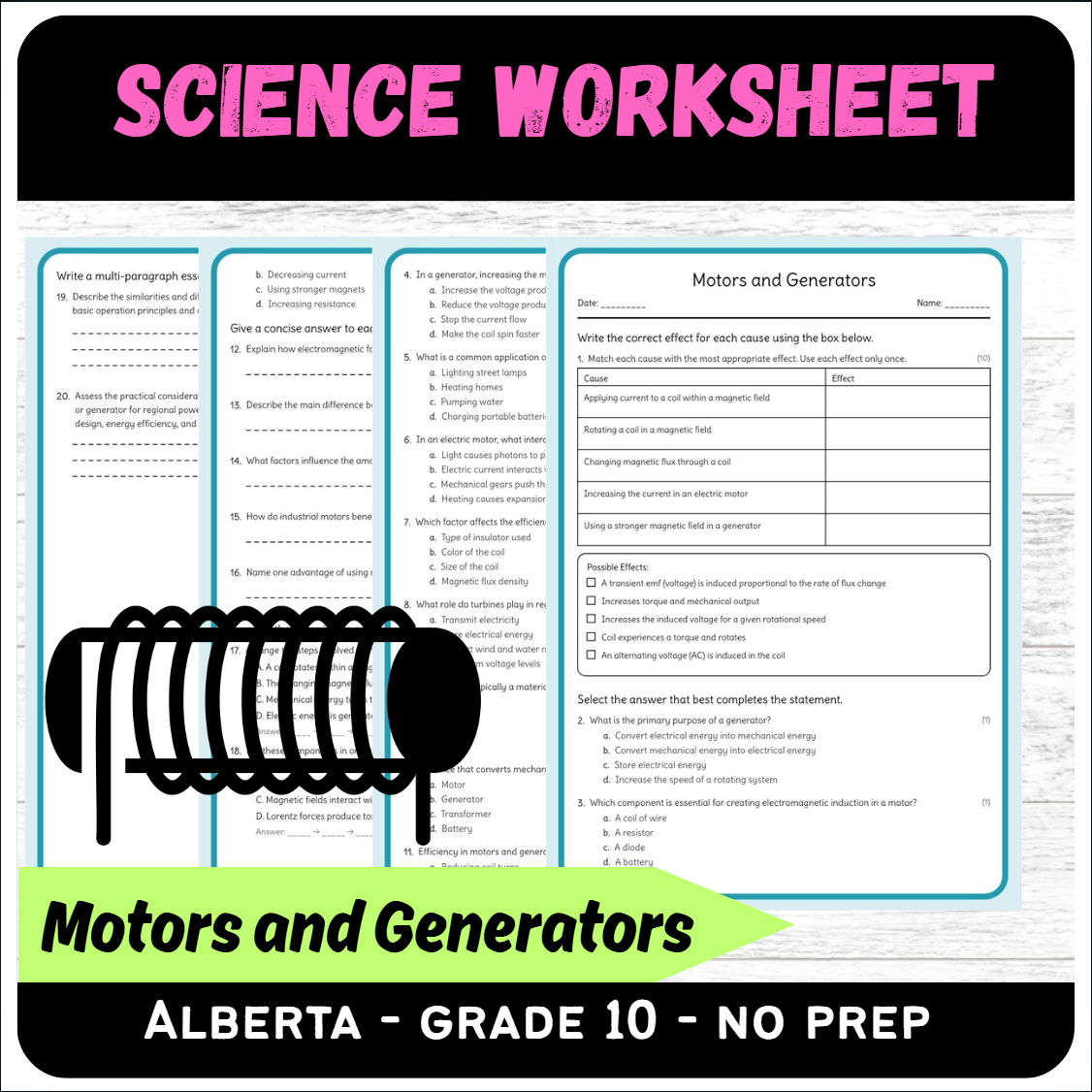
Grade 10 Science | Motors and Generators Worksheet (PDF) – Alberta Standards
Created byBright Mind ResourcesLearning Objectives
- Understand how motors and generators convert electrical energy into mechanical energy and vice versa.
- Explain the principles of electromagnetic induction involved in motor and generator operation.
- Analyze the relationship between electrical current, magnetic fields, and mechanical output in electromechanical devices.
Instant download
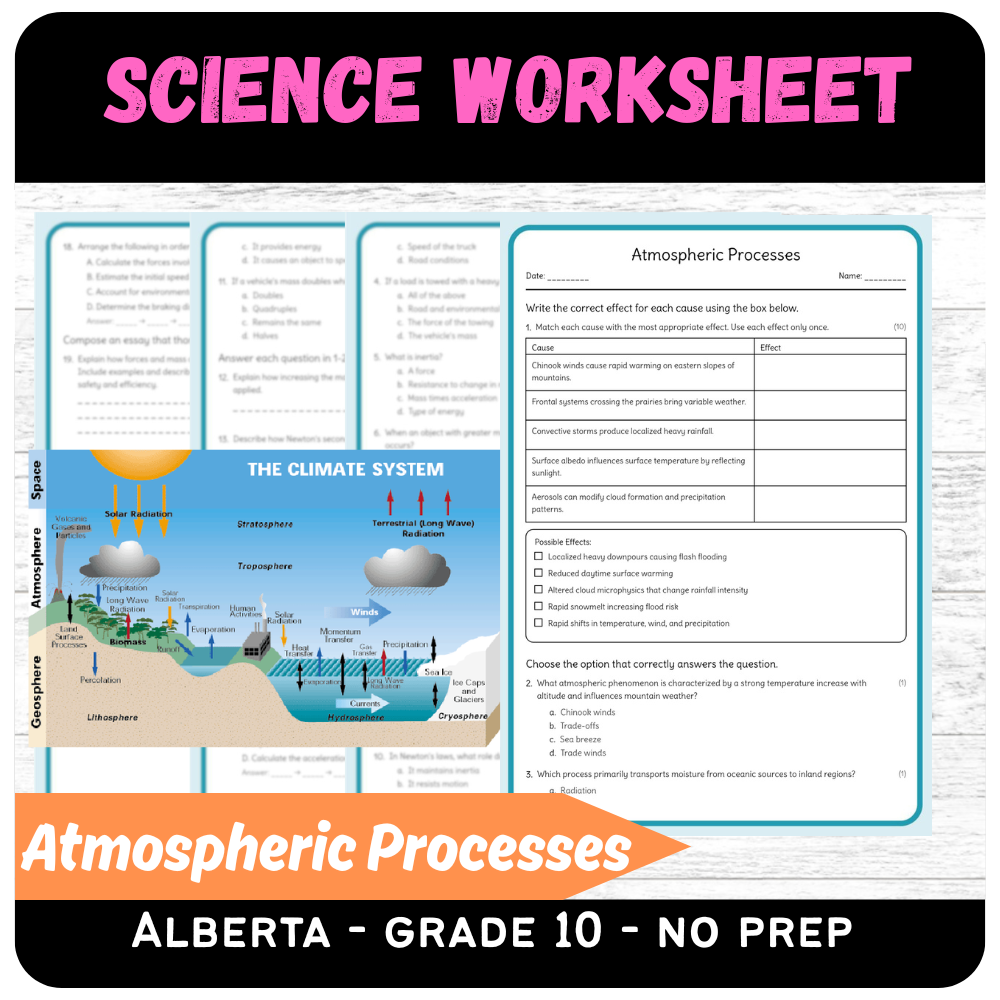
Grade 10 Science | Atmospheric Processes Worksheet (PDF) — Alberta Standards
Created byBright Mind ResourcesLearning Objectives
- Explain how pressure patterns, moisture transport, and thermal gradients influence weather systems and climate.
- Identify regional atmospheric phenomena and their effects on precipitation and weather variability.
- Describe how atmospheric composition, aerosols, and surface albedo modulate Earth's energy balance.
Instant download
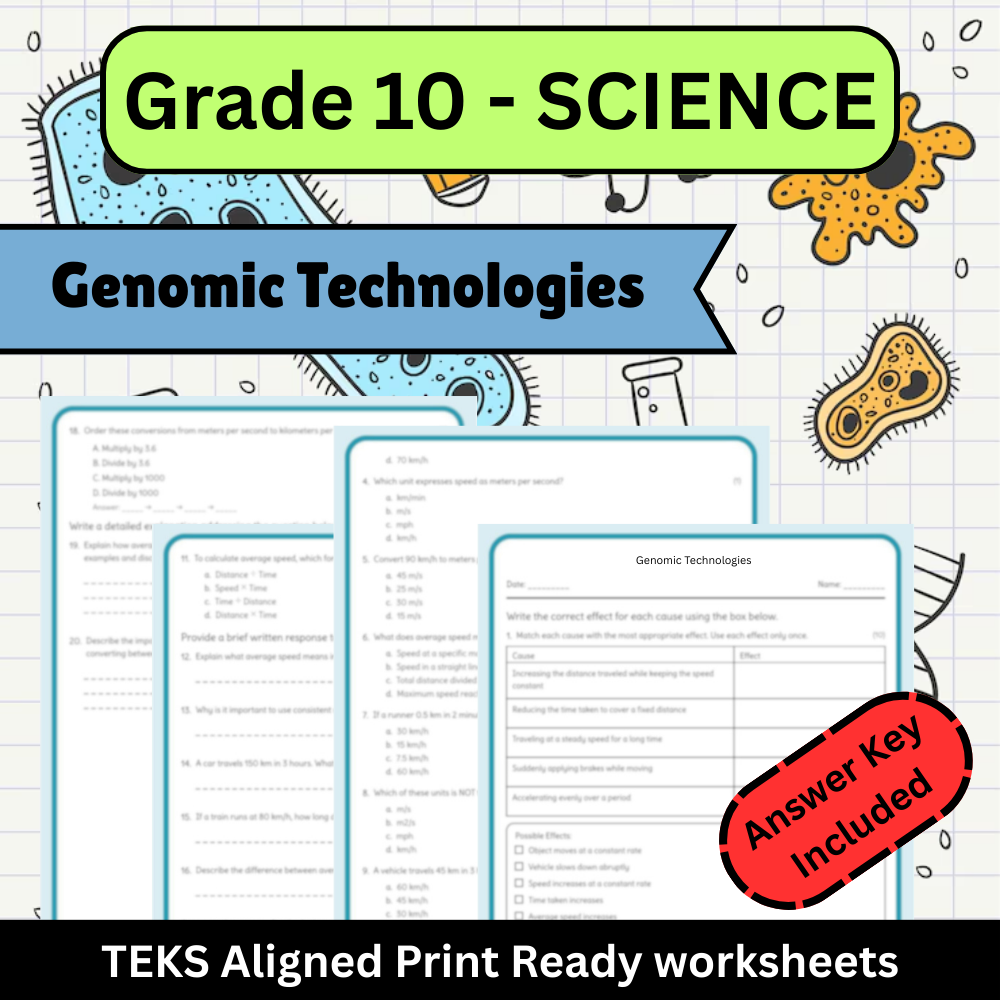
Grade 10 Science | Genomic Technologies Worksheet (Worksheet + Answer Key) – TEKS Aligned
Created byBright Mind ResourcesLearning Objectives
- Understand key genomic technologies such as PCR, DNA sequencing, and CRISPR.
- Explain how recombinant DNA techniques are used in biotechnology.
- Evaluate the societal and ecological impacts of genomic editing tools.
Also included in: Grade 10 Science | Genetics & DNA Unit Worksheet Pack (TEKS Aligned) +5 more
Instant download
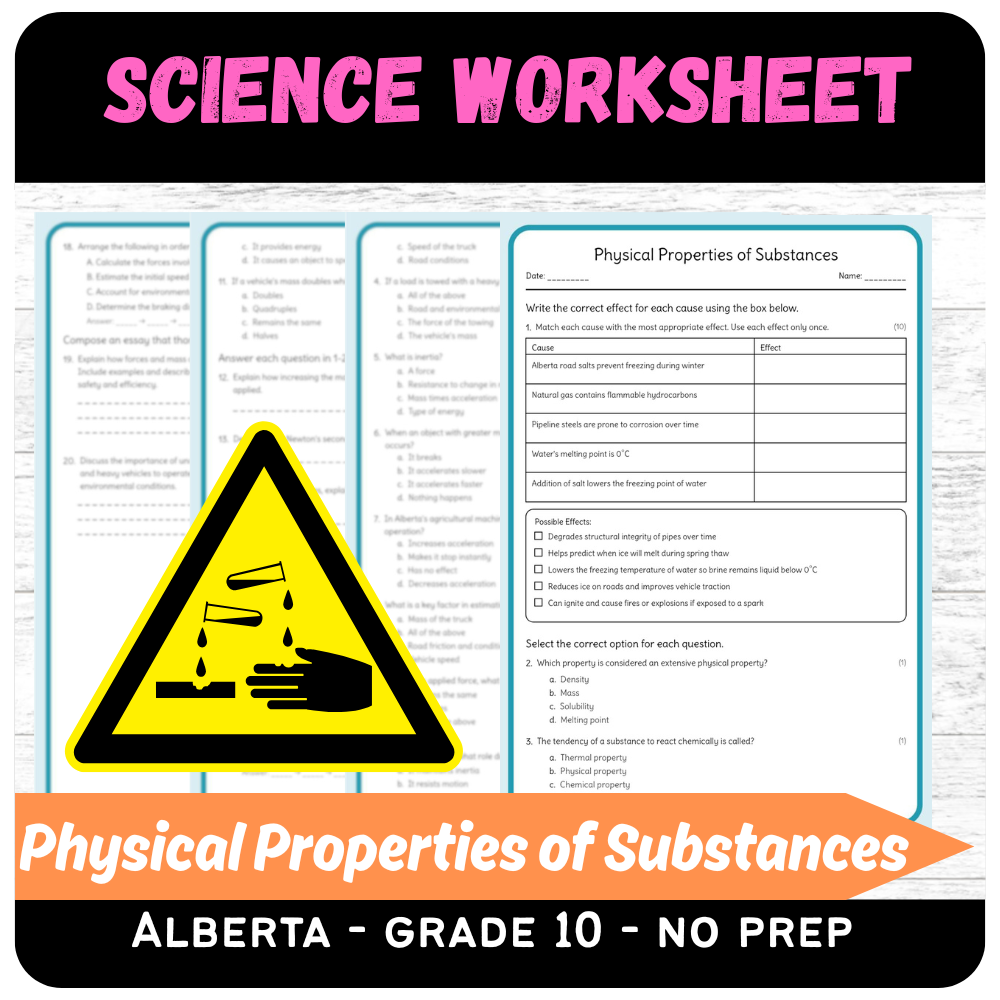
Grade 10 Science – Physical Properties of Substances Worksheet (PDF)
Created byBright Mind ResourcesLearning Objectives
- Identify and differentiate between intensive and extensive physical properties.
- Explain the significance of physical and chemical properties in material selection and environmental behavior.
- Apply knowledge of physical and chemical properties to real-world examples.
Instant download
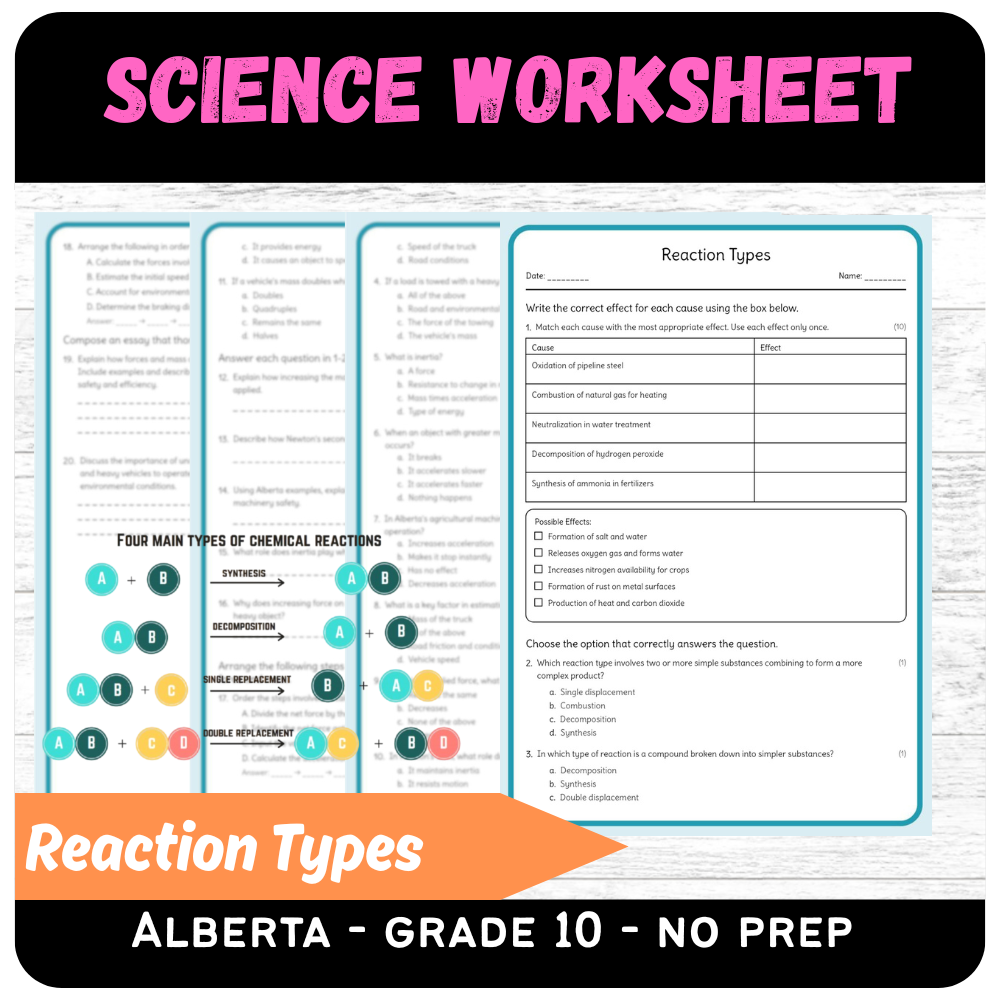
Grade 10 Science – Reaction Types Worksheet (PDF) – Alberta Standards
Created byBright Mind ResourcesLearning Objectives
- Understand the different types of chemical reactions including synthesis, decomposition, single and double displacement, and combustion.
- Identify reaction patterns and predict products based on reaction type using Alberta-relevant examples.
- Interpret chemical equations and classify reactions under typical provincial environmental conditions.
Instant download
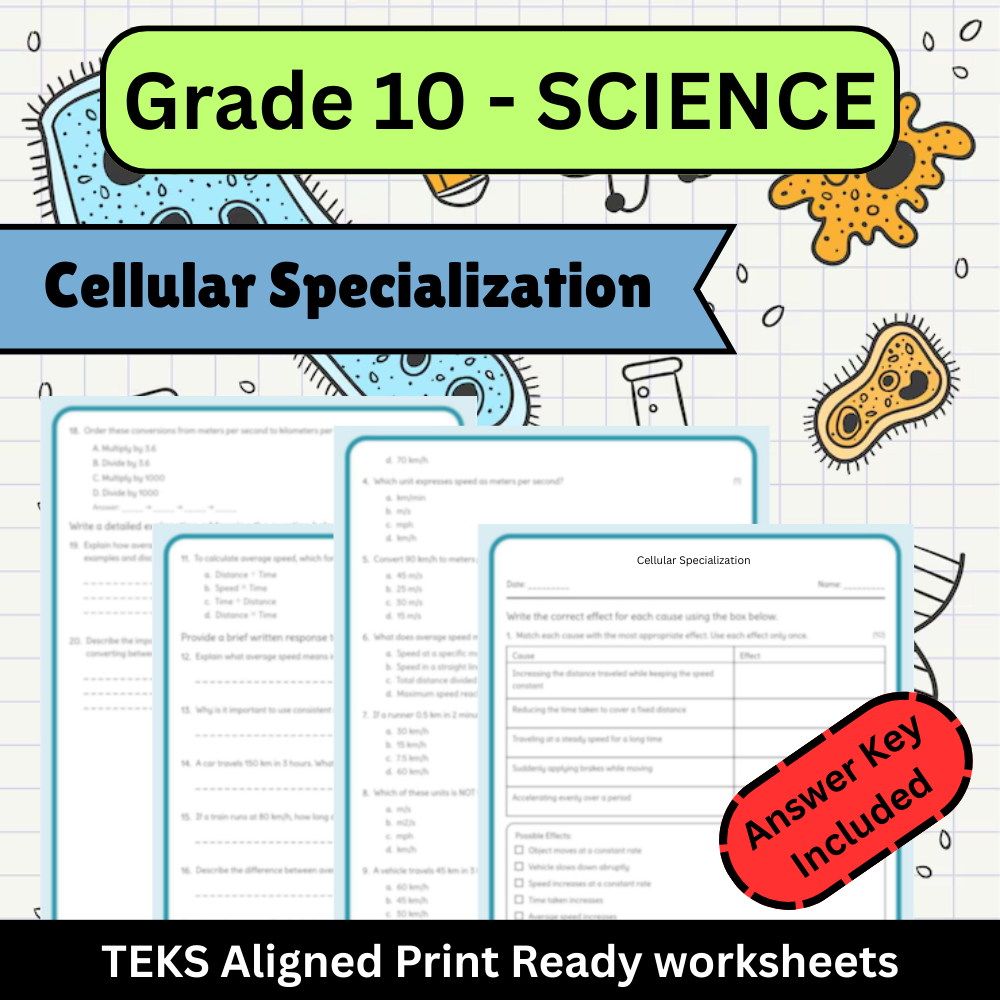
Grade 10 Science – Cellular Specialization Worksheet (Worksheet + Answer Key) | TEKS Alignment
Created byBright Mind ResourcesLearning Objectives
- Understand how organelles are specialized for specific cellular functions.
- Identify relationships between organelle abundance and cell function.
- Explain how cells form tissues and organ systems in multicellular organisms.
Also included in: Grade 10 Science | Cell Structure & Function Unit Worksheet Bundle(TEKS-Aligned) +5 more
Instant download
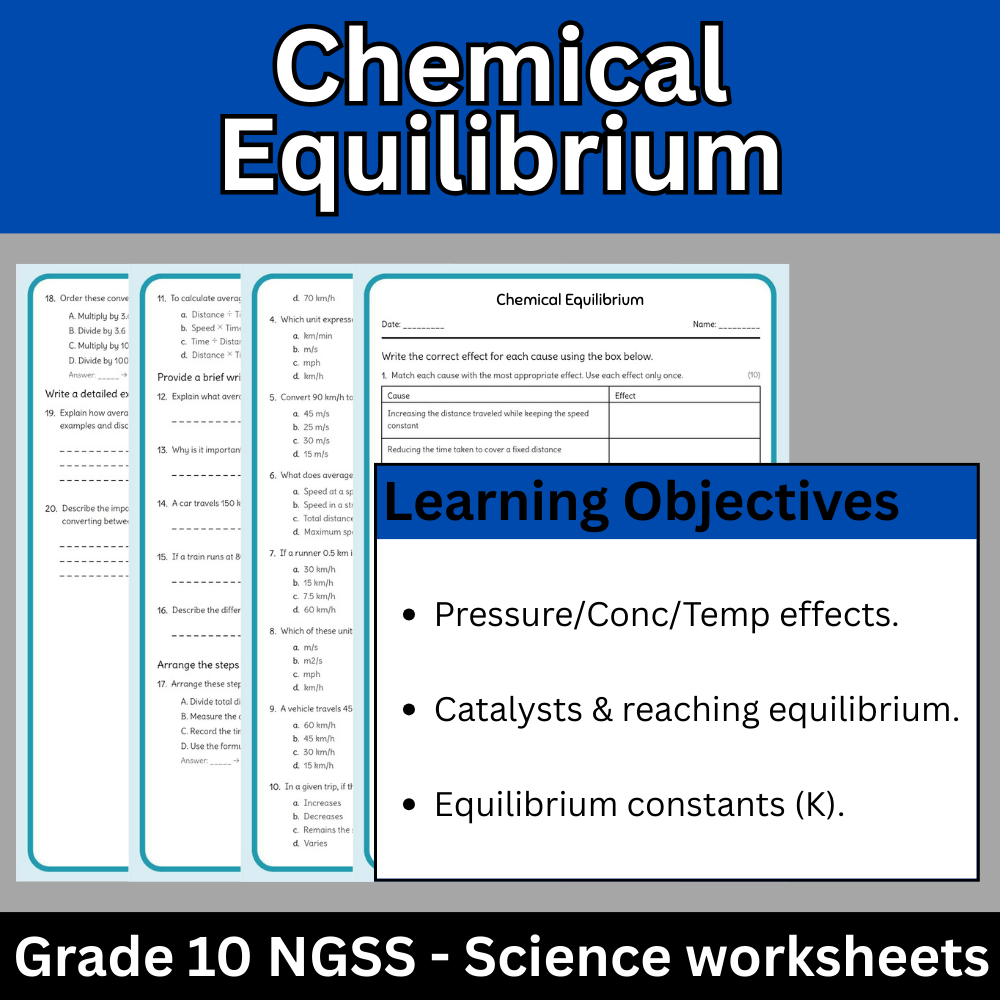
Grade 10 Science | Chemical Equilibrium Worksheet (Answer Key) – NGSS Standards
Created byBright Mind ResourcesLearning Objectives
- Understand how changes in pressure, concentration, and temperature affect chemical equilibria.
- Explain the role of catalysts in reaching equilibrium faster.
- Describe the significance of equilibrium constants as quantitative measures of reactions.
Instant download
Grade 10 Science – DNA Replication Instructional Worksheet (Worksheet + Answer Key)
Created byBright Mind ResourcesLearning Objectives
- Describe the process of DNA replication, including the roles of key enzymes.
- Explain the semiconservative nature of DNA replication.
- Identify the differences between leading and lagging strands during replication.
Also included in: Grade 10 Science | Genetics & DNA Unit Worksheet Pack (TEKS Aligned) +5 more
Instant download
Grade 10 Science | Tension and Normal Forces Worksheet (PDF) – BC Standards
Created byBright Mind ResourcesLearning Objectives
- Understand the concept of tension and how it transmits forces in connectors.
- Explain the normal force and its role in supporting objects on inclined surfaces.
- Analyze free-body diagrams involving tension and normal forces to determine object motion.
Instant download
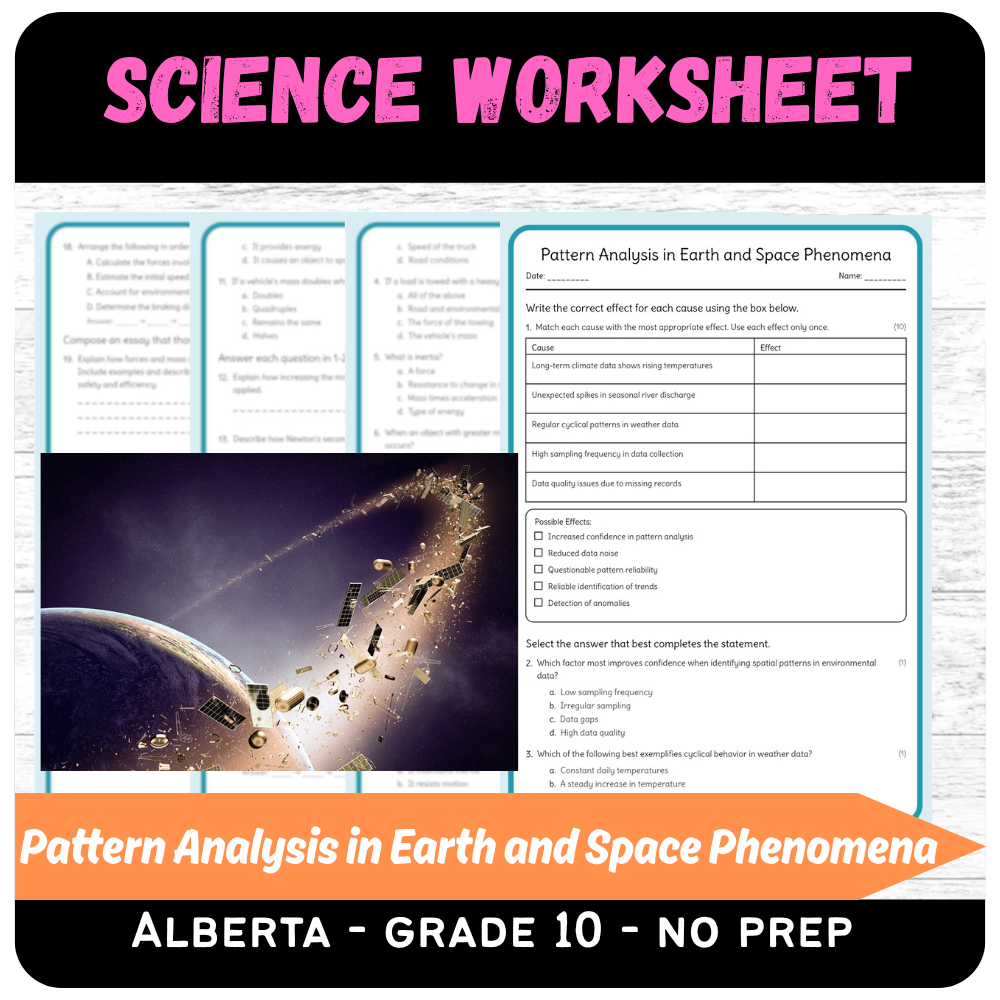
Grade 10 Science – Pattern Analysis in Earth and Space Phenomena (Worksheet + Answer Key)
Created byBright Mind ResourcesLearning Objectives
- Understand how to recognize and interpret temporal and spatial patterns in environmental data.
- Learn methods for analyzing regional climate, river discharge, and meteorological data to identify regularities and anomalies.
- Explore how data quality, sampling frequency, and statistical summaries influence confidence in pattern detection.
Instant download
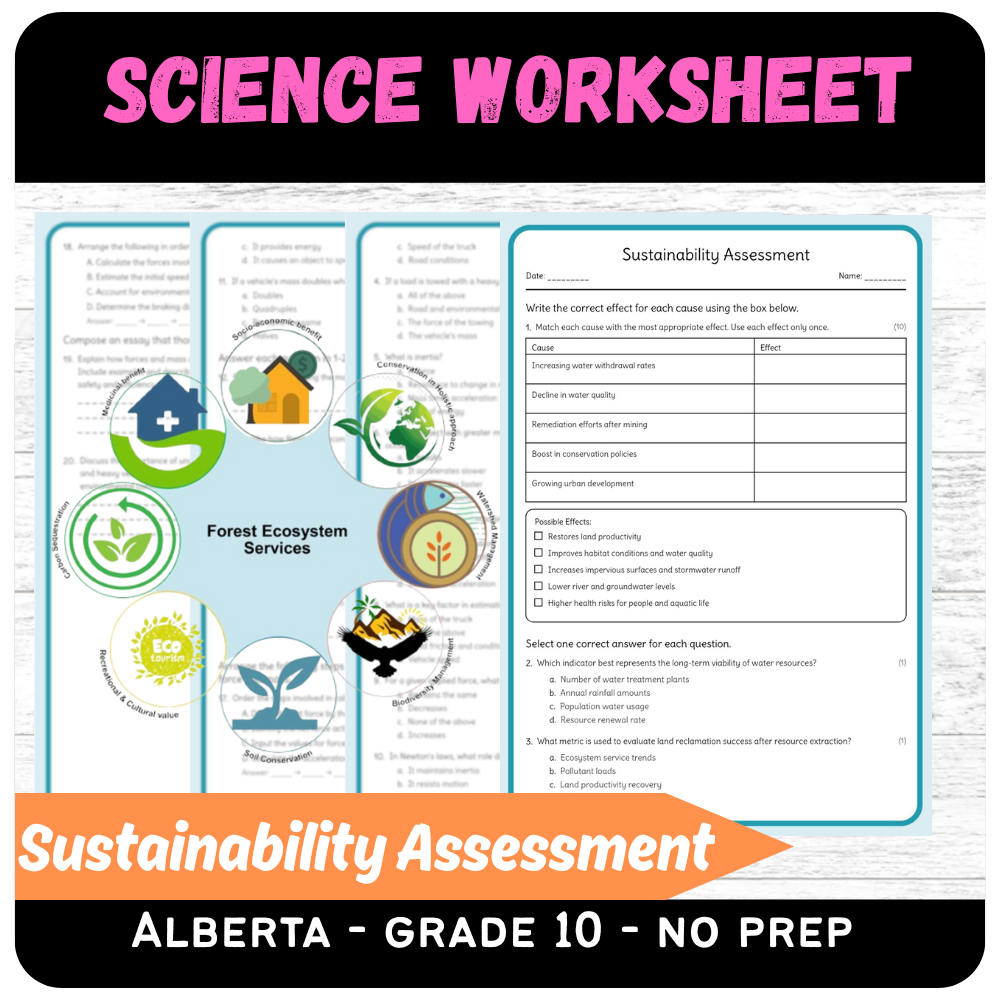
Grade 10 Science – Sustainability Assessment Worksheet (PDF) – Alberta Standards
Created byBright Mind ResourcesLearning Objectives
- Understand how environmental, economic, and social indicators are used to evaluate resource sustainability.
- Analyze frameworks for water allocation, land reclamation, and the effects of development to make informed decisions about resource management.
- Interpret metrics such as resource renewal rates, pollutant loads, and ecosystem service trends to assess sustainability.
Instant download
Grade 10 Science – Biotic and Abiotic Factors Worksheet (Answer Key) | TEKS
Created byBright Mind ResourcesLearning Objectives
- Identify the differences between biotic and abiotic factors in ecosystems.
- Explain how biotic and abiotic factors interact to influence habitats and communities.
- Describe how abiotic gradients affect species ranges and populations.
Also included in: Grade 10 Science | Ecosystems & Biodiversity Unit Worksheet Bundle(TEKS-Aligned) +5 more
Instant download
Grade 10 Science | Force Interactions Worksheet (NGSS Aligned) PDF
Created byBright Mind ResourcesLearning Objectives
- Classify contact and noncontact forces and represent them using vectors.
- Understand Newton's third law and pairwise interactions.
- Interpret free-body diagrams, vector addition, and equilibrium conditions.
Instant download
Grade 10 Science | Action-Reaction Forces Worksheet (Worksheet + Answer Key)
Created byBright Mind ResourcesLearning Objectives
- Explain Paired Forces in action-reaction pairs.
- Identify real-world examples of action-reaction forces.
- Analyze how forces affect motion depending on mass and acceleration.
Instant download
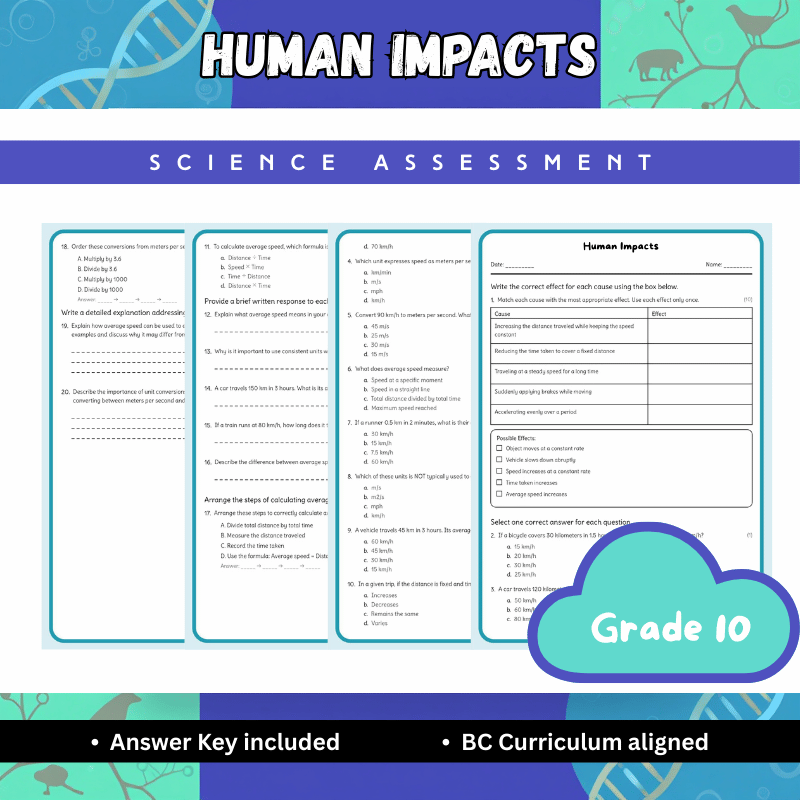
Grade 10 Science | Human Impacts Worksheet (PDF) – BC Standards & Key Concepts
Created byBright Mind ResourcesLearning Objectives
- Understand how human activities affect biodiversity and ecosystems.
- Identify specific human impacts such as habitat fragmentation, pollution, and invasive species.
- Analyze how climate change influences species' ranges and behaviors.
Instant download
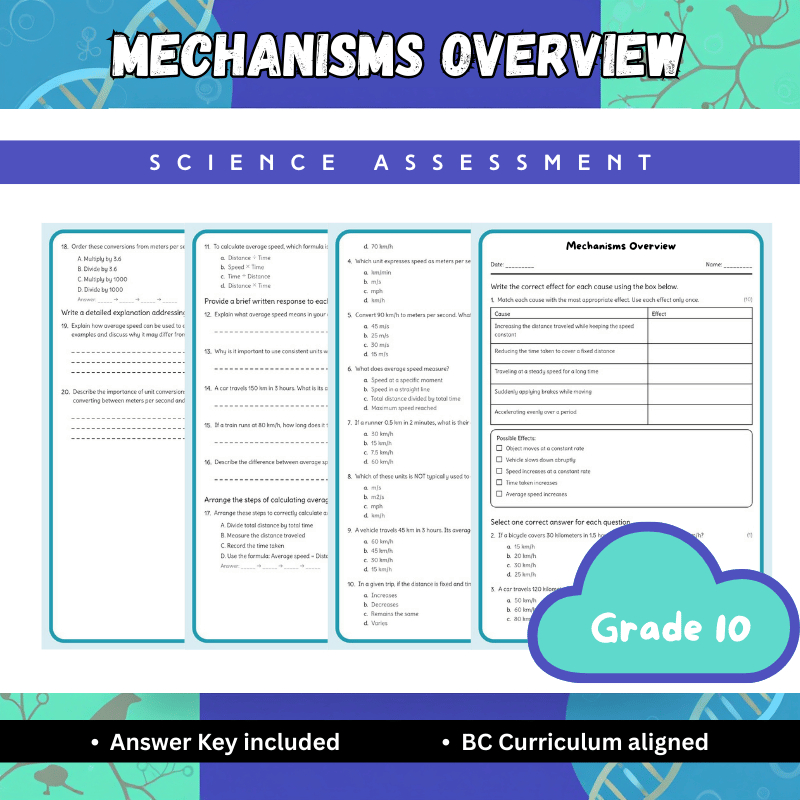
Grade 10 Science | Mechanisms of Evolution Worksheet (Answer Key) | BC Standards
Created byBright Mind ResourcesLearning Objectives
- Identify and describe the key mechanisms of evolution including natural selection, genetic drift, gene flow, and mutation.
- Explain how each mechanism influences allele frequencies within populations.
- Analyze the effects of these mechanisms on the evolution and adaptation of species.
Instant download
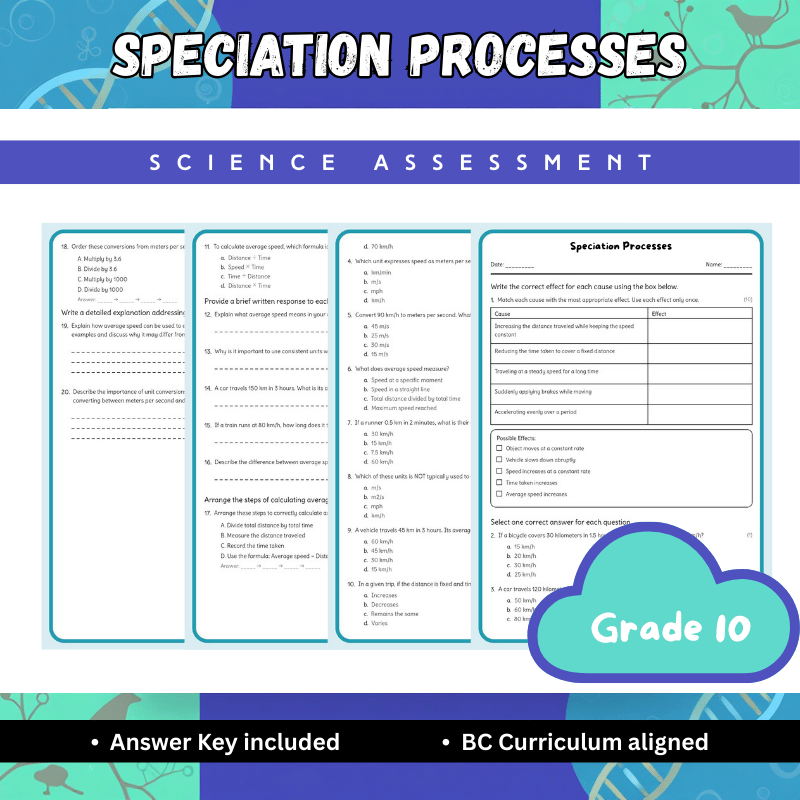
Grade 10 Science | Speciation Processes Worksheet (PDF) – BC Standards
Created byBright Mind ResourcesLearning Objectives
- Explain what causes speciation to occur and identify different types of speciation.
- Describe the mechanisms that lead to reproductive isolation.
- Differentiate between allopatric and sympatric speciation.
Instant download
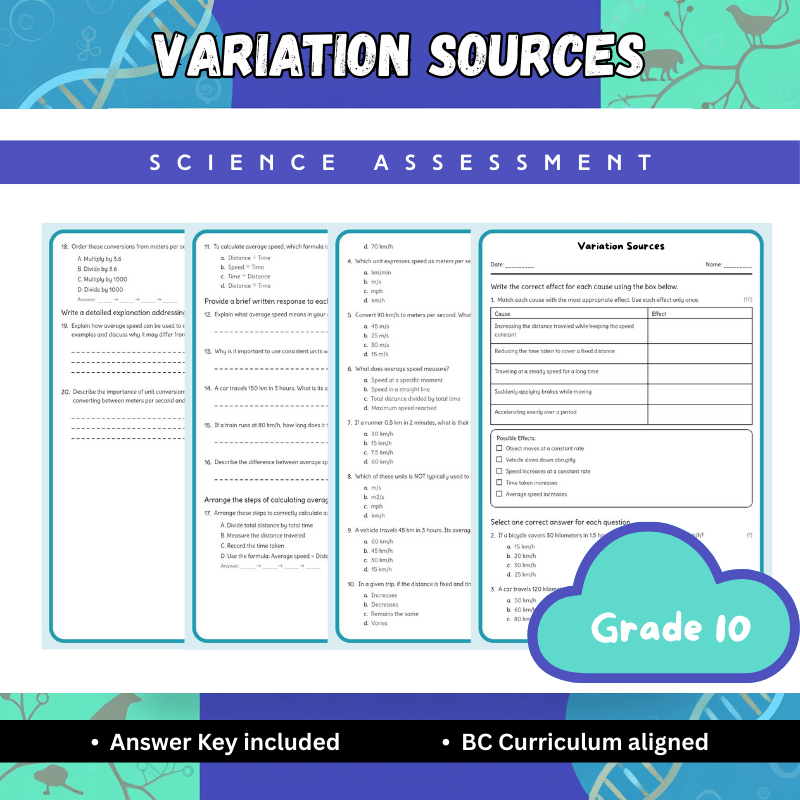
Grade 10 Science | Variation Sources Worksheet + Answer Key BC Standard
Created byBright Mind ResourcesLearning Objectives
- Identify the main sources of heritable variation in populations.
- Explain how mutations, recombination, and chromosomal rearrangements contribute to genetic diversity.
- Describe the process of natural selection and how it acts on variation within populations.
Instant download
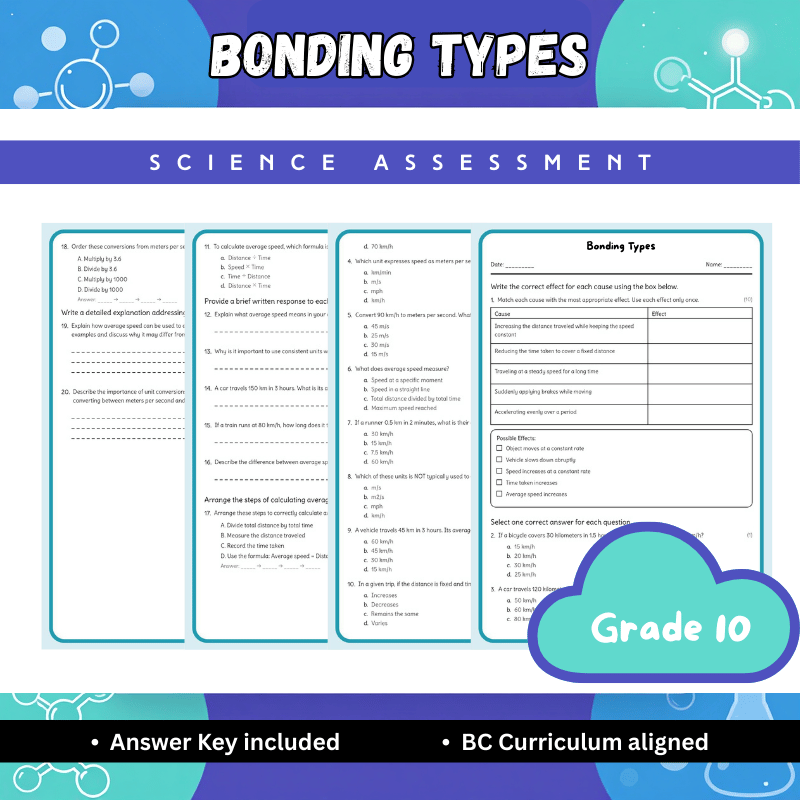
Grade 10 Science | Bonding Types Worksheet (Worksheet + Answer Key) BC Standard
Created byBright Mind ResourcesLearning Objectives
- Describe the differences between ionic, covalent, and metallic bonds.
- Explain how atoms achieve stable electron configurations through different bonding types.
- Relate bonding types to the periodic table to predict properties of compounds.
Instant download
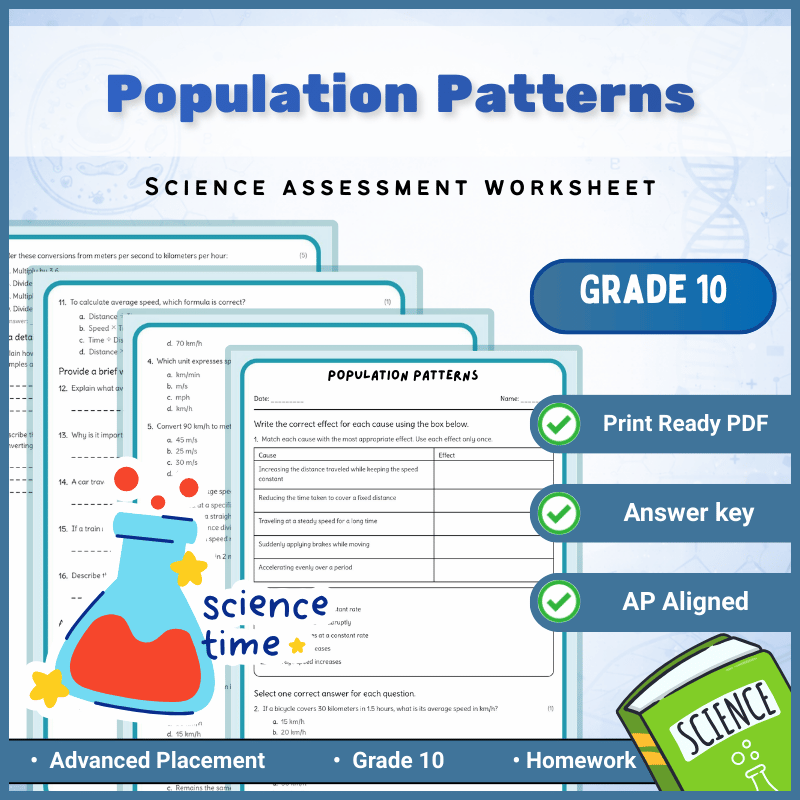
Grade 10 Science – Population Patterns Worksheet (AP Standard) – Science 1 (PDF)
Created byBright Mind ResourcesLearning Objectives
- Explain factors that influence population growth and structure, including birth and death rates.
- Interpret population models, including age-structure diagrams and differential representations.
- Relate organism traits and environmental interactions to population dynamics and cycles.
Instant download
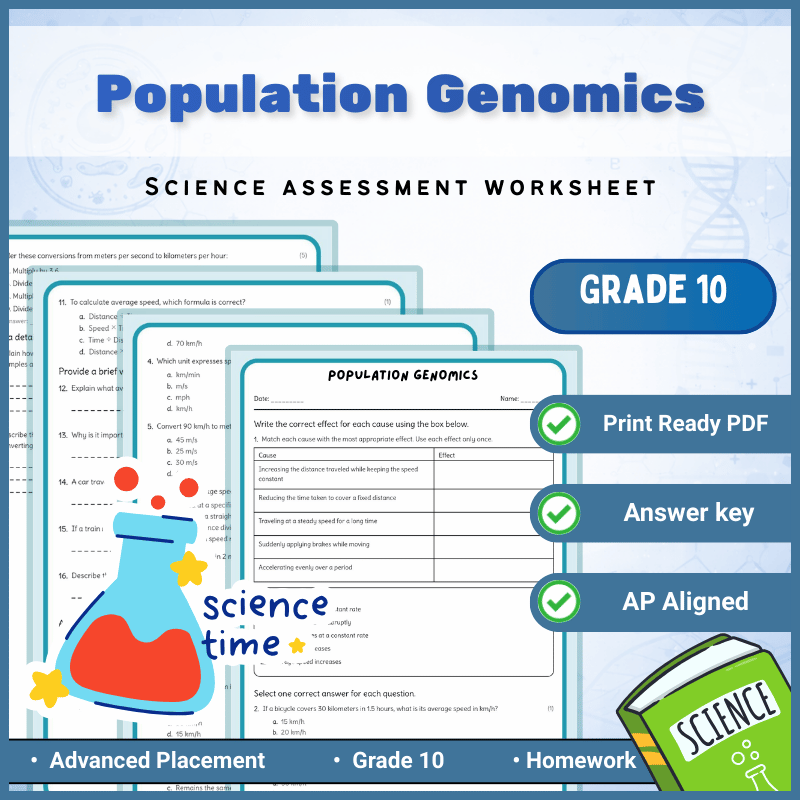
Grade 10 Science | Population Genomics AP Worksheet (PDF) with Answer Key
Created byBright Mind ResourcesLearning Objectives
- Understand how molecular variation contributes to population diversity.
- Analyze how mutation, gene flow, selection, and drift shape genomes.
- Interpret sequence-based evidence to infer population history and adaptation.
Instant download
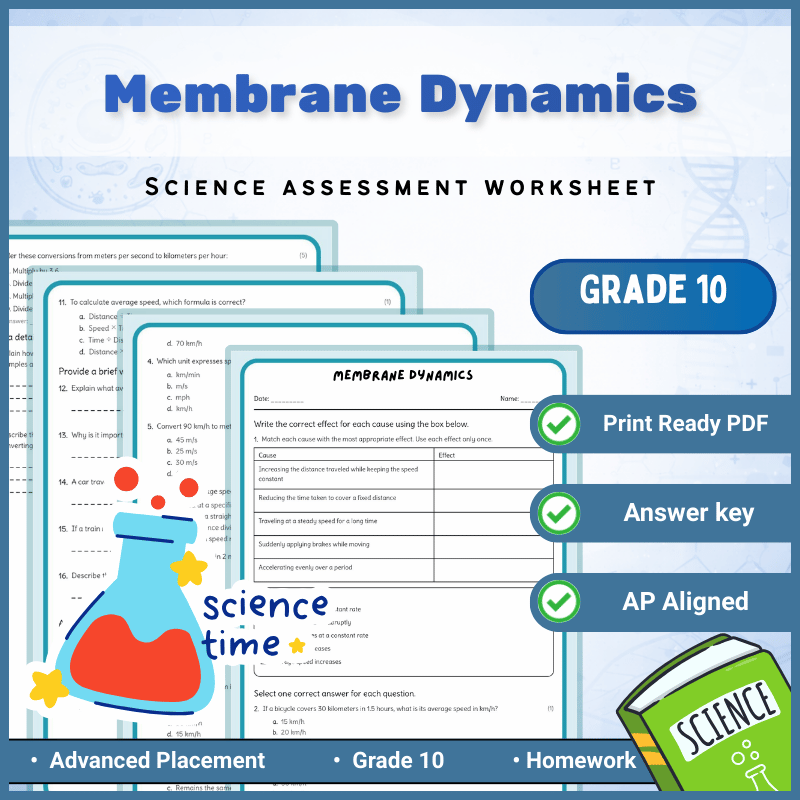
Grade 10 Science | Membrane Dynamics Worksheet + Answer Key (AP Standard) (PDF)
Created byBright Mind ResourcesLearning Objectives
- Understand membrane composition and the mechanisms of transport that establish electrochemical gradients.
- Explain how membrane proteins contribute to selective permeability and ion distribution.
- Analyze the energetics involved in membrane transport processes and their cellular functions.
Instant download
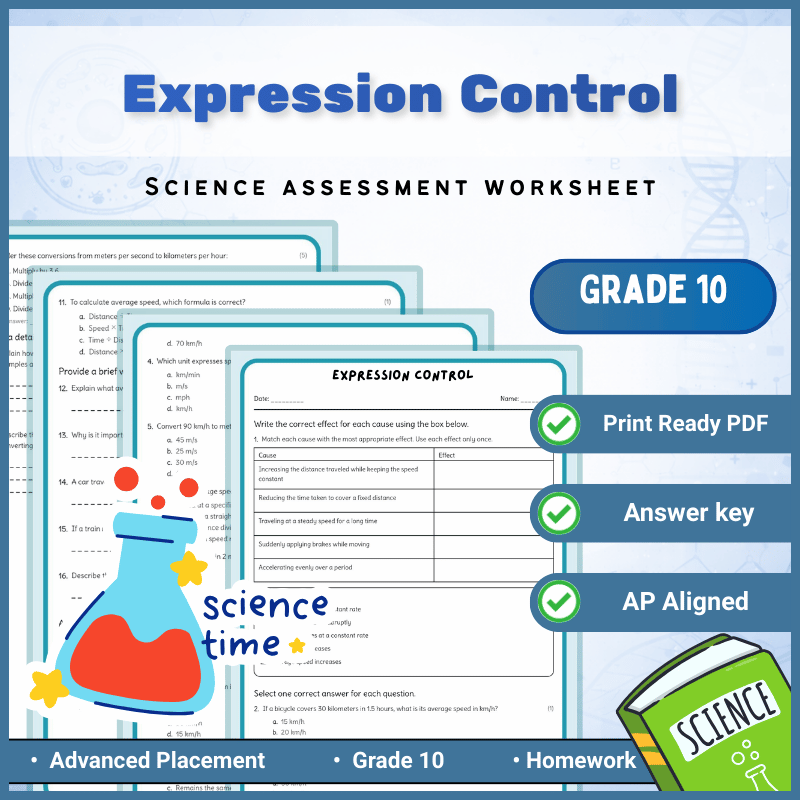
Grade 10 Science | Expression Control Worksheet (AP Standard + PDF)
Created byBright Mind ResourcesLearning Objectives
- Understand mechanisms regulating gene expression in prokaryotic and eukaryotic systems.
- Identify key components like promoter architecture, transcription factors, chromatin modifications, and post-transcriptional controls.
- Describe how signal integration influences transcriptional output and phenotypic plasticity.
Instant download
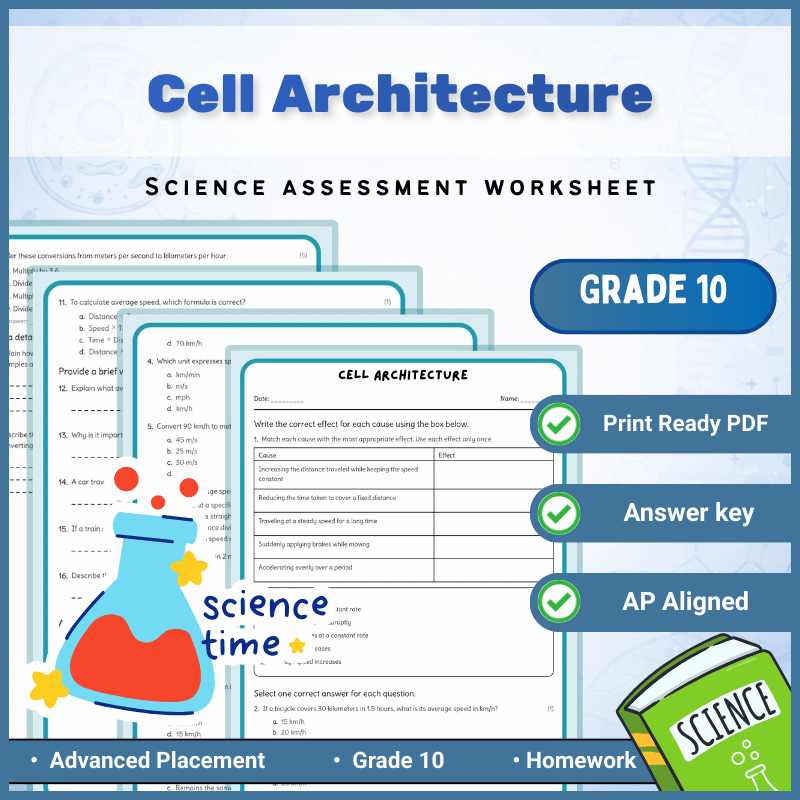
Grade 10 Science | Cell Architecture Worksheet (PDF) for AP Standards
Created byBright Mind ResourcesLearning Objectives
- Understand the hierarchical organization of cellular components from macromolecules to tissues.
- Compare and contrast prokaryotic and eukaryotic cell structures.
- Relate ultrastructural evidence to functional roles such as compartmentalization and protein targeting.
Instant download
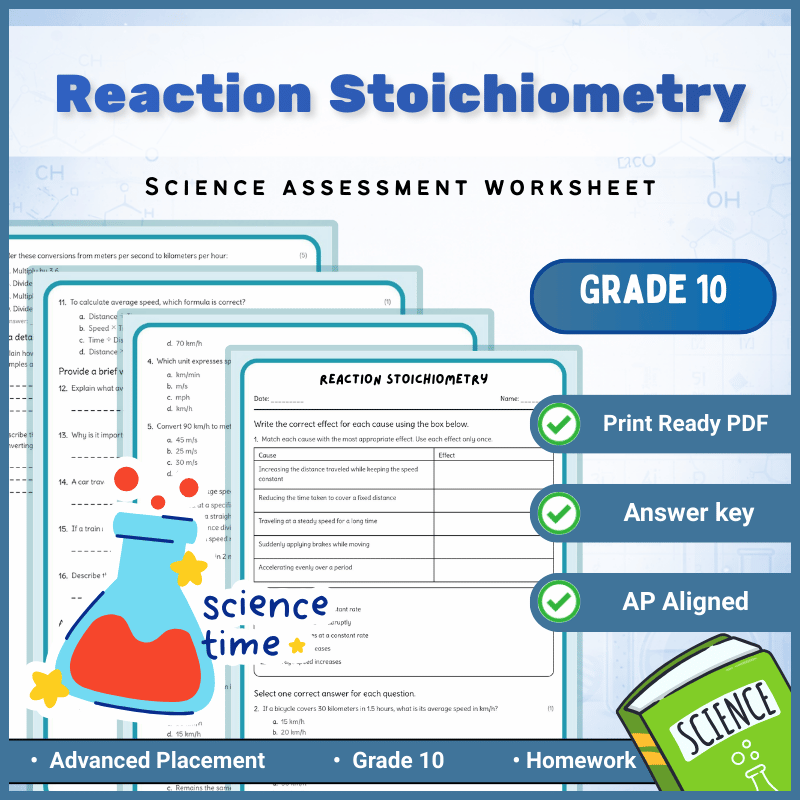
Grade 10 Science | Reaction Stoichiometry Worksheet + Answer Key (AP Standard)
Created byBright Mind ResourcesLearning Objectives
- Understand and apply mole concepts and molar mass in chemical calculations.
- Balance chemical equations and interpret them to determine relationships between substances.
- Perform stoichiometric calculations including mass-to-mass conversions, limiting reagent, and theoretical yield.
Instant download
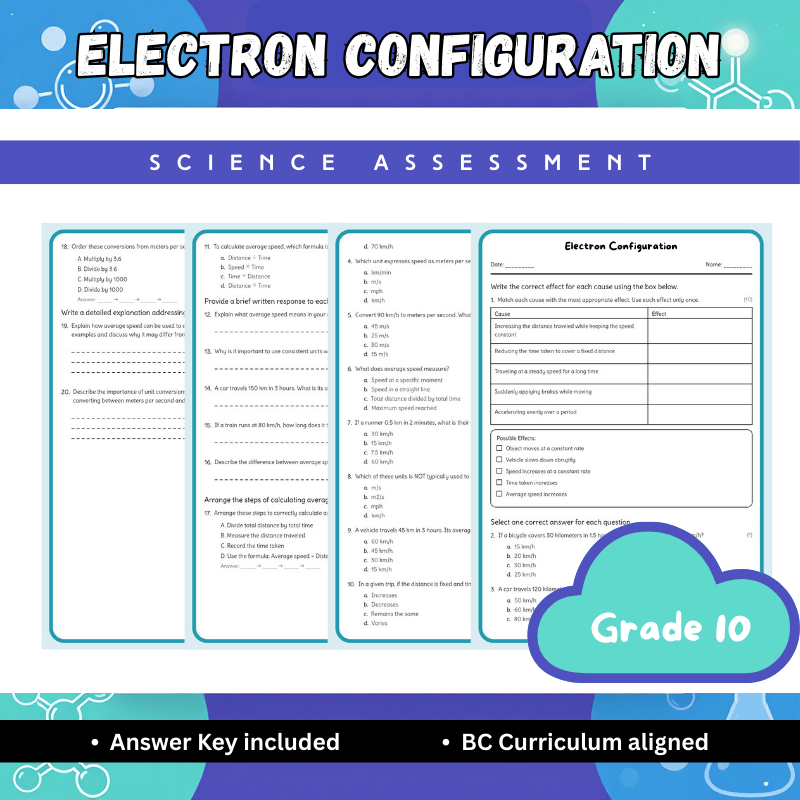
Grade 10 Science | Electron Configuration Worksheet(Answer Key) for BC Standards
Created byBright Mind ResourcesLearning Objectives
- Describe how electrons occupy energy levels and orbitals around an atomic nucleus.
- Explain the significance of valence electrons in bonding and reactivity.
- Relate patterns in electron configuration to the element's group and period positions.
Instant download
Grade 10 Science | Limiting Reagent Worksheet (Answer Key) – BC Standards
Created byBright Mind ResourcesLearning Objectives
- Understand the concept of a limiting reagent in a chemical reaction.
- Compare stoichiometric ratios and available amounts to identify the limiting reagent.
- Explain how the limiting reagent determines the maximum amount of product formed.
Instant download
Grade 10 Science | Molecules and Lattices Worksheet + Answer Key (PDF)
Created byBright Mind ResourcesLearning Objectives
- Describe the structural arrangements of ionic, covalent molecular, and metallic substances.
- Explain how these arrangements influence properties such as melting point, brittleness, and conductivity.
- Link lattice structures and element positions on the periodic table to material behaviors.
Instant download
Grade 10 Science – Nuclear Charge & Atomic Trends(Answer Key) | AP Standard
Created byBright Mind ResourcesLearning Objectives
- Understand the concept of effective nuclear charge (Zeff) and its influence on atomic properties.
- Analyze how shielding effects impact electron attraction within atoms.
- Compare periodic trends in atomic radius, ionization energy, and electron affinity based on Zeff.
Instant download
High School Science | Bond Polarity Worksheet (AP Standards) | Answer Key (PDF)
Created byBright Mind ResourcesLearning Objectives
- Understand how electronegativity differences determine bond polarity.
- Interpret dipole moment representations for polar bonds.
- Differentiate between polar covalent and ionic bonds on a continuum.
Instant download
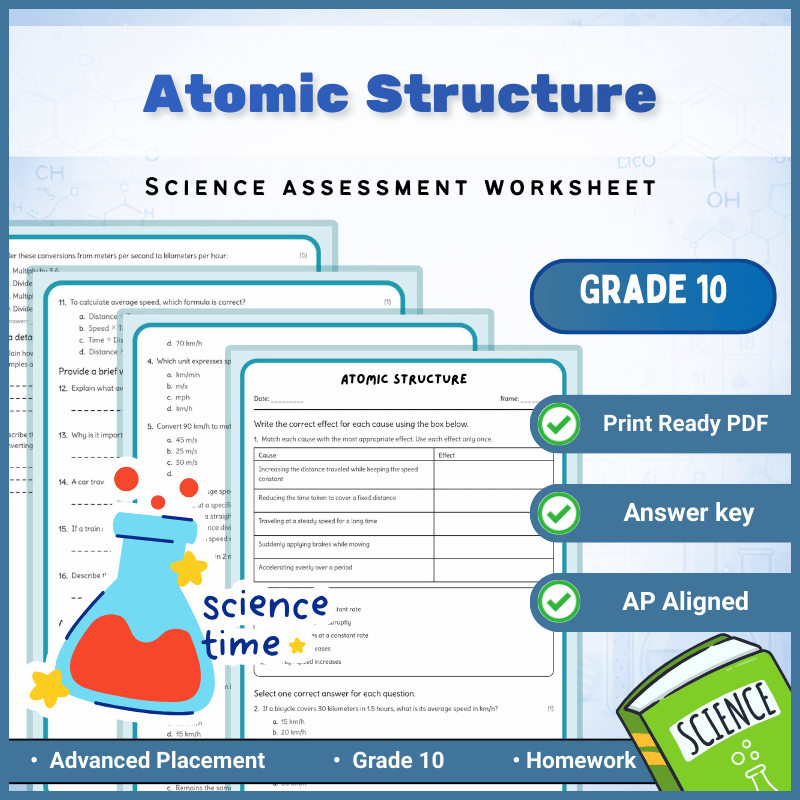
Grade 10 Science | Atomic Structure Worksheet + Answer Key (AP Standard)
Created byBright Mind ResourcesLearning Objectives
- Describe the subatomic components of atoms and their roles.
- Explain how emission spectra and scattering experiments provide evidence for atomic structure.
- Connect shell models and quantum numbers with atomic properties.
Instant download
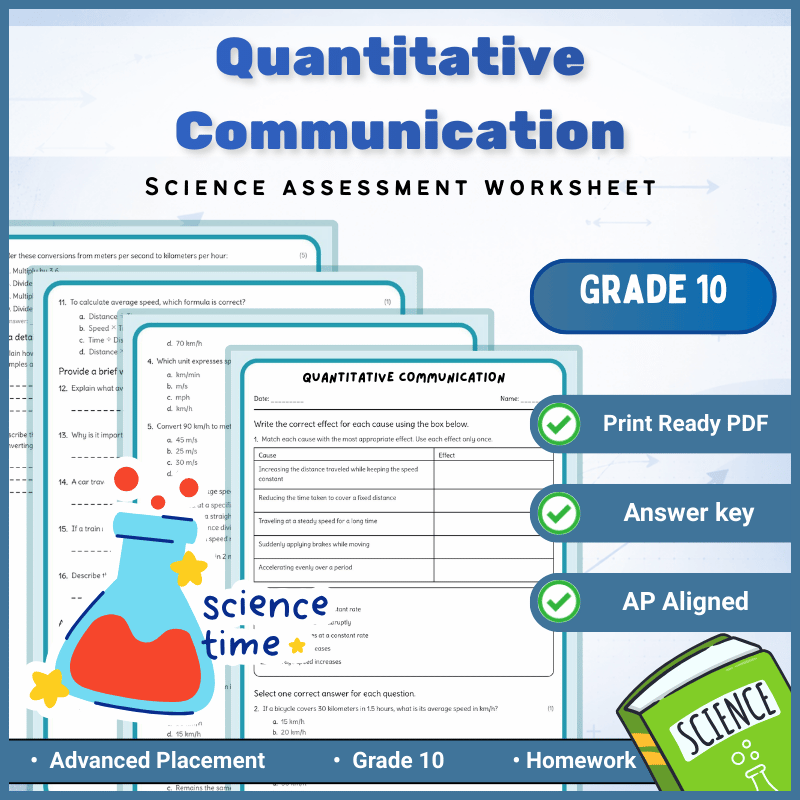
Grade 10 Science | Quantitative Communication AP Worksheet (PDF) with Answer Key
Created byBright Mind ResourcesLearning Objectives
- Understand conventions and strategies for reporting quantitative results including uncertainty notation and significant digits.
- Apply graphical annotations effectively while communicating data and results.
- Evaluate the role of numerical summaries and confidence intervals in supporting scientific conclusions.
Instant download
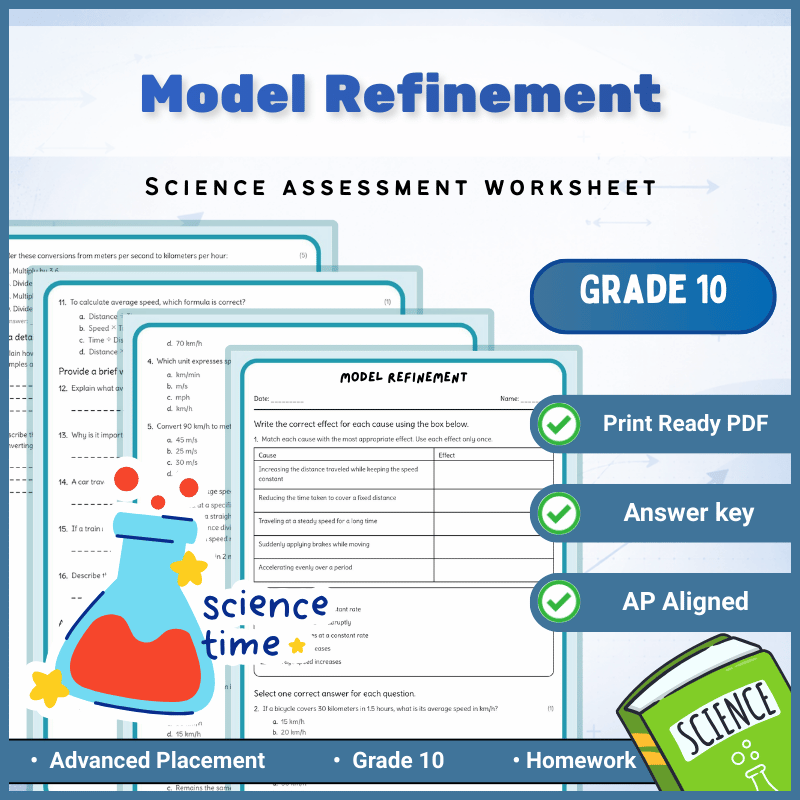
Grade 10 Science – Model Refinement Worksheet (AP Standards) | PDF
Created byBright Mind ResourcesLearning Objectives
- Understand the process of iterative model improvement through comparison with observed behavior.
- Identify methods for parameter estimation and inclusion of additional processes like damping or friction.
- Evaluate how residual analysis and sensitivity assessment guide model adjustments.
Instant download
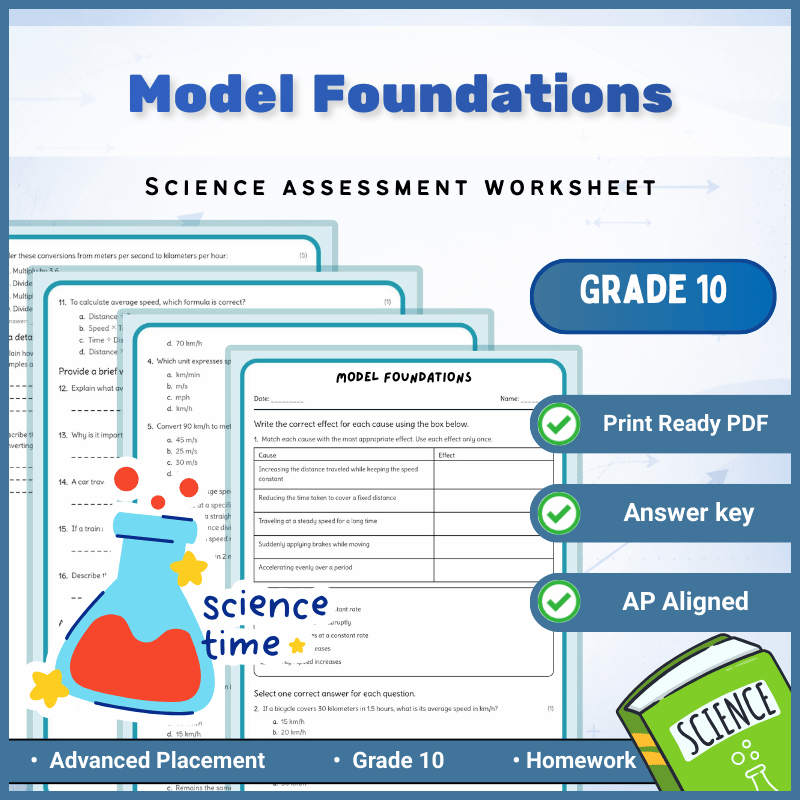
Grade 10 Science | Modeling Foundations Worksheet (AP Standard PDF)
Created byBright Mind ResourcesLearning Objectives
- Explain different types of scientific models including conceptual diagrams, mathematical relations, and physical analogues.
- Compare strengths and limitations of discrete representations in modeling systems.
- Understand how model components relate to observable features and how to calibrate parameters.
Instant download
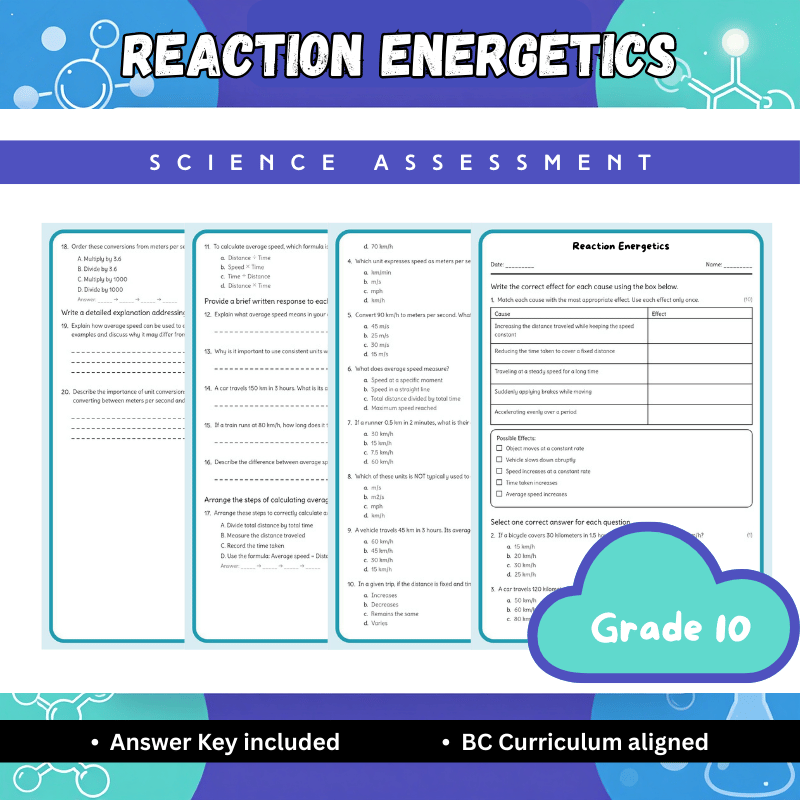
Grade 10 Science – Reaction Energetics Worksheet (Answer Key) | BC Standards
Created byBright Mind ResourcesLearning Objectives
- Understand energy changes during chemical reactions and how bond energies influence whether reactions are exothermic or endothermic.
- Identify factors that affect bond strength and reaction energetics, including periodic and structural influences.
- Analyze energy diagrams and interpret measurable temperature changes in reactions.
Instant download
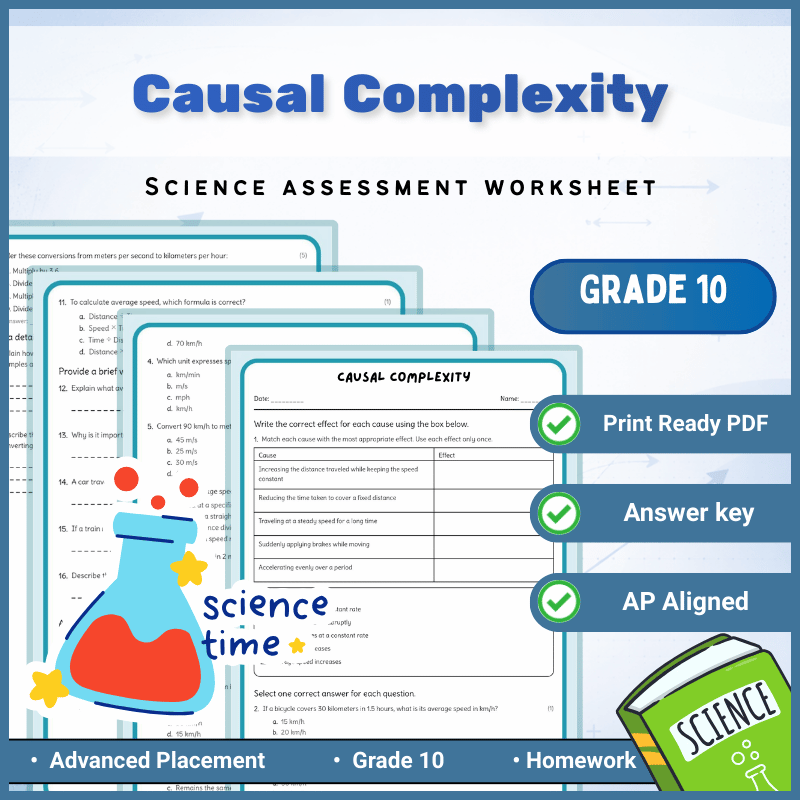
Grade 10 Science – Causal Complexity Worksheet (AP Standards | PDF)
Created byBright Mind ResourcesLearning Objectives
- Understand strategies for disentangling multivariable causal relationships
- Learn how to interpret control matrices, causal graphs, and stratified comparisons
- Identify confounding factors and interaction effects in complex systems
Instant download
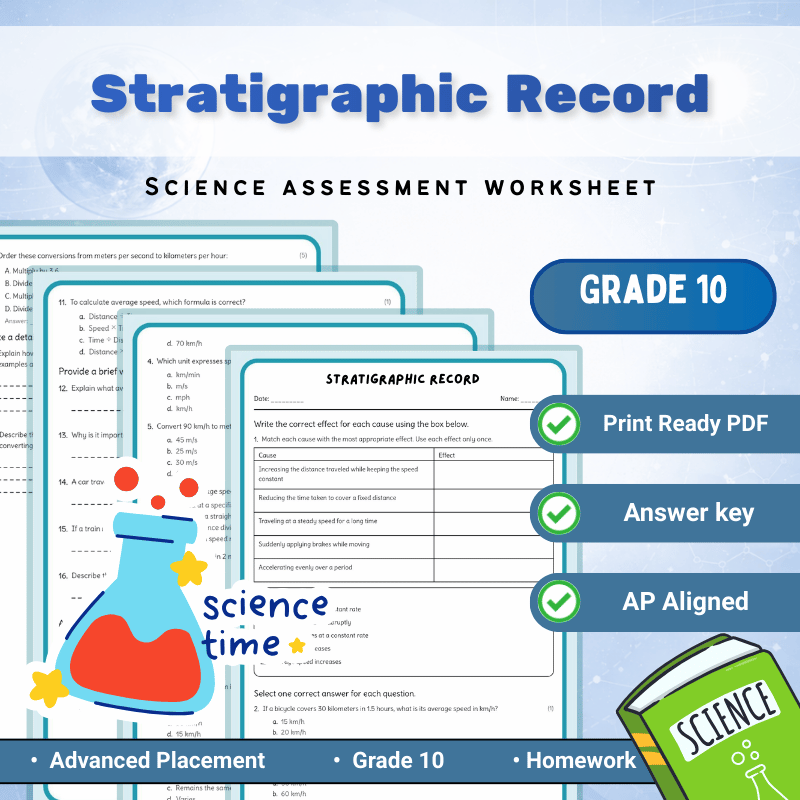
Grade 10 Science | Stratigraphic Record Worksheet (AP Standard) (PDF)
Created byBright Mind ResourcesLearning Objectives
- Interpret stratigraphic sequences and fossil assemblages to determine Earth's history timeline.
- Apply principles such as superposition, correlation, and unconformities to stratigraphic data.
- Evaluate radiometric decay methods and error considerations in dating geological events.
Instant download
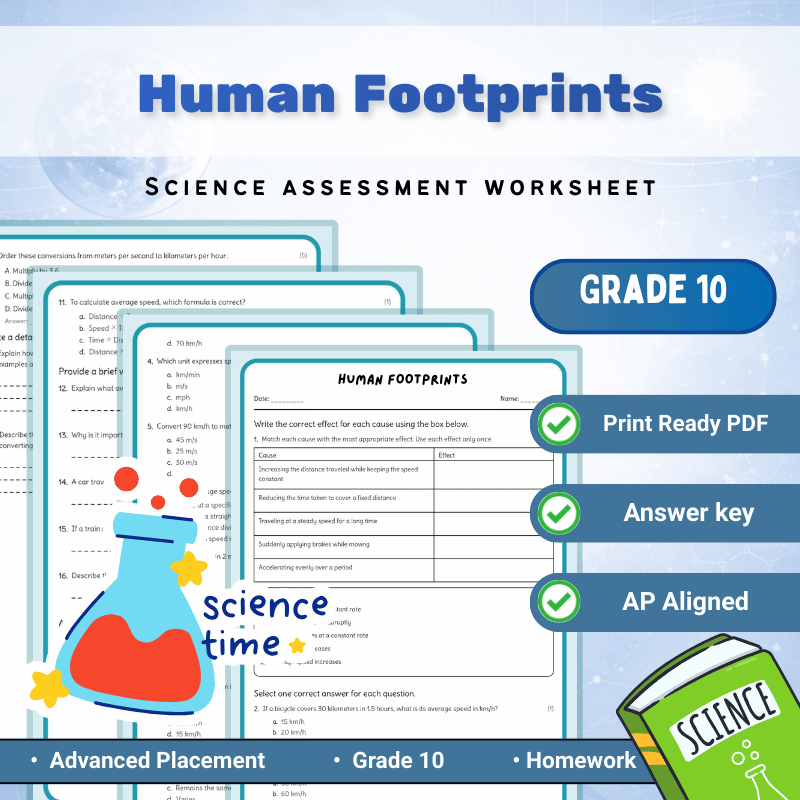
Grade 10 Science | Human Footprints AP Worksheet (PDF) – Environmental Impact
Created byBright Mind ResourcesLearning Objectives
- Understand how human activities alter Earth's land, water, and energy systems.
- Identify observable environmental consequences of anthropogenic forces.
- Analyze land-use changes, greenhouse gas emissions, and resource extraction impacts.
Instant download
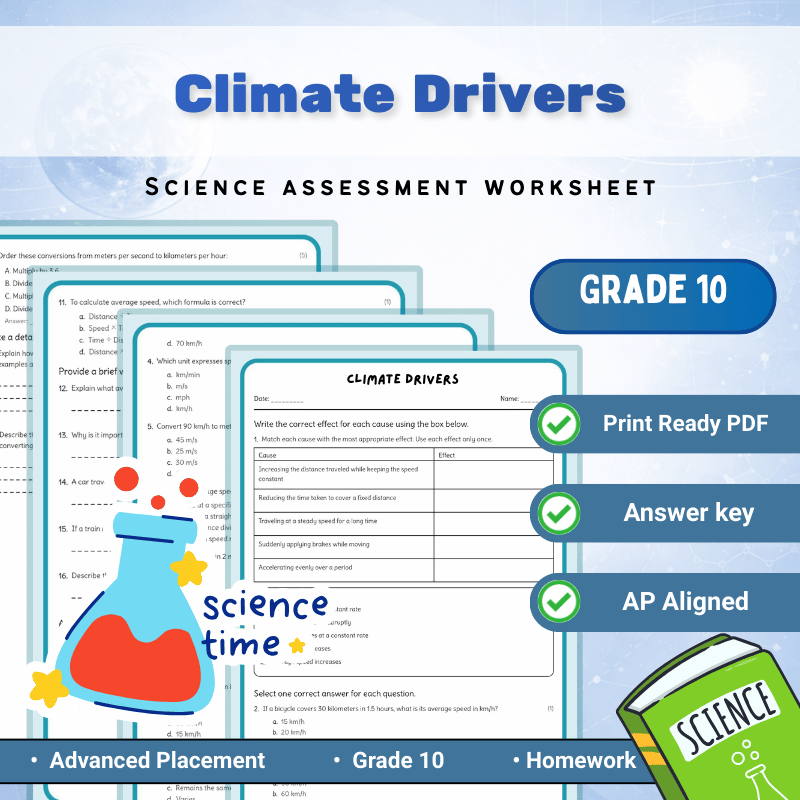
Grade 10 Science | Climate Drivers Worksheet (AP Standards + Answer Key)
Created byBright Mind ResourcesLearning Objectives
- Identify key factors influencing Earth's climate, including radiative forcing and greenhouse gases.
- Interpret feedback loops and their effects on climate variability.
- Evaluate model outputs and proxy records to assess long-term climate trends.
Instant download
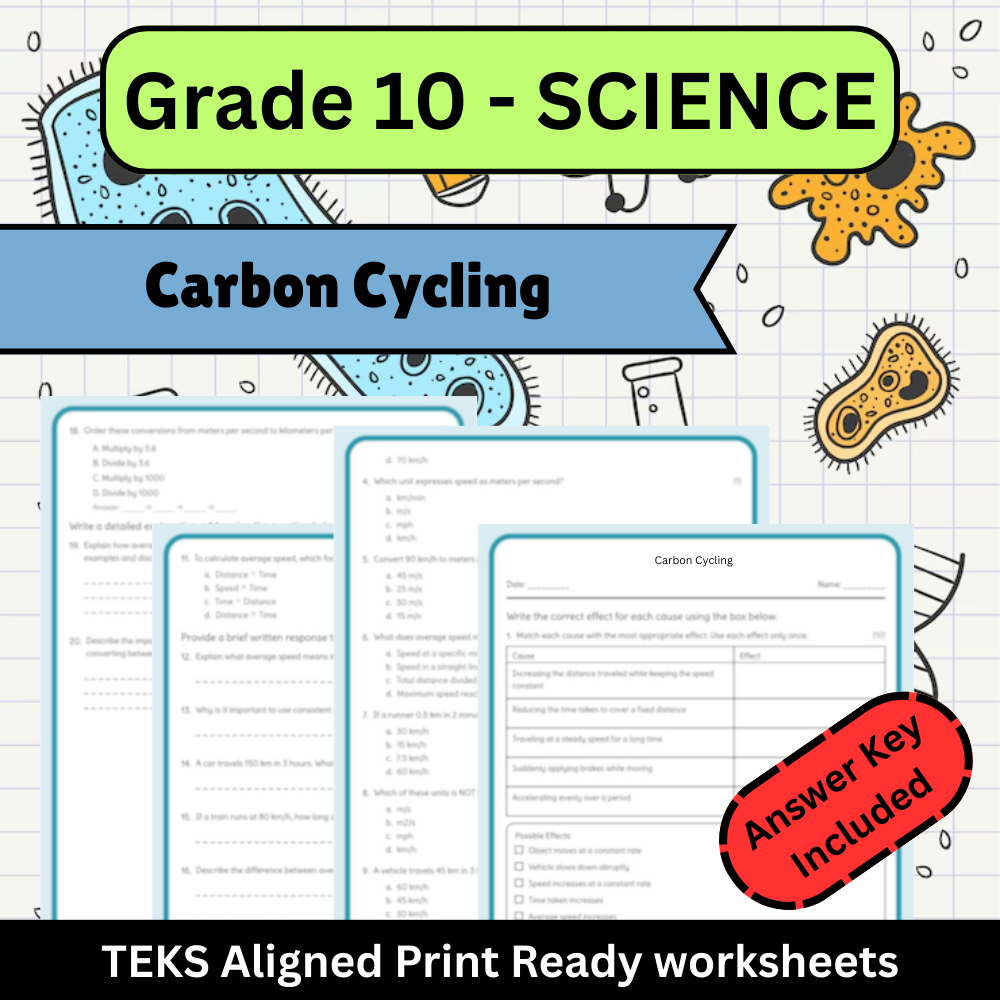
Grade 10 Science – Carbon Cycling Worksheet (Worksheet + Answer Key) | TEKS Aligned
Created byBright Mind ResourcesLearning Objectives
- Describe the pathways of carbon movement among the atmosphere, biosphere, hydrosphere, and geosphere.
- Explain the processes of photosynthesis and respiration in the carbon cycle.
- Identify human impacts on the carbon cycle and their effects on climate change.
Also included in: Grade 10 Science Unit Bundle – Photosynthesis, Respiration & Energy TEKS +5 more
Instant download
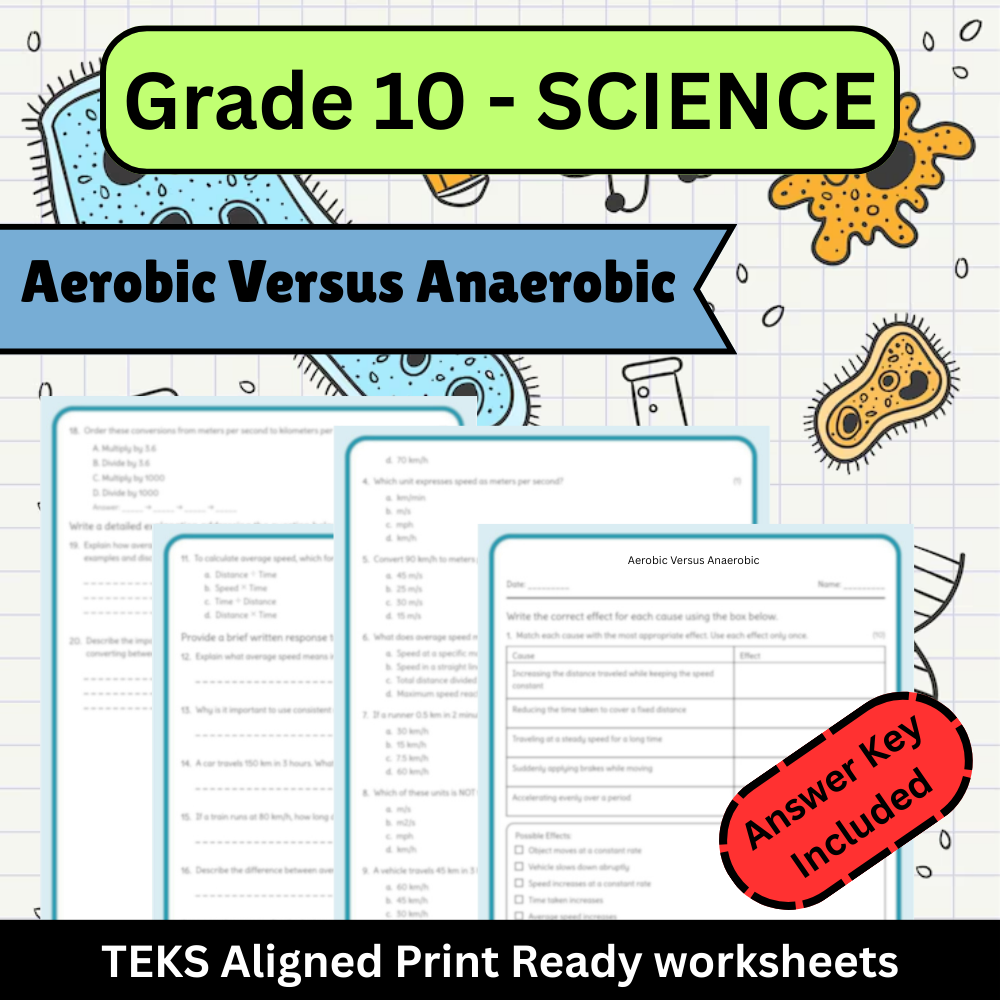
Grade 10 Science – Aerobic vs Anaerobic Respiration Worksheet (Answer Key) | TEKS Aligned
Created byBright Mind ResourcesLearning Objectives
- Explain the differences between aerobic and anaerobic respiration in terms of process, energy yield, and end products.
- Identify conditions and organisms where aerobic or anaerobic pathways are dominant.
- Evaluate the ecological and metabolic significance of aerobic and anaerobic pathways.
Also included in: Grade 10 Science Unit Bundle – Photosynthesis, Respiration & Energy TEKS +5 more
Instant download
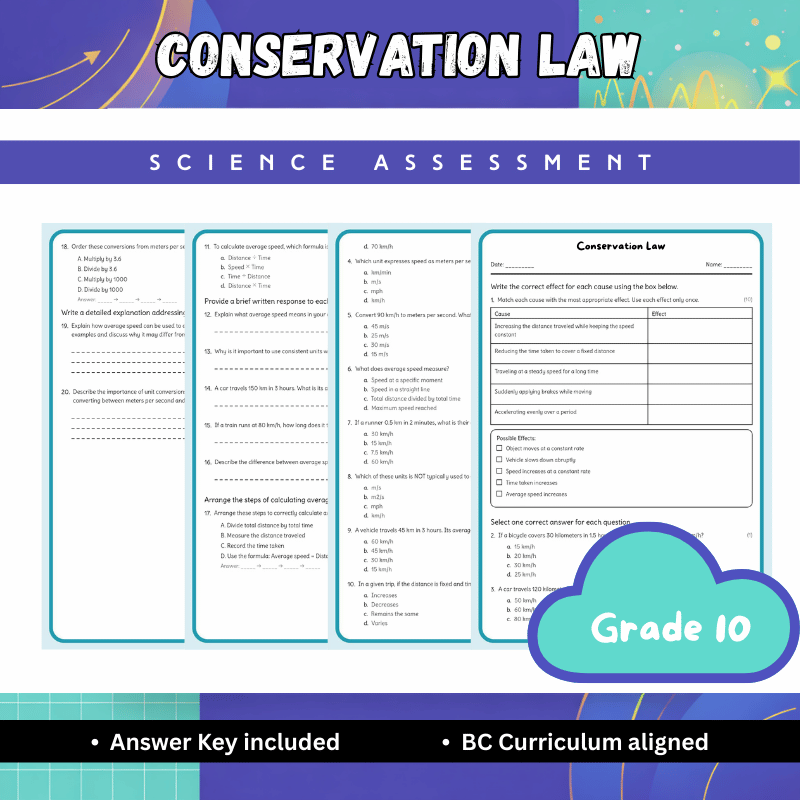
Grade 10 Science | Conservation Law Worksheet (Worksheet + Answer Key) PDF
Created byBright Mind ResourcesLearning Objectives
- Explain the law of conservation of energy and its significance in physical systems.
- Identify different forms of energy and how they transform in various scenarios.
- Understand the concepts of closed and open systems and their energy exchanges.
Instant download
Browse more categories
About Grade 10 Worksheets
Find Grade 10 worksheets covering algebra, biology, literature, and history. All 9,385 resources download instantly as PDFs for classwork, homework, or review.
MyTeachingSheets worksheets are made by real teacher-authors and checked before they go live. Download any as a print-ready PDF for lessons, homework, or independent practice — most include answer keys, and previews are always free.