
Grade 11 Worksheets
8,878 grade resources
Orbital Mechanics Practice Worksheet | Grade 11 Science NGSS Review
 Created byPrism Point Learning
Learning Objectives
- Explain how Kepler’s laws describe planetary motion and connect them to orbital geometry (semi-major axis, eccentricity).
- Use conservation of angular momentum and gravitational attraction to reason about changes in orbital speed and direction.
- Analyze how resonances and perturbations (eccentricity, inclination, and resonance with other bodies) can affect long-term stability.
Also included in: Grade 11 Orbital Mechanics & Timescales Science Lesson Bundle NGSS
Instant download

Long Range Forces Worksheet Review Printable | Grade 11 Science
Created byPrism Point LearningLearning Objectives
- Use inverse-square relationships to express gravitational and electrostatic force magnitudes between objects.
- Apply vector addition to determine a net force direction from multiple long-range interactions.
- Predict how net force influences motion, including orbital dynamics and curved charged-particle paths.
Instant download

Photosynthesis Worksheet Grade 11 Biology Activity NGSSS Science
Created byPrism Point LearningLearning Objectives
- Explain how photosynthesis converts light energy into chemical energy stored in organic molecules.
- Describe the roles of chlorophyll, electron transfer, and carbon dioxide in the overall process.
- Connect photosynthesis to atmospheric oxygen levels and carbon-based food webs.
Also included in: Ecology, Evolution & Genetics Lesson Bundle | Grade 11 Science NGSSS
Instant download

Natural Selection Worksheet Grade 11 Biology Activity NGSSS Science
Created byPrism Point LearningLearning Objectives
- Explain how natural selection changes allele frequencies in a population over generations
- Distinguish heritable variation, fitness, and environmental pressures in the process of natural selection
- Analyze how different environments can lead to different adaptations and evolutionary outcomes
Also included in: Ecology, Evolution & Genetics Lesson Bundle | Grade 11 Science NGSSS
Instant download

Gene Expression Worksheet Grade 11 Biology Activity NGSSS Science
Created byPrism Point LearningLearning Objectives
- Explain how transcription and translation connect DNA information to protein production
- Describe how proteins influence observable traits in cells and organisms
- Identify ways gene expression is regulated in different cell types and environments
Also included in: Ecology, Evolution & Genetics Lesson Bundle | Grade 11 Science NGSSS
Instant download

Universe Expansion Worksheet Grade 11 Astronomy Science NGSSS
Created byPrism Point LearningLearning Objectives
- Explain how redshift supports the idea that the universe is expanding
- Describe how observations of the cosmic microwave background support an early hot, dense universe
- Connect gravity to the formation and clustering of galaxies over cosmic time
Also included in: Grade 11 Earth & Space Science Systems Lesson Bundle | Florida NGSSS
Instant download

Work and Power Worksheet Grade 11 Physics NGSSS Science Activity
Created byPrism Point LearningLearning Objectives
- Explain when work is done by a force and how work depends on force and displacement.
- Distinguish power from work by describing power as the rate of energy transfer.
- Use work and power ideas to compare real situations such as lifting and stair climbing.
Instant download

DNA Information Worksheet Grade 11 Biology Genetics NGSSS Activity
Created byPrism Point LearningLearning Objectives
- Explain how DNA stores genetic information and how complementary base pairing supports accurate copying.
- Describe how DNA sequence relates to protein production and inherited traits.
- Evaluate how variation in DNA among individuals can influence phenotypes and contribute to evolutionary change.
Also included in: Ecology, Evolution & Genetics Lesson Bundle | Grade 11 Science NGSSS
Instant download

Acid Strength Factors Worksheet | Grade 11 Science Practice
Created byPrism Point LearningLearning Objectives
- Explain how molecular structure factors influence acid strength in water.
- Use trends such as bond polarity, electronegativity, atom size, resonance stabilization, and oxidation state to predict acidity.
- Relate electron-withdrawing groups in oxyacids and halogen-substituted acids to acidity trends.
Instant download

Henderson Equation Worksheet | Grade 11 Science Practice
Created byPrism Point LearningLearning Objectives
- Explain what the Henderson–Hasselbalch equation describes in terms of pH, pKa, and concentration ratios.
- Use the Henderson–Hasselbalch equation to predict how changing acid/base concentrations affects buffer pH.
- Interpret buffer behavior in real environmental or industrial water systems.
Instant download

Solution Stoichiometry Assessment | Alberta Standards Grade 11 Science
Created byPrism Point LearningLearning Objectives
- Explain the concept of molarity and its role in solution stoichiometry.
- Calculate reactant and product quantities using mole-mole relationships in aqueous solutions.
- Identify limiting reagents in solution reactions based on concentration and stoichiometry.
Also included in: Grade 11 Solutions and Solubility Science Lesson Bundle | Alberta Framework +1 more
Instant download

Gas Stoichiometry Assessment for Grade 11 Science | Alberta Standards
Created byPrism Point LearningLearning Objectives
- Understand the application of gas laws in stoichiometric calculations involving gases.
- Relate pressure, volume, and temperature conditions to mole quantities of gases.
- Calculate gas volumes under standard and non-standard conditions for industrial or environmental contexts.
Also included in: Grade 11 Chemical Reactions & Stoichiometry Science Lesson Bundle – Alberta +1 more
Instant download

Empirical Formulas Assessment | Alberta Standards Grade 11 Science
Created byPrism Point LearningLearning Objectives
- Understand the concept of empirical formulas and how they represent the simplest whole-number ratio of elements in a compound.
- Learn how to convert mass percent data into mole ratios for empirical formula determination.
- Apply molar calculations to derive empirical and molecular formulas from compositional data.
Also included in: Grade 11 Chemical Reactions & Stoichiometry Science Lesson Bundle – Alberta +1 more
Instant download

Evaluating Explanations Assessment Grade 11 | Florida NGSSS Science
Created byPrism Point LearningLearning Objectives
- Evaluate scientific explanations by judging the quality and limits of evidence.
- Distinguish correlation from causation when interpreting scientific claims.
- Assess whether an explanation accounts for multiple observations and considers alternative explanations.
Also included in: Grade 11 Scientific Inquiry, Models, and Evidence Science Lesson Bundle NGSSS +1 more
Instant download
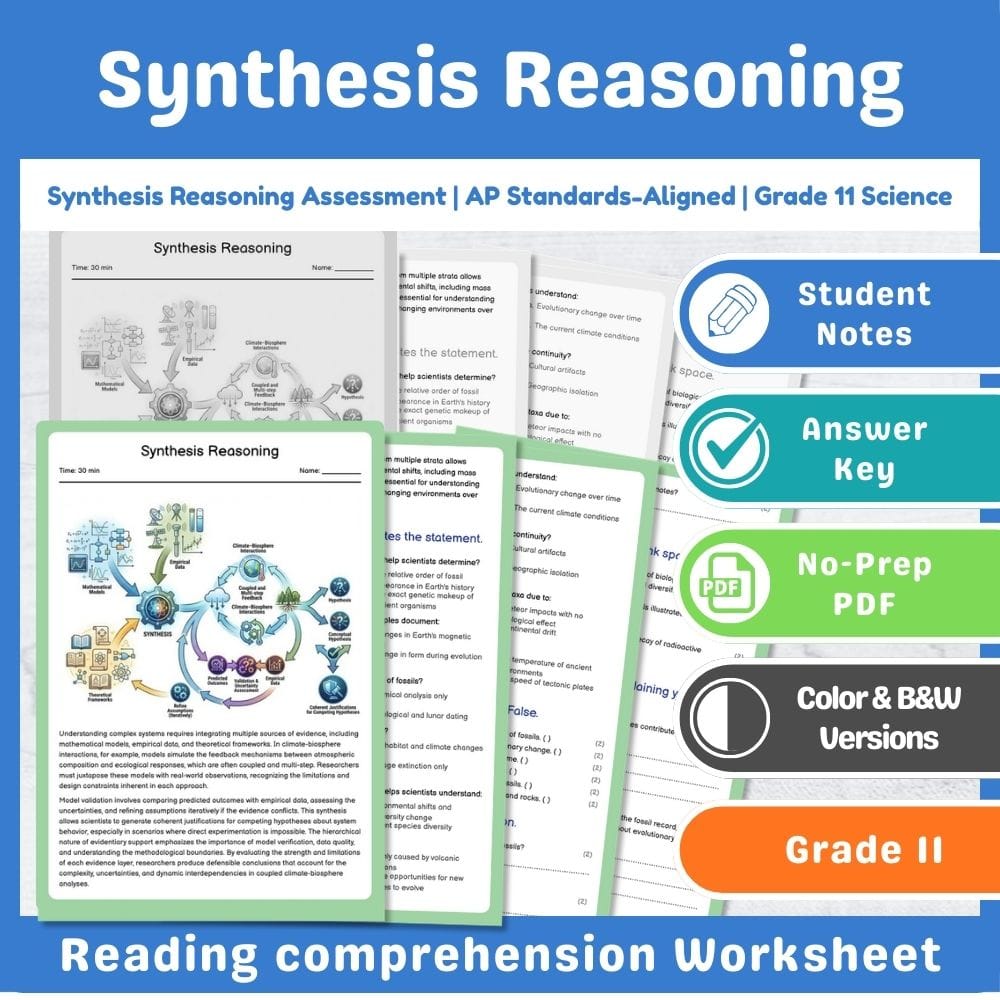
Synthesis Reasoning Assessment | AP Standards-Aligned | Grade 11 Science
Created byPrism Point LearningLearning Objectives
- Evaluate complex phenomena through model-based inference and quantitative reasoning.
- Integrate empirical summaries, model expectations, and design constraints for hypothesis testing.
- Apply uncertainty quantification and validation outcomes to support scientific conclusions.
Also included in: Grade 11 Science Mini Bundle | AP Science Practices & Skills
Instant download

Newton Second Law Assessment Grade 11 Science NGSSS Standards
Created byPrism Point LearningLearning Objectives
- Explain Newton’s second law using the relationship between net force, mass, and acceleration
- Predict the direction and relative magnitude of acceleration based on net force and mass
- Apply Newton’s second law to situations involving identical pushes on different masses and multiple forces acting together
Also included in: Lesson Grade 11 Forces Energy & Chemistry Science Assessment Lesson Bundle | Florida (NGSSS) +1 more
Instant download

DNA Information Assessment for Grade 11 Science | NGSSS Standards
Created byPrism Point LearningLearning Objectives
- Explain how DNA stores genetic information and how that information leads to protein production
- Describe the structure of DNA and the importance of complementary base pairing
- Analyze how accurate DNA replication preserves inheritance during cell division
Also included in: Grade 11 Population, Genetics & Energy Systems Science Lesson Bundle: Florida NGSSS +1 more
Instant download

Energy Changes In Reactions Assessment | General Standards-Aligned Grade 11 Science
Created byPrism Point LearningLearning Objectives
- Understand how energy is transferred during chemical and physical changes.
- Distinguish between endothermic and exothermic reactions based on energy diagrams.
- Explain the concepts of energy conservation and energy redistribution in reactions.
Instant download

Solution Stoichiometry Assessment | Alberta Standards Grade 11 Science
Created byPrism Point LearningLearning Objectives
- Understand how to use concentration measures like molarity to determine quantities of reactants and products in aqueous reactions.
- Apply mole relationships and equivalence principles to solve solution-based stoichiometry problems.
- Use mass conservation and volume-mole conversions to predict outcomes of chemical reactions in solution.
Also included in: Grade 11 Chemical Reactions & Stoichiometry Science Lesson Bundle – Alberta +1 more
Instant download

Ionic Strength Assessment | Alberta Standards Grade 11 Science
Created byPrism Point LearningLearning Objectives
- Understand the concept of ionic strength and how it relates to ion concentration and charge.
- Explain how ionic strength affects activity coefficients and solubility in solutions.
- Analyze real-world examples of ionic strength effects in natural waters and industrial processes.
Also included in: Grade 11 Solutions and Solubility Science Lesson Bundle | Alberta Framework +1 more
Instant download

Temperature Effects Assessment | Alberta Standards Grade 11 Science
Created byPrism Point LearningLearning Objectives
- Understand key concepts related to Science
- Apply knowledge through practice questions
- Demonstrate comprehension of the material
Also included in: Grade 11 Solutions and Solubility Science Lesson Bundle | Alberta Framework +1 more
Instant download

Carrying Capacity Assessment for Grade 11 Science | NGSSS Standards
Created byPrism Point LearningLearning Objectives
- Explain how birth rate, death rate, immigration, and emigration affect population change over time
- Define carrying capacity and describe how limiting factors slow population growth
- Interpret how competition, predation, and disease influence survival and reproduction
Also included in: Grade 11 Population, Genetics & Energy Systems Science Lesson Bundle: Florida NGSSS +1 more
Instant download

Feedback Control Loops Assessment | General Standards-Aligned Assessment Grade 11 Science
Created byPrism Point LearningLearning Objectives
- Understand the concept of feedback mechanisms in maintaining homeostasis.
- Differentiate between negative and positive feedback loops.
- Identify real-life examples of feedback control in the human body.
Also included in: Grade 11 Biological Evidence Science Lesson Bundle | General Framework
Instant download

Inheritance Patterns Assessment for Grade 11 Science | Standards-Aligned
Created byPrism Point LearningLearning Objectives
- Explain how observable traits are connected to genetic inheritance patterns across generations.
- Describe the role of Punnett squares in predicting offspring genotypes and phenotypes.
- Differentiate between autosomal and sex-linked inheritance, including dominance and recessiveness.
Also included in: Grade 11 Biological Evidence Science Lesson Bundle | General Framework
Instant download

Period Trends and Chemical Interactions Assessment | Alberta Grade 11 Science
Created byPrism Point LearningLearning Objectives
- Explain how atomic radius, ionization energy, and electronegativity vary across the periodic table.
- Describe how these trends influence element bonding preferences and material properties.
- Connect periodic patterns to practical examples like corrosion and alloy selection.
Also included in: Grade 11 Matter and Chemical Bonding Science Lesson Bundle for Alberta +1 more
Instant download

Testable Hypotheses Assessment | General Standards Grade 11 Science
Created byPrism Point LearningLearning Objectives
- Understand key concepts related to Science
- Apply knowledge through practice questions
- Demonstrate comprehension of the material
Also included in: Grade 11 Scientific Evidence & Modeling Science Lesson Bundle: General
Instant download

Phase Behaviour Assessment | Alberta Standard Grade 11 Science
Created byPrism Point LearningLearning Objectives
- Understand the concept of phase behaviour and phase diagrams.
- Identify the different phases of matter and their transitions under varying conditions.
- Interpret phase diagrams to determine phase changes at specific temperature and pressure points.
Also included in: Grade 11 Matter and Chemical Bonding Science Lesson Bundle for Alberta +1 more
Instant download

Lewis Structures Assessment | Alberta Standard Assessment Grade 11 Science
Created byPrism Point LearningLearning Objectives
- Understand the concept of Lewis electron-dot structures for molecules.
- Identify how to represent shared electrons and bonds.
- Interpret Lewis structures to predict molecular shapes and properties.
Also included in: Grade 11 Matter and Chemical Bonding Science Lesson Bundle for Alberta +1 more
Instant download

Titration Theory Assessment for Grade 11 Science | Alberta Standards
Created byPrism Point LearningLearning Objectives
- Explain the principles and process of titration in quantitative analysis.
- Identify the importance of proper calibration and indicator selection during titration.
- Calculate unknown concentrations using titrant volume and concentration relationships.
Also included in: Grade 11 Chemical Reactions & Stoichiometry Science Lesson Bundle – Alberta +1 more
Instant download
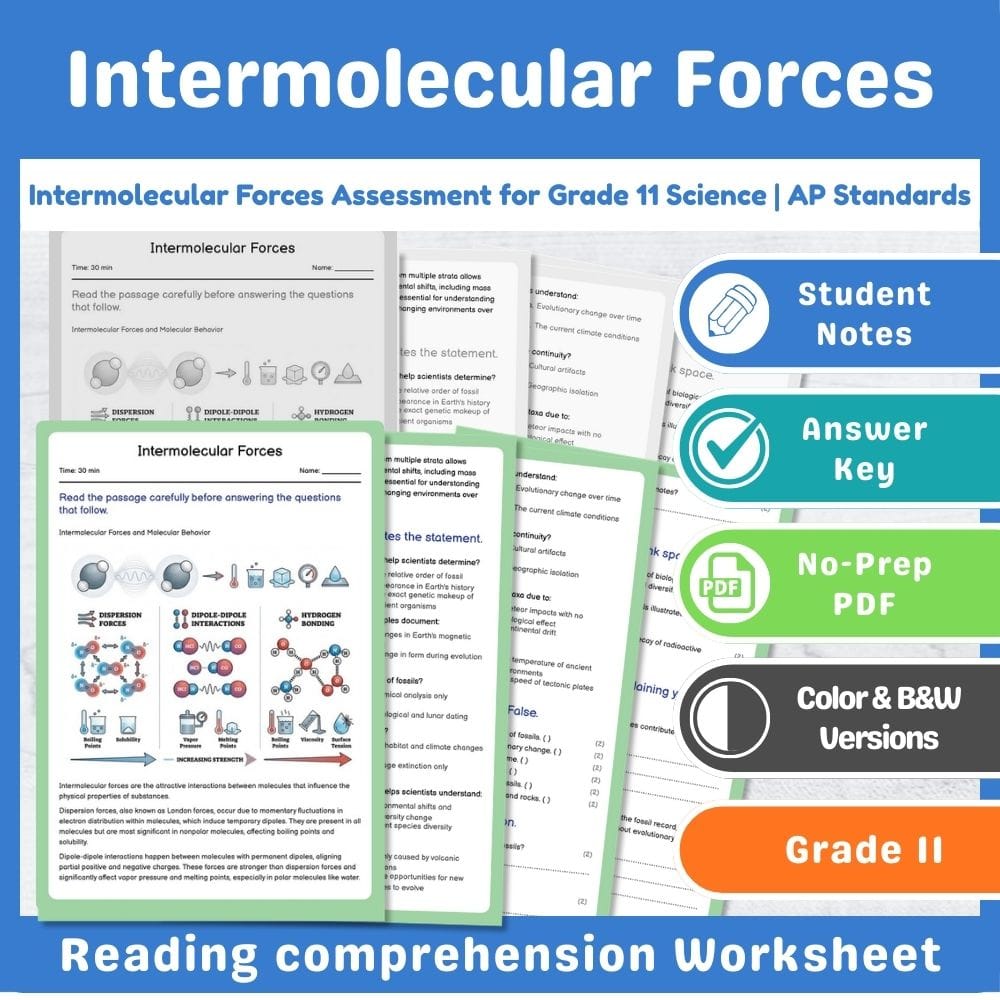
Intermolecular Forces Assessment for Grade 11 Science | AP Standards
Created byPrism Point LearningLearning Objectives
- Describe the different types of intermolecular forces: dispersion, dipole-dipole, and hydrogen bonding.
- Explain how intermolecular forces influence boiling point, vapor pressure, and solubility.
- Relate molecular polarity and surface interactions to phase behavior and macroscopic trends.
Instant download

VSEPR and Forces Assessment | Alberta Standards Grade 11 Science
Created byPrism Point LearningLearning Objectives
- Describe the VSEPR model and predict molecular geometries based on electron pair arrangements.
- Explain how molecular shapes influence intermolecular forces such as dipole interactions and hydrogen bonding.
- Relate molecular shape to physical properties like boiling and melting points, with real-world examples.
Also included in: Grade 11 Matter and Chemical Bonding Science Lesson Bundle for Alberta +1 more
Instant download
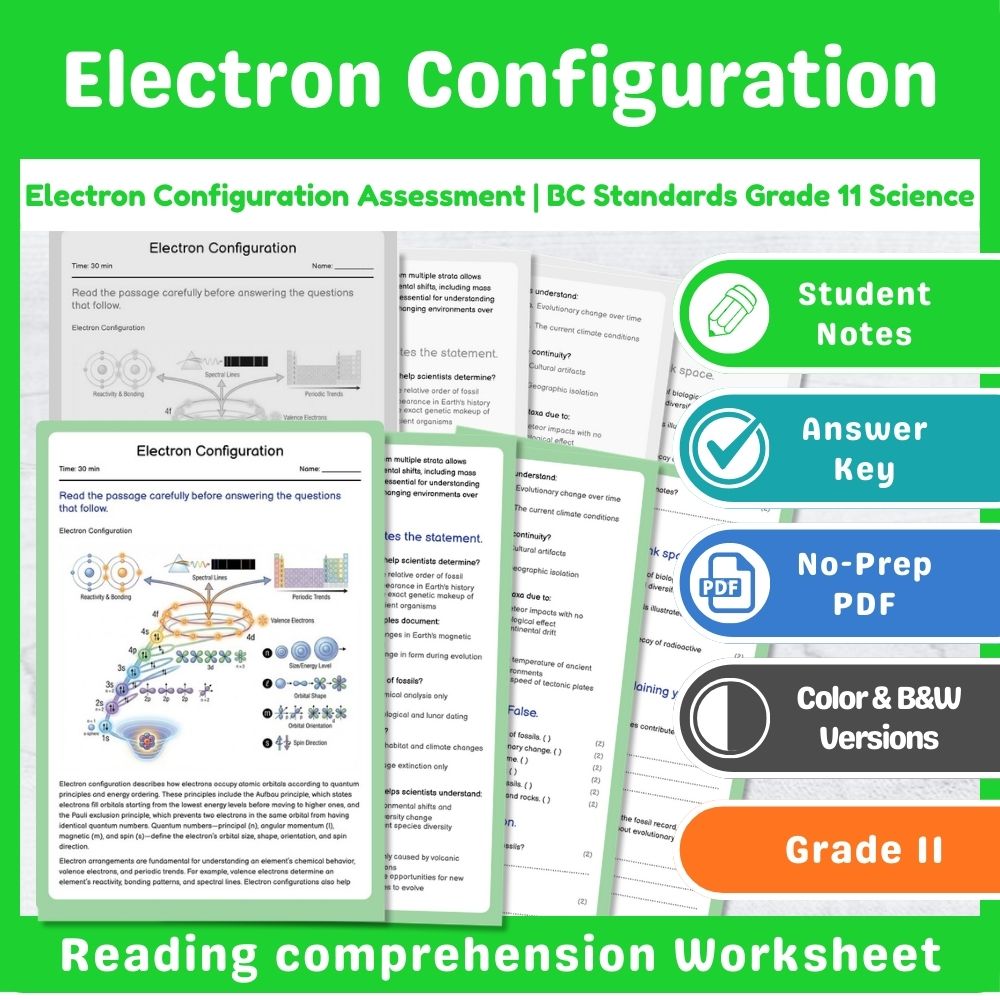
Electron Configuration Assessment | BC Standards Grade 11 Science
Created byPrism Point LearningLearning Objectives
- Explain how electrons occupy atomic orbitals according to quantum principles.
- Describe the role of quantum numbers, Pauli exclusion, and Aufbau principles in electron filling.
- Relate electron arrangements to elemental chemical behavior, valence electrons, and periodic trends.
Also included in: Grade 11 Science | Thermochemistry Assessment Bundle – Standards-Aligned
Instant download

Chemical Equilibrium Assessment for Grade 11 Science | BC Standards
Created byPrism Point LearningLearning Objectives
- Understand the concept of chemical equilibrium and the factors that affect it.
- Learn how to write and interpret equilibrium constant expressions.
- Apply Le Chatelier’s principle to predict shifts in equilibrium in response to concentration, temperature, and pressure changes.
Also included in: Grade 11 Science | Thermochemistry Assessment Bundle – Standards-Aligned
Instant download

The Mole Concept Assessment | BC Standards Grade 11 Science
Created byPrism Point LearningLearning Objectives
- Explain the fundamental principles of the mole concept and its relation to Avogadro's number.
- Convert between mass, number of particles, and volume using molar mass and molar relationships.
- Perform calculations involving moles, gases, and mass for quantitative analysis in chemistry.
Also included in: Grade 11 Science | Thermochemistry Assessment Bundle – Standards-Aligned
Instant download

Neutralization Stoichiometry Assessment for Grade 11 Science - Alberta
Created byPrism Point LearningLearning Objectives
- Understand the concept of neutralization reactions involving acids and bases.
- Apply molarity, limiting reagent, and titration principles in solving neutralization problems.
- Perform stoichiometric calculations to determine reagent quantities needed for neutralization.
Also included in: Grade 11 Acids, Bases & pH Chemistry Science Lesson Bundle | Alberta +1 more
Instant download
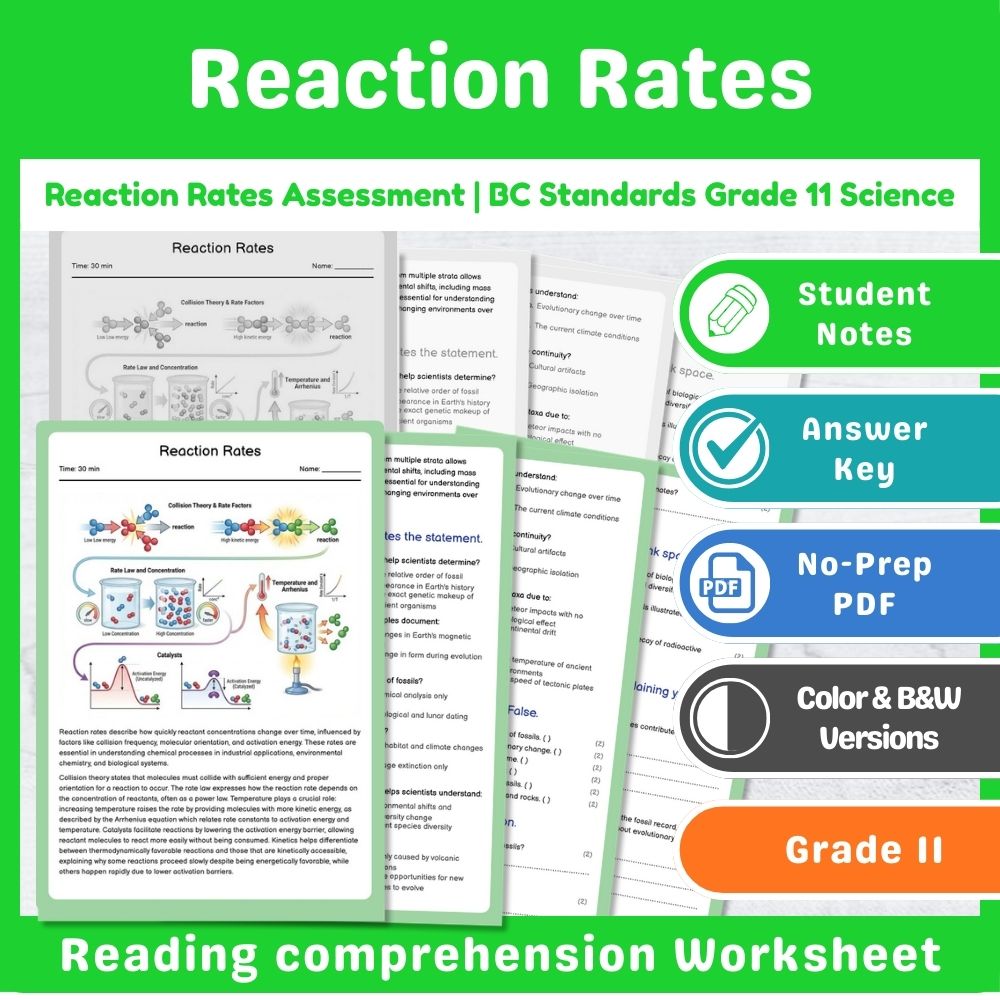
Reaction Rates Assessment | BC Standards Grade 11 Science
Created byPrism Point LearningLearning Objectives
- Explain the factors influencing reaction rates, including collision frequency, molecular orientation, and activation energy.
- Describe rate laws and how they relate reactant concentrations to reaction speed.
- Understand the Arrhenius equation and how temperature affects rate constants.
Also included in: Grade 11 Science | Thermochemistry Assessment Bundle – Standards-Aligned
Instant download

Thermochemistry Assessment for Grade 11 Science Standards-Aligned
Created byPrism Point LearningLearning Objectives
- Understand the concept of enthalpy and its role in chemical reactions.
- Identify differences between endothermic and exothermic processes.
- Calculate reaction enthalpies using bond energies and standard enthalpies of formation.
Also included in: Grade 11 Science | Thermochemistry Assessment Bundle – Standards-Aligned
Instant download

Groundwater Systems Assessment for Grade 11 Science | BC Standards
Created byPrism Point LearningLearning Objectives
- Understand the concepts of aquifers, porosity, and permeability in groundwater systems.
- Differentiate between confined and unconfined aquifers and their responses to recharge and pumping.
- Identify factors affecting groundwater flow, quality, and sustainability.
Also included in: Grade 11 Science Assessment | Plate Tectonics BC Standards Mini Bundle
Instant download

Earth Systems Assessment for Grade 11 Science | Florida NGSSS Standards
Created byPrism Point LearningLearning Objectives
- Explain how Earth’s geosphere, hydrosphere, atmosphere, and biosphere interact through energy flow and matter cycling
- Use cause-and-effect reasoning to describe how unequal heating drives atmospheric and ocean circulation
- Describe major processes such as the water cycle and biogeochemical cycling and connect them to regional or global patterns
Also included in: Lesson Bundle: Grade 11 Earth and Space Science Assessments | Florida NGSSS +1 more
Instant download

Mantle Convection Assessment for Grade 11 Science – Standards-Aligned
Created byPrism Point LearningLearning Objectives
- Understand the process of mantle convection and how it drives plate tectonics.
- Identify geophysical techniques used to observe mantle flow and dynamics.
- Explain the roles of slab pull, ridge push, and mantle plumes in Earth's geological activity.
Also included in: Grade 11 Science Assessment | Plate Tectonics BC Standards Mini Bundle
Instant download
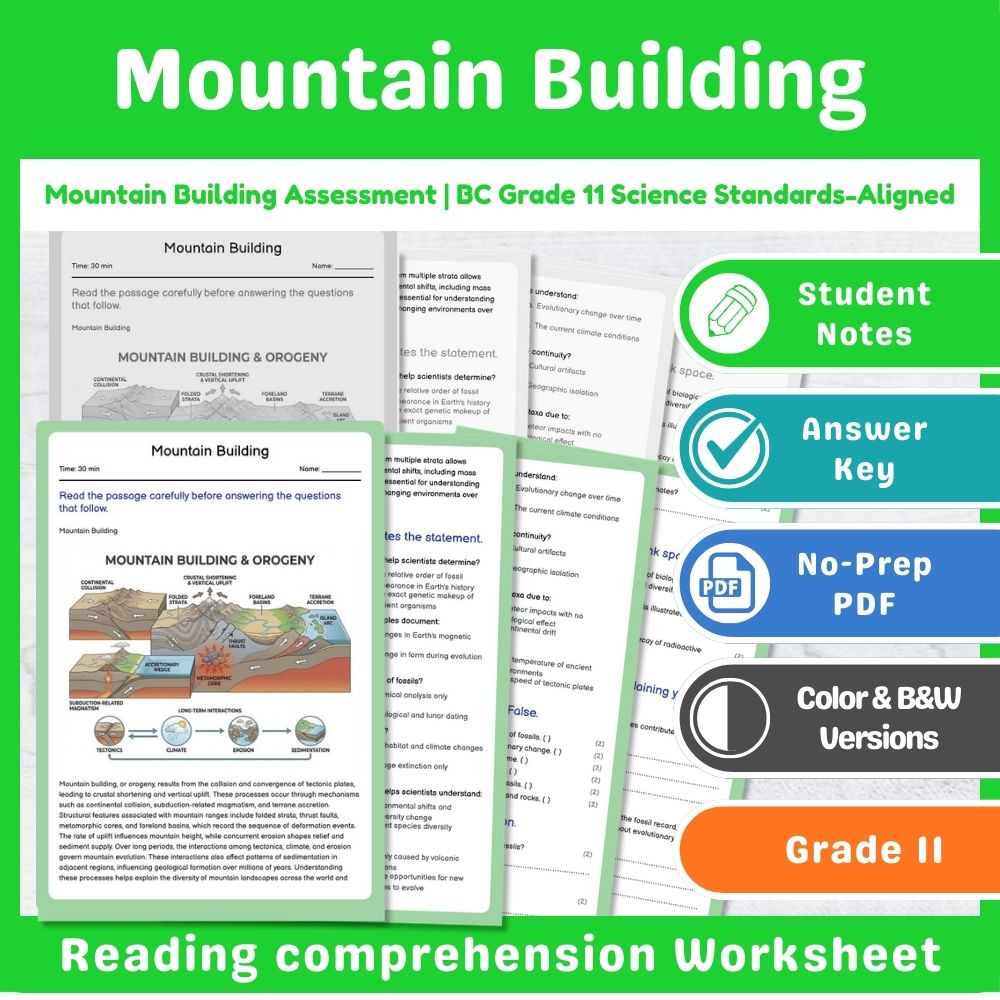
Mountain Building Assessment | BC Grade 11 Science Standards-Aligned
Created byPrism Point LearningLearning Objectives
- Explain the geological processes involved in mountain formation, including tectonic convergence, crustal shortening, and uplift.
- Identify structural features such as folded strata, thrust faults, metamorphic cores, and foreland basins associated with mountain ranges.
- Describe how rates of uplift and erosion influence mountain evolution and sediment distribution.
Also included in: Grade 11 Science Assessment | Plate Tectonics BC Standards Mini Bundle
Instant download
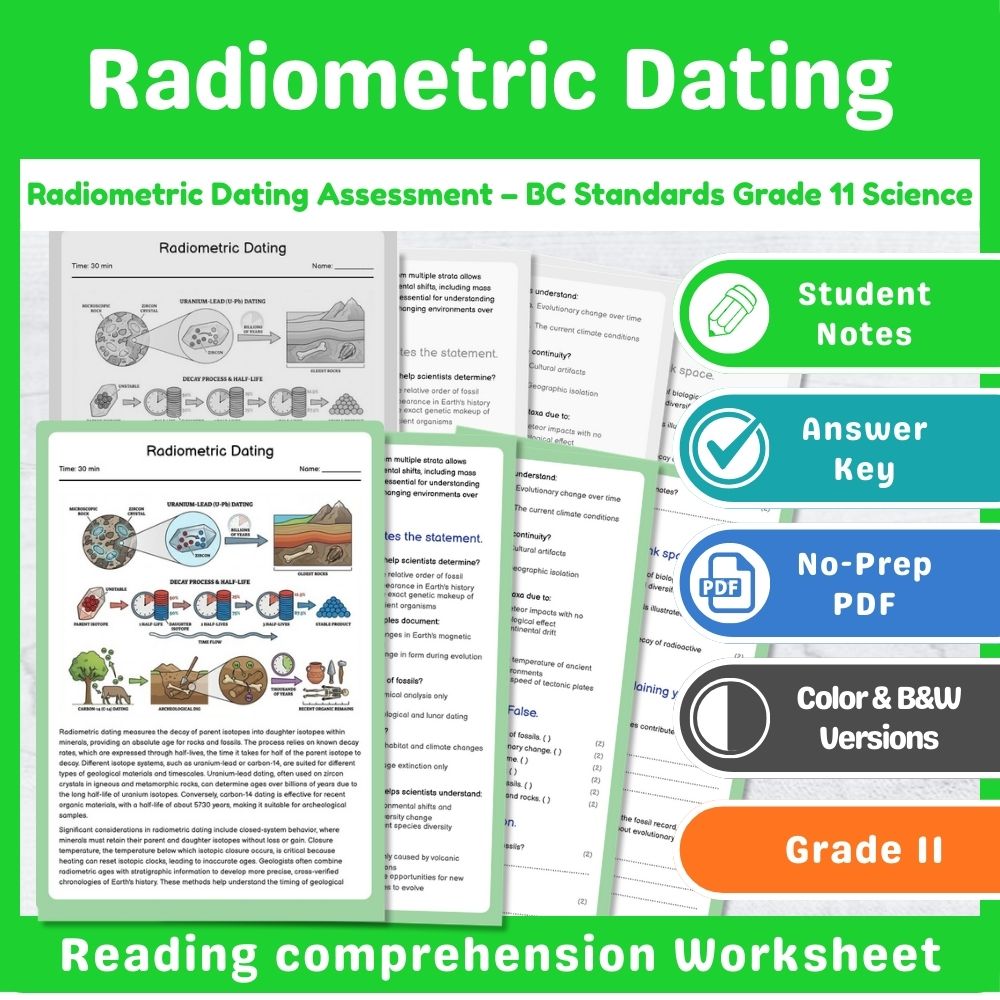
Radiometric Dating Assessment – BC Standards Grade 11 Science
Created byPrism Point LearningLearning Objectives
- Understand the principles of radiometric dating and how isotopic decay is used to determine geological ages.
- Identify different parent-daughter isotope systems suitable for various timescales and rock types.
- Explain the significance of closure temperature and how it affects isotopic retention in rocks.
Also included in: Grade 11 Science Assessment | Plate Tectonics BC Standards Mini Bundle
Instant download

Water Cycle Flux Assessment for Grade 11 Science | NGSSS Standards
Created byPrism Point LearningLearning Objectives
- Explain how water moves between the atmosphere and hydrosphere using the major processes of the water cycle flux.
- Analyze how ocean currents and sea surface temperature affect evaporation, humidity, and atmospheric stability.
- Evaluate how long-term and seasonal ocean-atmosphere interactions can change regional precipitation patterns, including El Niño and La Niña.
Also included in: Lesson Bundle: Grade 11 Earth and Space Science Assessments | Florida NGSSS +1 more
Instant download

Conservation of Mass Assessment | Florida NGSSS Grade 11 Science
Created byPrism Point LearningLearning Objectives
- Explain the conservation of mass in terms of closed systems and atomic rearrangement.
- Use balanced chemical equations to connect reactant and product amounts to measurable mass.
- Apply conservation of mass to interpret evidence from experiments involving solids and gases.
Also included in: Lesson Grade 11 Forces Energy & Chemistry Science Assessment Lesson Bundle | Florida (NGSSS) +1 more
Instant download
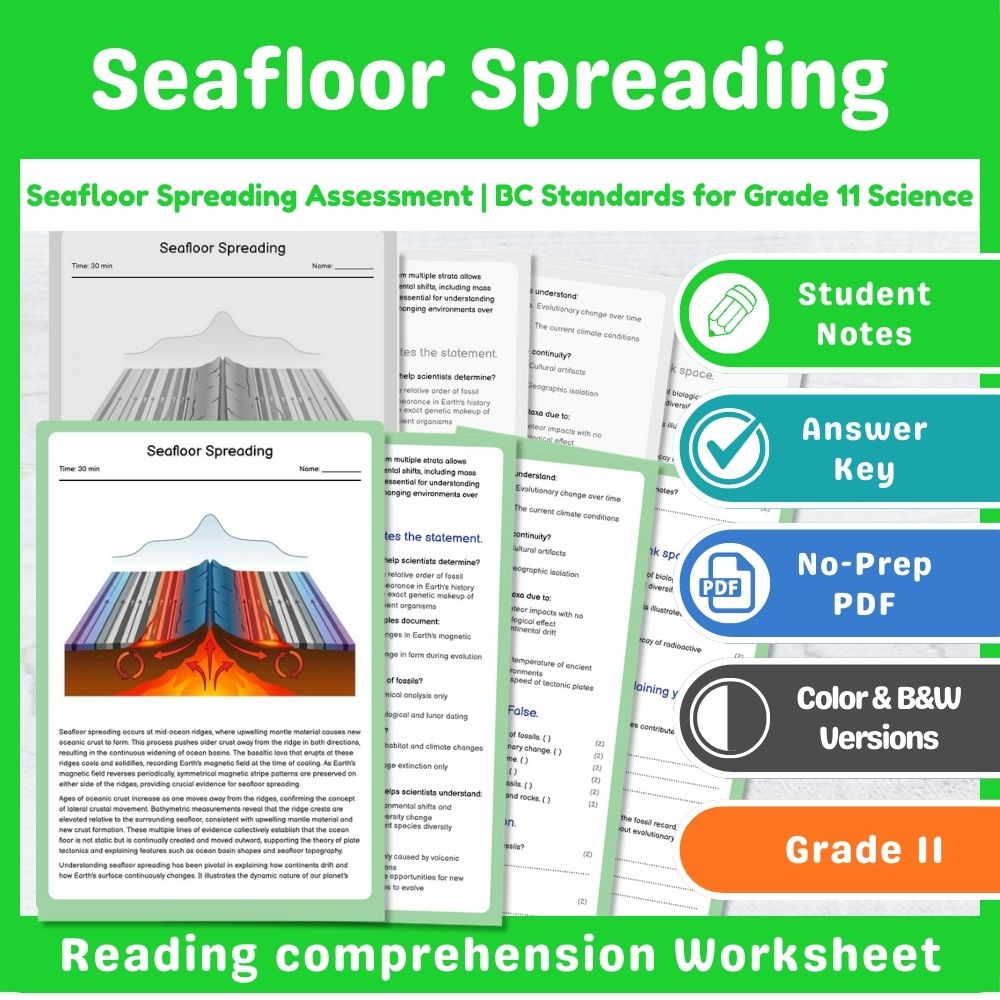
Seafloor Spreading Assessment | BC Standards for Grade 11 Science
Created byPrism Point LearningLearning Objectives
- Describe the process of seafloor spreading and how it shapes ocean basins.
- Explain how magnetic stripe patterns provide evidence for seafloor spreading.
- Analyze how age and bathymetric data support plate tectonic theory.
Also included in: Grade 11 Science Assessment | Plate Tectonics BC Standards Mini Bundle
Instant download

Stratigraphic Columns Assessment for Grade 11 Science | BC Standards
Created byPrism Point LearningLearning Objectives
- Understand the components and significance of stratigraphic columns in geology.
- Identify how lithology, fossils, and sedimentary structures help interpret past environments.
- Explain the concepts of correlation, unconformities, and facies changes within stratigraphy.
Also included in: Grade 11 Science Assessment | Plate Tectonics BC Standards Mini Bundle
Instant download

Tissue Organization Assessment | BC Standards Grade 11 Science
Created byPrism Point LearningLearning Objectives
- Understand how multicellular organisms organize cells into tissues, organs, and systems.
- Identify the roles of cellular differentiation in tissue specialization.
- Explain models of tissue architecture and intercellular communication.
Also included in: Grade 11 Science Lesson Assessment Bundle | Photosynthesis & Genetics
Instant download
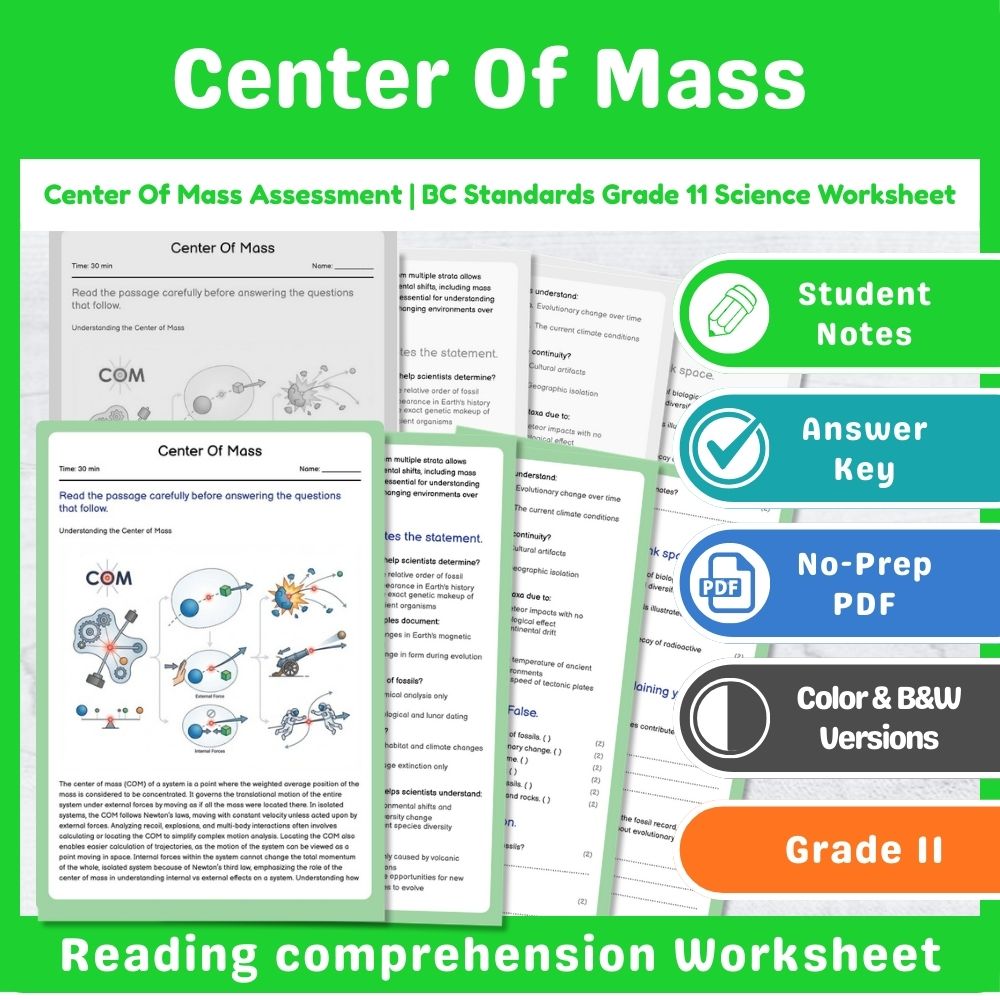
Center Of Mass Assessment | BC Standards Grade 11 Science Worksheet
Created byPrism Point LearningLearning Objectives
- Understand the concept of the center of mass in physical systems.
- Apply the principles of momentum conservation relative to the center of mass.
- Analyze system trajectories and internal forces using the center of mass concept.
Also included in: Grade 11 Science Assessment Bundle | Classical Mechanics & Motion Topics
Instant download
Browse more categories
About Grade 11 Worksheets
Find Grade 11 worksheets covering algebra, biology, literature, and history. All 8,878 resources download instantly as PDFs for classwork, homework, or review.
Each resource here is built by an independent educator and reviewed for quality. Worksheets print straight from PDF and suit classroom use, homework, or extra practice; most come with answer keys, and you can preview before purchasing.