
Grade 11 Worksheets
8,878 grade resources
Grade 11 Social Studies Worksheet on Colonial Legacies (BC Standard) (PDF)
 Created bySunny Desk Resources
Learning Objectives
- Analyze how colonial processes created long-term political, social, and economic legacies.
- Assess causes and consequences of land dispossession, governance shifts, and cultural change.
- Interpret diverse perspectives by comparing Indigenous experiences with colonial records and modern interpretations.
Also included in: Grade 11 Civic Inquiry Global Issues Social Studies Full-Year Bundle BC +1 more
Instant download
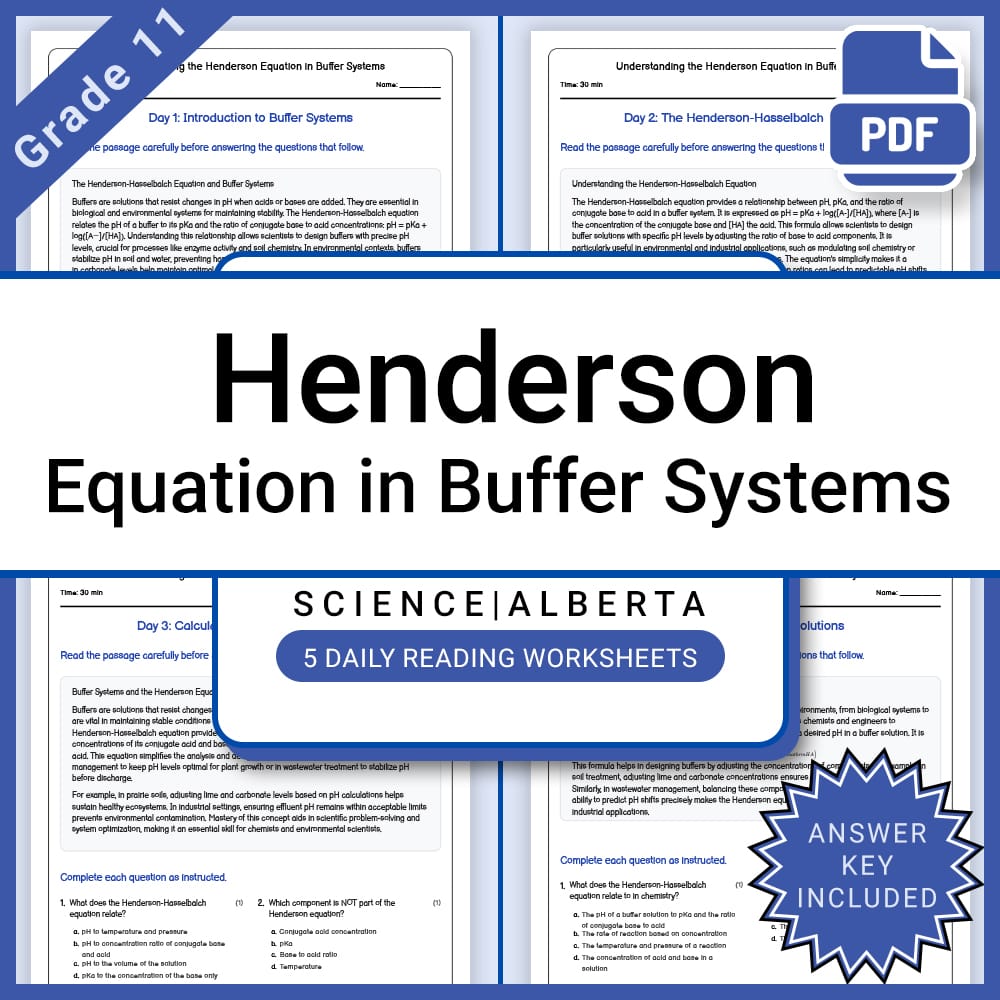
Grade 11 – Buffer Systems Henderson Equation Daily Worksheet + Answer Key
JCreated byJ.S SheetsLearning Objectives
- Explain the Henderson–Hasselbalch equation and its significance.
- Interpret the relationship between pH, pKa, and concentrations of acid/base.
- Apply the Henderson equation to calculate buffer solutions for desired pH levels.
Also included in: Grade 11 Science Lesson Bundle on Acids, Bases, and Titration | Alberta Framework +1 more
Instant download

Grade 11 Science — Worksheet MCQ Paper for Mastering Measurement Uncertainty
 Created byThe Resource Hub
Learning Objectives
- Understand the principles of precision and accuracy in measurements.
- Identify sources of measurement uncertainty in scientific experiments.
- Apply concepts of significant figures, calibration, and error propagation.
Also included in: Grade 11 Science AP Bundle: Mastering Key Concepts with MCQ Practice +1 more
Instant download

Grade 11 Science – Reaction Rates & Factors | Daily Reading Worksheet
 Created byBright Mind Resources
Learning Objectives
- Understand the factors influencing the speed of chemical reactions.
- Identify how temperature, concentration, surface area, and catalysts affect reaction rates.
- Recognize the principles of collision theory and activation energy.
Also included in: Grade 11 Reaction Stoichiometry Science Daily Reading Lesson Bundle | NGSS +2 more
Instant download
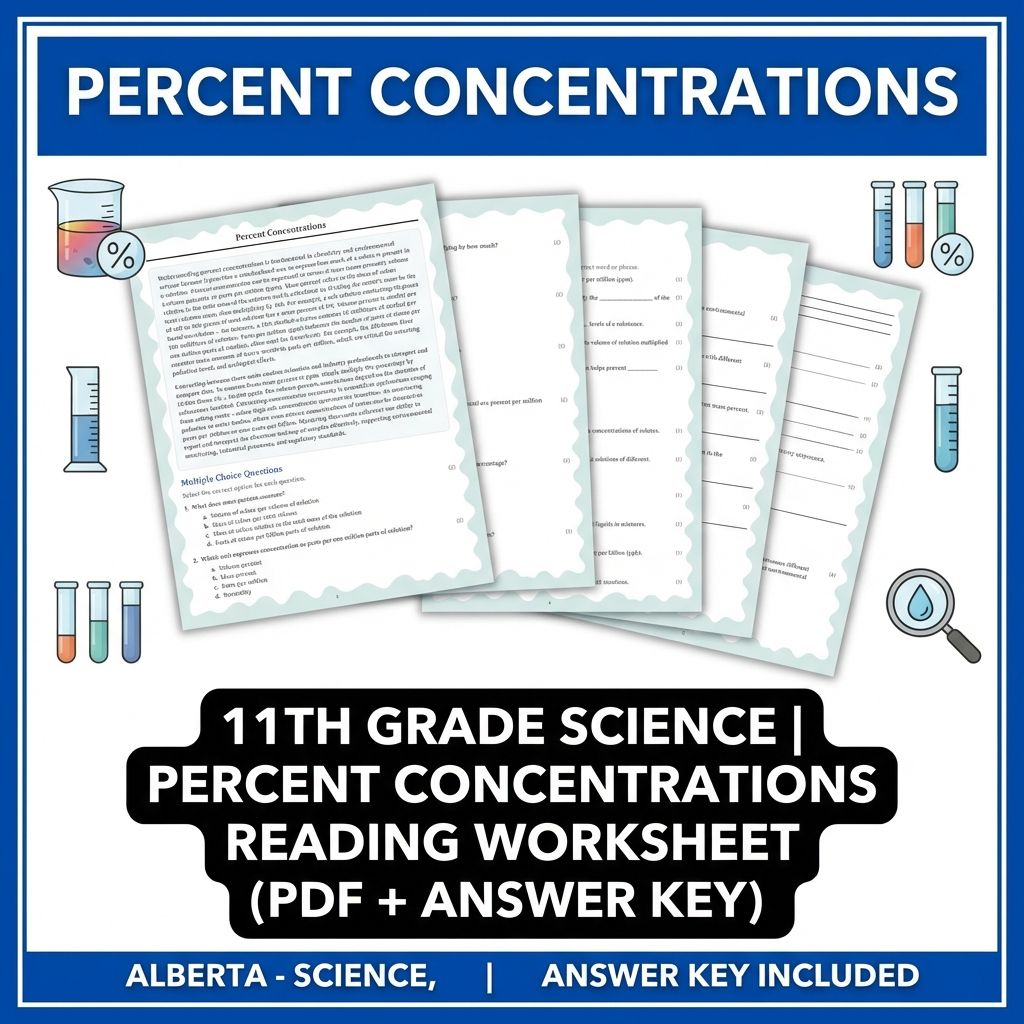
11th Grade Science | Percent Concentrations Reading Worksheet (PDF + Answer Key)
JCreated byJ.S SheetsLearning Objectives
- Understand the concept of percent concentration expressed by mass, volume, and parts per million.
- Convert and interpret different units of concentration through practical examples.
- Differentiate between mass percent, volume percent, and parts per million in various contexts.
Instant download
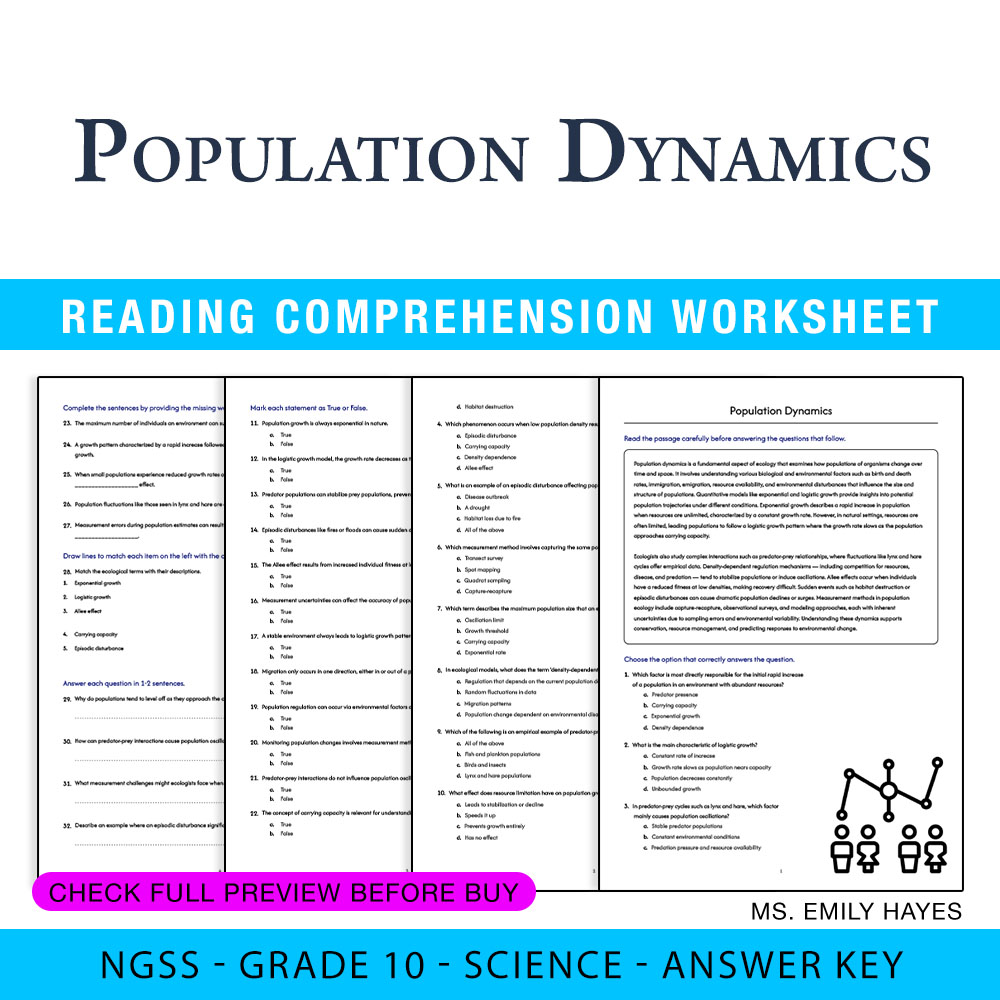
11th Grade Science | Population Dynamics Worksheet (PDF+ Answer Key)
 Created byCopper Leaf Classroom
Learning Objectives
- Understand the key factors influencing population size changes, including birth and death rates, immigration, and emigration.
- Describe different patterns of population growth such as exponential and logistic trajectories, and factors affecting them.
- Explain ecological concepts like predator-prey interactions, density dependence, Allee effects, and the impact of disturbances on populations.
Instant download

Henderson-Hasselbalch Equation Buffer Activity | Grade 11 Chemistry
 Created byMTS Academic Studio
Learning Objectives
- Calculate buffer relationships using the Henderson-Hasselbalch equation
- Relate pH and pKa to conjugate base-to-acid ratios
- Explain how buffer composition produces predictable pH changes
Instant download

Degree of Dissociation Learning Stations Activity | Grade 11 Chemistry
Created byMTS Academic StudioLearning Objectives
- Explain degree of dissociation for weak acids and bases
- Predict concentration effects on weak-acid and weak-base equilibria
- Interpret how pH changes influence dissociation equilibria
Instant download

Acid-Base Neutralization Stoichiometry Learning Stations | Grade 11 Science
Created byMTS Academic StudioLearning Objectives
- Identify practical applications of acid-base neutralization
- Apply balanced equations to neutralization requirements
- Use mole ratios to relate acids and bases
Instant download

Acid-Base Indicators Learning Stations Activity | Grade 11 Chemistry
Created byMTS Academic StudioLearning Objectives
- Select indicators whose transition ranges fit titration endpoints
- Compare indicator choices across three acid-base titration types
- Interpret indicator suitability from steep titration-curve pH changes
Instant download

Polyprotic Acids Learning Stations | Grade 11 Chemistry Activity
Created byMTS Academic StudioLearning Objectives
- Explain sequential proton transfers in polyprotic acid-base systems
- Identify species produced during successive proton transfers
- Compare predominant polyprotic species under different pH conditions
Instant download

Bond Polarity Learning Stations Activity | Grade 11 Chemistry Cases
Created byMTS Academic StudioLearning Objectives
- Explain how electronegativity differences create bond dipoles and partial charges
- Interpret bond-dipole vectors using molecular shape
- Distinguish polar bonds from polar molecules
Also included in: Grade 11 Science Chemical Bonding & Molecular Geometry Stations Bundle
Instant download

Percent Concentration Learning Stations Activity | Grade 11 Chemistry
Created byMTS Academic StudioLearning Objectives
- Distinguish mass percent from volume percent in chemical solutions
- Interpret parts per million in environmental concentration measurements
- Identify appropriate concentration units for different chemical contexts
Also included in: Grade 11 Alberta Chemistry Solutions & Solubility Stations Bundle
Instant download

Advanced Chemical Bonding Models Learning Stations | Grade 11 Science
Created byMTS Academic StudioLearning Objectives
- Explain bonding properties using molecular orbital models
- Interpret conductivity using electronic band structure
- Compare effects of orbital overlap and electron delocalization
Also included in: Grade 11 Science Chemical Bonding & Molecular Geometry Stations Bundle
Instant download

Dipole Interactions Learning Stations Activity | Grade 11 Chemistry
Created byMTS Academic StudioLearning Objectives
- Explain orientation-dependent attractions between permanent molecular dipoles
- Relate molecular structure to dipole interaction strength
- Explain temperature effects on boiling and condensation behaviour
Also included in: Grade 11 Science Chemical Bonding & Molecular Geometry Stations Bundle
Instant download

Periodic Trends Learning Stations Activity | Grade 11 Chemistry
Created byMTS Academic StudioLearning Objectives
- Explain atomic size differences using periodic trends
- Compare ionization energy across positions in the periodic table
- Interpret electronegativity patterns across periods and groups
Also included in: Grade 11 Science Chemical Bonding & Molecular Geometry Stations Bundle
Instant download

London Dispersion Forces Learning Stations | Grade 11 Chemistry Activity
Created byMTS Academic StudioLearning Objectives
- Explain how temporary electron fluctuations produce London dispersion attractions
- Compare dispersion strength using molecular size and shape
- Relate surface contact to London dispersion force strength
Also included in: Grade 11 Science Chemical Bonding & Molecular Geometry Stations Bundle
Instant download

Solutions and Solubility Learning Stations | Grade 11 Chemistry Activity
Created byMTS Academic StudioLearning Objectives
- Identify solutes and solvents in documented real-world solution examples.
- Classify solution types using evidence from chemistry case studies.
- Explain dissolution through interactions between solute and solvent particles.
Also included in: Grade 11 Alberta Chemistry Solutions & Solubility Stations Bundle
Instant download

Temperature Effects on Solubility and Reaction Rates | Grade 11 Stations
Created byMTS Academic StudioLearning Objectives
- Explain how temperature influences the solubility of solids.
- Compare gas solubility in warmer and colder water.
- Distinguish dissolution and crystallization from chemical reaction rates.
Also included in: Grade 11 Alberta Chemistry Solutions & Solubility Stations Bundle
Instant download

Chemical Bonding Learning Stations Activity | Grade 11 Science
Created byMTS Academic StudioLearning Objectives
- Relate ionic, metallic, and covalent bonding to physical properties
- Infer bonding structures from observable material-property evidence
- Compare conductivity, hardness, melting behaviour, and solubility
Also included in: Grade 11 Science Chemical Bonding & Molecular Geometry Stations Bundle
Instant download

Chemical Reactions Evidence Learning Stations Activity | Grade 11 Science
Created byMTS Academic StudioLearning Objectives
- Identify observable evidence of chemical reactions in documented cases
- Interpret colour changes, gas formation, and solid formation
- Recognize energy exchange as evidence of chemical processes
Also included in: Grade 11 Chemistry Titration & Stoichiometry Lesson Bundle Alberta
Instant download

Titration Theory Learning Stations Activity | Grade 11 Chemistry
Created byMTS Academic StudioLearning Objectives
- Explain how titrant volumes determine unknown solution concentrations.
- Apply stoichiometric reaction ratios to quantitative titration analysis.
- Compare five analytical titration methods and their applications.
Also included in: Grade 11 Chemistry Titration & Stoichiometry Lesson Bundle Alberta
Instant download

Lewis Structures Learning Stations Activity | Grade 11 Chemistry
Created byMTS Academic StudioLearning Objectives
- Construct Lewis structures from molecular formulas and valence-electron counts
- Apply formal charge to evaluate possible Lewis structures
- Interpret resonance representations for chemical substances
Also included in: Grade 11 Science Chemical Bonding & Molecular Geometry Stations Bundle
Instant download

Common Ion Effect Learning Stations Activity | Grade 11 Chemistry
Created byMTS Academic StudioLearning Objectives
- Identify common ions in dissolution equilibrium systems.
- Explain equilibrium shifts caused by changes in ion concentration.
- Predict precipitation or dissolution of sparingly soluble salts.
Also included in: Grade 11 Alberta Chemistry Solutions & Solubility Stations Bundle
Instant download

Gas Solubility and Henry's Law Learning Stations Activity | Grade 11 Science
Created byMTS Academic StudioLearning Objectives
- Explain how partial pressure influences dissolved gas concentration.
- Apply Henry's law to real-world gas solubility examples.
- Distinguish equilibrium concentration changes from dissolved gas release.
Also included in: Grade 11 Alberta Chemistry Solutions & Solubility Stations Bundle
Instant download

Ionic Strength Learning Stations Activity | Grade 11 Chemistry Water Cases
Created byMTS Academic StudioLearning Objectives
- Explain how dissolved ion concentration influences ionic strength.
- Compare the contributions of different ionic charges to ionic strength.
- Explain differences between ion concentration and effective ionic activity.
Also included in: Grade 11 Alberta Chemistry Solutions & Solubility Stations Bundle
Instant download

Combustion Reactions Learning Stations Activity | Grade 11 Chemistry
Created byMTS Academic StudioLearning Objectives
- Identify fuel sources and oxygen requirements in documented combustion cases.
- Explain complete and incomplete combustion using balanced chemical equations.
- Interpret stoichiometric ratios to determine relationships between reactants and products.
Also included in: Grade 11 Chemistry Titration & Stoichiometry Lesson Bundle Alberta
Instant download

Redox Reactions Learning Stations Activity | Grade 11 Chemistry
Created byMTS Academic StudioLearning Objectives
- Identify oxidation and reduction using changes in oxidation numbers.
- Explain electron transfer in industrial and environmental redox processes.
- Interpret redox equations using oxidation and reduction half-reactions.
Also included in: Grade 11 Chemistry Titration & Stoichiometry Lesson Bundle Alberta
Instant download

Buffer Capacity Learning Stations | Acids, Bases and pH Grade 11
Created byMTS Academic StudioLearning Objectives
- Explain how neutralizing substances influence buffer capacity
- Compare natural and added materials that resist pH change
- Evaluate why environmental systems respond differently to acid inputs
Instant download

Saturation States Learning Stations | Grade 11 Chemistry Solubility Activity
Created byMTS Academic StudioLearning Objectives
- Identify unsaturated, saturated, and supersaturated conditions using case evidence.
- Explain dynamic equilibrium between dissolved substances and solid phases.
- Analyze how evaporation and cooling affect saturation conditions.
Also included in: Grade 11 Alberta Chemistry Solutions & Solubility Stations Bundle
Instant download

Strong and Weak Acids and Bases Learning Stations Activity | Grade 11
Created byMTS Academic StudioLearning Objectives
- Compare strong and weak acids when dissolved in water
- Compare strong and weak bases in aqueous solutions
- Explain how ionization affects hydrogen-ion concentrations
Instant download

Percent Yield Chemistry Learning Stations Activity | Grade 11 Stoichiometry
Created byMTS Academic StudioLearning Objectives
- Distinguish theoretical yield from actual yield in chemical reactions.
- Calculate percent yield using actual and theoretical product quantities.
- Apply balanced equations to determine theoretical product yield.
Also included in: Grade 11 Chemistry Titration & Stoichiometry Lesson Bundle Alberta
Instant download

Balancing Chemical Equations Learning Stations | Grade 11 Chemistry
Created byMTS Academic StudioLearning Objectives
- Balance chemical equations using appropriate stoichiometric coefficients.
- Demonstrate conservation of atoms in balanced chemical reactions.
- Identify five common categories of chemical reactions.
Also included in: Grade 11 Chemistry Titration & Stoichiometry Lesson Bundle Alberta
Instant download

Molar Concentration Learning Stations | Grade 11 Chemistry Case Studies
Created byMTS Academic StudioLearning Objectives
- Explain molar concentration in moles per litre of solution.
- Distinguish molar concentration from mass concentration.
- Apply molar mass relationships to interpret dissolved quantities.
Also included in: Grade 11 Alberta Chemistry Solutions & Solubility Stations Bundle
Instant download

VSEPR Molecular Geometry Learning Stations Activity | Grade 11 Chemistry
Created byMTS Academic StudioLearning Objectives
- Identify bonding regions and lone pairs around central atoms.
- Predict molecular geometry using VSEPR electron-domain principles.
- Compare five molecular arrangements using bond angles and symmetry.
Also included in: Grade 11 Science Chemical Bonding & Molecular Geometry Stations Bundle
Instant download

Solution Stoichiometry Learning Stations Activity | Grade 11 Chemistry
Created byMTS Academic StudioLearning Objectives
- Interpret mole ratios from balanced aqueous chemical equations.
- Calculate dissolved substance quantities using molar concentration and solution volume.
- Identify limiting reactants in solution-phase chemical reactions.
Also included in: Grade 11 Alberta Chemistry Solutions & Solubility Stations Bundle
Instant download

Titration Curves Learning Stations Activity | Grade 11 Chemistry
Created byMTS Academic StudioLearning Objectives
- Interpret initial pH on titration curves
- Identify buffer regions and equivalence points on titration profiles
- Compare curves produced by different acid-base systems
Instant download

Hydrogen Bonding Learning Stations Activity | Grade 11 Chemistry
Created byMTS Academic StudioLearning Objectives
- Identify molecular features that allow hydrogen bonding to occur
- Explain how hydrogen bonding influences boiling and density
- Relate hydrogen bonding to molecular structure and material strength
Also included in: Grade 11 Science Chemical Bonding & Molecular Geometry Stations Bundle
Instant download

Acids, Bases and pH Learning Stations | Grade 11 Environmental Chemistry
Created byMTS Academic StudioLearning Objectives
- Explain environmental applications of acid-base chemistry
- Compare neutralization, buffering, monitoring, and treatment strategies
- Interpret evidence involving pH and chemical equilibria
Instant download

Electrolyte Properties Learning Stations | Grade 11 Chemistry Activity
Created byMTS Academic StudioLearning Objectives
- Explain how mobile dissolved ions enable electrical conductivity in water.
- Compare conductivity in freshwater, saline water, and treated water.
- Distinguish strong electrolytes, weak electrolytes, and nonelectrolytes.
Also included in: Grade 11 Alberta Chemistry Solutions & Solubility Stations Bundle
Instant download

Electron Arrangement Learning Stations | Grade 11 Chemistry Activity
Created byMTS Academic StudioLearning Objectives
- Explain molecular polarity using valence-electron arrangement and shape
- Compare polar and nonpolar molecules using structural evidence
- Relate molecular polarity to intermolecular attractions
Also included in: Grade 11 Science Chemical Bonding & Molecular Geometry Stations Bundle
Instant download

Titration Calculations Learning Stations | Grade 11 Chemistry Activity
Created byMTS Academic StudioLearning Objectives
- Explain how titration measurements determine unknown concentrations
- Interpret equivalence in quantitative acid-base analysis
- Connect stoichiometric ratios to titration measurements
Instant download

Solution Stoichiometry Learning Stations Activity | Grade 11 Chemistry
Created byMTS Academic StudioLearning Objectives
- Calculate moles of solute using molarity and solution volume.
- Determine solution concentrations from chemical quantities and volumes.
- Apply balanced equations to aqueous reaction stoichiometry calculations.
Also included in: Grade 11 Chemistry Titration & Stoichiometry Lesson Bundle Alberta
Instant download

pH Learning Stations Activity | Water Chemistry Cases | Grade 11 Science
Created byMTS Academic StudioLearning Objectives
- Interpret pH as a logarithmic measure of hydrogen ion concentration
- Compare acidity across different real-world water systems
- Explain how natural processes can change water pH
Instant download

Solubility Product (Ksp) Learning Stations Activity | Grade 11 Chemistry
Created byMTS Academic StudioLearning Objectives
- Explain Ksp equilibrium between slightly soluble solids and dissolved ions.
- Predict precipitation using changes in dissolved ion concentrations.
- Explain how common ions influence solubility equilibrium.
Also included in: Grade 11 Alberta Chemistry Solutions & Solubility Stations Bundle
Instant download

Gas Stoichiometry Learning Stations Activity | Grade 11 Chemistry
Created byMTS Academic StudioLearning Objectives
- Apply balanced chemical equations to gaseous reaction relationships.
- Calculate gaseous quantities using mole ratios and gas laws.
- Compare gas volumes under different temperature and pressure conditions.
Also included in: Grade 11 Chemistry Titration & Stoichiometry Lesson Bundle Alberta
Instant download

Solubility Curves Learning Stations Activity | Grade 11 Chemistry
Created byMTS Academic StudioLearning Objectives
- Interpret solubility curves to explain temperature-dependent solubility.
- Predict saturation conditions using evidence from chemical cases.
- Explain crystallization and precipitation under changing solution conditions.
Also included in: Grade 11 Alberta Chemistry Solutions & Solubility Stations Bundle
Instant download

pH and Ion Concentration Learning Stations | Grade 11 Chemistry Activity
Created byMTS Academic StudioLearning Objectives
- Calculate hydrogen ion concentration from measured pH values
- Calculate hydroxide ion concentration from measured pOH values
- Apply Kw to relate hydrogen and hydroxide ion concentrations
Instant download
Browse more categories
About Grade 11 Worksheets
Find Grade 11 worksheets covering algebra, biology, literature, and history. All 8,878 resources download instantly as PDFs for classwork, homework, or review.
Each resource here is built by an independent educator and reviewed for quality. Worksheets print straight from PDF and suit classroom use, homework, or extra practice; most come with answer keys, and you can preview before purchasing.