
Grade 7 Worksheets
8,459 grade resources
Grade 7 Biotic Abiotic Worksheet | Practice & Assessment PDF
 Created byClear Sky Classroom
Learning Objectives
- Explain how abiotic factors (sunlight, water, temperature, soil, topography) affect living organisms in an ecosystem.
- Describe cause-and-effect relationships between abiotic conditions and biotic community patterns.
- Identify how plants, animals, and microbes respond to non-living environmental gradients in Alberta landscapes.
Instant download

Technological Growth Worksheet for Grade 7 Social Studies | Standards-Aligned
JCreated byJ.S SheetsLearning Objectives
- Explain how technological innovations affect economic activities in communities
- Describe how improvements in tools and communication change resource management decisions
- Analyze social effects of technology, including access to information and shifts in social organization
Instant download

Grade 7 Holiday | Teaching Celebrating Teaching Activities PDF + Answer Key
 Created byShaNova Worksheets
Learning Objectives
- Analyze how teachers demonstrate leadership, empathy, and effective communication in classrooms and communities.
- Identify ways educators support both academic growth and students’ emotional well-being.
- Reflect on qualities of influential teaching and practice expressing gratitude respectfully.
Also included in: Grade 7 Holiday Gratitude Activities: Custom Lesson Bundle (NGSS)
Instant download

Grade 7 Science – Gas Behavior & Pressure Response | Daily Reading Worksheet
 Created byBright Mind Resources
Learning Objectives
- Explain how pressure in a gas changes when force is applied to the container.
- Describe how temperature and volume influence gas pressure and movement.
- Identify phenomena like diffusion and compressibility in gases through observation.
Also included in: 7th Grade States of Matter Science Daily Reading Lesson Bundle | TEKS +2 more
Instant download
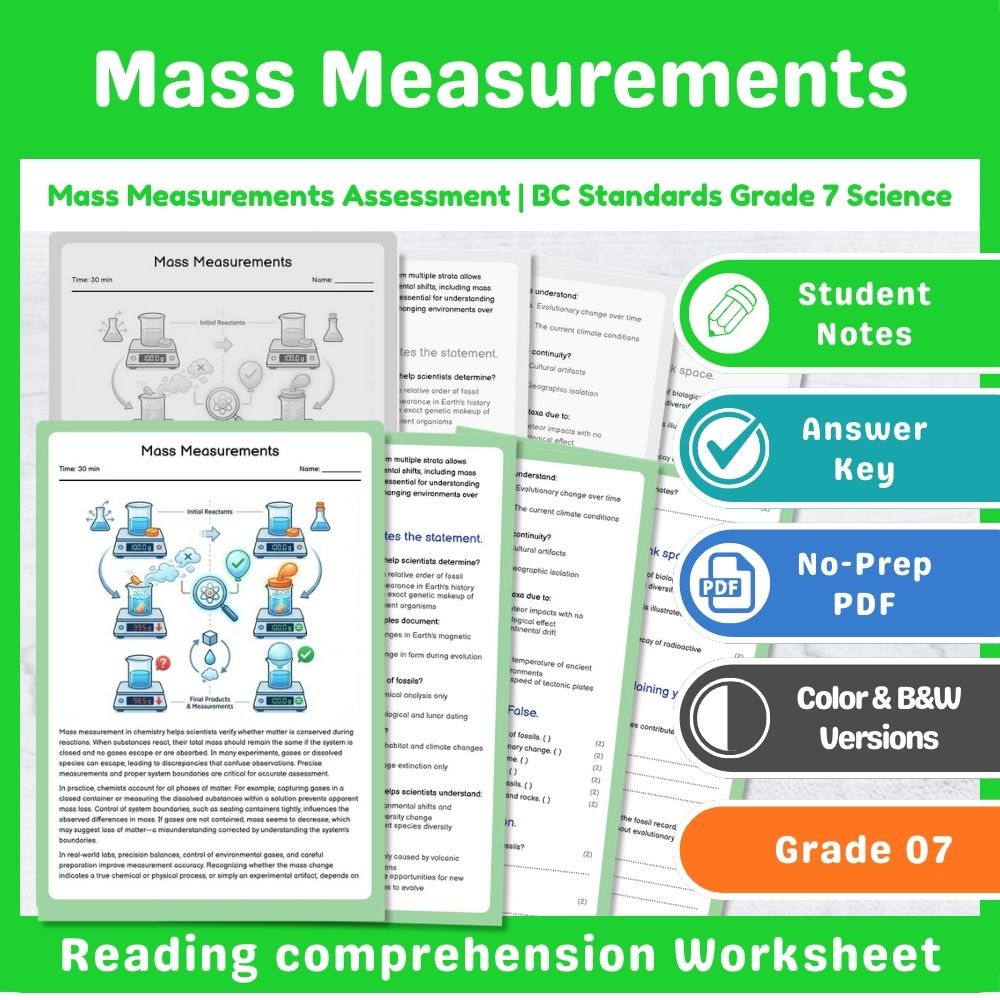
Mass Measurements Assessment | BC Standards Grade 7 Science
 Created byPrism Point Learning
Learning Objectives
- Understand the concept of conservation of mass during chemical changes.
- Identify factors that influence the accuracy of mass measurements.
- Apply knowledge of measurement techniques to real-world laboratory situations.
Instant download

Nuanced Word Meaning Worksheet | Grade 7 ELA Ontario Vocabulary Skills
 Created bySunny Desk Resources
Learning Objectives
- Determine a word’s connotation by analyzing how it affects tone, mood, and the author’s stance.
- Explain how changes in word choice shift meaning and influence an argument or theme.
- Use context clues to select the most accurate meaning when a word has multiple possible interpretations.
Instant download

Grade 7 Thermal Basics Worksheet | Practice & Assessment PDF
Created byClear Sky ClassroomLearning Objectives
- Distinguish between temperature and heat using the particle kinetic-energy model.
- Describe thermal transfer using conduction, convection, and radiation.
- Apply thermal-transfer ideas to explain real-world examples in Alberta’s climates.
Instant download
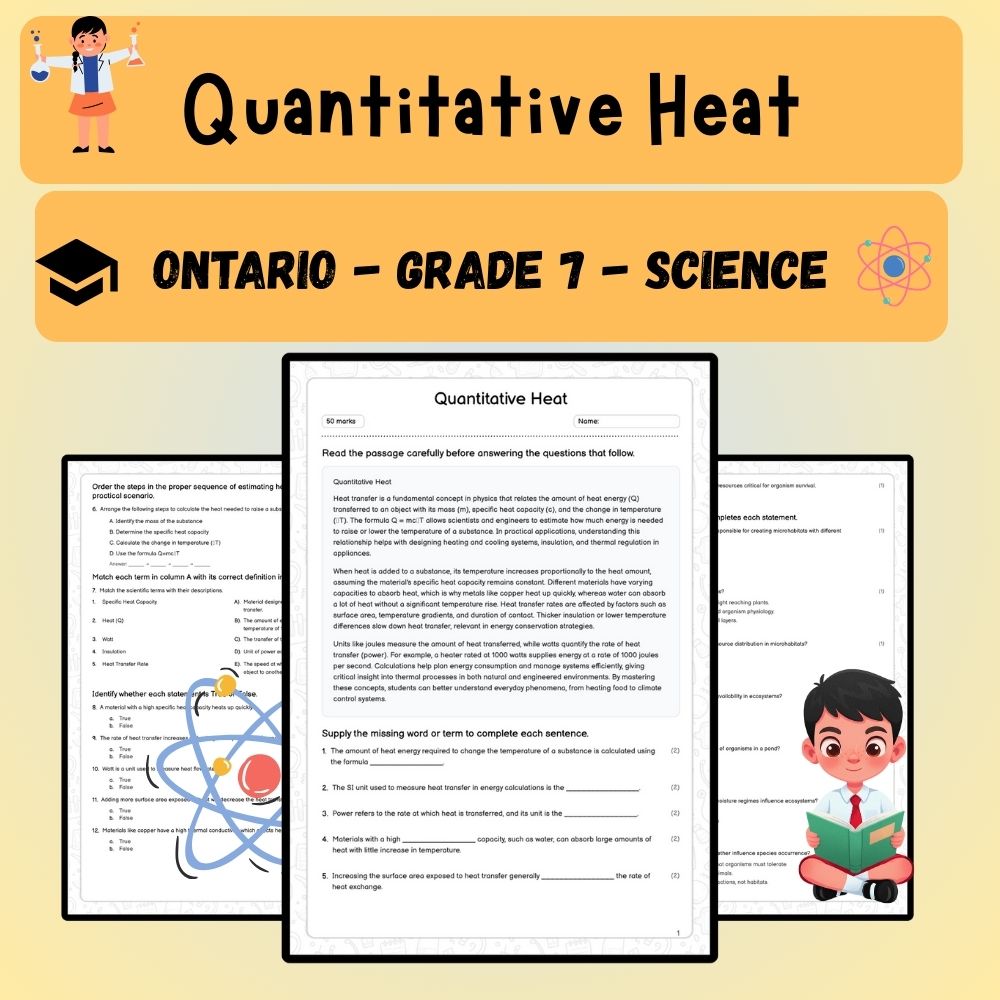
Grade 7 Science | Quantitative Heat Worksheet (PDF ) – Ontario Standards
Created byPrism Point LearningLearning Objectives
- Understand the relationship between heat, mass, and temperature change using the formula Q = mcΔT.
- Recognize units such as joules and watts used to measure heat and power.
- Apply the specific heat capacity concept to estimate energy required for heating substances.
Also included in: Grade 7 Science – Heat Transfer & Insulation Unit Worksheet Bundle +1 more
Instant download

Reading and Interpreting Graphs and Tables Worksheets Grade 7 Science
 Created byBRIGHT PATH RESOURCES
Learning Objectives
- Organize measurement data into tables using consistent units and clear labels.
- Describe patterns in graphs by using axis direction, scale, and category comparisons.
- Interpret relationships by reading trends, clusters, and differences between groups.
Also included in: Grade 7 Science Worksheets Bundle | Models, Variables & Evidence +2 more
Instant download

Grade 7 Science Solution Comparison Worksheet | NGSS Engineering Design Activity
 Created byNorthstar Worksheets
Learning Objectives
- Use models to predict how alternative design solutions will behave.
- Compare solutions using consistent metrics such as performance, cost, durability, and manufacturability.
- Identify and quantify trade-offs between competing design choices.
Also included in: ngss engineering design Grade 7 science Lesson Bundle | Solution & Optimization +1 more
Instant download

Grade 7 ELA – Complex Literature Insights Daily Reading Worksheet | CCSS Aligned
 Created byQuiet Forest Education
Learning Objectives
- Understand key concepts related to ELA
- Apply knowledge through practice questions
- Demonstrate comprehension of the material
Also included in: Literature Reading Grade 7 ELA Daily Reading Worksheets Lesson Bundle | CCSS +1 more
Instant download

Rock Cycle Worksheet Grade 7 NGSSS Earth Science Activities
 Created byEvergreen Desk Education
Learning Objectives
- Explain how the rock cycle shows that rocks can change types through natural geologic processes
- Describe how igneous, sedimentary, and metamorphic rocks form and how those pathways connect surface and subsurface environments
- Use evidence and key terms (weathering, compaction, cementation, heat, pressure) to compare rock-formation processes
Instant download
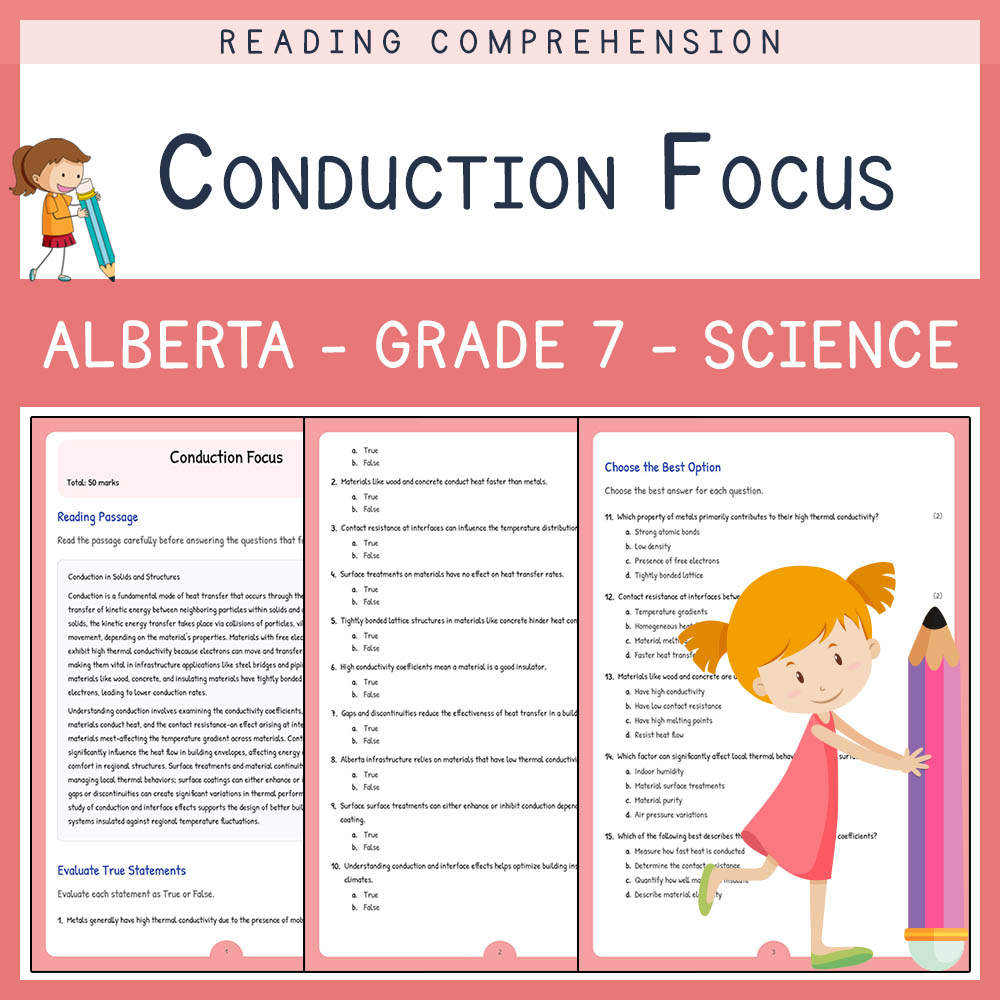
Grade 7 Science | Conduction Focus Worksheet | Alberta Standard
 Created byLumora Learning
Learning Objectives
- Understand the process of heat conduction and how it occurs in solids
- Identify materials with high and low thermal conductivity
- Explain how contact resistance and surface treatments affect heat transfer
Instant download

Grade 7 Text Organization Controlling Idea and Structure Worksheet | TEKS
Created bySunny Desk ResourcesLearning Objectives
- Identify a text’s purpose and controlling idea.
- Explain how an introduction, body, and conclusion work together to organize information.
- Use transition words and grouped details to keep writing focused and coherent.
Instant download

Grade 7 Text Structure Worksheet How Organization Builds Meaning TEKS
Created bySunny Desk ResourcesLearning Objectives
- Identify common text structures and explain how they support meaning.
- Distinguish narrative plot progression from informational idea relationships.
- Determine how details are arranged using chronological order, cause-effect, compare-contrast, or problem-solution.
Instant download

Section Structure Worksheet Grade 7 ELA Text Organization Analysis
Created bySunny Desk ResourcesLearning Objectives
- Explain how a text’s chapter and section structure affects pacing, suspense, and meaning.
- Identify how transitions, perspective shifts, and information release shape reader inferences.
- Analyze how the ending of a section can reframe earlier details and prepare for later events.
Also included in: Reading Literature Lesson Bundle | Grade 7 ELA | General ELA Framework +1 more
Instant download

Rock Cycle Transformations and Energy Flow Worksheets Grade 7
 Created byTeachers Club
Learning Objectives
- Describe how three major rock types transform through the rock cycle
- Explain how melting and cooling form igneous rocks
- Identify processes that transform material into sedimentary rocks
Also included in: Grade 7 Science Worksheets | Earth's Systems NGSS Bundle +2 more
Instant download

Grade 7 Net Force and Equilibrium Worksheet | Alberta Science Forces
Created byBRIGHT PATH RESOURCESLearning Objectives
- Define net force and equilibrium using key vocabulary from a text.
- Distinguish static equilibrium from dynamic equilibrium in simple situations.
- Explain how balanced force pairs affect motion using qualitative reasoning.
Also included in: Grade 7 Alberta Science Forces Structures and Motion Worksheet Bundle +1 more
Instant download

Grade 7 ELA – Collaborative Discussion Norms Daily Reading Worksheet
Created byQuiet Forest EducationLearning Objectives
- Understand the importance of taking turns during discussions
- Identify respectful language and active listening skills
- Apply discussion norms in group conversations
Also included in: Speaking & Listening Grade 7 ELA Daily Worksheets Lesson Bundle | Alberta +1 more
Instant download

Grade 7 Science | Energy Transfer Overview Worksheet | Florida NGSSS Aligned
Created byLumora LearningLearning Objectives
- Explain how energy transfers from higher-energy systems to lower-energy systems.
- Identify ways energy can transform (such as thermal, kinetic, and light energy) during everyday events.
- Connect energy transfer to observable effects like temperature change, motion, and light emission.
Instant download

Capitalization Choices Worksheet Grade 7 ELA TEKS Grammar Practice
 Created byGolden Apple Studio
Learning Objectives
- Use correct capitalization for proper nouns (people, places, and organizations).
- Choose correct capitalization for geographic regions, specific titles, and formal titles when required.
- Apply lowercase rules for seasons and general directions when they are not part of a proper name.
Also included in: Grade 7 Grammar & Punctuation Lesson Bundle | TEKS ELA Worksheets +1 more
Instant download

Grade 7 Cell Organization Worksheet | Practice & Assessment PDF
Created byClear Sky ClassroomLearning Objectives
- Explain how cells are organized into tissues and how tissues form organs
- Describe the roles of major tissue types (epithelial, muscle, nervous) in the body
- Use evidence from text to identify the main idea of organism-level cell organization
Instant download

Grade 7 Nuanced Word Meaning Worksheet | Ontario ELA Vocabulary Skills
Created byLumora LearningLearning Objectives
- Determine how connotation affects a word’s meaning in context
- Explain how word choice shapes tone, mood, and an author’s stance
- Choose the meaning that best supports a text’s intent and overall theme
Instant download

Grade 7 Science | Matter Energy Flow Worksheet | California Standards
Created byLumora LearningLearning Objectives
- Explain how energy captured by producers flows through food chains and webs to consumers and decomposers.
- Describe how matter is recycled in ecosystems through decomposition and nutrient return.
- Distinguish between energy transfer (with energy loss as heat) and matter cycling (with elements reused).
Instant download

Predator-Prey Feedbacks in Communities | Grade 7 Science Worksheet
Created byBRIGHT PATH RESOURCESLearning Objectives
- Explain how predator and prey populations can change over time through cause-and-effect feedbacks.
- Describe how changes in one population can ripple to affect other organisms in a community.
- Use models or scenarios to predict what happens when predators increase or decrease.
Also included in: Grade 7 Science Ecosystems & Food Webs Worksheets Bundle +2 more
Instant download

Grade 7 Science | Density And Volume Worksheet | NGSSS Aligned
Created byLumora LearningLearning Objectives
- Explain how density relates mass and volume using the equation density = mass ÷ volume.
- Identify the intensive property of density and predict how it changes (or does not) when sample amount changes.
- Compare and interpret densities of different materials using qualitative and quantitative reasoning.
Instant download

Nutrient Transport Worksheet Grade 7 Science Activities | California Standards
Created byPrism Point LearningLearning Objectives
- Explain how internal transport moves materials from where they are obtained to where cells need them.
- Describe how the body removes unusable materials to prevent harmful buildup.
- Use models and vocabulary to connect digestion, circulation, and waste removal.
Also included in: Life Science - Grade 7 Bundle
Instant download

Grade 7 Create Media Message Worksheet | Ontario ELA Media Literacy Activity
Created byLumora LearningLearning Objectives
- Identify how purpose, audience, and perspective shape the message in a media text
- Select effective details and media elements (visuals, audio, formatting) to reinforce clarity and credibility
- Apply planning steps for a media message by organizing content and choosing design features that guide interpretation
Instant download

Physical Changes in Matter: Signs and Evidence Worksheets Grade 7
Created bySunny Desk ResourcesLearning Objectives
- Identify indicators of physical changes in matter, such as phase changes and dissolving without new substances.
- Explain how particle rearrangement and energy transfer can change a substance’s form without changing its chemical identity.
- Use mass evidence from closed systems to support claims about physical change.
Also included in: Matter and Chemical Change Grade 7 Alberta Science Worksheets Bundle +1 more
Instant download

Meaning Strategies Worksheet for Grade 7 ELA | Ontario Standards-Aligned PDF
JCreated byJ.S SheetsLearning Objectives
- Use before-reading expectations and reading goals to focus attention on important details.
- Monitor comprehension during reading by rereading and clarifying meaning using nearby sentences and section-by-section understanding.
- Synthesize information after reading by writing summaries and brief reflections that connect main ideas to supporting details.
Instant download

Mechanical Energy Transfer and Conservation Worksheets Grade 7
Created bySunny Desk ResourcesLearning Objectives
- Explain the difference between kinetic energy and potential energy in mechanical systems
- Describe how changes in height, mass, and speed relate to mechanical energy
- Use conservation of mechanical energy to predict how energy forms change during motion
Also included in: Forces, Structures & Motion Grade 7 Science Bundle | Alberta +1 more
Instant download

Migration Drivers and Connectivity Worksheets Grade 7 Science Ecosystems
Created bySunny Desk ResourcesLearning Objectives
- Explain how food availability and breeding needs influence migration timing and routes
- Describe how migration connects distant habitats and affects population dynamics
- Identify timing cues and energetic demands that shape migratory movement
Also included in: Interactions & Ecosystems Grade 7 Alberta Science Worksheets Bundle +1 more
Instant download

Genre Structures Worksheet Grade 7 ELA TEKS Reading Skills Practice
Created byGolden Apple StudioLearning Objectives
- Identify key structural conventions of narrative, explanatory, and persuasive writing.
- Match purpose (entertain, inform, persuade) to appropriate genre structures and details.
- Use structure to maintain clarity, consistent formatting, and a clear viewpoint.
Also included in: Grade 7 ELA Literary Analysis & Writing Lesson Bundle | TEKS +1 more
Instant download

Plate Tectonics and Continental Drift Evidence Worksheets Grade 7
Created byTeachers ClubLearning Objectives
- Explain how fossils and rocks support past continental positions
- Match continental features to related tectonic processes
- Use earthquakes and volcanoes to infer relative plate motion
Also included in: Grade 7 Science Worksheets | Earth's Systems NGSS Bundle +2 more
Instant download

Grade 7 Production Context Worksheet | Ontario ELA Media Literacy Activity
Created byLumora LearningLearning Objectives
- Explain how production choices (sources, timing, and platform) affect the meaning of media texts
- Compare different versions of the same event to identify framing and emphasis shaped by production context
- Use evidence from text details to infer goals and constraints of producers
Instant download

Production Context Worksheet | Grade 7 ELA Ontario Reading Skills + Answer Key
Created bySunny Desk ResourcesLearning Objectives
- Explain how production context (sources, timing, format, platform, and audience expectations) shapes meaning in media texts.
- Compare how the same event can be framed differently across a press release, a televised news excerpt, and a social media repost.
- Identify evidence from text to support claims about why certain details are included or emphasized.
Instant download

Clear Organization Worksheet Grade 7 ELA Writing Structure Skills
Created bySunny Desk ResourcesLearning Objectives
- Identify how introductions, body paragraphs, and conclusions work together to support a reader’s understanding.
- Use transitions and connected sentences to maintain logical movement between ideas.
- Revise writing to keep details focused on the central purpose and avoid off-topic information.
Also included in: Grade 7 Writing Lesson Bundle – ELA Skills | General ELA +1 more
Instant download

Grade 7 ELA – Using Evidence & Quoting & Explaining | Daily Reading Worksheet
Created byQuiet Forest EducationLearning Objectives
- Understand key concepts related to ELA
- Apply knowledge through practice questions
- Demonstrate comprehension of the material
Also included in: Grade 7 ELA Daily Reading Lesson Bundle: Purposeful Planning & Writing | BC +1 more
Instant download

Grade 7 Informational Focus Worksheet | Ontario ELA Main Idea & Details
Created byLumora LearningLearning Objectives
- Preview informational texts by using titles, headings, subheadings, and organizing cues to predict the main idea.
- Track the main idea within sections and connect supporting details such as definitions, reasons, and examples.
- Write accurate summaries that explain what the text describes, argues, or teaches rather than listing isolated facts.
Instant download

Grade 7 Science Worksheet on Bitumen Separation | Alberta Standards Practice
JCreated byJ.S SheetsLearning Objectives
- Understand the physical and chemical processes involved in separating bitumen from oil sands.
- Identify the differences between physical separation techniques and chemical treatments in mixture processing.
- Explain how temperature, density, and additives influence mixture separation.
Instant download

Grade 7 ELA – Interpreting Evidence & Analyzing Character | Daily Worksheet
Created byQuiet Forest EducationLearning Objectives
- Interpret quoted details in a text to understand character motivation.
- Identify evidence that reveals character choices and relationships.
- Analyze how the author’s wording and prior events influence interpretation.
Also included in: Reading Literature Gr 7 ELA Daily Reading Worksheets Lesson Bundle | General ELA +2 more
Instant download

Grade 7 Idea Organization Worksheet | Ontario ELA Writing & Planning Skills
Created byLumora LearningLearning Objectives
- Identify how ideas can be arranged into categories that support a clear writing purpose.
- Use evidence-relevance and logical sequencing to organize notes into a draft-ready plan.
- Revise an outline by removing mismatched details and placing related evidence together.
Instant download

Nationalism & Imperialism Worksheets: Age of Empires Grade 7
 Created byWorld Paper Hub
Learning Objectives
- Explain how nationalism shaped public support for expanding territory and influence
- Describe how imperial competition affected alliances and diplomatic decisions
- Analyze how imperial rivalries contributed to political boundaries and later conflicts
Also included in: Government & Citizenship Worksheets | Grade 7 Social Studies TEKS
Instant download

Idea Organization Worksheet | Grade 7 ELA Ontario Writing Structure Skills
Created bySunny Desk ResourcesLearning Objectives
- Group related details into categories that match a writing purpose
- Remove information that does not support a claim or guiding idea
- Arrange points in a logical sequence that helps readers follow your direction
Instant download

Event Driven Programming Worksheet for Grade 7 Computer Science
Created byPrism Point LearningLearning Objectives
- Identify how events trigger program responses in event-driven systems
- Use key vocabulary (event, trigger, interaction, response) to explain what happens in a program
- Evaluate whether statements about event-driven programming are true or false
Instant download

Homogeneous vs. Heterogeneous Mixtures & Solutions Worksheets Grade 7
Created byTeachers ClubLearning Objectives
- Classify mixtures using homogeneous and heterogeneous particle distribution.
- Explain solubility, concentration, and saturation using solute-solvent relationships.
- Differentiate solutions, colloids, and suspensions by particle behavior.
Also included in: Grade 7 Science Worksheets | NGSS Matter & Its Interactions Bundle +2 more
Instant download

Grade 7 ELA – Understanding Text Organization & Reading | Daily Worksheet
Created byQuiet Forest EducationLearning Objectives
- Identify the main components of text organization in informational writing.
- Differentiate between introduction, body, and conclusion sections.
- Analyze how authors structure their ideas to enhance understanding.
Also included in: Narrative Writing Grade 7 ELA Daily Reading Worksheets Lesson Bundle | TEKS +1 more
Instant download

Social Media Day Reading Comprehension | Media Origins | Grades 6–8
Learning Objectives
- Explain key developments in early communication tools and how they changed global connections.
- Describe how social networking platforms changed who can create and share information.
- Use media literacy strategies to evaluate the credibility of online information.
Also included in: Social Media Day Mega Bundle | Grades 3–10 | Reading Comprehension
Instant download
Browse more categories
About Grade 7 Worksheets
Find Grade 7 worksheets covering math, ELA, science, and social studies. All 8,459 resources download instantly as PDFs for classwork, homework, or review.
MyTeachingSheets worksheets are made by real teacher-authors and checked before they go live. Download any as a print-ready PDF for lessons, homework, or independent practice — most include answer keys, and previews are always free.